Ashera Aeon fountain pen review.

Back in February, I received an email from Ashera GmbH, inviting me to review one of their pens. They offered to send me a pen on loan for evaluation and review. In return they offered a commission on any pens sold through my blog.

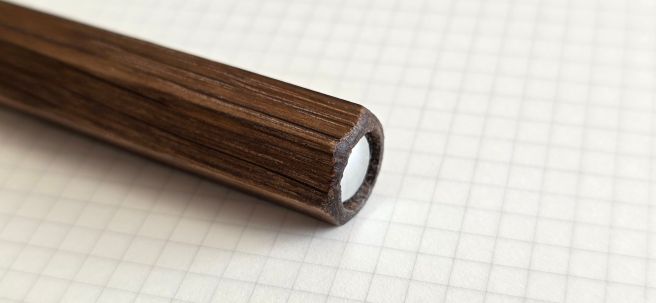
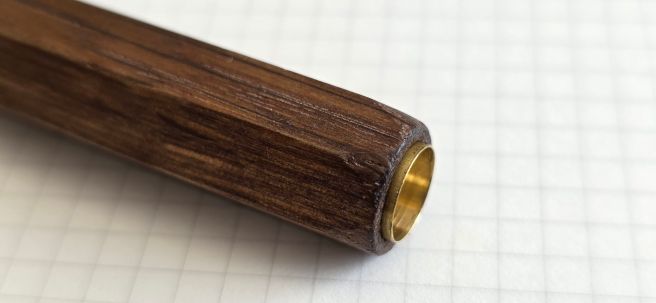
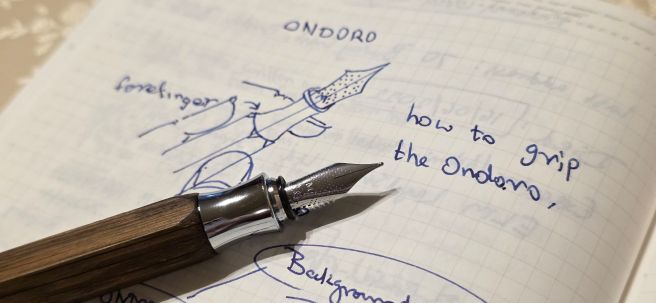
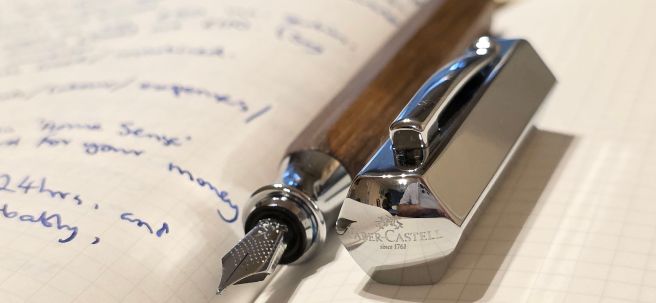
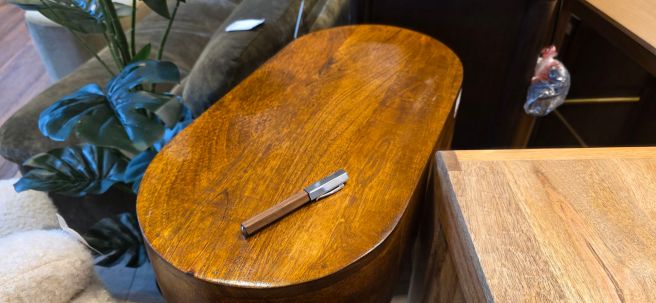
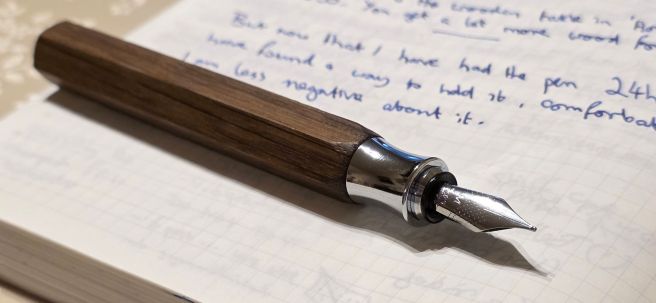
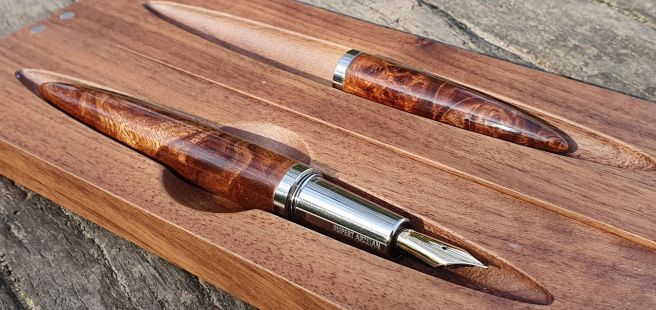
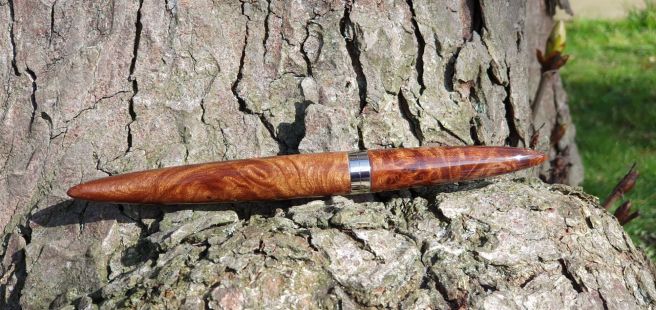
Ashera Aeon fountain pen, in Elm Burl wood.

Disclosure.

Readers will be aware that it has been my practice not to accept goods or favours from suppliers in return for a review, to avoid any suggestion that my opinion was biased in any way. Ashera understood this and asked only for my independent and honest feedback and review. After seeing their web site and reviews of early prototypes of their Aeon fountain pen, I was curious to try one. The photos of the pen looked stunning and the company’s environmental commitment was impressive and admirable.

After a little back and forth, we agreed terms whereby I may select the configuration of a pen for review and return, and that a discount of 20% be given on pens sold to readers, (available on up to ten pens) plus a modest commission for me.

Background.

Ashera introduced themselves to me as “a brand dedicated to crafting handmade luxury fountain pens that blend traditional craftsmanship with modern design.” Much can be learned from their web site, https://ashera-design.com which includes answers to FAQs.

They started making the Aeon pens in 2022. These are handmade in Germany, offered in a choice of six woods, with a titanium grip section and Bock nib in 14k gold or platinum (fine or medium). Production is limited to 999 pens in total.

The company has been most helpful in clarifying a few points that I raised. Their web site is being updated and contains a few inconsistences. For each pen sold, the company now plants 250 trees (not 100 as stated at the time of their video clip). The trees are planted via Ecologi. Ashera might add details of specific projects and sites where the trees are planted.

The unboxing.

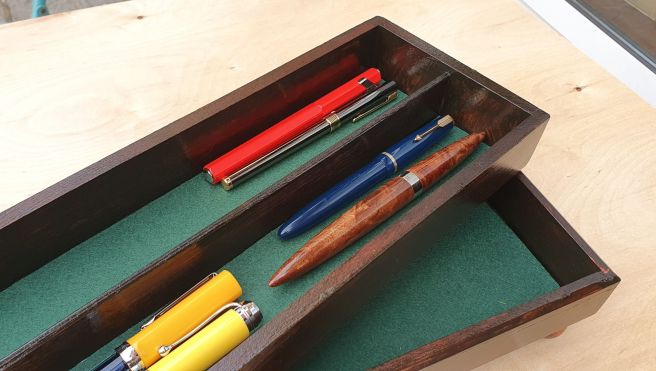
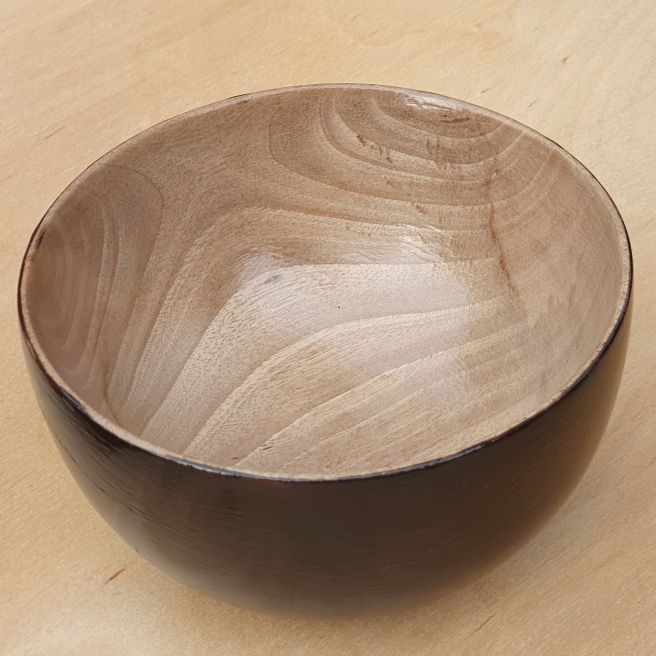
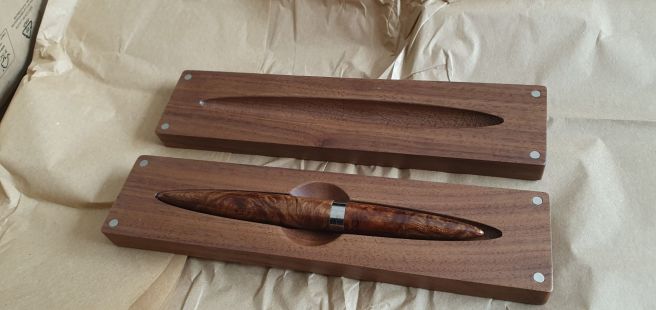
I was aware from the website that the pen comes in a wooden box. In my correspondence with Ashera, I suggested that they send me the review pen without the box to save on shipping costs each way. I am glad that they chose to disregard this request. The box is beautiful, although it now differs from the one on the website. The pen is supplied in a fully custom-built walnut wood box, smooth and tactile with a satin finish. It comprises two slats with a milling inside that fits the pen perfectly and magnets in the corners to hold it closed. The two parts have a cutaway, to display the pen or prevent it from rolling, which it would do. In the lower half, this cutaway is intersected by a hemisphere space for thumb and forefinger to pick up the pen. This creates a satisfying geometric meeting of curves, although the pen can also be scooped up easily from either end.

Walnut wood box/pen tray.

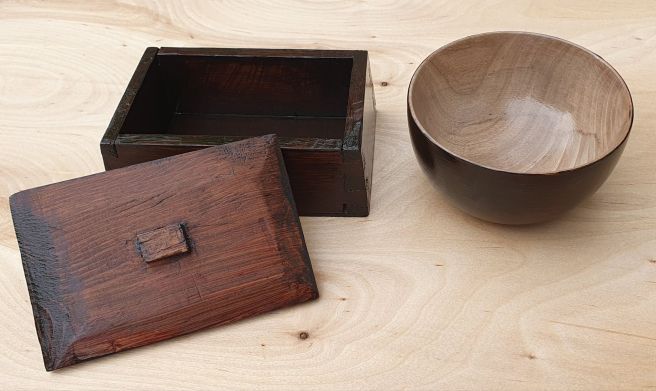
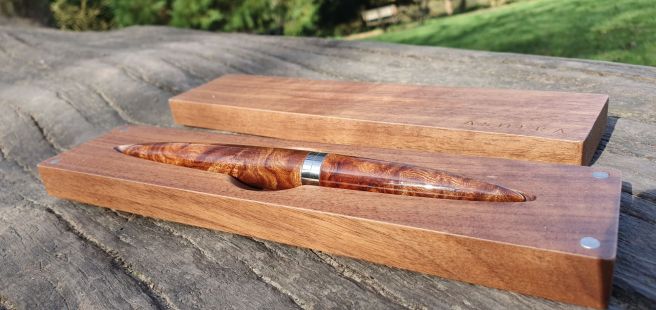
The box lid bears the name ASHERA engraved on the top, as well as another pen rest. This is a box which is attractive and useful and genuinely adds value.

I took the pen and its box along to my pen club. There was universal acclaim for the walnut wood box, the magnetic closure and then for this extraordinary pen, with its stunning lacquered wood grain and long tapering contours, nestled in its custom box.

Ashera Aeon and accompanying box.

Initial impressions.

My review pen is of Elm Burl which features a lovely swirling wood grain. Each pen is unique. The finish is high gloss and super-smooth as the process involves lacquering, drying and polishing the pen eight separate times, over a few weeks. The prices of the pens vary according to choice of wood and nib material, my chosen sample being about mid-way in the price range. I was drawn to the Elm, as they were common in Middlesex where I grew up although I remember many being lost to Dutch Elm Disease in the 1970’s. The wood for the pen actually comes from a burl, or burr, which is the gnarled, rounded, growth on a tree typically found on the trunk or branches and formed as a result of stress which the tree experiences. I can relate to that.

Barrel and section.

At first sight, the length of the pen is also striking. My sample is 17.2cm capped, although since these are handmade, there may be a little variation. (The length of 18cm, shown in the website is slightly overstated, although the cut-away in the pen box is that length).

Aesthetically, the pen is very pleasing. The shape is an ellipsoid (a three-dimensional ellipse). The cap and barrel, ending with titanium fittings, are completely flush when the pen is capped. The cap meets the barrel 7cm from the top of the pen, which is around 40% of the total length of the pen. Whether this has any place in sacred geometry I do not know, but it distinguishes the cap from the barrel. All threads and rings on the cap and barrel are titanium.

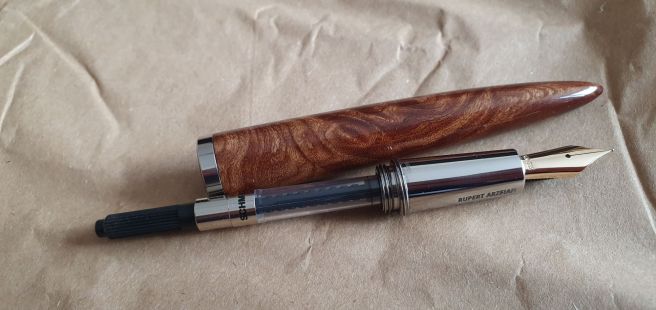
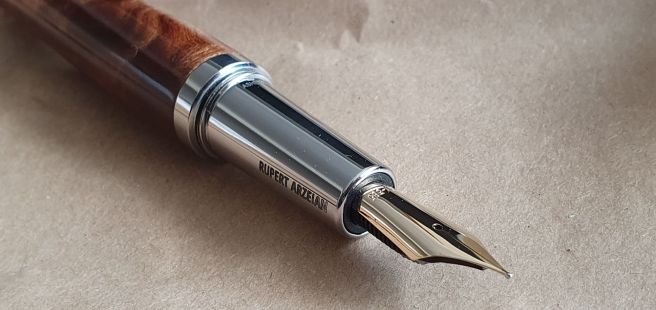
Uncapping the pen, on triple-start threads, requires only about 40% of a turn (as measured with a yellow post-it note!). This reveals the long metal section. This is solid titanium, not plated but mirror-polished. The website states “The feel of the titanium offers a sense of solidity in hand, and the mirror polish, unexpectedly, ensures a steady grip with minimal grip pressure required.”

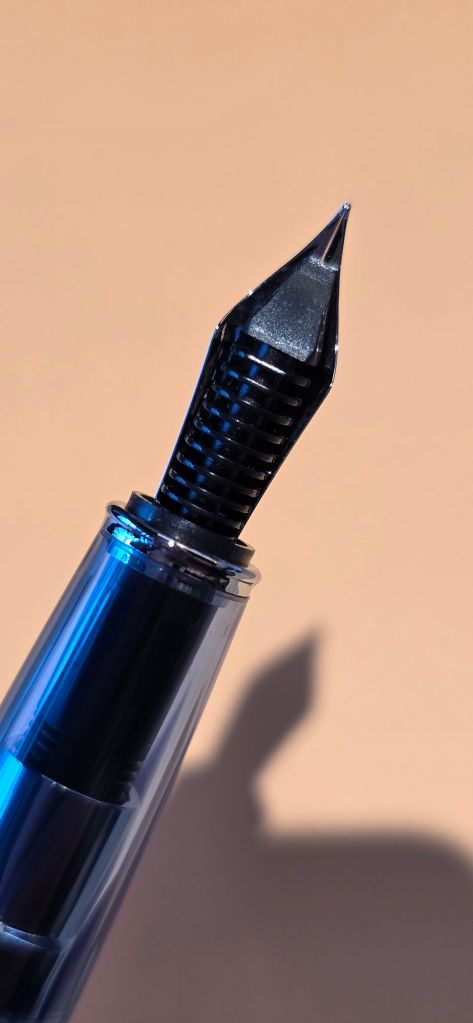
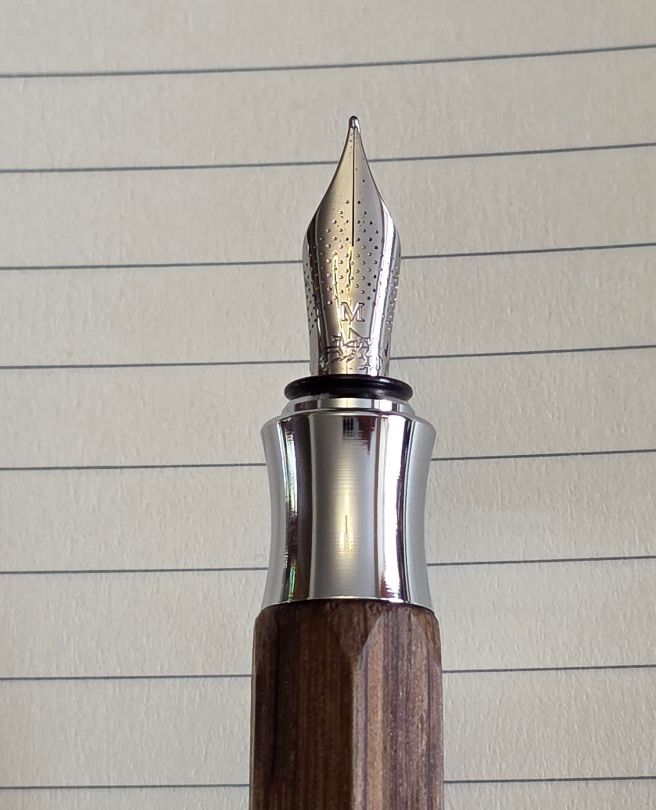
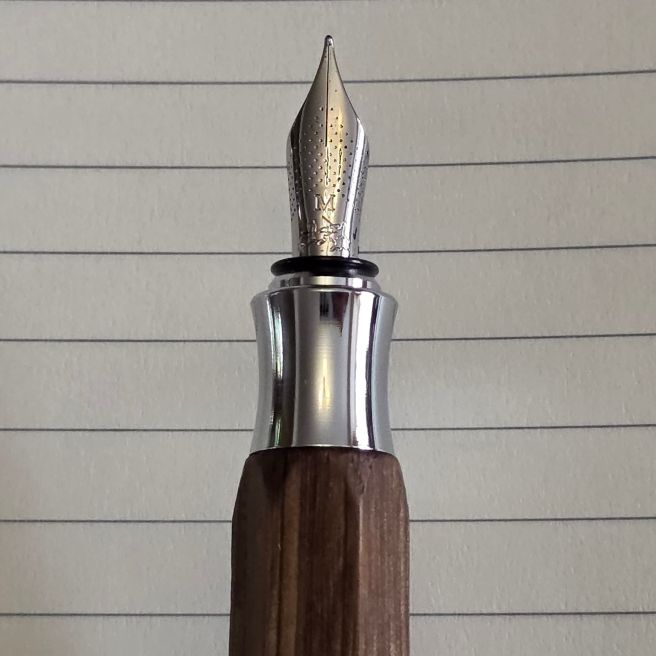
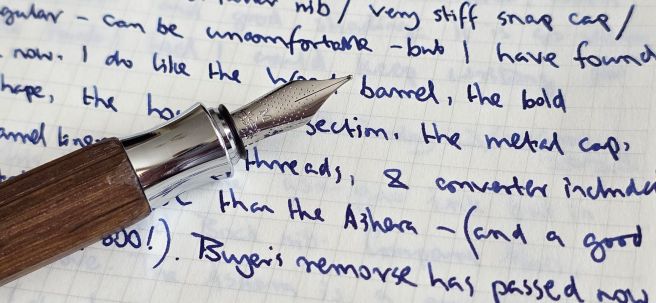
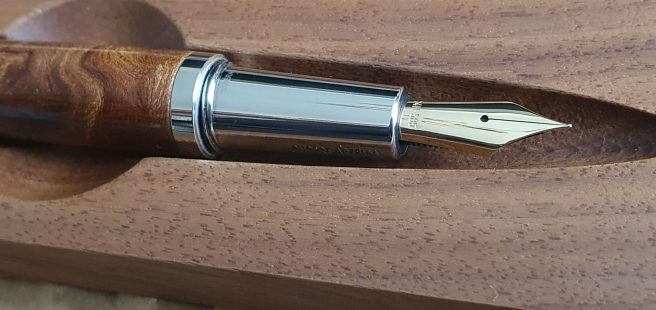
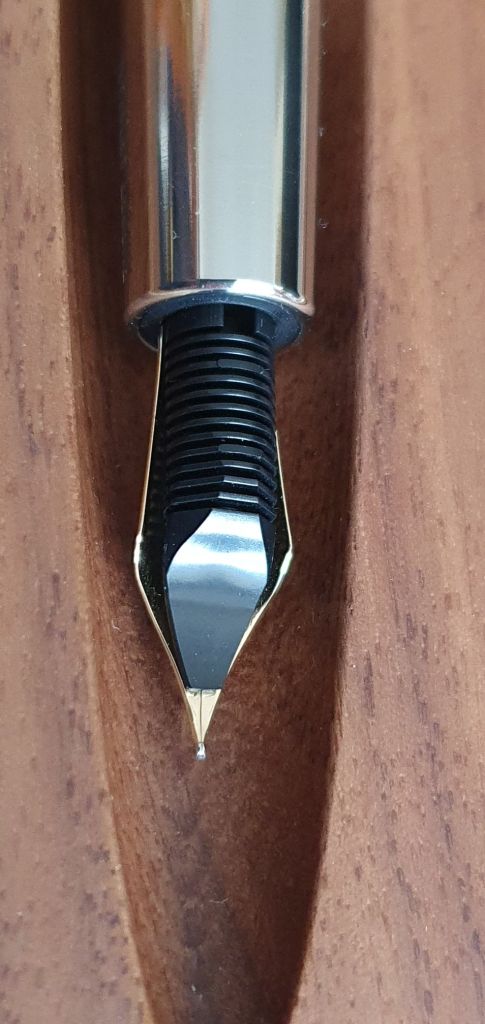
The nib that I chose is 14k gold, in a fine. I did ask why there was no name or logo on the nib, but only the gold description “14K-585”. This is to showcase the beauty of the gold (or platinum), and ironically, costs more to produce than if an imprint was present. Each nib is hand-polished individually for maximum gloss and hand-tuned and tested to ensure that the tine spacing is just right. This is quality control at its best.

The only branding on the pen is the name Ashera, laser etched in tiny capital letters just below the cap threads. This could hardly be less obtrusive.

Although titanium is a lightweight metal, the wood barrel is also light. The section is sufficiently weighty to give the pen a comfortable front-weighting, despite the long barrel. Uncapped, my sample pen measures about 15.3cm, which is wonderfully long. I like a pen to be at least 13cm long when uncapped and so the Aeon sits well above this. There would be no need to post the cap of the Aeon. In fact, don’t even think about it: the coming together of titanium cap threads and hand lacquered wood will not end well.

One concern from the design of the pen, is the step down from the barrel to the section. This is a necessary consequence of the cap closing flush with the barrel. However, whilst I usually dislike such a step, I can say that within two weeks of use, I had ceased to notice it and could pick up the pen and use it without any thought of discomfort. This, it occurred to me, should be the aim of any pen, rather like a pair of shoes. Nor has the metal grip been an issue. I read that titanium is highly resistant to corrosion, due to the formation of a thin, protective oxide layer on the surface. I wonder if it is this which helps provide some grip. It does feel different from a typical resin or acrylic pen with no such step, if that is what you are used to, but I soon adapted to it and it feels like holding a precision instrument.

Personalised engraving.

When ordering the pen, there is an option to choose to have it engraved for an extra 20 euros. Although I did not ask for this on my review sample, I was thrilled to see my name laser etched along the side of the section, and on both sides to be visible whether held in the left or the right hand. If Ashera thought that seeing my name in titanium would appeal to my ego, they were right!

Writing performance.

I first filled the pen with Diamine Gibson Guitar series, Cherry Sunburst, a smooth-running warm brown ink with good lubrication. The nib was smooth and firm with just a little bounce. The tines were well aligned with the small gap between them, narrowing until the tipping, just as it should. The nib was nicely centred over the feed. In use, this nib produces a smooth, consistent flow and a line width of around 0.40mm on a down stroke and 0.30mm on a cross stroke.

Nib and feed.

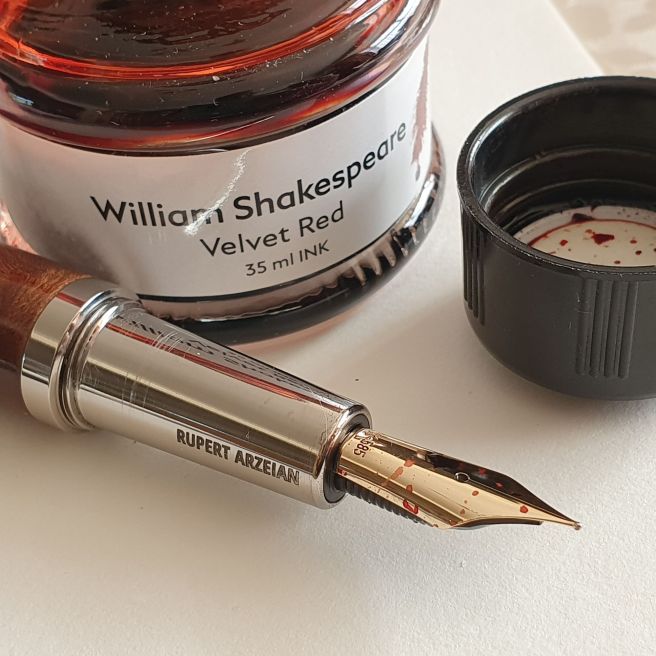
I was also pleased to find that the nib did not dry out overnight. My second fill was with Pelikan 4001 Brilliant Brown, a drier ink but still I experienced no hard starts in three weeks of use. I am currently using Montblanc William Shakespeare Velvet Red, with equally good results.

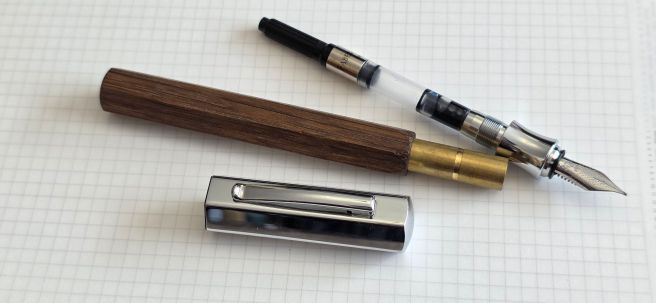
Pen and ink, uncapped

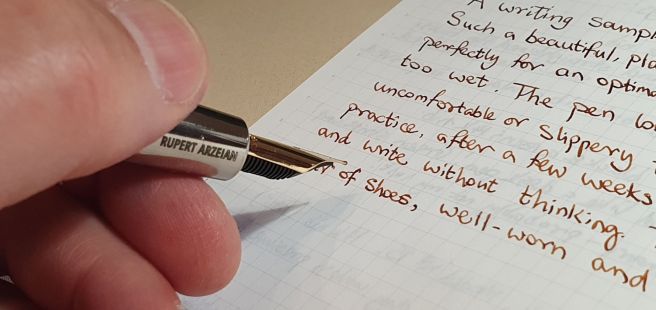
There is a little feedback from the nib, but no scratchiness or drag. The pen is a joy to use and I pick it up often.

Filling and maintenance.

The pen is a cartridge-converter filler. It takes standard international cartridges or can be filled with the push-in Schmidt converter, supplied with the pen, making for easy cleaning.

The Bock nib unit can be unscrewed from the section and the nib and feed can be pulled out for cleaning or maintenance although I have not tried to do so.

There is no inner cap. Whilst I found that none is needed here to prevent hard starts, I had a concern that ink drops could stain the inside of the cap, if the pen were to leak or be shaken in transit. However I am told that the cap is also lacquered from the inside, just like the outside. The lacquer is low viscosity and penetrates deeply into the wood fibres. If necessary, the inside of the cap could be cleaned with a cotton bud. Ashera advise against soaking the cap or barrel in water.

A one-handed selfie photograph.

Likes and dislikes.

I found much to like about this unusual pen. In summary the main points are:-

  • Choice of natural woods for cap and barrel, sustainably sourced;
  • Glossy, eight layer lacquering;
  • Unusually lengthy, with a comfortable balance;
  • Clean, minimalist ellipsoid design; there is no pocket clip;
  • Titanium grip section, rings and threads for strength and durability;
  • Comfortable girth, neither too wide nor too narrow for me;
  • High quality gold or platinum nib, free of branding or decoration, but hand-polished and tuned; writes smoothly; (reverse writing is also smooth and gives an extra fine line);
  • Seeing your name on such a high quality pen feels very special:
  • Company’s commitment to reforestation;
  • Attractive and practical wooden box/pen tray.

Some points to note:-

  • At first I was concerned that when uncapping the pen, the barrel might unscrew instead. It has worked loose a few times but generally, once screwed on tight, (and tighter than the cap) this does not happen;
  • The cap threads can be a little fiddly to align until you get used to them; the solution is to rotate the pen the other way until a click signals the start of the threads, and then screw it into the cap gently, ensuring that the cap and barrel remain in a straight line. My concern, when anyone else uses the pen, is that the cap may be put back on cross-threaded; one member of my pen club said that the threads felt rough and were not quite up to the same standard as the rest of the pen;
  • The threads on the inside of the cap are sharp and, even with careful use, appear to have left some scratch rings on the miror-polished titanium section (although personally, that would not bother me and might even improve grip);
  • Metal sections can be slippy, but I have not found this one to be a problem for long writing sessions. When writing, my thumb is half over the barrel ring and cap threads, which gives grip;
  • The step down from barrel to section is quite prominent but I have not found it uncomfortable in practice;
  • A couple of people at my pen club felt that the pen was too light; however it weighs 28g closed, or 23g when uncapped, the cap weighing 5g. Personally I find the weight and the balance, fine as they are and comfortable for long writing sessions;
  • Whilst I enjoy the extra length of the pen, it will be too long to fit in some pen cases. I carry it in a pouch.

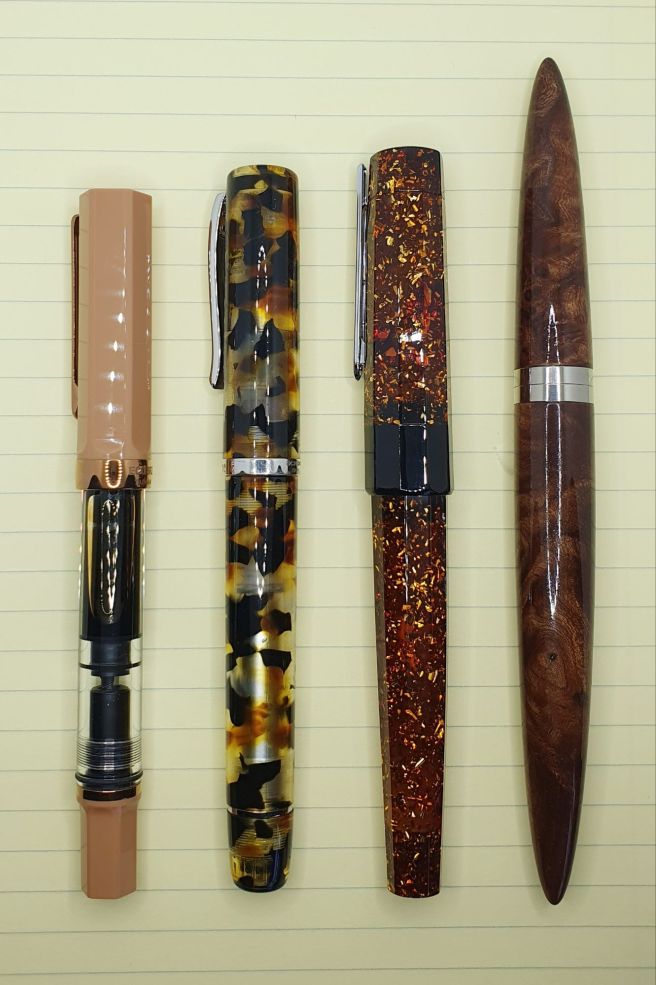
Size comparison with TWSBI Eco, Scribo Write Here “Africa”, and Benu Euphoria “Bourbon”.

Conclusion.

I have thoroughly enjoyed using the Aeon, these past three weeks. I was delighted with my choice, of Elm Burl and gold nib (Fine) that I opted for. Some of the wood options do increase the price, not because of the cost of the wood but rather due to the extra difficulty of working with it. A platinum nib also adds to the price.

Ashera have kindly arranged to provide a discount of 20% on the price of an Aeon fountain pen, (limited to ten pen sales) purchased via the following link: https://ashera-design.com/aeon-rupert-arzeian-edition The discount is applied at checkout.

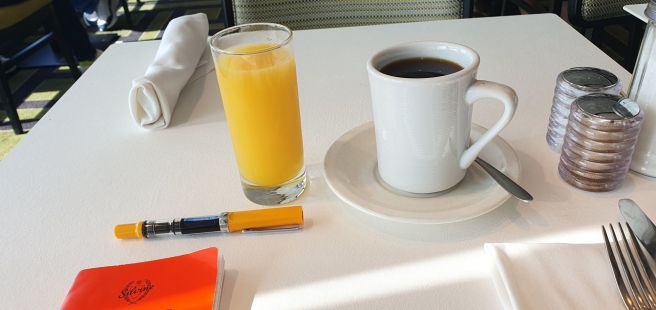
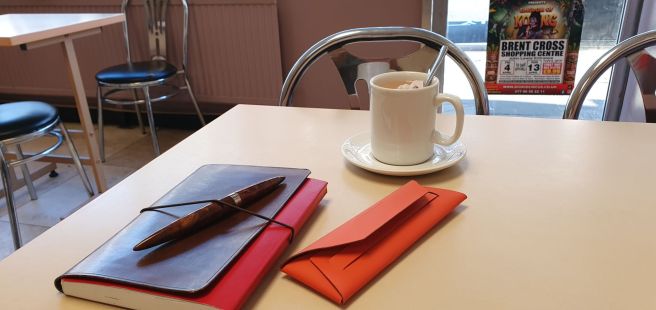
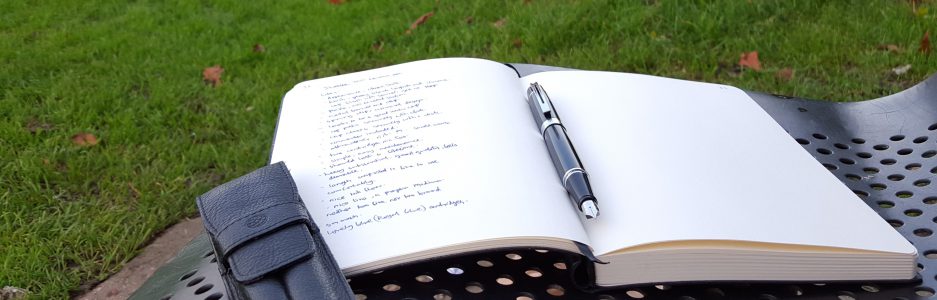
Coffee shop journaling.

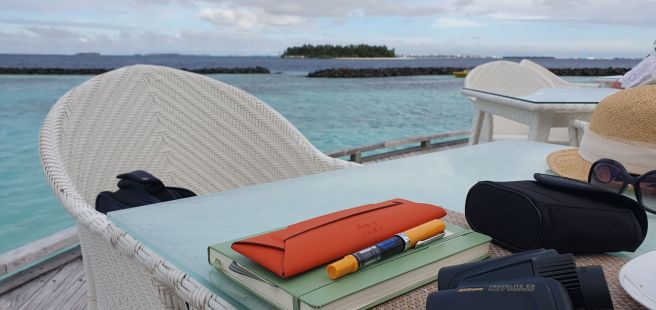
Travelling with ink: the Maldives, March 2025.

Our latest holiday destination was well-chosen by my wife, from her bucket list. We were both hoping for a peaceful break with little to do, other than snorkel by coral reefs. Faced with this prospect, I set about picking fountain pens to bring for some holiday journaling.

As usual, I briefly contemplated bringing just one pen to use exclusively, but caved in and eventually went with five. These included three recent acquisitions from the London Spring Pen Show – a Parker 17 Lady, a Parker Duofold button-filler and the TWSBI Eco T Saffron with EF nib. The other two were a Wing Sung 699 vac filler, which I have been enjoying since the start of the year and finally the red Caran d’Ache 849 bought in Bruges last November.

Vintage Parker button filler and a 17 Lady.

I should say now, that this will not be a post about all the best places to see fountain pens throughout the Maldives. We stayed on only one of the 1,190 islands. Aside from the Dive shop, the island had only one other shop, for gifts and souvenirs. The region is thus more an opportunity for pen using, than pen shopping.

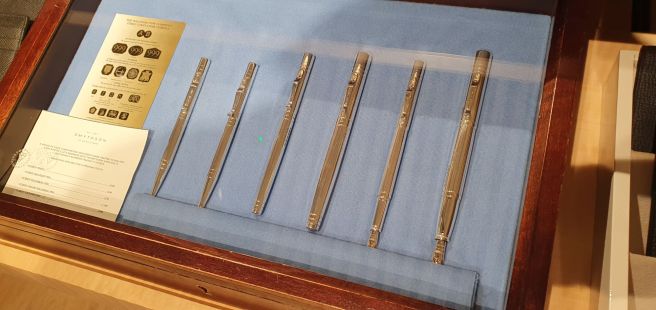
However the trip was not entirely without something for the stationery fan with gear acquisition syndrome. If I had been careless enough to leave home without any fountain pens at all, then help was at hand in the duty free shopping mall at London Heathrow Terminal 4: a Smythson stationery shop held a good selection of Yard-O-Led pens and pencils in Sterling Silver. Phew!

A rare sighting of some Yard-O-Led pens in London Heathrow Airport.

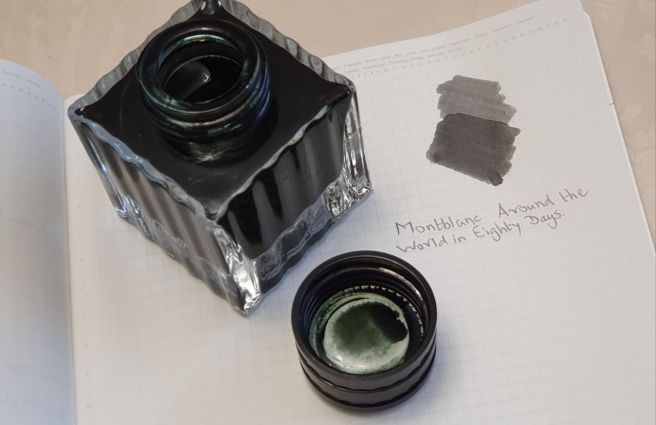
Also in the Terminal, is a Montblanc shop. Here I enjoyed a good browse around and a chat to the helpful assistant Lenka. A number of the fountain pens were on special offer with around one third off! But even with such a discount, a pen such as the Montblanc Meisterstuck Solitaire Blue Hour Legrand is still a hefty sum of money, especially for a spouse-accompanied impulse buy. However, I did succumb to a bottle of Montblanc “Around the World in 80 Days” special edition ink. This appeared to be an interesting grey with dark green undertones which I liked, although strangely described as Brown on the box.

Around the World in 80 Days.

I added this ink to my clear plastic bag of liquids under 100ml, to pass through security, along with my Pineider travelling inkwell of Quink Black. I emptied the vintage Parker Duofold button filler and the Parker 17 Lady, to avoid the risk of them leaking on the flight. The other inked pens remained in my carry-on backpack for the journey, with nibs uppermost and I had no trouble with any of them on the flights, out or back.

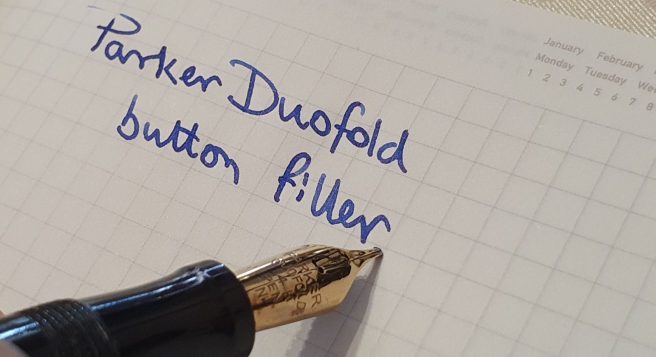
To write in, I had brought a Leuchtturm A5 journal. I see that I refilled the two vintage Parkers with my new Montblanc Around the World ink. I had brought a collapsible plastic cup (possibly a dog’s drinking bowl?) which was a useful accessory for holiday pen flushing. I used the Duofold button filler which wrote for about 10 x A5 pages on one fill. The nib is a medium to broad. I then switched to the Parker 17 with a fine or extra fine nib, which I enjoyed a lot with the Montblanc ink, since it produced a sharp pencilly grey line on my Leuchtturm paper. Next I used the Caran d’Ache for a short while before moving on to the TWSBI Eco T Saffron, with EF nib. I had paired this with New Old Stock Waterman Blue Black ink from the pen show and, with my Leuchtturm journal, I enjoyed this combo and used it for the remainder of the holiday. Even so, the capacious piston filler was still half full when I got home. It is a comfortable pen; I love the firm EF nib and the Saffron beachy vibes.

A TWSBI Eco T, Saffron, on vacation.

On the return flights there was another opportunity to be tempted by Montblanc in the duty free shop at Malé airport where I had a nice conversation with the friendly salesman, Irhan who was knowledgeable on the special editions and showed me the James Dean (in a sale) and a Chopin. He told me that they attend a course every few months to keep up to date with the pens.

As for the holiday itself, the Maldives are of course a wonderful, tropical paradise and we had a great time, swimming and snorkeling every day. Our small island resort was bounded by a coral reef and it was a joy to swim out from the beach, over the reef to the far side where it dropped off steeply to the deep blue depths. Here, a variety of colourful fish could be found, among the coral. In the course of the trip, we saw plenty of marine life, including turtles and reef sharks.

My Wife enjoying the beach view.

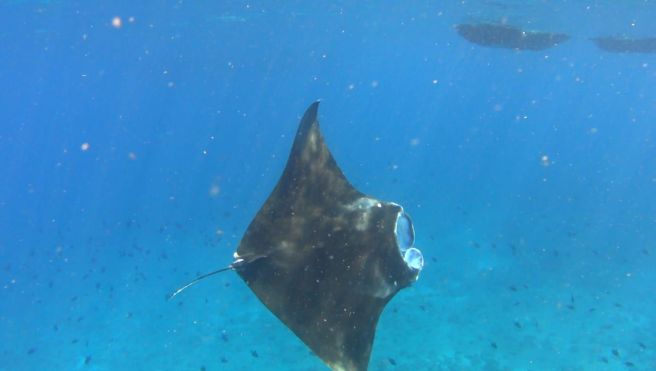
But the highlight of our stay was a guided snorkeling trip, by fast boat, to a patch of ocean about 25 minutes’ boat ride away, where we swam for an hour blissfully observing a group of manta rays, gliding by us in the crystal clear waters, feeding and occasionally showing off with a loop-the-loop. It was while watching these beautiful creatures, that our group was treated to the awesome sight of a Whale Shark, also feeding (but happily not on snorkelers) which was perhaps around 12 metres long. Our guides were excited as it was only their second sighting of a Whale Shark this season. We did not have an underwater camera but some friends in our group had one and later shared some of their photos with us.

Manta Ray in the Maldives

If we were to go again, I would like to bring a Go-Pro for some underwater stills and video. When we transferred flights at Abu Dhabi, I found several electronic shops in the airport selling these. But to buy one then seemed like locking the stable door after the horse has bolted. But, with thanks to a German couple whom we met on our trip, I can share a few photos of what we all saw.

Manta Ray


A Whale Shark, feeding.
Another gratuitous Whale Shark shot!
The rested spouse.

One Week 100 People 2025: Days 1 to 3.

I learned of this challenge from Writing at Large. The idea is to complete 100 sketches of people in a week,  from 3 to 7 March inclusive. The challenge runs every year in the first week of March.

Although I am not usually one for these online challenges, I was intrigued enough by this one, to have a go. I thought the practice would be beneficial, which it has been.

I gathered that there were few rules on how to go about this. You can use any sketching media. Then post your work using the hashtag #OneWeek100People.

Even the target of completing 100 pictures in 5 days is not essential. That is just as well, as I find myself woefully behind with just 12 pictures in three days.

Also my pictures have all been copied from photos, rather than drawn from life, as an urban sketcher would.

Having since looked at other people’s work, I now see that  my sketches are far too fussy, when I should have worked loosely and quickly.

But here are my attempts so far. All were drawn with a vintage Parker 17 Lady fountain pen with Parker Quink black ink in a Rymans A5 sketch book, with no prior pencil work. Going straight to ink builds confidence! I quickly learned that trying to produce pictures that are recognisably human is challenge enough: to get a likeness is a whole lot harder.

In blogs which promote fountain pens, I think it is good to inspire the use of these wonderful instruments, and not only their acquisition.

London Spring Pen Show 2025: my haul.

Well, this is embarrassing. I had pencilled in a post for this week, intending to call it a pen show recap, as “my haul” would not work on a “no-buy”. But as it turns out, the “no-buy” promptly went out of the window as soon I got through the gates. Another generous interpretation from one of my pen club friends, is that purchases during a pen show do not count in a no-buy.

Anyhow, I had a brilliant day at the show as always, running into many friends. As most of our pen club (The London Fountaineers) had arranged to meet up nearby at Latymers for a pub lunch during the show, I decided to go for the 9.00am early bird admission, to compensate for the lunchtime erosion of shopping time. This worked out perfectly and it was lovely to sit down and catch up with friends over a delicious Thai meal and share what each of us had found.

Pen club lunch at Latymers.

Over the course of the day, I acquired nine pens. I know that this sounds like a lot but none of them was terribly expensive and many folk spent more than my total on a single pen.

The only pen that I had specifically hunted for, was a Parker Duofold Senior, in blue. I found that the typical prices of these old Duofolds rise as you progress through the seven different sizes. The “Senior” (with a #35 nib), is the second largest of these and I paid £80.00 for a very nice example. The largest one was called the Maxima (#50 nib).

Parker Duofold Senior (#35 nib)

One of my earliest finds was a “Ty-phoo Tea” pen, a lovely old (1930’s?) lever filler, in black etched with a wave pattern, flat ended and clipless and a small, 14k gold nib. This would have been acquired as an offer in return for coupons from packets of tea. It is said to be “British Made” although the maker is not specified. I have since read on FPN that there were several such models made for Ty-phoo Tea over the years, likely to have been supplied by Swan, Wyvern or Conway Stewart. With a sudden brainwave, I have paired it with Jacques Herbin Lie de Thé.

Typhoo-Tea pen with aptly chosen ink

I picked up a TWSBI “Eco T” in Saffron with a lovely EF nib. Admittedly, I thought that I was buying a standard Eco, but later discovered it to be an Eco T, which has three, softly rounded facets on the grip section and a triangular cap and piston knob – a model that I had not been aware of, but still a pleasing buy with summery vibes.

A TWSBI ECO T, Saffron with EF nib.

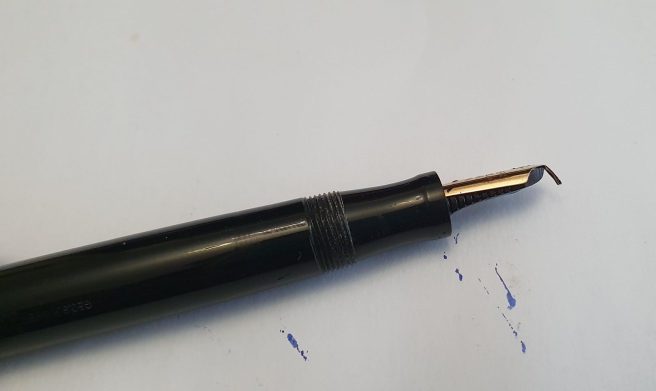
I had a successful run of buying three vintage Parkers, all in glossy black with gold trim, each from different vendors. First, a Duofold button filler (1940’s?), the first button filler I have owned, from Heritage Collectables. Next a Duofold Junior, with a Fine nib which, amazingly, was in near mint condition with original chalk marks and an aero filler which appeared never to have been inked. This was from Justin Janse van Vuuren. Finally, a gorgeously cute irresistible Parker 17 Lady (Fine), which posts beautifully to become a really delightful pocket pen, sold by Carneil Pens. I have been using this for sketching, with Parker Quink Black.

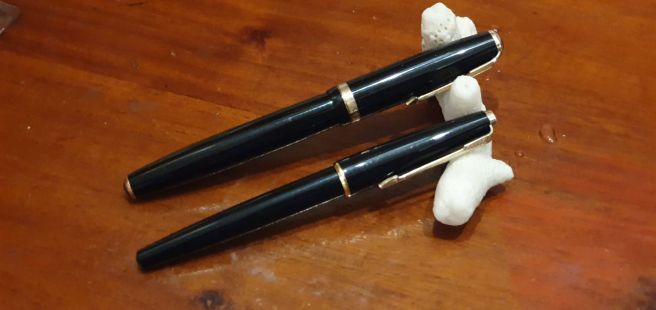
Three vintage Parkers.

I also bought my first Parker 25! I had never much liked the oddly industrial brushed steel tapered barrel and so had refrained from buying one when they were part of Parker’s range. But having learned that they were designed by Sir Kenneth Grange, also responsible for designing the Inter-City 125 train, I felt it was high time I tried one. There were several to chose from at the show and so I could examine their nibs with a loupe. In the hand, the pen is more comfortable than it looks and the cap posts beautifully, flush with the barrel, whereupon the tapering barrel makes sense.

Parker 25.

Otherwise, my pen-buying flurry included a Pelikan Jazz and a Sailor High Ace neo, each offered at just £5.00 from Cult Pens. I also stocked up on ink, finding bottles of new old stock Waterman Florida Blue and Waterman Blue Black, plus a luxurious box of 6 Pilot Iroshizuko kon-peki cartridges and a couple of boxes of the Kaweco Royal Blue cartridges.

Another suitcase, another haul.

The day was punctuated by lots of lovely conversations with friendly dealers including Jeremy Collingbridge, John Hall, Kirit Dal, Ray Walters, John Foye, Sarj Minas, Kasia Stier, Justin Janse van Vuuren, my good friend Jon of Pensharing and many others. On the train home, I also tried to list all the friends I had seen and this came to more than 20.

Kasia Stier of PenSpa.

For anyone serious about being on a no-buy, the London Pen Show is not the place to go. As a recent retiree, I discovered that I am still at heart, a child who wants a new toy a little too often. But I am thrilled with my acquisitions which I am sure will punch well above their weight in providing joy for years to come. Thanks, as always, to all the organisers, dealers and the fountain pen community. See you all next time!

The author (left) with some pen friends.

Inky Pursuits: February 2025.

Inky Pursuits is my occasional series of posts on topics which individually might not be quite blogworthy, but hopefully when combined together may be greater than the sum of their parts.

Thoughts on completing the WES Pen Repair Course.

This month saw our group complete the third and final module of the Pen Repair Course, available to members of The Writing Equipment Society. I was one of a friendly group of four attendees for the London classes, held at the Harrow Arts Centre and led by Ray Walters. Details of the course, topics covered and joining instructions are on the WES website (the Services tab) or via the link here.

The course had been highly recommended to me by a pen club friend who had attended the previous year. I am very glad I joined. Ray, who is also a regular vendor at pen shows, is an excellent tutor. On my arrival for the first module back in November, Ray had already laid out his tools and equipment including a large green canvas roll containing dozens of implements from section pliers, bionic pliers, hammer and drifts, to dental picks and pieces of bicycle tyre inner tube for gripping. The table resembled a field hospital.

During the course, which was very much hands-on throughout, we were shown how to assess a pen, refurbish its filling system and deal with bodywork issues. But aside from the specific techniques needed for various types of vintage pen, Ray’s general wisdom and his advice about the tools and how to use them correctly, was equally useful. By watching, listening and doing, we were soon able to service some of our own fountain pens and gain practical experience and confidence.

In particular, I was thrilled to return home after my first day, with two very elderly fountain pens, bought in a sorry state from a local antiques shop with no sacs and badly bent nibs – now back in full and joyous working order. The course had already paid for itself!

Both pens were lever fillers, from around the 1930’s. Their rubber sacs had long since perished and crumbled to dust. These pens proved to be an ideal example of how to go about a sac replacement. As for their nibs, Ray possessed an impressively heavy and shiny block of steel with tapering semi-circular ridges and channels, for burnishing nibs into shape. After watching Ray tackle one of my nibs, it was my turn to do the other one.

A Pitman College pen (top) and Swan Mabie Todd SF2 (below)

After lever fillers, we moved on to button fillers, Parker vacumatics and aerometrics and then Sheaffer touchdown fillers and “snorkel” fillers. Although Ray showed us how to disassemble and service these, I got the impression that snorkel repairs are best avoided if possible. They just do not seem to have been made with ease of servicing in mind.

In the final module we covered other filling systems including Onoto, Conklin, Montblanc and Pelikan. I had brought along my Montblanc Meisterstuck 146, a present from my wife 28 years ago. Although I cherished it, it had mostly stayed in its box as the piston was very tight and awkward to use. But with Ray’s Montblanc nib and piston removal wrench, I was finally able to introduce some silicone grease to the piston which made a world of difference. The pen is now filled and in daily use.

The whole course was very enjoyable and worthwhile. One caveat though: the new temptation to buy more tools opens up a whole new rabbit hole.

One Month One Pen.

In my previous post A new month, a new plan, I wrote of my intention to use just one fountain pen for the month of February. So, how is that going? The pen I chose was a Wing Sung 699, an inexpensive Chinese vac filler bought over five years ago. I wanted to remind myself what it was like to have only one fountain pen, to see whether I was content with this or whether I still craved other pens.

Wing Sung 699 partly disassembled for cleaning.

Overall, I think the exercise has been a success. I flushed out a whole bunch of pens. I enjoy using the Wing Sung very much. Used daily, I am a little more conscious of the need to unscrew the blind cap a little to raise the plunger, otherwise the pen ceases to write once the ink in the front end is exhausted – but this is no hardship. I find the pen very comfortable. I like the way it writes, with its firm, steel Fine nib, adjusted slightly to increase flow. Filling the pen with one downward push of the plunger, is always exciting to see.

One issue to be aware of is that the section of the Wing Sung 699 can be unscrewed for cleaning. That is a good thing. But you do need to ensure that it remains tightly done up when the pen is inked! A few days ago I found ink on my fingers and realised that the section had loosened slightly. This required me to empty the pen, clean it and grease the threads (as well as the main ink reservoir) and refill it. Another lesson that I learned is that the gold ring between the barrel and section will slip off without you noticing whilst you are bathing the pen in the wash basin. Luckily I spotted it gleaming in the water, before pulling the plug.

I have enjoyed this more concentrated spell of using the Wing Sung. I could probably use it exclusively if I had to. However, I have cheated a bit over the month with a few extra pens creeping into use. First there was the Montblanc that I serviced in the repair class and then filled. (My teacher made me do it). I have enjoyed having this special pen inked again. Then there was a Cleo Skribent Classic, with a steel nib that I had an urge to tune. Having done so successfully, I could not resist filling the pen and adding it to the pen cup.

This week, I received a surprise gift of an Ellington Nautilus fountain pen in the post from my brother, with an extra fine nib. I filled it up right away and it writes beautifully.

Ellington Nautilus fountain pen.

A 2025 no-buy.

This was another intention, voiced in my last post. It is too early to judge whether this will be a success or not. I am qualifying this to say that it relates only to fountain pens, as I have already bought several gel pens and notebooks as well as other stationery supplies.
As for fountain pens, I have not purchased any since buying the perfect pen on 4 December 2024. No, I do not mean that it was so perfect that I ended my pen-buying journey. Rather, it was a vintage pen called the “Wyvern 81 Perfect Pen.”

The 14k gold nib of the Wyvern 81 Perfect Pen

But having said that, I have still struggled with the usual temptations to buy other pens. Since meeting up with my good friend Jon of Pensharing.com, his Majohn P139 has played on my mind. This is a chunky, black and orange, piston filling fountain pen, a homage to the Montblanc writers’ limited edition Ernest Hemingway of 1992. The Majohn costs only around £52 with a number 8 nib, but I am bravely resisting for now.

I have received unexpected life-lines. A generous friend in Australia recently sent me three interesting vintage Parker fountain pens, which he had found in charity shops there. I have dip-tested them all but not yet put them into use and am looking forward to doing so. And then there was the lovely surprise gift from my brother too.

Parker 45 Insignia. One of three Parkers from my friend in Australia.

I am not expecting my will-power to survive the onslaught of the coming London Pen Show. The best I can strive for is sensible moderation and to hold tightly to my Wing Sung.

A new month, a new plan.

One of the joys of the fountain pen hobby is finding combinations of pen, ink and paper that work together really well. You find yourself writing with a pen that is supremely comfortable, with a nib that glides along the paper smoothly but with just the right amount of feedback, laying down an attractive line of ink that is neither too wet nor too dry.

In recent years, it has been my practice to pick a different pen and ink combination to use each month, for my daily A5 journal entry. I am using a Ryman A5 page a day diary. For January, I enjoyed writing with a Wing Sung 699, vacuum filling fountain pen with a fine nib. The ink was my own “Slops Blend blue black 2024” representing a mix of inks that I had flushed out of pens cleaned over the course of last year.

Wing Sung 699 vacuum fill fountain pen.

The slops blend experiment is somewhat reckless and goes against the usual advice not to mix inks. The risk is that different inks may clash to form a gunge that clogs pens. When mixing ink it is not only the colour that changes but also other features such as the viscosity, drying time and water resistance. But I have enjoyed recycling ink in this way and have been fortunate not to have any problems. It is a gamble, adding a few drops of ink to the bottle, shaking it up and testing the colour. I was lucky to find that my left-overs had produced a pleasing blue-black, that kept its tone and did not fade to a teal colour, as some do. The trick then is to avoid going too far and spoiling the mix.

My unique blue black recycled dregs.

My Wing Sung 699 seemed to like my slops blend ink. It produced a nice dark blue-black with attractive shading and a nice lubricating quality and did not suffer from the fading and colour changes.

As well as my Ryman diary, this combination was particularly nice on my Stalogy notebook paper. I found myself thinking that I would continue with the same pen and ink for the month of February too. It also crossed my mind that the combination was so enjoyable that perhaps I did not need any other fountain pens and could use this one for everything.

Such thoughts have often arisen but this time, I decided to act upon it and put my money where my mouth is. No, I have not sold or given away all my other pens! But I thought it may be an interesting exercise to simulate having only one fountain pen. I flushed out about a dozen inked pens, keeping out just the Wing Sung. (I have cheated slightly as I did not throw out half used cartridges or syringe out the remaining ink. Instead I have just put aside my inked cartridge pens, in a separate pen cup, for the time being).

The aftermath of a pen cleaning session.

I thought that this might give me an opportunity to spend a longer time using the Wing Sung vac filler pen, for diary, journaling, letter-writing, notetaking and EDC. It may be interesting to see whether there are any other fountain pens that I particularly miss, over the month. For example, I recall a holiday abroad some years ago when I badly missed my Parker Sonnet. Then there was an occasion when I was absent from work for a few months due to ill-health. The pen that I missed most was the Cross Bailey Light, in royal blue with Cross Blue ink, that I kept in the office.

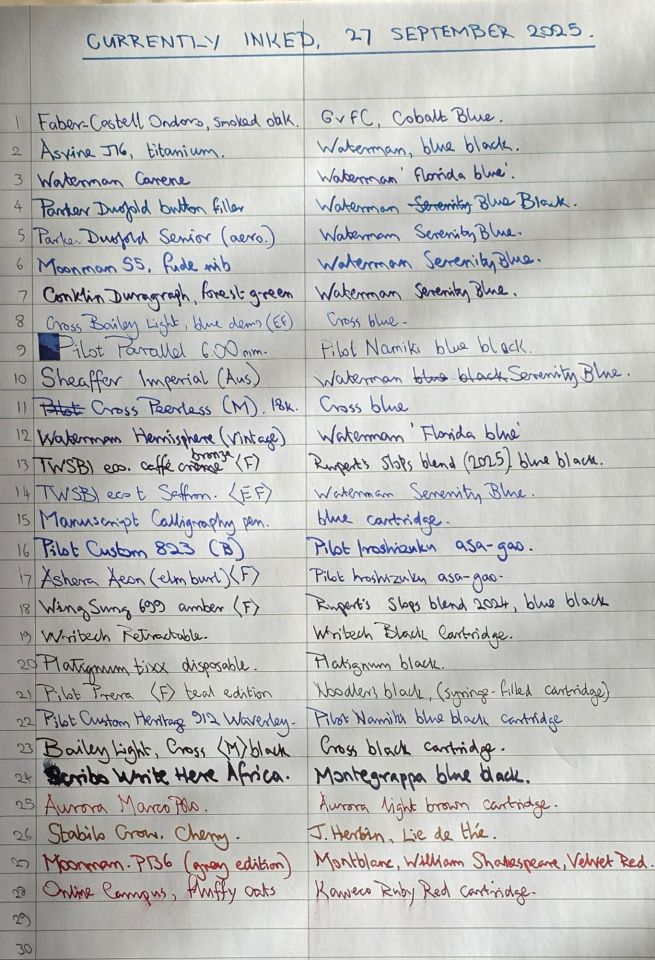
Other potential benefits of this little scheme, are that I was able to bring down the number of currently inked pens considerably, when this had been hovering well over 30 a few weeks ago. Also, I have already started to compile a new batch of Slops Blend ink, that I shall call my 2025 crop.

Perhaps this exercise is indicative of a wish to simplify life a bit. I bought around 50 fountain pens last year (mostly not expensive, with about half that number being vintage pens from eBay or pen shows). I, (or more accurately, my wife) decided that this pen buying needs to stop. I am therefore having a 2025 No Buy. The same goes for notebooks and ink, as well as other writing instruments such as ball points, roller balls, gel pens, mechanical and wood case pencils.

The very pleasing nib of my Wing Sung 699

I bought no fountain pens in January! Admittedly that is only one month. I will be very surprised if I can keep this up for long but thought I would make public my intentions as a contemporaneous record not only for myself but for readers to witness as well.

Again, I have already cheated slightly, in the impulse purchase of a rather lovely black and gold Cross Coventry ball pen. I have also added a few notebooks to my stash, just in case there is a siege in London. You can’t be too careful.

The irresistible Cross Coventry ball pen.

Getting inside the Wyvern Perfect Pen No.81.

As mentioned in my recent posts, I have been attending a practical course on fountain pen repair. Although very much a beginner, it has been fascinating to learn the correct ways to use the various tools involved and very satisfying to restore a vintage pen to life, when it goes well.

In between the sessions we are encouraged to “practice, practice, practice.” It is sensible not to go straight in with a valuable pen as there is a risk, or even a likelihood, of making mistakes and breaking your pen.

One of my recent early practice exercises was a Wyvern fountain pen, bought on eBay at a modest sum, advertised as for spare parts or repair. The pen was not in working order and the seller had been unable to remove the barrel. Nevertheless, it was an attractive pen in marbled green celluloid (I think), a lever filler with a 14k gold nib. Also, what was especially appealing was that the pen still bore its original paper price band stating “Wyvern No.81, 14ct Solid Gold Nib, Broad” and the price, including tax, of 22 shillings, 7 and a half pence. As a reminder for younger or overseas readers, there were 12 pennies to a shilling, and 20 shillings to a pound (therefore, 240 pennies to a pound). This pen therefore sold for roughly £1.13 when new. We switched to decimal currency on 15 February 1971.

Wyvern 81 “Perfect Pen” complete with price tag.

This is my first Wyvern fountain pen. I was aware that this was a British brand, beginning in 1896 and lasting until 1955. From brief searches online, I believe that my pen may date from around the late 1930’s.

When the pen arrived, the body appeared to be in good condition with no apparent cracks. The barrel imprint (always pleasing to find!) was still clear. The nib was caked in dried ink but on cleaning this in water with a soft toothbrush, it came up gleaming.

I am a sucker for a pen that needs cleaning.
Wyvern nib, after a good bath.

The lever for the filling mechanism would not move, suggesting that the sac had perished and hardened inside the barrel. Fortunately, I was able to remove the barrel, by gripping it with pliers, with the jaws shielded by rubber (from a bicycle tyre inner tube). On this pen, the barrel unscrews from the section.

I was expecting to find the rubber sac hardened and cracked into loose debris, to be shaken out of the barrel. To my surprise, very little debris did come out initially. I could see hardened sac material stuck to the inside of the barrel, at the opening. The challenge was how to get this out as it was stuck hard to the barrel.

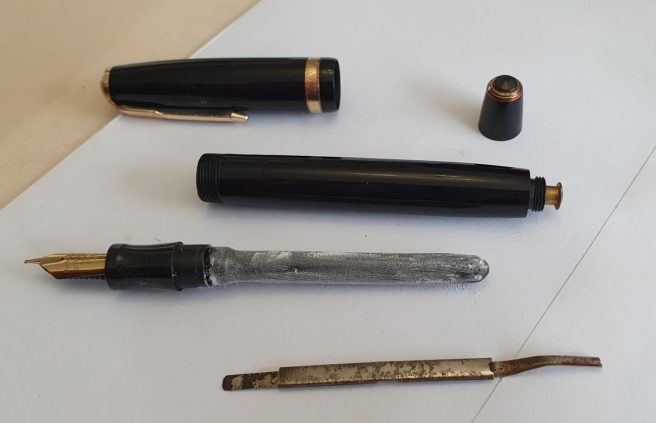
With nib, feed and section removed.

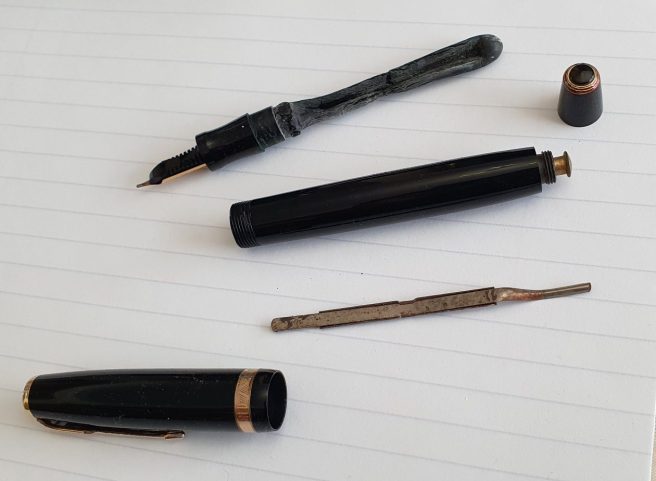
After establishing from a pen club friend that the barrel was not made of Casein (which must not be soaked in water as it will disintegrate), I was then confident to leave the barrel to soak in a jar of water overnight. I then tried scraping out the rubber residue, using a straightened out giant paper clip (carefully avoiding the pressure bar). Some fragments of rubber then started to come away. Patiently, I left the barrel to soak again for another night, before resuming my scraping. As well as tiny fragments and dust, a few larger bits of solidified rubber eventually came out, to my immense satisfaction.

Eventually, I was satisfied that I had removed all vestiges of the rubber. Inserting a brush, I was able to rotate this and clean the inside of the barrel nicely.

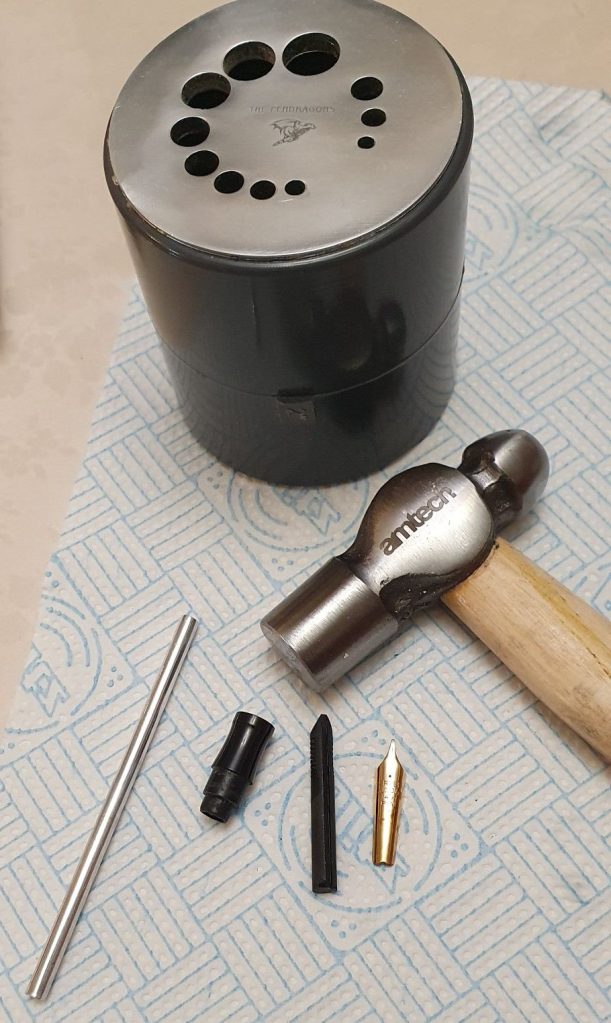
I had ordered a selection of replacement ink sacs, from The Pendragons. I also bought from them, some rubber-jawed section pliers, a pair of barrel-cleaning brushes and a nib knock-out block!

The dining table in workshop mode.

Fitting a new sac is a fairly straightforward but very satisfying task, for a beginner like me. Sometimes, removing the barrel is the trickiest part and soaking and/or heat is required. This was only my fourth such repair. Identifying the best size sac, if you have a few different sizes, is most easily done by introducing the sac to the barrel to find the largest diameter sac that fits, touching the sides lightly but without resistance. The length then needs to be trimmed, measuring from the sac nipple, to the end of the barrel, then shortening it a bit to allow some clearance at the back. To attach the sac, you apply shellac adhesive around the sac nipple. You also need French Chalk, (talcum powder) in which to roll the sac before it goes in the barrel, to prevent it from sticking to the sides.

However, before attaching the sac, there was another factor to bear in mind. As I said, the barrel was threaded, not friction fit. This meant that there was a risk of the sac being caught and twisted by the barrel. To avoid this, the nib and feed are removed from the section before fitting the sac. Assuming that the nib and feed cannot easily be pulled out, they are knocked out with a hammer and drift, using the knock-out block, having soaked the section in water first.

This leaves the section open whilst you attach the sac. You can then insert a rod (something not sharp) through the section and up into the sac, to keep it from twisting as you screw the section back into the barrel.

With the nib, feed and grip section separated, these can be cleaned. It is useful to floss the nib with a brass shim at this stage and check that the tine gap is as you like and the tines are level.

I was worried that the nib and feed would be difficult to push in, since they had been so tight to remove. I applied a little silicone grease to the outside of the feed, whilst trying to avoid any grease blocking the feed channel. It was still a tight fit to get the nib and feed back in, but all went well. Finally, I heat-set the nib and feed, dipping them in freshly boiled water for about a minute, squeezing them together for about half a minute and then cooling in cold water.

I was then finally able to test nib and fill the pen. I had deliberately refrained from writing with the nib beforehand, saving this treat until the new sac was installed and the pen ready for use.

I was surprised to find that the nib was much firmer than I expected and also that the line was not broad, but closer to a medium. However, the pen writes well, with a distinctive pencil-like feedback.

Writing sample, Wyvern 81 with Waterman Serenity Blue on Stalogy paper.

With every successful repair, one gains experience and confidence. I wish I knew more about this pen’s life and owners, during the last 80 years or so. I suspect that it had not been doing very much as the nib and sac could both be original. This will remain a mystery but I am happy to have the pen in use once again.

An 80 year old pen, back as good as new.

2024: some of my fountain pen highlights.

I have been meaning to post a round-up of my fountain pen activities over the past year and had better get on with it, before January is over. This tardiness is in no way indicative of any waning of my passion for fountain pens, which remains as strong as ever.

Pen acquisitions.

Let me begin by ‘fessing up to my annual spend on fountain pens. A look back at my handy Memento database app of pen acquisitions, shows a total of 52 arrivals last year, of which three were gifted to me. One of my purchases, a Parker 51 demi “Cocoa” fountain pen and pencil set was sold on to a lady in our pen club who had asked for help in finding one. Deducting this, I am left with 51 arrivals and a total cost of £1,828, which is up on the previous year.

However the total cost includes one grail pen namely my Scribo Write Here Africa, with its juicy broad 18k nib, purchased from the Write Here shop in Shrewsbury. This accounted for £440.00 of my annual total. If I deduct this, the total spend drops to £1,388 and 50 pens averaging just around £27 each and an average monthly outlay of around £115. This might not sound a lot to a fellow pen enthusiast, to spend on a hobby but I am mindful that I began the year (as I do this year), with a genuine intention to acquire fewer pens, not more!

Approximately one half of my pen acquisitions were vintage, which explains the modest average cost.

It is difficult to pick favourites, but here in no particular order are 10 of my pen purchases from 2024, which have given the most enjoyment. These are, from left to right: 1. Duke 551 Confucius bamboo fude nib sketching pen; 2. Scribo Write Here Africa; 3. Caran d’Ache 849; 4. Aurora Marco Polo; 5. Burnham 61; 6. Pitman College lever filler; 7. Parker 51 vacumatic; 8. Parker 51 aerometric; 9. Parker Slimfold; 10. Eversharp Skyline.

My top ten from 2024.

Other pen-related activites.

Aside from acquiring pens, my year has been punctuated by numerous events, including the London and Birmingham pen shows, the Pelikan Hub and our monthly pen club meets. Then there are the daily solitary hours spent in journaling, pen, ink and paper sampling, pen cleaning and tinkering, letter-writing, screen-time in following the global pen community online, reading blogs and “researching” pens on YouTube, eBay, Amazon and various online pen dealers.

As for this Fountain pen blog, WordPress informs me that in 2024 I added just 24 posts, writing 25,800 words, generating 270 likes and 252 comments. The all-time stats show a total of 276 posts (not including this one), and all-time views of 777,452. (Come on, let’s get this to a million!). I continue to be amazed at the reach of this blog, which arose in 2016 from and continues to be an extension of an innocent hobby. I do value the online interactions that it brings.

It is hard to list all the pen-related activities that one enjoys, without them sounding like a list of symptoms of an obsession. Perhaps it is. But I do have others as well, such as reading and listening to (and making) music. Having retired from work in 2024, I am wondering how I ever had time for it.

Towards the end of last year, I began the Pen Repair Course, organised by the Writing Equipment Society (WES) and led by the excellent Ray Walters, whom many will know as a dealer at pen shows. I have enjoyed his classes immensely and have one more session to attend, next month. Thus I have added pen repairing to my leisure activities and find this very satisfying and rewarding. There is a risk that the acquisition of some necessary tools can lead to marital friction. Buying a heat gun took a little bit of persuasion. But it keeps me out of mischief.

As always, I thank everyone for reading. Special thankyous go to The Pen Addict, The Gentleman Stationer and The Well-Appointed Desk who often include links to my posts in their weekly round-ups, giving my viewing figures a welcome boost. I wish you all much penjoyment in 2025 and beyond.
The new year diary, 2025.

It’s time to wake up this blog for another year and, where better to start than with a brief review of the diary that I plan to use?

For 2024, I used a Ryman A5, soft cover, flexi, Page A Day diary for my daily journaling, summarising what I did with the previous day. Occasionally, this might include a list of things I am grateful for (if I can be unselfish enough for a few moments, to remember). My post on the new year diary, 2024 can be re-read here.

This year, I went for the closest equivalent that I could find, which was again from my local Ryman stationers. Whilst seemingly much like last years, I was glad to notice several subtle improvements have been introduced. These are as follows:-

  • Instead of last year’s horizontal thin elastic closure, we now have a more conventional, vertical ribbon elastic closure. I disliked the old style, since with short finger nails, it was fiddly to lift the elastic to open the book – an issue for which I designed a simple hack, namely tying a piece of pink ribbon to the elastic.
  • Whilst retaining the same soft texture of the covers, last year’s flexible cover has been replaced with a stiffer cover, which I like. It also does away with the need for the little metal reinforcement tab on the edge of the front cover to protect it from being worn by the elastic. Over the year, that piece of metal had lifted, leaving a sharp edge which was a danger to adjacent books.
  • A Pen loop has been added, to the back cover. I don’t actually use it (other than for this photo) but it could be useful.
  • Something that I have only today noticed, the row height has been increased very slightly from 7.6mm to 7.9mm. I must admit, I was assuming that they were both 8mm until I checked.
  • Best of all, the 2025 edition now includes a Page A Day for Saturdays and Sundays, whereas last year they shared a page.

Otherwise, the two editions are much the same, with a ribbon page marker, cream paper which is fountain pen friendly and with sewn binding, to open flat without damage.

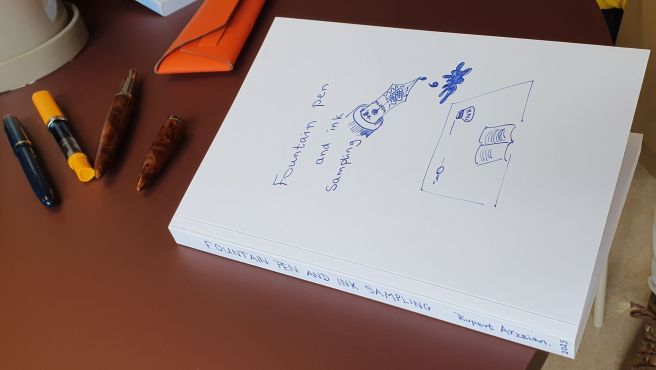
This suits my needs very nicely. For longer entries, such as holiday journaling, I use a separate Leuchtturm A5 notebook, with either plain paper or dot grid. Day to day pen and ink sampling and therapeutic pen time is done in a Stalogy A5 Editor Series 4mm grid, 365 page note book, a product which I have now used and enjoyed for several years.

For bullet-journaling, I upgraded my old Ryman A4 notebook to a WHSmiths Moderna Ruled A4 Leather Notebook, with 96 ivory sheets of 100gsm paper. I have set this up with monthly spreads, for the years 2024 to 2029 inclusive. It is very useful to log dates which are a year or more in advance, such as car and house insurance renewals, guarantee expiry dates, or investment product maturity dates. As well as these grown-up uses, I also like to include books read, albums listened to, trips to the gym and other day to day life admin.

So there you have it. Here’s wishing everyone a Happy New Year and hoping for happy events to plan and record in our diaries for 2025!

Discovering the Aurora Marco Polo fountain pen.
I am enjoying a run of good luck in my fountain pen acquisitions. Hot on the heels of my “four countries and six new pens in a week” cruise ship holiday, I stumbled across a vintage Aurora in an antiques market.

This happened in Spitalfields Market, where my wife and I had come to buy her a hat. Actually, she may have spotted the pens before I did. There, on a shelf, displayed in its Aurora box, was a fountain pen that I was unfamiliar with.

The sticker is from E.E. Ercolessi, a shop in Milan.

This was a slim, cylindrical pen with a glossy gun-metal finish and a gold-coloured pocket clip, cap-band and barrel end. Pulling off the snap-cap revealed a black section and a gold-coloured nib, flat topped with bends at the sides, a bit like a Lamy Safari nib but with no visible imprint. A generous blob of tipping and the condition of the body all suggested that the pen had seen little use.

Like new.

Generally speaking, I do not gravitate towards slim pens. However, for a vintage Aurora I was prepared to make an exception. It was mine for £20.00.

Aurora Marco Polo fountain pen.

With no papers in the box, I tried to think of the pen’s name. The name “Profil” kept coming to mind but no, that was a Lamy range. Then I remembered the name Hastil. Was it a Hastil perhaps? For a brief time, I thought it was.

Examining my purchase at home, I found the only bit of branding, the name AURORA in tiny letters on the cap but, unusually, printed in line with the pocket clip and barely noticeable on a casual inspection. I also discovered that the cap was cleverly designed to post, with a satisfying click, to add a bit of heft and length, making a very comfortable unit.

Subtle branding

I flushed the section and then pushed in a brown Aurora cartridge, from a box which I had fortuitously bought at a recent pen show. It wrote beautifully, with a nice medium line, good flow, no skipping, no hard-starts, no scratchiness. I was delighted.

Also, I surprised myself in finding that I took so well to such a slim pen. This was a revelation rather like when, as a teenager, I discovered that I did like strawberries after all.

Some research on the internet and in old Aurora catalogues, revealed that my pen was not the Hastil. From a similar pen being sold on eBay, I gathered that mine was the Aurora Marco Polo. (Marco Polo, c. 1254-1324, Venetian merchant, explorer and writer). I did read up about the Hastil, and learned that it was designed by Marco Zanuso, and introduced in 1970. The slim, cylindrical metal design was so novel and successful that the Hastil became the first fountain pen to be exhibited in the permanent collection of The Museum of Modern Art, New York.

I gather that my pen came later, and whilst sharing some superficial similarities to the Hastil, it did not have the Hastil’s gold nib (in a distinctive, scoop shape) nor the cap which was flush with the barrel – yet postable due to a barely perceptible tapering of the barrel. The Hastil also had a special recessed pocket clip feature.

I had not seen an Aurora Hastil in the flesh. But then by a strange coincidence, we were visiting a friend in north London, just a few days after my purchase of the Aurora. Knowing of my interest in pens, she went to dig out a few old pens to show me. Imagine my surprise, when one of these was an Aurora Hastil, complete with its original, extraordinary, metal cylinder box, with papers, a pair of unused Aurora cartridges (from which the ink had almost entirely evaporated) and the accompanying converter, called the Trik-Trak. Our friend could shed no light whatsoever on how she came to have this pen. I suspect that it had been purchased by or gifted to her husband, long since deceased.

The not-so-subtle Aurora Hastil canister.
Unboxing: the sliding cover reveals the cartridges and converter.

Having spent the previous few evenings gleaning information on the internet, I was thrilled to see an actual Aurora Hastil and took a few photos of it. These are not vintage pens that you come across very often. Fortunately, our friend’s son is a fountain pen enthusiast who will appreciate its worth.

Aurora Hastil fountain pen (c.1970’s).
The distinctive 14k gold nib of the Aurora Hastil.

Finally, my lucky streak did not end here: with my Pen Repair Course approaching, I had popped into a local antiques shop to ask whether they had any old pens, as I needed some to work on. The proprietor rummaged in a box, in a dimly lit corner of his cluttered shop piled high with furniture and all manner of bric-a-brac. He then emerged with a bundle of five fountain pens, namely a Parker 51 aerometric, a Parker Slimfold, two lever-fillers: – a ‘Swan’ Mabie Todd SF2 and a Pitman College and finally a black plastic “Marksman” Chinese pen. He would not sell them separately but only as a job lot. I bought the lot, and got them all clean and working again. I have been having a great time with them but will save this for another post.