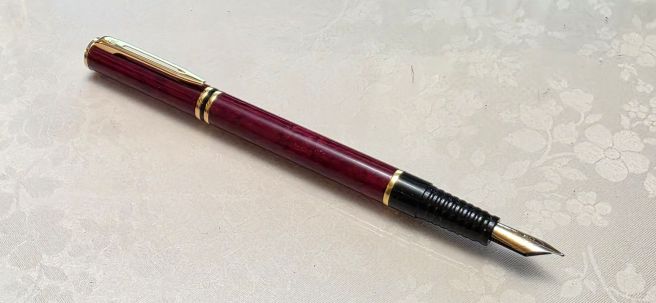
A look at the semi-vintage Parker 65 Custom fountain pen.

I bought this pen only two weeks ago, just days before the London Autumn Pen Show, in what I jokingly referred to as a warm-up purchase.
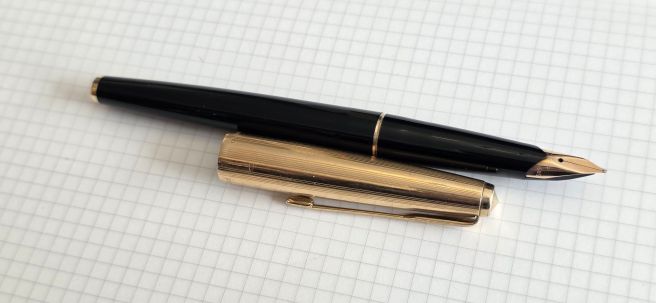
Parker 65 Custom fountain pen.

I had spotted the pen on eBay. It was offered for immediate sale at £60.00, rather than auction. After admiring the seller’s close up photos, including shots of the nib from several angles, I was keen to secure it and did not bother negotiating. I had looked at a few different Parker 65 models before but did not know much about them, other than that I liked the style with the open nib. Despite having accumulated quite a number of vintage Parkers, this was my first Parker 65.
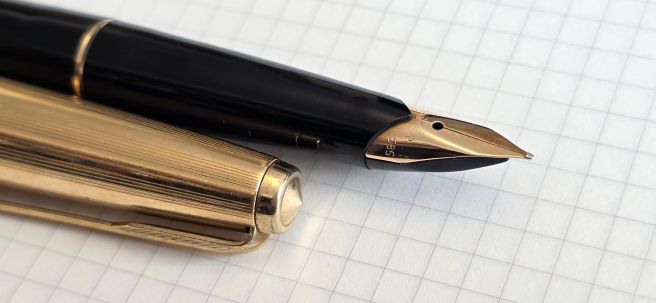
Open, semi-flex 14k gold nib.

I am grateful to Tony Fischier for his excellent site https://parkercollector.com (previously called parkerpens.net) and specifically his information on the Parker 65 history. From this I learned that the Parker 65 was produced in various forms from 1967 to 1983. I believe that my pen is one of the later versions (the black plastic connector was introduced in 1969 and the metal finials, instead of grey plastic jewelled finials, were introduced in 1975). The pen has a connector which links the section on one side and the barrel at the other. This should be glued into the section with shellac, otherwise there is a risk of it leaking and coming undone unintentionally, when you think you are unscrewing the barrel.

I also found a helpful video from Grandmia Pens, on Youtube “How to service a Parker 65 fountain pen.” I have not yet fully disassembled mine, as I do not have the necessary tool to unscrew the ink collector and will need to buy one, or perhaps adapt one from a pair of tweezers.

In short, my example Parker 65 is a cartridge converter pen, introduced as a “sister pen” to the Parker 61 but with an open nib as opposed to the 61’s hooded nib. Personally, I love the streamlined look of this nib and the way it follows the tapering contours of the grip section. Also it is a semi-flex nib in 14k gold, offering a softer writing experience with some “bounce”, although not full flex. The slip cap has the same type of gripping system as the Parker 51. It also posts beautifully, creating (surely!) one of the most sleek, elegant and comfortable pens ever.
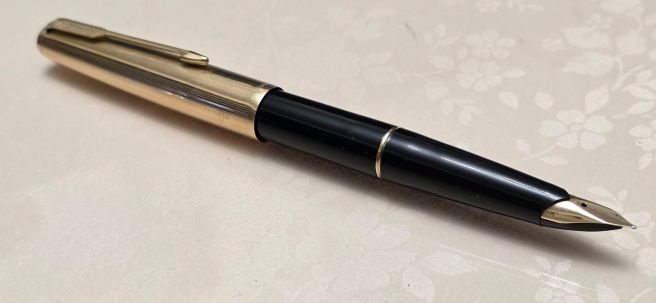
With cap posted. Still looking modern and supersonic today.

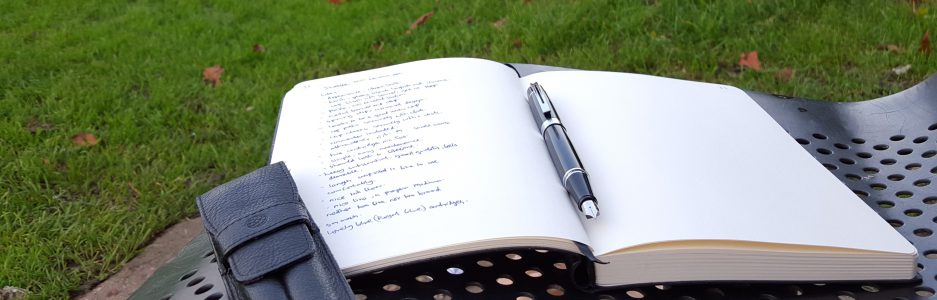
My pen did not have a converter when it arrived but I had one which fits. It takes Parker’s slim type of squeeze-bar converter. A wider one will go in, but can be felt brushing against the inside of the barrel. I filled the pen with Waterman Harmonious Green (to be distinctive in my Stalogy note book) and soon covered more than 10 enjoyable pages on my first fill.
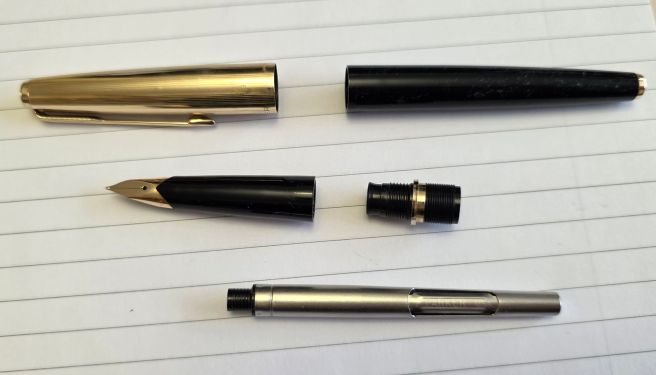
The plastic connector and squeeze bar converter.

I gathered from the online resources mentioned above, that the Parker 65 had some design issues, (not necessarily “flaws”) or – to put it more charitably – things that are helpful to know especially before disassembling the pen. These can be summarised as follows:-

  1. Do not attempt to unscrew the nib and feed from the front. (This will crack the shell).
  2. To remove the nib and feed, you must first take out the connector. If glued into the shell, as it should be, apply some gentle heat to soften the adhesive first (but not too much heat, which may distort and damage the shell).
  3. According to Grandmia pens, the plastic rim of the connector may deteriorate, such that a replacement is needed. (Happily, mine shows no deterioration).
  4. Once the grip section has been separated from the connector, look inside the shell to see what type of tool is needed to remove the collector (not to be confused with connector!). Some have a single groove across the middle, like a screw head, whereas others (such as mine) are squared off on two sides, requiring a small pair of flat sided tweezers to unscrew the collector.
  5. Once the collector is out, the nib and the long feed (terminating in the cartridge piercer), should come out easily through the front of the shell. The gold nib can then be separated from the feed by gripping it with a piece of rubber and sliding it backwards off the feed.
  6. (Although I have yet to disassemble mine) there is a protruding peg inside the shell, at the 12 o’clock position which serves as a locator to insert the feed correctly. This could easily be broken if attempting to unscrew the nib.
  7. When reassembling the pen, the back of the feed, where it meets the collector, needs to be sealed with some liquified/melted wax, otherwise the pen will leak from this point. See Grandmia pens’ video to see how modelling wax is melted and applied to the necessary area.
  8. Note that the lip of the shell, where it extends partly over the face of the nib, is a weak point and can be cracked if too much pressure is applied to the nib. Also, if a gap opens up between the nib and this lip, it can lead to ink flow problems.
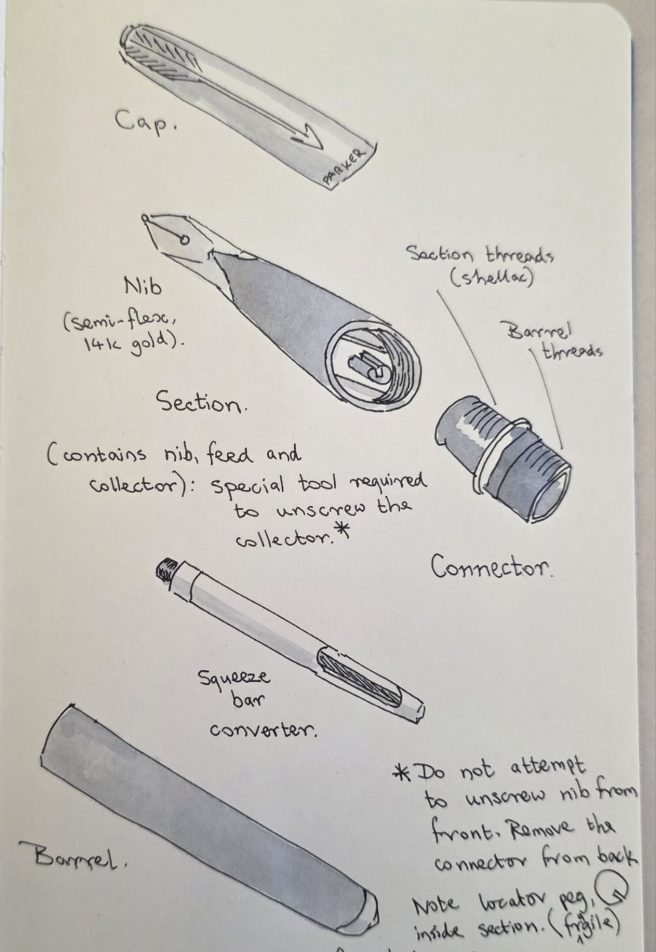
My sketch to show the collector, which is screwed into the shell.

Today, for the first time after uncapping my pen, I noticed green ink on my fingers and I am unsure exactly which part of the pen this came from. I therefore emptied and cleaned the pen. In doing so, I discovered that the connector was not glued in . Whilst this was interesting and saves me from messing around with my heat gun, I now want to complete the disassembly, remove the ink collector, nib and feed and apply fresh wax before reassembling and apply fresh shellac to keep it all in place. Meanwhile I shall avoid putting the pen in my new yellow-plush lined pen case.

Funnily enough, these various design weaknesses only endeared me more to the pen, since it needs looking after. It is still a beauty in my eyes, and although it is still early for such statements, it might just be my favourite Parker pen.
The London Autumn Pen Show, 2026: my haul.

The fountain pen gods have been smiling on me, these last few days. First, I received a lovely Parker 65 in the post from an eBay purchase, which has been a delight. This will be the subject of a separate post later. Then came the excitement of the London Pen Show at the Novotel, Hammersmith on 10 and 11 October 2026.

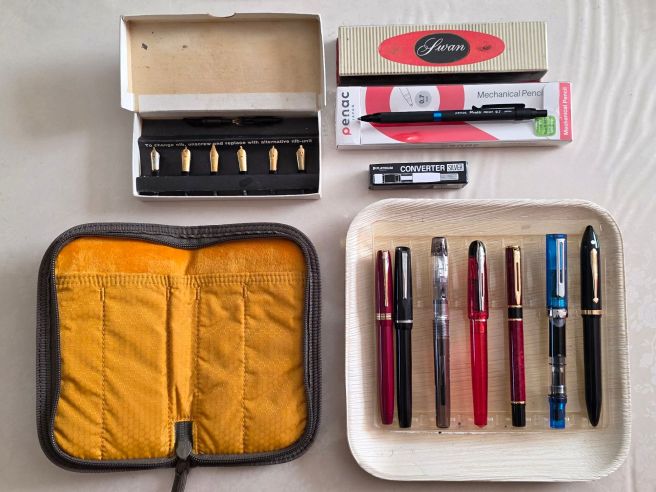
I attended for the first day only. First impressions on arriving were that the show appeared more crowded than usual. But then a lovely thing happened. I met Shauna from our pen club who had very kindly picked up two items for me from the karma table. One was a vintage Swan (more on which later) and the other, an Osmiroid 65 calligraphy pen in a nib tester set, boxed with eight nib units. She handed them to me, to keep or else return to the karma table if I did not want them. Both went in my bag!

My first purchase was from a dealer new to me, Benevis, and was a Waterman Laureat in marbled red, with a lacquered brass body and a steel, medium nib. The Laureat has a distinctive ribbed grip section and a short cap which sits flush with the barrel or posts neatly on the black finial, keeping the streamlined profile. I was not familiar with this model from the 1980’s – 90’s but having bought one, I began to notice several others at the show. It is an attractive and weighty pen, which feels reassuringly solid and writes smoothly.

Waterman Laureat.

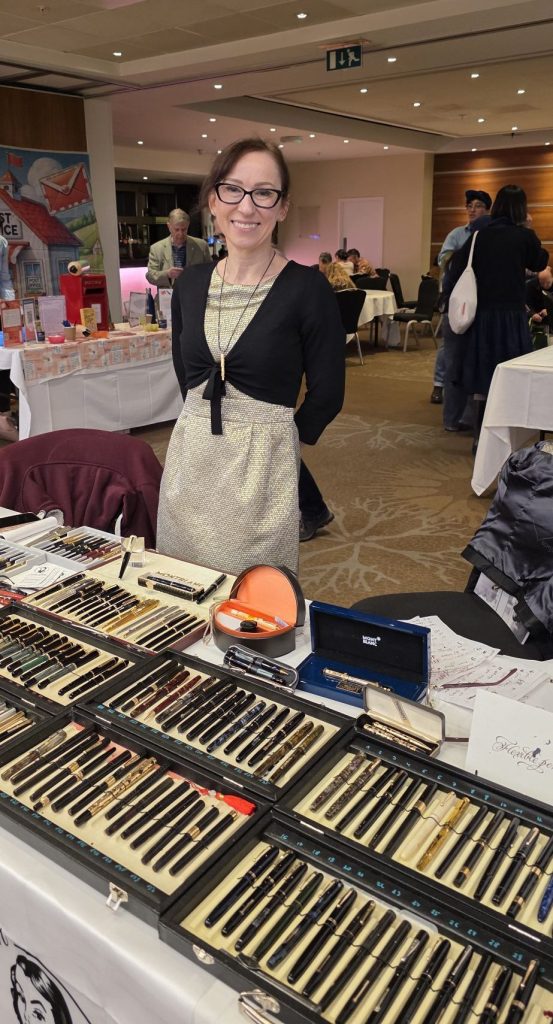
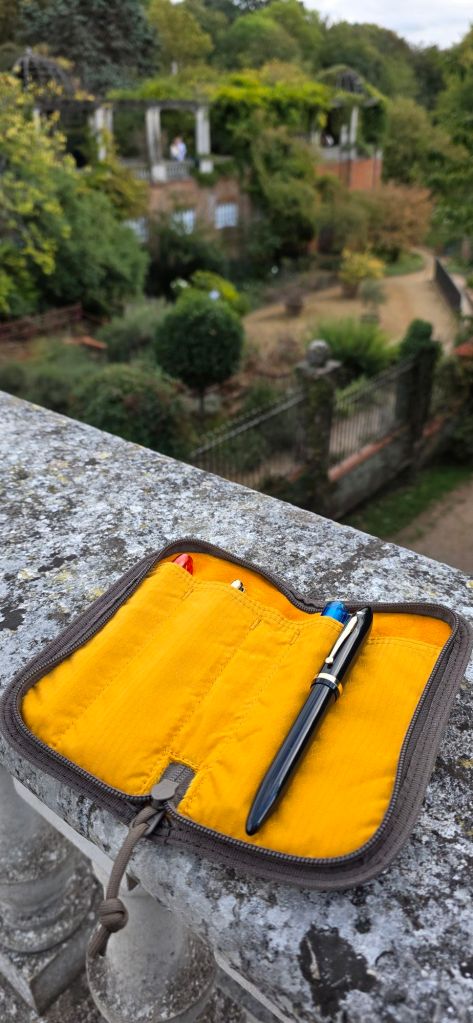
It is always a pleasure to see John Hall and his team at the Write Here tables. From him I bought a lovely zipped pen case, a Lochby Quattro V2, with a brown, waxed canvas exterior and a bright yellow plush velvet lining. It has ample space to carry four or more large pens in individual compartments. This has immediately become part of my daily carry. This is my first Lochby product.

Lochby Quattro V2 pen case (with Sheaffer Balance II).

At the tables of Heritage Collectables, I handled a handsome vintage Sheaffer, black with gold trim, distinctive torpedo-pointed ends and a prominent Sheaffer white dot (which originally signified the Lifetime guarantee). It looked like the classic Sheaffer Balance from around the 1930’s but I learned that it was the Sheaffer Balance II, a reissue from the 1990’s. This has the benefits of the Balance shape but with a cartridge-converter system instead of a lever filler, and also (on this example) a steel nib instead of gold. I did not buy it immediately, as I wanted to look further but returned later in the day and bought it.

At home, I filled it with Diamine Pelham Blue. The nib is a smooth round medium and quite juicy. I am still experimenting whether to write with the cap posted or not posted. At £80.00, the price is similar to what you might pay for a vintage Parker Duofold Senior with a gold nib. However I am very happy with the purchase. It also ‘scratches the Sheaffer itch’ that I had been experiencing for the past few weeks after seeing a modern Sheaffer Legacy online, another reissue of an older design, which I have manfully resisted buying (to date at least).

I went to say hello to Kasia Steer, who had flown in for the show. At her table I tried a new old stock Senator, an interesting vintage German fountain pen with a piston fill or captive converter and a fine flex nib. It was fun to try but my left handed writing does not do justice to flex nibs.

Kasia Steer of penspa.com

I also paid a visit to Ray Walters’ table, and congratulated him on his recent appearance as the fountain pen expert in the BBC program The Repair Shop. In a recent episode, Ray had been tasked with restoring a Swan lever filler fountain pen from the 1940’s which had belonged to the owner’s father during World War II and used to write daily letters to his future wife whilst in captivity for 42 months in a prison camp. He, the pen and the letters survived the war and the couple were engaged and married a few months after war ended.

The pen was missing a cap and needed some nib work and a new sac. Ray succeeded in sourcing a matching cap and got the pen writing once again. The family were most appreciative as the pen had been an important part of their history. After such a touching story, it was somewhat banal of me to buy a new TWSBI Eco from Ray’s table, rather than one of his vintage restored pens that are his usual fare. Ray had taught me on the Writing Equipment Society pen repair course two years ago and is a great tutor.

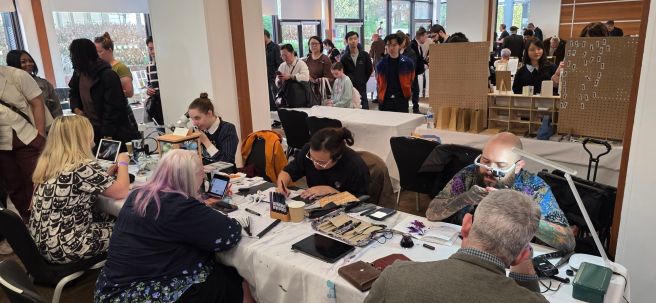
Nibmeisters Annabelle, Thomas and Jose were kept busy all day.

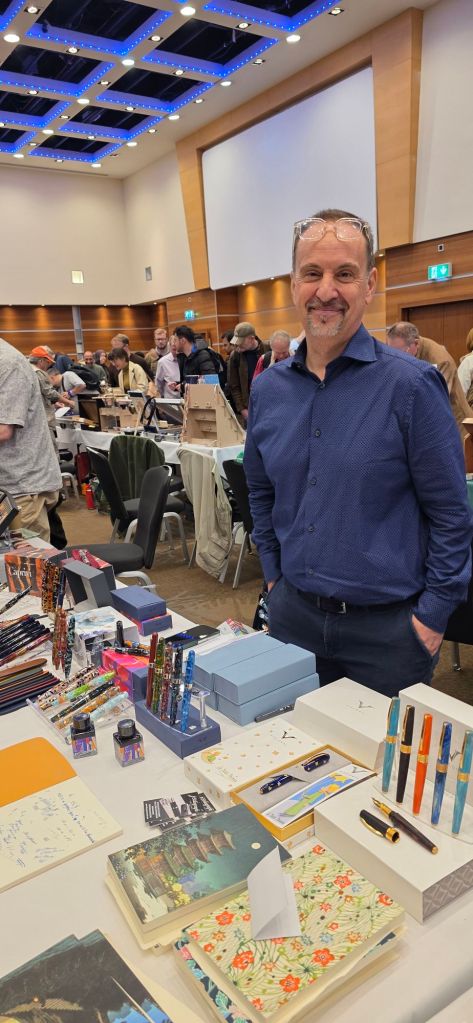
I was pleased to see Stefano Corsani at his table, over from Rome. I had first met him at a previous show in London many years ago and have bought pens from him before. I also paid a visit to his shop in Rome whilst there on holiday last January. Now, he showed me his latest new pen, his collaboration with Leonardo, which was a stunning poliedrica (polyhedron) ‘Caprivi’ piston fill fountain pen with a number 8 steel nib. The cellulose acetate material combined tortoise-shell colours with clear patches and areas of zebra stripes. The multifaceted design, including triangular sections blending into rounded ones, the number 8 nib and the piston filler, had been a challenge for Leonardos’ craftsmen. I did not buy one, the price being over my budget for an impulse buy but I was pleased to learn later that David from our pen club had purchased one the following day and so I hope to try it at some point. I understand from Stefano’s website that only around 75 will be made.

Stefano Corsani from Rome.

In contrast, I made a few extremely modest purchases: a Waterman Kultur from Appelboom’s tables (they had trays of these in translucent blue or translucent red, at a no-brainer price of £5.00) and from Cult Pens, a new Platinum Preppy 0.2 (EF) for just £4.50, which I use for sketching with Platinum Carbon Black ink. The Platinum converter for it at £10.00 cost more than twice the cost of the pen.

At the Penac table (a Japanese brand new to me) the vendor said apologetically that they were ‘a table of pencils, in a sea of fountain pens’. However I am very partial to a mechanical pencil. I tried a model called the Penac Protti, in a 0.7 and was immediately impressed by the weight, the knurled and front-weighted grip section and the rubberised barrel. Its features include a cushioned writing point. It was different enough from my Pentel GraphGear 1000 and Rotring 600 (which live on my desk) and sufficiently appealing to justify its £18.00 price, which compares favourably to the modern Rotrings. They also had for sale, an impressive multi-pen with two colour ball points plus pencil in a very slender barrel.

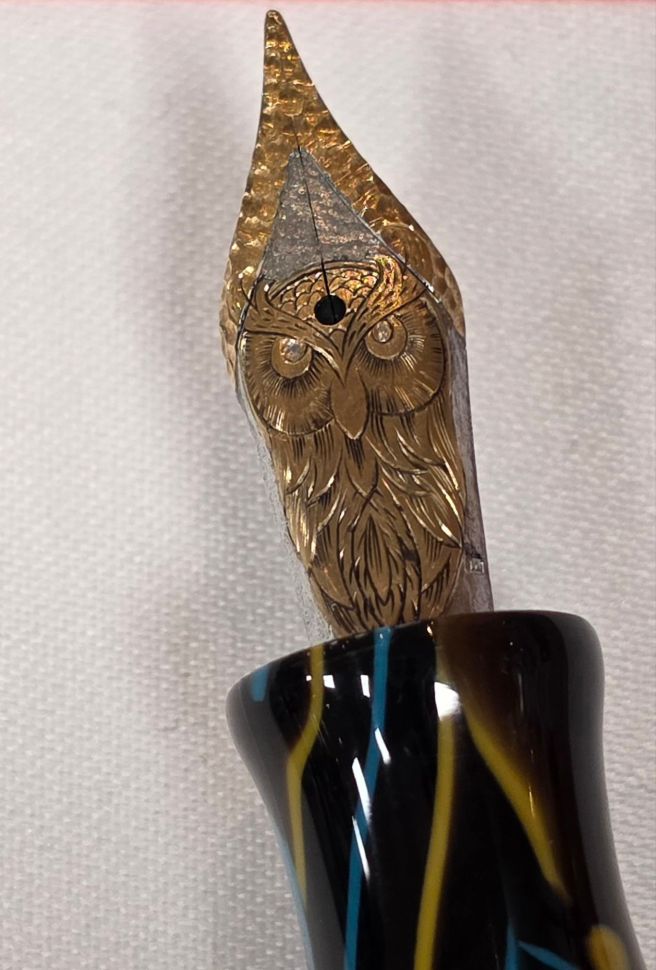
This owl engraved nib was on the table of Vazir pens of India.

As the show wound up, a group of us met to chat by the hotel bar and to see each other’s purchases. My stash, including Shauna’s karma table finds, looked a lot whereas others had made targeted, higher value purchases such as Monica’s vintage Monblanc 149, Kim’s special edition Pilot Capless and Baran’s Pelikan M805 in blue and black. My acquisitions had all been unplanned, random and fun but very pleasing. I am feeling very grateful for my modest haul and for all the friends and acquaintances whom I saw during the day.

Saturday’s haulage.

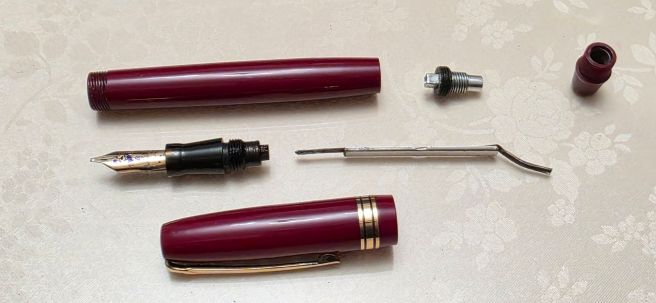
At home I have examined the Swan pen more closely. I have not yet identified the precise model and do not have experience of this filling system. It uses a collared rubber sac, compressed and released by a spring bar in the barrel but without a lever. Instead the sac is compressed by turning a knob at the end of the barrel: anti-clockwise to empty the pen and then clockwise to release the sac and fill the pen. I have enjoyed disassembling the pen. It needs a new sac. There is none in the pen, not even any remnants of one. The spring bar and the turning knob need to be reassembled in the correct way and in the correct sequence. This feels a bit confusing at the moment. Meanwhile I have enjoyed trying the pen dipped (with the innards removed). The number 2, 14k gold stub nib writes a very nice line. Sometimes the best things in life are free, or close to it like the Kultur and the Preppy – both of which also write well and are fun to use.

A Swan leverless – a work in progress.