A Pelikan Hub recap, London UK, 2026.

Well, that’s a wrap for this year’s Pelikan Hub. This event, the annual simultaneous gathering of fountain pen enthusiasts in cities around the globe and orchestrated by Pelikan, took place on Friday 25 September 2026.

For us Londoners, the venue chosen by our Hubmaster was The Grocer, a spacious English pub located in a corner of Spitalfields market, a short walk from Liverpool Street station. In fact we had two Hubmasters, as the London registrants numbered around 130, I think. A large section of the pub’s seating area was cordoned off for our event.

Officially, the Hub runs from 6.30pm to 8.30pm, local time. Those organising were there much earlier to set up tables. Every person registered and attending receives a nice goody bag from Pelikan (which the Hubmasters bring to the chosen venue, – no small achievement). Aside from setting up spaces for fellow pen-lovers to sit and meet each other, there were designated tables for ink swatching and a Karma table where people could donate items such as preloved pens, inks, washi tapes, notebooks, rubber stamps and other stationery items, for others to take home.
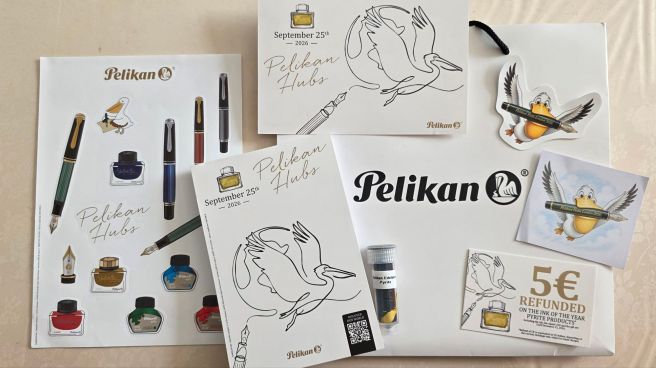
The goodies awaiting this year’s London attenders.

Our Hubmasters and a few other helpers, had worked hard to make the event an entertaining and enjoyable one for all, whether seasoned pen addicts or newbies. A few of us had been appointed as Hub Ambassadors (identified by name tags on purple lanyards) to be a point of contact for any newcomers who might not know anyone. I was one. With so many in attendance, there can be a natural temptation for folks to gravitate towards those they already knew. Most of our London Fountaineers pen club members were present, save a few who were overseas or tied up with work. However, it was good to see so many newcomers mingling and being welcomed.

I brought along my own flock of Pelikans, numbering seven fountain pens. Aside from my M205 and M800 most of these had been gifted to me by generous friends. The green and black M120 was a gift from a doctor in Sweden who reads my blog and whom I had not even met. We have since enjoyed corresponding for many years.
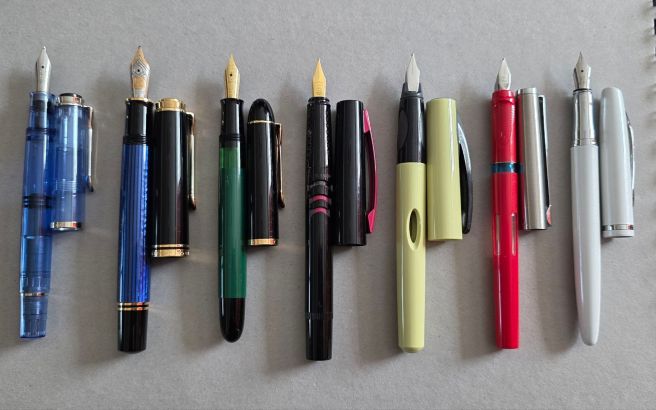
My Pelikan flock.

During the evening I was able to try a few other less common Pelikans, including a beautiful vintage model with a tortoiseshell barrel and a gold coloured metal cap, belonging to José.
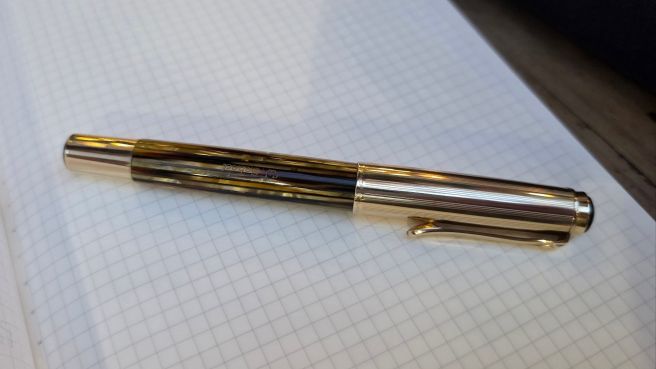
A lesser-spotted Pelikan 500 from about the 1950’s.

During the evening, I met several new people, including Lawrence, a police officer who introduced himself as a reader who enjoys my blog – which was very gratifying to hear. Later I made a rough tally of people I had spoken to in the evening: it was at least 26, which is a lot of conversations for someone usually leading a quiet, retired life!

The two hours soon went by. There were many other people to whom I did not get to speak but I hope that others found them and no one felt left out. A shared passion for fountain pens (not limited to Pelikans) makes a lively topic for conversation, often before learning people’s names and occupations.
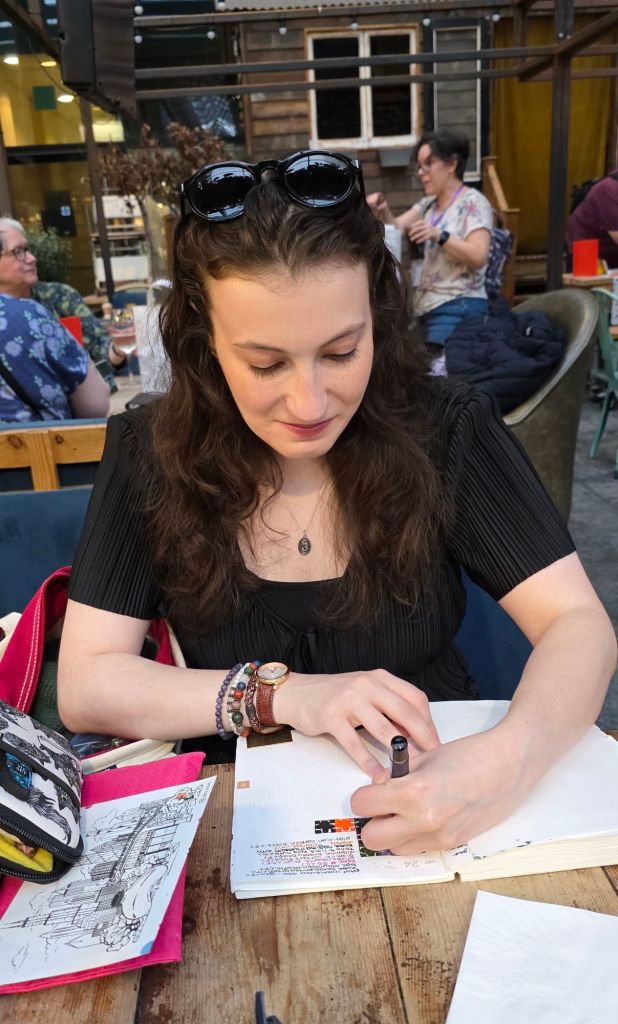
A fellow lefty tries my Pelikan M800.

Towards the end of the gathering, anyone who had not yet done so was reminded to sign the Pelikan banner. A free raffle took place, during which time a large number of prizes were given out. Two of these were fountain pens: one a John Garnham maker’s pen in a colourful resin, won by Biran. This had been donated several years ago but a tradition developed whereby the lucky winner would be custodian of the pen for a year and then return it to be raffled again at the Hub the following year. The same took place with The Good Blue R615 fountain pen generously donated by the brand last year and first won by me. This was won by a new custodian who also welcomed the idea of returning it next time.

With all the mingling and conversations, I took barely any photographs during the evening. However a photographer was on hand to provide a record of the event. Also a large group photo was taken at the end of the evening.
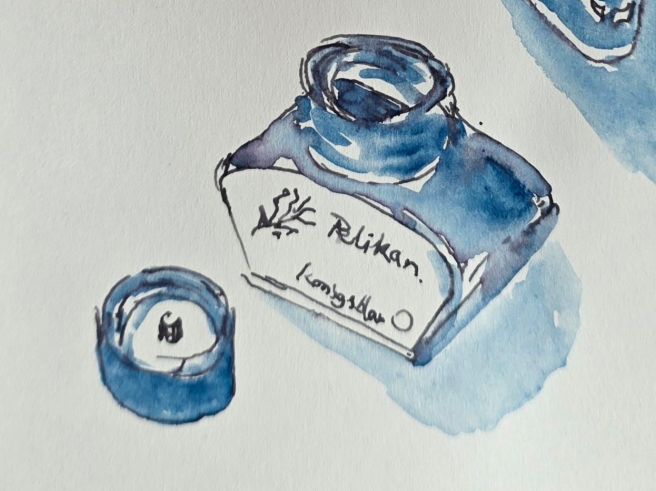
In the absence of photos of the event, here is a sketch I made earlier.

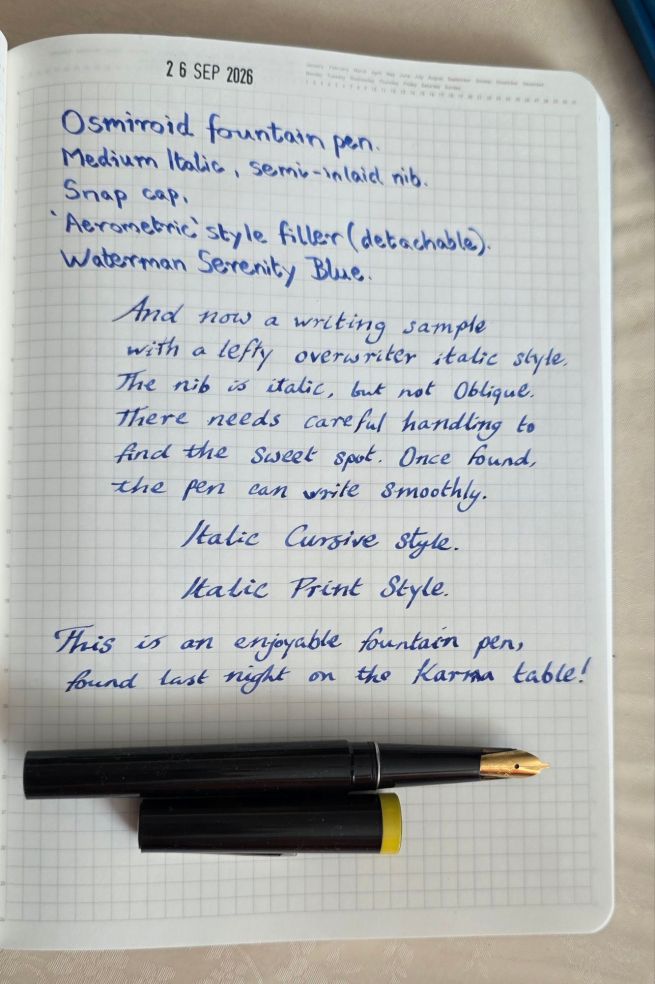
Before leaving, people were reminded to visit the Karma table to take something for themselves or a friend. I had contributed a number of my old “beginner” pens. Being long past the stage of needing any more pens, I still could not resist an old Osmiroid calligraphy pen from the table, in black with ecru-coloured plastic cap band and a semi-inlaid medium italic nib. I have today enjoyed giving it a good rinse and testing it out, inked with a soothing Waterman Serenity blue. However many pens you have, there is always room for one more, especially if in need of a bath and a new home.
As always, thanks to our Hubmasters Kee and Shauna, the many others who helped, to The Grocer pub for the use of their cosy venue, to Pelikan for facilitating and for the goodies – and to all who attended: who together make this such a much loved and anticipated annual event.
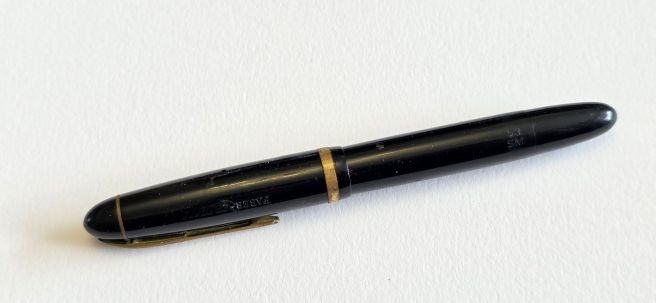
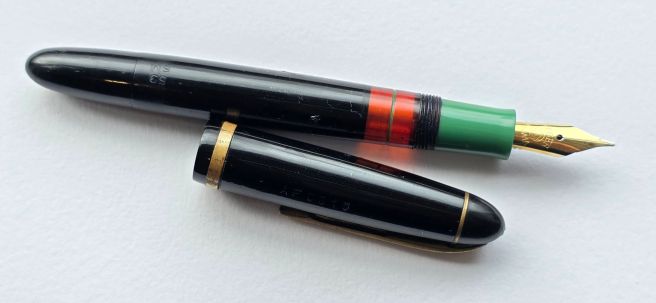
My encounter with the Osmia Faber Castell 53SM, vintage fountain pen.

First, let me say that this post will not tell a heroic story of me nursing a sixty year old pen back to its former glory. Life is not always like that. Unfortunately I have not yet been able to get the pen working again. But it has not been a complete disaster. The pen is an interesting one and I think the story is still worth telling.

I had largely got out of the habit of searching eBay for vintage pens, as I find it very addictive and never-ending. However, on a recent bit of idle scrolling, I spotted this Osmia Faber Castell pen, at a modest price of £21.50. The seller provided only three photographs. The ‘Additional Description’ just referred back to the photographs and invited questions if a buyer had any doubts. I sent a few questions such as whether the piston was working and whether the pen filled and was usable or needed repair. After a gentle reminder, the seller replied that he did not have the knowledge or skill to answer my questions. I decided to take a chance and buy it anyway, figuring that it would either be usable or an interesting repair project.

Osmia Faber Castell 53SM fountain pen.

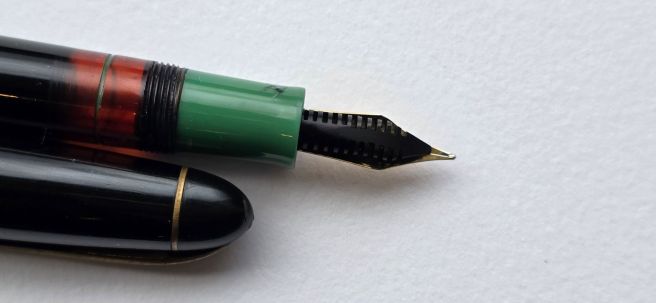
The pen arrived a couple of days later. The pen dates from a time when Faber-Castell was in the process of acquiring the Osmia pen company, which was finalised in the 1960’s. I found the pen interesting for several reasons. I had not come across Osmia pens before and knew nothing of the firm’s history or its range of pens. This was a story waiting to be discovered. The pen itself looked appealing – with a black cap and barrel, rounded ends, a contrasting green grip section and an amber coloured ink window (with a green filled groove in the middle). The pen is a piston filler. The piston knob is accessed by removing a blind cap.

Attractive green section and amber ink window.

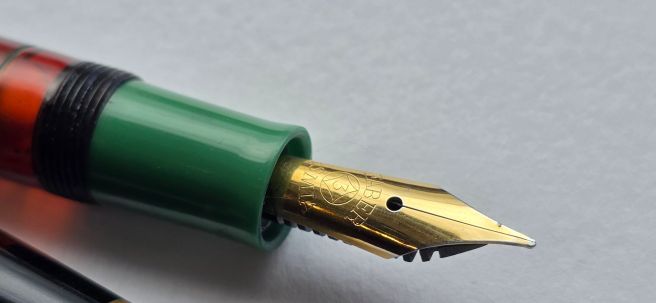
The nib has an imprint FABER OSMIA and a figure 3 inside Osmia’s diamond shape logo. The nib is not gold but has gold coloured plating and is set on a feed which I think is ebonite. The nib and feed appeared to be in good condition.

The Osmia #3 nib.
An ebonite feed, I think.

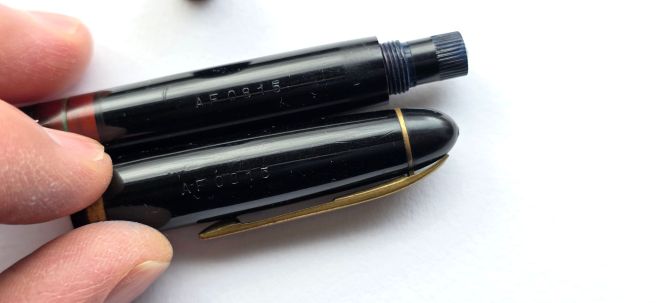
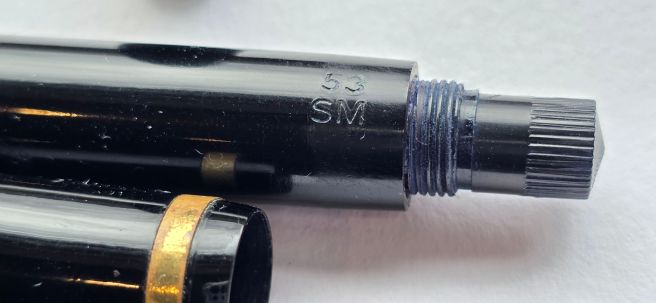
The cap has an imprint FABER CASTELL and what I presume to be a serial number, AF0815. The barrel also has an imprint of this same serial number, as well as a model number, of 53SM just before the blind cap. It is rather nice to have the serial number on both cap and barrel, to know that they are an original pair.

Matching serial numbers on cap and barrel.

On arrival the piston knob would not turn. I stood the pen in a jar of water overnight, to soak the nib and feed with a view to extracting them. When I returned, I found that water had reached the reservoir. Whether this was by capillary action up through the nib and feed, or else by a leak in the pen, I am not sure. However it was nice to see liquid sloshing around in the pen, even if it was not ink! I tried to let the water moisten the piston to allow me to raise and lower it, but it would not budge. I then put the pen to soak again, but this time horizontal and with the entire barrel immersed.

After a night’s soak, I tried pulling the nib and feed out. To my delight and relief, they came out very easily at the first attempt. I could then introduce some silicone grease, on the tip of a tooth pick, onto the piston head and the inside walls of the ink reservoir.

I was later able to get the piston knob turning freely and I could watch the piston travel up and down. This seemed promising. Nothing was broken. But whilst the piston now moved up and down, it did so too easily and was not airtight. Consequently it would not pull a vacuum and could not draw ink up into the barrel. I surmised that a cork piston seal had perished. To repair the pen I would need to first remove the piston mechanism, replace the cork seal and then insert it back into the barrel. This sounded like a fun but satisfying challenge.

Model number 53SM imprint.

One new feature of this repair story for me, was that I made use of AI. I asked Chat GPT for information on the history of the Osmia pen company. An interesting response came back. The AI lady (I assume she is a lady!) was most enthusiastic about my purchase and I learned that Osmia nibs were very well regarded.

Unfortunately, I have not yet been able to remove the piston from the barrel. As well as soaking in water, I tried applying some gentle heat with a heat gun to soften the glue. Despite this I have not been able to unscrew and remove the piston mechanism. I am anxious not to force it and break it. Given the age of the pen it would be very easy to crack the piston shaft or the barrel if inappropriate force is used. I am not sure whether the piston housing is even designed to unscrew, and if so, which way. With a vintage pen, there is also a risk that a repair may have been carried out in the past and some unsuitable glue used that does not readily loosen, and so it is wise to proceed with caution. As doctors say, ‘First do no harm.’

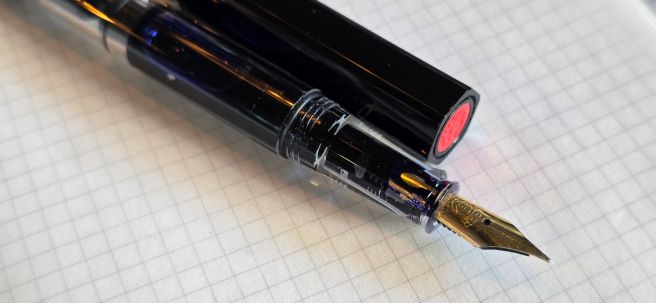
The good news however, is that I have been able to use and enjoy the lovely Osmia nib, by inserting it in a TWSBI Eco. Now, the nib is served by a fully working piston filler barrel and a fill of Pelikan 4001 Konigsblau, which seemed like a suitably German, school-friendly ink that it might have been used to.

The Osmia nib now in its new TWSBI Eco home.

And so all is not lost. I did not break the pen. The nib is writing and now enjoys a large capacity, demonstrator barrel and section. I am using the TWSBI’s own plastic feed. Care is needed when swapping nibs to ensure that there is enough headroom in the cap for the intended nib. The nib has settled well in the TWSBI and I enjoy using it. There is plenty of wear left in the nib. It is a firm nib but writes smoothly and with good flow and a medium width line, once the sweet spot is found.

I have not given up on the piston repair. If anyone has any advice on servicing a piston on this model, kindly let me know in the comments!