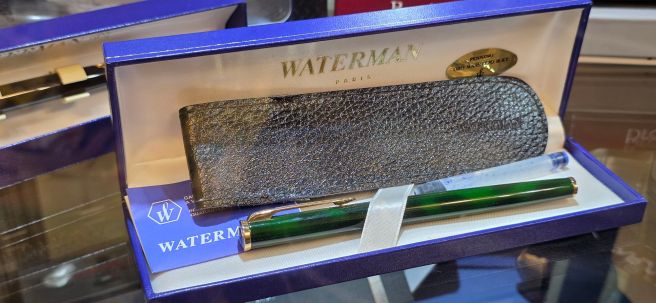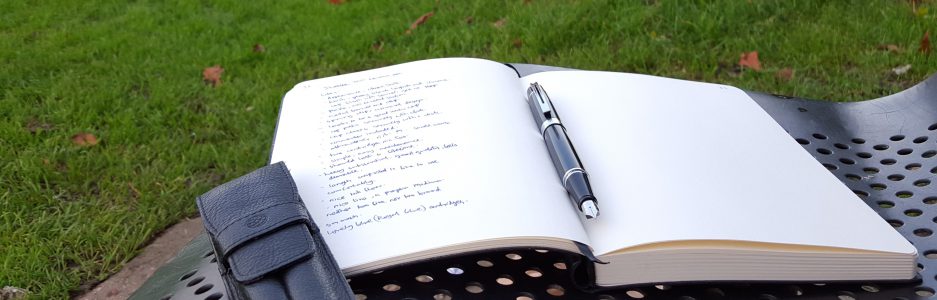
This blog has typically been about fountain pens, as the name suggests. The subject matter has been about whatever pen or related topic happens to be occupying my mind at the time. In this way I have shared my enthusiasm on the subject of fountain pens, which continues to be a major hobby for me.
Over the last year or so, my old hobby of watercolour sketching has blossomed again unexpectedly. This was a pastime that I had dipped into only sporadically, whilst my working life took up much of my time and energy. Since retiring from work, I have rediscovered the simple joy of drawing and painting. fuelled by the online community of enthusiasts and the ease of finding encouragement, tips and inspiration online.
My fountain pen hobby came with a good dose of Gear Acquisition Syndrome! Whilst this has mostly subsided, I now find the symptoms spilling over into the realm of art supplies. I have a weakness for nice sets of watercolour half pans, especially if the word “travel” is included in the name.
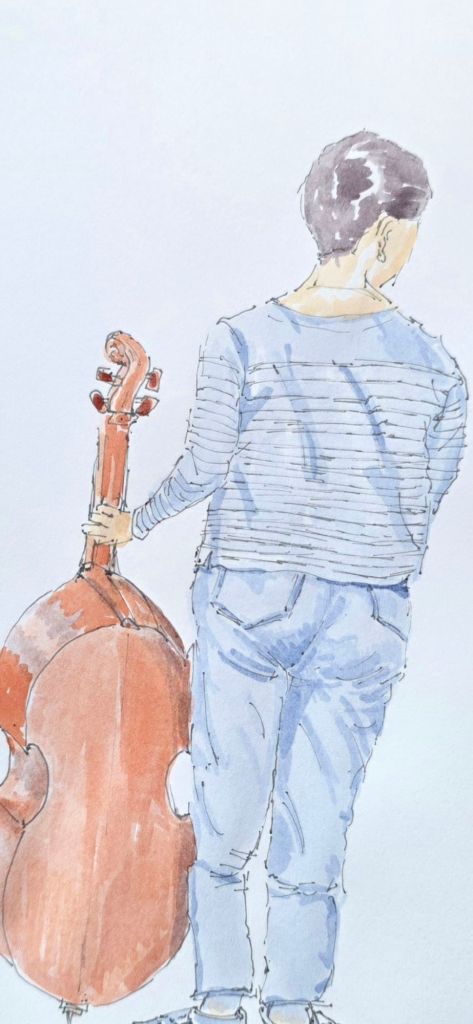
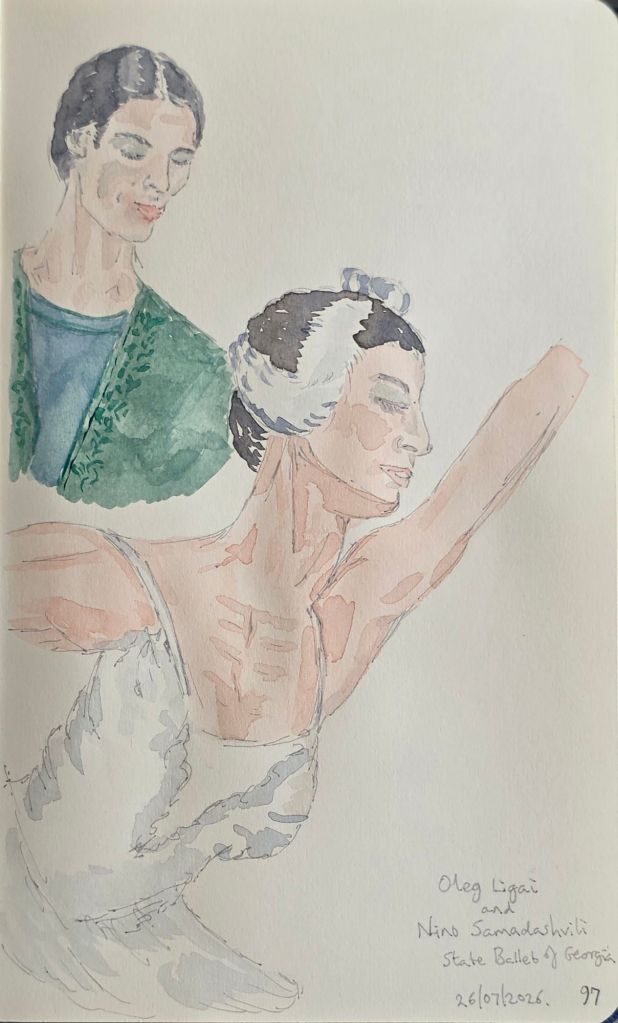
During the past year or so, I have been fortunate to attend many orchestral concerts, and a few final rehearsals, particularly at the Royal Festival Hall on London’s Southbank. As well as enjoying the music, there is the spectacle and I began to draw a few of the musicians from photographs taken before or after the performances. Violins and cellos are a fun challenge to draw.
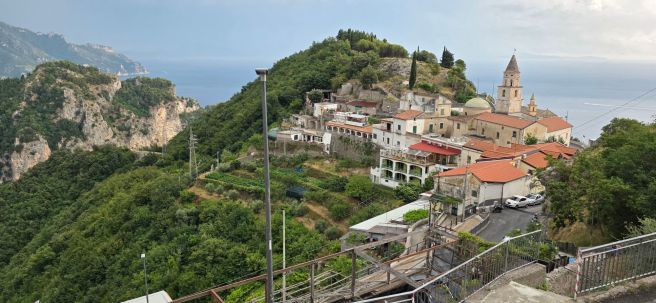
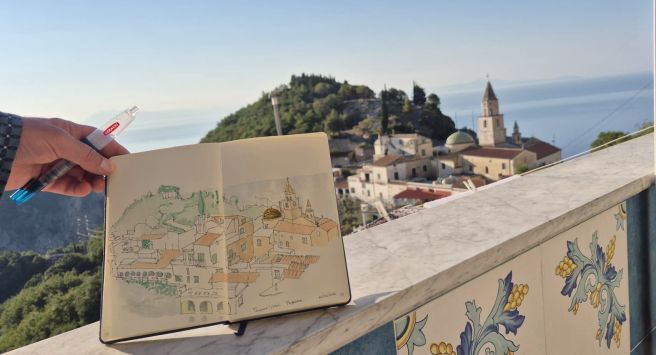
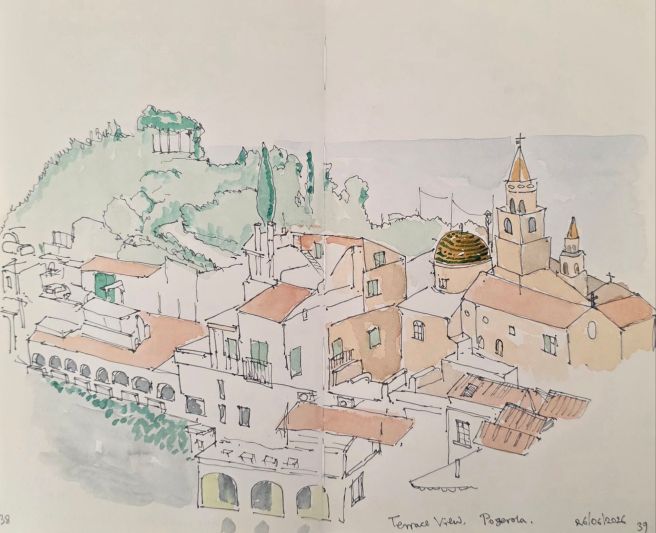
And then this summer, I decided to bring a sketch book and some watercolours on holiday. This was not the first time I have done so, but it was the first time that I actually used them daily. This soon became a habit and I liked to do at least one picture a day.
One principle which helped me is that in sketching, you are not trying to create a masterpiece. It does not have to be “good.” You are creating something, purely for your own practice, relaxation, enjoyment and satisfaction. The same might go for playing a musical instrument at home. That being the case, it is fine to make mistakes. Indeed mistakes are inevitable but I have taken the advice, to not mind making them. If I try to correct something, it often makes it more obvious. Keeping the work, with the mistake, serves as a reminder as to what went wrong and helps you to improve.
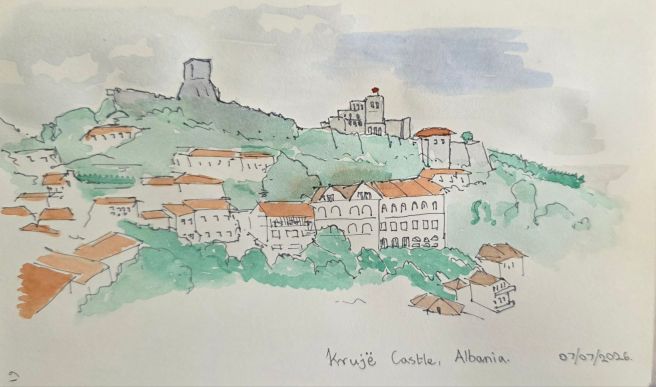
I make no claim to be proficient enough to teach anyone how to approach travel sketching. I can only share my own experience and say what works for me. There are plenty of others who offer tutorial videos online. I enjoy @tobysketchloose on YouTube, for example. From watching these I gained a better understanding of perspective. I also picked up a couple of alternative techniques for making a picture, such as (1) breaking a complex scene into simple shapes: a row of buildings with intersecting roof lines can be simplified into a series of adjoining rectangles, squares, triangles and so on, from which you move from one to the next. Alternatively, (2) quickly map out the outline of the entire scene using a pen and ink, without lifting the pen off the paper. You then have the whole composition outlined within a couple of minutes.
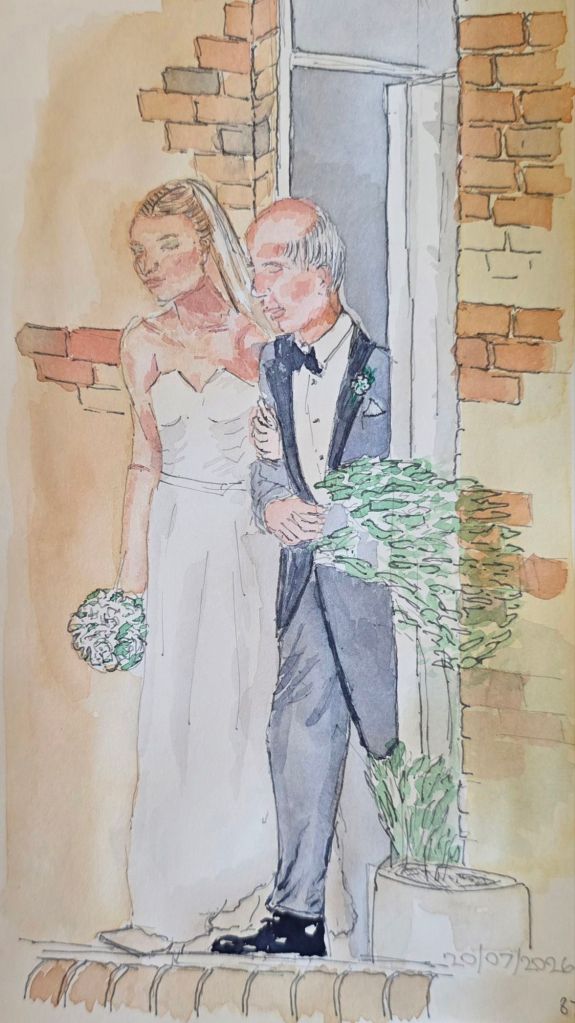
The point is, sketching does not have to be complicated. We are just trying to capture an image, for our own records or to show someone else what we saw. It can become daunting to think of all the related topics, such as composition, perspective, proportion, architecture, anatomy, materials and how to use them, use of light and shade, texture, and colour mixing. This can easily become off-putting and deter us from ever starting. But I found it liberating to not worry about mistakes and to enjoy painting with a simple aim of amusing myself, improving with practice and having the satisfaction of creating something to be a bit proud of.
I do feel that I have progressed, when looking back at sketches that I made a year ago. Another nice thing about it is that you look at things with new eyes. Visiting a quiet church while on holiday, for example, you may sit down for a while and try to sketch a dome, or an interesting intersection of walls and roof details.
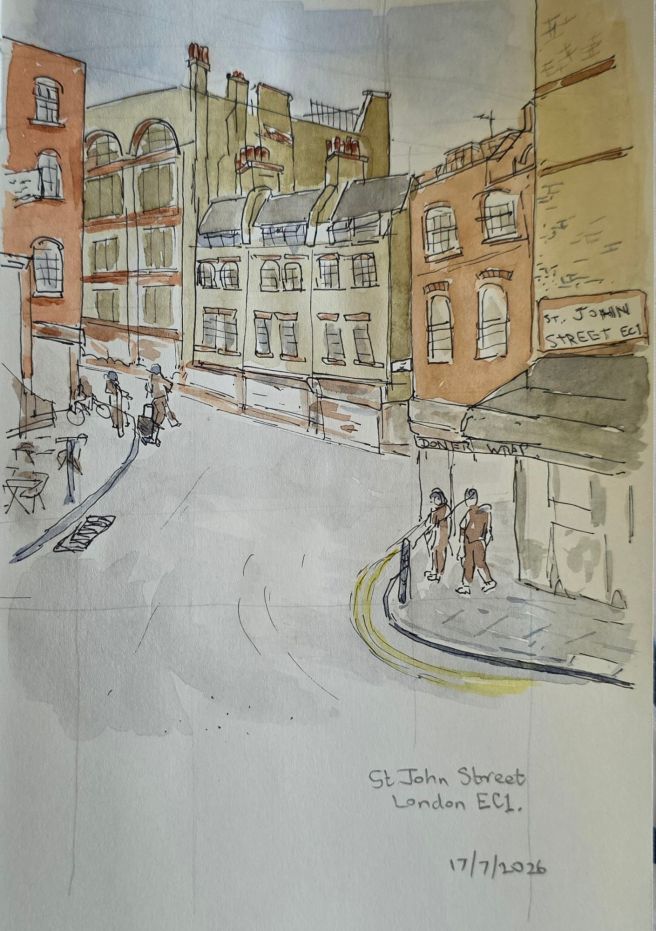
Here is another thing: even when you are not sketching, (for example, whilst waiting for a bus, or held at a red light on the road) you may look at the scenery and imagine how you might sketch it. You may improve your technique even without picking up a paint brush!
I also find sketching to be nicely absorbing and therefore relaxing. Unlike reading a book or watching a film (where we are consumers), in drawing and painting we become creators, which is cool and must be a good thing.
As for materials, the kit that I took on holiday recently consisted of an A5 sketch book, with 160 pages of plain paper of 140gsm from Talens, Art Creation (sold in TK Maxx), and a pocket set of 12 half pans of Aquafine watercolours, from Daler Rowney (which are student grade, not artist quality). I brought a collapsible cup for water although in practice I used this only in our accommodation. Whilst outdoors, I used water brushes from Derwent. It was the first time I had tried the water brushes and I found them very convenient and better than expected.
This set up was deliberately compact, lightweight and inexpensive. I found the paper quality to be pleasant enough to use and I did not want to have an expensive book or block of top quality paper that might make me afraid of messing it up. Occasionally, where I have later wanted to have a picture on better quality paper, I have treated the sketch book version as a practice and then made the picture again – hopefully with tweaks here and there to avoid the same mistakes.
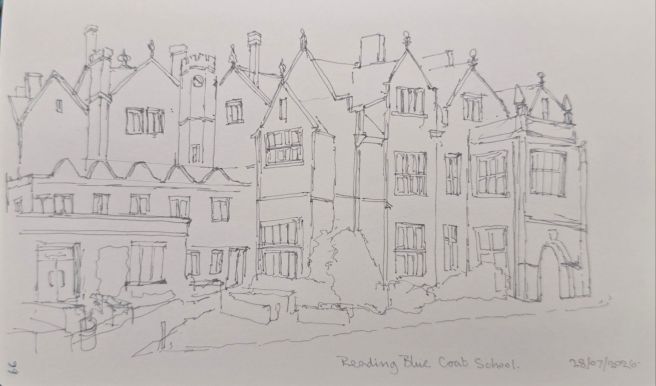
So, how to get started and what to sketch? My sketch book contains mostly people, buildings and landscapes. It is not helpful to say “sketch anything!” but there is really no limit. A picture can be made, ideally, from life but failing that, from a photograph or even from memory. If drawing on location, I find it helpful to take a photograph too, and perhaps to add the colour later. I would suggest that you may paint anything that you find interesting or attractive or a bit challenging. And not to be disheartened if it does not turn out as hoped. You can always start a new page or try something else tomorrow. To borrow a marketing slogan, “Just do it.”