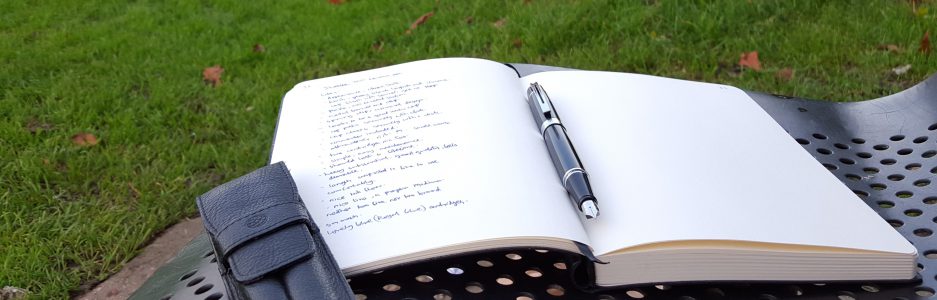
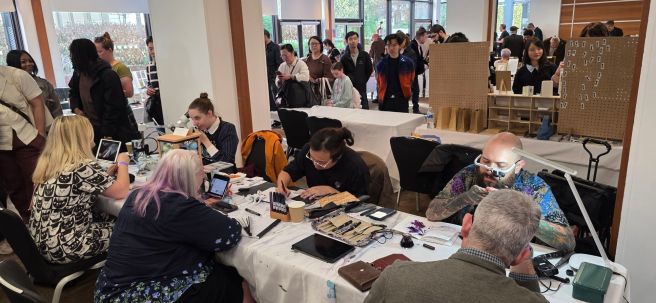
The fountain pen gods have been smiling on me, these last few days. First, I received a lovely Parker 65 in the post from an eBay purchase, which has been a delight. This will be the subject of a separate post later. Then came the excitement of the London Pen Show at the Novotel, Hammersmith on 10 and 11 October 2026.
I attended for the first day only. First impressions on arriving were that the show appeared more crowded than usual. But then a lovely thing happened. I met Shauna from our pen club who had very kindly picked up two items for me from the karma table. One was a vintage Swan (more on which later) and the other, an Osmiroid 65 calligraphy pen in a nib tester set, boxed with eight nib units. She handed them to me, to keep or else return to the karma table if I did not want them. Both went in my bag!
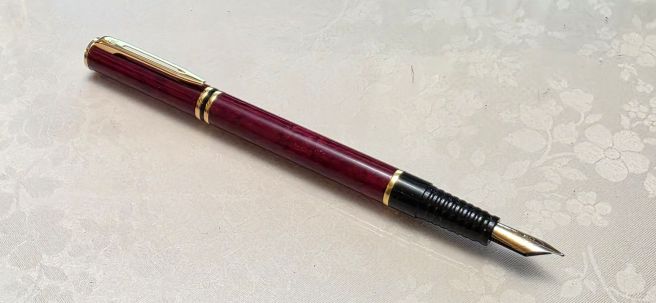
My first purchase was from a dealer new to me, Benevis, and was a Waterman Laureat in marbled red, with a lacquered brass body and a steel, medium nib. The Laureat has a distinctive ribbed grip section and a short cap which sits flush with the barrel or posts neatly on the black finial, keeping the streamlined profile. I was not familiar with this model from the 1980’s – 90’s but having bought one, I began to notice several others at the show. It is an attractive and weighty pen, which feels reassuringly solid and writes smoothly.
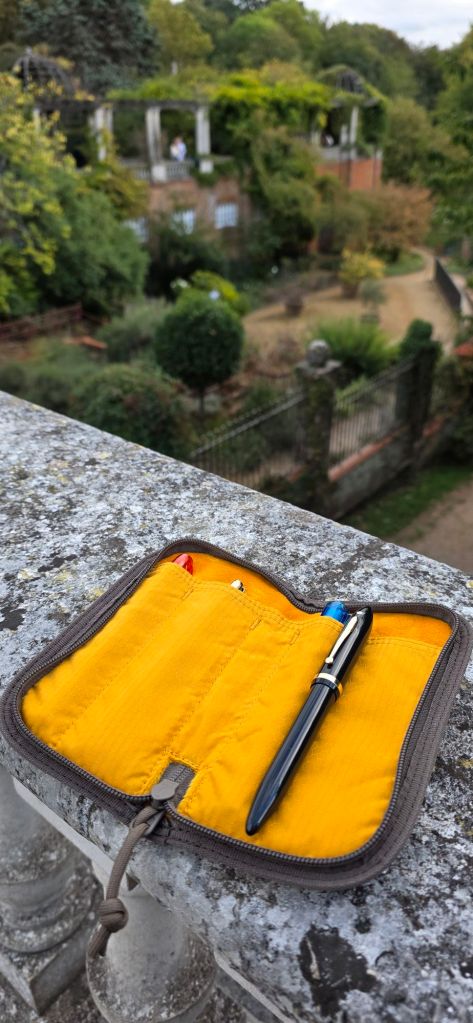
It is always a pleasure to see John Hall and his team at the Write Here tables. From him I bought a lovely zipped pen case, a Lochby Quattro V2, with a brown, waxed canvas exterior and a bright yellow plush velvet lining. It has ample space to carry four or more large pens in individual compartments. This has immediately become part of my daily carry. This is my first Lochby product.
At the tables of Heritage Collectables, I handled a handsome vintage Sheaffer, black with gold trim, distinctive torpedo-pointed ends and a prominent Sheaffer white dot (which originally signified the Lifetime guarantee). It looked like the classic Sheaffer Balance from around the 1930’s but I learned that it was the Sheaffer Balance II, a reissue from the 1990’s. This has the benefits of the Balance shape but with a cartridge-converter system instead of a lever filler, and also (on this example) a steel nib instead of gold. I did not buy it immediately, as I wanted to look further but returned later in the day and bought it.
At home, I filled it with Diamine Pelham Blue. The nib is a smooth round medium and quite juicy. I am still experimenting whether to write with the cap posted or not posted. At £80.00, the price is similar to what you might pay for a vintage Parker Duofold Senior with a gold nib. However I am very happy with the purchase. It also ‘scratches the Sheaffer itch’ that I had been experiencing for the past few weeks after seeing a modern Sheaffer Legacy online, another reissue of an older design, which I have manfully resisted buying (to date at least).
I went to say hello to Kasia Steer, who had flown in for the show. At her table I tried a new old stock Senator, an interesting vintage German fountain pen with a piston fill or captive converter and a fine flex nib. It was fun to try but my left handed writing does not do justice to flex nibs.
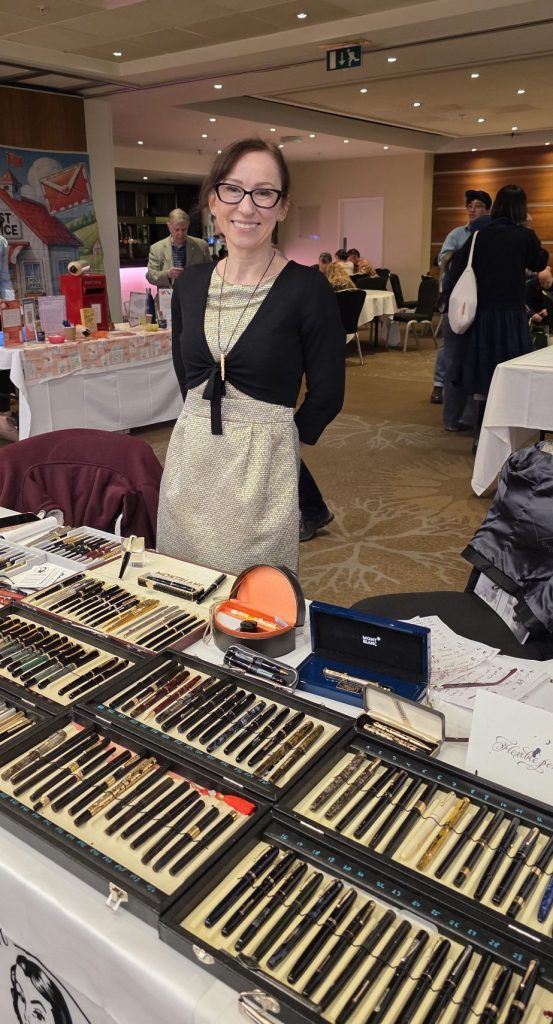
I also paid a visit to Ray Walters’ table, and congratulated him on his recent appearance as the fountain pen expert in the BBC program The Repair Shop. In a recent episode, Ray had been tasked with restoring a Swan lever filler fountain pen from the 1940’s which had belonged to the owner’s father during World War II and used to write daily letters to his future wife whilst in captivity for 42 months in a prison camp. He, the pen and the letters survived the war and the couple were engaged and married a few months after war ended.
The pen was missing a cap and needed some nib work and a new sac. Ray succeeded in sourcing a matching cap and got the pen writing once again. The family were most appreciative as the pen had been an important part of their history. After such a touching story, it was somewhat banal of me to buy a new TWSBI Eco from Ray’s table, rather than one of his vintage restored pens that are his usual fare. Ray had taught me on the Writing Equipment Society pen repair course two years ago and is a great tutor.
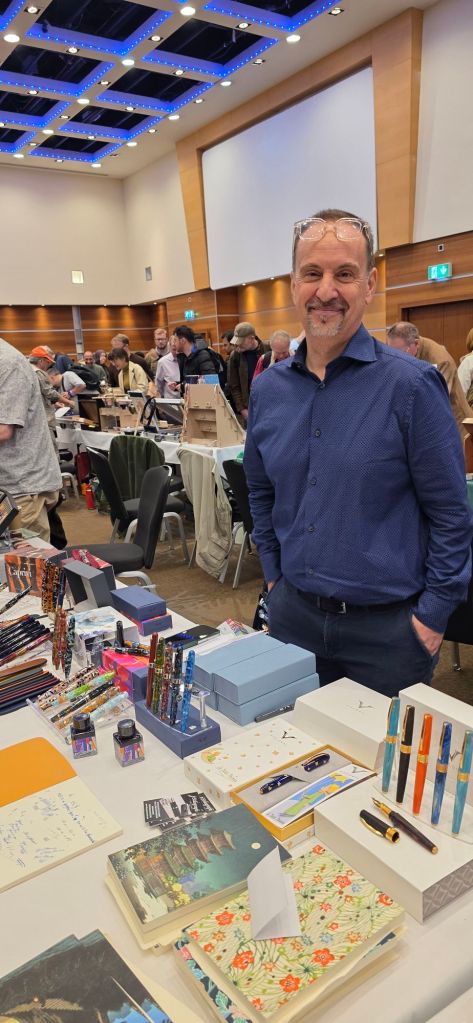
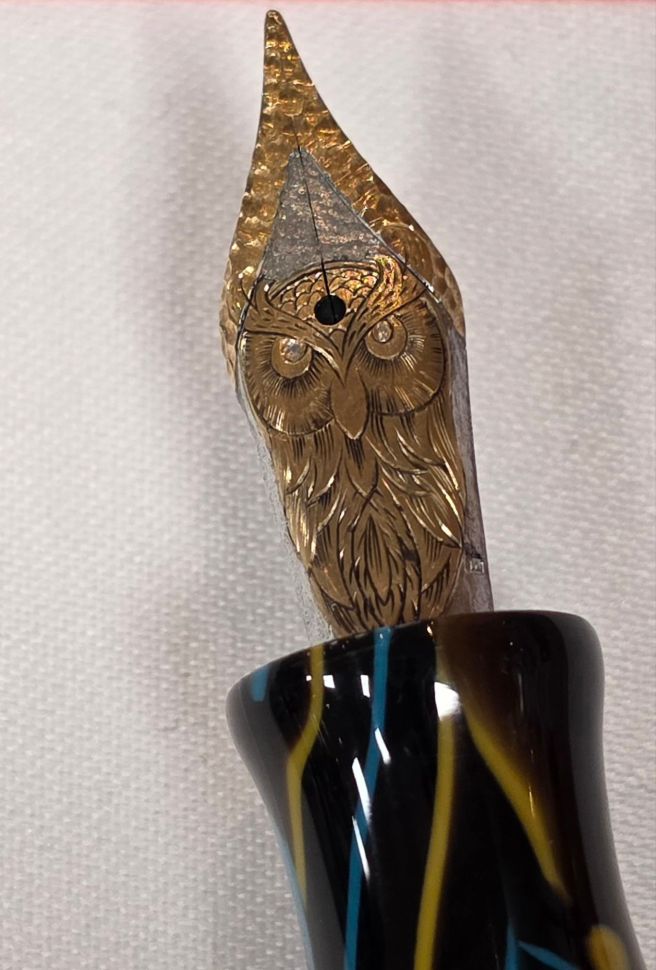
I was pleased to see Stefano Corsani at his table, over from Rome. I had first met him at a previous show in London many years ago and have bought pens from him before. I also paid a visit to his shop in Rome whilst there on holiday last January. Now, he showed me his latest new pen, his collaboration with Leonardo, which was a stunning poliedrica (polyhedron) ‘Caprivi’ piston fill fountain pen with a number 8 steel nib. The cellulose acetate material combined tortoise-shell colours with clear patches and areas of zebra stripes. The multifaceted design, including triangular sections blending into rounded ones, the number 8 nib and the piston filler, had been a challenge for Leonardos’ craftsmen. I did not buy one, the price being over my budget for an impulse buy but I was pleased to learn later that David from our pen club had purchased one the following day and so I hope to try it at some point. I understand from Stefano’s website that only around 75 will be made.
In contrast, I made a few extremely modest purchases: a Waterman Kultur from Appelboom’s tables (they had trays of these in translucent blue or translucent red, at a no-brainer price of £5.00) and from Cult Pens, a new Platinum Preppy 0.2 (EF) for just £4.50, which I use for sketching with Platinum Carbon Black ink. The Platinum converter for it at £10.00 cost more than twice the cost of the pen.
At the Penac table (a Japanese brand new to me) the vendor said apologetically that they were ‘a table of pencils, in a sea of fountain pens’. However I am very partial to a mechanical pencil. I tried a model called the Penac Protti, in a 0.7 and was immediately impressed by the weight, the knurled and front-weighted grip section and the rubberised barrel. Its features include a cushioned writing point. It was different enough from my Pentel GraphGear 1000 and Rotring 600 (which live on my desk) and sufficiently appealing to justify its £18.00 price, which compares favourably to the modern Rotrings. They also had for sale, an impressive multi-pen with two colour ball points plus pencil in a very slender barrel.
As the show wound up, a group of us met to chat by the hotel bar and to see each other’s purchases. My stash, including Shauna’s karma table finds, looked a lot whereas others had made targeted, higher value purchases such as Monica’s vintage Monblanc 149, Kim’s special edition Pilot Capless and Baran’s Pelikan M805 in blue and black. My acquisitions had all been unplanned, random and fun but very pleasing. I am feeling very grateful for my modest haul and for all the friends and acquaintances whom I saw during the day.
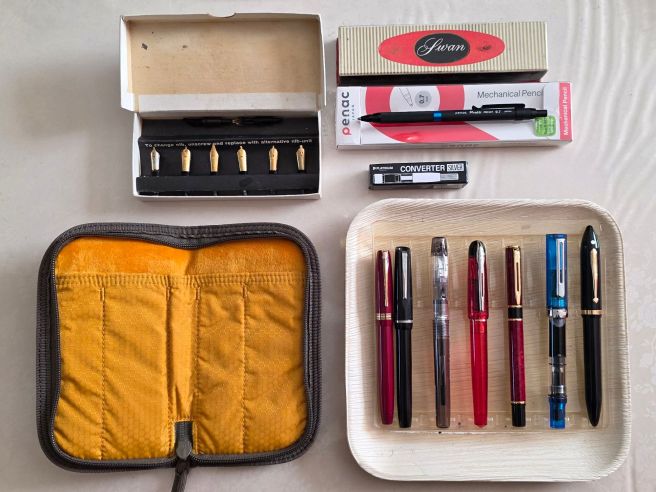
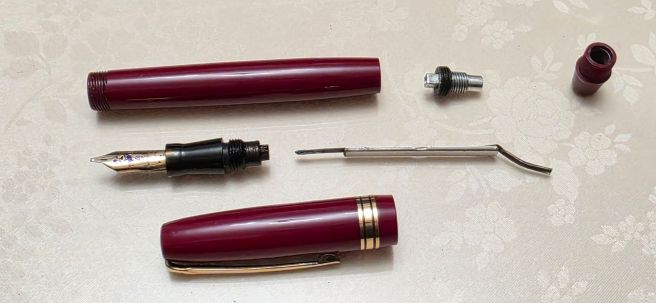
At home I have examined the Swan pen more closely. I have not yet identified the precise model and do not have experience of this filling system. It uses a collared rubber sac, compressed and released by a spring bar in the barrel but without a lever. Instead the sac is compressed by turning a knob at the end of the barrel: anti-clockwise to empty the pen and then clockwise to release the sac and fill the pen. I have enjoyed disassembling the pen. It needs a new sac. There is none in the pen, not even any remnants of one. The spring bar and the turning knob need to be reassembled in the correct way and in the correct sequence. This feels a bit confusing at the moment. Meanwhile I have enjoyed trying the pen dipped (with the innards removed). The number 2, 14k gold stub nib writes a very nice line. Sometimes the best things in life are free, or close to it like the Kultur and the Preppy – both of which also write well and are fun to use.


Hi Rupert. Very enjoyable read about your visit once again. Right at the end, you spoke about the Swan leverless pen having no sac. I have an 0160 Swan and put a standard sac inside a fair few years ago. It hardly fills at all. It dies one simple turn to empty and fill the sac.
But recently I watched a YouTube video where the gentleman spoke of restoring his 0160 pen, but not showing the process. His twist cap only turned the once too. The thing I found interesting? He did mention that the choice of sac is a special ‘necked’ sac. It must fill the whole chamber and is difficult to manipulate to house in situ. I haven’t looked into this yet. As a pen enthusiast and restorer, you probably know this. But thought I would mention it. I myself have very little knowledge regarding restoration or machinations of pens.
Thank you for describing your visit to Hammersmith once again. Last time I visited that part of London was in the 1970s. I was playing in my band at the Hammersmith Palais. I have a feeling it no longer exists.
All the best. 🙏🏽
LikeLike
Very nice 👌 pleasure ( from Andhra Pradesh)
LikeLike