It has been a while since the last of my posts in this series of round-ups. The latest was Inky Pursuits: May 2026 and so another now seems timely.
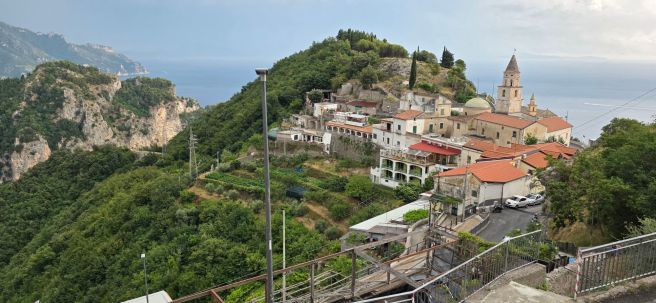
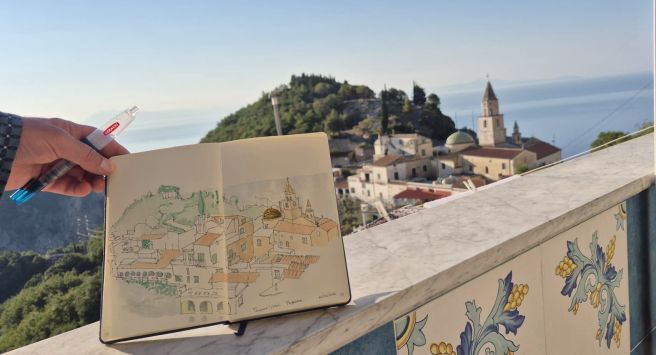
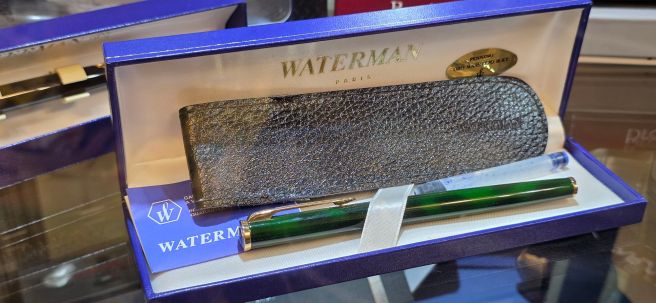
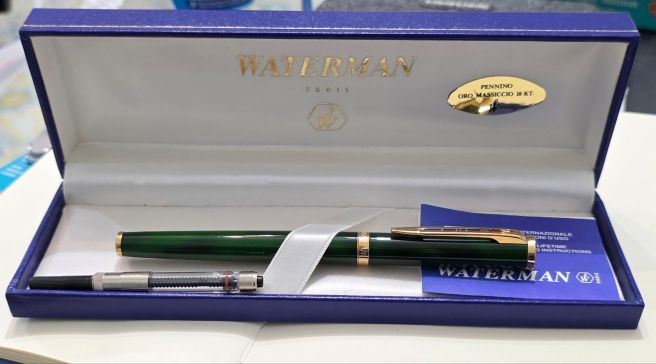
Since then I have made a few pen purchases of note, but nothing expensive. I have already written about my lucky find of a New Old Stock Waterman Preface, whilst on holiday in Italy. That pen continues to be a delight. I use it daily for my Page-a-day diary. I included the purchase story in Travelling with ink , June 2026: Part II, Italy.
In July, I bought my first Tom’s Studio pen: the Wren, a fibre tipped pocket pen, refillable with bottled fountain pen ink with a capillary fill system which is quick and effective. The pen itself is a beautifully tactile aluminium in matt black. The cap posts, making a comfortable length. The tip and the refillable ink reservoir should last a good while but spares can be purchased. The pen comes with a tiny 3ml bottle of Tom’s Studio “Midnight” ink. As I understand it, the pen can be filled with any fountain pen ink, although Tom’s Studio Midnight is especially formulated for fibre tipped pens. Fortunately I am keen on this rich dark grey and happy to stay with it. I have not yet attempted to flush the ink reservoir in order to change inks and do not know how easy this might be. However, Tom’s Studio also sells small plastic jars in which to keep ink reservoirs, suggesting that you put in a new one when you change ink, and save the old one in a jar, to avoid shortening the life of the reservoir by washing.
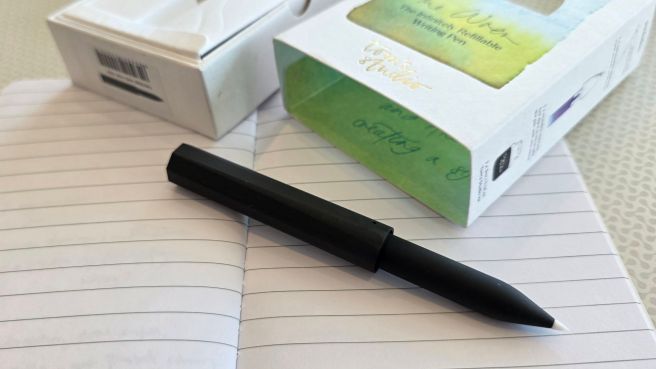
The tips, which are said to be made in Japan, are also replaceable. Quite how often you need to do so will vary depending how the pen is used. Although some line width variation is possible with pressure, I have avoided pressing down on the tip, in order to keep its shape for longer.
The pen gets good reviews. Personally, I enjoy the design. The cap is faceted with eight sides at one end, tapering away to none at the other. It has a fun filling system, and I like the almost invisible join where the short barrel unscrews, and the neat, smooth way in which the cap is removed or posted, gripped with O rings. It writes very smoothly and is convenient to carry around and to use for quick notes. I have read that one fill should give around 50 pages of writing! It gets a thumbs up from me. There are several colours available but I am pleased with the matt black.
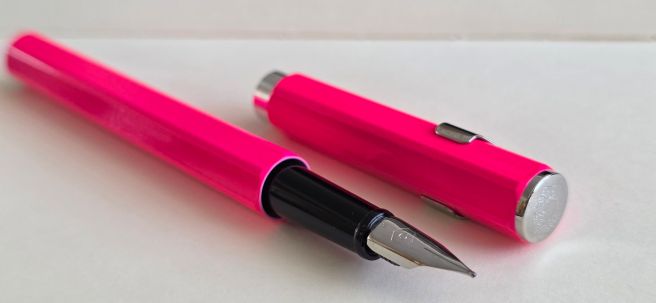
Soon after this, temptation struck again in July when I was browsing in an art supplies shop, Barnet Galleries in High Barnet and came across a brightly lit display of Caran d’Ache 849 fountain pens in neon colours. I already knew that I like the pen as I have one in red but I had not tried the hi-viz range before. They come in yellow, pink, orange or green. I chose the pink with a Medium nib and love this striking colour. It is also a great writer, tough, smooth and reliable. It uses standard international cartridges. Unfortunately no converter is included, which, for a £59.00 pen, is a bit disappointing. However, I suspect that a majority of purchasers would use only cartridges in any case.
My next pen purchases, were two Jinhao 59 fountain pens. I heard of these from friends at our London pen club. Finding them on Amazon at £17.99 for two, looked good value (although I heard that even lower prices are available elsewhere). Mine arrived from China within eight days. I bought one in black with gold trim and another in black with a brushed steel cap with chrome-coloured nib. Both are great and have been in use since they arrived.
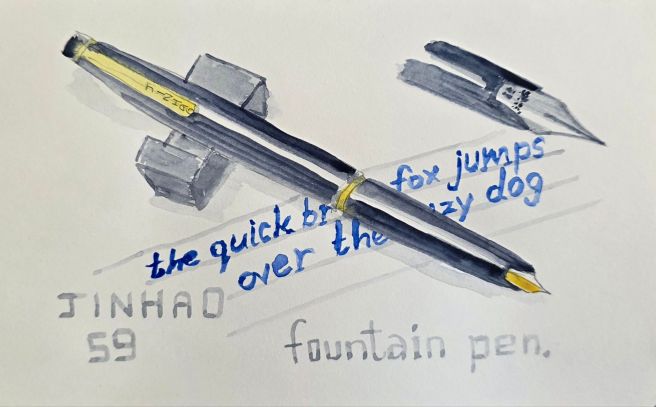
They are pocket pens, evidently based upon Pilot’s Elite (or E) 95S fountain pen but with steel nibs instead of gold. The cap posts to make a very comfortable length of 14.7cm. I have been extremely impressed with mine. In the black with gold trim edition, the cap appears from inside to be metal but coated on the outside with a high gloss (piano-black) finish. The cap is not threaded but slides on and off smoothly (there is no “snap”) held in place firmly by a clutch device inside the cap rim, like an old Parker 51. I particularly like the vintage look of the partially hooded nib, which reminds me of certain Montblanc and other pens of the 1960’s. Mine wrote perfectly without any adjustment.
The brushed steel cap version was also very pleasing and has a lovely classic look when posted. Both pens came with a converter (cough…Caran d’Ache, why can’t you do this?) although the design of the pen is such that the converter seats so deeply that you cannot see the ink level at all, even when full. My brushed steel capped pen wrote slightly drier than the all black version but this was soon remedied with an adjustment of the nib to open the tine gap slightly.
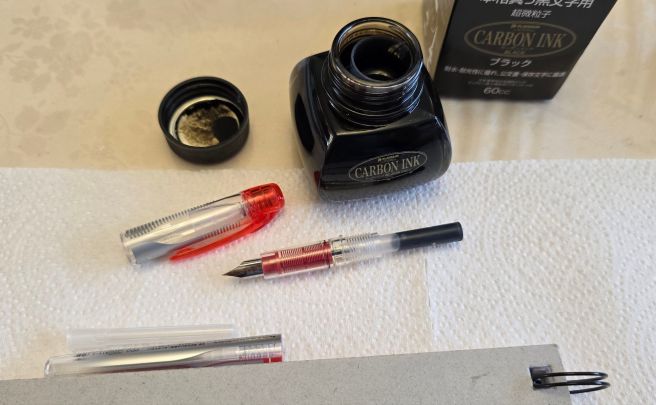
Another very recent purchase which I am thrilled about, has been a bottle of Platinum Carbon ink. I appreciate that this has been around for years and so it is hardly news, but please excuse my excitement as this is my first bottle. As mentioned in recent posts I have been bitten by the sketching bug! This ink works well for use with watercolour paints, as the ink does not run or smudge when water or wet paint is added.
A friend at our pen club suggested that I join the Urban Sketchers, London group. I found them online and was just in time to attend the last of their summer evening meet ups, which was in Soho Square Gardens at 6pm.
The meet up was informal and laid back and very well attended. I think there were over 70 of us. After an initial welcome talk by two of the administrators, we were invited to disperse and sketch the square however we wished and then to regroup in two hours. Most folks, including me, chose to sketch the mock-Tudor hut which is a central focal point of the square’s public garden. I found a seat at one of the perimeter benches and settled down to sketch the scene in pen and ink and then watercolour, after which I mingled around to see how the others were doing. I was very impressed (and humbled) at how professional many of the pictures looked. There was a wide range of styles, approaches, sizes and media in use. At 8pm we assembled for the “throwdown” placing our sketch books or pads on the ground in a row, so we could all see each other’s work. It was fascinating – to see so many styles, capturing scenes from the park or surrounding buildings in the individual’s own way. I realised that there are many ways to paint a scene and there is no rule that we must have only one style.
I am hooked on sketching now! I had been using Uni-ball pin fine liners in order to obtain a black line, for an “ink and wash” style of painting, but it is nicer to use a fountain pen and thus enjoy two hobbies at once. For a while I used a Platinum Preppy with Noodlers bulletproof black, which worked quite well. The important thing is for the ink not to run when you go over it with water or paint. I found that, even when dry, whilst the Noodlers ink is largely waterproof, there would still be a little black ink lifting off into the water which was unwanted. I find the Platinum Carbon black ink preferable for use with watercolours.
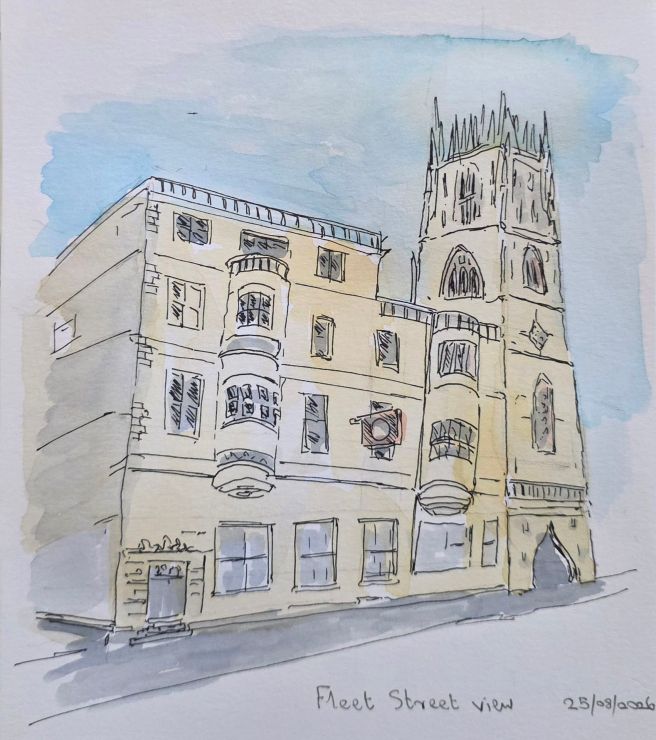
Whilst trying not to go overboard with my Gear Acquisition Syndrome, I have upgraded my Daler-Rowney Aquafine 12 colour set, to a 24 colour set which is in an equally slim white plastic box, little bigger than a large mobile phone, and gives a wider range of ready colours for convenience when out and about, as well as great possibilities for mixing colours.
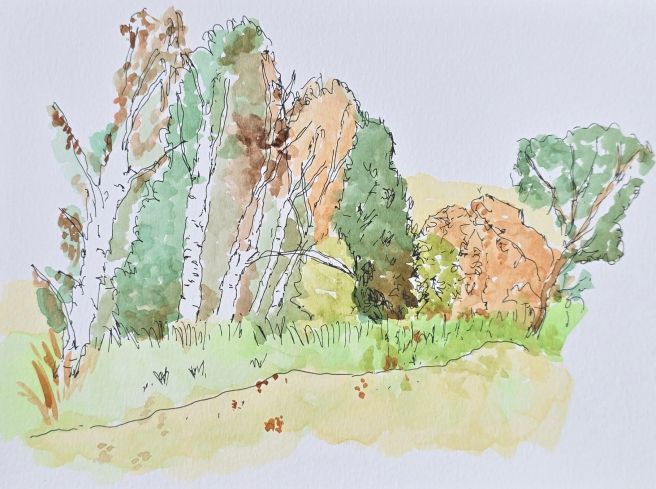
I am using the Platinum Carbon ink in a Platinum Preppy, 0.2 (Extra Fine) which seems a dream combo and ideal for my current needs. I enjoy sketching almost every day. Recently after a swim at my gym’s pool, I stayed to sketch a row of Silver Birch trees in a field beside the car park. For half an hour, I stood with the sun at my back, having found a way to hold my sketch pad and box of paints in one hand, and my pen or waterbrush in the other. I felt a bit like Monet. I sketched out the scene first with the Preppy and then added the colours. I found each stage in the process so absorbing and enjoyable. No wonder people get addicted.