Inky Pursuits: August 2026.

It has been a while since the last of my posts in this series of round-ups. The latest was Inky Pursuits: May 2026 and so another now seems timely.

Since then I have made a few pen purchases of note, but nothing expensive. I have already written about my lucky find of a New Old Stock Waterman Preface, whilst on holiday in Italy. That pen continues to be a delight. I use it daily for my Page-a-day diary. I included the purchase story in Travelling with ink , June 2026: Part II, Italy.
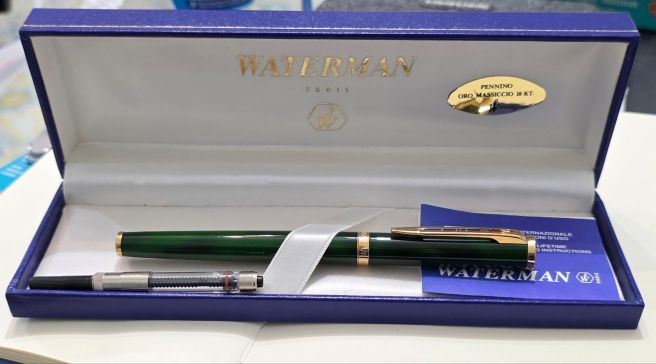
A NOS Waterman Preface, liberated from a tobacconist shop in Ravelo, Italy.

In July, I bought my first Tom’s Studio pen: the Wren, a fibre tipped pocket pen, refillable with bottled fountain pen ink with a capillary fill system which is quick and effective. The pen itself is a beautifully tactile aluminium in matt black. The cap posts, making a comfortable length. The tip and the refillable ink reservoir should last a good while but spares can be purchased. The pen comes with a tiny 3ml bottle of Tom’s Studio “Midnight” ink. As I understand it, the pen can be filled with any fountain pen ink, although Tom’s Studio Midnight is especially formulated for fibre tipped pens. Fortunately I am keen on this rich dark grey and happy to stay with it. I have not yet attempted to flush the ink reservoir in order to change inks and do not know how easy this might be. However, Tom’s Studio also sells small plastic jars in which to keep ink reservoirs, suggesting that you put in a new one when you change ink, and save the old one in a jar, to avoid shortening the life of the reservoir by washing.
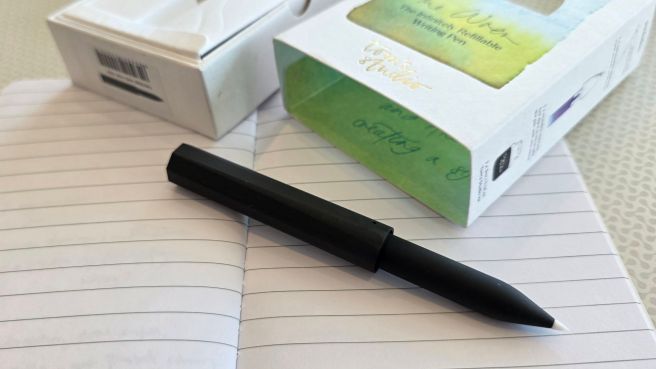
The Wren from Tom’s Studio.

The tips, which are said to be made in Japan, are also replaceable. Quite how often you need to do so will vary depending how the pen is used. Although some line width variation is possible with pressure, I have avoided pressing down on the tip, in order to keep its shape for longer.

The pen gets good reviews. Personally, I enjoy the design. The cap is faceted with eight sides at one end, tapering away to none at the other. It has a fun filling system, and I like the almost invisible join where the short barrel unscrews, and the neat, smooth way in which the cap is removed or posted, gripped with O rings. It writes very smoothly and is convenient to carry around and to use for quick notes. I have read that one fill should give around 50 pages of writing! It gets a thumbs up from me. There are several colours available but I am pleased with the matt black.

Soon after this, temptation struck again in July when I was browsing in an art supplies shop, Barnet Galleries in High Barnet and came across a brightly lit display of Caran d’Ache 849 fountain pens in neon colours. I already knew that I like the pen as I have one in red but I had not tried the hi-viz range before. They come in yellow, pink, orange or green. I chose the pink with a Medium nib and love this striking colour. It is also a great writer, tough, smooth and reliable. It uses standard international cartridges. Unfortunately no converter is included, which, for a £59.00 pen, is a bit disappointing. However, I suspect that a majority of purchasers would use only cartridges in any case.
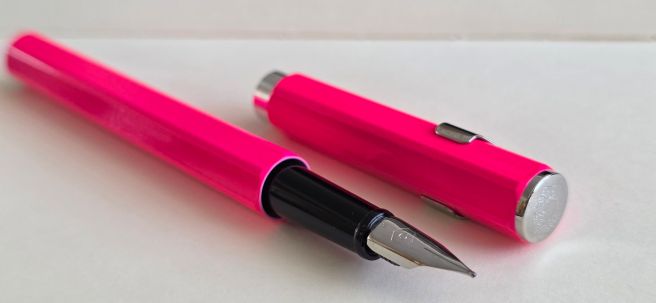
Caran dAche 849 fountain pen, in neon pink.

My next pen purchases, were two Jinhao 59 fountain pens. I heard of these from friends at our London pen club. Finding them on Amazon at £17.99 for two, looked good value (although I heard that even lower prices are available elsewhere). Mine arrived from China within eight days. I bought one in black with gold trim and another in black with a brushed steel cap with chrome-coloured nib. Both are great and have been in use since they arrived.
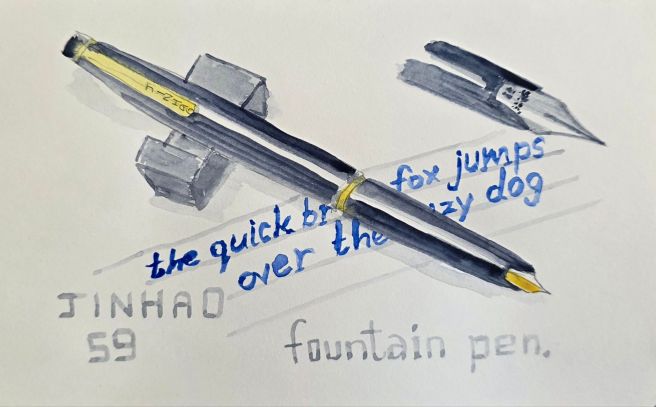
A little sketch of a Jinhao 59 pocket fountain pen.

They are pocket pens, evidently based upon Pilot’s Elite (or E) 95S fountain pen but with steel nibs instead of gold. The cap posts to make a very comfortable length of 14.7cm. I have been extremely impressed with mine. In the black with gold trim edition, the cap appears from inside to be metal but coated on the outside with a high gloss (piano-black) finish. The cap is not threaded but slides on and off smoothly (there is no “snap”) held in place firmly by a clutch device inside the cap rim, like an old Parker 51. I particularly like the vintage look of the partially hooded nib, which reminds me of certain Montblanc and other pens of the 1960’s. Mine wrote perfectly without any adjustment.

The brushed steel cap version was also very pleasing and has a lovely classic look when posted. Both pens came with a converter (cough…Caran d’Ache, why can’t you do this?) although the design of the pen is such that the converter seats so deeply that you cannot see the ink level at all, even when full. My brushed steel capped pen wrote slightly drier than the all black version but this was soon remedied with an adjustment of the nib to open the tine gap slightly.

Another very recent purchase which I am thrilled about, has been a bottle of Platinum Carbon ink. I appreciate that this has been around for years and so it is hardly news, but please excuse my excitement as this is my first bottle. As mentioned in recent posts I have been bitten by the sketching bug! This ink works well for use with watercolour paints, as the ink does not run or smudge when water or wet paint is added.

A friend at our pen club suggested that I join the Urban Sketchers, London group. I found them online and was just in time to attend the last of their summer evening meet ups, which was in Soho Square Gardens at 6pm.
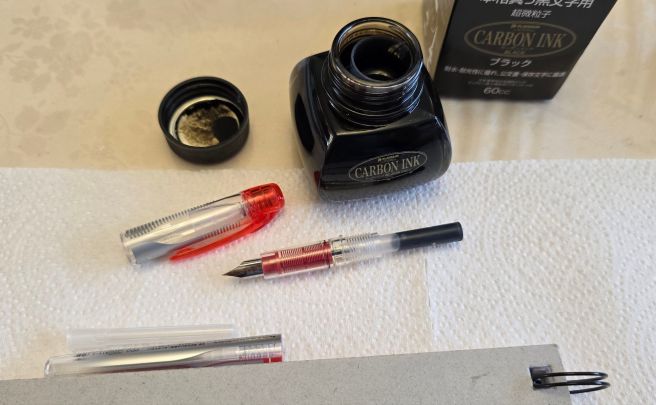
New Ink Day: Platinum Carbon black.

The meet up was informal and laid back and very well attended. I think there were over 70 of us. After an initial welcome talk by two of the administrators, we were invited to disperse and sketch the square however we wished and then to regroup in two hours. Most folks, including me, chose to sketch the mock-Tudor hut which is a central focal point of the square’s public garden. I found a seat at one of the perimeter benches and settled down to sketch the scene in pen and ink and then watercolour, after which I mingled around to see how the others were doing. I was very impressed (and humbled) at how professional many of the pictures looked. There was a wide range of styles, approaches, sizes and media in use. At 8pm we assembled for the “throwdown” placing our sketch books or pads on the ground in a row, so we could all see each other’s work. It was fascinating – to see so many styles, capturing scenes from the park or surrounding buildings in the individual’s own way. I realised that there are many ways to paint a scene and there is no rule that we must have only one style.

I am hooked on sketching now! I had been using Uni-ball pin fine liners in order to obtain a black line, for an “ink and wash” style of painting, but it is nicer to use a fountain pen and thus enjoy two hobbies at once. For a while I used a Platinum Preppy with Noodlers bulletproof black, which worked quite well. The important thing is for the ink not to run when you go over it with water or paint. I found that, even when dry, whilst the Noodlers ink is largely waterproof, there would still be a little black ink lifting off into the water which was unwanted. I find the Platinum Carbon black ink preferable for use with watercolours.
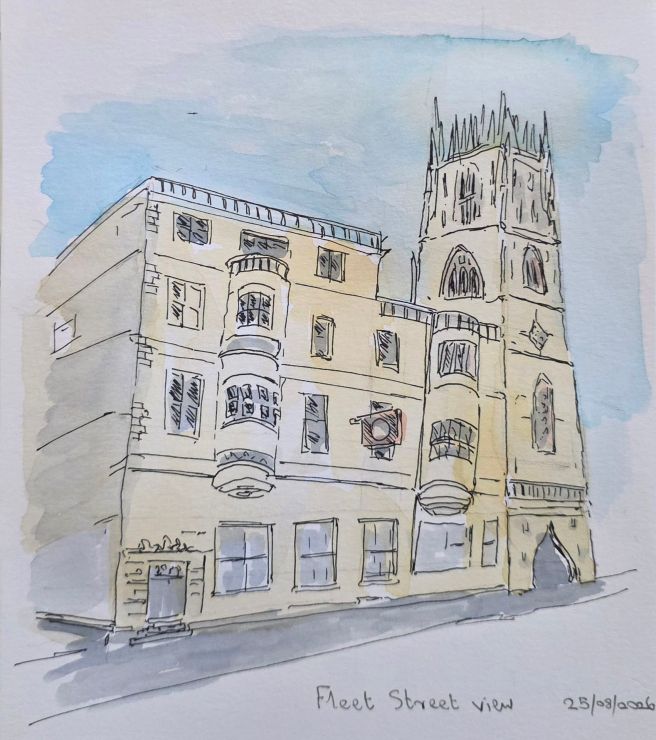
A view in Fleet Street, London EC4. Platinum Carbon ink is ideal for drawing, before adding watercolours.

Whilst trying not to go overboard with my Gear Acquisition Syndrome, I have upgraded my Daler-Rowney Aquafine 12 colour set, to a 24 colour set which is in an equally slim white plastic box, little bigger than a large mobile phone, and gives a wider range of ready colours for convenience when out and about, as well as great possibilities for mixing colours.

I am using the Platinum Carbon ink in a Platinum Preppy, 0.2 (Extra Fine) which seems a dream combo and ideal for my current needs. I enjoy sketching almost every day. Recently after a swim at my gym’s pool, I stayed to sketch a row of Silver Birch trees in a field beside the car park. For half an hour, I stood with the sun at my back, having found a way to hold my sketch pad and box of paints in one hand, and my pen or waterbrush in the other. I felt a bit like Monet. I sketched out the scene first with the Preppy and then added the colours. I found each stage in the process so absorbing and enjoyable. No wonder people get addicted.

Silver Birch trees. Platinum Preppy with Carbon black; Daler-Aquafine 24 half pan set; Daler-Rowney mixed media paper, A5, 250gsm. Capturing this scene with an outdoor sketch in the sunshine was a joy.

Travelling with ink: November 2024, my North Sea haul.

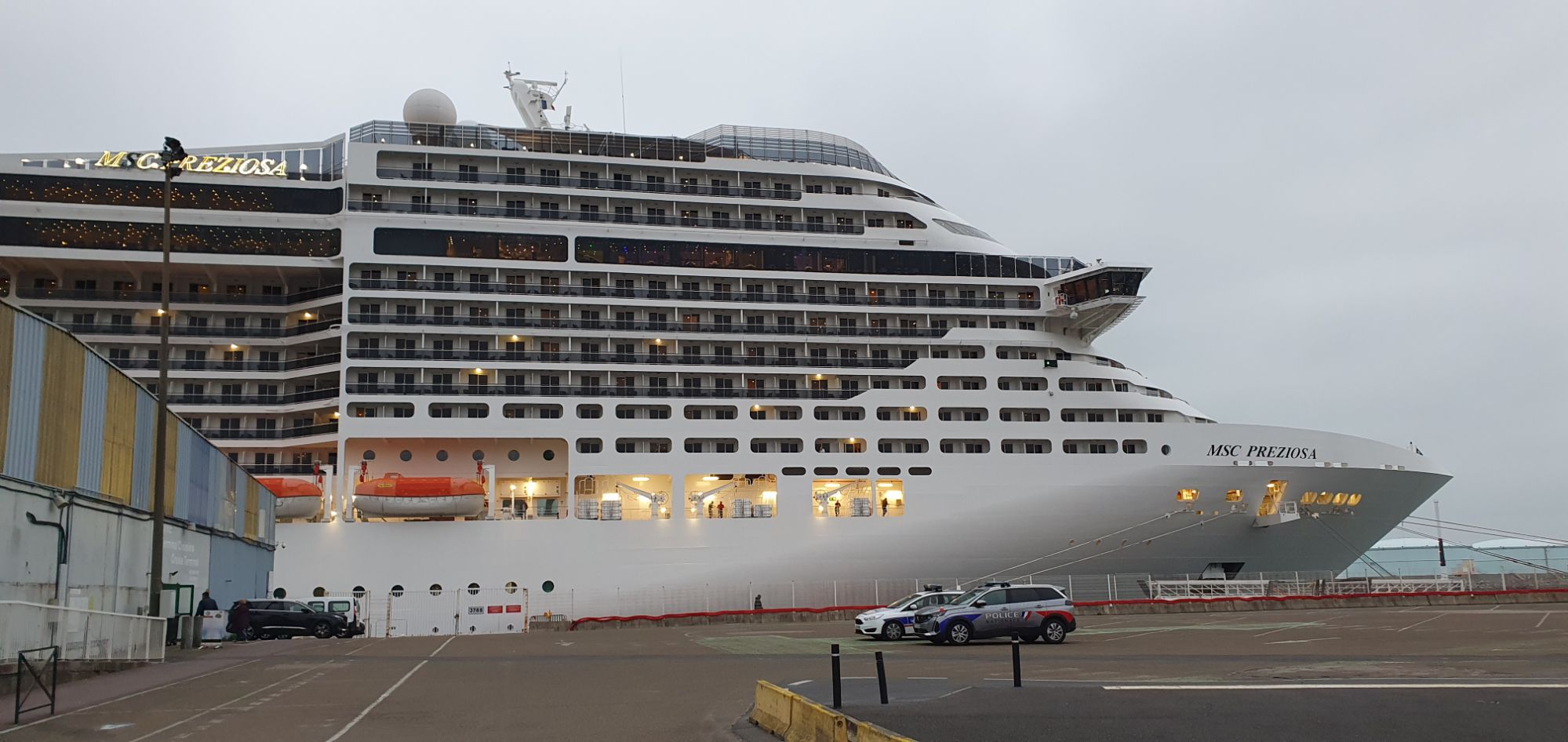
This month, I was fortunate enough to spend a week on a cruise ship, the MSC Preziosa. From Southampton, the trip would take us to Hamburg, Rotterdam, Zeebrugge and Le Havre. Four countries in a week!

The MSC Preziosa

I had been looking forward to the holiday, not only the shore visits but the time at sea, relaxing on the ship and the copious amounts of food and entertainment on board. In particular, I was looking forward to some pen time, writing up my journal in the cabin or any of the comfortable lounges and dining areas when time allowed.

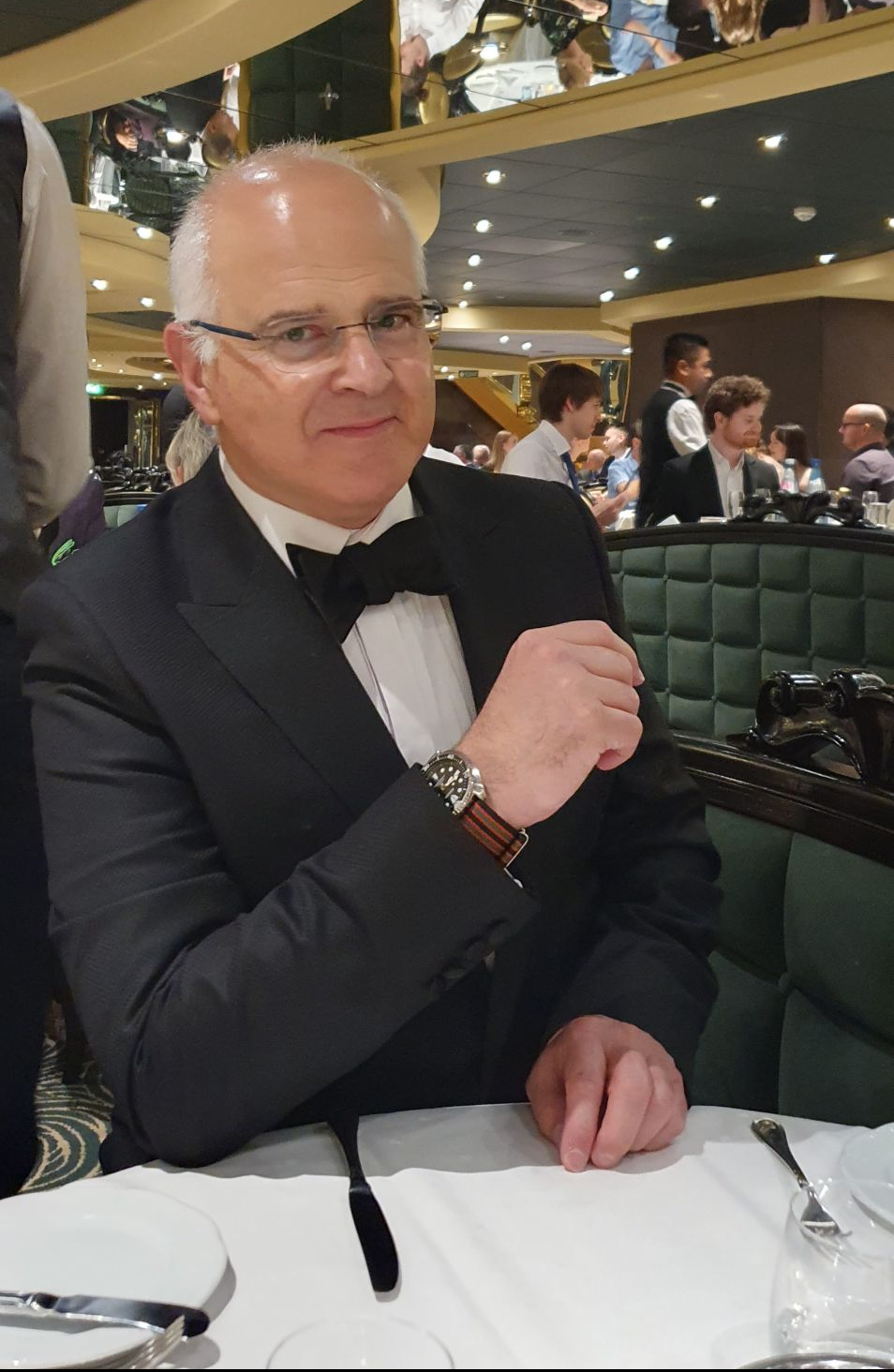
I took four vintage fountain pens. These were a Conway Stewart 15, a Burnham 61, another Conway 15 and an Eversharp Skyline. All are lever-fillers and freshly filled with Waterman inks: Intense black, Serenity blue, Audacious red and Harmonious green, respectively. My plan was to rotate these four pens, writing with a different one each day. For journaling, I brought a Leuchtturm A5 dot grid hardback notebook.

This system worked well. Each day’s entry was written in a different colour from the day before. In practice there was some overlap, when I wrote some more about the previous day but would already be on a new colour.

Another benefit would be the ease of measuring the page capacity of each pen (all recent acquisitions), by counting the pages written in each colour. However none of them has yet run dry and so this test is still in progress.

Another holiday pursuit, was seeking out fountain pen shops wherever we travelled. I had long been telling myself (and my wife tells me too) that I do not need more fountain pens, but I take it that such rules do not apply when outside the UK jurisdiction. At the very least, they are less rigorously enforced.

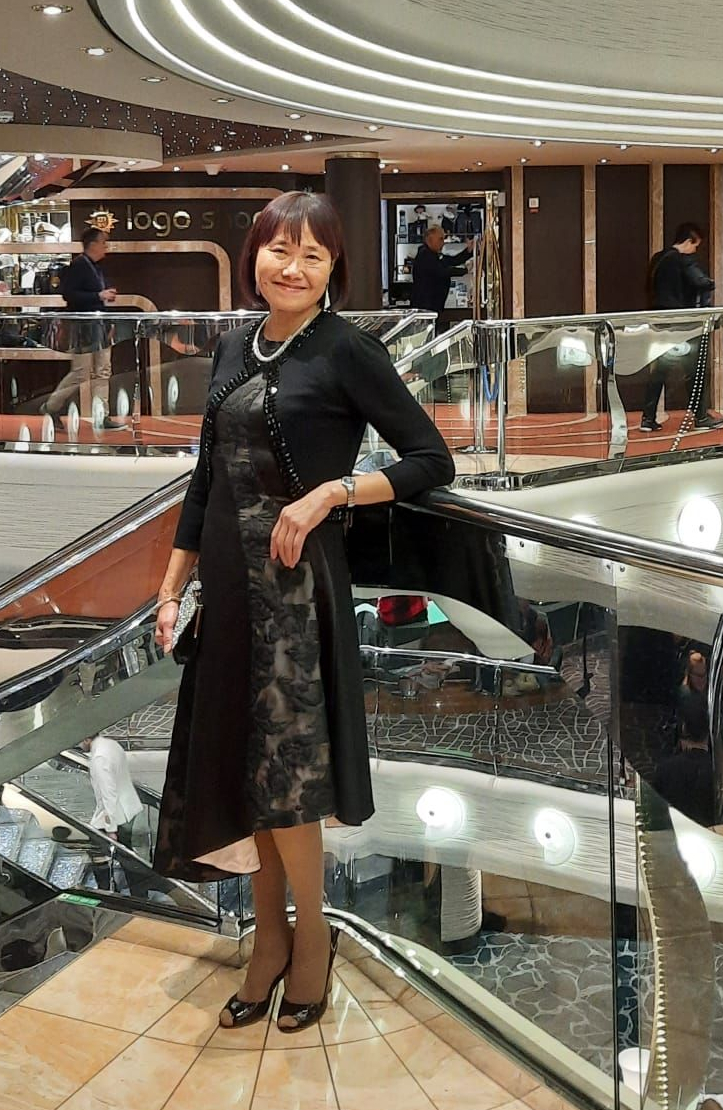
Ling, fully on board for Gala Night.

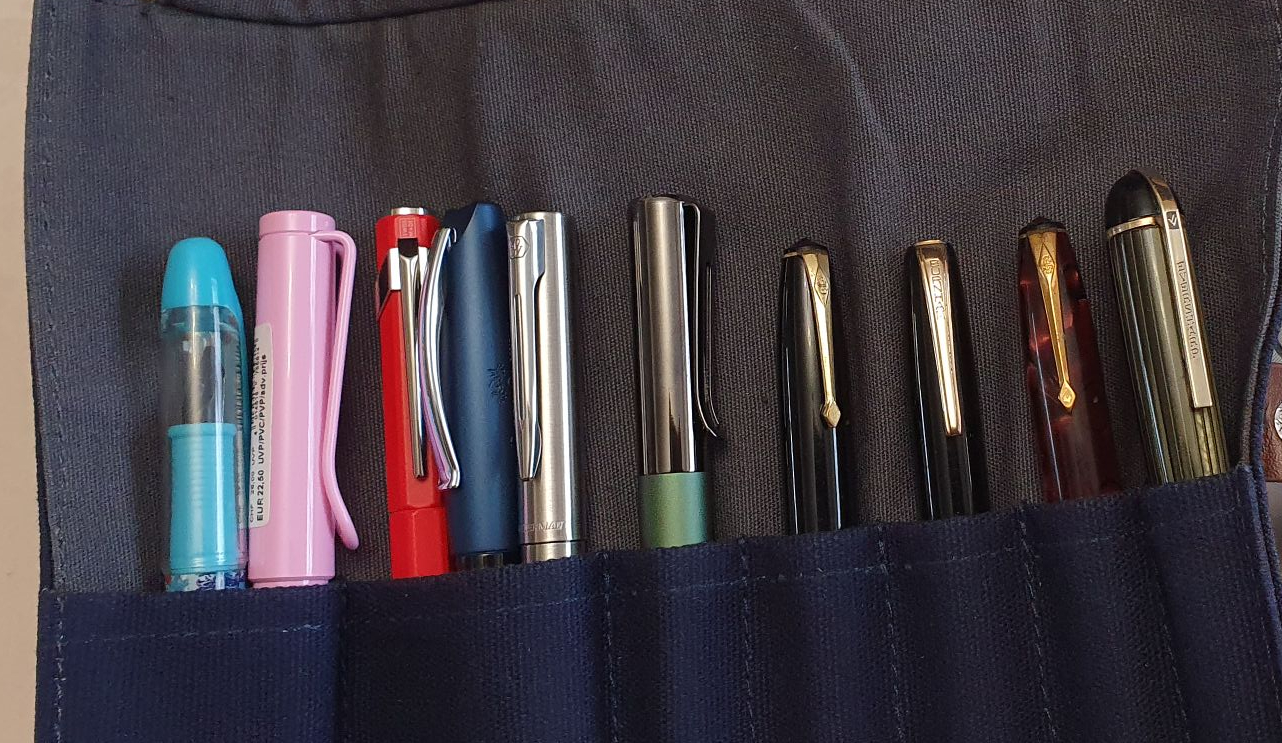
Over the course of the week, I managed to buy six fountain pens! These were all modest purchases, ranging in cost from three Euros, up to 60 Euros at most, all cartridge-converter pens and all with steel nibs. Nevertheless, finding and buying each of these brought me a great deal of pleasure and they continue to make me happy, long after the cruise is over. Here is an account of the new pens that came home with me.

Hamburg.

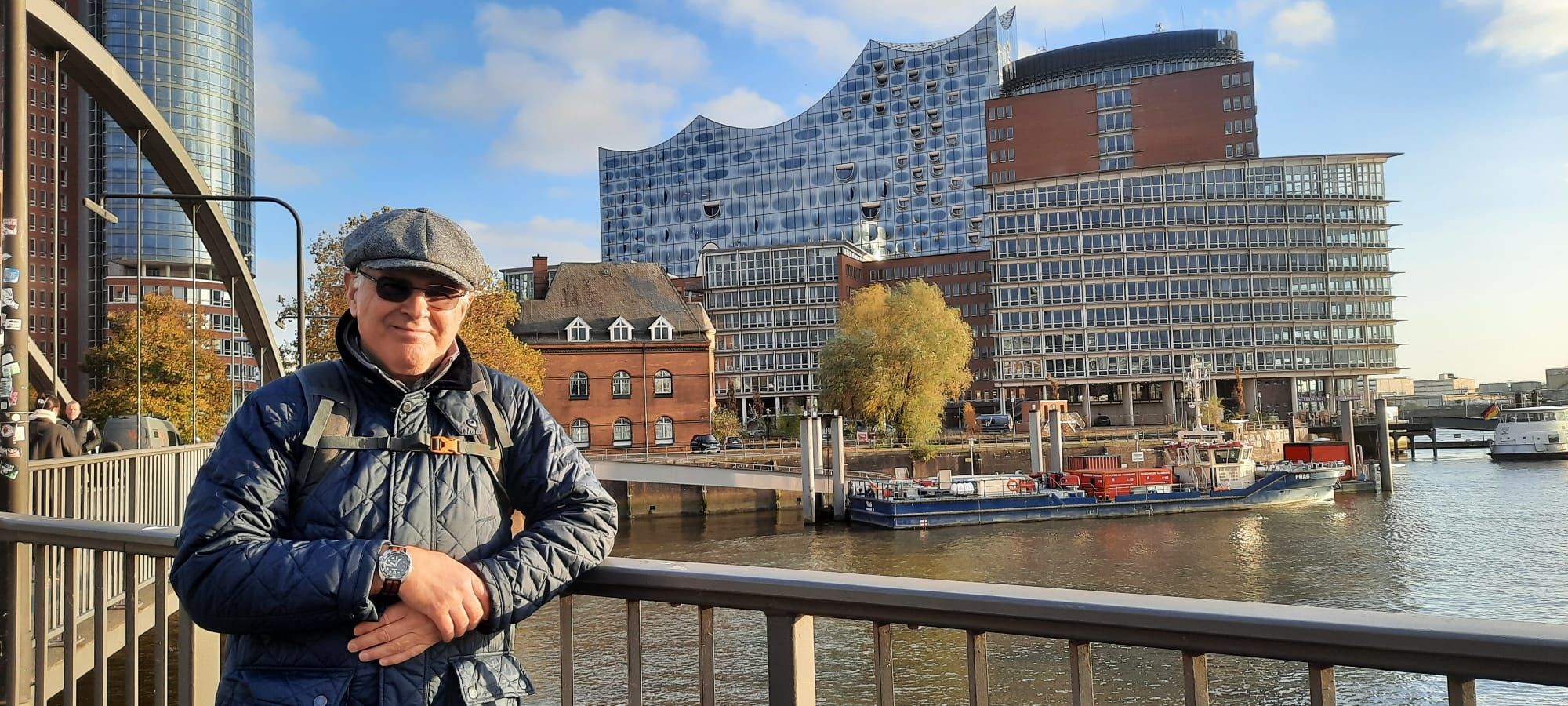
Despite its proximity to the UK, this was only my first time in Germany. A well-travelled friend had once told me that the pharmacy chain Mullers, often sold school pens, from brands such as Online. Our taxi dropped us near the splendid City Hall and from there we walked almost seven miles with our tourist map, taking in the main sites including churches, the concert hall, and the historic dockland warehouses.

Trying to blend in. In the background, is the Elbphilharmonie, Hamburg.

I did not come across a Mullers but we did briefly visit a modern shopping mall, Europa Passage where I had a quick look for any pen shops. I found a hobby craft shop called idee, where a helpful assistant showed me a small selection of Lamy Safaris. One of these, in a new “light rose” with matching clip and finial, appealed to me. I was surprised to find that all the Safari fountain pens were inked and could be tested before purchase. This pink one wrote very nicely (as expected with Lamy) and this became my souvenir from Germany.

Rotterdam.

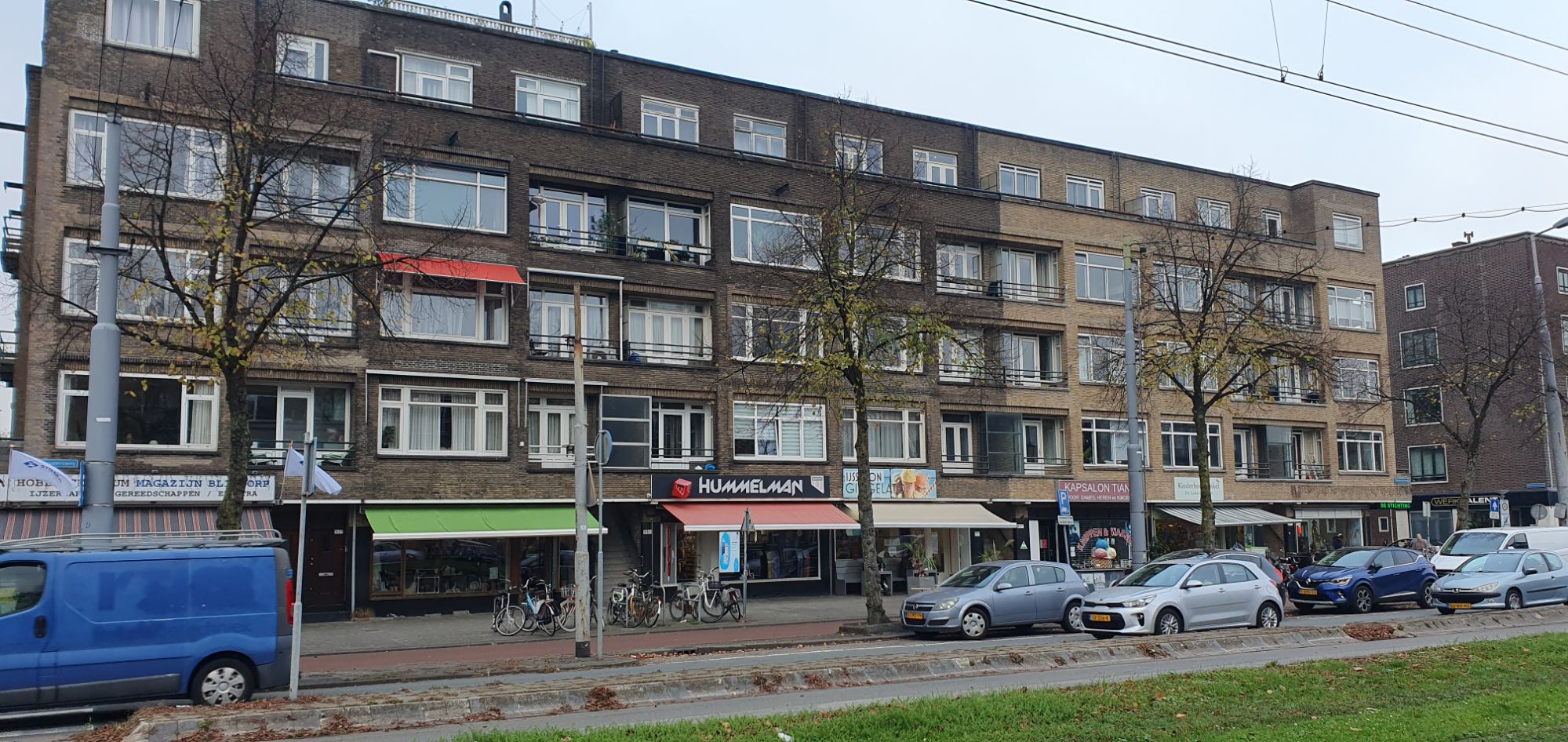
I had Googled for fountain pen shops in Rotterdam and the top result was Hummelman. After a nice walk across the bridge from the cruise terminal and along the waterfront and a visit to a few of the main attractions in the city centre, such as the market, the cube houses and City Hall, I took a walk to find Hummelman. This turned out to be a couple of miles from the centre but was well worth the visit.

Hummelman pen shop, Rotterdam.

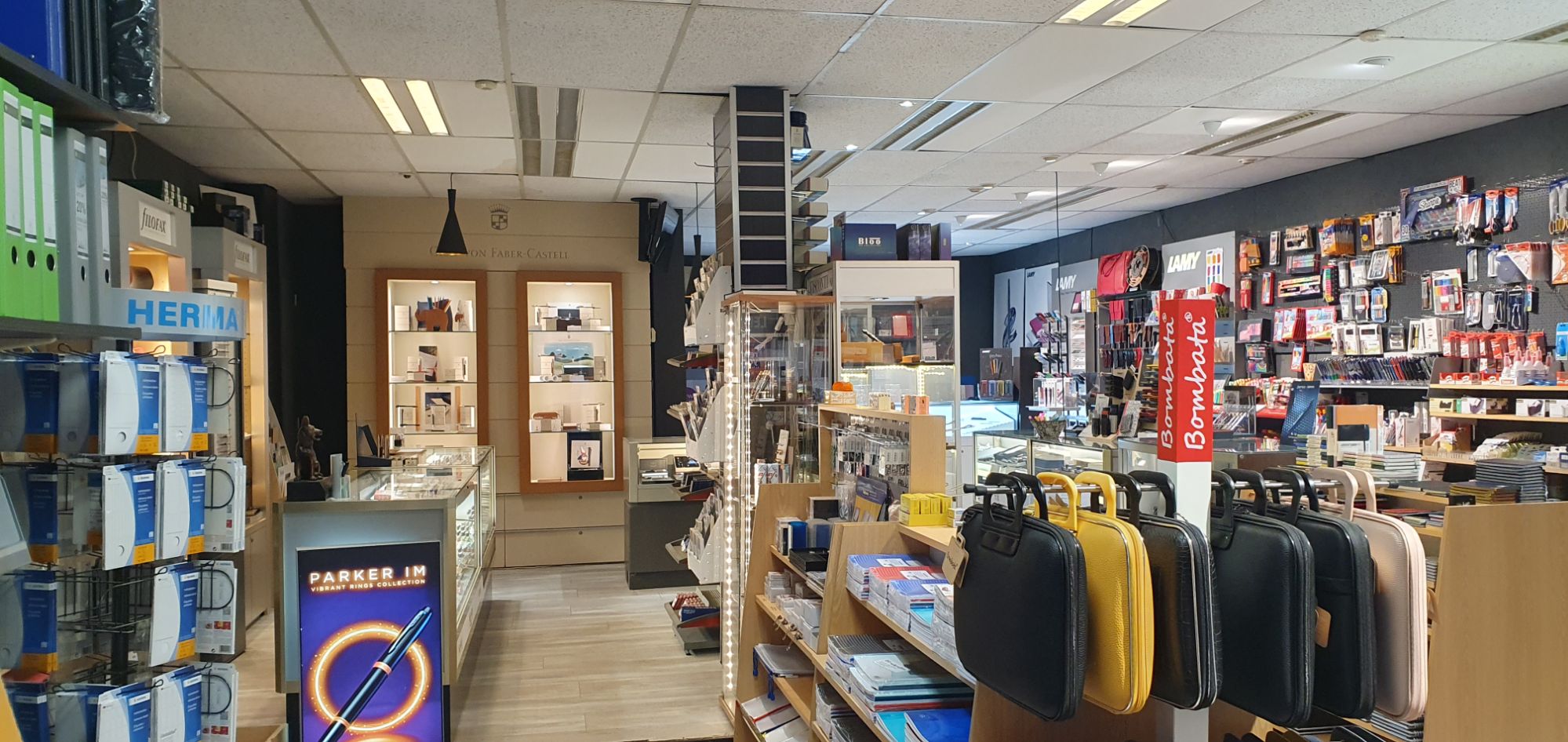
I learned that this family-run shop had been established in the 1930’s and now run by the third generation of the family. The genial proprietor, Vincent, kindly allowed me to take some photos and to take my time having a long browse around the displays. It was such a treat to find a bricks and mortar store with such a wide selection of brands and models and an enthusiastic and knowledgeable owner. I chose a green Monteverde Ritma – a large and hefty metal pen with a glossy gunmetal magnetic cap, and a blue Faber-Castell Essentio (or Basic), which was also in metal. Previously I had seen only plastic barrelled version with rubber grip section. Both of these pens were available in various colours and nib widths.

Stepping into Hummelman.

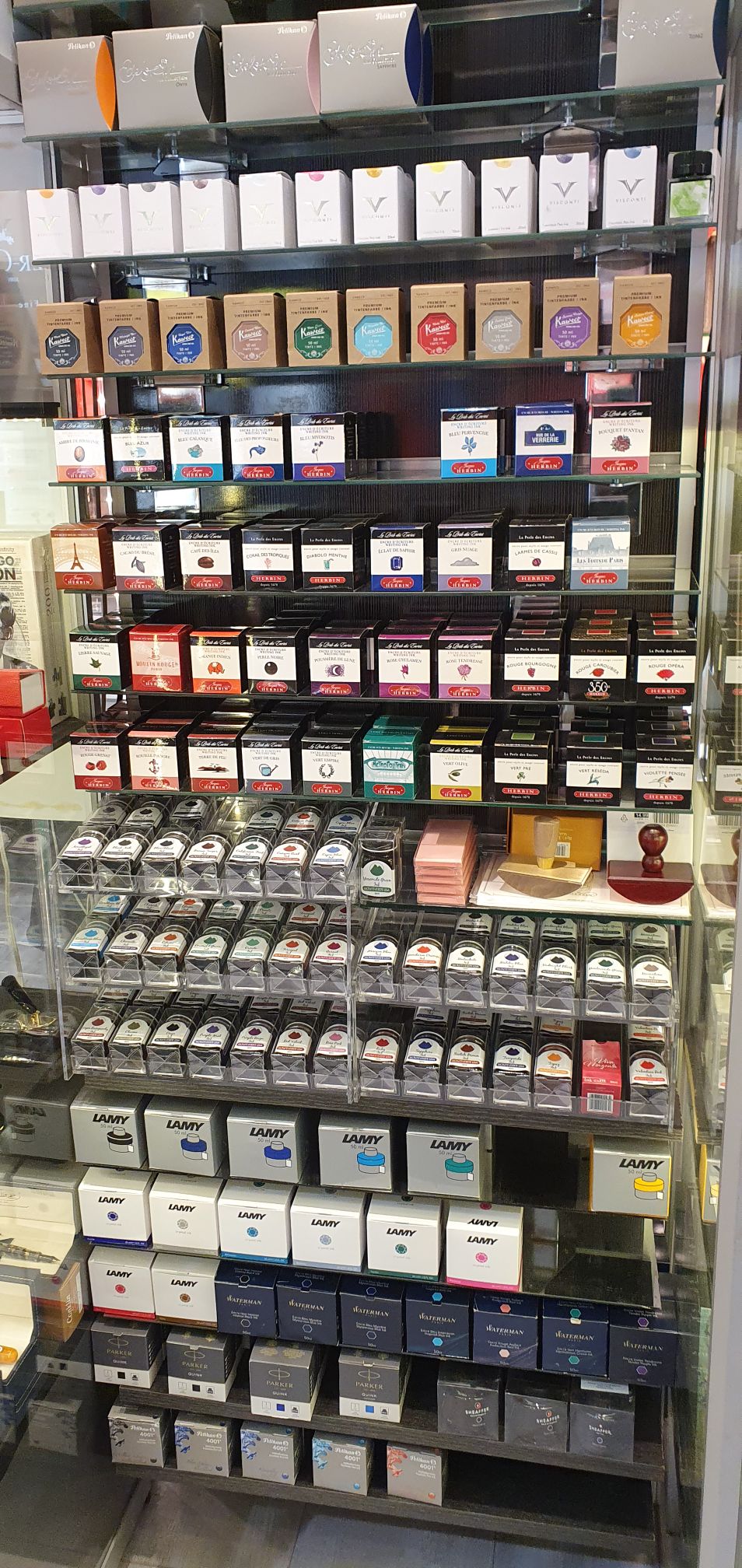
Vincent saw me studying his vast display of inks, which reached from floor to ceiling and referred me to his helpful book of ink swatch cards, carefully made by hand and grouped by brand. He told me that his father does the swatches. I chose a Jacques Herbin Lie de thé.

Just some of the fountain pen inks at Hummelman.

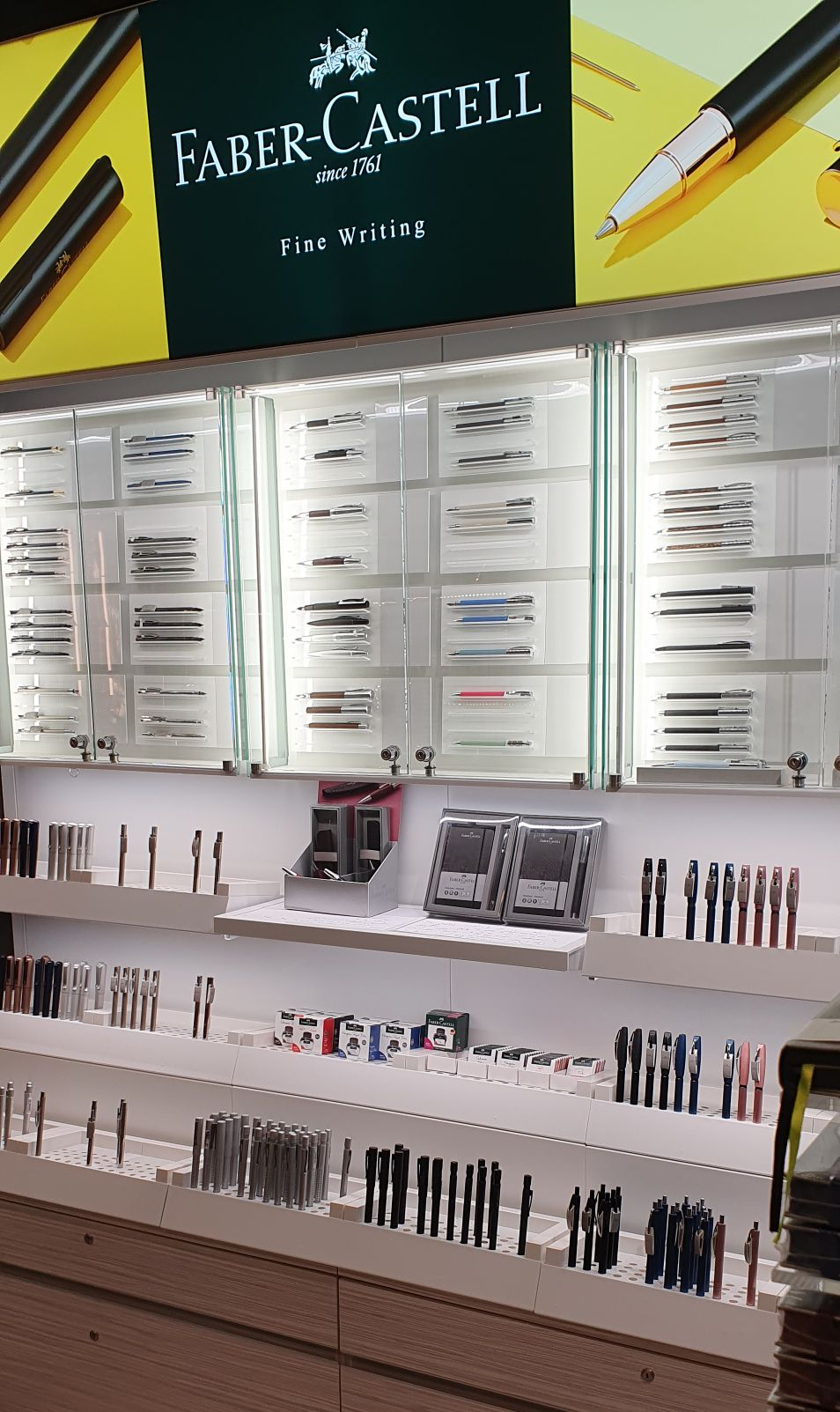
Of these two pens, I am finding the Faber-Castell to be easier. The fine nib is a joy: firm but smooth and effortless. The body and finish definitely feels like an upgrade from the plastic and rubber versions I had used before. As for the Monteverde, the glossy polished metal section is slippy, as I might have known. The magnetic cap works well and leaps into place with a click to fit flush with the barrel, whether on capping the pen or posting the cap. On my model, the stealthy black fine nib needed some smoothing and this, coupled with the insecure grip, makes the pen a bit tricky to use, but it is a handsome and weighty beast.

Great selections of Faber-Castell models and nib choices.

Zeebrugge.

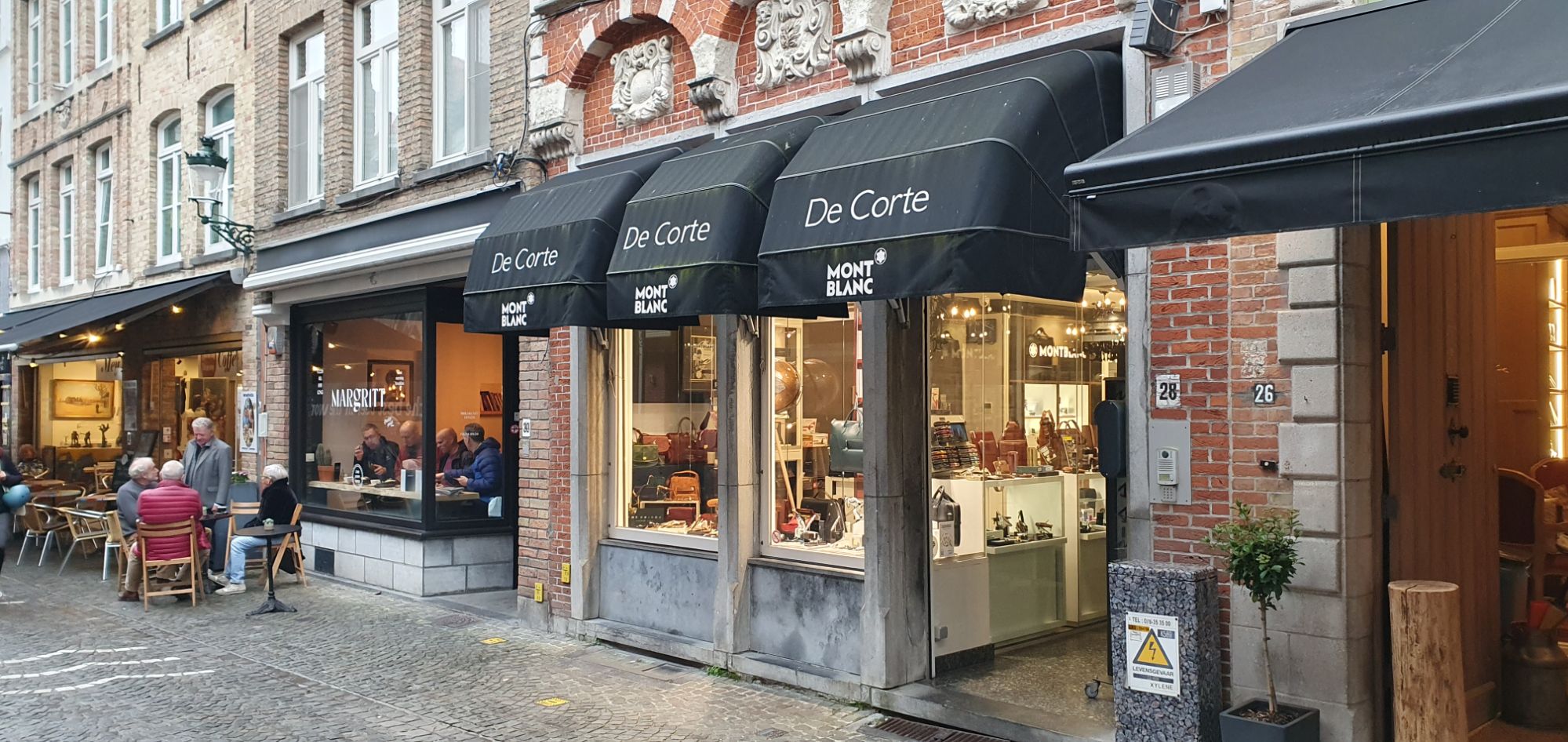
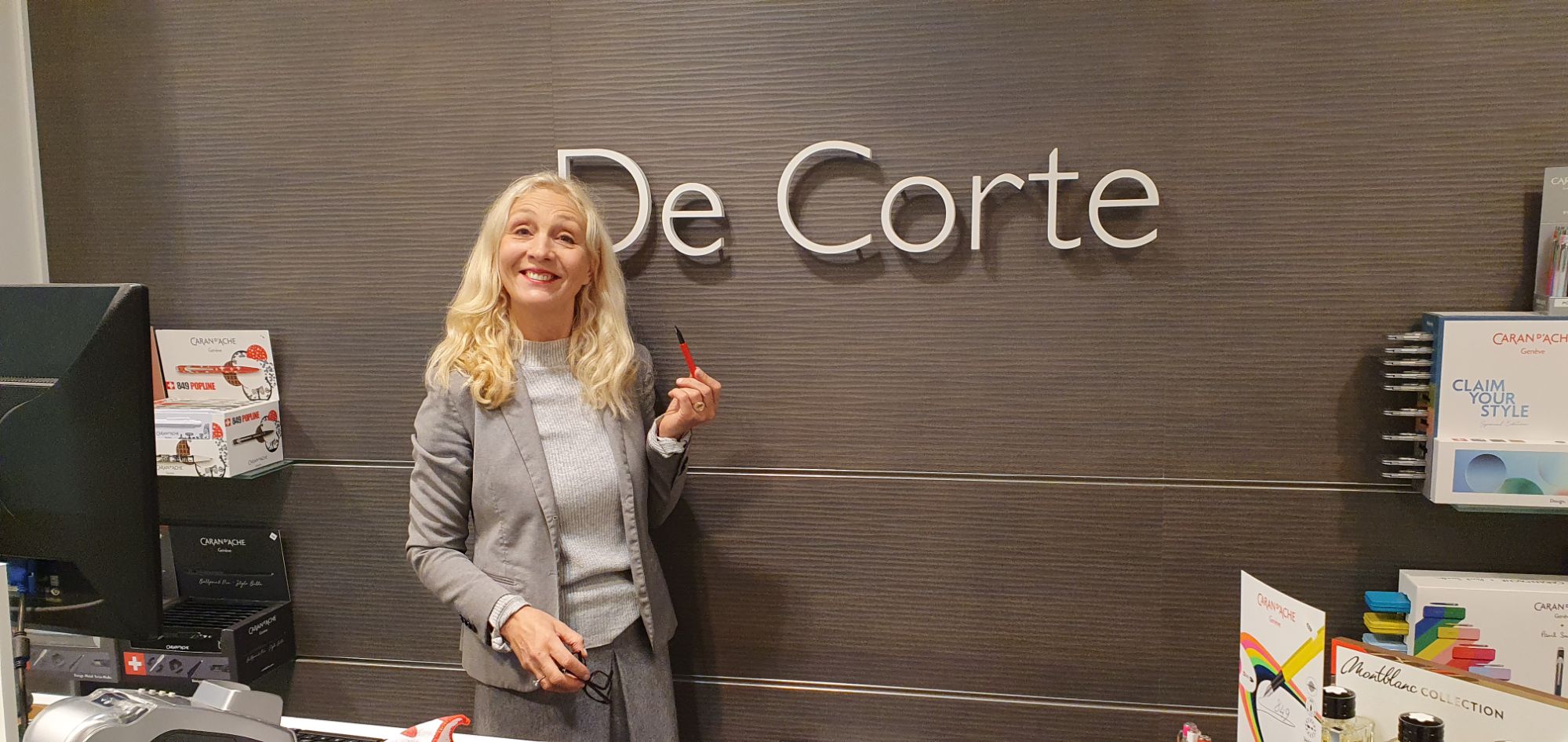
This is the port for the stunningly beautiful medieval town of Bruges, about 30 mins drive inland. When I was there last, in 2016, I had sought out a pen shop that I found online, named De Corte. This is another shop now owned by the third generation of the family, having started in the 1920’s. I have fond memories of finding the shop but having to peer at the window as the shop was closed. Fortunately the proprietor, Iris de Corte spotted me and allowed me to come inside and look around, as she was taking product photos for a proposed website.

The delightful De Corte pen shop, plus stationery and leather goods.

This time, the shop was open and I was happy to find Iris again, serving a customer. When I reminded her of my last visit of 8 years ago, she laughed and said that she had still not set up the website! She far prefers to meet customers face to face and to enable them to try a pen before buying. She told me that the number of such fountain pen shops is now very small. When I mentioned Hummelman’s in Rotterdam, she told me that she knew them! It is a very small world.

Ms Iris De Corte

Of course, I wished to buy a pen from Iris. I chose a Caran d’Ache 849 in red – the colour of Caran d’Ache and of the Swiss flag. As the joke goes, “You could say a lot of bad things about Switzerland but their flag is a big plus.” When I had first tried one of these pens, several years ago, I had dismissed it as being too slim and having an uncomfortable step down from barrel to section. However in practice, having spent time using the pen, neither of these points is an issue for me. I enjoy its pencil-like hexagonal cap and barrel, the satisfying click on capping the pen and the neat way the cap can be posted, flush with the barrel. It also writes very well.

Le Havre.

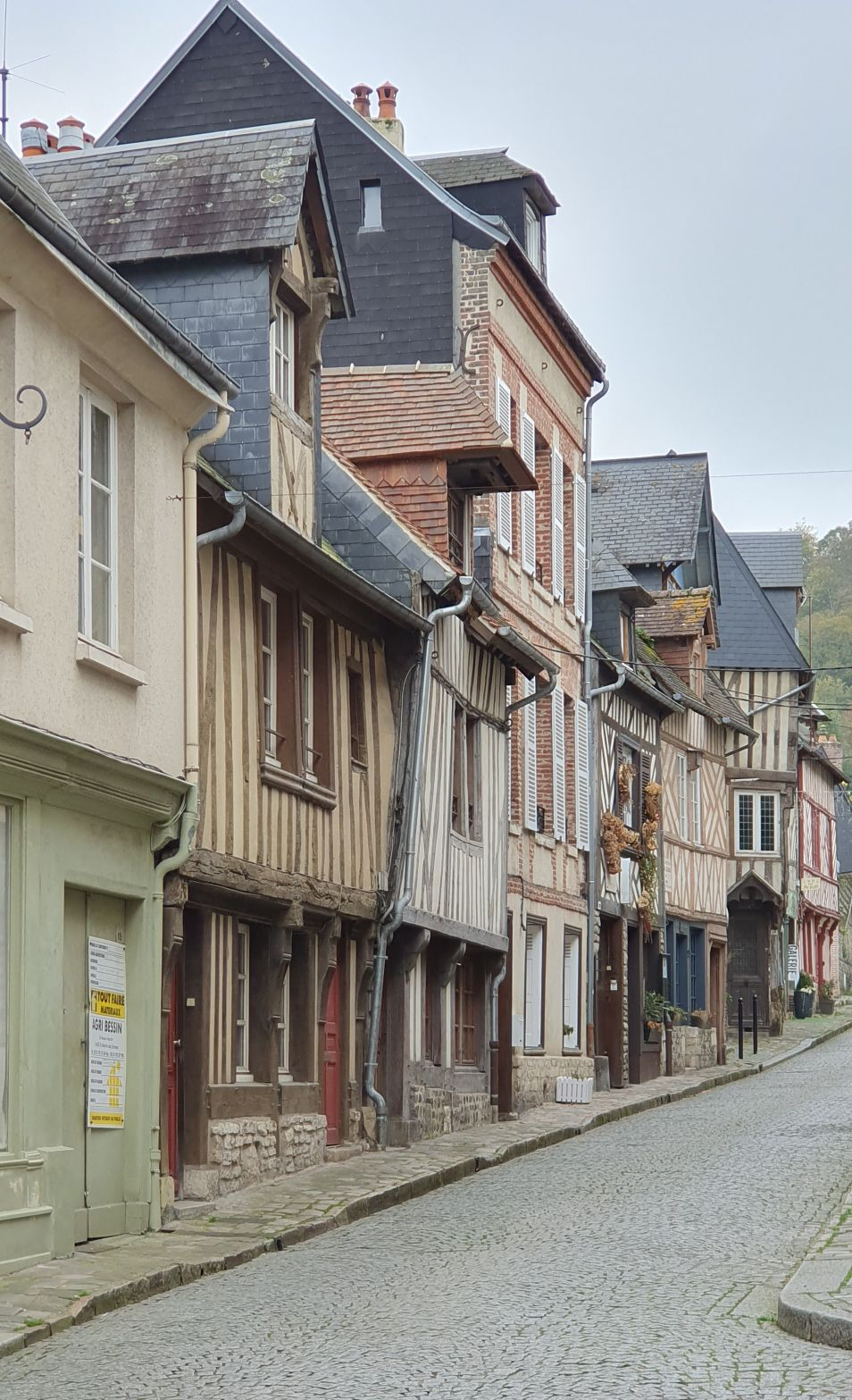
My wife and I had booked an excursion from the port of Le Havre, to visit Honfleur. This is a picture-postcard town of pretty timber-framed houses, picturesque streets of shops and art galleries and interesting churches and waterfront places to explore: an absolute gem.

A street scene in Honfleur.

Before getting immersed in this historic town, I popped into a supermarket for a quick look for a stationery aisle. I found one and could not resist buying a fountain pen for three Euros, including two cartridges. It had no brand name other than the name of the shop, “Casino, stylo plume” on the blister pack. Back outside, I loaded a cartridge, putting the second one in the barrel as a spare. After the pen had sat in my pocket for a few minutes, I tried it out in my notebook. To my surprise, it wrote immediately and with a lovely smooth flow. If only all pens were this good!

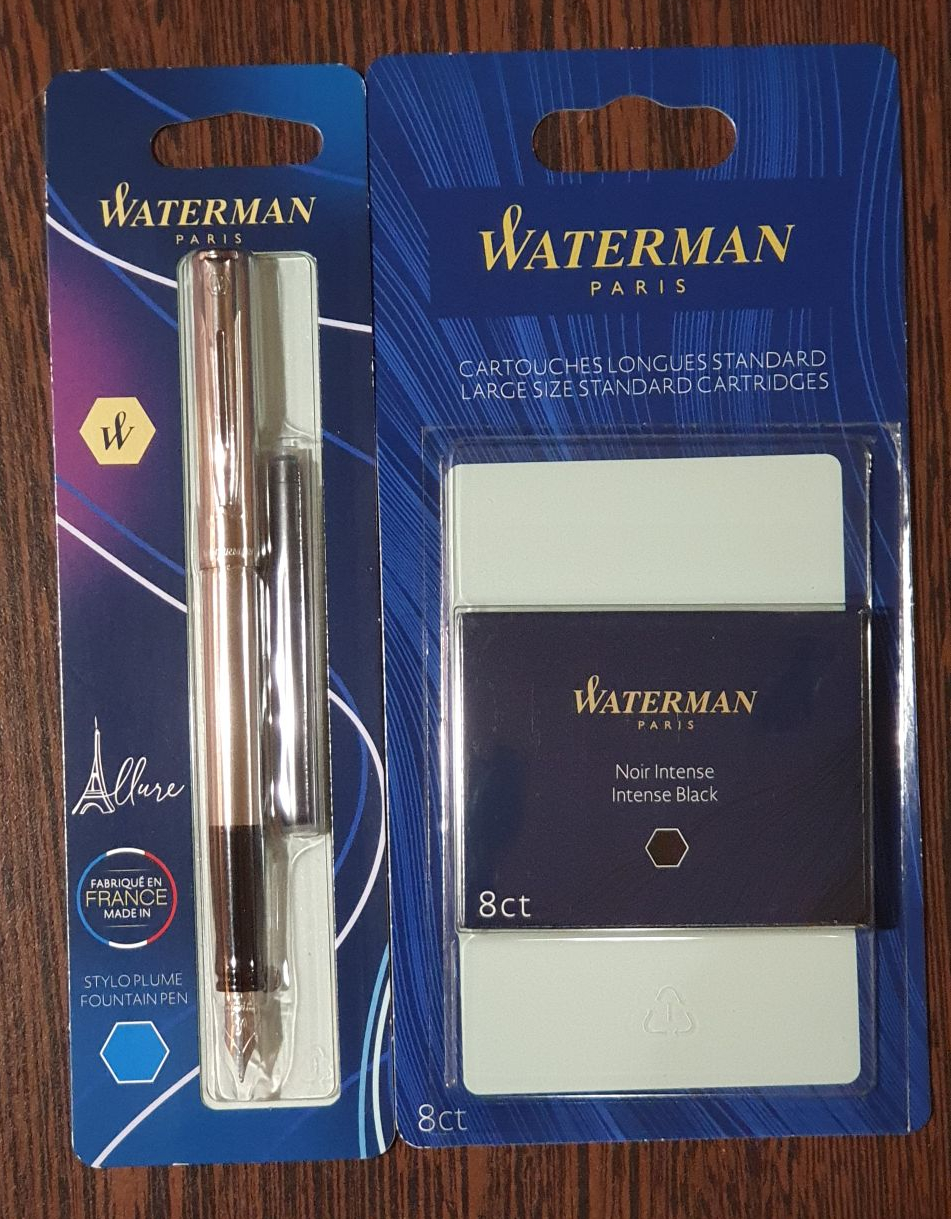
My final pen purchase of the trip came at the end of the day, back in Le Havre. Again, it was a supermarket in the city centre where I found an ideal souvenir: a Waterman Allure, made in France, in brushed stainless steel and with an improved plastic grip area. When I had bought an Allure previously, I disliked the grip section with a surface that defied gripping. In frustration, I had gouged grooves in it to stop the pen sliding around in my hand. Thankfully, this problem has been fixed, at least on the stainless steel versions now sold in Le Havre!

Again, this Waterman wrote beautifully, straight out of the box and makes a great EDC pen, encased in steel and with its large capacity Waterman cartridge.

Waterman Allure, brushed stainless steel.

The following day, our cruise ended and we disembarked at Southampton, tired but happy. I was pleased with my purchases. Returning with six additional pens inked will delay the emptying of my four vintage pens but this is a small price to pay for the joys of the holiday haul.

The four vintage pens on the right. The six new arrivals on the left.