Kaweco Dia 2 fountain pen review.

I know well the pleasure of receiving a new fountain pen. There is an element of risk as sometimes the pen might not live up to expectations and the initial excitement can turn to disappointment.

The Kaweco Dia 2 had been on my wish list for over a year. Eventually I succumbed. This was in part triggered by my recent experience of the new Kaweco Perkeo. I fully appreciate that the Perkeo is an inexpensive, entry level pen. I do not like to be negative about it and would feel awful if anything I wrote caused anyone who had just received a Perkeo, to like it any the less.

I liked the nib of the Perkeo and it certainly has a place as a robust, reliable, decent quality writing tool. But I came to realise, as I looked again at favourable reviews of the Kaweco Dia 2, that the various aspects of the Perkeo that I liked less were all remedied in the Dia 2 and that perhaps this was the pen for me.

I did not have the opportunity of handling a Dia 2 before buying, as I do not know anyone nearby who owns one and they are not found in the shops here. Paperchase do sell Kawecos but these seem to be limited to the Sport models including some aluminium and brass versions, (and now the Perkeo too).

I ordered my Dia 2 from Cult Pens and enjoyed their excellent service as usual. I received the pen on a Friday evening, with the happy prospect of a weekend ahead to get acquainted with it.

To get to the point, the pen is simply gorgeous. I have seldom been so thrilled with a new pen (and I have bought a few).

Admittedly, a fountain pen, like a wristwatch, is a personal thing and what appeals to one person does not appeal to everyone. But as someone who appreciates nice quality design, features and materials in a fountain pen, I found lots of detail to enjoy in the Dia 2 and very little to dislike. It seems to embody an excellent compromise, of being not too heavy, not too light, not too large, not too small, not too cheap and (dare I say) not 2 dia.

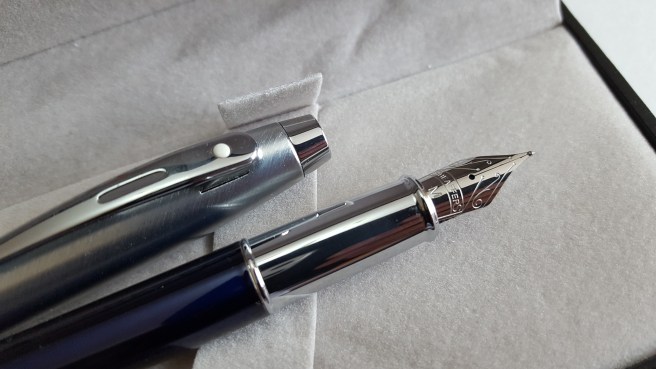
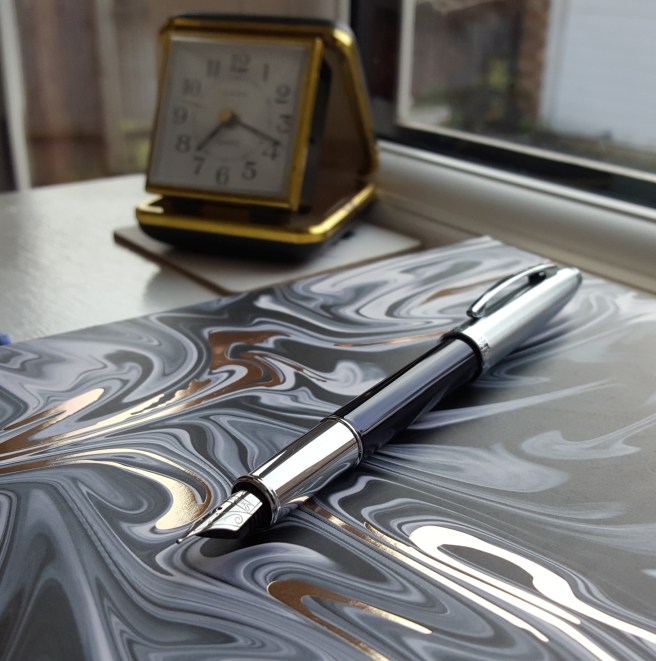
The pen is based on a classic design from the 1930’s. What immediately impresses, is the glossy black finish, with contrasting chrome coloured fittings, the classic subtle beauty of the shape, the gentle curves to the cap and barrel and the section where the pen rests comfortably on your finger as you write. Also the elegant knurled end caps and metal Kaweco badge at each end.

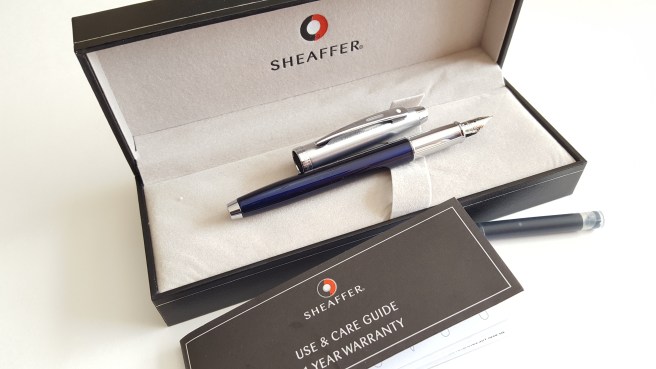
My pen arrived in a smallish black, hinged box with a push-button catch and a cushioned white satin interior, like a jewellery case. This was in a cardboard sleeve, with the Kaweco logo and slogan “License to write, Germany since 1883”. However I have heard the pen is sometimes packaged in the Kaweco tin instead (which I am familiar with, from purchasing a Kaweco Al-Sport).

20170723_232118

The Dia 2 is a black, cartridge-converter fountain pen, taking standard international cartridges with a stainless steel nib. There is a 14k gold nib unit available. There is an option of the chrome coloured fittings, or gold coloured at a little extra cost. In the hand, the pen feels reassuringly solid, beautifully balanced and particularly tactile. It wants to be picked up.

The pen measures (approximately) 133mm capped, 124mm open (not counting the raised badge at the end of the barrel) and 158mm posted. I weighed it at 28g (including two cartridges on board) of which around 18g is the pen unposted and 10g is the cap.

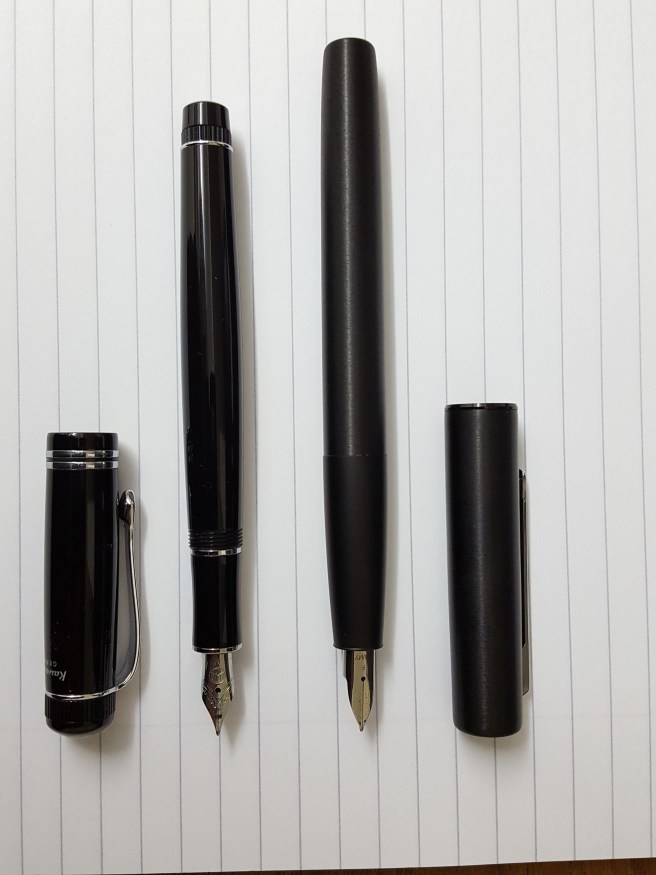
For me, this puts the length as being adequate to use unposted, although it is a little shorter unposted than the generous 130mm of a Lamy Safari or AL-Star, or the 135mm of my Cleo Skribent Classic. However, I do prefer to use the Dia 2 posted. It still feels nicely balanced this way, is not too long or back heavy and has the advantage that you can put it down on a desk without it rolling off.

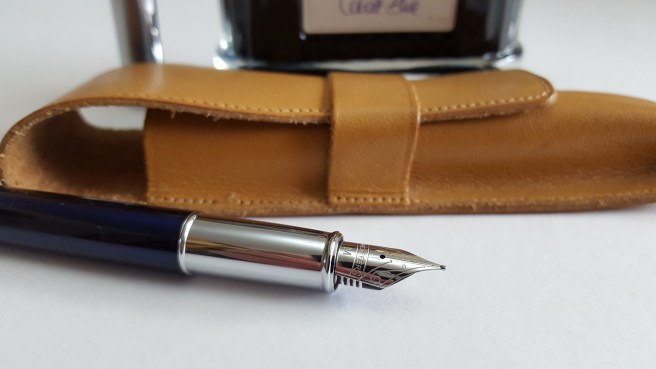
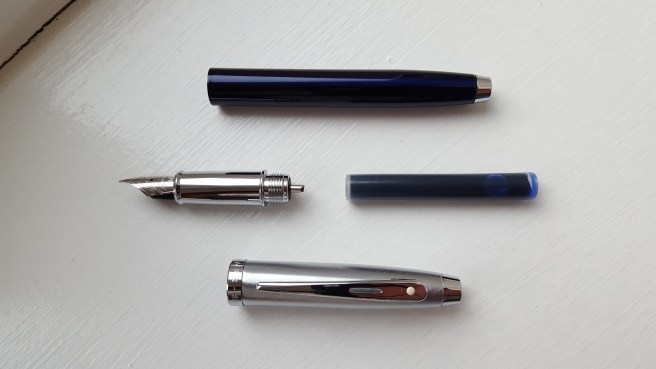
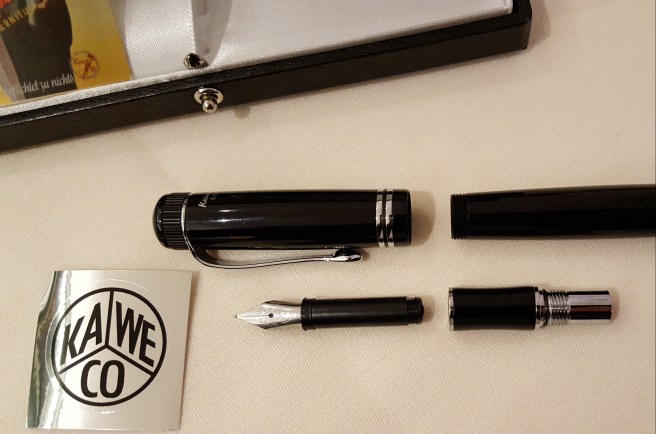
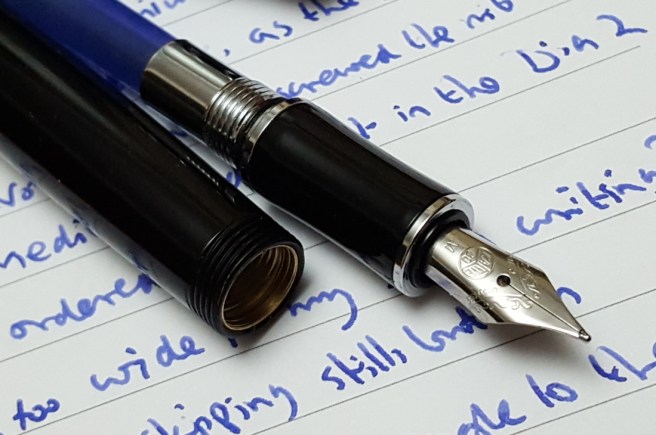
The stainless steel nib is part of a unit, which unscrews from the section when you want to clean it or swap nibs (rather like a Pelikan). Spare nib and feed units are very affordable, and available from Cult Pens in EF, F, M, B and BB widths. Currently these are priced at £8.40 each except for the Extra Fine or Double Broad which are £10.49. There is also a 14k gold option for £99.00, (all widths) if you want extra luxury.

20170706_000336_001

I have been genuinely delighted with my Dia 2. I ordered mine with a Fine nib, in stainless steel. I tried this for a day or two but found mine a little skippy and not as effortless as it should be. Perhaps it just needed tweaking or running in but I was impatient. I then swapped this with the medium nib unit from my Kaweco Al-Sport, the shiny aluminium one, that looks stunning but which I find slippery to hold. With the medium nib installed, the Dia 2 came into its own and wrote superbly.

Nothing is perfect but, being reasonable and taking account of the moderate price tag, I cannot really think of many improvements that could be made. To summarise likes and dislikes:

Likes:

  • Aesthetically very pleasing; a classic, 30’s design;
  • Combination of metal and acrylic materials for beauty and strength;
  • Nice design flourishes, such as the knurled end caps, the metal Kaweco badge at both ends, the sweeping curve of the pocket clip and the very subtle tapering curves on cap, barrel and section;
  • The inscription in white lettering, “Kaweco Dia GERMANY” at the back of the black cap, rather than on any of the rings;
  • Good quality yet very affordable Bock stainless steel nib, in an easy-to-change, screw in unit;
  • Commendable performance for an inexpensive nib. Pleasant feedback. No skips or hard starts. (I am using Caran d’Ache blue cartridges in mine);
  • Comfort. The gentle curve at the middle of the section, makes for a comfortable and natural way to rest the pen on your finger as you write; the weighty section balances the pen nicely when the cap is posted;
  • Screw-on cap with minimal turns, with a good secure bite at the end; it is not going to uncap itself in your pocket or bag;
  • The cap threads are not sharp and there is no step down from barrel to section;
  • Removing the barrel, reveals nice metal threads on both the section and the interior of the barrel, for durability;
  • There is an O-ring at the base of the threads, on the section, which is a nice touch, preventing the barrel from coming unscrewed in a pocket;
  • The cartridge is inserted into a deep, chrome collar (about 15mm long, including the screw threads), unlike some pens where the cartridge can wobble from side to side;
  • The barrel can carry a spare cartridge – a benefit if you are out and about;
  • There is a spring inside the barrel, which compresses when you have two cartridges on board, so that the spare does not rattle;
  • I loved the box that mine came in, with its push-button clasp.

Dislikes:

  • The pocket clip is very tight. If you clip it in a pocket, it is not going to fall out, which is a good thing, but it takes a bit of practice to find a way to release it; I tend to put my thumb-nail under the end of the clip to pull it away from the cap, before trying to pull the pen out of a pocket;
  • I have read a criticism that the nib size looks a little bit too small for the pen; personally, I do not have any problem with this;
  • Also I have read comments that for the price, it should be a piston filler, like a Pelikan M200 for example. Well, that would make it a different pen altogether. Personally I like it just as it is. I have a hoard of standard international cartridges at home and am glad of having an enjoyable pen in which to use them.
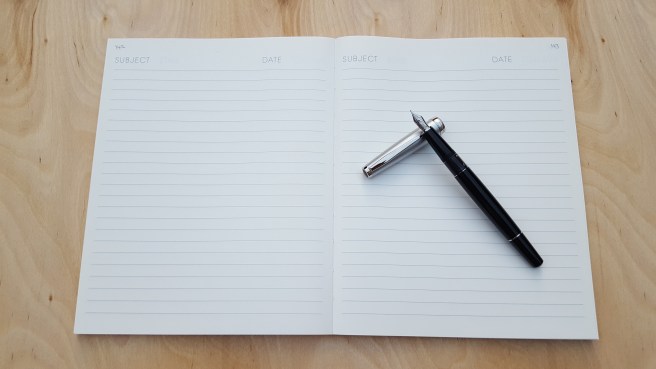
  • Again, other reviewers have said that the cap does not post deeply enough for them. I think a lot of engineering design has gone into the cap and inner cap. If it had been made wider, to post deeper, then this might have thrown up other problems. As it is , it does cover about 27mm of the barrel when posted and is not perched precariously on the tip of the barrel. I have no problem with it. I enjoy using the pen posted, it does not make for an uncomfortable, back-heavy pen and the overall posted length is not too long, in my opinion. It does post securely;
  • I have read that some converters do not fit, (due to the spring inside the barrel) but a Kaweco converter (not included with the pen) costs only £2.99 from Cult Pens. Interestingly, if you do not tighten the nib and feed unit enough, and then refit the barrel, with cartridge and a spare on board, you will have the disconcerting experience of seeing the nib unscrew itself as the barrel goes on! Simply tighten the nib and feed a bit more, to resolve this.

Conclusion.

I have been using the Dia 2 at work now for several weeks, for taking notes on pads of file paper. It is a joy to look at and to hold. For a work pen, the ability to start immediately if left uncapped for a while, is appreciated.
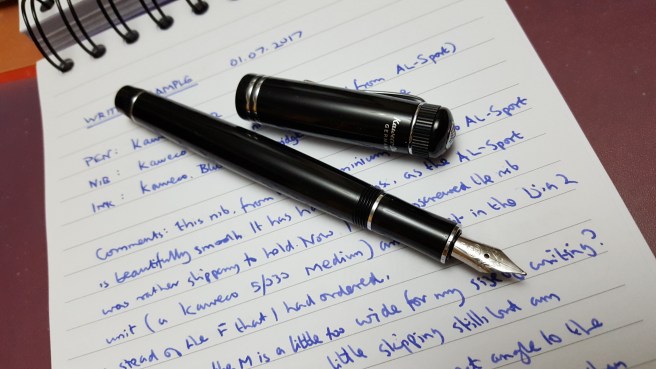
If we were playing the “If you could only keep one pen” game, then currently this Kaweco Dia 2 would be a contender. It has very quickly become a daily companion for me. I cannot imagine getting bored of the classy design. For anyone looking for a well designed, well made cartridge converter pen that is smart and attractive enough to treasure but which does not cost a fortune, this is well worth considering.
20170706_000636

Kaweco Perkeo, a brief update.

Following my recent post A peek at the Perkeo; first impressions of the new Kaweco cartridge pen. I wished to add a few comments after my first week of ownership.

The good news and the main message to take away, is that the performance of the Bock, stainless steel medium nibs on both of the pens that I bought is quite superb, with a lovely smooth writing experience far beyond what you might expect at this price level. Yes, perhaps the size 5 nib is a little more firm than a larger, size 6 might have been but overall I am delighted with it.

My biggest gripe had been with the faceted grip section. After all it is probably targeted by its price tag as being a beginner’s pen or close to it. But having medium to large hands myself, I have very quickly found that I automatically grip the pen higher up the body than the facets (save for the third facet on the underside, where the pen conveniently rests on my second finger) and so the facets were not an issue for me in practice. Within a few days of use, I barely noticed them.

On the downside, I have received one comment from a work colleague, who saw my Old Chambray coloured Perkeo on my desk, and said that it looked like an insulin pen. Admittedly, the colour scheme, size, shape and material of this pen do give it a slightly clinical look.

20170624_164734

This week I did try removing the nib and feed. I had expected them to unscrew, as a unit (as on the Kaweco Al sport). However this is not the case. The nib and feed of the Perkeo are friction fit and push directly into the coloured section.

20170701_010554

As I tried in vain the unscrew them, I was simply rotating them in the section.

There is no flattened edge of the circular opening, to give any guide to locating the nib and feed. To replace them you just seat the nib on top of the feed, align them with a centre line between two facets and then push them home.

For the benefit of anyone new to the art of nib removal, (a noble and relaxing pass-time which I whole-heartedly recommend) then there are few rules which I have gleaned online and from experience:

  • take care to grip the nib and feed together firmly, between thumb and the first joint of your finger (with thumb over the nib) using some grippy material or else a tissue or cloth;
  • for nib and feeds which are friction-fit (as with the Perkeo), grip firmly and then pull in a straight line, taking care not to bend or distort the nib or damage the delicate fins on the feed;
  • if doing this over a basin, do have the plug in place, in case the small nib or feed drop down the plug hole;
  • once removed, it is very easy and satisfying to rinse the nib and feed and the section in water and dry them, before reassembling;
  • the nib can be examined under a magnifying glass or loupe to check that the tines are aligned and adjustments can be made (very gently and by hand) before reassembling;
  • for nib units which unscrew, (such as the Kaweco Al-sport, or Pelikan M series, for example) then grip the nib and feed as described above but rotate the barrel, not the nib, to unscrew;
  • It is good practice to clean a nib and feed from time to time, particularly before changing inks. A short cut, rather than removing the nib and feed, is to leave the entire nib section to soak in water overnight and then rinse under a tap or use a rubber squeezy blower to squirt water through it, until it runs clear.

Coming back to the Perkeo, since there is no set position to align the nib and feed in the section, this means that you are free to align them how you wish, in relation to the facets. You can offset the nib if you wish.  There is no need to feel that you are forced to have the nib centred between two facets. With trial and error, if the centred nib does not conform to your preferred grip, you can customise your pen – rather than feeling that you have to adjust your grip to suit the pen.

In conclusion, I think that the Perkeo is a pen that I shall use and enjoy, for its excellent stainless steel nib and writing performance, if not for its looks.


A peek at the Perkeo; first impressions of the new Kaweco cartridge pen.

A cruise ship holiday offers a wonderful opportunity for the fountain pen enthusiast, to spend a little time away, in new surroundings with a few select pens for journaling on the trip.

Our recent one-week cruise departed from Southampton, with visits to La Rochelle in France, Bilboa in Spain and finally, St Peter Port, Guernsey.  Being a novice at the modern cruise ship experience, I had not prepared myself much beyond planning which pens to bring.  While my wife was happily picking out which evening dresses to pack, I was looking forward particularly to sitting in our balcony cabin, with notebook and pen, to “unpack” a few thoughts and impressions of our travels.

Choosing which pens to bring from the “currently inked” selection in my pen cups, was a challenge, but an enjoyable one. I settled on the following:

  1. Lamy AL-star, Pacific Blue (with Lamy turquoise ink cartridges);
  2. Lamy AL-star, Charged Green (with syringe-filled cartridge of Graf von Faber-Castell Moss Green ink);
  3. Cleo Skribent, Classic Gold piston filler, with Graf von Faber-Castell Cobalt Blue ink); the ink colour reminds me of a Guernsey pullover;
  4. Cleo Skribent, Classic Metal piston filler, with Graf von Faber-Castell Moss Green ink);
  5. Faber-Castell School pen, with blue ink cartridge. A light-weight and reliable shirt pocket pen for the hasty note.

Admittedly, any one of these would have been sufficient on its own to use for a week, but I enjoyed each of them in turn.

I had hoped that the shore excursions might afford an opportunity to stumble across a charming local pen shop and browse among some unfamiliar brands of fountain pens and inks. However, having chosen to join guided tours for our visits to La Rochelle and Bilbao, there was limited time available for shopping.

It was not until day six, when spending a day wandering on our own at St Peter Port, that I spotted the familiar “Paperchase” shop sign and found a stationery shop looking just like any of their other branches in London. Nevertheless, starved of pen shops for almost a week I was interested to check whether their stock was any different from ours at home.

The glass cabinets displays of Cross, Kaweco and Parker pens and the hanging displays of Lamy Safaris and AL-stars were all very familiar. But then I had my first sighting of a Kaweco Perkeo, a recently released model, news of which had not yet reached me.

20170622_191405

Displayed in a clear plastic clam-shell style pack, I first noticed the “Cotton Candy” version, with a contrasting taupe coloured cap. I understand that cotton candy is the spun sugar confection that in the UK is known as candy floss. To me however, the colour of this pen puts me more in mind of salmon which would be a truer although perhaps less appealing description.

Beside this on the rack, there was another version called “Old Chambray” which denotes a blue-grey colour for the cap, with white barrel and section.

The pen has a stainless steel nib (made by Bock) familiar from the Kaweco Sport pocket pens. Indeed the pen is similar to the Kaweco Sport but larger all round and with a broader cap. The cap is eight sided whilst the barrel is sixteen sided. I have read that it is based upon another old Kaweco fountain pen.

20170624_165002

The main and most obvious difference is the length, with the Perkeo having a length, opened and unposted, of about 128mm (or 160mm posted), whilst the Kaweco Sport measures just around 100mm opened and unposted, (or around 133mm posted, as it is intended to be used). Thus the Perkeo is almost as long unposted, as the Sport is posted. Other differences are that the Perkeo section has three flat surfaces, or facets, intended to improve correct grip and that the cap of the Perkeo is broader and shorter than on the Sport and snaps on rather than being threaded.

The packaging shows three cartridges included although there are in fact four, since you find one more in the barrel, plus a blank, dummy cartridge already fitted in the section.

Deciding to buy one of each colour, I was keen to have a closer look at home and to ink them up. The nibs on both proved to be very smooth, with tines well-adjusted “out of the box” with a good ink flow thus giving a very pleasing, well lubricated writing experience. No complaints there.

20170624_164734

I have since read online that there are two other colour options, namely “Indian Summer” which is yellow and black, or “Bad Taste” which is coral pink and black.

I inked the Old Chambray model with one of the supplied cartridges of Kaweco blue ink. This is an excellent ink, a rich, dark royal blue. As for the Cotton Candy model, as I have rather too many pens already inked with blue, I inserted a dark blood-orange cartridge from an old bag of standard international cartridges in assorted colours from Paperchase that I had at home. (At £2.50 for a bag of 50, these are great value and give your pens a low running cost for high mileage writing).

20170623_190046

In summary my initial impressions are:-

Likes

  • good length, comfortable to use posted or unposted;
  • barrel has room for a spare cartridge;
  • strong resin material; a tough pen to use and carry around every day, such as for school use;
  • excellent stainless steel nib; smooth, optimum flow (wet but not overly so);
  • four Kaweco ink cartridges included with the pen;
  • firm snap on cap, with good inner cap fitted and an attractive metal Kaweco badge for the finial;
  • reasonable price; similar to the Lamy Safari.

Dislikes

  • three facets in the section; I would have preferred the section without these; however they are shorter than those on the Lamy Safari or AL-star and the pen barrel is sufficiently long, to avoid the facets and grip the pen higher up with thumb and forefinger over the contrasting coloured band at the end of the section and still have the barrel resting in the crook of your hand; or you may post the cap for even greater length;
  • colours are a bit garish and weird, unlike the more standard colours available for the Safari;
  • tough resin material and the snap-on cap (with no pocket clip) combine to give a functional but rather charmless, clunky, white board marker-pen feel.

Conclusions

Overall, this is a pen that writes very well, with a good quality German stainless steel nib. If you like the Kaweco Sport but wish it was a full sized pen that you could use unposted, then this may be the answer, being bigger and longer than the little Sport. For me, I would have preferred it without the facets on the grip section. As there are three of them they do narrow the grip and also do not quite coincide with the angle at which I like to hold the nib to the page. However I liked the pen despite this feature.

Finally, the irony of choosing a German pen as a souvenir from Guernsey, has not escaped me. Guernsey was occupied by Germany during the war and was not liberated until 9 May 1945, a date commemorated on several monuments around the pretty harbour area of St Peter Port.  The pens will still remind me of a brief and pleasant visit to the island. I did also buy some Guernsey Cream Fudge.

20170623_180803


Faber-Castell School fountain pen; initial impressions.


Whenever I get the chance to travel, one of the joys is to visit the stationery shops and supermarkets to see whether they have anything different from the familiar range of fountain pens found in our local WH Smith, Rymans or Paperchase.

The hope is that I will discover a nice new pen, from a well known and respected brand, which writes like a dream, targeted at school students and costs very little.

Last week, without even travelling, I was browsing in a local Waterstones book store and was distracted by the sign for Stationery.  There, among the greeting cards and notebooks, on a revolving stand, was a Faber-Castell Schulfüller School pen, for just £4.99, in a blister pack with a box of 6 Faber-Castell cartridges.

20170510_210610

This looked to be a good find. The design was a basic, bright coloured plastic barrel and cap, a black rubberised section with two flat grip surfaces left and right of centre, (like a Lamy Safari), and an attractive-looking stainless steel nib. With 6 cartridges included, it was a no-brainer and it just remained for me to decide whether to go for blue or red. I chose blue. There was only one of each colour left on the rack and it seemed greedy to take them both.

On closer inspection, the packaging declared that the pen featured a tough stainless steel nib with iridium tip, a rubberised grip zone and was for right and left handers and had a tough plastic barrel with metal clip. The ink cartridges were made in Germany and the fountain pen made in Slovenia.

On first inking the pen, using one of the supplied cartridges, I was delighted when the pen wrote immediately with no shaking, squeezing or coaxing, very smoothly and with good flow. The Royal Blue ink is very pleasant having some shading when a little added pressure is applied to the nib.

20170513_173216

I will not go overboard in describing what is a very simple and inexpensive pen. It measures around 133mm capped , 122mm opened and a very comfortable 150mm with cap posted. It takes standard international cartridges. A very useful feature is that there is room to carry a spare cartridge in the barrel so that you are unlikely to run out in a day.  The barrel does not have an ink window. It does have some air vents at the base of the barrel as an anti-choking feature and so this is not suitable for converting to eye-dropper. You could however use a converter, for bottled ink although none is included.

For such an inexpensive pen, there is a lot to like. I was disproportionately pleased for my modest £4.99 outlay. I particularly liked the following:

Likes

  • Respected, long-established German brand;
  • Attractive stainless steel Medium nib, with dimple pattern (similar to the Faber-Castell emotion and Ambition range) and jousting knights logo;
  • Writes smoothly with good flow and lubrication; nib is firm but can provide a little line variation with some pressure;
  • Comfortable to hold either posted or unposted; light-weight cap posts well, without upsetting balance;
  • Barrel has space for a spare cartridge;
  • Secure, snap-on cap has a springy, metal pocket clip with Faber-Castell name in black letters (the correct way up for left handers like me, when posted);
  • A white plastic inner cap to stop the nib from drying out;
  • Good, practical and simple design; does not look like a child’s pen;
  • Excellent value.

Dislikes

I could not find much to dislike, especially for the low price. I did notice that the nib and feed seem to point downwards, (like the droop-nose design of the Concorde when taking off and landing). In a photograph on a mobile phone camera, the distortion made this even more pronounced. It is not a concern as the pen writes very well. However I was curious to see whether this was just a one-off or whether this was by design. This was all the excuse I needed, to go back to buy the red one.

20170514_193131

Well, the red one had the same nib droop as the blue. I was not quite so fortunate with the nib of the red pen at first, as the tines were not quite aligned, viewed with a loupe and there was a little bit of scratchiness in side strokes. This was easily remedied by a little gentle bending of tines until they were level. Thereafter the pen wrote smoothly, like my blue one.

I decided to put a red cartridge in the red pen. I had a bag of 50 standard international cartridges in assorted colours from Paperchase which had cost just £2.00, although they might be a bit more now.

I have not experienced any hard starts with either of the pens (although, admittedly, both have been in quite frequent use so far) and I think they make ideal pens for carrying around without worrying too much. In conclusion, these are very enjoyable pens to use and would make great gifts, if you can bear to part with them.

20170514_170535

Off topic warning: the story of an unexploded bomb.

20170506_122710

Today I was asked to put together some notes about an unexploded bomb which had remained in the family for over 40 years before moving to a museum.

It seemed impossible to tell the story without saying a little about my late father, who died in 1983.  It is not about fountain pens but there is a little about collecting things. And so here is an abridged version.

The story of dad’s bomb.

My late father was born in Ealing in 1929, and grew up in Hangar Lane, West London. He was ten years old when the Second World War broke out in 1939 and remained with his parents throughout the war.

From the 1950’s until 1974 (when made redundant) he worked for Ultra Electronics, in Perivale as a general and electrical maintenance engineer. He then moved to a similar position at EMI in Ruislip. He had left school with minimal qualifications but was very practical and experienced at making and fixing equipment.

One of his main hobbies was target shooting. He had a firearms licence and always kept a variety of pistols and rifles, which he would shoot at Bisley or our local gun club, often bringing me with him from a young age. He also had a few old muzzle-loading flintlocks and percussion cap pistols and one which he had built himself. He enjoyed casting his own bullets in lead, in his garage. He also built a small cannon on a wooden carriage, which he fired in the garden at midnight every new year’s eve to see the new year in.

He collected old incendiary bombs and tall, brass anti-tank shell cases, which, along with his cannons and large jagged pieces of shrapnel, were arranged on the floor around our TV set.

Against this background, the largest item in his collection was an unexploded German 500 pound bomb. As I recall, he got this in the mid 1970’s from an industrial estate, possibly near Perivale or Kew, West London where, probably since the war,  it had served as a speed limit bollard, standing upright by the roadside, with its base set in a car tyre filled with cement. It was painted white with the speed restriction painted in black figures, for vehicles entering the estate.

I remember going in the car with him, to collect it. I have a vague recollection of him telling me that he had heard the bomb fall during the war. I suppose if you heard a bomb falling, you would wait for the explosion and if none came, you would be curious to find where it had landed.

I cannot recall now how he knew it was there or why it was being disposed of. Perhaps the site was being redeveloped and he might well have simply asked whether he could have it.  I believe we went there in his grey Vauxhall Cresta Deluxe, a 1966 model, which he had bought second hand with part of his redundancy money and so it would have been around 1974 or shortly after.  The bomb went in the large boot of the car. I imagine we left the plinth behind.

At home, he set about cleaning it up, at the back of the garden, near his bonfire patch behind the garage.  He was confident that it was safe. The cylindrical metal detonator device had been removed. He had read several books about the various types of detonators and tense stories of bomb disposal work, on UXB’s (unexploded bombs).

Originally there would have been metal tail fins on the bomb but these had long since gone. He was able to access the inside of the bomb case, through its base. It was largely empty, the explosives having been removed but there were vestiges of this (TNT perhaps) around the inside, which he chipped away and which came out in thick, rusty brown clumps. These, he assured me, were quite safe and he chucked them on his bonfire, where they fizzled and spat a little.

Once satisfied that he had got the inside as clean as he could, he gave it a new coat of paint, in British Racing Green. He then made a sturdy wooden cradle for it and a bench seat at the top (pictured). For the next 15 years or so, it remained in our house in Ickenham, either as a seat around the dining table or latterly, in the hallway beneath the coat pegs.  We enjoyed having it. It was a rather different and eccentric, to have a 500 pound bomb in the house.

Dad died in 1983. The bomb stayed in the house until my mother moved some six years later and since then has been in the wider family, in the custody of my aunt until she also moved house in 2016 and then my cousin. Now, having survived for over 70 years in these various unexpected roles, it will be great for the bomb to move to a museum.

Cleo Skribent Classic Gold, Piston fountain pen; first impressions.

Cleo Skribent is a German manufacturer of writing instruments, based at Bad Wilsnack, which is between Berlin and Hamburg. It was founded immediately after the Second World War, from small beginnings in a backyard car park. The first collection of writing instruments was called Cleopatra, which later became Cleo. Today, it is one of the few remaining companies to manufacture exclusively in Germany.

Readers of this blog may recall my review in February 2017 of the Cleo Skribent Classic Metal piston fountain pen, (click here: Cleo Skribent Classic Metal Piston fountain pen) a sleek, black resin pen with a brushed metal cap and a stainless steel nib. My fine nib model continues to be a delight.

So, what do you do when you find a pen that is near perfect for you? Do you stop looking for pens? No, it turns out you buy another one the same. Well, not quite the same. The differences (a.k.a. justifications) this time are (1) that it has a 14k gold nib; (2) the nib is a Medium; (3) it is all black resin, with gold coloured fittings and (4) lighter than the metal cap version.  So, totally different. Yet retaining the design and feel which I loved in the metal cap version.

20170429_114103

Once again I bought through Cult Pens, one of the handful of UK dealers of Cleo Skribent instruments. The company is much less well known here than Mont Blanc, Pelikan, Lamy or Faber Castell, but prides itself in making high quality writing instruments, with emphasis on quality rather than quantity and (as their booklet says) “instead of fully automatic machines, we employ people who understand their craft.”

Cult Pens refers to this model as being astonishingly light, for fatigue-free writing and ease of handling. Newly filled with ink, mine weighs around 19g capped, or 12g uncapped. It measures 145mm capped or 135mm uncapped, which I have found to be a comfortable length to use un-posted. However, you could post the resin cap, quite deeply and securely to add some weight without making the pen back heavy, but just bear in mind that it grips on the blind cap (not the barrel) and so be careful not to rotate the cap whilst posted in case you over-tighten and damage the blind cap.

The body and cap are of a beautiful, glossy black resin. I opted for the version with gold coloured fittings. There is also a version with palladium fittings which costs less, (why,  I do not know, as the pen is otherwise identical, with both having a 14k gold nib). I am not particularly averse to mixing my metals, when it comes to pen finishes. It is purely cosmetic, I know, but on this occasion, I decided on the gold coloured furniture as being indicative of the gold nib within.

20170430_194633

The nib is the heart of a pen. I have been delighted with the Fine stainless steel nib in my metal capped version, which is superbly set up, being responsive to the slightest touch and having a marvelous feed back. A joy to use.

I had read in reviews that their gold nibs were even better, with some flex. So when mine arrived, I was eager to examine it and give it a try. First, under the x7 loupe, the gold nib had everything that you look and hope for in a new nib. It looked to be set up perfectly, with the nib slit narrowing just so, the tipping material being even and the tines level. Admittedly I have only two Cleo Skribent pens to go on, but I believe the brochure and can imagine that they take care in sending out well finished products, which as we know, is not always the case these days.

20170429_105936

Whilst waiting for the pen to arrive (which was not very long, less than 24 hours) I enjoyed pondering what ink to use. I tend to use blues mostly for work. I love to see the blue ink on scanned signed documents on my computer screen. I narrowed it down to Waterman Serenity Blue, Caran d’Ache Idyllic Blue or Aurora Blue and went for the latter.

At first, dipping the pen, the writing experience was so smooth and pleasant and so pleased was I at the Medium nib width for this gold nib, that I happily continued writing for a full page on the first dip. I then inked it properly with the piston filler, one of life’s simple pleasures. I was using a spiral-bound pad of smooth, white, lined paper from Cherry Press, an independent stationer and print shop in Chipping Campden, in the Cotswolds. This showed off the blue ink beautifully. The ink flow, on this paper, is pretty much ideal being neither too wet nor too dry. The nib does have a little bit of flex, to allow for some line variation but it is certainly not too soft. As a left hander, I fare better with a firm nib.

20170430_171520

To summarise what I like about this pen (at the risk of sounding too gushing):-

  • Attractive, long and sleek design;
  • Handsome, glossy black resin body;
  • Piston filler, with blind cap covering the turning knob;
  • Large clear ink window;
  • Large ink capacity;
  • Superb 14k gold nib;
  • “Reverse writing” also smooth, for extra fine writing or drawing;
  • Nib and feed are friction fit and can be removed if desired for cleaning;
  • Comfortable length to use unposted (but can post cap if desired);
  • Good value for a high quality pen, in comparison with well-known German brands;
  • Lifetime warranty.

What about dislikes? Well, I have not found any major failings. Rather, I would mention the following points:-

  • Remember that this is a screw-cap pen; do not forget (as I did at first) and try to pull the cap off or hand it to someone who might do so, as this will exert force on the glued joints around the clear ink window. (The cap threads are located on the nib-side of the ink window);
  • Be careful not to inadvertently over-tighten the blind cap by posting the cap and then rotating it;
  • The piston mechanism works well but feels less smooth in operation than my Pelikans; it is too soon to say how this will perform in the long term, but there is a lifetime warranty;
  • The glossy black body does show up dust, as I have tried to demonstrate on my photos 🙂

Although I have no affiliation with Cleo Skribent, or Cult Pens, I am pleased to recommend them both.

20170429_113553


Converting a Platinum Preppy to eyedropper.

20170414_145541

If you had asked me about this a few years ago, I would not have known what you were talking about. It is one of those things that I picked up from the internet. Sensing that it seemed to be one of the rites of passage of fountain pen enthusiasts, I gave it a try today for the first time.

For the benefit of other newbies, we are talking about taking a fountain pen that is a typical cartridge/converter type filler and instead removing the cartridge or converter and filling the barrel directly with ink. The benefit, supposedly, is that you have a greatly increased ink capacity and do not need to fill the pen as often.

In order for a pen to be suitable, it needs to have a plastic barrel and plastic threads and for there to be no metal parts which might otherwise corrode from sustained contact with ink. Also the barrel must have no hole at the end, for obvious reasons.

The Platinum Preppy meets all these criteria and is a good choice. It is a very inexpensive pen, (mine was £2.79 from Cult Pens) but with a good nib available in a range of widths. The clear demonstrator barrels also mean that you can enjoy the sight of your ink sloshing around inside.

On the other hand, arguments against filling the barrel with ink are that there is a risk of greater mess if anything goes wrong. Perhaps if you were going travelling and did not want to take a bottle of ink, then having an eyedroppered Preppy would keep you writing for a good while but travelling with such a pen would be a worry. So you might want to keep your eyedropper for use at home or at work. But then given that you are likely to have a ready supply of ink on hand at home and work, it seems that there is not much of a case for an eyedroppered pen either for travelling or for home/work use. Maybe it would suit students who write large amounts of lecture notes every day, provided the pen is carried with care.

For the benefit of anyone who wants to try it, there are just a few items that you will need, as well as a suitable pen and some bottled ink, as follows:

  1. Pure silicone grease, to put in the threads.
  2. An O ring, to prevent leakage.
  3. A pipette, or syringe to transfer ink from a bottle to the barrel of your pen.

Gathering all of these items takes a little bit of hunting. I had heard that Silicone grease could be purchased from dive shops and as luck would have it, we have a dive shop in my corner of London.  The O rings can be bought in packs from the plumbing section of DIY stores. And the pipette I spotted in an art supply shop in a pack of ten.

The operation is very simple. You take an O ring,  stretch it over the threads and roll it down until it is seated at the end. I tried one of the large ones to start with, but then found that the smaller one will stretch over the threads making the rubber slightly narrower so I went with that size instead. You then take just a small amount of the pure silicone grease on your finger and smear it into the threads. Then, using the pipette, draw up some of your chosen ink and release it into the barrel.

According to an instruction video from Brian Goulet that I have just re-watched,  it is recommended that you keep the pen at least half full of ink. Also, I read on an information sheet that came with a Noodler’s Ahab pen (another good candidate for eyedropper conversion) that air in the chamber may expand from the heat of your hand and that refilling is required when the pen is down to two thirds air, in order to inhibit excessive flow.

20170414_150249

I have a Preppy with a medium (0.5) nib which writes very nicely. I had been using it recently with Sailor Kiwa-guro, permanent black ink in a cartridge which I filled with a syringe. I now planned to use this ink in the pen as an eyedropper.

On my first attempt this afternoon I had a few little issues. First I nearly forgot that the Preppy has a push on cap and I automatically started to “unscrew” the cap a few turns before realising that I was undoing the barrel and was perilously close to pouring permanent black ink all over myself. Secondly I then noticed that despite my generous application of silicone grease, ink had still worked its way part of the way down the clear plastic threads. Thirdly, the O ring was still rather too fat and so it protruded just where I grip the pen, although it did a good job of ensuring the barrel was secured pretty well. You do not want to overtighten the barrel as there would then be a risk of cracking the pen. Fourthly when I tried writing with the pen, I had a few wet blobs of ink suddenly appear on the paper.

I wondered whether this might possibly be due to a build up of air pressure as you screw the barrel onto the section, but then read the Noodlers’ advice about keeping the ink level up. I had filled the pen only half way up the barrel but went back and topped it up with some more ink until it was about three quarters full and I hope that this solves the problem.

It is rather too early to see how this is going to work out. I am very impressed with the Sailor Kiwa-guro ink and like to keep one pen inked with this, as it so useful for writing cheques or addressing envelopes. I know it is said to be fountain pen friendly, but I still feel a bit wary of having it in more than one pen at a time with the risk that it might get left to dry in the feed. I had washed it out of my Lamy AL-star and decided to use it in the Preppy instead. I like the way it moves around in the Preppy, without leaving much trace on the barrel. And unlike cartridge ink, the eyedropper method means that you do not get ink staying at the wrong end of a cartridge and causing ink starvation.

I am not sure yet whether I am going to keep the Preppy eyedroppered or go back to using cartridges. But at least it is another milestone in the fountain pen journey, to mark off the list.

My Pelikan M205 fountain pen, one year on.

This past week marked 12 months since my purchase of a Pelikan M205. This was the 2016 special edition, blue demonstrator version. (The cropped name tag reads “Demonstrator M205, Blau/Trans. B”)

Recently I read a criticism made on FPN, levelled at some of those who provide reviews of fountain pens online, that they were often produced after the reviewer had spent little time with the pen. The inference was that the reviewer was too biased in favour of a pen still in its honeymoon period. (The thread was entitled “The Rampant Inaccuracy of Fountain Pen Reviews”; just go to FPN and search “rampant”). This ran to 125 comments when I last looked and so had clearly prompted some lively debate.

Personally, I much enjoy looking at reviews of fountain pens online, including enthusiastic ones when someone is excited with a new acquisition.  I am sure that we all make allowances for any bias that might be apparent, in order to form our own opinions, weighing up comments from multiple sources.

Nevertheless, I do take the point. I thought today would be a good opportunity to offer my reflections on the Pelikan M205 after a year’s ownership.

This was my first Pelikan. Having read much about the Pelikan M series piston filler pens, my expectations were high. And all the points that I liked about the pen when I received it, still apply a year on:-

Likes:-

  • Attractive, neat and petite demonstrator body, in a sky blue see-through material, being a little more discreet and less distracting than a clear demonstrator;
  • Piston filler; a smooth, simple, reliable, large capacity ink reservoir and with no worries of running out of ink unexpectedly; a fountain pen in the true sense, not a cartridge/converter pen;
  • Wonderful stainless steel nib, (mine is a Broad), which is smooth, wet and just nicely springy for my liking;
  • Easily removable nib and feed unit, for easy cleaning or nib-swapping with replacement nib units currently available in Extra Fine, Fine, Medium or Broad at £11.25 from Cult Pens;
  • Screw cap, which posts deeply and securely, giving a comfortable posted length of around 148mm;
  • No hard starts: the nib, feed and inner cap design and screw threads located a third of the way up the cap, combine to make a pen that is always ready, even after standing idle for several days;
  • No problems with air travel;
  • The Pelikan heritage and quality name, even though this is not part of the Souveran range.

20170409_221358

Dislikes:-

“Dislikes” is perhaps too strong a word when discussing a Pelikan pen, but for want of a better one, I offer the following:-

  • I felt that its looks, at least to the uninitiated, meant that it could too easily be mistaken for an inexpensive pen like a Platinum Preppy or a single use or roller-ball type pen;
  • It is very lightweight and lacks “heft” although this is not necessarily a bad thing;
  • When filling, ink gets “under the skin” of the nib section. In this pen, the section is not detachable but is all part of the barrel. However there seem to be two layers of the acrylic body material, the space between them being unsealed, allowing ink to seep in,  which you cannot easily clean out, even with the nib unit removed although soaking in water does clear this. I am not sure whether this is common to all M205’s or whether this is just a fault of my pen; I consulted SBRE Brown, who was aware of the issue;
  • Being aware that this was perhaps an entry level Pelikan I still harboured an urge to try one of the familiar, striped models in the Souveran range with a gold nib and one with the heavier, brass piston mechanism which meant going for an M800 or M1000.
  • The price, at the time I bought mine from The Writing Desk, was £95.00 which is approximately double the price of a TWSBI Diamond 580. The TWSBI gives the appearance of being a better quality pen, with its faceted, polished barrel and larger proportions. I do however appreciate that it is unfair to compare pricing of German made pens with those from the Far East.

From a quick glance at my pen cup, (sixteen pens today), I note that the M205 is the only one of these that has remained inked continuously for the past 12 months, while others have been in rotation. I had used it exclusively with Waterman Serenity Blue ink, which in my view is an excellently behaved ink and reasonably priced.

On its 12 months’ anniversary, I filled the pen with Waterman Harmonious Green, an ink which I also like very much. However, in the blue M205 it just seems “wrong” and I plan to go back to the Serenity blue, ironically, to restore harmony to my pen cup.

Perhaps the greatest testimony of my appreciation of Pelikans, is that I have since bought a new M800 and a vintage M400 for myself, plus another M205 (in Aquamarine) as a getting-a-place-at-University gift for my neice.

I do enjoy my M800 and M400 too and each has its particular attributes. Yet the M205 still retains a special place in my collection and will always be my first Pelikan.


My Sailor Lapis Lazuli Limited Edition with 21k Zoom nib.

P1100991

I have put off doing a post about this pen because, frankly, I did not know quite what it was. I bought it on a bit of an impulse, during a live auction in January without having inspected it.  It is not a current model.

I did know that Sailor fountain pens and nibs are very well regarded. I have not owned one before, but had a brief look at a new Sailor Pro Gear at the London Pen Show in October and was very taken with the 21k gold nib.

There was brief description of the pen on the auction web site and a few photos. It was described as a limited edition, number 114 of 150, with a 21k gold nib. The pen was boxed, with original Sailor cleaning cloth, two packets of two cartridges and the Instruction Manual. It included a converter and was said to be inked, which was a worry but also rather appealing to someone who loves to clean pens.

P1100986

Having successfully bid for the pen at auction, I went to Hampstead Auctions the following day to collect it. At the same auction I had bought the lovely 1950’s Pelikan M400 tortoise and over the following days it was the Pelikan that got more of my attention.

The Sailor was in a good condition, save that the nib and feed were encrusted in dried ink and the converter almost cemented into the section. However, with a bit of soaking, the 21k gold nib cleaned up spectacularly, like new. I was also able to get the converter out and give it a good clean, as it still had remnants of blue ink inside. I was not familiar with the Sailor converter which has an unusually large opening, like the proprietary Sailor cartridges.

The cap, section and barrel are all of a mottled light and dark blue resin. The number 114/150 is stamped on the barrel. The cap band reads “Sailor Japan founded 1911.”  The barrel does screw on very securely to the section, as a result of an O ring and so there is no danger of it coming unscrewed in your pocket. The pocket clip ends in a large ball, which gives a bit of a clue in this case, as to what you find at the tip of the nib.

The nib, bearing the Sailor name and anchor emblem and “21K” has a “Z”on the side although I confess that at first I thought this might be an “N” the other way up. Clearly, the nib looked to be very broad, with a giant blob of tipping material. I assumed it to be a Japanese double broad or similar.

I filled the pen with Diamine Oxblood and gave it a go. Immediate impressions were that the nib was (a) extremely smooth and (b) extremely broad. In fact it was too broad to use for my usual smallish handwriting but well suited to writing headings in capital letters. Apart from trying it out a bit, I did not put the pen into regular use and instead, cleaned it again and returned it to its box.

I was keen to try to find out what model it was and how old it was. The Instruction Manual was generic for a range of different writing implements. It did have a number in the corner, 99-3027-000 which I guessed might perhaps indicate that it was issued in 1999.

Revisiting the pen earlier this week, I googled “How to identify a Sailor fountain pen” and was taken to a thread on Fountain Pen Network. Following the trail I was thrilled to find an entry from 22 June 2005 by “The Noble Savage” with photos of the same model, described as a Sailor Lapis Lazuli Limited Editions, bearing number 127/150! I understand that it is based on the Sailor Magellan but with a different colour and name. It is unclear when it was introduced but I read opinions that it was in the mid 1990’s or early 2000’s.

I was also interested to discover (and you probably knew this already) that the nib, with the “Z” mark,  is called a Zoom. Rather like a zoom lens gives you a range of options, this nib has multiple surfaces which give differing line widths. It has a large blob of tipping material and the main writing surface on the underside, is in a triangular shape and slightly convex, with the apex of the triangle at the tip of the nib. Thus, if you hold the pen towards the vertical as you write, there is a narrower surface touching the paper whereas if you lay the pen down low, there is a very wide surface area of tipping material in contact with the paper, giving you a very broad line.

Naturally, as soon as I read this, I could not wait to ink the pen again and try this out for myself. This time I went for the familiar Waterman Serenity Blue. The serene sailor.

Well, it certainly works. What you have is a gadget, a handy multi-purpose nib that you can use to create a range of lines from fine to double or triple broad. I found that using the reverse side of the nib gave a nice fine line for general purpose writing whilst the normal writing position gave a broad line, which can be made even more broad by lowering the back of the pen towards the paper. It is fun to try.

wp-1491001890776.jpg

FPN-ers had varying experiences with this. Some did not get on with it and preferred to exchange the nib. Others compared it to a music nib, such as is available from another Japanese pen company, Platinum, but which has two slits and gives a wide, crisp line one way or a very narrow line the other way.

I can see that it has its uses. Perhaps it is more suited to writing Japanese characters or for being held upright like a calligraphy ink brush.

Whilst they had not appeared on my radar until now, I see that Sailor Zoom nibs are still available although the Sailor Magellan is no longer made. I gather that it was sold with the option of a Titanium nib or 14k or 21k gold. Like a music nib, the Zoom nib is good for blocking in large areas of ink quickly if drawing but is rather a specialised tool and not ideally suited to normal writing unless you happen to have huge hand writing and like a double broad line.

I would be interested to hear your comments if anyone can provide more information on this model or share their experiences of the Sailor Zoom nib.

wp-1491001922297.jpg


Paperchase cartridge pen and coloured ink.

wp-1490478585289.jpg

Happy Mothers’ Day, from London. Also, the clocks went forward today. Spring is officially here and we are now in British Summer Time and enjoying lighter evenings.

Today’s splash of colour comes from a recent visit to my local Paperchase stationery shop. As well as selling Cross, Kaweco, Lamy and Parker fountain pens they have a few of their own brand cartridge pens. I have tried three different models since July 2016, costing up to £6.00. This current blue demonstrator model is just £2.50 including three blue cartridges.

For this, you get a lightweight, plastic pen with a snap-on cap. The plastic pocket clip is quite springy and functional. The cap posts securely, giving a posted length of 150mm. The steel nib has no markings or breather hole but does have tipping material. It also has a wick between the nib and feed to help with ink supply. I would describe the nib as a medium.

The section is clear plastic and through this you can see the feed which is of a light blue plastic.

The pen takes a standard international cartridge but does not have room for a spare. The barrel has a hole at the end and so unlike the Platinum Preppy, this pen could not be converted to an eye-dropper fill.

Inking it up for the first time, it took a while and a bit of shaking before ink reached the nib but once it did, the writing experience was surprisingly smooth and I had no complaints about the ink flow. In fact it wrote with hardly any pressure. Do not expect a flex nib but you can get a little bit of line width variation, between sideways strokes with no pressure and downward strokes with some pressure.

wp-1490478934657.jpg

The pen also does reasonably well at starting up again after a few days of non-use, despite the absence of an inner cap.

At this price, it seems unfair to find fault but there is a sharp-edged step from the barrel down to the section which is rather uncomfortable, just where most people would grip the pen. Perhaps this was necessary in order to form the seal between the barrel and the snap-on cap but the comfort would be much improved if the moulded barrel could have a smooth edge.

Other than that, it is a colourful, handy and satisfactory little pen. I found that Paperchase also sells cute re-sealable bags of 20 coloured ink cartridges for £1.50 (as well as all black or all blue options) and so for a grand total of £4.00 you would be able to get by for a few months if you suddenly found yourself separated from any other writing implements. More likely perhaps, if you arrived in town and found that you had forgotten your preferred fountain pen, then a quick visit to Paperchase would get you back up and running for a minimal outlay.

wp-1490478645523.jpg

For accuracy, I should say that the coloured ink pack did not include blues, but there were three included with the pen. There were actually two more greens in the pack of 20, but instead I used the remaining blues for the rainbow.

I have not yet tried all the coloured inks. What I have learned though, is that “standard international cartridges” means standard in size and not ink quality and so if you have a preferred brand of ink cartridge of the same size, you may prefer to use an ink that you know. However, at just seven and a half pence per cartridge, you cannot really go wrong with these and there is a certain pleasure to be had from experiencing such a modestly priced combination of pen and ink.