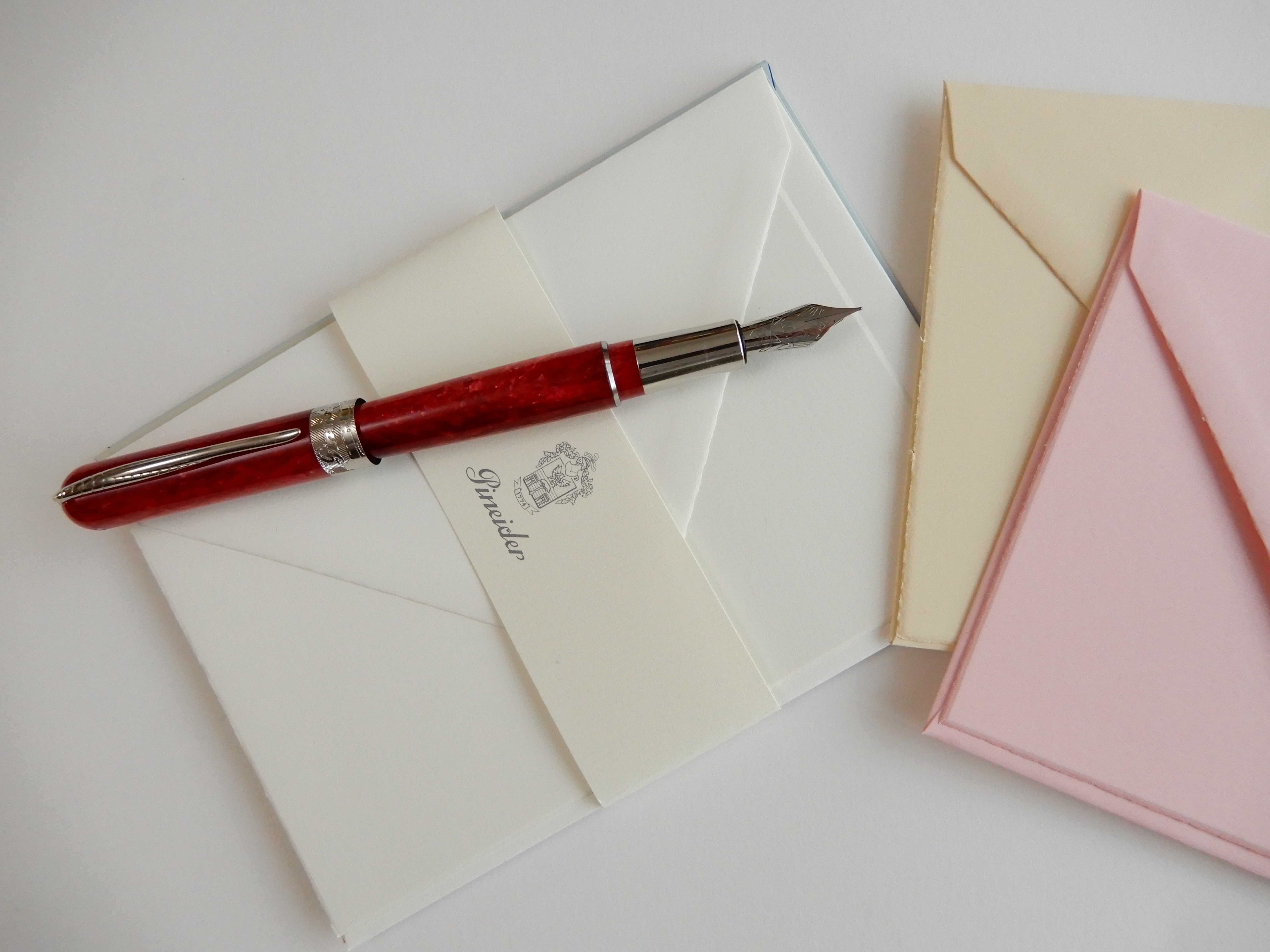
A Tale of Two Pineiders.

It was the best of tines, it was the worst of tines. Ok, that’s enough: no-one likes a smart aleck. This post should really be titled Early Thoughts on the Pineider Avatar Traveler and Pineider Tempi Moderni fountain pens.
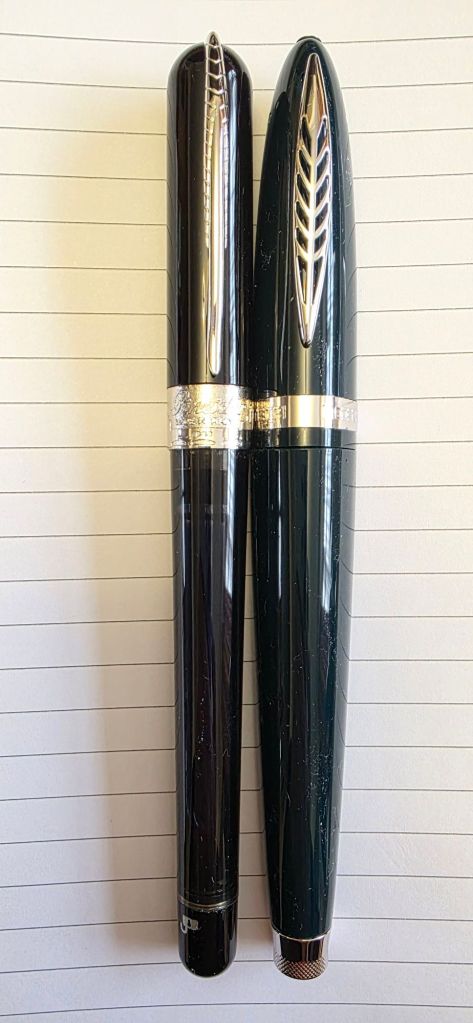
The Avatar Traveler (left) with Tempi Moderni.

As you will know from my recent posts, I am not craving any more pens and am very content with my accumulation. But as you may also know, I am not good at resisting irresistibly good bargains and can think of nothing I would rather spend money on, than a new and exciting fountain pen.

It came to my attention recently that TK Maxx were selling Pineider fountain pens online. I am a big fan of TK Maxx and always enjoy browsing whenever I see one of their large stores. I have been lucky to pick up some really good bargains there over the years, for example the wrist watch that I have on at the moment, an Elysee GMT automatic.
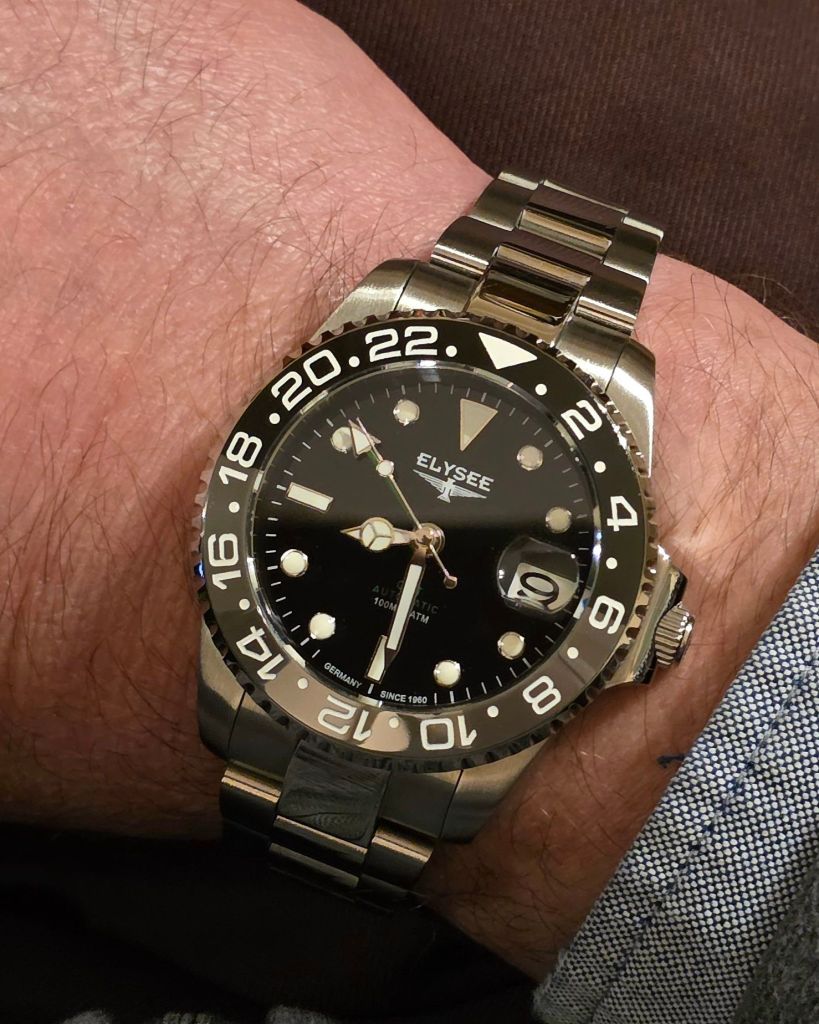
Eysee GMT Automatic.

I did already have one Pineider, an Avatar cartridge converter pen, an impulse buy from Harrods in 2018. Until recently, I was not aware that Pineider has a new version, the Avatar Traveler, which is a vacuum filler. There are other changes too apart from the filling system. The new version is made of “Ultra Resin” – stronger and better than normal resin. The vac filler also has a few other notable features: a clever, twist-release blind cap which is used to operate the plunger when filling or emptying the pen and also when opening the main ink reservoir to allow ink into the nib section. The blind cap has a spring and a bayonet mount and pops up by itself when you turn it to the “unlock” position, marked by an open padlock symbol.
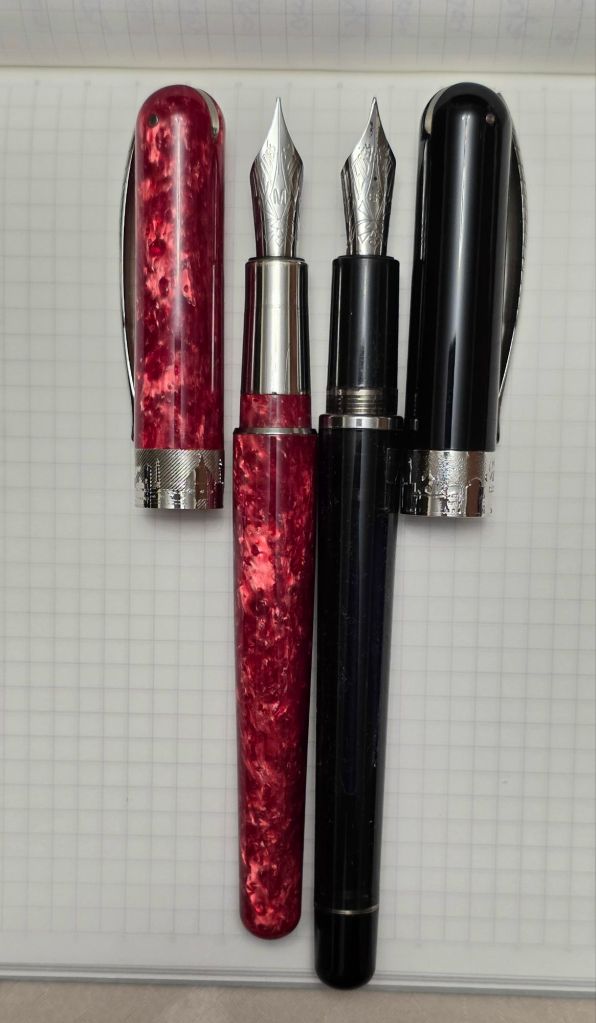
Side by side, my old and new Pineider Avatars.

Another feature is that the pen has “Twin Tanks”: the main reservoir and a second chamber for a smaller quantity of ink in the grip section, sealed off when the blind cap is in the locked position. This means that if travelling where the pen is jolted around or subjected to changes in air pressure, the main ink reservoir should not be a leakage risk, as it is sealed like an ink bottle.

The total ink capacity of the pen is said to be 2.7ml, which is massive and is equivalent to roughly four standard international cartridges.

This new Avatar is called the Pineider Avatar Traveler, UR (Ultra Resin), Twin Tanks fountain pen. Another Avatar with the more usual cartridge converter system is also available.

Other noticeable differences or improvements when compared to my old Avatar, are that the grip section is now resin and not the polished metal, plated finish (I prefer the resin) and the barrel is longer so that there is less likelihood of anyone wanting to post the cap. On this subject, I heard that there is a risk that if you do post the cap while the blind cap is in the raised position, the blind cap may get stuck inside the cap: if you then need to pull the cap off, you will also draw back the plunger: in order to push the plunger back down again, you will expel all your ink.

Otherwise the new Avatar has a similar profile to the old one. The cap is still held on by magnet. There is the distinctive, sprung, quill pocket clip. The cap band still features an engraving of the Florence skyline.

I was very excited to collect my new Avatar Traveler from my local TK Maxx store a couple of days after ordering. The whole process of ordering had been smooth and efficient and it was nice to collect the package in person rather than await a delivery. The web site, it has to be said, has a few areas for improvement: the photos do not always correspond to the description of the pens, so you may see a photograph of a rollerball pen illustrating the sale description of a fountain pen, for example. Also TK Maxx do not bother with details such as whether you would like an Extra Fine, Fine or Medium nib with your pen. It is safest to be happy to accept whatever comes. On the other hand the prices were so much less than RRP that it did not affect the purchase decision.

When the pen arrived I drove down to TK Maxx at once and opened the package in the car. This seemed appropriate for a pen called the Traveler. I discovered, to my delight, that mine had an Extra Fine nib. The box was a simple, small grey cardboard lidded box with a soft pen tray inside, and a leaflet – perfectly sensible and acceptable although not the splendid writing bureau-style box that we sometimes see with Pineider pens.
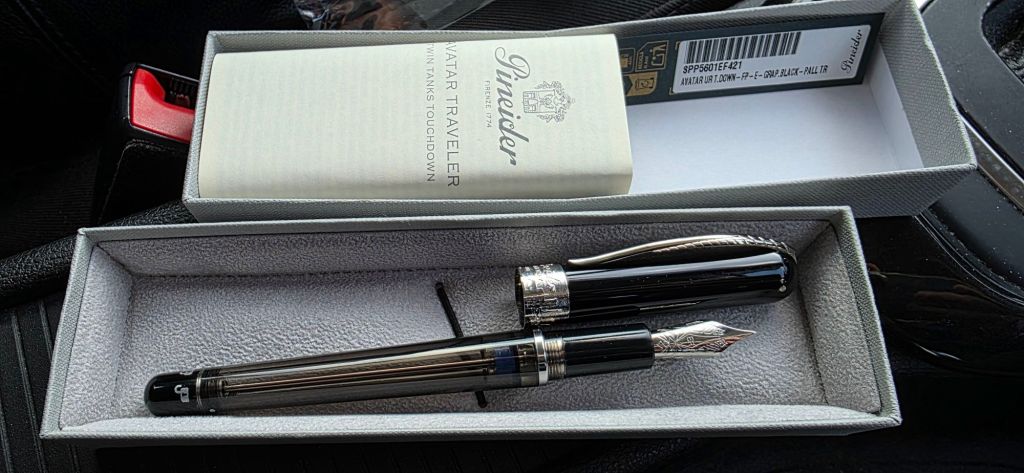
Unboxing, the Pineider Avatar Traveler.

I filled up the pen at home. It really does give a very generous fill. It is a thrill to see the pen fill, through the semi-translucent black barrel. But filling the pen is not something that you will see very frequently!

I did find that the ink flow was on the dry side. I decided to adjust this myself, simply by bending the tines upwards very slightly to ease open a small gap between the tines. This had the desired effect and took only a few moments to do.

In conclusion I have been very pleased with the Avatar Traveler. Subject to my only reservation, that it needed a slight bit of nib tuning for my taste, it is a great pen and I enjoy using it and appreciate how my handwriting looks neater with it.
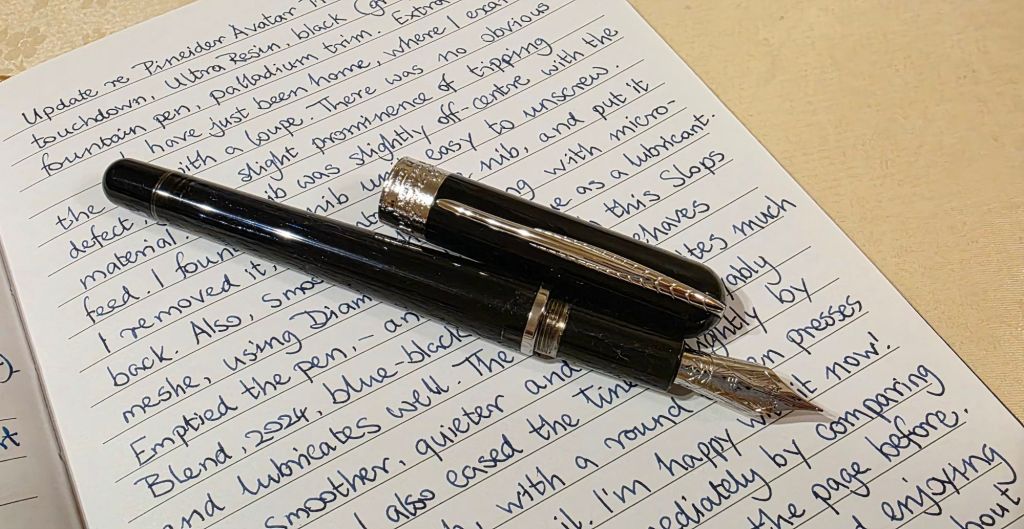
Avatar Traveler, Extra Fine nib.

So pleased was I with the buying experience, that I made a slightly impulsive decision to order another Pineider from TK Maxx, but this time, the strikingly odd triangular pen called the Pineider Tempi Moderni. “Modern Times” is the name of a Charlie Chaplin film and follows the trend of Pineider to name its pens after films, hence Avatar.
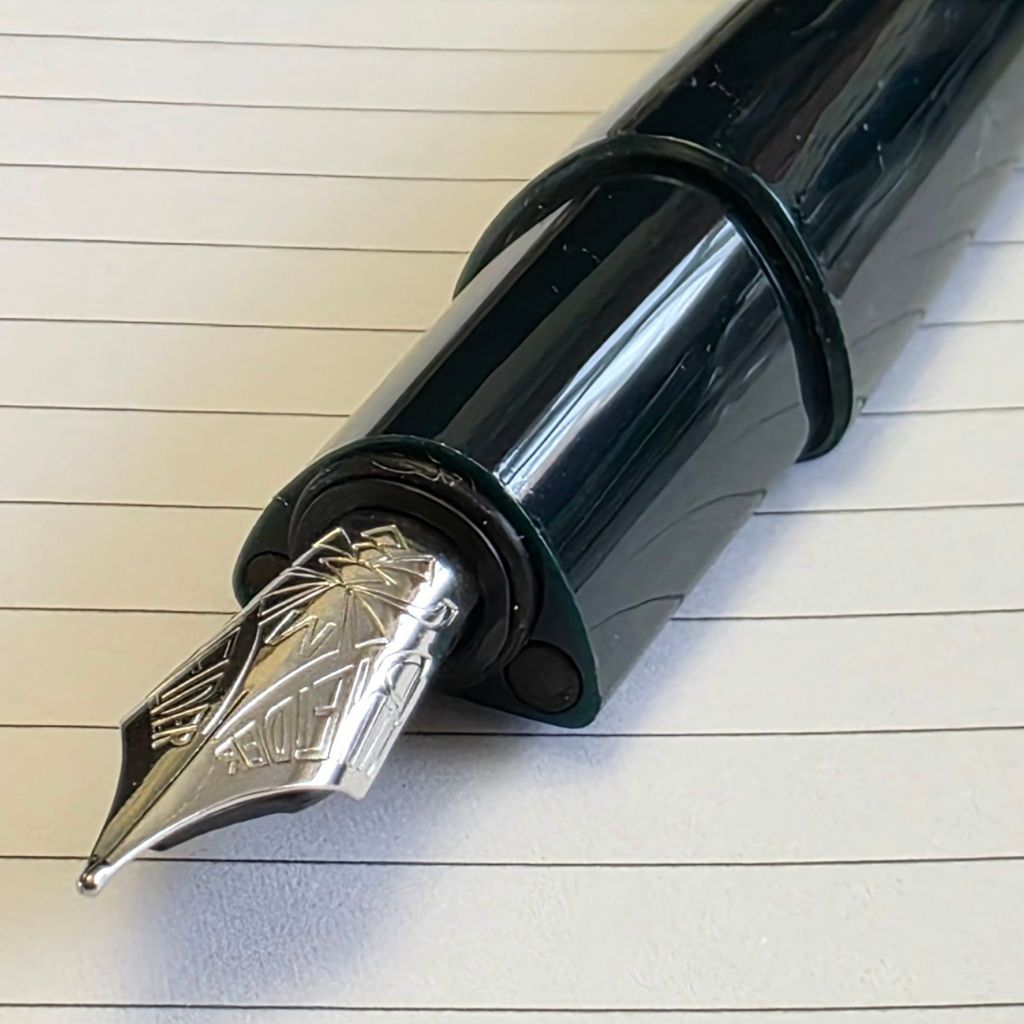
The Pineider Tempi Moderni, Racing Green.

The Tempi Moderni was also on offer with an equally generous discount at TK Maxx. I chose the Racing Green edition with chrome coloured nib and trim. Once again, it arrived very promptly. And once again I did not know what nib it would have but secretly hoped for a medium this time – and it was!

The pen is large and feels nice and tactile to hold with a good quality finish. The triangular shape is unusual although not unique, something similar having been made by Omas, but it was the first one I had tried. Actually I surprised myself in finding it more comfortable than expected. The pen can rest on my bent, middle finger while held between thumb and first finger. I experimented over several days with my two writing styles: an underwriter style for perpendicular ascenders and descenders, or my lefty overwriter style, for slanted writing. Both worked pretty well. The issue is that the angle of the tipping to the paper is dictated by the flat underside of the pen resting on your finger. You do not have the option to rotate the pen a little left or right to find a “sweet spot”.

The Tempi Moderni is a piston filled fountain pen with the piston turning knob at the back of the barrel. It may be more correct to say it is a “captive converter pen”. The piston knob does not move up and down as you operate it. It holds about 20 drops of ink, which seems to equate to about 20 pages of my A5 journal. The turning knob feels a bit too easy to turn and did not inspire confidence but it fills well and has not leaked in a few weeks of use.

Just as with the Avatar Traveler, I found the ink flow a bit dry and made the same adjustment, to open the tines slightly to improve flow and lubrication.

Buying two Pineiders almost simultaneously is bound to invite comparison. Of the two, I prefer using the Avatar Traveler, as it is easier to hold comfortably and feels long, slim and precise with its EF nib. The Tempi Moderni is very different and has been a lot of fun, and great value with TK Maxx’s discount but I would not have risked buying such an odd pen at full price. It has taken some getting used to and needs a forgiving nib, to allow for people’s different writing angles. From speaking to friends, I was not alone in finding that the nibs may need fine tuning and this may be off-putting for some, and more so if paying full price. The nib unit can be easily unscrewed to aid in cleaning although I do not think you can access the piston mechanism. The cap is held on with firm magnets, a convenient feature to dispense with cap threads although I will keep the magnets away from my wristwatch.
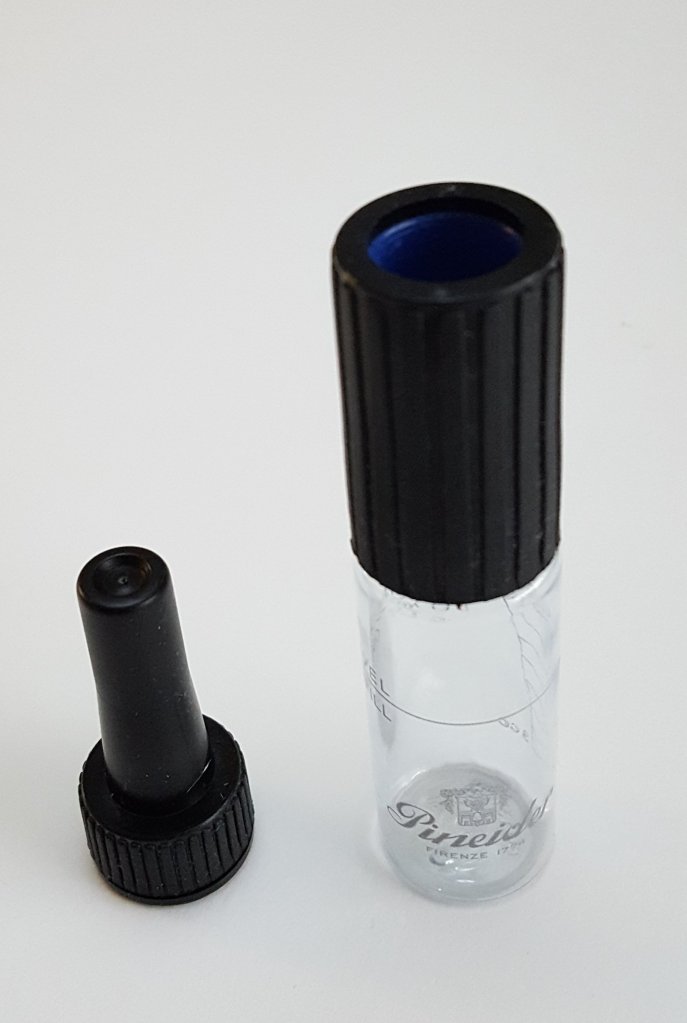
Some early thoughts on the Pineider Pen Filler travelling inkwell.

This handy gadget is a travelling inkwell, introduced in 2018 by Italian company Pineider. A friend arranged a group buy for our London UK Fountain Pen Club although they are now available from Cult Pens at £20.00.

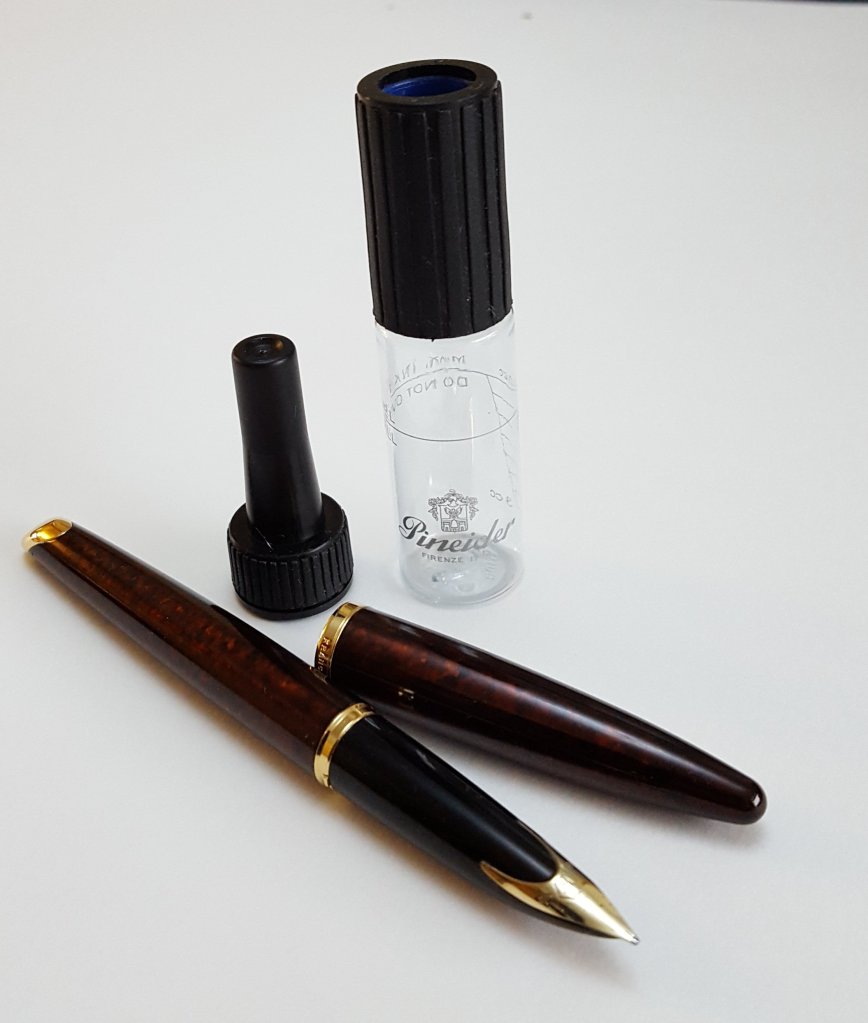
Pineider Pen Filler. Stopper removed to show blue rubber inner sleeve.

What’s in the box.

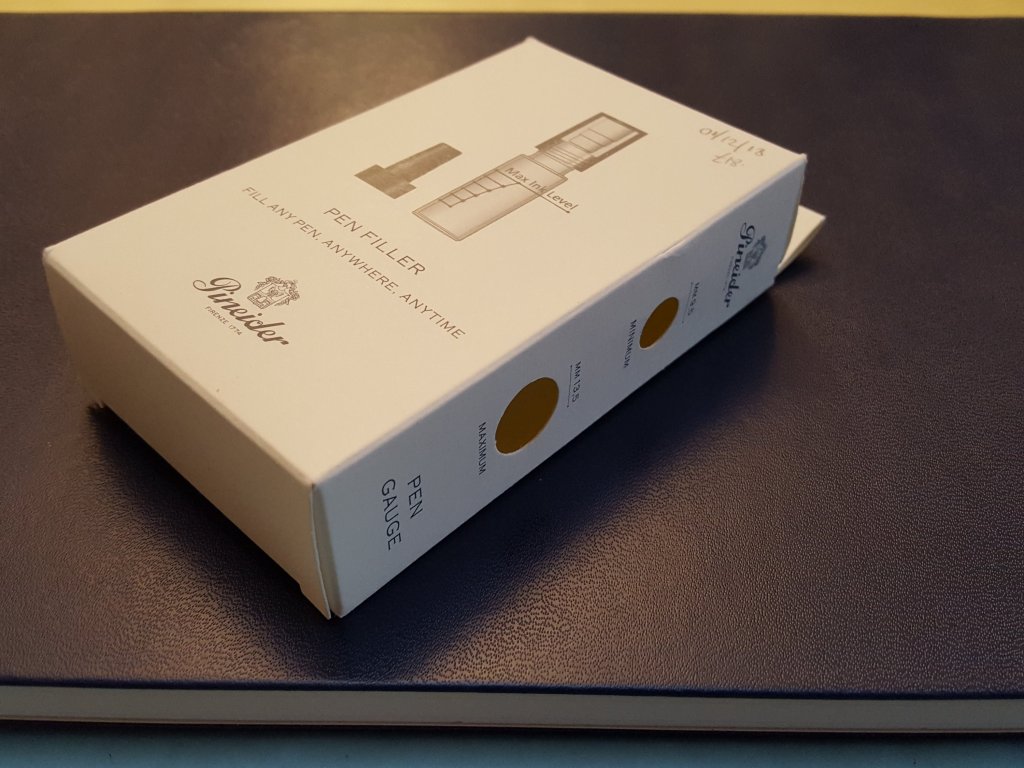
The pen filler comes in a simple cardboard box, about the size of a cigarette packet. One side of the box has two holes, one of 9.5mm, one of 13.5.mm diameter, being the minimum and maximum size grip sections that can be used. The idea is to use these holes to check that your pen is neither smaller than the small hole, nor larger than the large hole.

Cardboard box. Holes to check that your pens will fit.

Inside the box, was the pen filler together with a small pipette or eye-dropper (although I am not sure these are always included) plus a sheet of instructions. If no pipette is included, use your own or a syringe to fill the pen filler.

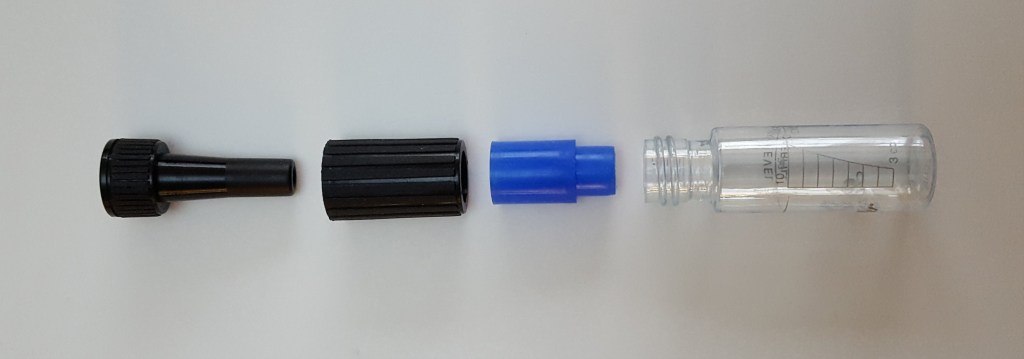
The pen filler is comprised of four parts: the clear plastic ink holder with a measuring scale in 1ml units, up to 10ml (or 10 cubic centilitres), a black plastic knurled collar and a black plastic stopper. Hidden by the collar is a blue rubbery sleeve, part of which fits into the ink holder.

The four parts of the Pineider Pen Filler.

How to use.

Preparation: It is recommended that you first check that your pen is not too big or small for the pen filler, using the holes in the box if in doubt. Next practice with water first. Fill the ink holder with water, up to the 10cc mark. If you have a number of pens that you might wish to use with the pen filler, then it might be convenient to flush them all and try each of them in turn with the filler and make a note of which pens you have tried. According to the instructions, “you can use the pen filler to fill lever pens, piston pens, plunger pens, converter pens and even the old eyedropper pens.”

Filling the pen: It is recommended that the pen be emptied first. If it had last been filled with the same ink, you could discharge it into the pen filler if you are not too fussy about only using fresh ink. If using a converter or piston fill pen, then wind the plunger down first, before locking the pen into the pen filler. This is to avoid over-pressurising the ink holder and causing leaks.

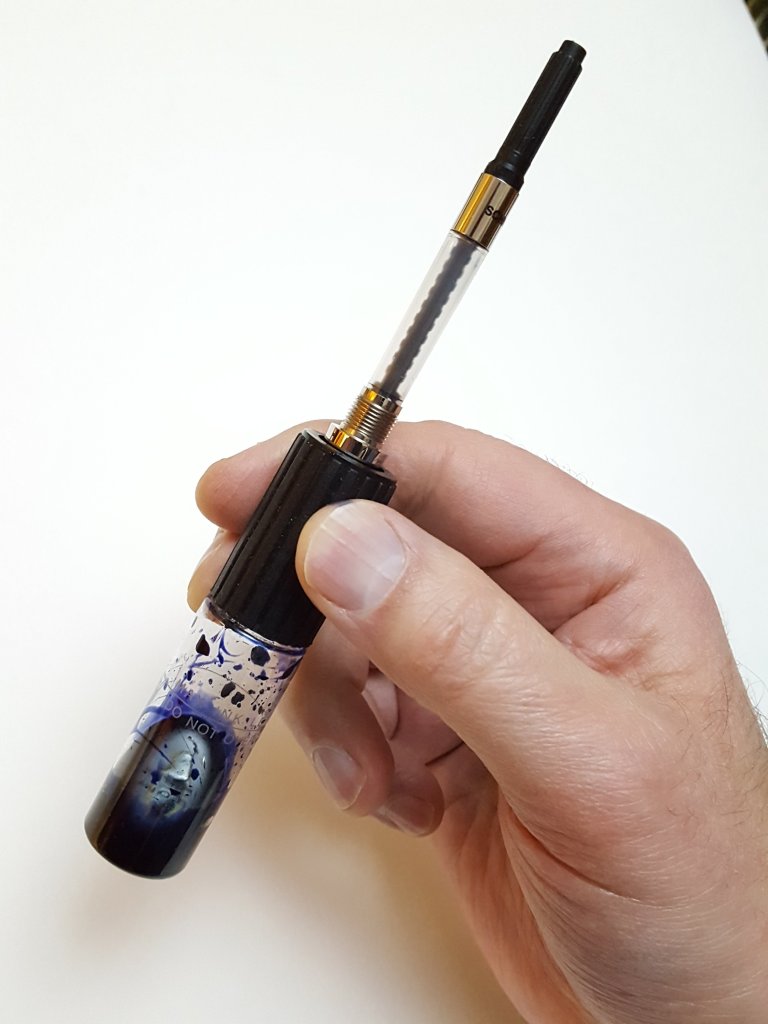
Pen gripped securely in the filler, ready to turn upside down and fill.

So, you are ready to fill your pen.

  • remove barrel of pen (if using a converter) and wind down the plunger;
  • pull out the stopper from the pen filler; unscrew the knurled black collar (which gradually increases the opening) until you can insert your pen;
  • tighten the collar; (as you screw the collar down, the blue rubber sleeve tightens around the grip section of the pen); continue until the pen is held firmly. This stage is a little awkward as you are holding the pen in one hand with the barrel removed and so take care not to dislodge the converter from the pen);
  • Now the fun/risky part. Turn the bottle upside down, allowing the ink to cover the nib. Wind the converter or operate the piston to fill the pen, by a combination of suction and gravity;
  • Once filled; turn the pen and bottle the right way up again; unscrew the collar a little until the pen comes free; remove pen; screw the collar back down fully and insert stopper.
  • Replace the barrel on your pen, wipe off any ink from the section and nib. And you are ready to go.

Limitations.

There are some limitations to the use of the pen filler, for those pens which are too wide or too narrow for it. For oversized pens you may have to fill these direct from a bottle. For pens too narrow to use the pen filler system, you may still be able to fill from the travelling ink well, just by removing the stopper and dipping the pen into the ink (if the ink level is deep enough).

Advantages.

  • The pen filler is a very convenient size for travelling, being small and light weight, when you do not want to travel with a typical 50ml glass bottle.
  • A 10ml supply of ink is enough to fill a typical converter around 12 – 15 times I found, although I confess that I lost count while attempting this exercise, filling a pen repeatedly with water until empty.
  • If used correctly and carefully, it is possible to get a good fill with minimum inky mess.
  • You can still fill a pen even from your last 1ml of ink! This would be difficult for most pens, if filling from a conventional bottle.
  • You do not need to be too anxious about the pen not being perfectly clean from a previous ink, as you will not contaminate a whole bottle, but only a few millilitres.
  • You can experiment by mixing compatible inks, just a millilitre or two at a time, in your pen filler. (I made a blend of Robert Oster Aqua and Pilot Iroshizuku Shin-kai, about 50/50, although this carries some risk that certain inks will not be compatible and will combine to make a sticky goo). It is prudent to test out any such blends in a separate receptacle and leave to stand for a day or so, before filling your pen.
  • If going away for a few days, it can be very handy to have a little supply of ink with you just in case you buy a pen (!), or as happened to me recently while visiting an elderly aunt over the holidays, I was asked to see if I could get her old Parker Slimfold working again and she could not find any ink in the house. In this situation it is little consolation to know that you have an entire drawer-full of fountain pen inks back at base camp.

Conclusions.

I am impressed with the simplicity of the design. If used correctly and with care, it works well. It is not entirely fool proof and it is a good idea to practice first with any given pen, using water until confident. When I first got mine, I picked a fairly large sized cartridge converter pen and was interested to see how many times it could be filled, from 10ml of water and using even the last drop. I have been using it successfully for a few weeks now. However, in trying it last night newly filled with Conway Stewart Tavy to photograph for this post, I must have done something wrong and ink leaked over my hands. This could be due to me forgetting to wind down the plunger prior to locking the pen into the holder, or not tightening the screw-down collar sufficiently before inverting the bottle, or perhaps dislodging the converter slightly. Like I said, it is not fool proof.

As for durability, it remains to be seen whether the plastic ink holder may crack eventually from the repeated stress of tightening and loosening the collar but I would expect it to last for a few years at least and would be happy with this. As for value, when looking at the four individual components of the pen filler, each of which looks mass-produced costing only a few pence each, it is questionable whether the sum of the parts amounts to £20.00. I sometimes feel like this when looking at the disassembled parts of a fountain pen. Obviously the company needs to make a profit and the initial costs of designing the parts and manufacturing them all need to be taken into account.

Overall, for the usefulness of the pen filler I would be happy to spend £20.00. And for the question of what to give a fountain pen enthusiast, who has everything except a Pineider Pen Filler, this is a good answer.

Pineider Pen Filler, shown with a Waterman Carene for size comparison.

Pineider Avatar fountain pen review.

After attending our monthly pen club meet in London recently, I took myself off to Harrods to have a browse around The Great Writing Room. It is wonderful to see their large selection of luxury fountain pens from so many leading brands.

A new name to me, was Pineider, an Italian brand established in 1774, whose pens and stationery were displayed in a corner of the large room. Under the glass counter, one pen was shown in a gift box which immediately caught my eye as it opened like a miniature writing desk. I asked to see the pen, with an attractive green marbled body and a silver section. However, it had an 18k gold nib and was five hundred and something pounds and so I hastily handed it back.

But next to this pen was a display of, what I now know to be the Pineider Avatar fountain pens, in their four available colour options of saffron yellow, pacific blue, lipstick red and coal grey. These looked very striking, particularly the yellow and the red versions.

DSCN2173
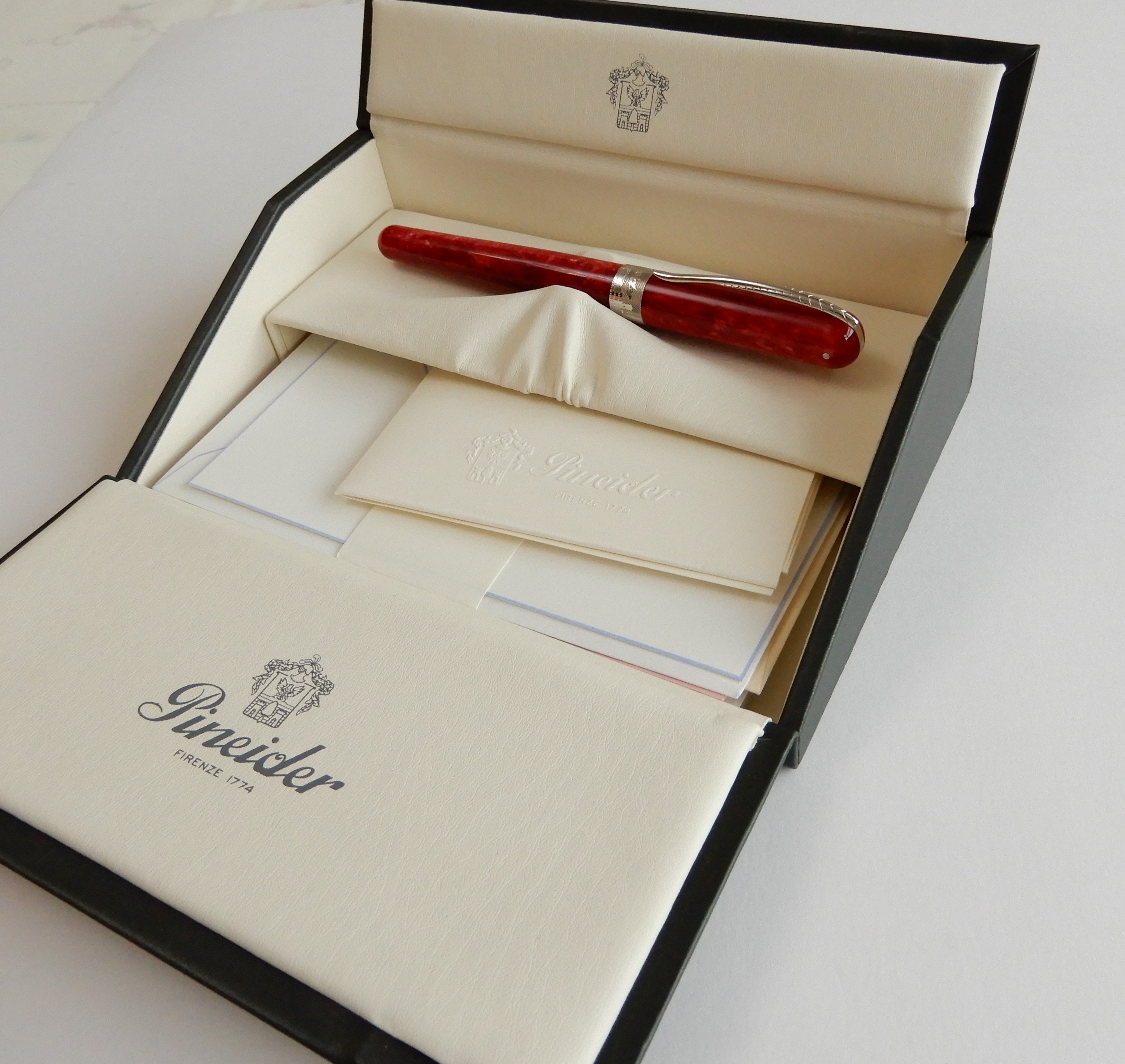
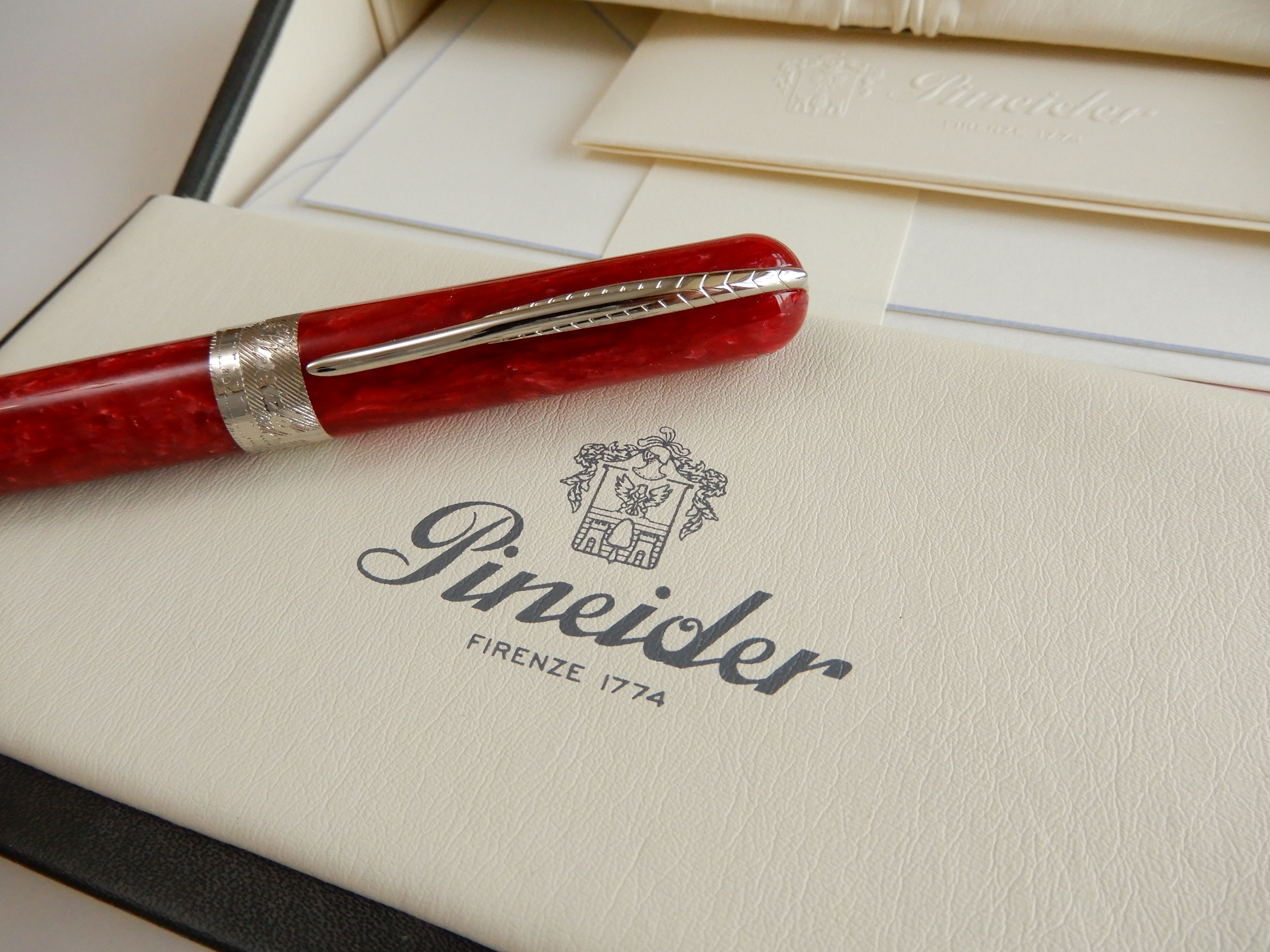
Pineider Avatar in gift box including samples of Pineider stationery.

I must say, I am generally wary of pens with shiny metal sections as they can be slippery to hold. The salesman got the red one out to show me and produced some ink and paper. I fell in love with it pretty much instantly.

As this is a relatively new pen on the market and there do not seem to be all that many reviews or photographs online I will attempt an FPN-style review, save for giving marks out of ten.

RSCN2029
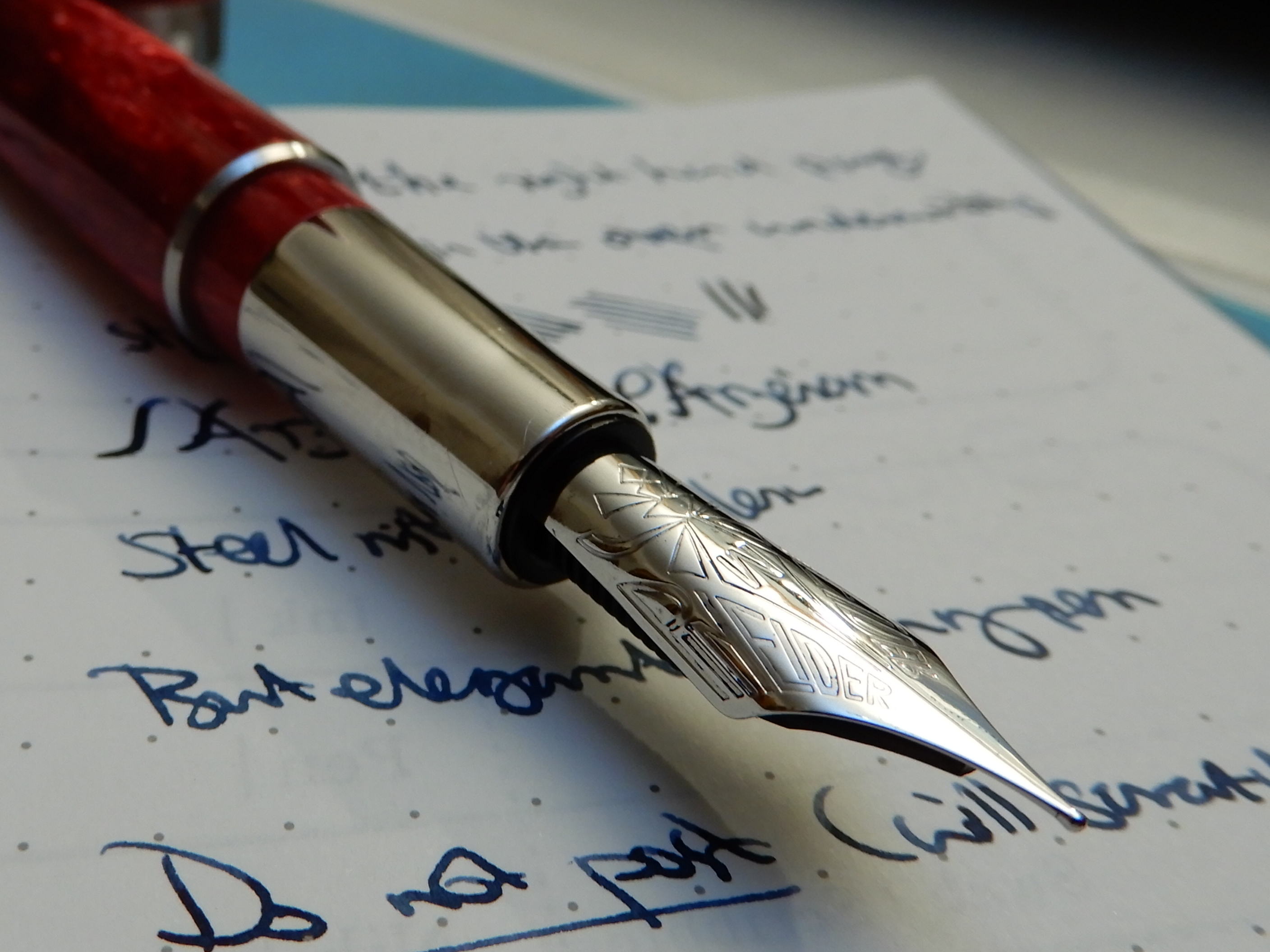
The long steel, Rhodium plated nib of the Pineider Avatar. After my early worries about scratching the barrel, I soon decided that the pen felt better with cap posted.

First impressions, appearance and design.

This is a stunning-looking pen. The highly polished, bright red marbled resin with contrasting silver coloured clip and cap band, with rounded ends, make the pen a joy to hold and to look at. The resin has light and dark shades which give a beautiful chatoyance as you turn the pen in your hands.

The pocket clip (in marine steel) is long and slender, engraved to suggest a quill. It is bowed in the middle and is sprung, giving a good reach to clip onto thicker material if needed although the spring tension is not very firm.

DSCN2175
Distinctive clip in the shape of a quill.

A surprise awaits when you come to remove the cap. It is a pull-off cap, but secured by a magnet inside the cap which meets a metal ring around the barrel. When you cap the pen, offering it up slowly as it nears the barrel, it jumps into place with a little click. The magnetic power is enough to keep the cap in place. Removing the cap requires perhaps rather less force than you might be used to and I would not be overly confident about carrying the pen in a suit pocket for fear that the pen may slip out of the cap.

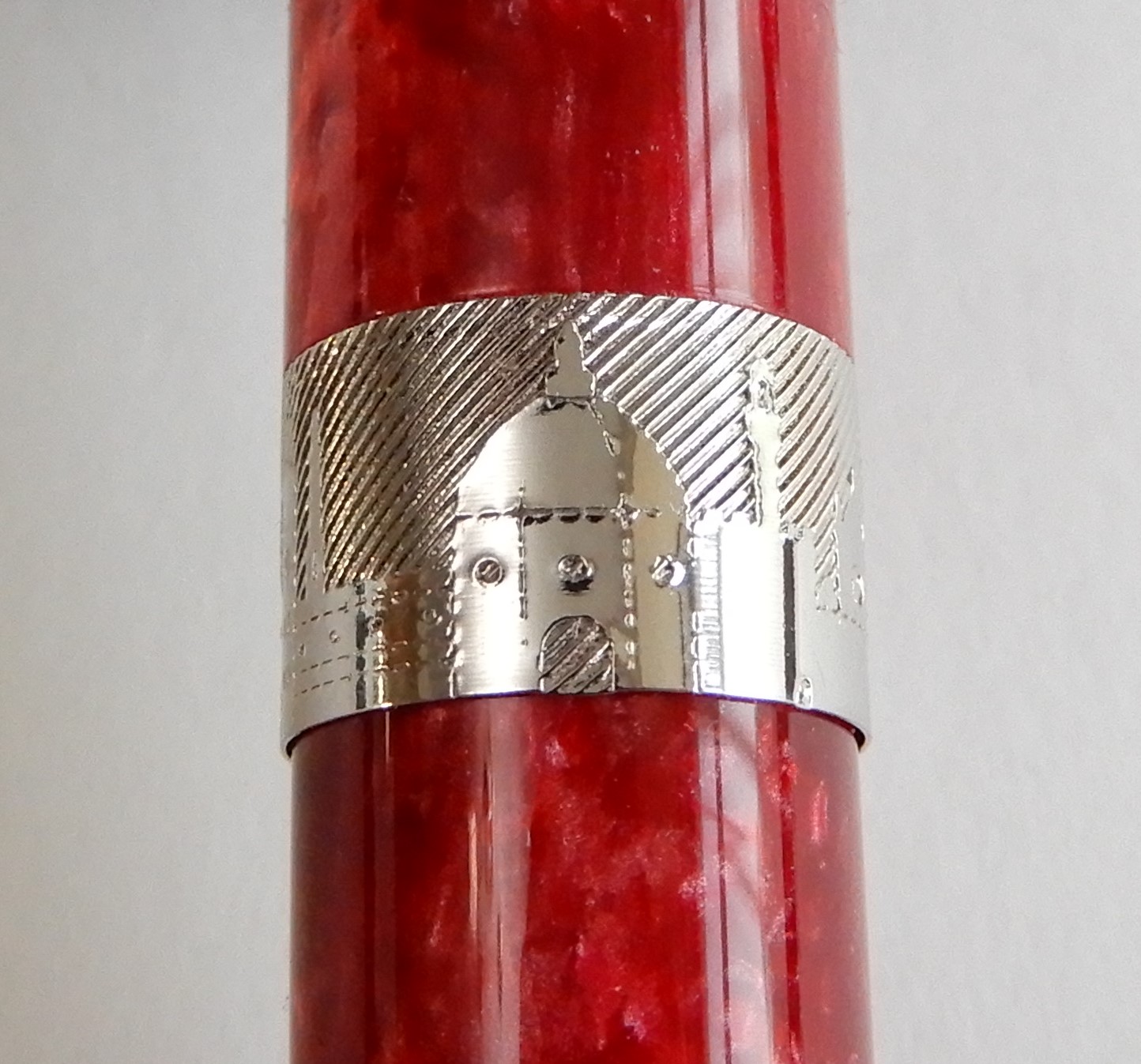
Another lovely feature is the cap band, which features the name Pineider above a stylised engraving of the Florence skyline recalling to mind the many domes and towers of that beautiful city.

DSCN2158
Better than just writing “Florence” on the cap band.

Under the cap, you have a long, sleek, elegantly shaped nib and some attractive engraving, which includes on closer inspection, the name Pineider in capital letters, written normally along one edge of the nib and in mirror image along the other edge. Put like that, it might sound off-putting but it is only noticeable when examined under a magnifying glass.

The section is of a shiny metal finish, and gives the front end of the pen a pleasant weight, which you notice and appreciate as soon as the cap is removed. The metal section tapers slightly save for the last five millimetres or so where it straightens, to give a barely visible but effective, curved, finger rest, when the pen is held in the writing position.

Construction and Quality.

The pen seems very nicely made and I have no complaints with my model. The resin barrel screws firmly onto the metal threads of the section. Everything fits together well. If looking for faults, you could say that the rim of the cap band is a little sharp to the touch, but this has not been noticeable in normal use. The pocket clip, whilst attractive, looks rather delicate (compared, for example to the mighty and barely lift-able clip on my Montegrappa Fortuna), but this is not a problem for me as I carry the pen in a leather pen case, not a pocket.

Weight and dimensions (approximate).

Capped: 142mm

Uncapped: 130mm

Posted: 161mm

The pen weighs around 27.5g, capped or posted. Uncapped, it is about 17g and the cap alone weighs 10.5g.  These weights are ideal, being neither too heavy nor too light.

The uncapped length of 130mm makes this about the same as a Lamy Safari. But whilst I find the Safari comfortable to use unposted, I much prefer to use the Avatar with the cap posted. Perhaps this is because I hold it higher up, (due to the shiny section) or due to the fact that the barrel tapers slightly, but it feels very comfortable posted. It is long, but the cap is light and does not upset the balance. I worried a little at first about whether posting the cap with its magnet inside, would leave scratches on the barrel. However, I found the pen so much more comfortable when posted and soon decided not to worry about this. The pen is meant to be used. I think it does actually cause some scratches but they are only visible under a loupe.

Nib and Performance.

I love this nib! It is Rhodium plated steel, with no breather hole and having a very polished finish that matches the section. The long sweeping curves look stylish. Mine is a medium. A fine is also available. I had tried the pen before buying and was delighted that it wrote so smoothly. It is on the finer side of medium and ideal for me. Flow is wet, but not gushy. Overall, it provides a really pleasant writing experience with some feedback. There is some softness or flex available to give some pleasing line variation in normal writing, and this suits me nicely as my handwriting style is not compatible with more flexible nibs.  I like that the nib is steel and not gold as this keeps the cost down.

DSCN2183
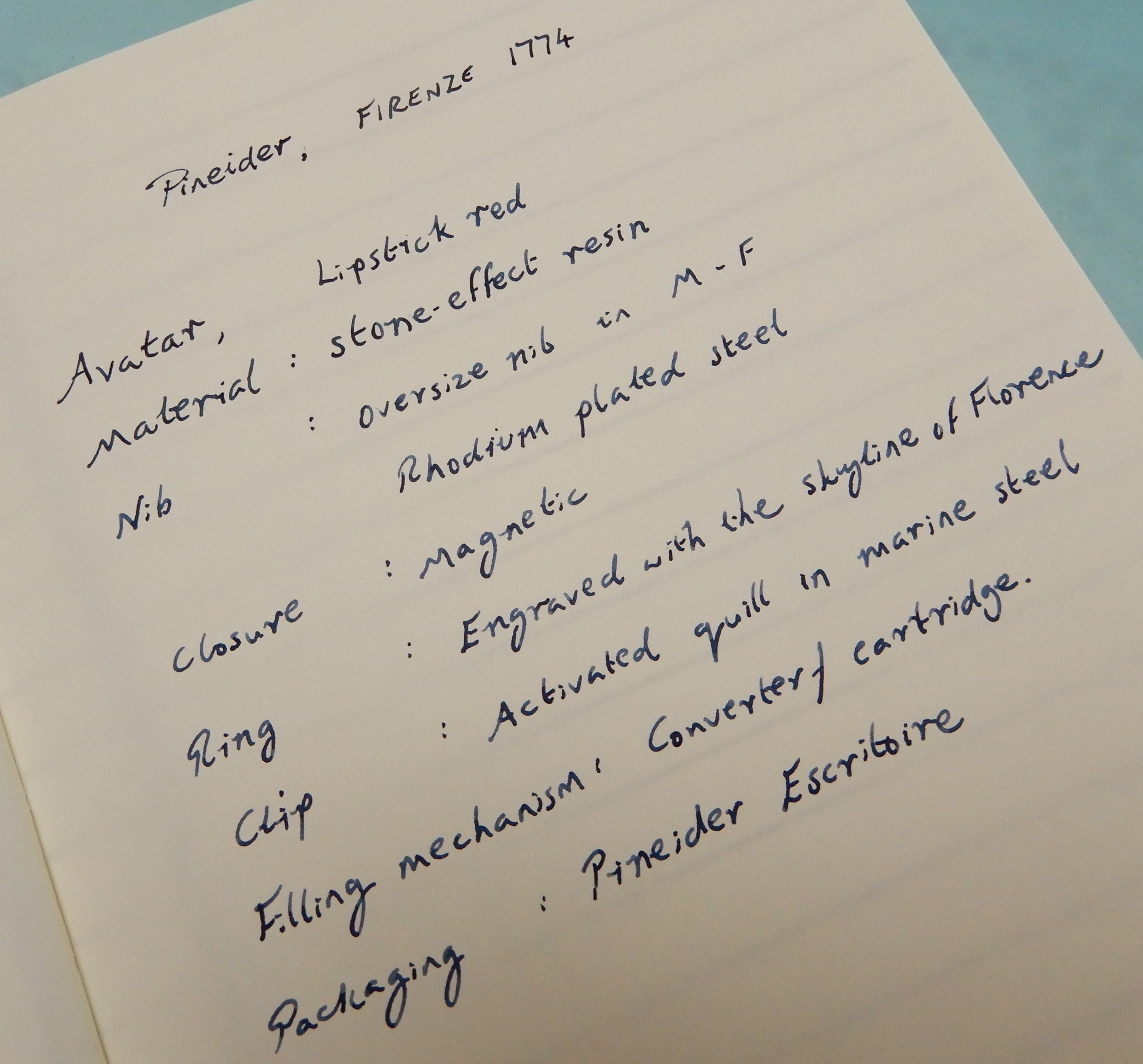
Writing sample, medium nib. Ink is Conway Stewart Tavy.

Filling system and maintenance.

This is a cartridge converter pen taking standard international cartridges, or bottled ink from the Pineider branded, push-fit converter that is included.  Cleaning of such pens is straightforward: you just run water through the section until it comes clear, or leave the whole section, with nib and feed inside, to soak in water overnight if needed before rinsing again.

I have not tried going any further, removing the nib from the section. The fins on the underside of the feed look quite fine and delicate and I would be worried about damaging them or upsetting the nib alignment.

Cost and value.

The price in Harrods was £148.00, which I thought was fair. I was thrilled to learn that it came in the same type of gift box as the much more expensive model. A converter is inside, but the box also includes a sample of Pineider’s famous stationery – a set of six cards with matching envelopes.  It is probably towards the top end of what you would want to pay for a steel nibbed pen before moving up to a gold nib.

DSCN2180
Free stationery!

Conclusion.

This pen was an impulse buy from a brand that was unknown to me, and therefore bought entirely on its own merits and on the basis of what I learned in the store. This absence of homework is not always recommended but on this occasion I am really pleased with the pen. Trying the nib in the shop makes a big difference in lowering the risk.

I have since learned a little bit more about the company behind the pen. The Pineider company was founded in Florence in 1774, and for many years was known for its high quality stationery, which it supplied to the Vatican and to royalty.  Luciano Pavarotti was also a customer. The company also sold luxury leather goods, but was not noted for its pens. However, Dante Del Vecchio, pen designer of Italian brand Visconti left that company and moved to Pineider where for the last year,  he has set about making the fountain pen line more prominent. Thus it is no accident that the Avatar bears similarities to the Visconti Rembrandt. There are some differences too, and whilst I do not have experience of the Rembrandt, I rather preferred the Avatar’s overall flair.

I am greatly enjoying the pen. There are few pens that actually make you want to get up in the morning, to write with. This one is a keeper and I look forward to writing with it for many years to come.