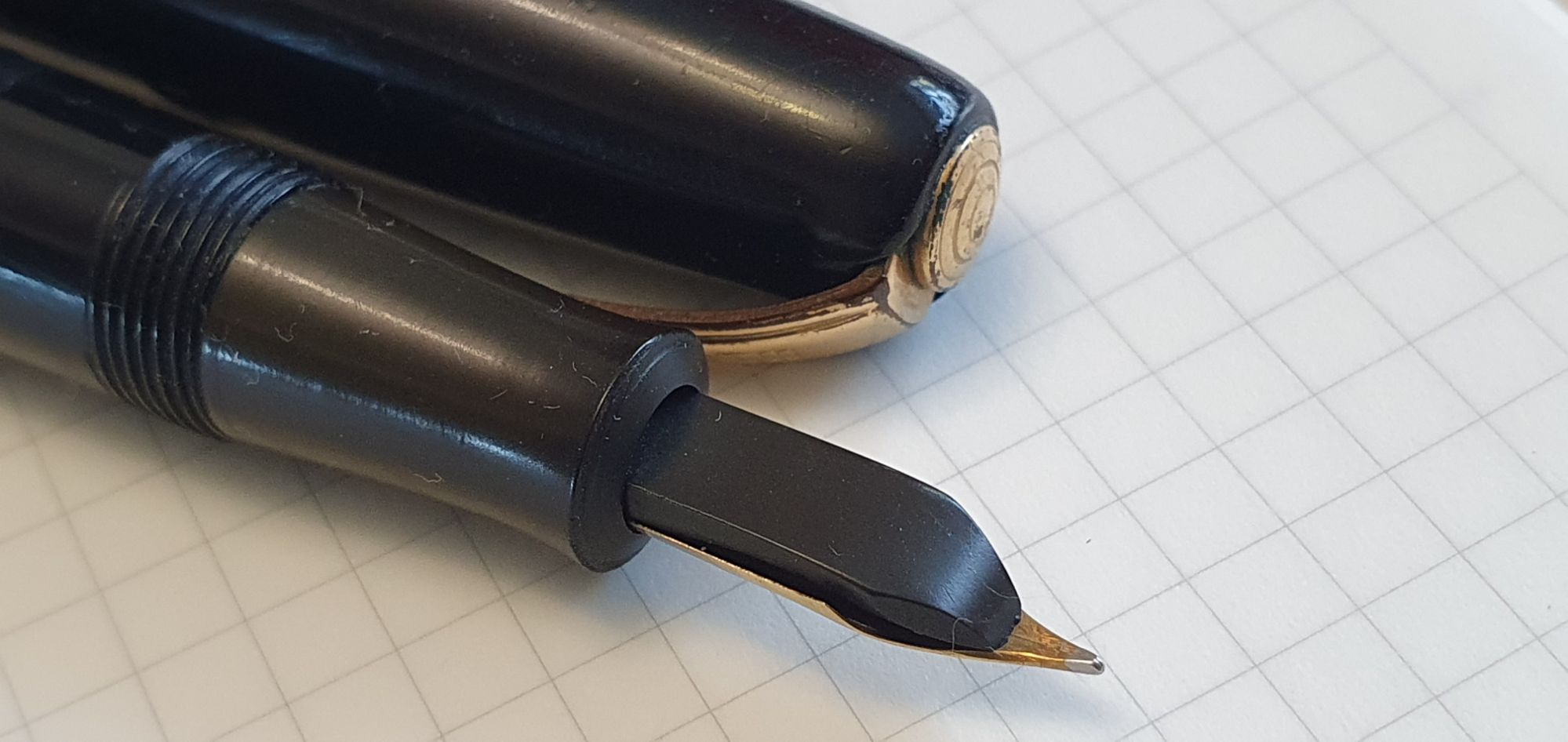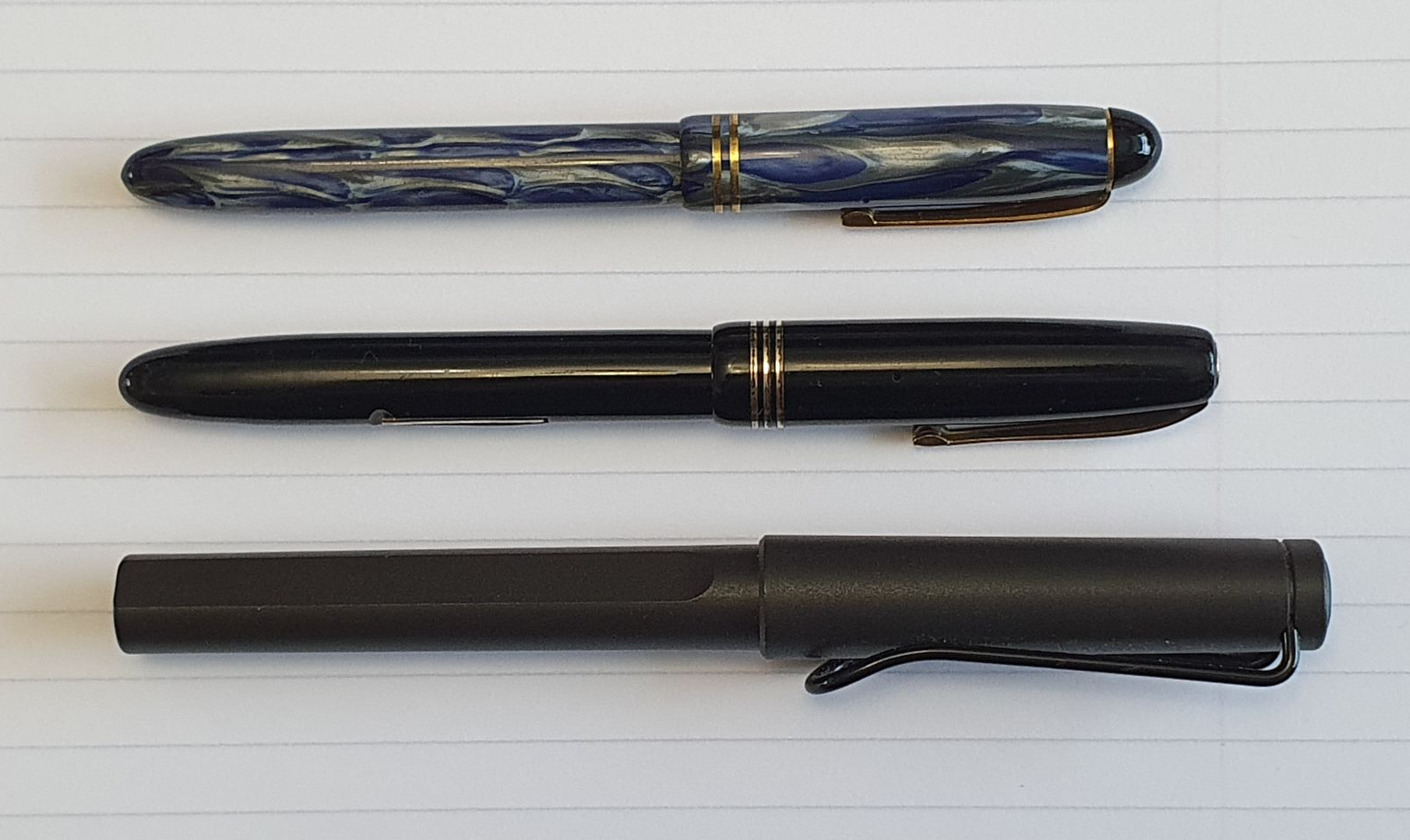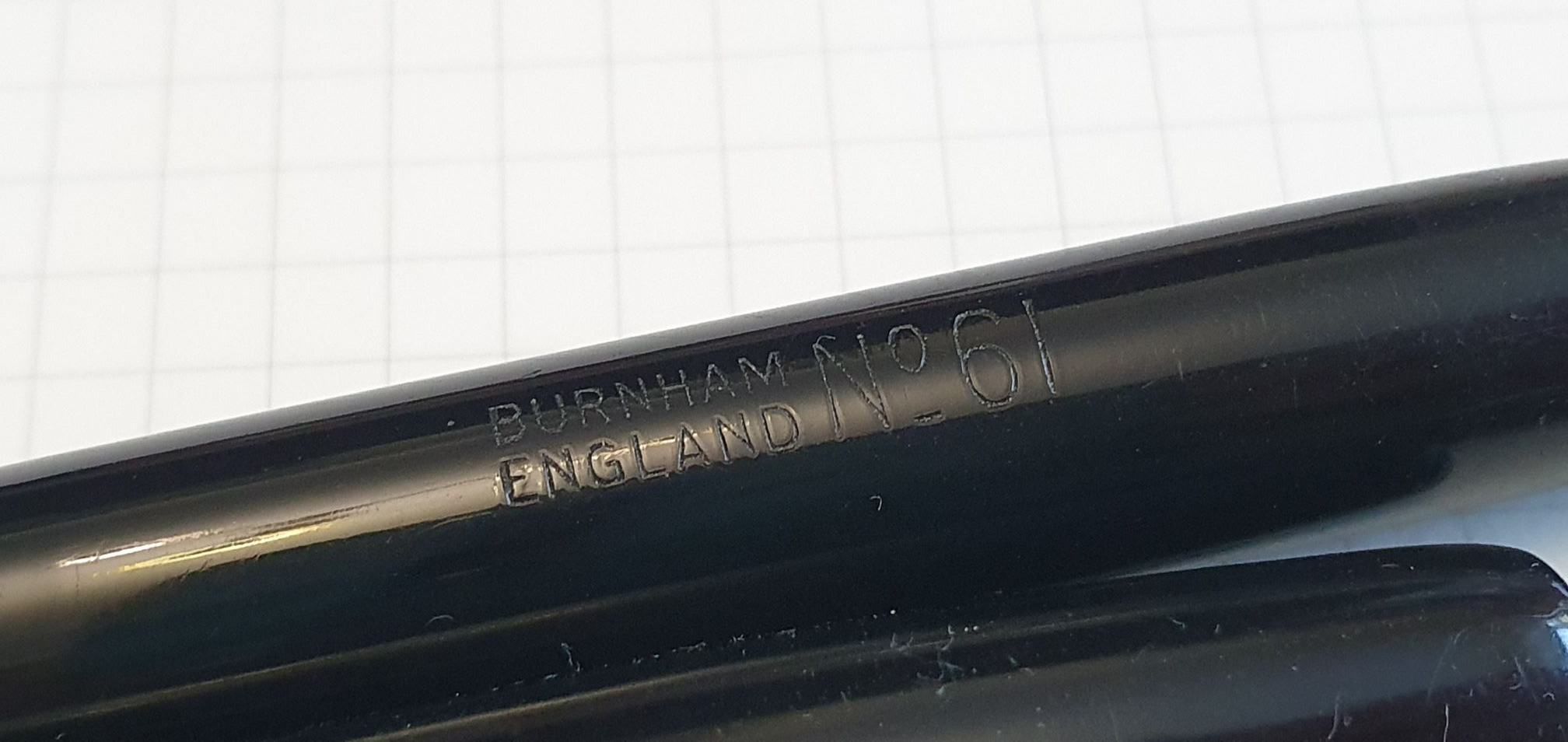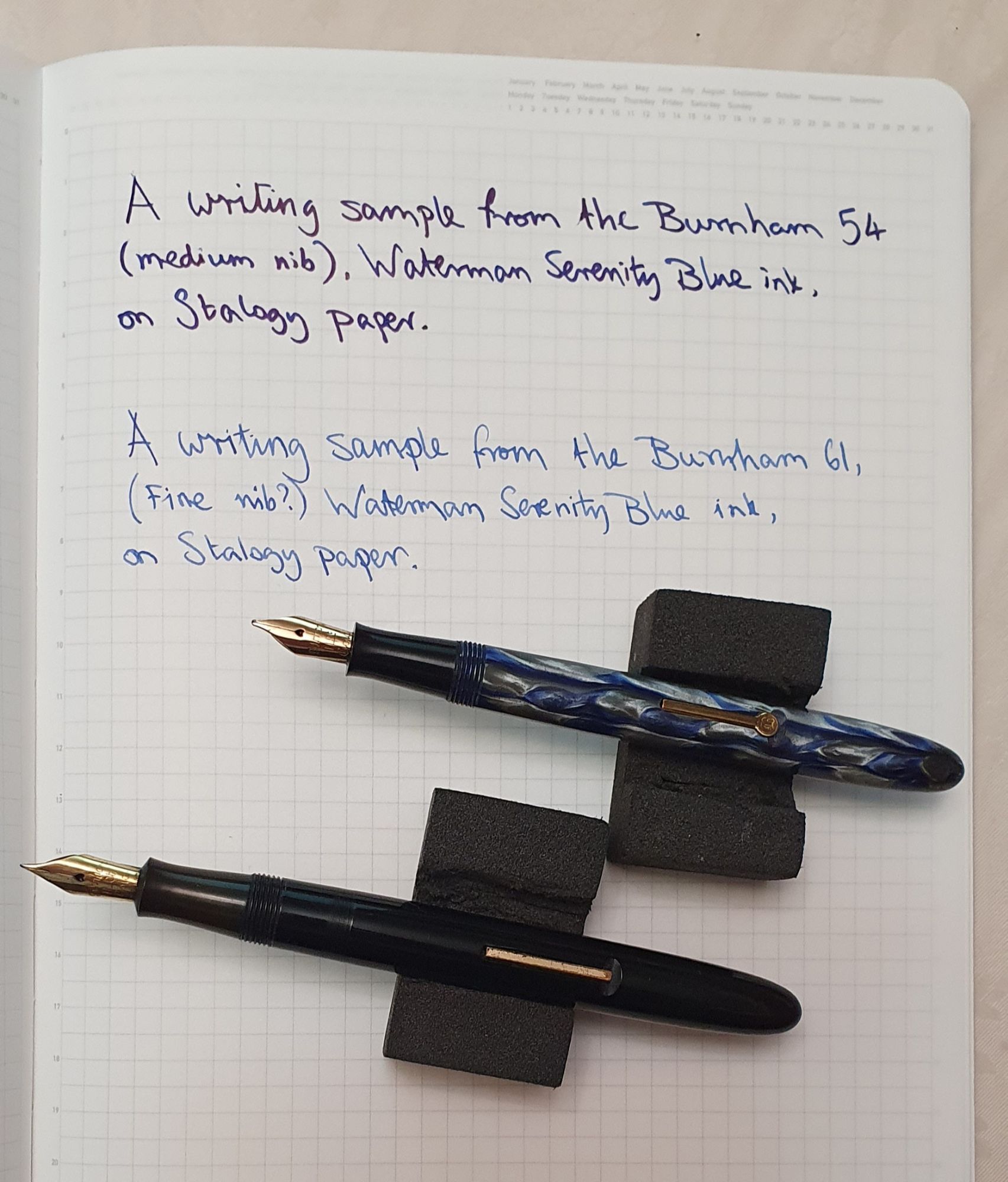
I have long been a fan of Diplomat’s metal bodied fountain pens, the Traveller, the Esteem and the Excellence and now own several. Yet it has taken until now for me try their lightweight, entry level offering, the Diplomat Magnum.
What little I knew about Diplomat can broadly be summarised thus: they were established in Germany in 1922; they are an underrated brand; and their nibs are of particularly good quality.
Diplomat pens are a rare sight in what few pen shops we have in the UK. But whilst browsing in the wonderful Pens Plus in Oxford in May, I was excited to find a display of Diplomat Magnum fountain pens in several different colours and chose the black one.
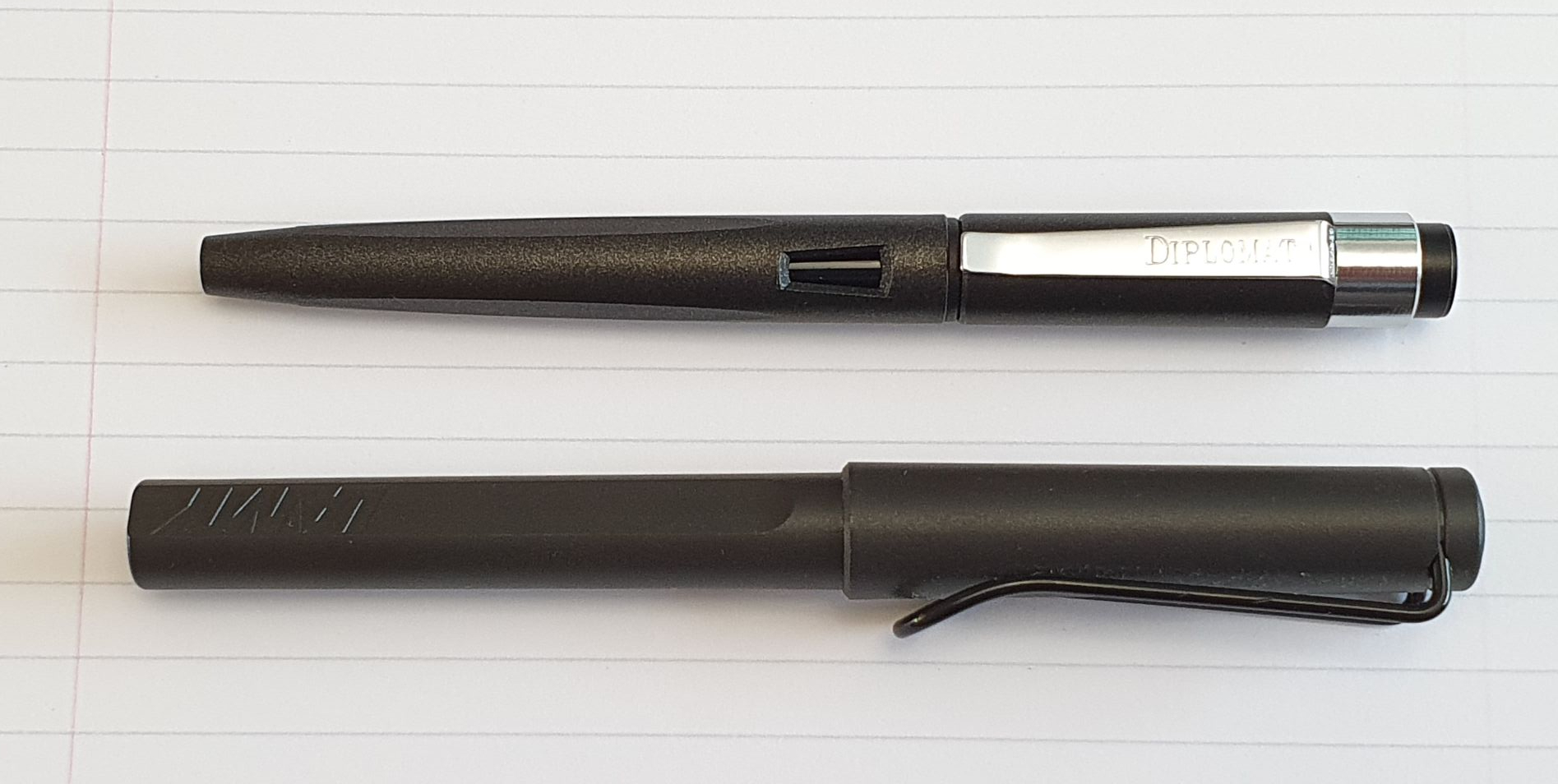
Diplomat Magnum, crow black fountain pen, beside a Lamy Safari for scale.
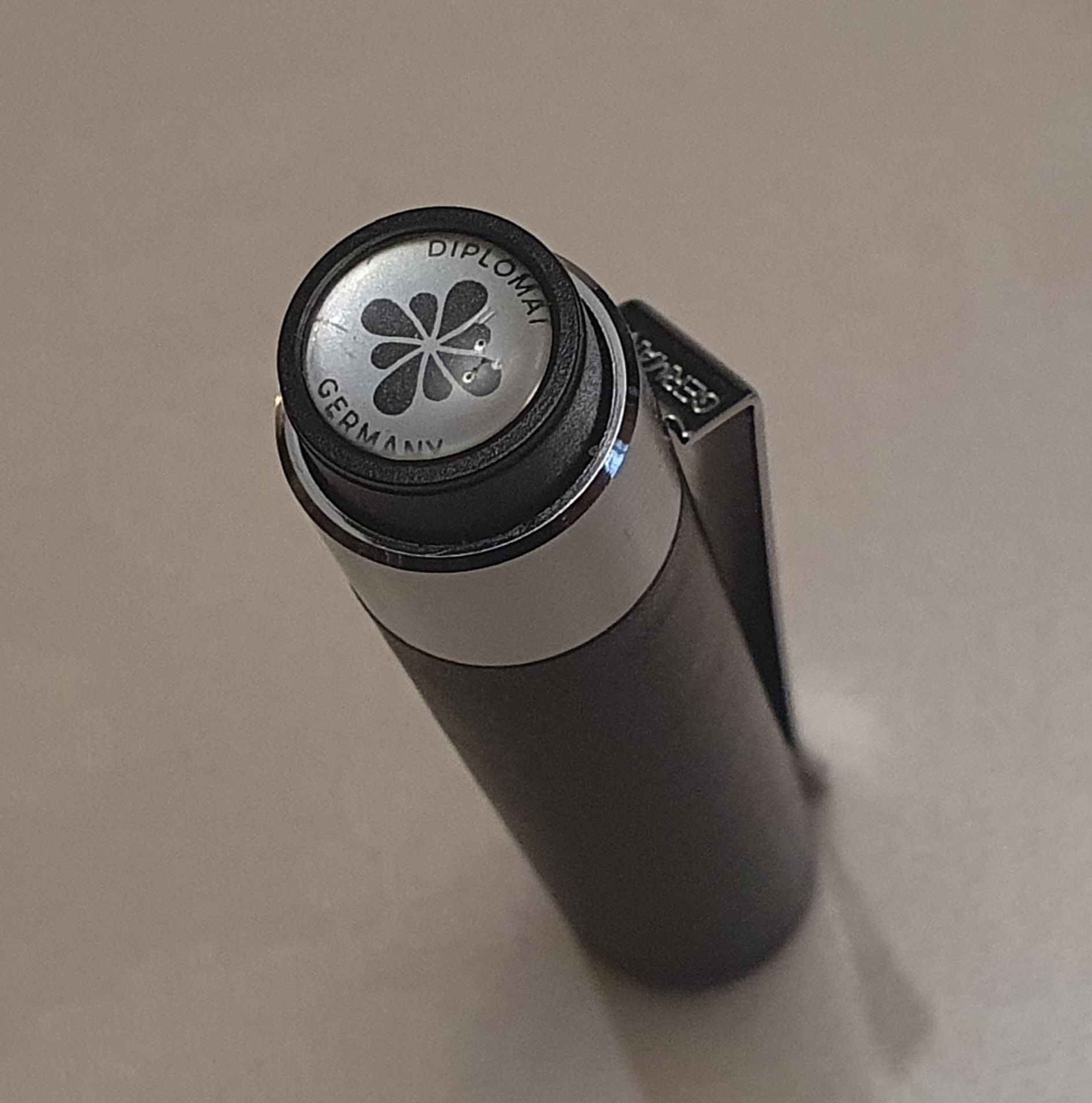
It is a smallish pen, particularly for one called “Magnum.” Although an entry level model, it still has Diplomat’s distinctive finial, showing their logo of black petals on a white background. Below the finial is a broad shiny metal band and a strong, springy, metal pocket clip.
Cap and finial.
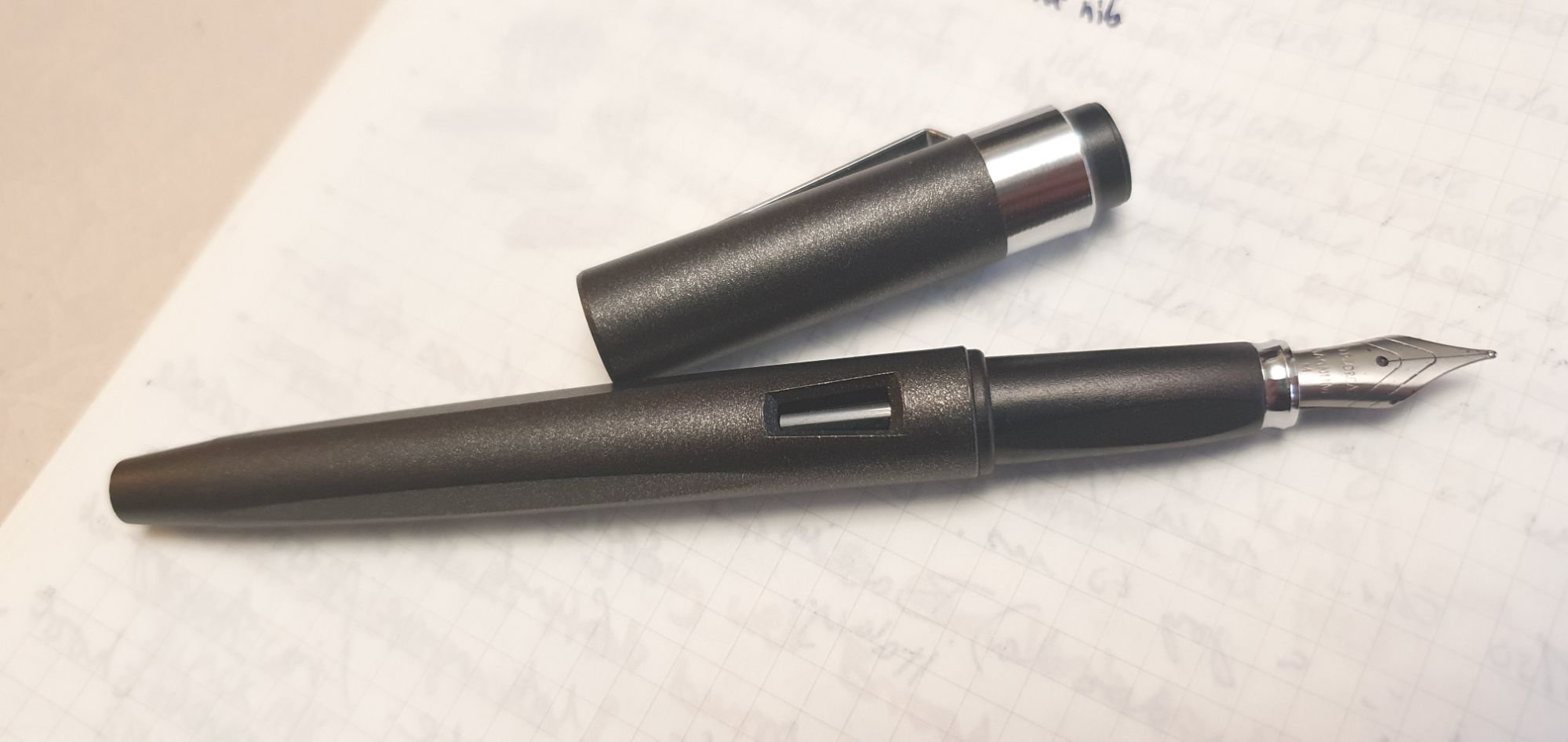
The body of the pen is comprised of a black plastic, which on my “Crow black” model, is a stealthy dark matte grey. It feels smooth and solid, yet looks textured with a grainy finish which reflects the light. Whilst the cap is cylindrical, the barrel tapers and the curved surface is interrupted by three flat facets and two keystone-shaped ink windows.
Diplomat Magnum.
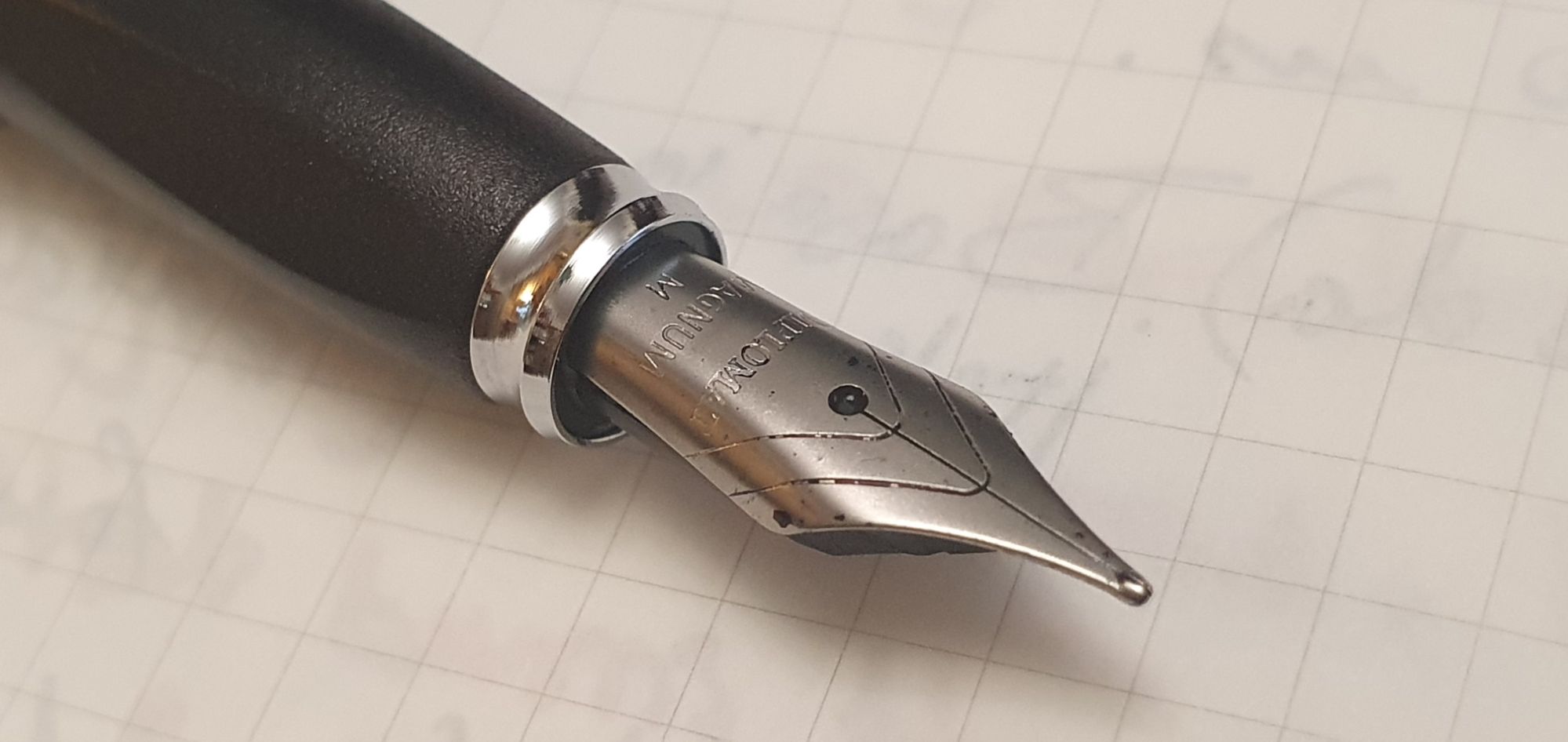
Removing the snap cap, which can be posted, there is a stainless steel nib finished in a matte grey, giving it the appearance of titanium. The nib is stamped DIPLOMAT MAGNUM and (on my model) M for medium. Other widths (EF, F and B) are available and can be purchased separately from Diplomat. The black plastic section also has three narrow facets, to provide an ergonomic grip but these are not obtrusive and can be bypassed if you prefer to hold the pen higher up.
A typically wonderful Diplomat steel nib.
The pen uses standard international cartridges. However, I borrowed a converter from another pen and filled it with my freshly-purchased Diamine Oxford Blue whilst still in the city and enjoying lunch in a cafe. Putting pen to paper for the first time provided one of those “Yes!” moments as the nib felt exquisitely smooth and a joy to use.
The pen, as I have said, is on the small side and the grip section is only around 9mm wide at most. Yet it has a pleasing feel, as if using a precision instrument. Indeed, with its grey colouring and facets, the design did put me in mind of the TWSBI Precision.
As well as Pens Plus, it is also available on Cult Pens’ website. The website diplomat-pen.com is well worth a visit. I read there that Diplomat pens are “manufactured with love and care by one of our eight employees.” Only eight! On its products page, the Magnum is described as “the writing instrument for everyday life, whether young or old, thanks to its ergonomic grip zone, it is suitable as a pen for children from the first grade.” I can vouch for that and have enjoyed using mine both at home and when out and about.
The firm’s website provides its address, as Erlenweg 14, Cunewalde, 02733, Germany. Looking this up on google’s street view site, shows a white building with Diplomat signage, in a yard behind metal gates, nestling in the midst of an attractive, picture-postcard residential community of cobbled streets and traditional-style, timber-framed houses. The Wikipedia entry for Cunewalde even mentions in its list of main sights of the village, that Diplomat Deutschland GmbH has been headquartered in Cunewalde since 1922.
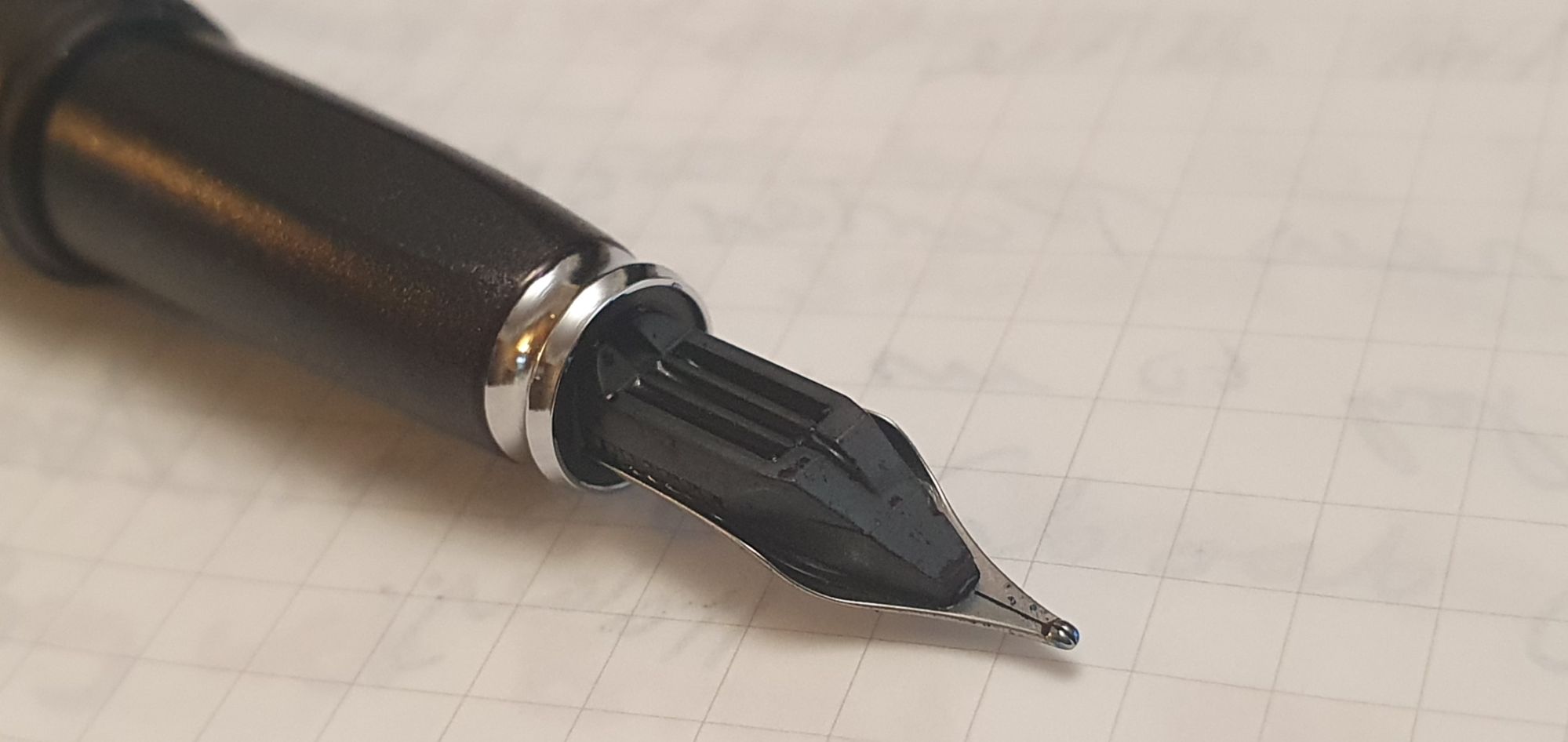
Underside of nib and feed, after inking.
In conclusion, if like me, you had not yet tried a Diplomat Magnum then I recommend that you do so, whether a child in the first grade or not.
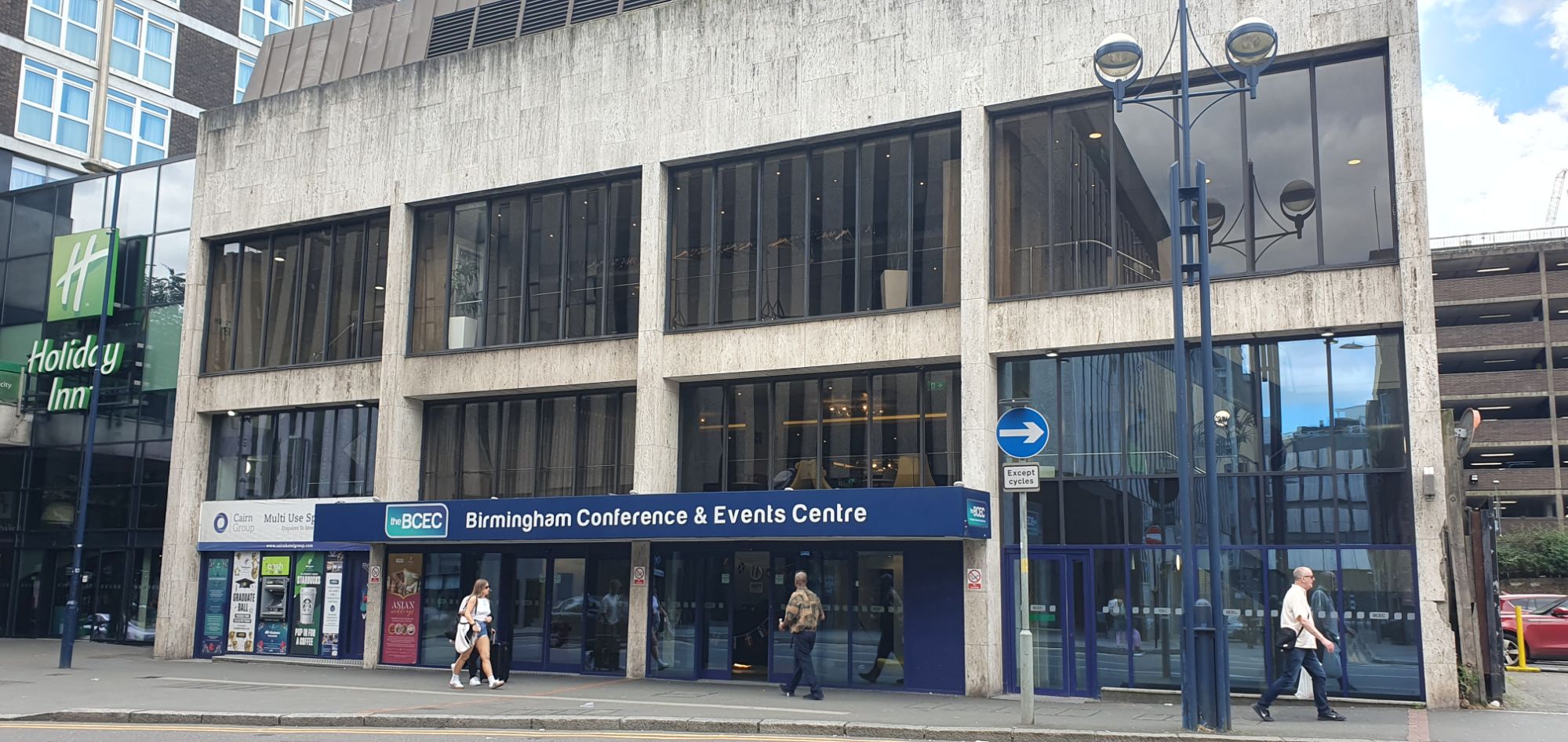
Last Sunday I enjoyed a day at the Birmingham Pen Show, held in the Birmingham Conference and Events Centre, “the BCEC” in Hill Street, a short walk from the main train stations. It was good to see so many of the familiar vendors whom I know from the London Pen Shows.
Before entering the main hall, I visited Michael Owen’s table, representing Writech. He asked me whether I had seen his retractable fountain pens. I had not! He had one on the table to try as well as a stand with examples of the pen in a range of pastel colours.
Retractable Fountain Pen and ink set, from Writech.
I picked up the pen and clicked open the nib. Actually, the clicking mechanism is almost silent, whether extending or retracting the nib, a boon for anyone using the pen in a meeting or quiet public environment, or sitting next to one!
When the knock is pressed, a little round plastic hatch door opens and out comes the nib, just like a ball pen. But unlike a ball pen, a door seals off the nib to stop the ink from drying out or evaporating away, whilst not in use.
In writing mode.
This is not new of course, Pilot having brought out the Capless in 1963, for the Tokyo Olympics of 1964. These have been followed by the Lamy Dialogue and, more recently, the Platinum Curidas.
Designing a fountain pen without a cap does present a challenge, to keep the nib from drying out between uses. The Curidas did this by means of a hatch door which opened onto the underside of the pen protected by two plastic protrusions, supposedly out of the way, but many found that the protrusions interfered with their grip. My own issue as a lefty, using the Curidas was that the pocket clip was at the nib-end of the pen and restricted my grip, since I wished to rotate the pen inwards. The clip could be detached, but this left a large protruding plastic “keel” which still got in the way, leading me to file mine off.
In the case of the Pilot Capless, or Vanishing Point, the pocket clip is also at the nib end as you write. If I held it in my natural, lefty-overwriter style, the nib would be turned inwards, and my thumb would be resting on the pocket clip, rather than the barrel.
The Writech avoids these problems completely. The pocket clip is at the back, or “knock” end of the pen, so the pen looks a lot more normal when in use, as the clip is where it would be on a ball pen, or a fountain pen with cap posted.
Nib and hatch door
However, the hatch door stowage is not quite so elegant. In a brave move, the hatch has been designed to stay open beside the nib in full view whilst the nib is out. This does look strange and is rather jarring at first and will, I expect, be the divisive, Marmite (love it or hate it) issue.
The steel nib is available as a Fine only. Initial impressions are very favourable. The tiny unmarked nib, with a slit but no breather hole, writes very smoothly and with an excellent steady flow.
Fair warning.
Filling the pen is a breeze. Simply unscrew the barrel, place a Writech cartridge in the section and push until it clicks being careful to keep your fingers out of the way as the nib will pop out at the other end. I found that the easiest way to insert a cartridge was to stand the cartridge upright on a table, and then push the section down on top of it.
Unscrewed and ready to fill.
I was sufficiently impressed with the pen, to buy two of them. Michael was selling these at £12.99 each, or £15.00 to include an extra box of cartridges which is remarkably good value compared to any other retractable nib fountain pen.
Two pen sets and two extra packs of cartridges.
One pack of 5 cartridges is supplied in the clear plastic clam-shell box with the pen. Unscrewing the pen for the first time, an empty cartridge is attached to show where it goes, but can also be kept to syringe-fill with the ink of your choice.
The packs of cartridges were available only in black or “Erasable Blue”. I have tried only the black ink. I am not sure whether the blue ink can be rubbed out (as with a Pilot Frixion) or whether the ink is washable. I will experiment with this on my next fill.
In conclusion, I have been using the pen for a week now. It is convenient and fun to use and I rather like seeing the hatch door flip open as the nib pops out, like a cuckoo clock. Above all the pen is comfortable to hold, writes very well and costs less than a Lamy Safari.
Likes:
Comfortable to use; cylindrical barrel and no protrusions in the grip area; (there are two very slight indentations, too small to call facets and barely there, for an ergonomic grip);
Nib extending and retracting mechanism works well;
Smooth, fine nib:
The airtight seal also works well, in keeping the nib ready to write; (Michael had tested this over several weeks);
The nib does not grip the feed, and so there should be less danger of the feeds cracking, as happened with some early Curidas pens;
Simple design and ease of filling;
At £12.99, these are great value, a lot of fun and write well.
Dislikes:
Not everyone will like the round hatch door open on the right, beside the nib;
The pen uses only Writech proprietary cartridges, a more expensive and limited option than standard international cartridges, (which might be how the company hopes to make money) but to be fair, the Pilot Capless, Lamy Dialogue and Platinum Curidas all used proprietary cartridges; Michael mentioned that an adaptor may be available later.
Although I love having the pocket clip at the back, mine does not quite align with the nib. It would be unpleasant to hold if the barrel threads stopped with the clip on the underside of the pen as you write;
The pocket clip requires that the pen be carried nib downward, contrary to conventional wisdom; I have not yet dared try carrying it upside down, preferring to carry it in a pen case, nib up, or stand it in a pen cup, nib up;
Although the black ink cartridge ink flows well, I found that it feathers on the paper of my Stalogy notebook, which is usually fountain pen friendly. However, on the laid paper of a Semi-Kolon A5 journal, there was no noticeable feathering;
I have not yet tried cleaning the pen but it might be best to use an open-backed cartridge to push open the nib hatch and flush the section, nib and feed;
As yet the pen does not have a distinctive name, (unlike the Capless/Vanishing Point, Dialogue or Curidas). Its model number “W-784” does not yet look as though it is intended for customer use.
I have had the pen for only one week and need more time to test for hard starts after a period of non use and also to simulate carrying the pen nib down in a shirt or jacket pocket on a warm day whilst running for a bus. Subject to my remaining on good terms with the pen, I will also try out its erasable blue ink cartridges.
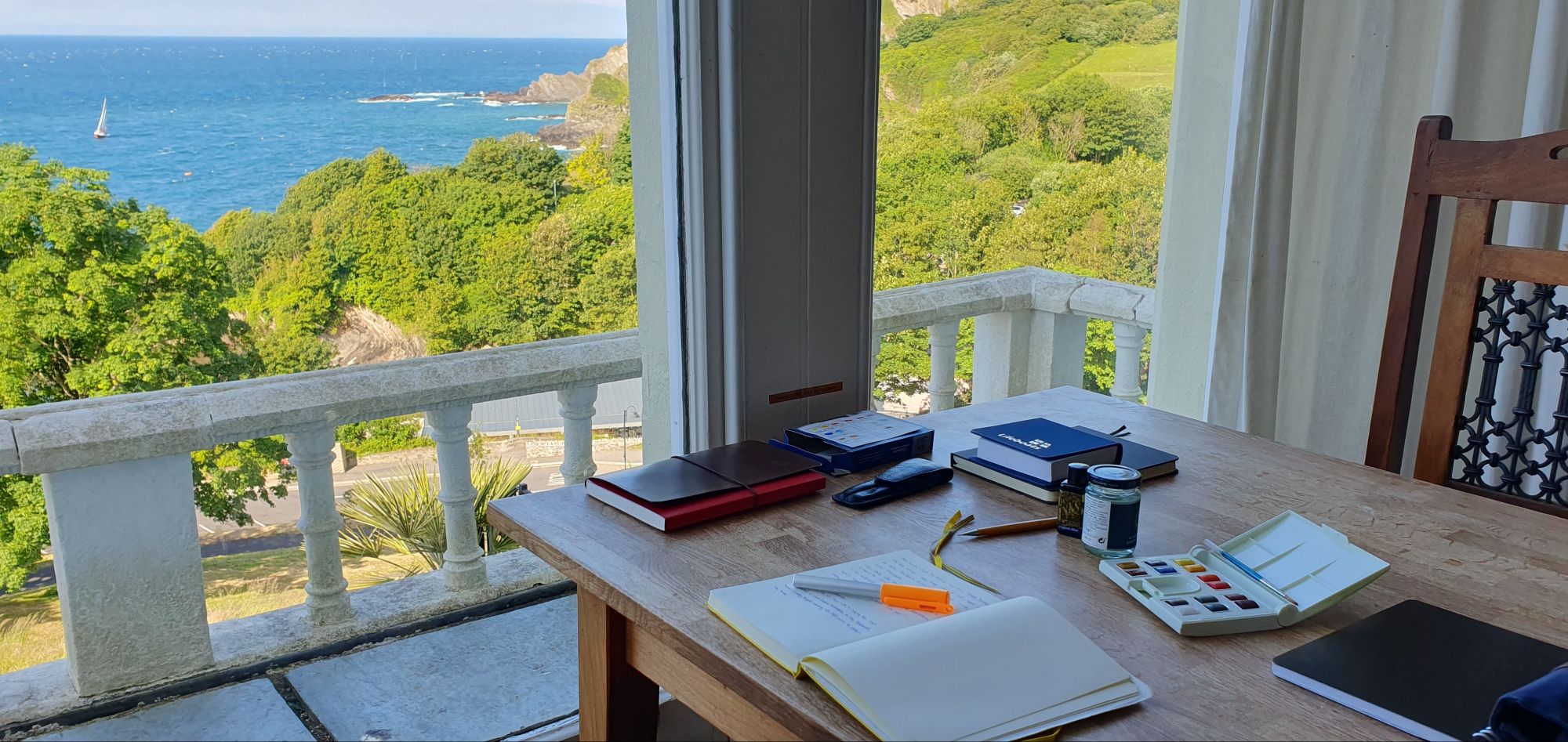
We have just returned from a week’s holiday in Ilfracombe, North Devon. Our holiday flat was in a grand Victorian terrace, in a house dating from 1872 with stunning views of the harbour and the rocky coastline. We were also lucky to have a solid week of good weather and this made for a wonderful trip.
My journaling corner.
A week away involves choosing which writing tools to bring. I had my usual inner debate on whether to bring a selection or travel light and just bring one. As usual, I came down on the side of bringing a selection. The final tally amounted to five fountain pens, three roller balls, two ballpoint pens (one being a multi-pen) and one mechanical pencil. I also brought too many notebooks: A Leuchtturm A5 for holiday journaling, a Stalogy 365, A5 in a leather notebook cover for when out and about, a new Moderno (WHSmiths) A5 notebook for any creative writing (which I did not open all week!), a little red Silvine pocket memo book which I carry everywhere and an A5 Ryman’s sketchbook and a small set of watercolours.
To this, I added a square notepad bought at the RNLI shop near the harbour, little changed from their notepads that I used to get on family holidays some 50 years ago.
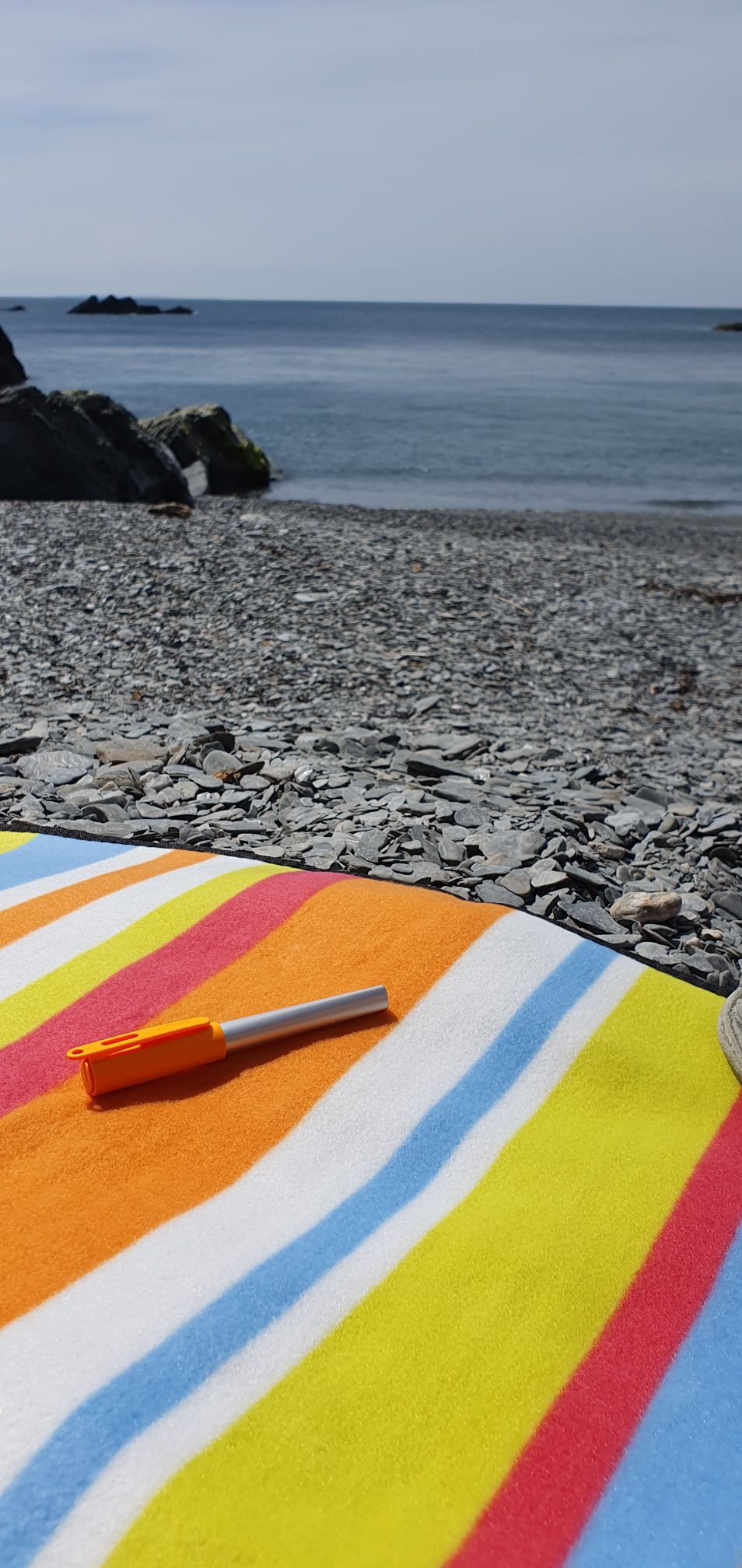
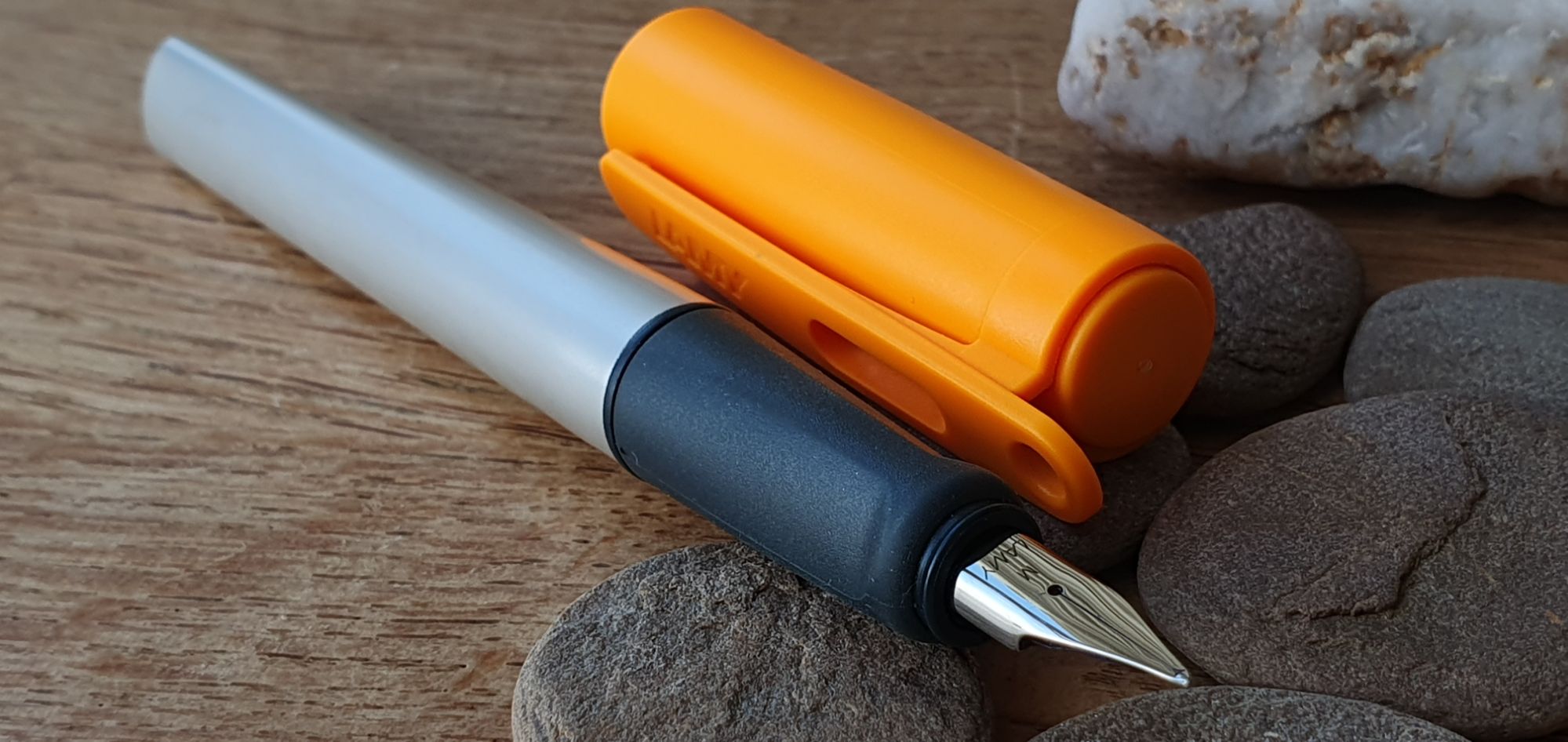
It transpired that I used only one of the five fountain pens, a newly acquired Lamy Nexx, purchased for its striking Neon Orange cap. I had not been a particularly big fan of the Lamy Nexx, with its rubber faceted grip but on giving it another chance and some sustained daily use, I found it very comfortable and it performed faultlessly. The bright orange cap shouts holiday vibes.
Nexx on the beach.
I used the blue Lamy cartridge that came with the pen. Writing each day in the Leuchtturm journal using a medium nib, the cartridge lasted for a respectable 38 pages.
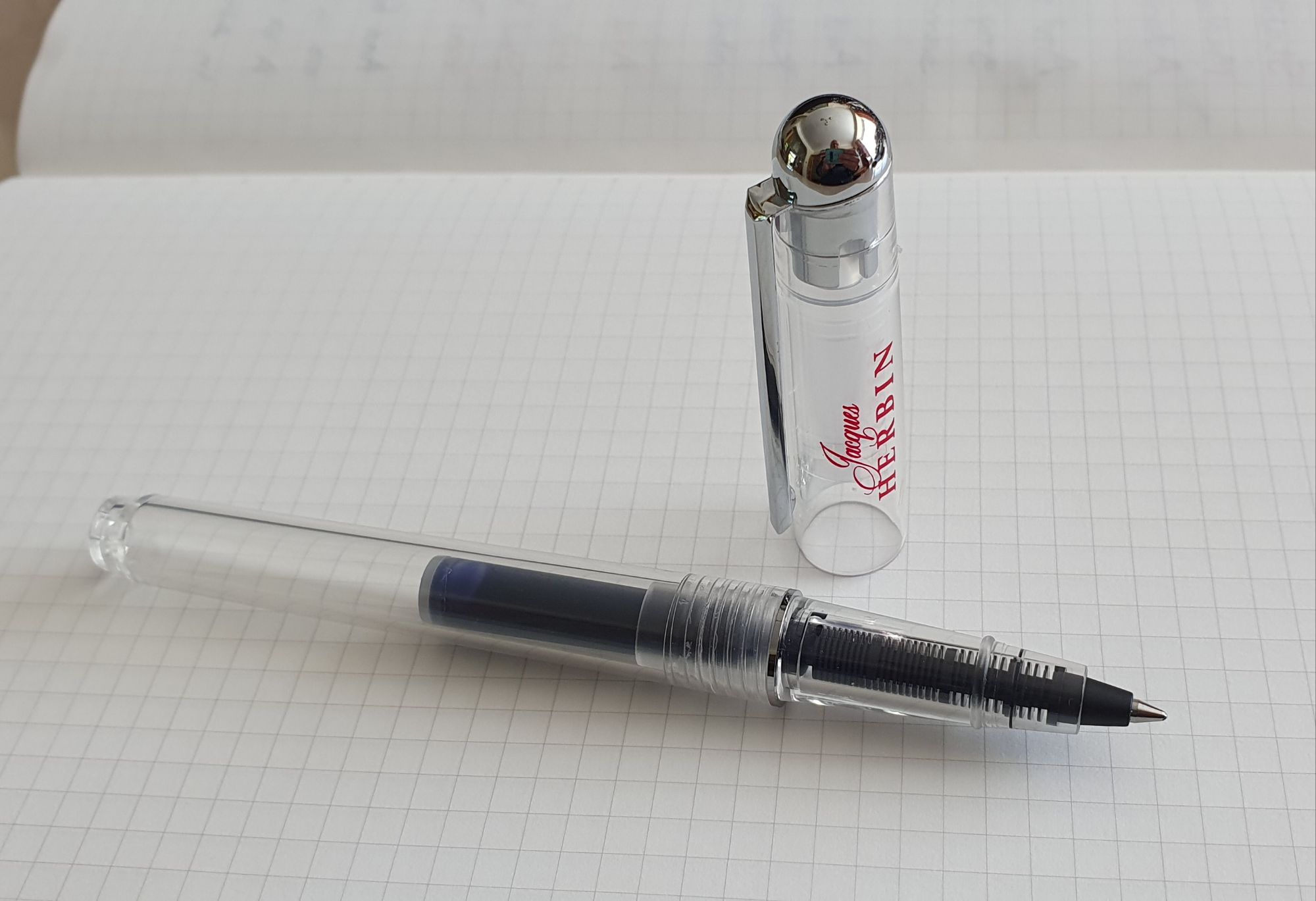
When the Lamy finally ran dry, I switched to a Jacques Herbin clear demonstrator roller ball pen, (model 22500T) which uses standard international cartridges. I had bought this a few weeks earlier, at Pens Plus of Oxford and like it a lot, far in excess of its modest price-point. It has become my shirt-pocket pen, great for short notes or longer writing sessions too.
Jacques Herbin roller ball ink cartridge pen.
I did not discover any fountain pen shops, either in Ilfracombe or any other places we visited, not that I was in need of anything! But I thoroughly enjoyed my quiet time spent with my notebooks and pens, and watching the harbour activity from our windows.
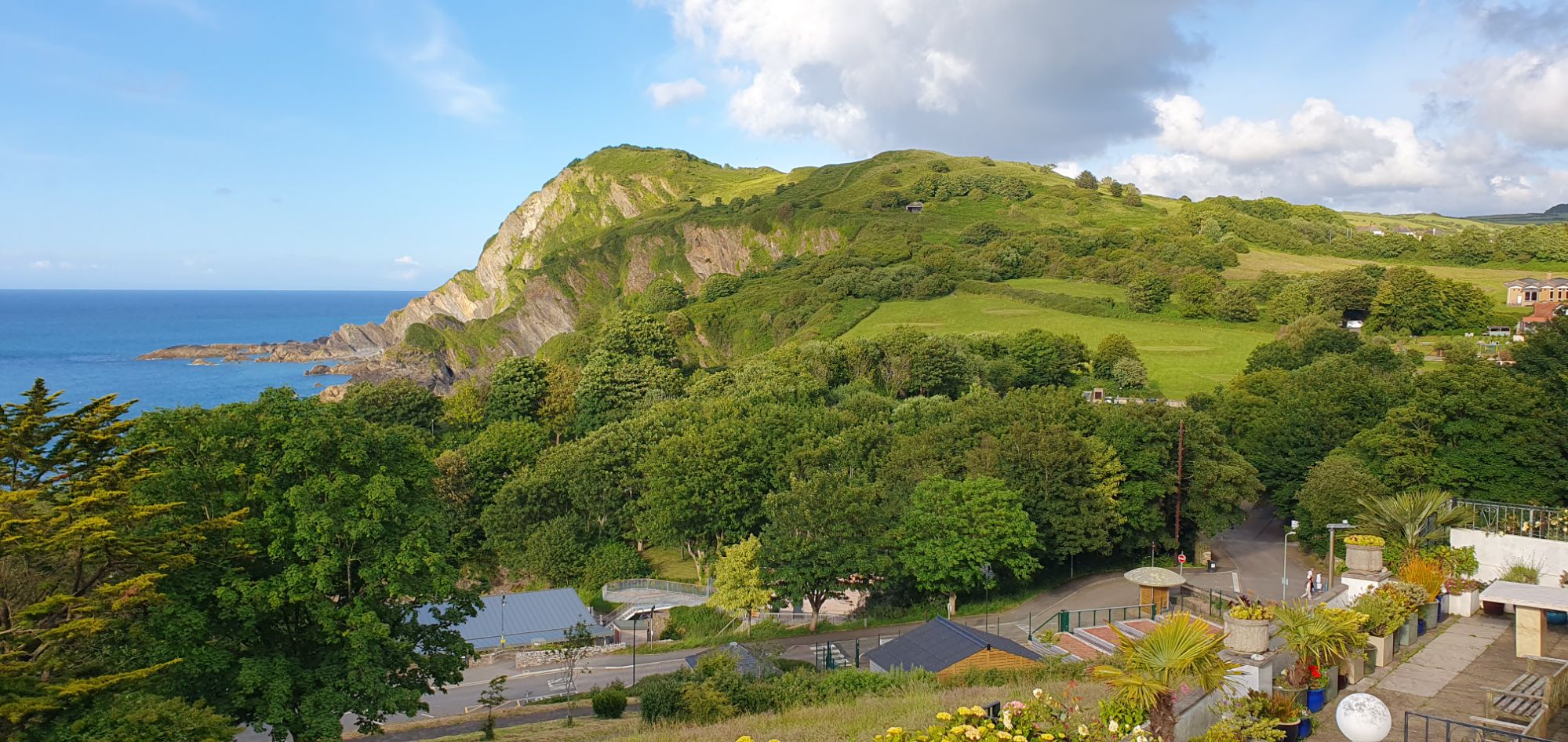
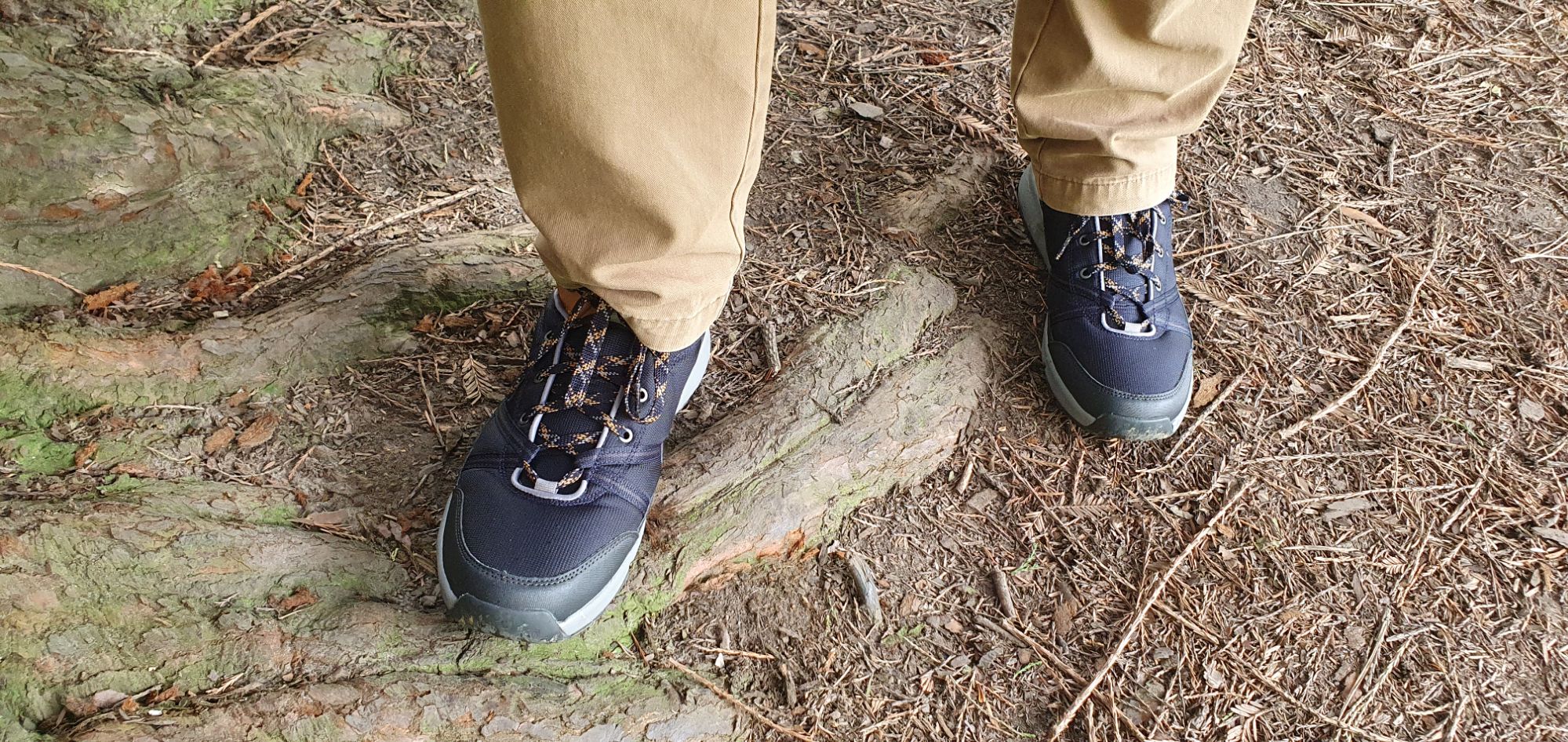
With little more to report as to the performance of either the Lamy or the Jacques Herbin pen, there was some other, off-topic, “product testing” of some recently acquired items. First, I had picked up some lightweight, inexpensive Quechua, fabric waterproof hiking boots from Decathlon, and was glad of the chance to try these out in the hilly coast paths. There are lovely walks on Hillsborough Hill, (known as “The Elephant’s Head”) which we could see from our flat and this was a good testing ground for the boots.
The Elephant’s Head, Ilfracombe.
Unlike my leather Karrimor boots, the Quechuas are extremely light and comfortable and as soft as slippers, yet provide a tough, grippy sole. On my first hill walk I found that having opted for a larger size for the added width, my feet slid around a little inside the boots on descents. However, on my next walk, I solved this simply by lacing the boots more tightly.
Decathlon Quechua hiking boots.
Another feature of the boots is their claim to being waterproof. In dry, summer conditions there was not the scope to try these for a long walk in heavy rain. However they stood up well to wading through shallow rockpools on the beach, keeping my socks and feet dry. Being so light, they would not provide enough support and protection for very rugged terrain. Having read mixed reviews of these, I am keen to see how they fare over the next 12 months or so.
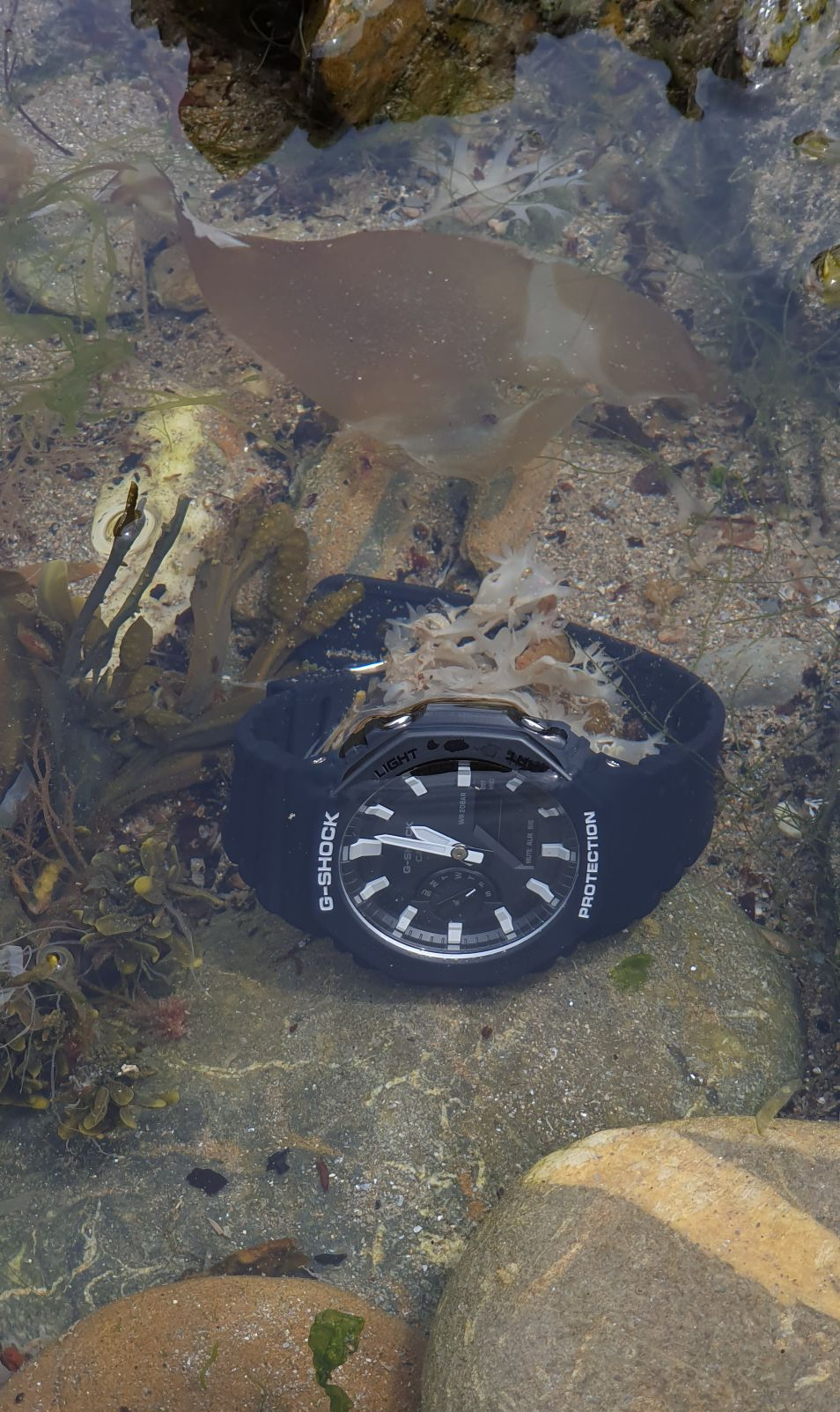
Another recent acquisition immediately prior to the holiday, was a Casio G-Shock wristwatch, bought chiefly for its 20 bar water resistance (equivalent to approximately 200 metres) for swimming in the sea.
Casio G-Shock model GA-2100-1AER in a rockpool.
Being lightweight, comfortable and easy to read with its white hands on a black dial, I enjoyed wearing this all week. My only complaint would be that the digital readouts in the lower right quadrant are too small and dark (unless viewed in line with a light source), but in practice, it is better that these are not too prominent and distracting as, nine times out of ten, I just want to read the time.
Tunnels Beaches, Ilfracombe. A sheltered cove with a tidal pool (submerged here at high tide) accessed only by tunnels through the cliffs, dug in 1823.
Finally, back from my week away, I tested my other inked pens for hard starts. All did well. Only the Parker 51 Vacumatic needed a moment and a light moistening of the nib, but for a 1940’s pen, this is entirely understandable.
This post is unashamedly about an entry-level school pen for those who enjoy trying fountain pens from the lower end of the spectrum.
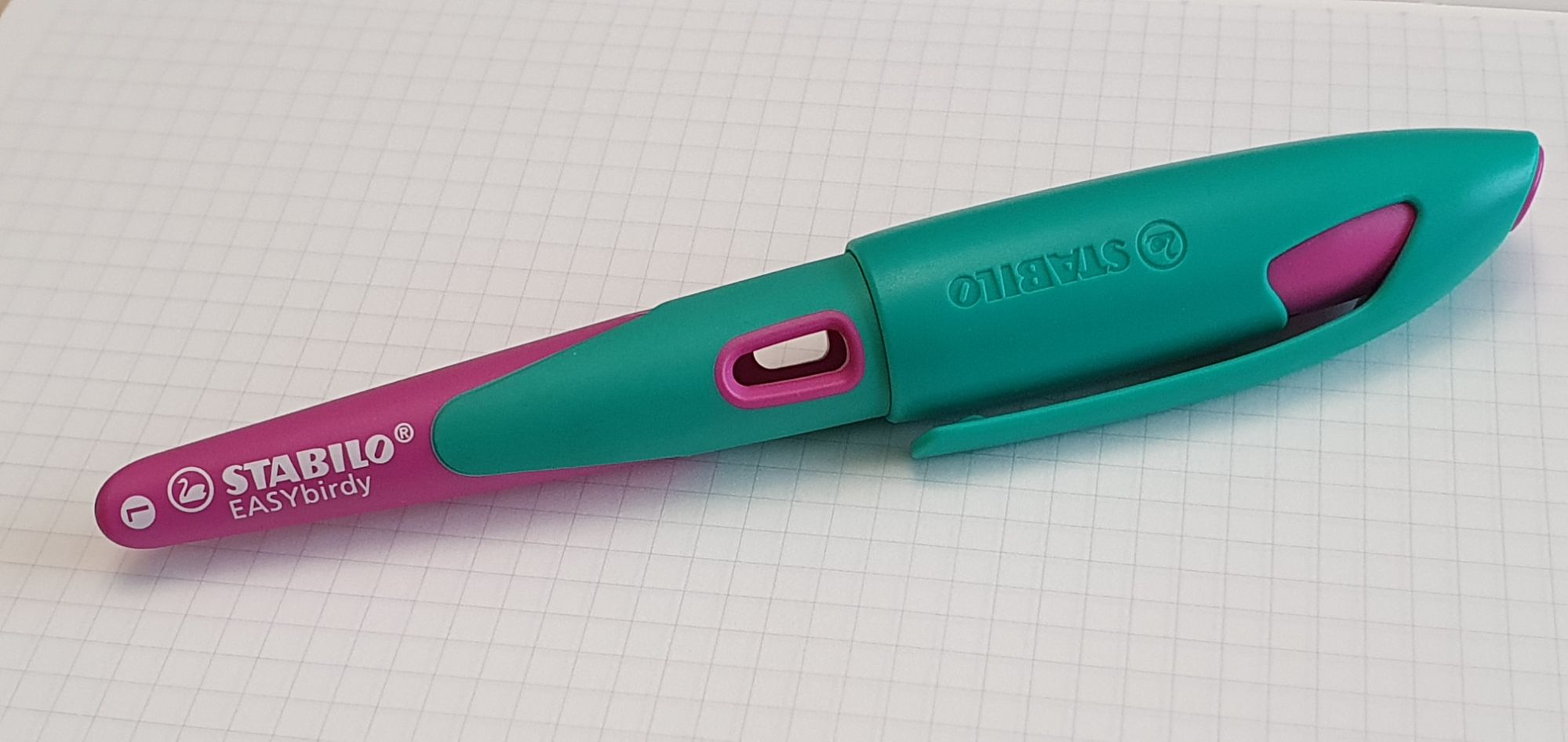
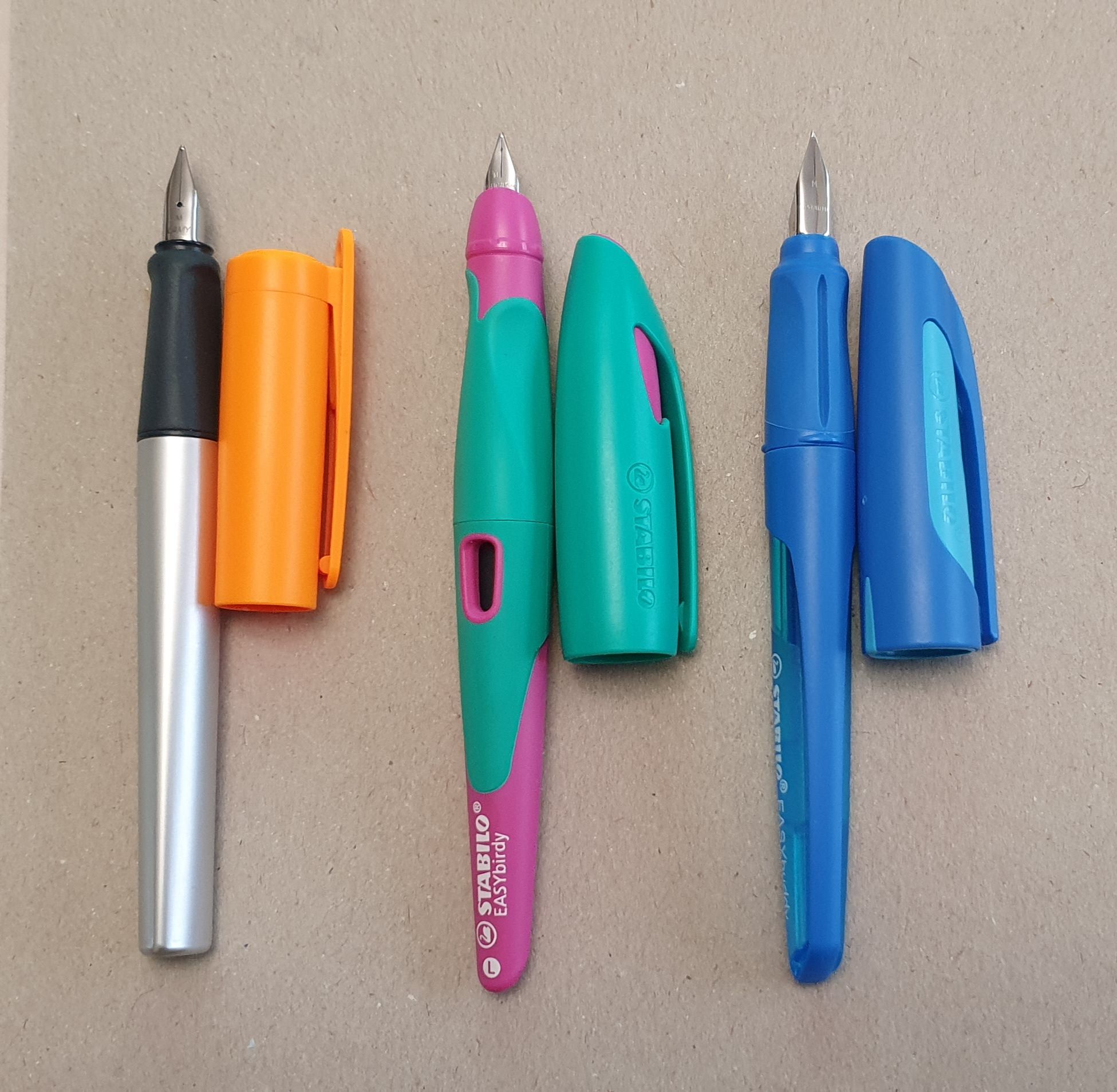
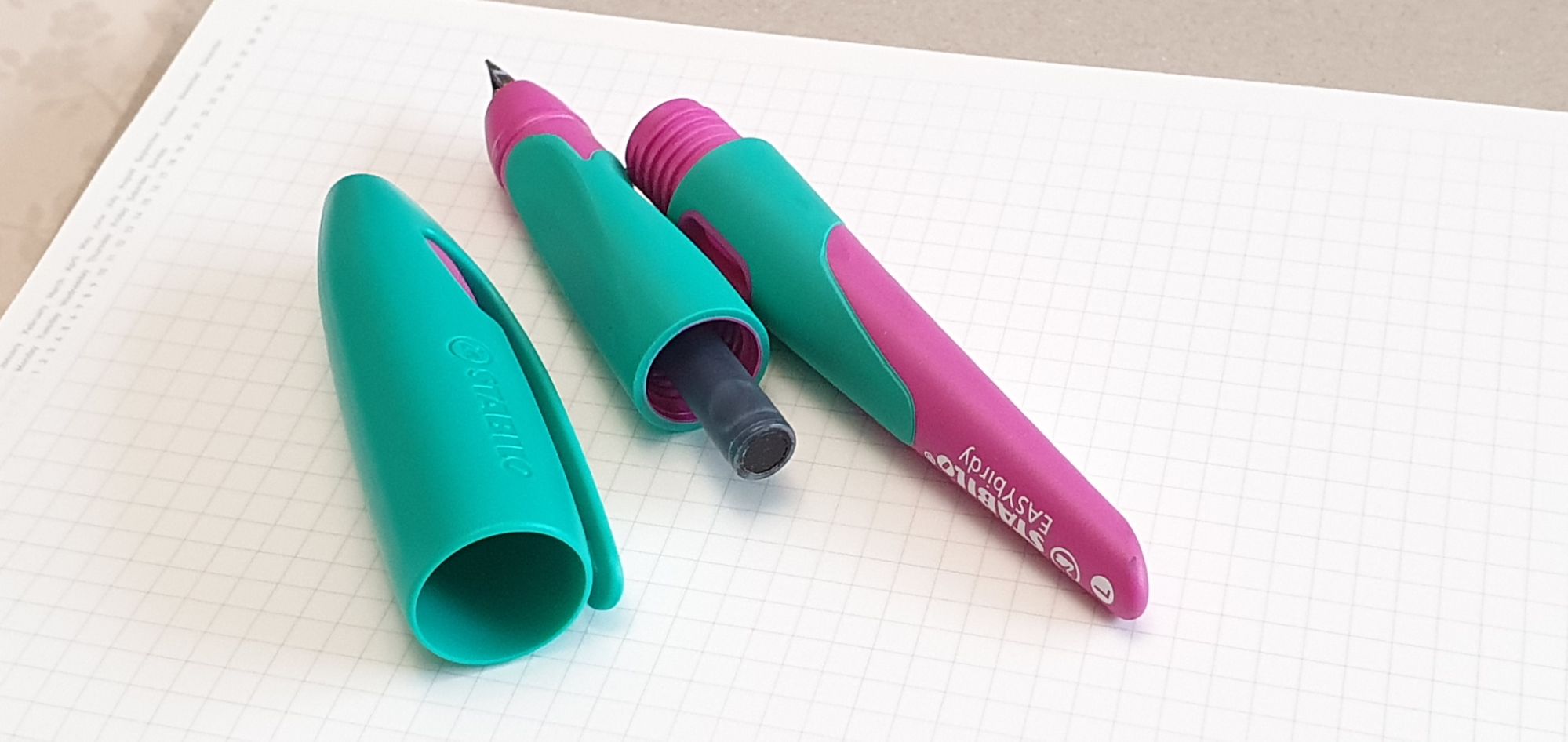
It is getting on for six years since I wrote a post on the Stabilo EASYbuddy, a chunky, robust, plastic fountain pen designed for children. The EASYbirdy looks very similar but has some important differences.
Stabilo EASYbirdy fountain pen.
Examined side by side, the EASY birdy is about 10mm shorter when capped, yet the same length as the EASYbuddy when uncapped. The EASYbirdy has a shorter barrel, a longer section, a smaller and “unglazed” pair of ink windows, unequal length facets for the thumb and forefinger, and a semi-hooded nib.
Stabilo EASYbirdy with Stabilo EASYbuddy (right) and Lamy Nexx (left).
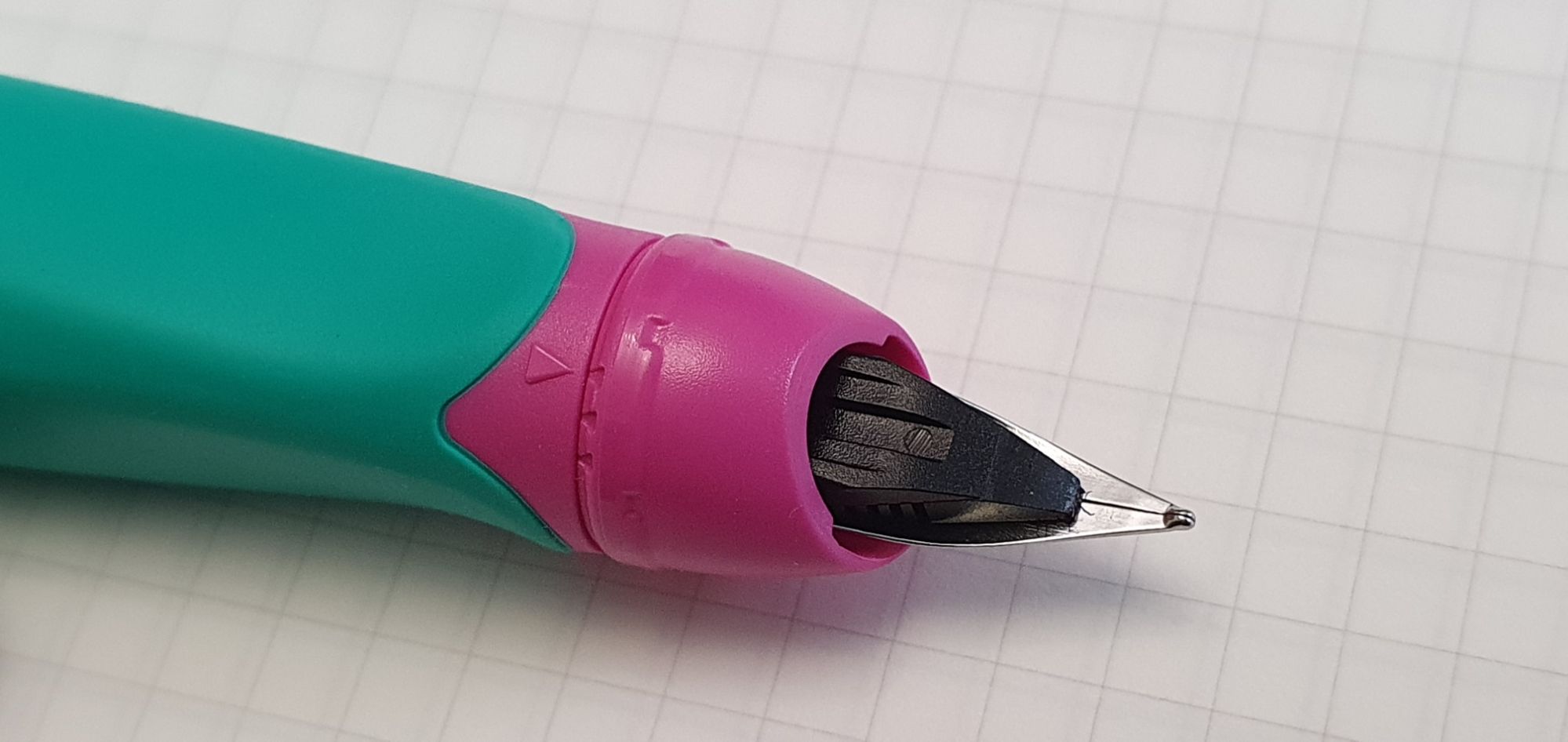
But the most significant distinctions are that (a) the EASYbirdy is available in Left or Right handed versions and (b) has an adjustable nib-housing, allowing the nib to be rotated either left or right, or centred, in relation to the grip facets.
Nib housing showing different settings.
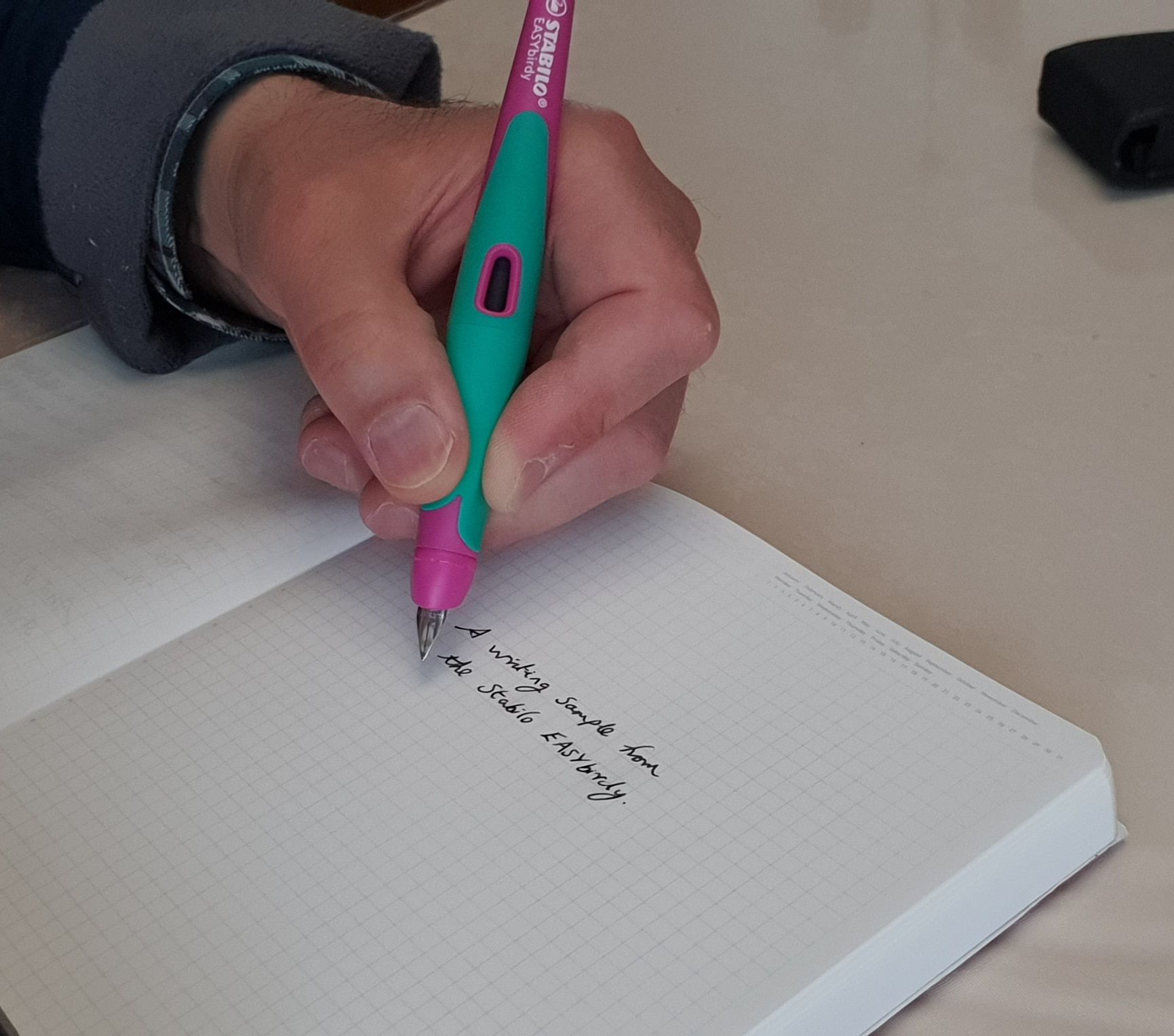
As a lefty-overwriter myself, I was intrigued by this design. I was keen to see how it worked and whether it was of any benefit to me. I spotted a half-hidden display of these pens in a local stationery/computer repair shop, on a shelf behind numerous boxes of roller-ball and gel pens.
The EASYbirdy sample tray contained six pens: three for left-handers and three for right-handers. The pens for lefties were all in pink and green with “L” at the tip of the barrel. The pens for righthanders were green and blue with “R” on the barrel.
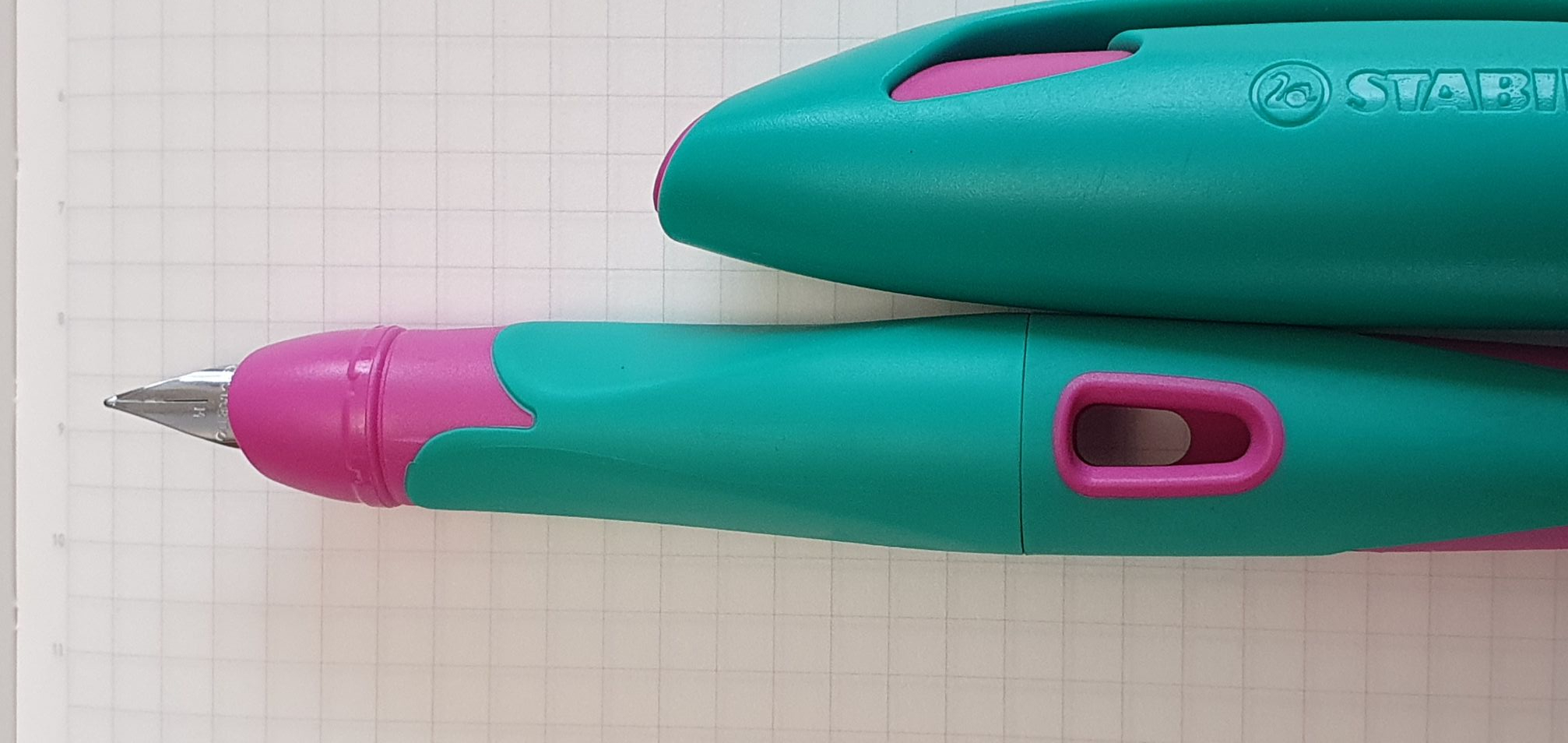
It took me a while to spot how the left and right hand versions differed, before eventually noticing that the facet for your forefinger came down a little further than the facet for your thumb. This hardly seems necessary but I suppose it helps towards a grip whereby the forefinger is flatter against the section instead of being bent at a right-angle.
The shorter facet is for the thumb on this left-handed model.
Having grasped this, I was still confused about the off-setting of the nib and why there were so many display samples in the tray. The answer is that a customer, whether left or right handed, can try writing with pens with nibs pre-set to left, right or centre, (labelled as -1, 0, and +1) to see which is most comfortable.
The retailer can then dial in this adjustment to a new pen, using his special plastic Stabilo tool (NOT sold with the pen). If not right, the pen can always be brought back for the nib rotation to be altered.
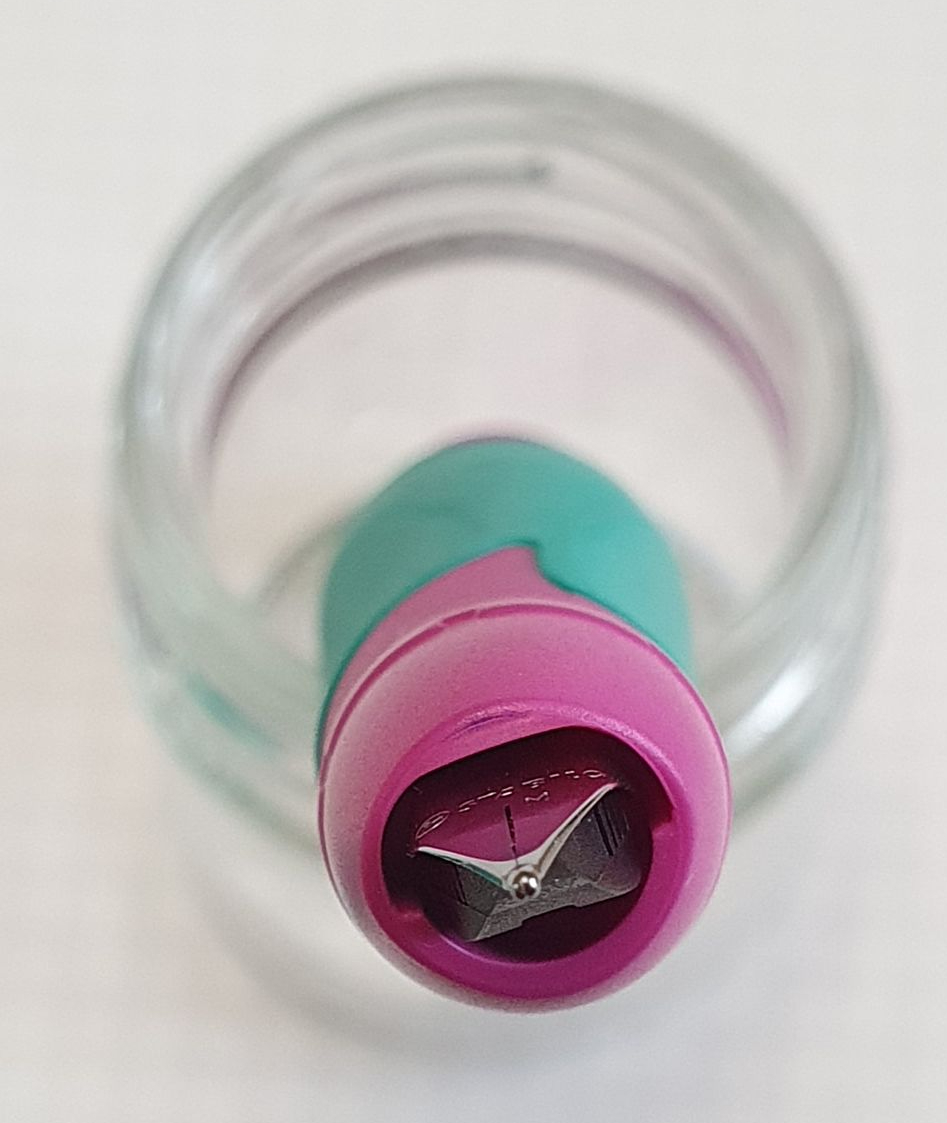
With facets at “ten to two”, this shows my nib rotated for a lefty overwriter.
The only other fountain pen that I can think of with a faceted grip and the ability to rotate the nib, was the Parker 75 in which you simply gripped the nib and feed, and twisted them one way or the other as desired. The EASYbirdy system is different: a tool is needed. Also, you do not apply the tool to the front end of the pen, as you might expect. Rather, you remove the barrel and use the tool to loosen the housing from inside the section. Once loose, the angle can be altered and the tool is used to tighten it up and lock it in place.
Likes.
The steel nib writes smoothly and with good flow. The pen takes standard international cartridges. If using the short ones, there is room for a spare in the barrel, making for a great outdoor and EDC pen. The length of the pen uncapped, at around 133mm together with the generous girth (even allowing for facets) makes for a comfortable pen. The left and right options, together with the ability to rotate the nib, means that there should be a version and setting for everyone.
A cartridge inserted with room for a spare in the barrel.
Dislikes.
The need for a tool, which is not included with the purchase, is a little disappointing. I can understand that, once set up in the shop, most people may not want or need the tool again. Personally I would like to have my own or it would be even better if the tool could somehow be built into the cap or barrel. The push-cap is secure but does not click. It does not post either, although the pen is long enough without posting. The colour scheme of pink and green is not to my taste, although distinctive. I accept that I am not the target age group.
Conclusion.
I am not generally a fan of faceted grip sections on fountain pens, which dictate how you must hold the pen to the paper and punish you with uncomfortable ridges if you do not comply. But here we have a rubbery ergonomic grip with the option to rotate the nib. The pen fits the user; the user does not have to fit the pen. I do find that I can hold the pen at the facets whilst still having my nib rotated inwards. For lefties especially, this could make writing a little more comfortable, whatever your age.
In April I spent a delightful week in Shropshire on the Netley Hall Estate, a few miles south of Shrewsbury. The Shropshire Hills National Landscape is a beautiful region. We enjoyed visiting nearby towns, with streets lined with picturesque half-timbered buildings dating from Tudor times.
A street scene in Ludlow.
I was eager to visit Write Here, the superb independent fountain pen shop in the heart of Shrewsbury. This was my first time in the town and I had hoped to visit ever since learning of this shop and meeting John Hall regularly at pen shows.
Write Here, Shrewsbury.
The shop was everything I had expected, and more! I could have spent hours browsing the fountain pen displays. It was just as well that I was constrained by the two hours maximum stay where I had parked my car, plus the knowledge that my wife and mother-in-law were meeting me in a nearby coffee shop.
In the preceding days, I had formed a desire to buy a Scribo, a grail pen at the outer-limits of my spending comfort zone, although quite which version and with which nib, I had not decided. I had tactfully asked my wife whether there were any rules that I needed to know before visiting the shop. “Only buy one pen” she replied. Right. Better make it a good one then.
In the shop John asked whether there was anything in particular that I would like to look at. I asked to see two Scribos: one being the Write Here “Africa” and the other, a Feel “Blu Califfo.” (The Blue Caliph is a variety of fig and the pen is a lovely deep dark blue with small bursts of orange in the resin).
The Scribo Write Here pens are produced for Write Here in annual limited editions of just fifty numbered pieces, the “Africa” being the current version. Previous edition colours were (1) grey with lime green, the Write Here shop colours; (2) Cardinal red and Noble green (the only year in which the fifty pens were split between two colours); (3) Blue; (4) Tropea (named after a type of red onion); and (5) Mariana Deep Blue.
A Scribo Write Here Africa.
Like the Scribo Feel but without its faceted body or bulbous barrel, the Scribo Write Here editions are also piston fillers and have the same renowned gold nibs and ebonite feeds, in 14k (extra flessible) or 18k gold, with Rhodium plating. Others have already reviewed the Scribo Write Here fountain pens, including UK Fountain Pens, SBRE Brown, The Pencil Case Blog and Dapprman. What follows is the tale of my own purchase and getting acquainted with the pen, rather than another review.
Scribo was formed by employees of the former Omas pen company and produces nibs with the same tools and to the same specification as Omas. I have never owned an Omas pen but it is common knowledge that the Scribo Feel and Write Here models have very desirable nibs which are just like the Omas OM81 nibs of old.
The 18k gold broad nib.
Back to my decision-making. John provided a table and ink and anticipated that I may wish to use my own paper. I produced my Stalogy A5 notebook and had a blissful time trying both the Feel Blu Califfo and the Write Here Africa. I soon decided that I would not go home without buying one of them!
To narrow down the options, I ruled out the 14k Extra Flessible nibs as these can be difficult to use for a lefty-overwriter and easy to spring. That still left a range of beautiful nibs in 18k gold. I tried the Africa with a fine nib. John then swapped in a new broad nib for me to try. In the Blu Califfo I tried an extra fine, which I also liked. I did not need to try the extra extra fine.
The Africa cap.
I was struggling to chose between the Africa and the Blu Califfo as I liked elements from both. The Blu Califfo was a gorgeous blue, my favourite colour and very slightly longer. I liked its faceted body but not so much the aesthetics of the bulbous barrel meeting the straight section, although admittedly, very comfortable to hold.
The Africa however, was like a vintage tortoiseshell colouring but more hardcore, like a leopard and with patches of clear acrylic resin. This had one advantage, namely that you could see the ink level between the black and golden-brown flecks of colour.
Nib-unit and section.
To help with my deliberations, John suggested showing me something completely different. I then enjoyed his personal guided tour of all the pen displays, including Pilot, Sailor, TWSBI, Conway Stewart and a generous range of Leonardo pens, with his comments on the various merits of them all. This was refreshing and I saw several pens that I had not seen in the flesh before. As John said, most pens look better in real life than in photographs.
Returning to the table, I weighed up the two Scribos again. As I felt that I would be happy either way, I chose the Africa on the grounds that you could see the ink level, it did not have the bulbous barrel or metal ring at the end of the section and was also the lower priced of the two.
As for nibs, I already had a good number of pens with medium and fine gold nibs but fewer with broad nibs, especially a stubby broad. John added, perceptively, that I had looked the most comfortable whilst trying the broad nib. This clinched it and so I became the happy owner of the Scribo Write Here Africa, number 25/50, with an 18k broad nib.
Scribo Write Here Africa unboxing.
I would like to say that I took it home and all ended happily ever after. I should have filled the pen and just got on with it, allowing it to run in, but could not stop myself from tinkering with the nib. On close examination, I felt that the nib was not quite centred over the feed. Foolishly, I tried to adjust this by twisting the nib in situ, as though it were a steel Jinhao. This might have moved the nib by the tiny amount needed, but put the tines out of alignment. This required some further tweaking, until the tines and the tipping were level again. Another problem then manifested itself, in that the tines rubbed and clicked against each other whenever I put pen to paper, which I hate. I managed to cure this by flossing the tines with my thinnest gauge of brass shim, checking that the tines were still level. But this may have added to what was already a generous ink flow.
Stubby broad tipping and an ebonite feed!
The writing experience of this beautifully crafted nib was initially marred by skipping and overly wet ink flow. For the first two weeks, I probably tinkered with the nib every day, trying to get it to be as good as it could possibly be. The tipping was super-smooth and gave a juicy broad down stroke and a fine cross stroke. By holding the pen vertical, a double broad effect was achievable. By turning the pen over, the tipping allowed a stubby fine line, which was useful but scratchy.
One of my many pages of writing samples.
I also changed inks every couple of days and am already on my fifth ink. I wondered whether, in view of my nib tuning efforts, I should heat-set the nib and ebonite feed. I read a few different and conflicting guides on this. Using hot water to heat the feed is safer than a flame. One account warned that hot water might discolour the ebonite. But after holding back for a few days, I could no longer resist trying the hot water technique. I unscrewed the nib housing, extracted the nib and feed carefully, checked symmetry over the feed and pushed them back in their housing. I boiled some water, poured it into an egg cup and then dipped the nib and feed in the water for 30 seconds. I then withdrew them from the water and pinched them together for 20 seconds.
The better way to align nib and feed.
The result is that all now looks good again. The nib is still super-smooth and prefers paper with a bit of texture. It skips at the beginning of words sometimes, which I think may be due to “baby’s bottom” but this is improving and should continue to do so. It still writes very wet but I am reluctant to try narrowing the tine gap in case I reintroduce the tine-clicking issue, or put a bend in the tines.
Notwithstanding these self-induced tribulations, I love using the pen. I still cannot walk past it without picking it up to write a few lines or more. The feel of this nib on paper, its bounce and the line that it produces are addictive and the pen is like nothing else in my collection.
Rather than this being a pen nib that needed taming, it may be truer to say that it was I, who should have shown a bit more patience before subjecting it to my nib-tuning experiments. But I am confident now that the pen will be great if I can allow it to settle down.
I am thrilled to own a Scribo at last and am most grateful to John Hall at Write Here for giving me so much of his time on my visit.
A view from The Burway, near Church Stretton. Some students meeting some sheep.
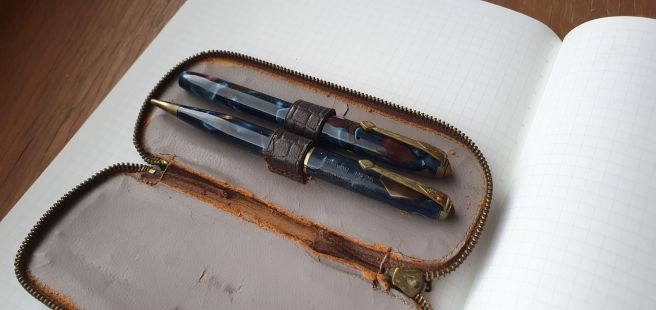
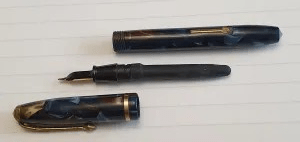
Recently, I was thrilled to win an eBay auction for an attractive, marbled blue and grey vintage fountain pen. It was a lever filler with a 14k gold nib. The sac had been replaced and it looked to be in good condition. I had looked at the seller’s photographs again and again in the week before the auction.
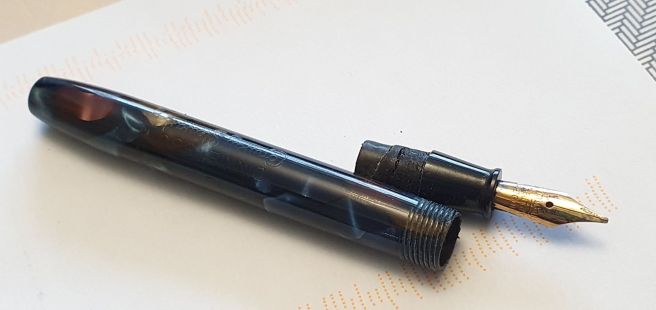
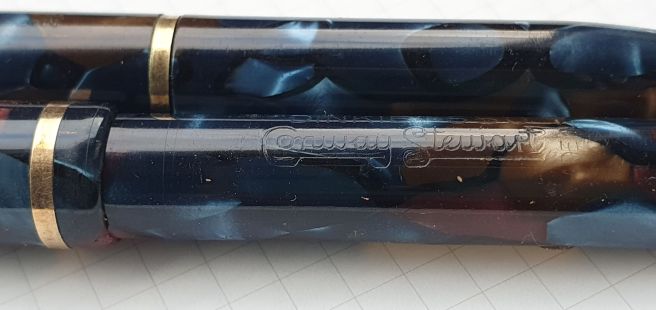
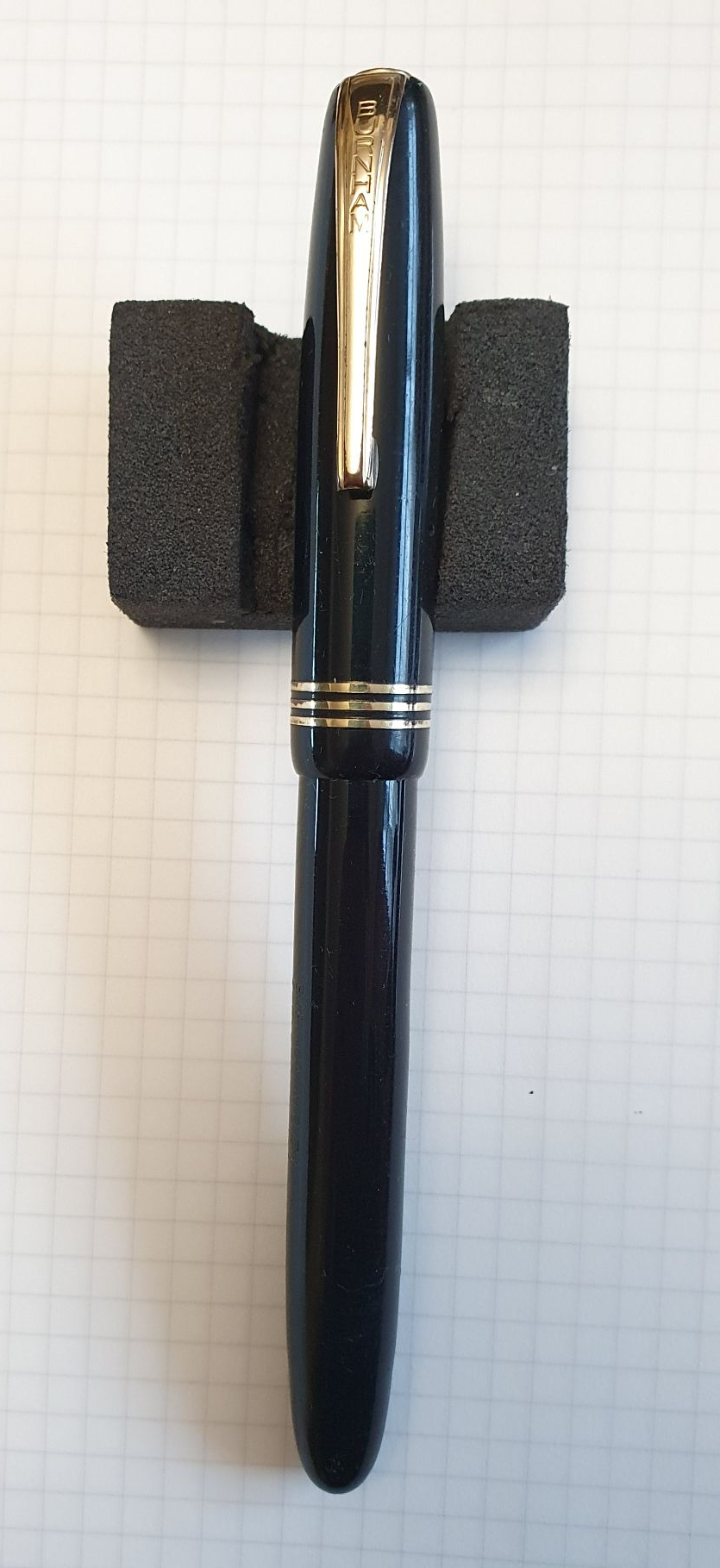
When it arrived, it looked even prettier in person than in the photographs, although much smaller than I had expected. I believe it to be a Burnham 54, although there is no imprint on the barrel and I know little about this brand. There were many variants of the model 54 and numerous other clues to look for in the finial, pocket clip, branding on the clip, the number of cap rings, the inscription on the nib and the shape and markings of the lever filler.
Burnham 54 fountain pen.
In his book “Fountain Pens” by Peter Twydle, (2009), he includes a few paragraphs about Burnham in his chapter on manufacturers. He writes “The pen trade has recognized Burnham, perhaps unfairly, as the poor man’s Conway Stewart.” The company was started by Harry Burnham in London in the 1920’s and continued until the 1960’s. Their pens were mostly lever fillers and used similar materials to Conway Stewart, but being less prestigious and lower priced, became thought of as school pens.
Rounded finial, branded clip and two cap rings on my version.
For a detailed account of Burnham pens, there is a comprehensive study on the WES website, (the Writing Equipment Society), wesonline.co.uk from 2011 by Alan Charlton, on Burnhamography. Meanwhile, my post here is more of a “show and tell” since I know little about this pen.
Uncapped. The classic proportions mask its diminutive size.
Had I known how small the pen was by current standards, even though beautifully-proportioned, I would probably not have bid. This would have been a great shame as I have found the pen very comfortable and enjoyable to use. As I have tended to avoid pens which I thought of as too short or too slim, this was an exciting revelation with a potential to extend the already vast rabbit warren.
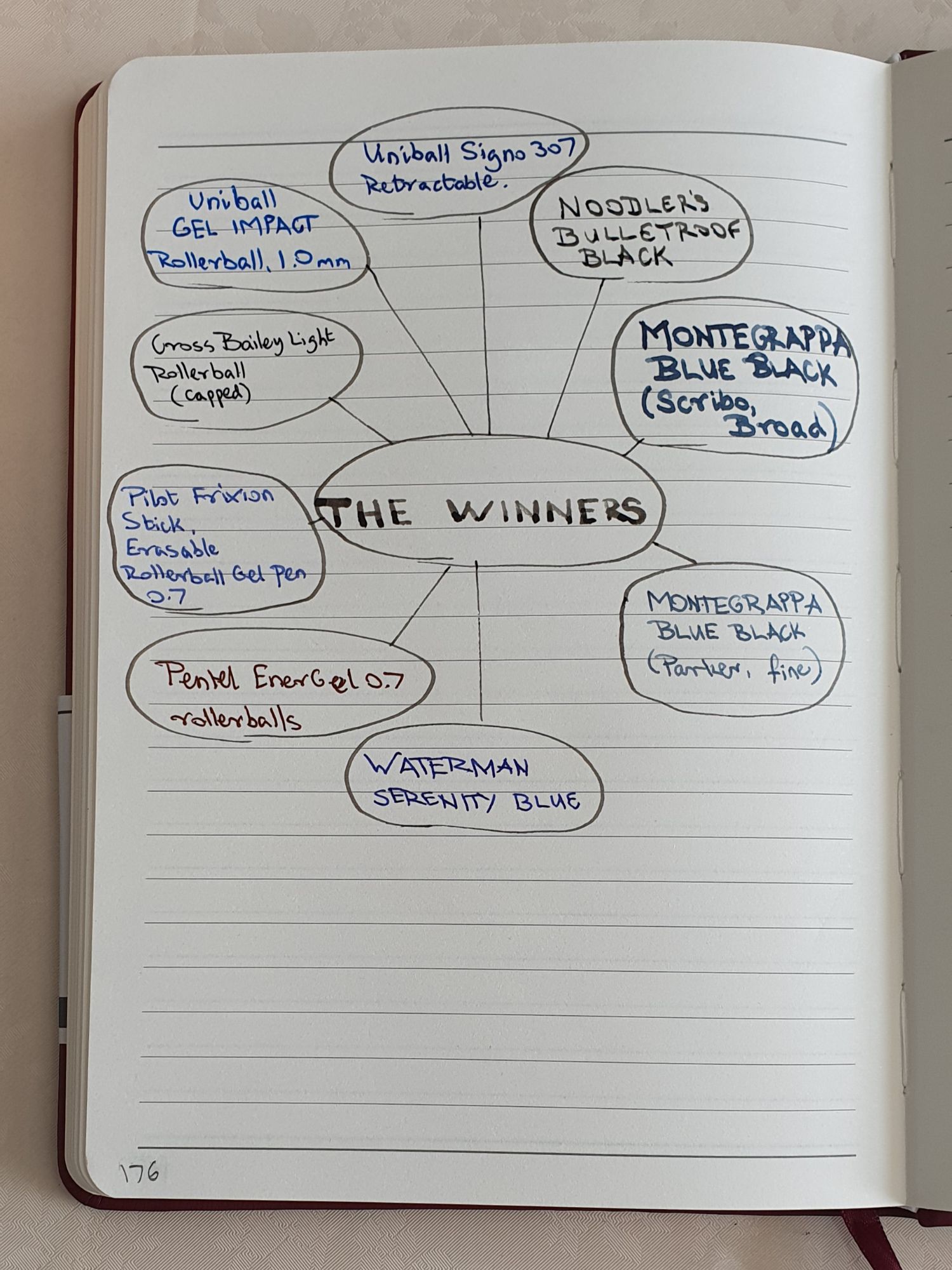
After flushing the pen, I filled it with Waterman Serenity Blue. It filled well. The writing experience from the 14k gold nib was a joy: silky smooth, broad, with an optimal flow and just a little bounce, that you might call semi-flex. This more than compensated for any shortness or skinniness of the pen. I cannot tell you whether the barrel and cap material is celluloid or plastic, or whether the feed is ebonite or plastic. I have avoided posting the cap and instead have grown accustomed to holding this little pen unposted.
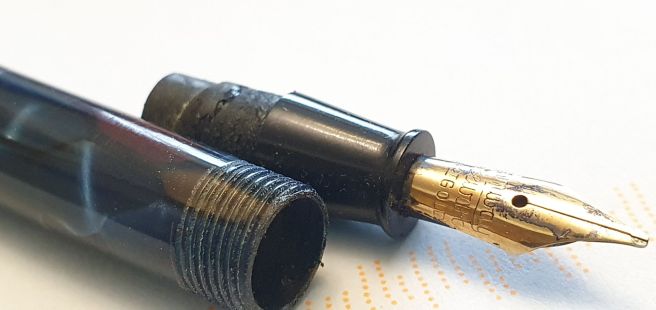
Very clean nib, marked “Burnham 14 ct Gold.”Smooth feed. Ebonite, I think.
The screw cap comes off in just over two full rotations. The cap threads are multi-start and I found that by inserting the pen (nib up) into the cap, pocket clip up, and turning the pen one click the wrong way before tightening, the lever almost aligns with the clip.
On a recent short break in the beautiful Shropshire countryside, I took the Burnham and used it every day for some holiday journaling in a Leuchtturm A5 notebook. The nicely-tuned vintage nib, with its heart-shaped breather hole, performed as well as any other nib I have ever experienced, at any price. One fill managed more than 12 pages, before it was time to enjoy the lever-filling experience again.
Size and weight:
Capped, the pen measures about 121mm and uncapped, only 109mm. The weight is about 11.5 grams capped, comprised as to 7 grams for the pen and 4.5 grams for the cap. These figures are pretty minimal and might sound off-putting but my experience has been that what the pen lacks in size and weight is more than made up for, by its cuteness and the sensation of writing with the smooth and bouncy nib.
Trying out my new old pen. Waterman Serenity Blue; Stalogy 018 Editor’s Series 365 days notebook.
The moral of this tale is that you might surprise yourself, using a pen that goes against your usual criteria. This is good news, unless like me, you are trying (weakly) to resist more pens incoming.
Edit: Here is a photo to show the comparative size of the Burnham 54, against a Parker 51 Demi, a Parker 51 standard and a Parker 45.
I think I may have mentioned that I am fond of vintage Parker pens. My admiration dates back to the late 1960’s when I collected Parker advertisements from newspapers and magazines. A Parker was also my first “grown-up” fountain pen when I went to my secondary school. It follows that this blog post might come across as slightly biased.
The Parker 45 model was part of the current range when I was at school. Buying a new one in town was a rare treat. I remember using them in lessons to write in exercise books. If you left one uncapped for too long the nib was likely to dry out, although this is true of most fountain pens.
A Parker 45 Arrow.
In those days, I would have used the cheaper, steel nib versions, mostly Medium. They were also available with gold nibs. I do not recall being aware that there was such a wide choice of gold nibs to choose from for the Parker 45. The nib grade is shown by a letter on the underside of the little black nib housing. I never ventured beyond M (medium) and F (Fine). Only recently, have I discovered the X (Extra Fine) and the R (Medium Oblique). For a list of the nib codes, see the following thread on Fountain Pen Network.
I still have a couple of my Parker 45’s from the seventies – one in grey and another in brushed stainless steel. As ever I recommend Tony Fischier’s site, Parkerpens.net for an authoritative and comprehensive history of the Parker 45 range. They were produced from 1960 until 2007 and heralded the beginning of the Parker Quink cartridge system. The all-plastic version was called the Parker 45 Arrow. The version with a metal cap was the Parker 45 Classic and the brushed stainless steel version (very desirable to my 11 year-old self) was the Parker 45 Flighter.
Fast-forwarding to the present, my fountain pen journey took me down the vintage Parker rabbit hole. Last year was my year of the Parker-buying. I swooped on the inexpensive but surprisingly good Parker 17 models at pen shows and on eBay, before moving on to the Parker 61 and 51.
In the midst of this run, I happened to spot a Parker 45 Classic with a somewhat rare Medium Oblique (code “R”) nib, which proved to be delightful. Oblique nibs seem to be the most flattering for my handwriting when using a lefty-overwriter style, whereas non-oblique nibs work better for me in an underwriter style.
My last Parker pen purchase of 2023 was bought on eBay and intended as a Christmas present for someone else. It was a black model with a 14k gold Medium nib. But here’s the strange thing: after testing it the writing experience was so utterly delicious, exquisite and wonderful, that I honestly could not bring myself to part with it and had to keep this one for myself. Selfish, shameful and shocking I know, but true.
Easy to disassemble. No heat gun or shellac required.
But then, like a drug (I imagine), or at least chocolate, I craved another one. Happily at the London Spring Pen Show in March, I spotted and pounced on a lovely midnight blue model with a Fine nib. And then finally, back more recently on eBay I bought a burgundy red model with the less-common Extra Fine nib.
You can just make out the “X” for Extra Fine on the nib housing.
And so in the last seven months, my little Parker 45 family grew from two to six pens. My four recent buys all having 14 gold nibs, have all been superb and yet each cost between around £20 to £25 only.
The four on the right have 14k gold nibs in Oblique medium, Medium, Fine and Extra fine, respectively.
“What is so good about them?” you might ask. Here are a few answers:
Comfortable to hold (not too short, long, heavy or light; not having any step or cap threads);
Well balanced whether used unposted or posted. The lightweight cap posts very deeply and does not throw the balance off;
Convenience of accepting cartridges or a converter;
Great-looking pen (subjective and in the eye of the beholder, I know);
Best of all, having a screw-in nib housing. The nib, feed and housing can be removed easily for cleaning or nib adjustment; this is where the 45 scores over the 17, 51 or 61.
Can be found at pen shows or on eBay for a very modest outlay – similar to the cost of a Lamy Safari or Cross Bailey Light, both of which would have steel nibs.
The rather rare “X” (Extra Fine”) nib in 14k gold.
In summary, it comes down to good design. I read on Tony Fischier’s site (linked earlier) that the Parker 45 was designed by Don Doman who also designed the Parker 61 and Parker 75 amongst others.
17 grams and 145mm with cap posted.
Are there are any negatives? Yes, the type of plastic material used for the Parker 45 is softer and inferior to the material of the Parker 51. It would show bite-marks, rather like a chewed cap of a Bic Crystal biro.
Size and Weight: The length capped is around 136mm or uncapped, 127mm. The length posted is 145mm. The all-plastic version weighs around 17 grams, or 12 grams uncapped, whilst the Flighter is only slightly heavier at around 20 grams.
For anyone who has any liking for fountain pens, let alone an obsession, vintage Parkers can save you money, so long as you do not buy too many of them. Which is why (as politicians annoyingly say), I have garnered a reputation in my pen club as the vintage Parker influencer.
Parker 45 with the Filofax A5 Lockwood zip in Garnet.
On 9 January 2024, I wrote about my brief ownership of a Lorus automatic watch. The episode concluded with me taking it back to the shop, which was rather a down-beat ending.
But in case I misled anyone into thinking that I was left sad and watch-less, here is What Happened Next.
So this happened.
I do not buy a new automatic watch very often: aside from the Lorus, I had not done so since 1999. After the Lorus episode, I next took a renewed interest in the Seiko ranges of automatics, the “5” series and the Prospex. To do so is to dive down another enjoyable rabbit hole. For instance, I read that Queen’s Brian May had bought a Seiko 5 diving watch in Tokyo which he had worn since the 1970’s and that Seiko made a special Brian May limited edition in his honour.
It was informative to browse the line-up of Seiko watches in my usual haunts. But it was while looking casually around H Samuel’s Oxford Street branch in mid-January (intending to look at their Seikos) that a Bulova caught my eye. I was attracted by the uncluttered dial, the absence of numerals and the absence of any day and date complication. The face has a round hole at the 7 o’clock position to show the balance wheel in action. The watch was not actually running at that stage and my initial reaction was that I would have preferred it without this porthole, which I later learned was called the “open heart” feature, (as opposed to a skeleton dial which shows the whole movement at the expense of making it difficult to see the hands and read the time).
I liked everything else about the watch including its dark blue dial, silver-tone indices and supple steel bracelet. Unlike the Lorus, this movement allows manual as well as automatic winding and also allows hacking: the pausing of the second hand by pulling out the crown, in order to set it precisely.
As well as it being the most appealing in the display, it was also 50% off the list price. I asked to have a look at it. The helpful assistant commented that the colour suited me, although I was wearing a navy blue shirt, jacket and carrying a navy blue shoulder bag! I certainly did like the colour of the dial and had never had a watch with a dial other than white or black. She adjusted the bracelet, removing two links from each side, which still left it comfortably loose but secure. I was a happy and lucky man.
At the front and in a half price sale!
It also has an exhibition back and this, together with the open heart dial (a term I do not like very much) means that you can actually hold the watch and see through it. The movement includes a rotor which, I was surprised to see, is a D outline but open in the middle. Is this to save weight? If so this seems to rather defeat the object. Perhaps it is to allow a better view of the inner workings. In any event, the rotor is very sensitive and works perfectly. The watch also has some modest water-resistance although not a screw-down crown and so I would not wear it in the water.
Exhibition back and Miyota 21 Jewel movement.
Swiss chronometer accuracy is no longer of such importance to me as when I was twenty, or even forty and buying a Rolex. Nevertheless I was curious to check the Bulova’s time-keeping. Over the first seven days it gained about 12 seconds a day. I then tested it over the next seven days too and got the same result. However, trying this again more recently, the deviation had lessened and it was gaining just 7 seconds a day. I hope that it remains there and does not continue to slow much further, but will check it now and again.
Waiting for the pips on Radio 2.
I also tested the power reserve – the amount of time for which the watch keeps running when not worn. I ensured that it was fully wound and then set it down. It managed a very respectable 44 hours.
Comfortable steel bracelet and clasp
I have had this watch for over two months now. I still get a little thrill every time I see it on my wrist. As well as enjoying the sight of the second hand scurrying around the dial, I soon came to enjoy seeing the intricate movement through the porthole, which is much better when the watch is running.
The Bulova tuning fork logo.
I had thought that I might rotate the Bulova with the other watches in my modest collection. In practice though, I have worn it every day since I bought it except for the weekend when I checked the power reserve. And this is perhaps the best testament of my high opinion.
Well, what a great day that was! I felt like there was nowhere I would rather be, and nothing that I would rather spend my money on: the London Spring Pen Show at Novotel, Hammersmith, on Sunday 3rd March 2024.
This time, my wife Ling accompanied me. She enjoyed meeting all my pen club friends and a big group of us had arranged to meet for a lunch break at nearby Latymers. Almost everyone to whom I introduced her, joked that I was a bad influence in my penabling, particularly with regard to vintage Parkers! I do tend to gush about Parkers but I make the case that buying these actually savesyou money, compared to the cost of a modern equivalent gold nibbed fountain pen. Oh well, more for me then.
Ling came to support me and meet my friends.
This post will list my purchases at the show, rather than naming all the wonderful stall-holders and fellow enthusiasts in the pen community who were there in force. It was good to see so many familiar faces and I am grateful to all the organisers and dealers for making the day so successful and enjoyable. We tend to forget all the work that goes on behind the scenes before and after the show: the preparation, the travelling, the setting up, and then the packing up and more travelling. Several folks such as Sarj Minhas had literally only just returned from the California pen show the night before
So, what did I buy this time? Despite not hunting for anything in particular and trying feebly to stop accumulating, I did not expect to go home empty handed. Here I will try to justify, to myself at least, some of my purchases.
Parker 45, blue with chrome trim, 14k gold nib, Fine.
Parker 45, still looking new.
First up was this Parker, which I spotted on the table of Janse van vuuren (Justin). It was in its original box with filling instructions and guarantee dated 21 April 1976, original press-bar converter, and two blue cartridges still taped under the pen tray with some very yellowed Sellotape. I used these pens throughout my secondary school years although mostly they were the steel nib versions. Last winter I bought a very similar one to this, but in black with chrome trim and with a Medium gold nib which is an absolute joy to use and cost only £20.00. Coincidentally, this gorgeous dark blue one was also just £20.00 and being in such good condition and with a Fine nib, was an easy decision for me.
Aside from the style and comfort of these pens, one of their best features is the ease of cleaning and maintenance. For those not familiar, you unscrew the little nib-housing to remove it from the section. Then, being very careful not to bend or break the long feed or lose the nib, you slide the housing backwards off the feed. The nib can then be lifted off the feed, and cleaned or adjusted. When putting it back, it slots into place over the feed and does not move, so you know you have the correct position. That evening, I took the nib apart and gave everything a very satisfying wash, before filling with Waterman Serenity Blue. It writes like a dream.
Nib unit disassembled. Note the “F” for Fine on the housing.
Parker 51 vacumatic.
I am happier when I can see the price of a pen, without having to ask. Some dealers have pen trays grouped by price, “everything £40.00” which is where I found my next purchase in a tray of Parker 51s. All but this navy blue and gold-capped one were aerometrics. I spotted the tell-tale blind cap of the vacumatic and had a closer look. On removing the cap, I found the section covered in wet ink. This did not put me off but just added to the attraction and my desire to take the pen home and clean it. The pens in this tray were all tested and so I did not worry that it might leak. The condition of the nib and the barrel all looked very good and the plunger button responded nicely. The rolled-gold and striped cap had brassing at the rim, which I did not mind. I am not sure whether the cap is the original one for this pen.
A gorgeous dark navy blue Parker 51 Vacumatic.
At home I took great pleasure in flushing the pen and cleaning out the inside of the cap. I considered leaving the pen to stand in some water overnight but was too impatient to ink it and so decided that I would only soak it if it needed.
Again, the pen filled and worked well. This one writes a little dry but I did not want to rush into any adjustments, given that the pen dates from the 1940’s and is around 80 years’ old. I used it for a few days, as it was. This weekend I have flushed it again and let it stand in water for 24 hours. I am hopeful that this might improve the ink flow but if not, I can ease the tines apart just a fraction. I am thrilled to have my first Parker vac, and at just £40.00.
As I write this, the Vac is having a long soak.
Parker 51 Aerometric, forest green.
Readers may remember that I passed up a beautiful, mint condition Parker 51 in forest green, at the pen show last year. This time I spotted another one, again in great condition but at a much more affordable price at the tables of Jeremy Collingridge (from whom I bought a lovely Parker 61 Heirloom last time). I was invited to try the Parker 51 but despite several dips, it refused to write. With permission, I even tried filling the pen but still it would not write. Nevertheless, I was not put off but was only drawn to the pen all the more. I suspected that there was nothing wrong but that it just needed a thorough clean. This proved to be correct. It is a stunner and I love the green!
Poor lighting, but a forest green 51.
Sailor Profit fude nib pen.
This was an impulse buy from Pure Pens’ table. Having enjoyed the Duke 551 Confucius fude nib pen bought earlier this year I was interested to try this much smaller and lighter pen. It came boxed with two Sailor cartridges, at £22.00. The fude nib is marked only with the anchor logo and the initials MF.
Sailor Profit fude nib.
The pen actually performs extremely well and as I hoped, can write with a variety of line widths, depending upon how you hold it.
Fun with the Fude.
Aside from these four pens, my other purchases were:
Two packs of Aurora cartridges, from Kirit Dal and daughter; (as anyone who has tried will know, these cartridges are very difficult to find in the UK);
A 12-pack box of Pilot Namiki blue black cartridges, from Amaya Cerdeirina of Penfriend. These are for my Pilot Custom Heritage 912;
Another bottle of Diamine’s Conway Stewart Tavy, blue black ink. I buy one almost every year;
A handy little x5 loupe;
A Jowo fit nib, feed and housing with rose gold coloured coating, from John Twiss.
Kirit Dal and his daughter.
Sometimes, after buying several pens in a day, I ration myself to trying one new pen per day. But not this time. Within a few hours, all four new arrivals were cleaned and inked and being introduced to my Stalogy notebook. All in all, it was a very successful day. My total spend at the show was just over £200.00 and for that, I have lots of lovely new toys to play with and no buyer’s remorse whatsoever.
My day’s shopping plus some gifted ink samples.The new nib unit in my Wancher Crystal fountain pen.
I have had this pen since 27 December 1986, bought at WHSmiths, Uxbridge. I know this because I still have the box with the Access card sales voucher, with the guarantee and care guide, folded up beneath the pen tray. So, that’s 37 years.
Parker 75 Laque fountain pen.
I wish I could say that during that time, the pen has been a constant companion, always to hand, faithful and dependable, travelling with me everywhere. But that would not be true. Certainly, that was the aim, but for some reason things did not work out and I never gelled with the pen.
A New Pen Day for me on 27/12/86.
As I still have my old diaries, I dug out my old 1986 volume to see whether I had written anything about the purchase. Sure enough, there was a line near the top of the page (after a reminder to watch the movie “Splash” at 8.30pm), which reads “See about Parker 75 Lacque (sic) £60!?” So, I was aware of the pen and its price and planned to give it another look. Perhaps I had seen it, possibly marked down in the post-Christmas sales.
My diary entry went on to say “I went to Uxbridge with Hilly (my sister) & bought the Parker 75 Laque fountain pen. Also got us an A4 size diary each and went in M&S & got some pre-faded jeans for £14.99! Pyjamas in Burtons where they were playing “If she knows what she wants” (Bangles).* My pen was an example of reality not matching up to the dream…grips in the wrong place & writes a little dry. Watched Splash with mum & felt a bit sad.”
Not much of a honeymoon period for the Parker then. I was already disappointed with it, the day I bought it. This sounds to me like an early case of buyer’s remorse.
A diary entry from 1986.
The pen cost me £60.00. This was quite a lot of money for me at the time, when I might have been accustomed to buying steel-nibbed Sheaffer No Nonsense pens for about one tenth of that amount. Indeed, a quick calculation in my diary recorded the meagre total of my savings at that time. Expectations for the pen costing 2.3% of my net worth, would have been high.
I see that I took an almost immediate dislike to the facets on the grip section (but not quite quick enough to stop me buying it). The pen was also quite small and slender, compared to what I had been used to.
It’s worth reminding ourselves that this was before the age of the internet, websites, YouTube reviews, nib-meisters and the interconnected global fountain pen community. This was 10 years before I possessed a PC. I was on my own, unless I wrote a letter to Parker (which I did once, to ask about an image used in one of their advertisements).
As I did not enjoy using the pen very much, it stayed in its box, largely untouched for the next 37 years.
Thinking back, I do not remember even being aware of the pen’s special and possibly unique feature for that time, namely that the nib and feed could be turned a few degrees to the left or to the right in the section, to alter the alignment of the facets in relation to the nib. Supposedly this was to help people, such as myself, who liked to rotate their pen (in my case, to the right) but then found that the symmetrical facets were no longer equidistant from the centre of the nib: you were left with thumb and finger resting on an uncomfortable sharp ridge.
Perhaps this innovation would have helped me. I simply cannot recall now whether I had tried experimenting with this facility and still not liked the pen, or whether I was completely unaware of the feature. I need to look back for any more references in my diaries.
On the rare occasions when I did get the pen out again, I noticed a little corrosion on the gold plated ring at the end of the section (called a “rust ring”). This did not help endear the pen to me.
It was only last year, when a friend wrote to me and mentioned the Parker 75 and its adjustable nib feature, that I remembered that I had one and got it out to try turning the nib. It is very easy. No tools are required. You just grip the nib and feed and twist them left or right, as desired.
Actually this is rather good.
The only other pen I know of now that had this feature, is a child’s beginner pen, the Stabilo EASYbirdy (not to be confused with the EASYbuddy which does not have this ability).
Last year was a year in which my enthusiasm for vintage Parker fountain pens flourished, helped by eBay and pen shows. I collected a number of Parker 17, 45 and 61 models as well as a Parker 51, all of which I enjoyed very much. I am glad to have a Parker 75 in this line-up.
One thing I have learned in recent years, is how to make some basic adjustments to a fountain pen nib, to make it write wetter or smoother, using a loupe, some brass shims, some micromesh pads and a bit of courage and/or recklessness. A few weeks ago, I got out my Parker 75 again. I spent a few minutes examining the nib and then eased the tines apart just a little, until a gap could be seen all the way to the tip. Then, checking that the tines were still aligned I tried writing with the pen once again. A few minutes’ effort had made a huge improvement. I found a suitable converter, filled the pen with Waterman Serenity Blue and have been enjoying it ever since. The medium nib now writes with a smooth, easy flow and has just a little softness too.
The tine gap after adjustment.
Better late than never. I no longer regret buying the pen, but only that I did not have the knowledge to tinker with the nib all those years ago. The main thing is that we are getting along again now. Feel free to reflect upon the lessons of this post, when you next hear Billy Joel singing “Turn the Lights Back On.”
*”If She Knew What She Wants” song, by The Bangles.