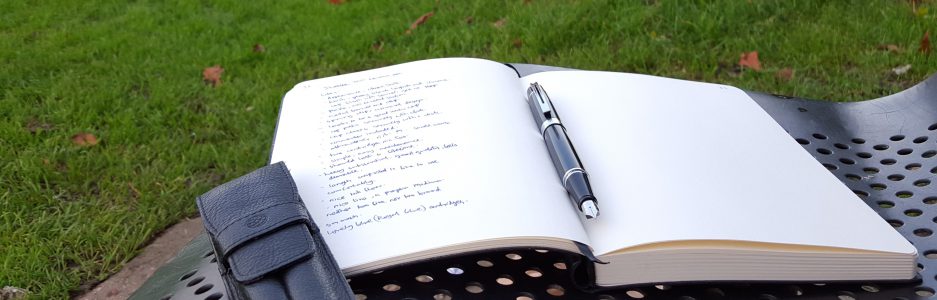
Long term thoughts on the Visconti Rembrandt fountain pen.

It has been four years since I wrote a post The Visconti Rembrandt v The Pineider Avatar fountain pen (8 September 2018). At the time, I had owned the Rembrandt for less than a week. I think my comments then were fair and still hold good. As to which one of those two pens you prefer, that is subjective and each has its merits.

It has been my habit for decades, to write a daily entry in my diary. Currently I use an A5 page-a-day diary from Rymans. This year, it was my intention to use a different pen and ink combination each month. I started out with a Cleo Skribent Classic Gold in January but was enjoying it so much that I continued with it for February too. Then, forcing myself to have a change, I started March with the Visconti Rembrandt. I am still using it now. By the end of August, I had been using the Rembrandt almost every day for six months, barring a few days when I went away and took other pens for holiday journaling.

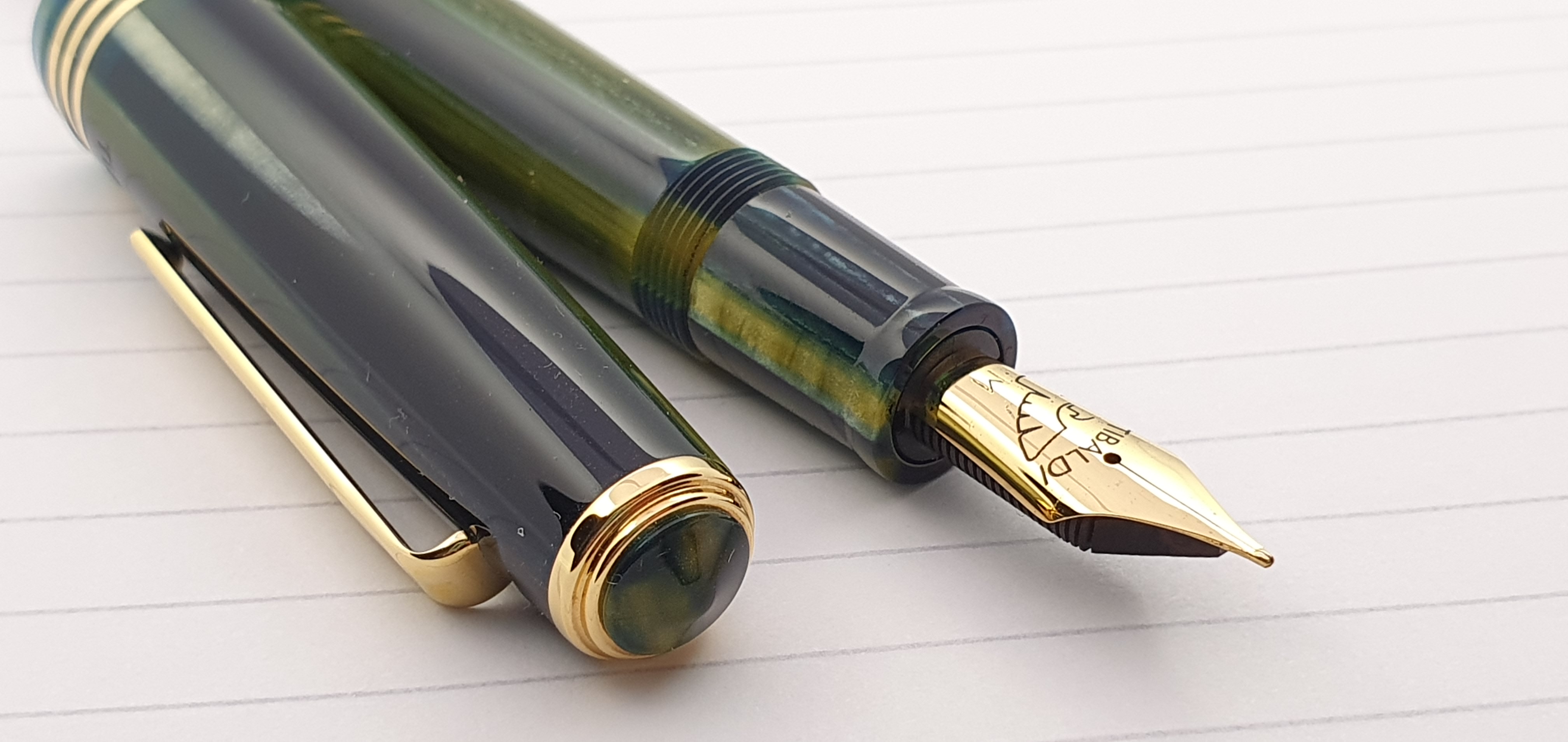
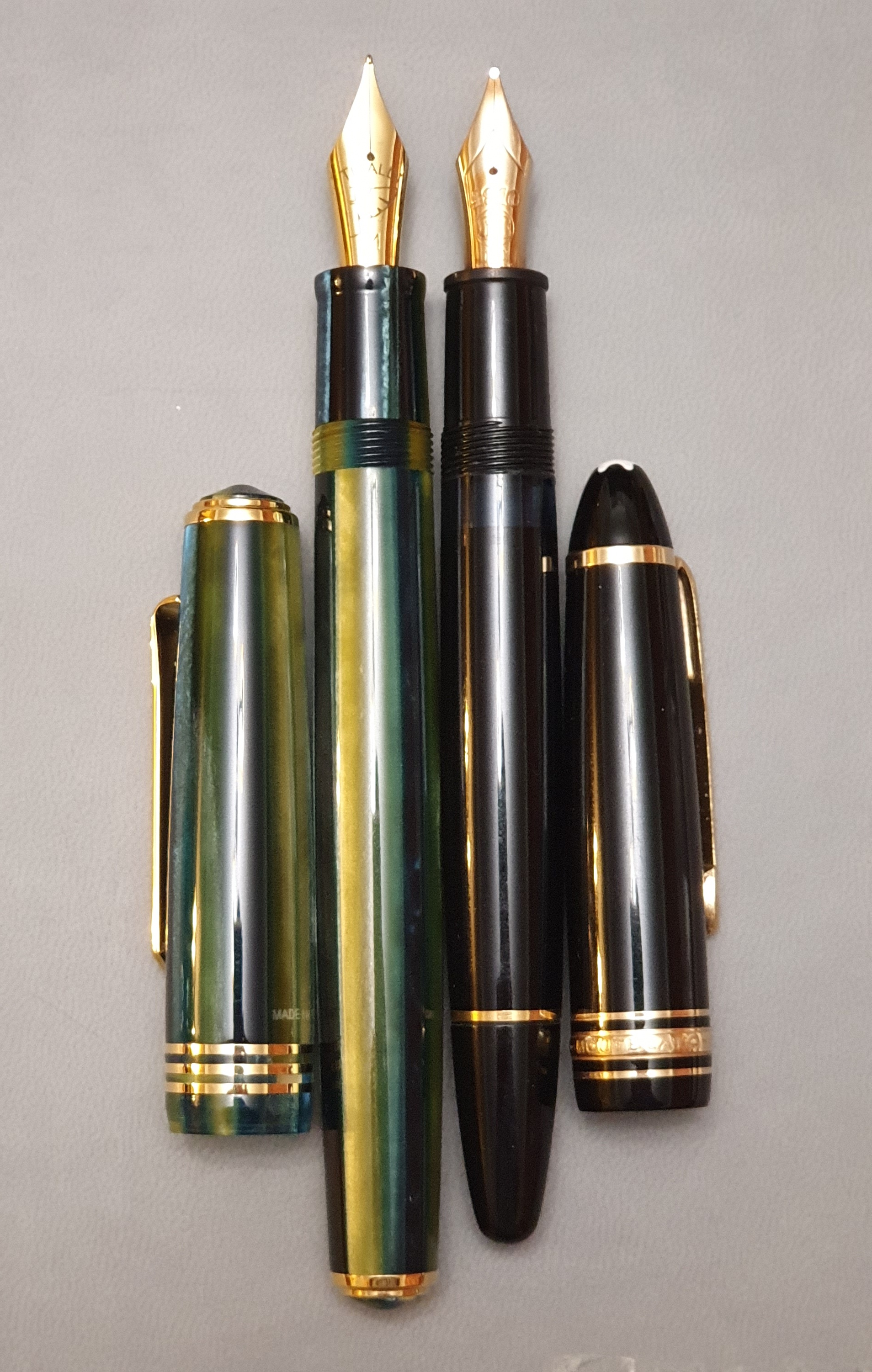
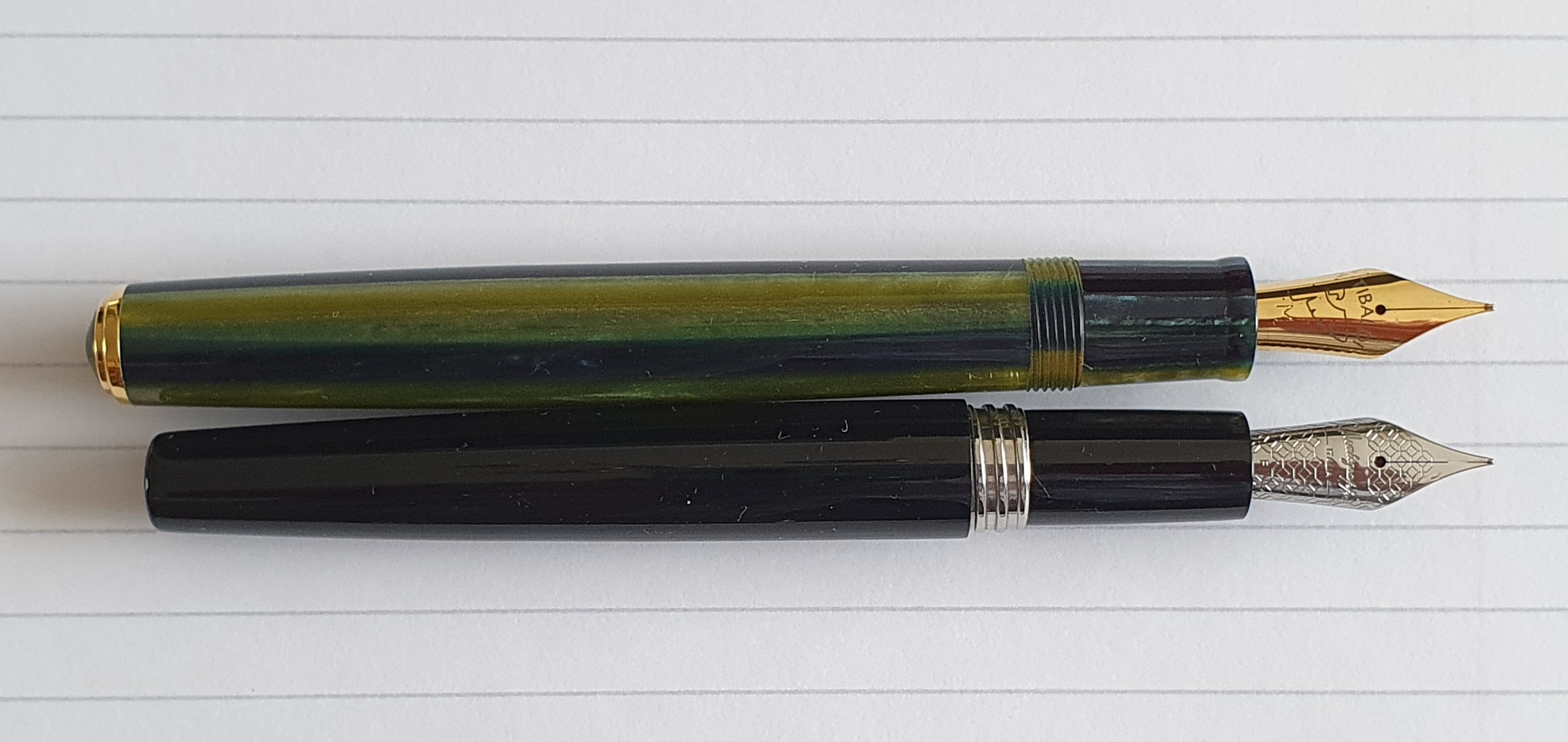
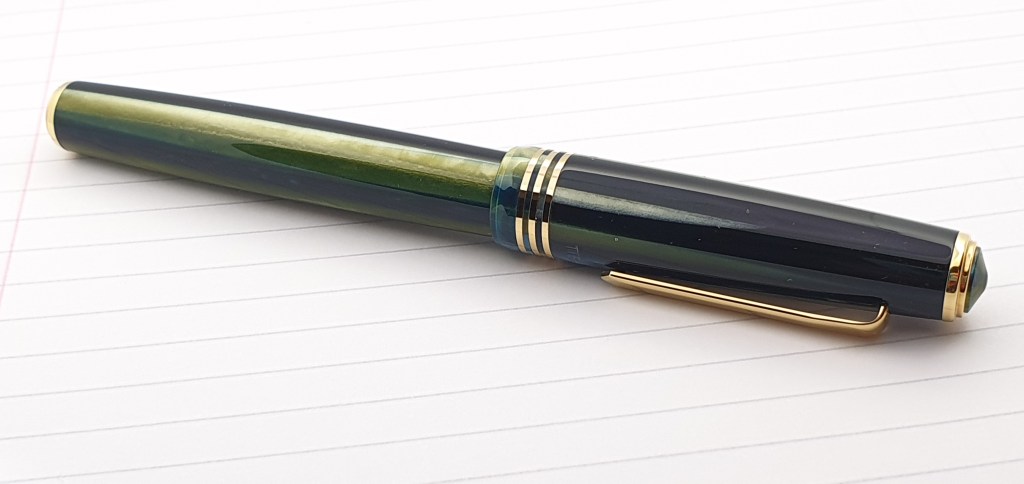
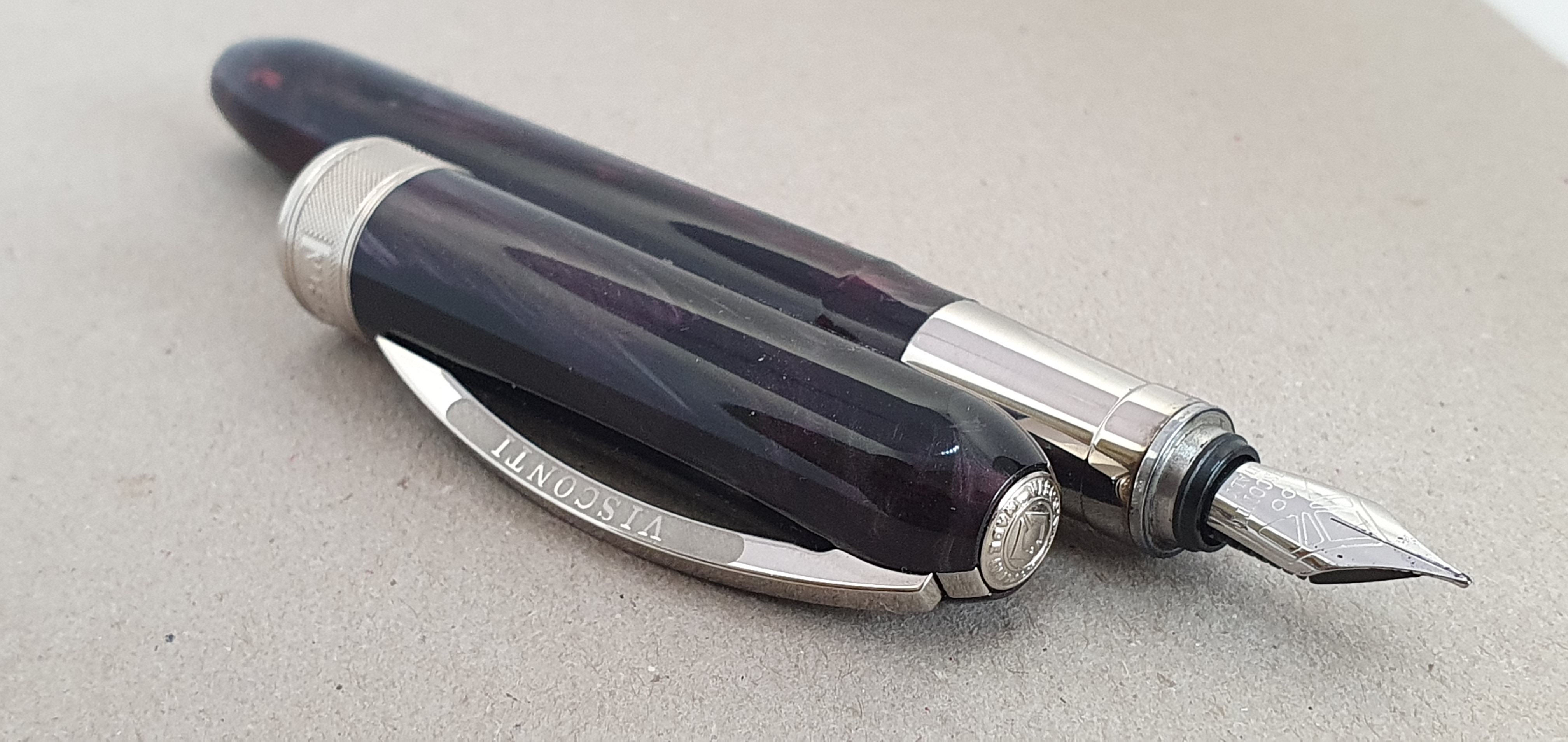
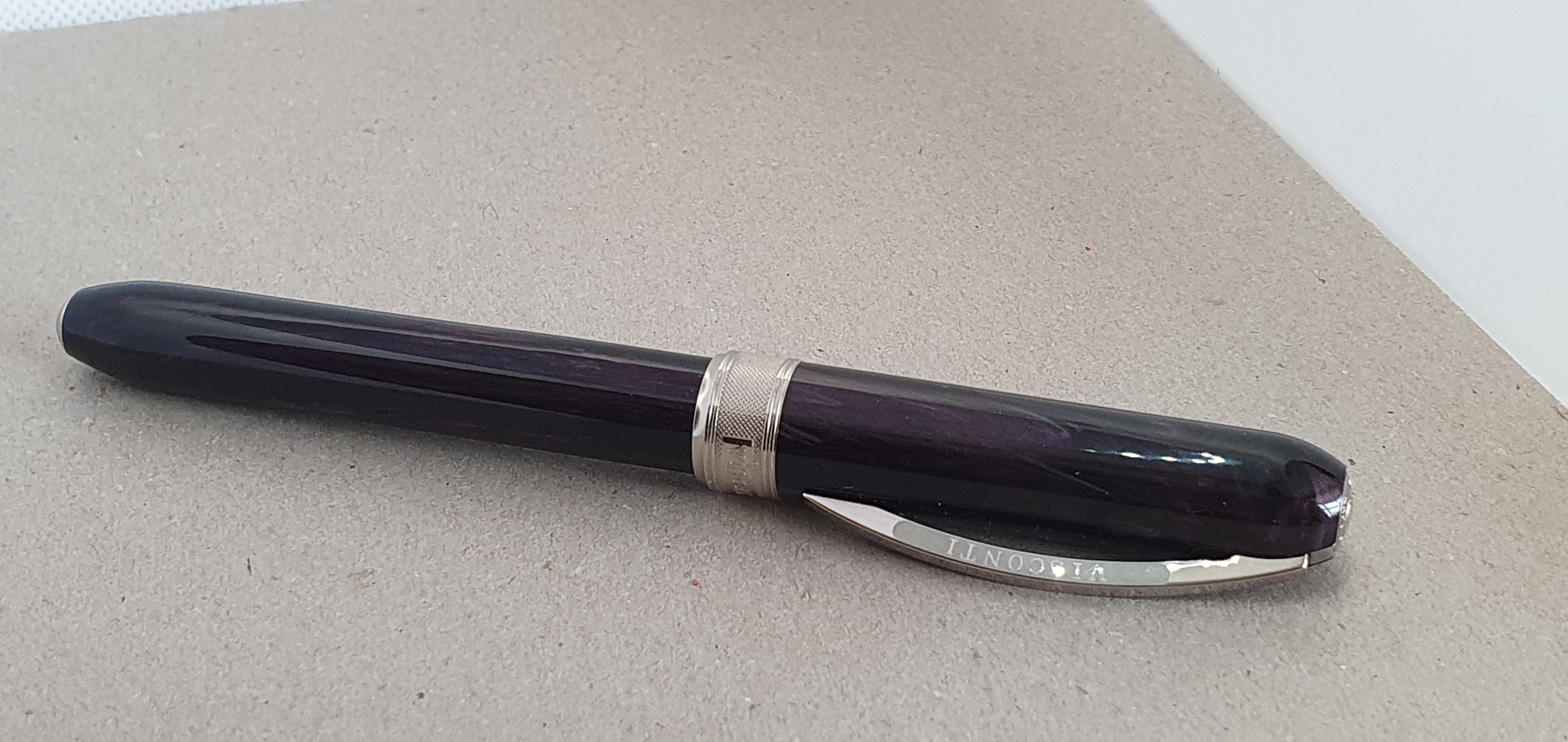
My Visconti Rembrandt Twilight, at four years old.

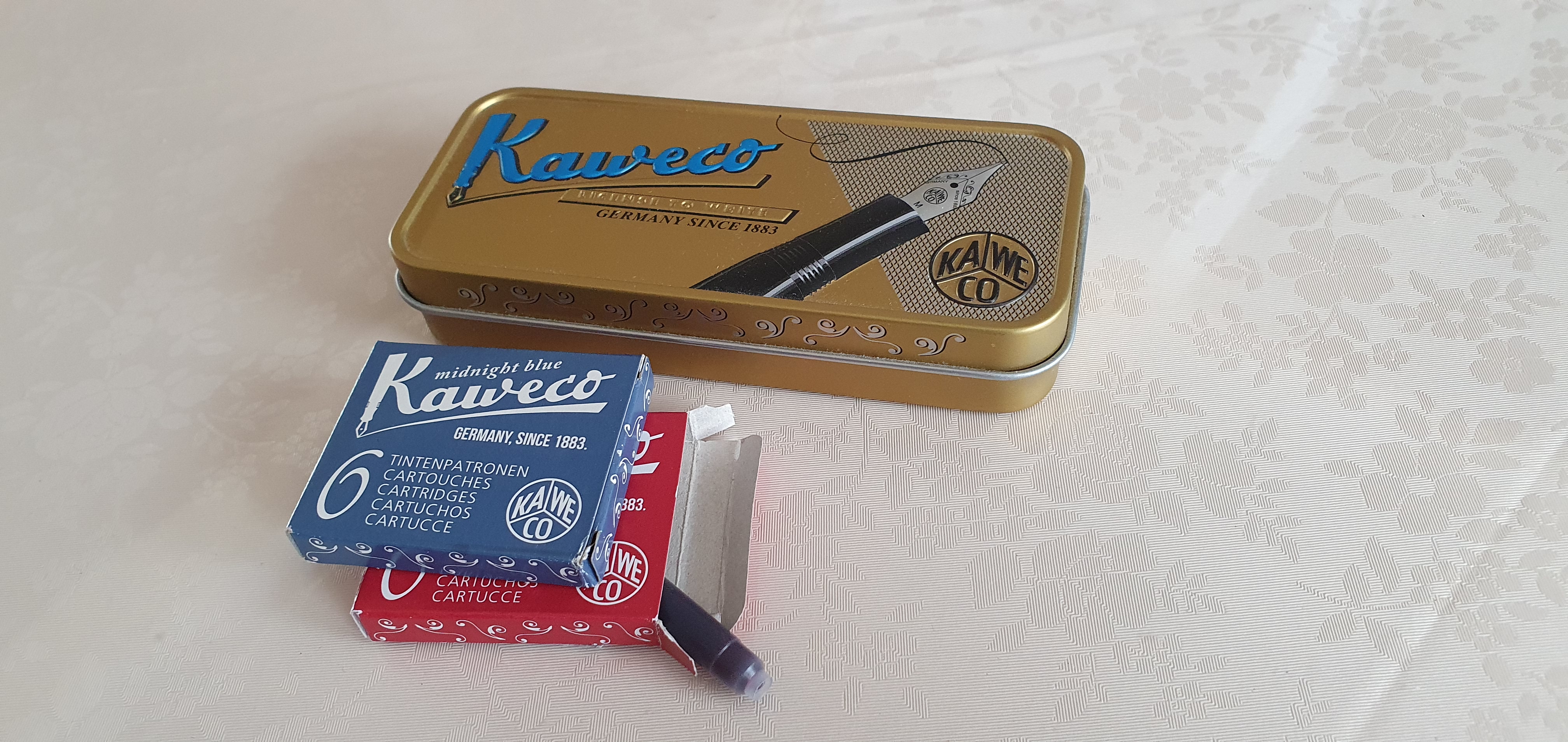
As for ink, I have been using it with Kaweco blue cartridges. I had a stash of these, acquired on buying Kaweco pens, particularly the Perkeo of which I have several. With each purchase, there would be four new Kaweco blue cartridges, with the Kaweco name along the side. I particularly liked this ink and kept these cartridges in a Kaweco tin, separate from my hoard of generic blue standard international cartridges.

This adorable Kaweco tin lives on my desk and held my stash of Kaweco blue cartridges.

Since 9 February 2022, I have filled the Rembrandt eight times with these cartridges and am down to my last one. I plan to switch to Kaweco midnight blue next, as I have a box waiting. I will never get through all my ink, but it feels satisfying to have used up these Kaweco blues, at least.

Whilst using a standard international cartridge, the Rembrandt has space to carry a spare. The spare cartridge does rattle around though, and to stop this I cut a small cube of rubber from an eraser and dropped it into the back of the barrel. Be careful with this however: too large a piece and it will jam inside and you will not be able to get it out again unless you break it up with a cocktail stick.

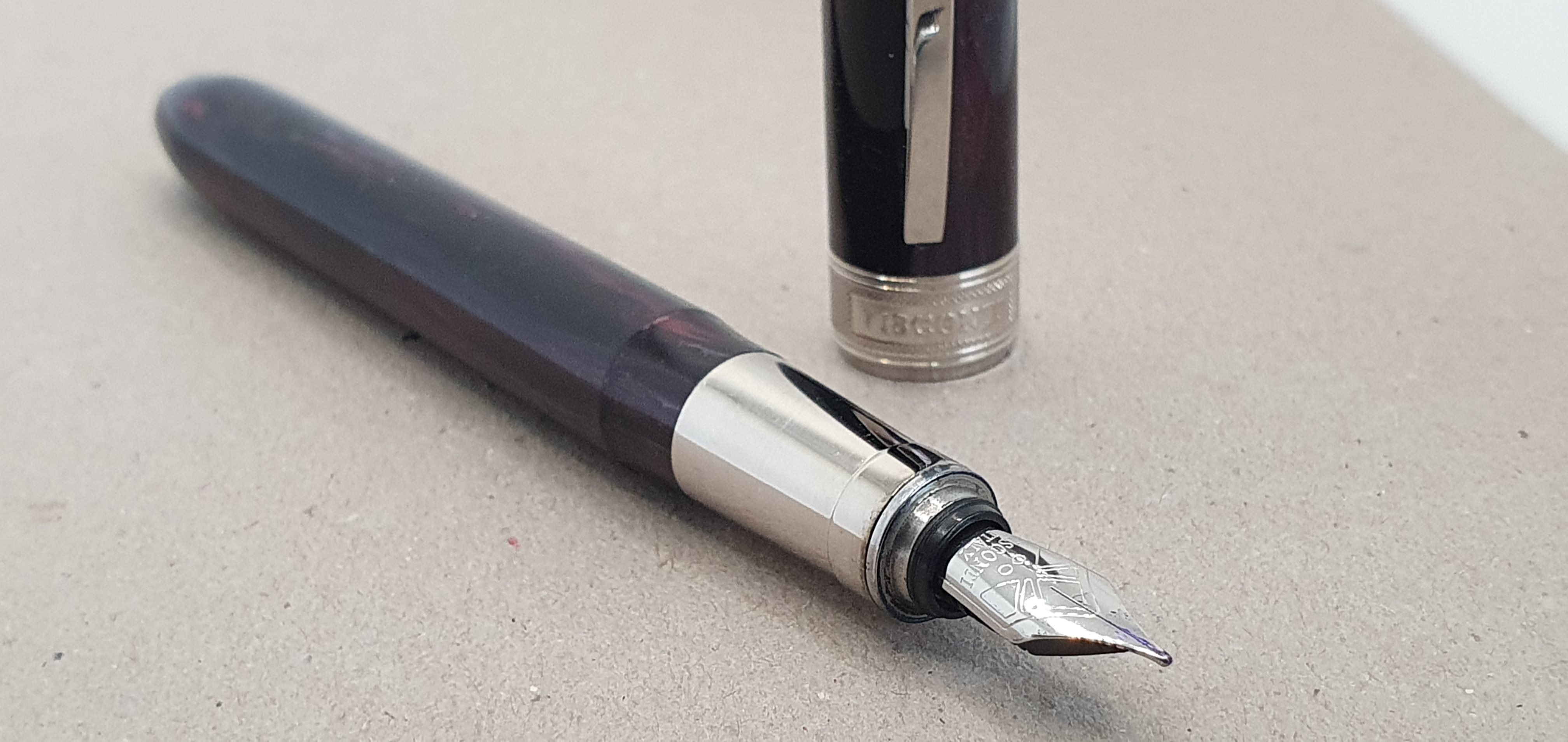
I should mention the chrome section of the Rembrandt. Generally, I am not a fan of slippery metal sections. For this reason I have avoided the Lamy Studio (apart from the brushed steel version with the black rubberised grip section). But in all fairness, the Rembrandt’s shiny plated metal section has not been a problem for me at all. My grip on the pen does not slip. I do not have trouble controlling the nib or stopping it from rotating left or right. I think that this may be partly because the section and the nib are both relatively short and when I hold the pen, my thumb still rests on the purple barrel, serving to anchor the pen and stop it from rotating in my hands.

The shiny plated business-end of the Rembrandt.

When I first got the pen, I preferred using it with the cap posted, but my habit has changed and I now use it unposted. If I had been put off buying the Rembrandt because of its metal section, then I would have missed out. The magnetic cap fastening still works well and is quick and convenient. It makes for a grip area free of any sharp step or screw threads.

Above, all, the pen writes really well. I get no hard starts. I did adjust the nib slightly when it first arrived, to ease open the gap between the tines to improve flow to my taste, but having done this in the first few days, the pen has written smoothly and effortlessly ever since and works well with the Kaweco blue cartridges.

As for the Pineider Avatar in its vibrant Lipstick Red, I still have it and it is a beauty. It has the “Wow factor” which the Rembrandt lacks and got the best admiring looks at our London pen club. Yet the Rembrandt has proved itself a solid performer over time and deserves credit for that.

It is hard to show that it is actually purple, with subtle “brush strokes” of lighter colours in the material.

Early thoughts on the Flying Tiger traveller notebook.

On a recent visit to London’s Canary Wharf, I found a branch of Flying Tiger Copenhagen, and popped in for a browse.

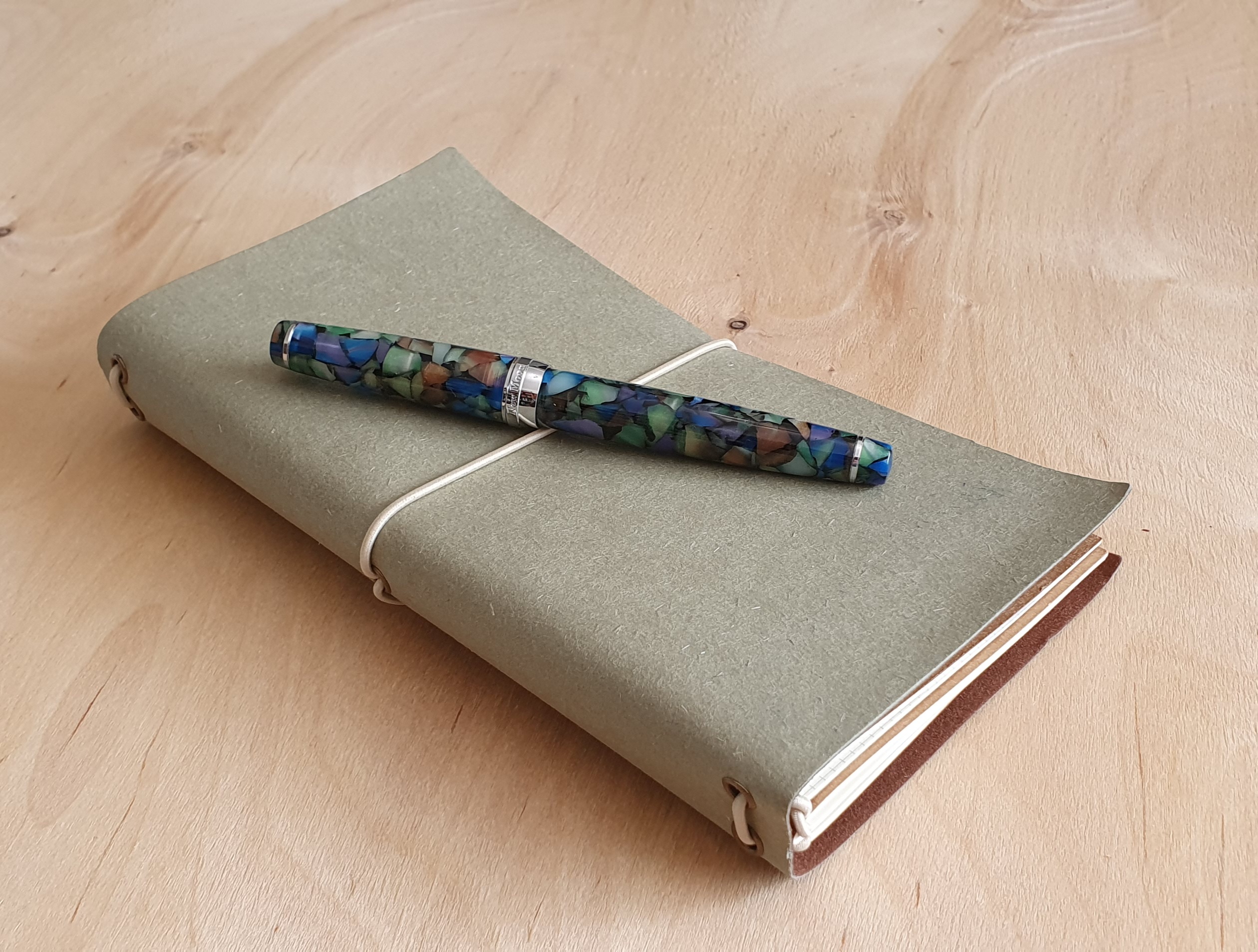
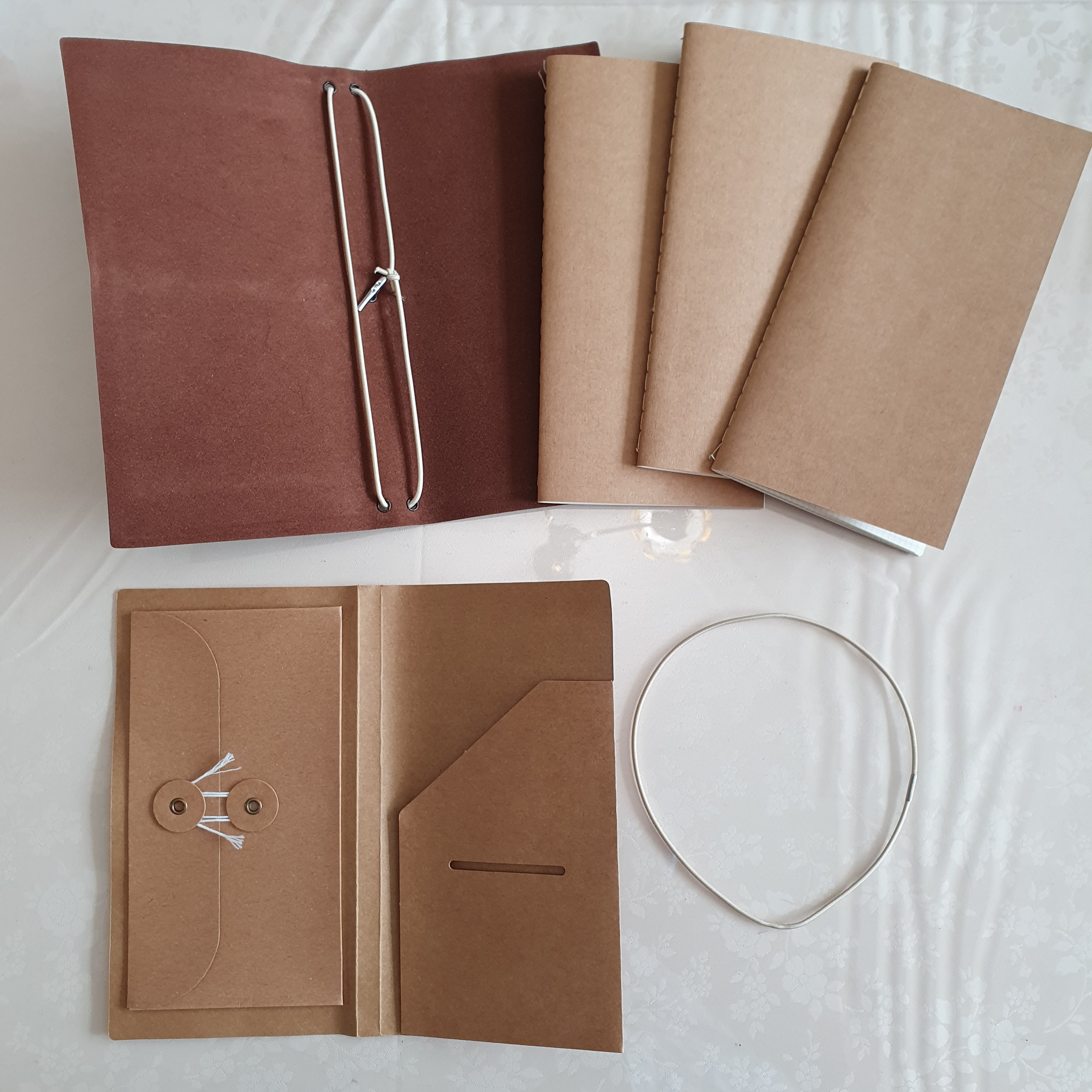
Right near the entrance, I spotted an olive colour, traveller-style notebook cover with elasticated loop, containing three notebooks, each with different paper. It was simply labelled Notebook, or Notesbog in Danish. The cover was not leather, but felt like a soft, fibrous cardstock with a brown faux-suede backing. Inside this, a removable brown card (which slips in behind the notebooks, between the books and the outer cover) provides an expandable wallet with cotton fastening on one side and another little pouch, to keep tickets or receipts or such like on the other side. As the ticket pouch needs to be the right way up, this has to be at the back, whilst the expandable wallet will be at the front of your notebooks. However if you do not need these, or prefer not to feel the uneven lumps and bumps below the paper when writing, you can slide it out.

Traveller-style notebook from Flying Tiger. Delike New Moon fountain pen for scale.

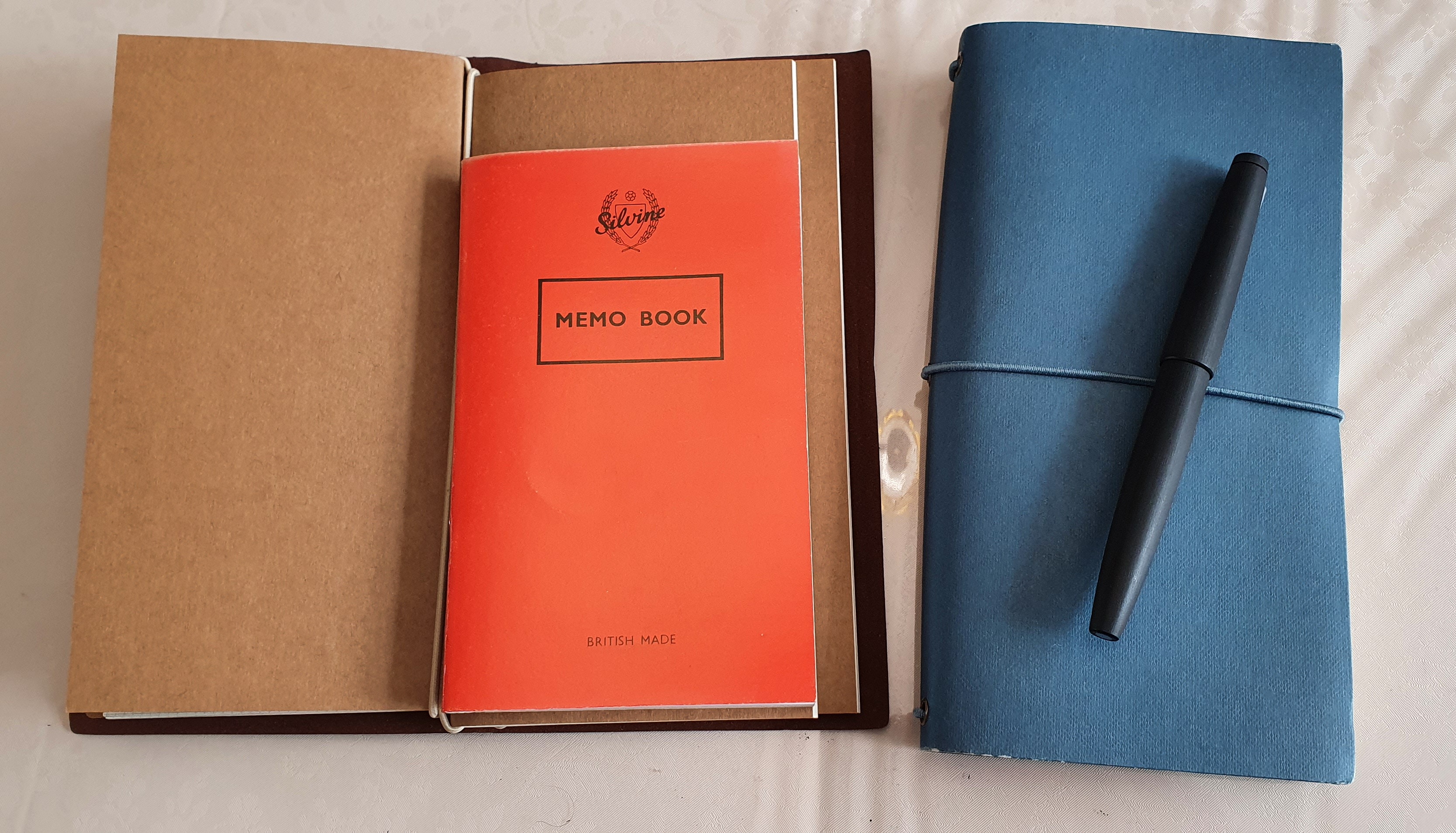
I was very taken with this, especially the olive colour. The notebooks looked tall and slim, rather taller than the red Silvine memo book that I usually carry when out and about, but the same page width. The paper in the first notebook was squared, the second book had lined pages and the third had dot grid. The paper felt reasonably thick and good quality. The notebooks were each stitched, rather than stapled and with plain brown card covers. Each book was held in place with an elasticated loop.

Size comparison with my usual carry, a Silvine pocket notebook.

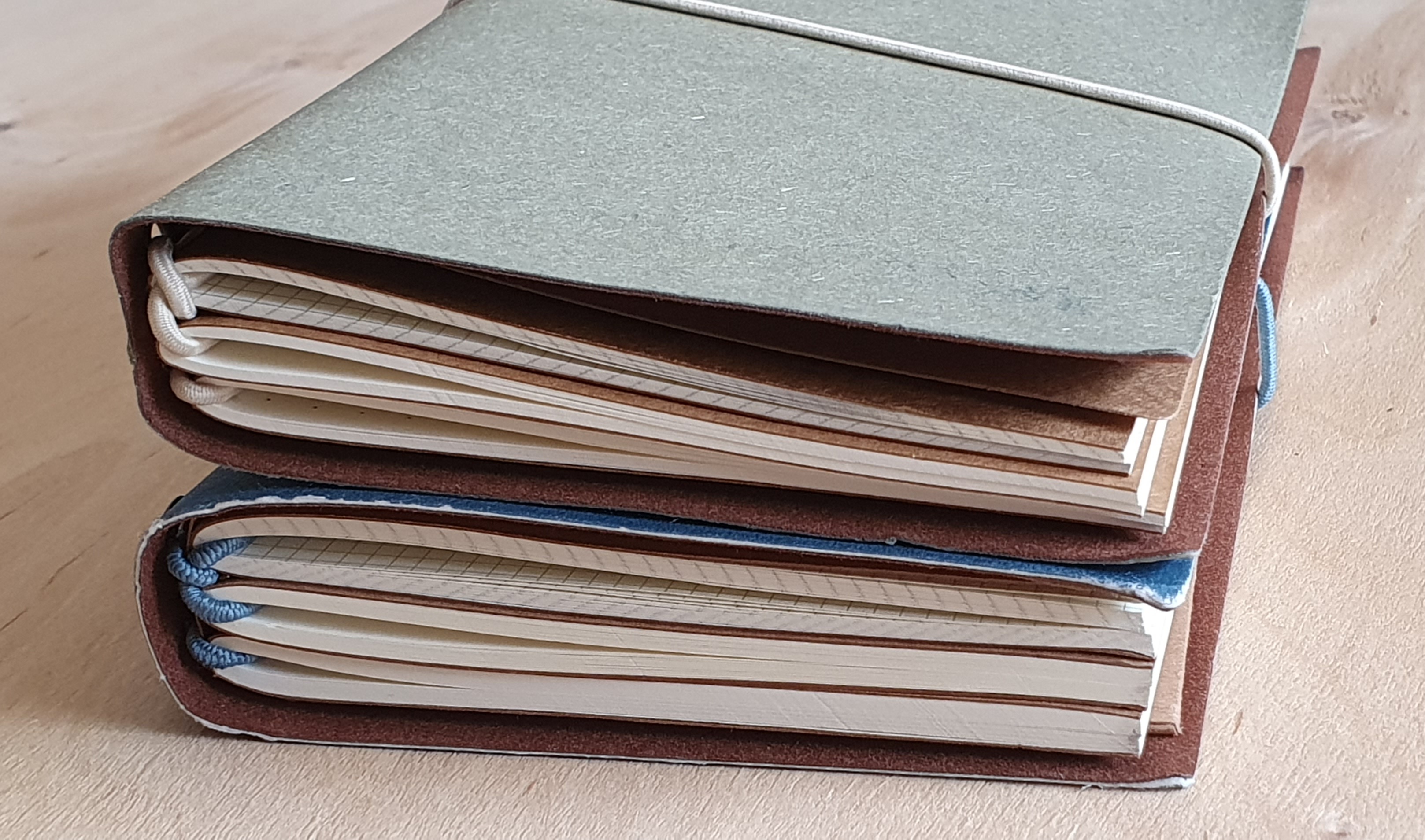
The cover includes two elasticated loops inside the spine. You could slide one notebook under each loop if you just wished to carry two. However there are three notebooks in total, the first two attached to each other by a separate elasticated loop and then slid under the first of the two loops attached to the cover.

Three slim notebooks inside.

Having picked up one to buy, I made my way toward the cash tills, following the one-way route around all the aisles so that you get to pass every item in the shop. I soon found another display of these notebooks, but this time the covers were available in blue-grey, (which I will call blue) or dark green. This threw me slightly, and to confuse matters further, these blue or green versions were fatter and heavier. On closer inspection, I noticed that whilst the covers were all of the same size, there were more pages in the blue and the green cover notebooks, than in the olive one that I had seen first. Yet they were the same price, still only £4.00. Was the olive one over-priced, or were the blue and the green ones underpriced? I decided to hedge my bets and buy one of each size.

I’ll take these two please.

Specifications:

Olive green version:

  • 1 x outer cover, olive green with one elasticated loop closure and two loops in the spine
  • 1 x cardboard insert, with expandable pouch and a slot for tickets;
  • 1 x notebook with squared paper, 48 pages, squares are 2.7mm, or 10 squares = 2.7cm;
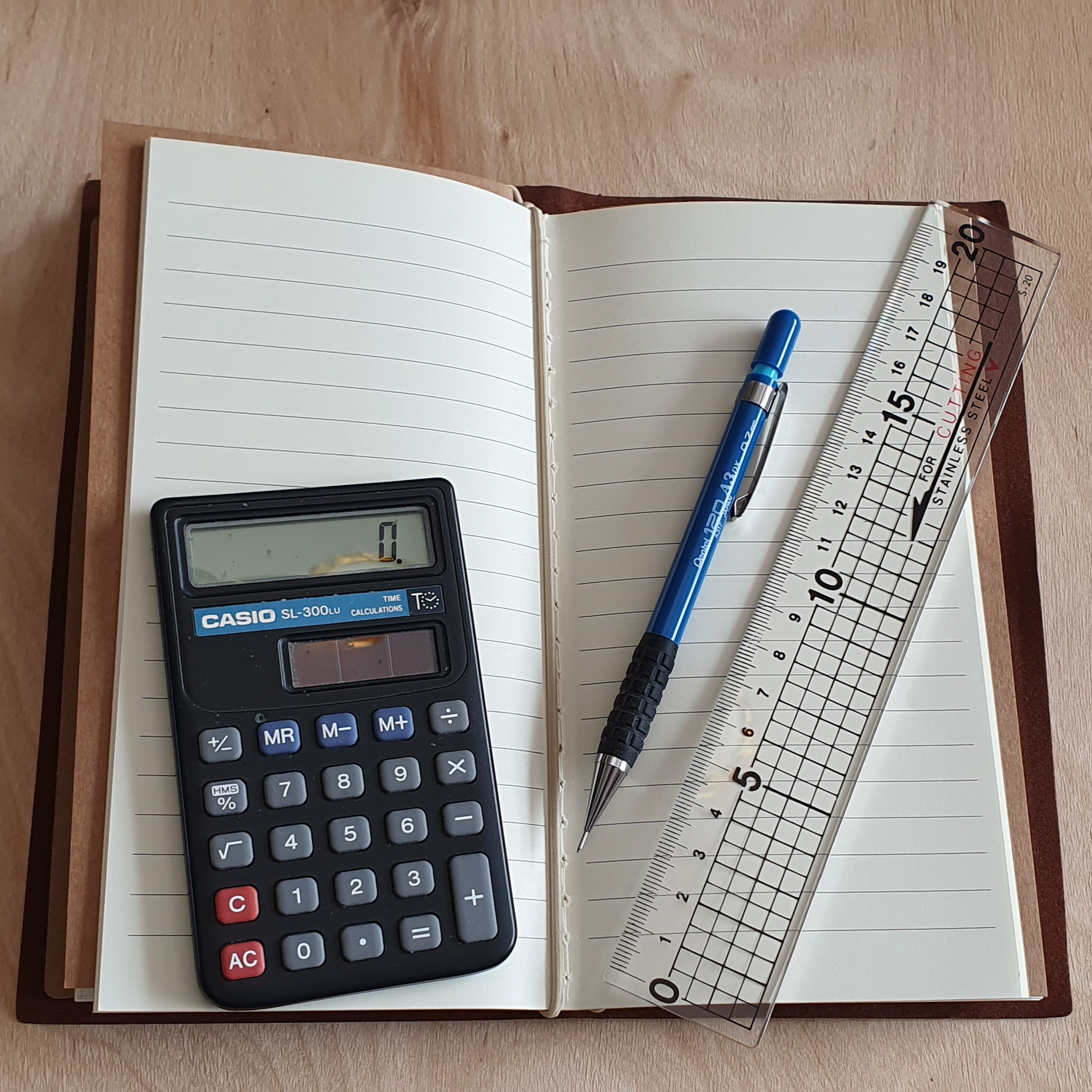
  • 1 x notebook with lined paper, 48 pages, 20 rows per page, 8.2mm row height;
  • 1 x notebook with dot-grid paper, 48 pages, 5mm squares;
  • The notebook size is 19.5cm x 9.5cm. The paper is 80 gsm.
  • Total 72 leaves, or 144 pages. Total weight: approximately 177 grams.

Blue version:

  • 1 x outer cover, blue, with one elasticated loop closure and two loops in the spine
  • 1 x cardboard insert, with expandable pouch and a slot for tickets;
  • 1 x notebook with squared paper, 64 pages, squares are 2.7mm, or 10 squares = 2.7cm;
  • 1 x notebook with lined paper, 64 pages, 20 rows per page, 8.2mm row height;
  • 1 x notebook with dot-grid paper, 64 pages, 5mm squares;
  • The notebook size is 19.5cm x 9.5cm. The paper is 80 gsm.

Total 96 leaves, or 192 pages. Total weight: approximately 258 grams.

Traveller notebook. Lined pages are 8.2mm row height.

Finally, the difference in weight of these two options is not entirely due to the extra number of pages: the cover of the blue version feels slightly thicker and stiffer than on the olive one. This led me to disassemble both sets to weigh the component parts individually. Even I felt a bit nerdy doing this. But sure enough, the olive cover weighed approximately 26.5 grams, whilst the blue cover weighed around 30.5 grams.

The component parts. All for a very reasonable £4.00.

So in summary, you have a choice, one with a total of 144 pages, and one with 192 pages and a stiffer cover.

The paper is pleasant to use and is fountain pen friendly. The set will be great to chuck in my green canvas shoulder bag. It remains to be seen how each cover will fare over time, after being carried about. The elastic loop may in time bite into the covers – more likely with the thinner cover of the olive version. You get more for your money with the blue version, whilst the olive version is thinner and lighter to carry. Of course, you can mix and match the contents or replace them as you wish. But both seemed good value to me. Buying one of each in order to reap the average value seemed the right choice.

I’ve got the notebook. Now I just need the travel.

Travelling with ink: Suffolk, August 2022 edition.

How many pens do you need for a two night hotel break in Suffolk. One? Yes, possibly. And how many pens did I need? Answer: five fountain pens, plus a Lamy 2000 multi-colour ball pen and a Pentel P207 mechanical pencil (just in case I ran into difficulties with the Wordle).

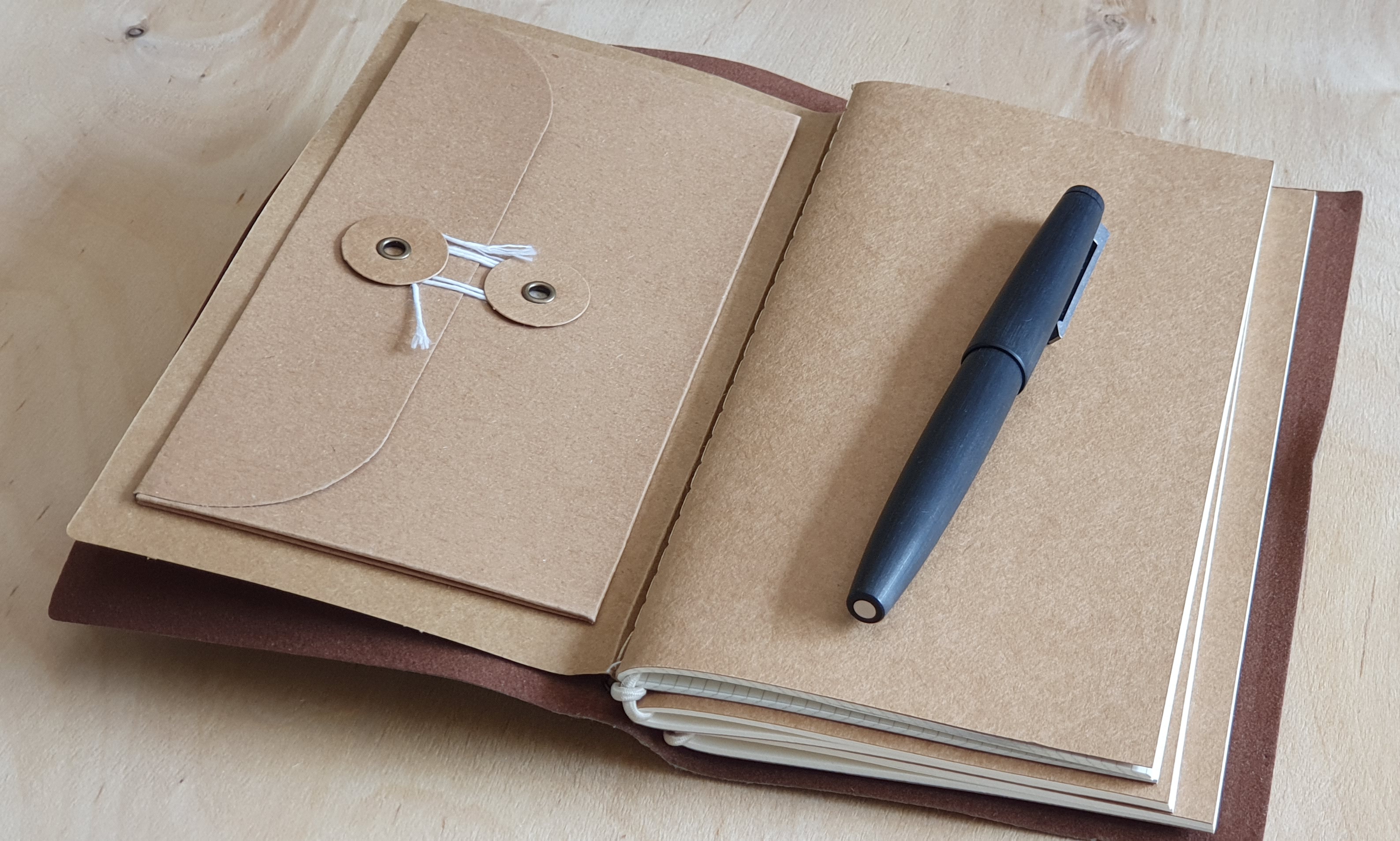
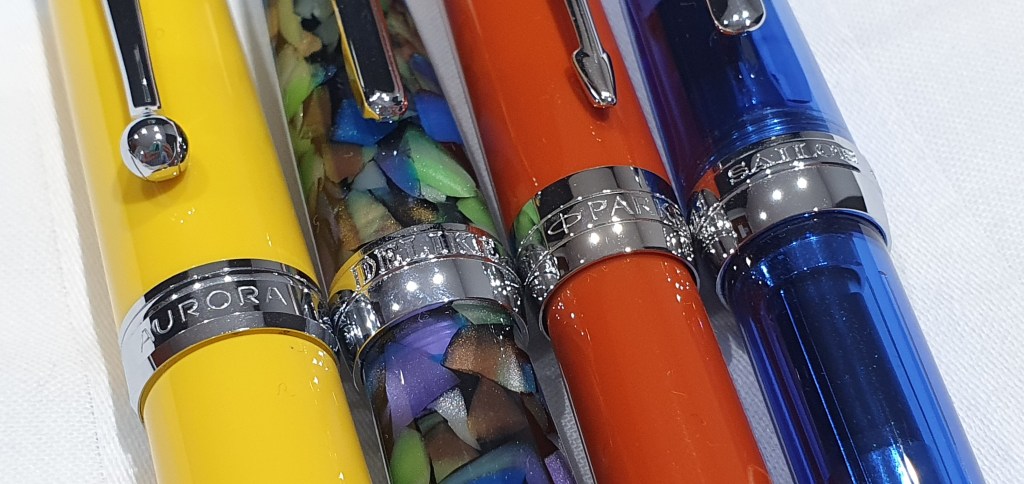
The cap bands. (The Lamy 2000 sat this one out).

I always enjoy thinking about what pens to bring on a holiday. Whilst there is an attraction in the simplicity of bringing just one, I rarely (or never) take that option. This time, I chose the following:-

Lamy 2000 (Fine): recently back from a nib exchange with Lamy and newly filled with Graf von Faber-Castell Moss Green. I am loving this pairing especially on my holiday journal which is a Leuchtturm A5 hard cover notebook. (The hard cover helps if you do not want to sit at a table and need to write with the book on your knees).

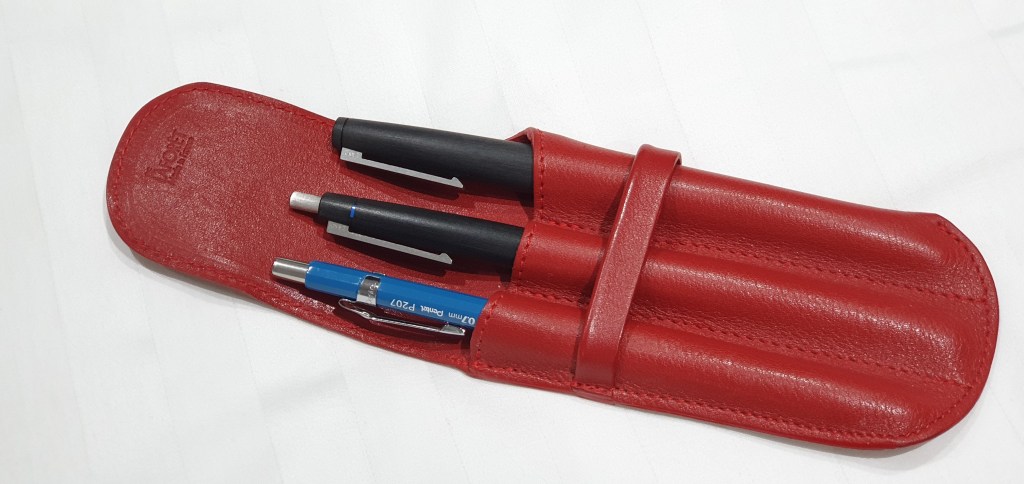
The Lamy 2000 fountain pen and multipen, plus a Pentel pencil.

Aurora Talentum, Oblique Medium: a recent purchase this summer and one that I am delighted with. Now that a little initial skipping has been cured, the pen is a joy and I think it may be one of the best buys around in its price range. Currently inked with Pelikan 4001 Konigsblau. The OM nib is a game changer for me as a lefty overwriter. The pen works for my style, and I do not have to adapt my writing style to suit the pen.

Parker Duofold International, Big red edition, Medium nib: now inked with a Quink blue black cartridge. Recently I had inserted a blue black cartridge in my new Vector XL. Flow problems ensued and I removed the cartridge to investigate. It turned out to be a simple case of the plastic which gets punched out when you puncture the cartridge, had not broken off completely and was still blocking the flow. I poked it away with a toothpick. Then I had the thought: why put this cartridge back in the Vector when I have a Duofold sitting idle? And so it went in the Duofold, with great results. This is a “forever ink” for this pen.
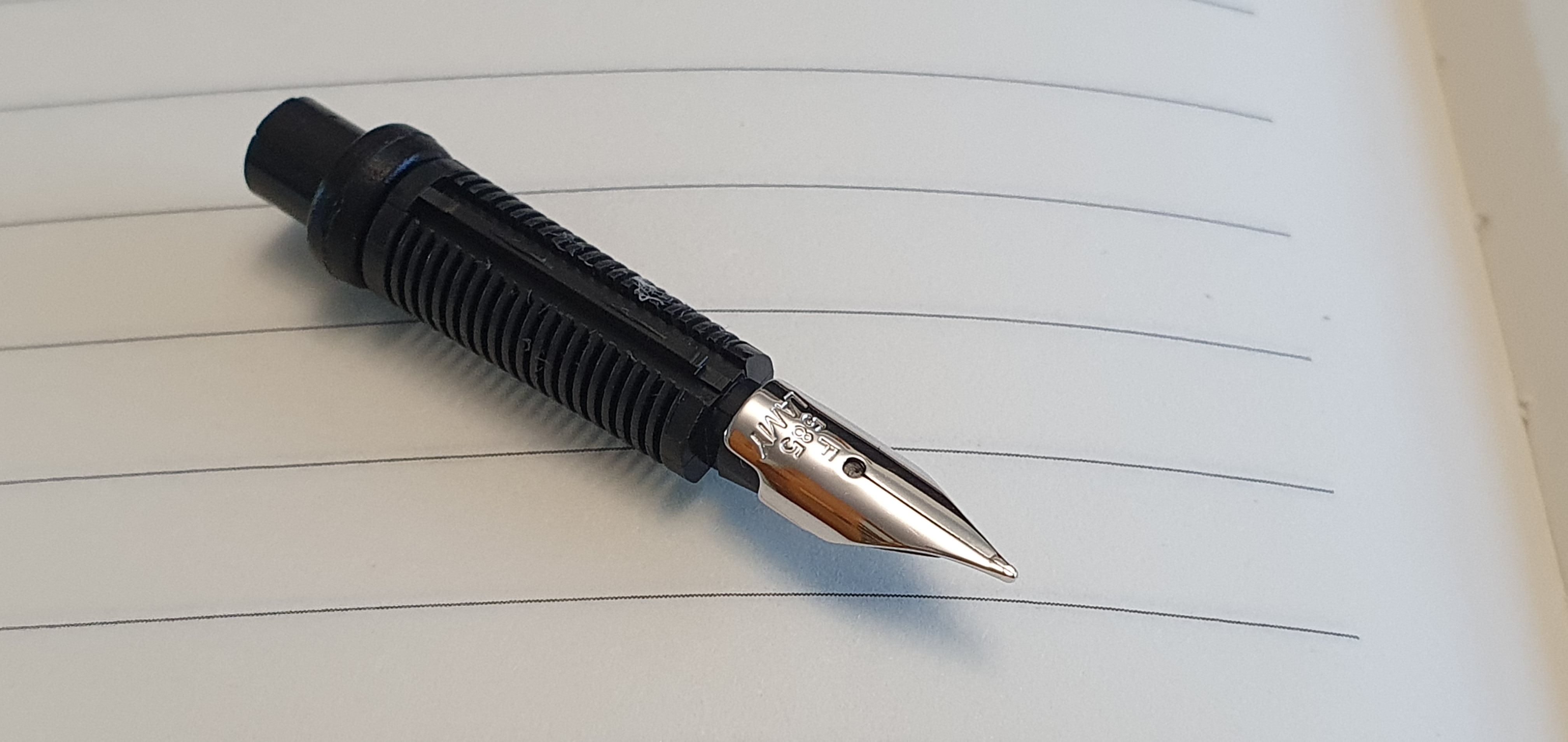
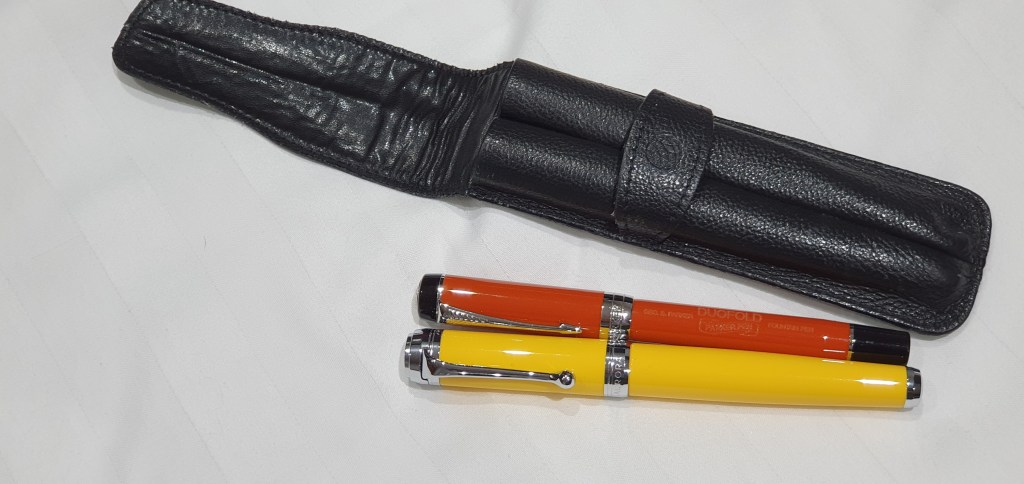
Oranges and lemons: the Duofold and Talentum.

Delike Newmoon, green marbled acrylic pen with fude nib and Waterman Harmonious Green. I am thrilled with this pen, out of all proportion to its modest price. The nib is so enjoyable, being usable in a variety of styles and having four distinct line widths up its sleeve, depending on how you hold it. For these reasons, it would actually be a good choice if you were to take only one pen with you.

That was nearly enough, and then at the last minute I spotted my Sailor Pro-Color 500 blue demonstrator steel nibbed pen, in my pen cup. This has a fine nib (extra fine by western standards) and is filled with Noodlers Bulletproof Black. Another “forever-ink” pairing. People speak of Sailor nibs having a pencil-like feedback, in terms of feel and sound on the paper. But this combo goes a step further and the line also looks like the writing from a sharp, soft pencil. And it has the added quality of being waterproof and so you can go over it with a highlighter is you so wish, without it smudging.

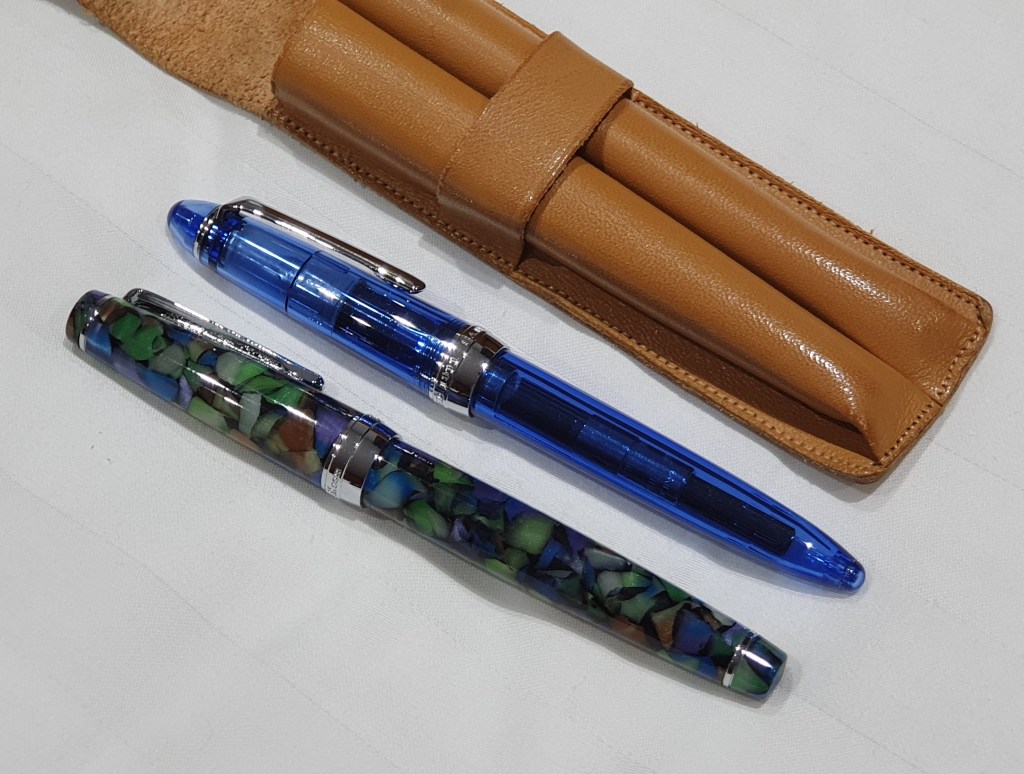
Delike Newmoon and Sailor Pro-Color 500.

In the event, despite having the choice of five fountain pens, it was the new Lamy 2000 that I chose to use for the quiet half hour of writing before the days got started.

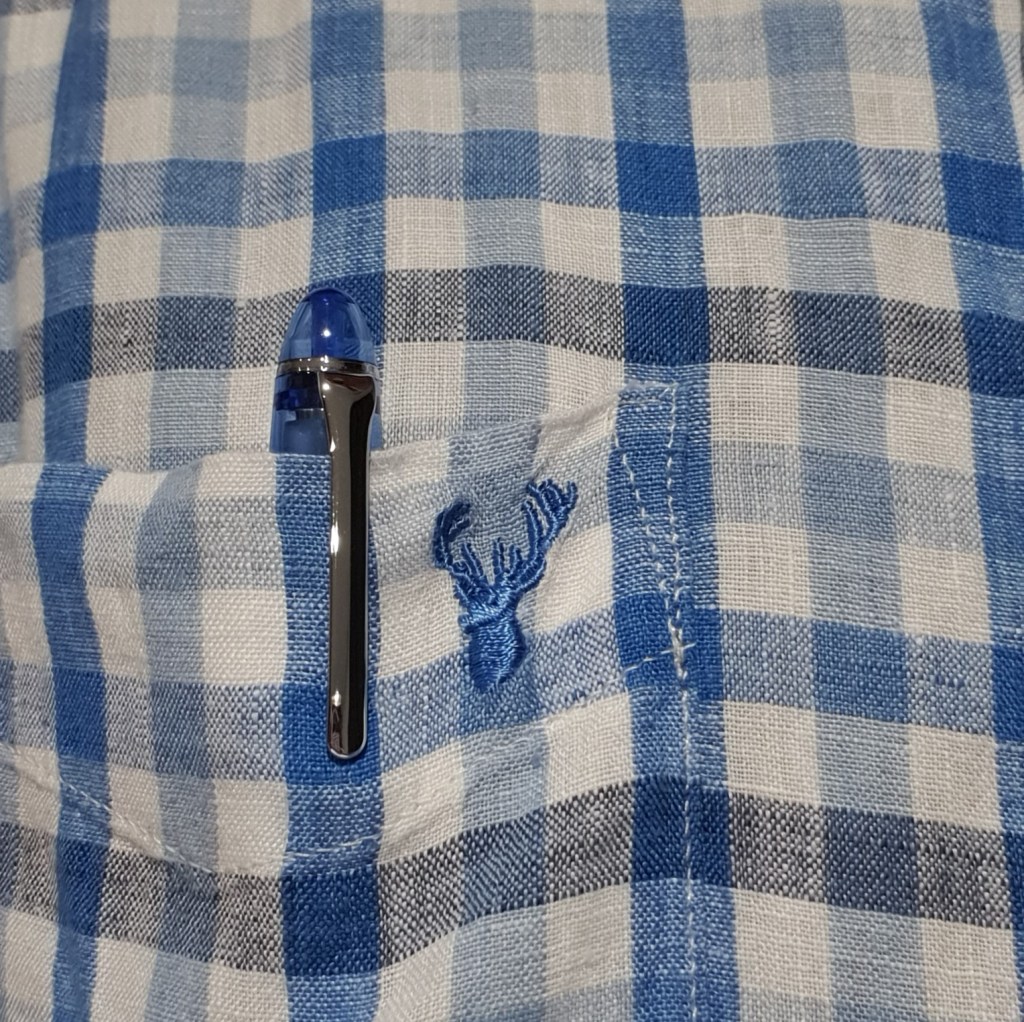
But the Sailor came into its own as a shirt-pocket pen when out during the day, excellent for a quick note to aid the memory, in my red Silvine A6 pocket notebook which lives in my shoulder bag when out and about.

Barely there. The Sailor Pro-Color 500 slips into a shirt pocket.

When visiting seaside towns, I always enjoy coming across an RNLI lifeboat station and will visit them if they are open. It is good to know that they are there, even if you do not need them – which was a little bit like the rest of my fountain pens on this trip. As for the pencil, I did not need it for the Wordle. But I did buy a souvenir notebook from the wonderful Suffolk Owl Sanctuary which I might just paginate.

Whether you bring pens or not, a few days’ break in Suffolk to visit the lovely coastal towns or to drive around the beautiful countryside and enjoy the landscape, is strongly recommended.

Big skies and laid back beachy vibes at Aldeburgh.
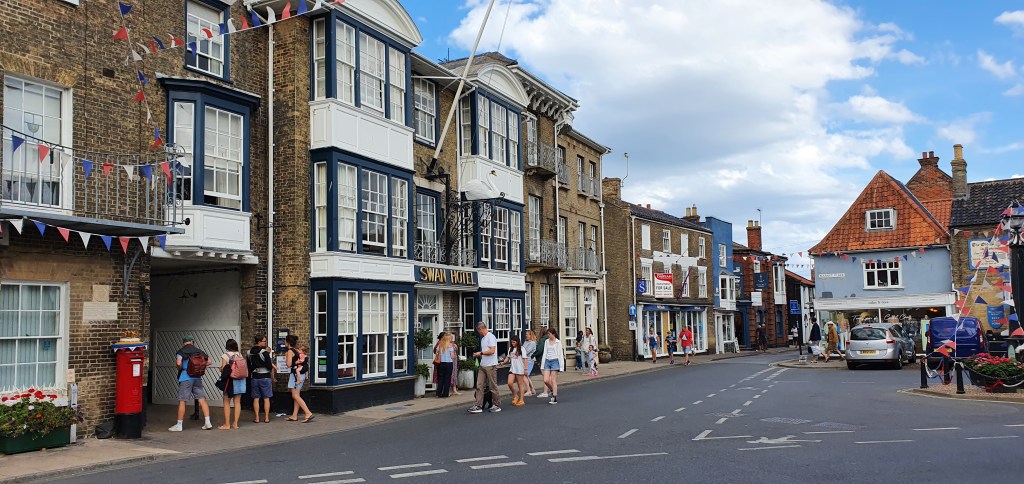
Southwold. The seafront is just beyond the shops.

My big red ink swab fest.

In recent posts, I have been looking at my fountain pen ink accumulation. Today it is the turn of my red inks to be in the spotlight.

I like red ink but do not use it very much. As somebody who uses mostly blue or blue black inks, it came as a surprise to see quite how many different bottles of red ink I have. This is due to the temptation to try new shades of red, combined with the fact that finishing a bottle, at my rate of use, takes forever.

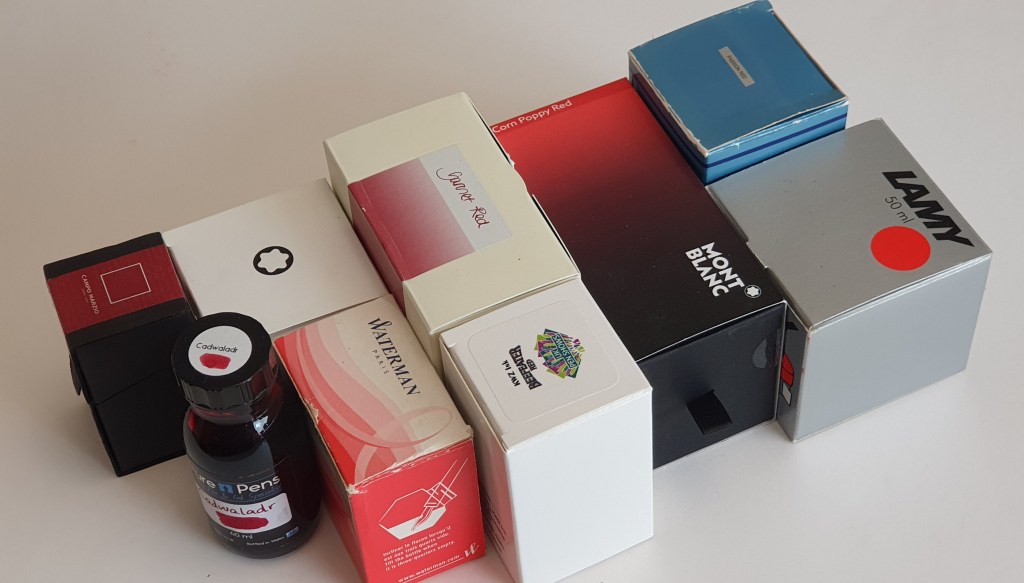
Every fountain pen enthusiast needs at least one bottle of red ink. A Waterman Audacious Red, for example, would probably do. You cannot go wrong with Waterman ink. Rummaging through my ink drawers, I had forgotten that I owned a bottle of Lamy red and cannot now remember buying it. Others triggered happy memories – such as buying the Beefeater Red from KWZ Inks at the London Pen Show one year, or the Pure Pens Cadwaladr Red, also at the Pen Show.

The little bottle of Campo Marzio Bordeaux was purchased at the delightful Campo Marzio shop in Piccadilly which I recently heard sadly may not be there any more.

The Montblanc Corn Poppy Red was an ink that I had heard about a lot on the internet and had to buy for myself – probably from Harrods, whilst Graf von Faber-Castell’s lovely Garnet Red came either from Harrods or Selfridges in London. I was thrilled with Garnet Red when I first discovered it. It was just what I had been looking for as it had a very pleasing orangey brown hue to it. But when using it more recently, it seemed to have lost this feature that I particularly liked and seemed to have changed from how I remembered it, to a Burgundy. I fear that I may have accidentally contaminated my bottle by filling a pen which still had traces of another ink inside. Time to buy another bottle perhaps.

However, I later purchased a bottle of Montblanc’s William Shakespeare Velvet Red, a premium ink in a 35ml bottle, which I was fortunate to bag at a London Pen Show for a mere £10.00. This also has the special orangey hints that I had liked so much in the Garnet Red.

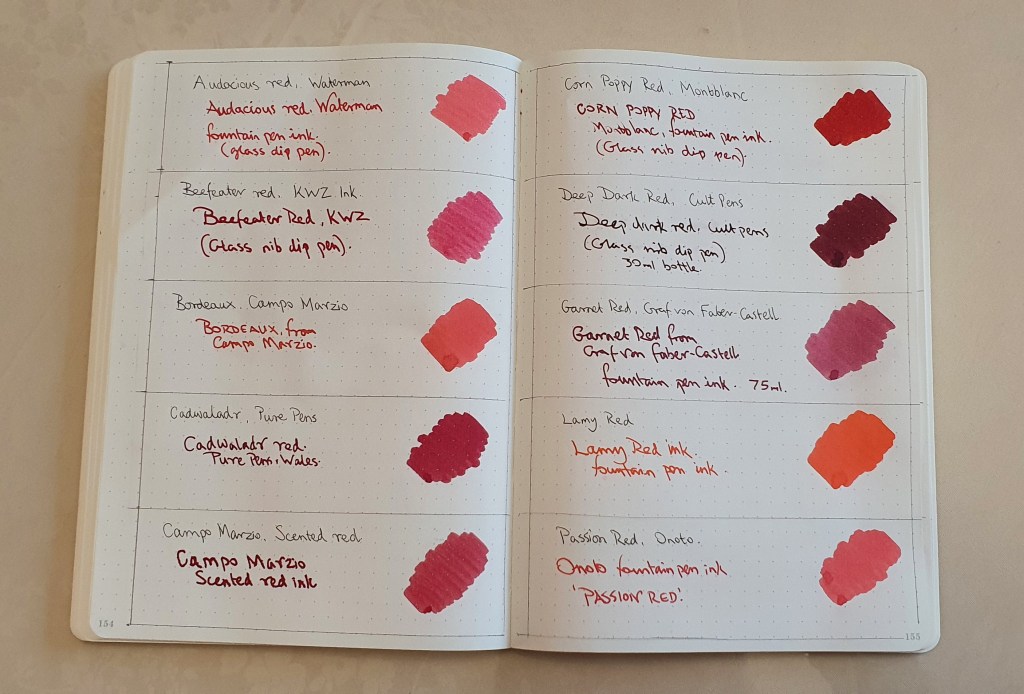
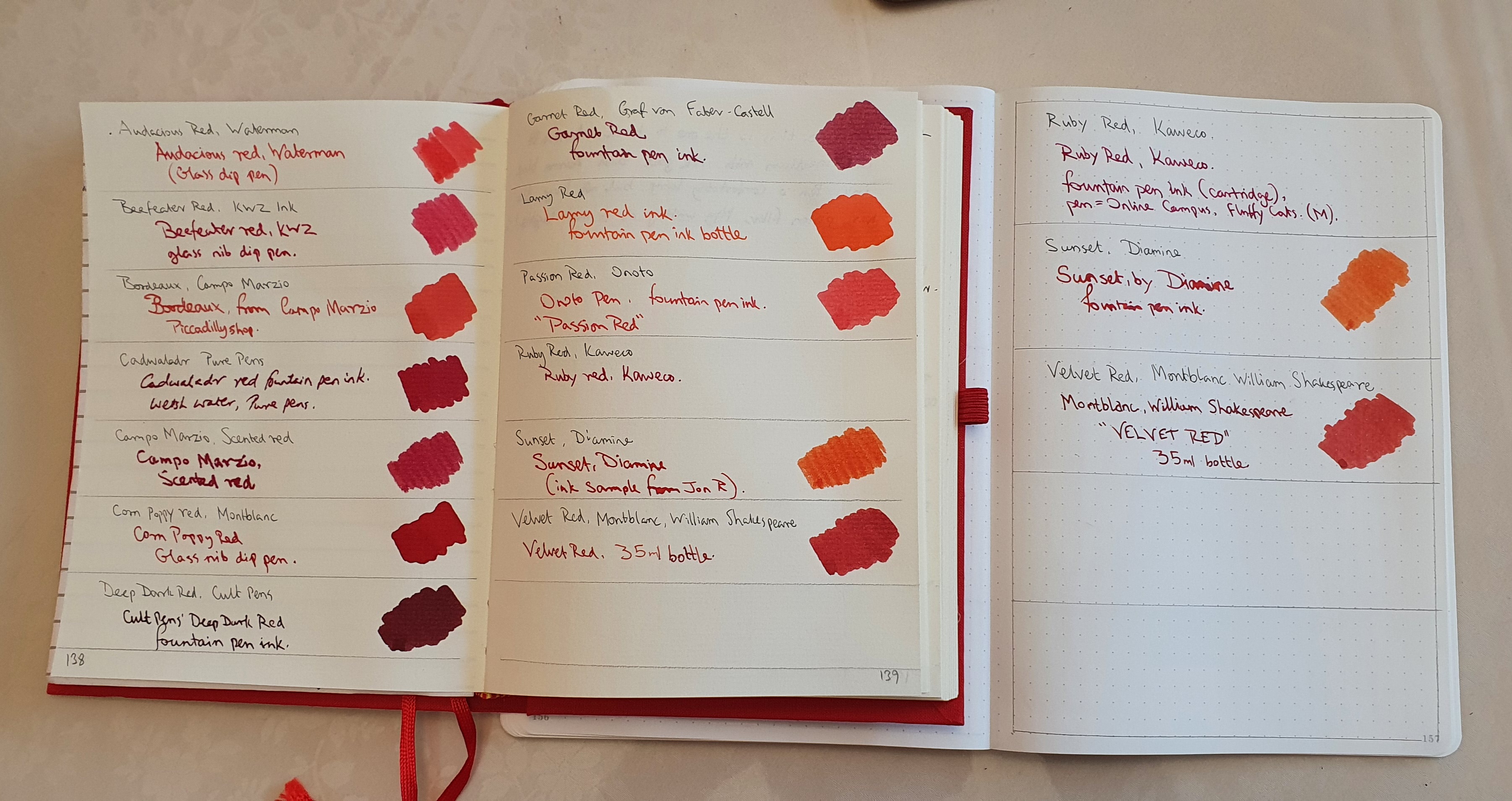
Today, to illustrate the differences (and also the similarities, to be fair) in my red inks I have swabbed them all. This was an exercise that turned my writing desk briefly into something resembling a science lab. I swabbed the inks with cotton buds, onto a spread in a Tomoe River paper note book which I keep for ink sampling. Also for good measure I swabbed them on a SemiKolon Grand Voyage journal, which uses a cream coloured laid paper and is, I was told, related to Leuchtturm.

Red ink swabs on Tomoe River paper.

I used a Moonman glass nib dip pen for the writing samples, although this is not a good representation of how an ink may appear from the more controlled flow of a fountain pen nib

While gathering my red inks together for this exercise, I thought that I would include a few ink samples that I was given, such as a scented ink by Campo Marzio, given to me by a dear friend in the fountain pen community and a sample of Diamine Sunset, a well regarded ink, given to me by Jon of Pensharing. The Onoto Passion Red was one of three inks, generously given to me by James Boddy of Onoto.

Red ink swabs on a SemiKolon Grand Voyage journal as well as a Tomoe River journal.

Ironically, the only pen in which I have red ink at present, (out of around 18 fountain pens inked) is an Online Campus Fluffy Cats edition, in which I am using the excellent Kaweco Ruby Red in cartridges, not bottled ink. I was therefore unable to do a swab but have included it in the spread nonetheless.

I am conscious of there being a great many excellent red inks that I do not have and am yet to try, such as Sheaffer Skrip red, or Diamine Red Dragon, to name but two, but you can’t have them all. It is the wanting that has led to my present predicament and I am already at saturation point and ready for any eventuality calling for a massive amount of red ink writing.

Some of my bottled red ink stash.

My current top 5 inks.

It is not very often that I take stock of what bottled inks I have. Until now, the most recent count up was in 2020, which I posted about in The Great Bottled Ink Count on 21 November 2020. At that time I had 65 bottles. It has since grown to around 82 bottles.

Whilst it is nice to have such a variety to choose from when inking a pen, there is also a nagging feeling that I have got more than I need and will never use it all. If we chop and change inks every time we fill a pen, and have multiple pens inked at once, we very rarely manage to finish a bottle. It takes sustained use and many repeat fills, to drain a typical 50ml bottle.

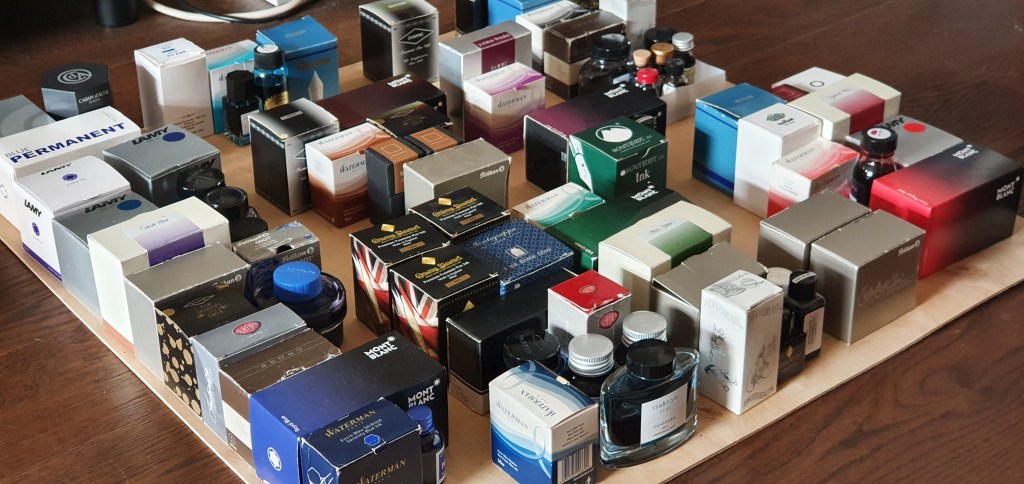
When I got all my inks out recently, it was hard to make them all fit back in their drawers again. Having them stacked on top of each other in drawers means that you forget what is underneath. It leads me to fantasise about having just one ink, or say one of each main colour. How much simpler that would be. The same goes for fountain pens and notebooks. Imagine having only one pen, one ink and one notebook. No difficult decisions about which to take! You can temporarily create a such a position by going on a retreat or even just going to a coffee shop, bringing only one pen, one ink and one notebook with you.

This was me last weekend, sorting the ink stash by colour.

I am unlikely to reduce my ink stash unless I have to. I am set up for life! But meanwhile it can be a fun exercise to reflect on which inks I would select, if I could keep only five of them. Currently, if it came to this, I would nominate the following.

Waterman Serenity Blue

An attractive royal blue ink, that is readily available, inexpensive, and behaves well. An excellent general purpose ink. It flows well in a pen, dries quickly, doesn’t stain and is easy to wash out of a pen. It can also help to clean a pen that has had something less well-behaved in it before. If I could keep only one ink, this would probably be it. But I would miss not having Graf von Faber-Castell Cobalt blue.

Conway Stewart Tavy, by Diamine

This is blue black ink and named after the River Tavy in the county of Devon where Conway Stewart at one time was based. I first discovered the ink at a London Pen Show and it became an instant favourite. I recall later buying a spare bottle.

But the memory plays tricks on us. When laying out all my inks on view recently, I discovered that I actually had three bottles of Tavy. I had written their dates of purchase inside the lids: October 2017, March 2019 and October 2021. All were at pen shows. But when I opened the bottles recently to check how much was left, I could not understand why they were all full, or nearly full. And then I spotted an empty Tavy ink bottle on the book shelf behind my desk, and remembered that I had been through a whole bottle. It turns out that after that first bottle of Tavy, I had bought three spare bottles, not one.

It turns out that every two years I buy another bottle of Tavy.

Montblanc William Shakespeare Velvet Red

This is a gorgeous orangey red, like a Venetian red and is a premium ink from Montblanc in a 35ml bottle. I was fortunate to find a bottle for £10.00 at a pen show. For a long time I used it exclusively in my Montblanc 145 Classique, although now I am a little more relaxed about letting other pens share it.

Graf von Faber-Castell, Moss Green

As green inks go, this is a dark, rich green which shades well, rather than the viridian shades of some others.

Pelikan Edelstein, Smoky Quartz

This ink was a free gift at the London Pelikan Hub gathering one year. It is a distinctive earthy light brown, very different from say the Montblanc Toffee Brown. It is described on the box as a softer ink and has a tendency to bleed through certain papers and so needs to be used with care but is a gorgeous colour and shades beautifully too.

As well as being very pleasing inks used on their own, these five also have the advantage of looking good on a page together, as if they all came from the same set.

But trying to decide which Inks I would keep and which I would part with, is surprisingly painful. I am clearly not yet ready to let go.

A look at my brown ink stash.

In my previous post, I rounded up my green inks to remind myself of what I had. It was also done in part to assess the task of how much ink I still have to get through in my life time. I think we all know that that is not going to happen! There were seven green bottles alone. And since writing that post, I found that I had missed one, a bottle of Pelikan Edelstein Olivine.

I thought that today, I would continue the exercise, and see what brown inks I have. And to avoid the risk of missing any, I got out all of my bottled ink and put them into groups, so no-one got forgotten.

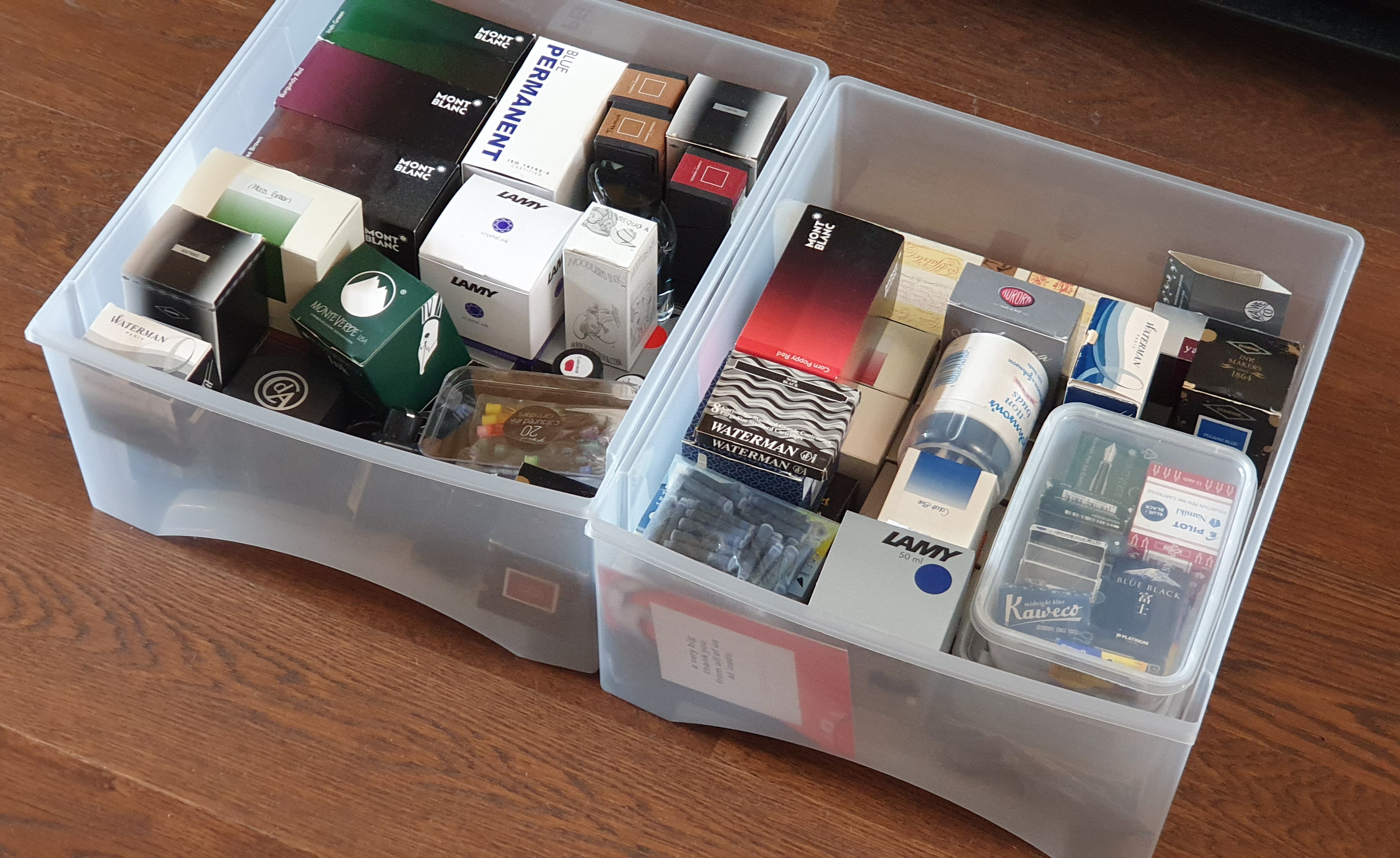
Two drawers of inks from my storage chest of drawers.

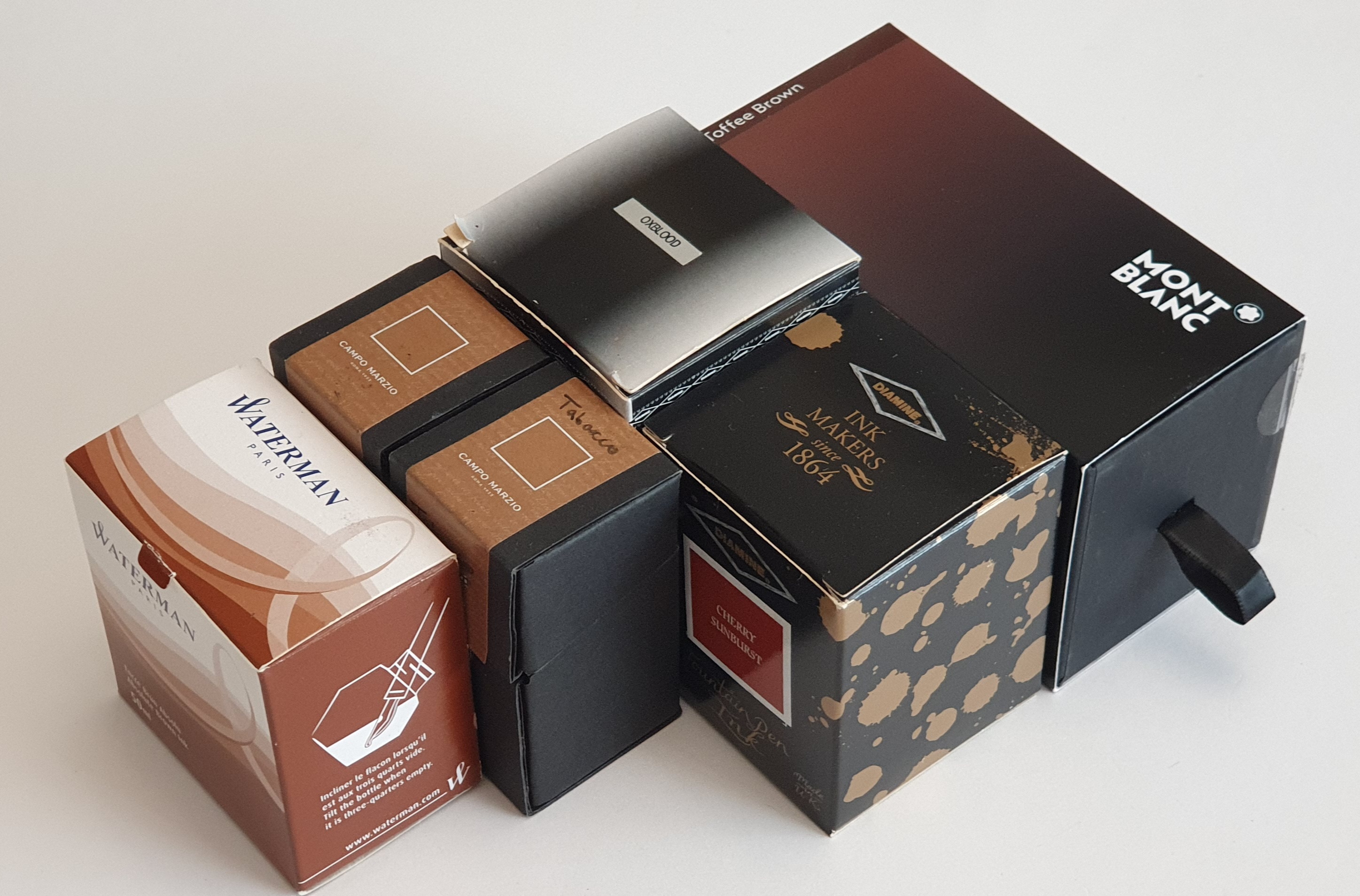
As soon as you start this, you run into problems of classification. I had to make a few policy decisions, such as separating my blue ink into (a) royal blue (b) blue black and (c) light blues, including turquoise. As for the brown inks I had to decide whether to include Cult Pens Deep Dark Red, and Diamine Oxblood, or whether to put them in the reds or the Burgundies. Without getting too bogged down in deliberating, I put the Oxblood in with the browns, and Deed Dark Red with the Burgundy. I am sure many would disagree.

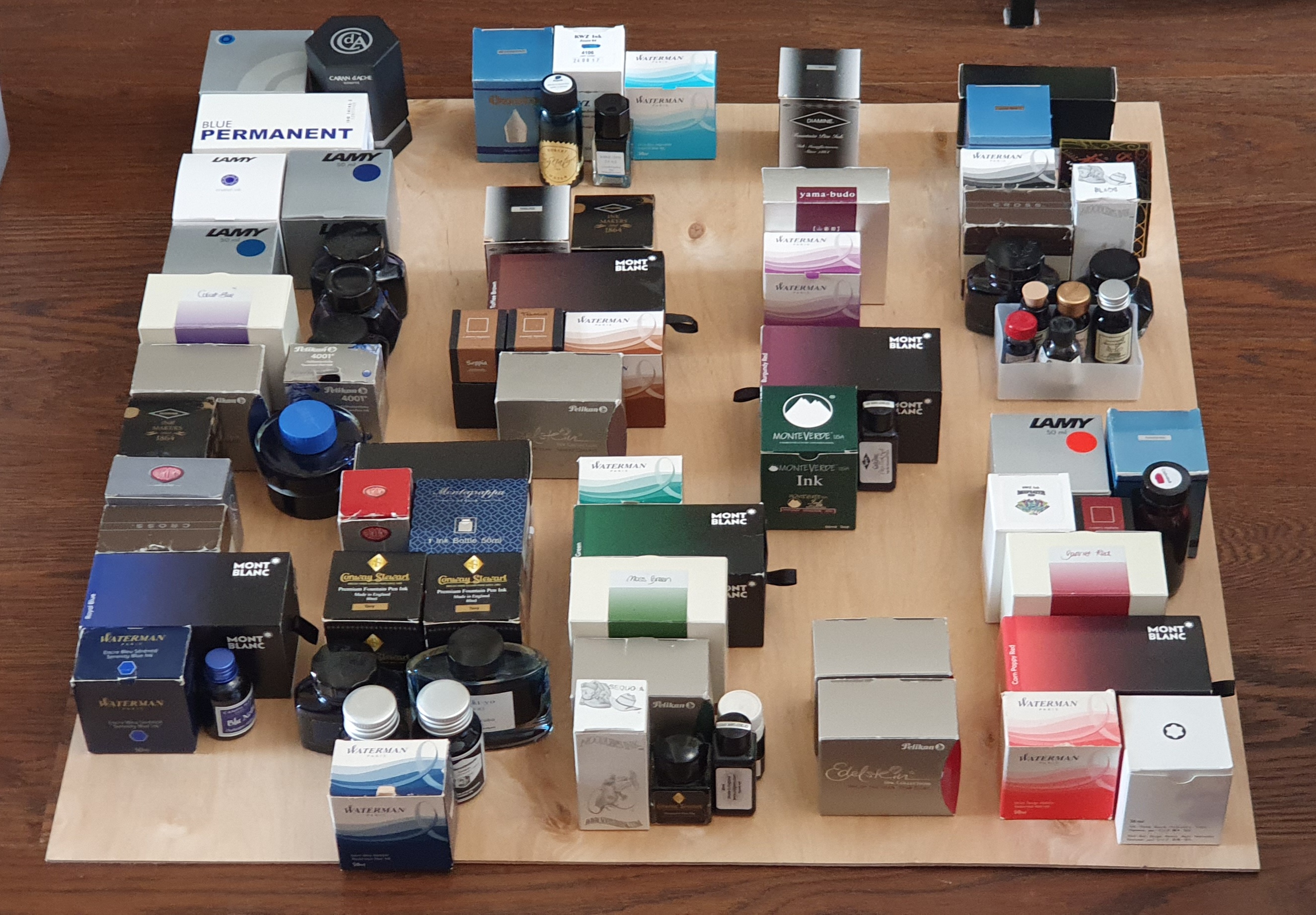
Making an attempt at classification.

And then, where do you group Pilot Iroshizuku Yama-budo? I put it with my Waterman Tender Purple, which was lonely in its Purple category of one.

Another category that consisted of only one ink, was orange. I put Diamine Pumpkin there. I had two pinks (although they were duplicate bottles of Pelikan Edelstein Star Ruby), three Burgundies, a surprisingly high number of nine black inks given that I do not regularly use black ink, and an even more surprising number of nine red inks. It is nice to have so many different shades and from different brands, but do I really need nine bottles of red?

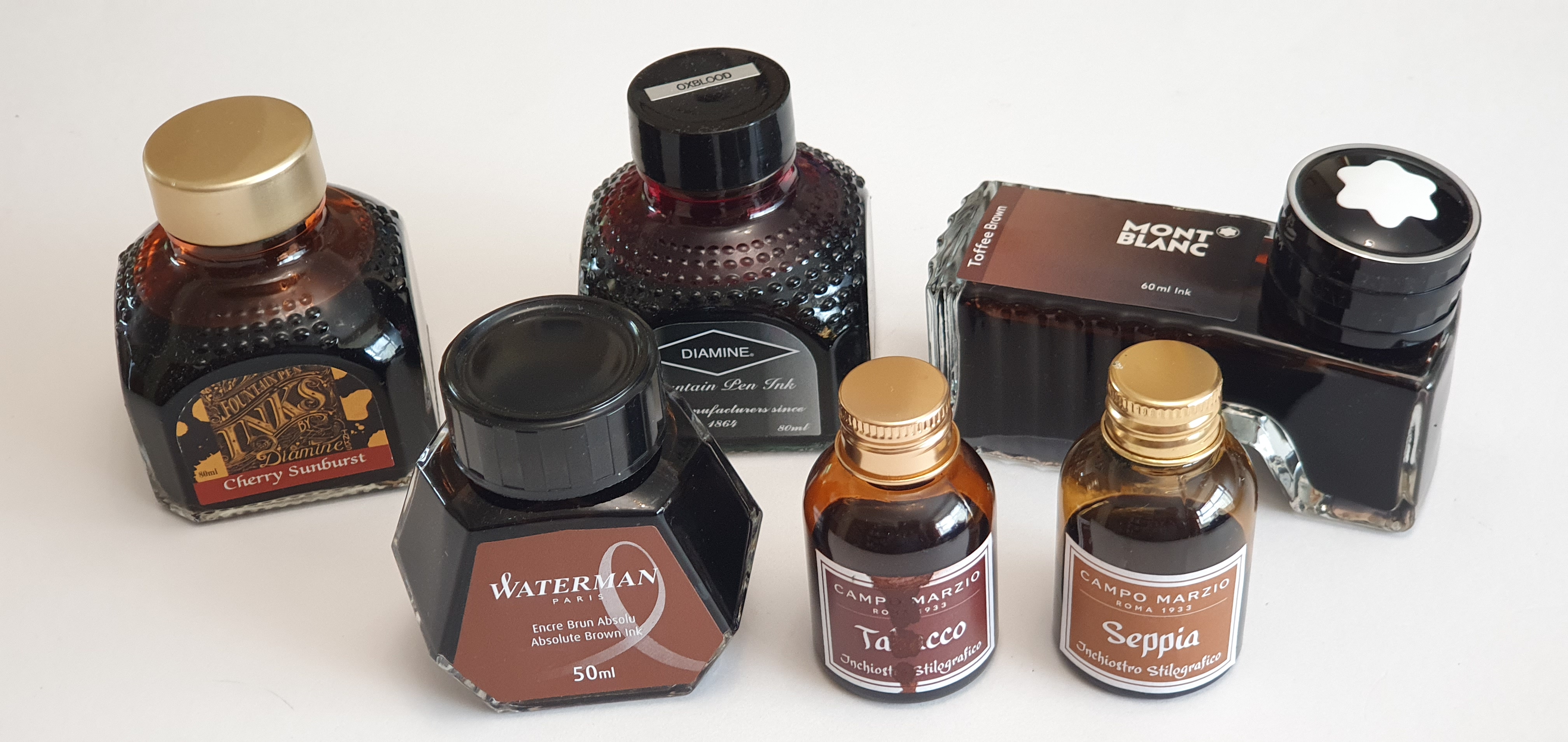
For someone who does not use brown ink regularly, I have a respectable seven bottles. Pelikan Edelstein Smoky Quartz, a freebee from the Pelikan Hub one year, remains a firm favourite. It is great in my Montegrappa Fortuna with a fine steel nib. Another favourite is Diamine Cherry Sunburst, with its musical connotations as part of the Gibson Les Paul guitar series. I use that sometimes in the gold Lamy Lx.

The brown team from my ink stash. I forgot to include the Smoky Quartz in the picture.

Since getting into the fountain pen hobby, I have kept a record of pen acquisitions but have been in a fog of denial about the ink situation, having only a vague idea of what I have accumulated. Sometimes it is quite nice not knowing the numbers.

Given that for the most part, I prefer blue and blue black inks, it is rather surprising that I have gathered so many other colours, which tend to be for “recreation” and occasional correspondence with other pen and ink users rather than regular work use.

I think it was some time around 2014 that I fell into the rabbit hole, when the internet kindled my long-standing enjoyment of fountain pens. I lapped up Stephen Brown’s pen review videos and discovered a few blogs, and went to the London Pen show for the first time. And over that time, my bottled ink ownership has quietly grown from only a handful, to its current tally of 82 (including a few duplicates). I seem to have massively overestimated my life expectancy. And this is not even taking into account the stash of ink cartridges.

It is not all bad of course. I do get a lot of enjoyment and relaxation from my pen hobby. Even when not actually using my pens, I can unwind just by thinking about them and pondering some future combinations of pens and inks to try. As hobbies go, it is cheaper and takes up less space than many others I can think of.

Relaxation in a bottle.

Finishing my greens: a look at my green ink stash.

Like many others in this hobby with a passion for fountain pens, I have suffered from Gear Acquisition Syndrome and now find myself with an embarrassing number of pens, unused notebooks and bottles of ink. From time to time I need to remind myself of what I have “in stock.”

When my late Godfather (“Uncle Brian”) died, his wife Mary offered me his almost full bottle of ink. It was Cross Blue. I gladly took it to finish and have been getting through it in the pen that I use at work, a Cross Bailey Light. It is now on its tenth fill, since last December.

Unlike Uncle Brian, I have two drawers full of bottled inks in various colours and will never get through it unless I decide to paint the walls with it. Of course it is nice to have a good selection of different inks to play with and most inks keep well for years. (One exception is registrar’s blue black iron gall ink, which once opened, is best used within 18 months or so, before it starts to lose its darkening ability).

I may at last be reaching the age where my desire not to fill my house with extra possessions, can sometimes outweigh the attraction of the thing itself. As I try to to use and enjoy what I have, it can help to break this down into smaller goals. Green inks are a category of inks that I have relatively few of. I can count my bottles on the fingers of, well, two hands.

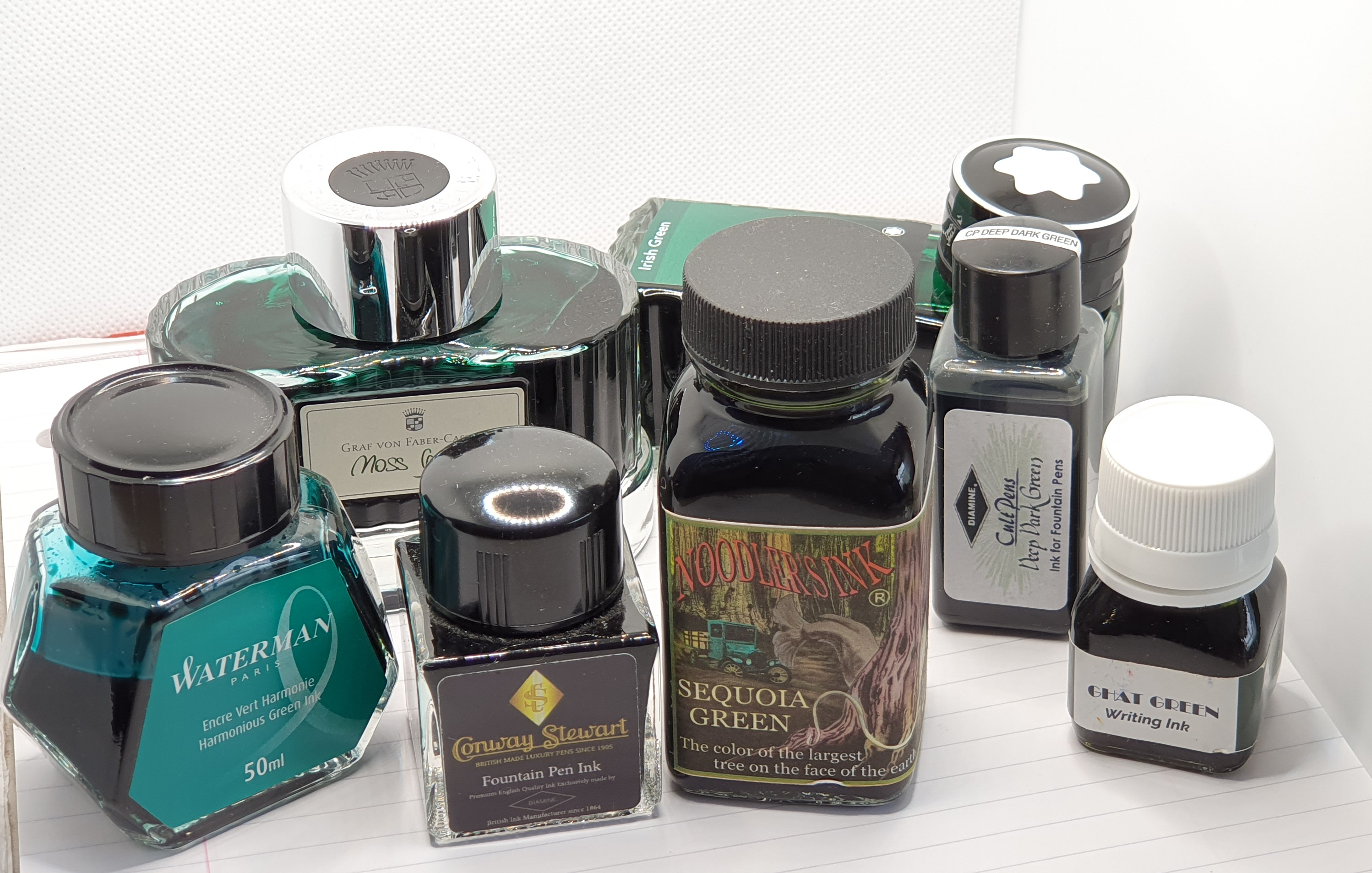
The Green Team, from my ink stash

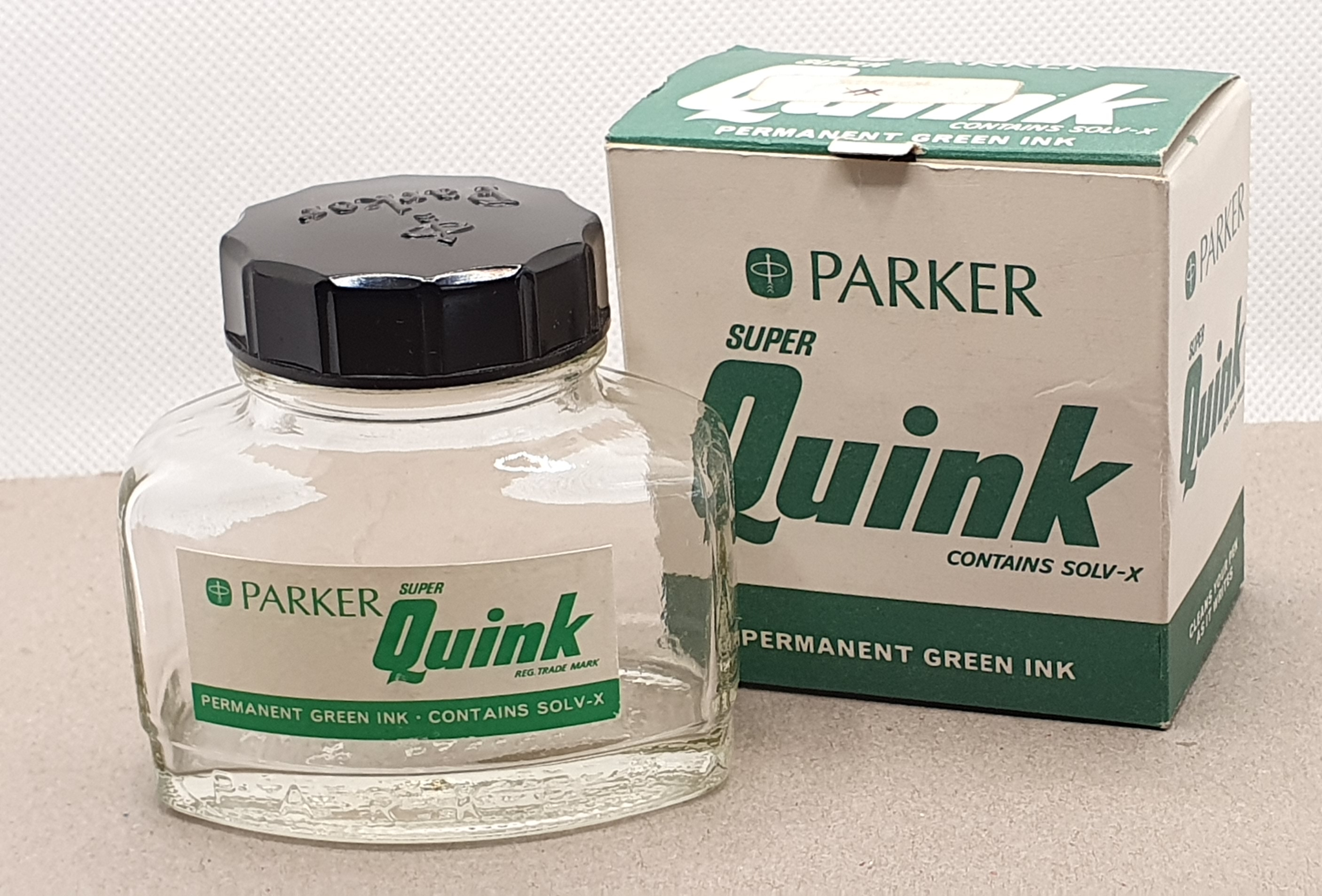
The only one of these that I have finished, and which was for many years my only green ink, was a bottle of Parker Quink. I still have the classic bottle and its cardboard box. Sadly these bottled inks are sold in plastic blister packs now. My bottle has a faded price label and I can still see that it came from WHSmiths.

I did eventually finish this but had had it for so long that I could not part with the bottle.

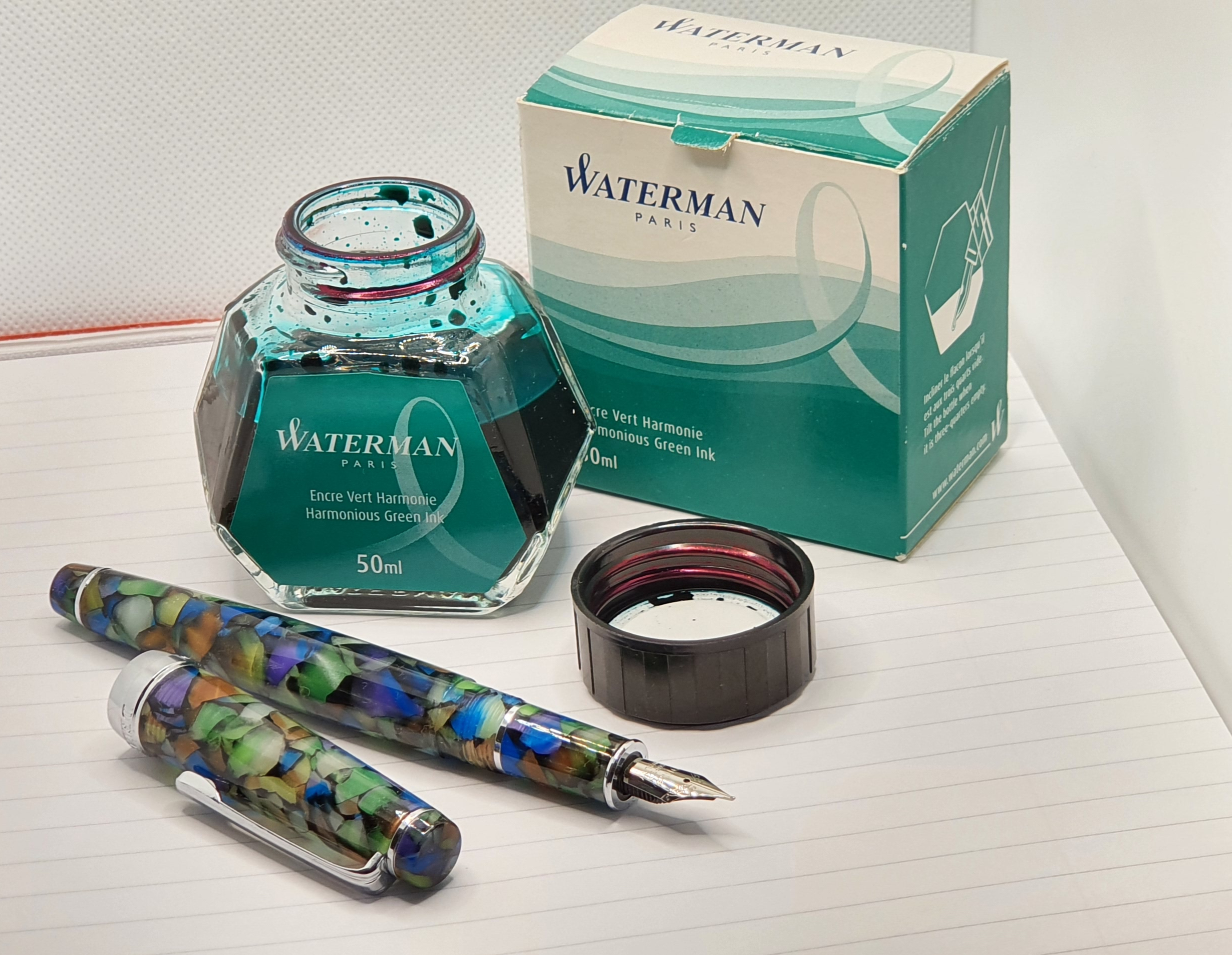
A modern equivalent, for a good day-to-day green ink might be Waterman’s Harmonious Green. Nowadays, I like to write the date of purchase inside the box lid. Mine bears the date 26 September 2015 and I bought it in the Burlington Arcade, off Piccadilly in London. It is still a good two thirds full. However I am now using it regularly in my Delike New Moon, fude nib pen. It is a good combination for the marbled green acrylic pen. It is an inexpensive ink for an inexpensive pen.

My Delike New Moon, fude nib pen with its current pairing of Waterman Harmonious Green.

I have some more up-market green inks: Montblanc Irish Green and, probably my favourite, Graf von Faber-Castell Moss Green in its attractive heavy bottle.

I have a 30ml plastic bottle of Diamine’s Deep Dark Green, which I bought at the same time as their Deep Dark Blue and Deep Dark Red. I used the Deed Dark Blue by far the most and finished the bottle, often using it in a TWSBI Vac 700 or Diamond 580.

Some less common greens are my Noodler’s Sequoia: a brim-full glass bottle containing 3oz of this green-black ink. Unfortunately, although I was very taken with the colour, I found it all but unusable for a lefty-overwriter as it is so slow-drying and smudges long after I would expect it to be dry.

Seven bottles. That is still a lot of writing.

At the London Pen Show one year, I picked up a cute little bottle of Conway Stewart green ink, made by Diamine. I do not know the name of the colour but think it was of the same series as Conway Stewart Tavy, which is a nice blue black. However I bought it more for the bottle, nice for travelling, than the ink.

Finally, I have a bottle of Krishna Inks Ghat Green, which is an attractive khaki green-gold. I did not use it much at first as I suspected it of causing unsightly and disturbing nib crud on my Montegrappa Fortuna’s steel nib. But I later gave it another chance, in my Sailor Pro-Gear with a 21k gold nib and have had no problems with it at all.

If you want to get through ink faster, using a pen with broad, stub or music nib will help. Or you could use it for drawing. For some years I could not settle to using a green ink as I would soon have the urge to flush it out and refill with a blue. But I now appreciate a green ink from time to time and it is well worth having at least one green-inked pen! I heard it said that there is, or was, a convention in the Royal Navy, of different colour inks being used by different ranks of officer. I have not been able to verify that. I do remember that green was the colour of correspondence from Rolex, if you got a typed letter from them in the 1960’s. It also makes a good colour for amending and editing typed drafts, rather than red.

A green ink can look attractive, particularly on cream coloured paper and paired with the right pen and can make a refreshing change from the usual blues. I don’t know when I will next finish a bottle or whether I will ever own just one bottle but I am at least trying not to buy more.

Joshua Lee Turner and Allison Young: first night review.

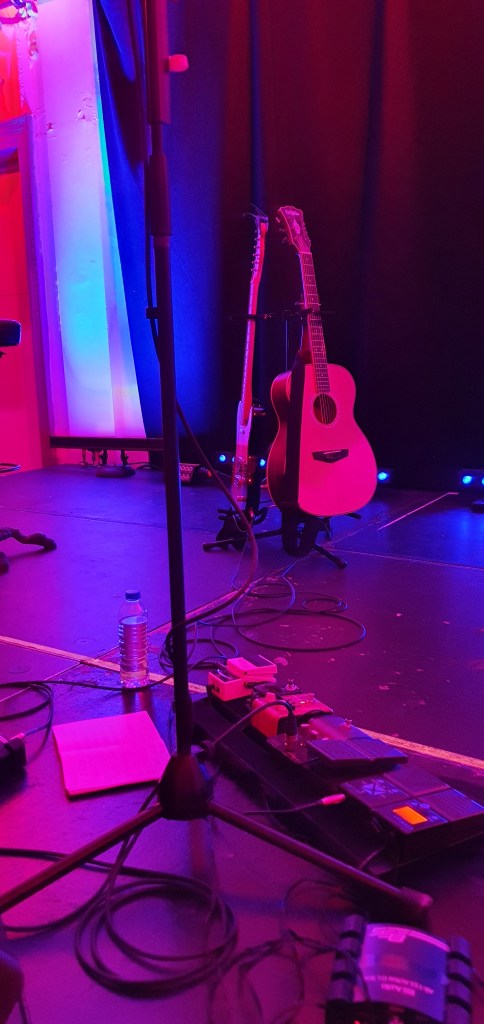
Although this blog is usually about fountain pens, today’s post is off-topic, to reflect on an excellent gig at London’s Bush Hall in Shepherds Bush, on Friday 15 July 2022. This was the first of a seven date UK tour and was also the first performance of this new duo to a live audience.

Joshua is well-known from YouTube as one half of the duo The Other Favorites, with Carson McKee. His videos have seen him collaborate with numerous other talented musicians, including Allison Young whose own work includes singing with the Post Modern Jukebox band.

I have raved in this blog before about The Other Favorites (An evening with The Other Favorites, and Another evening with The Other Favorites: this time it’s virtual). I continue to do so, to anyone who will listen. It is hard to think of any other musician as versatile as Josh, not only as a multi-instrumentalist but in crossing pretty much every musical genre, plus being a song-writer and having the IT skills to produce and promote his work.

My wife and I arrived unfashionably early at the venue. The doors were still shut and there was no-one about. A passing couple stopped to look at the poster of Joshua and Allison on the front door, and asked us if this was who we had come to see and how we had heard about the event. “What type of music is it, Americana?” This put me on the spot. How do you pigeon-hole Josh Turner who can not only turn his hand to, but excel at so many types of music from pop, rock, country, folk, bluegrass, singer-songwriter, gypsy-jazz, great American songbook standards, and more. I thought of Allison Young, whose videos of songs such as “Crazy” and “Fever” I had seen – and came out with a fumbled response of “Jazz”. “But that’s not a jazz guitar” said my enquirer, pointing to the Spanish guitar in the poster. “No, but he can play any stringed instrument you put in front of him”, I gushed. I hope that they came back and bought tickets.

As show time drew closer, a decent sized queue built up behind us. Many in the know had gone to the bar next door before the show. We chatted to another couple: Dave had been watching The Other Favorites on Youtube for a considerable time but not made it to a live show before.

With no allocated seating, we were able to pick the front row. It was our first concert since lockdown restrictions were lifted and good to be able to enjoy live music again.

Josh and Allison took to the stage, each holding a guitar. They launched into “Shadows on the Wall”, also the opening song on their recent EP entitled “May 9-12” comprising six tracks written between those dates. Josh told the audience that they had realised as the tour approached, that they did not have many songs, – due in part to not quite believing that the tour would happen. They had recorded new material, not that we would have known they were new, as the songs from the EP blended right in with the rest of the set, as if they had been performing them for years.

What took place was an evening of pure joy and a masterclass in musicianship. The two performers remained on stage together throughout, although a few of the numbers were solo. There were some teething problems with Allison’s mic initially which crackled and popped. Josh paused in playing to give the mic a deft tap, which cured the problem temporarily until it was soon replaced by the sound engineer. Allison appeared not in the least fazed by the episode, which endeared them both to us all the more.

Josh’s finger-style guitar playing always amazes me, in his musicality and confident mastery of the fingerboard – be it on an acoustic or his starburst Fender Telecaster seen in many videos, or his ukulele, all of which featured in the show. There is never a beat missed or note out of place as he uses these instruments to their full potential. (I am thinking here of my own baritone ukulele, and a new mandolin, which would love to be played properly).

Allison’s voice is beautiful and has a timeless warmth and quality which was showcased perfectly on such classics as Hoagy Carmichael’s “Stardust”, or Diana Krall’s “Autumn in New York” as well as “Fever” and “Crazy”. She cites Patsy Cline as a major influence. Her natural charm, expressive movements and the twinkle in her eyes in performing all of these, brought them to life. She also sang and played a few of her own songs not yet recorded, which can be a test for an audience but were well received.

Josh played some songs from his back catalogue. “Nineteen and Aimless” was a song he had written about being nineteen and aimless. He honoured his 93 year old grandmother, in playing an instrumental that he had arranged at her request back when she was only 91, an impressive and foot-tapping rendition of “St Louis Blues” and was the envy of all the wannabe guitarists in the room. But it was his song “Cross-eyed Love” with its rousing speeded up, drop-tuned, gallop at the end, which brought the house down.

Josh and Allison played a guitar instrumental duet on La Valse d’Amelie, Yann Tierson’s “Amelie’s Waltz” from the 2001 French language film Amelie. Josh told us that both he and Allison were fans of the film. This slow piece was one of my wife’s highlights of the night.

They played over 20 songs in all. After the encore as the lights came up, two ladies sitting behind us asked how we had heard of the event. I explained that I had seen it online (and jumped on the tickets). They asked me if I played an instrument. I said that I played guitar, or used to think I could! Watching Josh is humbling but I admire these great musicians with so much ability and potential, following their dream.

I looked up Hoagy Carmichael afterwards. On Wikipedia is says that he “was among the first singer-songwriters in the age of mass media to utilise new communication technologies such as television, electronic microphones and sound recording.” Sound like anyone? To this Josh and Allison have harnessed Youtube and Instagram. As Josh put it, social media is not all a hell-hole. Good things come out of too, such as how he and Allison came to “follow” each other, to meet, record videos and the EP and now put together this tour. Josh had made good use of the lockdown to write and record an album and perform some livestream gigs all from his New York apartment. Allison had also been writing.

As I left the theatre, into the sultry warm London night, I had a spring in my step and was still grinning at the joy of the evening and the knowledge that such talent exists in the world.

Edit: 23 July 2022. Below is the setlist (compiled from a combination of my list made during the show, a photo of the list on the stage floor, plus the website Setlist FM.

  1. Shadows on the wall;
  2. Do I ever cross your mind (Dolly Parton);
  3. Lucy;
  4. Stardust;
  5. Plastic Jesus;
  6. Secondhand store;
  7. Fever; (Peggy Lee)
  8. Nineteen & Aimless;
  9. St Louis Blues (instrumental);
  10. Aquellos Ojos Verdes; (Spanish song)
  11. Samba Ukulele;
  12. Winter’s come and gone;
  13. La Valse d’Amelie; (Theme from the film “Amelie”)
  14. Autumn in New York; (Diana Krall)
  15. Til the stars turn cold;
  16. Where in time;
  17. Cross-eyed love;
  18. I fall to pieces; (Patsy Cline)
  19. Tiny Vases;
  20. Crazy; (Patsy Cline)
  21. We’ll meet again; Vera Lynn
  22. Hollow Wood.

My Lamy 2000 and I: a new chapter begins.

If you were to ask a group of watch enthusiasts to name the most iconic, recognisable watches of the last 100 years, they might include a Rolex GMT Master, an Omega Speedmaster, a Casio G Shock and maybe even a Fitbit. Try the same exercise with camera enthusiasts and you might hear the Leica M3, Hasselblad 500CM, a Rolleiflex, Nikon F and Olympus OM1. The debate will be endless.

Take a group of fountain pen fans – a random selection from a pen show perhaps. Again, everyone will have a different answer. Some likely contenders might be the Parker 51, Pilot Capless, Montblanc Meisterstuck 146, Cross Townsend and a Pelikan M800. Also there is the Onoto Magna, an Aurora 88, and a Visconti Homo Sapiens. I suspect that there is a good chance that a Lamy 2000 and a Lamy Safari will be mentioned.

This week, I have had a lot of love for Lamy. A generous pen friend in Australia had very kindly sent me a Lamy 2000 fountain pen, with an Oblique Broad nib, knowing of my new-found liking for oblique nibs. This began by accident on my purchasing a Moonman S5 demonstrator pen online, with three nibs included. I went on to buy an Aurora Optima with OB nib and then an Aurora Talentum with OM nib. Both are wonderful. My friend had passed on to me, all the way from Australia, a Geha 715 with OB nib, a vintage Montblanc 34 with OB or OBB nib (fabulous to write with) and a Montblanc Carrera with a steel OB nib and the Lamy 2000 OB: each very different.

However the Lamy 2000’s OB nib was a very different experience from, say the Aurora. The Aurora’s nib, although broad, is not very “thick”, or deep, and so allows for fine cross strokes. The Lamy 2000 nib (at least, the way I held it), had a writing surface which was both broad and deep. Perhaps it needed holding more upright. But for me the effect was not pretty and it was necessary to write larger to avoid loops being filled.

I emailed Lamy customer services in Germany to explain my predicament and to ask whether they would allow me to send the Lamy 2000 back for a nib swap. I soon received a friendly reply, that they would be happy to swap the nib, provided that the existing one was reusable. I sent my pen in, and waited eagerly for the reply. There were a few anxious days when the tracking information showed that my pen had been waylaid in Customs, on the way to Heidelberg. This prompted me to email them again. I had followed their advice on completing the Customs Declaration form and so hoped that there should be no duty to pay. Happily, I got a reply to reassure me that they now had my pen and would return it to me within a few days.

Last Thursday, after just over a month, the Lamy arrived back. It was well protected in a polythene sleeve, in a white envelope, in a cardboard box with a surprisingly copious 12 pages of documents but stating that the pen had been repaired free of charge, the nib exchanged for a Fine, the ink flow checked and the surface refurbished.

I was thrilled to have the pen back and with a fine nib this time. The tipping material is long and narrow. I gave the nib a little flossing and a rinse and checked the tines were level.

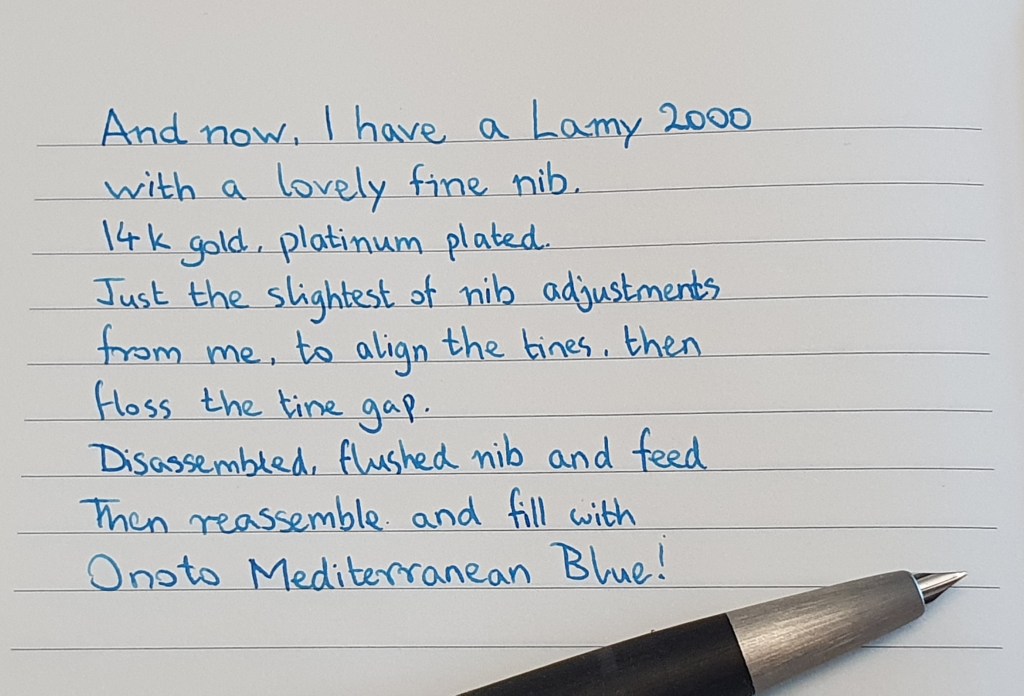
For its inaugural inking, I filled the pen with Onoto Mediterranean Blue (which might be called a cerulean blue perhaps) in contrast to my usual royal blues. The writing experience was a joy – all the more so for the month’s wait. At last, I have a Lamy 2000 which writes effortlessly and without squeaking. The fine nib has a good flow, just a little softness and some pleasant feedback.

The pen is well travelled, having gone from Germany to Australia, to the UK, then to Germany and back to the UK again. My own journey with the Lamy 2000 has also been a long one. I bought my first in May 2014, but struggled to get along with the M nib. I later exchanged the nib for a B which I found much better although not until after some rather risky do-it-yourself tine-gap widening.

I have wanted to like the Lamy 2000 fountain pen for a very long time – not because it is fashionable to do so, but for its many unique merits. Over the years and after all I have heard and read, I had come to the view that if I were to buy another, that the fine nib was the one to have. Now thanks to a generous friend and an impressive customer service from Lamy, I have one. It feels great.

Early thoughts on the Parker Vector XL fountain pen.

A few weeks ago I first noticed a new Parker pen called the Vector XL, in my local WH Smith at London’s Brent Cross shopping centre, in a range of colours. I did not buy one immediately, but whilst on holiday recently, checked out branches of WH Smith in other towns that we visited, to see whether they had them. I did not succeed in finding one until back home in London again.

Parker’s new offering: the Vector XL.

I have always had a soft spot for Parker fountain pens, ever since I was a young child. I know that they are now made in China and for several years my attention has been diverted by numerous brands from Germany, Italy, Japan, USA, and other countries, brands that I would have had little or no awareness of as a child, However there is still a certain nostalgia in revisiting Parker, the brand I idolised in my younger days.

With that background, and being curious to try this new release, I took the plunge and bought one. There were four colours to chose from. Teal, Lilac, black or Silver-Blue. I narrowed these down to Teal and Silver Blue and sought advice from a nearby member of staff who was refilling the shelves. His response was to pick the Silver Blue saying “It matches your shirt”, which indeed it did. He then added “I’m not the person to ask – I go for black everything” which was evidenced by his attire of black trousers and tee shirt. I was coming down in favour of the Silver Blue as well, as looking a little more adult than the Teal perhaps.

Parker Vector XL fountain pens in four colours.

I was aware that the pen was available for about a third less from Cult Pens, but opted for the bricks and mortar buying experience, although this was fairly impersonal at a self-service checkout till.

Sitting down outside the shop I opened the blister pack. The pen felt quite nice, with a matte, metallic finish. The cap finial contains a shiny metal disc, featuring the Parker logo. There is a Parker arrow clip. There is no cap ring but the name Parker stands out more legibly against the Silver Blue background than on the Teal.

Silver Blue version, uncapped

The cap snaps on and off firmly. The section is of a matching but transparent coloured plastic through which you can see the base of the nib and the nozzle for the cartridge. Once you insert a cartridge, you can see the first centimetre of it through the section. Crucially for me, the section feels comfortable and just slightly textured.

Transparent section, after inking.

The pen comes with a black and a blue cartridge of Parker Quink ink. I popped in the blue one, omitting the flushing stage as I was still in the shopping centre. Immediately, I could see ink seeping down through the feed and within a few shakes the pen was writing.

Initial impressions were favourable! The large, traditional shaped nib seemed an improvement on the old Vector and I preferred the girth of the XL model. There is no breather hole. The nib does have a large blob of tipping which is not flattened on the face (as it would be on a Montblanc at twenty times the price). From the naked eye, the nib looked to be in good order and it wrote smoothly and well. For a medium nib, the line is perhaps closer to a broad and may be too wide for some users but I was very happy with it. There was some line width variation between the down strokes and the cross strokes. Also a fine line was possible when “reverse writing” – using the opposite side of the nib.

Steel nib, Medium with a generous tip.

Likes:

  • Attractive and robust aluminium finish;
  • The grip section is reasonably comfortable and not too slippery and not faceted. It feels nicer than the black plastic used on the otherwise very similar Waterman Allure;
  • The coloured, transparent section adds interest and is unusual for a Parker; it will also serve as an ink window;
  • Smooth, rounded nib, good for under or over-writing, with good ink flow right “out of the box”;
  • Decent length: 12.5cm uncapped, long enough to use unposted. The cap does post securely if you want it to, but makes the pen 16cm long and a bit unwieldy;
  • There may (I hope) be a production date code on the moulded plastic barrel threads (rather than the barrel itself): mine says “U” which I think would denote 2021, if this is pursuant to Parker’s “QUALITYPEN” system of identifying the year. There is also a figure 5, but this may just be a part number.
  • The XL size is to be welcomed: the original Vector felt too slim.
Parker Vector XL alongside an original Vector (left) and a Waterman Allure (right).

Dislikes:

  • For its price, there seems little to criticise. There is no converter included, although you get two cartridges. My only concern, and something which I had anticipated, is that the cap is not airtight (you can blow air through it), which I think is an anti-choking safety feature but I wonder whether this will lead to ink evaporation and hard starts. It is early days and I will watch for this;
  • Parker’s proprietary cartridges can be a bit pricey (e.g. £4.99 for a pack of 5 in some places – particularly annoying if ink evaporates from the cap, which I hope it won’t), although you can refill the cartridges or use a converter.

All in all I am very happy with this, as a convenient and robust, low cost every day carry pen to use when out and about.

This medium nib writes more like a broad.

Edit: 24 July 2022: When I wrote this post a month ago, expressed a concern that the pen might suffer from ink evaporation and hard starts as the cap seemed not to be airtight. Well I am happy to report that a month on, the pen does not appear to have lost any significant or noticeable amount of ink due to evaporation and has not suffered from hard starts either. And this includes a week in which London has seen record-breaking temperatures, reaching 39 degrees.

This is good news for anyone who is thinking of buying one of these pens, who might have been worried about potential hard starts. As the pen is metal bodied, yet very light, and writes smoothly and reliably it makes a good pen to carry in a shirt pocket when out and about.