
Early today, as the September morning sunshine streamed into my dining room, I sat at the table and made a list of all the fountain pens in my pen cups, and their respective inks.
In the absence of a system, my currently inked pens had grown to 28. Making a list of these seemed a good first step towards taking back some control. I have since flushed and cleaned three of those pens, which had been inked for a very long time. It is only a start but it feels like a win.
Here is the list, warts and all, complete with mistakes and corrections, smudges and diffuse sunlight.
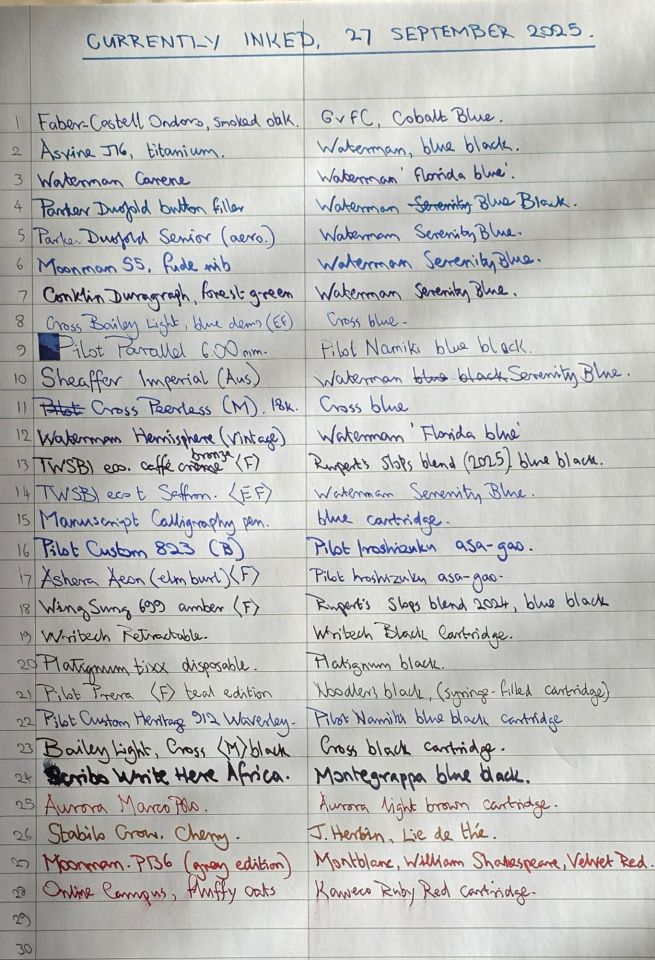
Looking back at my list of posts on this blog, I had to go back over five years to find the last time I made a Currently Inked post, in August 2020 (unless I have missed any). But reading that old post again today, I was struck by the fact that my pen cups are still “allowed to develop organically” (to put it politely), which is to say, without any strategy, rules or plan. One obvious consequence of this is that the list immediately shows my preference for blue inks. Today’s list includes two reds and two browns but very little other variety. And no greens at all, just like in August 2020!
I thought it might be helpful to share this, if only as an example of how a pen cup might lay bare the absence of method when pens are inked on a whim. There must be a great many ways in which to manage a pen collection/accumulation in a way which rotates the pens on a regular basis. I wonder how many of us have a successful system to do this, to ensure that our pen cups also have a representative selection of our ink stash, at any given time (so that we at least have one green in use for example), as well as a few different grades of nib.
Instead of such a system, my pen cups always contain a few recently acquired pens, which I am playing with and getting used to as well as some old favourites, and a mix of modern and vintage. Then there are some costly pens which I feel need to be kept in circulation to justify their cost.
Of course, we would have a faster turnover of pens in the pen cups if (a) we wrote more and (b) had less pens in use at a time. I do not like to flush pens when they are still partly full, but I have found a solution to this: I jettison the ink (unless it is black) into an ink bottle, which contains the dregs from my unfinished fills for the year. Last year’s crop produced a full 50ml bottle which I called “Slops Blend blue black, 2024”. I am using that ink daily, in my Wing Sung 699 for my diary and have been using that combination all year. It is actually a very pleasing and unique blue black! Another bottle, Slops Blend 2025, is coming along. I know that this goes against all the usual advice about not mixing inks but I have been fortunate so far. My blends have not resulted in any obvious clashes. An advantage of using predominantly blue and blue black inks, is that they can result in creating a nice new shade at the end of a year.
To impose a system on the pen cups would require (1) a list of all the pens and (2) a list of one’s ink collection to be included, and (3) a table of pairings of pens and inks alongside a calendar to show when they due for changeover.
This would sound less daunting the smaller the number of pens we keep inked at any given time. But then, if we have just a handful of pens on the go at once, although they will get more concentrated use, it will take a long time to get round an entire lifetime’s accumulation of pens.
If all this sounds like too much work for a hobby which is meant to be fun, then we (I mean I) can go on as before, just filling or flushing a few pens here and there when the mood strikes me, or when I want to use a particular ink or a particular pen.
Recently, I inked up my Waterman Carene for the first time in a long while, simply because someone in my pen club had expressed an interest in trying one. I inked it with a cartridge of “Waterman Florida Blue” which goes to show how old the cartridges were, since Waterman’s Royal Blue ink has been called Serenity Blue for many years now. Half the ink had evaporated from the cartridge, but it still wrote beautifully. I had forgotten what a good pen it is.
Whilst it may be too much work to impose a strict rotation on the use of our pens and inks, the making of a “Currently Inked” list regularly does at least give us an opportunity to take stock. It is probably a good idea to be a bit more intentional about what is inked and why and for how long. Trying to keep the number from growing too high is also sensible.
Of course this would not be an issue if we had only one or two pens and a couple of inks. Having to think how to make good use of all our pens is the price we pay for allowing ourselves to accumulate too many of them. And it is with this thought that I shall try to be mindful and sensible at our coming London Pen Show.
 Fountain pen blog
Well Rupert, impressive work and impressive collection! …but I’m pretty sure that the list is in need of a revision after the upcoming London Pen Show!
LikeLiked by 1 person
Thanks Lennart. I am looking forward to the London Pen Show. Experience tells me that I never come home empty handed!
LikeLike
Uh huh. I only have a half a dozen fountain pens but even so it’s hard to keep them all serviced and functioning. Well done and good luck with your catalog of pens and their associated inks.
LikeLiked by 1 person
Thankyou for reading, Ceci. I rather envy you having so few pens! When the numbers are in the hundreds and with several drawers full of inks, it becomes quite a challenge to use them all and certainly it is impossible to use them all extensively. Logically, that is nature’s way of telling us to cut back!
LikeLike
Uh huh. I only have a half a dozen fountain pens but even so it’s hard to keep them all serviced and functioning. Well done and good luck with your catalog of pens and their associated inks.
LikeLiked by 1 person
Rupert another interesting article.
I find myself in much the same boat as you, too many inked 18/20 and too much work involved to list all and have a clear rotation system! I equally like to use rather than flush pens even when wanting to rest them!
LikeLiked by 1 person
I expect many of us have the same issue! I like to have the flexibility to get out a pen and ink it up, on impulse, but do lose sight of the bigger picture of how the pen cups are filling- often with more of the same blue inks.
LikeLike
My currently-inked pen cup is an expression of my need for logic and order. Life may be messy, I tell myself, but in my pen cup ruthless minimalism rules. Inspired by your blog post, Rupert, I decided it was high time to re-audit my box of tools and here is what I found:
2 x Jinhao 599 transparent demonstrators with black Parker Quink
2 x Jinhao 599 blue-tinted demonstrators with blue Parker Quink
1 x green Platinum Prefounte
2 x Platinum G-2 rollerballs (one red, one black)
2 x Helix Oxford ball points (one dark blue, one rose gold)
So far so good, but on closer inspection I found I had long-ago removed the proprietary cartridge from the Prefounte (green naturally, to match the body) but forgotten to replace it. Also both my Helix Oxfords contained BLACK refills.
So I gave myself a stern talking to and ordered a green Platinum G-2 rollerball from eBay, my logic being that I use green ink so infrequently that even with Platinum’s slip and seal technology I can’t rely on a fountain pen to write first time. The Prefounte is now relegated to my backup pen cup.
The Helix Oxford ball point situation is intolerable, and what is worse one of the black refills is inside a dark blue pen. They may be “nicely weighted” (Cult Pens) but this is no time for sentimentality: into the backup pen cup they go as well, to be replaced by two Parker Jotters with matching blue and black barrels and refills.
Order is now restored, or will be when the green G-2 is delivered, and since my currently-inked cup contains only the best tools for the job then the question of rotation shouldn’t arise. However as my eyes move between my currently-inked and backup pen cups, something nags at my sense of serene satisfaction. Along with ballpoints and rollerballs, the backup cup contains no fewer than 17 fountain pens – more Platinums, a Parker, a Faber Castell, a Monami Olika and some Kaco Retros including one in a very fetching bright orange. They’re all of them good pens, just uninked and the thought occurs to me that minimalism has its price, both literally and metaphorically.
LikeLiked by 1 person
Hi Philip,
Thank you for sharing the results of this audit! I see that there were good intentions but that things had drifted a little and become lax. It is good to restamp your authority.
In my case, I had addressed only the fountain pen situation and had not looked at ball pens, gel pens, roller-balls, fine-liners, single use pens, multi-pens and mechanical pencils – which come under the category of “Everything Else.” Also my post was largely an observation, or snap-shot, of the situation as it then was, rather than offering any solutions.
I need to give this some more thought and decide on a method: whether this be to continue the status quo with little or no method, or try to impose a planned rotation or at least a schedule of regular reviews. Food for thought!
LikeLiked by 1 person
Even with my extremely modest selection of pens, I have come to accept that some will only rarely be inked whilst others will be pretty much permanently in use. As with all things in life, I am very much “boom or bust”. I’ve gone from having half a dozen pens inked up to being down to the dregs on the final one and so the question of what to ink and why has been on my mind recently. I think I will follow my heart and refill my current favourites, casting aside any guilty feelings that I should be inking up pens I haven’t used in a while. I expect if I had hundreds of pens I would be inking up the same few on repeat and the rest would be in stasis.
I love your list of blue and black inks.
LikeLiked by 1 person
Hi Pamela, Thank you for reading and sharing your own system. To “follow your heart” sounds a good policy, so you will feel at peace with the selection and not be restricted to using only what was scheduled, in a planning session from the distant past which could not have anticipated your preferences and needs at this time.
I think that perhaps, somewhere between the extremes of (a) no system and (b) a strict planned rotation schedule, there must be a moderate compromise, which offers order but flexibility. I am thinking of perhaps weekly or monthly inspections of the pen cups, to consider who goes and who stays, on a one-out-one-in basis (to keep to a desired limit). But all this is only an issue for those who had accumulated large numbers of pens and who still plan to use them. Another positive step is to downsize the accumulation, even a little, but which is easier said than done. I need some training in Not Wanting New Things All the Time, but will probably be back here in a couple of weeks posting about my pen show haul 🙂
LikeLike
“It is good to restamp your authority.”
Yes indeed. 😀
LikeLiked by 1 person
just lay back and enjoy the pleasure of having them. Paraphrasing Tolkien: “Your preciooouuuuusss!!!”. Cheers! Vic
LikeLiked by 1 person
Thanks Vic, I will! That policy sounds as valid as any!
LikeLike
Inspired by your article, I counted the pens I had inked: 24. Many more than I thought. I have them spread out in different cases and boxes. Each one has its place. I alternate between them, and it’s rare for any one to go more than five days without use. There is a core group of about six favorite pens that are almost always inked.
The rest follow a rotation sequence, so that I can use a good part of my collection. I have reached a point where some of them will probably never be inked. The problem with all this is that having 24 inked pens means I have to fill many pages. I do it with pleasure, but my cabinets are starting to look like a company archive.
LikeLiked by 1 person
Hi Miguel, Thanks for your comments. I am not suggesting that there are any right and wrong answers to the pen-rotation question. How we deal with this is a matter of trial and error, flexibility and adaptation to changing preferences and needs. Your solution of having a core group almost aways inked, then an outer circle of pens in rotation, sounds as good as any!
Having your cupboards look like a pen company’s archive, is not a bad situation!
LikeLiked by 1 person
Hello Rupert, I was interested in your method of ink retrieval. I was advides too not to mix inks, but I must say I do it on currently basis because I love some results, and in the hope of obtaining a truly persisting ink, as the precipitates formed by the mix should make the ink permanent (I use them for work, for exemple, and the parker Quink is not waterproof, so I mix it with a Red Herbin and it gives me a wonderful and very ladylike purple).
These “side effects” that we should see on the pens… what are we expecting, actually ? would the mix precipitate and clog the feed ? or it can stain the nib ?
If we mix inks of the same brand, is it less risky ? for one, I have a spring green by diamine that is far too light, with just a spot of oxford blue it give a beautyful forest green. Is it ok to do so ?
LikeLiked by 1 person