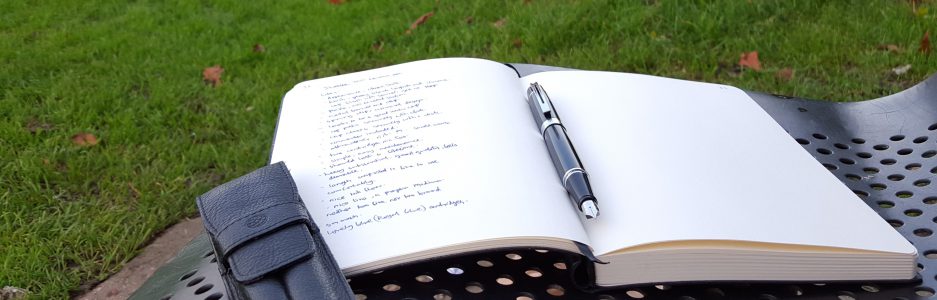
Left handed writers have a disadvantage when using fountain pens, compared to right handers. Typically, there will be less ink flow when the nib is “pushed” along the line, as opposed to being “pulled” along, writing from left to right. Less ink flow means less lubrication and a less smooth writing experience.
Secondly, if the lefty writes with a hooked wrist, there is a likelihood of smudging the wet ink as his hand passes over it.
There are two main styles of writing for the lefty: these I call “underwriting”, by which I mean writing with the pen under the line, with the back of the pen pointing towards the body, or “overwriting” where the hand is above the line, and the back of the pen is pointing away from the body. Many overwriters hook their wrists. As a lefty myself, I am most comfortable when using the overwriter style although I have my own particular method which I developed as a child and still use. Instead of hooking my left wrist, I rotate the paper about 45 degrees left (or anti-clockwise), adjusting the paper rather than my wrist.
One of the joys of using a fountain pen is the ability to produce lines of varying width. We have all seen beautiful copperplate calligraphy with attractive fine and broad strokes, adding character to the writing, such as a thickening in the tail of a lower case letter “y”.
One way ito achieve line variation is to use a flexy nib, where the tines widen as you apply pressure. However this is not suitable for a lefty overwriter as you can apply pressure to the nib only when pulling it back, not when pushing it forward.
The other way to achieve line variation, and which is more practical for us lefties, is to use a stub nib which will produce a broad line up or down, or a fine line left or right, assuming it is held at a consistent angle.
The opposite effect is achieved by using a nib with an “architect” grind, which produces a fine line in the down stroke, and a broad line in the cross stroke. Such nibs are not usually available with a new pen and so require some specialist work by a nibmeister.
However, a similar effect to the architect grind, can be readily enjoyed by using a “bent nib” where the tip is bent upwards to create a flattened, elongated writing area, again producing a fine line in the down stroke or a broad line in the cross stroke.
Today I want to highlight two of the fountain pens that I particularly enjoy using at the moment. The first is the Delike New Moon, an inexpensive Chinese pen bought on Amazon and described as having a “bent” nib. I now have three of these, in different colours. I like the effect that the bent nib has on my handwriting when I use the underwriter style, giving narrow down strokes and broad cross strokes although the difference is subtle.
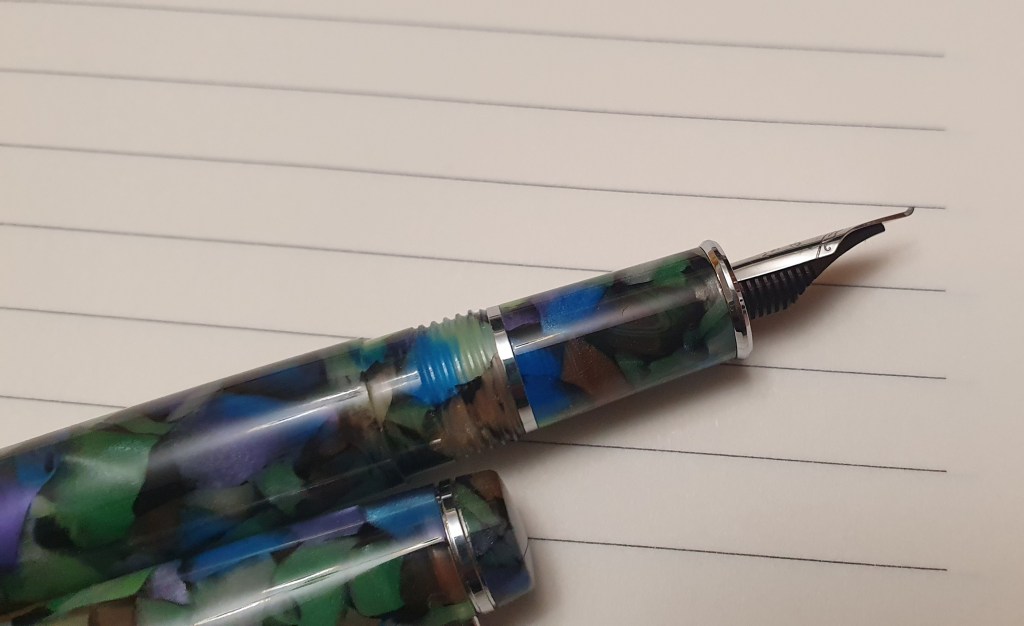
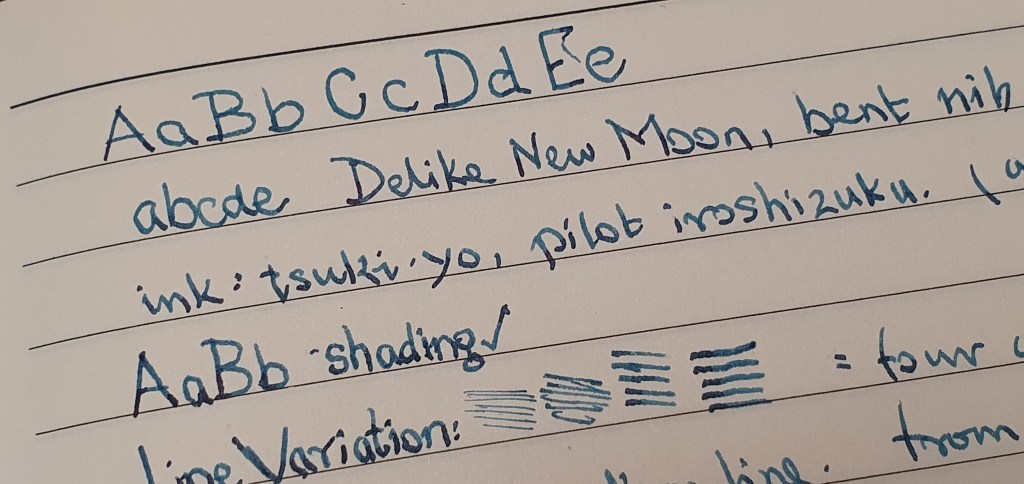
The nib is very versatile, being capable of four distinct line widths. Held normally, it writes a medium line. Hold it more vertically, and it will produce a fine line, or lay it back at a lower angle than normal and apply a little pressure and you will get a broad line. Turn the nib over and “reverse writing” will give an extra fine line, when needed.
But here is an interesting thing: the bent nib produces fine down strokes and broad cross strokes, when used in the underwriter style. But if used in the overwriter style, the fine and the broad strokes are switched. Take the capital A for example and see how the fine and broad lines are reversed, in these two writing styles.
The other pen that I am much enjoying, is the vintage Parker 17, with an oblique broad nib, bought at the London Pen Show in March this year. Ironically, at £30.00 it was one of the least expensive of the seven pens that I bought myself that day yet probably has the best effect on my handwriting.
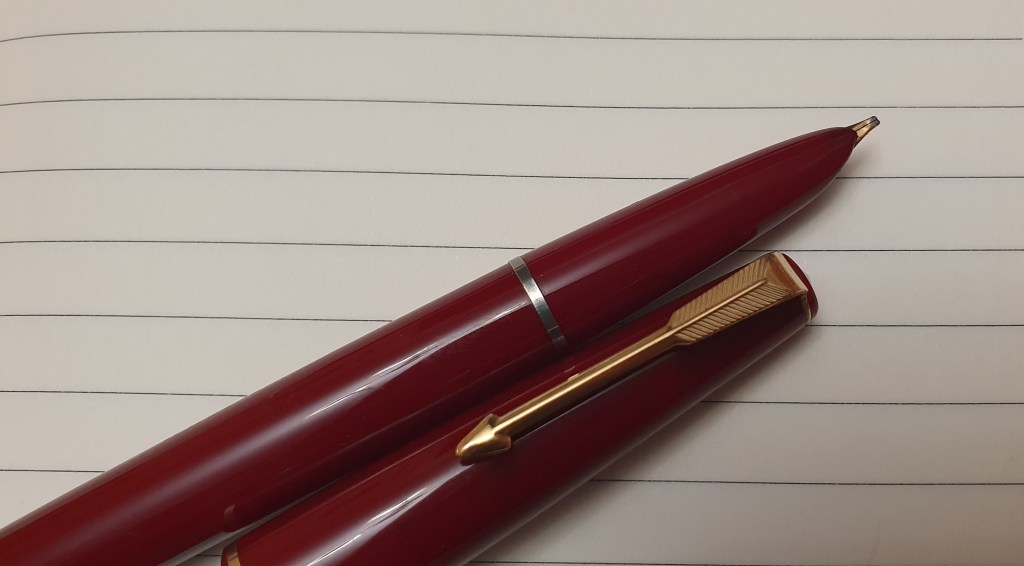
As opposed to the bent nib pen, the Parker’s oblique nib produces broad down strokes and fine cross strokes, used in an underwriter style, and the opposite if used, (as I prefer) in the overwriter style.
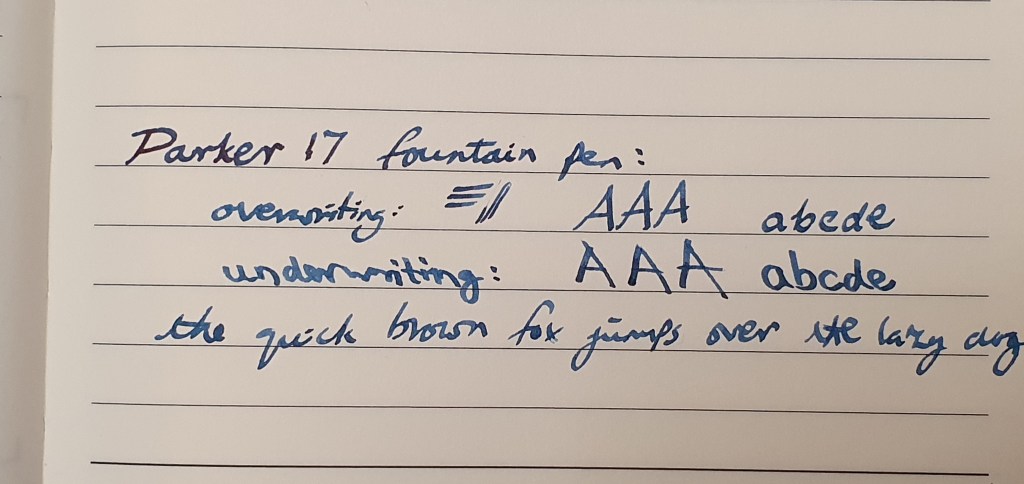
Currently, of the nine inked fountain pens in my ink cups, these are two that I reach for the most and provide the most enjoyment, out of all proportion to their modest cost. The Delike New Moon is inked with Pilot Iroshizuku Tsuki-yo, whilst the Parker 1 7 is inked exclusively with Quink Blue black. Both are very pleasing combinations. The Parker 17 with its oblique nib was a very lucky find at the pen show as medium nibs were much more common. There was a crack to the shell, just above the nib to which I applied some superglue. It does not leak and the pen writes wonderfully. The crack is still visible but in a way the pen is all the more endearing for this, rather like a Japanese Kintsugi bowl.
As well as the line variation, I also enjoy the shading from the Quink blue black ink. I need to write a bit slower with the Parker, to keep it from skipping but slowing down helps me to keep my writing more tidy and legible and reduces mistakes.
In a hobby where there can be temptations to spend ever increasing sums of money for one’s next best pen, it is worth remembering that the simple joys of line variation and shading, particular to fountain pen use and helping your handwriting to look its best, can all be had without breaking the bank.


Brilliant as usual, Rupert!
LikeLiked by 1 person
Thank you very much Lennart.
LikeLike
An interesting post, thank you. It prompts me to wonder if those whose scripts run right to left experience the same issues in reverse. Assuming they don’t have a higher proportion of left-handedness in the general population, the right-handers must have the same problems, and do they employ the same solutions.
LikeLiked by 1 person
Thanks. That is a good question and it would be interesting to know the answer!
LikeLike
Hi, Vic here, from Portugal. Welcome back, long time no see. One aspect (among others) that entices me in writing with fountain pens is that wee flimsy instant when the just released ink shines quite like enamel, right before drying into the paper and acquiring an all different look after the drying. Cheers.
LikeLiked by 1 person
Thankyou. Yes, that lasts for only a few seconds before the ink dries but it is enjoyable to see and is something that you do not get with a ball pen.
LikeLike
Nice to see you posting again, Rupert. I was starting to get worried.
LikeLiked by 1 person
Thanks Philip. Yes, I have been quiet on the blog for a while but intend to keep posting occasionally.
LikeLike
Ha, ha. Before reading your post, I filled my Delike New Moon 2 bent nibs, one with Diamine Eau de Nil and the other Waterman Mysterious Blue. It’s been nearly three years since I discovered these pens and at least one is always inked. What a find they were!
LikeLiked by 1 person
Thanks Margana. I often think of you when using my New Moon pens, and remember your epic run of repeat fills with Syo-ro. I don’t have that ink but Tsuki-yo is a good alternative. I enjoyed your recent post about bent versus fude nibs.
LikeLike
Thank you. I thought of you when writing the post and when putting together my current rotation this weekend as it has two New Moon bent nibs in it. So glad you liked the post. Tsuki-yo is very similar to Syo-ro and a good choice as an alternative. Doesn’t Iroshizuku offer some of the best colors?
LikeLiked by 1 person
I’m a lefty and I do the same thing as you! Wow, This is the first reference I have read of someone else writing like us. I was beginning to think I may need to adopt and practice a new writing technique. I have only just fallen down the pen and ink rabbit hole. I’m ecstatic! Thanks!
LikeLiked by 1 person
Thank you Connie. I am delighted that you found this post helpful.
Welcome to the pen and ink rabbit hole. I hope you enjoy finding lots of great discoveries.
LikeLike
And here is yet another lefty who writes using the overwriting style and rotating the paper 45 degrees left! I’ve been writing with my first fountain pen (Kaweco sport with a fine nib + Kaweco ink) for a year now, and I didn’t even know that there could be some difficulties for lefties using fountain pens. But of course, I only have experience on this one fountain pen and ink, but I am planning to get others. I’ve just started to explore fountain pens and inks more and I came across with these articles about left-handed writing styles. I was surprised that our writing style was not even mentioned in them. I was really glad when I found your blog!
LikeLike