Converting a Platinum Preppy to eyedropper.

20170414_145541

If you had asked me about this a few years ago, I would not have known what you were talking about. It is one of those things that I picked up from the internet. Sensing that it seemed to be one of the rites of passage of fountain pen enthusiasts, I gave it a try today for the first time.

For the benefit of other newbies, we are talking about taking a fountain pen that is a typical cartridge/converter type filler and instead removing the cartridge or converter and filling the barrel directly with ink. The benefit, supposedly, is that you have a greatly increased ink capacity and do not need to fill the pen as often.

In order for a pen to be suitable, it needs to have a plastic barrel and plastic threads and for there to be no metal parts which might otherwise corrode from sustained contact with ink. Also the barrel must have no hole at the end, for obvious reasons.

The Platinum Preppy meets all these criteria and is a good choice. It is a very inexpensive pen, (mine was £2.79 from Cult Pens) but with a good nib available in a range of widths. The clear demonstrator barrels also mean that you can enjoy the sight of your ink sloshing around inside.

On the other hand, arguments against filling the barrel with ink are that there is a risk of greater mess if anything goes wrong. Perhaps if you were going travelling and did not want to take a bottle of ink, then having an eyedroppered Preppy would keep you writing for a good while but travelling with such a pen would be a worry. So you might want to keep your eyedropper for use at home or at work. But then given that you are likely to have a ready supply of ink on hand at home and work, it seems that there is not much of a case for an eyedroppered pen either for travelling or for home/work use. Maybe it would suit students who write large amounts of lecture notes every day, provided the pen is carried with care.

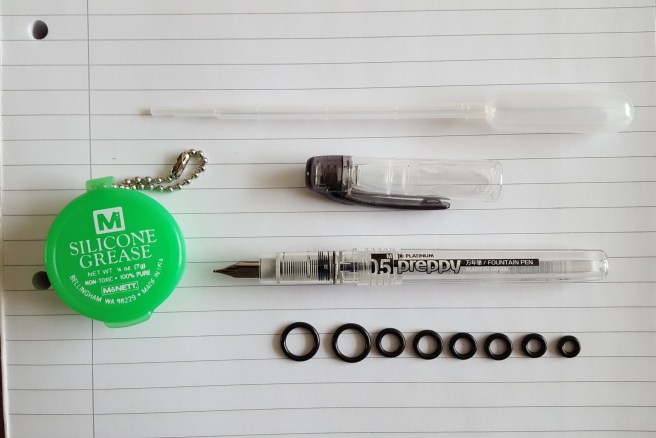
For the benefit of anyone who wants to try it, there are just a few items that you will need, as well as a suitable pen and some bottled ink, as follows:

  1. Pure silicone grease, to put in the threads.
  2. An O ring, to prevent leakage.
  3. A pipette, or syringe to transfer ink from a bottle to the barrel of your pen.

Gathering all of these items takes a little bit of hunting. I had heard that Silicone grease could be purchased from dive shops and as luck would have it, we have a dive shop in my corner of London.  The O rings can be bought in packs from the plumbing section of DIY stores. And the pipette I spotted in an art supply shop in a pack of ten.

The operation is very simple. You take an O ring,  stretch it over the threads and roll it down until it is seated at the end. I tried one of the large ones to start with, but then found that the smaller one will stretch over the threads making the rubber slightly narrower so I went with that size instead. You then take just a small amount of the pure silicone grease on your finger and smear it into the threads. Then, using the pipette, draw up some of your chosen ink and release it into the barrel.

According to an instruction video from Brian Goulet that I have just re-watched,  it is recommended that you keep the pen at least half full of ink. Also, I read on an information sheet that came with a Noodler’s Ahab pen (another good candidate for eyedropper conversion) that air in the chamber may expand from the heat of your hand and that refilling is required when the pen is down to two thirds air, in order to inhibit excessive flow.

20170414_150249

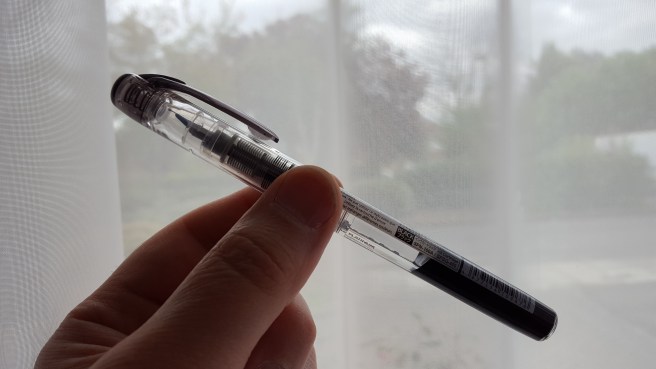
I have a Preppy with a medium (0.5) nib which writes very nicely. I had been using it recently with Sailor Kiwa-guro, permanent black ink in a cartridge which I filled with a syringe. I now planned to use this ink in the pen as an eyedropper.

On my first attempt this afternoon I had a few little issues. First I nearly forgot that the Preppy has a push on cap and I automatically started to “unscrew” the cap a few turns before realising that I was undoing the barrel and was perilously close to pouring permanent black ink all over myself. Secondly I then noticed that despite my generous application of silicone grease, ink had still worked its way part of the way down the clear plastic threads. Thirdly, the O ring was still rather too fat and so it protruded just where I grip the pen, although it did a good job of ensuring the barrel was secured pretty well. You do not want to overtighten the barrel as there would then be a risk of cracking the pen. Fourthly when I tried writing with the pen, I had a few wet blobs of ink suddenly appear on the paper.

I wondered whether this might possibly be due to a build up of air pressure as you screw the barrel onto the section, but then read the Noodlers’ advice about keeping the ink level up. I had filled the pen only half way up the barrel but went back and topped it up with some more ink until it was about three quarters full and I hope that this solves the problem.

It is rather too early to see how this is going to work out. I am very impressed with the Sailor Kiwa-guro ink and like to keep one pen inked with this, as it so useful for writing cheques or addressing envelopes. I know it is said to be fountain pen friendly, but I still feel a bit wary of having it in more than one pen at a time with the risk that it might get left to dry in the feed. I had washed it out of my Lamy AL-star and decided to use it in the Preppy instead. I like the way it moves around in the Preppy, without leaving much trace on the barrel. And unlike cartridge ink, the eyedropper method means that you do not get ink staying at the wrong end of a cartridge and causing ink starvation.

I am not sure yet whether I am going to keep the Preppy eyedroppered or go back to using cartridges. But at least it is another milestone in the fountain pen journey, to mark off the list.

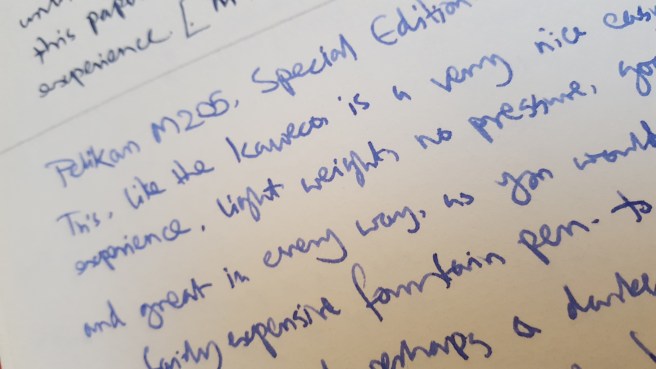
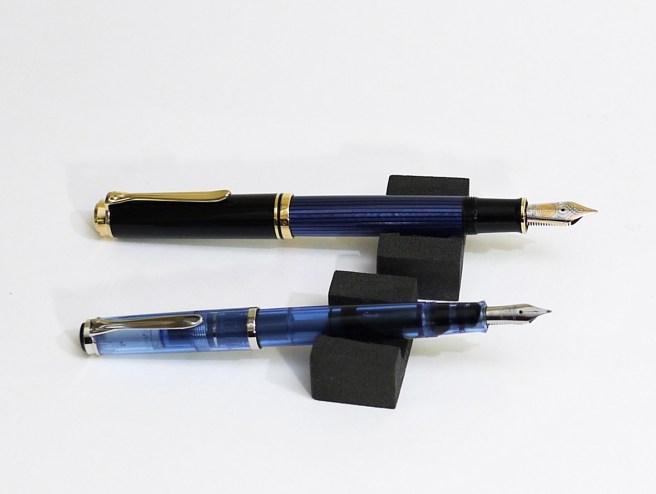
My Pelikan M205 fountain pen, one year on.

This past week marked 12 months since my purchase of a Pelikan M205. This was the 2016 special edition, blue demonstrator version. (The cropped name tag reads “Demonstrator M205, Blau/Trans. B”)

Recently I read a criticism made on FPN, levelled at some of those who provide reviews of fountain pens online, that they were often produced after the reviewer had spent little time with the pen. The inference was that the reviewer was too biased in favour of a pen still in its honeymoon period. (The thread was entitled “The Rampant Inaccuracy of Fountain Pen Reviews”; just go to FPN and search “rampant”). This ran to 125 comments when I last looked and so had clearly prompted some lively debate.

Personally, I much enjoy looking at reviews of fountain pens online, including enthusiastic ones when someone is excited with a new acquisition.  I am sure that we all make allowances for any bias that might be apparent, in order to form our own opinions, weighing up comments from multiple sources.

Nevertheless, I do take the point. I thought today would be a good opportunity to offer my reflections on the Pelikan M205 after a year’s ownership.

This was my first Pelikan. Having read much about the Pelikan M series piston filler pens, my expectations were high. And all the points that I liked about the pen when I received it, still apply a year on:-

Likes:-

  • Attractive, neat and petite demonstrator body, in a sky blue see-through material, being a little more discreet and less distracting than a clear demonstrator;
  • Piston filler; a smooth, simple, reliable, large capacity ink reservoir and with no worries of running out of ink unexpectedly; a fountain pen in the true sense, not a cartridge/converter pen;
  • Wonderful stainless steel nib, (mine is a Broad), which is smooth, wet and just nicely springy for my liking;
  • Easily removable nib and feed unit, for easy cleaning or nib-swapping with replacement nib units currently available in Extra Fine, Fine, Medium or Broad at £11.25 from Cult Pens;
  • Screw cap, which posts deeply and securely, giving a comfortable posted length of around 148mm;
  • No hard starts: the nib, feed and inner cap design and screw threads located a third of the way up the cap, combine to make a pen that is always ready, even after standing idle for several days;
  • No problems with air travel;
  • The Pelikan heritage and quality name, even though this is not part of the Souveran range.

20170409_221358

Dislikes:-

“Dislikes” is perhaps too strong a word when discussing a Pelikan pen, but for want of a better one, I offer the following:-

  • I felt that its looks, at least to the uninitiated, meant that it could too easily be mistaken for an inexpensive pen like a Platinum Preppy or a single use or roller-ball type pen;
  • It is very lightweight and lacks “heft” although this is not necessarily a bad thing;
  • When filling, ink gets “under the skin” of the nib section. In this pen, the section is not detachable but is all part of the barrel. However there seem to be two layers of the acrylic body material, the space between them being unsealed, allowing ink to seep in,  which you cannot easily clean out, even with the nib unit removed although soaking in water does clear this. I am not sure whether this is common to all M205’s or whether this is just a fault of my pen; I consulted SBRE Brown, who was aware of the issue;
  • Being aware that this was perhaps an entry level Pelikan I still harboured an urge to try one of the familiar, striped models in the Souveran range with a gold nib and one with the heavier, brass piston mechanism which meant going for an M800 or M1000.
  • The price, at the time I bought mine from The Writing Desk, was £95.00 which is approximately double the price of a TWSBI Diamond 580. The TWSBI gives the appearance of being a better quality pen, with its faceted, polished barrel and larger proportions. I do however appreciate that it is unfair to compare pricing of German made pens with those from the Far East.

From a quick glance at my pen cup, (sixteen pens today), I note that the M205 is the only one of these that has remained inked continuously for the past 12 months, while others have been in rotation. I had used it exclusively with Waterman Serenity Blue ink, which in my view is an excellently behaved ink and reasonably priced.

On its 12 months’ anniversary, I filled the pen with Waterman Harmonious Green, an ink which I also like very much. However, in the blue M205 it just seems “wrong” and I plan to go back to the Serenity blue, ironically, to restore harmony to my pen cup.

Perhaps the greatest testimony of my appreciation of Pelikans, is that I have since bought a new M800 and a vintage M400 for myself, plus another M205 (in Aquamarine) as a getting-a-place-at-University gift for my neice.

I do enjoy my M800 and M400 too and each has its particular attributes. Yet the M205 still retains a special place in my collection and will always be my first Pelikan.


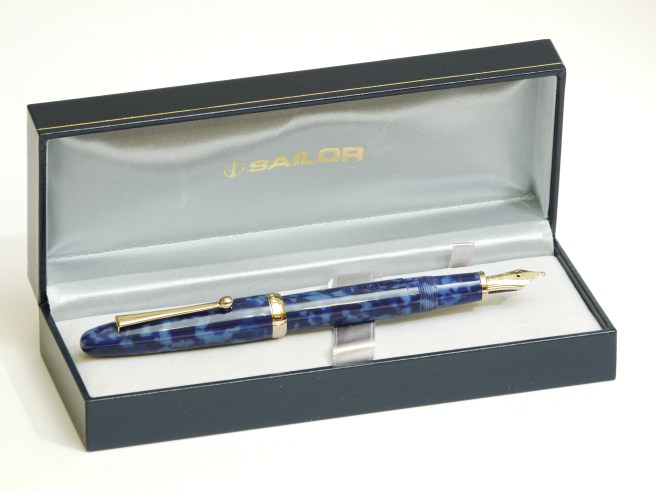
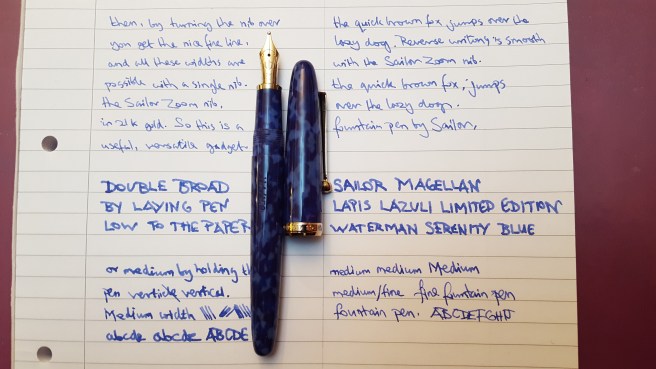
My Sailor Lapis Lazuli Limited Edition with 21k Zoom nib.

P1100991

I have put off doing a post about this pen because, frankly, I did not know quite what it was. I bought it on a bit of an impulse, during a live auction in January without having inspected it.  It is not a current model.

I did know that Sailor fountain pens and nibs are very well regarded. I have not owned one before, but had a brief look at a new Sailor Pro Gear at the London Pen Show in October and was very taken with the 21k gold nib.

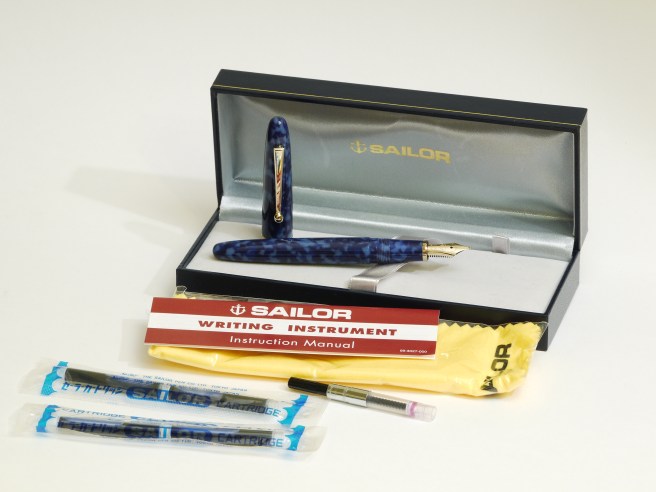
There was brief description of the pen on the auction web site and a few photos. It was described as a limited edition, number 114 of 150, with a 21k gold nib. The pen was boxed, with original Sailor cleaning cloth, two packets of two cartridges and the Instruction Manual. It included a converter and was said to be inked, which was a worry but also rather appealing to someone who loves to clean pens.

P1100986

Having successfully bid for the pen at auction, I went to Hampstead Auctions the following day to collect it. At the same auction I had bought the lovely 1950’s Pelikan M400 tortoise and over the following days it was the Pelikan that got more of my attention.

The Sailor was in a good condition, save that the nib and feed were encrusted in dried ink and the converter almost cemented into the section. However, with a bit of soaking, the 21k gold nib cleaned up spectacularly, like new. I was also able to get the converter out and give it a good clean, as it still had remnants of blue ink inside. I was not familiar with the Sailor converter which has an unusually large opening, like the proprietary Sailor cartridges.

The cap, section and barrel are all of a mottled light and dark blue resin. The number 114/150 is stamped on the barrel. The cap band reads “Sailor Japan founded 1911.”  The barrel does screw on very securely to the section, as a result of an O ring and so there is no danger of it coming unscrewed in your pocket. The pocket clip ends in a large ball, which gives a bit of a clue in this case, as to what you find at the tip of the nib.

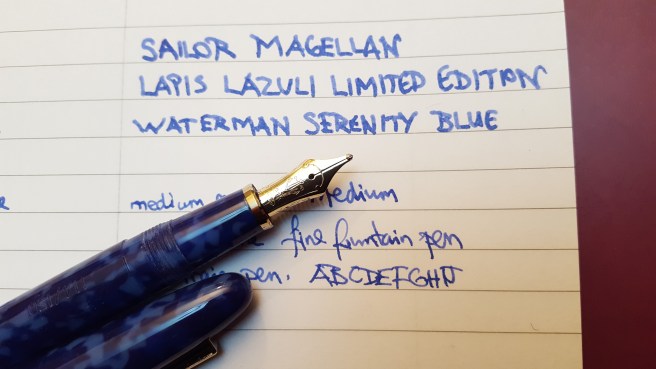
The nib, bearing the Sailor name and anchor emblem and “21K” has a “Z”on the side although I confess that at first I thought this might be an “N” the other way up. Clearly, the nib looked to be very broad, with a giant blob of tipping material. I assumed it to be a Japanese double broad or similar.

I filled the pen with Diamine Oxblood and gave it a go. Immediate impressions were that the nib was (a) extremely smooth and (b) extremely broad. In fact it was too broad to use for my usual smallish handwriting but well suited to writing headings in capital letters. Apart from trying it out a bit, I did not put the pen into regular use and instead, cleaned it again and returned it to its box.

I was keen to try to find out what model it was and how old it was. The Instruction Manual was generic for a range of different writing implements. It did have a number in the corner, 99-3027-000 which I guessed might perhaps indicate that it was issued in 1999.

Revisiting the pen earlier this week, I googled “How to identify a Sailor fountain pen” and was taken to a thread on Fountain Pen Network. Following the trail I was thrilled to find an entry from 22 June 2005 by “The Noble Savage” with photos of the same model, described as a Sailor Lapis Lazuli Limited Editions, bearing number 127/150! I understand that it is based on the Sailor Magellan but with a different colour and name. It is unclear when it was introduced but I read opinions that it was in the mid 1990’s or early 2000’s.

I was also interested to discover (and you probably knew this already) that the nib, with the “Z” mark,  is called a Zoom. Rather like a zoom lens gives you a range of options, this nib has multiple surfaces which give differing line widths. It has a large blob of tipping material and the main writing surface on the underside, is in a triangular shape and slightly convex, with the apex of the triangle at the tip of the nib. Thus, if you hold the pen towards the vertical as you write, there is a narrower surface touching the paper whereas if you lay the pen down low, there is a very wide surface area of tipping material in contact with the paper, giving you a very broad line.

Naturally, as soon as I read this, I could not wait to ink the pen again and try this out for myself. This time I went for the familiar Waterman Serenity Blue. The serene sailor.

Well, it certainly works. What you have is a gadget, a handy multi-purpose nib that you can use to create a range of lines from fine to double or triple broad. I found that using the reverse side of the nib gave a nice fine line for general purpose writing whilst the normal writing position gave a broad line, which can be made even more broad by lowering the back of the pen towards the paper. It is fun to try.

wp-1491001890776.jpg

FPN-ers had varying experiences with this. Some did not get on with it and preferred to exchange the nib. Others compared it to a music nib, such as is available from another Japanese pen company, Platinum, but which has two slits and gives a wide, crisp line one way or a very narrow line the other way.

I can see that it has its uses. Perhaps it is more suited to writing Japanese characters or for being held upright like a calligraphy ink brush.

Whilst they had not appeared on my radar until now, I see that Sailor Zoom nibs are still available although the Sailor Magellan is no longer made. I gather that it was sold with the option of a Titanium nib or 14k or 21k gold. Like a music nib, the Zoom nib is good for blocking in large areas of ink quickly if drawing but is rather a specialised tool and not ideally suited to normal writing unless you happen to have huge hand writing and like a double broad line.

I would be interested to hear your comments if anyone can provide more information on this model or share their experiences of the Sailor Zoom nib.

wp-1491001922297.jpg


Paperchase cartridge pen and coloured ink.

wp-1490478585289.jpg

Happy Mothers’ Day, from London. Also, the clocks went forward today. Spring is officially here and we are now in British Summer Time and enjoying lighter evenings.

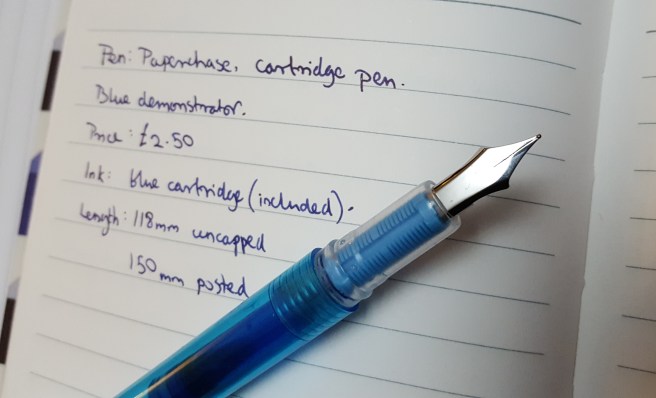
Today’s splash of colour comes from a recent visit to my local Paperchase stationery shop. As well as selling Cross, Kaweco, Lamy and Parker fountain pens they have a few of their own brand cartridge pens. I have tried three different models since July 2016, costing up to £6.00. This current blue demonstrator model is just £2.50 including three blue cartridges.

For this, you get a lightweight, plastic pen with a snap-on cap. The plastic pocket clip is quite springy and functional. The cap posts securely, giving a posted length of 150mm. The steel nib has no markings or breather hole but does have tipping material. It also has a wick between the nib and feed to help with ink supply. I would describe the nib as a medium.

The section is clear plastic and through this you can see the feed which is of a light blue plastic.

The pen takes a standard international cartridge but does not have room for a spare. The barrel has a hole at the end and so unlike the Platinum Preppy, this pen could not be converted to an eye-dropper fill.

Inking it up for the first time, it took a while and a bit of shaking before ink reached the nib but once it did, the writing experience was surprisingly smooth and I had no complaints about the ink flow. In fact it wrote with hardly any pressure. Do not expect a flex nib but you can get a little bit of line width variation, between sideways strokes with no pressure and downward strokes with some pressure.

wp-1490478934657.jpg

The pen also does reasonably well at starting up again after a few days of non-use, despite the absence of an inner cap.

At this price, it seems unfair to find fault but there is a sharp-edged step from the barrel down to the section which is rather uncomfortable, just where most people would grip the pen. Perhaps this was necessary in order to form the seal between the barrel and the snap-on cap but the comfort would be much improved if the moulded barrel could have a smooth edge.

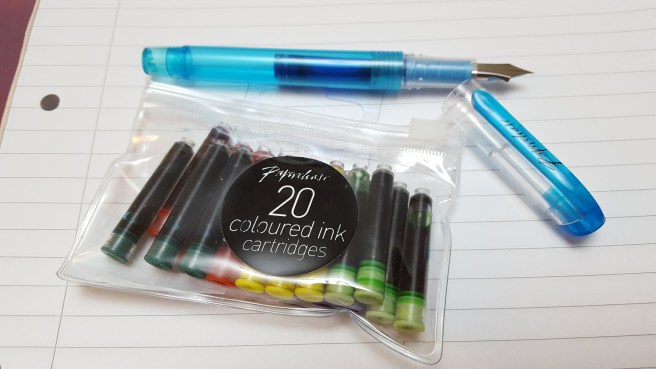
Other than that, it is a colourful, handy and satisfactory little pen. I found that Paperchase also sells cute re-sealable bags of 20 coloured ink cartridges for £1.50 (as well as all black or all blue options) and so for a grand total of £4.00 you would be able to get by for a few months if you suddenly found yourself separated from any other writing implements. More likely perhaps, if you arrived in town and found that you had forgotten your preferred fountain pen, then a quick visit to Paperchase would get you back up and running for a minimal outlay.

wp-1490478645523.jpg

For accuracy, I should say that the coloured ink pack did not include blues, but there were three included with the pen. There were actually two more greens in the pack of 20, but instead I used the remaining blues for the rainbow.

I have not yet tried all the coloured inks. What I have learned though, is that “standard international cartridges” means standard in size and not ink quality and so if you have a preferred brand of ink cartridge of the same size, you may prefer to use an ink that you know. However, at just seven and a half pence per cartridge, you cannot really go wrong with these and there is a certain pleasure to be had from experiencing such a modestly priced combination of pen and ink.


Inky pursuits: my weekend round-up (2)

This weekend has seen some more inky goings-on which, taken on their own, might not be blog-worthy but together seem worth sharing in a round-up.

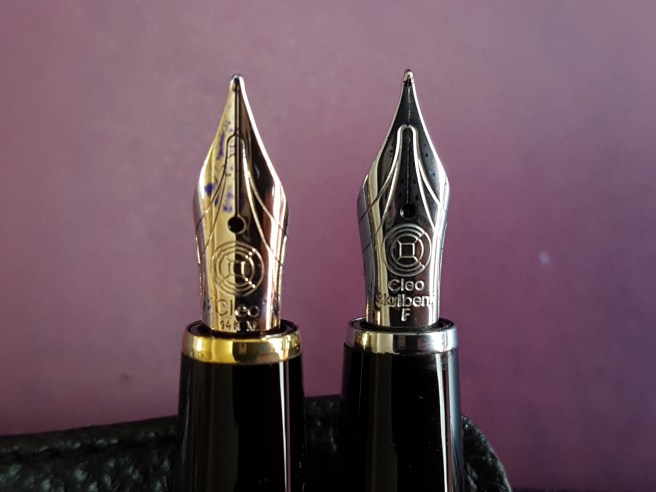
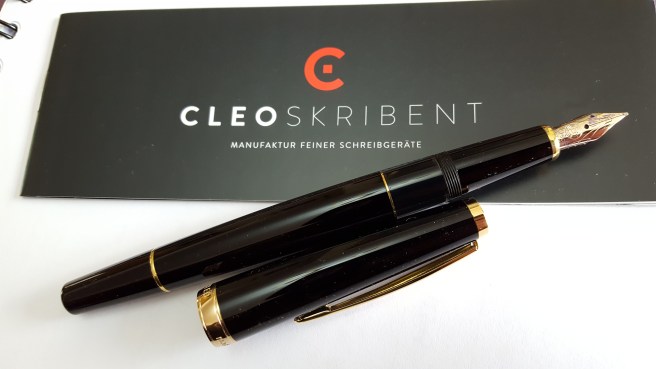
I am still delighted with the Cleo Skribent, piston filler fountain pen, four weeks in. I can genuinely say that I feel happy every time I remember it. The first fill, with Aurora Blue was still not quite finished when I ordered a bottle of Monteverde Napa Burgundy and decided to flush the remains of the blue, to have an ink change.

While flushing the pen, I decided to try removing the nib and feed. I had not yet found any guidance on doing this and was anxious not to cause any damage. I found that they are friction fit and came out very easily, when gripped together in tissue paper and pulled out straight. It is great to be able to rinse a nib and feed or remove the nib for any minor adjustments. To replace them, you just need to line up the nib and feed correctly, holding the nib on top of the feed centrally and with the right length of tines protruding beyond the end of the feed and then gently rotate them in the grip section until you locate the right way to push them back in.

20170319_233749.jpg

Whilst the pen was empty, I dipped it in three different inks to see how they would each look from the fine (more like extra fine) nib of the Cleo Skribent. I tried Pelikan Edelstein Tanzanite, Waterman Harmonious Green and then Diamine Conway Stewart Tavy, which is one of my favourite blue-black inks. I tried these on three different papers in turn. The Tavy gave a slightly bluer shade than the Tanzanite.

I then had the idea of seeing whether any of my pens had nibs which were interchangeable with the Cleo Skribent. The nib looked to be about the same size as the nib on a Kaweco Sport, a Cross Apogee or a Monteverde Artista Crystal. All of these are friction fit and are removed just by a careful pull of the nib and feed together, taking care not to damage the delicate feed. The nib on the Cross Apogee is 18k gold with a silver-coloured plating. However, once removed from the pens, the nibs of the Cross Apogee and the Kaweco Sport were both shorter than that of the Cleo Skribent.

The nib on the Monteverde Artista Crystal appears to be same length as the Cleo Skribent and so I think it would be possible to use that in the Cleo, if I wanted a Medium nib option. However, for now, I kept to the Cleo’s own nib.

wp-1489966399601.jpg

On Friday, I received an exciting package from Cult Pens, including the Monteverde Napa Burgundy ink that I had ordered. It came in a 90ml bottle and boasts a special formula, which they call ITF (Ink Treatment Formula). This, it is claimed, “drastically improves ink-flow quality, extends cap-off time, lubricates and protects the ink-feeding systems from corrosion and clogging and improves ink-drying time on papers.”

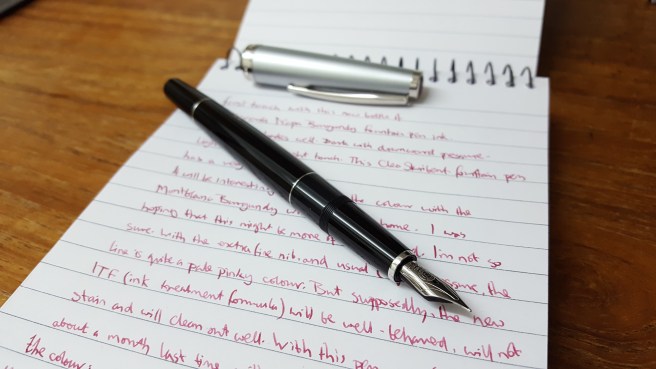
Whilst this all sounds very commendable, I soon found that the colour when paired with the very fine nib of the Cleo Skribent, looked a rather pale pinky-brown rather than the rich dark burgundy red that I had hoped for. I will try it in a pen with a broader and wetter nib but meanwhile decided to flush it from the Cleo.

wp-1489968067149.jpg

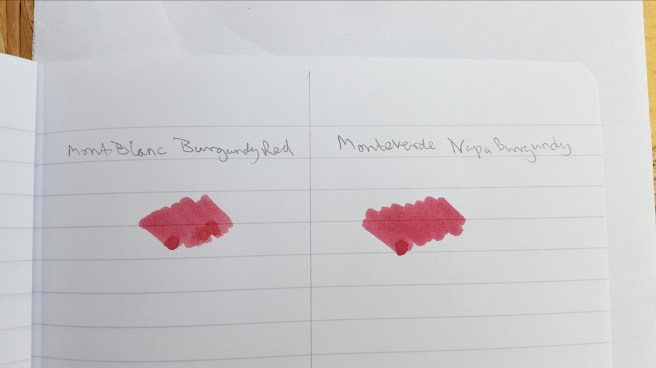
Furthermore, I did a very quick swab test comparison of the Monteverde Napa Burgundy with a Mont Blanc Burgundy and found that they appear pretty much the same colour. Others may conduct a proper and thorough comparison but to my eyes there is little to distinguish them in terms of colour on the page and if I was shown a sample of only one of them, I would be hard put to say which one it was. Of course, the other qualities listed above should also be evaluated and not only the colour. Anyway, happiness was soon restored once I refilled the Cleo, with the Tavy ink that I had sampled earlier.

wp-1489966853824.jpg

On Saturday, I spent the day at a church in Flackwell Heath, Buckinghamshire, hearing first hand about all the excellent work of a UK registered charity, Jubilee Society of Mongolia. The talk was hosted by the church which has supported the organisation since it was founded. Two Mongolian ladies from the organisation had come over to give a presentation, celebrating its 15th anniversary.

After hearing about all the very important and valuable work that the charity is doing in Mongolia, it seems rather shallow to tell you only that I took notes all day, using a Sheaffer Sagaris in the morning and then the Cleo Skribent in the afternoon. Both pens were excellent for note-taking and did not dry out if uncapped for a while.

Also in that package from Cult Pens, as well as the burgundy ink, was my new Lamy AL-star in the Pacific Blue, special edition for 2017. I had not seen these in the shops yet. The colour and finish are very appealing. Cult Pens offers a choice of nibs, in Extra Fine, Fine, Medium, Broad and Left Handed. I was rather intrigued by this last option and telephoned to ask what it meant, before ordering. Was it an oblique nib? Or one which was adjusted to write wetter for lefties? And what nib width was it? I was told that it is simply a bit more rounded and forgiving for people to hold the pen at different angles. Being a leftie, I decided to try one. I also ordered a pack of the matching Pacific Blue cartridges.

I tried the new pen and ink as soon as they arrived. I love the colour of the pen and the ink. I thought the ink to be quite similar to Pilot Iroshizuku ama-iro. However on comparing them side by side, the Pacific Blue is clearly lighter than the Ama-iro.

wp-1489967142656.jpg

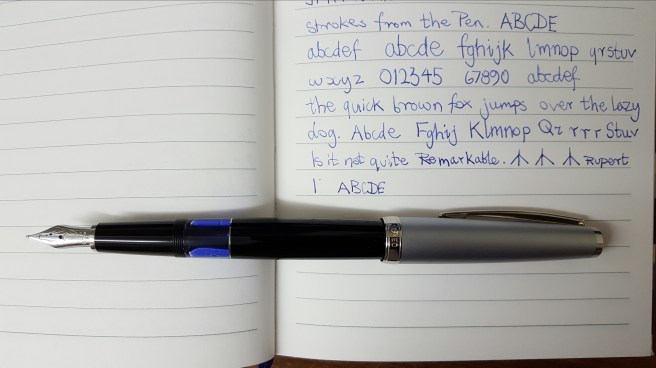
As for the nib, I had  close look at it under the loupe. It has the letters LH on. There is generous amount of tipping material and the nib was usable straight out of the box, but a little skippy. I suspect it just needed to wear in. However, being impatient to enjoy the new pen and ink, I swapped over the LH nib for a medium nib from one of my Safaris and this is now writing very nicely and is the nib used for the writing sample pictured.

With this new Pacific Blue AL-star to brighten my pen cups, I now have seventeen fountain pens currently inked and need to bring this down.

This week I have one day out on a continuing professional development course. I am looking forward to taking notes with the Cleo Skribent again and possibly the Lamy AL-star Pacific Blue for annotating the handouts.

wp-1489966543149.jpg


Paperchase A6+ Flexi Linen Notebook review.

wp-1489261822080.jpgMy liking for notebooks goes back to childhood when it was a treat to visit Arthur Birds, our local independent stationer and book seller in Ickenham, a villagey suburb on the outskirts of London. Then, as now, I appreciated good quality and for a notebook, that included having stitched binding so that you could open the book flat without risk of the pages breaking loose.
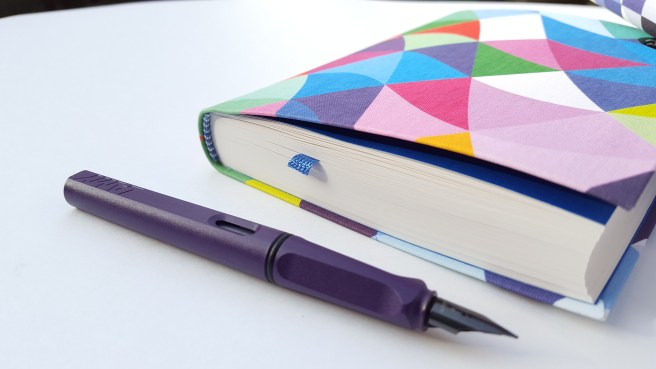
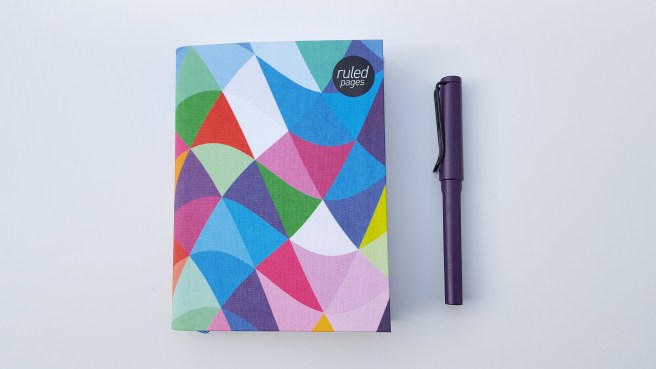
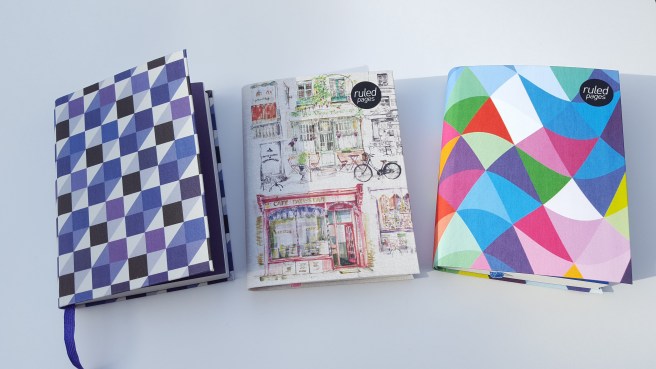
Today I am looking at a notebook from Paperchase. A sticker on the back cover describes this a COLOURED SQ GEO A6+ FLEXI LINEN NOTEBOOK. They are made in the UK and sell for £8.00. Happily I picked up mine for £4.00 during a sale.

The “coloured sq geo” refers to the cover design and there are several other options. This one consists of a geometric pattern of squares in shades of purple and white. It also  has purple endpapers, a matching purple bookmark and purple headband (the pretty piece of material like a small caterpiller at the top and bottom of the binding).

wp-1489261874981.jpg

The book contains 320 ruled pages of almost white (ivory?) paper, with a pleasantly generous line spacing. There are 17 rows to a page, measuring 137mm (not including the top and bottom margins) and so this means each row has a height of 8.059mm. Personally I find this ideal as I am not so keen on narrow line spacing.

I should mention that the book is actually larger than A6. I assume that this is why it is called A6+. The pages measure 163mm x 119mm and the covers are slightly larger all round, to protect the paper. This is a very useful and convenient size to carry in a bag or large coat pocket without being too bulky and heavy.

The cover material is hard to identify. It does have a pleasant texture and the covers are flexible, but I am not sure if it is linen. Whilst it has a cloth-bound feel, I would guess it to be some sort of man-made material, but whatever it is, it is nice to hold and feels tough and hard wearing.

wp-1489261835547.jpg

The binding, I am delighted to say, is very well done, with 10 sewn batches of folded leaves and a pleasing, rounded fore edge to the leaves. The book can be flexed in the hand as you flick through the pages, yet the cover seems sturdy and protective. All in all it feels very well made.

The paper is very smooth to the touch and of an ideal weight, being neither too thin and see-through nor too thick and stiff. The weight is not stated. I would guess it to be a little heavier than your typical 70 or 80gsm office paper and so perhaps somewhere around 100gsm.

For the fountain pen user, the paper is smooth and I have not experienced any feathering or bleeding with any pen and ink combinations that I have tried so far. Show-through is minimal. I would describe this as fountain pen friendly paper.  I would just caution that if you have a very smooth, highly polished nib, it may skate around on this paper and struggle to lay ink down. I think it needs a nib which is a little “toothy” to make the best use of this paper. Recently I have been enjoying a new Cleo Skribent piston-fill fountain pen with a stainless steel, fine nib. The paper is not overly absorbent and the ink does not spread and so a very fine nib does produce a very fine line. The nib on the Cleo Skribent is quite amazing and with no pressure will lay down a line on even the smoothest of papers.

When I buy a new notebook I like to try out a few different pens on the back page to check for feathering and bleeding and general fountain pen friendliness. I then like to paginate it, with pencil or ballpoint pen so that I can go through the whole book quite quickly.

I was sufficiently delighted with this book to go back for two more, even though these were back at the usual price of £8.00. For the many hours of use that I will get from 320 pages, I think this is great value these days.

wp-1489261889968.jpg

Inky pursuits: my weekend round-up.

20170306_190226.jpg

It is remarkable how soothing and therapeutic, the simple act of using a fountain pen can be. It does not even have to be proper writing. Just putting pen to paper and enjoying the flow of the ink from the tines is enough. A particular delight is to observe the ink flowing as you write, with a  magnifying glass or illuminated loupe.

For the past two weeks I have been greatly enjoying my new Cleo Skribent piston filler fountain pen (shown above). It is still on its first fill, of Aurora Blue, but I am wondering whether to try a darker ink next time, as the nib is so fine. I will try to be patient and wait until it runs dry.

After a busy week I also find it relaxing to ponder what ink changes to make next. On Friday evening, I decided to put Sailor Kiwa-guro black pigment ink in my black Platinum Preppy. The Preppy has a good inner cap and seemed an ideal choice for this ink. Not long ago I had syringe-filled a cartridge with this ink for a Berol Handwriting pen, but was not altogether happy with the writing experience, but it was easy to switch the cartridge into the Preppy and flush the Berol. I then pottered about trying the ink on various papers and notebooks and was much happier with it in this pen.

On Saturday morning, I decided to try a black ink in my burgundy Platinum 3776 Century. I had for many months been using Waterman Harmonious Green ink in this pen, which shades beautifully. However, some time last week I had switched to Mont Blanc Burgundy Red in the 3776, thinking that this would be a clever match for the burgundy pen. I was not very taken with the result. The ink did have some shading but overall the rather subdued, lighter pinky-brown tones did not look as exciting as I had hoped.

So, I wanted to try a black ink that would replicate the shading that I had enjoyed from the Harmonious Green, but provide a few (ahem) shades of grey. I spent a happy hour or so dipping the 3776 in Parker Quink Black, then Waterman Intense Black and finally, Cross Black archival ink and examining the results on some different papers. I settled upon the Waterman ink and filled it up. The shading was not as pronounced as I had envisaged but the writing experience was very smooth and satisfactory.

On Saturday afternoon, I took the underground to the West End to meet my wife and to have a look around a few pen shops, which I had not visited for a while. First, I took her to  Campo Marzio at 166 Piccadilly, (near The Ritz Hotel), where we enjoyed browsing their colourful displays of pens and inks and accessories. I was tempted to buy another Acropolis fountain pen as the green marbled resin version looked so appealing, (imagine this filled with Harmonious Green!) but held back for now. My blue version is a favourite.

Next we walked up the Burlington Arcade to visit Penfriend. I had brought along my Sailor fountain pen bought at auction in January, hoping to get their help to identify the model and year. I was shocked to find that the shop had closed down and the inside was bare. I looked on Google and found an announcement stating “We have now closed both our shops in Burlington and Fleet Street however we are defining what the next steps are for our business” and giving an email address to keep in touch.

Back in Piccadilly, I went to have a browse in the pen department of Fortnum & Mason. The pen department had been rearranged a little when I was last there, before Christmas, but this time it had moved from the first floor completely. I met one of the sales assistants, who told me that the fountain pens had been moved up to another floor. I went up to have a look but the pen counters seemed to have been reduced to a couple of displays, although still included Visconti and Yard-O-Led.

After a nice fish and chips lunch off Regent Street, we took the tube from Oxford Circus to Knightsbridge, to have a look at Harrods. Their Great Writing Room, is probably one of the finest fountain pen departments in London. At the Visconti table, I was able to handle the Homo Sapiens, bronze model and was surprised that it did not feel at all as I had expected. I thought it would be more like pumice stone but it was smooth and rubbery. The sales assistant showed me how flexible the 23k Palladium Dreamtouch nib was, by pressing it down gently against the glass counter to spread the tines.  It was not inked but you could imagine the lovely broad strokes that might be achieved from such a nib. She told me that the material absorbed moisture and might discolour in time but that you could treat it with handcream! That sounded rather unusual advice for fountain pen care but then this is a unique pen.  I must admit, I was tempted to treat myself to one on the spot but it seemed too impetuous for such a costly pen and I managed to refrain from buying one, (for now).

At the Faber Castell corner, I spotted the Garnet ink in its gorgeous bottle and tried to remember the gist of a friend’s recent review that I had read of it. Finding the review, I was reminded that it had many good qualities but was perhaps not sufficiently different from the Mont Blanc Burgundy Red (that I already owned), to justify a purchase.

Back home that evening,  I found a couple of good YouTube reviews on the Visconti Homo Sapiens from Stephen Brown and Brian Goulet . Interesting though it was to learn more about the pen, its nib and filling system, I was pleased that I had not rushed to buy it in the afternoon before doing more research and looking at other options. Sometimes, buys which seem such a good idea at the weekend can leave me feeling a bit guilty and regretful come Monday.

This is where a wish list comes in very handy as a sort of holding reservoir, where I can let my desired pens sit for a time, while I weigh up the pros and cons. This way, I hope to make more considered decisions and to make purchases that  will give lasting enjoyment.

On Sunday afternoon, I had to pop in to our local shopping centre to return a new rain coat. I do not always get that right first time, either.


Cross, but no longer alone.

Here is a short, true story with a happy ending.

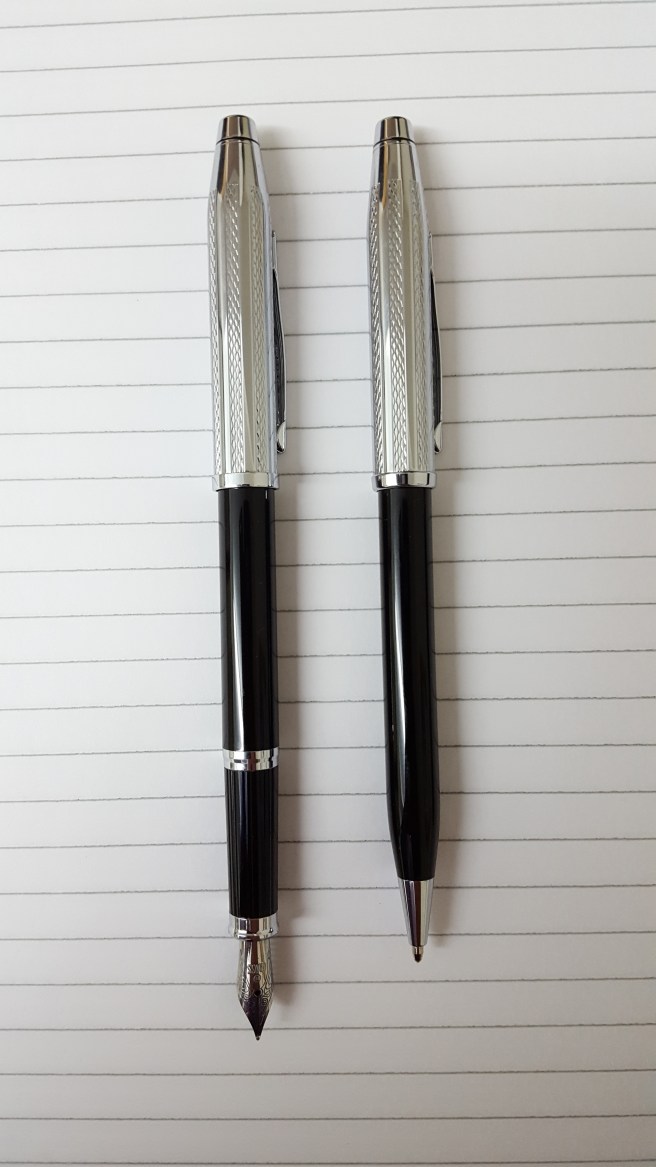
Back in November, I bought a Cross Century II fountain pen, the black lacquer with chrome cap version. This was the subject of my blog post of 30 November (see link:  Cross Century II, black lacquer and chrome cap ). I had bought only the fountain pen, although I had seen them offered for sale previously with a matching ballpoint pen.

I loved the look and the weight of the fountain pen and enjoyed using it, despite the very slender grip section. Currently, I have it inked with Waterman Mysterious Blue. The nib seems to have a rather narrow sweet-spot and so is better for sustained use, where you can hold it at a consistent angle, rather than for picking up, writing little notes and putting down again frequently.

A month or so later, I visited the same shop where I had bought it and spotted the matching ballpoint pen offered for sale, at £40.00. I thought about it for a while but resisted.

However, on later trips to the shop, I kept checking to see whether the ballpoint pen was still there and kept seeing it at the back of a glass display case, gleaming under the little spot-lamps. It began to bother me, that I had the fountain pen but not the ballpoint.

I rather surprised myself at how much this bothered me, such that after three months, I finally decided to buy the ballpoint and got out my £40.00. However, the assistant was unable to find the box and without this to show the necessary bar code, was unable to process the sale. Another lady came downstairs to help but despite a thorough search of the pen cupboard, they could not locate the missing box.

It occurred to me that I might have it, since the fountain pen that I had bought in November does come as part of a set. I told them this and they asked that I please bring in the box to show them.

And so the following day, I brought in my Cross Century II box and there found that the sticker on the box and the receipt (which I had put inside) clearly referred to the item being a fountain pen and ballpoint pen set. And so it turned out that my box was the one that it should have been in. Not only that, but I had already paid for the set. Yes, I should have studied the receipt more closely.

Faced with this evidence, the staff cheerfully told me that the pen was mine and that no further payment was required. The fountain pen and ballpoint pen had been separated for three months but are now reunited.

See how nice they look together.

wp-1488289755557.jpg


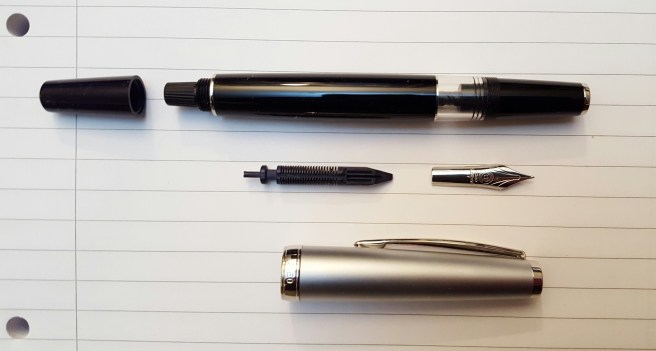
Cleo Skribent Classic Metal, Piston fountain pen review.

cleo-1

It was a joy for me to find another German brand of very nice fountain pens recently. If  you have not heard of these pens before, then I recommend them to you.

My story begins a week ago when I was browsing on Cult Pens’ web site, looking at the long list of brands and noticed the name and logo of Cleo Skribent. Clicking on this out of curiosity I was taken to the page showing some of their range of pens.

The one that caught my eye particularly, (and which is the subject of this review) was a piston filler, with black barrel and brushed stainless steel cap, described by Cult Pens as a beautiful lightweight piston-filling fountain pen.

Some decision making is required as there were three options. The steel cap version comes with a stainless steel nib. But for a little extra, you may buy the 14k gold nib version. However, you no longer get the brushed stainless steel cap and instead have an all black pen with palladium fittings. This will not match the gold nib (if that is important to you)  but there is a further option, for another increase in price, to have the 14k gold nib, all black pen and gold coloured fittings.

All three versions have the same large clear ink window, which appealed to me. What was not apparent from the Cult Pens pictures is that the pen has a blind cap which you unscrew to access the piston turning knob inside.

20170218_141157_001

I successfully resisted ordering the pen on first viewing, to weigh up the pros and cons of the three similar models. Instead, I added a Cleo Skribent to my “wish list”. (This is not just a figure of speech but is now a spread in a bullet journal where the Cleo Skribent had to compete with, amongst other things, a Kaweco Dia 2 and a Pelikan M120N).

Meanwhile I looked for more information about Cleo Skribent. I found some favourable reviews where the stainless steel nibs were given particular praise. I found on Amazon that there was also a bordeaux option and some cartridge-converter options although I preferred the piston filler. I also found the company’s own web site and another very informative article by Jim Mamoulides on PenHero.com including the company’s history.(See link: Cleo Skribent history).

The choice of gold or steel nib, particularly given the fairly modest difference in price, was a case of head versus heart (head saying go for gold but heart saying that I prefer the brushed steel cap with steel nib) but in the end it was the brushed steel cap paired with the black barrel which won me over. Although this meant settling for the stainless steel nib, the positives were (a) I had read good reviews of the stainless steel nib, (b) its colour would match the brushed stainless steel cap (c) it was in my eyes, the most pleasing of the three to look at and (d) also the least expensive.

After the Cleo emerged victorious from its brief stay in the wish list, I looked again at the Cult Pens site. The prices of all three piston filler models had come down, since I had last looked! So on the Thursday night, I put in my order.

The parcel arrived on Saturday morning, which was ideal. First impressions were all very favourable. There is a nice black gift box with plush grey lining and colour booklet.The glossy black barrel does look very handsome paired with brushed stainless steel cap. In the cap, there is a finial with the Cleo Skribent logo in red on a black background. The pocket clip is usefully tight with a generous range of movement. The polished cap band, contrasting with the brushed finish of the cap itself, reads “CLEO  made in Germany”.

cleo-5

The cap unscrews with two twists, to reveal the plastic threads on the section and the large clear ink window, which is fully concealed when the cap is on. The black, grip section tapers down towards the nib, ending with a chrome decorative ring.

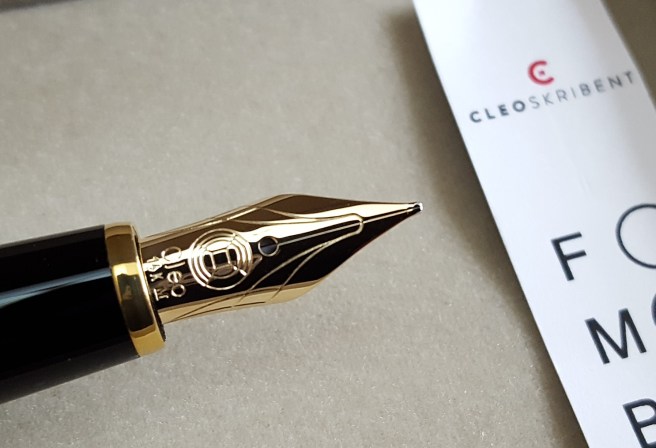
The nib looked very nicely made. I had chosen a Fine. There is some attractive scroll work and the markings “Cleo Skribent F” beneath the logo. All looked good. The tines were even and symmetrical and the slit narrowed from the breather hole down to the tip. The black plastic feed looked streamlined with the delicate fins housed on the inside so that the exposed side of the feed was smooth. I do not yet know whether the nib and feed are friction fit and can be pulled out for cleaning or nib swapping but if so, then the absence of delicate fins on the feed reduces the risk of damage.

This is an unusually long pen. Capped, the pen stands at around 145mm which is taller than a Lamy Safari. Uncapped, the pen measures around 135mm which, for me, is very comfortable in the hand to use unposted. If you find that holding a pen helps you concentrate, then this one seems ideal for that. Somehow, holding the long slender instrument with its fine precision nib seems to aid the thought processes. It very quickly becomes comfortable and familiar in the hand. I tend to grip it with my thumb over the ink window and my first finger on the threads, which are not at all sharp.

The blind cap unscrews to reveal the knurled, black plastic turning knob of the piston. The cap can be posted, securely and deeply but does grip the blind cap and so you need to be careful not to turn the cap once posted, which would either unscrew the blind cap or over-tighten it with a  risk of damage. With care, you can avoid this but I have found that the pen is very comfortable to use unposted.

The pen weighs a total of 25g inked, but remove the cap and it is then just 11.5g, which is light for a pen but with its length and build quality it does not feel insubstantial.

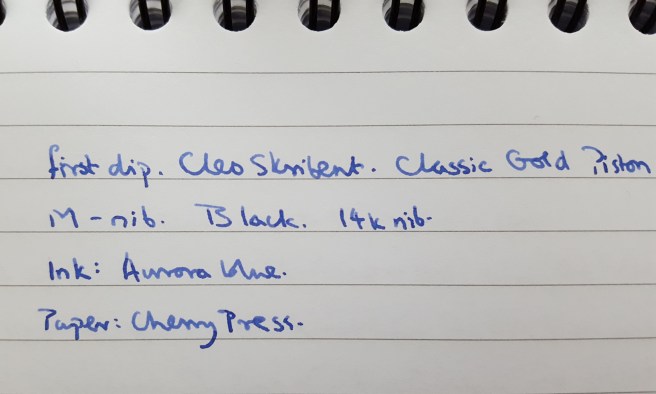
I tried dipping the pen first, in a new bottle of Aurora Blue. My initial reaction was that the nib was smooth but on the dry side, not because there was any downward pressure needed or any lack of lubrication but simply because the line appeared so fine and pale. I had expected the line to be a darker, more vibrant royal blue. I then flushed the pen, and filled it enjoying the first sight of the blue ink in the window.

cleo-8

The paleness of the line troubled me at first and I feared that this may be one of those nibs that is not perfectly tuned “out of the box” but needs some adjustment to perform correctly. However I found the pen extremely enjoyable to use and  could produce very small, intricate lettering with the beautifully crafted steel nib.

I then examined the nib closely with a x7 illuminated loupe whilst writing. I realised that the nib was not dry at all. It lays down ink effortlessly and you can observe the ink glistening for several seconds before it dries. The line variation and shading are all there. The steel nib is smooth but has a little, pleasant feedback. It is firm but has just a little flex to give some variation with downward pressure. What I had wrongly thought to be due to dryness, is just a very fine line with an ink flow proportionate to the narrowness of this nib.  You might class this as an extra fine if accustomed to more generous western fines.

cleo-7

This nib is as wet as it needs to be and if it were any wetter, it may not produce such a fine line and small lettering without ink pooling in all your loops. I concluded that there is nothing wrong with the nib at all and that the good people at Cleo Skribent know better than I. Thankfully I had not tinkered with the nib to make it any wetter, before coming to this conclusion.

I am enjoying every opportunity to use the pen. The fine point is great for making small marginal notes in printed text. It is also nice to have something a little less commonplace. Mine is currently the only one that I have seen.

It would be good to find out whether the nibs are easily interchangeable. And if not, there is always the gold nib option for next time.

cleo-4


The Bic EasyClic: a brief review (in which we find a novel posting suggestion)

p1100982

Having written about my Pelikan M400 vintage tortoise for three posts in a row last month, I thought today, for balance, I would celebrate a pen from the lower end of the price spectrum.

So, how would you like to see a pen that loads like a shotgun? I thought so. Take a look at the Bic EasyClic.

I first learned of these from one of Stephen Brown’s YouTube videos, in which he reviewed the red “Hello Kitty” version, giving it the same systematic treatment as he might give a Visconti. I was intrigued enough to seek one out and found them in our local Ryman stationer, sold in a blister pack, for just £3.99.

This is primarily a child’s pen, available in a range of colours and measuring about 12.7cm capped and 11.8 uncapped. It has matching, transparent coloured push-on cap, the plastic pocket clip of which looks rather fragile.

The section has two rubbery facets, left and right of centre, to aid grip. Between these, if you look closely, (I only spotted this today) is the Bic logo. The plastic barrel is in two parts, with a sliding section which you pull back using the ridged gripping areas and then tilt by about 30 degrees, to expose the cartridge holder. Inside this sliding section, there is a metal insert to hold a cartridge. You simply push in a standard international cartridge, push the narrow end into the metal collar and then tilt and push the holder back into place with an easy click which gives the pen its name. It is tempting to point it at the sky and shout “Pull!”


p1100985

The nib is  stainless steel  with the Bic name and logo but no other markings. There is no breather hole. This is a butterfly nib with the tip formed by folding the ends of the tines back on each other, rather than having a pellet of tipping material. However, if the tines are level, the nib is capable of writing very smoothly.

Over the following few weeks, I amassed four more of these in other colours. On checking the nibs with a loupe, some needed slight adjustment to align the tines but this was easily accomplished. Two of my five models have TUNISIA on the barrel, while the other three have FRANCE.

20151018_163722

The pen, being designed for a child’s hand, is short  when uncapped. The cap can be placed on the back but does not post securely. As an adult with medium to large hands, and what with the tapering of the barrel, I found the pen too short to be comfortable for all but the briefest of notes.

However, after trying on a few different caps, I found that the cap of a Lamy Safari posts deeply and securely giving a posted length of 14cm and making this little pen much more comfortable and easier to control. The Safari cap also gives it more weight, without upsetting balance and stops the pen from rolling off a desk. So pleased was I at this simple discovery that I wrote to tell Stephen Brown, who said it was a cool suggestion. Of course, it does mean that you have an unused Lamy Safari and arguably you may have a better writing experience using the Safari which costs four times as much but that is not the point.

The pen weighs around 9.5 grams inked and uncapped, but posting a Lamy Safari cap brings this up to a comfortable 17 grams.

For disassembly, if desired, you can detach the section by pulling it hard, while holding the barrel firmly by the sides, (the non-sliding part) in the other hand. It snaps on and off. Beyond this I have not tried to remove the nib and feed from the section.

Mine have given various levels of success. I paired them up with matching coloured ink cartridges. The blue pen has the smoothest nib and this has been inked constantly. It is particularly impressive at starting immediately, even after a week or more without use. This is due to the cap forming a good airtight seal, with some rubber O rings on the section. You can easily slide open the barrel to check the remaining ink.

20150511_204218

Clearly this pen will not appeal to those whose interest is only in higher end pens for serious grown ups. But if, like me, you do not discriminate on price or target age group and enjoy the merits of the pen, I think it is a fun pen and well worth a look. I like that it is a re-usable pen at this price and cheap to run on a bag of 50 cartridges for £2.00. For me the unusual loading mechanism alone is already worth the purchase price. And to find one which writes well with good flow and no hard starts at such a low price is great. If you are prepared to use better quality ink cartridges such as Diamine, Graf von Faber-Castell or Kaweco, this will improve the writing experience.

I do enjoy keeping an eye on what fountain pens are available, including school pens, in stationery shops and supermarkets both here and when travelling. It is great when you find a bargain which is also a good performer.

20151018_164023