In my previous post on this pen, I covered the buying experience and the brief passing phase of buyer’s remorse before coming to accept and enjoy the pen. I had owned it for not quite a week.
Now, at still only two weeks in, I feel it necessary to say more about the issues I have with the pen and to correct a few misconceptions. Although mine was an impulse buy, I would recommend trying the pen before buying if possible and also to read the many online reviews – from which I now see that this model has been around for over 10 years.
To recap, the potential issue arises from a combination of two design factors, namely the short grip section and the faceted barrel. If you do not wish to grip the pen around the metal, hourglass shaped section but higher up, then your fingers meet the facets. These are fine if they correspond with where you wish to rest your fingers: but if they do not, then you are instead holding a sharp ridge between two facets, which is uncomfortable and unsteady.
At the time of my first post, I explained that on my pen, when the barrel was fully tightened, the facets stopped with a ridge in the centre, or “12 o’clock position” (if viewing the nib head on).
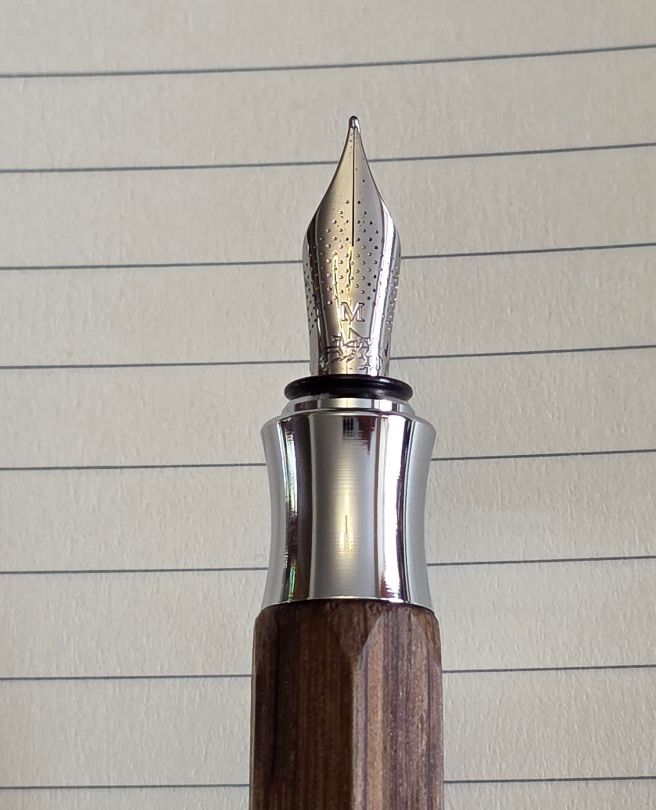
Of course, we want to hold our pens comfortably and in such a way that the tipping of the nib touches the paper at the smoothest angle, to write well without scratchiness or skipping – “the sweet spot.” Depending on an individual’s writing style, – whether they be left or right handed, whether an under-writer, over-writer or side-writer, facets may or may not be helpful.
The big news that I wish to share, is that the wood barrel sleeve is not attached to the metal inner barrel (which I presume is brass) and can be adjusted. At least, I am speaking for my own pen only and have not examined any other samples. Thus if the facets are not where you need them, simply twist the barrel firmly a little way beyond its tightest point. You do not need to move it far. You may line up the nib with the flat surface, or a sharp ridge, or perhaps half way between these points as a compromise.
I discovered this by accident when I noticed that after capping and uncapping the pen for a few days, the barrel ferrule was sinking down inside the barrel.
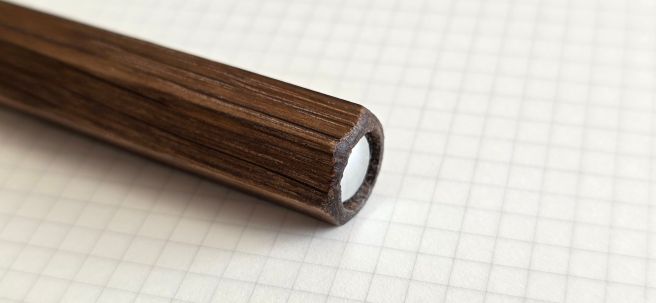
When I unscrewed the barrel, I found that the metal barrel liner, was beginning to protrude.
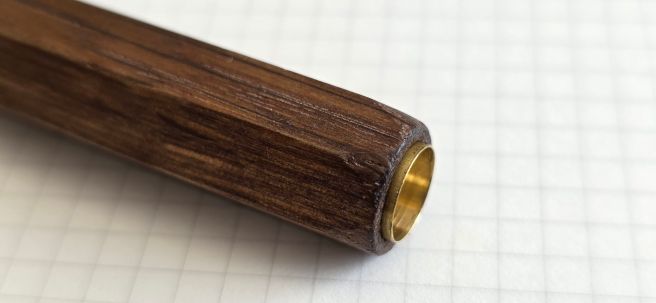
Having discovered that the barrel sleeve could move over its liner, I tried pushing the liner out further (using an empty plastic cartridge and pushing the barrel down against a hard surface):-
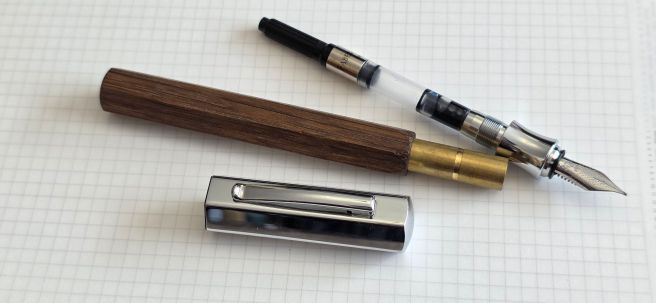
The good news: You can therefore twist the wood barrel sleeve to adjust the position of the facets in relation to the nib, if you need to. For example, if a flat facet at the 12 o’clock position suits you best, just twist a few degrees and you are there. It is a bit like the feature of the Parker 75 which allowed you to rotate the nib for the optimum writing – a solution to the problem caused by adding facets to the grip section.
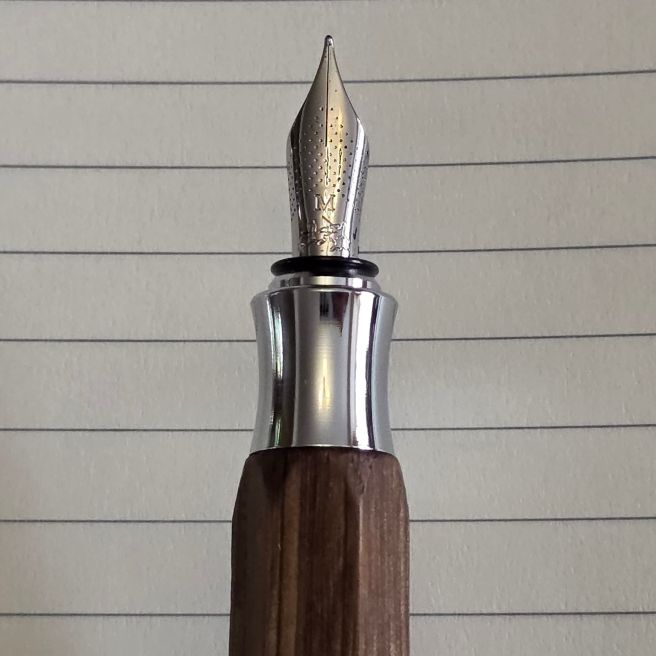
If you like the nib aligned with a facet, this also has the added bonus of enabling you to cap the pen with the pocket clip aligned to the nib or to post the cap thus aligned, (although writing with this cap posted will make the pen unbalanced).
The bad news: the barrel is not meant to move on the liner and moving it will soon make it loose. Two new problems are caused by solving the facet issue: (1) when you uncap the pen, the nib section and barrel liner, are pulled forward out of the barrel sleeve and (2) when you go to unscrew the section, instead of unscrewing, the barrel liner rotates in its sleeve.
Experimenting with nib-to-facet angles, I found myself suffering FOMO: this was made more complicated by having more than one writing style – whether under or over writing. “Am I missing out on a smoother writing experience, if only the barrel were turned a few more degrees?” The angle for one writing style was not the same as for the other. Imagine the distraction and stress of having this thought if you were taking an exam.
Already after only a few days of experimenting, my barrel was getting looser and I noticed a gap between the section and the barrel appearing, each time I pulled off the cap. It is a pity that there is not a screw, or a hex nut we can tighten in the barrel liner, to arrest this movement. I have stuck a little Sellotape on the barrel liner to try to make it a tighter fit.
In conclusion, I do actually like the pen. Theoretically having a facet against your finger, should give a steadier grip than if the only points of contact were rounded edges of a tube. The facets certainly look bold and attractive – especially as they are echoed in the metal cap. (Incidentally, the cap is made of metal, although the metal is thin and it has a plastic liner).
When I bought the pen, I was on my way to see a concert of music by Frederick Delius. The piece, a cantata entitled “A Mass of Life” is quite a difficult listen – a huge, powerful, exuberant, out-pouring of passion – which probably needs to be heard more times than I have yet given it, to enjoy and appreciate it properly. Meanwhile, you might think “Why bother with this, when there is more readily satisfying, melodious and recognisably-structured music available?” Perhaps there is an analogy here with the Ondoro: it is a challenge but there is nothing quite like it and it is worth the effort of persevering. Or perhaps I am just making excuses for a flawed pen or one that was not suitable for my particular grip?
The nib is excellent. When it is writing smoothly, I can happily write or doodle with it. I sometimes think that a writing sample reveals more about the comfort of a pen: how neatly can I write with it? If the writing is shaky and rushed, it suggests we cannot wait to put the pen down. If it is neat, then it shows the writer to be relaxed, comfortable and at peace with the pen!
If I were to give up on the pen, then at least the nib unit can be transferred to the Faber-Castell Essentio, a cylindrical and facetless aluminium pen that I bought last year. But it has not come to that yet!
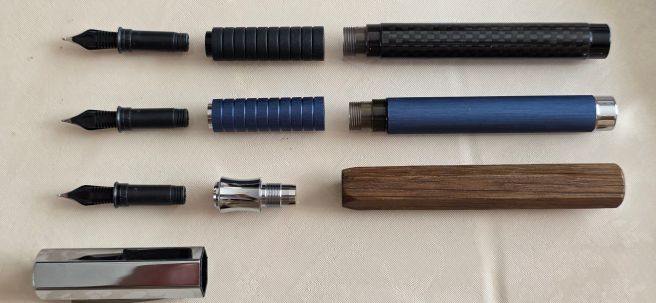
The pen does make a nice companion for my Ashera fountain pen, hand finished in multi-lacquered elm burl wood. The Ondoro is not lacquered and polished but its wood is faceted and is Smoked Oak (not just stained to look like it) – a chemical process which I imagine adds a bit to the cost. It is not correct to say that the wood is untreated.
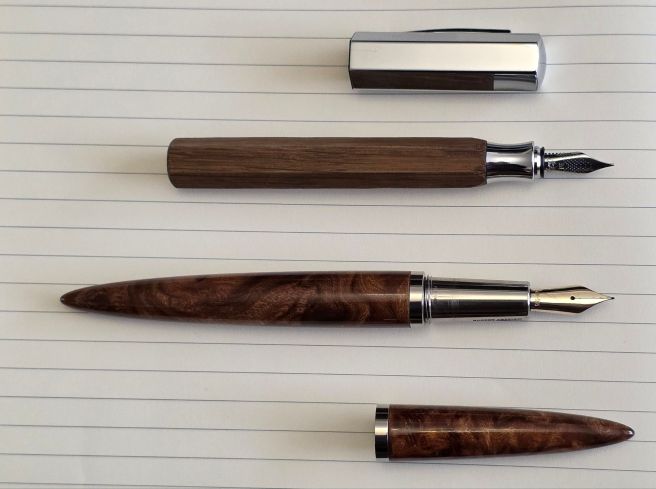
The Ondoro might not be my favourite pen – at least not today. But I am using it every day which is a good sign.
 Fountain pen blog
There is one thing you should consider: the environmental conditions in your home during the English winter. If, as I imagine, you use heating, it may reduce the humidity in the air, which will affect the wood, causing it to contract and expand. Given that it is a valuable pen, it might be best to make use of the Faber-Castell warranty. Otherwise, in the future, you may have to resort to a more risky solution, such as applying varnish to the metal tube, using an appropriate adhesive, or even asking a cabinetmaker to make you a replica.
LikeLiked by 1 person
Hi Miguel, Thanks for reading and for your suggestions. Yes, you make a good point about wood being affected by humidity and temperature (partly why stringed instruments need retuning),so i need to watch for that, as well as the potential loosening of the barrel sleeve caused by me fiddling with it.
I note that the Faber-Castell warranty is 24 months. I think i will try to manage the pen although I appreciate that adding adhesive would probably void the warranty.
LikeLiked by 1 person
Hi Rupert, Vic here fom Portugal. Nice explicative post, and the problem may be held as considerable for a few reasons, practical and economic. May i offer a sugestion? As long as you can extract at least some of the metalic liner out from the wood, why not coat the liner with some superglue, either in liquid or gel form, spreading it as thinly and evenly as possible, and before it dries align it to your comfortable writing position and then pushing it back inside (i’ve seen this done in videos of “kit pens” being completed with woods). After a few hours – even a full day – of rest for the complete consolidation of the glue, is reasonably to believe the pen wil have improved out of your gripping and general physical solidity concerns. After all, if a pen almost dismounts itself each time you uncap it, it can get a little bit irritating (to say only the veryvery least) more and more so because it is getting (and it will get) more and more loosened with time. Always a pleasure to read you. Cheers! Vic
LikeLiked by 1 person
Hi Vic, Thankyou for following along with this story and for your suggestion. At the weekend I took the pen to my pen club and everyone said that I should return it to Harrods. However I still like the pen and want to keep it. But as you rightly say, a wood barrel sleeve that becomes progressively looser, is irritating. I think I will use the pen and see if the problem recurs. If it does, I can try your glue suggestion. Hopefully, my use of Sellotape might have fixed things.
LikeLike
… mind however that tape-related solutions are never final. And it might even happen the tape sometimes coming to “peep” out of the work done. Cheers! Vic
LikeLiked by 1 person
hi Rupert, this is Vic from Portugal. i wrote a comment to your latest post, and it seems to have vanished. Is there any way of making it visible again. Thanks. Cheers!
LikeLiked by 1 person
Hi Vic, Thankyou. I see that your earlier comment on this post has vanished. On looking into this, I found the comment which had been incorrectly sent to a spam folder (even though I posted a reply to you). I do not know whether this was an error from me or from the system. It is possible that my chubby fingers may have tapped a wrong button.
I have retrieved the comment and hopefully it now appears in the comments trail!
LikeLike
Regarding Victor’s comment, I also thought about the adhesive solution. However, after researching, I believe it’s a very risky fix that should only be done under expert guidance. From what I’ve read, most glues are unsuitable. A low-viscosity epoxy could be an option, but I have doubts.
We don’t know the exact fit Faber-Castell uses. I suspect they press-fit the liner with a hydraulic press, perfectly centred. If we use glue, we don’t know if the wood will withstand the pressure. I’ve seen a cracked plastic Ambition body, and I know the metal end can come loose from frequent posting.
Some type of varnish on the liner would slightly increase its thickness, similar to the adhesive tape but distributing pressure along its length. However, the long-term pressure risk of cracking the wood remains.
Regarding artisan pens, we don’t know their wood-to-liner fit. It might be slightly loose to avoid stressing the wood.
Concerning the tape, I worry about uneven pressure on one side, potentially causing irregular deformation inside the body.
In any case, I think a simple solution for Faber-Castell would have been to add a stop at the top end, like the head of a thumbtack.
LikeLiked by 1 person
Hi Miguel, Thankyou very much for these thoughtful and detailed suggestions. Whilst gluing the wood to the liner sounds an easy fix, I understand the problem of finding a suitable adhesive and the risk of splitting the wood.
At the moment the pen is ‘working’ with the tiniest piece of sellotape to increase resistance, to stop unwanted rotation. This has also stopped the liner being pulled forward by the action of uncapping. I shall refrain from any further tinkering and hope that this simple repair will hold out.
LikeLiked by 1 person
Best of luck!!! ✍️
LikeLiked by 1 person
Oh bloody hell, it’s a 150 euro pen from one of, if not, the largest and most respected stationary companies in Europe. It has been out for near a decade now and FC is sure to be aware of the issues with it. You should not utilize “Algo pa’ resolver” to fix something they should have fixed in the last decade the pen has been out.
Based on my research, the fact you managed to get it without the pin being crooked is already a miracle, as that’s, yet another, common issue with the pen.
I was most disappointed to learn of the slew of issues plaguing this piece because it seems a perfect pen for me; I love wood, I love its simplistic, yet elegant, lines, I love the size of it and, above all, I love the lack of branding and similar kitsch features that pen makers seem to gravitate towards.
That said, I’m not surprised either, as the company has been on a downturn since the death of Count Anton. Furthermore, if you do opt to take advantage of the warranty, know they’ve become quite unresponsive to honouring warranties and you may need to leverage your influence to resolve it. They also don’t sell replacement parts anymore so when, not if, the plastic rim holding the cap closed wears, you’ll need to invest in one of their cheaper offerings and salvage it from there.
Just quite disappointed with the whole product.
I’ve turned my eye to the new Tom Hessin Revolution now, which is also a wooden offering, but more akin to FC’s Ambition line, still can’t find a suitable, but better made, replacement for the Ondoro.
LikeLike
I can only write from my own experience but on the one occasion when I accidently damaged a Faber-Castell fountain pen (by over-tightening and cracking the body), they replaced it for me without question.
The Ondoro pen with smoked oak barrel has certainly grown on me. Most users, I suspect, wìll have no problem with it.
LikeLike