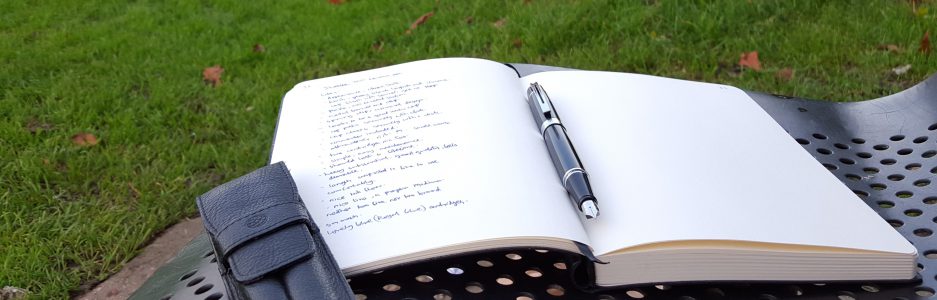
Travelling with ink: Iceland, June 2025.

It has been holiday time again. We have recently returned from a two week cruise on Cunard’s Queen Anne which included four days in Iceland. Departing from Southampton, we also stopped in Belfast on the way north. On the return leg, we spent a day in Stornoway in the Outer Hebrides and a day in Greenock, on the Clyde near Glasgow.
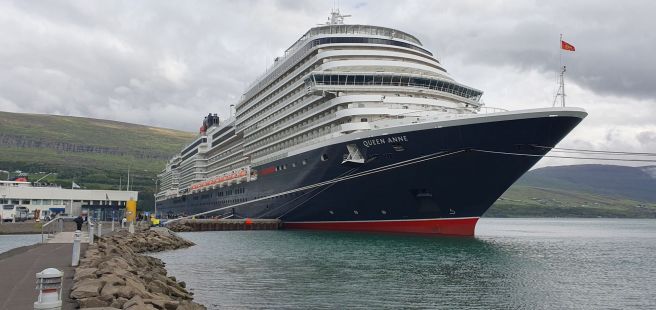
Queen Anne.

As ever, a vacation signals to me some journaling time with pen and ink. Although luggage limitations are less of a constraint on a cruise, I still wished to keep things simple. I decided on a select few fountain pens, namely my new Ashera Aeon, a vintage Parker Senior Duofold and lastly a TWSBI eco-T, in saffron yellow (holiday colours) with an extra fine nib. My thinking was that I would fill the TWSBI to use if the other pens ran dry, and avoid the need to bring a bottle of ink. As usual my journal-of-choice for travelling was a Leuchtturm A5 hardback.
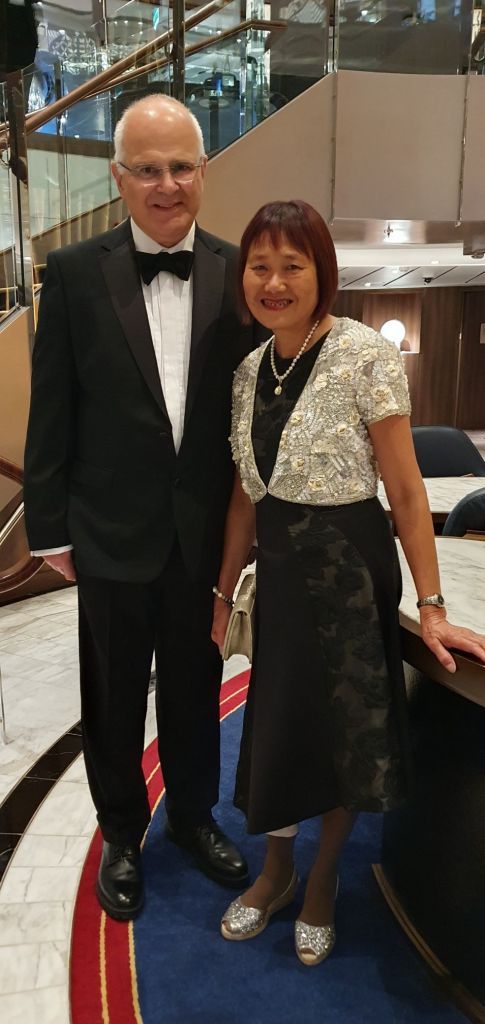
One of the gala-nights on board.

Our cabin included a small desk next to the balcony, but in reality it was a dressing table and the stool was too low for writing. The balcony was equipped with two seats and a small table. The hardback notebook works well resting on a knee, but I found the sea-scape more interesting than my journal and seldom managed more than a few lines outdoors.

Fortunately there is no shortage of comfortable seating around the ship, in the lounges, buffet-restaurants and in areas such as Library and the Chart Room. In the latter, I found some desks equipped with a seal, to stamp an image of our ship and her name onto paper, albeit without the luxury of melted wax.
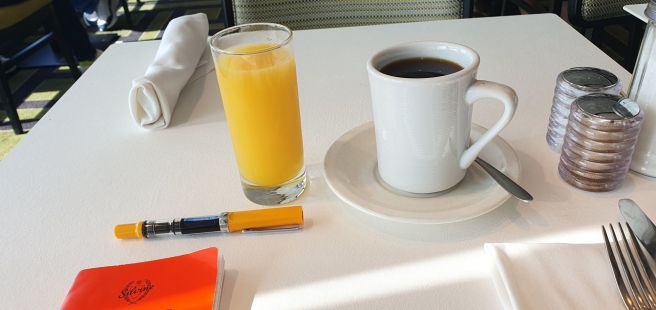
Nothing says “holiday” like a saffron TWSBI.

It has become a custom of mine, or perhaps an unhealthy obsession to look for fountain pen shops whilst abroad, in the vain hope of coming across a delightful and friendly shop with some exquisite, unusual and attractively-priced fountain pens as possible souvenirs of my travels. Whilst this has succeeded on some occasions (such as Porto, or Bruges), this was not to be one of those trips. In fact I barely found anything with a nib, the whole time. Don’t get me wrong; this is probably not a bad thing as my magpie tendencies to acquire fountain pens are not sustainable.

We had favourable weather for almost all our trip. The one exception was whilst in Northern Ireland, where we had time for an excursion to the coast to see The Giant’s Causeway, the spectacular basalt rock columns and a World Heritage Site. Here we encountered a very heavy downpour.
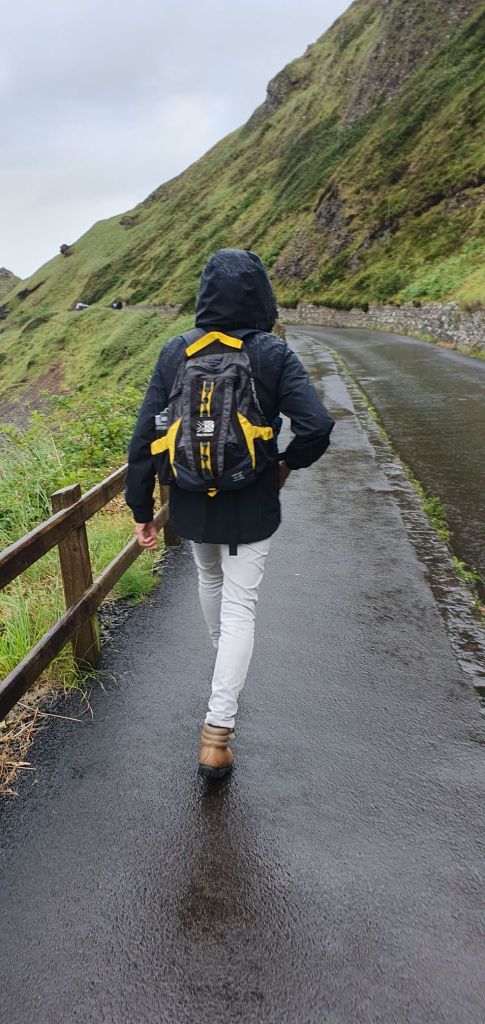
Trying to keep up with Ling at the Giant’s Causeway.

I had been excited to visit Iceland again. I holidayed there in 2008 visiting several areas of spectacular and varied volcanic landscape along the south coast, but this time, we were to have two days in Reyjavik and a day each in the northern fjiord ports of Isafjordur and Akureyri.

Reykjavik was very much just as I remembered it from 17 years earlier. We found our old hotel, Hotel Leifur Eriksson, opposite the landmark cathedral, Hallgrimskirkja with its 73 metre tower, perched like a space shuttle against the sky.

Once again I browsed in a book shop, Eymundsson (since 1872). In 2008, I had bought a copy of “The Sagas of Icelanders” published by Penguin Classics. I was surprised to see that there was again a tall pile of these same books on a table, just as there had been when I was here last. It was as if time had stood still.
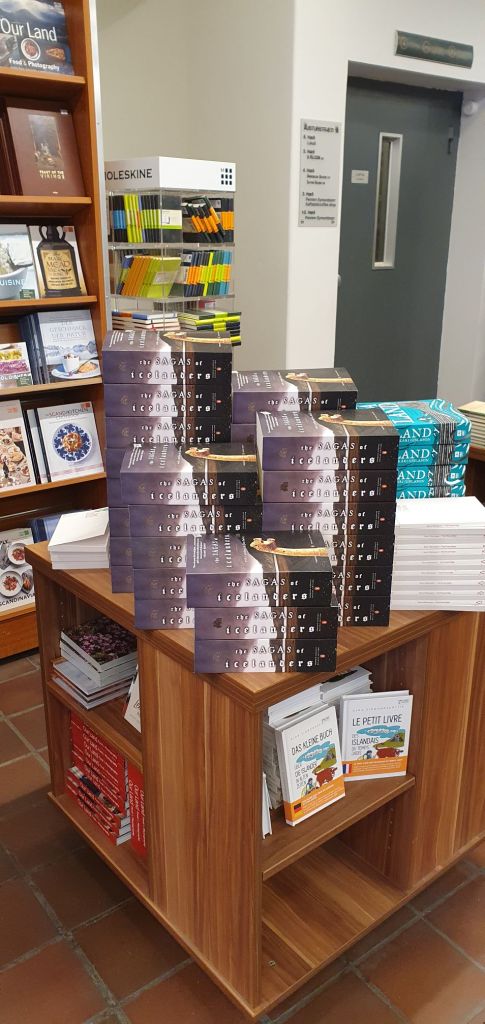
Still promoting The Sagas of Icelanders.

It was here that I ventured downstairs to the stationery section, hunting for fountain pens. I found only a few Pelikan Jazz pens and was content to leave these alone. Had we been shopping rather than sight-seeing, there were plenty of examples of Icelandic wool pullovers and hats for sale in the city. I also found a lovely watch shop on the main street, named GullBudin, which had a good selection of Orient watches in particular.

Our next port of call was Isafjordur. Here, even our ship was dwarfed by the hills of the fjiord, their peaks hidden in cloud. We had a morning excursion to visit a waterfall and an afternoon free to explore the small town. Here, we came across an elegant white building now described as a culture house. It was formerly a hospital and still contained exhibits of beds and equipment and old black and white photographs of nurses and staff.

Culture House, (a former hospital)

In a large upper room we found the space empty, but for two curving bookcases, filled with books but many with blank spines or covers. On closer inspection, we found that these were notebooks and that we were in a participatory art installation, called Book Space, by Elin Hansdottir. This project comprised 2,000 blank notebooks inserted into library collections in which visitors are invited not to read but to write, draw or contribute in any way they choose. Being unable to resist a blank notebook, I began one and proceeded to write a page with each of three fountain pens that I was carrying, identifying the pen and ink in each case. I hope that others may find it and add their own entries!
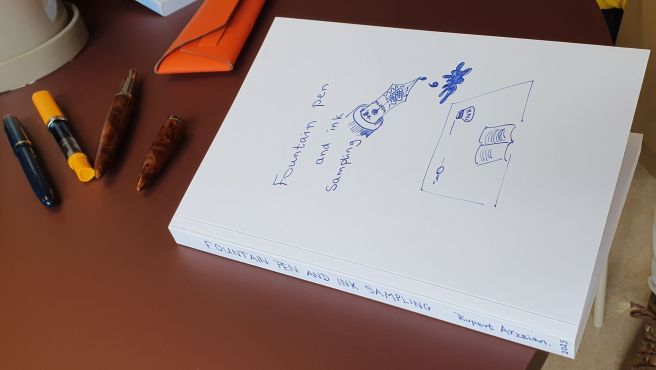
My contribution to the Book Space exhibition.

Our guide that morning had mentioned that rhubarb is grown in the area and told us of a local treat called “Happy Marriage Cake”, comprising a biscuit base, a layer of rhubarb jam and then baked with a crumble topping. Naturally I felt it could do no harm to taste some, when a cake shop presented itself!
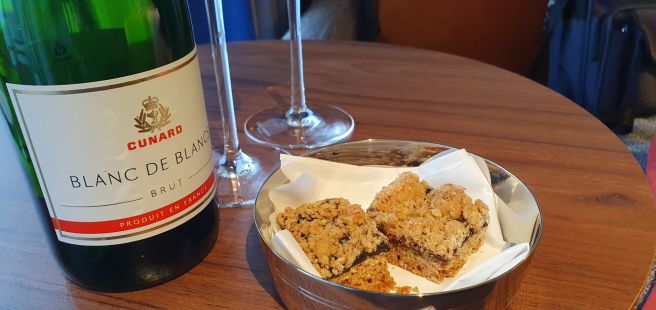
“Happy Marriage Cake.”

In Akureyri we had another coach tour to visit some of the spectacular sights of the landscape, including the colossal Godafoss Waterfall, some lava rock formations and a vast area of geothermal activity with sulphurous steam spouting from the ground and burbling mud pools.

Godafoss Waterfall.

After Iceland, our visit to Stornoway in the Outer Hebrides seemed rather tame, but was in fact the only port on our trip in which the captain had struggled to enter safely, due to high winds. It took three attempts before the ship could be berthed, but we still had ample time to see the town and to attend an exhibition of Harris Tweed, which is made only on these islands.
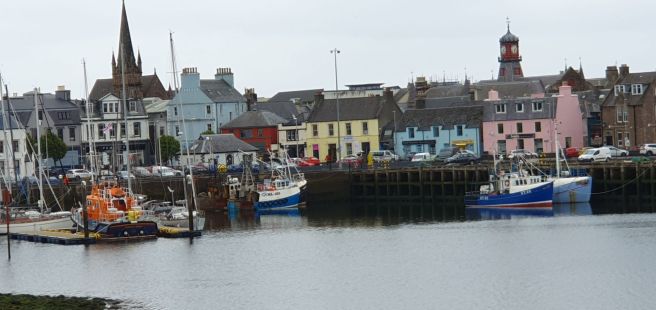
Stornoway.

Our final shore visit of the cruise was in Greenock, on the Clyde and from which it is just a short train ride into Glasgow. We spent some time acclimatising ourselves back to the UK mainland. Glasgow in the sunshine was a lively and vibrant city. It was a graduation day for the University of Strathclyde and so we saw several new graduates in their gowns with their families. It seemed as if there was music from buskers around every street corner which leant a nice mood to our strolls.

Glasgow graduates.

In the familiar territory of a John Lewis department store, I made my last attempt to find a fountain pen display counter, but alas, there was none. However, I did spot some bottles of Waterman ink generously discounted from about £11.00 down to £3.45 and so availed myself of this opportunity to support the economy.

I had almost failed in buying a fountain pen at all on this trip, but this failure was avoided by finding a newsagents in Stornoway with a Platignum Tixx, for a couple of pounds and thought it worth a try. I did not realise until afterwards, that it it a disposable one.

In conclusion, we had a very happy trip. The time at sea was filled with food and entertainment (theatre shows, interesting talks, and live music of all types) and meeting new friends. As for the journaling, I had made the mistake of starting the trip with the TWSBI eco-T, and then using it every day as my main journaling pen for the rest of the trip, as I enjoyed it so much. Still it was nice to have the others for variety. And yes, I did still return home with more ink than I had started with.
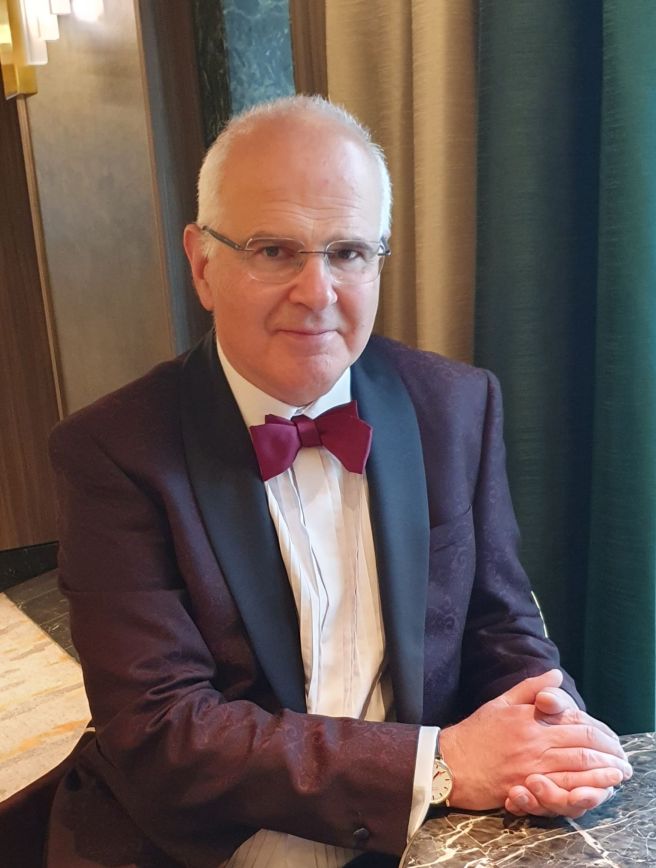
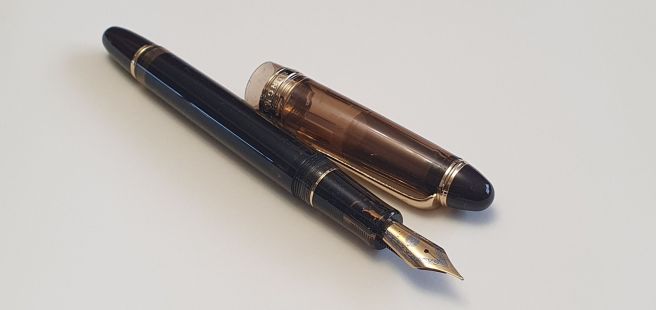
Ready for a book-signing, but with no book.

A new month, a new plan.

One of the joys of the fountain pen hobby is finding combinations of pen, ink and paper that work together really well. You find yourself writing with a pen that is supremely comfortable, with a nib that glides along the paper smoothly but with just the right amount of feedback, laying down an attractive line of ink that is neither too wet nor too dry.

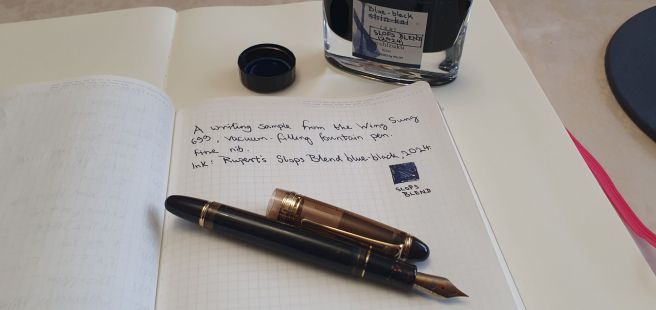
In recent years, it has been my practice to pick a different pen and ink combination to use each month, for my daily A5 journal entry. I am using a Ryman A5 page a day diary. For January, I enjoyed writing with a Wing Sung 699, vacuum filling fountain pen with a fine nib. The ink was my own “Slops Blend blue black 2024” representing a mix of inks that I had flushed out of pens cleaned over the course of last year.

Wing Sung 699 vacuum fill fountain pen.

The slops blend experiment is somewhat reckless and goes against the usual advice not to mix inks. The risk is that different inks may clash to form a gunge that clogs pens. When mixing ink it is not only the colour that changes but also other features such as the viscosity, drying time and water resistance. But I have enjoyed recycling ink in this way and have been fortunate not to have any problems. It is a gamble, adding a few drops of ink to the bottle, shaking it up and testing the colour. I was lucky to find that my left-overs had produced a pleasing blue-black, that kept its tone and did not fade to a teal colour, as some do. The trick then is to avoid going too far and spoiling the mix.

My unique blue black recycled dregs.

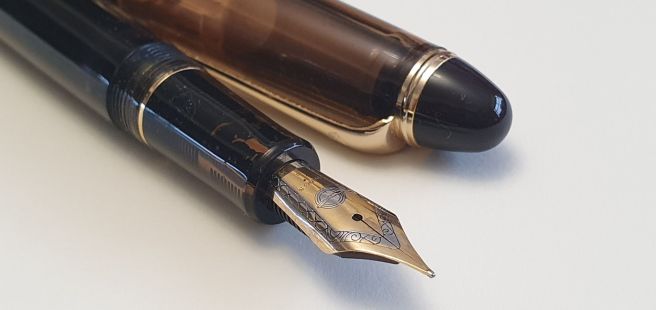
My Wing Sung 699 seemed to like my slops blend ink. It produced a nice dark blue-black with attractive shading and a nice lubricating quality and did not suffer from the fading and colour changes.

As well as my Ryman diary, this combination was particularly nice on my Stalogy notebook paper. I found myself thinking that I would continue with the same pen and ink for the month of February too. It also crossed my mind that the combination was so enjoyable that perhaps I did not need any other fountain pens and could use this one for everything.

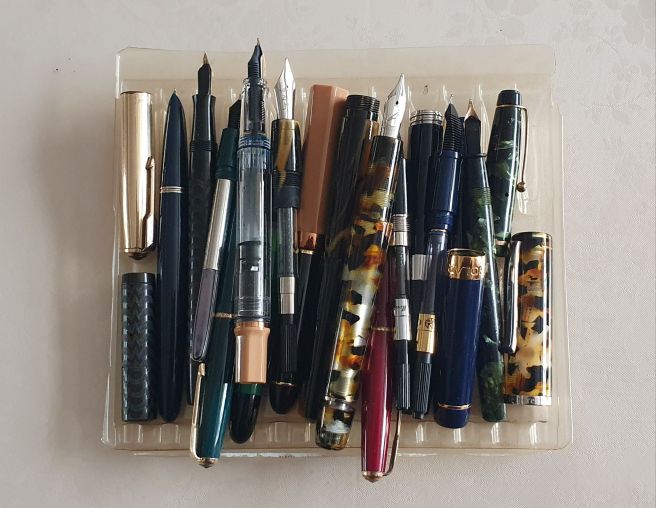
Such thoughts have often arisen but this time, I decided to act upon it and put my money where my mouth is. No, I have not sold or given away all my other pens! But I thought it may be an interesting exercise to simulate having only one fountain pen. I flushed out about a dozen inked pens, keeping out just the Wing Sung. (I have cheated slightly as I did not throw out half used cartridges or syringe out the remaining ink. Instead I have just put aside my inked cartridge pens, in a separate pen cup, for the time being).

The aftermath of a pen cleaning session.

I thought that this might give me an opportunity to spend a longer time using the Wing Sung vac filler pen, for diary, journaling, letter-writing, notetaking and EDC. It may be interesting to see whether there are any other fountain pens that I particularly miss, over the month. For example, I recall a holiday abroad some years ago when I badly missed my Parker Sonnet. Then there was an occasion when I was absent from work for a few months due to ill-health. The pen that I missed most was the Cross Bailey Light, in royal blue with Cross Blue ink, that I kept in the office.
Other potential benefits of this little scheme, are that I was able to bring down the number of currently inked pens considerably, when this had been hovering well over 30 a few weeks ago. Also, I have already started to compile a new batch of Slops Blend ink, that I shall call my 2025 crop.

Perhaps this exercise is indicative of a wish to simplify life a bit. I bought around 50 fountain pens last year (mostly not expensive, with about half that number being vintage pens from eBay or pen shows). I, (or more accurately, my wife) decided that this pen buying needs to stop. I am therefore having a 2025 No Buy. The same goes for notebooks and ink, as well as other writing instruments such as ball points, roller balls, gel pens, mechanical and wood case pencils.

The very pleasing nib of my Wing Sung 699

I bought no fountain pens in January! Admittedly that is only one month. I will be very surprised if I can keep this up for long but thought I would make public my intentions as a contemporaneous record not only for myself but for readers to witness as well.

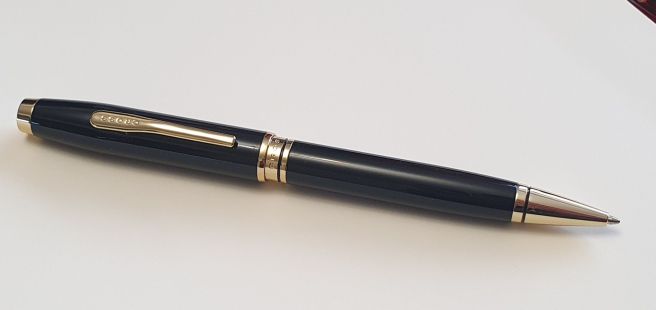
Again, I have already cheated slightly, in the impulse purchase of a rather lovely black and gold Cross Coventry ball pen. I have also added a few notebooks to my stash, just in case there is a siege in London. You can’t be too careful.

The irresistible Cross Coventry ball pen.

Getting inside the Wyvern Perfect Pen No.81.

As mentioned in my recent posts, I have been attending a practical course on fountain pen repair. Although very much a beginner, it has been fascinating to learn the correct ways to use the various tools involved and very satisfying to restore a vintage pen to life, when it goes well.

In between the sessions we are encouraged to “practice, practice, practice.” It is sensible not to go straight in with a valuable pen as there is a risk, or even a likelihood, of making mistakes and breaking your pen.

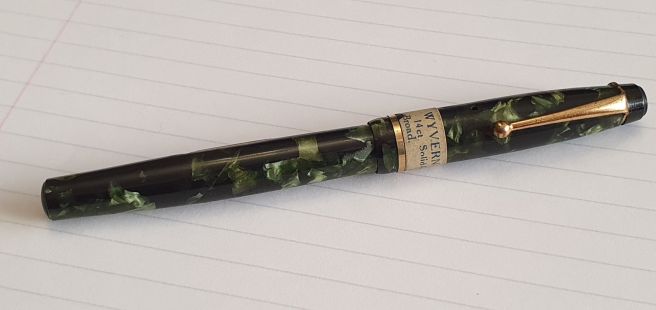
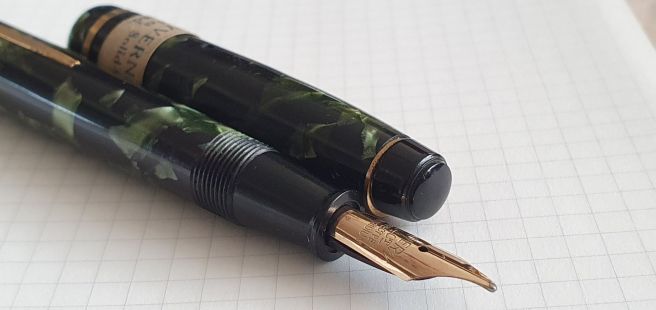
One of my recent early practice exercises was a Wyvern fountain pen, bought on eBay at a modest sum, advertised as for spare parts or repair. The pen was not in working order and the seller had been unable to remove the barrel. Nevertheless, it was an attractive pen in marbled green celluloid (I think), a lever filler with a 14k gold nib. Also, what was especially appealing was that the pen still bore its original paper price band stating “Wyvern No.81, 14ct Solid Gold Nib, Broad” and the price, including tax, of 22 shillings, 7 and a half pence. As a reminder for younger or overseas readers, there were 12 pennies to a shilling, and 20 shillings to a pound (therefore, 240 pennies to a pound). This pen therefore sold for roughly £1.13 when new. We switched to decimal currency on 15 February 1971.

Wyvern 81 “Perfect Pen” complete with price tag.

This is my first Wyvern fountain pen. I was aware that this was a British brand, beginning in 1896 and lasting until 1955. From brief searches online, I believe that my pen may date from around the late 1930’s.

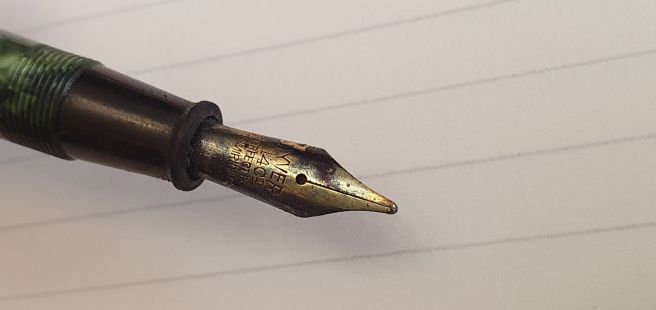
When the pen arrived, the body appeared to be in good condition with no apparent cracks. The barrel imprint (always pleasing to find!) was still clear. The nib was caked in dried ink but on cleaning this in water with a soft toothbrush, it came up gleaming.

I am a sucker for a pen that needs cleaning.
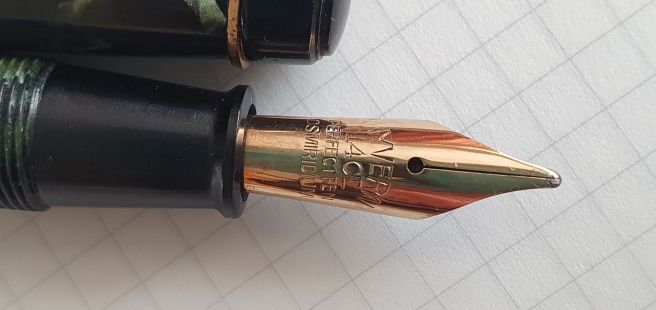
Wyvern nib, after a good bath.

The lever for the filling mechanism would not move, suggesting that the sac had perished and hardened inside the barrel. Fortunately, I was able to remove the barrel, by gripping it with pliers, with the jaws shielded by rubber (from a bicycle tyre inner tube). On this pen, the barrel unscrews from the section.

I was expecting to find the rubber sac hardened and cracked into loose debris, to be shaken out of the barrel. To my surprise, very little debris did come out initially. I could see hardened sac material stuck to the inside of the barrel, at the opening. The challenge was how to get this out as it was stuck hard to the barrel.

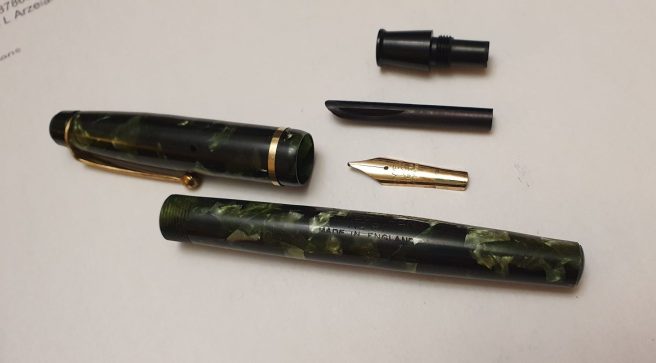
With nib, feed and section removed.

After establishing from a pen club friend that the barrel was not made of Casein (which must not be soaked in water as it will disintegrate), I was then confident to leave the barrel to soak in a jar of water overnight. I then tried scraping out the rubber residue, using a straightened out giant paper clip (carefully avoiding the pressure bar). Some fragments of rubber then started to come away. Patiently, I left the barrel to soak again for another night, before resuming my scraping. As well as tiny fragments and dust, a few larger bits of solidified rubber eventually came out, to my immense satisfaction.

Eventually, I was satisfied that I had removed all vestiges of the rubber. Inserting a brush, I was able to rotate this and clean the inside of the barrel nicely.

I had ordered a selection of replacement ink sacs, from The Pendragons. I also bought from them, some rubber-jawed section pliers, a pair of barrel-cleaning brushes and a nib knock-out block!

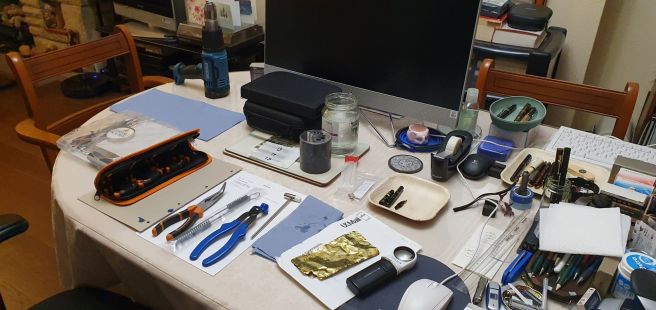
The dining table in workshop mode.

Fitting a new sac is a fairly straightforward but very satisfying task, for a beginner like me. Sometimes, removing the barrel is the trickiest part and soaking and/or heat is required. This was only my fourth such repair. Identifying the best size sac, if you have a few different sizes, is most easily done by introducing the sac to the barrel to find the largest diameter sac that fits, touching the sides lightly but without resistance. The length then needs to be trimmed, measuring from the sac nipple, to the end of the barrel, then shortening it a bit to allow some clearance at the back. To attach the sac, you apply shellac adhesive around the sac nipple. You also need French Chalk, (talcum powder) in which to roll the sac before it goes in the barrel, to prevent it from sticking to the sides.

However, before attaching the sac, there was another factor to bear in mind. As I said, the barrel was threaded, not friction fit. This meant that there was a risk of the sac being caught and twisted by the barrel. To avoid this, the nib and feed are removed from the section before fitting the sac. Assuming that the nib and feed cannot easily be pulled out, they are knocked out with a hammer and drift, using the knock-out block, having soaked the section in water first.

This leaves the section open whilst you attach the sac. You can then insert a rod (something not sharp) through the section and up into the sac, to keep it from twisting as you screw the section back into the barrel.

With the nib, feed and grip section separated, these can be cleaned. It is useful to floss the nib with a brass shim at this stage and check that the tine gap is as you like and the tines are level.

I was worried that the nib and feed would be difficult to push in, since they had been so tight to remove. I applied a little silicone grease to the outside of the feed, whilst trying to avoid any grease blocking the feed channel. It was still a tight fit to get the nib and feed back in, but all went well. Finally, I heat-set the nib and feed, dipping them in freshly boiled water for about a minute, squeezing them together for about half a minute and then cooling in cold water.

I was then finally able to test nib and fill the pen. I had deliberately refrained from writing with the nib beforehand, saving this treat until the new sac was installed and the pen ready for use.

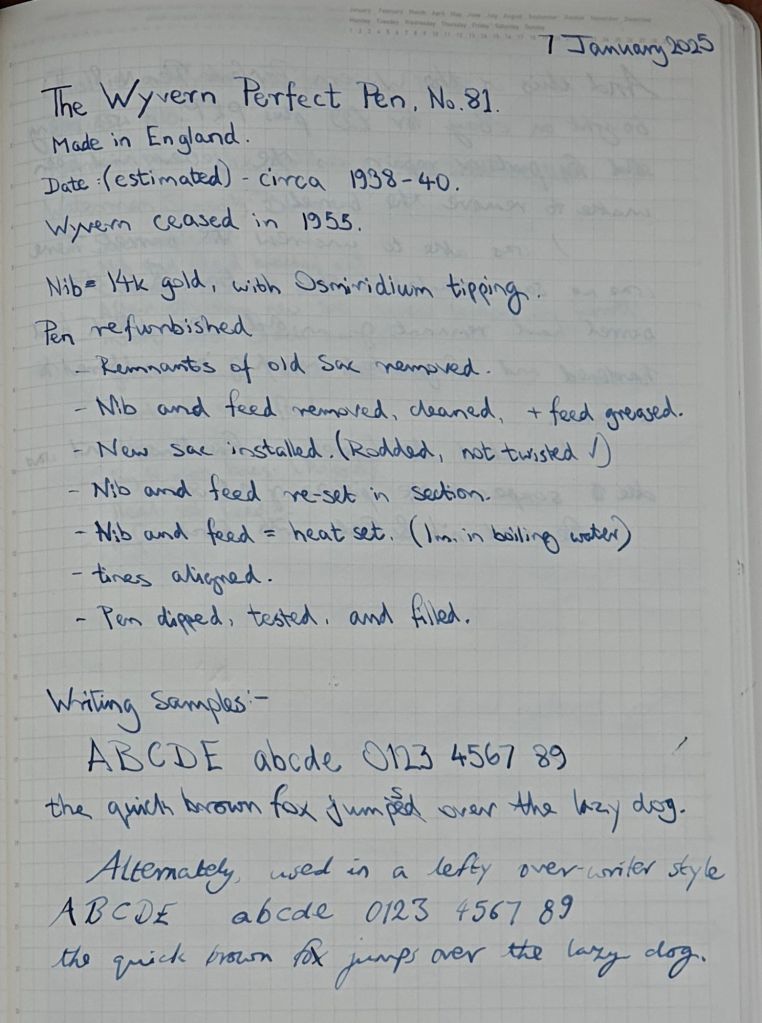
I was surprised to find that the nib was much firmer than I expected and also that the line was not broad, but closer to a medium. However, the pen writes well, with a distinctive pencil-like feedback.

Writing sample, Wyvern 81 with Waterman Serenity Blue on Stalogy paper.

With every successful repair, one gains experience and confidence. I wish I knew more about this pen’s life and owners, during the last 80 years or so. I suspect that it had not been doing very much as the nib and sac could both be original. This will remain a mystery but I am happy to have the pen in use once again.

An 80 year old pen, back as good as new.

2024: some of my fountain pen highlights.

I have been meaning to post a round-up of my fountain pen activities over the past year and had better get on with it, before January is over. This tardiness is in no way indicative of any waning of my passion for fountain pens, which remains as strong as ever.

Pen acquisitions.

Let me begin by ‘fessing up to my annual spend on fountain pens. A look back at my handy Memento database app of pen acquisitions, shows a total of 52 arrivals last year, of which three were gifted to me. One of my purchases, a Parker 51 demi “Cocoa” fountain pen and pencil set was sold on to a lady in our pen club who had asked for help in finding one. Deducting this, I am left with 51 arrivals and a total cost of £1,828, which is up on the previous year.

However the total cost includes one grail pen namely my Scribo Write Here Africa, with its juicy broad 18k nib, purchased from the Write Here shop in Shrewsbury. This accounted for £440.00 of my annual total. If I deduct this, the total spend drops to £1,388 and 50 pens averaging just around £27 each and an average monthly outlay of around £115. This might not sound a lot to a fellow pen enthusiast, to spend on a hobby but I am mindful that I began the year (as I do this year), with a genuine intention to acquire fewer pens, not more!

Approximately one half of my pen acquisitions were vintage, which explains the modest average cost.

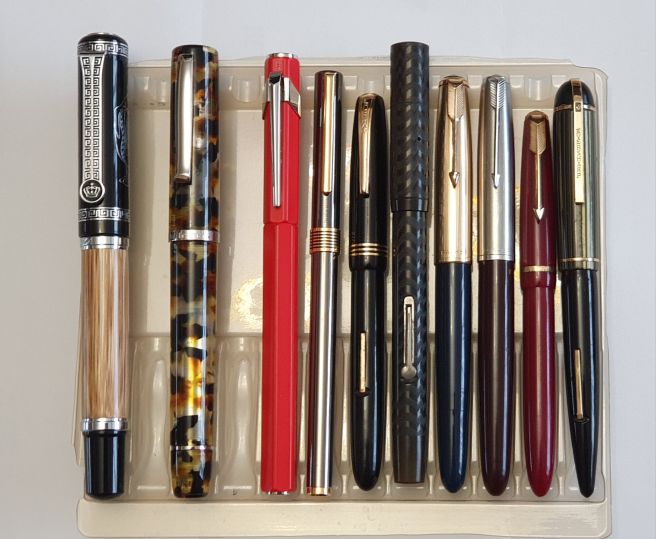
It is difficult to pick favourites, but here in no particular order are 10 of my pen purchases from 2024, which have given the most enjoyment. These are, from left to right: 1. Duke 551 Confucius bamboo fude nib sketching pen; 2. Scribo Write Here Africa; 3. Caran d’Ache 849; 4. Aurora Marco Polo; 5. Burnham 61; 6. Pitman College lever filler; 7. Parker 51 vacumatic; 8. Parker 51 aerometric; 9. Parker Slimfold; 10. Eversharp Skyline.

My top ten from 2024.

Other pen-related activites.

Aside from acquiring pens, my year has been punctuated by numerous events, including the London and Birmingham pen shows, the Pelikan Hub and our monthly pen club meets. Then there are the daily solitary hours spent in journaling, pen, ink and paper sampling, pen cleaning and tinkering, letter-writing, screen-time in following the global pen community online, reading blogs and “researching” pens on YouTube, eBay, Amazon and various online pen dealers.

As for this Fountain pen blog, WordPress informs me that in 2024 I added just 24 posts, writing 25,800 words, generating 270 likes and 252 comments. The all-time stats show a total of 276 posts (not including this one), and all-time views of 777,452. (Come on, let’s get this to a million!). I continue to be amazed at the reach of this blog, which arose in 2016 from and continues to be an extension of an innocent hobby. I do value the online interactions that it brings.

It is hard to list all the pen-related activities that one enjoys, without them sounding like a list of symptoms of an obsession. Perhaps it is. But I do have others as well, such as reading and listening to (and making) music. Having retired from work in 2024, I am wondering how I ever had time for it.

Towards the end of last year, I began the Pen Repair Course, organised by the Writing Equipment Society (WES) and led by the excellent Ray Walters, whom many will know as a dealer at pen shows. I have enjoyed his classes immensely and have one more session to attend, next month. Thus I have added pen repairing to my leisure activities and find this very satisfying and rewarding. There is a risk that the acquisition of some necessary tools can lead to marital friction. Buying a heat gun took a little bit of persuasion. But it keeps me out of mischief.

As always, I thank everyone for reading. Special thankyous go to The Pen Addict, The Gentleman Stationer and The Well-Appointed Desk who often include links to my posts in their weekly round-ups, giving my viewing figures a welcome boost. I wish you all much penjoyment in 2025 and beyond.

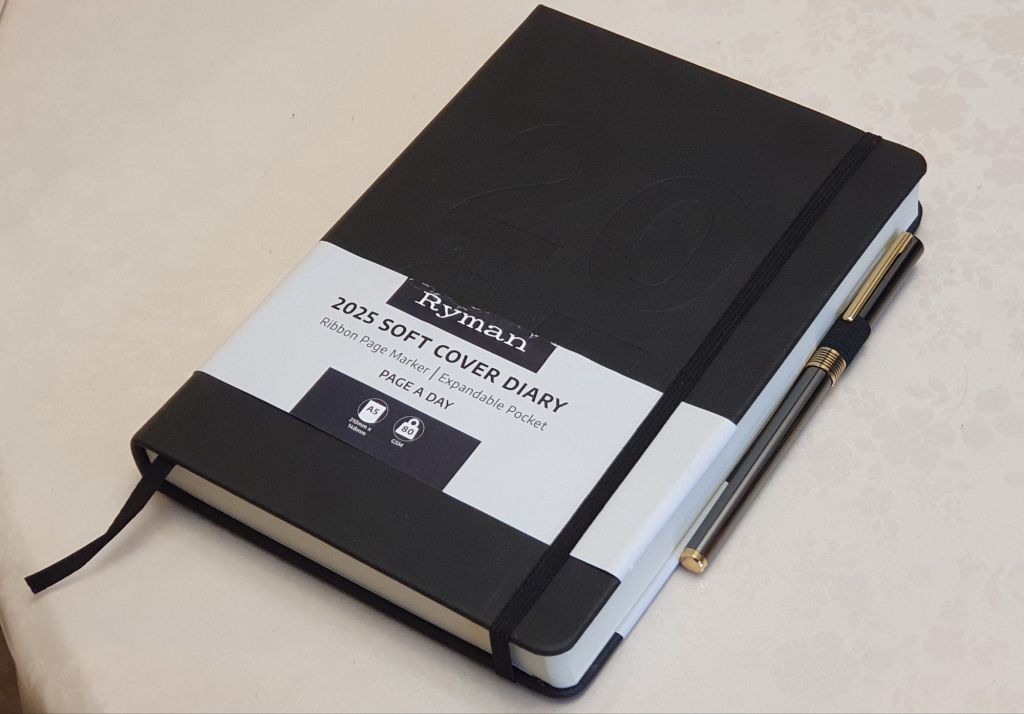
The new year diary, 2025.

It’s time to wake up this blog for another year and, where better to start than with a brief review of the diary that I plan to use?

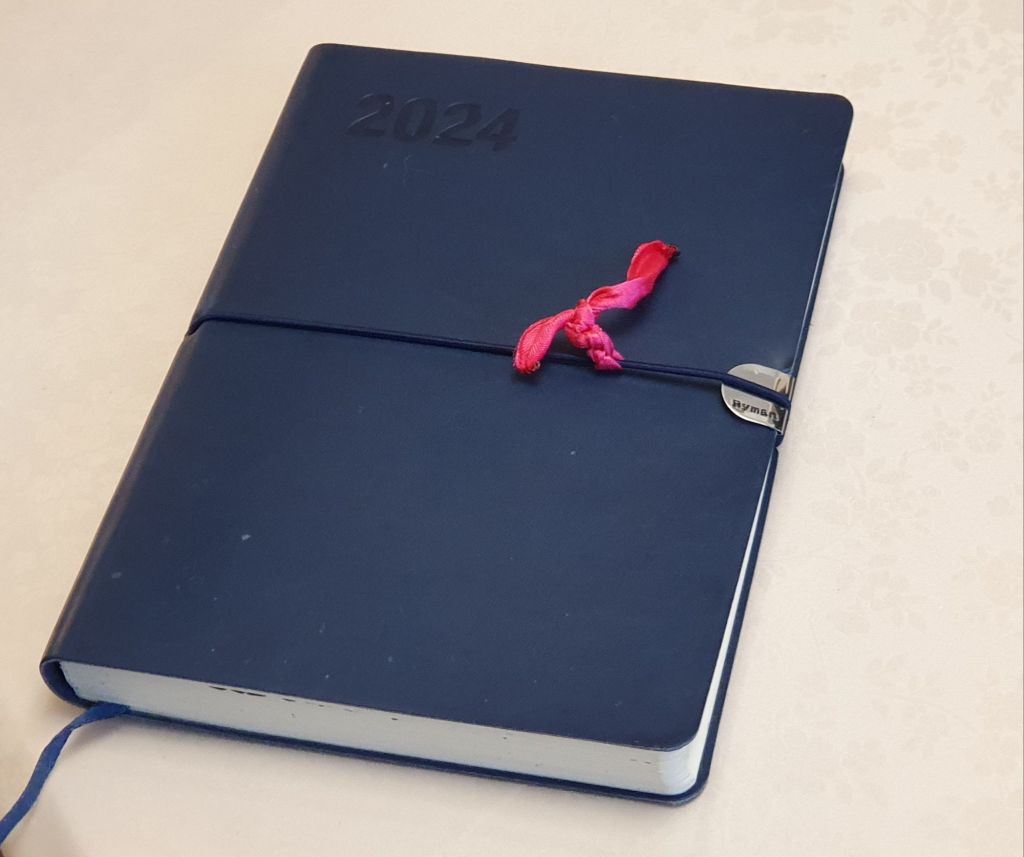
For 2024, I used a Ryman A5, soft cover, flexi, Page A Day diary for my daily journaling, summarising what I did with the previous day. Occasionally, this might include a list of things I am grateful for (if I can be unselfish enough for a few moments, to remember). My post on the new year diary, 2024 can be re-read here.

This year, I went for the closest equivalent that I could find, which was again from my local Ryman stationers. Whilst seemingly much like last years, I was glad to notice several subtle improvements have been introduced. These are as follows:-

  • Instead of last year’s horizontal thin elastic closure, we now have a more conventional, vertical ribbon elastic closure. I disliked the old style, since with short finger nails, it was fiddly to lift the elastic to open the book – an issue for which I designed a simple hack, namely tying a piece of pink ribbon to the elastic.
  • Whilst retaining the same soft texture of the covers, last year’s flexible cover has been replaced with a stiffer cover, which I like. It also does away with the need for the little metal reinforcement tab on the edge of the front cover to protect it from being worn by the elastic. Over the year, that piece of metal had lifted, leaving a sharp edge which was a danger to adjacent books.
  • A Pen loop has been added, to the back cover. I don’t actually use it (other than for this photo) but it could be useful.
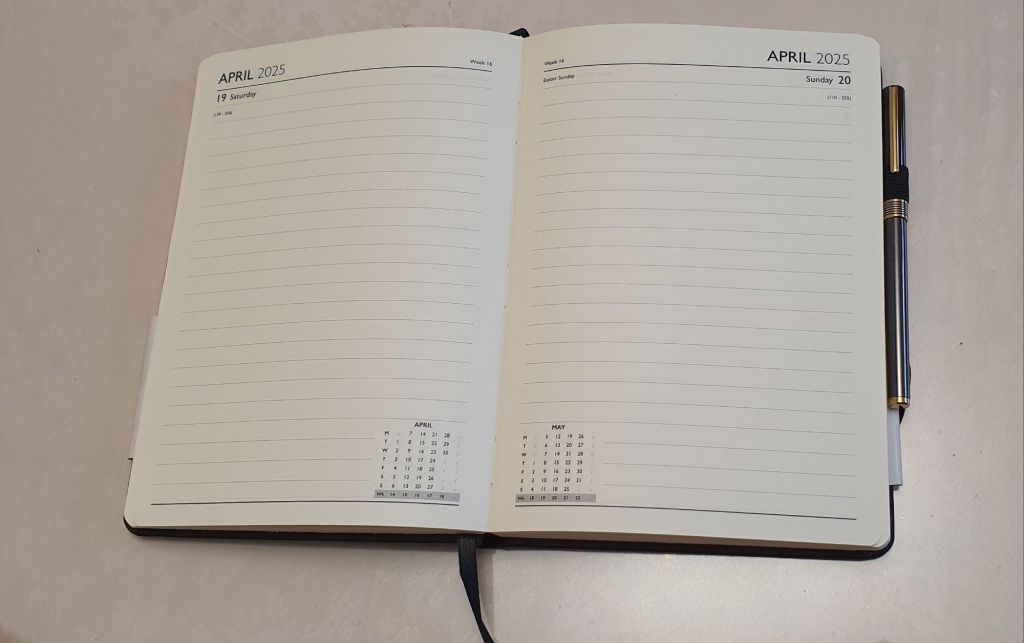
  • Something that I have only today noticed, the row height has been increased very slightly from 7.6mm to 7.9mm. I must admit, I was assuming that they were both 8mm until I checked.
  • Best of all, the 2025 edition now includes a Page A Day for Saturdays and Sundays, whereas last year they shared a page.

Otherwise, the two editions are much the same, with a ribbon page marker, cream paper which is fountain pen friendly and with sewn binding, to open flat without damage.

This suits my needs very nicely. For longer entries, such as holiday journaling, I use a separate Leuchtturm A5 notebook, with either plain paper or dot grid. Day to day pen and ink sampling and therapeutic pen time is done in a Stalogy A5 Editor Series 4mm grid, 365 page note book, a product which I have now used and enjoyed for several years.

For bullet-journaling, I upgraded my old Ryman A4 notebook to a WHSmiths Moderna Ruled A4 Leather Notebook, with 96 ivory sheets of 100gsm paper. I have set this up with monthly spreads, for the years 2024 to 2029 inclusive. It is very useful to log dates which are a year or more in advance, such as car and house insurance renewals, guarantee expiry dates, or investment product maturity dates. As well as these grown-up uses, I also like to include books read, albums listened to, trips to the gym and other day to day life admin.

So there you have it. Here’s wishing everyone a Happy New Year and hoping for happy events to plan and record in our diaries for 2025!

Travelling with ink: November 2024, my North Sea haul.

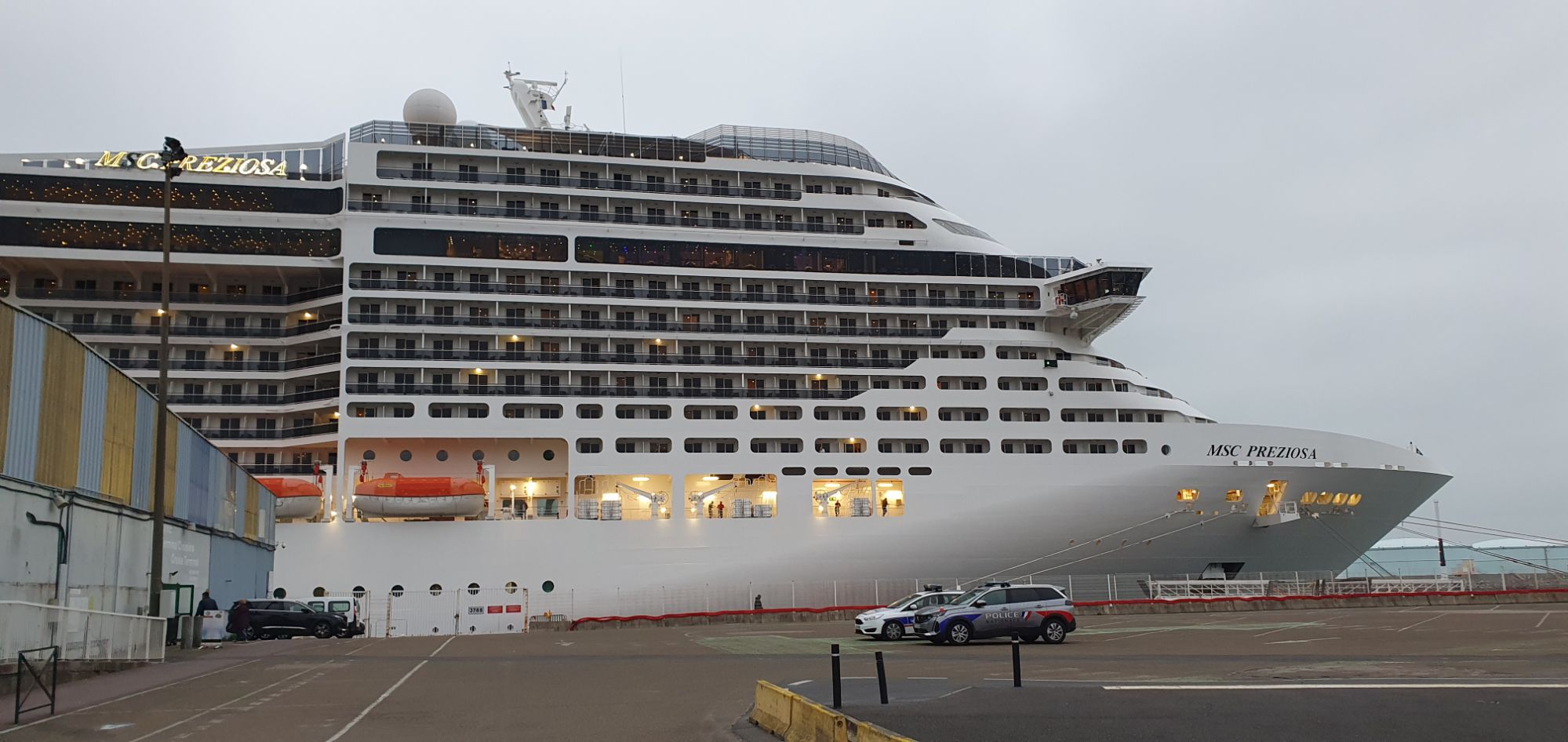
This month, I was fortunate enough to spend a week on a cruise ship, the MSC Preziosa. From Southampton, the trip would take us to Hamburg, Rotterdam, Zeebrugge and Le Havre. Four countries in a week!

The MSC Preziosa

I had been looking forward to the holiday, not only the shore visits but the time at sea, relaxing on the ship and the copious amounts of food and entertainment on board. In particular, I was looking forward to some pen time, writing up my journal in the cabin or any of the comfortable lounges and dining areas when time allowed.

I took four vintage fountain pens. These were a Conway Stewart 15, a Burnham 61, another Conway 15 and an Eversharp Skyline. All are lever-fillers and freshly filled with Waterman inks: Intense black, Serenity blue, Audacious red and Harmonious green, respectively. My plan was to rotate these four pens, writing with a different one each day. For journaling, I brought a Leuchtturm A5 dot grid hardback notebook.

This system worked well. Each day’s entry was written in a different colour from the day before. In practice there was some overlap, when I wrote some more about the previous day but would already be on a new colour.

Another benefit would be the ease of measuring the page capacity of each pen (all recent acquisitions), by counting the pages written in each colour. However none of them has yet run dry and so this test is still in progress.

Another holiday pursuit, was seeking out fountain pen shops wherever we travelled. I had long been telling myself (and my wife tells me too) that I do not need more fountain pens, but I take it that such rules do not apply when outside the UK jurisdiction. At the very least, they are less rigorously enforced.

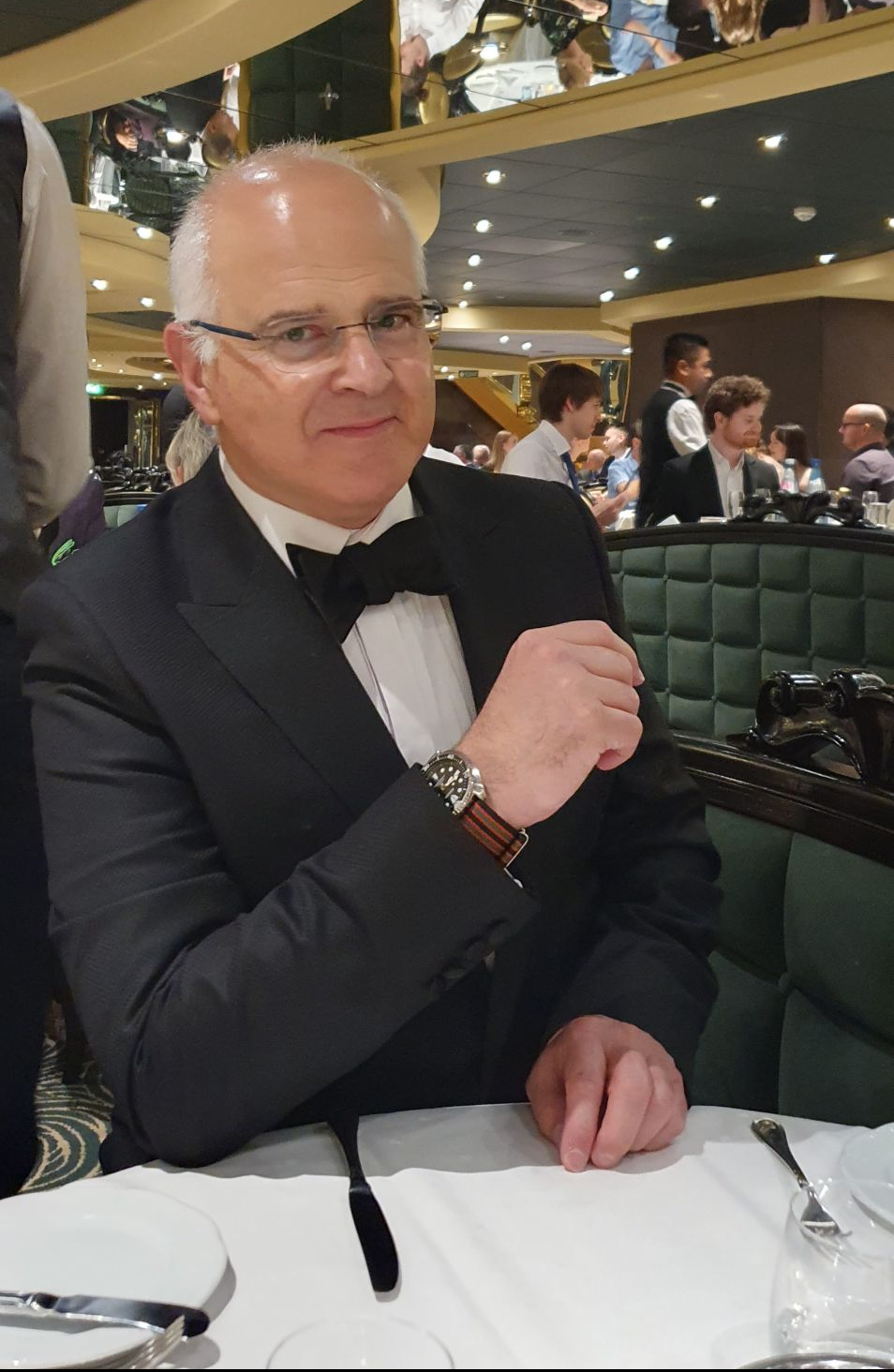
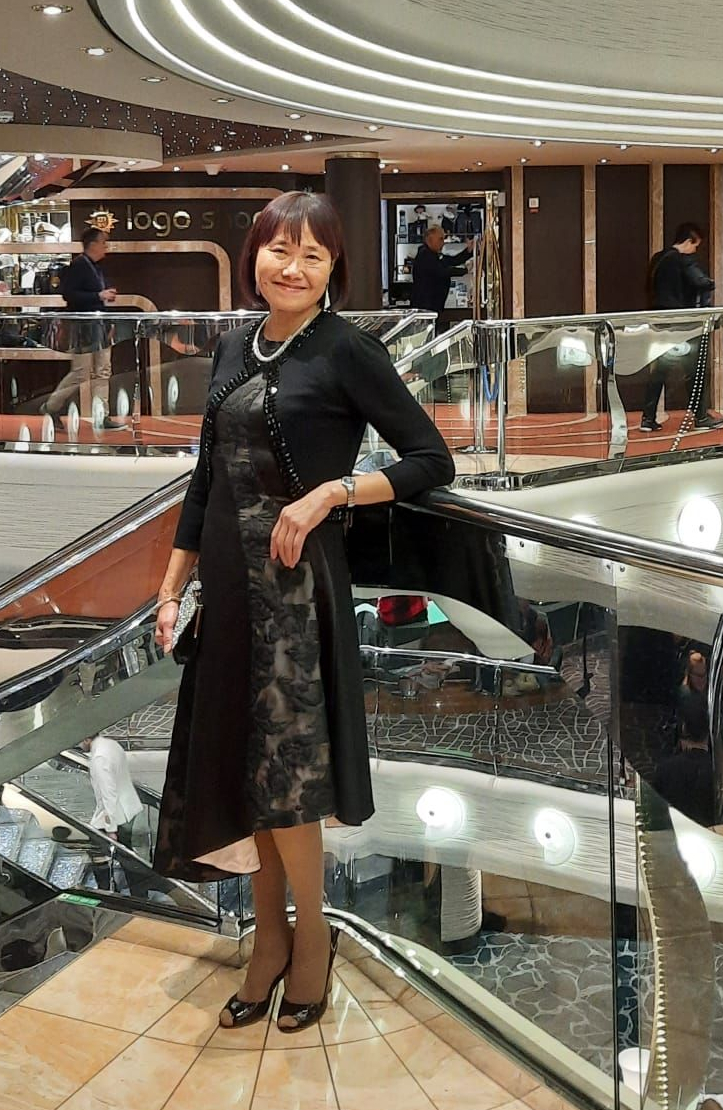
Ling, fully on board for Gala Night.

Over the course of the week, I managed to buy six fountain pens! These were all modest purchases, ranging in cost from three Euros, up to 60 Euros at most, all cartridge-converter pens and all with steel nibs. Nevertheless, finding and buying each of these brought me a great deal of pleasure and they continue to make me happy, long after the cruise is over. Here is an account of the new pens that came home with me.

Hamburg.

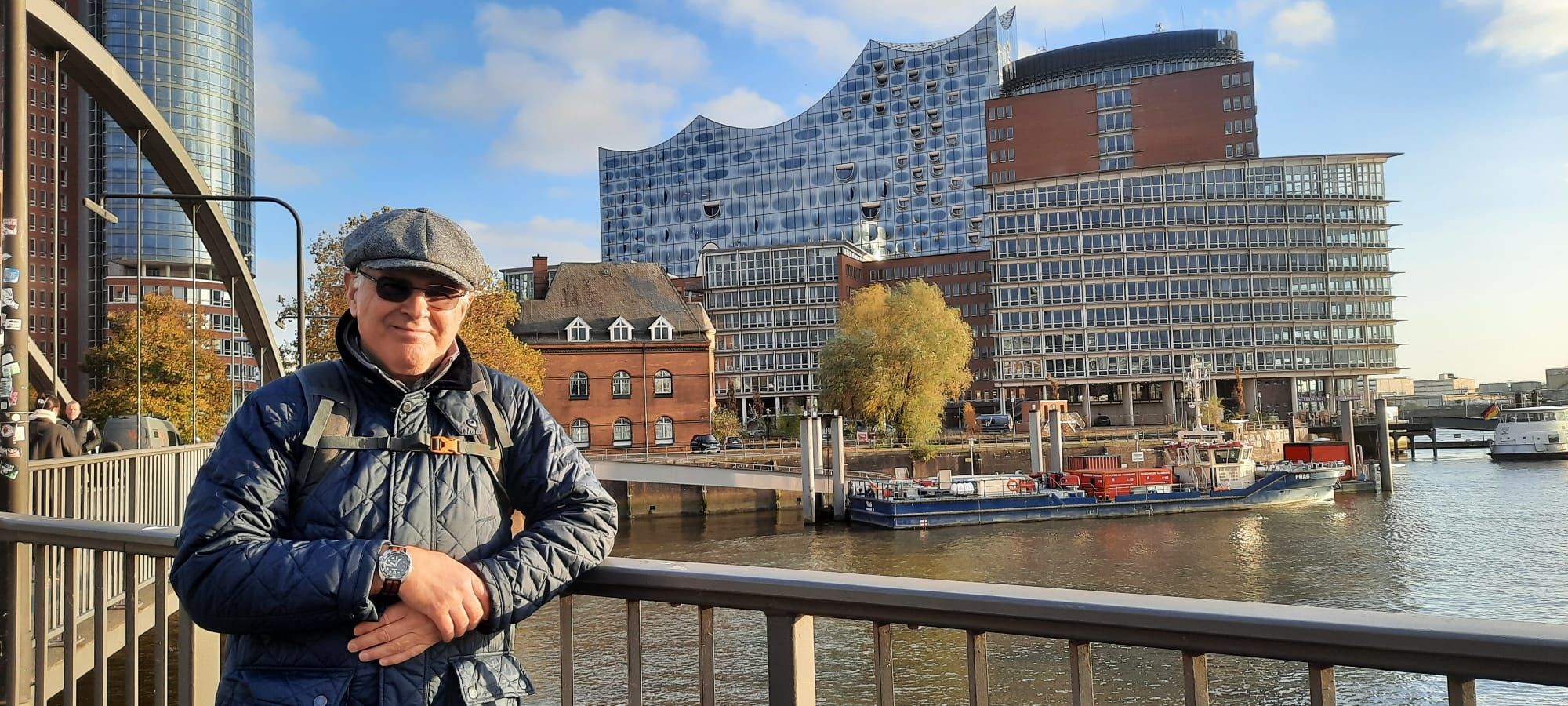
Despite its proximity to the UK, this was only my first time in Germany. A well-travelled friend had once told me that the pharmacy chain Mullers, often sold school pens, from brands such as Online. Our taxi dropped us near the splendid City Hall and from there we walked almost seven miles with our tourist map, taking in the main sites including churches, the concert hall, and the historic dockland warehouses.

Trying to blend in. In the background, is the Elbphilharmonie, Hamburg.

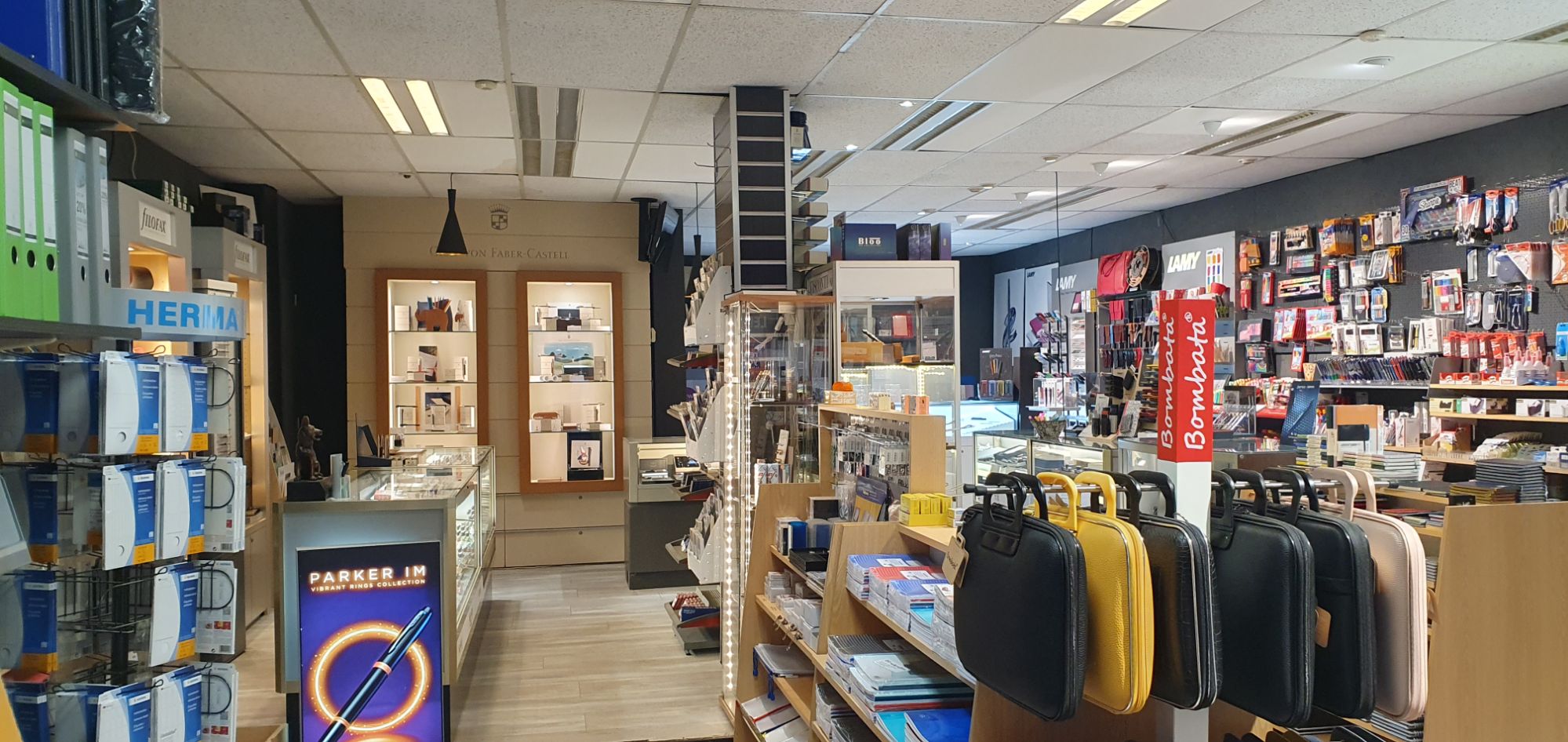
I did not come across a Mullers but we did briefly visit a modern shopping mall, Europa Passage where I had a quick look for any pen shops. I found a hobby craft shop called idee, where a helpful assistant showed me a small selection of Lamy Safaris. One of these, in a new “light rose” with matching clip and finial, appealed to me. I was surprised to find that all the Safari fountain pens were inked and could be tested before purchase. This pink one wrote very nicely (as expected with Lamy) and this became my souvenir from Germany.

Rotterdam.

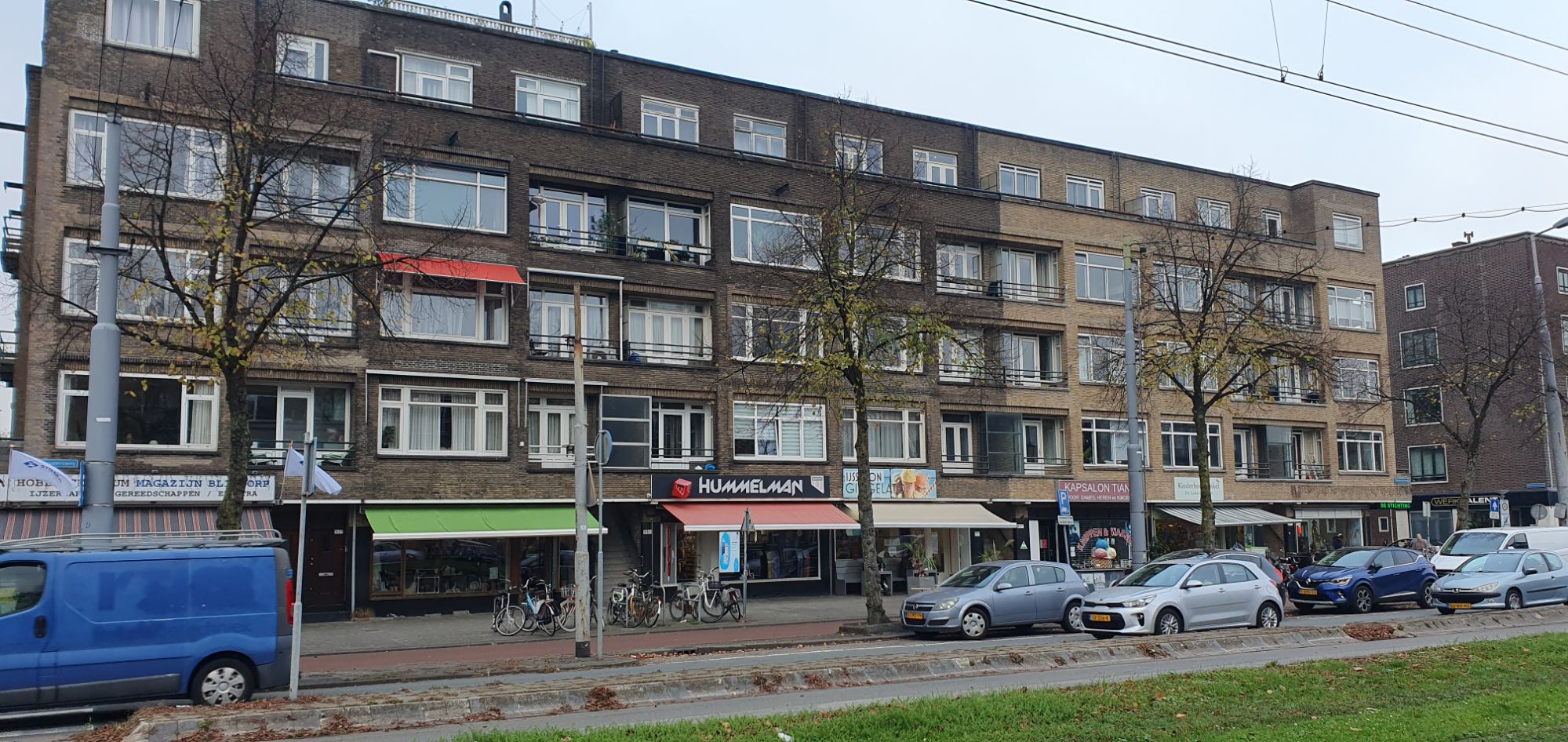
I had Googled for fountain pen shops in Rotterdam and the top result was Hummelman. After a nice walk across the bridge from the cruise terminal and along the waterfront and a visit to a few of the main attractions in the city centre, such as the market, the cube houses and City Hall, I took a walk to find Hummelman. This turned out to be a couple of miles from the centre but was well worth the visit.

Hummelman pen shop, Rotterdam.

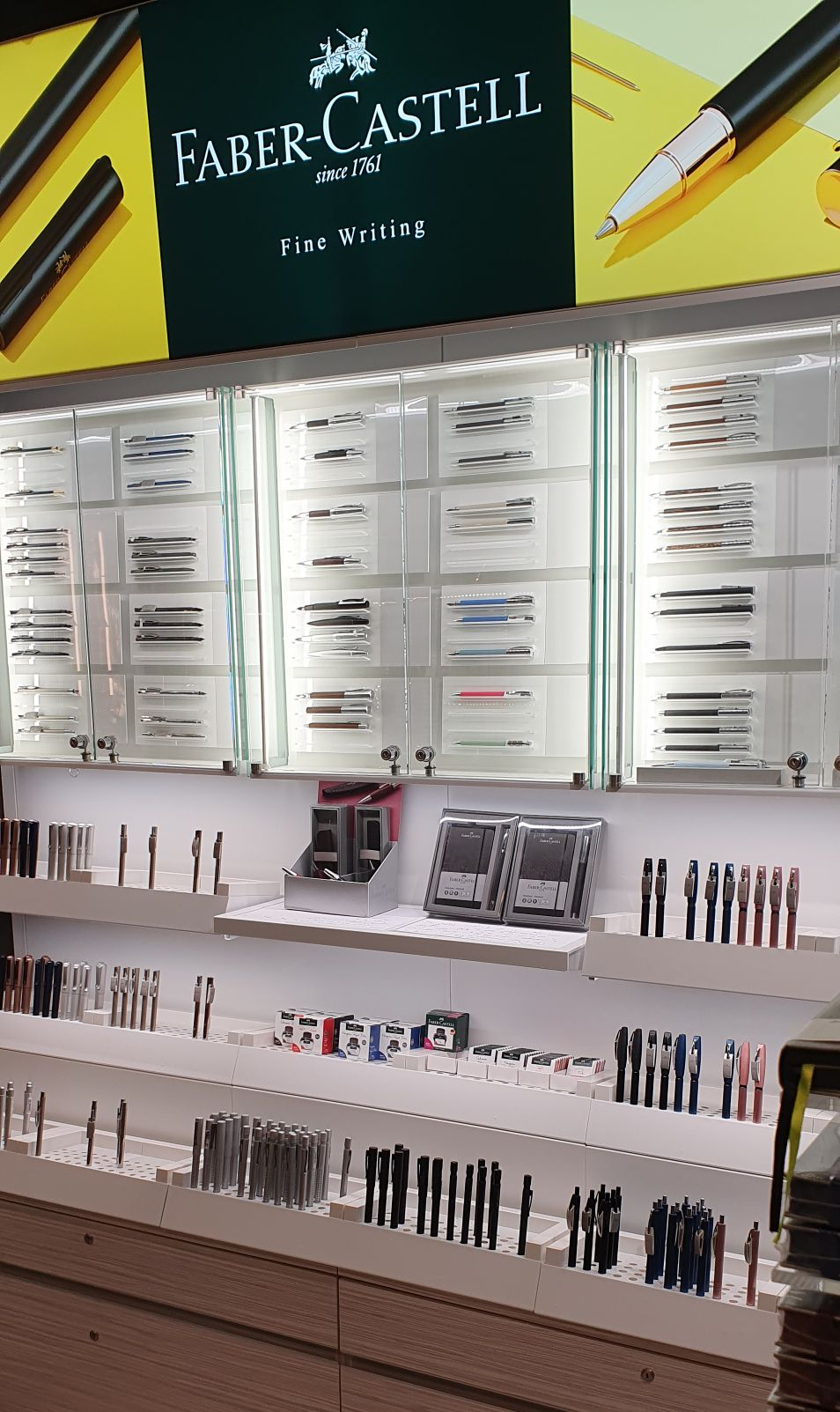
I learned that this family-run shop had been established in the 1930’s and now run by the third generation of the family. The genial proprietor, Vincent, kindly allowed me to take some photos and to take my time having a long browse around the displays. It was such a treat to find a bricks and mortar store with such a wide selection of brands and models and an enthusiastic and knowledgeable owner. I chose a green Monteverde Ritma – a large and hefty metal pen with a glossy gunmetal magnetic cap, and a blue Faber-Castell Essentio (or Basic), which was also in metal. Previously I had seen only plastic barrelled version with rubber grip section. Both of these pens were available in various colours and nib widths.

Stepping into Hummelman.

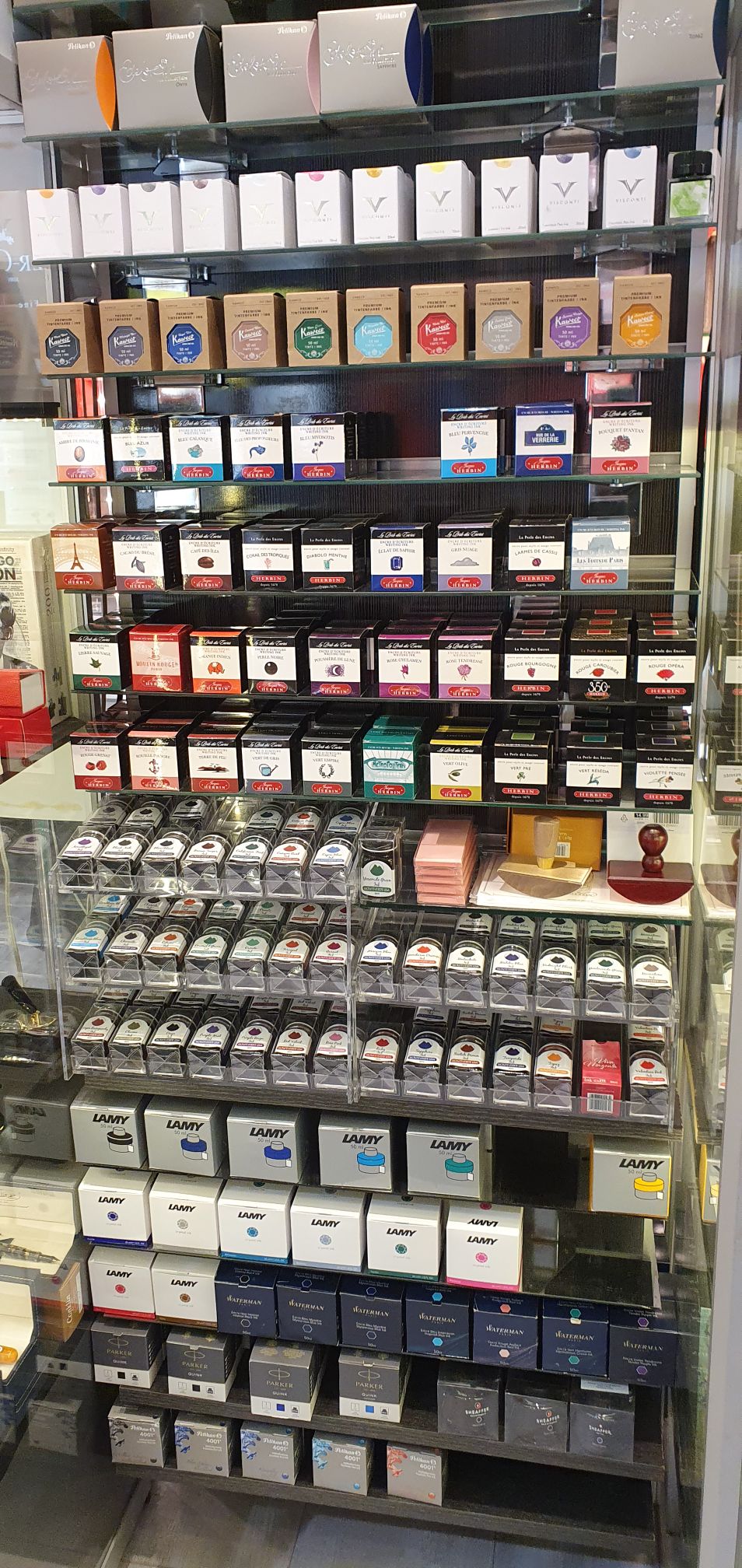
Vincent saw me studying his vast display of inks, which reached from floor to ceiling and referred me to his helpful book of ink swatch cards, carefully made by hand and grouped by brand. He told me that his father does the swatches. I chose a Jacques Herbin Lie de thé.

Just some of the fountain pen inks at Hummelman.

Of these two pens, I am finding the Faber-Castell to be easier. The fine nib is a joy: firm but smooth and effortless. The body and finish definitely feels like an upgrade from the plastic and rubber versions I had used before. As for the Monteverde, the glossy polished metal section is slippy, as I might have known. The magnetic cap works well and leaps into place with a click to fit flush with the barrel, whether on capping the pen or posting the cap. On my model, the stealthy black fine nib needed some smoothing and this, coupled with the insecure grip, makes the pen a bit tricky to use, but it is a handsome and weighty beast.

Great selections of Faber-Castell models and nib choices.

Zeebrugge.

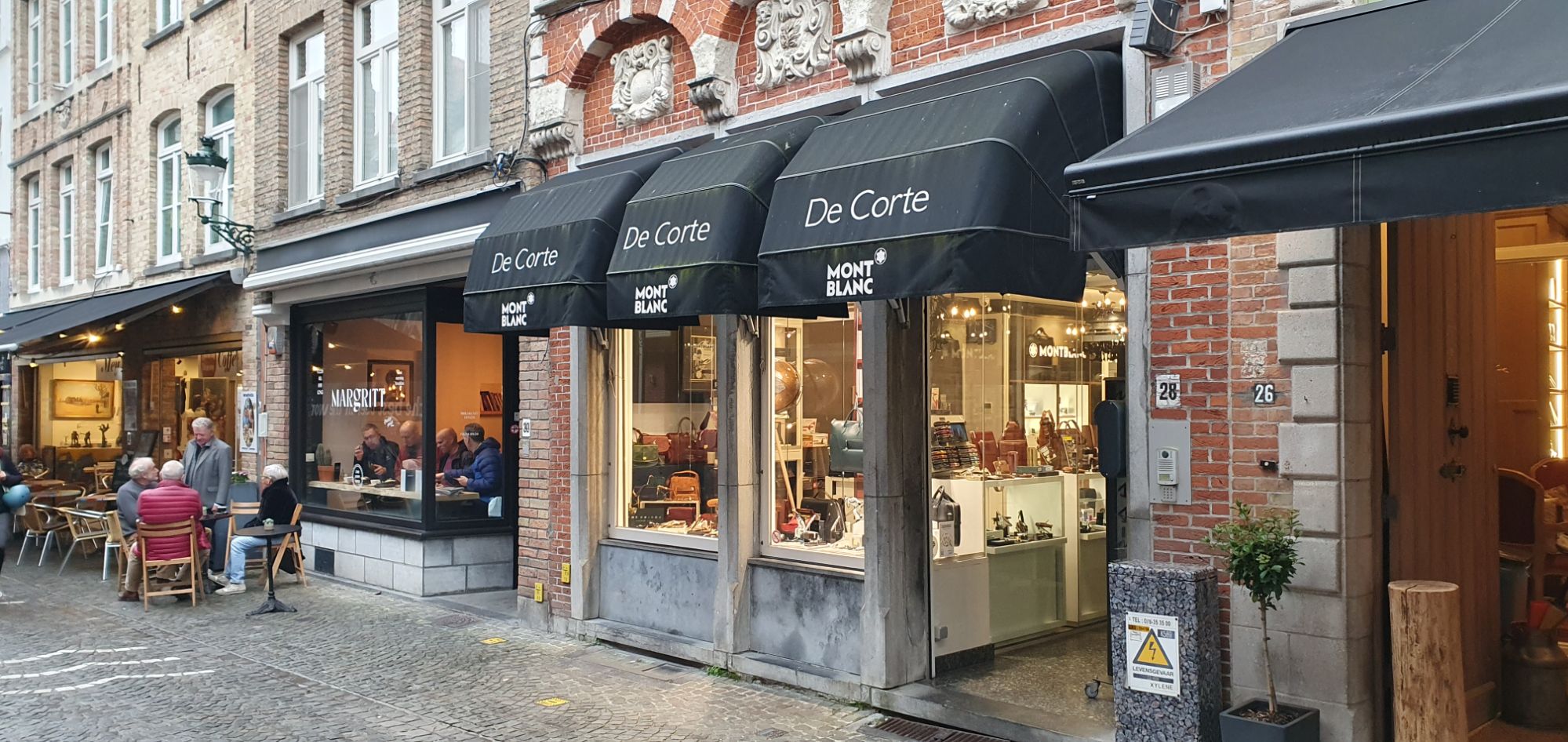
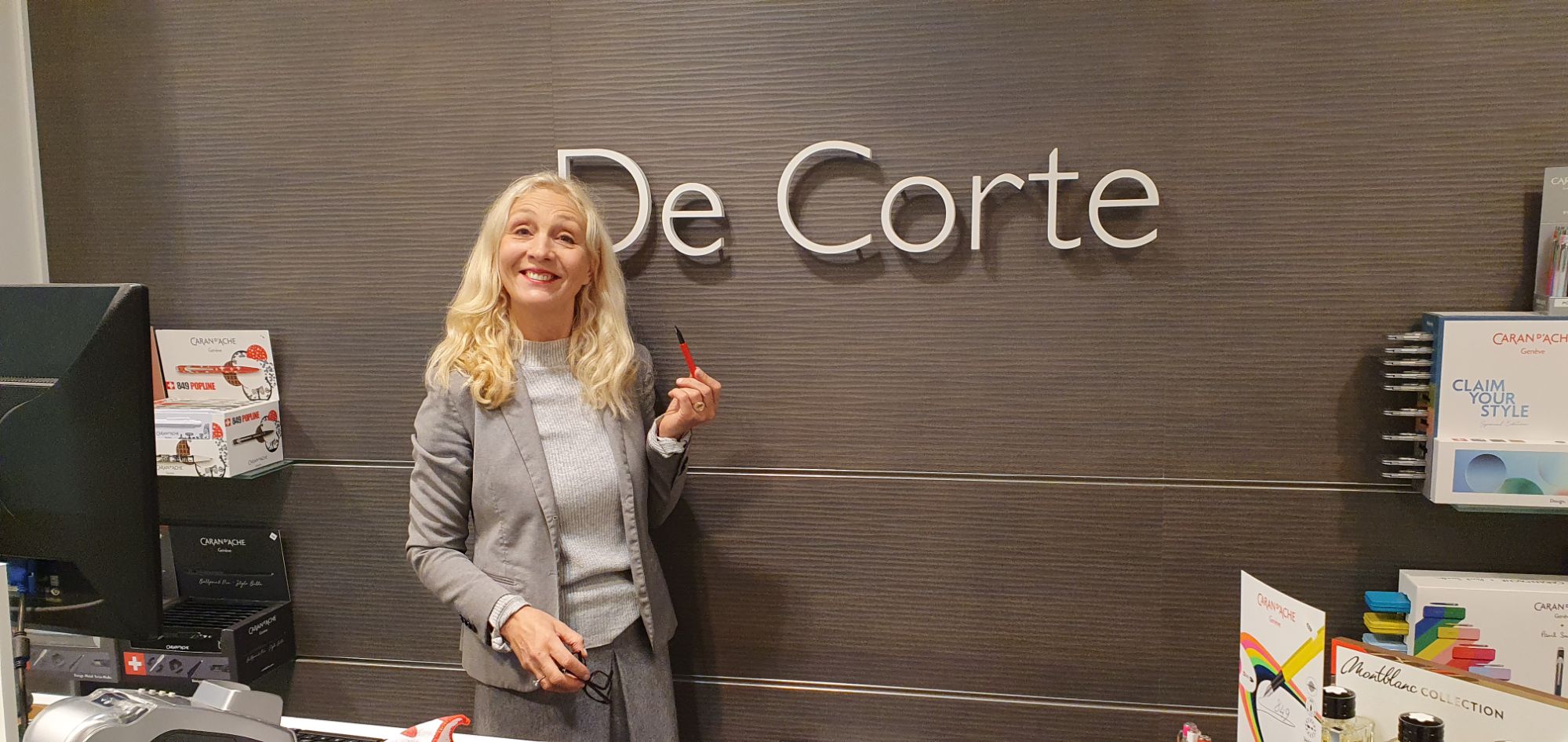
This is the port for the stunningly beautiful medieval town of Bruges, about 30 mins drive inland. When I was there last, in 2016, I had sought out a pen shop that I found online, named De Corte. This is another shop now owned by the third generation of the family, having started in the 1920’s. I have fond memories of finding the shop but having to peer at the window as the shop was closed. Fortunately the proprietor, Iris de Corte spotted me and allowed me to come inside and look around, as she was taking product photos for a proposed website.

The delightful De Corte pen shop, plus stationery and leather goods.

This time, the shop was open and I was happy to find Iris again, serving a customer. When I reminded her of my last visit of 8 years ago, she laughed and said that she had still not set up the website! She far prefers to meet customers face to face and to enable them to try a pen before buying. She told me that the number of such fountain pen shops is now very small. When I mentioned Hummelman’s in Rotterdam, she told me that she knew them! It is a very small world.

Ms Iris De Corte

Of course, I wished to buy a pen from Iris. I chose a Caran d’Ache 849 in red – the colour of Caran d’Ache and of the Swiss flag. As the joke goes, “You could say a lot of bad things about Switzerland but their flag is a big plus.” When I had first tried one of these pens, several years ago, I had dismissed it as being too slim and having an uncomfortable step down from barrel to section. However in practice, having spent time using the pen, neither of these points is an issue for me. I enjoy its pencil-like hexagonal cap and barrel, the satisfying click on capping the pen and the neat way the cap can be posted, flush with the barrel. It also writes very well.

Le Havre.

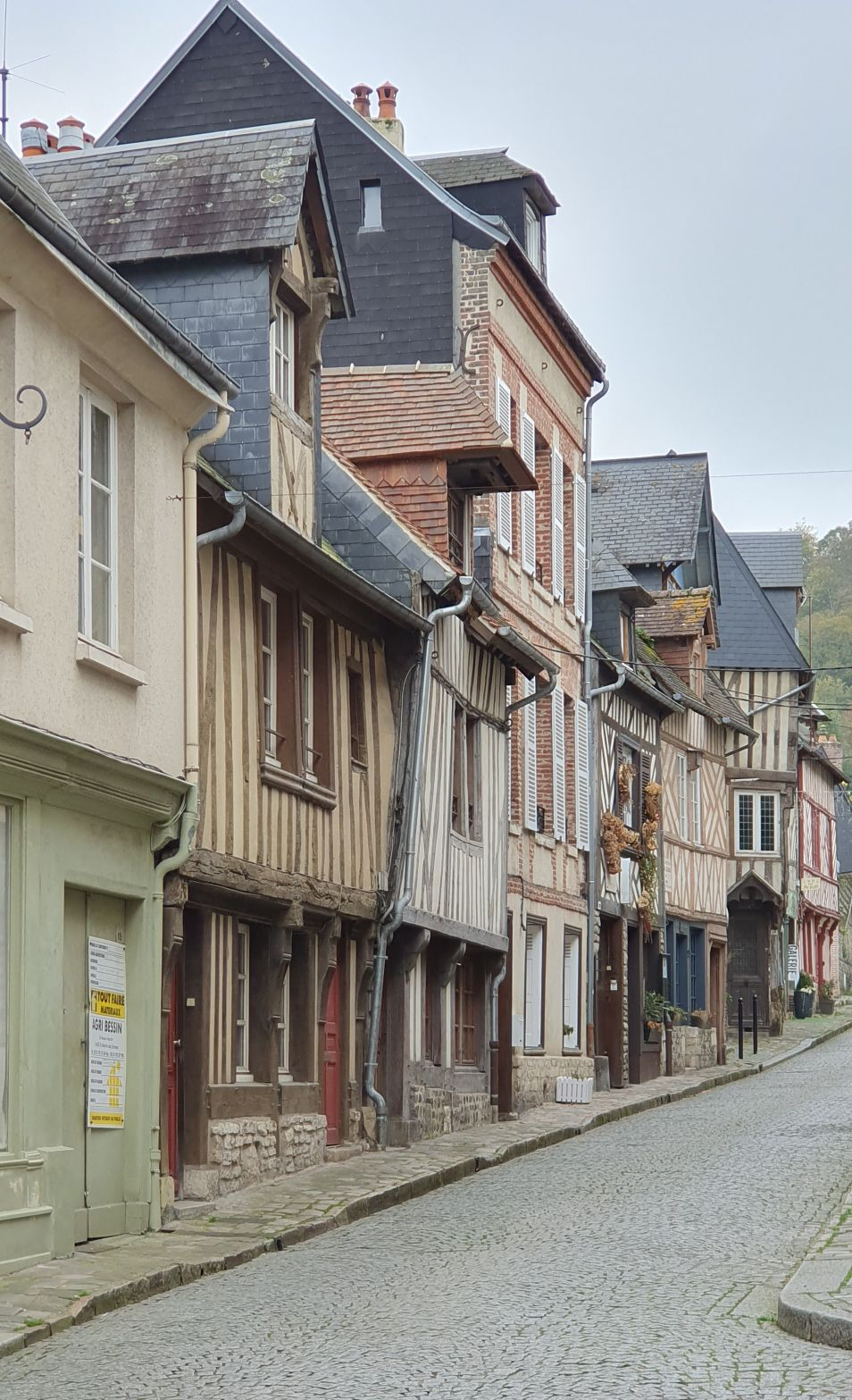
My wife and I had booked an excursion from the port of Le Havre, to visit Honfleur. This is a picture-postcard town of pretty timber-framed houses, picturesque streets of shops and art galleries and interesting churches and waterfront places to explore: an absolute gem.

A street scene in Honfleur.

Before getting immersed in this historic town, I popped into a supermarket for a quick look for a stationery aisle. I found one and could not resist buying a fountain pen for three Euros, including two cartridges. It had no brand name other than the name of the shop, “Casino, stylo plume” on the blister pack. Back outside, I loaded a cartridge, putting the second one in the barrel as a spare. After the pen had sat in my pocket for a few minutes, I tried it out in my notebook. To my surprise, it wrote immediately and with a lovely smooth flow. If only all pens were this good!

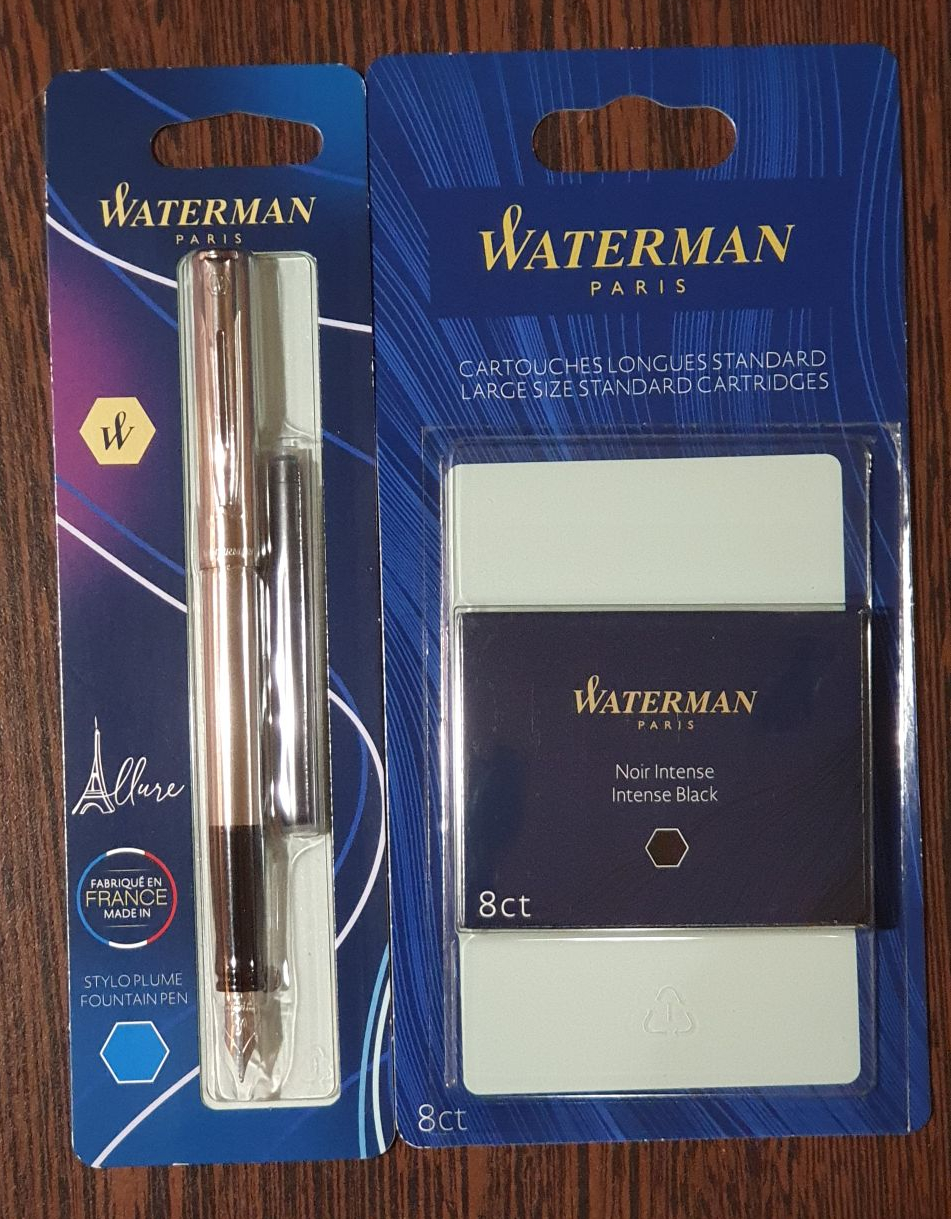
My final pen purchase of the trip came at the end of the day, back in Le Havre. Again, it was a supermarket in the city centre where I found an ideal souvenir: a Waterman Allure, made in France, in brushed stainless steel and with an improved plastic grip area. When I had bought an Allure previously, I disliked the grip section with a surface that defied gripping. In frustration, I had gouged grooves in it to stop the pen sliding around in my hand. Thankfully, this problem has been fixed, at least on the stainless steel versions now sold in Le Havre!

Again, this Waterman wrote beautifully, straight out of the box and makes a great EDC pen, encased in steel and with its large capacity Waterman cartridge.

Waterman Allure, brushed stainless steel.

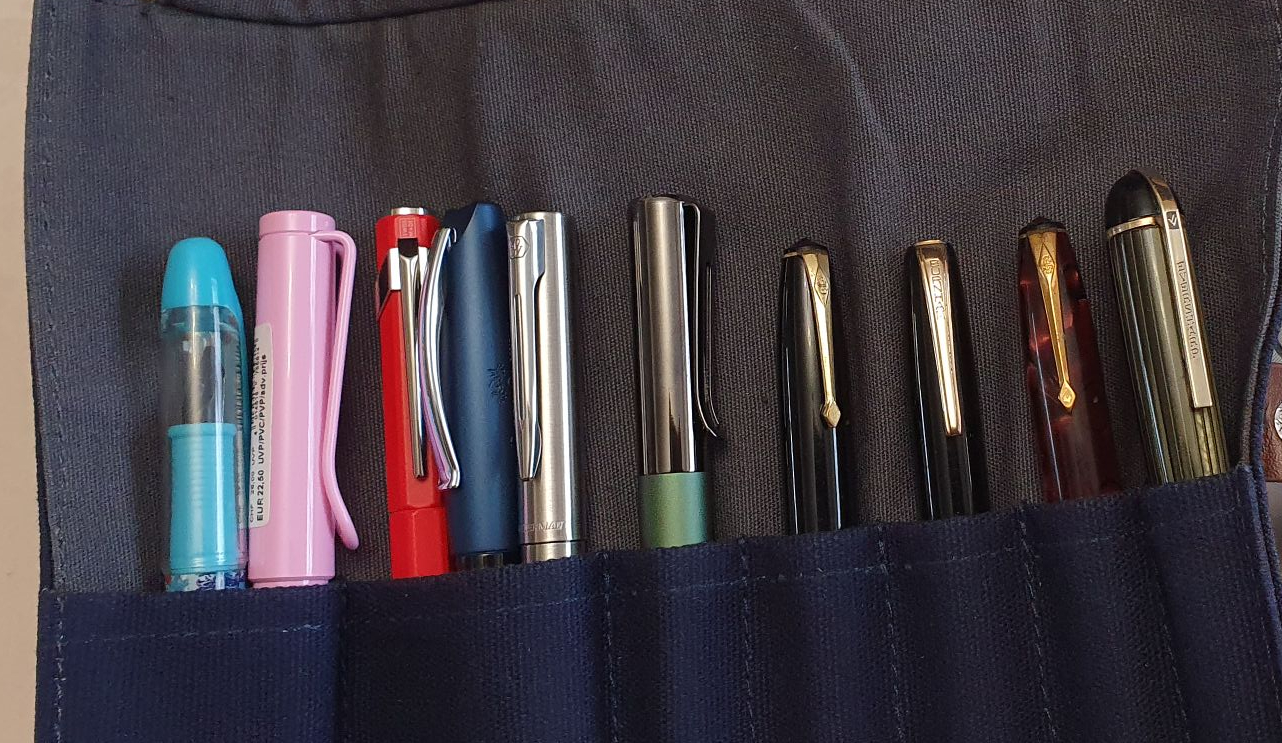
The following day, our cruise ended and we disembarked at Southampton, tired but happy. I was pleased with my purchases. Returning with six additional pens inked will delay the emptying of my four vintage pens but this is a small price to pay for the joys of the holiday haul.

The four vintage pens on the right. The six new arrivals on the left.

My pen of the week: the Burnham 61 lever filler.

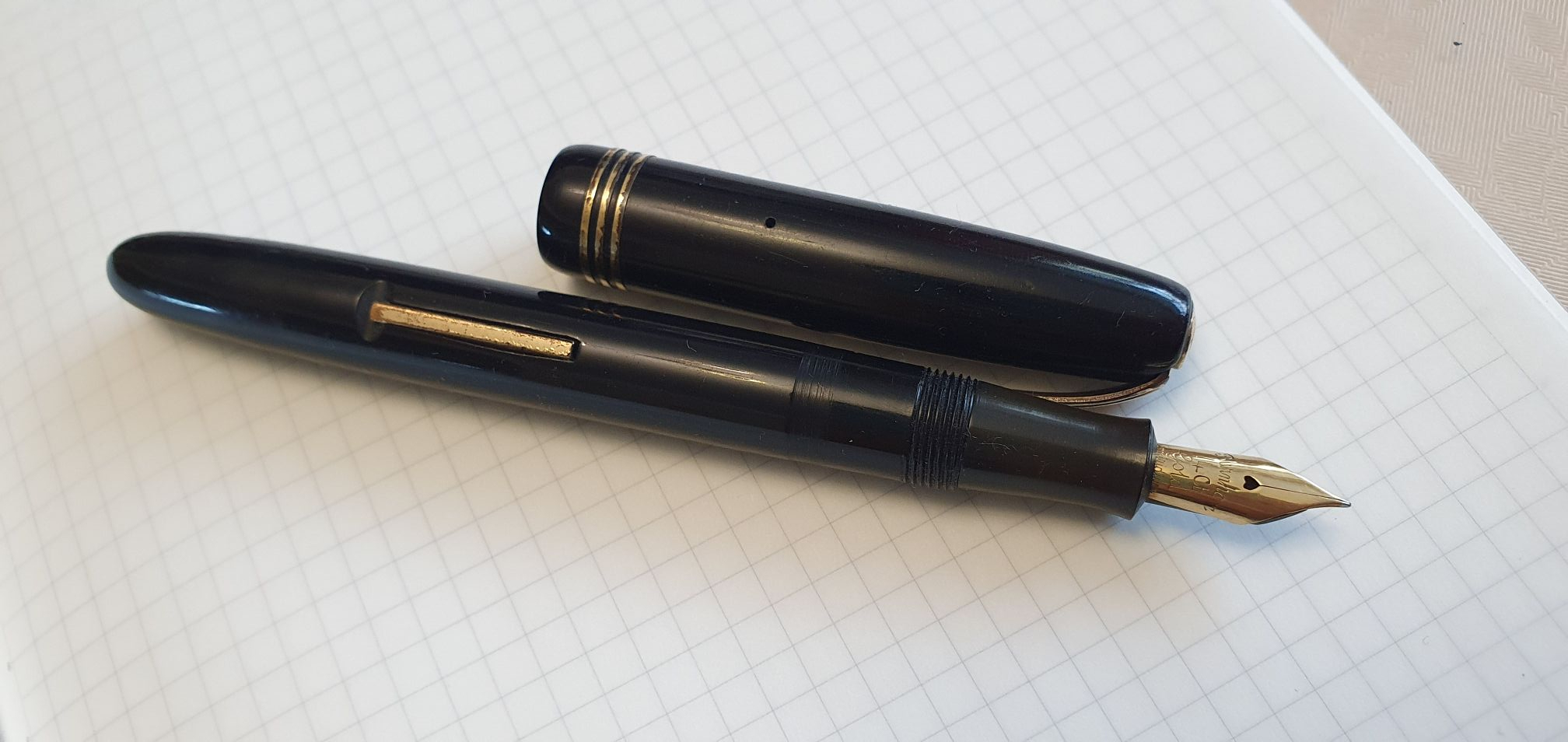
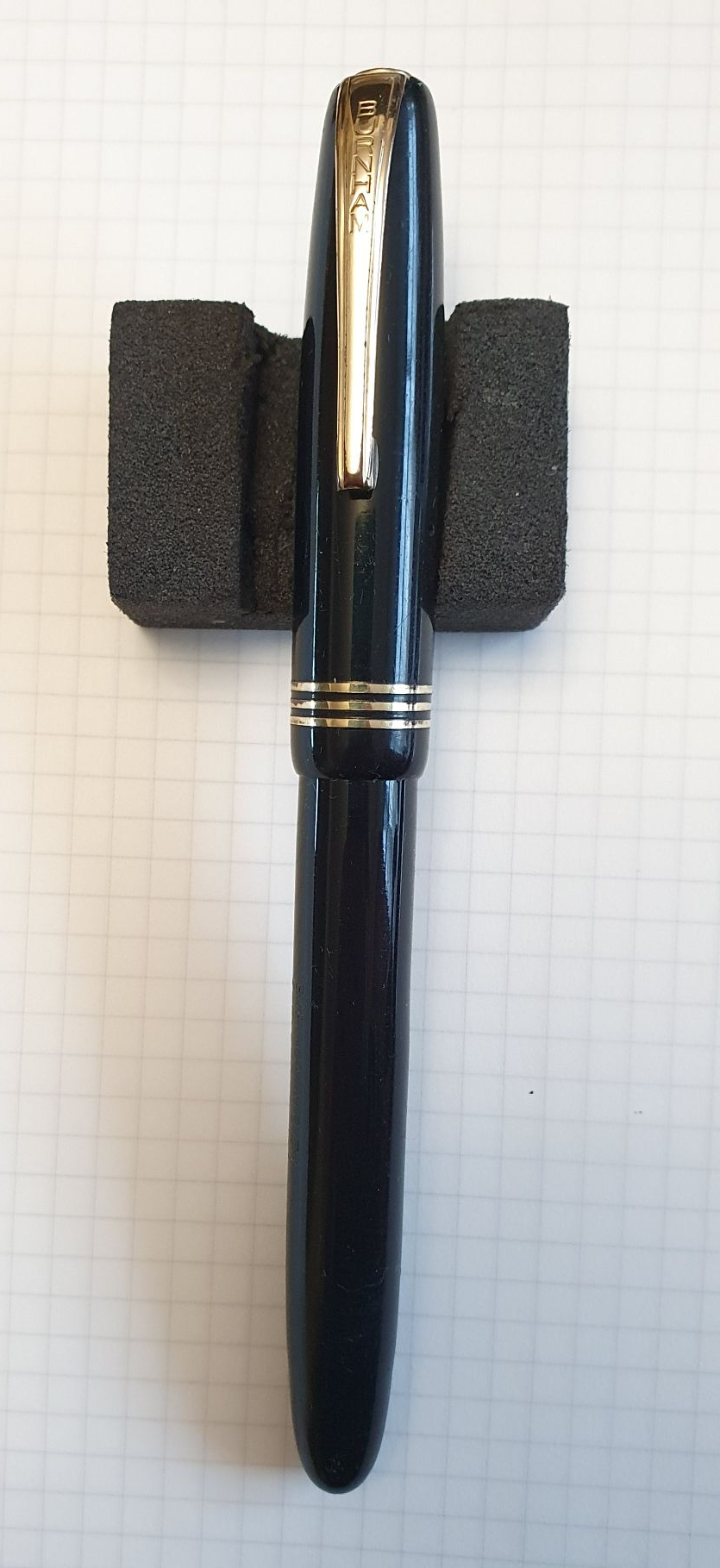
The latest fountain pen to arrive on my doormat has been this lovely vintage Burnham 61, which I found on eBay.

Burnham No.61

The backstory to this purchase, is that I had first bought a Burnham, a number 54, in March this year and had been delighted with it. Some photos and information on that pen appeared in my post Finding joy in small things: the Burnham 54 fountain pen back in April. That pen was much smaller than I had expected but the soft, 14k gold nib made the pen such a pleasure to use that I soon adjusted to its size.

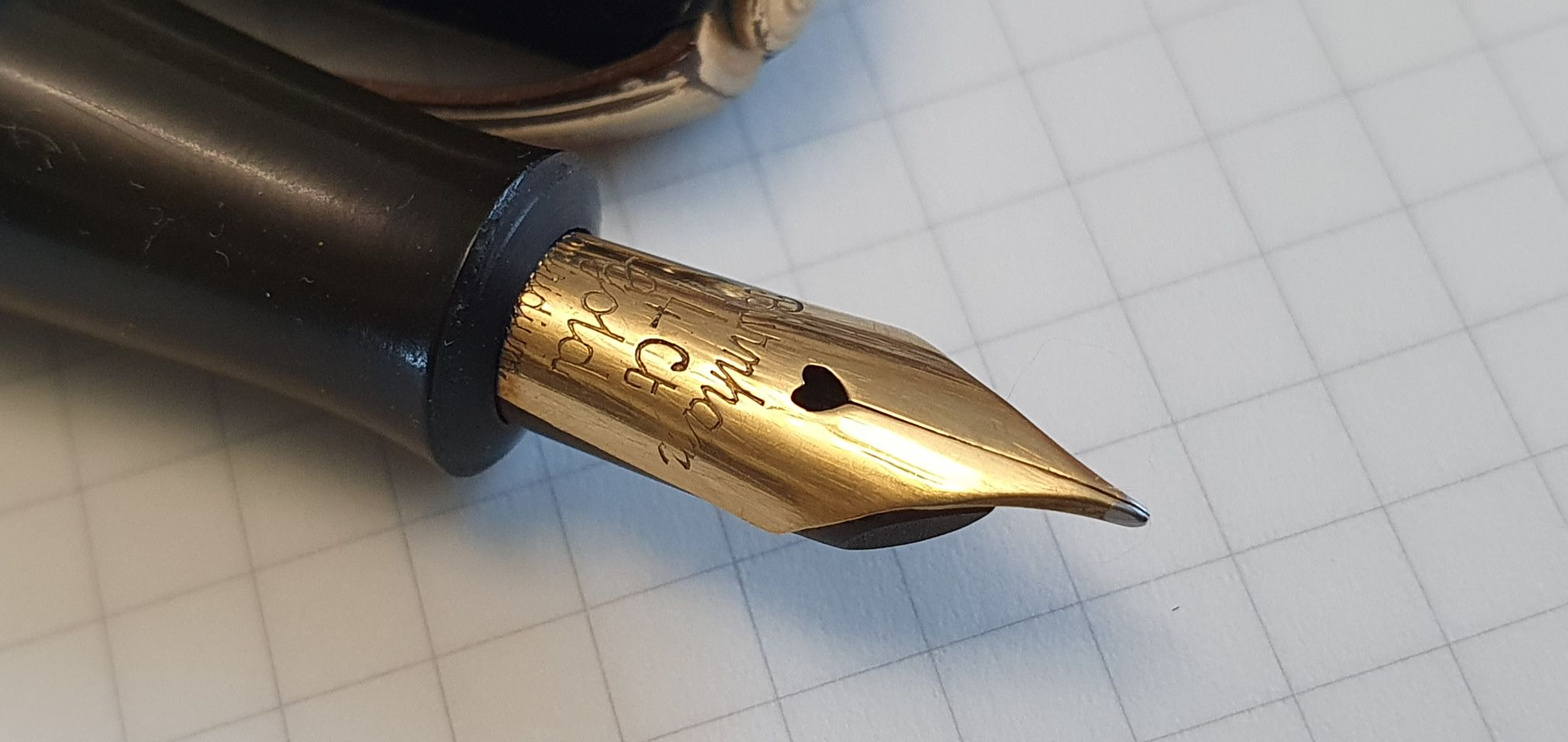
I have been warned by a close relative in my household, to stop looking at pens on eBay as the temptation there is never ending. This, I can confirm, is true. Nevertheless, a decent interval having elapsed since my last transgression, I ventured back to the site and, sure enough, spotted this black Burnham 61 which was offered for immediate purchase. The description stated that the sac had been replaced and that the pen was in good condition for its age. The seller’s photograph of the nib proved too much for me and I was smitten.

Got to love the heart-shape!
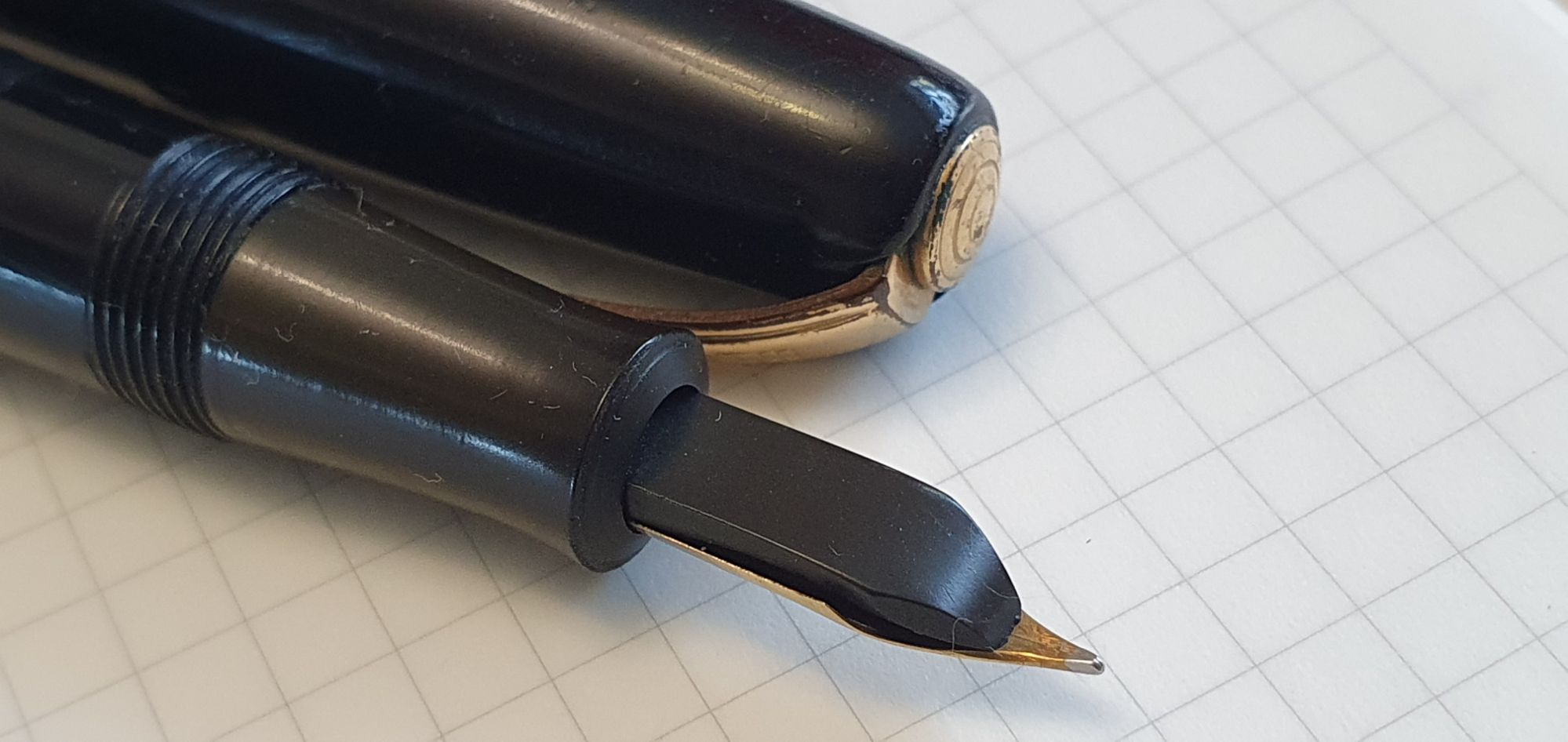
The grip section is of a lighter colour than the barrel and cap.

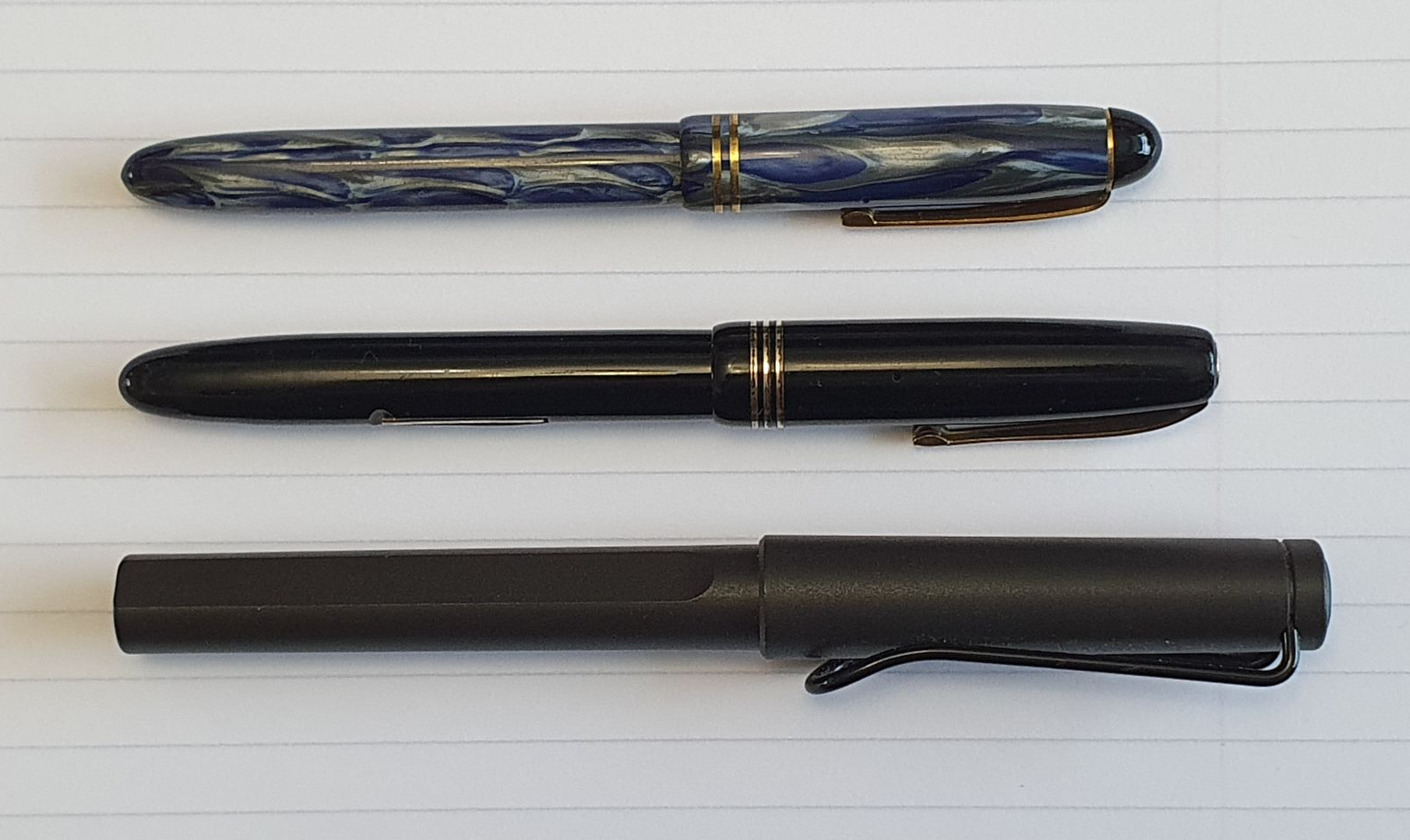
Once again, I had made the mistake of expecting the pen to be bigger! Although larger all round than my Burnham 54, it is still a small pen by modern standards. With vintage pens, I avoid posting the cap in case of damaging the cap rim. An alternative is to find a cap from a modern pen to post, to add length. In this case, I found that a cap from a Speedball calligraphy pen worked very well, but I found it preferable, at least for short writing sessions, to get accustomed to holding the pen unposted.

Size comparison: Top: Burnham 54; Middle: Burnham 61 and Bottom: Lamy Safari.

I flushed the pen a few times in warm water and then filled it with Waterman Serenity Blue. The pen filled well. There is no ink window of course, but if you wish to measure how much ink a lever filler draws up, you may empty it slowly and count the drops. Alternatively, for a more immediate assurance, you may decant some ink into an ink-miser with a narrow diameter, which will better show the ink level sinking, as ink is drawn into the sac. I use the plastic insert from a TWSBI Diamond 580 ink well for this.

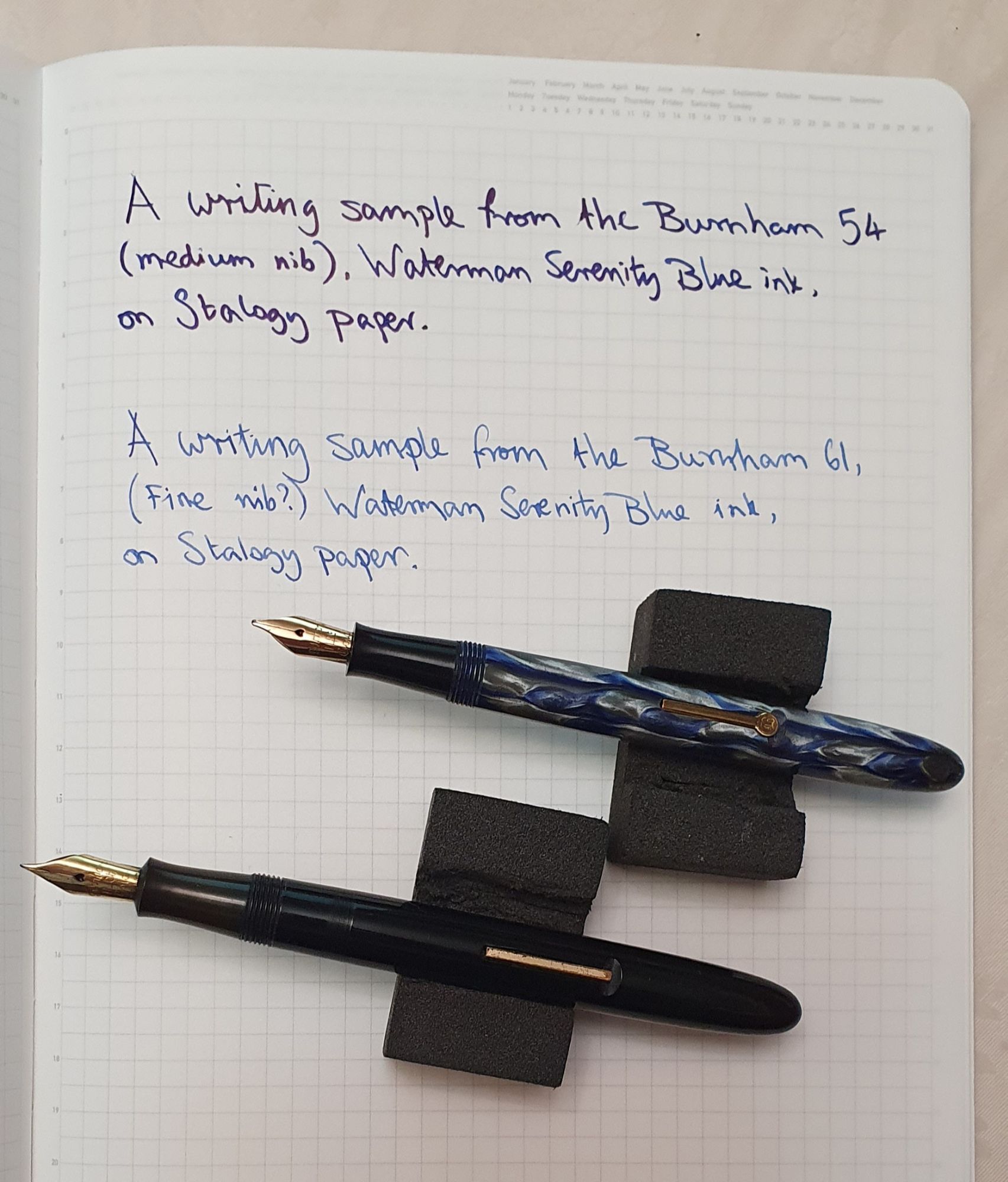
And so to the writing. The pen wrote superbly. The nib grade is not shown but I presume it to be a Fine or Extra Fine. The nib imprint reads “Burnham 14Ct Gold Osmiridium.”

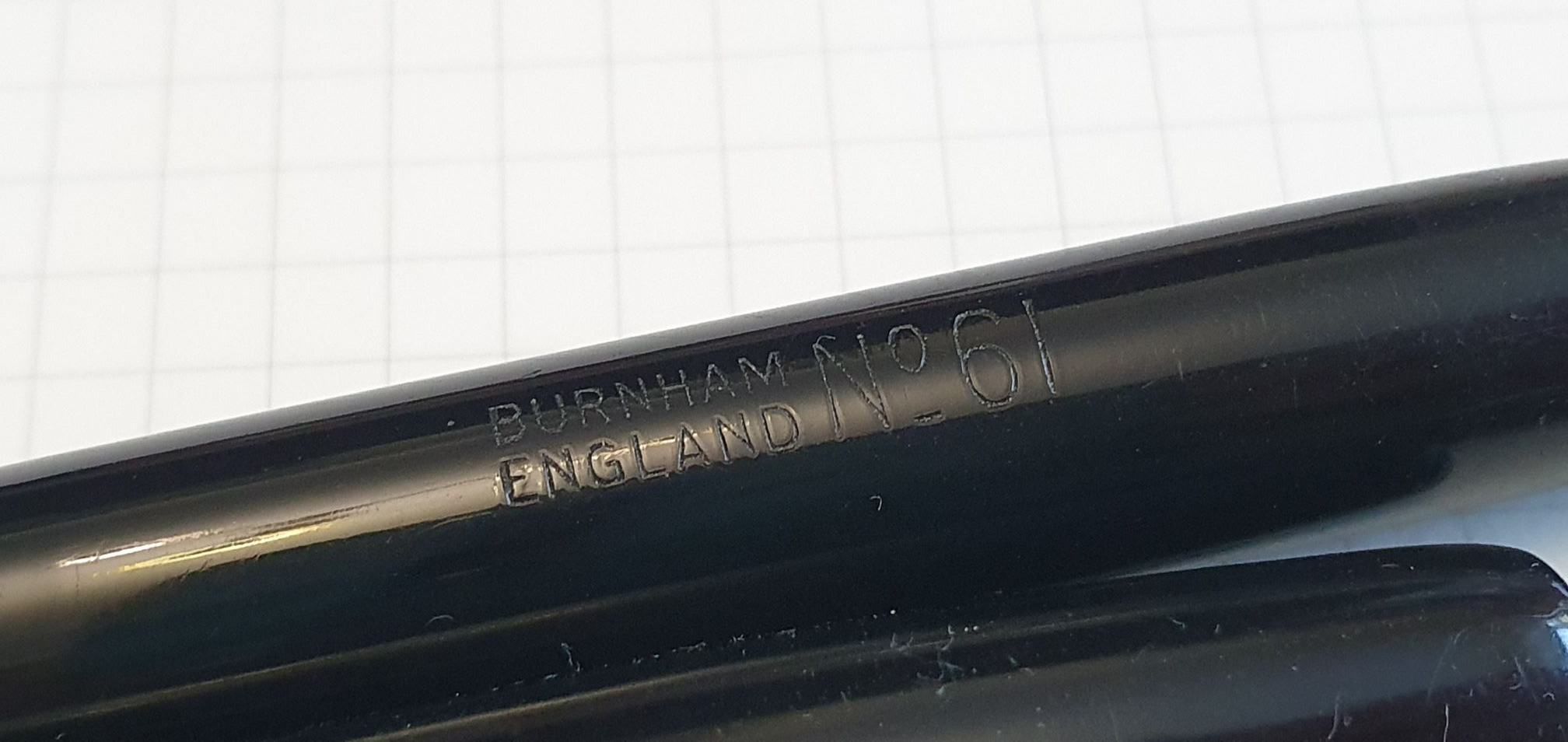
Barrel imprint

I would have been happy if this pen had simply written the same as my Burnham 54, but the fact that it wrote with a lovely precise fine line, was a bonus. Once again, the nib felt smooth on my Stalogy notebook paper, but there was a distinct feedback, hard to explain yet exquisitely enjoyable!

Imagine your own handwriting here.

Burnham pens do not seem to garner very much attention in the fountain pen community. I am probably not helping myself by raving about them here, with the London Pen Show just a few weeks away, but I hope to see a few Burnhams at the show. As I now have a collection of two Burnham lever filler fountain pens, (each costing me less than a Lamy AL-Star) I can attest that these can make a very satisfying buy. With some high-end, steel-nibbed pens costing around £200.00, a vintage Burnham offers a gold nib at a fraction of this amount and with a wealth of character with which a modern pen cannot compete. My advice, if a Burnham should catch your eye at the show, would be to (1) ask whether the sac has been replaced; (2) inspect the nib and if possible, try a dip test to see how it writes, and (3) save some for me.

Small but perfectly formed.