Early thoughts on the Tibaldi Infrangible Black Gold fountain pen.

This was an impulse buy when I visited Selfridges’ Fine Writing department fully intending just to have a look around. Having said that, I am very glad to have stumbled across this pen and have no “buyer’s remorse.”

Visitors to Selfridges’ pen area on the lower ground floor, will notice that it has diminished in size over the last few years, but still has an interesting range of high-end pens, including a good selection of Onoto for example, although the number of brands is reduced.

Having circled the island of attractive displays in the brightly lit glass counters, one looks along the row of displays in glass cabinets along the rear wall. Here I found a cabinet of Tibaldi pens, in various colours and moved in for a closer look. I might have moved on eventually, but the young lady assistant, Monshoor, timed her approach just right and asked if I needed any help. “Yes, help me to not buy any more pens” is what I might have said. Instead, something in my brain took over and said “Thank you, can I please have a look at that one?” and pointed to a fountain pen from the display of Tibaldi Infrangible (meaning “unbreakable”) pens. She unlocked the glass window and handed the pen to me.
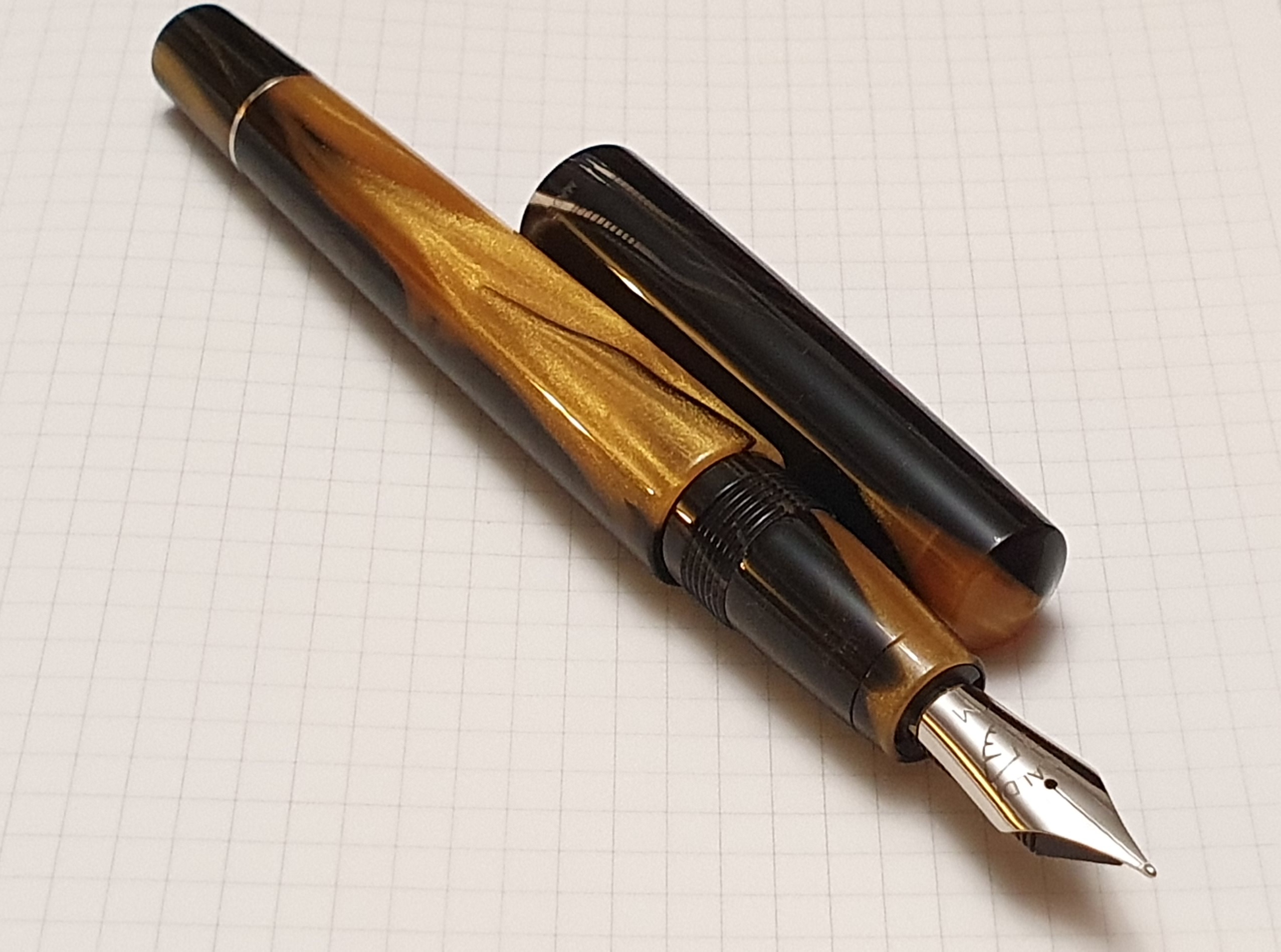
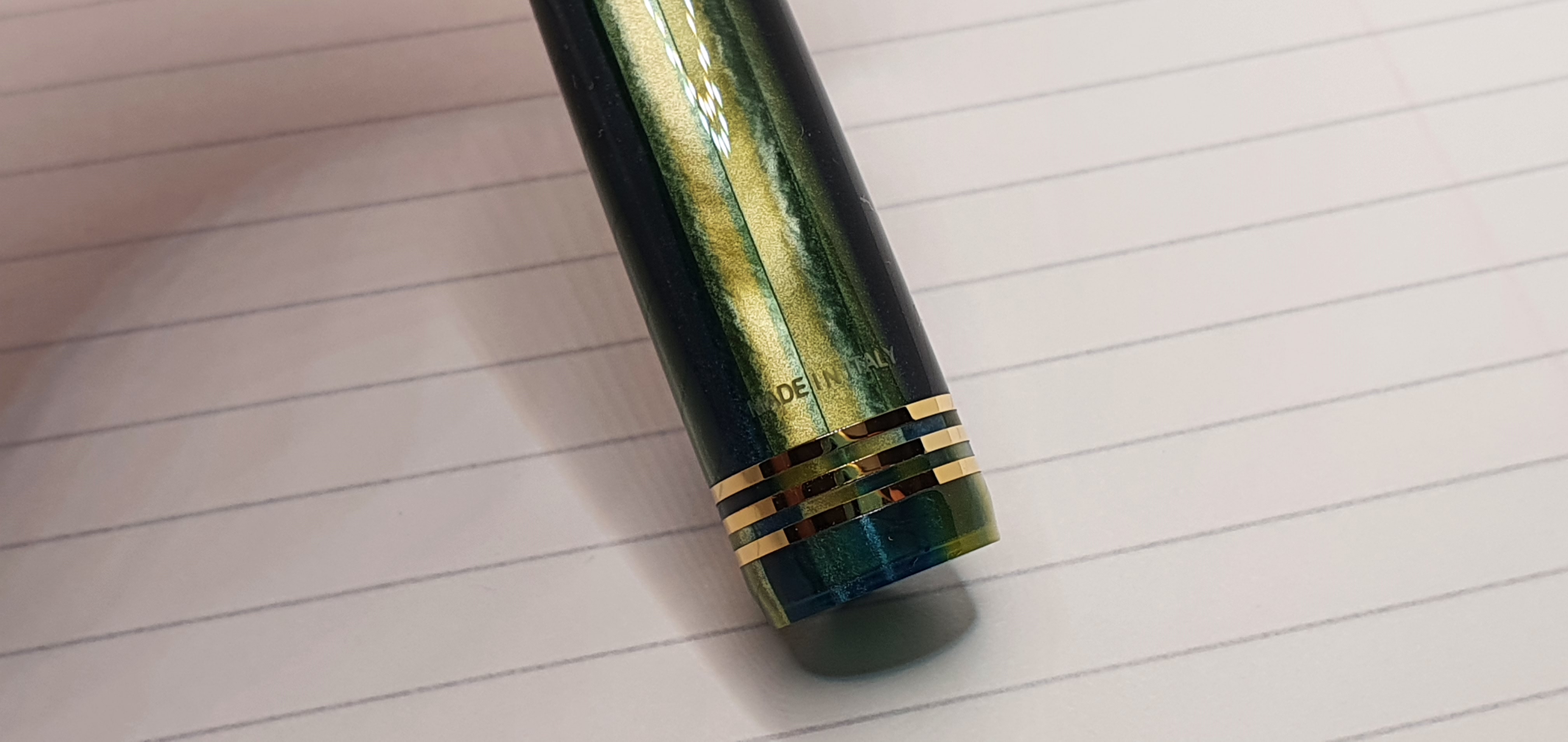
Tibaldi Infrangible. Made in Italy.

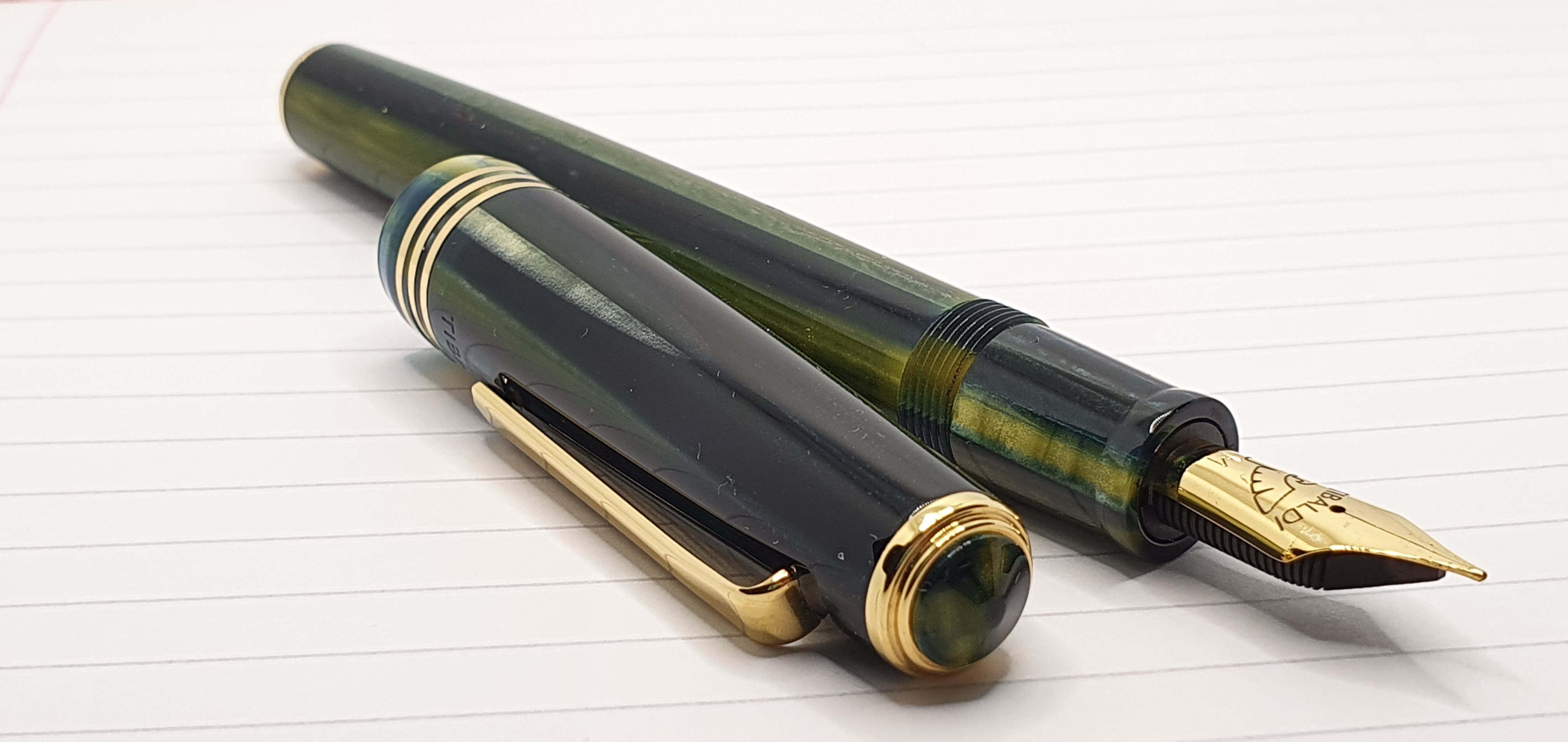
Here I should point out that most photos of this pen do not do it justice. Even getting it home and photographing it in my light box, the multiple tiny LEDs did not show off the material at its best. It really needs sunlight or a bright spotlamp.

There are ten colour options with this model. This particular version is, I think, called the Black Gold. I say “I think” because I have since seen a similar pen for sale on eBay but described as the “Chrome Yellow Special Edition.” Certainly there is a Chrome Yellow version, but according to photos on the official Tibaldi website, it has the patterned resins in the cap only, whereas the barrel and section are all black. I am not aware of any special editions. The Black Gold, on the other hand, has swirls of yellow in the cap, AND barrel and grip section. I read that they are formed of gold dust in the resin.
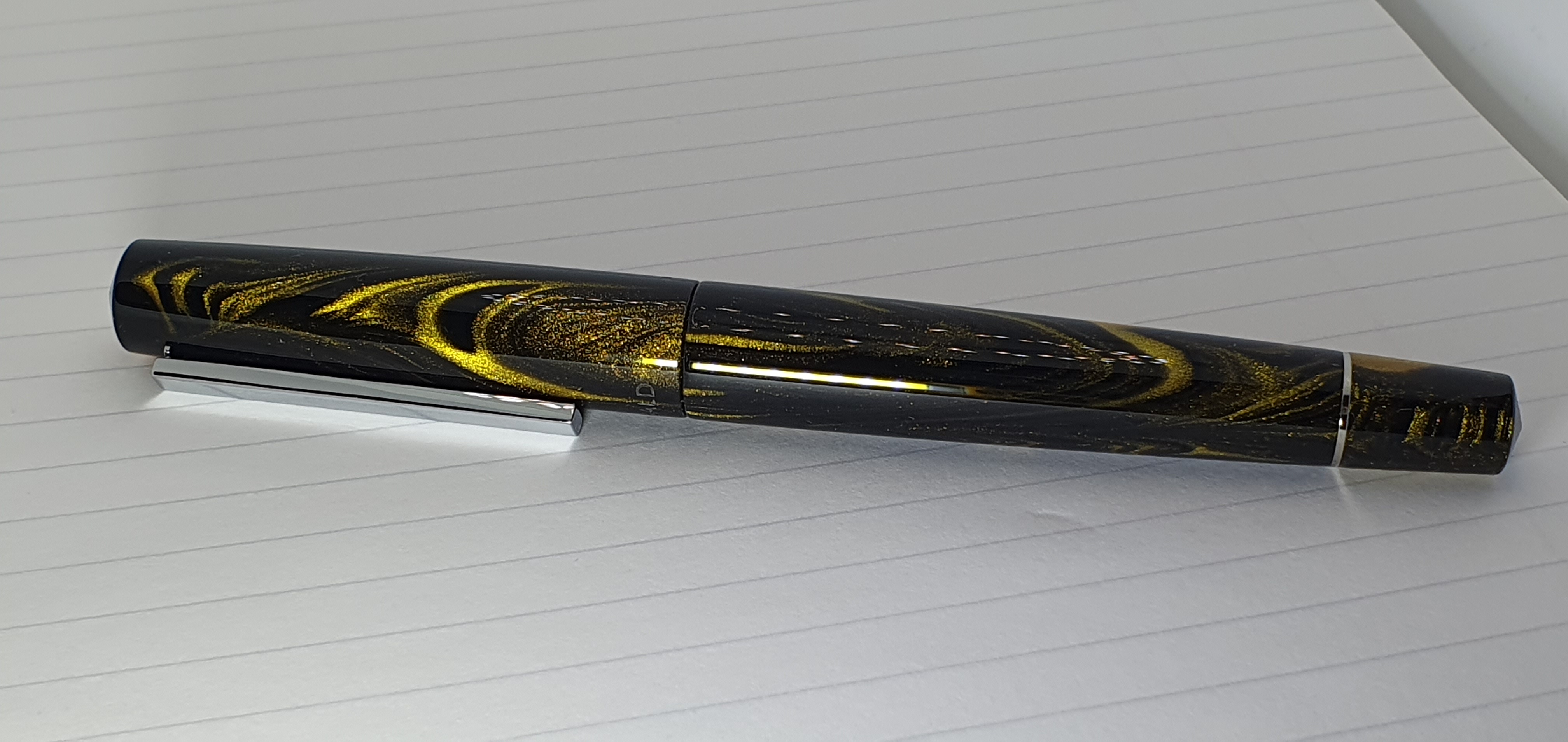
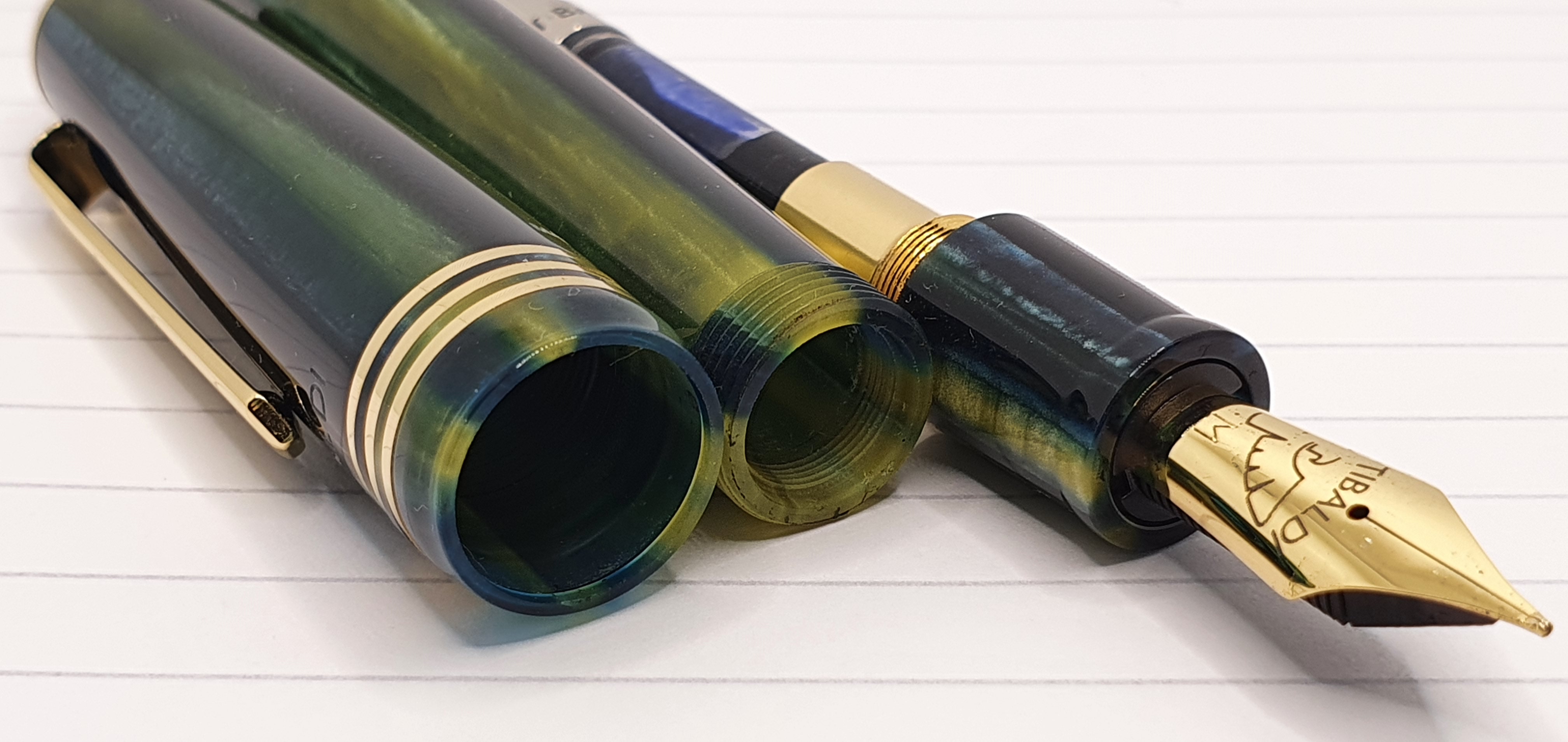
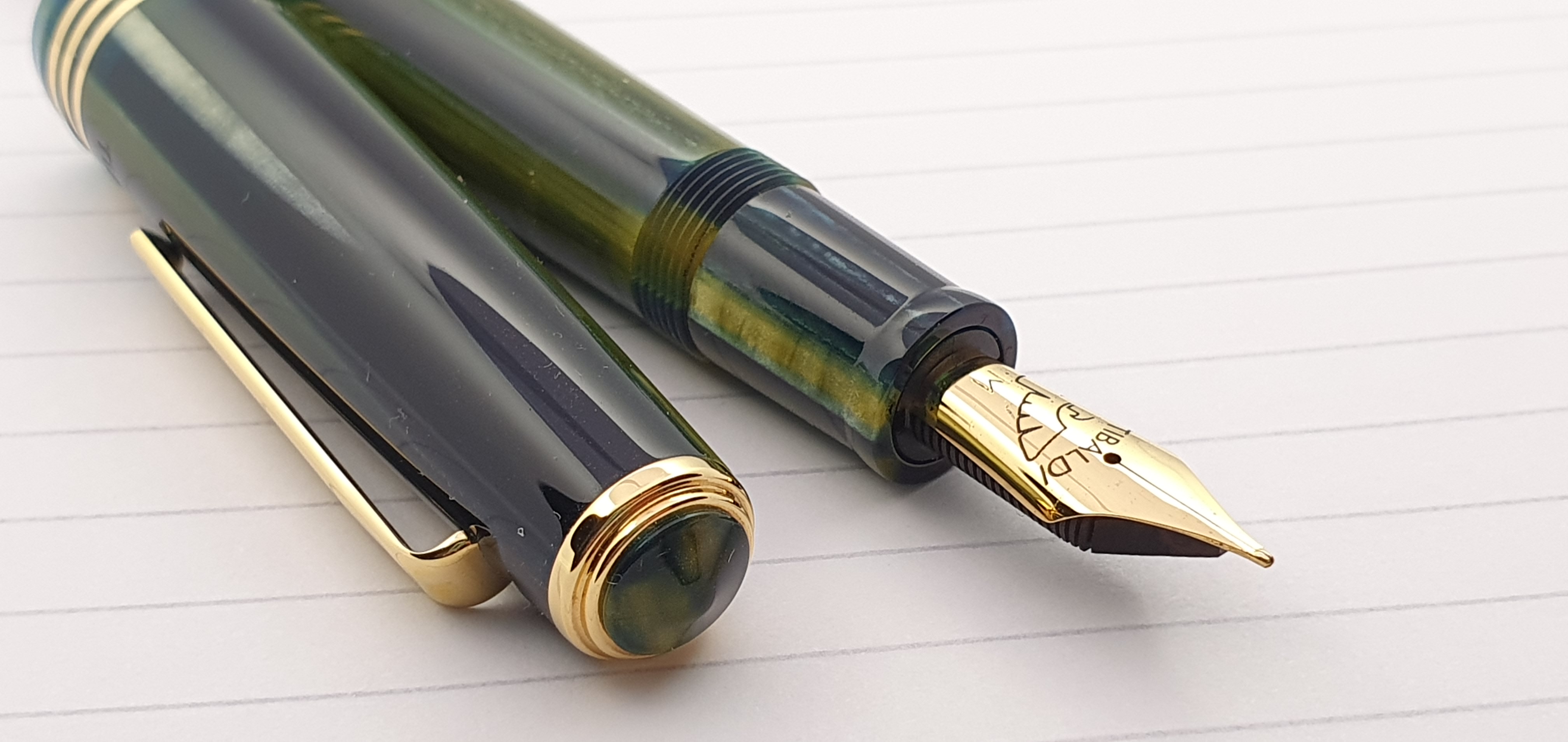
Yes, this is the same pen, but from another side.

Anyway, whatever this version is called, I was smitten. Under the bright spotlamps in the shop, the coloured resins came alive with a brilliance as I turned the pen in my hands. Although it is the colours which initially catch your attention, the high quality of the resin in the hand is reassuring, polished and gleaming. The steel nib also looked immaculate. The nib is paired with an ebonite feed, a feature which I much appreciate, to improve ink flow and reduce hard-starts.
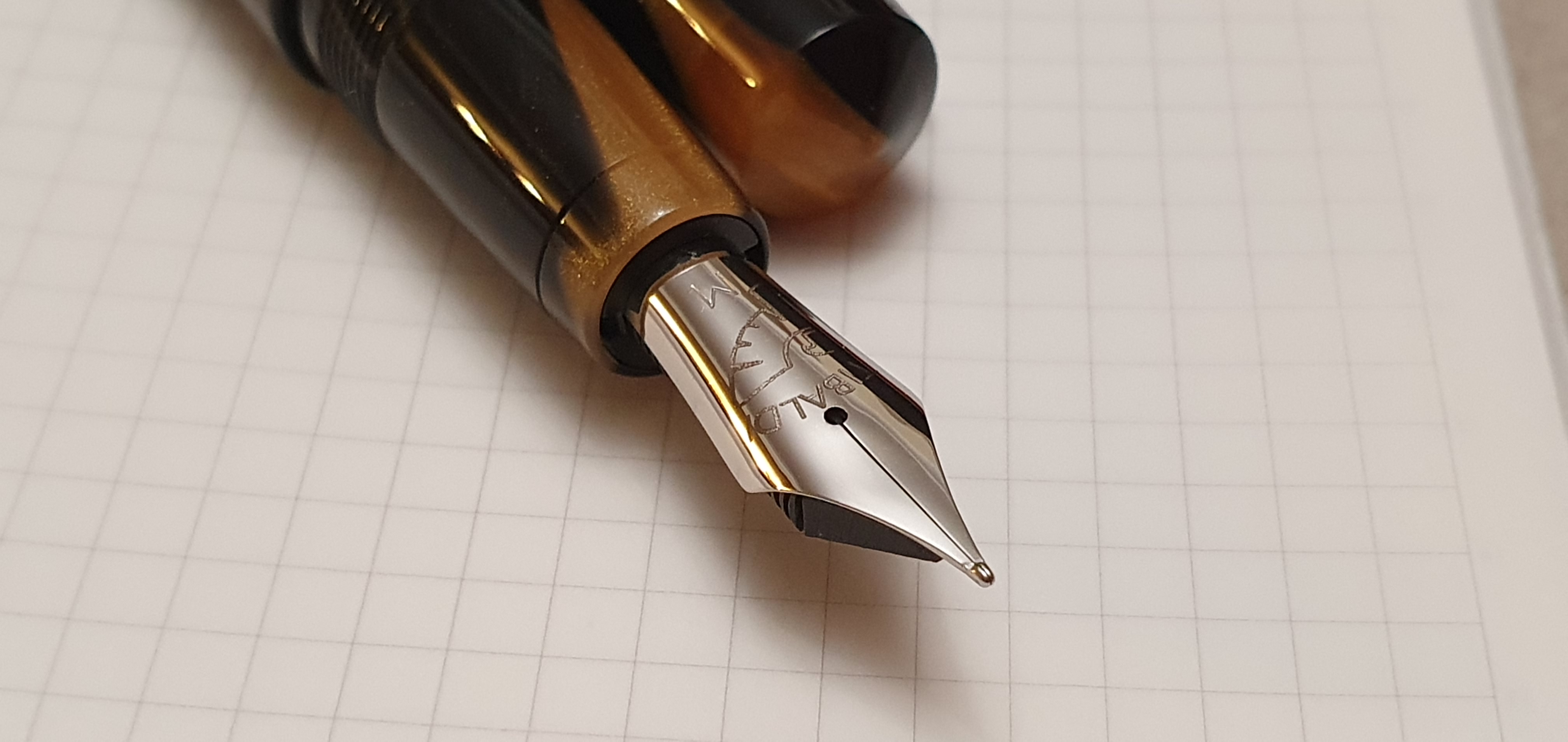
Steel nib, in a Medium.

Having confirmed to Monshoor that I wished to buy the pen, she offered to get me another one in a box. Here, some care is needed as the patterns in the coloured resins on every pen are unique. This is a pen that really is best bought in a bricks and mortar shop where you can look closely at what you are buying.

I enjoyed being able to compare the display model with a similar one, but concluded that I preferred the distribution of colours in the display model that I had seen first and so that was the one that I took.

I had not yet tried writing with the pen, nor checked the nib other than a brief visual. Under my loupe, the nib was even more pleasing than I first thought and looked to be tuned just the way I like, with the nib slit narrowing towards the tip but still with the smallest of gaps, showing light between the tines at the tipping. The tipping was nicely rounded, polished and symmetrical and the tines were well aligned.
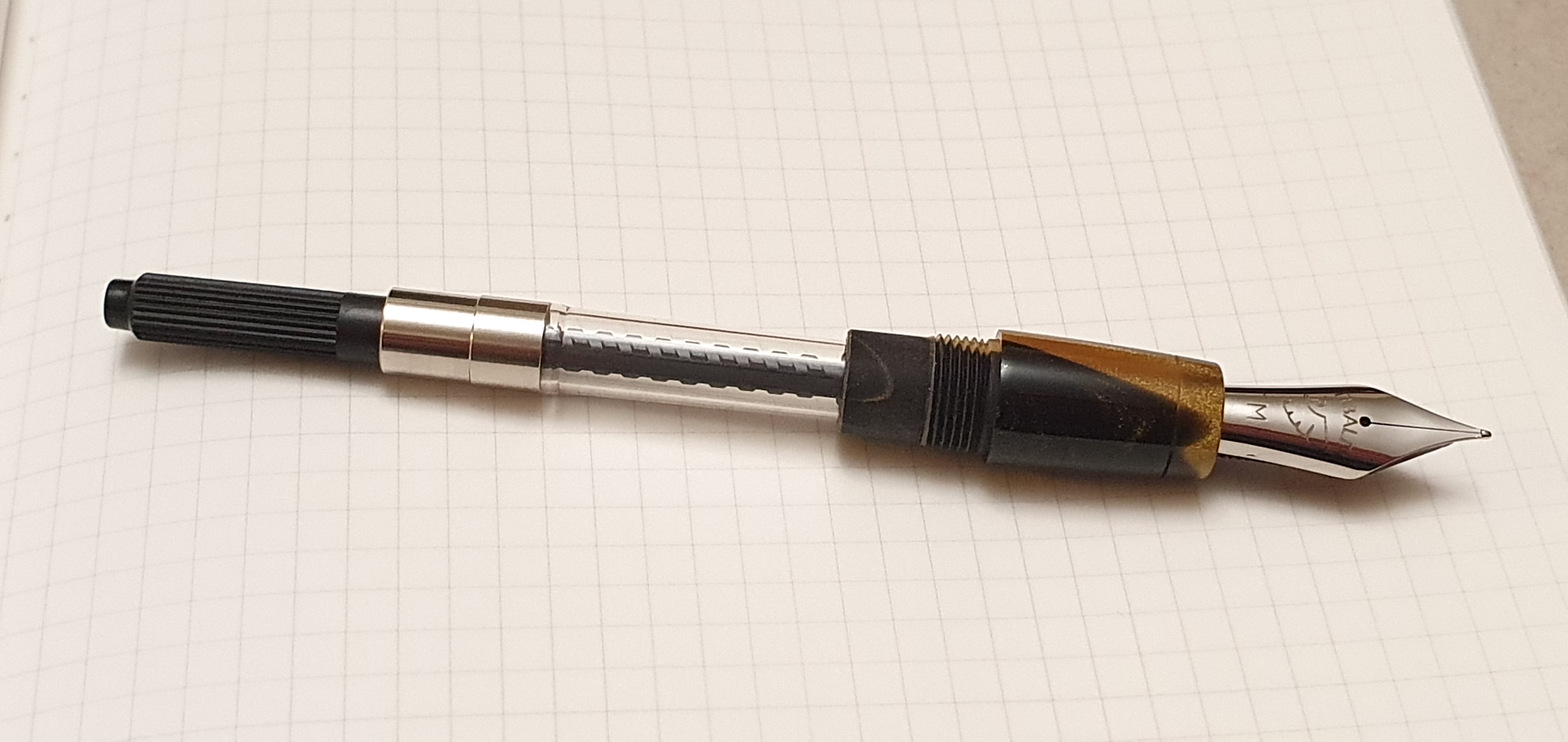
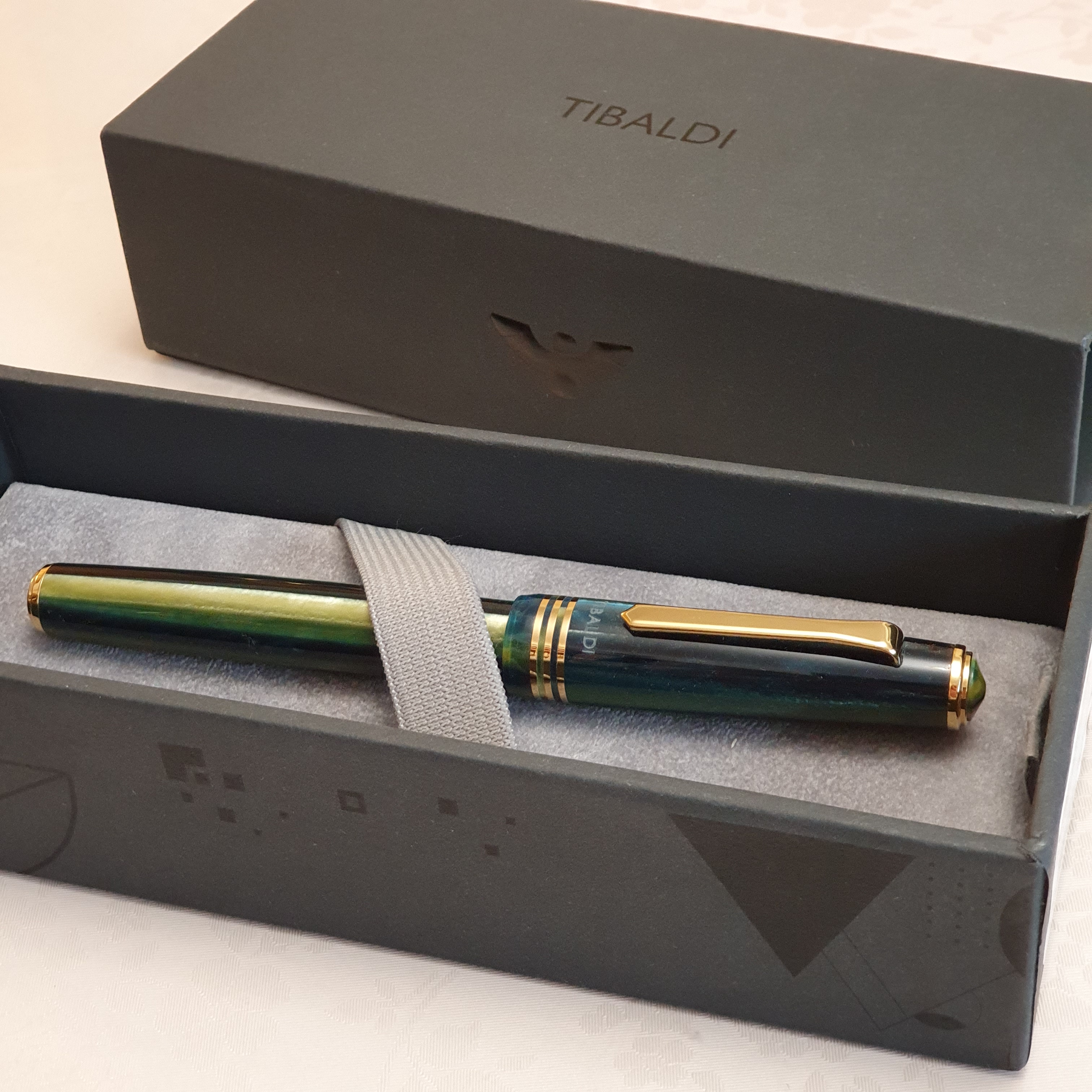
Converter included.

The pen came with a converter and a packet containing one black and one blue cartridge, of the standard international size. I flushed the nib and section and pondered what ink to use. Although I try most new pens first with Waterman Serenity Blue, I decided instead, quite rightly as it turns out, that the pen would like an Italian ink and filled it with Campo Marzio Tabacco, a rich dark brown that flows and shades well.

And so to the writing experience. The grip area is of generous girth. There are cap threads and a step at the barrel, to enable the cap to close flush with the body. You do feel these but I do not find them uncomfortable. The nib, as expected, wrote smoothly and with an ink flow that was neither too wet nor too dry. It should be noted that the nib is very firm.

Capping the pen: The cap unscrews with about one and a quarter turns. A useful tip is that when you have a pen with patterns in the cap and the barrel, it is nice to line them up (if you can), the same way every time. This pen has three entry points for the cap threads, giving you three choices for the position of the cap, in relation to the barrel. The way to take advantage of this is to hold the cap horizontal, with the clip at the top, or 12 o’clock position and then insert the pen with the nib also at the 12 o’clock position, into the cap until it touches the threads. Then turn the cap slowly, the wrong way until you hear the first click and then tighten the cap in the correct direction. Repeat, but with two clicks and then with three clicks and remember which of these gives you the best result.
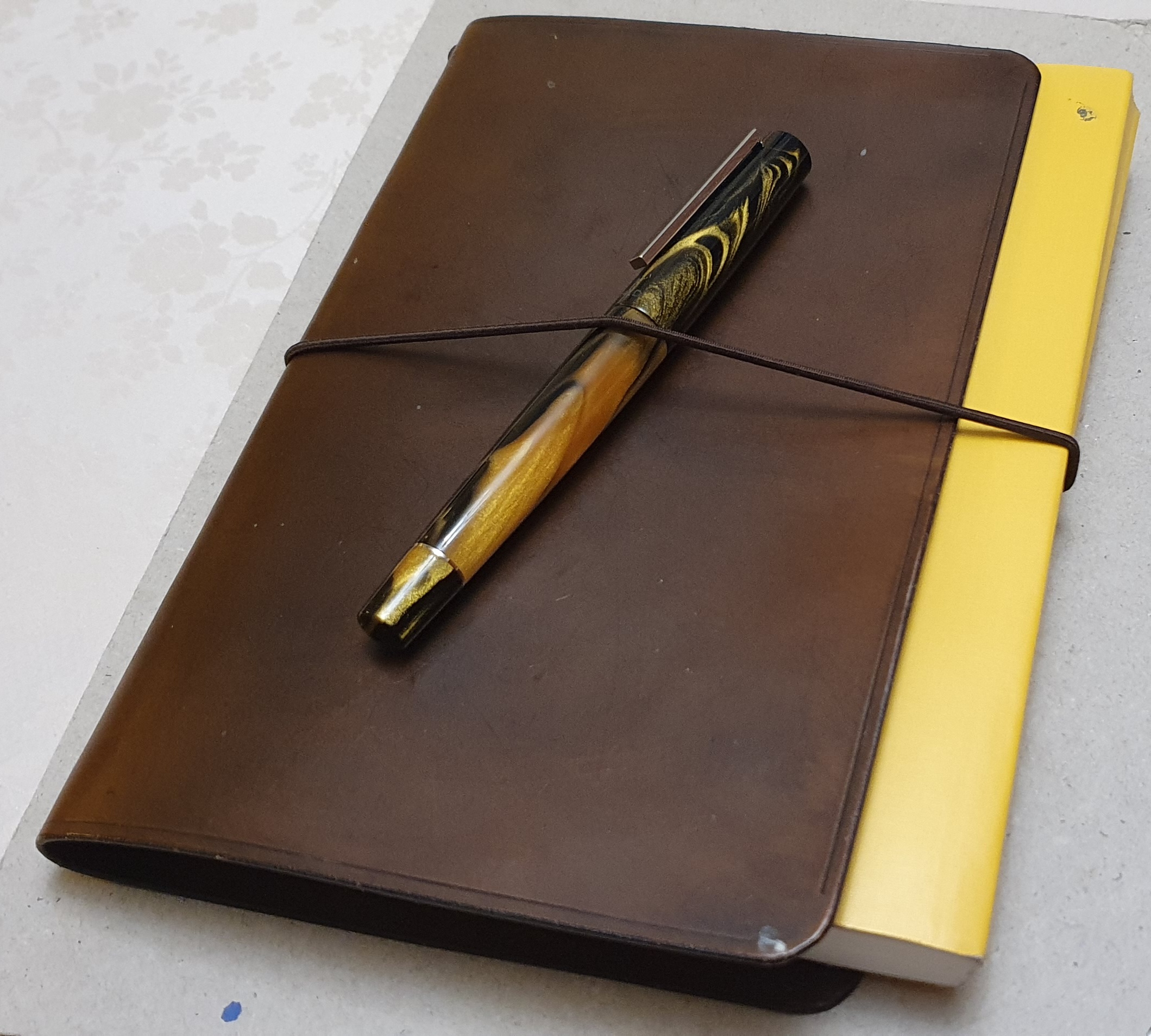
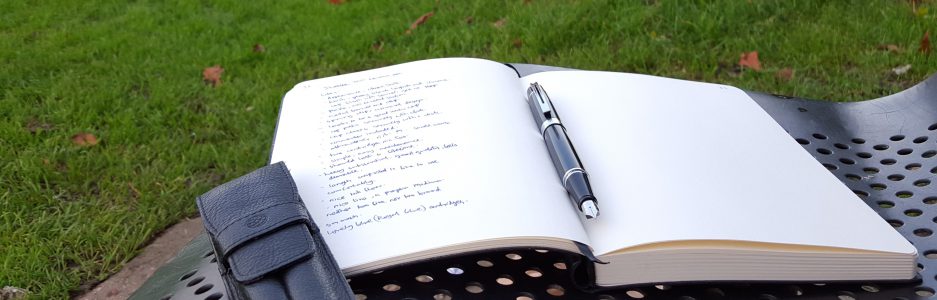
My notebook set-up.

The cap has a steel pocket clip, notable for its absence of any adornment. It is simply a straight, rectangular bar and appears to be chrome plated. It is very stiff to raise and so would grip a pocket securely but would be hard to operate. The cap can be posted, quite securely and covering the barrel to about one half of the cap’s length, but the pen then becomes about 160mm long. The uncapped pen measures a comfortable length of 130mm and so I find no need to post the cap.

In the unlikely event of any problems arising, all Tibaldi products have a 24 months’ guarantee, against any manufacturing defect. The pen comes in a sturdy black cardboard box with a slide out tray and a dark orange paper outer sleeve. It is a nice box if you wish to keep it, whilst at the same time being a box that you could recycle without missing too much.

I am delighted with the pen. Features that I particularly enjoy are:

  • beautiful autumn-leaf gold colours and distribution of contrasting colours in the resin;
  • a joy to have and to hold, as well as to write with;
  • comfortable to grip and of an ideal length unposted (for me);
  • well made steel nib: smooth, with good ink flow but very stiff;
  • three alignment options in capping the pen;
  • converter included (as well as two cartridges to get you started);
  • last but not least, an ebonite feed: a rare luxury for a pen at this price.
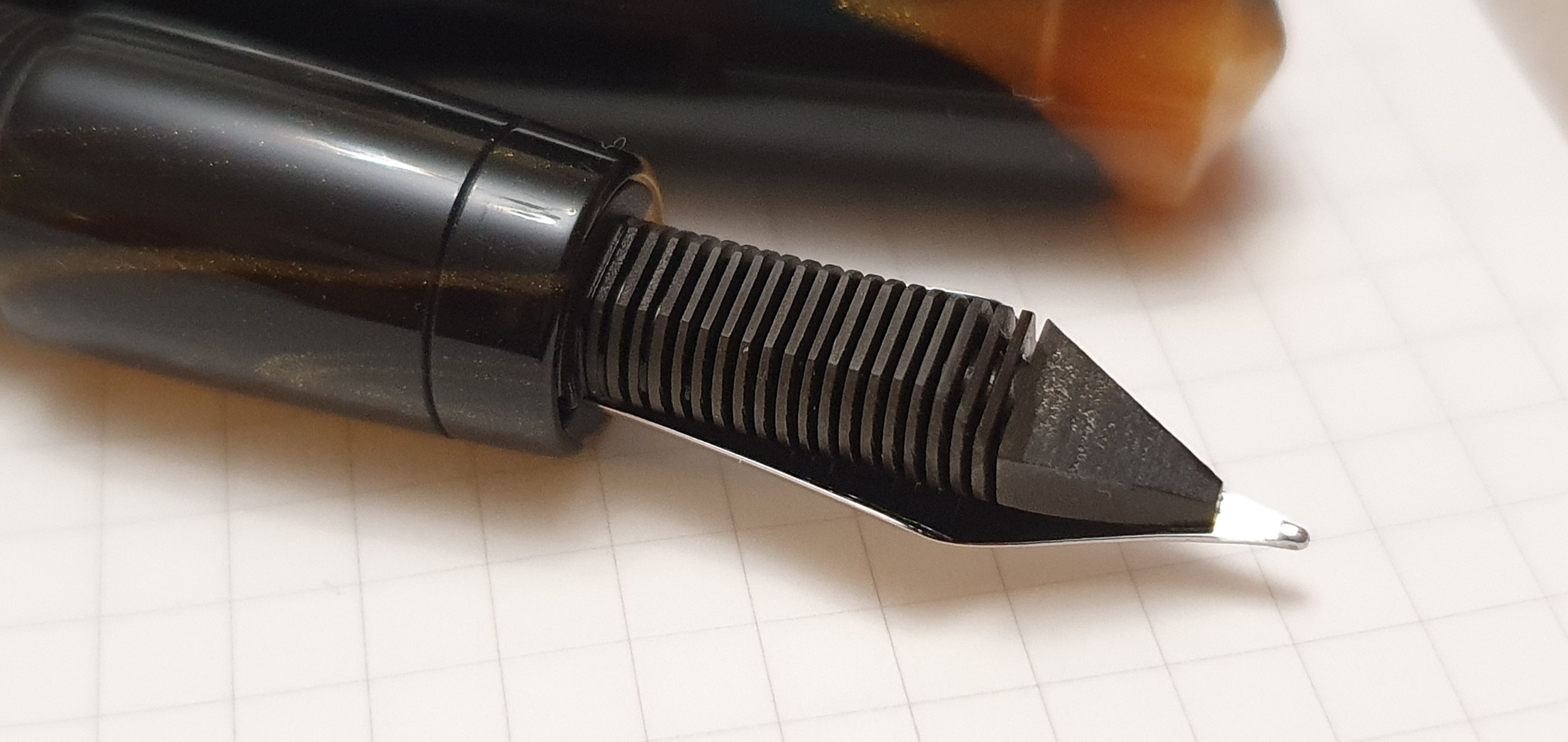
Ebonite feed.

All in all, this looks and feels like a pen that you could use happily for hours on end and then simply gaze upon for a few hours more.
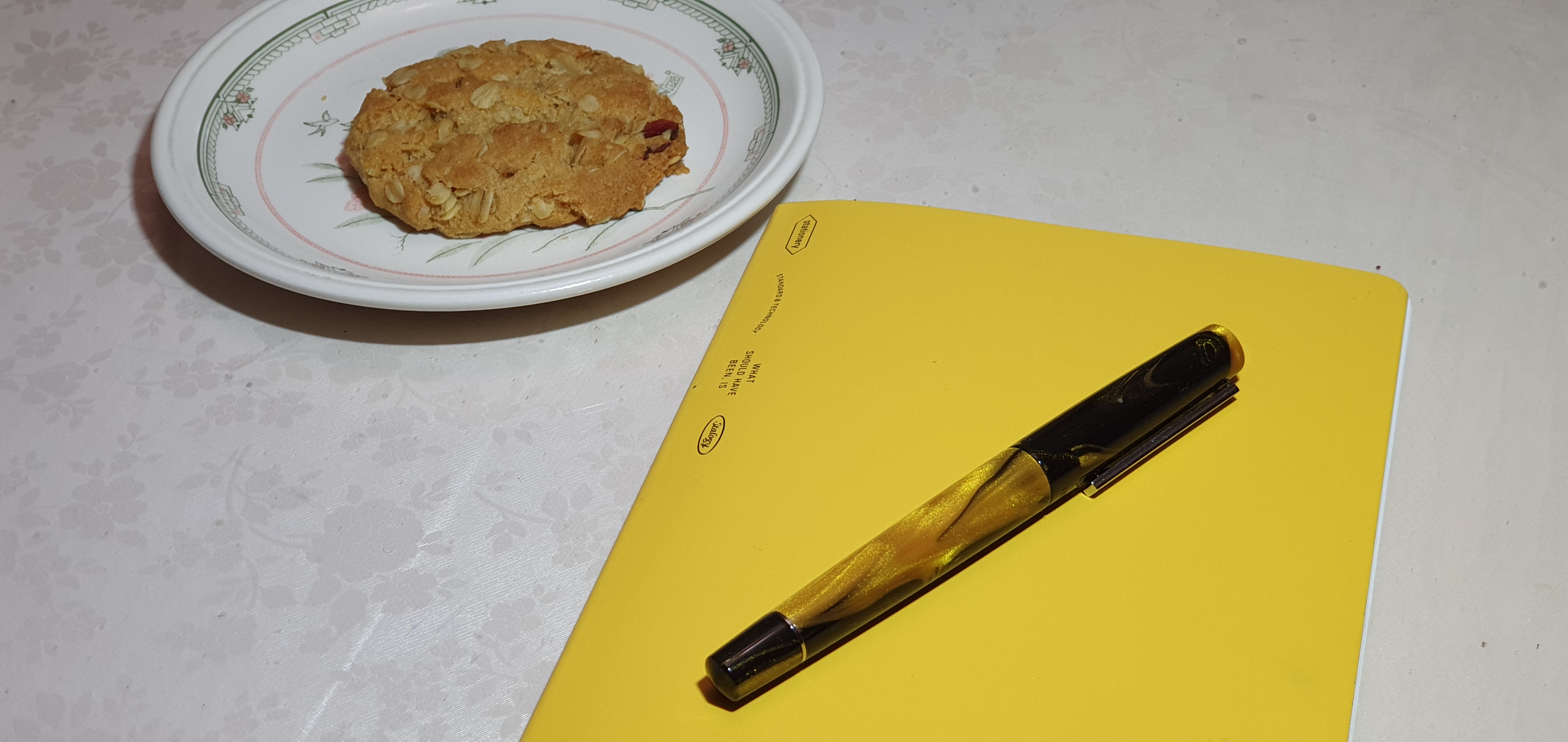
A few indulgences. Tibaldi pen, Stalogy notebook and a freshly-baked oatmeal cookie with cranberries.

Early thoughts on the Tibaldi N.60 fountain pen.

I do not buy an expensive pen so often now. This has been only my third in 2022, the others being my Esterbrook Estie and then an Aurora Talentum, both of which proved successful purchases.

Purchase backstory

I first saw a Tibaldi N.60 in the flesh, whilst browsing in Selfridges some months ago. They had the Ruby red edition on display. It was a little too pricey for an impulse buy, and felt too similar in specification to my marbled red Leonardo Momento Zero. But the memory of it stayed with me. I read some reviews online which further whetted my appetite. I found that the pen was also available in Emerald green, Amber yellow, Samarkand blue or Rich black, with Palladium trim.

And then came the tempting Iguanasell summer sales. I had already bought three Aurora fountain pens online from Iguanasell. Their keen prices and fast service are hard to resist and receiving the parcel from FedEx is exciting. It was whilst scrolling through their sale pens, that I spotted the Tibaldi N.60, but not in any of the versions I knew of: this was called Retro Zest green and featured an 18k gold plated nib and trim, instead of the Palladium. I was immediately taken with this edition. In the photos the cap looked a lighter green than the body. After a few days I eventually and inevitably caved in and pulled the trigger. I opted for a medium nib.

The history

Tibaldi was founded in Italy in 1916 by Guiseppi Tibaldi, being amongst Italy’s earliest pen manufacturers. I believe it continued in business until 1965. I found images of a vintage Tibaldi online, which my pen closely resembles, save that the original was made of celluloid, had a solid gold nib and was a piston filler. Like many pen companies, for example Esterbrook, the company brand was later reborn. The headquarters was moved from Florence to Bassana del Grappa in 2004, which readers may recognise as the home of Montegrappa fountain pens. I gather that Tibaldi shares the same management as Montegrappa, in the Aquila family. Other models in the Tibaldi line are the Bononia, the Infrangible and the Perfecta.

Unboxing

The pen comes in a simple but sturdy black cardboard box, with a tray sliding out from an outer black sleeve, all within an orange paper outer sleeve. The pen cushion lifts out, to reveal a 2 year warranty card and a sealed pack containing two Tibaldi branded cartridges.

Tibaldi N.60 Retro Zest fountain pen.

Description

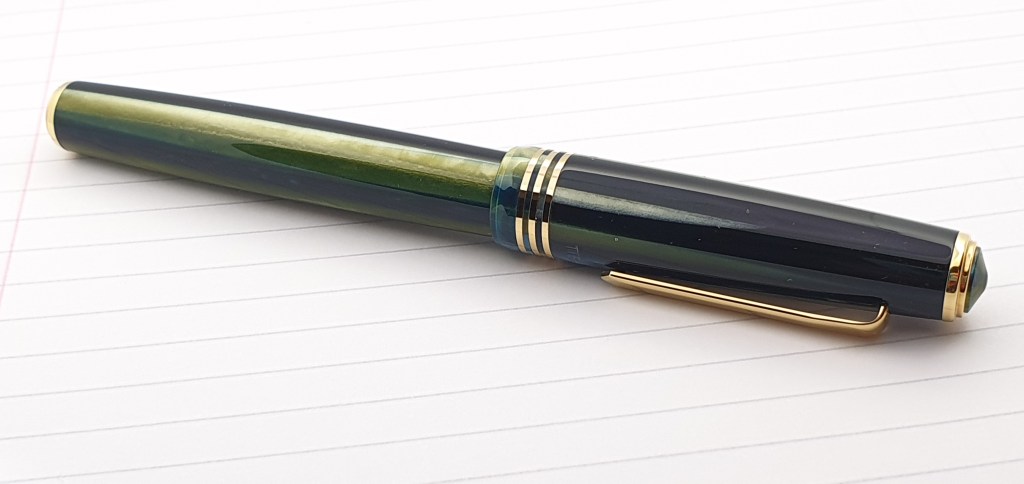
The Retro Zest green material was far more spectacular in real life than in the photos. On my model, the cap was not a lighter green than the barrel, but there are stripes of light and dark tones, from a very light green-gold to a dark green that is almost black. The colours look stunning as you rotate the pen in your hands. The pen body has the appearance of being faceted, yet is not and is entirely rounded and polished.

Catching the chatoyance in the cap.

It is a large pen. There is a distinctive, pointed finial in the same green acrylic material as the body, surrounded by a gold trim ring; a very stiff, tie-shaped pocket clip; three gold plated cap bands; Tibaldi on the front and Made in Italy on the back. The cap unscrews in one full rotation.

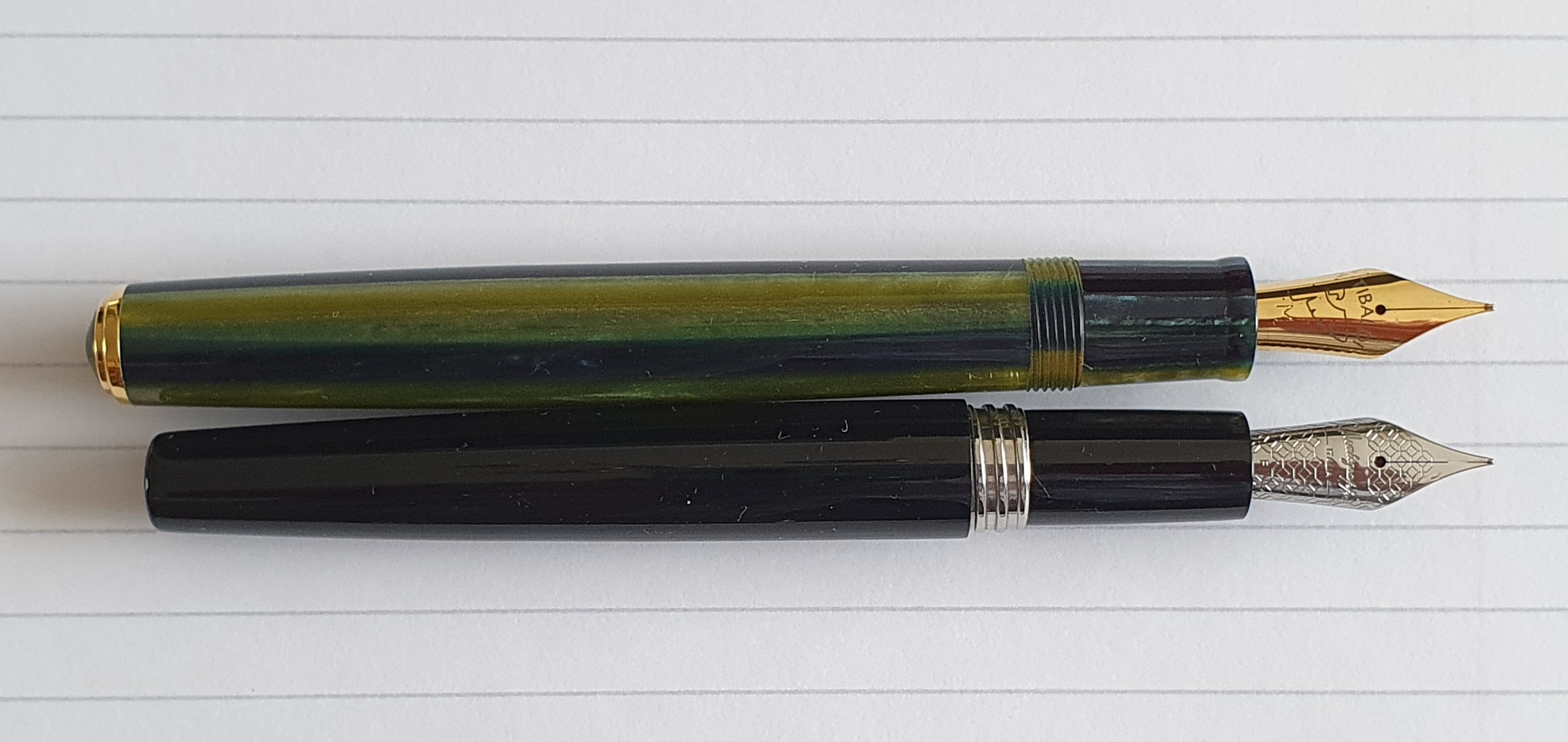
Uncapped

The section is of the same coloured material as the cap and barrel on this edition, whereas on the other colours mentioned earlier there is a black section. The section is rather short, before meeting the cap threads on the barrel but these are not sharp or uncomfortable if you grip the pen there. The section and barrel are very girthy however at around 12mm at its widest point.

The barrel unscrews and there is a gold-plated metal mount for a cartridge or converter. A Tibaldi branded converter is supplied, which is screw fit, a feature which I always enjoy. The other end of the barrel ends with another finial with a green acrylic “jewel” matching that on the cap.

Tibaldi screw-fit converter included.

Nib and feed

The stainless steel nib is gold plated and has the name Tibaldi, the bird’s wing logo and an M for medium. A particularly welcome feature at this price point, is the ebonite feed rather than plastic. This is semi-porous and partly absorbs ink, helping the flow of ink between nib and feed and also helps to ensure that the nib stays ready to write, even if the pen is unused for a few days.

Nib and the cap finial.

On my model, the nib was smooth and wrote right out of the box. It is a very firm nib. My early trials with the nib found it to be rather on the dry side. This may suit the majority of right-handed under-writers but I prefer a slightly wetter nib for greater lubrication and a darker line even when writing without any downward pressure, this being my usual lefty over-writer syle. I therefore set about easing the tines apart just minimally, first with brass shims and then with a gentle wiggle of a craft knife. This had the desired effect and I am now enjoying good flow and effortless writing.

Size and Weight

The pen measures 148mm end to end, including the raised finials. Uncapped it remains a generous 132mm which is plenty long enough to use unposted. The cap can be posted but brings the length to 173mm. It weighs aground 27.5g, 17g uncapped and 10g for the cap alone.

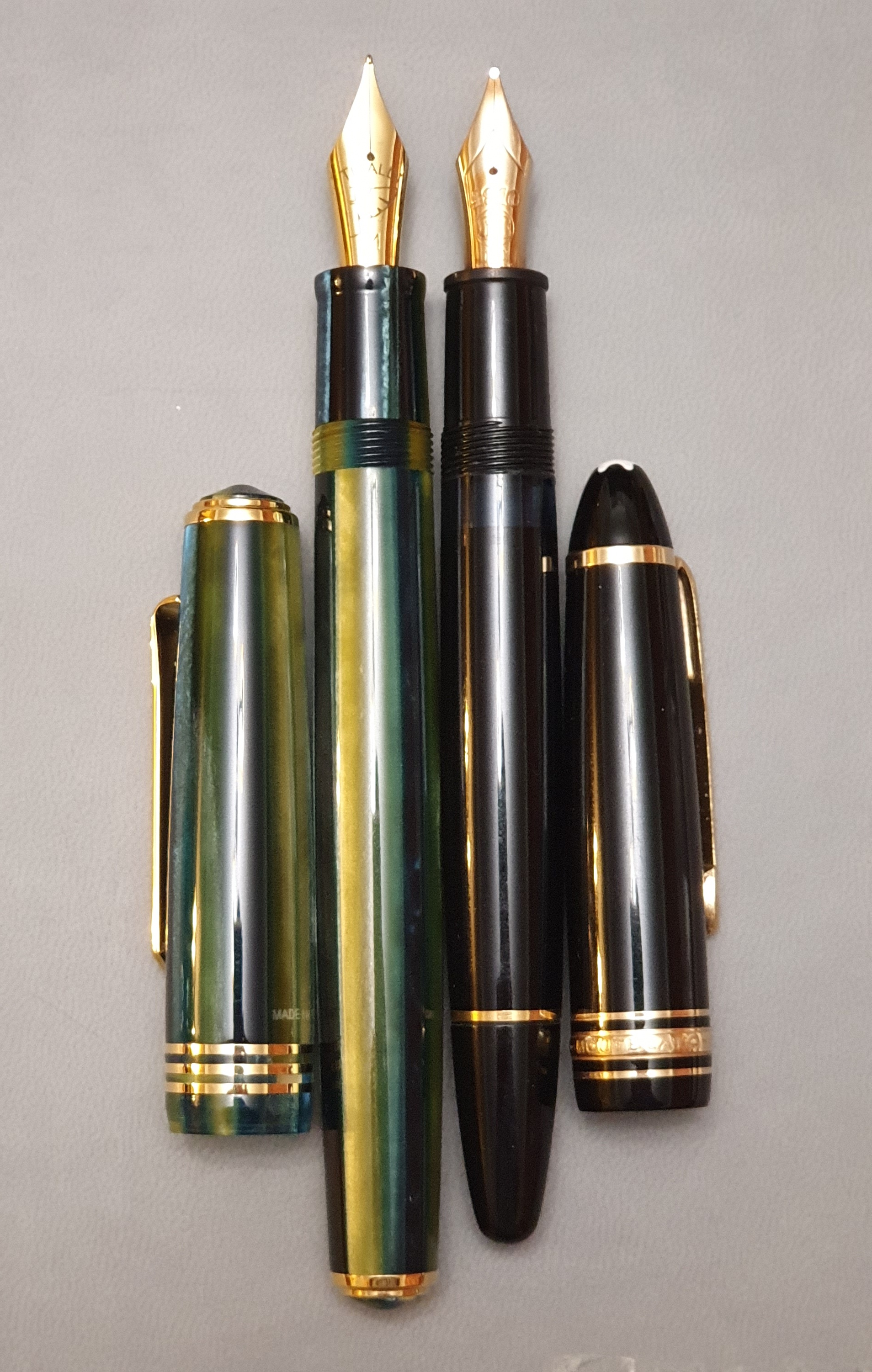
Size comparison with the Montblanc Meisterstuck 146.

Likes and dislikes

On the plus side, the colour and finish of this pen’s material has a big appeal for me. To a casual glance in poor light it might look like a black or very dark green, but on closer inspection as you turn the pen in the hand the polished feel and the strips of different shades of green reveal themselves having the appearance of an exotic vintage celluloid of pens of old. The pen is of a generous length and girth, without being unduly heavy. The ebonite feed (as found on my Aurora Talentum, Optima, and 88) is a rare delight in a steel nibbed pen at this price. Having a steel nib keeps the cost down.

On the negative side, the section is short. Some may find it too wide. The pocket clip is very stiff which means it grips securely but is not so easy to use. I would have liked to see “Tibaldi Model 60, Made in Italy” engraved on the barrel, in the manner of an Aurora Optima or Parker Duofold but I am probably asking too much now. Finally, one could argue that the pen is pretending to be something it is not, with a body which looks like celluloid and a nib which looks like gold. I do not see it that way and think that even without comparison to the pre-1965 model which it resembles, the pen stands up well in its own right for a modern, safe and convenient equivalent.

I recently saw a review by SBRE Brown of the Tibaldi N.60 in Emerald green. His only complaint was that the grip section was black, not of the same colour as the rest of the body. That is not an issue on the Retro Zest edition.

Size comparison with a (dusty) Montegrappa Fortuna

Conclusions

It is sometimes said (at least, in fountain pen circles) that if you find a pen you like and in a finish that you like, then buy it! Tibaldi pens are not very easy to find in the UK. Cult Pens sells them, including the N.60 but not currently the Retro Zest edition. Iguanasell has served me well now on several occasions even including a surprise free gift with this order and I would recommend them.

Perhaps some comparables below £200.00 might be an Edison Collier, a Conklin All American, Leonardo Momento Zero or a Montegrappa Fortuna. In terms of size and girth, the N.60 could be a good test of whether you will get along with such a large pen, before splashing out on a Pelikan M1000 or Montblanc 149.

Some final thoughts. This has been a momentous and sombre week in the UK: HM Queen Elizabeth II died on 8 September 2022 at the age of 96, after serving as monarch for over 70 years and just two days after greeting our new Prime Minister Liz Truss and inviting her to form a new government. The Queen was of my parents’ generation and hugely loved and respected. She had been the Queen for all of my life and so there is a sense of loss here. The N.60 was the last pen I bought whilst our Queen was alive. We are in period of mourning, which I will record in my journal. We have a new King and a new Prime Minister. Amidst all this change the N.60 Retro Zest is a good tool for such reflections and an echo of another age.