Early thoughts on the Faber-Castell Ondoro, Smoked Oak fountain pen.

Faber-Castell is a well respected maker of pencils, pens and art supplies with a history dating back to 1761. For fountain pen enthusiasts, their nibs are among the best in the business.

None of this was on my mind as I breezed into Harrods one evening, for a quick browse around their Fountain Pen arcade on the lower ground floor, prior to taking my seat for a concert at the nearby Royal Albert Hall. I was off to see Sir Mark Elder conducting the BBC Symphony Orchestra, massed choirs and four soloists, in a rare performance of Delius’ “A Mass of Life”, as part of the BBC Proms. I say “rare” because the piece had not been performed at the Proms for 37 years.

As always on my also-rare visits to Harrods, it was a triumph to locate the pen department. Once there, I enjoyed making a round or two of the displays, including Montegrappa, Chopard, ST Dupont, Caran d’Ache, Graf von Faber-Castell and of course Montblanc. There were notebooks and stationery from Smithson and Moleskine.

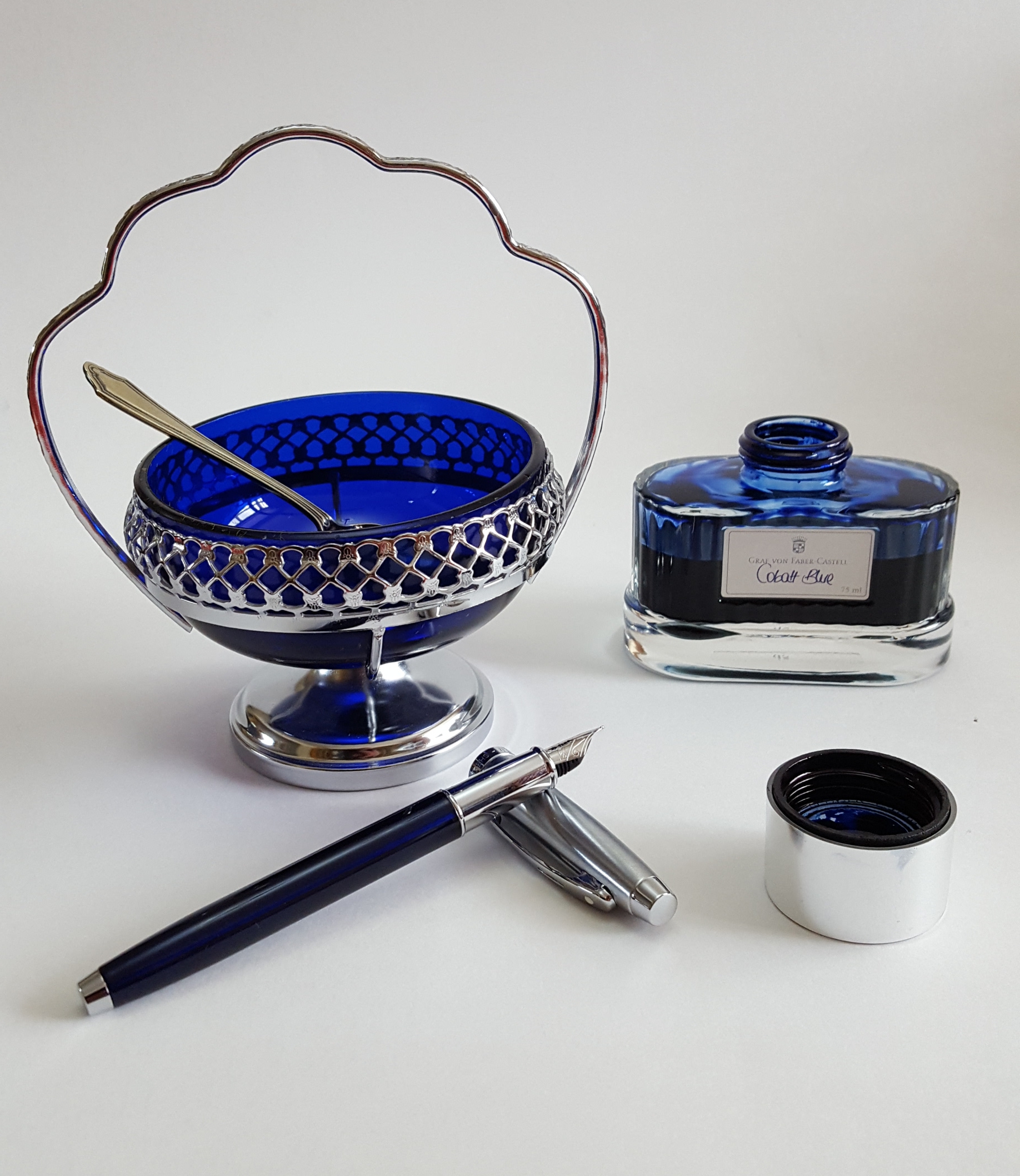
At the Graf von Faber-Castell counter, I spoke to the helpful assistant, Melvyn and chose a bottle of Cobalt Blue ink. I have almost finished my first bottle and this is probably my favourite “posh” ink. The rich dark blue ink, the attractive 75ml heavy glass bottle and packaging are all luxurious.

I then asked to take a closer look at the Faber-Castell Ondoro, in wood with a metal cap. I recalled seeing the pen some years ago with an orange barrel, but was not aware of this wood version. I enquired as to what the wood was and after consulting the catalogue, Melvyn informed me that it was “Smoked Oak”. It is an appealing, mid-brown with a dark grain. I have not yet discovered the significance of the “Smoked” in the title. I wondered whether it might perhaps be a process whereby the wood is heated, altering its enzyme constituents in a way which “ages”, dries and hardens the wood as Yamaha does for certain guitars in its range, to emulate the tone of a vintage guitar. However this was just a fantasy conjecture on my part. Presumably the oak is not smoked to improve its flavour like bacon or mackerel. Is it smoked just to give it a charred look? I am yet to find out.
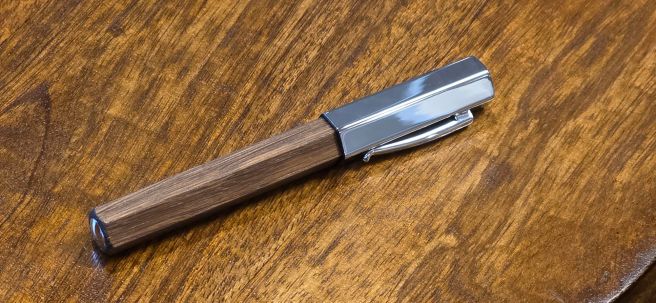
Faber-Castell Ondoro, Smoked Oak fountain pen.

Edit: Since publishing this post, a Google search revealed that Smoked Oak is a term for oak that has been exposed to ammonia fumes, in a sealed environment, for a number of hours. The fumes react with the tannins in the wood, causing it to darken. The longer the exposure, the darker the wood, until black. The process also enhances the natural grain.

The Ondoro features a hexagonal cap and barrel. It is not very long, but is chunky. Aside from the hexagonal form, another striking feature is the hour-glass shaped grip section. This is a short section and so, if you use a pinch grip around the section, your grip will be close to the paper.
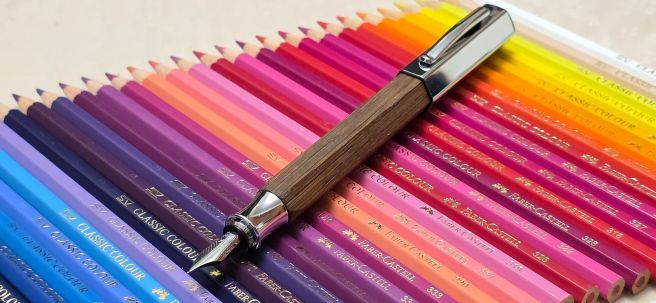
Posted and showing the dimpled nib and the hourglass section.

At first, I was undecided how best to hold the pen. A pinch grip around the section is a bit too low and too crowded for me. But if you hold it higher up, at the barrel, you have the issue of gripping around the faceted sides, which may or may not conform to your preferred way of holding a pen. Then there is the option of posting the cap. It does post securely but adds considerable weight and alters the balance such that you would want to hold the pen much higher up.
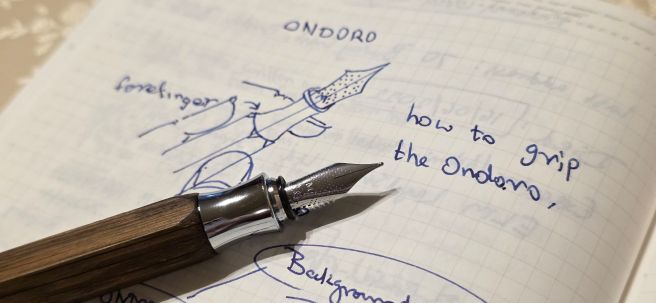
Finding my grip.

At £165.00, the pen looked to be a bargain compared to most of the others on display and might have been the most affordable pen in the showroom. I was drawn to the Oak material which may develop a lovely patina eventually. I was also mindful that I had enjoyed good experiences with steel nibs from Faber-Castell in the past with pens such as the eMotion, Grip and Loom. I was sufficiently intrigued by the pen to include it with my impulse purchase of the Cobalt Blue ink and I left with a smart Faber-Castell shopping bag and a smile on my face.

Later at the Royal Albert Hall, before arriving I had switched the pen and ink to my shoulder bag. At the entrance, halting for the security check, a torch was shone into my bag and the man pointed to the box and said “What’s in there?” “It is fountain pen ink” I replied. I got the impression that he did not get that answer very often.

I had the opportunity to fill the pen during the interval. The performance (both the concert and the pen) was excellent. It was necessary to crouch down and put the ink bottle on the floor of the Hall by my seat, as even I was not stupid enough to open an ink bottle in my lap. Once filled, I could take my seat again and test the pen in a small pocket notebook. The nib appeared to be perfectly tuned, right out of the box and wrote smoothly and well, as I have learned to expect from Faber-Castell.
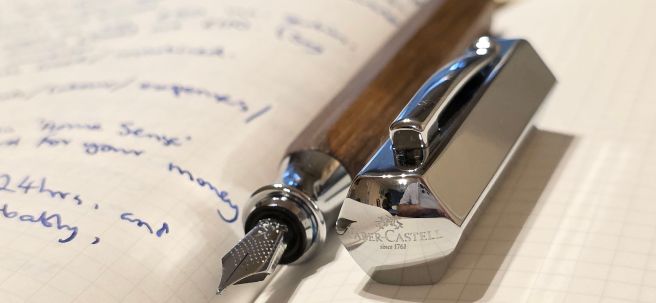
Highly reflective cap.

However, within a fairly short time, I began to suffer from an attack of BR or Buyer’s Remorse. This was triggered by the realisation that the pen was lumpy and angular and unusual to grip. I soon discovered that I could have bought the pen and the ink considerably cheaper online. Then thoughts began to crowd in, that I had not needed the pen, that it was arguably not as comfortable, or as good value, as my recently purchased Asvine J16 – a titanium bodied piston filler pen made, we generously assume, as an homage to the Montblanc Meisterstuch 146.

The following day, the BR only got worse, exacerbated by a visit to a home furnishings superstore where I made the realisation that, if it was Oak that I was after, I could buy an attractive table for a modest sum of £99.00.
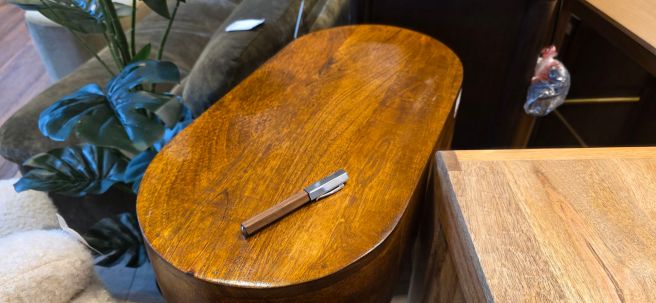
You get more wood in a table.

However, after a few days, I was over the worst of the BR. I realised that it is not helpful, thinking about a fountain pen’s value in comparison to other household items. Even comparing pens from different brands and countries, it is a mistake to think that we should acquire a new pen “at cost.” As for comparing values in recent pen purchases, of course some appear better value than others and it sometimes helps to combine the cost of a few pen purchases and then average their cost.

Happily, I soon grew to fully enjoy the Ondoro once again. The key to this, in my case, was finding a comfortable grip. I found this by resting the section on my second finger, and then gripping the pen between thumb and forefinger a little higher up at the bottom of the barrel. I found that I could hold the pen with the nib at the “sweetspot” (rotated inwards slightly) if I held the pen at the facets, leaving one facet in between.
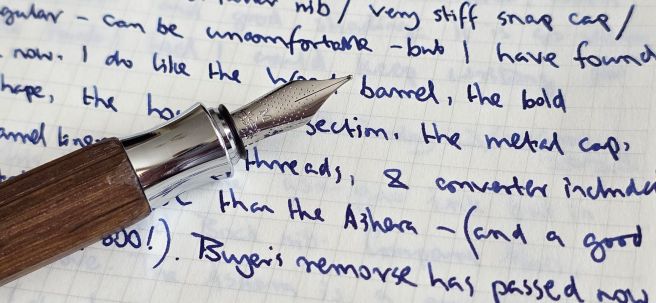
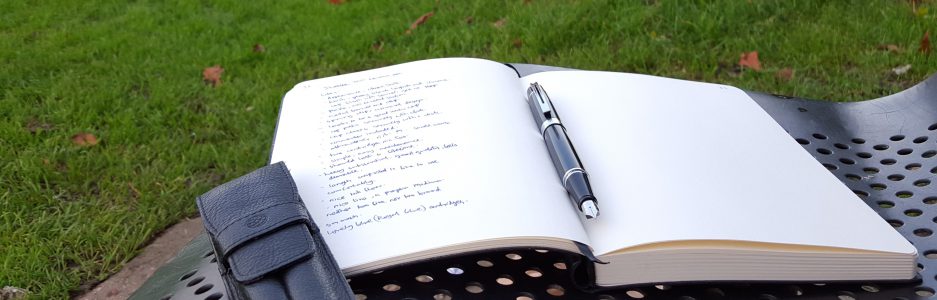
Some writing with the Ondoro and Cobalt Blue ink on Stalogy paper.

On my pen, and I don’t know whether they are all like this, when the barrel is screwed on to the section tightly, the nib aligns with a ridge between two facets, not a facet itself. I could hold the pen comfortably with the nib rotated inwards (I am a lefty). Once found, the grip is actually very pleasant and a bit addictive!

It is normal to have both likes and dislikes about the design of a pen. A few of mine are as follows. Let’s hope the likes outweigh the dislikes:-

Likes:

  • Bold and unusual, attractive design;
  • Facets: the hexagonal barrel with flat sides, is like an oversized pencil; also prevents rolling:
  • The use of wood, as a warm and natural material – with a satin finish which may develop an attractive patina in use; I love having a piece of Oak in my hands;
  • Short, chunky proportions;
  • Weighty metal cap – with shiny plated finish contrasting with the satin finish of the wood;
  • Subtle imprint of name and logo on the top of the cap, with the words “since 1761” imparting a sense of history:
  • Comfortable hour-glass section on which to rest the pen;
  • Well-tuned steel medium nib writes smoothly and with excellent flow:
  • A Faber-Castell branded, Schmidt converter is included;
  • Fit and finish are excellent: brass liner and threads to barrel; metal threads on the section; plastic liner to cap;
  • Slightly domed metal barrel finial, protects the wood when pen is standing:
  • Cap can be posted (although making the pen back-weighted and heavy);
  • The tough, short and stocky feel of the pen make it well-suited for an EDC pen.

Dislikes:

  • Facets: Unless held around the section, gripping the pen at the barrel has a risk that the facets may not necessarily fall where you would wish to grip the pen. You may instead encounter a sharp ridge between two facets, or else have your grip dictated by the position of the facets, rather than by the best rotation of the nib to the “sweetspot.”
  • On my pen (and again this may not be same for all), the snap cap is very tight and it needs considerable force to uncap the pen: however this may ease eventually with use; meanwhile, if using the pen intermittently, the pen could be “soft-capped”, to reduce ink evaporation;
  • If posting the pen, the hexagonal cap has to align with the facets and, on my model, this means that the sprung pocket clip will either be to the left or the right of the nib’s centre line and not in line with it – a slight annoyance.

Weights and measurements.

The pen looks and feels, chunky, solid and dense! Capped, it measures around 127mm and uncapped, 123mm. Posted, it is around 157mm. The width of the barrel across opposite facets, is about 12mm. It weighs 44.5g capped, or 27g uncapped and 17.5g for the cap alone. Using the pen uncapped, the weight is very comfortable.

Conclusion.

I am fond of Faber-Castell’s steel-nibbed fountain pens such as the Grip, the Basic, the Essentio and Ambition and have in the past enjoyed the writing experience, particularly with a Faber-Castell Loom, in gunmetal grey, a long-term EDC. I recall the excitement of once buying a Faber-Castell eMotion in Fortnum & Mason, and then heading to the men’s room to ink the pen (with Waterman’s Harmonious Green) and on to the British Museum to write with it. Perhaps I was hoping to recreate that new Faber-Castell feeling with my Ondoro purchase.

This time, the purchase was followed by a wobble and a couple of days of regret, but having come through this, and having spent some time experimenting with different grips, I can now report that I am enjoying the pen and that my bond with it is perhaps stronger as a result of this emotional roller-coaster ride.

Naturally, it sometimes pays to shop around before buying. Also it is best to handle a pen before buying to check that it will be comfortable or whether you will need (and be able) to adapt to it and so there are advantages to buying from a bricks and mortar shop, if you have one. Also, it is human nature to forget to be sensible once in a while.
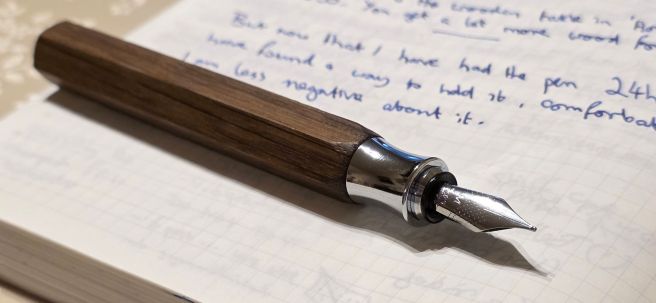
A gripping challenge, but worthwhile.

A look at the Pilot V disposable fountain pen and how to refill one.

I realise that there is a risk here in marking myself out as a cheapskate. I make no secret of my fondness for inexpensive pens. This is not from any inverted snobbery: I like expensive pens too, but they sometimes lose points in my eyes from being too expensive. When a fountain pen costs more than, say, a decent bicycle, something seems wrong.

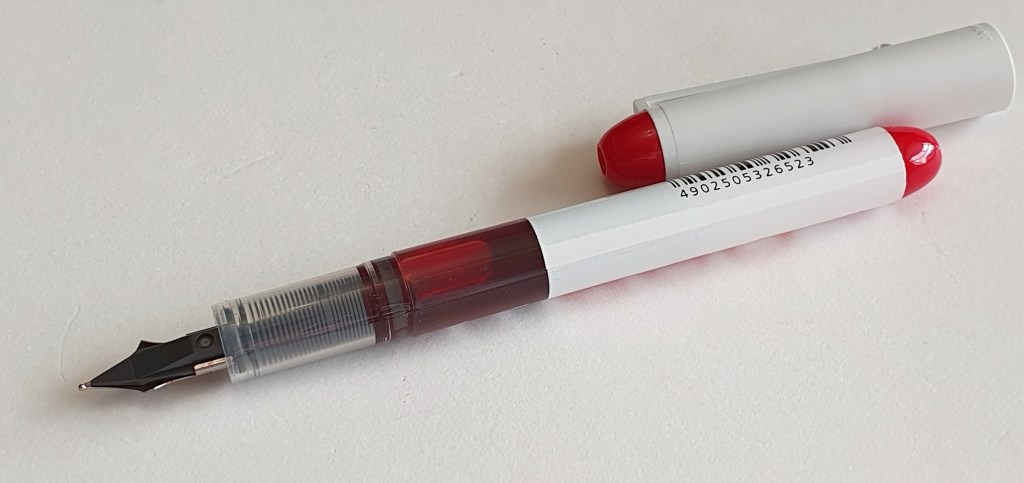
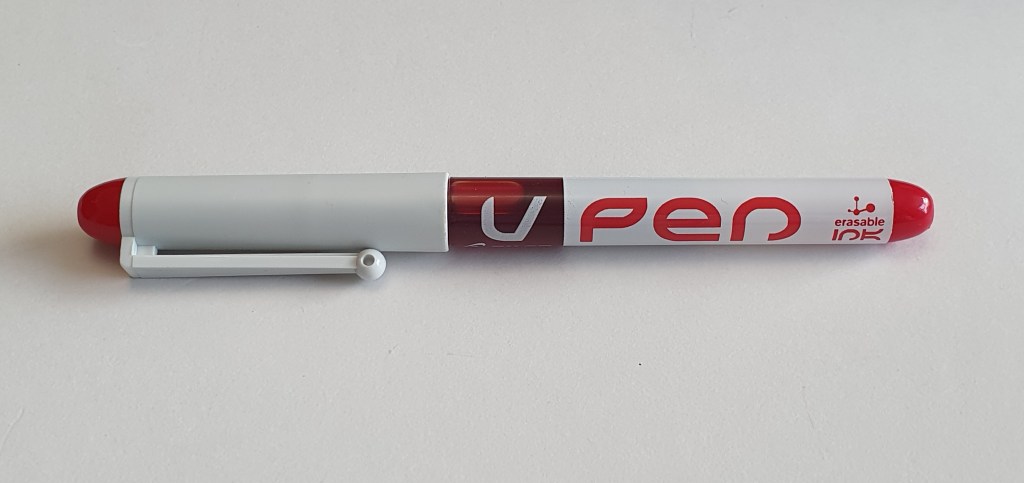
I happened to be out on my bicycle at the weekend and visited a stationery shop in St John’s Wood in North West London. I went to buy some supplies of file paper. I was tempted by a colourful display of Pilot pens – gel pens, fineliners and the Pilot V pen, a single use fountain pen. I stocked up on a selection of stuff, including a red ink V Pen, which I fancied as being a useful tool to use at work for amending drafts. I tried it out on a test pad and was impressed at the colour and how smoothly it wrote.

Pilot V Pen, a disposable or single-use fountain pen.

I have had a few of these V Pens in the past. Well, I say past, but I still have them in blue, black and purple. They seem to go on almost forever and do not mind being ignored for months or years on end. The ink seems to be specially formulated to resist drying out in the pen. The downside of this is that the ink seems prone to bleedthrough. On a recent test of thirty different inked pens on an A4 notebook, I found that the Pilot V pen was the only one to bleed through the paper.

Available in a wide range of colours.

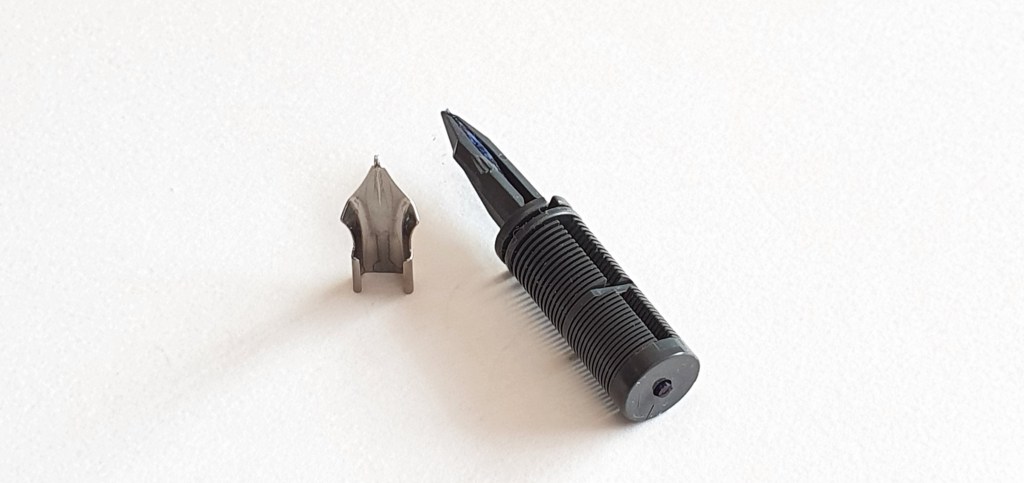
When I looked recently at my old V pens, which had languished in a pen cup for longer than I can remember, the black and the purple ones still wrote at once, but the blue one seemed to have finally run dry. I also noticed that the blue ink model was of an older design than the others, with a narrow slit for the ink window along the barrel on two sides and with a rather basic butterfly nib. This is a nib where there is no tipping material but the tines are crimped, and folded downwards at the end and polished to form a writing tip. I have encountered this design before on a Bic Easy-Click fountain pen.

I then remembered a friend mentioning that it was possible to refill and reuse these Pilot V pens. I did not know how and had never looked into this. I did a quick search on Google and found a very useful blog post How to Refill a Pilot Varsity Disposable Fountain Pen on Fountain Pen Love, by John Bosley in a post from September 20, 2017. I read this with interest. I was keen to have a go at refilling my blue V Pen and felt that I had little to lose.

The technique simply requires that you pull out the nib and feed, which are friction fit. You can then flush out the pen and refill the barrel with some ink of your choice and refit the nib and fit with a firm push, until it clicks into place.

I got some grippy material. I pulled and pulled at the nib and feed but they would not budge. Instead, the nib came away, leaving the feed in place.

Determined to get it out, I resorted to using hand tools, (a big no-no in fountain pen work) and used the pliers of my Leatherman. This was rather reckless as you have a good chance of crushing the feed and breaking it, or at least cracking it. Squeeze too hard on those pliers and it will break like a walnut.

I tried gripping it firmly with the pliers but not so hard as to crush the feed. I pulled. After the pliers had slipped off a few times, eventually I was successful and the feed came away with a pop, like a Champagne cork. That the feed came out and was not broken, was very pleasing.

An older style Pilot V pen disassembled for refilling, with butterfly nib and narrow slit ink windows.

I washed the nib, feed and barrel then had a closer look at the nib and feed under the loupe. There were some marks from my pliers, but nothing terrible. I noticed that the feed has a wick running along the channel, to keep the nib moist.

Nib and feed disassembled

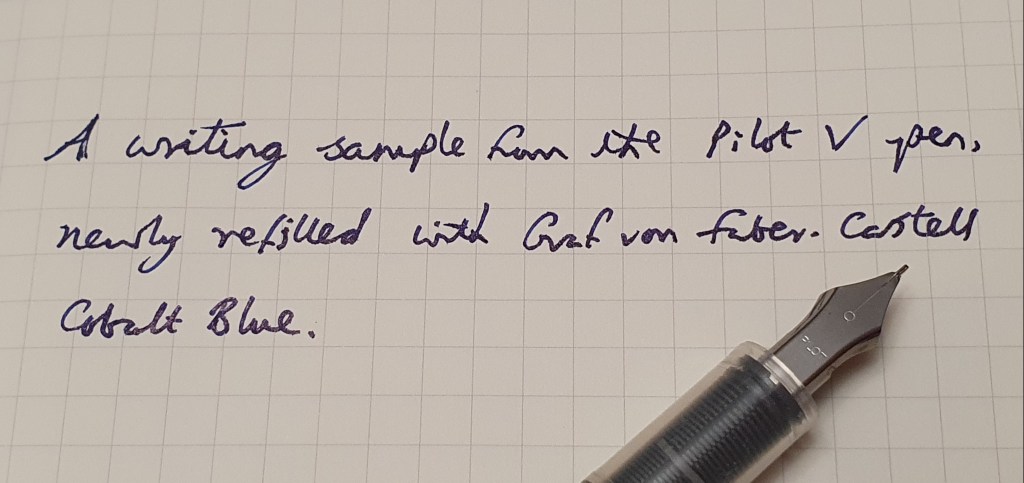
It just remained to choose some ink and refill the barrel, with a pipette. I decided on Graf von Faber-Castell Cobalt Blue. I was careful not to put too much in. You need to leave space for the feed, which can be seen through the clear plastic grip section.

The pen now writes again! The Cobalt blue looks good. It should not bleed through paper like the original ink, but then again the pen will probably not be so resilient as before in coping with long periods of neglect.

A sample of Cobalt Blue from my newly re-filled Pilot V Pen, on a Moleskin notebook.

The butterfly nib is not the best writing experience, but it is reasonably smooth. The newer version with the rounded tipping material is a big improvement.

In conclusion, I doubt that I would want to get out the pliers every time to refill this pen and risk shattering the feed. Perhaps it might come out a bit easier next time. But even refilling the pen just once means it has doubled its working life, roughly halving the pen’s “cost” and helps to reduce plastic waste. It is nice to know it can be done.

That red though!

Update 27 March 2021: I would just like to add, that in using the pliers I did also have the grippy material wrapped around the feed to protect it from the sharp metal jaws of the pliers.

A look at the Sheaffer 100 Translucent blue and chrome fountain pen

What is it about the combination of electric blue and chrome which makes it so captivating and (to me) irresistible?

20170812_105952_001

This year marks the 225th anniversary of WH Smith, the high street  book shop, newsagent and stationer chain that is a familiar sight in our towns and cities. Our local branch, at Brent Cross shopping centre, North London has reinvigorated its fountain pen display cabinets. This was a welcome find, when I visited recently. I enjoy looking around for anything new. This time I was rewarded with their dedicated self contained glass display cabinet showing a range of fountain pens from Parker, Cross, Waterman and Sheaffer each arranged in a fan shape although closer inspection revealed that the brands were intermixed.

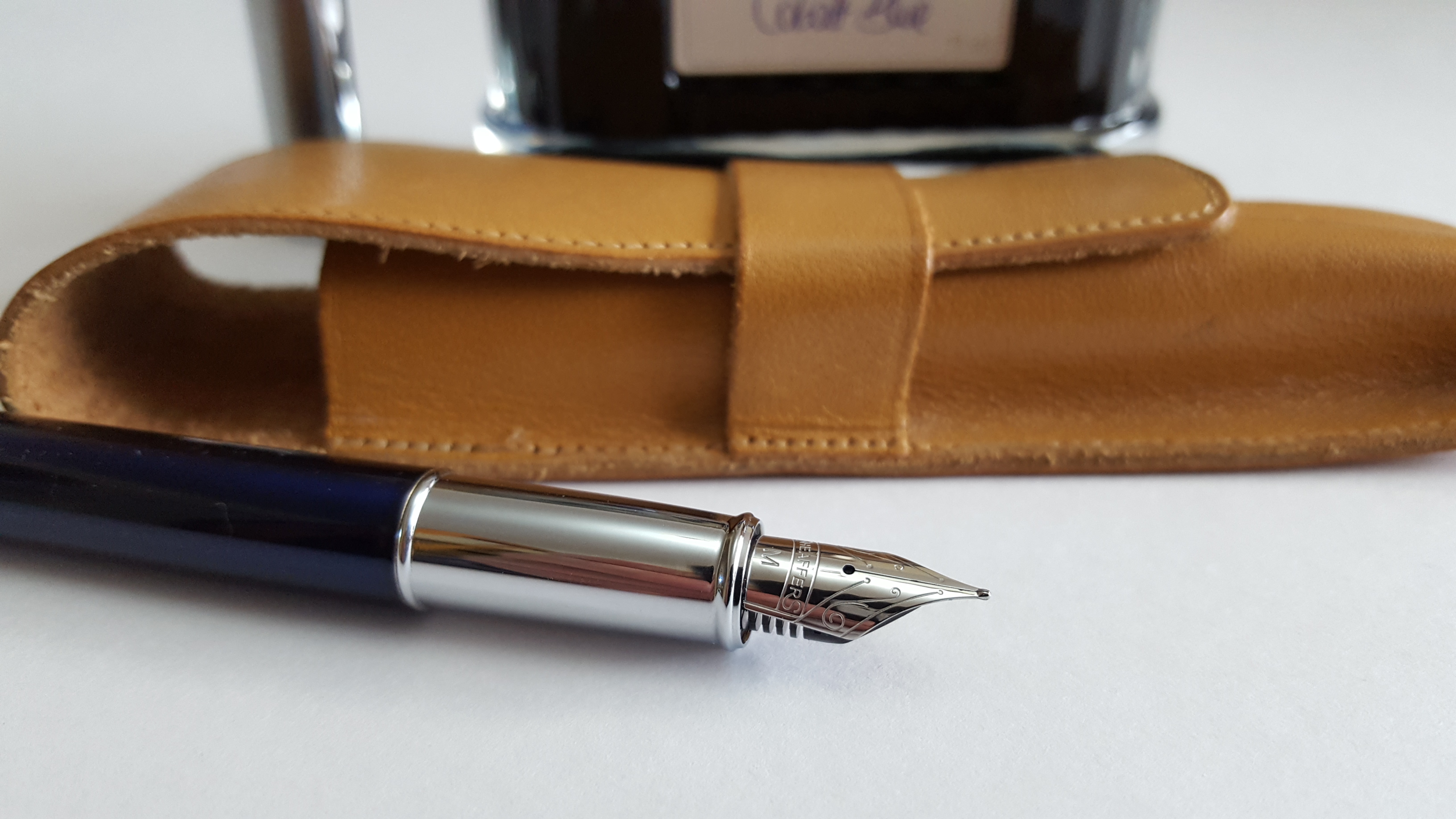
It was there that I spotted what I now know to be the Sheaffer 100, in translucent blue, with polished chrome section and a brushed stainless steel cap, featuring the trademark Sheaffer white dot. The pen, with cap posted, looked stunning with its vibrant blue barrel and contrasting silver coloured section and cap. The nib, with its decorative scroll work, harks back to the glory days of Sheaffer when they were made in Fort Madison, Iowa.

20170812_210401
Sheaffer 100 Translucent blue and chrome

The pen looked to be good value, particularly in comparison with some of the other offerings on display with similar specification. With its striking good looks, needless to say, I succumbed to buying another pen.

The pen comes in a decently made and typical, black gift box with a removable padded tray, underneath which is a Use and Care Guide and 1 year warranty leaflet. Whilst this is for a Sheaffer pen, the name on the back of the leaflet nowadays reads A.T.Cross Company. You also get two Sheaffer Skrip cartridges, one blue and one black but no converter.

20170812_105901

A feature of this pen is the shiny grip section. But there we have a contradiction in terms. Shiny sections are difficult for me to grip. I know this. I have a Cross Aventura with the same issue. The section looks pretty and photogenic but slips around in my hand.

Why is this important? We look at writing samples to see how nibs perform, how wide the line is, how dry or wet the ink flow is, whether it skips and so on. But there is another factor at work here. Is the pen comfortable to hold? And part of feeling comfortable with a pen, means being able to hold it securely and confidently so that you can exercise sufficient control of the pen as you write. At the same time, you do not want to be overly aware of how you are holding the pen, which you will be if you are gripping too tight as your hand will tell you after a little while.

20170812_110848

A pen which cannot be gripped securely will manifest itself in shaky and erratic writing. Happiness does not shine through.

In the case of the Sheaffer 100, I have been writing with it for a few weeks now and have become accustomed to holding the pen just above the join of the section and the barrel. In this way, I can hold the blue barrel between finger and thumb, whilst the cool and shiny section rests on my second finger. This works for me. It feels slightly higher than I would normally hold a pen, but not too much higher like chopsticks.

20170722_202419

Holding the pen further back from the nib also means that you still need sufficient length for the back of the pen to rest in the crook of your hand. The pen unposted measures 120mm (4 3/4 inches) but happily, the cap posts securely (if you give it a firm push) and brings the pen up to 149mm (about 5 7/8ths inches) which is a very comfortable length, for me. The pen weighs 28g capped or posted. Uncapped it is 18g, with the cap weighing 10g.  I like to use it posted and this is not too heavy.

As for the writing experience, I tried the pen first with the supplied blue Sheaffer Skrip cartridge. The medium nib wrote a nice wet line, on the fine side of medium. The nib looks very attractive. However, seen under a loupe, the tipping on my nib looked just a little off, with the nib slit at the tip being not quite perpendicular when viewed head on, but leaning towards a 1 o’clock to 7 o’clock line. I decided to leave it to wear in naturally and I think it will wear smooth as I use the pen.

Whilst having a lovely ink flow, the blue Skrip did bleed through quite badly on a particular Paperchase notebook that was using such that when I finished the first cartridge I syringe-filled it with Graf von Faber-Castell Cobalt blue, which I am using now and without the bleedthrough.

20170816_091039
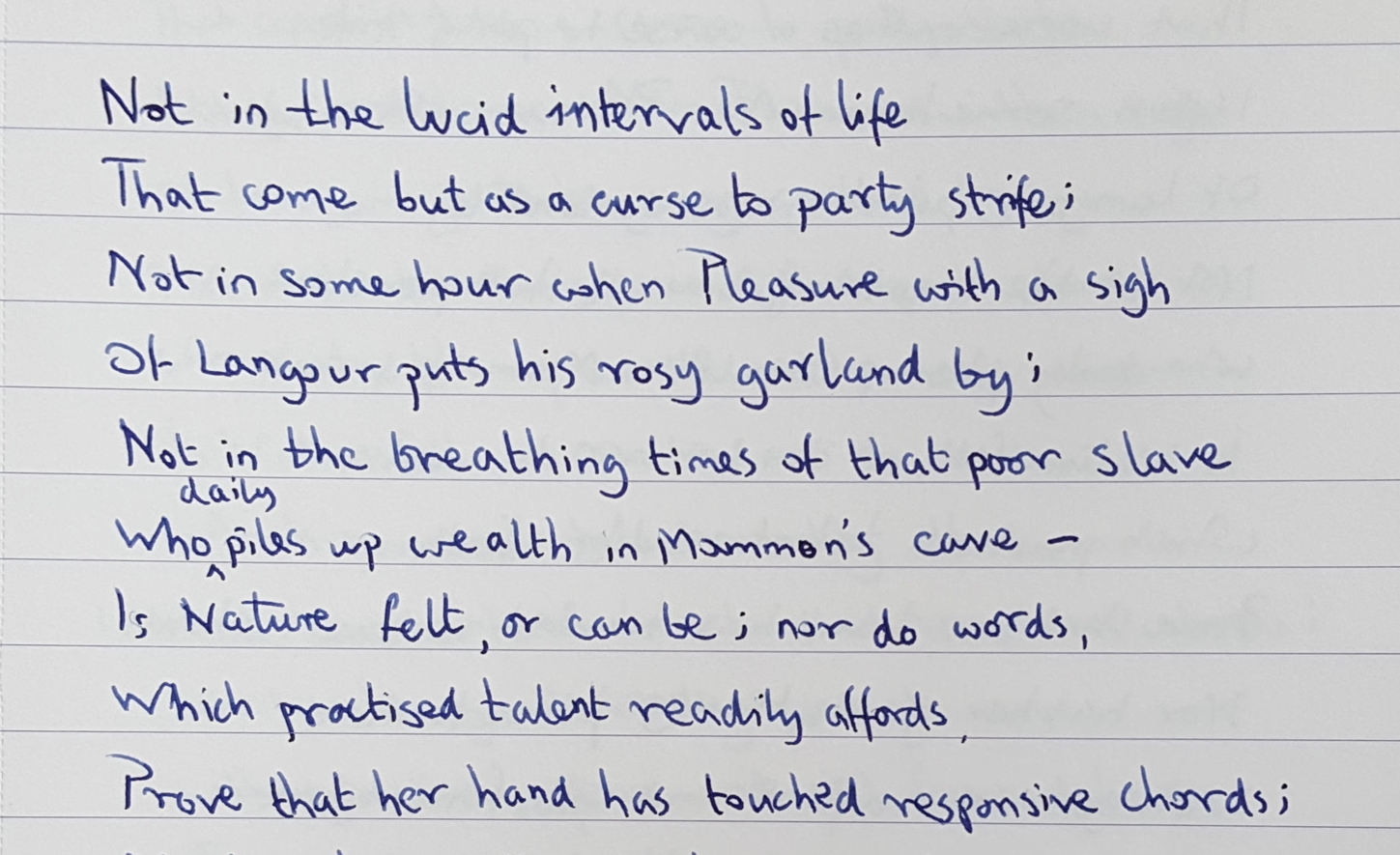
Sheaffer 100 with Medium stainless steel nib and Graf von Faber-Castell Cobalt blue ink on Rhodia 90gsm paper. Words by William Wordsworth.

I have adapted to holding the pen a little higher than I might otherwise, in view of the slippy no-go area of chrome section. But it is good to adapt and be comfortable with using different pens, rather like being able to drive different types of car.

If I had not liked the look of the pen I would not have persevered with it but I am fond of Sheaffers and it has been worth the effort.

20170812_111635
My grandmother had a sugar bowl like this one.