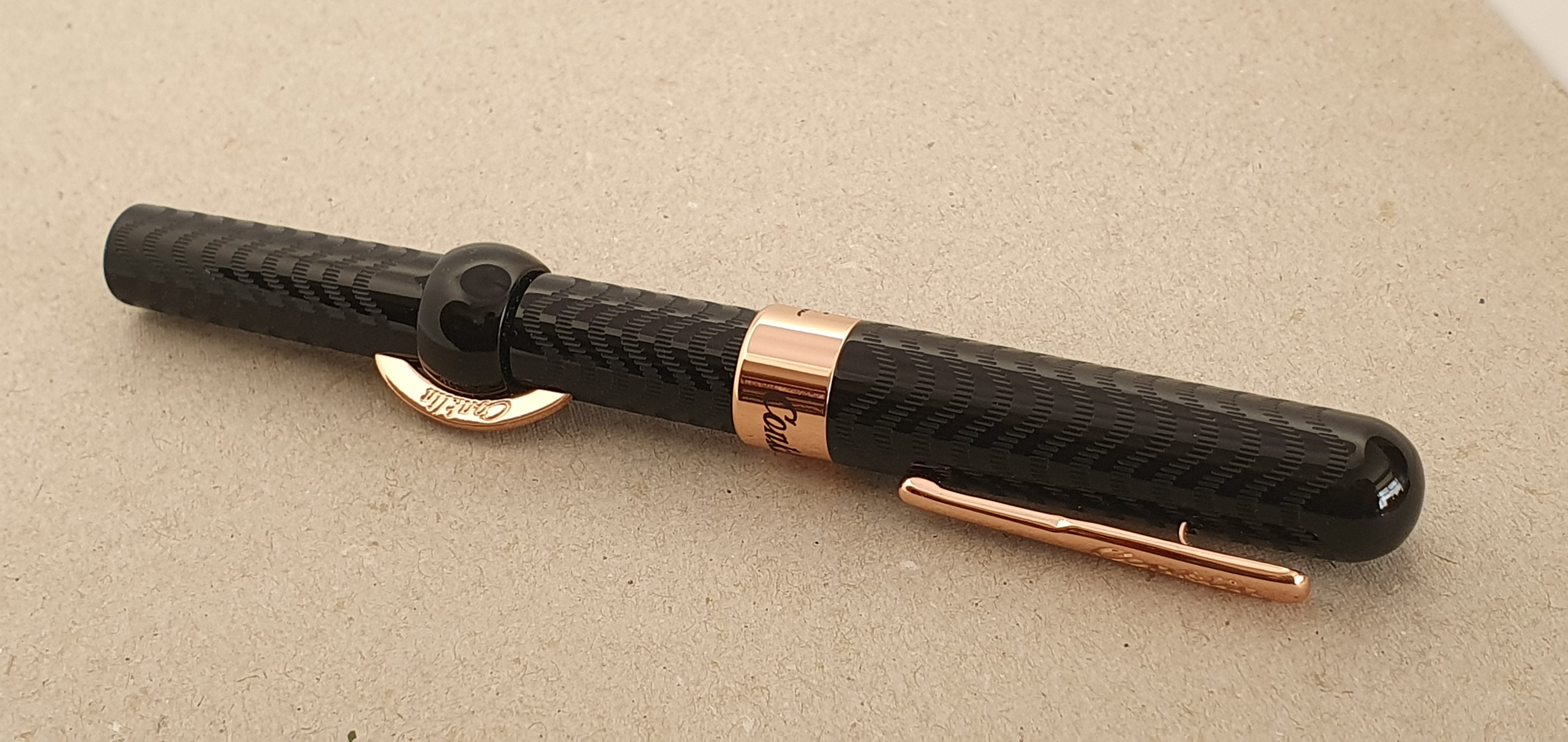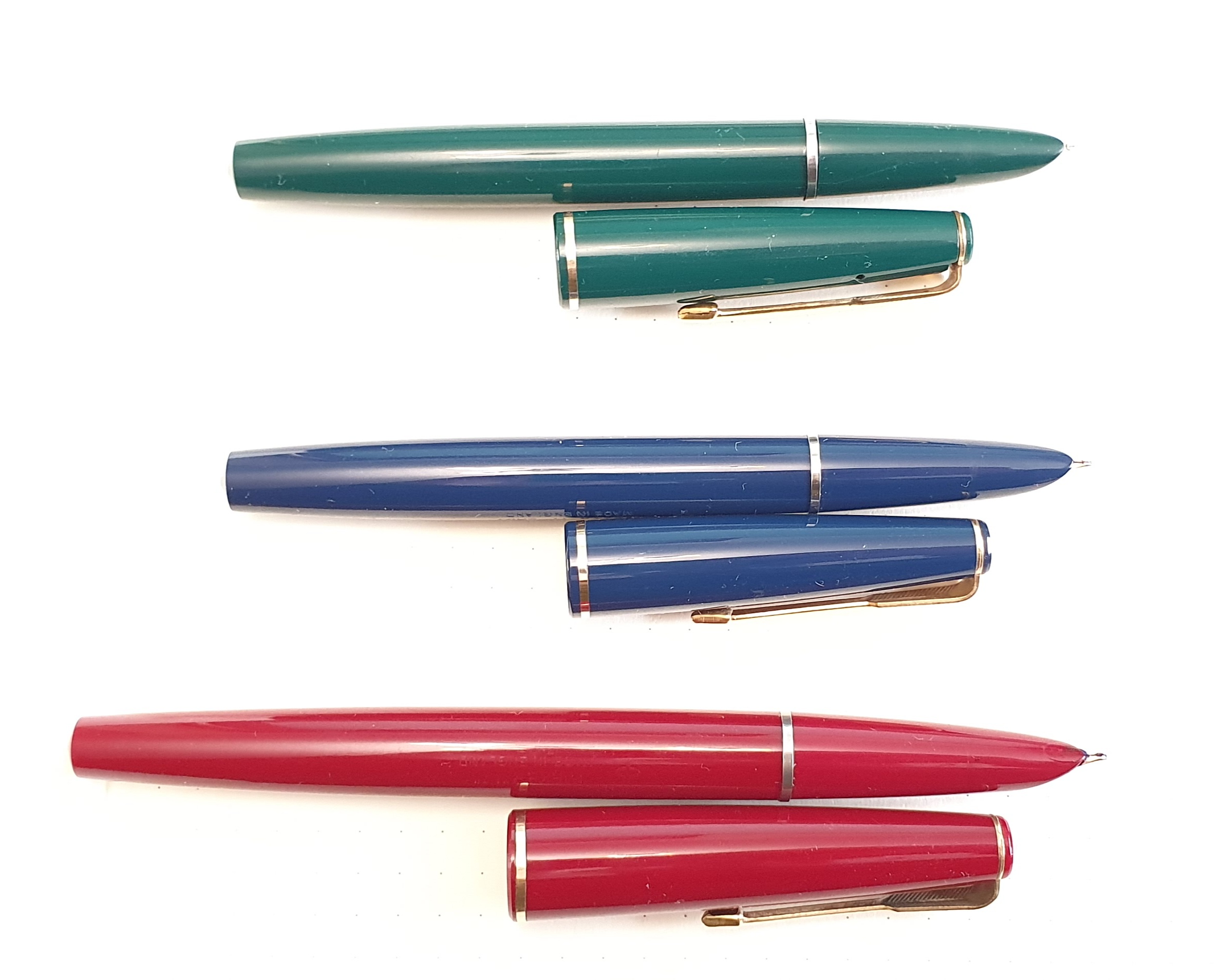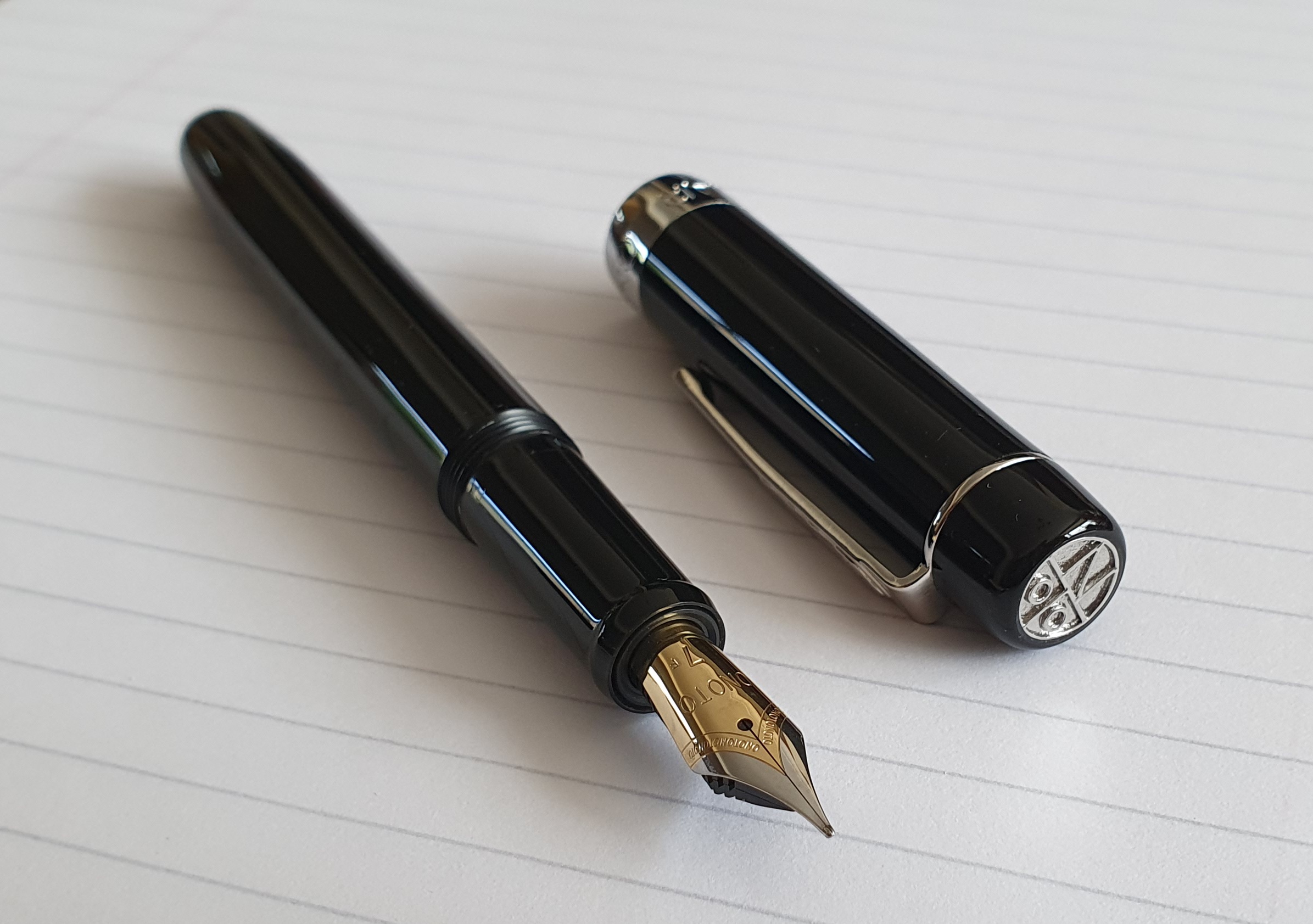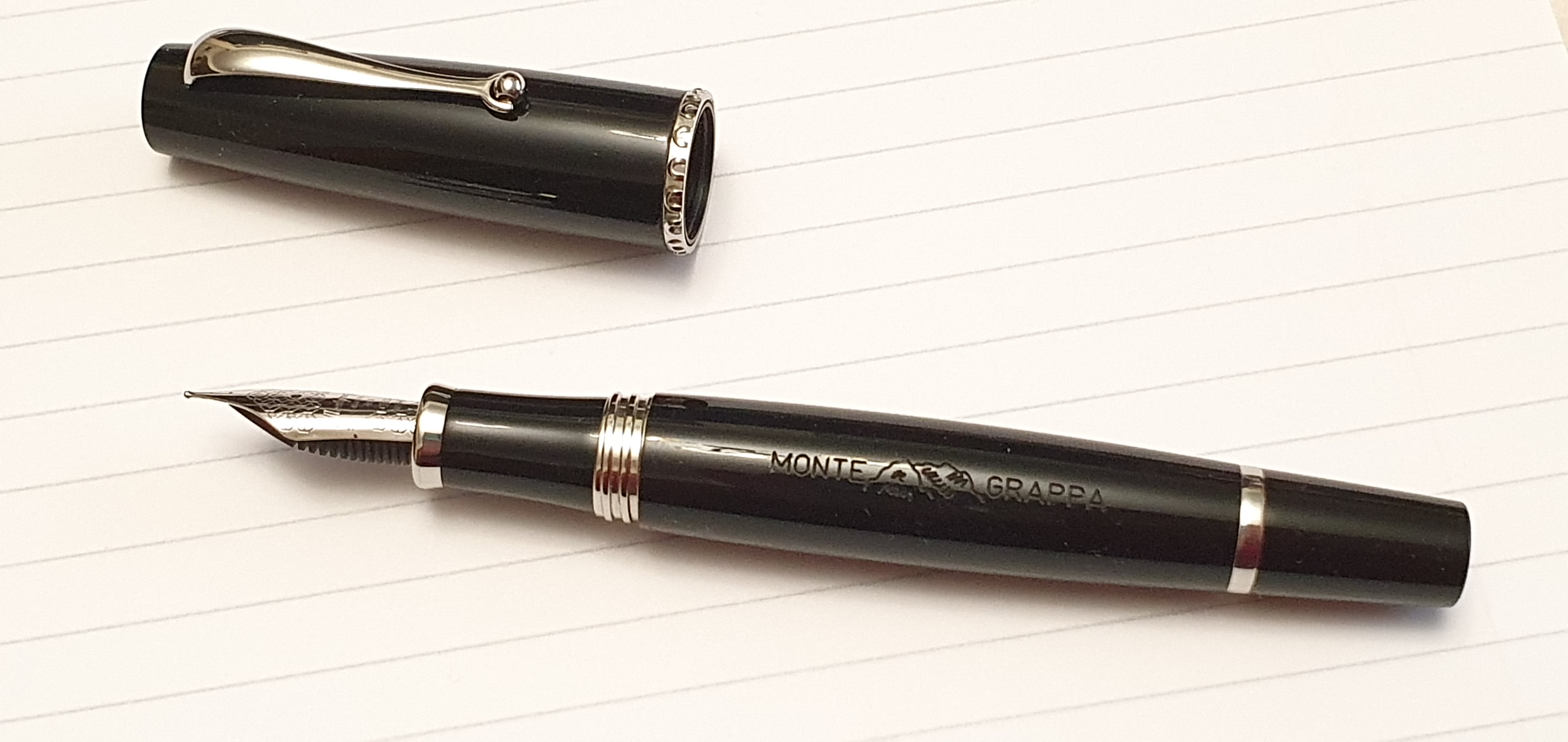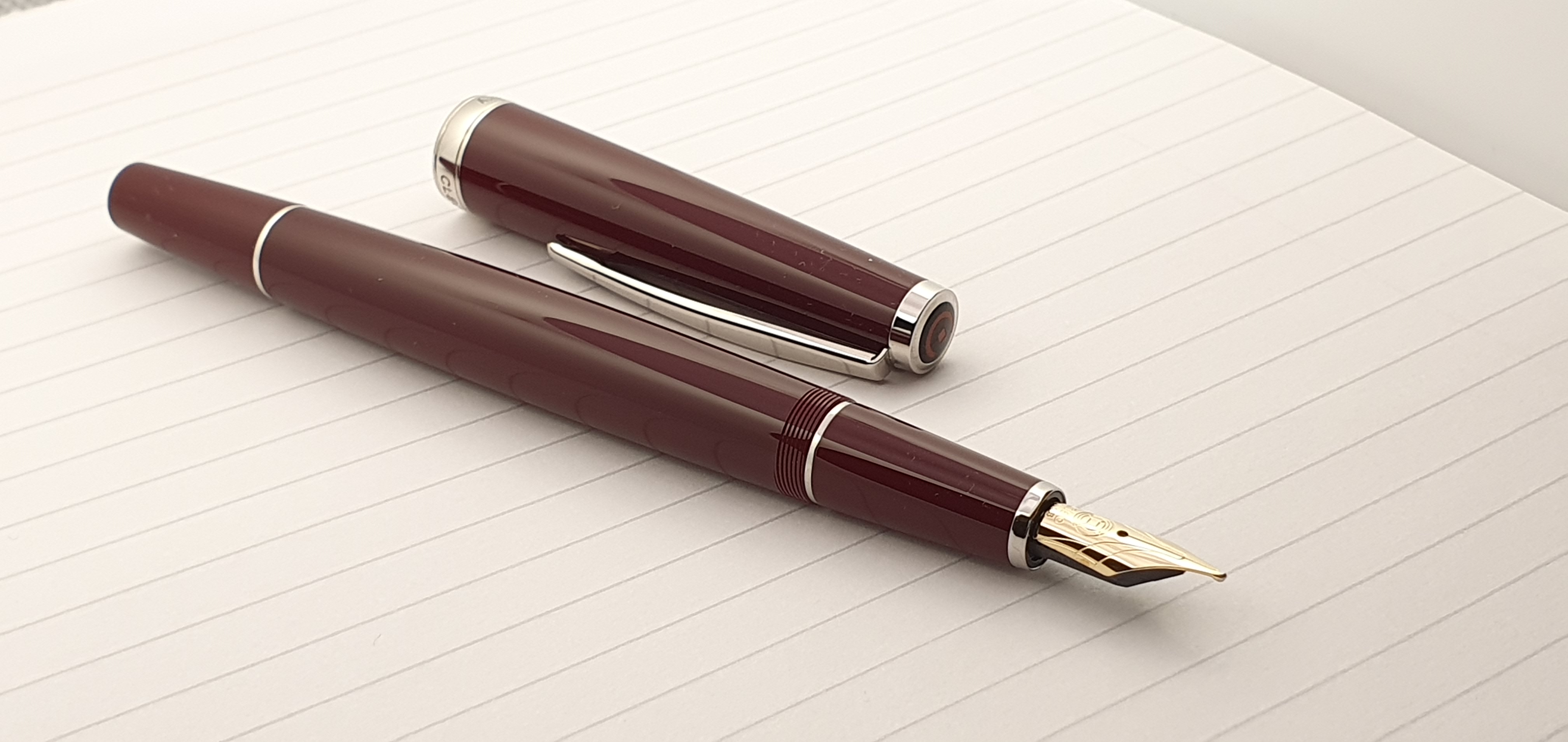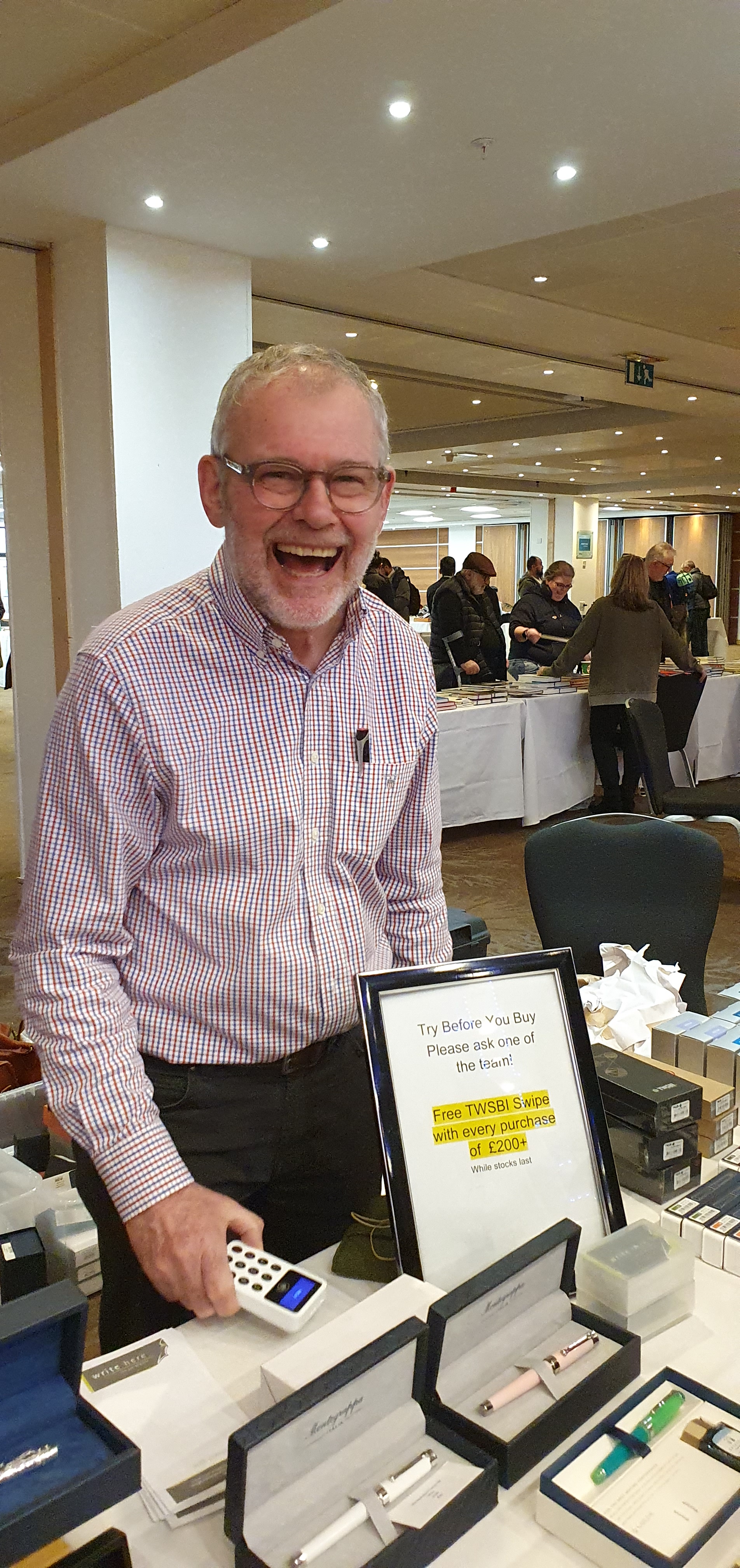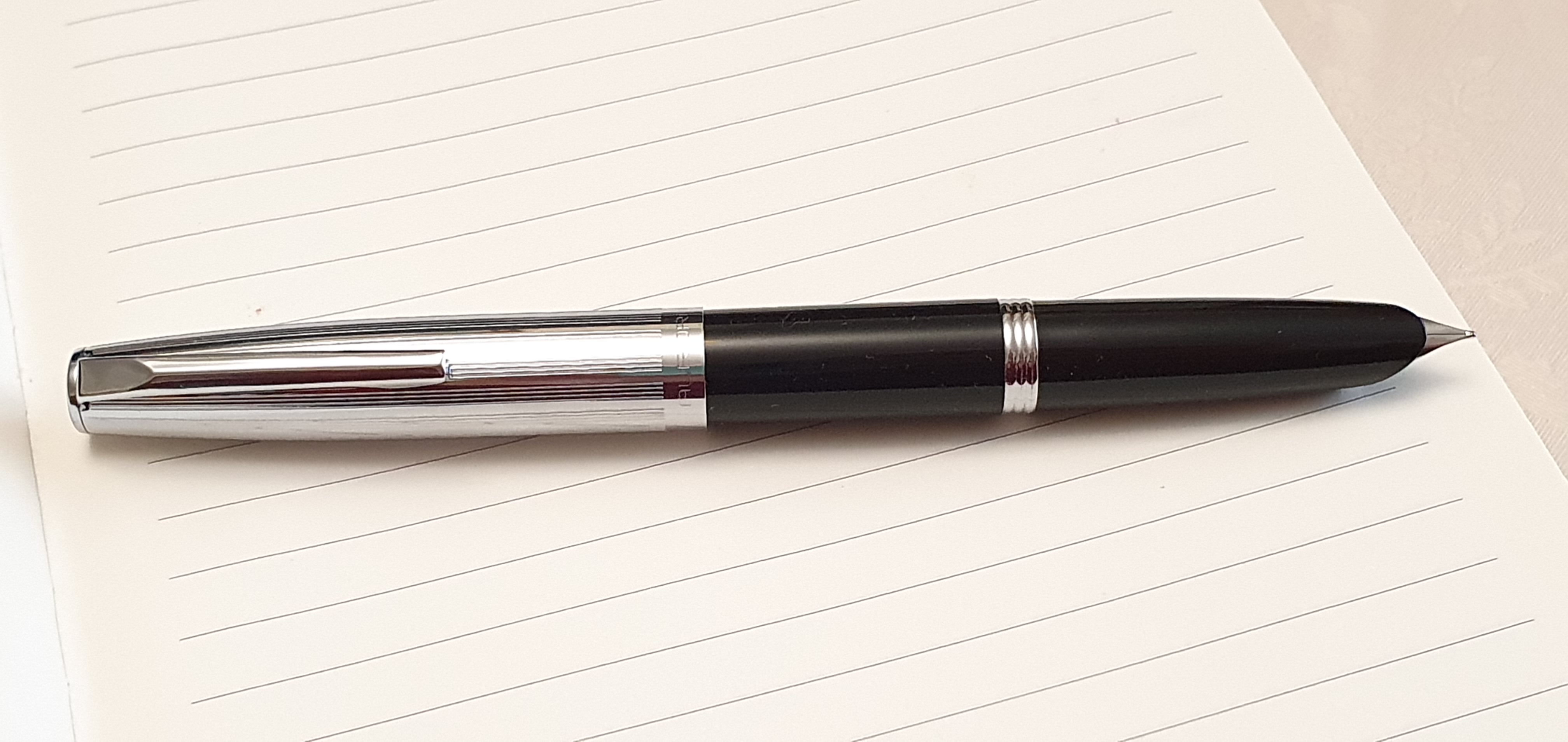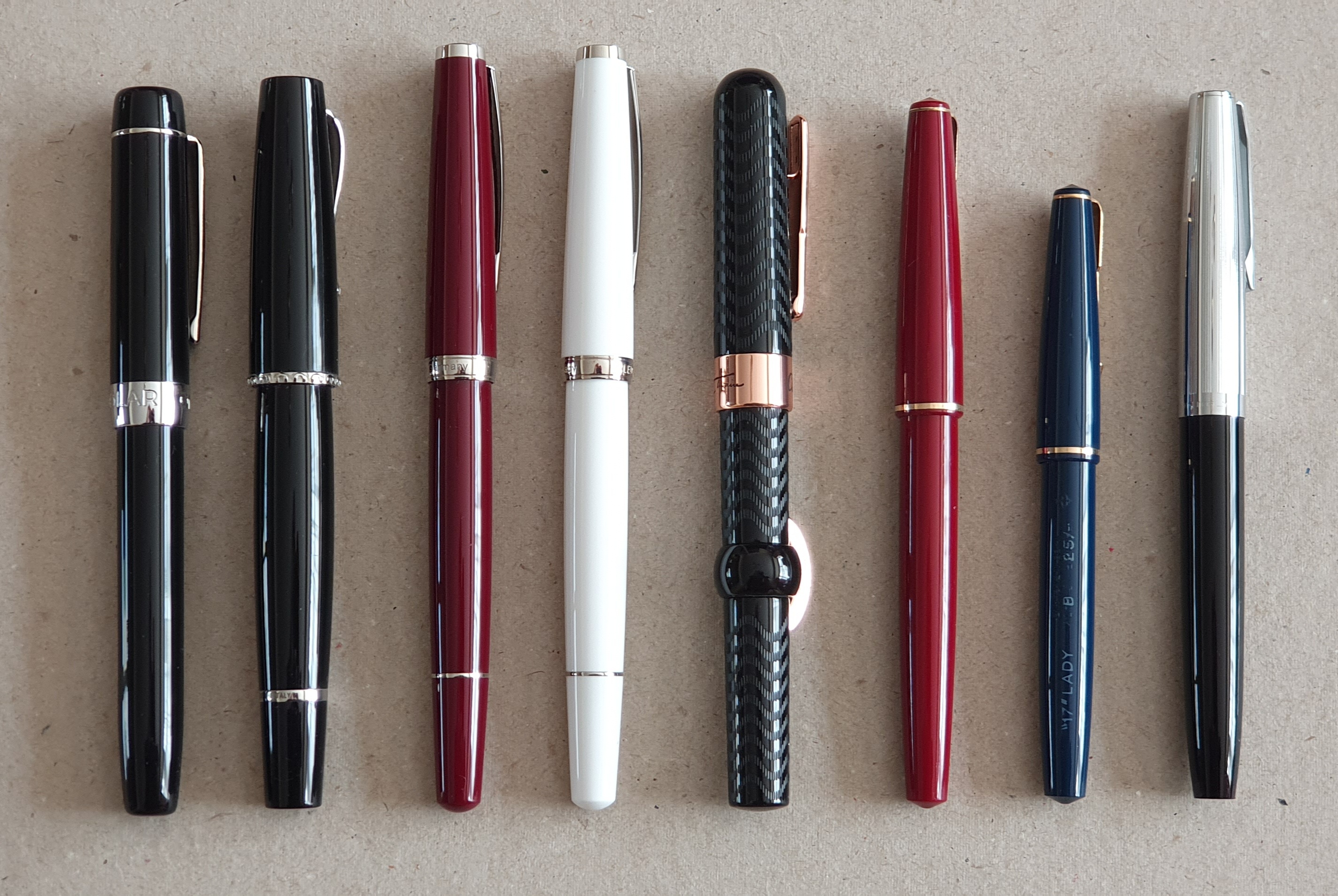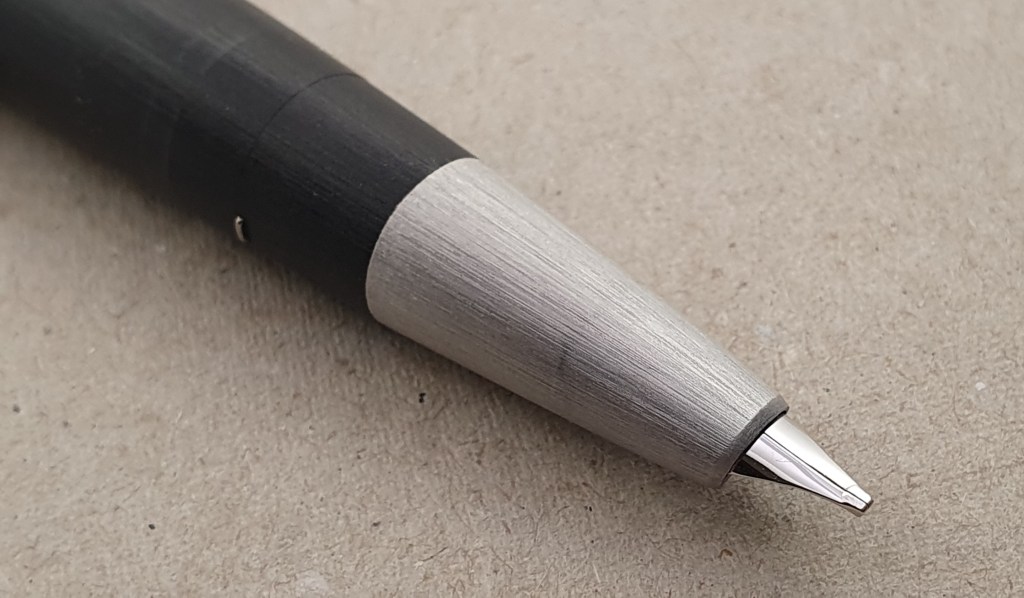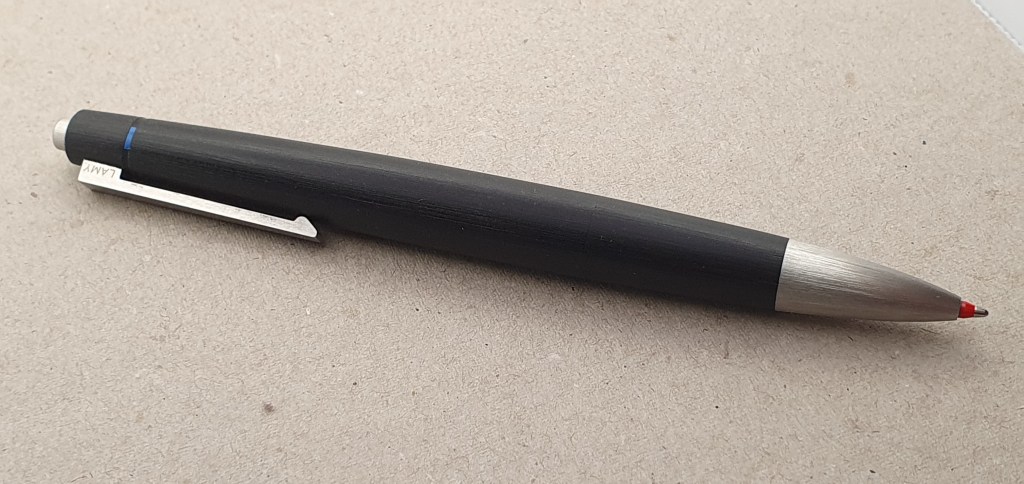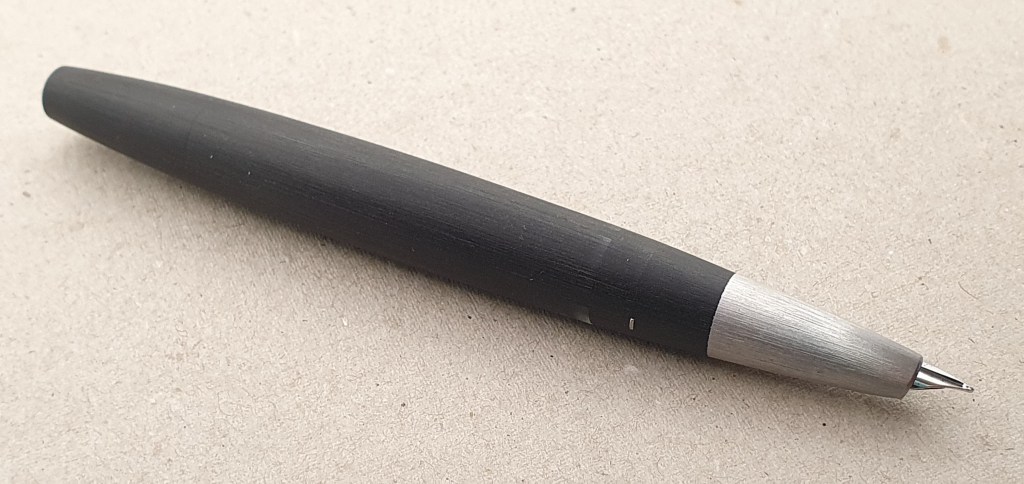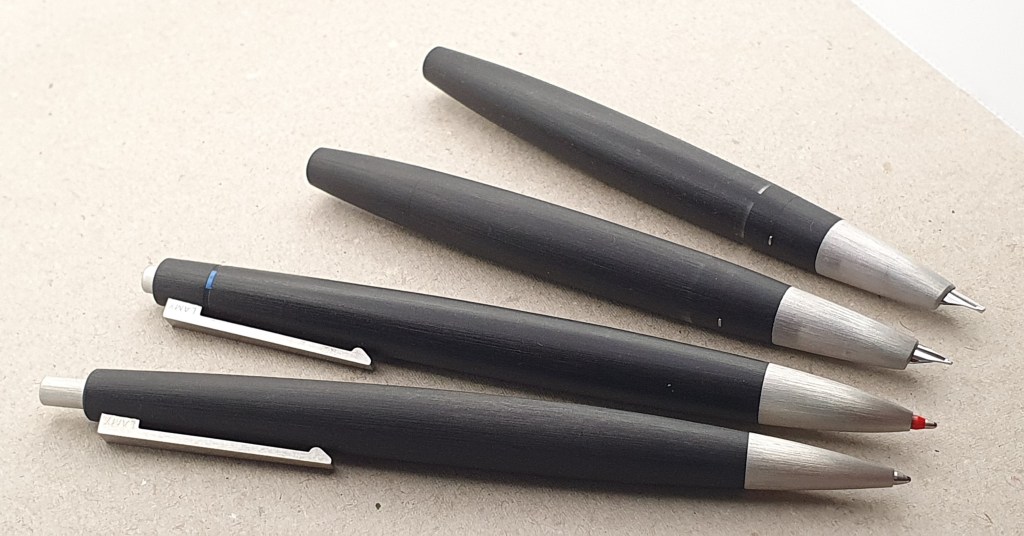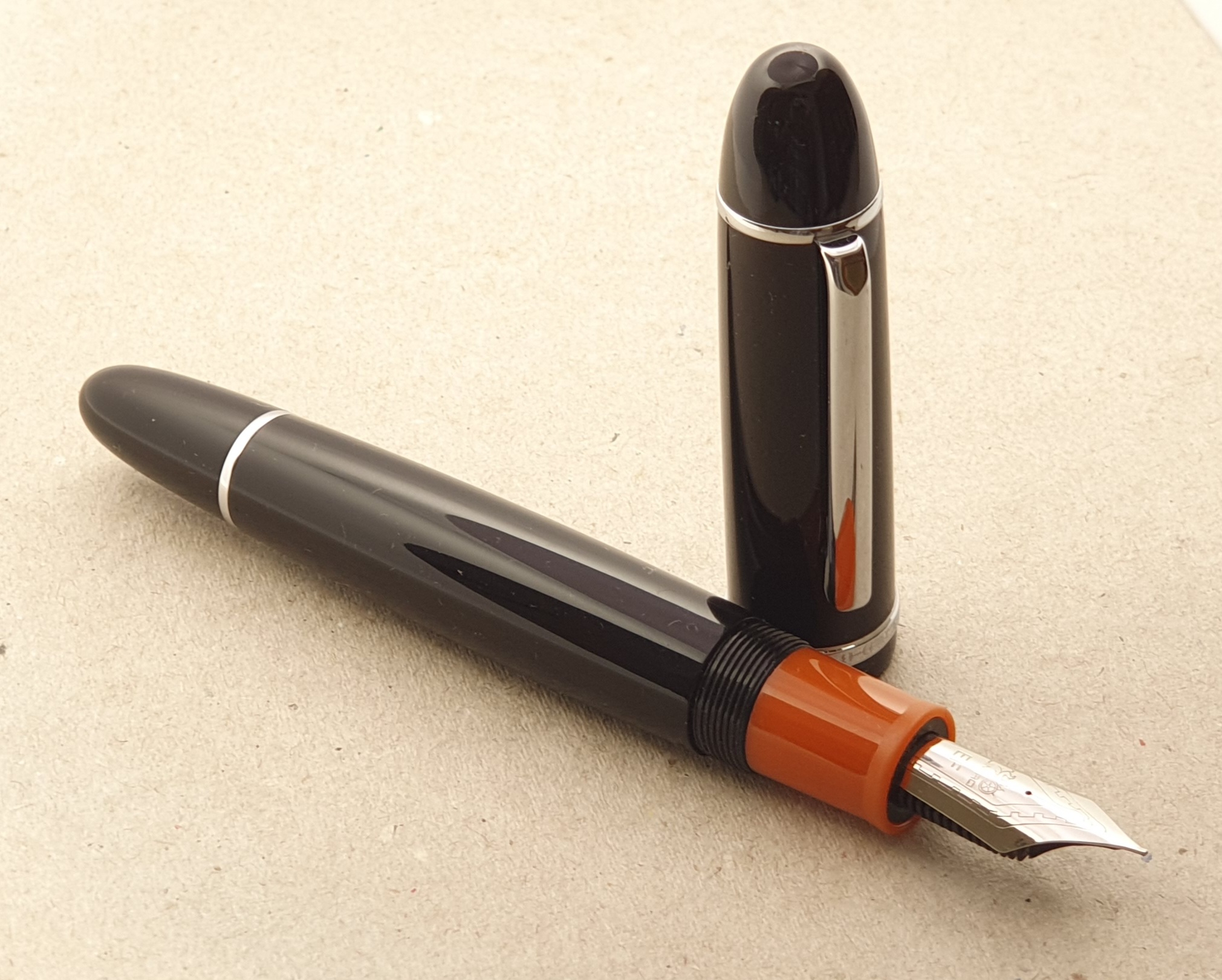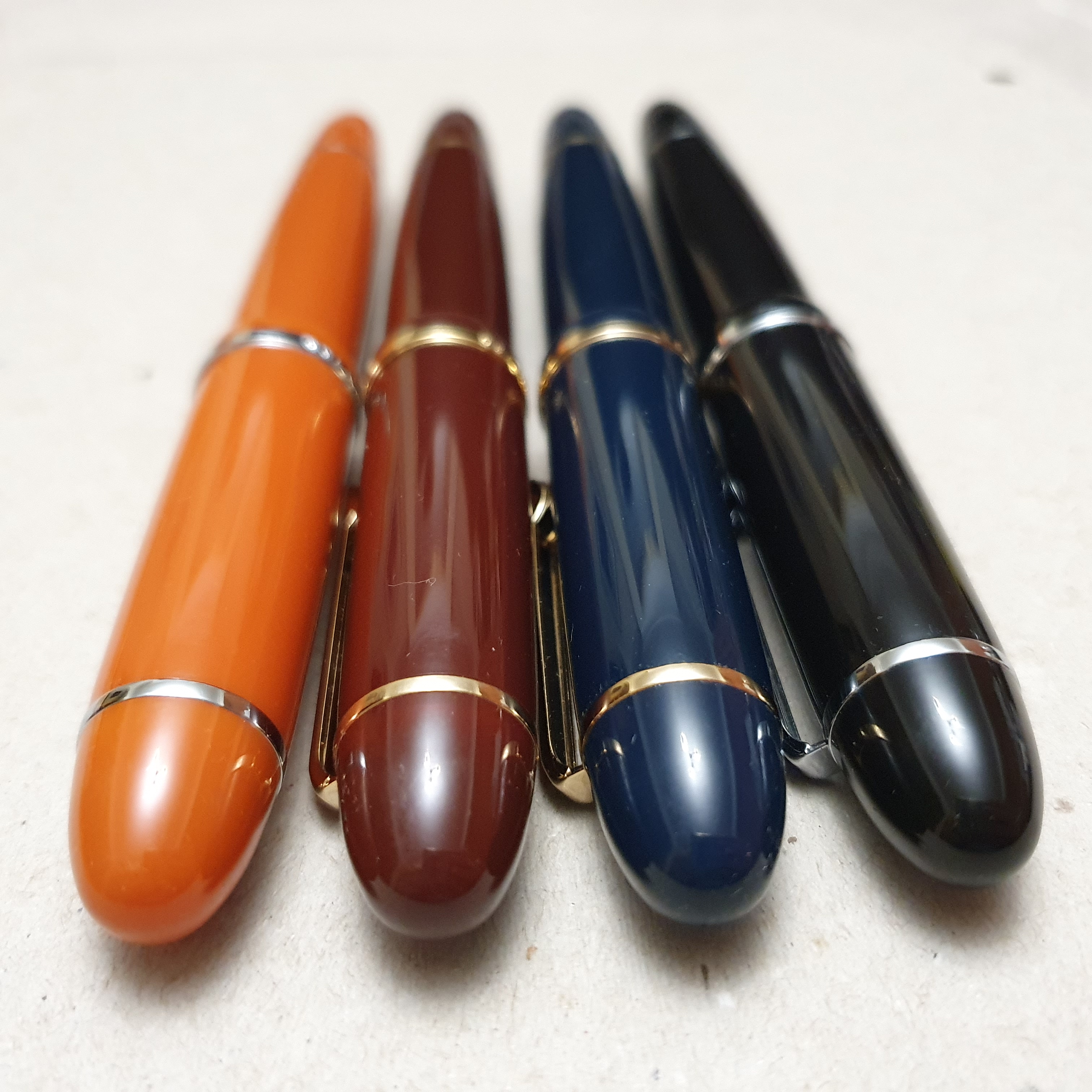
My growing Lamy 2000 family.

My journey with the Lamy 2000 began in May 2014, with the purchase of the fountain pen, at Websters on a day trip to Brighton. In fact, I had wanted one for some time before this, since being shown one by a helpful sales lady at her pen shop in Hampstead, whilst purchasing my first Lamy Al-star. That must have been around 2012. I still remember wrestling with my conscience over whether to buy one from a shop, or from a well-known online source whose price was significantly lower. I chose Websters.

My first Lamy 2000. The original medium nib was exchanged for this stubby broad.

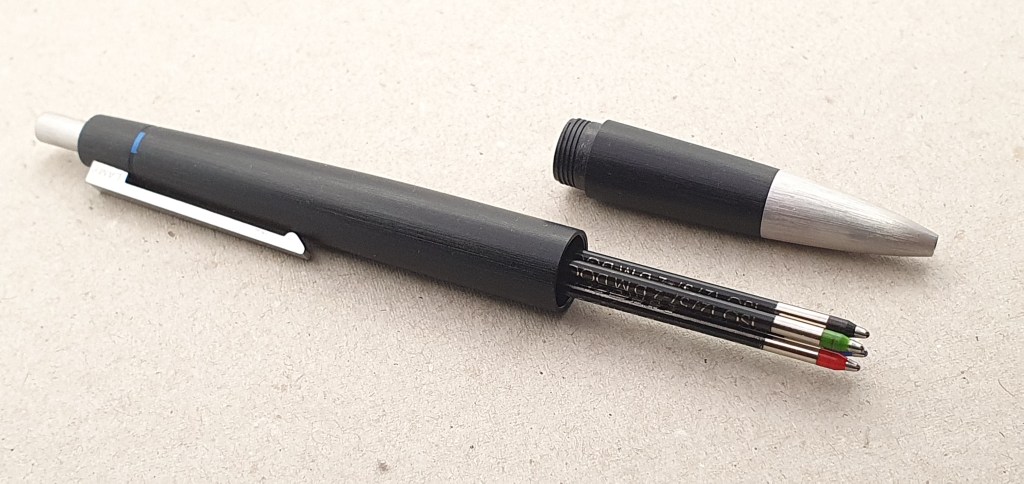
The story of my first Lamy 2000 has been told here before and in an update here. Several years after buying the fountain pen, I picked up the matching four colour multipen, also in Makrolon and brushed stainless steel. It features an ingenious colour selection system, in fact based upon gravity but which seemingly enables you to select one of the four colours just by looking at that colour on the indicator, before pushing the nock. I love this. It is a great party trick.

Lamy 2000 four colour multi-pen.
The innards.

My Lamy 2000 fountain pen was then joined by another, this time a gift from a pen friend in Australia. He had sent one with an oblique broad nib, which sounds right up my street but which in practice I struggled with. However, the good people at Lamy in Heidelberg very kindly allowed me to send the pen to them for a nib swap and this time I opted for a Fine nib, which is lovely. That tale was told here. The pen is currently inked, with Montblanc Royal Blue, a good pairing.

Lamy 2000 back from Heidelberg with a fine nib (in place of the oblique broad)

I had no burning desire for any more Lamy 2000s. However, a few weeks ago whilst taking a walk in Hampstead, I spotted that Rymans had some display pens on sale. A Lamy 2000 ballpoint pen caught my eye, priced at £20.00. (Rymans do occasionally have some great discounts: in the past I have bought Diplomat Traveller fountain pens here for £5.00).

Trying hard to fight temptation, I passed up this opportunity to buy the Lamy 2000 ballpoint, even though it was about one third of the usual price. I walked back to my office, feeling self-righteous but also disappointed and Lamyless.

Over the following couple of weeks, I kept remembering the Lamy 2000 and tried to convince myself that I did not want it, certainly did not need it, and that I should let it go. This strategy was not very effective. Occasionally I would see something that would remind me of the pen, such as an Instagram post by Phil @theinkscribe on 22 February 2023, thanking the Brew Hull cafe, Kingston upon Hull, for finding and looking after his Lamy 2000 ballpoint, which had got cleared up with a board game that he and some friends had been playing at the weekend. A lovely story with a happy ending.

Not long before this, a solicitor had visited my office to sign a deed and produced his Lamy 2000 ballpoint with a green refill for this task, which was an unusual sight and lifted my spirits.

Unable to put the Rymans pen out of my mind, I decided to pay another visit to the shop, “just to see whether it was still there.” I had an, admittedly feeble idea that seeing it again would enable me to tell myself that I did not need it.

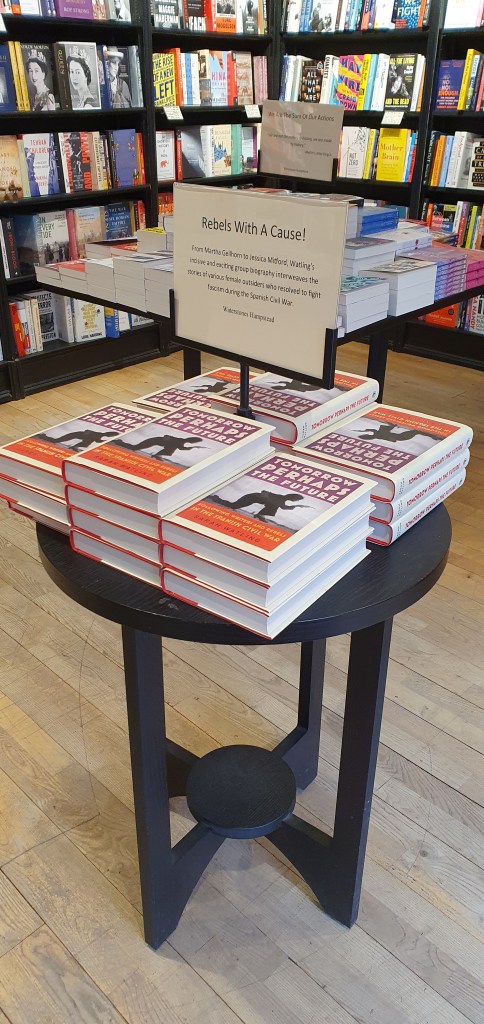
And so one Friday lunchtime, I strode up to Hampstead village again. First I popped in to Waterstones book shop, to see whether they had the new book “Tomorrow perhaps the future” written by my Goddaughter Sarah Watling. I very proudly attended her book launch evening earlier in February at Hatchards in Piccadilly.

“Tomorrow perhaps the future” by Sarah Watling, on display in Waterstones, Hampstead.

Not only did Waterstones have the book, but it was in the middle of the window. And then, on entering, I was greeted by an entire table displaying the book. I could not have been more thrilled.

Buoyed up by this exciting discovery, I floated into Rymans and made my way to the pen display. Miraculously, the Lamy 2000 ballpoint, marked “Clearance, £20.00” was still there! I could not believe that no-one had bought it in more than two weeks. What is wrong with people?

With the last of my resolve evaporating, I asked to see the pen and waited while the display cabinet was unlocked. In celebratory mood, I said that I would like to buy it. I asked whether the refill was black or blue. The sales lady made a little scribble and said “Black – and it’s very smooth!”

But then a little drama ensued. She went in search of the accompanying box for the pen, which was surprisingly and frustratingly necessary in order scan the bar code and sell the item. Several minutes passed. Eventually she returned with a handful of Lamy boxes. As there was no indication of which, if any was for the Lamy 2000 ballpoint, she took them to her computer to scan the boxes, hoping that for one of them, an image of the ballpoint pen would appear on her screen. One by one she scanned the boxes. At one point she announced “Lamy Assent?” this being another of the pens in the clearance sale. “Lamy Accent, I think you’ll find”, I replied. “I love that you know this!” she answered. She continued scanning boxes but none seemed to be the right one.

Eventually she found a way out of the impasse and I proffered a twenty pound note. She handed me back £5.00 change. “No, it was £20.00” I said. “Not any more it isn’t” she replied. And so, for a mere £15.00 I was the proud owner of a Lamy 2000 ballpoint, albeit without a box AND the proud Godfather of a published author.

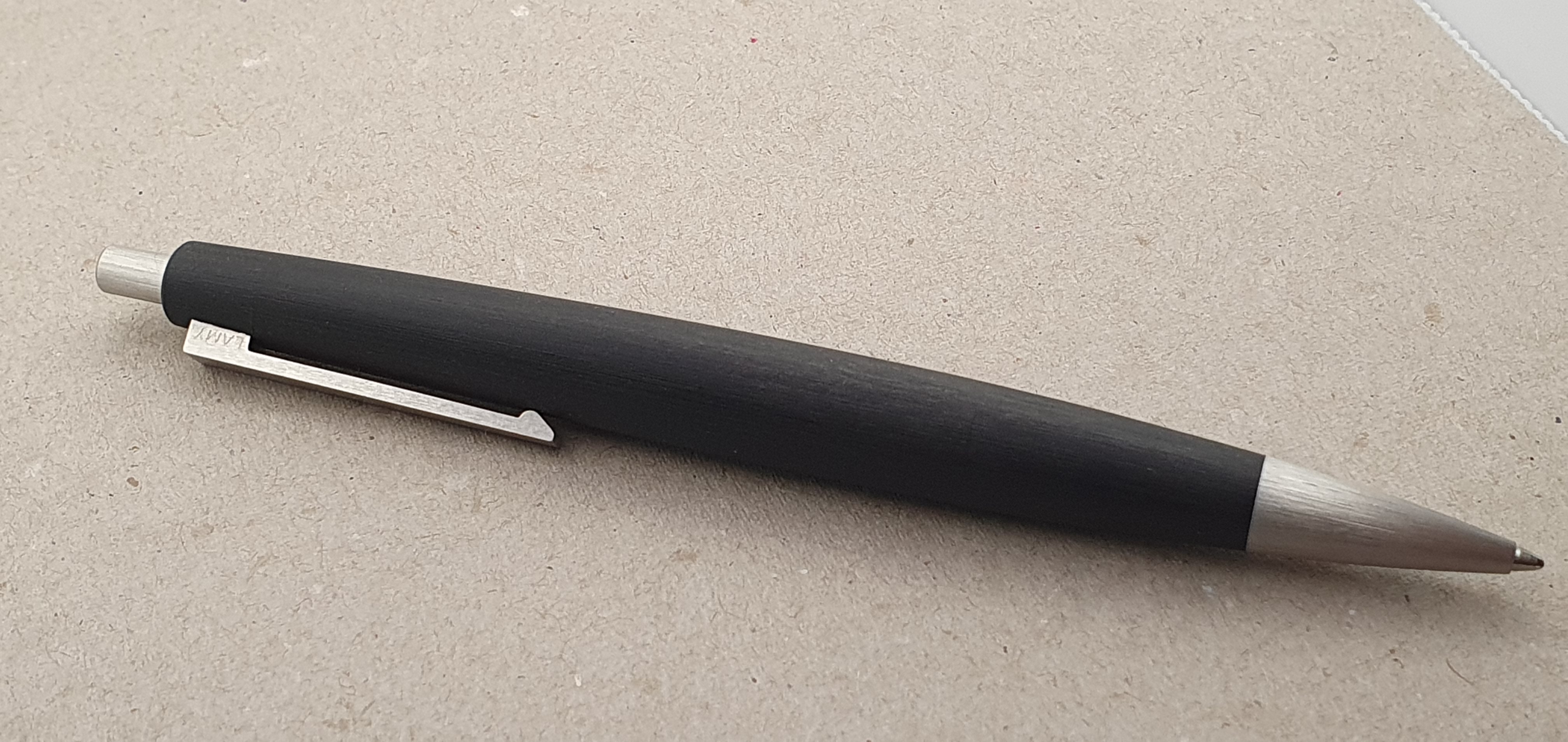
Lamy 2000 ballpoint. Fitted with a black, medium refill

It is not that I am a mean person but it is lovely when a bargain like this comes your way. The ballpoint pen and I started off on a great footing. I found the familiar Makrolon to be very pleasant to the touch. I very much enjoy having the pen on my desk at work and relish every opportunity to pick it up and use it.

Perhaps the moral of the tale here is that, even if you do not think you need a certain pen, perhaps you do. As one of my colleagues in the office later said, “It had your name on it.” And big thanks to Rymans of Hampstead for enabling.

A family of four.

Early thoughts on the Waterman Emblème fountain pen.

This is a current but not new model in Waterman’s range. It is one of their lesser spotted models, at least here in the UK. I remember first seeing them online a few years ago and that they were available in a choice of black, red, white or blue. There were also grey and a gold coloured “Deluxe” versions with a more lustrous finish.

I did not buy one at the time, but having spotted a Deluxe grey one online last weekend at a very attractive price, I went for it. It has been with me for only five days and is still within the honeymoon period but I shall try to give a balanced opinion.

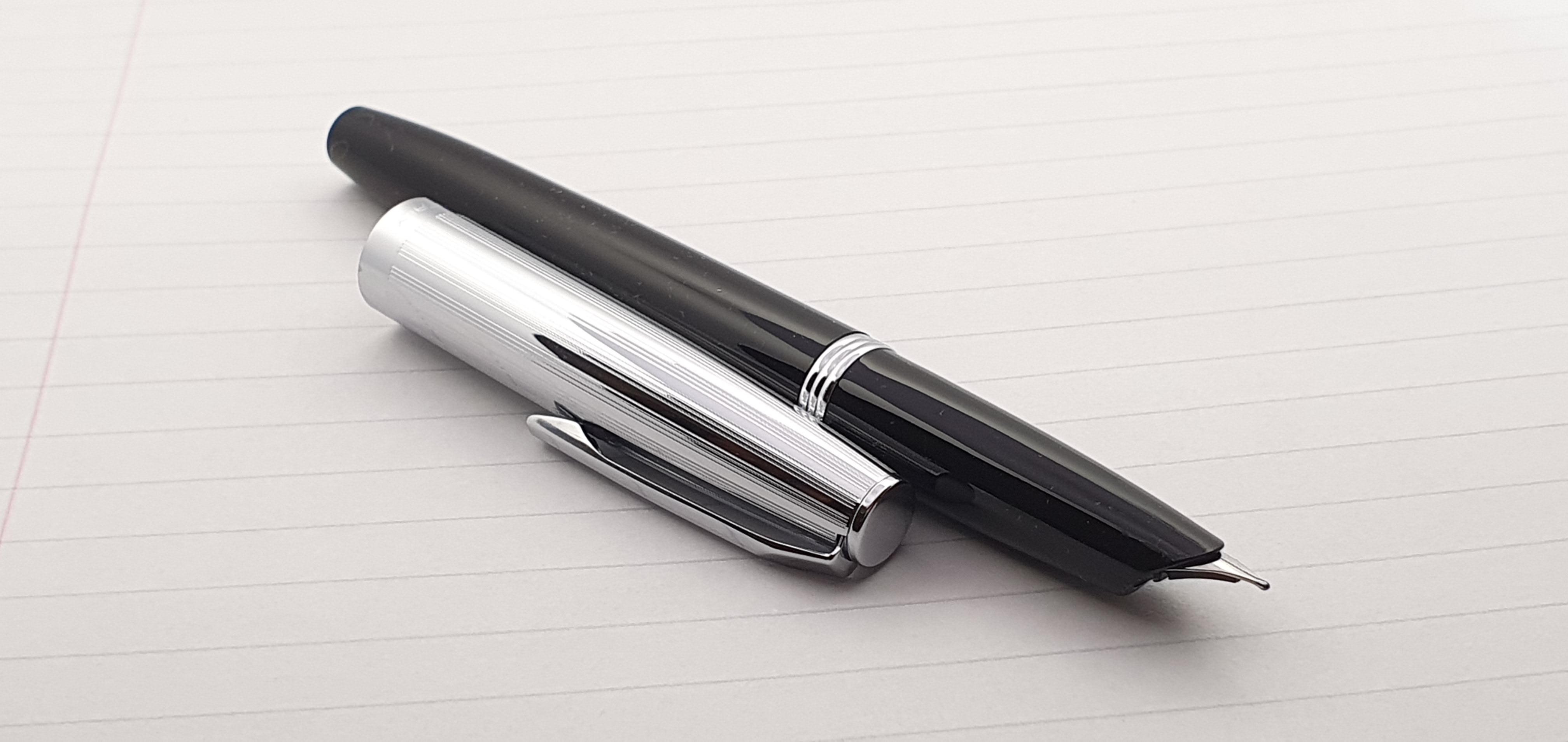
Waterman Emblême fountain pen, Deluxe grey.

Unboxing.

The pen came in a small and simple cardboard box, with a white protective outer box. Inside is a pen tray where the pen is gripped by an elastic band under a white sash. The tray lifts out and underneath is a sheet with filling instructions and an international 3 year warranty. One Waterman blue cartridge was included but no converter. Full marks for the presentable packaging which can be kept or recycled.

Simple cardboard gift box.

Description.

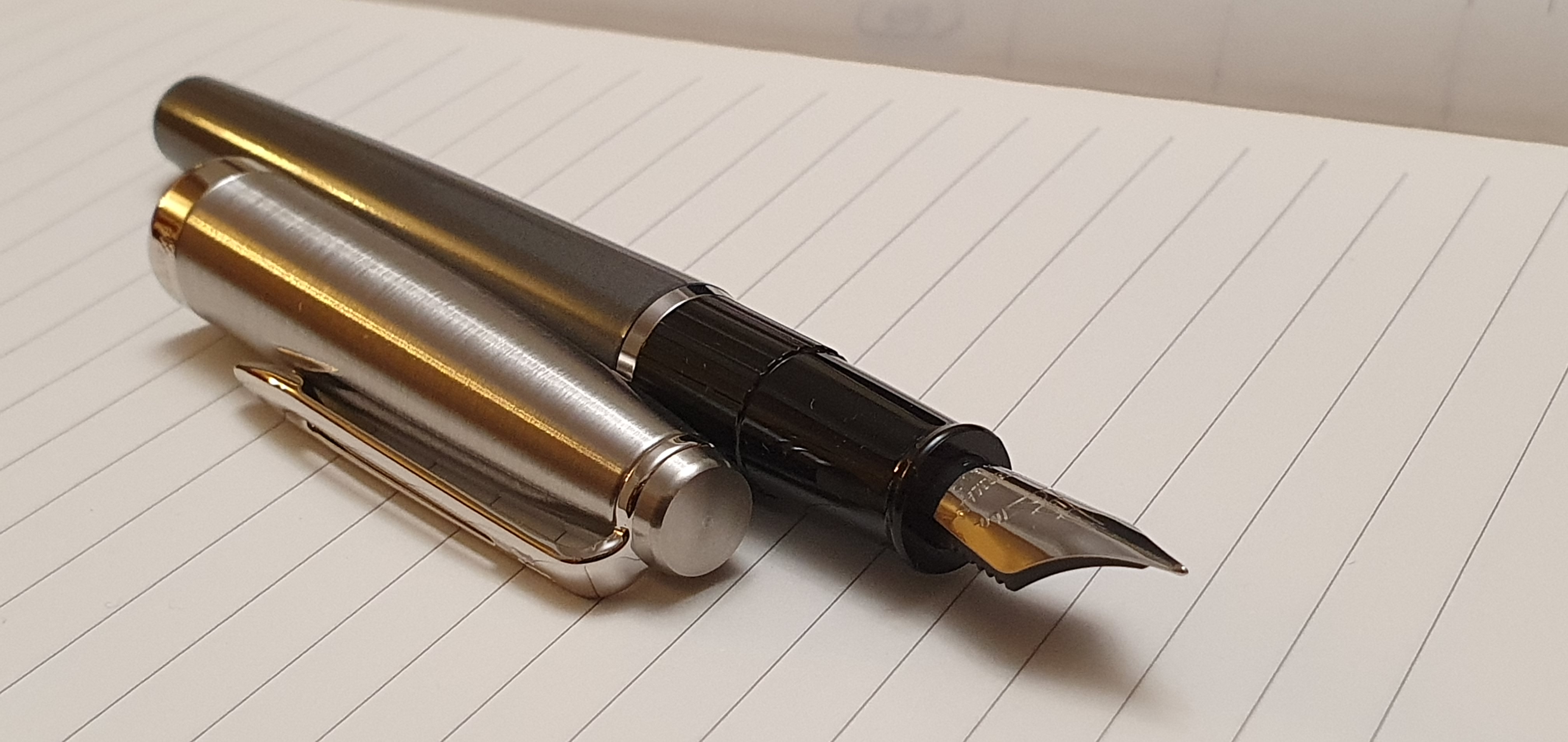
This is a smart, elegant pen with a plastic barrel and a brushed stainless steel cap. The cap finial is flat and plain. The pocket clip is firm and functional with a gap down the middle and the Waterman logo at the top. The glossy polished cap band reads Waterman Paris on the front and France on the back.

Brushed stainless steel cap and finial.

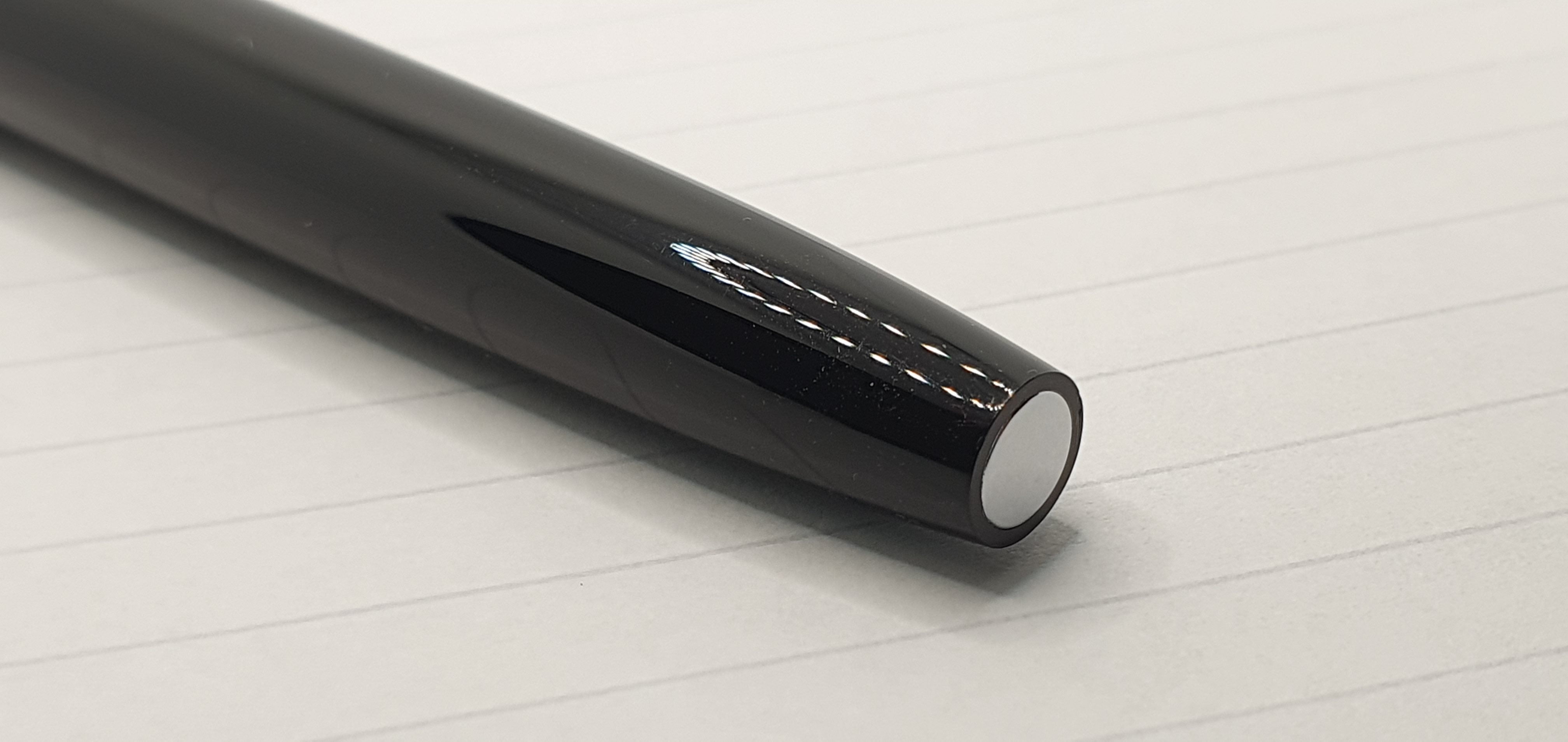
The cap and barrel are almost flush and the transition is smooth and tactile. The barrel tapers gently and ends in a shallow conical point.

The snap cap closes tightly with a reassuring click. It could be carried in a jacket pocket, with confidence that the pen will not drop out of the cap.

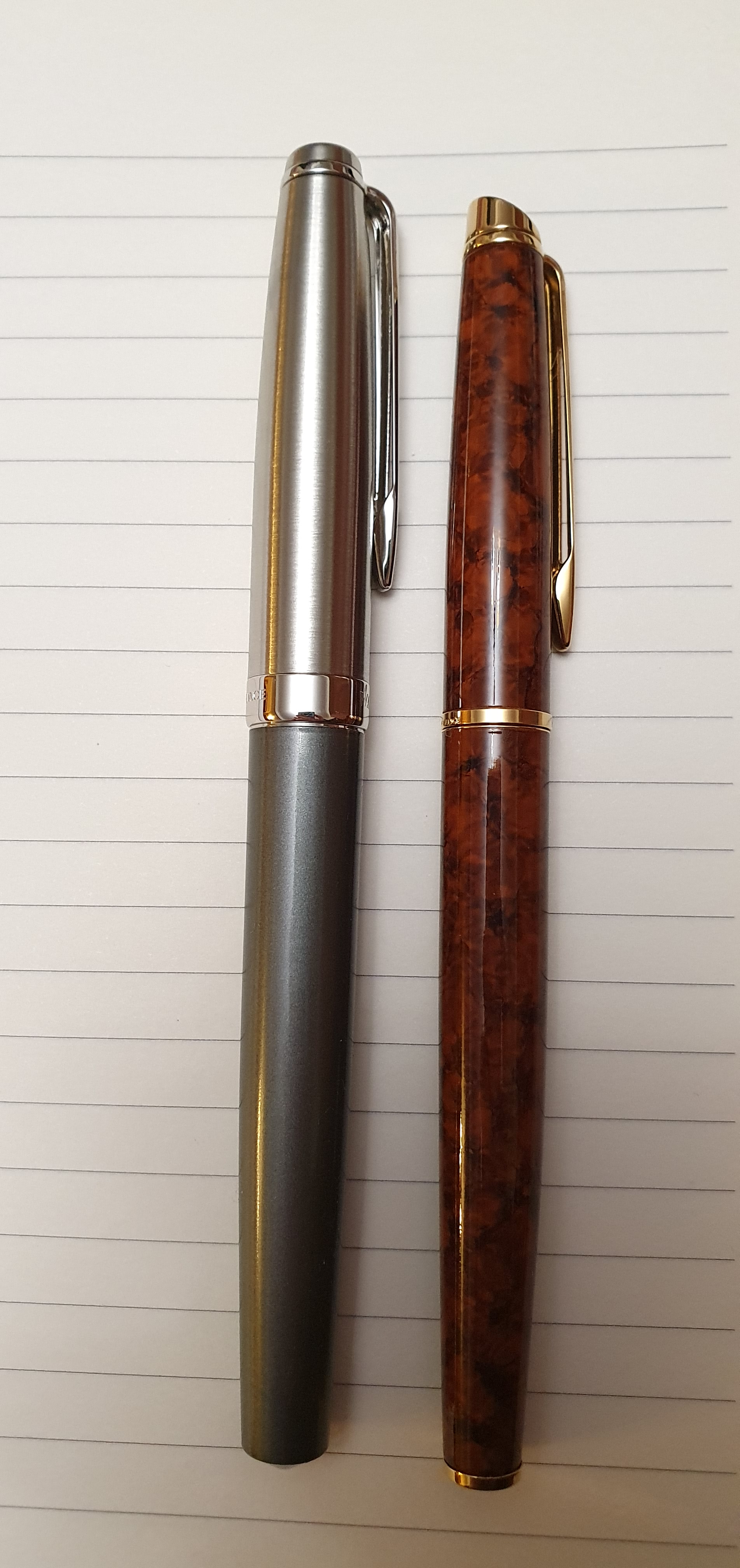
The Emblême (left) next to an older-style Waterman Hemisphere.

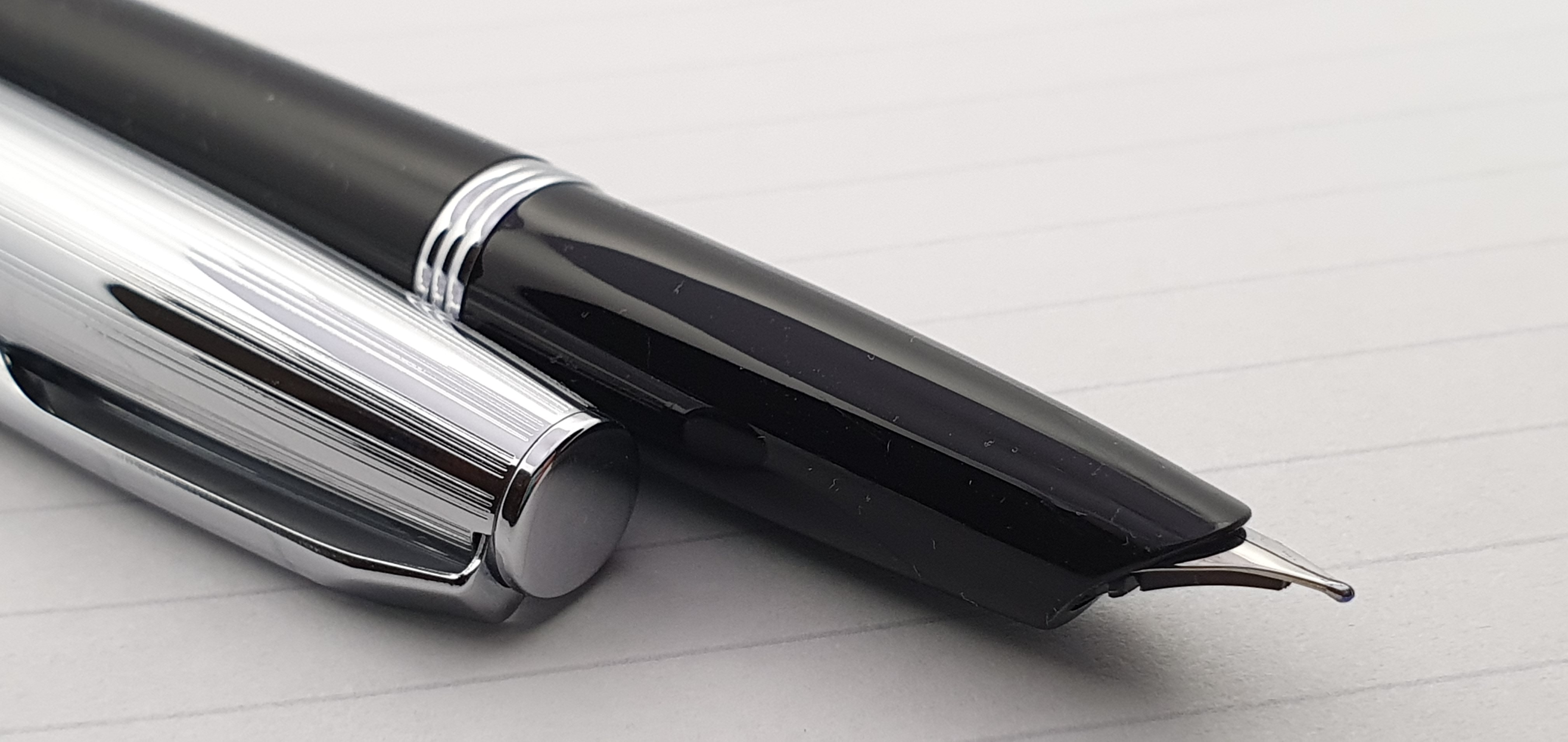
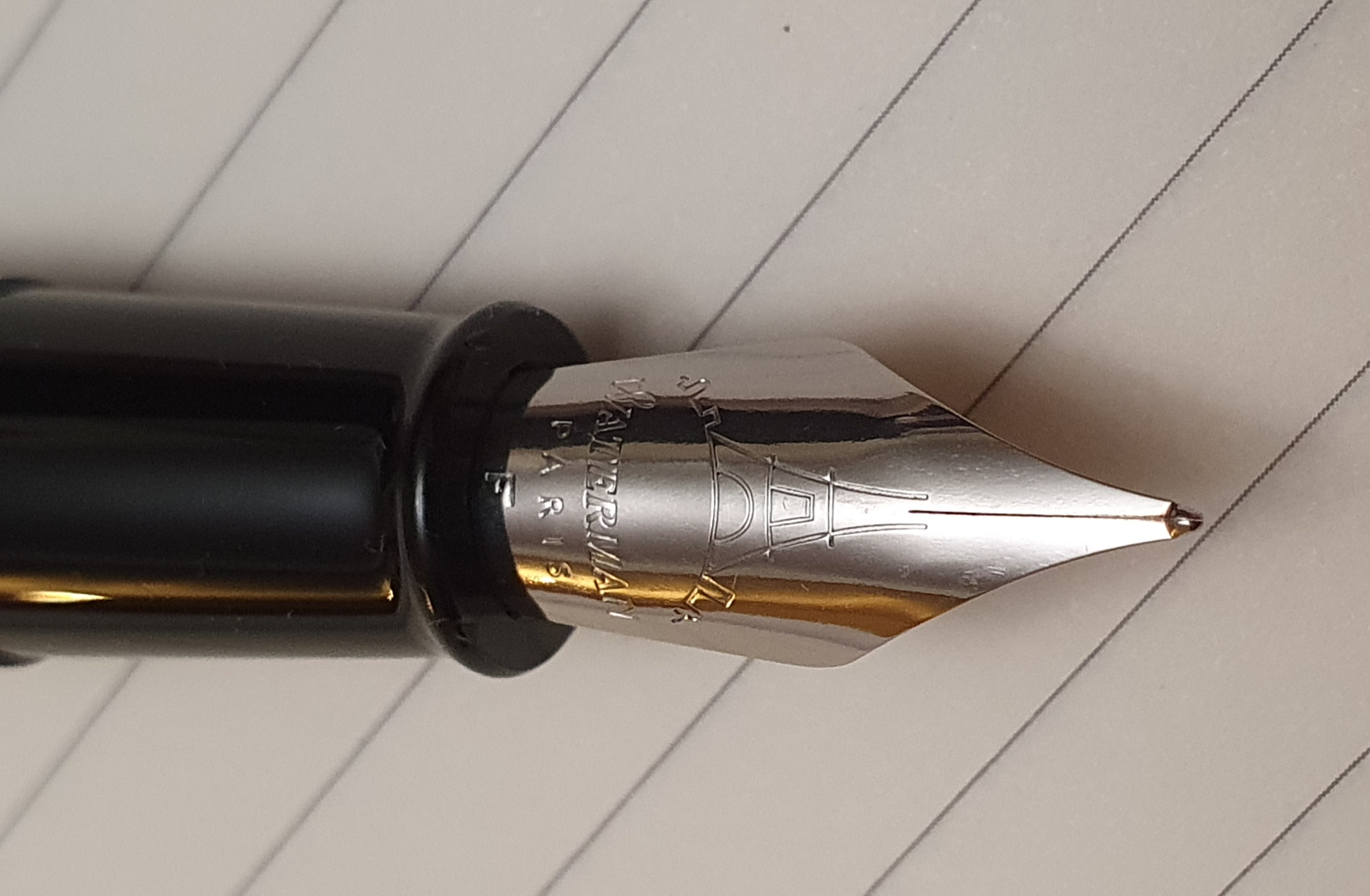
Removing the cap, you have a stainless steel nib, featuring an Eiffel Tower image and Waterman, Paris, and the nib grade, “F” in my case. There is a black plastic grip section, ridged at the top end and smooth at the lower end with a lip which serves to stop your fingers sliding onto the nib and to secure the pen in the cap. The plastic grip section design is the same as that which was used on the Waterman Phileas and also the Kultur and so is well tried and tested.

Eiffel Tower!

Beneath the barrel, which unscrews on plastic threads, there is a plastic collar in which to insert a Waterman cartridge.

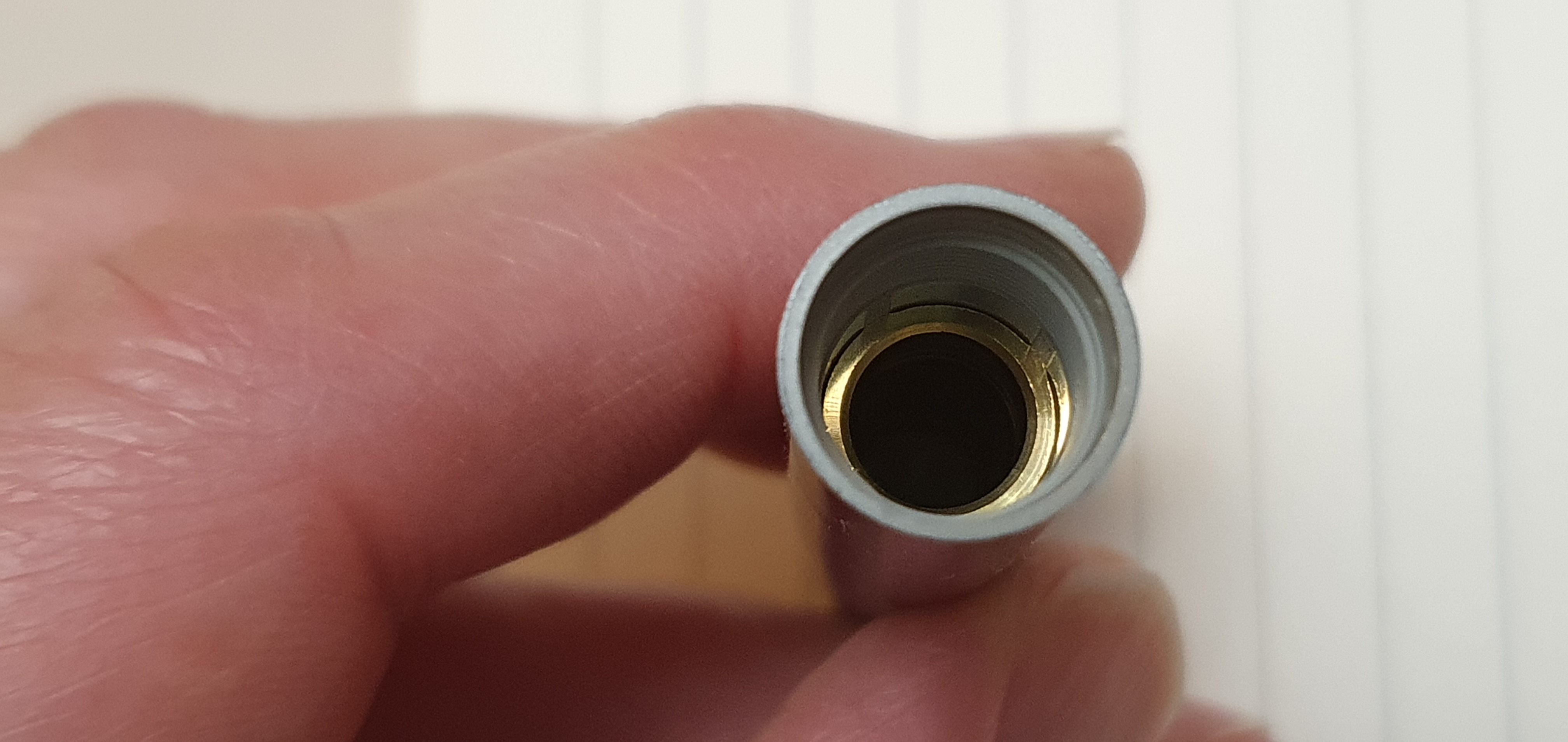
Inside the barrel, a brass liner can be seen, which is a very nice feature and adds a little more heft and strength to the pen. There is still room to fit a Waterman converter in the pen if you prefer.

Brass liner adds weight to the barrel.

The nib.

According to Waterman’s web site, the Emblème has the largest nib in the Waterman range. It is engraved with a unique Eiffel Tower design. There is no breather hole. The tines were even and level. The tipping was smooth and symmetrical. It might have been an ideal set-up for the majority of users with an “underwriting” style, but my personal preference is to have a very slight gap between the tines at the tip, so that ink flows as soon as the nib touches paper, without needing any pressure. This is preferable for an “overwriting” style. I therefore spent a few minutes in flexing the tines up and down a little just enough to get daylight between the tines at the tip. Having checked that the tines were still level, I then smoothed the tipping, with the very minimum of wear, on Micro-mesh pads.

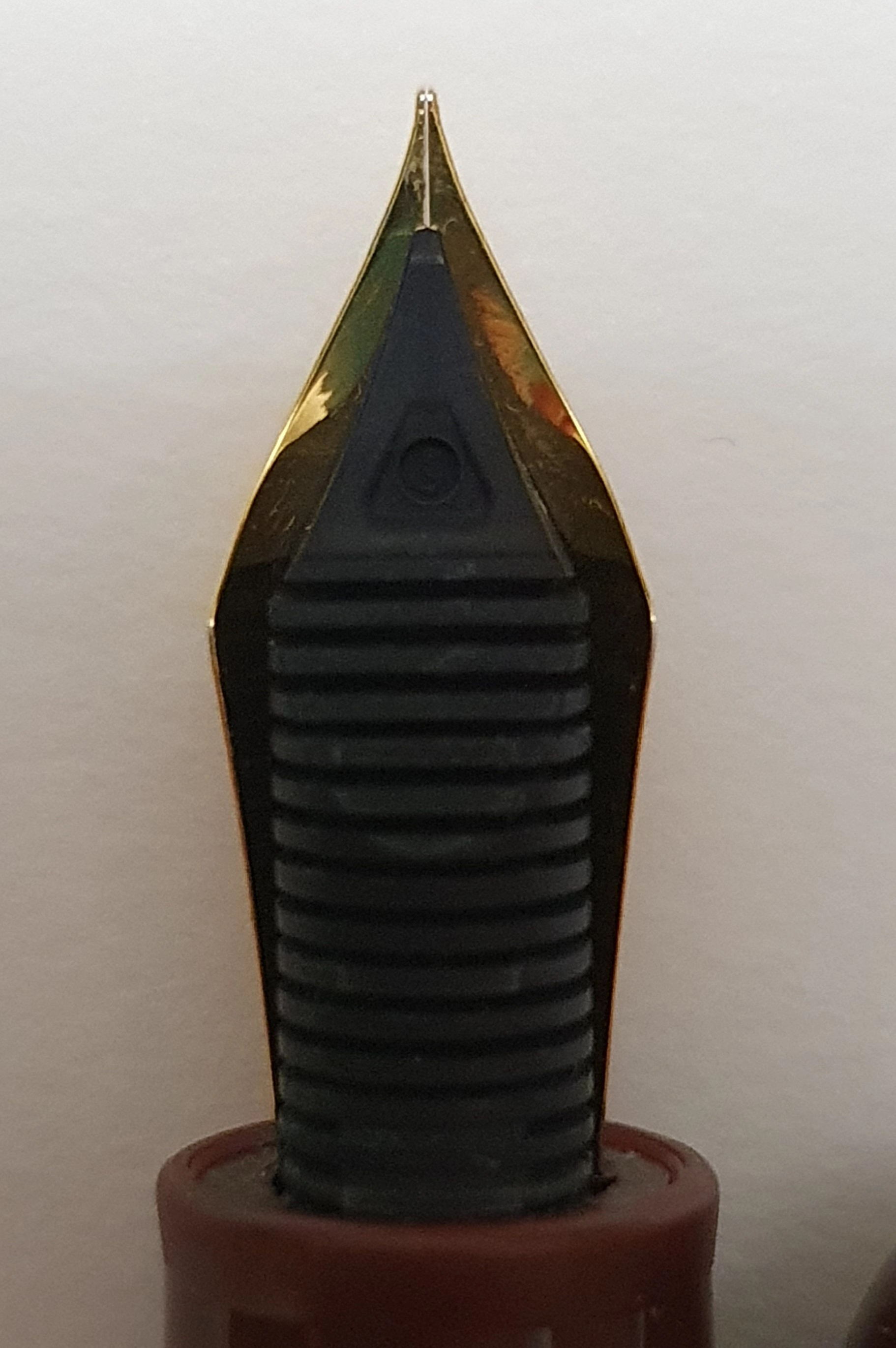
Nib and feed, before adjusting.
And now with a visible tine gap for pressure-less writing.

Writing performance.

The result, once I had tweaked the nib to my preference, was that it wrote wonderfully: smooth and effortless with a fine line and good flow. I was very happy with this outcome.

Size and weight (approximate).

Closed, the pen is 141mm long: uncapped, about 125mm, and posted 152mm. It can be posted quite deeply but I did not like to push the cap on to the back of the barrel too firmly for fear of damaging either the barrel or the inner cap. The result was that the cap when posted soon worked loose. In fact I prefer to use this pen unposted.

It weighs 26.5g in all, as to 15g uncapped and 11.5g for the cap alone.

Likes and dislikes.

I very much like the overall smart look of the pen. I have always liked pens with metal caps, with a Parker 51 vibe. It also makes me happy to think that the nib would be protected in its cap if the pen were to be accidentally dropped or stepped upon. Also I like the Eiffel Tower engraving. The section is of a good width and can be gripped comfortably. The brass liner in the barrel is very nice benefit. You are buying into the Waterman heritage and reputation and even the name harks back to the early Waterman Emblem Pen model, dating from around the 1930’s.

Comparison: Watermans Emblême, Phileas and Kultur.

There is not much that I dislike. The featureless cap finial is perhaps a missed opportunity. A coloured jewel insert to match the barrel would have been lovely but given its modest price there is nothing wrong with the simple steel disc as it is. The same might be said for the barrel finial: a metal finial would look nice but then you are not paying for a Waterman Carène here. For the price I have no complaints.

Conclusions.

The pen, at the price I paid, is great value, costing about the same in the UK as a Cross Bailey Light or a Lamy AL-Star. The full price should be around double that. I am delighted with mine and am very glad to have bought it. Whilst at work during the week, I looked forward to coming home to my Waterman Emblème. Perhaps here I am allowing myself to be overly biased in this honeymoon period but honestly my heart did a little leap whenever I thought of it. I have enjoyed letter-writing with it and have written plenty of paragraphs just for the simple and inexplicable pleasure of writing with a smooth, fine, wet nib.

A few peripheral fountain pen accessories.

Wouldn’t it be nice if our fountain pen hobby could be condensed down to a single pen, a bottle of ink and one current journal? There is an attraction to a more minimal, less wasteful lifestyle as we grow older. Perhaps it is also a subconscious desire to rediscover our ten-year old selves.

However a glance around my writing space reveals that this is not where I am at, at least not yet. Over the years of acquiring fountain pens and blogging about them, I find myself surrounded by a host of extra items, more or less related to the use and enjoyment of the pens themselves. Here is a quick A-Z of some which spring to mind.

1. Apps.

These do not take up any space, other than on my phone. I use one called Memento Database to keep a virtual card-index record of my fountain pens, with dates of purchase and price, nib details and a record of when they were inked and with what. The records can easily be sorted alphabetically by brand or in order of dates of purchase. I use ColorNote, a long-term favourite, to make lists and sort them. This could be of writing prompts, memories of something or someone sorted by key words, or just a list of points such as for this blog post. Also, a Magnifier app can be very useful to inspect pen nibs and also has a camera facility.

2. Book stand.

If you aspire to transcribing a book by fountain pen, it is useful to have a means to prop it up and hold it open. I bought one when I decided to tackle Marcus Aurelius’ Meditations, inspired by Kimberly of @allthehobbies on Instagram.

3. Bulb blower.

This device was purchased originally to blow dust off camera lenses, but has since been re-purposed as a means of flushing nib sections with warm water.

4. Brass shims.

Thin sheets of brass, in various thicknesses, used to floss the tines of a nib to clean out accumulated paper fibres and dried ink. Also useful if widening tines to improve ink flow.

5. Craft knife.

The next step, when you become frustrated that the brass shim flossing is not widening the tine gap and decide that more extreme action is called for. Sometimes inserting a blade from the breather-hole end and lowering it into the tine gap and giving it a gentle wiggle, is what is needed.

6. Dremel 3000.

Ok, this is stretching it a bit, to list under fountain pen accessories. This is a rotary, power tool used for drilling, grinding, cutting, or polishing and lots more. Mine was bought in an extreme case of Gear Acquisition Syndrome with the intention of smoothing the rough end of the deliberately broken-off pocket clip on my Pilot Capless. I have not yet dared attempt it though as I will very likely damage the surrounding area of the pen body.

7. Ferrero Rocher chocolate boxes.

The square, clear plastic lidded boxes are very handy for keeping fountain pens if not in current circulation. Someone does need to eat the chocolates first.

8. Glass nib dip pens.

Excellent for sampling a number of inks in quick succession. A quick dip in water and a wipe with a tissue and it is ready for the next ink. I have two: one is an all-glass design with a long slender glass handle: the other has a plastic body and screw cap meaning it is easy to transport.

9. Grippy material.

A sheet of rubbery material, sometimes sold to help unscrew jars, but which can be useful when pulling out a friction-fit nib and feed from a section, for cleaning or maintenance.

10. Ink bottles.

Empty bottles can be useful. The tall, square Aurora bottles are good to hold the barrel of an eye-dropper pen, for filling.

11. Kitchen roll.

For drying nibs and other parts of a pen after cleaning. The absorbent paper wicks away the moisture from the nib and feed. Alternatively you may wrap the whole section in several layers of paper and give it a few deft shakes to get the water out by centrifugal force (pro tip learned from Brad of the Pen Addict). Large rolls of blue paper from hardware stores, are cheap and last for ages.

12. Loupe.

A powerful magnifier, to closely examine a nib before attempting adjustment. My favourite is an “Eschenbach Mobilux 7x28D 60” with an LED light. Lives permanently on my desk and is used frequently.
13. Magnifying glass.

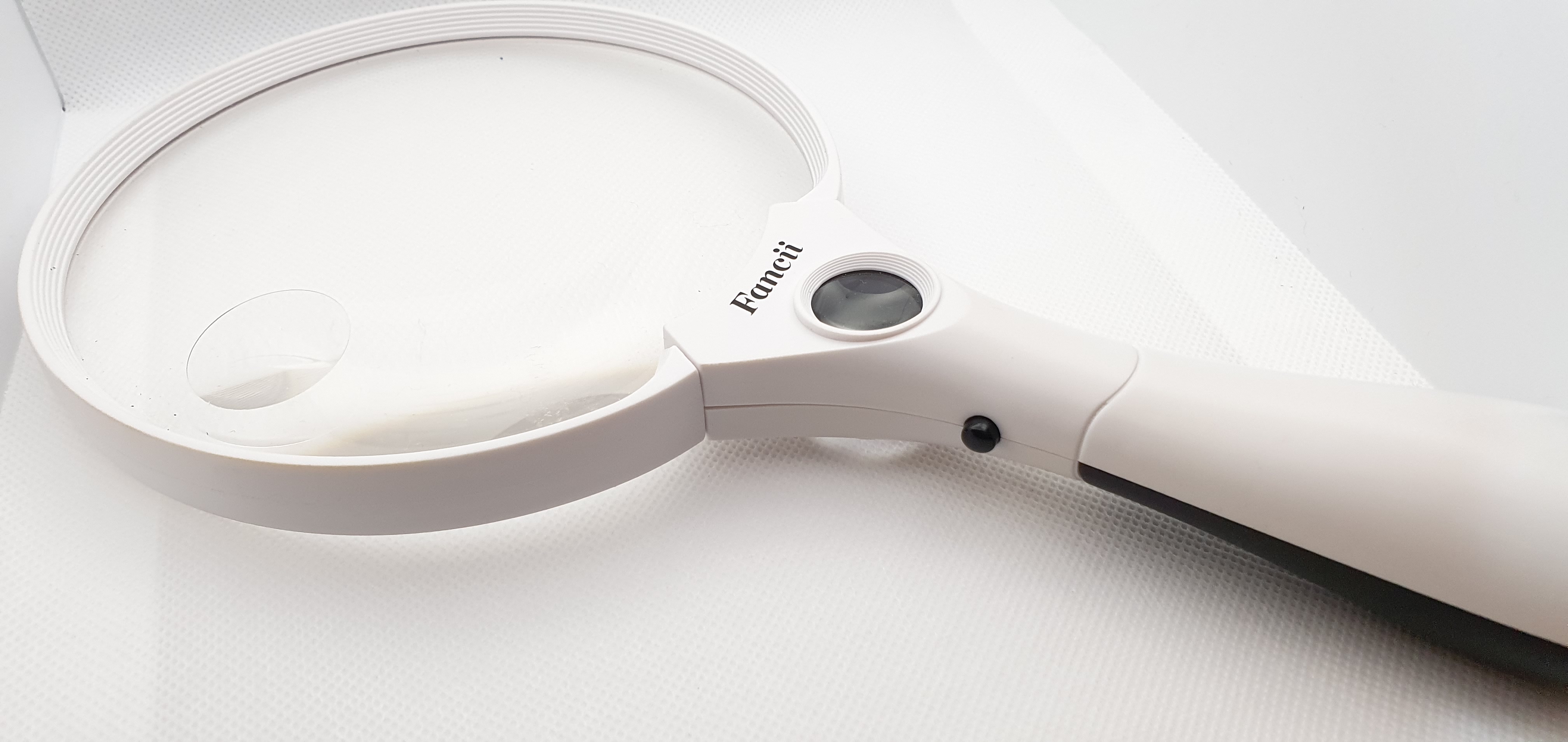
I have lost count of how many I have bought now, in all shapes and sizes. The newest, called Fancii, has a huge, 130mm diameter lens in lightweight plastic, an LED light and a powerful x10 lens in the handle. It can be used to hold in one hand, while you write with the other, to observe the exquisite sensation of glistening wet ink and shading on the page. Unfortunately it suffers from pin-cushion distortion in the centre area, which makes you want to smooth-down a bulge in the paper which is not really there.

Fancii magnifying glass. 130mm diameter lens.

14. Micro-mesh craft kit.

A box of grinding pads of assorted grades, used for smoothing nibs.

15. Pen cases and pouches.

Mine range from zippered faux-leather cases holding 24 pens to leather pouches to carry one, two or three pens. I use a Waterman two-pen pouch mostly.

16. Pen cups.

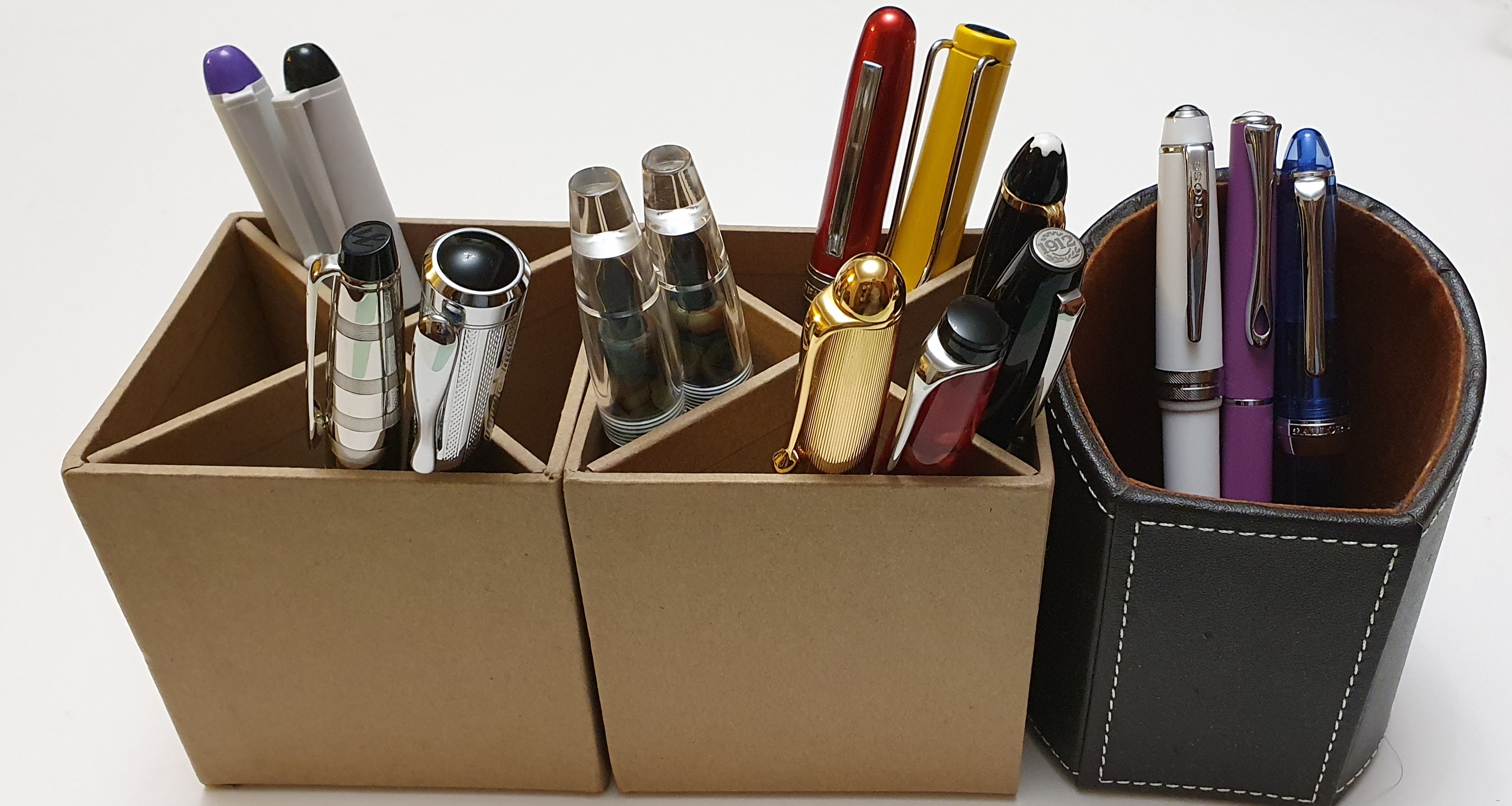
I keep a couple of these, in stiff cardboard, each divided into four quadrants, on my writing desk – just for the inked fountain pens. All other writing implements have their own cups.

Pen cups for the currently inked.

17. Pen rest.

An essential desk accessory in which to place an uncapped pen so that it will not roll off the table. Mine are handmade from the blocks of black squashy sponge material that come with certain ink bottles – Pelikan Edelstein I think.

18. Pen roll.

A rolled up pen storage pouch, to hold around 6 – 10 pens. Good for pen club meet-ups.

19. Pen tray inserts.

These are moulded plastic trays, with a sort of felty surface, in which to keep pens apart when in storage (eg in a Ferrero Rocher box as above). They can be cut to size.

20. Pipette.

A handy “eye-dropper” type device to transfer ink from a bottle, directly into the barrel of an eye-dropper pen.

21. Portable photo-studio.

A white plastic foldable box with one open side, and a ring of LED lights in the top, usually powered by a USB charge pack and so can be used away from a mains power socket. Great for small product photography such as pens, at any time of day or night when you need a stable light source for photos.

22. Self-seal clear plastic envelopes.

Small clear envelopes to keep tiny bits and pieces, such as fountain pen converters, cartridge adaptors, spare nibs etc.

23. Silicone grease.

A grease to lubricate a piston, in a piston-filling pen such as a TWSBI or Lamy 2000. Purchased from a diving shop.

24. Storage chest.

A chest of drawers, as a storage solution for pens, bottles of inks and even the note-book stash. Mine is a plastic tower unit of four, deep drawers. The bottom two are ink.

25. Travelling ink well.

A means of transporting a smallish quantify of ink. Mine is a Pineider, and holds up to 10cc of ink. Useful to fill a pen on the go if you do not wish to carry a whole bottle. Visconti also make one.

26. Weighing scales.

Digital scales to weigh pens, for descriptive and comparative purposes in blog posts. Bought from a kitchen supply shop.

So it can be seen, that the pen that you bought yourself as a present, itself needs a present, and so it goes on. There are no doubt many more accessories that I have missed in this quick round up. Let me know some of your favourites in the comments!

Further thoughts on the Jinhao X159 fountain pen.

I am still besotted with these. Following the success of my recent purchase of two Jinhao X159 fountain pens, I found myself tempted to add more, in other colours.

They are available in a variety of editions. Most colours have the option of gold-coloured or silver-coloured trim and a choice of a Fine or Extra Fine nib. Depending upon your preferences the prices ranged from £7.49 up to around £20.00 and the estimated delivery times also vary.

Lingering repeatedly over the online photos, I contemplated adding a couple more to my existing pair. Readers may recall, I had started by ordering a black one, with silver trim and a Fine nib. This was swiftly followed by a blue one with gold trim and Extra Fine nib.

For my next order, I went for a dark orange with silver trim, Extra Fine nib and also a dark red one, gold trim and Extra Fine nib. Two pens in one order. See how this escalates!

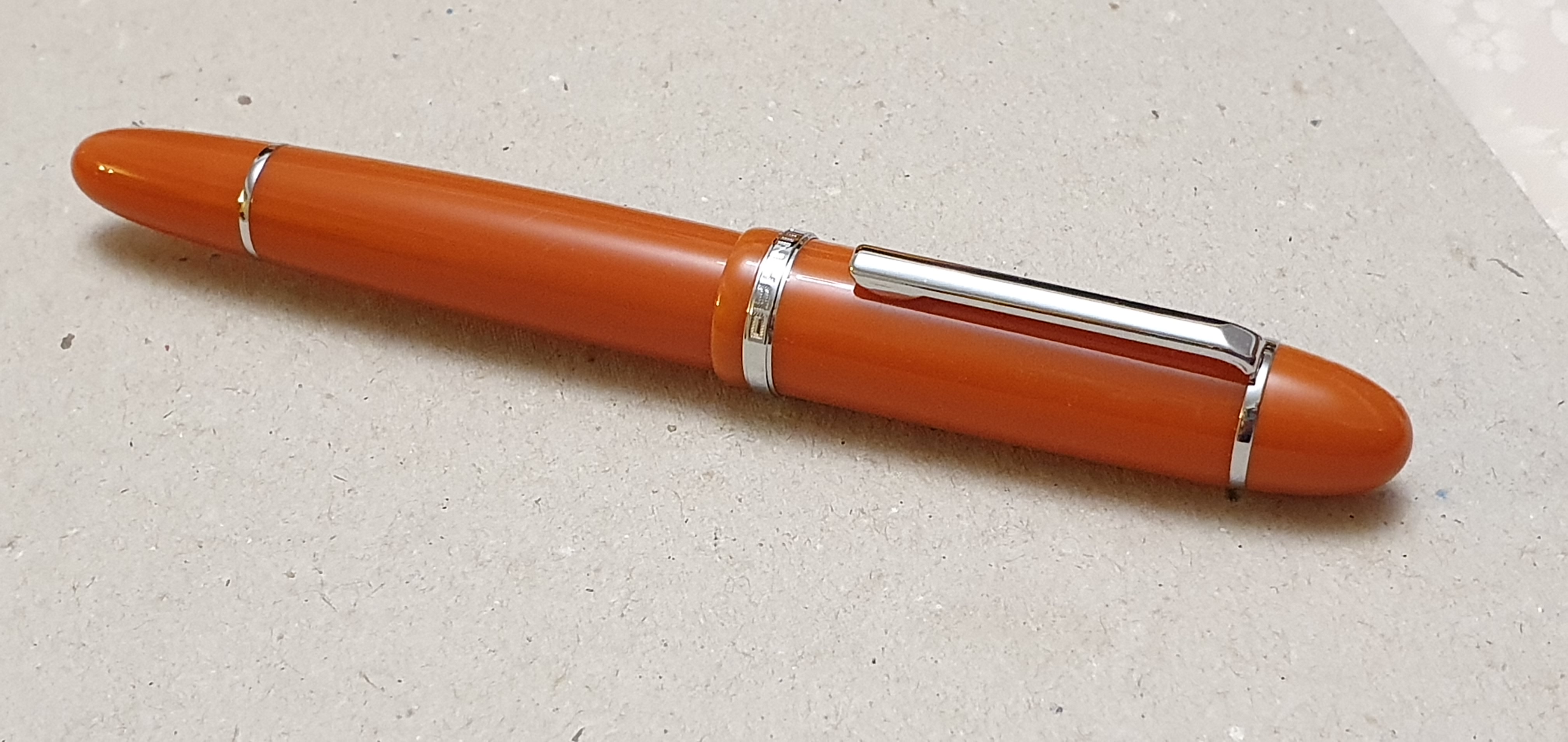
A dark orange edition, with silver colour trim.

They arrived within 24 hours of ordering. Again, each pen was packed in its own simple padded envelope. Each comes with a converter fitted. No cartridge is included although they take standard international cartridges.

New pen induction ritual.

Again, I had the happy prospect of inspecting and preparing my new pens. Starting with the orange pen, and in what has become a familiar routine with my Jinhao flock, I started by examining the nib under a loupe. It looked to be set up well. I unscrewed the nib housing, separated the nib and feed and gave them a good rinse in warm water. In each of my Jinhaos from the seller Erofa, I have noticed a little blue ink residue in the water at this stage, a sign that the nib has been tested before sale. This is very admirable for its modest price.

I reassembled the nib, taking care to centre the nib over the feed and to hold it to the feed tightly as I pushed it back into the housing. I like the dark orange colour. It is not bright and showy, but more of a terra cotta.

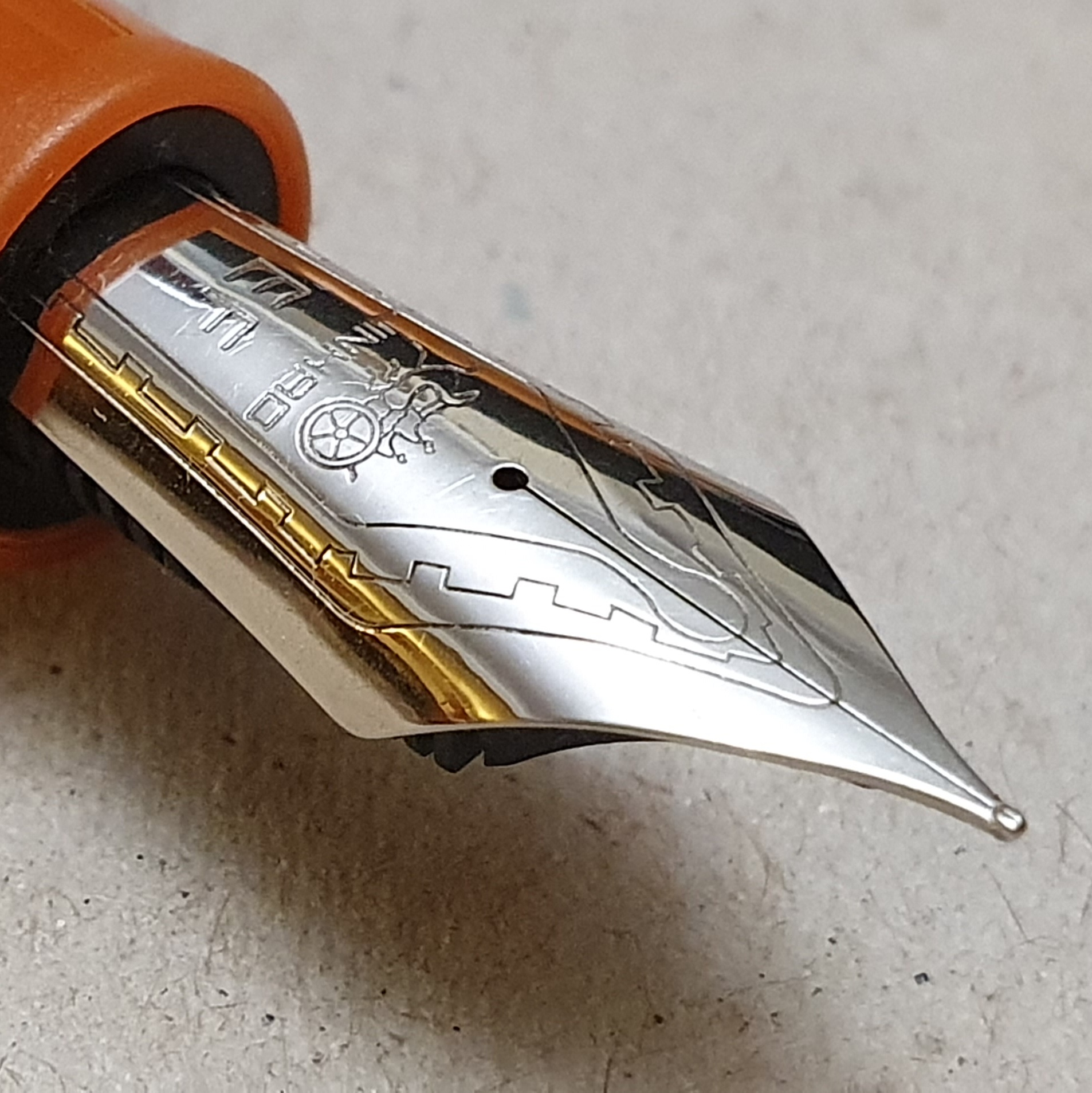
A lot of nib for your money.

Using cartridges.

I had given some thought to what ink to use, pondering a brown perhaps. But when the time came to ink the pen, I decided on trying a black cartridge. I have a stash of these, having bought WHSmith bags of 30, when they were about £3.00. I found that this ink actually performed very nicely and flows well. Somehow, this humble and inexpensive ink seems right to pair with the budget priced Jinhao – to keep the theme of getting the job done at the lowest possible price.

One big advantage of using these cartridges is that a pen will often have room in the barrel to carry a spare, great if you run dry while away from your supplies. I popped a spare one in the cavernous barrel of the X159. There was ample room for the barrel to be screwed back on, so much so that the spare cartridge could be heard ratting inside.

I thought of cutting a small piece off an eraser and putting it at the back of the barrel. I tried this, but on screwing it back together with the spare cartridge inside, the piece of rubber got stuck in the pen. I had also cut it too large, as the barrel would not screw on all the way. Having something stuck in the pen, or the risk of it happening, annoyed me and after eventually dislodging it, I decided on a different option, that of using a scrunched up piece of kitchen roll paper, (about 1 inch square, rolled into a ball) and placing it between the two cartridges, rather than behind the spare. This worked nicely: no rattle, and it could be removed easily. The cartridge did not get stuck either (a common issue with the Cross Bailey Light, incidentally).

Nib tweakery.

I had saved the red Jinhao for the next evening. When I inspected the nib, it was quite a way off the centre line of the feed, but this is very quickly and easily corrected. Again, I took out the nib housing and separated the nib and feed. I flexed each tine up and down a few times to loosen up the tine gap a bit, before rinsing and drying the parts and reassembling. I took my usual care over centering the nib and put it all back together.

A dark red edition, with gold colour trim and bicolour nib.

I then noticed that the tine gap was a bit wider than it had been. Important lessen to self: make sure the nib is correctly centred symmetrically over the feed BEFORE widening the tine gap. It may be that once centred, the tine gap will be wider.

Now centred on the feed. Tine gap a bit on the wet side, but good for lefty overwriters.

To ink the dark red pen, I got out six bottles of red ink and sampled them all with a glass nib dip pen. I settled on Pure Pens Cadwaladr, a lovely dark red. The colour reminds me of my favourite wax crayon as a child, in primary school “wet play” times!

I now have four Jinhao X159s each inked with a different colour. Here is the collection (so far!):-

Pen colourTrimNib Ink
BlackSilverFineMontblanc Royal Blue
BlueGoldExtra FineDiamine Tavy blue black
OrangeSilverExtra FineWHSmith black cartridge
Dark redGoldExtra FinePure Pens Cadwaladr red

When you buy more than one of a pen, the downside is that you may find yourself liking one over the others. Currently, I tend to bring the orange one if going out, since its spare cartridge means I will not run out, away from home. With the prices being so attractive, it is tempting to gather up one of every colour, perhaps to use with corresponding inks. I would fancy a dark green and a brown next, if I were to buy any more. Then there are the white or ivory editions.

Mixing and matching parts.

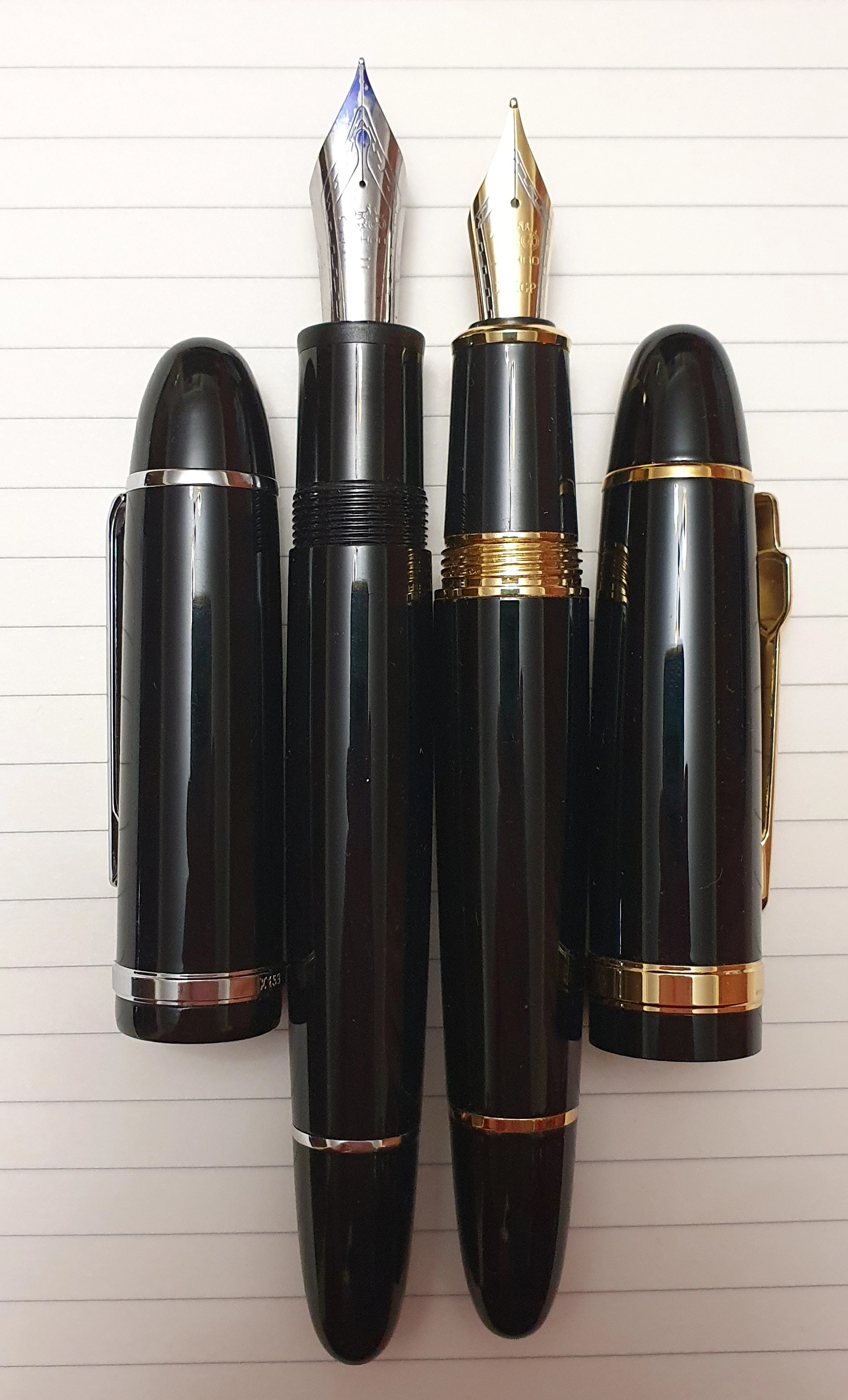
There is also the useful option of being able to mix and match the pen parts and make your own colour combinations. For example I could put a black cap on my orange pen, and give it a Delta Dolce Vita vibe. Also the black pen, given an orange section, looks rather special. Mixing has a practical purpose as well as an aesthetic one, in that you can chose what ink colour you want to carry and then put the nib section with its converter or cartridge, into whichever barrel you wish. Don’t want an orange pen in a courtroom? Clothe it in a black cap and barrel!

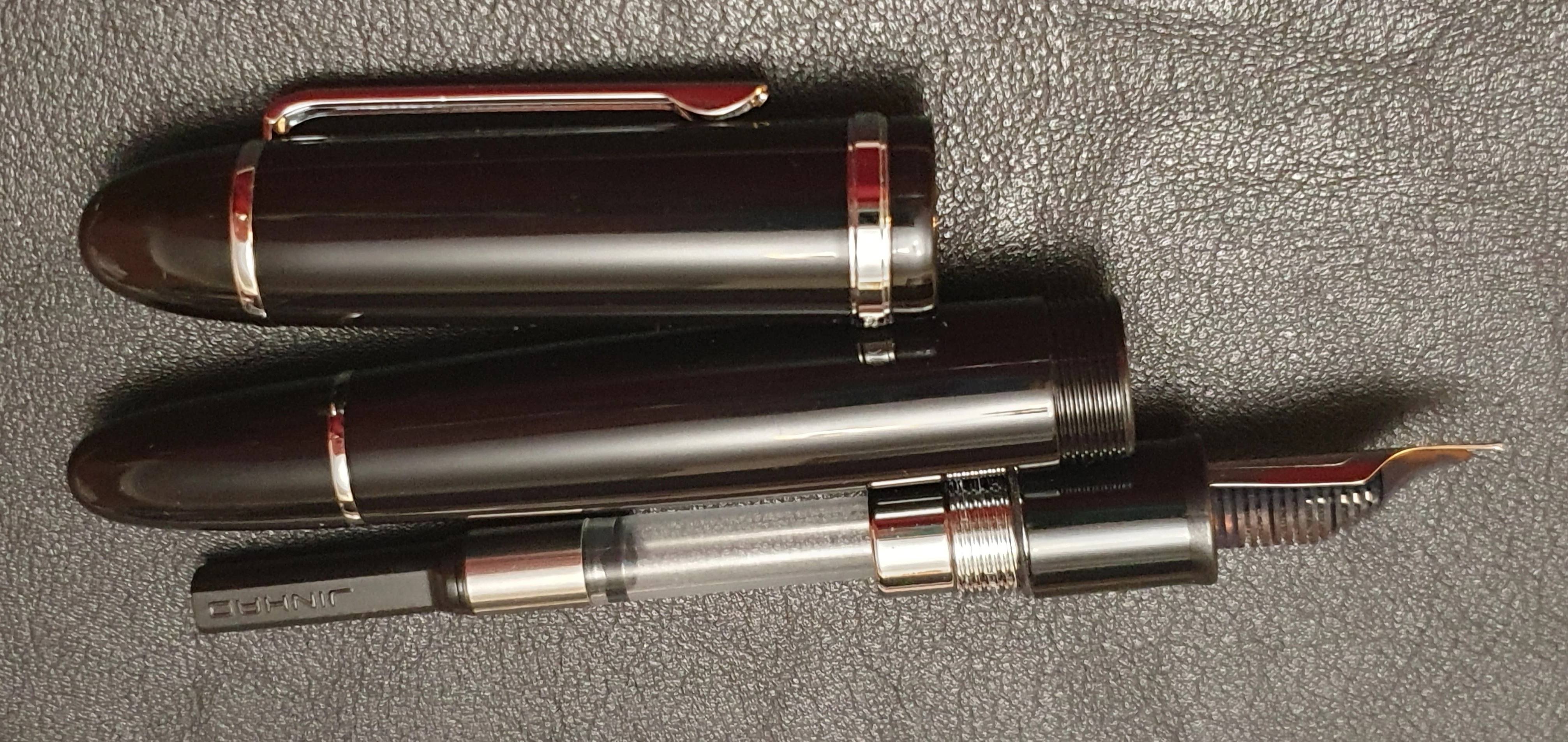
If you have more than one X159, you can pull off crazy stunts like this.

So, four new pens for me before January was out. The black version is probably the most versatile to take any ink colour but if you want to treat them like a set of colouring pens, with every colour carrying a matching ink, then the Jinhaos are probably the most economical way of doing so.

My Jinhao X159 family.

Moderno B5 Charcoal notebook review.

Our local WH Smith stationery shop in Brent Cross shopping centre has had another revamp recently and is looking a bit more inviting and spacious as you enter. Whilst browsing, and after circling the racks of roller-balls and fine-liners to check out the fountain pens (mostly Lamy, Parker and Sheaffer), I ventured on to the shelves of journals.

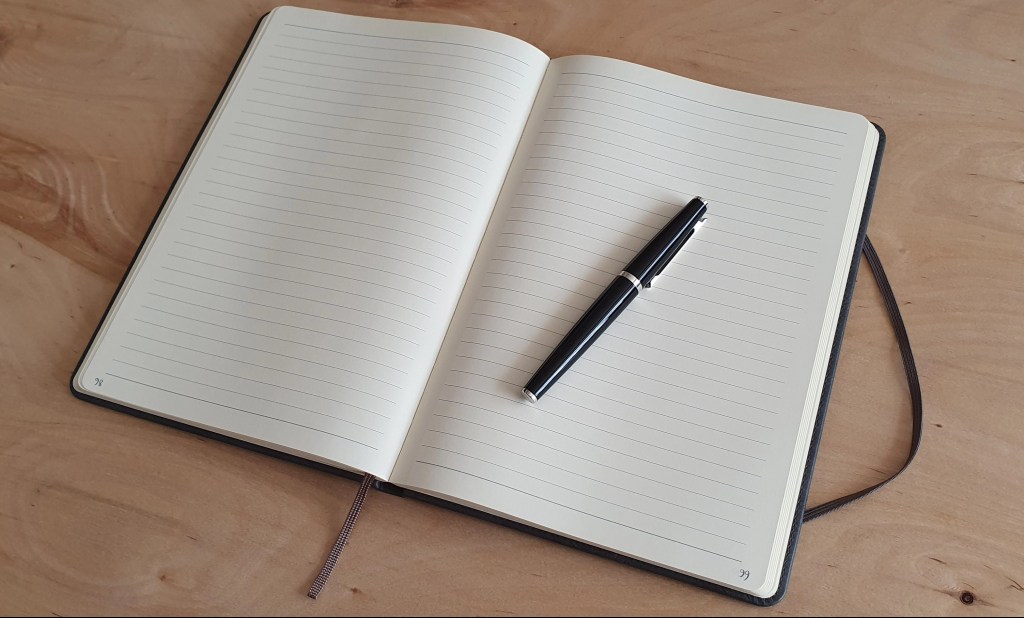
My eyes were drawn to their Moderno B5 notebook, with 96 ruled ivory sheets (192 pages) of 80gsm paper. It has the ubiquitous inside back pocket and an elastic closure.

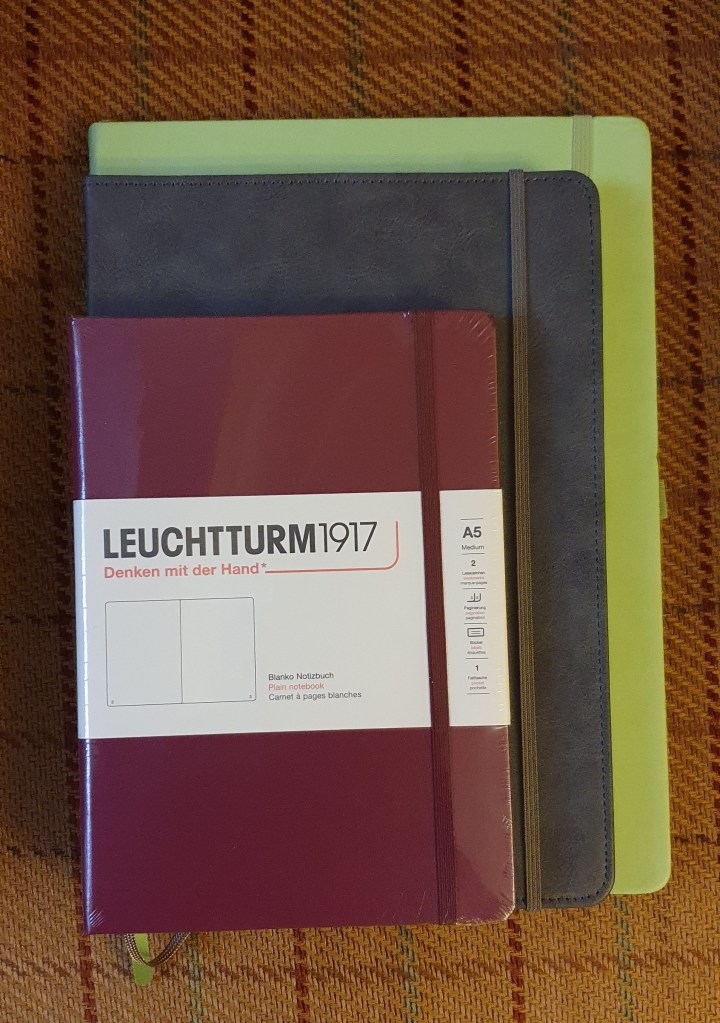
Moderno B5 journal, next to an A5 Leuchtturm for size comparison.

I did not have any immediate need of a notebook (an understatement, tbh) but was nevertheless tempted by this one, mainly I think due to the interesting B5 size which sits as a nice compromise between A4 and A5. I had no idea whether the paper would be fountain pen friendly or not (which is partly why I am writing this brief review: spoiler alert – yes it is) but found myself making my way to the self-service checkouts to part with £11.99. The lure of a new journal is a strong one.

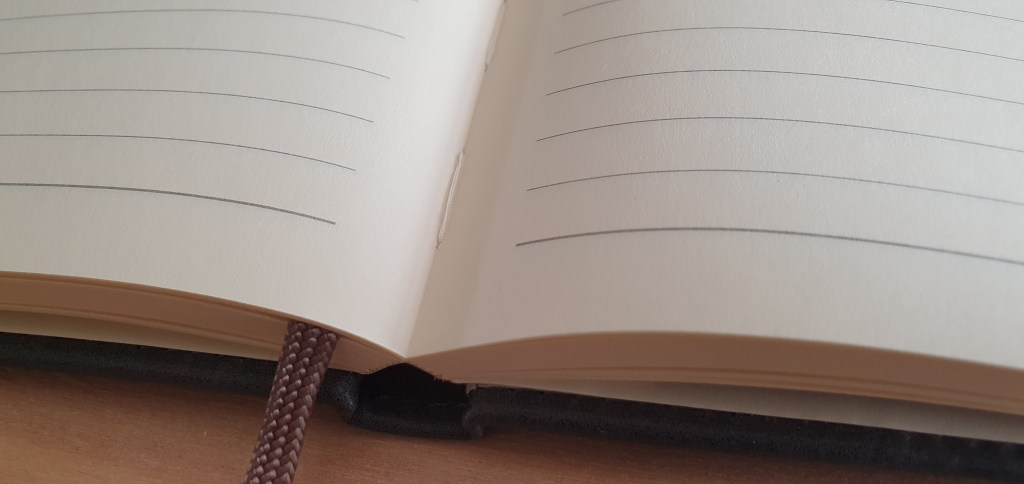
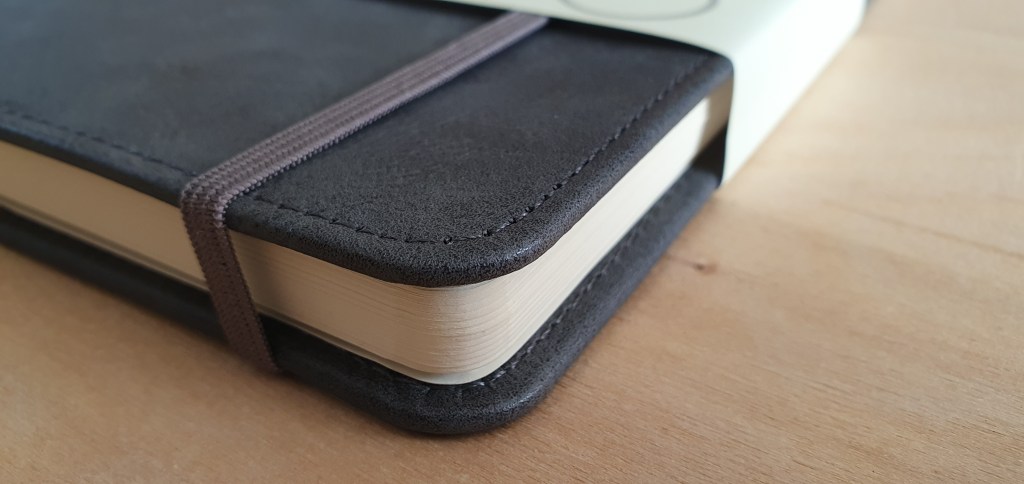
The notebook has a pleasing grey plastic leather-look cover. I do not yet know whether this plastic will crack and flake in the long term. The book is stitched. The lyrics of Paul Simon pop into my head – every page is neatly bound, “for a poet and a one-man band”, or something.

Nice strong open-flat binding.

Getting it home, I could examine the features more closely:

  • 96 ruled ivory sheets; (not paginated but I do that myself);
  • 80gsm paper;
  • rounded corners;
  • inside back pocket;
  • elastic closure: (a bit slack but usable);
  • 8mm row height; (Yay! my favourite)
  • 29 rows to the page; (close, but not quite a month’s worth of days);
  • one ribbon bookmark;
  • produced in China.

One of the first things to be done of course when trying a new notebook, is to test the paper for fountain pen ink. I usually select a handful of pens from my “currently inked” pots and write a line or two with each, to see how the pen feels on the paper, whether it feathers, and crucially whether it bleeds through the paper or shows through too much. I am happy to report that with all the inks I tried, these tests were a success. There was no bleed-through with any of them and very little show-through either.

Plastic leather-look cover in smart charcoal colour and neatly rounded page corners.

In terms of usefulness, a B5 journal is rather nice to have. It could be used as a bullet-journal or “bu-jo”. The only caveat is that with 29 rows to the page, you are a couple of days short of a month (or a few sandwiches short of a picnic) but you could add an extra row at the top and another at the bottom of the page, if this is your chosen use. I have done this before on another book, in which I created a three year bu-jo with a double page spread for each month.

I am not one for stickers and washi-tape but do find a bu-jo very useful. For example, unlike a one year diary, you can insert dates for a future year, or even two or three years ahead, such as car insurance renewal dates, MOT expiry dates, or maturity dates for ISAs or fixed term saving accounts.

A double page spread with 29 rows per page.

Then there are the rest of the pages, not allocated to monthly views, which you can use for all sorts of other things. For example I like to make lists of albums from particular artists, and then tick them off after I have listened to them, – which I find so much more satisfying than track-hopping on Spotify.

Above all, I am pleased that I can use fountain pens with the book. The 8mm row height hits the spot for me. I do not think I will use this one for a bu-jo as I am already set up for that, but I shall enjoy having it in stock until a suitable function presents itself. I realise that one should have a NEED of a notebook before buying one, not the other way round, but such is the life of a stationery addict.

My notebooks fall into two broad categories: those which I would want to keep once they are full, and those which I would not (which are typically full of pen and ink samplings and notes of no lasting interest). Having a book which has a durable cover would tend to indicate that it should be used as a “keeper”. In the past I used a Ryman A4 journal as a bu-jo but after several years’ service, the cover material is now flaking off and leaving bits everywhere on my table. If planning to use a notebook for a multi-year bu-jo, then it is wise to consider how the cover might wear.

The B5 size has the advantage of giving you more space on the page than an A5 journal, (of which I use a lot of Leuchtturms) whilst not needing as much space in a bag as an A4 if you wished to take it out and about, to do some writing in a coffee shop, as I like to imagine myself doing, but have not done much of late.

When I next need a B5 journal, which is suitable for fountain pens, I will be ready.

This picture might be more useful, to show the B5 size, in between an A5 and an A4 notebook.

Early thoughts on the Jinhao X159 fountain pen.

Occasionally, something new comes along in the pen world which sets social media buzzing amongst the fountain pen community. Recently, we have had a new offering from Jinhao, named the X159.

The imposing Jinhao X159.

This is not entirely new: there has long been a Jinhao 159 (without the “X” factor), which we might call an homage to the Montblanc Meisterstuck 149, but with a steel nib, cartridge-converter filling and a fraction of the cost. However, it was a heavy beast, being made of metal. I owned one myself. In the event it did not see a lot of use, on the ground that the ink flow in my model proved to be a bit erratic despite my efforts.

However, the new version, the X159 is different in many respects and offers significant improvements. Whilst similar in size and appearance to its forerunner, the main changes are as follows:

  • It is now made of acrylic and is much lighter;
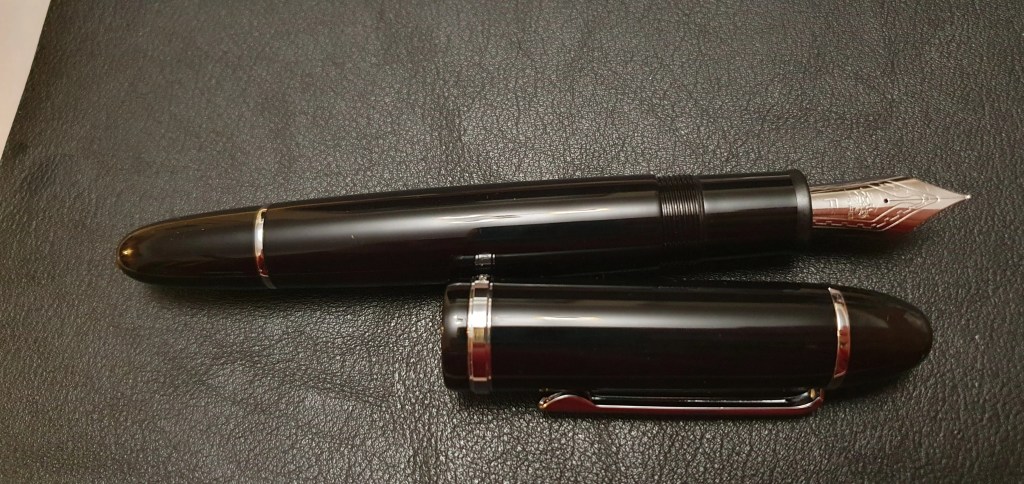
  • It has a larger, number 8 nib;
  • There is new, more subtle pocket clip;
  • The grip section is much less tapered and does not end with a metal ring (colloquially termed a “rust ring”);
  • The threads on the barrel, for the cap are now acrylic instead of metal.
Uncapped. Big girthy pen with number 8 nib.

These cannot be found in our shops but are available online. The prices on Amazon currently range from £7.49 to around £20.00 depending upon which colour, trim finish and nib size you chose. Nib sizes are Fine or Extra Fine. There is an option for gold or silver colour trim, the former having a bicolour nib.

I resisted the temptation to order one for several weeks, happy with my current line-up and convincing myself that the Jinhao could not possibly perform any better than steel nibbed pens that I already owned, such as my Onoto Scholar or the Otto Hutt Design 06 to name but two. Whilst the price was obviously not an issue, I did not want the added clutter.

However the temptation did not go away and I learned that a few friends had ordered one. Still curious to try one for myself, I eventually weakened and pulled the trigger. I opted for a black version, with silver coloured trim and a Fine nib, for a princely sum of £9.99.

The unboxing.

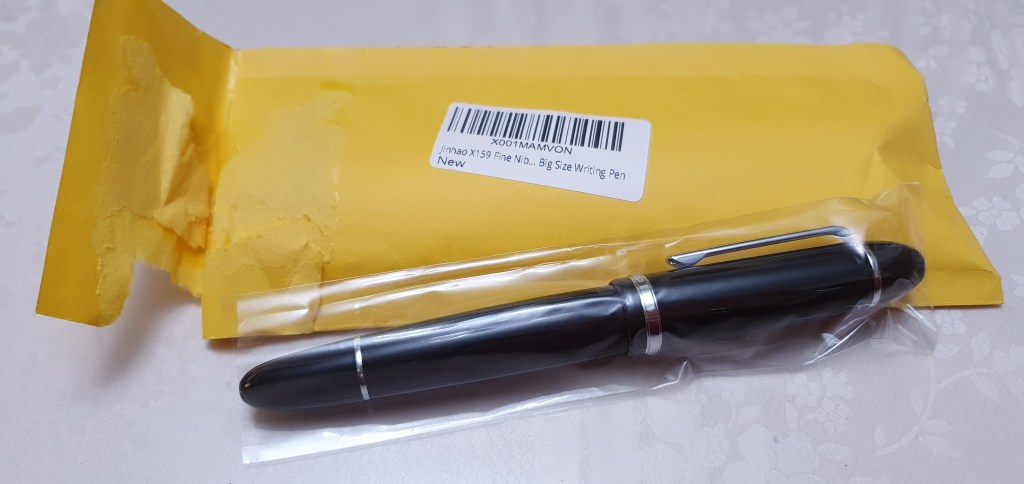
With Amazon Prime, the pen arrived the following day. Inside the cardboard envelope, the pen was packed in a simple polythene sleeve inside a padded envelope. This was just enough to get the pen to me without damage and did not leave me with any unnecessary box.

That’s all the packaging.

In the flesh, first impressions were very favourable. The black acrylic body was smooth and glossy. Fit and finish all seemed good. The number 8 nib, being the first pen I have bought with one, was a good bit larger than the usual number 6 size and looked impressive and perhaps a bit more in keeping with the large girth of the pen.

The nib and feed.

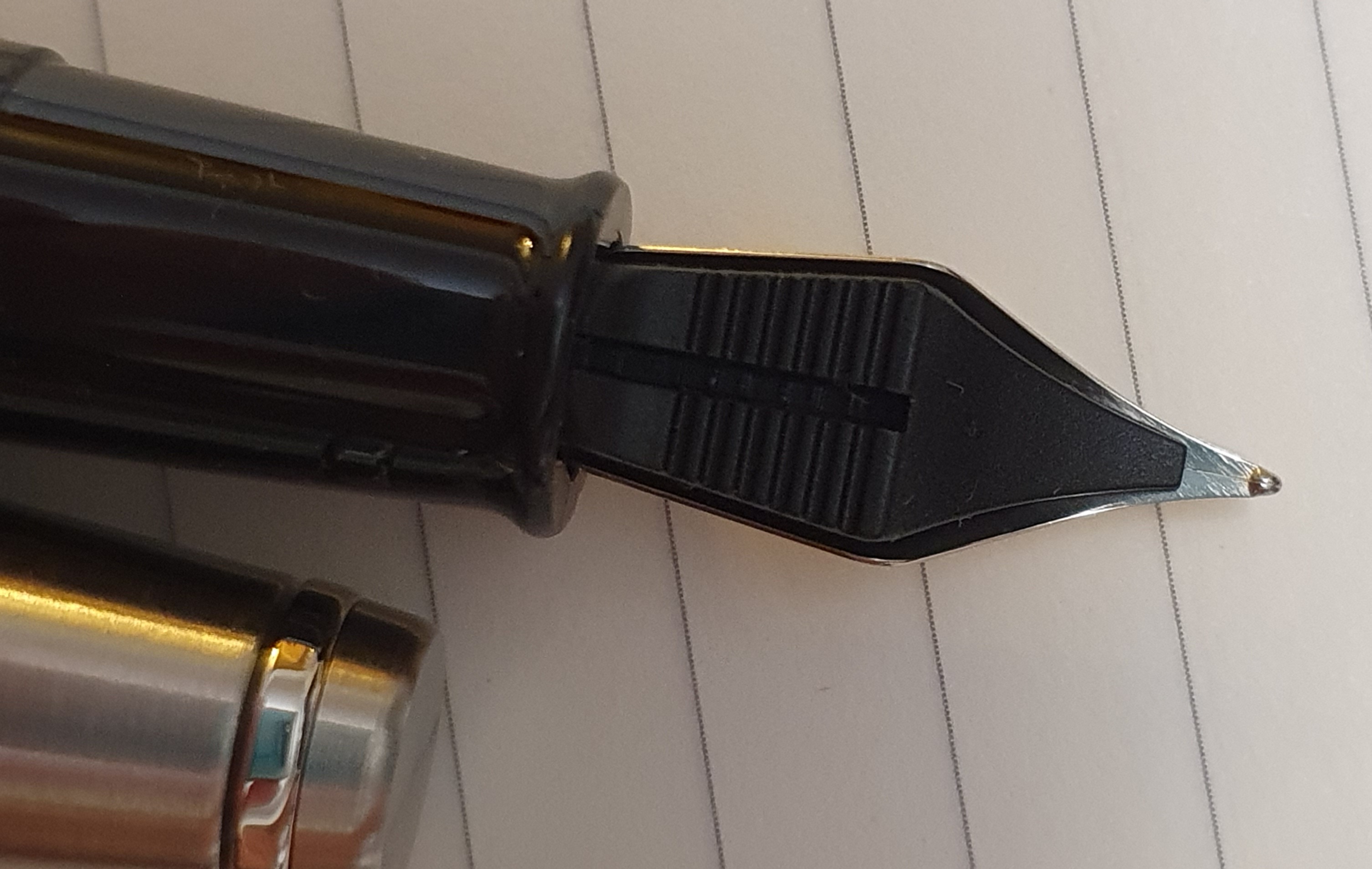
I examined the nib under a loupe. The tines looked to be even, with good symmetrical tipping. There was a nib slit which narrowed down from the breather hole to the tipping at which point the tines were quite tightly together. Viewed from the back, the nib was not quite symmetrical to the feed, but this is easily adjusted.

Disassembled.

I flushed the nib and feed in warm water to remove any residue of grease from manufacturing. The nib is easy to disassemble – a feature that I appreciate very much. You can unscrew the nib housing from the section. Once out, the nib and feed are friction-fit and can be pulled out from the housing, by gripping them together, perhaps with a soft cloth or tissue and pulling in a straight line, being careful not to damage the delicate plastic feed. Once out, you can lift the nib off the feed, and it is more easy to clean and adjust if necessary. I noticed that the ink channel at the top of the feed was cut quite wide and more like a trough than a slit. Good!

I had expected the nib to be a bit dry, having seen a video review by Stephen Brown. As a lefty-overwriter, my preference is for pens which lay down ink with little or no pressure needed. This can usually be achieved by opening up the gap between the tines at the tipping, just a very little until you can see a space, or daylight, between them.

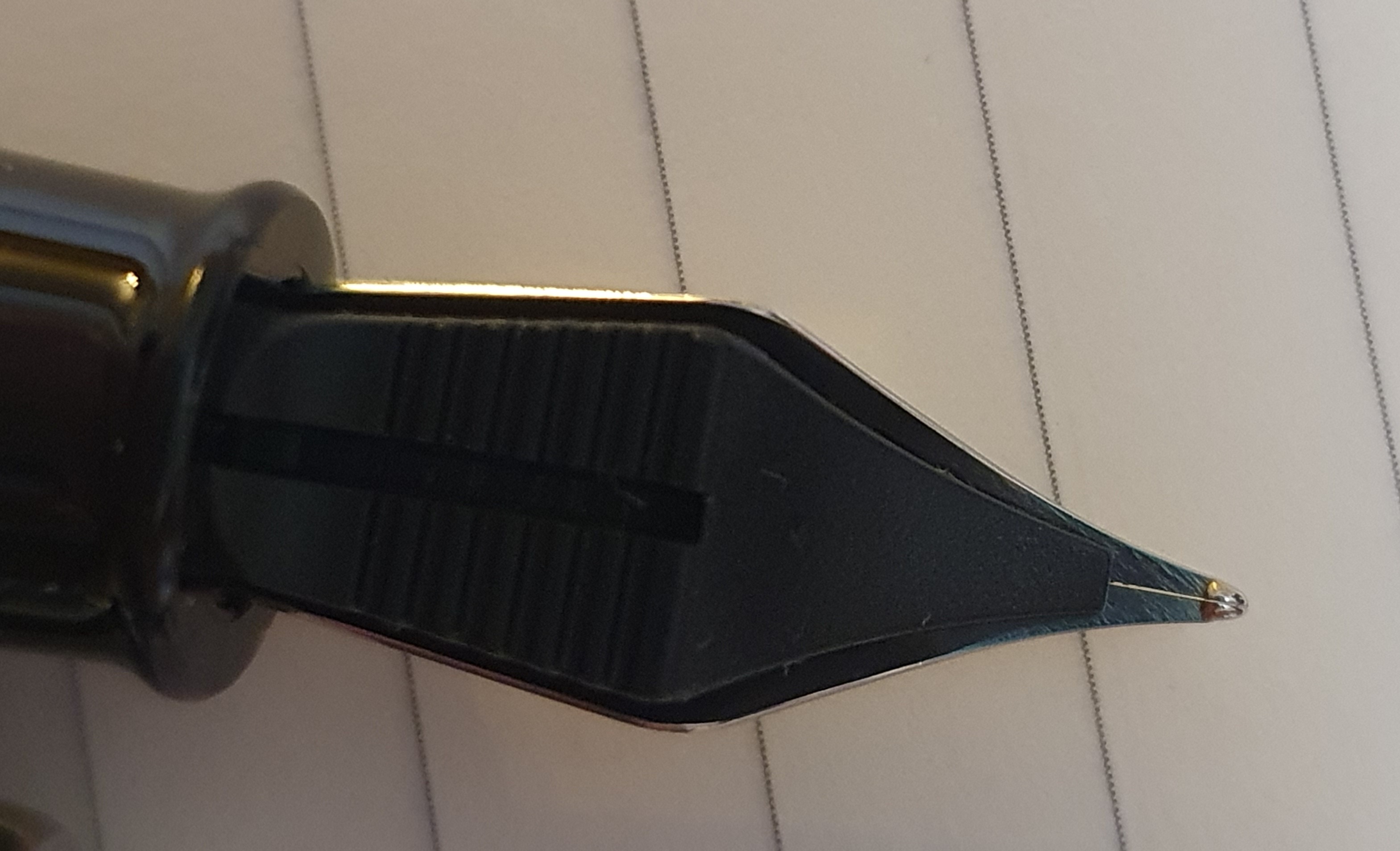
After separating the tines slightly and realigning the nib on the feed.

This is a very useful adjustment. It is often easier with a gold nib than a steel one. There are various tricks to doing this, using brass shims to floss the nib, bending the tines up, or trying to wriggle a blade between the tines – all of which should be attempted with great care and with frequent pauses to inspect the nib under a loupe and to try writing with it again. Eventually, I had the best success by lifting first one tine, with my thumbnail, bouncing it up and down a few times – and then doing the same with the other. I then replaced the nib onto the feed, and pushed them back into the housing, carefully ensuring that the feed’s point was centred with the nib and that the tines were both level and smooth.
Filling:

After flushing and drying the pen, I filled it with Montblanc Royal Blue. The large nib does need quite a full bottle to be able to immerse the nib for filling. My Montblanc bottle has the useful feature that you can tip it to make the filling area deeper. Before doing this, the converter did not draw up any ink leading me to wonder whether it was not pulling a vacuum. Note that the converter is like the Lamy ones, with a flat edge to hold rather than being round. Personally I do not like this feature as it makes the converter harder to twist.

Converter included.

Writing and performance:

Having adjusted my nib I then flushed, cleaned, dried and filled it, all of which took less than an hour. I was thrilled that it wrote superbly, as well as I could wish for. The nib was smooth, with good ink flow and lubrication. It is a firm nib. My fine nib writes a slightly wider line than intended by reason of my tine-widening exercise, but the end result, a medium-fine, is very pleasing. All in all, I was absolutely delighted.

It then just remained to do two further tests. One is to write for about a page of A4, to see how the feed keeps up, once the excess ink from filling the pen and saturating the feed, is used up. This is to check for “ink starvation” if ink is not being replenished from the converter. This (like opening the tine gap) is another tip I picked up from Stephen Brown’s videos. All looked good on this front. The final test was to check for hard starts. Leaving the pen untouched for 8 hours, revealed no issues. Later, when I could bear to leave it alone, I managed some longer intervals and again, there were no hard start issues.
Size and weight.
Jinhao 159Jinhao X159
Weight, total46g28g
Weight without cap27g18g
Weight of cap 19g10g
Length capped148mm148mm
Length open125mm130mm
Length posted165mm162mm
Size and weight (approximate) comparison.
Comparing the X159 with the 159 (right).


Epilogue.

I have been really thrilled with the Jinhao X159. I think it is phenomenally great value. There is nothing else quite like it on the market. It could compete well with some pens in the £100.00 to £200.00 bracket. I hope that it continues to perform as well as it does now, and see no reason why it should not, with usual care and maintenance.

Indeed, so impressed and blown away was I, that I ordered a second one, this time trying a different colour, and with gold coloured fittings with a bi-colour nib and in Extra Fine. I opted for a blue and gold one. This cost just £7.99, firmly within “no-brainer” territory. There is also a Dark Blue version but this was priced around £20 and would come from the US, taking longer.

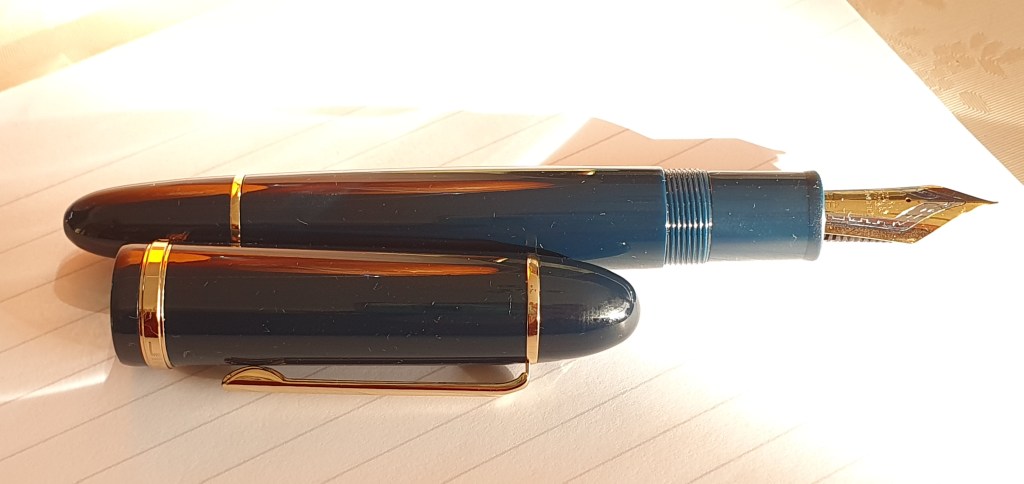
The blue-teal colour is quite hard to capture in a photo.

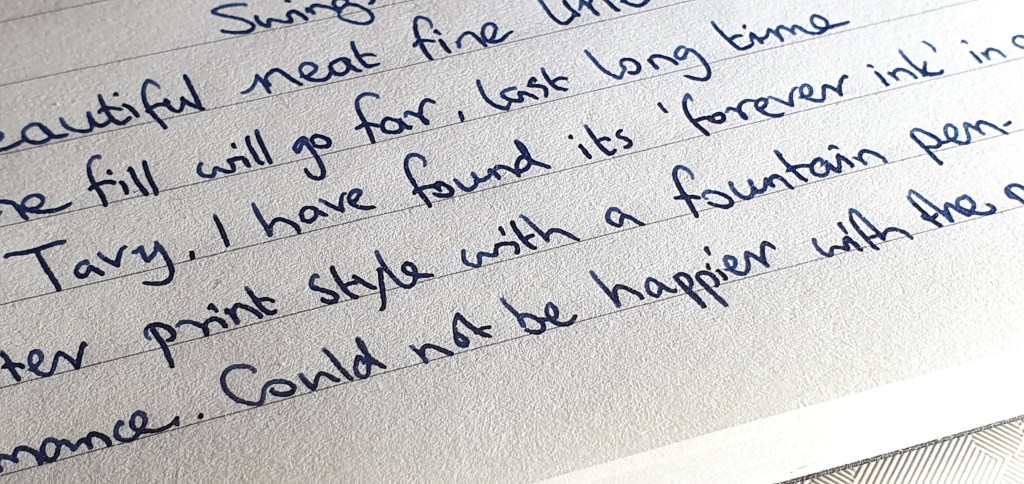
Once again, my pen arrived the following day. At first, it looked like I had got Dark Blue as it looked like navy, in artificial light. However, daylight revealed the colour to be a very pleasing blue-teal, which I am very happy with. I was excited to see under the loupe that the EF nib looked to be tuned to my liking, with the slightest of gaps between the tines, promising a good writing experience. After flushing the pen, I filled it with Diamine’s Conway Stewart Tavy, my go-to blue black. Bliss. This feels like its “forever ink.” The extra fine nib performs beautifully. In my notebook I wrote “I am genuinely over the moon at how good this pen looks, feels and writes and all for a £7.99 price tag.”

Writing sample of EF nib.
A big pen with a tiny EF tip.

Early thoughts on the Otto Hutt Design 06 fountain pen.

My relationship with the Otto Hutt Design 06 fountain pen had the best possible start. I bought the pen whilst on a short break in the beautiful city of Porto, in one of the most delightful pen shops I have ever seen, namely Araujo & Sobrinho founded in 1829. So, being abroad, in holiday mood AND being in a pen shop, I was very open to the possibility of finding a new fountain pen to take home.

The Otto Hutt Design 06 fountain pen, glossy black lacquer version.

The brand Otto Hutt, of Germany, was unfamiliar to me. I had heard the name and seen a few reviews of their pens online, notably from Anthony of UK Fountain pens, but had not seen any of their pens in the flesh. I had not come across them in any shops in London although I have since learned that they are available from the online seller Cult Pens. Another excellent review can be found on The Gentleman Stationer.

At the time of my visit, the shop had two glass display cabinets featuring Otto Hutt pens. First, an eye-catching display in the counter as you enter the shop, contained the Otto Hutt Design 08, a stylish metal pen with a grooved barrel and a distinctive black grip section with with rather sharp-looking backward pointing ridges. These looked grippy, if rather uncomfortable, rather like a sharper take on the Lamy Imporium. Next to this was an Otto Hutt Design 07, which I learned is made from sterling silver and a little more conventional in shape than the Design 08.

Next I spotted a range of Otto Hutt pens in various colours, and which I now know to the be the Design 06. I must admit that at first sight, I was not tempted by these by reason of the polished metal grip section and secondly, the step down from barrel to section. I have found that metal sections can be slippery making it difficult to control the pen without it rotating left or right in your hand. Also a step can be sharp and uncomfortable under your fingers. I had a good browse around the shop and its attractive displays but left without buying anything.

The cap ring of the Otto Hutt Design 06.

However, I returned a few days later, being the last day of our mini-break in Porto. This time I met Miguel Araujo the proprietor who kindly allowed me to take a few photos in the shop, which I included in my recent post Travelling with ink: Porto, Portugal. I then asked to take a closer look at the Otto Hutt Design 06, perhaps hoping to convince myself of its unsuitability.

A series of revelations ensued. First, whilst the polished metal section is undoubtedly slippy if you were to grip it there, I found that I naturally held the pen with the section resting on my second finger, my first finger over the cap threads (which are not sharp) and, crucially, with my thumb on the lacquered metal barrel, which was not slippery and which allowed me to anchor the pen and prevent it from turning inwards or outwards. Held in this way, unposted, and with its centre of gravity being located towards the front end, it actually felt strangely comfortable. I say “strangely” as it felt different from my other pens and with it cradled in my hand it almost felt like an extension of my body (if my hand had been designed as a writing tool).

Uncapped. A step down from the barrel to the shiny metal section.

The step down from barrel to cap threads and section, which looks quite pronounced and sharp, was not a problem for me in practice. As I said, my thumb rested on the barrel and my first and second figures were on the section and so my grip was formed either side of the step.

The next revelation occurred when I asked to try the pen. Miguel produced a bottle of ink and some paper. I tentatively dipped the nib, and put pen to paper. There was literally a “Wow” moment as soon as I wrote and noticed the soft springiness of the nib, such as is sometimes found in gold nibs. Yet the Otto Hutt Design 06’s nib is stainless steel. Aside from the softness of the nib, it was also beautifully tuned to write smoothly and with an optimal flow. The bi-colour nib with its imprint also happens to be very pretty.

Cartridge or converter fill.

As you can imagine, I was thrilled with the pen and was keen to buy that very one. Miguel cleaned the nib for me, found the box and the converter, and gave me an Otto Hutt catalogue plus a post card with an old black and white photograph of the shop and a tote bag in which to take it all back to my hotel.

The unboxing. The polishing cloth is a nice bonus.

Having used the pen for almost two months I am pleased to say that I remain just as pleased with it as I was on that first day, if not more so. I have used it so far only with Graf von Faber-Castell cartridges in Cobalt Blue.

Size and Weight

The Design 06 is a medium-sized pen. It measures 139mm capped, 122mm uncapped and 156mm posted. It weighs around 47g in total, comprised as to 32g uncapped and 15g for the cap alone. Personally, I prefer to use it unposted and in this mode it feels nicely front-weighted. However the cap does post, quite deeply and securely if desired, making the pen quite long and shifting the centre of gravity back a bit.

Likes

There is a great deal that I like about the pen. As I write this at home, I have ten fountain pens in my ink cups, plus a further three Delike New Moon pens at hand with inks to match their colours. Of my currently inked pens, the Otto Hutt is the only lacquered metal pen and so its heft does make it stand out from the rest. Here is what I like about it:

  • The nib is the main attraction, being soft, smooth, with a pretty imprint and bi-metal, shiny plated finish. It is a medium but writes a line which is on the fine side of medium.
  • The smooth, flush body, from barrel to cap (achieved at the expense of having the step down from barrel to section mentioned earlier);
  • The stylish, disc finial bearing the initals o|h;
  • Having a serial number, laser etched around the finial, mine being 06-11332;
  • The long, straight, pocket clip, which pivots when the top is pressed;
  • The stylish cap ring, with “ottohutt” on the front and “GERMANY” on the back.
  • The shiny metal barrel ferrule.
  • The surprisingly quick cap threads, needing literally only a half a rotation to remove or replace the cap;
  • The ability to use standard international cartridges, with room for a spare in the barrel.
  • It is, in my humble opinion, great value for a top-quality, steel nibbed fountain with a nib that is amongst the best that I have used. I paid 145 Euros for mine.
  • The clean and smart look of the polished metal section, next to the glossy black of the barrel; the hardwear components, according to the catalogue, are plated with platinum in the black version, whilst some other colours feature rose gold plating. Whilst I tend to avoid metal sections, who doesn’t like platinum?
  • The pen comes in a white cardboard box, (a bit like a mobile phone) with a black outer sleeve. Inside you find, in cardboard inserts, the cartridge converter, a cleaning cloth (a rare luxury) and the user guide and card to note your serial number and date of purchase. The packaging is ideal and makes a good impression but could be easily recycled or used for other things.
  • Overall, the pen is tactile, stylish and attractive, whilst also subtle.
VERY long threads for the barrel. Serial number on the finial!

Dislikes

In two months of ownership, I have genuinely not found anything to dislike about the Design 06. One could perhaps wish that it was slightly longer and/or that the grip section was not of shiny metal plating or tapered the way that it is. But if you take away those features, you would be left with a pen like the Diplomat Excellence, clearly a great pen and one of my favourites but which can look slightly plain next to the Design 06.

Size comparison with the Diplomat Excellence (right)

I would like to visit Pforzheim one day, the city in south west Germany from which the Otto Hutt business had its origins in 1920. Some history can be read in the Otto Hutt website and Pforzheim was famed as the Golden City and jewellery capital of Germany. The city was the target of a notorious and controversial bombing raid by RAF Bomber Command during World War II on 23 February 1945 in which much of the city was destroyed with huge loss of life. When the city was rebuilt, the rubble from the destruction was formed into a hill, or Wallberg, to create a scenic memorial and viewpoint. Today, Otto Hutt is located at the nearby municipality of Konigsbach-Stein.

When asked to name a German fountain pen maker, I suspect that most people here would first think of Montblanc or Lamy or Faber-Castell. Otto Hutt is a much less well-known name here but its distinctive Bauhaus-inspired designs and quality workmanship are deserving of greater attention. Certainly if you are fortunate enough to find yourself in a pen shop which sells Otto Hutt fountain pens, it is well worth taking a close look at one. You may be pleasantly surprised and smitten, as I was.

An attractive sweeping taper to each end and the cap fits perfectly flush with the barrel.

The new year diary, 2023.

I have been in the habit of keeping a diary since I was about 18. For about the last 10 years, I have used A5, page a day diaries and usually write my entry after breakfast the next day.

In recent years, I have bought these from Rymans stationers, which had 23 rows per page, with a row height of 7.9mm. These are still available for £13.99. My new year diary 2022 was reviewed here.

However, for 2023 I have tried something different. I am now using a Moleskine 2022-23 Daily Diary / Planner. Again this has a day per page and is ruled. A big difference is that it covers 18 months, from July 2022 to December 2023.

My Rymans page a day diary for 2022 and the Moleskine 18 months’ diary 2022-23.

This was an impulse buy, on visiting the Moleskine store in London’s Covent Garden, in early November. Admittedly, I was lured by the fact that it was reduced in a sale, from £24.99 to £17.50. I presume that this was due to the fact that it was November and over four of the 18 months covered by the diary had already passed. This did not worry me as I was quite happy to start the diary in January and to have the previous six months’ pages free to use like a notebook, as I wished.

I did have some reservations, first as to the paper quality. My experience of Moleskine A5 notebooks had been that the paper was generally not fountain-pen friendly, as most inks bled through the paper making the other side unusable. However, I thought that I might overcome this by finding an ink which would not bleed. My other concern was as to the line spacing. This Moleskine diary pages have 29 rows, with a row height of 6mm which is much narrower than my preferred spacing of around 8mm. On the other hand, you get more rows per page. Also, I often use balloon diagrams in my diary entries for work days, and so the row height is a bit less important.

Narrower pages and narrow line spacing (6mm) than I would like.

Ultimately, the reduced price, extra notebook pages, as well as the rather pleasing chunky proportions of the diary, sealed in its shrink wrap, made me overcome my reservations and I bought it.

When I got it home and had the opportunity to test the paper, I was pleasantly surprised and relieved to find that the paper is not the same as I had seen in Moleskine A5 notebooks. The paper in the diary IS fountain pen friendly and very pleasant to write on! I tried writing a paragraph with five different inks (Waterman Serenity blue, Diamine Tavy, Waterman Harmonious green, Montblanc Velvet Red and Diamine Pelham blue. All performed beautifully on the silky smooth paper with no bleed through and very minimal show through.

Testing the paper for fountain pen friendliness. Success!

As for the line spacing, whilst I still prefer to have a bit more breathing space, I think I can manage with it. I noticed that the Moleskine diary page is quite a bit narrower than the Rymans diaries, (130mm instead of 145mm) but the shorter length actually helps make up for the narrower row height. (I sometimes rule a page into two columns, in notebooks with narrow line spacing).

Three sheets of stickers included.

Other features of the Moleskine diary include neatly sewn binding and so the book lays open flat, without risk of pages falling out. There is a ribbon bookmark, an expanding pocket in the back cover, an elastic closer, and three sheets of sticker symbols which can be used in the diary, or elsewhere. There are plenty of information pages at the beginning, with yearly calendars and monthly planning pages, world time zones, national holidays and dialing codes.

Nice stitched binding.

So, off we go again for another year. Already 2023 looks set to be marked by the awful continuing war in Ukraine, industrial action for pay disputes and the current fall-out of Prince Harry’s tell-all biography, plus challenging times for household finances. We all live in hope for better days ahead.

Crucially, the paper in the Moleskine 18 months’ diary is very fountain pen friendly.

2022: Some of my fountain pen highlights.

As another year end approaches, it is time for a round-up. Against the background of a tumultuous year in national and world events, I had a busy year and took comfort in my fountain pens, whilst trying to curb my temptation to buy more.

In 2022, I had 24 fountain pens incoming. These included five that I bought and gifted, and coincidentally, another five that were given to me. This leaves 14 fountain pens bought for myself over the year. My total spend on these came to around £976.00.

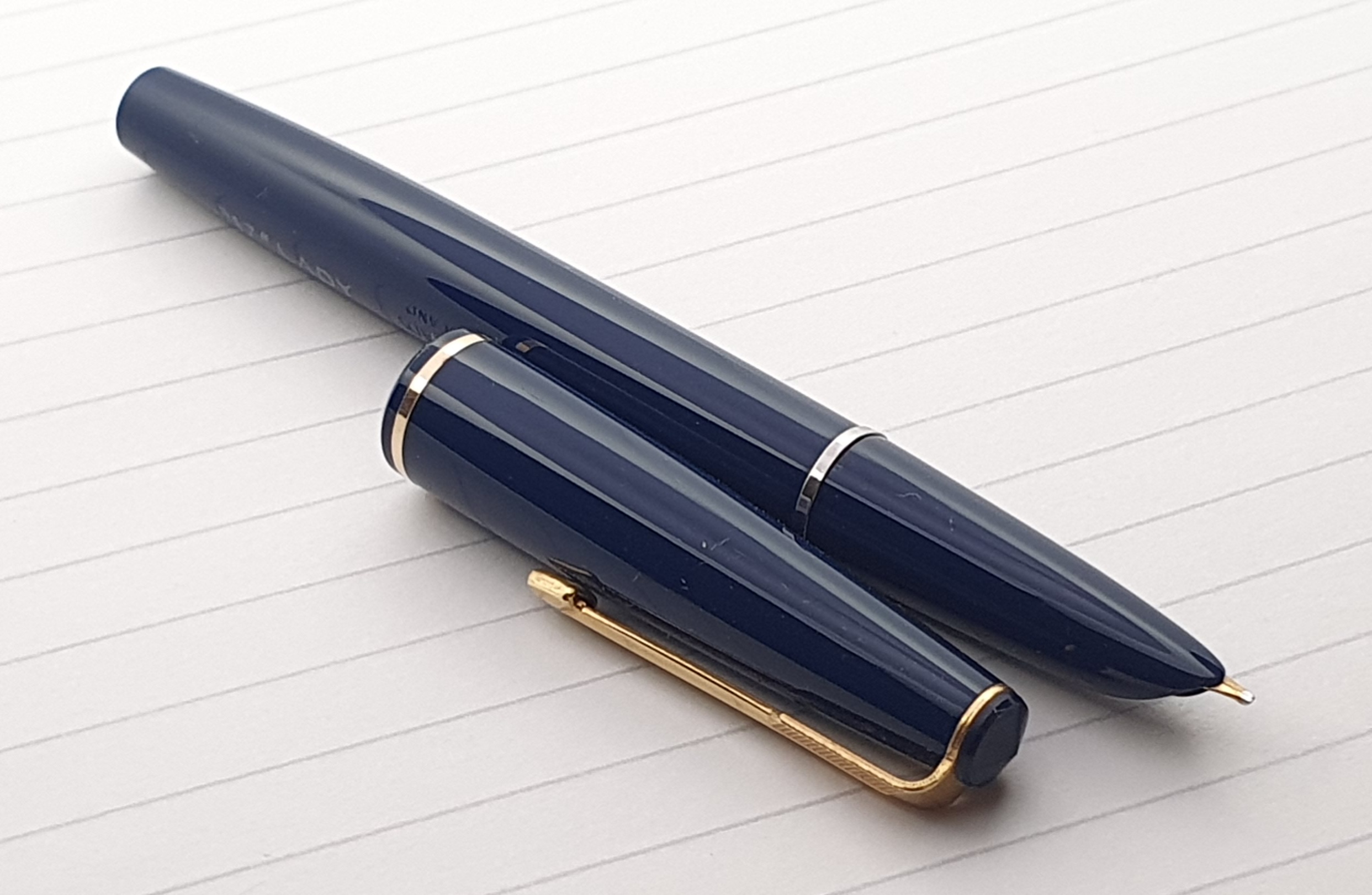
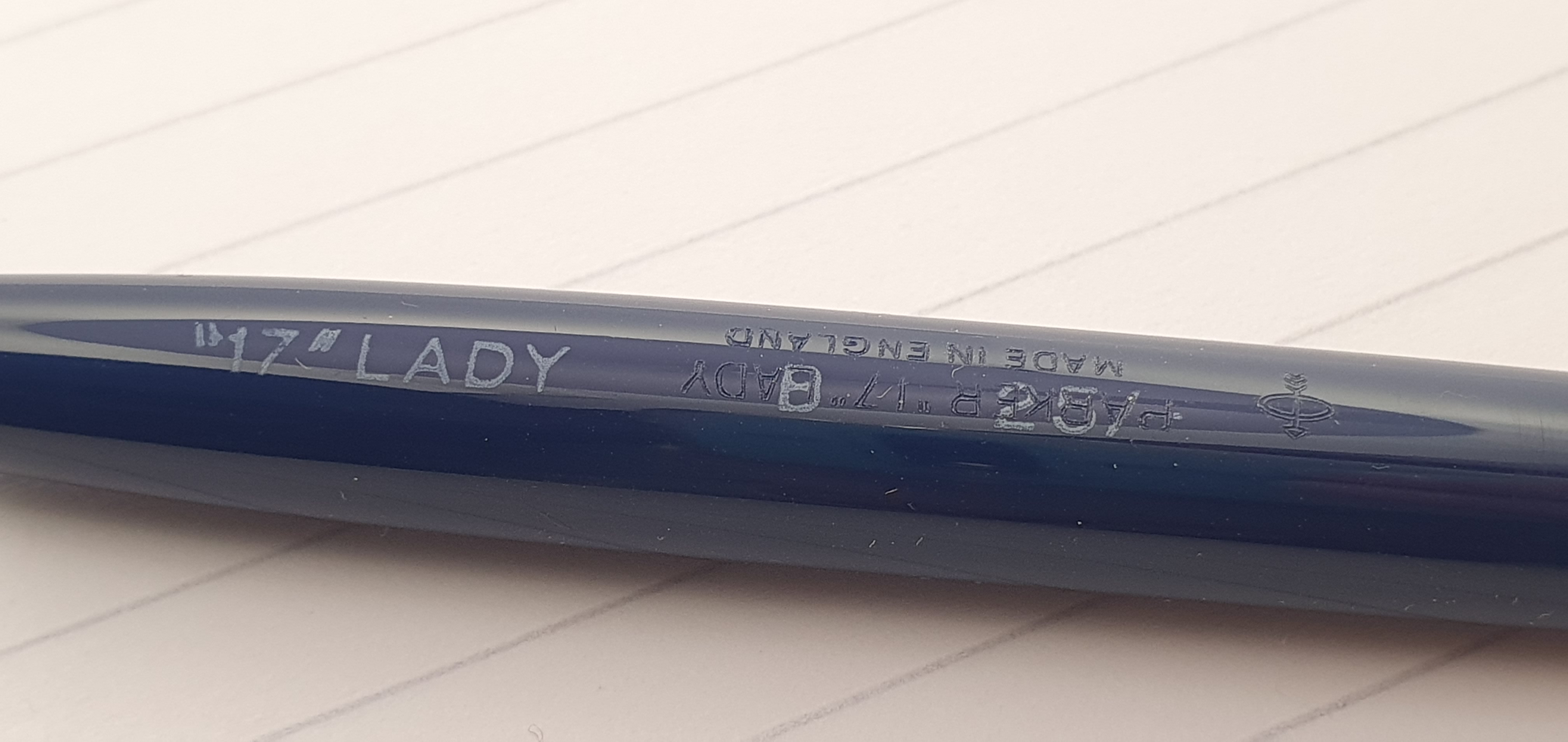
My biggest single purchase was an Aurora Talentum in yellow, with a 14k gold, oblique medium nib. I am delighted with it and consider it one of the best value gold nib pens on the market. Aside from a vintage Parker 17 Lady, a £10.00 impulse buy at a pen show, the Talentum was the only pen that I bought with a gold nib.

Aurora Talentum, with oblique medium 14k gold nib, rhodium plated

I notice that a theme of my 2022 pen purchases, has been in relatively high-end steel nib pens. These included a Tibaldi N.60, an Esterbrook Estie Nouveau bleu, an Onoto Scholar and an Otto Hut Design 06. In each case, the pen was the first and only model that I have of each brand.

Esterbrook Estie, Aurora Talentum, Tibaldi N.60 and Onoto Scholar.

Another theme to note is that I bought myself three Delike New Moon fountain pens, with fude (bent) nibs, in green, blue and finally red acrylic. I am very taken with these. They are inexpensive cartridge-converter fillers, with screw caps and steel nibs, in attractive finishes and with a very versatile smooth nib. This can be used to produce a line from broad to extra fine, depending upon how you hold the pen. I have them filled with matching inks and enjoy them a lot.

Delike New Moon fude nib fountain pens. Great value.

Receiving a surprise parcel in the post with a gift of pens from a friend overseas, is always a thrill. A friend in Australia sent me five fountain pens, namely a Geha 715, Montblanc Carrera, a Montblanc 34, a Lamy 2000 and an old version Waterman Hemisphere in tobacco brown. There were also two Montblanc ballpoint pens (a matching ball pen for the Carrera, plus a Meisterstuck ball pen, both with new refills). It was exciting to try them all out. The Geha 715 was a German, black resin, piston fill pen which had an ink reserve feature, activated by sliding a switch in the feed, under the nib. The Carrera was a steel nib pen, mine being a cartridge converter version. Aside from the Waterman, the others all had oblique nibs, which I have found to be suited to my lefty overwriter hand-writing style.

Some gifts from Australia! Montblanc 34; Montblanc Carrera fountain pen and ballpoint pen; Waterman Hemisphere.

The Lamy 2000 was new and had an oblique broad nib. Unfortunately I found that this one did not suit me. Held at my usual writing angle, it produced too broad a line for me, both in down strokes and cross strokes. Perhaps looking back I needed to adjust my angle of grip for this particular nib to use it properly. However, I asked Lamy whether they would agree to exchange this nib for a Fine. They kindly agreed and I sent the pen to Germany.

I wrote a blog post at the time about sending the Lamy 2000 back for a nib swap. An extraordinary thing then happened and this post received over 14,000 views in the first month. My blog received it’s highest ever numbers of daily and monthly views.

I attended both the London Spring and Autumn Pen Shows, in March and October. These were most enjoyable and it was good to see so many friends particularly as we had not resumed the London pen club meets since Covid restrictions were lifted.

It was at the Spring pen show that I bought my Esterbrook Estie. I had seen a lot of buzz about these online and was a late-comer to the party. Then at the Autumn pen show, I bought my Onoto Scholar, in navy blue with gold plated trim. The bicolour steel, number 7 medium nib is a joy to use and is the same as the standard steel nib that you would receive on an Onoto Magna, a pen costing more than twice the price of a Scholar, although there is an option to upgrade to a gold nib.

My final pen purchase of the year came in November whilst on a short break in Portugal. I found a wonderful, long-established fountain pen shop called Araujo & Sobrinho and enjoyed meeting the proprietor and buying an Otto Hutt Design 06, in black lacquer with silver colour trim. I am thrilled with it. I hope to give it a blog post to itself soon.

Otto Hutt Design 06 fountain pen.

At home, my pen cups typically have around a dozen pens currently inked. At my office, I limit my work fountain pens to two. A Cross Bailey Light, royal blue model has been in constant use with bottled Cross Blue ink all year, which I am using up for my late Godfather Brian. My other work pen is a Moonman S5 eyedropper, with oblique broad nib. This gets only occasional use and as a result has not needed refilling all year.

I have continued to use fountain pens for my daily A5 page-a-day journal. I cherish the ten minutes or so, spent recalling and summarising the previous day. I think my intention was to change pen each month. In the event, I used the Cleo Skribent Classic Gold for both January and February. I then switched to the Visconti Rembrandt from March right through to September inclusive. In October, I used the Esterbrook Estie. Then for November and December it was the Onoto Scholar. When travelling, I take a different notebook for holiday journaling.

With the year almost over, I am very content with my accumulated pens and ink stash. I have ample to last me out! Also, I am equally well stocked for new notebooks, of all shapes and sizes. My resolution for 2023 will be to remember to use the pens, inks and notebooks I have and not keep buying more. I always say that.

One of my resolutions last year was to walk 1,500 miles, an average of 125 miles per month. Mostly, this consists of walking to and from my office. Ultimately, my pedometer app has counted about 1,200 miles, a slightly disappointing 80% of my annual target. Still, as with my stationery hopes, it is good to leave some room for improvement in the future. A Happy New Year to all.

Onoto Scholar. An exquisite steel nib.

Travelling with ink: Porto, Portugal.

A recent trip with my wife to the city of Porto, was a most welcome break and my first time out of the UK in three years. It was also an opportunity to bring a few pens and notebooks and to discover pen shops in the area.

I considered bringing only one fountain pen, but as usual ended up with several. These were my new Onoto Scholar and two Delike New Moon fude nib pens, which I enjoy. I also brought a Lamy 2000 multi-pen and a Pentel 0.7mm mechanical pencil. For notebooks, I had a Leuchtterm A5 as my holiday journal, another cheap A5 book for random writings and a traveller-style notebook and cover from Flying Tiger Copenhagen.

I had learned from FPN of a pen shop in Porto called Araujo & Sobrinho, founded in 1829 and still belonging to the Araujo family, now in its fifth generation. As luck would have it, this shop was just 100 yards from our hotel.

At the Douro River, Porto.

It is wonderful to explore the city, on foot. It is built on hills each side of the River Douro and famous for the production of Port. Fronting the south side of river, there are a dozen or so Port wine companies. We visited one of these, Sandeman, for a memorable tour of their cellars, finishing with a tasting of three types of their Ports.

Sandeman’s premises and visitor centre, Porto.
Our knowledgeable tour guide at Sandeman.

In an indoor market I found a man making and selling leather notebook covers, branded Sango Handmade Creations. My wife bought me an A5 cover in stiff, dark brown leather with an elastic loop closure and containing one Moleskine notebook. It appealed to me as the notebook is held only by an elastic loop and does not need its covers to be slid into a raised leather pouches which cause an uneven writing surface. However the cover is very stiff and needs effort to keep it open flat, as it wants to slam shut. I expect that with use, and some leather softener on the spine, this will ease.

My new Sango Handmade Creations notebook cover and a pen case. On a mosaic floor of the Bolsa Palace.

As well as the ubiquitous confeitaria pastry shops, I learned to look out for shops called papelaria, Portuguese for stationer. I enjoyed browsing one called Papelaria Peninsular where I bought a couple of Pentel EnerGel 0.7 gel pens, in brown and navy blue.

Papelaria Peninsular. An attractive stationers with print shop at the back.

I came across another, Papelaria Modelo but it was closed for lunch and I could only savour the attractive window including some Kaweco pens and inks.

Papelaria Modelo.

A book shop called Livraria Lello is a popular tourist attraction, claiming to be The Most Beautiful Bookstore in the World. So popular has this become, that it is necessary to book a visit, which has to be done online and to pay a fee of five euros and then wait in a long queue to be admitted. I learned only several days later that you can recover the ticket price against the price of book purchase. The features of the shop, which was very crowded, include a stained glass roof, and curved wooden, red-painted staircases to the galleried first floor. There was currently a display of The Little Prince, with two books from the first 1943 print run inside a mirrored infinity box (to represent the enduring appeal of the book). Also, there was a display of books by the late Nobel prize winning writer José Saramago. A display case included his passport and also a fountain pen that he had used.

Inside Livraria Lello.
A pen used by José Saramago.

It was well worth visiting Clerigos Church and to climb its tower, to see the panoramic views of the city. Just wandering the streets, particularly at the weekend with many buskers and other street entertainers performing, makes for a relaxing holiday atmosphere. One of my favourite performers was a couple dancing to music and it took a moment to realise that the lady was a mannequin whose shoes were attached to her partner’s.

A view of roof tops in Porto.
A dancing “couple” in Porto. She blew me a kiss.

And so to Araujo & Sobrinho. On our first day, we had lunched opposite and, having found the shop location, thought that it may now be a hotel restaurant. But on entering from the front, I spotted a passage leading behind the dining area, where there was a Caran d’Ache sign. There is a pen shop! We had a browse around, assisted by a young man who was working there but unrelated to the family owners. I was keen to return for another look and to take a few photos. This did not materialise until our last morning before our flight home.

Araujo & Sobrinho, at the lower end of Rua das Flores.
The pen shop is more evident from the side entrance.
The inviting interior.
I asked whether Canetas was a Portuguese brand. No, it means “pen.”

On this second visit, I was delighted to meet Mr Miguel Araujo, who kindly allowed me to take some photos of his very attractive shop. Glass cabinets contained displays including Parker, Pilot, Namiki and Caran d’Ache pens. There was a large selection of mechanical pencils, notebooks, Traveler Notebook refills, and inks. For the first time in a bricks and mortar shop, I saw displays of pens from Otto Hutt of Germany, seldom found in the UK. These included a Design 08 with its distinctive guilloche patterned body and black grip section, and the Design 07 in sterling silver.

The author with Mr Miguel Araujo (right).
Notebooks and a display of old large size ink bottles.

I asked to take a look at a black lacquered fountain pen with a shiny plated section (Platinum plating) which I now know to be the Otto Hutt Design 06. I wanted to feel whether the grip would be a problem, either due to the shiny metal plating or the step down from barrel to section to accommodate the flush-fitting screw cap. Rather to my surprise, the pen fits the hand very comfortably and neither of these points was an issue. Miguel dipped the pen in some ink for me to try. Here I was blown away by how smooth and soft the nib was. It is a steel nib but has the soft feel of a gold one. And so, the Design 06 was to come home with me! It was a treat to enjoy a personal and attentive buying experience. Miguel carefully cleaned the nib, put the pen in its box, which also included a converter and gave me a souvenir post card of the shop and an Otto Hutt catalogue, all in an Araujo & Sobrinho tote bag.

One of the Otto Hutt display cases in the shop. My pen, third from the front!
Hard to resist, once you have experienced writing with it.

I caught up with writing some notes in my Flying Tiger notebook on the two hour flight home, now with my new Otto Hutt fountain pen. And on the coach back to London, I was interested to re-read an old review of the pen by Anthony on UKFountain Pens, and was pleased to discover that my opinions very much echoed his from two years ago.

I can strongly recommend a visit to Porto. And if you go, do not miss Araujo & Sobrinho to support this lovely long-established shop for many more years to come.

Goodbye, Porto.