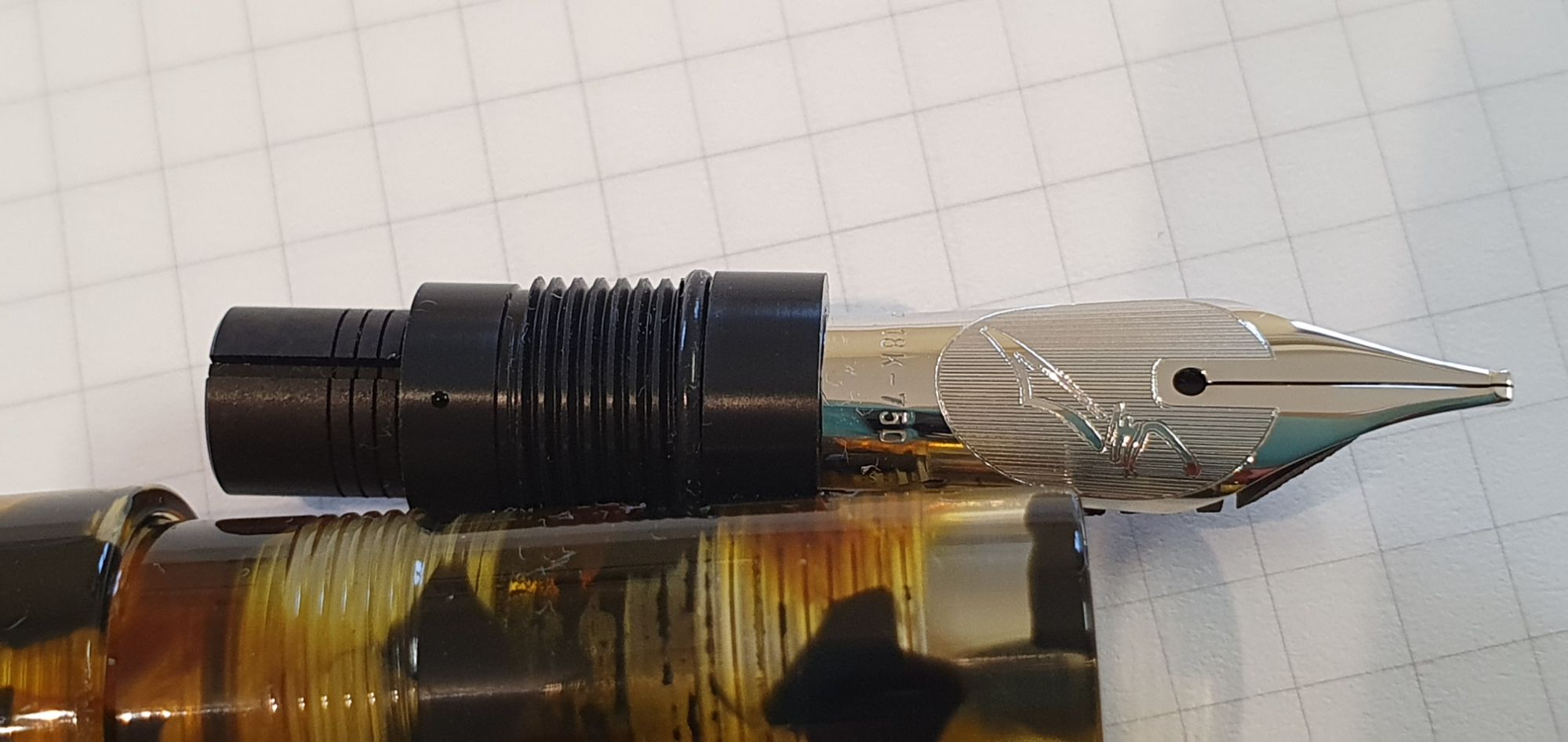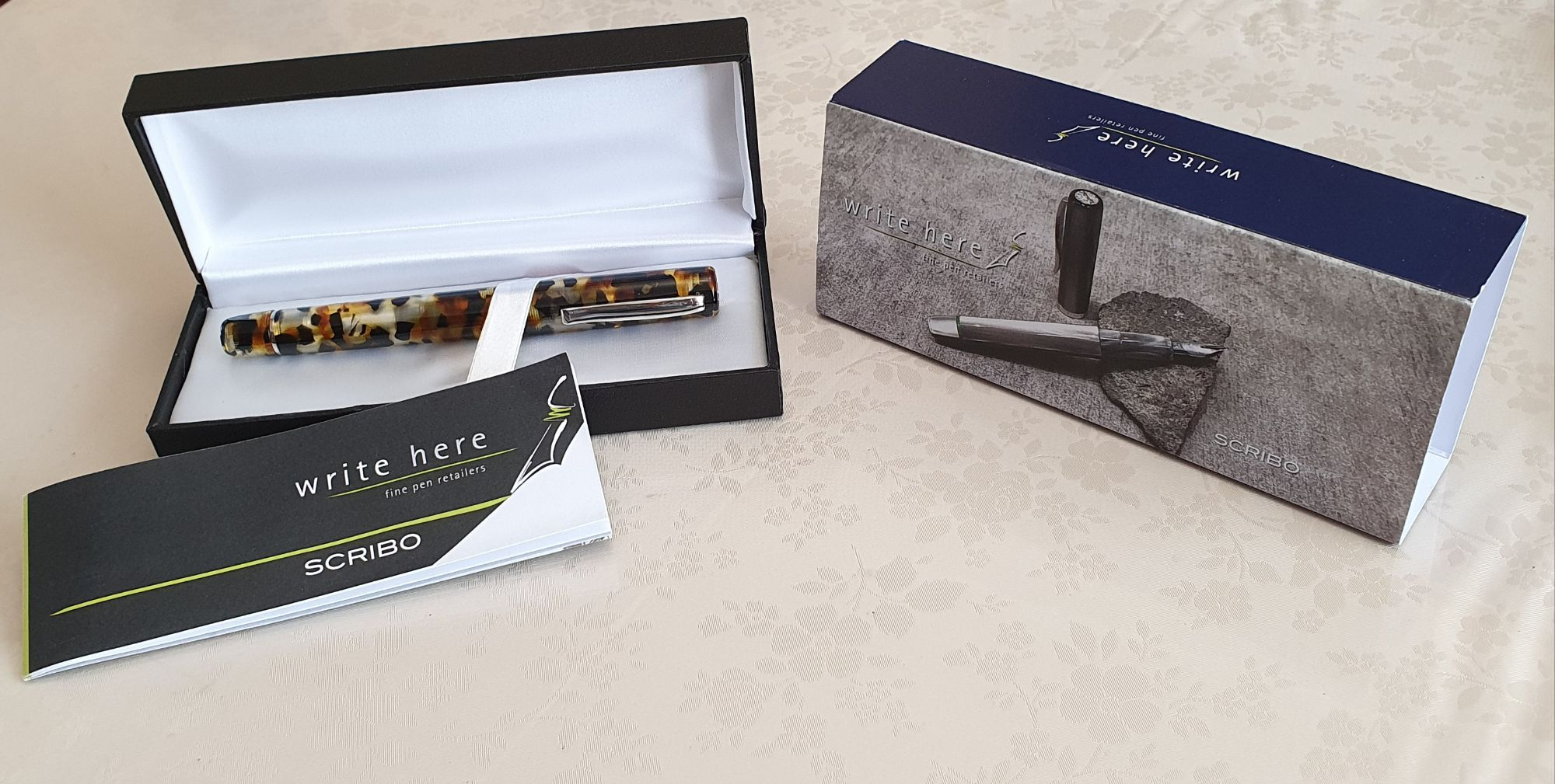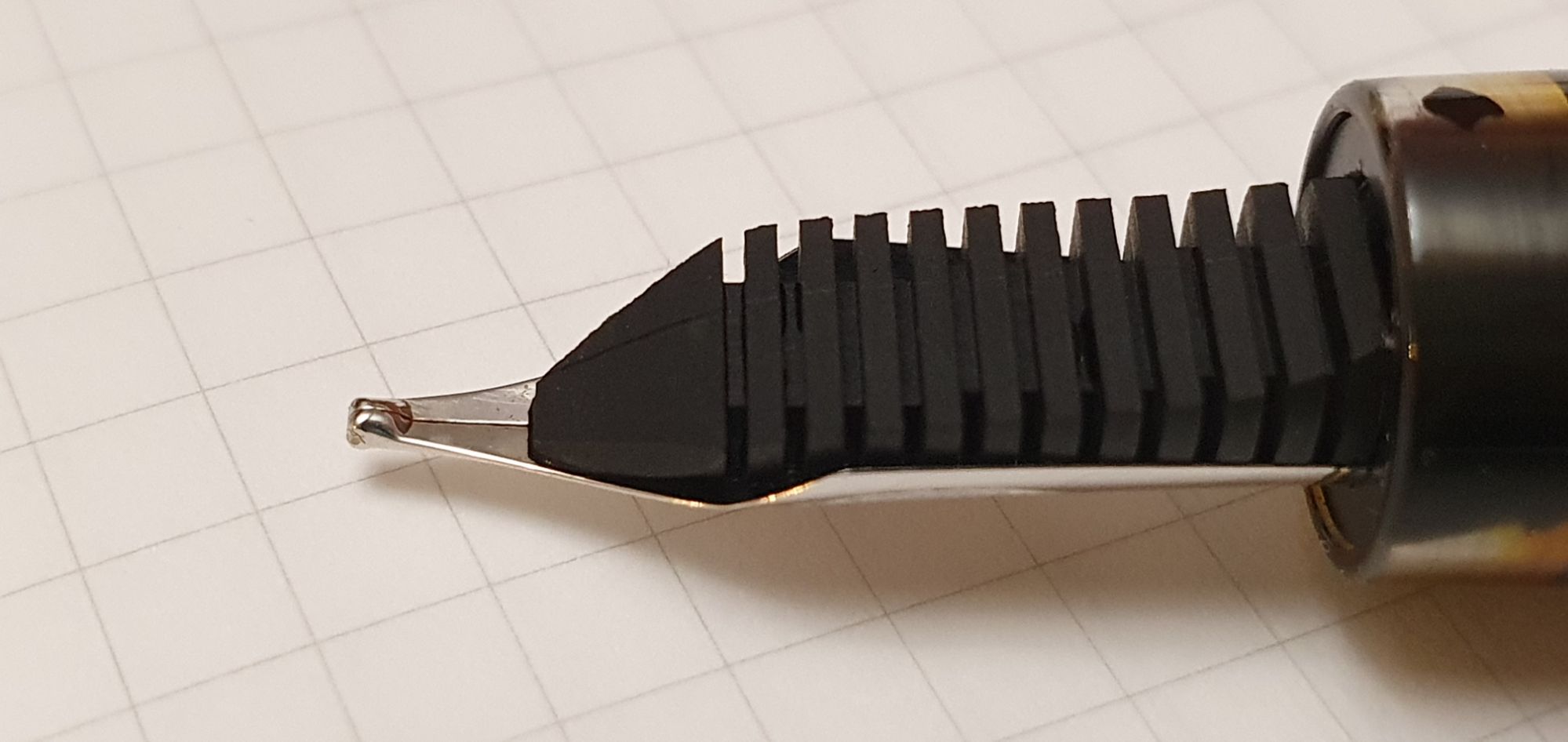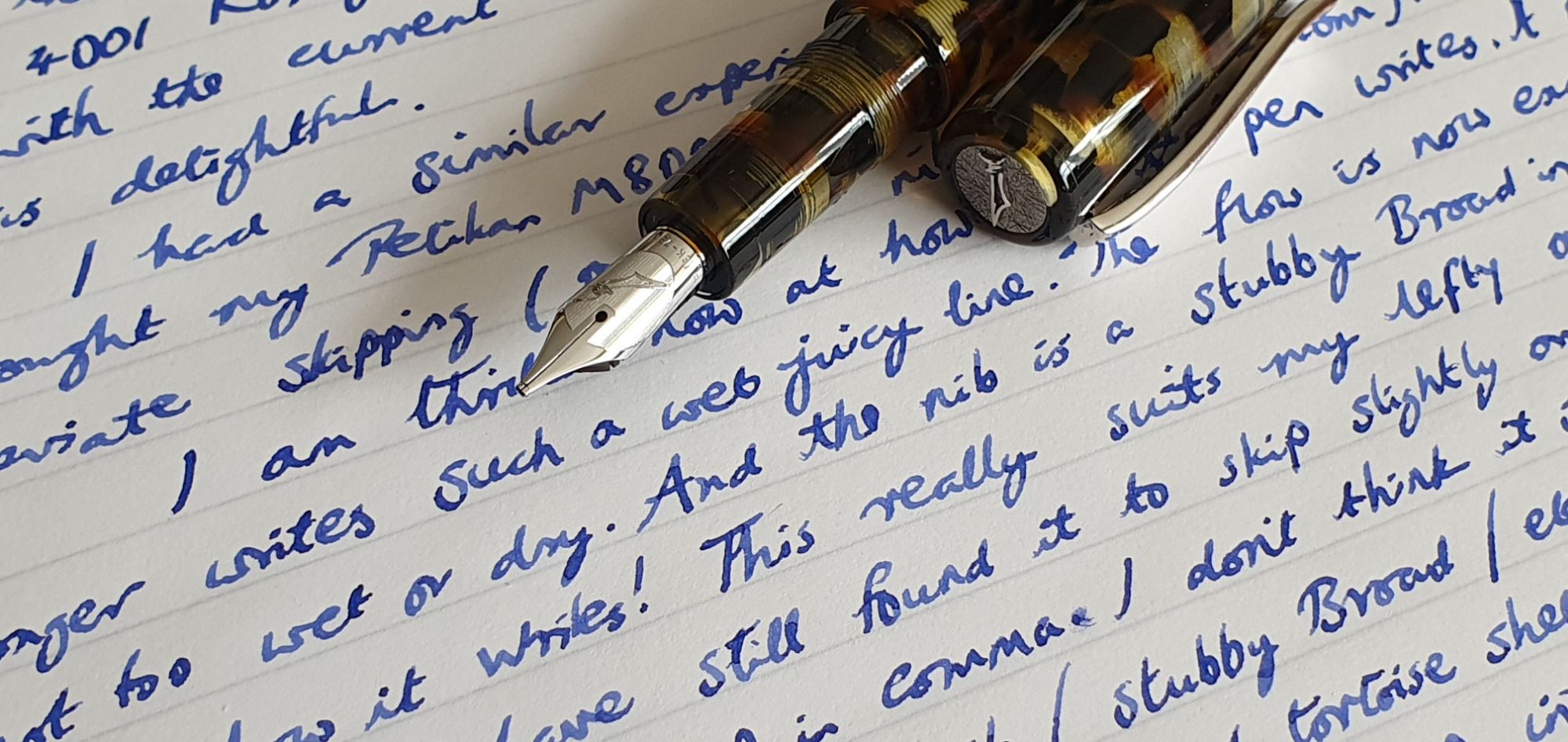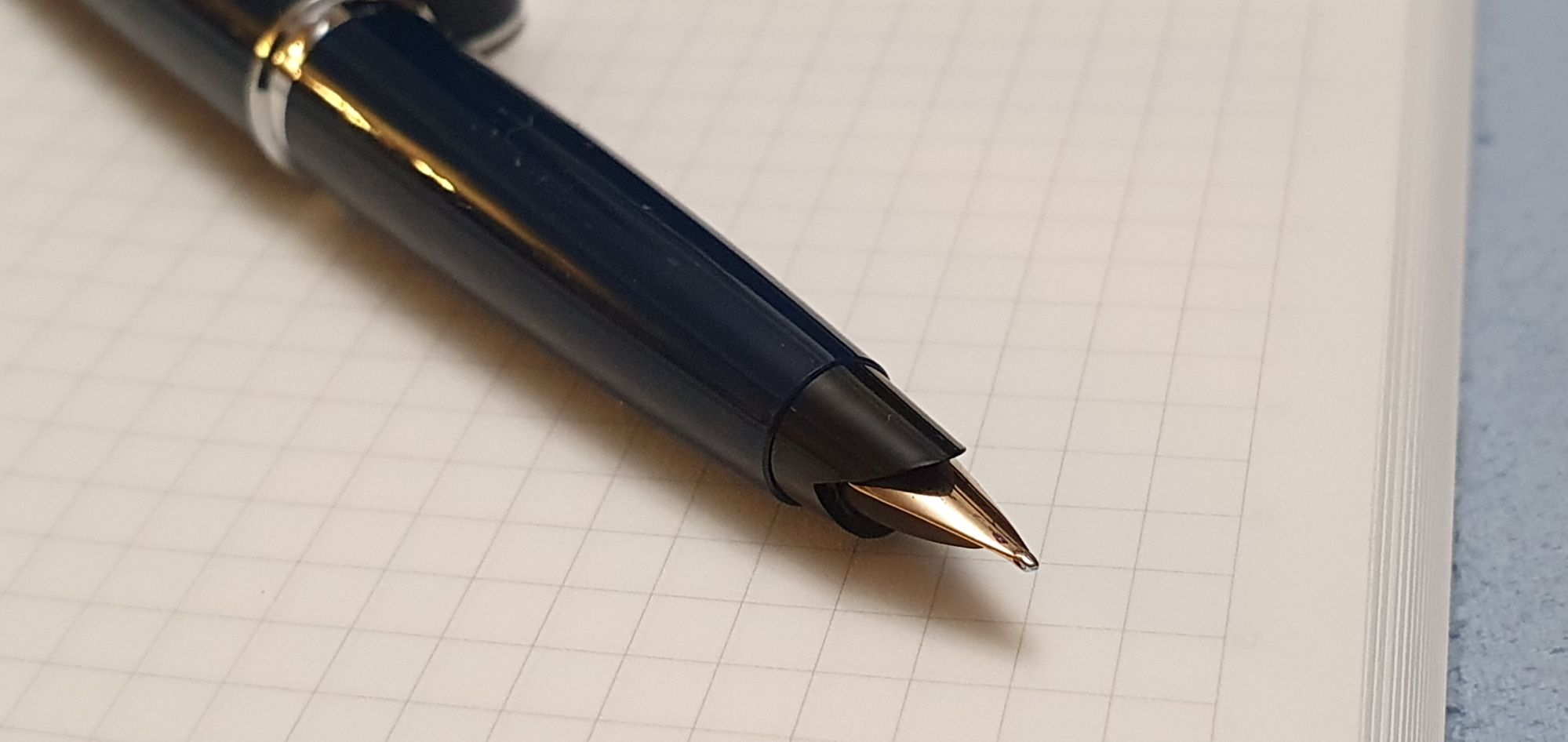
Early thoughts on the Duke 551 Confucius bamboo fude nib pen.

As early thoughts go, today’s are even earlier than usual as this lovely pen has been with me for barely 24 hours. However, my first impressions are very favourable: the quality and finish and the sheer fun that you can have with it, exceeded my expectations.

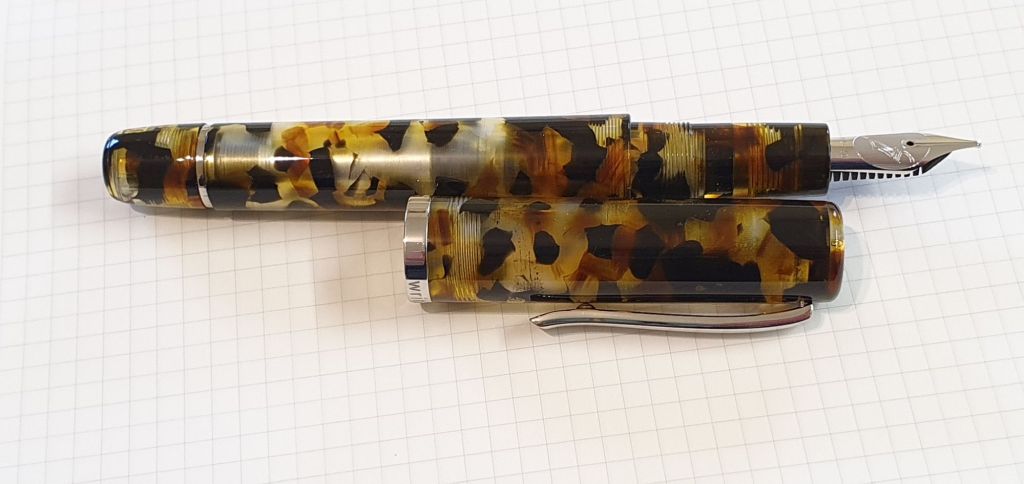
Duke 551 Confucius, bamboo fude nib pen.

This model has been around for several years now and I am informed by artist Terry Christopherson (Instagram @theTravelSketcher) and of peninkandpaint.com that it is big in the urban sketching community. I was already familiar with another model that I reviewed previously called the Duke 552, also featuring a natural bamboo barrel. I had imagined that the 551 would be similar, but with a fude nib and a more decorated cap. It turns out that they are quite a bit different.

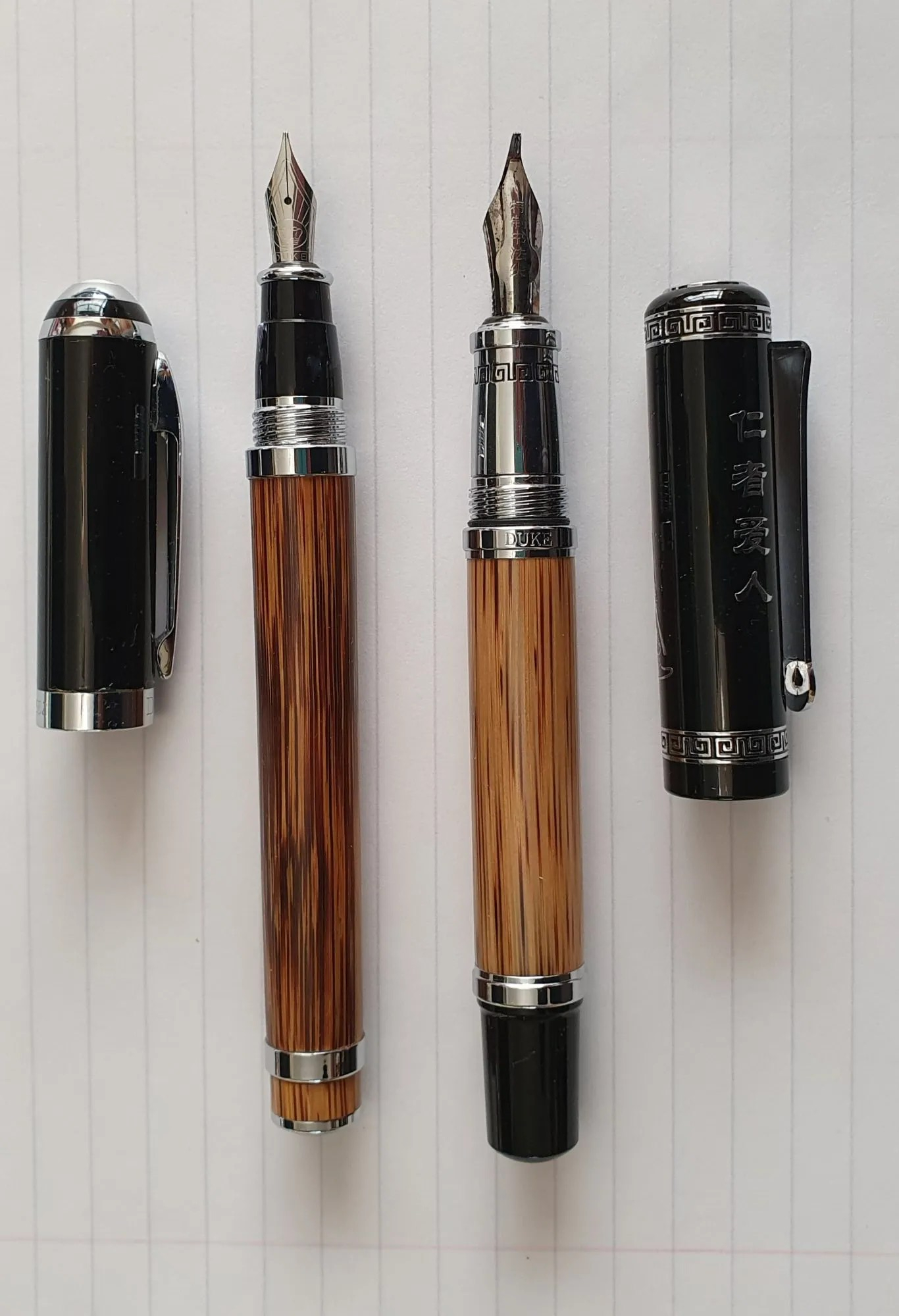
Although the 551 is similar in length and has a similar look of bamboo barrel, black cap with silvertone furniture, it is girthier, heavier, has a much bigger nib and a section which is longer and made of metal. The differences are apparent when the two models are seen side by side.

Duke 551 fude (right) with Duke 552 (left)

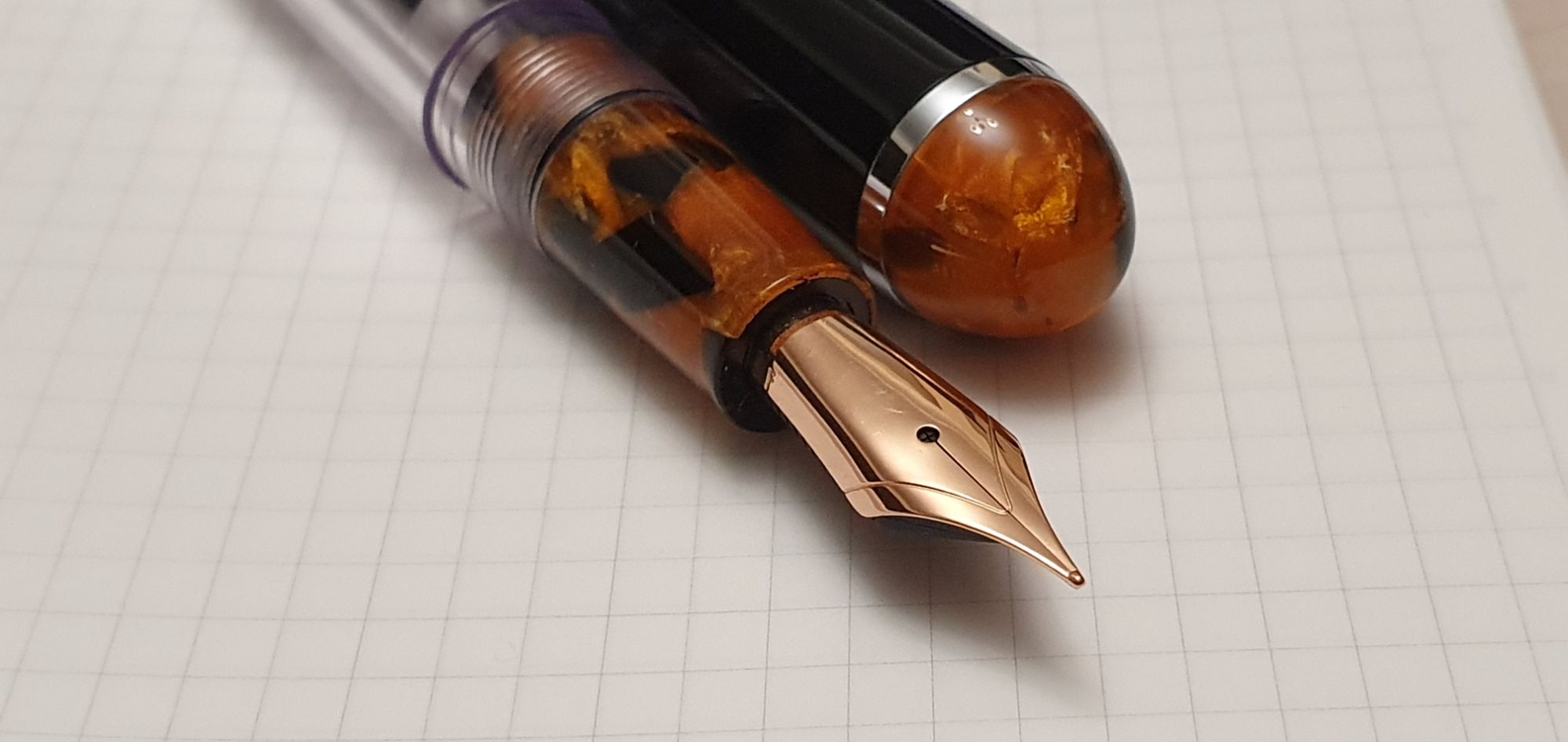
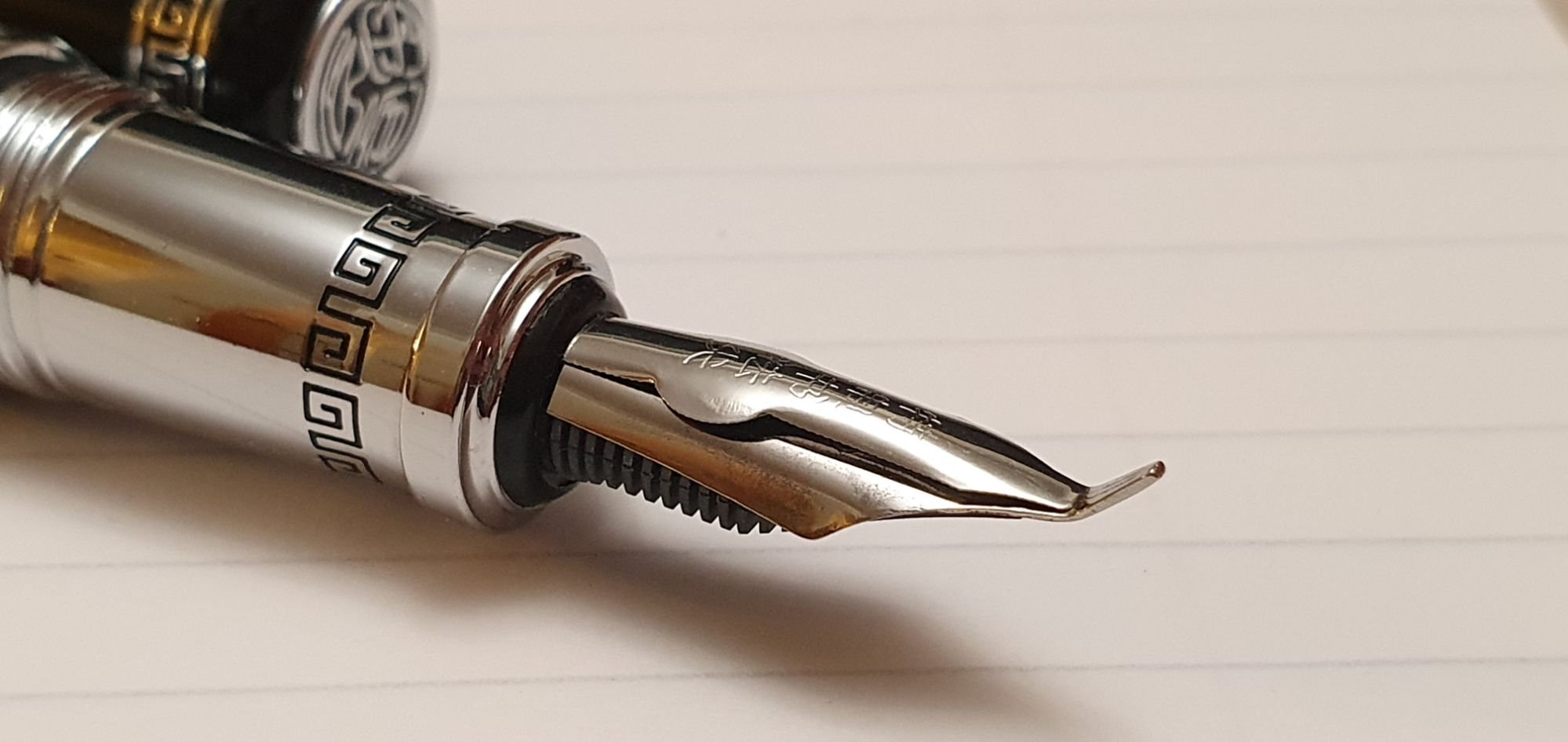
However, the main difference and reason to buy the 551, is for its amazing, steel fude nib. The nib looks quite alarming at first to anyone not expecting it. The tip is angled upwards, at about 45 degrees and presents a flat surface approximately 4mm long, to the paper.

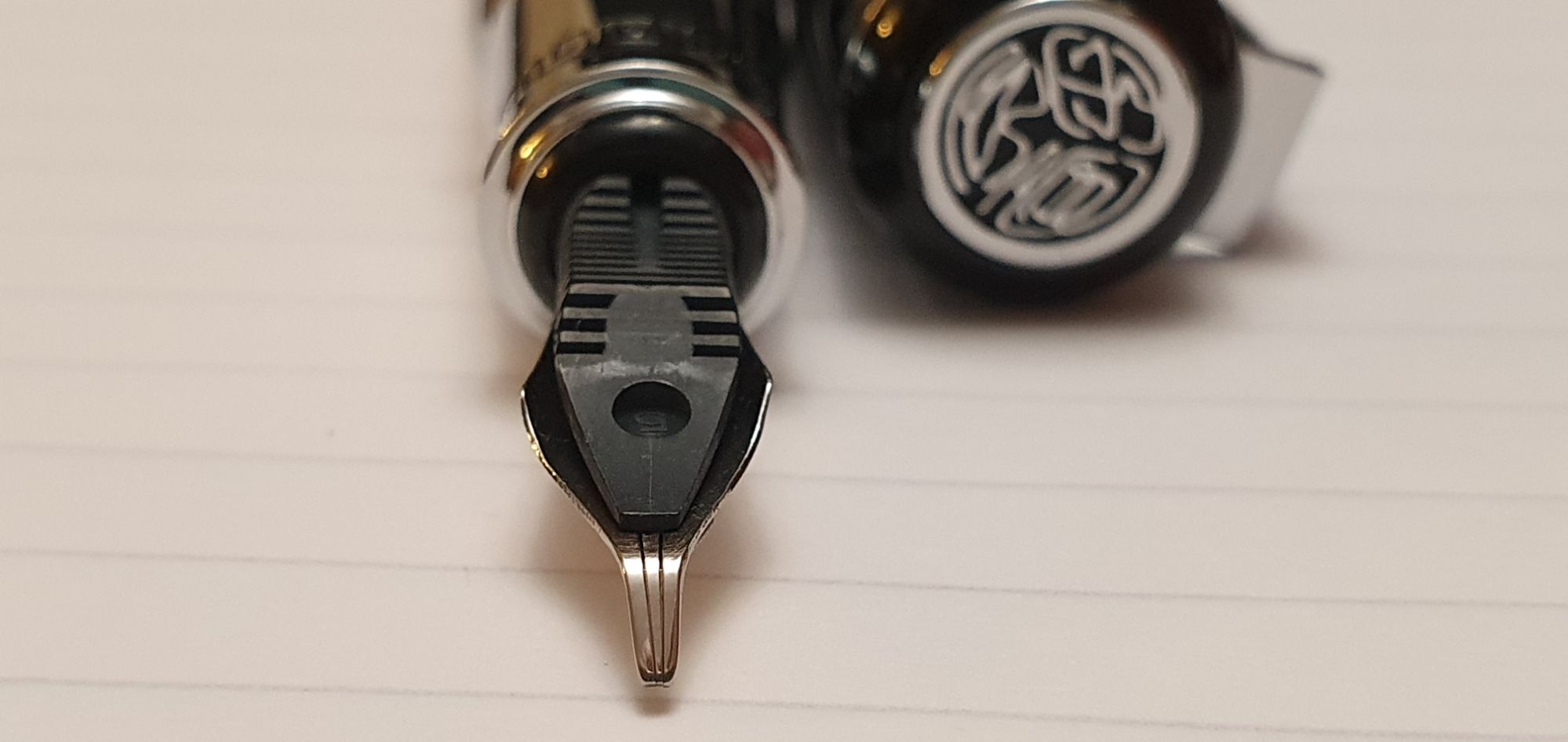
The three tine, steel fude nib with fitted ink reservoir for when dipping.

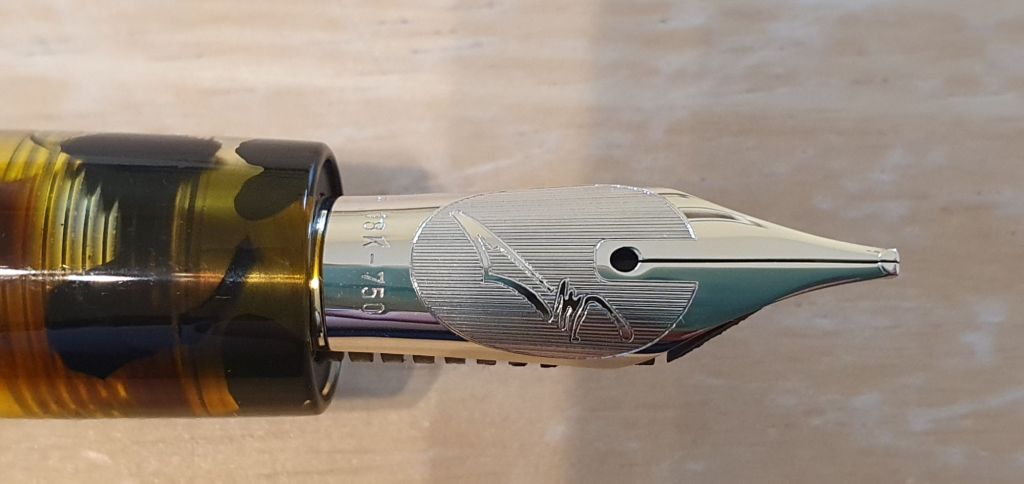
What I had not fully appreciated before the pen arrived, were two other special features of this fude nib, namely that it has two slits for improved ink delivery and an ink reservoir on top of the nib, so that when used as a dip pen, it needs dipping far less frequently. There are some Chinese characters on the nib, which my wife translated as “special calligraphy nib.”

Smooth nib with three tines, like some music nibs.

As well as its dip pen suitability, it is also a cartridge-converter filler and is supplied with a push-in converter. This contains a small coil of metal to serve as an ink agitator, which can be useful. However I saw in a YouTube video review by @chrisrap52 that this little spring does make it harder to flush the converter thoroughly when changing ink colours and he prefers to remove the spring, by unscrewing the metal collar of the converter.

A Duke branded converter is included.

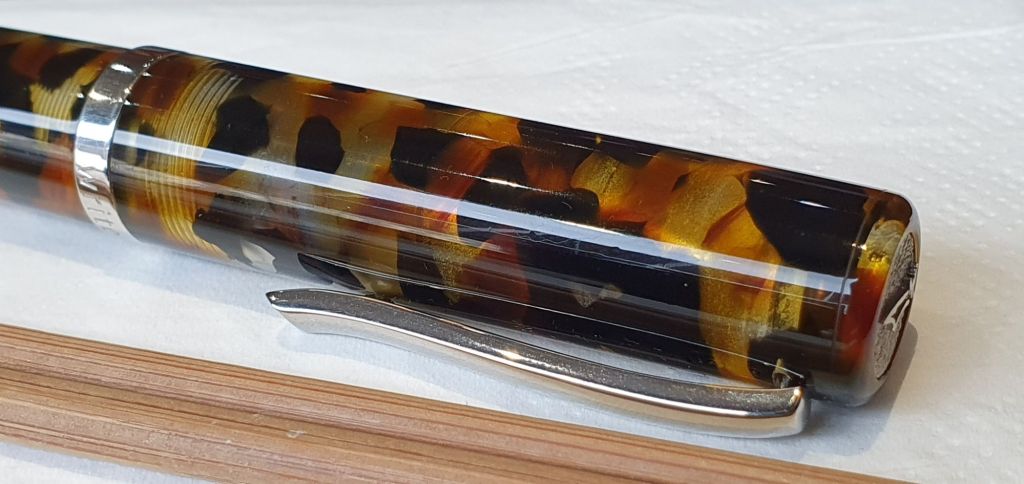
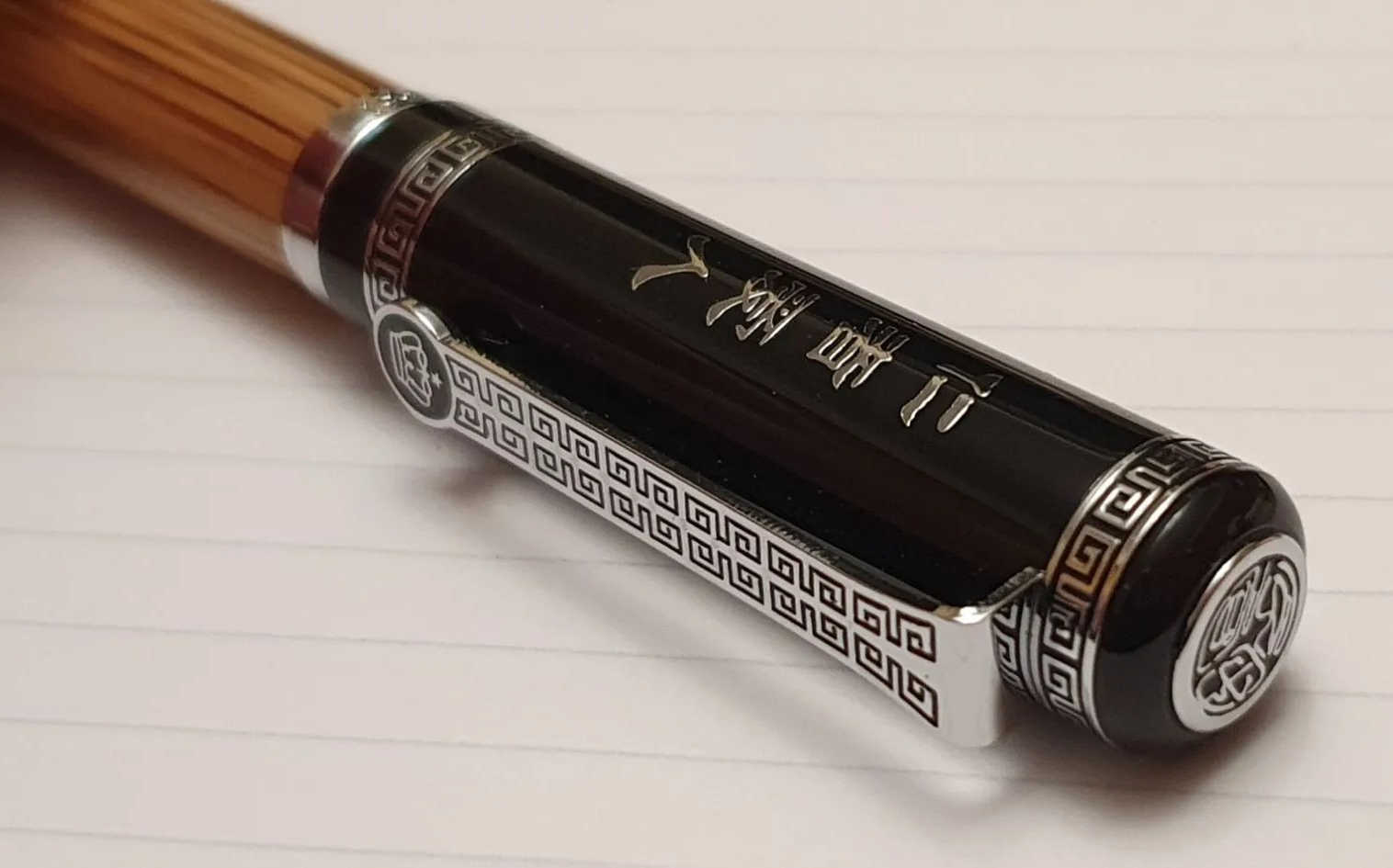
The cap features an engraving of Chinese philosopher Confucius on one side and more Chinese text on the other side. My wife translated this, approximately, as “A kind person loves everybody” which is part of a Chinese saying which continues “and everbody loves him.” There is a nicely decorated finial, a very stiff and strong pocket clip culminating in the Duke crown emblem and decorated metal rings at both top and bottom of the cap.

The cap unscrews in just over one full turn. When screwed on, it meets a rubber O ring, giving a reassuring tightness to the cap. It also makes for a good seal and, from other reviews I have read on Amazon’s site, the nib does not suffer from drying out although I have not had my pen long enough to put this to the test.

Lots going on with the cap too.

I very much like the natural bamboo of the barrel. I think the inside of the barrel may be lined in metal here, and it feels heavier than the Golden Stripe Bamboo barrel of my Duke 552 (23.5 grams as opposed to 16.5 grams).

I do not generally get on with shiny chrome sections, as they can be slippery to hold. However this one is of a substantial size. It tapers slightly towards the nib where there is some engraved ornamentation and then a step up at the end, to stop your fingers sliding onto the nib.

From my initial trials with this pen, I have not found the section to cause difficulty in holding the pen securely. I can keep my thumb on the bamboo barrel for better control. However, I am finding that where the pen rests on my middle finger, the step does feel a little uncomfortable and so it is necessary to draw your finger back from it slightly.

So how does it write? I was very excited to find out. After flushing the nib and feed and the converter, I filled the pen with Noodlers Black, a water resistant ink that would allow me to paint over the ink, once dry, with watercolours without the ink smudging.

The nib is very smooth, as I have read in other reviews. The twin slits, like a music nib, provide a more generous flow of ink to the nib, which is needed when making side strokes with that long fude nib. It covers large areas at a single stroke. It would be great as a redacting pen, for hiding confidential text from a document before disclosure.

The fude nib is designed for calligraphy, allowing for fine lines to be drawn with the tip or very broad strokes with the flat part. It is not a “zoom” nib and there is not an easy way to get a medium width line between these two extremes.

In the right hands, the pen would be great for sketching, as the line width extreme variation, and ease of blocking in areas of colour, are a real benefit. Mine are not the right hands to demonstrate this properly but I enjoyed trying.

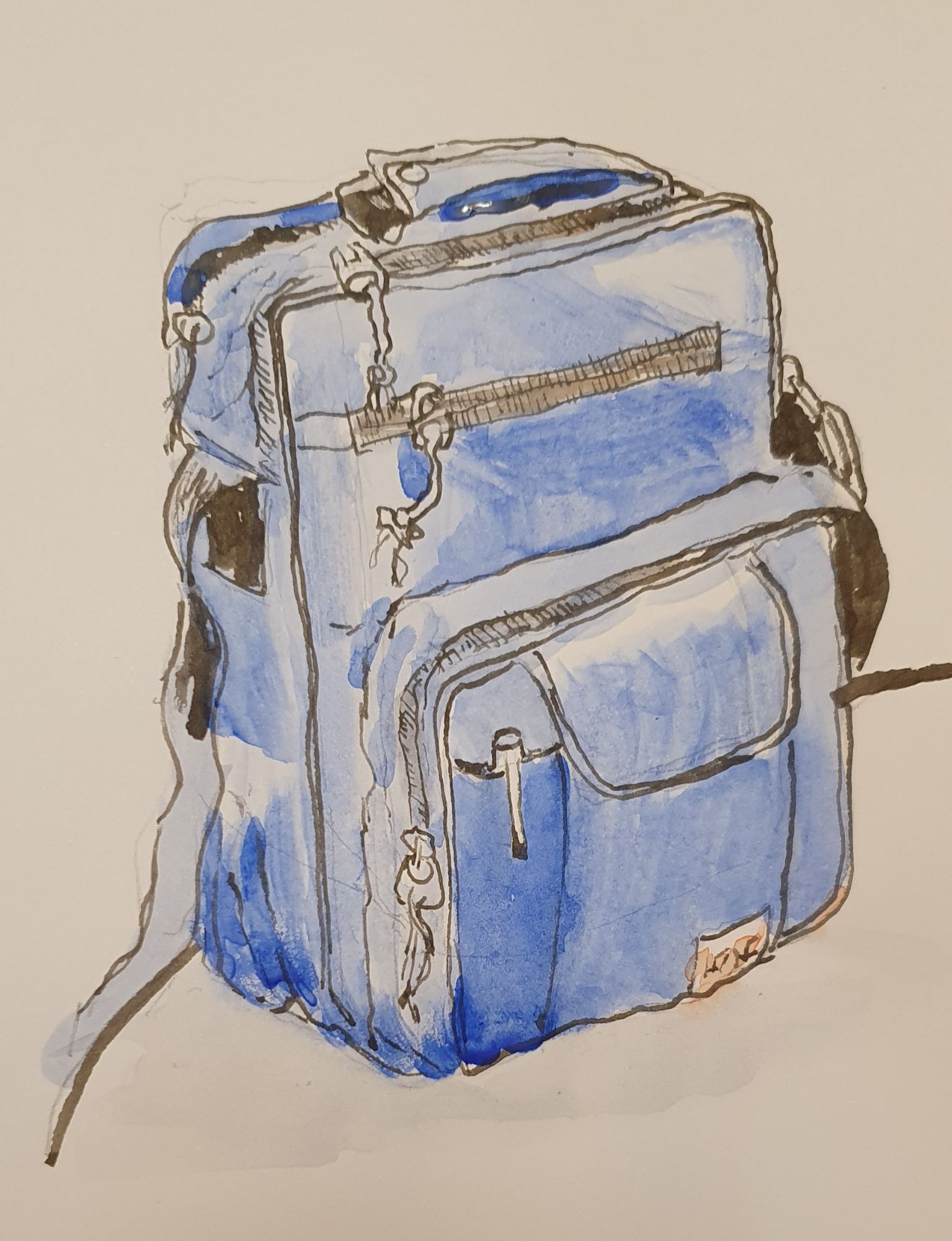
My man bag: Duke 551 fude, Noodlers Black ink and watercolours.

As for normal writing with this pen, it is possible but in order to get a fine line, the pen needs to be held upright at a steep angle, as you would for a ball pen. If the pen is allowed to lay back towards a more typical fountain pen angle, the line will be much broader and, with a 4mm line, you would need to write very large letters to avoid all the loops being filled.

It is very early days but already I am enjoying my experiments with the fude nib. It will get through a converter of ink quicker than most pens, particular if used for drawing and blocking in large areas. Before refilling it, I am keen to test out its built-in nib reservoir in dip mode.

Duke 551 Specifications:

  • Length capped: 147mm
  • Length uncapped: 132mm (I am very happy with this)
  • Length posted: 182mm
  • Weight (total) 64 grams (compared to 40 grams for the Duke 552)
  • Weight uncapped: 37.5g
  • Weight, cap only: 26.5 grams

Well, so much for my New Year pen-buying abstinence once again. I made it all the way to 18 January 2024 this time. But then this pen is quite an exceptional piece of kit and I am unrepentant.
Off topic: a brief romance with a Lorus automatic wristwatch.

This blog is generally about fountain pens as the name suggests, but I write to relate a recent tale in the world of watches. My excuse for this digression is that many people who enjoy fountain pens feel the same way about mechanical watches.

Whilst I have more than my fair share of high quality fountain pens, I do also enjoy seeing how good a writing experience can be had for minimal outlay. I regularly use a Cross Bailey Light which cost about £20.00 and various inexpensive pens from China. To a lesser extent, this curiosity sometimes spills over to watches.

Having owned several high-end watches I thought I knew a reasonable amount about automatics. It turns out that there were some glaring gaps in my knowledge.

First of all, I had looked down rather snobbishly on the brand Lorus, but learned only recently that the brand was formed by the Seiko Watch Corporation, the mighty Japanese giant and introduced in Europe in 1982. They are aimed at the lower end of the market for people seeking quality watches at affordable prices.

On a recent stay in Chichester, I was strolling the high street when I came across a display of Lorus automatics, in H Samuels. The one that caught my eye was the black dial, military-style watch with a day/date window. Given that Seiko automatics now start at around £260.00, a Lorus at £129.99 is one of the cheapest entry level options. Furthermore, H Samuel were offering 20% off, bring the price of this model to around £103.00. I walked on.

A Lorus military style automatic, reduced to £103.99.

A week or so later, back home in London I visited my local H Samuel branch hoping to take a closer look at this model. Alas, they told me that they no longer sold Lorus watches in their branch but only online. That particular model was (and still is) available on the H Samuel website but I did not pursue it. The price was certainly attractive but I was deterred by the day and the date window, envisaging that for a watch worn only occasionally, I would be forever resetting these.

A little later, whilst in John Lewis and enjoying my customary look at their watch displays, I saw a cabinet marked “Clearance”, in which I noticed a Lorus automatic watch, with a silvery white textured dial and hands in a style reminiscent of a grandfather clock. Remarkably, it was just £43.50. John Lewis is currently having its January sales, with large red signs urging shoppers to “Succumb to the sale.” This watch had a price ticket of £72.50 previously but was reduced by 40%. It had been put out just that day.

And a more dressy version for £43.50.

It was not the military style field watch that I had seen, but nonetheless I quite liked the whitish face, the vintage hands, and large size (42mm diameter case). There was no luminescence and there was still the issue of the day and date hassle. I asked to have a look at it.

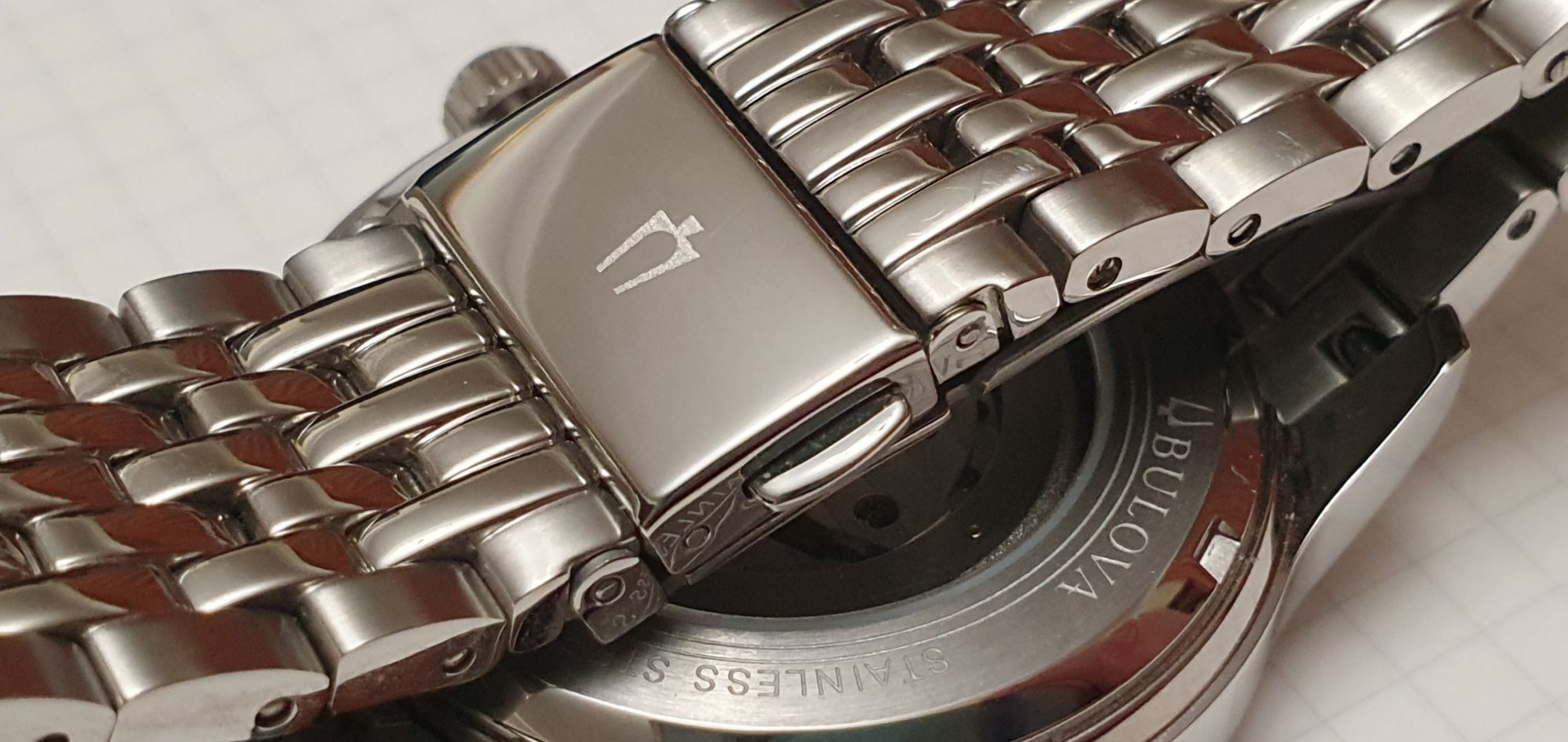
Handling the watch, the finish and quality looked and felt impressive, with its highly polished plated steel case and a black leather strap. There was even an exhibition window in the screw-down back, showing the automatic movement and the swinging rotor, on which “TWENTY-ONE JEWELS” was stamped. For a mere £43.50, it was one sixth of the price of the nearest Seiko automatic, and I felt it was a fun purchase and in need of a home.

A glass back gives a view of the Lorus Y676 automatic, 21 jewel movement.

Even the packaging was quite decent and appropriate: a small cardboard lidded box and the watch strapped around a soft brown pillow. The instructions and two year guarantee documents were below.

I was pleasantly surprised that the initial setting up of the day and date was no trouble at all and took only a minute: pull out the crown to the first click, turn it one way to advance the date and the other way to advance the day. Set them to the previous day, then pull out the crown to the second click, and advance the hour and minute hands to the correct time, (remembering to go past 12 o’clock twice if it is after mid-day).

Still a lot of watch for a little money.

However, what was not so easy was then getting the watch to start. Having no power at all, it was necessary to wind it sufficiently to start working before putting it on and allowing the automatic movement to keep the watch wound through the movement of the wrist. I tried to wind the watch manually but felt no resistance from the crown. Peering in at the movement, I began to fear that the mainspring was broken. I had wound the crown perhaps a hundred times and the second hand had not budged.

The instruction leaflet did not mention winding the watch with the crown but suggested that the watch be swung back and forth, horizontally, for 30 seconds. In practice, it needed considerably longer than 30 seconds but did start eventually and the second hand came to life, in the joyous way that mechanical watches do.

I looked online for some reviews of the watch. I found one at benswatchclub.com, for a similar model where it was stated that the movement appeared to be the same as that used in the Seiko 5 models. He states “To my understanding, the mechanism labelled as a ‘Y676C’ is a rebadged Seiko 7S26C, identical to that in most last-gen Seiko 5 watches” and “If you’re familiar with the 7S26, you’ll know that this movement is durable but rudimentary, with no hacking or hand-winding capabilities. You’ll have to rotate the watch to get it going manually.”

This was a revelation. The good news was that my mainspring was not broken. But here was the second big gap in my knowledge: I am embarrassed to say that I did not know that some automatic watches could not be wound by hand.

I also learned that “hacking” refers to the ability to stop the second hand by pulling out the winding crown, necessary for military watches in order that they could be synchronised. Mine did not have that facility either.

Whilst I admired the intricate design and finish of the watch and obviously its price, (the leather strap alone must be worth half of this), I was put off by the lack of a manual winding option.

I am sad to say that ultimately the watch and I agreed that each of us was not what the other wanted. I wanted an automatic, but one which I could wind up quickly for occasional use. I like to wear a different watch at weekends from the one I wear on weekdays.

The watch, on the other hand, wanted an owner for whom it was his only watch, perhaps his first ever grown-up watch, and to be worn every day so that the absence of a manual wind option was immaterial. It did not want an owner who would compare it unfavourably and unreasonably with other, vastly more costly timepieces but would enjoy it for its own merits, not only for its cheapness.

And so, with some regret, I returned the watch to John Lewis for a refund early the next day, still a little sad to see it go but having learnt from the experience. This turned out to be a “catch and release” or as my late father used to say “easy come, easy go.”

The new year diary, 2024.

Last year, my daily journaling was done in a page a day, Moleskine 18 month volume. I bought it too late to make use of the pages for July to December 2022, but was happy to have them as a sort of bonus notebook.

I persevered with the book although it was not particularly enjoyable to use. This was not, as you might think, due to paper quality which was actually quite pleasant and fountain pen friendly, but rather because I did not like the line spacing of only 6mm row height. Added to this, I found the width of the pages, at 130mm, a bit narrow. An A5 page is 148mm wide and losing 18mm makes a big difference, particularly on days when I wished to use a balloon diagram, to confer some retrospective order on the previous day’s events.

For 2024, I have gone back to my more usual Ryman A5 Page a Day diary. This does not suffer from either of my two complaints above: the row height is 7.6mm and the page width is the full A5, 148mm size. These two features make it more comfortable for me to use. However, it is not perfect. On removing the cellophane at the start of the year, my first discovery was that the covers were thin and bendy and not stiff as I had been used to. To be fair, the description on the belly band states “2024 Soft Cover Flexi Diary, Page a Day”. The word “Soft” refers to the texture which is like a faux leather, whilst “Flexi” means “bendy”, rather than “versatile“.

Whilst on the subject of the description, the words “Page a Day” apply only to Monday to Friday. Saturdays and Sundays have to share a page, which is always a pity. Rather than add the words “but only Half a Page a Day at Weekends!”, Ryman has instead chosen silently to include an image of a double-page spread with a Friday, Saturday and Sunday in view if you look closely.

New Ryman A5 diary for 2024, alongside last year’s Moleskine book.

Other than that, there is not much to add. The Ryman paper is a cream colour, 80gsm with a pleasant texture and fountain pen friendly. The binding is sewn to help the book open flat and there is an elastic closure. Given the rather insubstantial cover, there is a metal reinforcement at the edge, to prevent the elastic from wearing away at the cover. But (a) the metal is not stuck down on the front and so leaves a sharp edge, and (b) there is no metal reinforcement for the back cover. I would have preferred that there be a hardback cover so that reinforcement is not necessary.

This will be used for my daily journal, usually written up after breakfast, recalling the events of the previous day. This is an opportunity to enjoy a few minutes with a fountain pen, as well as a memory exercise.

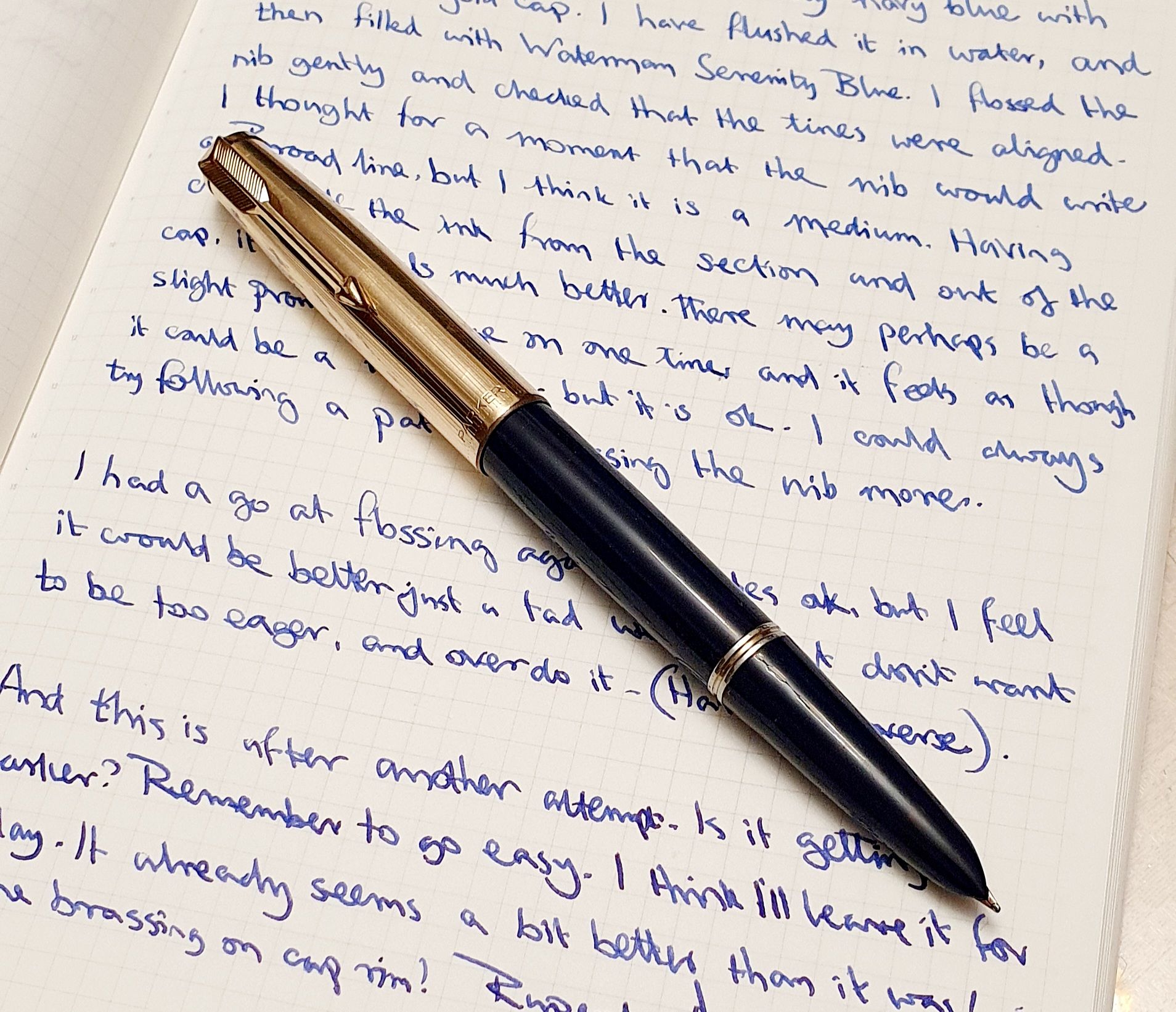
It has also been a recent custom of mine to stick to one fountain pen and ink per month for my diary entries. For January I have started with the Parker 45 (14k gold, medium nib) with Waterman Serenity Blue that I wrote about rather gushingly in my previous post.

A Page a Day is for Mondays to Fridays only.

Aside from the diary, I write on most days, in a Stalogy 018 Editor’s Series 365 Days Notebook A5 size. I love the paper in these. I carry this to pen club meets and when out and about, in a stiff leather cover with elastic closure. The cover is a very simple single board, not quite A5 in width and is so stiff that it wants to slam closed all the time. I liked the fact that it did not have any pen loop, credit card pockets or other features, as I found that these make for a lumpy surface if you are writing with the book open inside the cover. However, in practice I found that the cover works much better for me, with my notebook tucked in the other way around, purely to protect it and keep it closed in transit.

My backwards “traveller notebook” set-up.

Writing with a nice fountain pen in a Stalogy notebook, is one of my favourite things to do. I use it for all sorts of things, although mostly for enjoying my pens and inks for the sheer fun of it and not for writing anything profound. This is an inexpensive form of relaxation and we all need one of those.

I do also have an A4 Ryman notebook which serves as a bullet journal, or bujo. This is a simple book of lined pages, 37 rows per page, on which I have listed dates for a month down each left-hand page, leaving the right-hand page clear for notes, often divided into two columns. This had enough pages for 2020 to 2025 inclusive, although after four years the cover is getting a bit tatty and flaky now. I find the bujo very useful for diarising dates that are far ahead, such as insurance renewals, road tax and car MOT and service due dates and a few others. Having six years at 24 pages per year, required 144 pages. As the book has 192 pages, this left plenty of double page spreads for lists, such as books read (or to be read), albums to listen to, TV episodes to watch, monthly steps counted and so forth. The possibilities are endless. I have not adorned it with washi tape or ink stamps like the photogenic ones we see on Instagram, but each to his own. I may however create a page for “Fountain pen wish list 2024”, although what I really need to do is to practice not wanting more things. As always, we shall see.

2023: some of my fountain pen highlights.

I usually start this exercise by looking at how many pens I acquired over the year and how much I spent on the hobby. 2023 saw me acquire 39 fountain pens, of which four were gifts for others, so 35 for me. The total spent was £1,676.19: not too terrible.

A strong theme throughout the year was vintage Parkers, mostly bought on eBay plus a small number at the London Pen Shows.

Always late to the party, this was really the first year in which I started looking for and buying vintage pens on eBay. Of the pens acquired in 2023, 15 were vintage Parkers and the remaining 24 a mix of other brands. I would search a make and model, say “Parker 17 fountain pen,” for example. This might find several hundred listings, which I would whittle down by filtering the results to UK only and then sorting them in order of auctions ending soonest.

Occasionally, a special item would come up, such as a Burgundy red Parker 17 Super Duofold with the early “beak” nib, which I would set my heart on winning. In the days leading up to the auction, I repeatedly checked how the bids were going and always stopped to look at the close-up photographs, particularly of the nib, front and back. Happily I was successful and that pen is now mine.

After buying a number of Parker 17s, with their 14 carat gold hooded nibs and hooped squeeze-bar fillers, I moved on to the Parker 61. Again with so many for sale I decided to be choosy and ignored any with the inlaid arrow missing from the section. By the end of the year, I had acquired four Parker 61s. Two were the early, capillary fillers, with one of these being the “Heirloom” (with two-tone rolled gold cap also called the rainbow cap). Two were cartridge or converter fillers; one was a Flighter; one was Made in USA and the others all Made in England; so, a good cross-section.

I was thrilled when a Parker 51 with an oblique nib came up and again when I found a Parker 45 with an oblique medium nib. Both are great for me to use in lefty-overwriter mode.

Some of my 2023 vintage Parker finds.

Eventually, my wife expressed concern that my buying of Parkers on eBay was getting “out of control,” and that temptations would be never-ending, since hundreds more pens come on the market every day. True. We agreed that a recent, lovely teal Parker 61 would be my last. 

It was about this time that I happened to spot a black Parker 45, with a 14 carat gold Medium nib, in great condition. I zoomed in on the close-up nib photos and made screenshots of them. It was only £24.99 “buy now or best offer”. I held out bravely for a few days but then received a thoughtful notification from eBay that the seller had dropped the price to £19.99! This was too much to bear. I knew from the photos that the pen would write like a dream. A vintage Parker, with a pristine gold nib at less than the price of a new Parker Jotter or Lamy Safari. I could not not buy it. Then a solution came to me: I would buy the pen, but as a gift for someone else!

The pen duly arrived. As it was to be a gift, I had to check it first, flush it and test it out. The nib was as wonderful as I had imagined and needed only a light flossing with a brass shim and a rinse. I separated the nib and feed to clean and photograph them. The sac puffed out air bubbles into the water and all looked well. I dried the pen and filled it with Waterman Serenity Blue. It was a joy to write with. Ink flow was ideal, once I had ejected about three or four drops of ink.

I decided to “test” the pen over a few days. Big mistake. This pen was exceptionally enjoyable and I bonded with it. With Serenity Blue, it wrote like my Pelikan M800. There was no way I could part with it. Instead, I gave the intended recipient a lovely new fountain pen of equivalent price.

Of the remaining brands represented in my 2023 acquisitions, these included a flurry of Jinhaos, first the X159 and later the 9019 and 82 models. After trying these, the most enduringly successful seem to be the blue demonstrator version 9019 with an EF nib and filled with Diamine Tavy blue black and the 82 in Caribbean Sea Blue with gold trim, F nib and the same ink. Both start immediately after long intervals and write smoothly with good flow.

I greatly enjoyed the London Pen Shows in March and October. These are always joyous days, running into numerous friends from the online fountain pen community and talking to the sellers. Some of my favourite buys of 2023 were:

  • Montegrappa “Monte Grappa”, in black with 14 carat gold M nib: possibly John Hall’s last one as Write Here of Shrewsbury was to end links with this brand;
  • A Cleo Skribent Classic, cartridge-converter filler version in Burgundy red with 14k Broad nib (also purchased from John Hall);
  • An Aurora Duo-Cart, sold by Kirit Dal from his ex-samples tray at a generous discount; he kindly sent me a branded Aurora converter for it afterwards and a box of cartridges.
  • A Benu Euphoria Bourbon, with a broad nib, from Stonecott Fine Writing Supplies Ltd: the perfect vehicle for Diamine’s Caramel Sparkle ink.

My last and quite possibly most special fountain pen arrival of the year was a gift from my aforementioned wife, bought whilst on her trip to Hong Kong in November. It is the Pilot Custom Heritage 912 with a 14 carat gold Waverly (upturned) nib. I use it every day and it is a wonderful pen, with an element of Unobtainium about it, since they are not readily available in the UK. The WA nib is great for me as a lefty who uses both over and under-writer styles.

I have enjoyed attending our monthly pen club meets, (The London Fountaineers) whenever I can. Also, there have been daily interactions with a host of fellow enthusiasts online, via WordPress and Instagram and in correspondence from the UK and beyond.

As I do every year (and usually fail), I will endeavour once again to buy less pens, ink and notebooks and to make more use of what I already have. Thank you for reading and I wish everyone a Happy New Year.

Some of The London Fountaineers at our Christmas meet. I am the one with the bunny ears.

Remembering my dad, Manouk Sarkis Arzeian, (1929 – 1983).

In normal daily life it is rare that anyone asks me about my late father. To be fair, I do not often ask other people about theirs. We are too busy, caught up in our own lives.

Yet I think about him often. Today, 9 December 2023, marks the 40th anniversary of his death. He was aged only 54 and had been admitted to hospital for a coronary by-pass operation, but passed away before the surgery took place.

He had been fit and active all his life. He was born in 1929 to an Armenian father and English mother and grew up near Ealing, west London. He worked for a time in his father’s antiques and carpets business, before moving on to work for an electronics company. He met my mum whilst they were both working for Ultra Electronics in Perivale in the mid 1950’s and they married in 1957, moving into a new detached house in Ickenham, a suburb of London which had a pleasant, village feel. I was their first child, in 1959 and was later joined by a sister and then a brother.

Dad stayed at Ultras, working as an electrical maintenance engineer until 1974 when he moved to a similar role at EMI, better known as a record label, although he worked in a totally different division, building electronic equipment.

At home, he always kept busy, outdoors mostly, such as in tackling jobs in the garden or doing all his own maintenance on the house or the car. One end of the garage comprised his workbench, full of tools and surrounded by odd pieces of scrap metal and wood which might be of use. He once built me a magnificent go-cart, which my friends and I loved to ride around the garden. My parents had landscaped the garden, to include a pond, which my friends and I loved to play in.

He had numerous interests over the years, from collecting coins, Victorian bottles, fossils, flint arrow-heads, attending philosophy evening classes, and a keen interest in watches, cameras, and guns – to name a few. He enjoyed the novels of Nevil Shute and was keen on old films, having been to the cinema’s matinee club, every week for a year as a child, knowing all the Hollywood greats.

If we visited a town centre together, we would always pause at watch shop windows, and pass judgment on all the watches on display and pick our favourite. As a young man he was proud of his Heuer Chronograph. I recall that, as his tastes changed, he bought a Rolex GMT Master, but after a few years, swapped this for a Rolex Submariner (or it might have been the other way round). He then tried the new Bulova Accutron, before eventually coming full circle and reverting to simple, inexpensive hand-wound mechanical watches such as Sekondas, that he did not need to worry about.

Dad, late 1950’s or early 1960’s wearing his Heuer Chronograph.

I remember him trying numerous different, mainly 35mm cameras too, from a Contax, to a heavy Russian Zenith E (his first SLR camera), a Petri TTL, then an Olympus OM1, his favourite. There were many others, including a Konica with one of the first auto-focus systems, a tiny metal Minox “spy camera” and a Zorki 4.

His other most enduring hobby was shooting. He held a firearms licence and, as with his watches and cameras, progressed through a number of different models. He often took me with him to Bisley ranges on a Saturday morning, or to our local gun club, from the age of about 6 onwards. When I later went to a boarding school and joined the cadet force, I did at least have one advantage in that I was already familiar with handguns and rifles. Dad had owned dozens of different models.

He had not been interested in fountain pens, but if he had, I imagine that he would have gone through a similar journey as he did with his watches, cameras and guns, always wanting to try something else, before eventually concluding that he needed only something simple and inexpensive.

As a young man he took an interest in law and liked to discuss legal issues with an acquaintance who was an in-house solicitor for a large corporation. He was happy that I was to go into the legal profession. By the time he died, I was 24 and had been working as a trainee solicitor (then called an articled clerk) for two years and was due to qualify in March of 1984, embarking on a career of almost 40 years as a solicitor in private practice.

Memories of my dad often pop into my head and catch me unawares. About 10 years ago, I compiled a list of some that I could remember, giving them each a key word or words and then sorting them alphabetically in a mobile phone app called Colornote. I continued to add to my list for some time, before writing up these fragments of childhood recollections, one by one, with a fountain pen in an A5 journal. I tried to set aside an hour on Thursday mornings, when I could rise early and enjoy some quiet time with a pen and notebook. Within a few months I had “written a book”, albeit of significance only to myself. It felt good to have these memories down, in case I forget them later. I have since given this to my niece Emma, who missed out on knowing her grandfather by a few years. I was to repeat the writing process later with memories of my mum, then my school days and then college years. It was an enjoyable and satisfying process which I would recommend.

A few weeks ago, it occurred to me that my dad’s date of death, 9th December or 912, was also a model of a Pilot Custom Heritage fountain pen that I liked. I toyed with the idea of buying one in his memory, although admittedly that seemed a weak excuse to buy yet another pen. However, when my wife was in Hong Kong recently and asked whether there was anything I would like her to get for me, the idea of the Pilot CH912 was at the front of my mind. She very kindly tracked one down on her last full day there, with my first choice of a Waverly (WA) nib as requested. I love it. I like to think that dad would appreciate his 40th anniversary being remembered and marked in this way.

One of the pen shops my wife visited in Hong Kong. Just as well I wasn’t there.

Early thoughts on the Hongdian N23 Year of the Rabbit fountain pen.

I am lucky to belong to a fountain pen club that meets once a month in the convivial surroundings of a pub in London’s Spitalfields market. This is where I can spend three hours thinking and talking about pens in the company of equally enthusiastic pen people.

At our latest meet, as my notebook reminds me, I had enjoyed trying out a variety of fountain pens, including Bryan’s Pilot Custom Urushi, a Hakase ebony, and a special Platinum 3776 in briarwood and then a few of Peter’s vintage Kingswood pens with Swan nibs. I then picked up one of Baran’s pens in what appeared to my untrained eye to be an urushi lacquer with intricate gold maki-e artwork on the cap and barrel. The large gold-coloured nib featured a rabbit imprint and a rather long tip, rather like photos of a custom architect grind, that I had seen on Instagram, on Marc Bacus’ @nibgrinder site.

When I put pen to paper, the sensation was of a deliciously smooth nib, producing a bold line with some subtle line variation. I asked him whether this was a custom grind. “No” he replied and went on to confirm that this was a factory nib and that he had not done anything to it, other than perhaps a little smoothing. To my surprise, the pen in my hands that I had thought cost hundreds of pounds, was a Chinese Hongdian model N23, or “Year of the Rabbit” edition, costing around £40.00 on Amazon. I made a mental note to look into this!

Hongdian N23 “Year of the Rabbit” pen.

As the afternoon progressed, I was able to try many more interesting pens that were circulating the tables. I reciprocated, handing around my recently acquired Tibaldi Infrangible Black Gold, and a Parker 61 Heirloom, capillary filler with one of the smoothest hooded nibs I have ever known.

Back home that evening I looked for the Hongdian N23 rabbit pen. I found that it was available in four colours, red, black, blue and white. The red and the black versions featured gold coloured engraving, whilst on the blue and the white versions, it was in silver colour. Also there was a choice of an extra fine nib or the nib that Baran’s pen had, which they called a “long knife” nib. I opted for the red version with long knife nib. As luck would have it, there was a 20% discount on for Amazon Prime members and the pen would arrive the next day.

Unboxing.

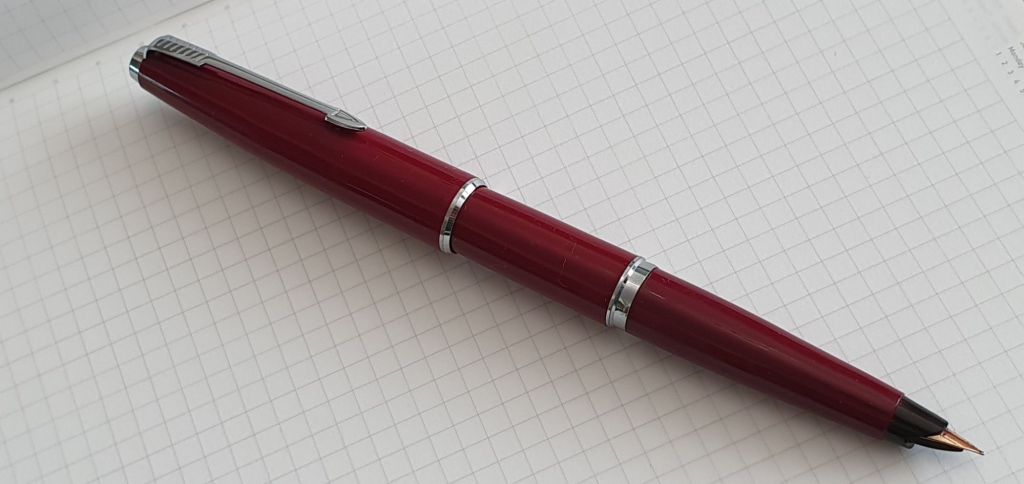
The pen comes in a grey cardboard outer box, inside which is a metal box, with the pen nestling in a foam surround and in a polythene sleeve. Having more time to inspect it closely, the quality of finish looked and felt good. The pen is of metal construction, but coated in a rich Burgundy piano lacquer and the artwork, which appears to be engraved or applied in gold, includes a rabbit on both barrel and cap, plus trees and foliage and distant hills in the style of a Chinese brush and ink painting.

Joy and anticipation.

Construction.

The pen has rounded ends and a screw cap. There is a gold coloured pocket clip which looked as if it might be sprung but is not, and is extremely stiff, functioning better as a roll-stop. The cap unscrews in one and a half rotations. There is a comfortable grip section, ending at the nib with a flat-fronted ring. The nib and the ring are, I think, gold plated although the nib is not marked as such, at least not on the part of the nib which is exposed. Whilst the ring looks nice I suspect that it may reflect sunlight into a halo around my writing, which is a first world problem I have sometimes with my Pelikan M800.

The “long knife” nib option, with rabbit motif and a gold plated ring.

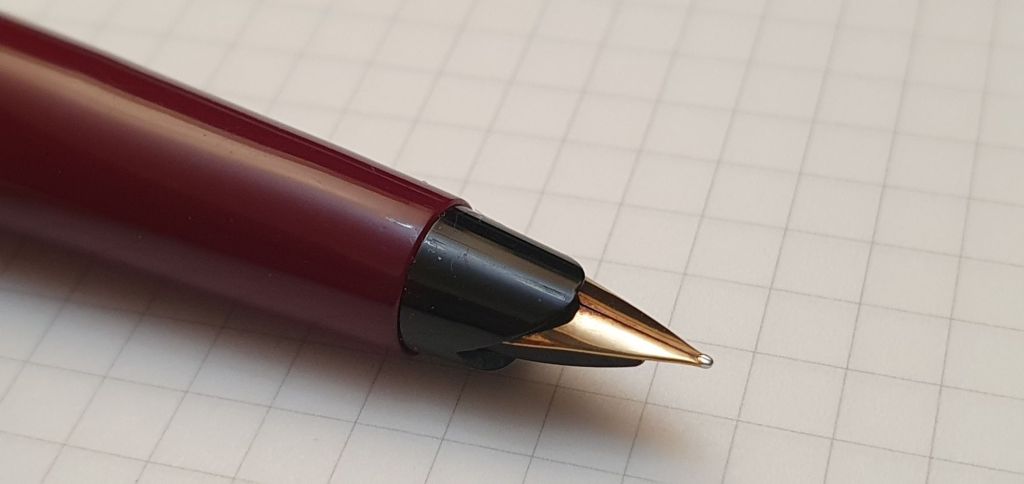
The nib has another rabbit motif and a plastic feed. The tipping is rather special. It is not a flat, architect type grind but rather, presents a curved edge to the paper so that the pen may write smoothly however steeply you hold it to the paper. This is similar to the principle of Pilot’s Waverley nib, except that the curved writing surface is formed by the shape of the Iridium tipping material, rather than by having Pilot’s gentle upward curve to the tines.

A surprisingly fun nib for a £40 pen.

The pleasing quality continues with the metal collar to support a cartridge or converter (the latter being included in the pen) and a rubber O-ring to help seal the pen against leaks and to give the barrel a more secure hold, when screwed in place. The threads inside the barrel are also metal.

Plastic threads for the cap, metal threads for the barrel. Converter includes an ink agitator ball.

The writing experience.

Very smooth. I inked the pen initially with Montblanc Corn Poppy Red, which was quite pleasing but changed it the following day for Diamine’s Pelham Blue. The ink flow was just right, giving a nicely lubricated writing surface. On my Stalogy notebook paper, it writes very well although on Basildon Bond’s writing paper, the nib struggled with the smooth paper and skipped a lot.

Trying a few different writing styles on Stalogy 4mm grid paper.

The line width, although I do not have an accurate means of measuring it, appears to be around 0.6 mm on the cross stroke, at my usual writing angle. This is not a nib designed to write lines of different thickness according to how steeply you hold the pen (as with Sailor’s Zoom nib for example) but rather, seems intended to write smoothly to accommodate different ways the pen might be held.

Weights and measures.

The pen, capped is around 141mm long. Uncapped it is 122mm. I do not like to post this cap, for fear of damaging either the cap threads or the barrel engraving. It does not post very deeply or securely and I have not pushed it. It weighs a decent 35g, being 21g uncapped and 14g for the cap alone. That is a good optimum weight for a pen in my opinion.

Gratuitous Porn Copy Red

Conclusions.

I am glad to have found this pen, with its attractive appearance and unusual tipping. I enjoy writing with it. It serves as a lovely smooth broad nib and at a modest price. The rabbit is a symbol of good luck, prosperity, happiness and serenity in Chinese culture. Certainly, I feel lucky right now. I am lucky to have so much pleasure from the fountain pen hobby. I am lucky to have this blog and today’s post is the 250th.

The lucky rabbit.

This is my first Hongdian pen. I wonder whether they may bring out a new edition for each Chinese New Year. This could be a slippery slope.

Early thoughts on the Tibaldi Infrangible Black Gold fountain pen.

This was an impulse buy when I visited Selfridges’ Fine Writing department fully intending just to have a look around. Having said that, I am very glad to have stumbled across this pen and have no “buyer’s remorse.”

Visitors to Selfridges’ pen area on the lower ground floor, will notice that it has diminished in size over the last few years, but still has an interesting range of high-end pens, including a good selection of Onoto for example, although the number of brands is reduced.

Having circled the island of attractive displays in the brightly lit glass counters, one looks along the row of displays in glass cabinets along the rear wall. Here I found a cabinet of Tibaldi pens, in various colours and moved in for a closer look. I might have moved on eventually, but the young lady assistant, Monshoor, timed her approach just right and asked if I needed any help. “Yes, help me to not buy any more pens” is what I might have said. Instead, something in my brain took over and said “Thank you, can I please have a look at that one?” and pointed to a fountain pen from the display of Tibaldi Infrangible (meaning “unbreakable”) pens. She unlocked the glass window and handed the pen to me.

Tibaldi Infrangible. Made in Italy.

Here I should point out that most photos of this pen do not do it justice. Even getting it home and photographing it in my light box, the multiple tiny LEDs did not show off the material at its best. It really needs sunlight or a bright spotlamp.

There are ten colour options with this model. This particular version is, I think, called the Black Gold. I say “I think” because I have since seen a similar pen for sale on eBay but described as the “Chrome Yellow Special Edition.” Certainly there is a Chrome Yellow version, but according to photos on the official Tibaldi website, it has the patterned resins in the cap only, whereas the barrel and section are all black. I am not aware of any special editions. The Black Gold, on the other hand, has swirls of yellow in the cap, AND barrel and grip section. I read that they are formed of gold dust in the resin.

Yes, this is the same pen, but from another side.

Anyway, whatever this version is called, I was smitten. Under the bright spotlamps in the shop, the coloured resins came alive with a brilliance as I turned the pen in my hands. Although it is the colours which initially catch your attention, the high quality of the resin in the hand is reassuring, polished and gleaming. The steel nib also looked immaculate. The nib is paired with an ebonite feed, a feature which I much appreciate, to improve ink flow and reduce hard-starts.

Steel nib, in a Medium.

Having confirmed to Monshoor that I wished to buy the pen, she offered to get me another one in a box. Here, some care is needed as the patterns in the coloured resins on every pen are unique. This is a pen that really is best bought in a bricks and mortar shop where you can look closely at what you are buying.

I enjoyed being able to compare the display model with a similar one, but concluded that I preferred the distribution of colours in the display model that I had seen first and so that was the one that I took.

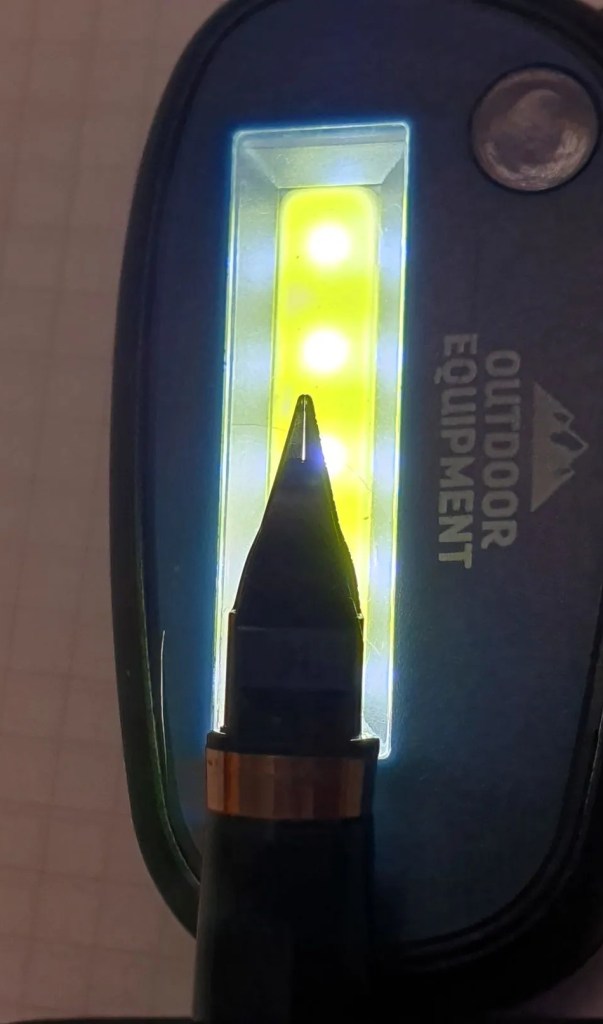
I had not yet tried writing with the pen, nor checked the nib other than a brief visual. Under my loupe, the nib was even more pleasing than I first thought and looked to be tuned just the way I like, with the nib slit narrowing towards the tip but still with the smallest of gaps, showing light between the tines at the tipping. The tipping was nicely rounded, polished and symmetrical and the tines were well aligned.

Converter included.

The pen came with a converter and a packet containing one black and one blue cartridge, of the standard international size. I flushed the nib and section and pondered what ink to use. Although I try most new pens first with Waterman Serenity Blue, I decided instead, quite rightly as it turns out, that the pen would like an Italian ink and filled it with Campo Marzio Tabacco, a rich dark brown that flows and shades well.

And so to the writing experience. The grip area is of generous girth. There are cap threads and a step at the barrel, to enable the cap to close flush with the body. You do feel these but I do not find them uncomfortable. The nib, as expected, wrote smoothly and with an ink flow that was neither too wet nor too dry. It should be noted that the nib is very firm.

Capping the pen: The cap unscrews with about one and a quarter turns. A useful tip is that when you have a pen with patterns in the cap and the barrel, it is nice to line them up (if you can), the same way every time. This pen has three entry points for the cap threads, giving you three choices for the position of the cap, in relation to the barrel. The way to take advantage of this is to hold the cap horizontal, with the clip at the top, or 12 o’clock position and then insert the pen with the nib also at the 12 o’clock position, into the cap until it touches the threads. Then turn the cap slowly, the wrong way until you hear the first click and then tighten the cap in the correct direction. Repeat, but with two clicks and then with three clicks and remember which of these gives you the best result.

My notebook set-up.

The cap has a steel pocket clip, notable for its absence of any adornment. It is simply a straight, rectangular bar and appears to be chrome plated. It is very stiff to raise and so would grip a pocket securely but would be hard to operate. The cap can be posted, quite securely and covering the barrel to about one half of the cap’s length, but the pen then becomes about 160mm long. The uncapped pen measures a comfortable length of 130mm and so I find no need to post the cap.

In the unlikely event of any problems arising, all Tibaldi products have a 24 months’ guarantee, against any manufacturing defect. The pen comes in a sturdy black cardboard box with a slide out tray and a dark orange paper outer sleeve. It is a nice box if you wish to keep it, whilst at the same time being a box that you could recycle without missing too much.

I am delighted with the pen. Features that I particularly enjoy are:

  • beautiful autumn-leaf gold colours and distribution of contrasting colours in the resin;
  • a joy to have and to hold, as well as to write with;
  • comfortable to grip and of an ideal length unposted (for me);
  • well made steel nib: smooth, with good ink flow but very stiff;
  • three alignment options in capping the pen;
  • converter included (as well as two cartridges to get you started);
  • last but not least, an ebonite feed: a rare luxury for a pen at this price.
Ebonite feed.

All in all, this looks and feels like a pen that you could use happily for hours on end and then simply gaze upon for a few hours more.

A few indulgences. Tibaldi pen, Stalogy notebook and a freshly-baked oatmeal cookie with cranberries.

The Benu Euphoria Bourbon fountain pen: early thoughts 7th blogiversary post.

In my recent post about my pen show haul, I mentioned my Benu Euphoria Bourbon and the fact that it deserved a post of its own. Well, here it is.

I first laid eyes on this pen at the London Pen Show in October 2023, on Derek Bambrough’s Stonecott Fine Writing table. The pen just calls to be picked up and looked at. Also on the same table were inks from Diamine’s Shimmering Fountain Pen Inks range, including Caramel Sparkle and it did not take me long to imagine them together.

The Benu Euphoria, Bourbon edition.

All of this surprised me, because I was not previously drawn to fountain pens that are sparkly, nor had I any urge to use glittering inks. I thought that I would have no use for them and that they would clog my pens. As recently as 31 July 2023 in my post on the 21 plus 5 pen questions, I had been dismissive of sparkly pens and inks, although mentioning that if I were to buy a sparkly pen, it would be a Benu Euphoria. This name-dropping suggested a knowledge of sparkly pens which was a little disingenuous, as I had been shown a Benu only the day before, at a pen club meet.

I later read on Cult Pens’ site, that Benu was created in 2016 and that the Euphoria range celebrates life and things that bring us joy. This particular model celebrates Bourbon, a whisky (or whiskey in the USA) distilled from maize and rye and named, according to The Concise Oxford Dictionary, after Bourbon County in Kentucky where it was first made. I have not found any suggestion that the pen celebrates the Bourbon chocolate biscuit, named after the French or Spanish House of Bourbon. Details of this pen range as well as some special editions and the other lines can be seen at http://www.benupen.com.

Ten facets on the cap and barrel.

Handling this pen at the pen show, the material did not suggest whiskey to me, but rather a woodland carpeted with sun-lit autumn leaves. As you turn the pen in the hand, areas of red appear, like pools of blood at a crime scene. Not exactly a joyful image I agree, and I do not mean to spoil the pen for anyone, but I thought of Armenia and its troubled history. Benu pens are hand-made in Yerevan, Armenia. I found the pen both poignant and beautiful and, having some Armenian ancestry myself, of course I had to buy it. And a bottle of Caramel Sparkle.

Diamine’s Caramel Sparkle, shimmering ink.

The pen appears to be made of a transparent acrylic, generously infused with fragments of glitter which catch the light and give the pen its richly golden-brown depth, with areas of red in the cap and the barrel. It was really the patches of red that sold it for me. The grip section and cap threads are black, as is the broad cap band, on which the name BENU appears. The pen is faceted (although not the grip section) with ten polished sides. The facets of the cap align perfectly with those of the barrel, which is both impressive and very pleasing.

There is no separate finial at either end, just slightly convex or domed acrylic ends which, like the rest of the pen, are beautifully smooth and polished.

The nib is a number 6 sized Schmidt, in stainless steel. Mine is a Broad, marked with an ornate “B” in the centre of the imprint. It writes beautifully smooth and wet but not too wet. The pocket clip is also stainless steel and sprung, to lift when the top end is squeezed, to enable the clip to slide easily over a pocket.

Faceted barrel. Broad nib writing sample.

Uncapped, the pen is a very good length, around 137mm, being well above my preferred minimum of 130mm. The grip area is also of a good length offering plenty of space for different grips. If, like me, you grip the pen quite high up, then you may find your thumb resting on the cap threads but these are heavy duty and not sharp. Further up the section, there is a step where the coloured material begins which allows the cap to be more flush with the barrel, although not completely. The cap takes about two and half rotations to remove although I had not even noticed this before now. The cap can also be posted although the pen becomes ridiculously long and back-weighted.

The pen came with a Schmidt converter but can also take standard international cartridges and could be eye-droppered, although I have not tried.

Schmidt nib and converter too.

Naturally, I was eager to try out the pen and also the Caramel Sparkle ink. I was delighted with both! The ink makes for an excellent combination with the Bourbon. The ink is a joy in itself. Gold glitter settles at the bottom of the bottle like sediment in a wine and the bottle needs shaking before filling the pen. Then it is entertaining just to watch the glittery ink swirling in the bottle. At our recent pen club meet, the ink drew much interest and I gave samples to five of our group.

I have not had any trouble with ink clogging the pen or causing hard starts. I give the pen a little shake before writing to wake up the glitter although I am not sure that this is necessary. The ink is a lovely golden brown and dries with a gold sheen. It is marvellous to watch fresh ink on paper via an illuminated loupe, as the tiny glitter particles swim around like pond life, until the ink dries and the sheen appears.

Woooh, sheeny!

I am very glad to have found this pen and to have made the purchase. Coincidentally, like Benu, this blog also started in 2016. As I write this, on 5 November, it is the seventh blogiversary. I take this opportunity to thank everyone for reading, liking and commenting over the years. I love the interaction that the blog brings, in this wonderful, global community. Special thanks also to those who have been kind enough often to include my blog in their own weekly lists of links, notably The Gentleman Stationer in his Sunday Reading posts, the Pen Addict in Sunday’s Misfill posts and The Well-Appointed Desk in their Link-Love posts. Recognition from these far larger blogs across the pond, is very gratifying.

Today’s post is my 248th of this blog. The blog has drawn 546,000 views to date and the number of new subscribers has roughly kept pace with the number of posts. Am I losing interest in the pen hobby, after seven years? Not at all. As my latest venture into sparkling pens and inks shows, I am still discovering new things.

When pen, ink – and facets – are perfectly aligned.

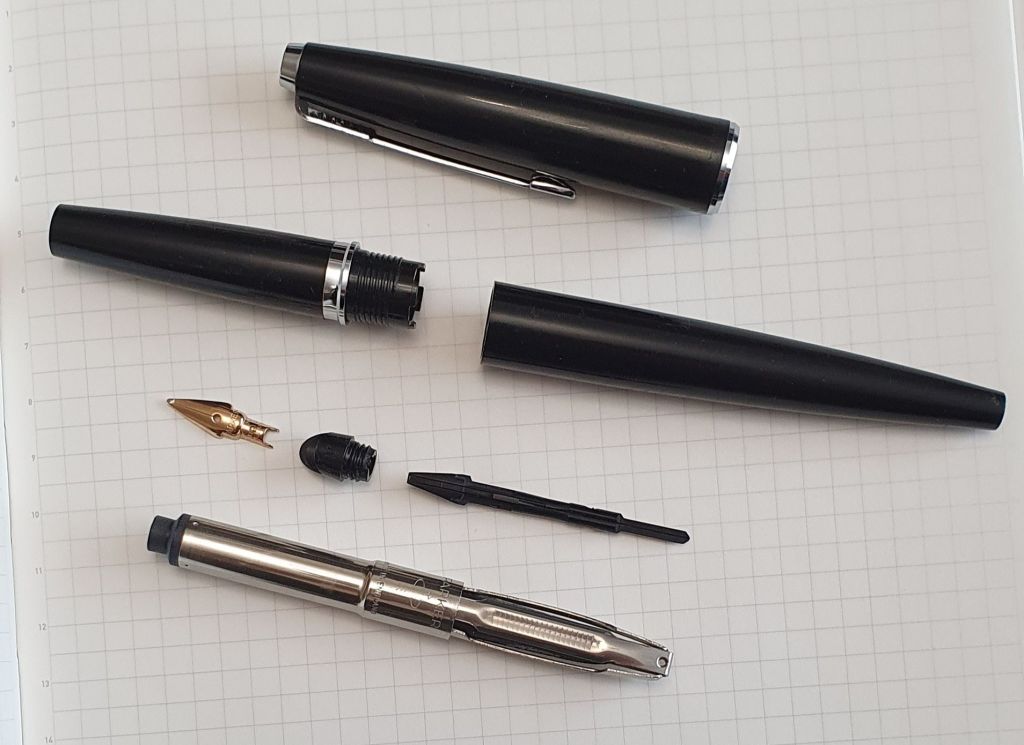
My Parker 61 Flighter fountain pen: a cautionary tale.

In my post of 21 September 2023, I wrote about my eBay purchase of a Parker 61 Flighter and my initial tinkering as I got to know its anatomy. I had been pleased to discover that the connector was not glued into the section, as I could remove it and the feed, ink collector and nib for cleaning and maintenance.

Parker 61 Flighter.

There was a downside to this. Not having the connector glued meant that when trying to remove the barrel, the connector unscrewed itself from the section (shell) instead. The section threads were looser than the barrel threads. Also, applying silicone grease to the section threads might have made things worse. I was wary of over-tightening the shell in case it should crack.

I had filled the pen and enjoyed writing with it. But I then discovered that, on tightening the barrel, it did not stop tightly at the end of the threads, but kept going round and round. I wondered whether the fine plastic threads were stripped.

I thought perhaps the problem was not damaged threads, but that (what I presumed to be) a threaded, plastic collar inside the steel barrel, was loose and turning freely inside the barrel. This lead me to decide that the solution would be to apply a little Loctite superglue, to the rim of the plastic collar, in the hope that the glue would seep behind it.

The connector screws into the shell and can then connect it to the barrel.

This operation (even if it had been the right one) did not go particularly well. I applied too much glue and got some on the threads too. But I left the glue to harden for several hours.

Returning to see the results, I tried re-attaching the barrel. This time, the threads were much stiffer and needed a lot of effort, as well as care to avoid the barrel going on cross-threaded. I tried removing some of the build up of hardened glue with a small blade, without much success. Also, once sure that it was not cross-threaded, I worked the barrel back and forth quickly, many times, trying to loosen up the threads.

Having the barrel threads so tight and difficult, meant that whenever removing the barrel, the connector would instead unscrew from the shell. This is no good. The pen was all but unusable. I contemplated buying a replacement brushed steel barrel.

But then, whilst wrestling with the barrel threads again, I made a surprise discovery. The barrel threads were not a plastic collar at all, but were part of a black plastic barrel liner, which went the length of the barrel. I only learned of this, because it came out.

Showing barrel liner, barrel and securing screw.

The barrel liner should be secured in the barrel by a metal screw, which forms the barrel finial. It has a decorative, conical top but no groove for a screw driver, which makes it very difficult to tighten. Also, from the look of the barrel liner, it appeared to have been glued in the past, as there were residues of hardened glue on the outside.

With the barrel liner out, it was easier for me to work on removing my glue. Scraping with a blade and working the threads back and forth, did not seem to help.

I looked up online, how to remove Loctite glue. The answers depended on the surface. For plastics, there was a suggestion, as a gentle approach, that you apply skin moisturiser to soften the glue first. Alternatively, white vinegar might work. Failing this, there was a suggestion to try pure Acetone.

I tried the moisturiser trick but do not think it helped much if at all. I did not have any vinegar to try, let alone Acetone.

At our local pharmacy, I casually enquired whether they had any nail varnish remover. Whilst the lady located some, I explained that I did not want it for removing nail varnish, but hoped that it might contain Acetone, to remove some glue!

To my surprise, the lady said that she could instead sell me some pure Acetone. I had no idea that this could be bought over the counter. A small, 50ml bottle was just £1.20.

Preparing to remove glue, using Acetone solvent.

I was a bit frightened of the Acetone as the bottle label was peppered with warnings. I had read that with plastics, you should try it on a small unobtrusive area first, but skipped that. I dipped a cotton-bud into some Acetone and applied it to patches of my hardened glue at the threads. Rather alarmingly, the cotton-bud came away quite black. I feared that it had dissolved the plastic, completely removing the threads in the process.

Fortunately, this was not the case. I washed the barrel liner thoroughly in soapy water and tried the threads again. Better! They were getting looser. I then smothered the threads in moisturiser, to soften the glue, and left it for 24 hours, before having another couple of attempts with the Acetone.

After this, although glue residue was still evident, I felt that the threads were probably as loose as I could get them without overdoing it.

Re-assembling the pen, I did not use silicone grease in the shell this time. The barrel threads were now looser. Unfortunately however, the barrel liner could still rotate inside the barrel.
This has been a learning curve for me, making mistakes along the way, whilst learning about the penatomy of the Parker 61 Flighter. I have not given up yet. I have just ordered a small bottle of shellac to apply a little to fix the connector into the shell, plus a little to the outside of the barrel liner, to secure this into the steel barrel. If this succeeds, I will be able to use and enjoy this lovely pen with more confidence.

Update: 23 October 2023.

Sorry for this cliff-hanger ending. But since writing this post, I had another idea to stop the barrel liner from rotating by wedging a slip of paper between it and the barrel. I cut a piece of paper and wrapped it around the back end of the barrel liner before re-inserting it and doing up the screw/finial. This worked! I also screwed the connector into the shell a little more tightly than before. Now, I can unscrew the barrel without the connector coming out instead. Also, when putting the barrel back on, it stops at the end of the threads, in the normal way. To celebrate, I have inked the pen with Montblanc William Shakespeare Velvet Red!

The London Autumn Pen Show, 2023: my haul.

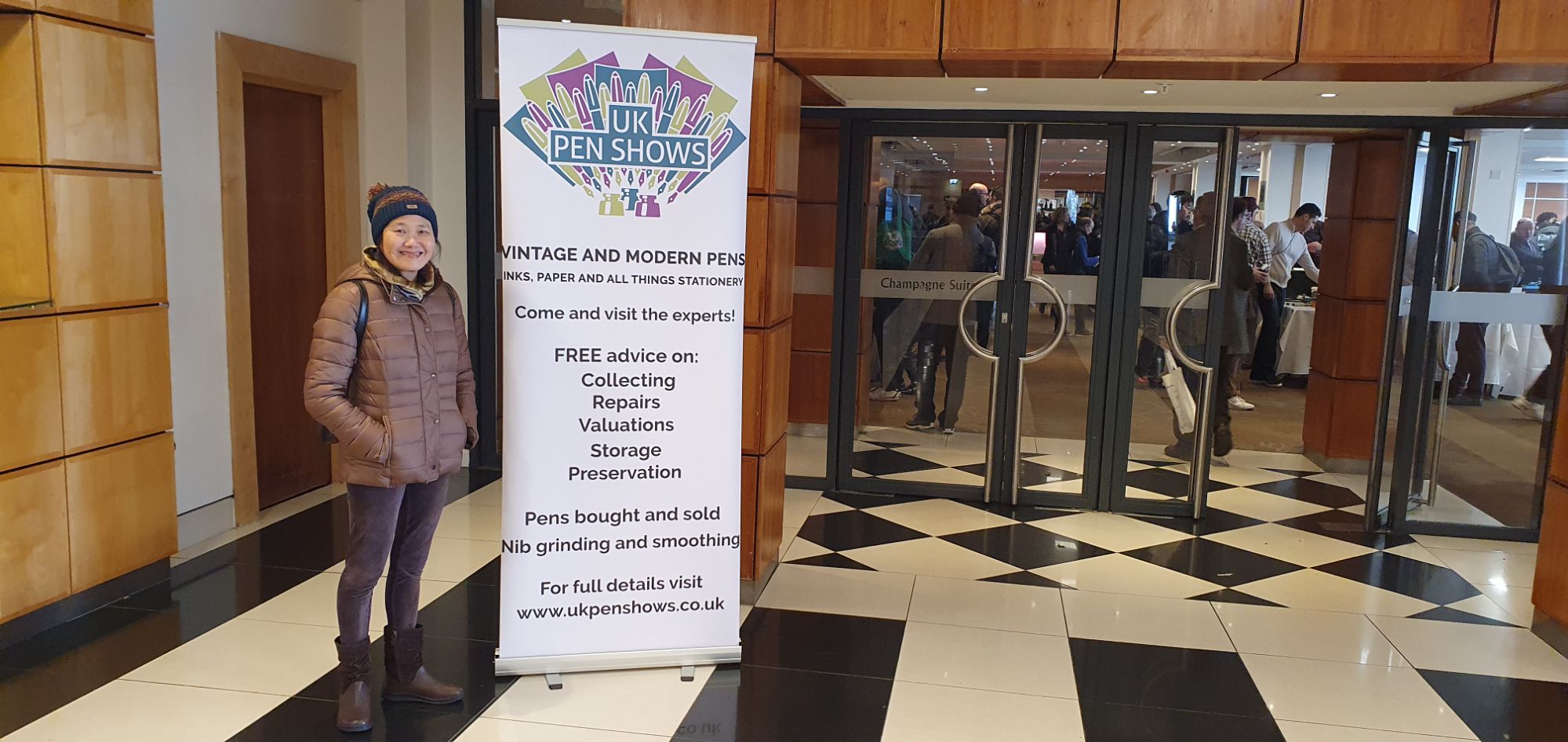
Here in London, our autumn Pen Show has just taken place on Sunday 8 October, at the Novotel, Hammersmith.

I had been eagerly looking forward to this event as always. The last two shows had set me on a path of seeking out vintage Parker fountain pens. I had bought several more on eBay, in the arid months between shows. I did not have much specifically in mind to look for this time, other than to find a cap jewel for my Parker 51, which I had bought on eBay without one.

The show was well attended. There were more vendor tables than in March although the venue provided ample space without feeling crowded. I cannot list everyone but for many great photos and videos from the day, head over to John Foye on Instagram, @stjohnspens.

Claire and Derek sporting pink hair at Stonecott Fine Writing.

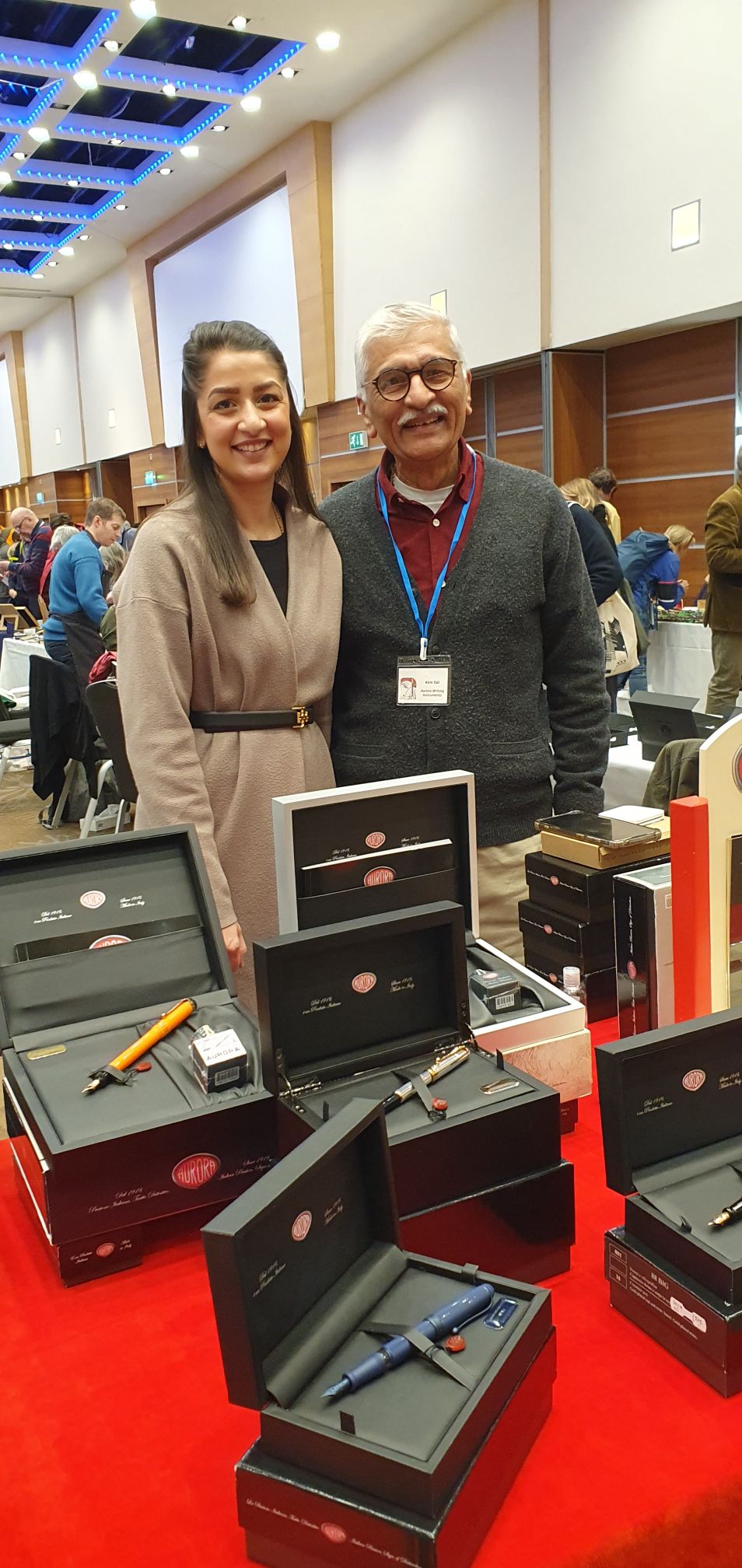
It was wonderful to see and chat to numerous friends from the pen community throughout the day. My fellow blogger Gary dapprman had his own table, aiming to release some pens from his collection back into the wild. It was good to see Jon of pensharing recruiting plenty of new members for his unique service for the community. I enjoyed chatting to many vendors, including John Hall, John Foye and Kirit Dal, and the lady from Pen Friends whose name I did not catch.

Kirit Dal’s Aurora table is always enticing.

My first purchase of the day was at Mark Catley’s Vintage Fountain Pens table, where I found the cap jewel that I wanted. My Parker 51 is now complete.

For vintage Parkers, there were hundreds for sale in the room. At Graham Jasper’s Pen Estates tables, I handled a wonderful, mint condition Parker 51 in a sumptuous Forest Green, but this was one that got away.

I was keen to take a look at some Parker 61 pens, particularly an early model with the ingenious capillary filling system, which I wrote about in my recent post. After looking at a few tables, I found a tray of Parker 61s, and unlike on eBay, had the luxury of inspecting them and dip-testing them in Quink blue black. I decided on a gorgeous classic, black model with a rolled gold cap and deliciously smooth nib.

My newest, but oldest Parker 61.
The Teflon-coated, capillary filler, or “cell.”

I caught up with my friend So-Jin, who mentioned that I had been rather negative about sheening and glitter inks in my blog post, on the 21 Pen Questions that did the rounds a few months ago. Having written that such inks were not my thing, it was strange that within minutes after our conversation, I found myself at Stonecott Fine Writing Supplies’ table, drawn to a very glittery Benu Euphoria Bourbon in gold and brown with tantalising patches of crimson. As I turned the pen in my hands, I envisaged filling this pen with Diamine’s Caramel Sparkle, available at the same table. I chatted with @claire.scribbleswithpens who was assisting Derek for a while. I did not purchase the pen immediately, but the temptation proved too much for me and I returned to buy it, along with a bottle of Caramel Sparkle soon after. Benu are based in Yerevan, Armenia, from whence my distant ancestors came.
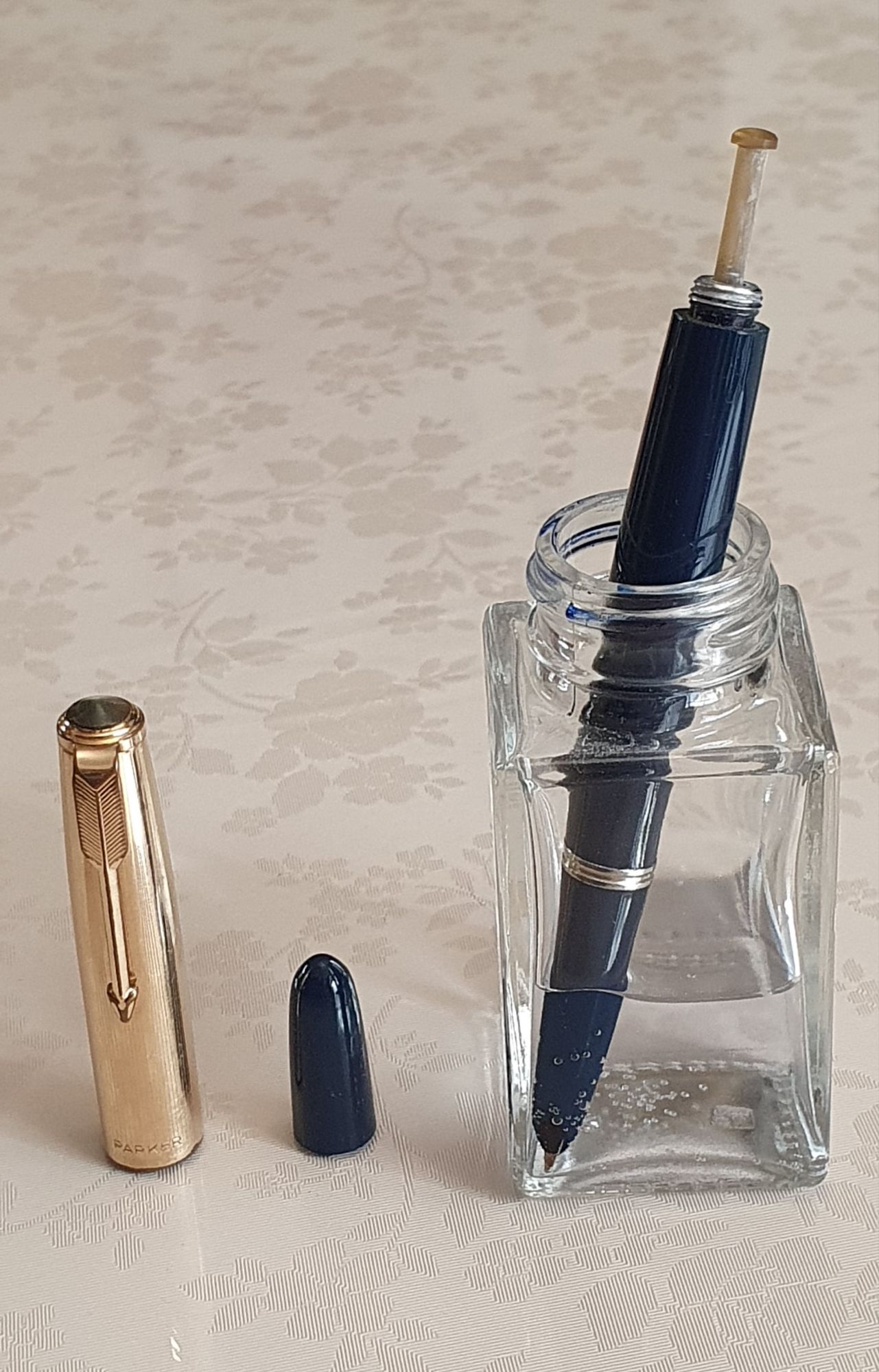
Benu Euphoria Bourbon.

My final pen purchase of the day, was a Jinhao 82 in a pretty pastel jade green. I already have one in Caribbean Sea Blue with a fine nib and am very impressed with it. This pale green version has a medium nib and makes a great, inexpensive, EDC pocket pen.

Jinhao 82 in a particularly lovely, Jade green.

Finally, having largely resisted the many notebooks available, I weakened at the sight of an Endless Recorder A5 journal with Tomoe River at Louise’s table. Newer versions now come with Regalia paper. TR paper may sadly become extinct.
Endless Recorder, A5 journal.

Back home I felt that I had, broadly speaking, heeded my wife’s instructions not to go mad and not to stay too long. I enjoyed inking the Benu (which deserves its own post later) and the Jinhao 82, which I paired with Pelikan Edelstein Olivine. The new cap jewel and brass bush, found their place in the Parker 51.

But the biggest thrill of all was the Parker 61. The seller had removed her sticker from around the pocket clip and I had not noticed until later in natural daylight, that my pen was an edition called the Parker 61 Heirloom, featuring a rainbow pattern in two tone rolled gold on the cap. Given that my pen was made in England, I believe this pattern dates it between 1964 and 1967, from what I read on parkerpens.net. My pen remembers The Beatles.

The rainbow cap of the Parker 61 Heirloom.
Markings on the cap and barrel.

I rinsed the nib and polished the gold cap. Without attempting any cleaning of the capillary filler, I thought I would first try to fill it and see if it worked. I decanted a little Waterman Serenity Blue into the plastic ink receptacle in a TWSBI ink well. I then placed the capillary filler in the ink, and took a photo of the ink level at the start of filling and another one about three minutes later. The ink level had gone down significantly. I found this enormously exciting.

Preparing to try out the capillary filler for the first time!
Physics in action.

However, the pen did not write initially. I gave it a few gentle shakes downwards, but this did not appear to have much effect. Fearing that there may be a blockage from decades-old dried ink in the feed, I dipped the pen and began to write with the ink that the nib had retained. Once again, I revelled in its smoothness, but with a worry that this might last for only a paragraph before the nib ran dry.

But to my growing relief and exhilaration, the pen continued to write for a full page, then a second, a third and fourth page of my A5 Stalogy notebook, by which time I was certain that the ink I was seeing on the page was ink that the capillary filler had drawn up.

The nib writes a smooth medium-broad.

I am hugely pleased with the Parker 61 Heirloom and everything about it. It looks and feels great and writes like a dream. The filling system is unique. It was heralded as “the pen that fills itself” and, as I read, took 12 years to develop! Also, as a party trick, this pen can write upside down, on a wall or ceiling, because the flow of ink to the nib is a product of capillary action and not gravity. And the price of all this enjoyment? A modest £45.00. I recommend anyone who might be hesitating, to take a look at vintage Parkers.

My haul.