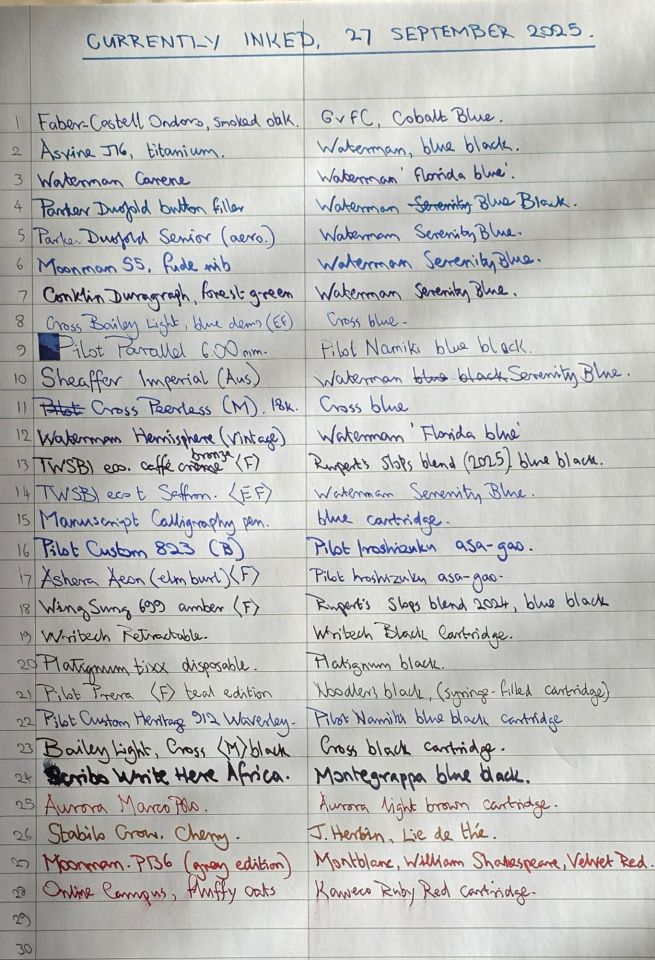
Early today, as the September morning sunshine streamed into my dining room, I sat at the table and made a list of all the fountain pens in my pen cups, and their respective inks.
In the absence of a system, my currently inked pens had grown to 28. Making a list of these seemed a good first step towards taking back some control. I have since flushed and cleaned three of those pens, which had been inked for a very long time. It is only a start but it feels like a win.
Here is the list, warts and all, complete with mistakes and corrections, smudges and diffuse sunlight.
Currently inked, 27 September 2025.
Looking back at my list of posts on this blog, I had to go back over five years to find the last time I made a Currently Inked post, in August 2020 (unless I have missed any). But reading that old post again today, I was struck by the fact that my pen cups are still “allowed to develop organically” (to put it politely), which is to say, without any strategy, rules or plan. One obvious consequence of this is that the list immediately shows my preference for blue inks. Today’s list includes two reds and two browns but very little other variety. And no greens at all, just like in August 2020!
I thought it might be helpful to share this, if only as an example of how a pen cup might lay bare the absence of method when pens are inked on a whim. There must be a great many ways in which to manage a pen collection/accumulation in a way which rotates the pens on a regular basis. I wonder how many of us have a successful system to do this, to ensure that our pen cups also have a representative selection of our ink stash, at any given time (so that we at least have one green in use for example), as well as a few different grades of nib.
Instead of such a system, my pen cups always contain a few recently acquired pens, which I am playing with and getting used to as well as some old favourites, and a mix of modern and vintage. Then there are some costly pens which I feel need to be kept in circulation to justify their cost.
Of course, we would have a faster turnover of pens in the pen cups if (a) we wrote more and (b) had less pens in use at a time. I do not like to flush pens when they are still partly full, but I have found a solution to this: I jettison the ink (unless it is black) into an ink bottle, which contains the dregs from my unfinished fills for the year. Last year’s crop produced a full 50ml bottle which I called “Slops Blend blue black, 2024”. I am using that ink daily, in my Wing Sung 699 for my diary and have been using that combination all year. It is actually a very pleasing and unique blue black! Another bottle, Slops Blend 2025, is coming along. I know that this goes against all the usual advice about not mixing inks but I have been fortunate so far. My blends have not resulted in any obvious clashes. An advantage of using predominantly blue and blue black inks, is that they can result in creating a nice new shade at the end of a year.
To impose a system on the pen cups would require (1) a list of all the pens and (2) a list of one’s ink collection to be included, and (3) a table of pairings of pens and inks alongside a calendar to show when they due for changeover.
This would sound less daunting the smaller the number of pens we keep inked at any given time. But then, if we have just a handful of pens on the go at once, although they will get more concentrated use, it will take a long time to get round an entire lifetime’s accumulation of pens.
If all this sounds like too much work for a hobby which is meant to be fun, then we (I mean I) can go on as before, just filling or flushing a few pens here and there when the mood strikes me, or when I want to use a particular ink or a particular pen. Recently, I inked up my Waterman Carene for the first time in a long while, simply because someone in my pen club had expressed an interest in trying one. I inked it with a cartridge of “Waterman Florida Blue” which goes to show how old the cartridges were, since Waterman’s Royal Blue ink has been called Serenity Blue for many years now. Half the ink had evaporated from the cartridge, but it still wrote beautifully. I had forgotten what a good pen it is.
Whilst it may be too much work to impose a strict rotation on the use of our pens and inks, the making of a “Currently Inked” list regularly does at least give us an opportunity to take stock. It is probably a good idea to be a bit more intentional about what is inked and why and for how long. Trying to keep the number from growing too high is also sensible.
Of course this would not be an issue if we had only one or two pens and a couple of inks. Having to think how to make good use of all our pens is the price we pay for allowing ourselves to accumulate too many of them. And it is with this thought that I shall try to be mindful and sensible at our coming London Pen Show.
The purpose of this short post is to share the news that one of my favourite modern entry level fountain pens is now available in a new set of demonstrator editions.
At least, this was news to me, when I came across a display of them in a delightful stationery shop in Hitchin, Hertfordshire. I could not resist buying one. The assistant told me that she had only just put them out on display that morning and I was the first customer to buy one!
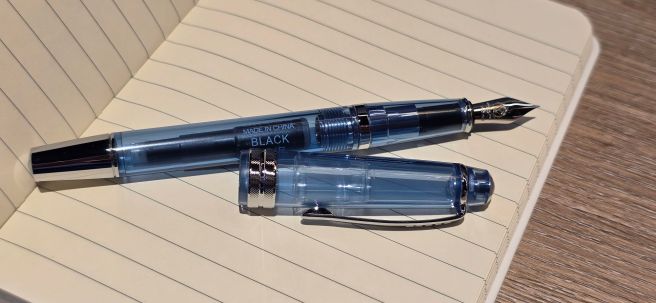
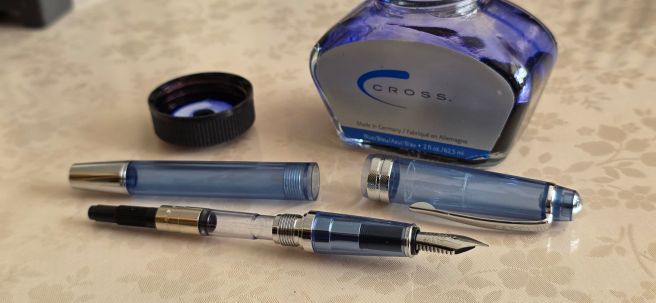
Cross Bailey Light Translucent, blue.
I am referring to the Cross Bailey Light. I first discovered these pens in our John Lewis department store back in October 2019 and then at the modest price of £20.00, for the fountain pen and two cartridges. The set did not include a proprietary, Cross converter which would therefore need to be bought separately but the pen takes their non-threaded (push-in) type. This adds appreciably to the cost, if you do not wish to use their rather pricey cartridges. Over the years, I have accumulated several more of these pens in their various colours. My favourite remains the royal blue edition which for a long time was my work pen and lived on my office desk, inked with Cross Blue. In 2023 I was away from work for a few months and missed this pen very much, as well as my colleagues of course.
Extra Fine nib only.
Until recently I was aware only of the pen being available in a range of opaque colours. It came as a surprise then, to see a glass cabinet showing a clear demonstrator version, as well as blue, pink and green demonstrator editions too.
As I have reviewed the Cross Bailey Light before, I will mention only the points of difference:
Whilst there were several chrome highlights on the opaque editions, the demonstrators now get a smart, chrome ferrule to the barrel.
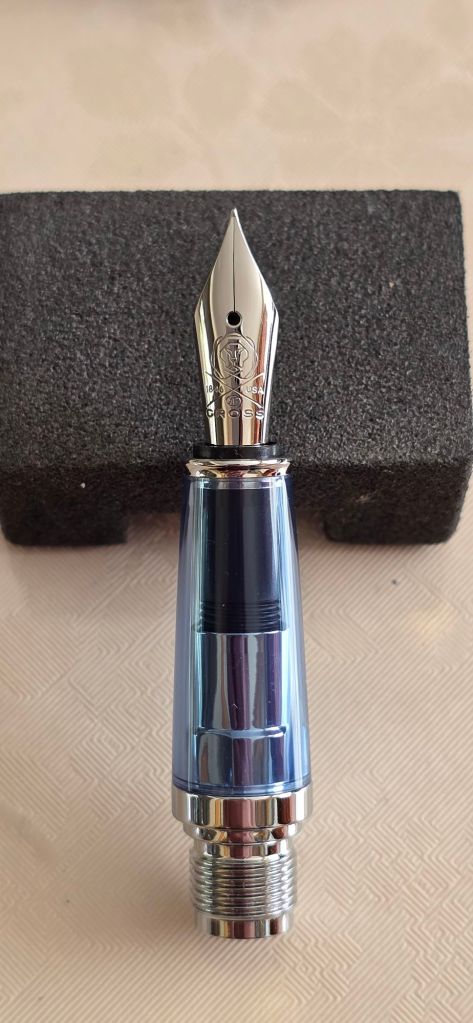
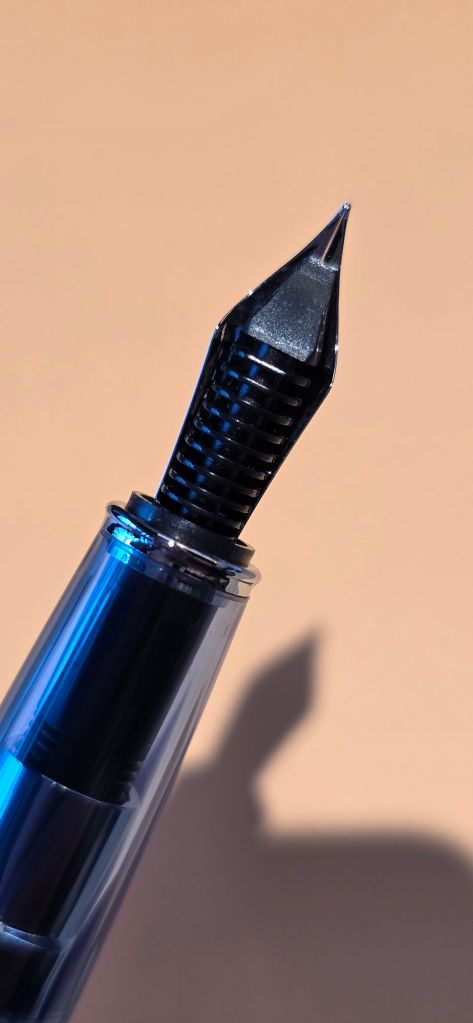
As far as I know, the demonstrator versions are available only with an extra fine nib (marked XF on the nib).
Having a see-through cap, barrel and section is a popular feature with many brands, for example from TWSBI, Pelikan, Platinum, and Lamy, to Aurora and Conid to name a few, but I think this may be a new departure for Cross. A clear barrel is the ultimate ink window. The clear cap shows the inner cap and, in particular, the way in which it clicks onto the ferrule when the cap is posted. Another benefit is that it will now be obvious if a spare cartridge is lodged in the back end of the barrel. I was asked several times in comments, why the barrel will not fit over a converter on a new Cross Bailey Light and this has invariably been the reason.
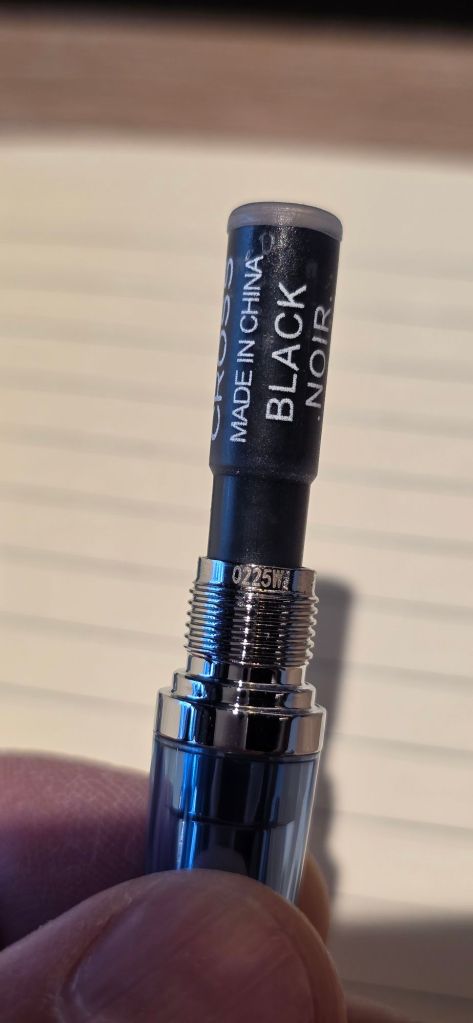
A small change, but one which pleased me very much is that the demonstrator versions now include a production date code. Mine read 0225W which I take to be February 2025. I do not know what the W signifies. (I have been informed in the past by one reader that the digits on a Cross pen are not a date code – but the majority of my Cross pens do have numbers which would fit with their likely date of manufacture: perhaps there are some exceptions). The ink cartridges are dated too, which is helpful when deciding in what order to use them up.
As usual for Cross pens, it has a lifetime guarantee.
On their website, Cross call these new versions the “Cross Bailey Light Translucent” and the four colours are translucent clear, navy blue, green and pink sapphire. It comes in a simple cardboard gift box, in a cardboard outer sleeve (an improvement on the old plastic packaging).
Initially I tried the included Cross Black cartridge, but was a little disappointed that this ink feathered in the two notebooks that I had with me, a Stalogy and a Ryman A6. When I got home, I transferred the cartridge to a different Cross pen, and instead filled my new pen with Cross Blue, from a bottle, with a Cross converter – a much preferred option.
The obvious ink choice.
I was delighted with the “XF” nib which appeared to be perfectly set up, right out of the box. Despite owning numerous Cross Bailey Light pens now, mine had all been Medium nibs and so this extra fine is a refreshing change. The nib is firm and has a downward slope to it which worries some people but this is quite standard.
A perfectly tuned nib, right out of the box
I remain a big fan of the Cross Bailey Light. I recommend them to beginners as an affordable and professional looking alternative to the popular suggestion of a Lamy Safari, as the Cross pen does not have a faceted grip section and is, in my opinion, extremely comfortable and convenient to use, as well as looking smart and traditional.
A production date code? Or not?
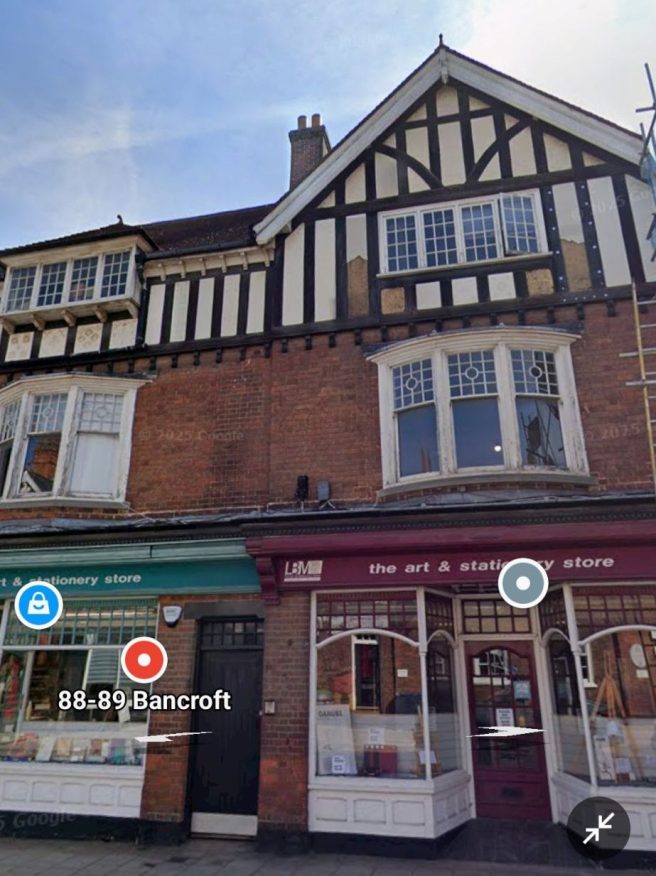
Searching online, I found that the new versions are available on Cult Pens and Pure Pens although I bought mine for £29.00 at The Art and Stationery Store, 88-89 Bancroft, Hitchin, Hertfordshire.
“the art and stationery store”, Hitchin. (image from Google Maps)
In my previous post on this pen, I covered the buying experience and the brief passing phase of buyer’s remorse before coming to accept and enjoy the pen. I had owned it for not quite a week.
Now, at still only two weeks in, I feel it necessary to say more about the issues I have with the pen and to correct a few misconceptions. Although mine was an impulse buy, I would recommend trying the pen before buying if possible and also to read the many online reviews – from which I now see that this model has been around for over 10 years.
To recap, the potential issue arises from a combination of two design factors, namely the short grip section and the faceted barrel. If you do not wish to grip the pen around the metal, hourglass shaped section but higher up, then your fingers meet the facets. These are fine if they correspond with where you wish to rest your fingers: but if they do not, then you are instead holding a sharp ridge between two facets, which is uncomfortable and unsteady.
At the time of my first post, I explained that on my pen, when the barrel was fully tightened, the facets stopped with a ridge in the centre, or “12 o’clock position” (if viewing the nib head on).
Nib aligned with a ridge between two facets.
Of course, we want to hold our pens comfortably and in such a way that the tipping of the nib touches the paper at the smoothest angle, to write well without scratchiness or skipping – “the sweet spot.” Depending on an individual’s writing style, – whether they be left or right handed, whether an under-writer, over-writer or side-writer, facets may or may not be helpful.
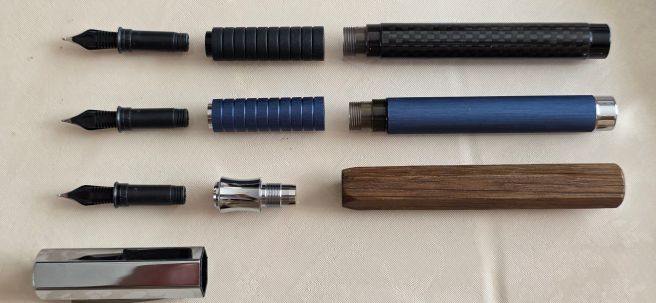
The big news that I wish to share, is that the wood barrel sleeve is not attached to the metal inner barrel (which I presume is brass) and can be adjusted. At least, I am speaking for my own pen only and have not examined any other samples. Thus if the facets are not where you need them, simply twist the barrel firmly a little way beyond its tightest point. You do not need to move it far. You may line up the nib with the flat surface, or a sharp ridge, or perhaps half way between these points as a compromise.
I discovered this by accident when I noticed that after capping and uncapping the pen for a few days, the barrel ferrule was sinking down inside the barrel.
Barrel ferrule, retreating into the wood sleeve.
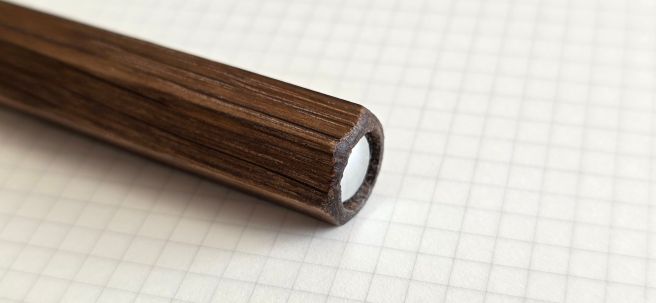
When I unscrewed the barrel, I found that the metal barrel liner, was beginning to protrude.
Barrel liner, pulled forwards by the act of uncapping the over-tight cap.
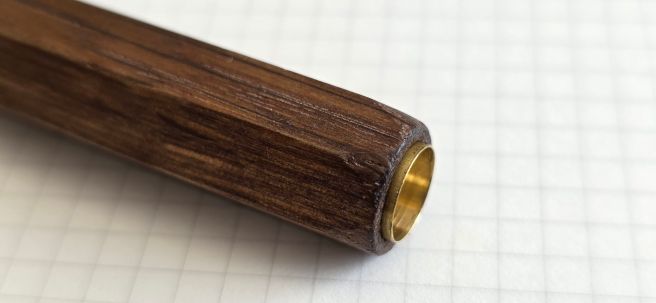
Having discovered that the barrel sleeve could move over its liner, I tried pushing the liner out further (using an empty plastic cartridge and pushing the barrel down against a hard surface):-
More of the barrel liner exposed.
The good news: You can therefore twist the wood barrel sleeve to adjust the position of the facets in relation to the nib, if you need to. For example, if a flat facet at the 12 o’clock position suits you best, just twist a few degrees and you are there. It is a bit like the feature of the Parker 75 which allowed you to rotate the nib for the optimum writing – a solution to the problem caused by adding facets to the grip section.
Barrel turned to align nib with a facet.
If you like the nib aligned with a facet, this also has the added bonus of enabling you to cap the pen with the pocket clip aligned to the nib or to post the cap thus aligned, (although writing with this cap posted will make the pen unbalanced).
The bad news: the barrel is not meant to move on the liner and moving it will soon make it loose. Two new problems are caused by solving the facet issue: (1) when you uncap the pen, the nib section and barrel liner, are pulled forward out of the barrel sleeve and (2) when you go to unscrew the section, instead of unscrewing, the barrel liner rotates in its sleeve.
Experimenting with nib-to-facet angles, I found myself suffering FOMO: this was made more complicated by having more than one writing style – whether under or over writing. “Am I missing out on a smoother writing experience, if only the barrel were turned a few more degrees?” The angle for one writing style was not the same as for the other. Imagine the distraction and stress of having this thought if you were taking an exam.
Already after only a few days of experimenting, my barrel was getting looser and I noticed a gap between the section and the barrel appearing, each time I pulled off the cap. It is a pity that there is not a screw, or a hex nut we can tighten in the barrel liner, to arrest this movement. I have stuck a little Sellotape on the barrel liner to try to make it a tighter fit.
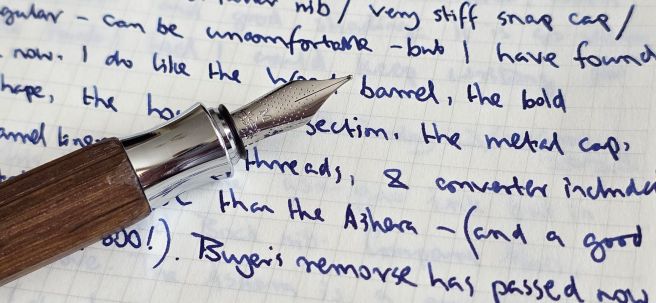
In conclusion, I do actually like the pen. Theoretically having a facet against your finger, should give a steadier grip than if the only points of contact were rounded edges of a tube. The facets certainly look bold and attractive – especially as they are echoed in the metal cap. (Incidentally, the cap is made of metal, although the metal is thin and it has a plastic liner).
When I bought the pen, I was on my way to see a concert of music by Frederick Delius. The piece, a cantata entitled “A Mass of Life” is quite a difficult listen – a huge, powerful, exuberant, out-pouring of passion – which probably needs to be heard more times than I have yet given it, to enjoy and appreciate it properly. Meanwhile, you might think “Why bother with this, when there is more readily satisfying, melodious and recognisably-structured music available?” Perhaps there is an analogy here with the Ondoro: it is a challenge but there is nothing quite like it and it is worth the effort of persevering. Or perhaps I am just making excuses for a flawed pen or one that was not suitable for my particular grip?
The nib is excellent. When it is writing smoothly, I can happily write or doodle with it. I sometimes think that a writing sample reveals more about the comfort of a pen: how neatly can I write with it? If the writing is shaky and rushed, it suggests we cannot wait to put the pen down. If it is neat, then it shows the writer to be relaxed, comfortable and at peace with the pen!
If I were to give up on the pen, then at least the nib unit can be transferred to the Faber-Castell Essentio, a cylindrical and facetless aluminium pen that I bought last year. But it has not come to that yet!
Ondoro beneath a Faber-Castell Basic and the aluminium Essentio.
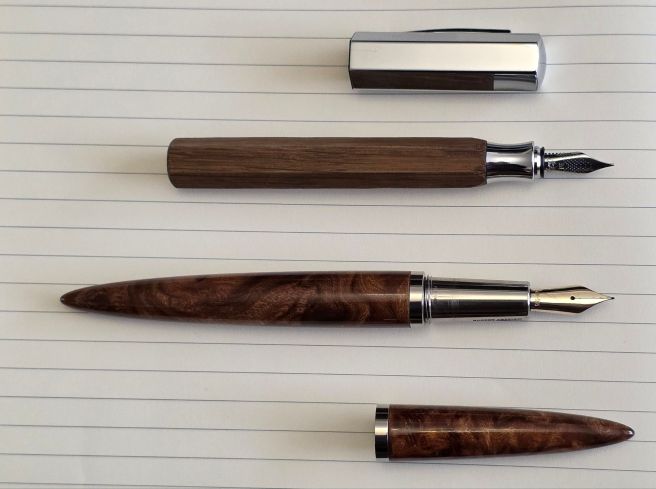
The pen does make a nice companion for my Ashera fountain pen, hand finished in multi-lacquered elm burl wood. The Ondoro is not lacquered and polished but its wood is faceted and is Smoked Oak (not just stained to look like it) – a chemical process which I imagine adds a bit to the cost. It is not correct to say that the wood is untreated.
The Oak and the Elm: the Faber-Castell Ondoro next to an Ashera Aeon fountain pen.
The Ondoro might not be my favourite pen – at least not today. But I am using it every day which is a good sign.
Faber-Castell is a well respected maker of pencils, pens and art supplies with a history dating back to 1761. For fountain pen enthusiasts, their nibs are among the best in the business.
None of this was on my mind as I breezed into Harrods one evening, for a quick browse around their Fountain Pen arcade on the lower ground floor, prior to taking my seat for a concert at the nearby Royal Albert Hall. I was off to see Sir Mark Elder conducting the BBC Symphony Orchestra, massed choirs and four soloists, in a rare performance of Delius’ “A Mass of Life”, as part of the BBC Proms. I say “rare” because the piece had not been performed at the Proms for 37 years.
As always on my also-rare visits to Harrods, it was a triumph to locate the pen department. Once there, I enjoyed making a round or two of the displays, including Montegrappa, Chopard, ST Dupont, Caran d’Ache, Graf von Faber-Castell and of course Montblanc. There were notebooks and stationery from Smithson and Moleskine.
At the Graf von Faber-Castell counter, I spoke to the helpful assistant, Melvyn and chose a bottle of Cobalt Blue ink. I have almost finished my first bottle and this is probably my favourite “posh” ink. The rich dark blue ink, the attractive 75ml heavy glass bottle and packaging are all luxurious.
I then asked to take a closer look at the Faber-Castell Ondoro, in wood with a metal cap. I recalled seeing the pen some years ago with an orange barrel, but was not aware of this wood version. I enquired as to what the wood was and after consulting the catalogue, Melvyn informed me that it was “Smoked Oak”. It is an appealing, mid-brown with a dark grain. I have not yet discovered the significance of the “Smoked” in the title. I wondered whether it might perhaps be a process whereby the wood is heated, altering its enzyme constituents in a way which “ages”, dries and hardens the wood as Yamaha does for certain guitars in its range, to emulate the tone of a vintage guitar. However this was just a fantasy conjecture on my part. Presumably the oak is not smoked to improve its flavour like bacon or mackerel. Is it smoked just to give it a charred look? I am yet to find out.
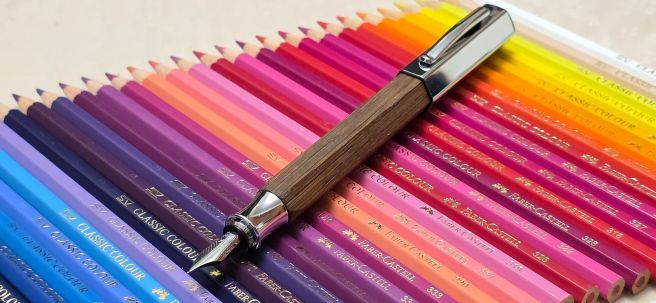
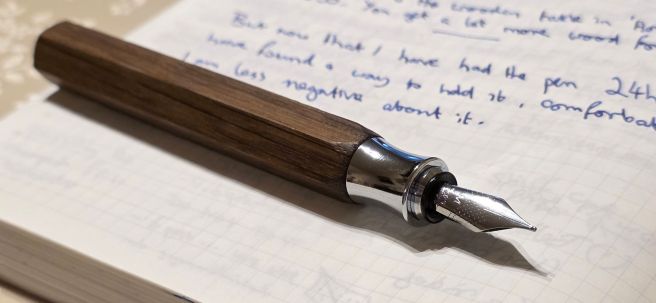
Faber-Castell Ondoro, Smoked Oak fountain pen.
Edit: Since publishing this post, a Google search revealed that Smoked Oak is a term for oak that has been exposed to ammonia fumes, in a sealed environment, for a number of hours. The fumes react with the tannins in the wood, causing it to darken. The longer the exposure, the darker the wood, until black. The process also enhances the natural grain.
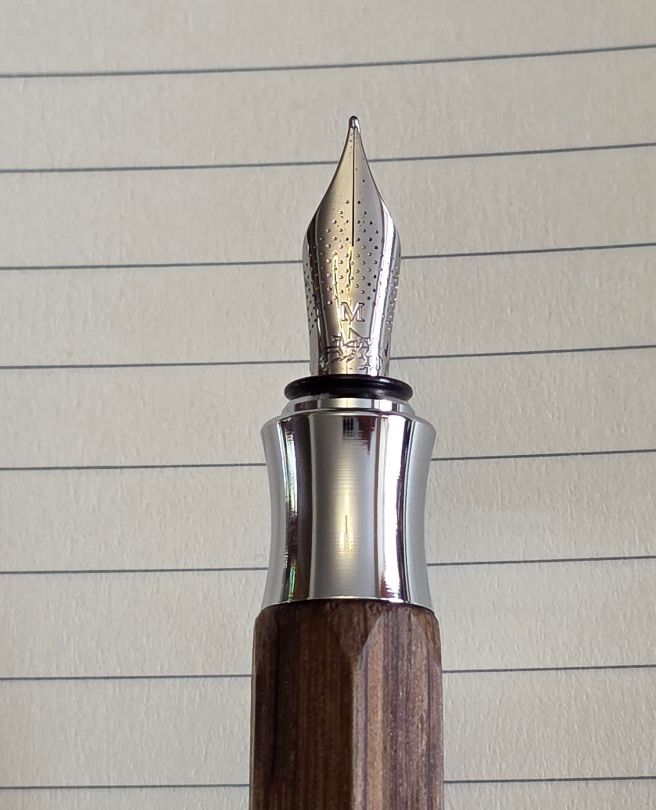
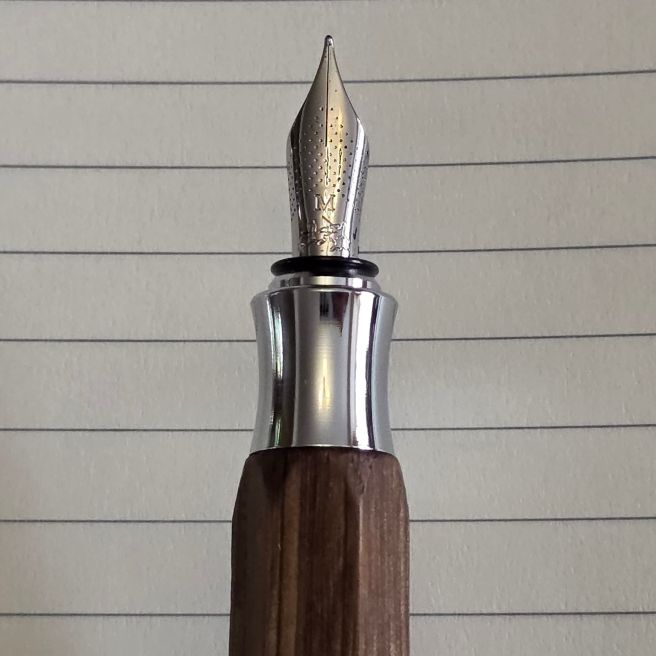
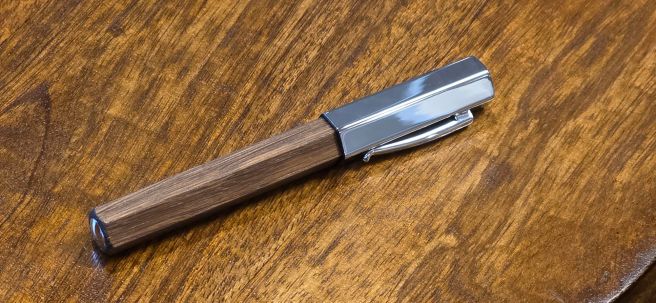
The Ondoro features a hexagonal cap and barrel. It is not very long, but is chunky. Aside from the hexagonal form, another striking feature is the hour-glass shaped grip section. This is a short section and so, if you use a pinch grip around the section, your grip will be close to the paper.
Posted and showing the dimpled nib and the hourglass section.
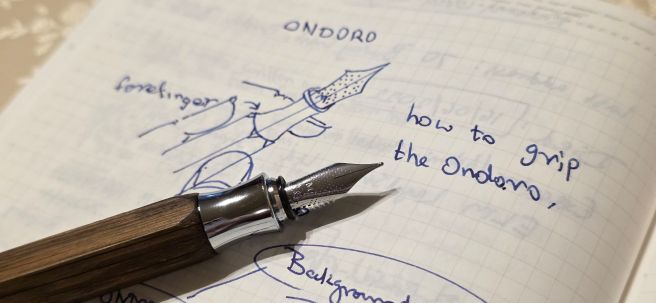
At first, I was undecided how best to hold the pen. A pinch grip around the section is a bit too low and too crowded for me. But if you hold it higher up, at the barrel, you have the issue of gripping around the faceted sides, which may or may not conform to your preferred way of holding a pen. Then there is the option of posting the cap. It does post securely but adds considerable weight and alters the balance such that you would want to hold the pen much higher up.
Finding my grip.
At £165.00, the pen looked to be a bargain compared to most of the others on display and might have been the most affordable pen in the showroom. I was drawn to the Oak material which may develop a lovely patina eventually. I was also mindful that I had enjoyed good experiences with steel nibs from Faber-Castell in the past with pens such as the eMotion, Grip and Loom. I was sufficiently intrigued by the pen to include it with my impulse purchase of the Cobalt Blue ink and I left with a smart Faber-Castell shopping bag and a smile on my face.
Later at the Royal Albert Hall, before arriving I had switched the pen and ink to my shoulder bag. At the entrance, halting for the security check, a torch was shone into my bag and the man pointed to the box and said “What’s in there?” “It is fountain pen ink” I replied. I got the impression that he did not get that answer very often.
I had the opportunity to fill the pen during the interval. The performance (both the concert and the pen) was excellent. It was necessary to crouch down and put the ink bottle on the floor of the Hall by my seat, as even I was not stupid enough to open an ink bottle in my lap. Once filled, I could take my seat again and test the pen in a small pocket notebook. The nib appeared to be perfectly tuned, right out of the box and wrote smoothly and well, as I have learned to expect from Faber-Castell.
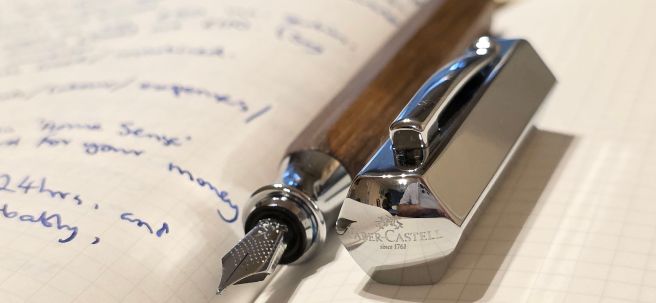
Highly reflective cap.
However, within a fairly short time, I began to suffer from an attack of BR or Buyer’s Remorse. This was triggered by the realisation that the pen was lumpy and angular and unusual to grip. I soon discovered that I could have bought the pen and the ink considerably cheaper online. Then thoughts began to crowd in, that I had not needed the pen, that it was arguably not as comfortable, or as good value, as my recently purchased Asvine J16 – a titanium bodied piston filler pen made, we generously assume, as an homage to the Montblanc Meisterstuch 146.
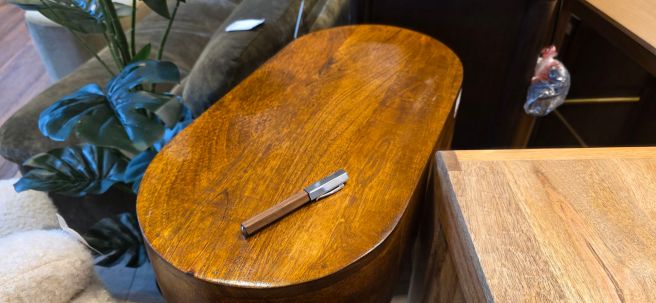
The following day, the BR only got worse, exacerbated by a visit to a home furnishings superstore where I made the realisation that, if it was Oak that I was after, I could buy an attractive table for a modest sum of £99.00.
You get more wood in a table.
However, after a few days, I was over the worst of the BR. I realised that it is not helpful, thinking about a fountain pen’s value in comparison to other household items. Even comparing pens from different brands and countries, it is a mistake to think that we should acquire a new pen “at cost.” As for comparing values in recent pen purchases, of course some appear better value than others and it sometimes helps to combine the cost of a few pen purchases and then average their cost.
Happily, I soon grew to fully enjoy the Ondoro once again. The key to this, in my case, was finding a comfortable grip. I found this by resting the section on my second finger, and then gripping the pen between thumb and forefinger a little higher up at the bottom of the barrel. I found that I could hold the pen with the nib at the “sweetspot” (rotated inwards slightly) if I held the pen at the facets, leaving one facet in between.
Some writing with the Ondoro and Cobalt Blue ink on Stalogy paper.
On my pen, and I don’t know whether they are all like this, when the barrel is screwed on to the section tightly, the nib aligns with a ridge between two facets, not a facet itself. I could hold the pen comfortably with the nib rotated inwards (I am a lefty). Once found, the grip is actually very pleasant and a bit addictive!
It is normal to have both likes and dislikes about the design of a pen. A few of mine are as follows. Let’s hope the likes outweigh the dislikes:-
Likes:
Bold and unusual, attractive design;
Facets: the hexagonal barrel with flat sides, is like an oversized pencil; also prevents rolling:
The use of wood, as a warm and natural material – with a satin finish which may develop an attractive patina in use; I love having a piece of Oak in my hands;
Short, chunky proportions;
Weighty metal cap – with shiny plated finish contrasting with the satin finish of the wood;
Subtle imprint of name and logo on the top of the cap, with the words “since 1761” imparting a sense of history:
Comfortable hour-glass section on which to rest the pen;
Well-tuned steel medium nib writes smoothly and with excellent flow:
A Faber-Castell branded, Schmidt converter is included;
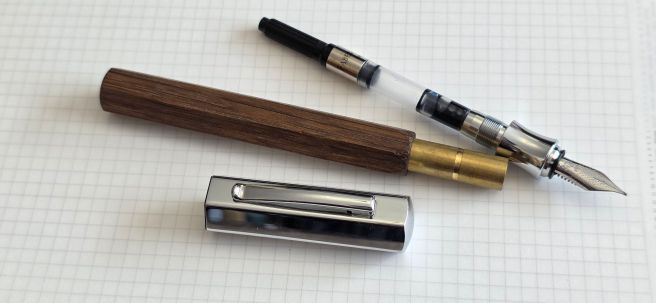
Fit and finish are excellent: brass liner and threads to barrel; metal threads on the section; plastic liner to cap;
Slightly domed metal barrel finial, protects the wood when pen is standing:
Cap can be posted (although making the pen back-weighted and heavy);
The tough, short and stocky feel of the pen make it well-suited for an EDC pen.
Dislikes:
Facets: Unless held around the section, gripping the pen at the barrel has a risk that the facets may not necessarily fall where you would wish to grip the pen. You may instead encounter a sharp ridge between two facets, or else have your grip dictated by the position of the facets, rather than by the best rotation of the nib to the “sweetspot.”
On my pen (and again this may not be same for all), the snap cap is very tight and it needs considerable force to uncap the pen: however this may ease eventually with use; meanwhile, if using the pen intermittently, the pen could be “soft-capped”, to reduce ink evaporation;
If posting the pen, the hexagonal cap has to align with the facets and, on my model, this means that the sprung pocket clip will either be to the left or the right of the nib’s centre line and not in line with it – a slight annoyance.
Weights and measurements.
The pen looks and feels, chunky, solid and dense! Capped, it measures around 127mm and uncapped, 123mm. Posted, it is around 157mm. The width of the barrel across opposite facets, is about 12mm. It weighs 44.5g capped, or 27g uncapped and 17.5g for the cap alone. Using the pen uncapped, the weight is very comfortable.
Conclusion.
I am fond of Faber-Castell’s steel-nibbed fountain pens such as the Grip, the Basic, the Essentio and Ambition and have in the past enjoyed the writing experience, particularly with a Faber-Castell Loom, in gunmetal grey, a long-term EDC. I recall the excitement of once buying a Faber-Castell eMotion in Fortnum & Mason, and then heading to the men’s room to ink the pen (with Waterman’s Harmonious Green) and on to the British Museum to write with it. Perhaps I was hoping to recreate that new Faber-Castell feeling with my Ondoro purchase.
This time, the purchase was followed by a wobble and a couple of days of regret, but having come through this, and having spent some time experimenting with different grips, I can now report that I am enjoying the pen and that my bond with it is perhaps stronger as a result of this emotional roller-coaster ride.
Naturally, it sometimes pays to shop around before buying. Also it is best to handle a pen before buying to check that it will be comfortable or whether you will need (and be able) to adapt to it and so there are advantages to buying from a bricks and mortar shop, if you have one. Also, it is human nature to forget to be sensible once in a while.
Within the circle of my pen club friends, I am known for enthusing about vintage Parker fountain pens. These are plentiful at pen shows and can represent excellent value, when compared with their modern counterparts.
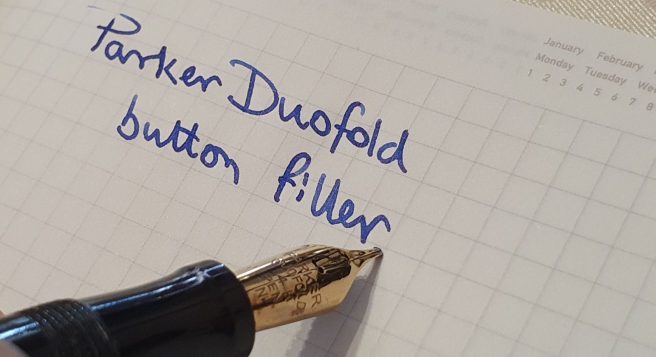
One of my friends bought a vintage Parker Duofold, button filler fountain pen at a recent pen show and asked for my help to get it working and to fix a bent nib. I had completed the Writing Equipment Society’s pen repair course, only last winter. The course was great but attendees still need to practice what they have learned, preferably on their own pens to start with, to gain experience and confidence before being let loose on someone else’s pen. My friend was aware of this but still content for me to have a go.
Having seen a photograph of her pen in pieces, I hoped that it might only need a replacement sac and I suggested that she order one from The Pendragons, whereupon I would have a look at the pen at our next monthly get-together.
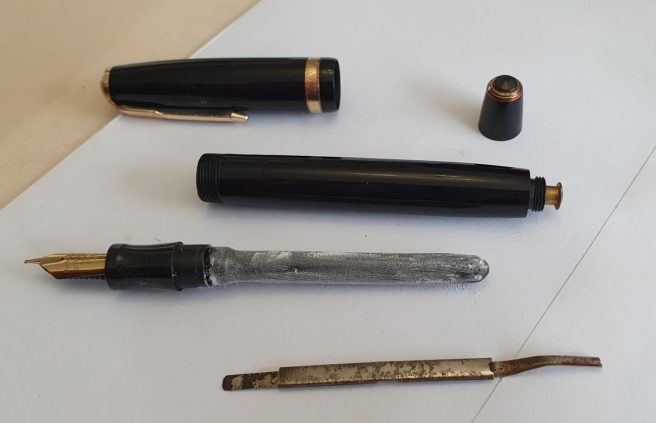
Prior to attending the course, I had not even known what a button-filler pen was. It has an ink sac in the barrel. Alongside the sac, is a thin metal bar with a pressure plate. One end of the bar slots into a recess underneath a button (beneath a “blind cap”). When the button is pushed, the metal bar flexes, pushing a pressure plate against the sac. This forces air out of the sac, sending a stream of bubbles to your ink bottle. Then as the button is released, the sac regains shape and draws up ink.
When we met, my friend had already done the hard part, which was to disassemble her pen – remove the barrel, (which was a screw-fit), remove the sac which had perished and also remove the button from the barrel. She had not removed the nib and feed from the section but had purchased a replacement number 17 sac. The repair then went something like this:-
Replacing a sac on a Parker button-filler fountain pen (with a screw-on barrel):
Examine and clean the parts; the metal bar was free of corrosion; scrape off any residue of the sac from the sac peg;
Straighten out the nib to re-align the tines;
Trim the new sac to a length to fit in the barrel;
Tip: if the section screws into the barrel, there is a risk that, when a new sac is attached, the sac will become twisted as the section is turned; for this reason it is best to remove the nib and feed – either by pulling them firmly, or else by soaking or washing in an ultrasonic bath, applying gentle heat from a heat gun, and then knocking them out using a hammer, a drift and a nib knock-out block. Then, fit the new sac, and insert a rod up through the section and into the sac to prevent it from twisting as you screw the section into the barrel. The nib and feed are then replaced last. However, we did not do this as the nib and feed could not easily be removed.
I attached the new sac to the sac peg, with shellac and then dusted it with French Chalk;
Once the section went in the barrel, we could feel the sac twisting. However, it was only catching at the far end and we overcame this by snipping about 5mm off the sac and re-attaching it;
Once the section was in place, the spring bar was carefully inserted, guiding it through the hole where the button goes. This needs to be slid in with care to avoid catching on the sac. Again, the bar was liberally dusted with French Chalk.
The push button was then pushed back into the barrel. The pen was ready to fill.
Happily, the pen then filled. Bubbles could be seen and heard, which is what you want. The pen wrote smoothly and all appears to be well.
Being asked to repair someone’s fountain pen is a privilege and an honour but carries risk: a bit like being asked to baptise their child, you do not want to drop it! I was grateful for the honour and relieved that the repair was a success.
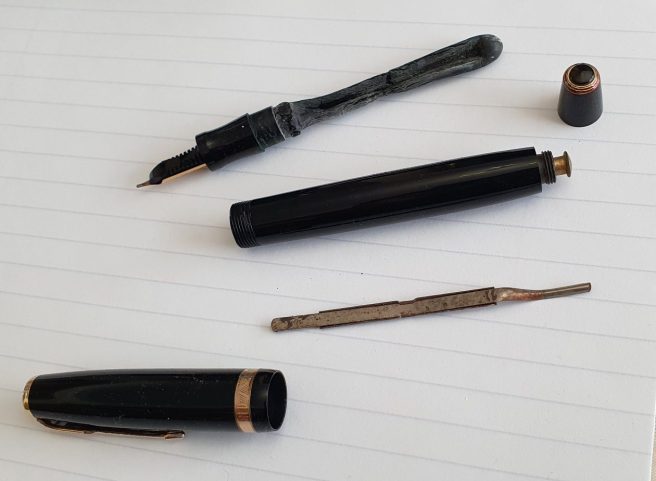
I do have one Parker Duofold button filler of my own, bought at the March London Pen Show. I had not used it much but thought that it was working. But on closer examination, it would write for only two pages before drying out. It appeared that this was just the ink retained in the nib and feed and that the sac was not filling. When pressing the button, no bubbles appeared in the ink bottle. With my newfound optimism, I decided to disassemble my Parker.
Old perished sac before replacement.
The steps were very similar to repairing my friend’s pen and so I will mention only the key differences:
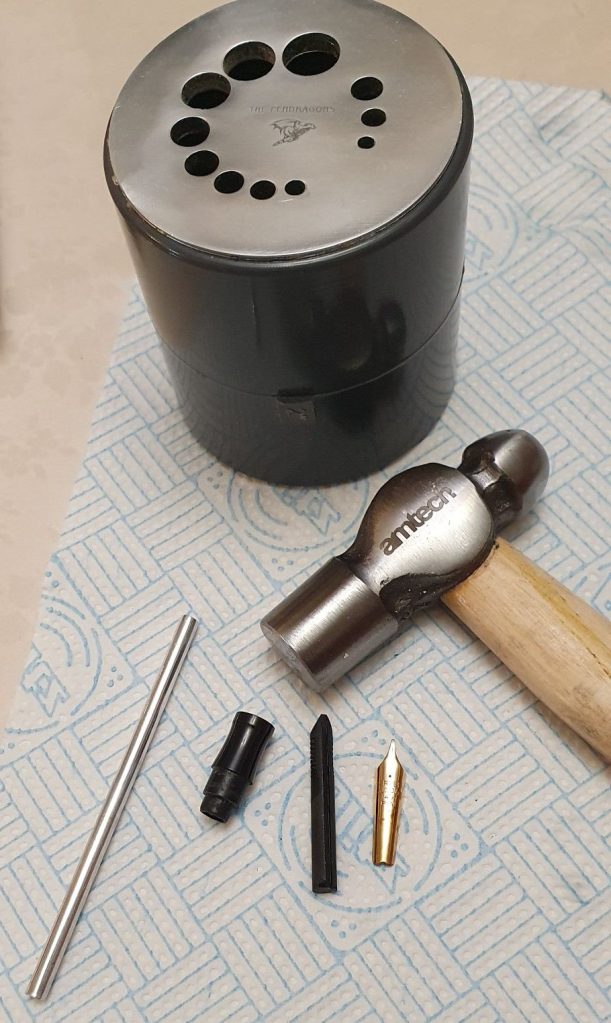
Knock-out block, hammer and drift.
I soaked the nib and section in water for several hours and then applied some gentle heat from my heat gun, before attempting to remove the barrel. As my tutor used to say, “Soaked pens come apart; unsoaked pens break.”
After about 5 – 10 minutes’ heat, at around 160 degrees, the barrel separated from the section and, unlike my friend’s pen, mine was a simple push-fit, not threaded.
The sac had indeed perished and was hard and cracked.
The spring bar had a bit of rust, but was still usable; I dusted it with French Chalk;
I soaked the section in an ultrasonic, then removed the nib and feed, using a knock-out block with a hammer and drift;
The new number 17 sac went on nicely, attached with shellac and then dusted with French Chalk
I had not been able to remove the button, from the end of the barrel. Not wishing to apply excessive force, I left it in place. However this meant that the spring bar could not be inserted through the button hole, after the section and new sac were in place. Instead the spring bar had to be placed in the barrel from the open end, taking care to have the pressure plate facing inwards, before inserting the section with sac attached.
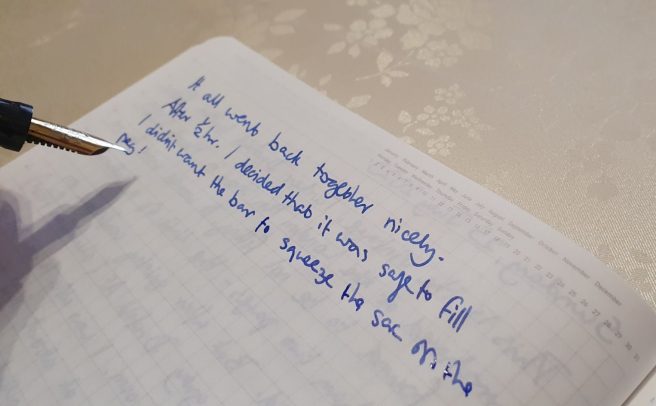
The pen went back together smoothly and I was ready to fill it.
New sac attached and dusted.
Since my pen had a push-fit barrel, it was not really necessary to remove the nib and feed and insert a rod into the new sac to prevent twisting when screwing the barrel back on, but it was nice to be able to clean and inspect the nib thoroughly.
Falling at the last hurdle.
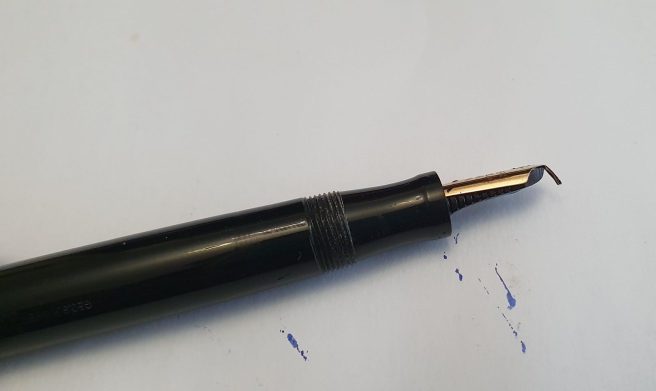
However, pride comes before a fall. In my excitement at seeing the pen fill properly, I had neglected to support the pen sufficiently, whilst pressing down on the button. Without realising, I had driven the pen down into the glass bottle and bent the soft gold nib to a right angle.
Oh no! It’s Gonzo from the Muppets!
Perhaps I was lucky, but I was able to bend the nib back into shape and do some rudimentary burnishing, using the tools available, namely a wooden McDonalds’ tea stirrer and a table mat. I got the nib back in shape with the tines aligned as best I could. The pen wrote smoothly and well.
Now that the pen fills properly, I kept track of its output and noted that it wrote for 15 pages of an A5 notebook on one fill.
There is always more to learn, even in a seemingly basic task like replacing a sac or inking your pen! This is why it is best to practice and make your mistakes on your own pens first. With the button filler I tackled my friend’s pen first but I am glad that the Gods of pen repair were aware of this and saved this humbling blunder for my own.
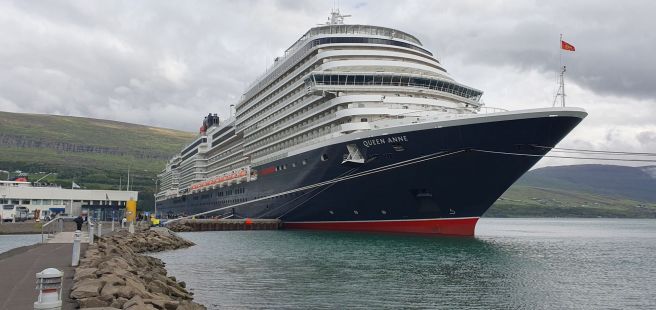
It has been holiday time again. We have recently returned from a two week cruise on Cunard’s Queen Anne which included four days in Iceland. Departing from Southampton, we also stopped in Belfast on the way north. On the return leg, we spent a day in Stornoway in the Outer Hebrides and a day in Greenock, on the Clyde near Glasgow.
Queen Anne.
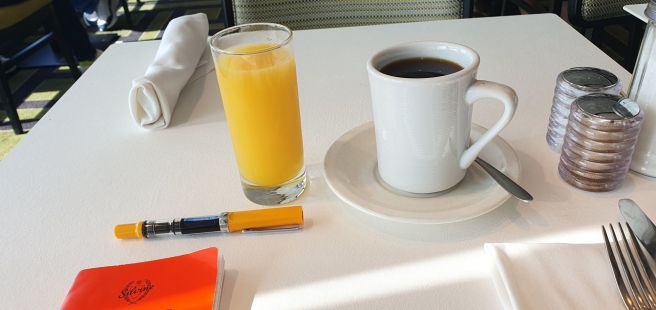
As ever, a vacation signals to me some journaling time with pen and ink. Although luggage limitations are less of a constraint on a cruise, I still wished to keep things simple. I decided on a select few fountain pens, namely my new Ashera Aeon, a vintage Parker Senior Duofold and lastly a TWSBI eco-T, in saffron yellow (holiday colours) with an extra fine nib. My thinking was that I would fill the TWSBI to use if the other pens ran dry, and avoid the need to bring a bottle of ink. As usual my journal-of-choice for travelling was a Leuchtturm A5 hardback.
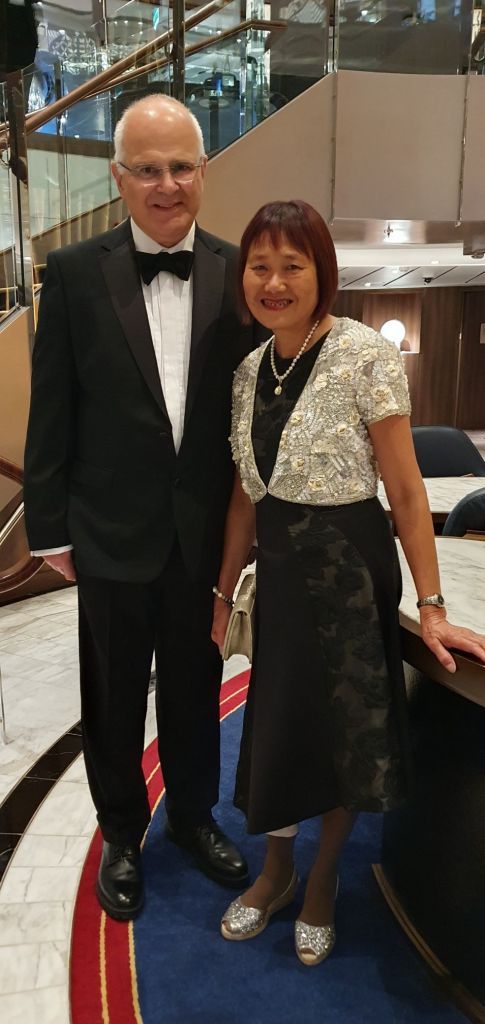
One of the gala-nights on board.
Our cabin included a small desk next to the balcony, but in reality it was a dressing table and the stool was too low for writing. The balcony was equipped with two seats and a small table. The hardback notebook works well resting on a knee, but I found the sea-scape more interesting than my journal and seldom managed more than a few lines outdoors.
Fortunately there is no shortage of comfortable seating around the ship, in the lounges, buffet-restaurants and in areas such as Library and the Chart Room. In the latter, I found some desks equipped with a seal, to stamp an image of our ship and her name onto paper, albeit without the luxury of melted wax.
Nothing says “holiday” like a saffron TWSBI.
It has become a custom of mine, or perhaps an unhealthy obsession to look for fountain pen shops whilst abroad, in the vain hope of coming across a delightful and friendly shop with some exquisite, unusual and attractively-priced fountain pens as possible souvenirs of my travels. Whilst this has succeeded on some occasions (such as Porto, or Bruges), this was not to be one of those trips. In fact I barely found anything with a nib, the whole time. Don’t get me wrong; this is probably not a bad thing as my magpie tendencies to acquire fountain pens are not sustainable.
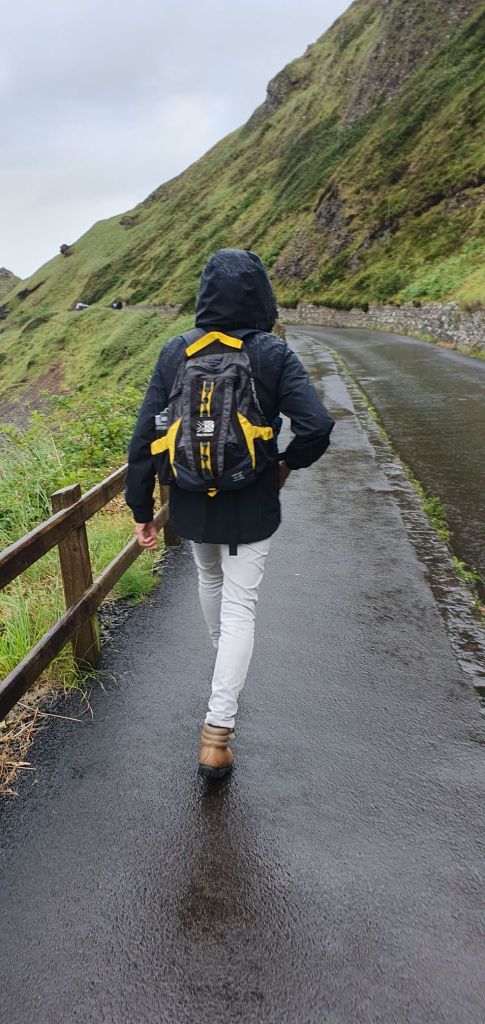
We had favourable weather for almost all our trip. The one exception was whilst in Northern Ireland, where we had time for an excursion to the coast to see The Giant’s Causeway, the spectacular basalt rock columns and a World Heritage Site. Here we encountered a very heavy downpour.
Trying to keep up with Ling at the Giant’s Causeway.
I had been excited to visit Iceland again. I holidayed there in 2008 visiting several areas of spectacular and varied volcanic landscape along the south coast, but this time, we were to have two days in Reyjavik and a day each in the northern fjiord ports of Isafjordur and Akureyri.
Reykjavik was very much just as I remembered it from 17 years earlier. We found our old hotel, Hotel Leifur Eriksson, opposite the landmark cathedral, Hallgrimskirkja with its 73 metre tower, perched like a space shuttle against the sky.
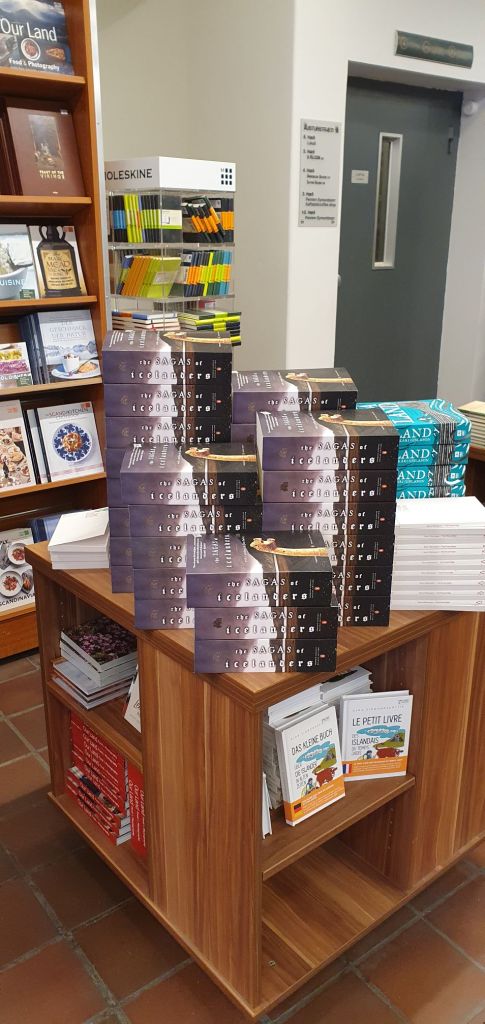
Once again I browsed in a book shop, Eymundsson (since 1872). In 2008, I had bought a copy of “The Sagas of Icelanders” published by Penguin Classics. I was surprised to see that there was again a tall pile of these same books on a table, just as there had been when I was here last. It was as if time had stood still.
Still promoting The Sagas of Icelanders.
It was here that I ventured downstairs to the stationery section, hunting for fountain pens. I found only a few Pelikan Jazz pens and was content to leave these alone. Had we been shopping rather than sight-seeing, there were plenty of examples of Icelandic wool pullovers and hats for sale in the city. I also found a lovely watch shop on the main street, named GullBudin, which had a good selection of Orient watches in particular.
Our next port of call was Isafjordur. Here, even our ship was dwarfed by the hills of the fjiord, their peaks hidden in cloud. We had a morning excursion to visit a waterfall and an afternoon free to explore the small town. Here, we came across an elegant white building now described as a culture house. It was formerly a hospital and still contained exhibits of beds and equipment and old black and white photographs of nurses and staff.
Culture House, (a former hospital)
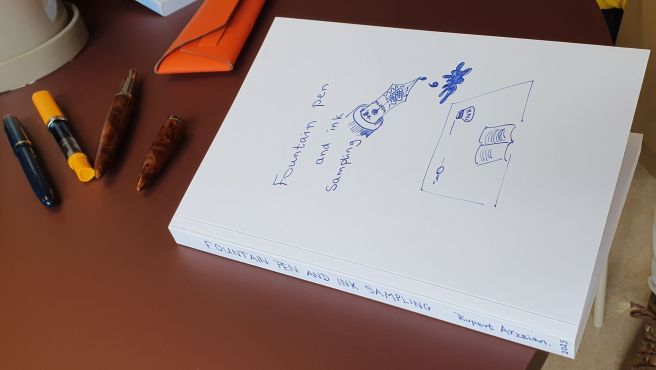
In a large upper room we found the space empty, but for two curving bookcases, filled with books but many with blank spines or covers. On closer inspection, we found that these were notebooks and that we were in a participatory art installation, called Book Space, by Elin Hansdottir. This project comprised 2,000 blank notebooks inserted into library collections in which visitors are invited not to read but to write, draw or contribute in any way they choose. Being unable to resist a blank notebook, I began one and proceeded to write a page with each of three fountain pens that I was carrying, identifying the pen and ink in each case. I hope that others may find it and add their own entries!
My contribution to the Book Space exhibition.
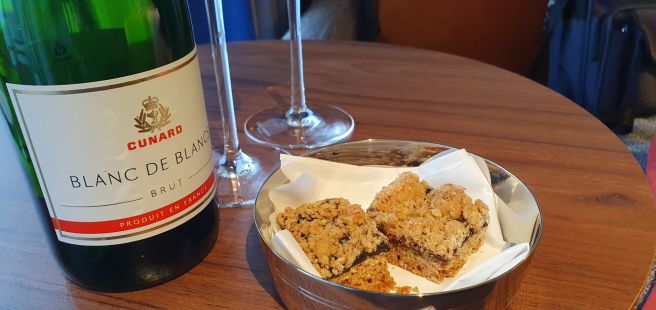
Our guide that morning had mentioned that rhubarb is grown in the area and told us of a local treat called “Happy Marriage Cake”, comprising a biscuit base, a layer of rhubarb jam and then baked with a crumble topping. Naturally I felt it could do no harm to taste some, when a cake shop presented itself!
“Happy Marriage Cake.”
In Akureyri we had another coach tour to visit some of the spectacular sights of the landscape, including the colossal Godafoss Waterfall, some lava rock formations and a vast area of geothermal activity with sulphurous steam spouting from the ground and burbling mud pools.
Godafoss Waterfall.
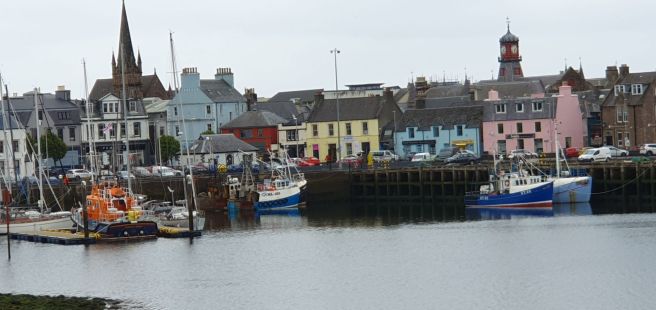
After Iceland, our visit to Stornoway in the Outer Hebrides seemed rather tame, but was in fact the only port on our trip in which the captain had struggled to enter safely, due to high winds. It took three attempts before the ship could be berthed, but we still had ample time to see the town and to attend an exhibition of Harris Tweed, which is made only on these islands.
Stornoway.
Our final shore visit of the cruise was in Greenock, on the Clyde and from which it is just a short train ride into Glasgow. We spent some time acclimatising ourselves back to the UK mainland. Glasgow in the sunshine was a lively and vibrant city. It was a graduation day for the University of Strathclyde and so we saw several new graduates in their gowns with their families. It seemed as if there was music from buskers around every street corner which leant a nice mood to our strolls.
Glasgow graduates.
In the familiar territory of a John Lewis department store, I made my last attempt to find a fountain pen display counter, but alas, there was none. However, I did spot some bottles of Waterman ink generously discounted from about £11.00 down to £3.45 and so availed myself of this opportunity to support the economy.
I had almost failed in buying a fountain pen at all on this trip, but this failure was avoided by finding a newsagents in Stornoway with a Platignum Tixx, for a couple of pounds and thought it worth a try. I did not realise until afterwards, that it it a disposable one.
In conclusion, we had a very happy trip. The time at sea was filled with food and entertainment (theatre shows, interesting talks, and live music of all types) and meeting new friends. As for the journaling, I had made the mistake of starting the trip with the TWSBI eco-T, and then using it every day as my main journaling pen for the rest of the trip, as I enjoyed it so much. Still it was nice to have the others for variety. And yes, I did still return home with more ink than I had started with.
Last month I posted a review of the Ashera Aeon fountain pen. The pen had been sent to me on loan, to try out (for as long as needed to familiarise myself with it) and then to review and return to Ashera in Germany. All very normal, you might think, except that in my case in eight years of pen-blogging, this was the first time that I had entered into such an arrangement.
Ashera Aeon.
After my review had been up for about three weeks, I thought that it was probably time to get the pen back to Ashera. I dropped them an email to check a few details and also enquired on what terms they might be prepared to sell the review pen to me. I received a warm and friendly reply. Indeed, all my correspondence from Ashera has been courteous and friendly and it has been a real pleasure dealing with them. They had considered my suggestion and offered me a generous discount, if I wished to buy the pen.
At this point, my wife reminded me, fairly emphatically, that I already have more than enough fountain pens for her to deal with after my demise and that another pen was the last thing we needed. Accepting her line of argument, albeit under duress, I replied to Ashera’s email and reluctantly declined their kind offer.
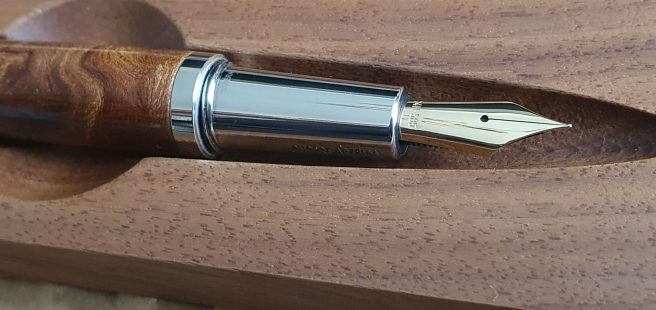
That could have been an end of my Ashera journey. However I was not prepared for quite how bereft I felt in the following few days. Whilst the pen was with me, I had used it at every opportunity with many different inks and read all I could find about it, to write an informed review. The pen was like nothing else in my collection in many ways – its hand polished wood body, its long tapering profile (reminiscent of a desk pen or art pen), its titanium grip section and the unsigned 14k gold nib from Bock. From showing the pen and its wooden box/pen tray to friends I was familiar with potential danger areas: “Be careful – the box lid is held on by magnets; yes it’s a screw-cap; no, don’t try to post it; be careful screwing the cap back on” etc. My review pen, having the elm burl wood body, has a very pretty grain although there are numerous small “holes” in the grain of the cap, seen by shining a light from outside the cap, whilst rotating the cap and peering inside. These all have to be filled when the wood is lacquered and polished, one reason why the elm burl version costs more than the holly or olive wood models.
I felt that I may never have such a good opportunity again, to buy such a high quality pen with the luxury of testing it first, for some two months! Knowing the pen so well, it almost felt as though I should write some care instructions for its eventual owner: “It likes Pilot Iroshizuku asa-gao and Stalogy paper” and “Don’t let it roll off the table!”
Around this time, I went to see Wagner’s opera “Die Walküre” from the Ring Cycle. In the protracted scene when the God Wotan expresses his emotion at having to banish his favourite but rebellious daughter, Brünnhilde, I could think only of my own, imminent separation from the Ashera (a Goddess in ancient Semitic religions, associated with sacred trees). In short, I had a bad case of non-buyer’s remorse.
In my case, the remedy was rather simpler than for Wotan. I tip-toed onto the subject again with Mrs A, who listened to my closing arguments for the defence. After some admonishing to “learn to control yourself” etc, she conceded that, if I felt so strongly about it, then she would not stop me. I wasted no time in notifying Ashera that I had changed my mind (cough) and asked for the bank details to send payment!
I was thrilled to receive their confirmation once payment had gone through. It was good to know that the pen was officially mine – although it does literally have my name on it!
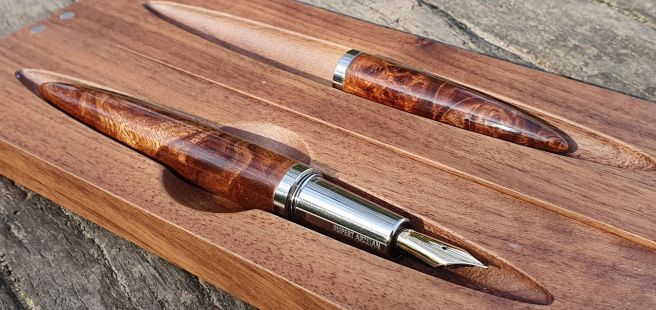
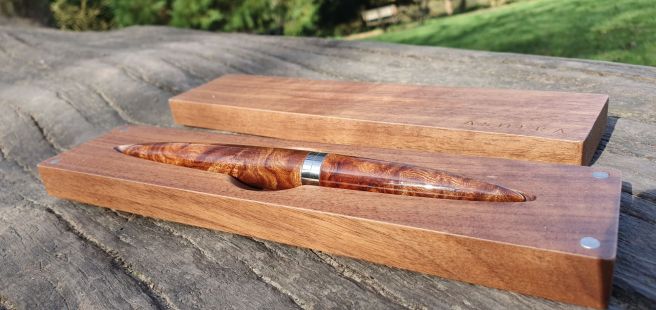
Ashera Aeon in elm burl, with its walnut wood box.
Aside from this brief, emotional roller-coaster ride, the other unexpected effect of the Ashera upon me has been to give me a taste for wood varnishing. The Ashera features a natural wood cap and barrel, turned and smoothed and then lacquered. The eventual deep gloss finish is a result of the wood being lacquered, dried and polished again and again, over a number of weeks, for eight layers. The finished pen is joy to hold with the long, smooth, cigar-like ellipsoid, interrupted only by the titanium rings flush with the cap and barrel.
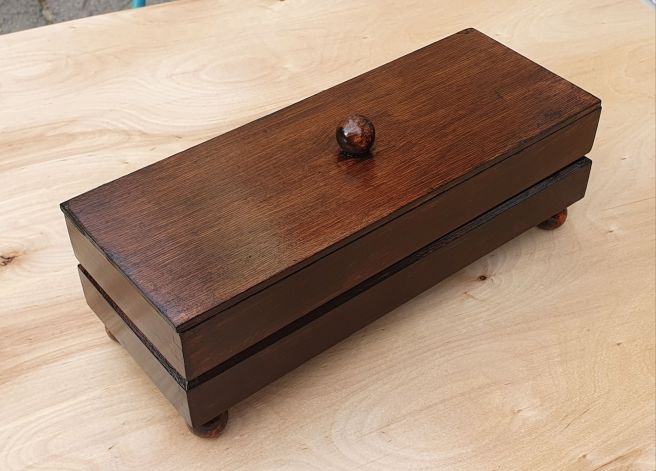
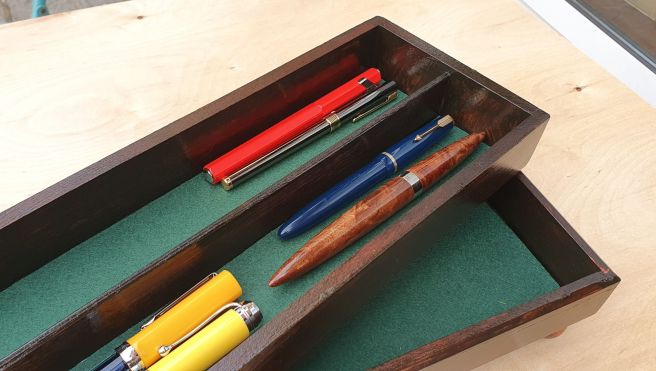
This work is done by artisans and not a skill that you can acquire in five minutes. However, I found that it is possible to achieve some very pleasing results by sanding some wood and applying some varnish to it. Recently, I came across a little wooden, lidded box in a charity shop. It comprised a single tray on the bottom layer, then a separate middle layer divided longways into two further trays. It was about 13½” long by 5″ high. It was in white, bare wood and at just £10.00, I thought that it should have a new life as a pen box. I bought myself a small tin of wood varnish, (walnut, gloss) from our B&Q store and a few brushes.
A two-layer pen box, newly varnished.
It was surprisingly satisfying and a bit addictive, to watch the box being transformed into a rather elegant, glossy dark chest. My varnish was quick-drying, and just tacky after 30 minutes and dry after 4 hours. The instructions recommended using three or more coats allowing each coat to dry before applying the next. Theoretically, you could apply all three coats in a day, but I rather enjoyed doing the varnishing late in the evening and then leaving it to dry overnight.
Once I had applied three coats all over, I added some green felt to the three trays. Rather than stick the felt directly to the wood, I stuck it to some card stock to have the option of changing these easily in the future.
Upper deck of my pen box.
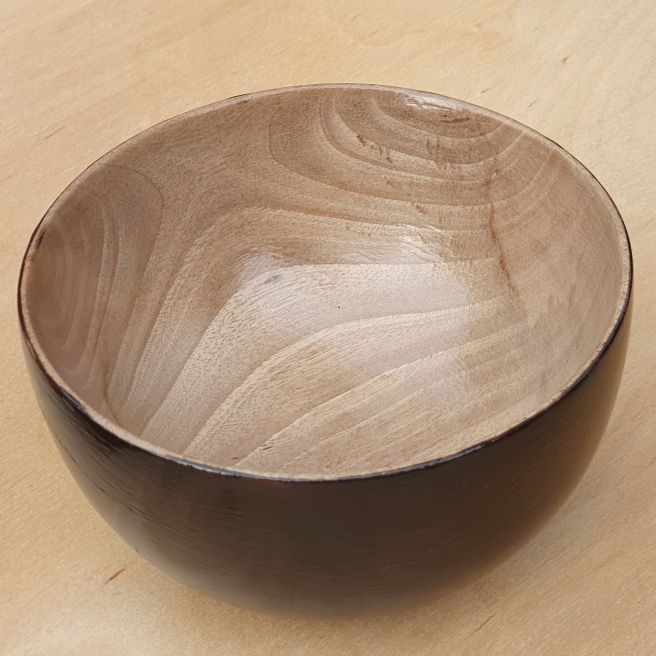
Encouraged by my early efforts, I browsed some more charity shops and found a small wooden bowl, slightly marked but having potential to be restored with some sandpaper, varnish and TLC. This was much smaller and quicker than the pen box project. I use the word “project” to keep up with my wife, who is currently embarking on a project of her own to convert her mother’s garage into a day-room or office space.
My bowl project went well, thanks. I used the same walnut gloss finish for the outside but a clear gloss varnish for the inside to show the natural wood grain. The first coat of varnish did cause the grain to rise and become rough and so it was necessary to sand it smooth again before the next coat. I am rather chuffed with the result! I did find a long crack or split, about ½” below the rim, which appears to go all the way through suggesting that the bowl might have been dropped at some time in its life. It is no longer easily visible on the inside but is prominent on the outside. A younger me might have been put off by this flaw but now it actually gives me more affection for the bowl – just as we all pick up some scars, physical or mental, as we go through life.
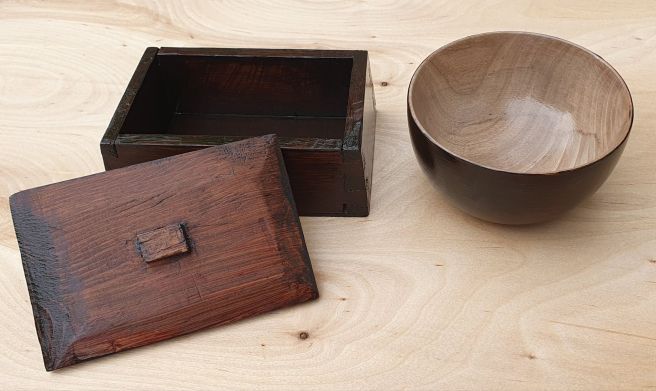
Currently, I am on my third wood varnishing project! This is another very cheap knick-knack from a local charity shop, bought with no apparent wood protection and I am now advancing through my three-coats procedure. I think this may be another candidate for my self-adhesive, holly-green felt.
Wooden bowl (finished) and a lidded box (work in progress).
It is possible that but for the Ashera fountain pen, I might never have discovered my inner artisan (LOL). I cannot promise that an Ashera will have the same effects on everyone. I appreciate that it is an expensive pen. Even with the generous discount that I received, it was still one of the costliest pens I have bought and one of only a tiny number on which I have broken my £400.00 barrier. I am happy to report that I have no regrets and that it continues to be in daily use. I am grateful to Ashera for entrusting me with the pen, initially for a review.
For anyone reading this who is still thinking of ordering an Ashera, there is still (at the time of writing) a discount available via a link in my last post, and repeated here, which results in a 20% reduction. The link takes you to a page created by Ashera referring to a “Rupert Arzeian Edition.” This indicates to Ashera that the purchaser comes via my blog, triggering the discount and a commission. It does not mean that I designed the pen or that you have to have my name on it!
To order, (1) chose one of six wood options, (2) select either gold or platinum for the Bock nib ; (3) chose a nib width of either Fine or Medium, and (4) indicate your chosen name for the engraving. The price is then adjusted automatically, albeit shown only in US dollars or Euros at present. When you click “Add to basket”, the 20% discount price shows in the Summary. You then have the option to “Proceed to Checkout” or to delete the pen from the basket. The choice is yours.
Back in February, I received an email from Ashera GmbH, inviting me to review one of their pens. They offered to send me a pen on loan for evaluation and review. In return they offered a commission on any pens sold through my blog.
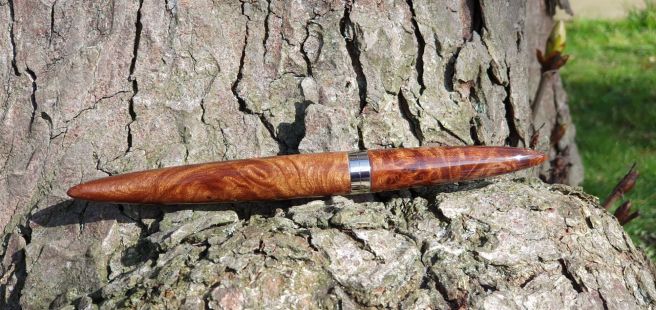
Ashera Aeon fountain pen, in Elm Burl wood.
Disclosure.
Readers will be aware that it has been my practice not to accept goods or favours from suppliers in return for a review, to avoid any suggestion that my opinion was biased in any way. Ashera understood this and asked only for my independent and honest feedback and review. After seeing their web site and reviews of early prototypes of their Aeon fountain pen, I was curious to try one. The photos of the pen looked stunning and the company’s environmental commitment was impressive and admirable.
After a little back and forth, we agreed terms whereby I may select the configuration of a pen for review and return, and that a discount of 20% be given on pens sold to readers, (available on up to ten pens) plus a modest commission for me.
Background.
Ashera introduced themselves to me as “a brand dedicated to crafting handmade luxury fountain pens that blend traditional craftsmanship with modern design.” Much can be learned from their web site, https://ashera-design.com which includes answers to FAQs.
They started making the Aeon pens in 2022. These are handmade in Germany, offered in a choice of six woods, with a titanium grip section and Bock nib in 14k gold or platinum (fine or medium). Production is limited to 999 pens in total.
The company has been most helpful in clarifying a few points that I raised. Their web site is being updated and contains a few inconsistences. For each pen sold, the company now plants 250 trees (not 100 as stated at the time of their video clip). The trees are planted via Ecologi. Ashera might add details of specific projects and sites where the trees are planted.
The unboxing.
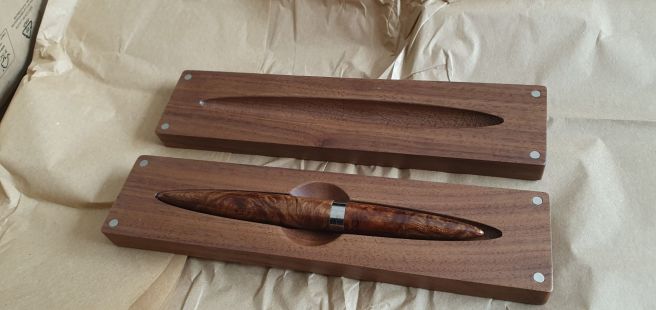
I was aware from the website that the pen comes in a wooden box. In my correspondence with Ashera, I suggested that they send me the review pen without the box to save on shipping costs each way. I am glad that they chose to disregard this request. The box is beautiful, although it now differs from the one on the website. The pen is supplied in a fully custom-built walnut wood box, smooth and tactile with a satin finish. It comprises two slats with a milling inside that fits the pen perfectly and magnets in the corners to hold it closed. The two parts have a cutaway, to display the pen or prevent it from rolling, which it would do. In the lower half, this cutaway is intersected by a hemisphere space for thumb and forefinger to pick up the pen. This creates a satisfying geometric meeting of curves, although the pen can also be scooped up easily from either end.
Walnut wood box/pen tray.
The box lid bears the name ASHERA engraved on the top, as well as another pen rest. This is a box which is attractive and useful and genuinely adds value.
I took the pen and its box along to my pen club. There was universal acclaim for the walnut wood box, the magnetic closure and then for this extraordinary pen, with its stunning lacquered wood grain and long tapering contours, nestled in its custom box.
Ashera Aeon and accompanying box.
Initial impressions.
My review pen is of Elm Burl which features a lovely swirling wood grain. Each pen is unique. The finish is high gloss and super-smooth as the process involves lacquering, drying and polishing the pen eight separate times, over a few weeks. The prices of the pens vary according to choice of wood and nib material, my chosen sample being about mid-way in the price range. I was drawn to the Elm, as they were common in Middlesex where I grew up although I remember many being lost to Dutch Elm Disease in the 1970’s. The wood for the pen actually comes from a burl, or burr, which is the gnarled, rounded, growth on a tree typically found on the trunk or branches and formed as a result of stress which the tree experiences. I can relate to that.
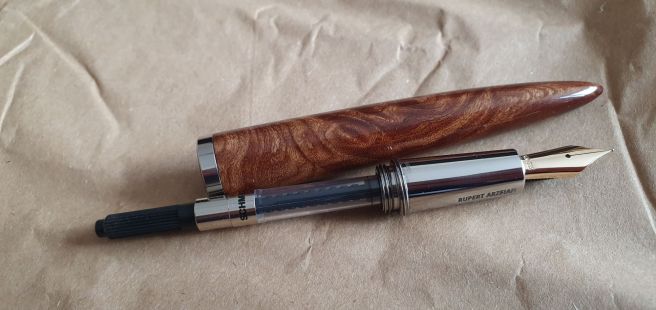
Barrel and section.
At first sight, the length of the pen is also striking. My sample is 17.2cm capped, although since these are handmade, there may be a little variation. (The length of 18cm, shown in the website is slightly overstated, although the cut-away in the pen box is that length).
Aesthetically, the pen is very pleasing. The shape is an ellipsoid (a three-dimensional ellipse). The cap and barrel, ending with titanium fittings, are completely flush when the pen is capped. The cap meets the barrel 7cm from the top of the pen, which is around 40% of the total length of the pen. Whether this has any place in sacred geometry I do not know, but it distinguishes the cap from the barrel. All threads and rings on the cap and barrel are titanium.
Uncapping the pen, on triple-start threads, requires only about 40% of a turn (as measured with a yellow post-it note!). This reveals the long metal section. This is solid titanium, not plated but mirror-polished. The website states “The feel of the titanium offers a sense of solidity in hand, and the mirror polish, unexpectedly, ensures a steady grip with minimal grip pressure required.”
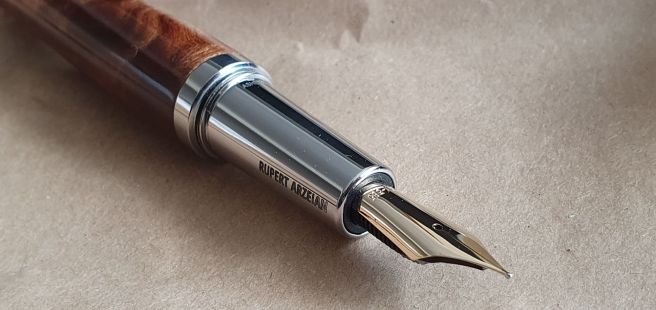
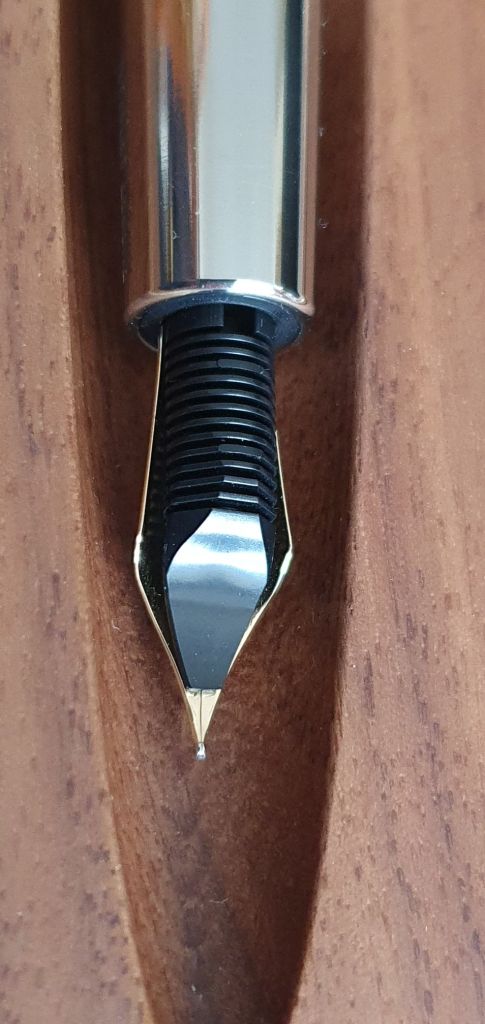
The nib that I chose is 14k gold, in a fine. I did ask why there was no name or logo on the nib, but only the gold description “14K-585”. This is to showcase the beauty of the gold (or platinum), and ironically, costs more to produce than if an imprint was present. Each nib is hand-polished individually for maximum gloss and hand-tuned and tested to ensure that the tine spacing is just right. This is quality control at its best.
The only branding on the pen is the name Ashera, laser etched in tiny capital letters just below the cap threads. This could hardly be less obtrusive.
Although titanium is a lightweight metal, the wood barrel is also light. The section is sufficiently weighty to give the pen a comfortable front-weighting, despite the long barrel. Uncapped, my sample pen measures about 15.3cm, which is wonderfully long. I like a pen to be at least 13cm long when uncapped and so the Aeon sits well above this. There would be no need to post the cap of the Aeon. In fact, don’t even think about it: the coming together of titanium cap threads and hand lacquered wood will not end well.
One concern from the design of the pen, is the step down from the barrel to the section. This is a necessary consequence of the cap closing flush with the barrel. However, whilst I usually dislike such a step, I can say that within two weeks of use, I had ceased to notice it and could pick up the pen and use it without any thought of discomfort. This, it occurred to me, should be the aim of any pen, rather like a pair of shoes. Nor has the metal grip been an issue. I read that titanium is highly resistant to corrosion, due to the formation of a thin, protective oxide layer on the surface. I wonder if it is this which helps provide some grip. It does feel different from a typical resin or acrylic pen with no such step, if that is what you are used to, but I soon adapted to it and it feels like holding a precision instrument.
Personalised engraving.
When ordering the pen, there is an option to choose to have it engraved for an extra 20 euros. Although I did not ask for this on my review sample, I was thrilled to see my name laser etched along the side of the section, and on both sides to be visible whether held in the left or the right hand. If Ashera thought that seeing my name in titanium would appeal to my ego, they were right!
Writing performance.
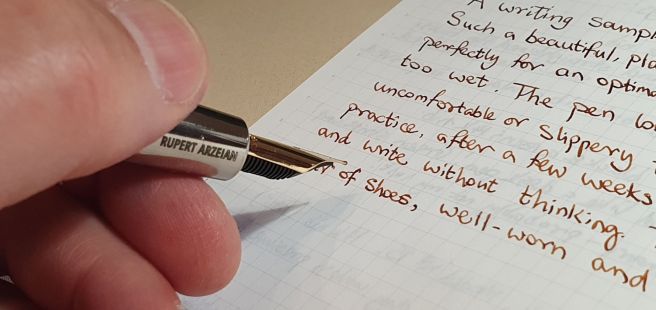
I first filled the pen with Diamine Gibson Guitar series, Cherry Sunburst, a smooth-running warm brown ink with good lubrication. The nib was smooth and firm with just a little bounce. The tines were well aligned with the small gap between them, narrowing until the tipping, just as it should. The nib was nicely centred over the feed. In use, this nib produces a smooth, consistent flow and a line width of around 0.40mm on a down stroke and 0.30mm on a cross stroke.
Nib and feed.
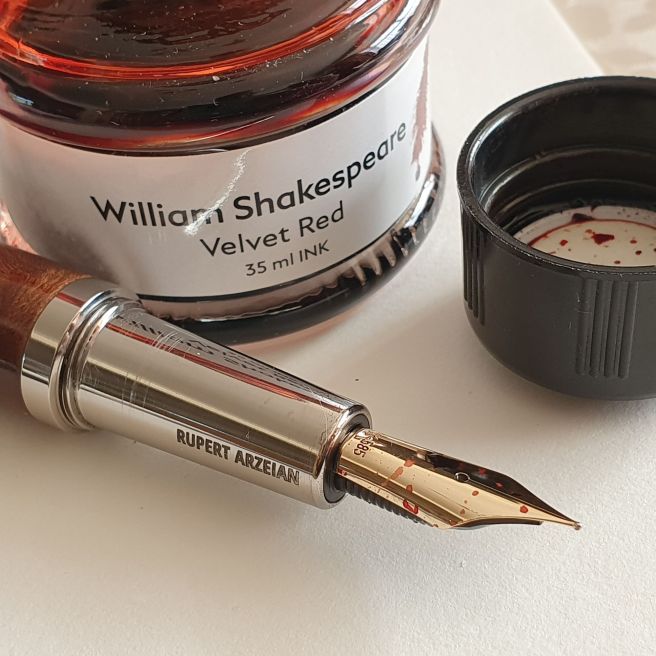
I was also pleased to find that the nib did not dry out overnight. My second fill was with Pelikan 4001 Brilliant Brown, a drier ink but still I experienced no hard starts in three weeks of use. I am currently using Montblanc William Shakespeare Velvet Red, with equally good results.
Pen and ink, uncapped
There is a little feedback from the nib, but no scratchiness or drag. The pen is a joy to use and I pick it up often.
Filling and maintenance.
The pen is a cartridge-converter filler. It takes standard international cartridges or can be filled with the push-in Schmidt converter, supplied with the pen, making for easy cleaning.
The Bock nib unit can be unscrewed from the section and the nib and feed can be pulled out for cleaning or maintenance although I have not tried to do so.
There is no inner cap. Whilst I found that none is needed here to prevent hard starts, I had a concern that ink drops could stain the inside of the cap, if the pen were to leak or be shaken in transit. However I am told that the cap is also lacquered from the inside, just like the outside. The lacquer is low viscosity and penetrates deeply into the wood fibres. If necessary, the inside of the cap could be cleaned with a cotton bud. Ashera advise against soaking the cap or barrel in water.
A one-handed selfie photograph.
Likes and dislikes.
I found much to like about this unusual pen. In summary the main points are:-
Choice of natural woods for cap and barrel, sustainably sourced;
Glossy, eight layer lacquering;
Unusually lengthy, with a comfortable balance;
Clean, minimalist ellipsoid design; there is no pocket clip;
Titanium grip section, rings and threads for strength and durability;
Comfortable girth, neither too wide nor too narrow for me;
High quality gold or platinum nib, free of branding or decoration, but hand-polished and tuned; writes smoothly; (reverse writing is also smooth and gives an extra fine line);
Seeing your name on such a high quality pen feels very special:
Company’s commitment to reforestation;
Attractive and practical wooden box/pen tray.
Some points to note:-
At first I was concerned that when uncapping the pen, the barrel might unscrew instead. It has worked loose a few times but generally, once screwed on tight, (and tighter than the cap) this does not happen;
The cap threads can be a little fiddly to align until you get used to them; the solution is to rotate the pen the other way until a click signals the start of the threads, and then screw it into the cap gently, ensuring that the cap and barrel remain in a straight line. My concern, when anyone else uses the pen, is that the cap may be put back on cross-threaded; one member of my pen club said that the threads felt rough and were not quite up to the same standard as the rest of the pen;
The threads on the inside of the cap are sharp and, even with careful use, appear to have left some scratch rings on the miror-polished titanium section (although personally, that would not bother me and might even improve grip);
Metal sections can be slippy, but I have not found this one to be a problem for long writing sessions. When writing, my thumb is half over the barrel ring and cap threads, which gives grip;
The step down from barrel to section is quite prominent but I have not found it uncomfortable in practice;
A couple of people at my pen club felt that the pen was too light; however it weighs 28g closed, or 23g when uncapped, the cap weighing 5g. Personally I find the weight and the balance, fine as they are and comfortable for long writing sessions;
Whilst I enjoy the extra length of the pen, it will be too long to fit in some pen cases. I carry it in a pouch.
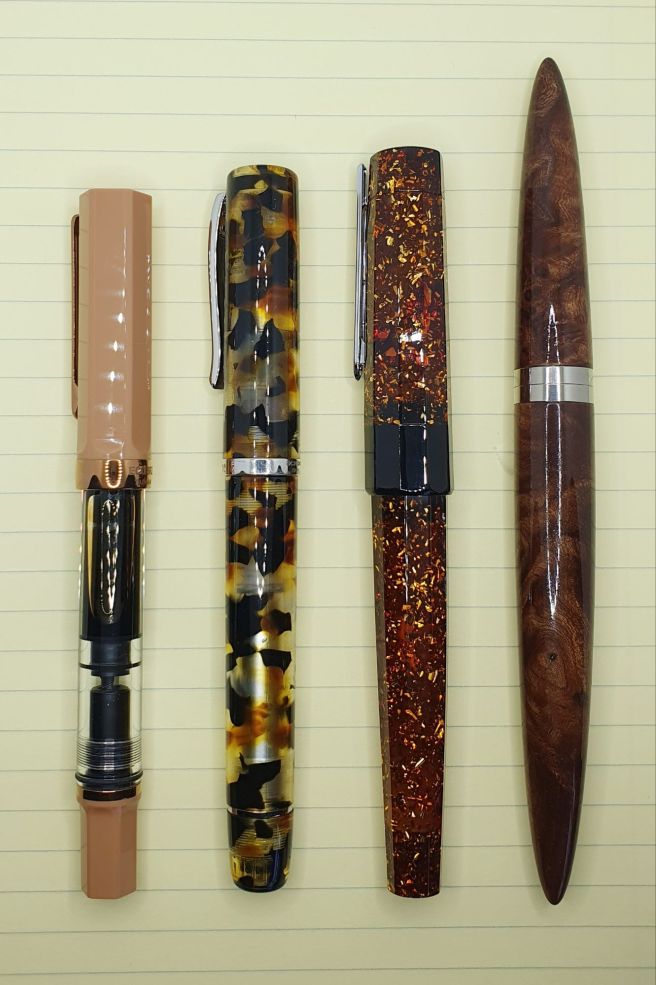
Size comparison with TWSBI Eco, Scribo Write Here “Africa”, and Benu Euphoria “Bourbon”.
Conclusion.
I have thoroughly enjoyed using the Aeon, these past three weeks. I was delighted with my choice, of Elm Burl and gold nib (Fine) that I opted for. Some of the wood options do increase the price, not because of the cost of the wood but rather due to the extra difficulty of working with it. A platinum nib also adds to the price.
Ashera have kindly arranged to provide a discount of 20% on the price of an Aeon fountain pen, (limited to ten pen sales) purchased via the following link: https://ashera-design.com/aeon-rupert-arzeian-edition The discount is applied at checkout.
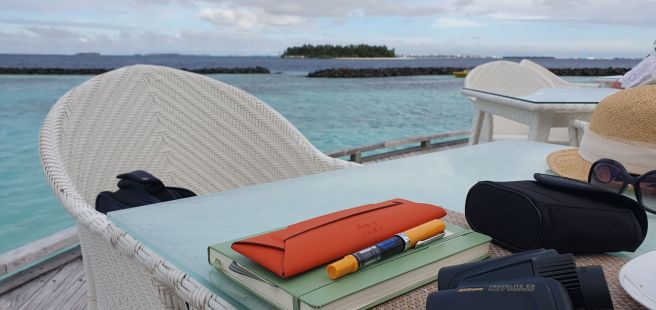
Our latest holiday destination was well-chosen by my wife, from her bucket list. We were both hoping for a peaceful break with little to do, other than snorkel by coral reefs. Faced with this prospect, I set about picking fountain pens to bring for some holiday journaling.
As usual, I briefly contemplated bringing just one pen to use exclusively, but caved in and eventually went with five. These included three recent acquisitions from the London Spring Pen Show – a Parker 17 Lady, a Parker Duofold button-filler and the TWSBI Eco T Saffron with EF nib. The other two were a Wing Sung 699 vac filler, which I have been enjoying since the start of the year and finally the red Caran d’Ache 849 bought in Bruges last November.
Vintage Parker button filler and a 17 Lady.
I should say now, that this will not be a post about all the best places to see fountain pens throughout the Maldives. We stayed on only one of the 1,190 islands. Aside from the Dive shop, the island had only one other shop, for gifts and souvenirs. The region is thus more an opportunity for pen using, than pen shopping.
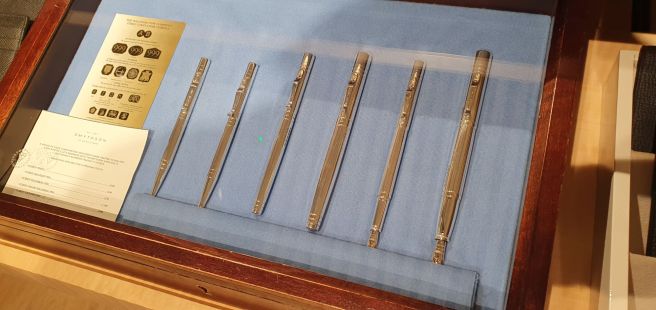
However the trip was not entirely without something for the stationery fan with gear acquisition syndrome. If I had been careless enough to leave home without any fountain pens at all, then help was at hand in the duty free shopping mall at London Heathrow Terminal 4: a Smythson stationery shop held a good selection of Yard-O-Led pens and pencils in Sterling Silver. Phew!
A rare sighting of some Yard-O-Led pens in London Heathrow Airport.
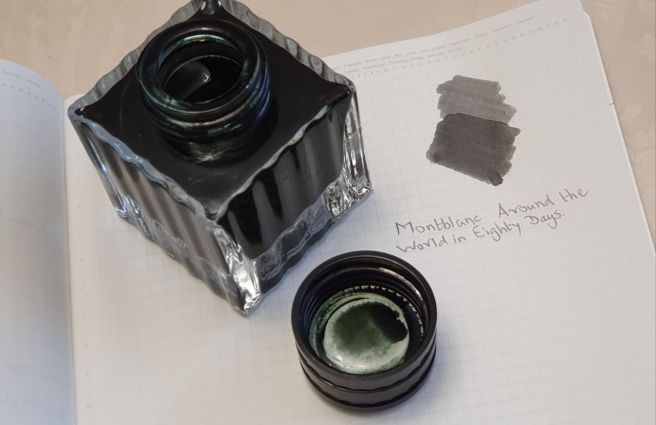
Also in the Terminal, is a Montblanc shop. Here I enjoyed a good browse around and a chat to the helpful assistant Lenka. A number of the fountain pens were on special offer with around one third off! But even with such a discount, a pen such as the Montblanc Meisterstuck Solitaire Blue Hour Legrand is still a hefty sum of money, especially for a spouse-accompanied impulse buy. However, I did succumb to a bottle of Montblanc “Around the World in 80 Days” special edition ink. This appeared to be an interesting grey with dark green undertones which I liked, although strangely described as Brown on the box.
Around the World in 80 Days.
I added this ink to my clear plastic bag of liquids under 100ml, to pass through security, along with my Pineider travelling inkwell of Quink Black. I emptied the vintage Parker Duofold button filler and the Parker 17 Lady, to avoid the risk of them leaking on the flight. The other inked pens remained in my carry-on backpack for the journey, with nibs uppermost and I had no trouble with any of them on the flights, out or back.
To write in, I had brought a Leuchtturm A5 journal. I see that I refilled the two vintage Parkers with my new Montblanc Around the World ink. I had brought a collapsible plastic cup (possibly a dog’s drinking bowl?) which was a useful accessory for holiday pen flushing. I used the Duofold button filler which wrote for about 10 x A5 pages on one fill. The nib is a medium to broad. I then switched to the Parker 17 with a fine or extra fine nib, which I enjoyed a lot with the Montblanc ink, since it produced a sharp pencilly grey line on my Leuchtturm paper. Next I used the Caran d’Ache for a short while before moving on to the TWSBI Eco T Saffron, with EF nib. I had paired this with New Old Stock Waterman Blue Black ink from the pen show and, with my Leuchtturm journal, I enjoyed this combo and used it for the remainder of the holiday. Even so, the capacious piston filler was still half full when I got home. It is a comfortable pen; I love the firm EF nib and the Saffron beachy vibes.
A TWSBI Eco T, Saffron, on vacation.
On the return flights there was another opportunity to be tempted by Montblanc in the duty free shop at Malé airport where I had a nice conversation with the friendly salesman, Irhan who was knowledgeable on the special editions and showed me the James Dean (in a sale) and a Chopin. He told me that they attend a course every few months to keep up to date with the pens.
As for the holiday itself, the Maldives are of course a wonderful, tropical paradise and we had a great time, swimming and snorkeling every day. Our small island resort was bounded by a coral reef and it was a joy to swim out from the beach, over the reef to the far side where it dropped off steeply to the deep blue depths. Here, a variety of colourful fish could be found, among the coral. In the course of the trip, we saw plenty of marine life, including turtles and reef sharks.
My Wife enjoying the beach view.
But the highlight of our stay was a guided snorkeling trip, by fast boat, to a patch of ocean about 25 minutes’ boat ride away, where we swam for an hour blissfully observing a group of manta rays, gliding by us in the crystal clear waters, feeding and occasionally showing off with a loop-the-loop. It was while watching these beautiful creatures, that our group was treated to the awesome sight of a Whale Shark, also feeding (but happily not on snorkelers) which was perhaps around 12 metres long. Our guides were excited as it was only their second sighting of a Whale Shark this season. We did not have an underwater camera but some friends in our group had one and later shared some of their photos with us.
Manta Ray in the Maldives
If we were to go again, I would like to bring a Go-Pro for some underwater stills and video. When we transferred flights at Abu Dhabi, I found several electronic shops in the airport selling these. But to buy one then seemed like locking the stable door after the horse has bolted. But, with thanks to a German couple whom we met on our trip, I can share a few photos of what we all saw.
Manta Ray
A Whale Shark, feeding.Another gratuitous Whale Shark shot!The rested spouse.
I learned of this challenge from Writing at Large. The idea is to complete 100 sketches of people in a week, from 3 to 7 March inclusive. The challenge runs every year in the first week of March.
Although I am not usually one for these online challenges, I was intrigued enough by this one, to have a go. I thought the practice would be beneficial, which it has been.
I gathered that there were few rules on how to go about this. You can use any sketching media. Then post your work using the hashtag #OneWeek100People.
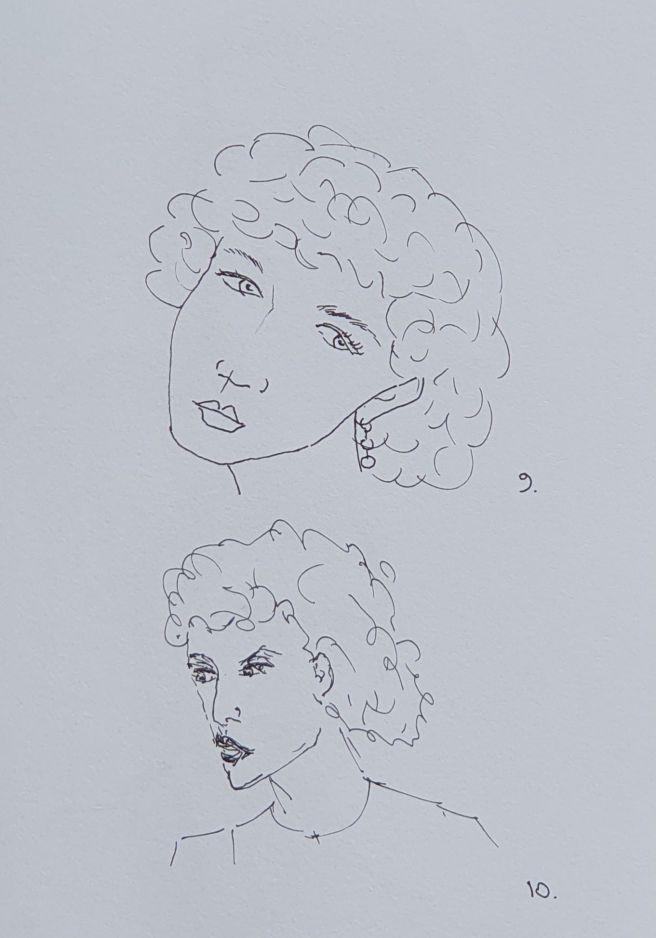
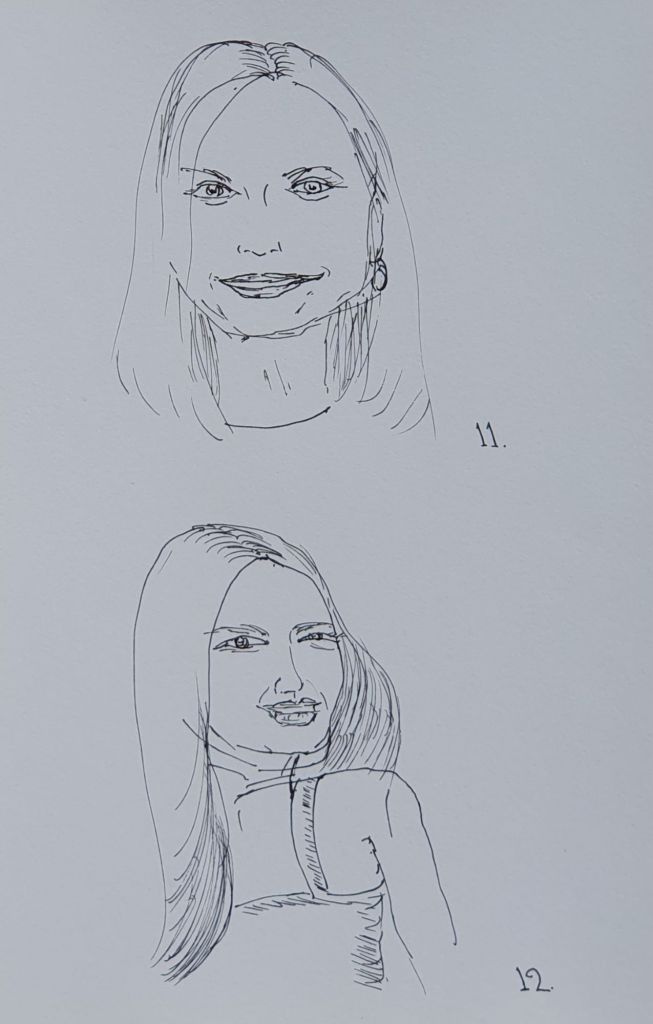
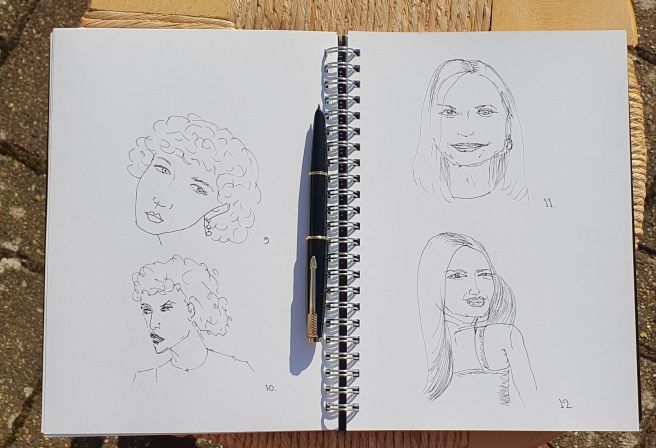
Even the target of completing 100 pictures in 5 days is not essential. That is just as well, as I find myself woefully behind with just 12 pictures in three days.
Also my pictures have all been copied from photos, rather than drawn from life, as an urban sketcher would.
Having since looked at other people’s work, I now see that my sketches are far too fussy, when I should have worked loosely and quickly.
But here are my attempts so far. All were drawn with a vintage Parker 17 Lady fountain pen with Parker Quink black ink in a Rymans A5 sketch book, with no prior pencil work. Going straight to ink builds confidence! I quickly learned that trying to produce pictures that are recognisably human is challenge enough: to get a likeness is a whole lot harder.
In blogs which promote fountain pens, I think it is good to inspire the use of these wonderful instruments, and not only their acquisition.














 Fountain pen blog