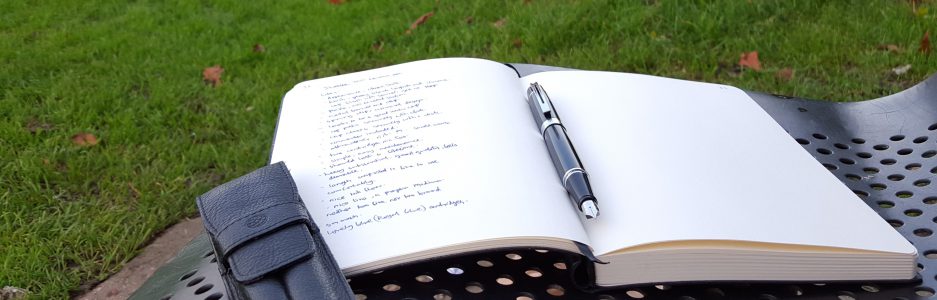
Nine years with the Parker Frontier fountain pen.

There are several reasons for my writing about this pen today:

  1. I have been looking through my accumulation and rediscovering pens which are like old friends.
  2. I added an Index of Pen Posts to the blog menu recently and noticed that this is a worthy pen not covered before.
  3. I thought that it was coming up to ten years since I bought the pen, although it turns out to be nine.

Background

I bought this pen at Rymans, our local stationers in May 2011. It cost £22.99 normally but there was a discount of £6.00, which was a bonus. I had some previous experience with other versions from the Frontier range. I used the plastic barrelled ones for registering weddings at our church, a duty that I had taken on a few years earlier. I had liked it, as a plain and simple but respectable pen, for use with iron gall ink.

Parker Frontier, in stainless steel with gold coloured nib and clip.

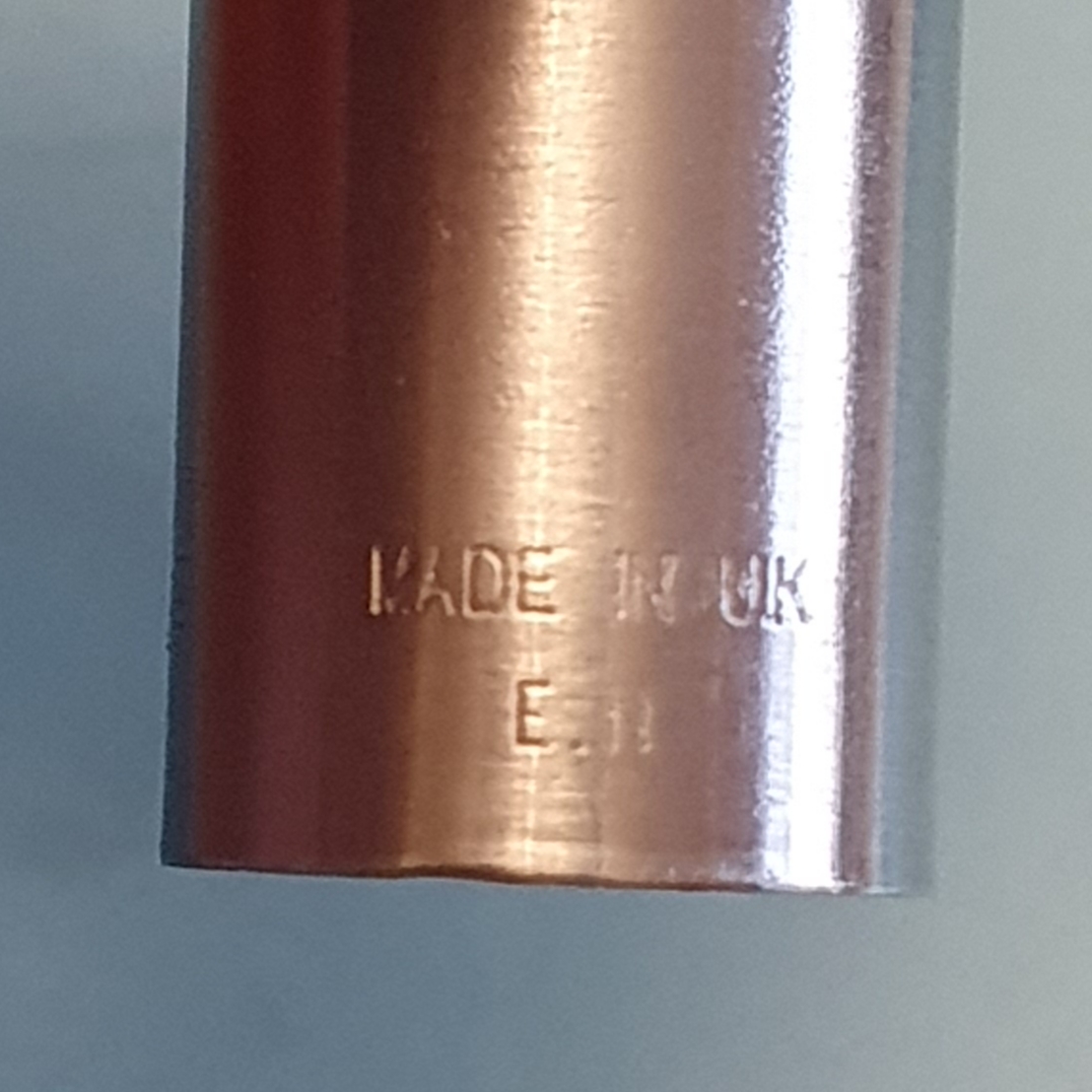
The story of the Parker Pen Company is a long one and dates back to 1888. This particular pen bears the production date code E which denotes the year 2008, (using the “QUALITYPEN” system with Q being a year ending with zero). The cap also states that it was made in the UK which would be from the Newhaven site, which was to close in 2011.

Make and Model name shown here…
and the place and date of production.

Thus at the time of manufacturing this particular pen in 2008, Parker had a history of 120 years. Apparently, this milestone was celebrated with a souvenir DVD of the company’s history, a copy of which was given to all the employees at the Newhaven site along with a twin set of a Parker Frontier fountain pen and ball pen. The Parker film (about 51 minutes long) on 120 years of Parker, can be viewed on YouTube. It is somewhat dated now but gives an interesting insight into the company’s origins in Janesville, Wisconsin, the introduction of the Duofold, the vacumatic and the Parker 51, the management buyout, visits by dignitaries including Margaret Thatcher and culminating in the production of 40 million pens a year.

The Frontier was to fill a place in the market at the lower end of the Parker range, sitting above the Vector but below the Sonnet. I remember reading a number of reviews of the pen on Amazon at the time. I was very happy with mine and it became my main pen, for several years.

Construction and design

My model has the brushed stainless steel barrel and cap with a gold coloured pocket clip and cap finial. Some people do not like “mixing their metals” but I liked the gold and silver colours together, (a feature which Cross calls “the medalist”). Parker did also make a version with all-silver coloured fittings which was the model that SBRE Brown owned and reviewed and with which he wrote his final exams in high school.

There is no cap ring. The rim of the cap is quite sharp but sits almost flush with the barrel when the pen is capped. It also posts deeply and securely. The length is around 131mm capped, 123mm uncapped and 149mm posted. Despite the steel body, it weighs only around 22g in all, or 14g uncapped.

The barrel seems to be made from a single piece of steel and has no seams, and has a rounded end like a bullet. When capped the pen feels very robust and protected, encased in steel.

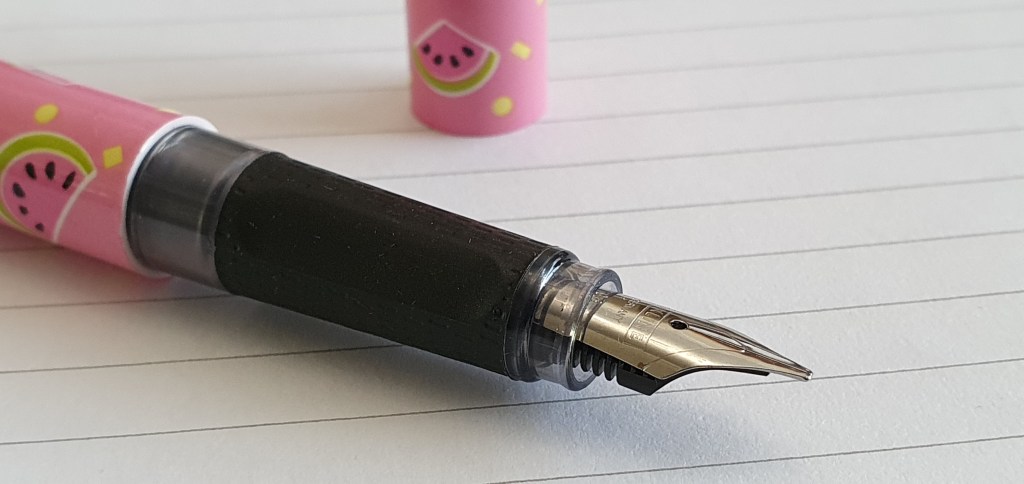
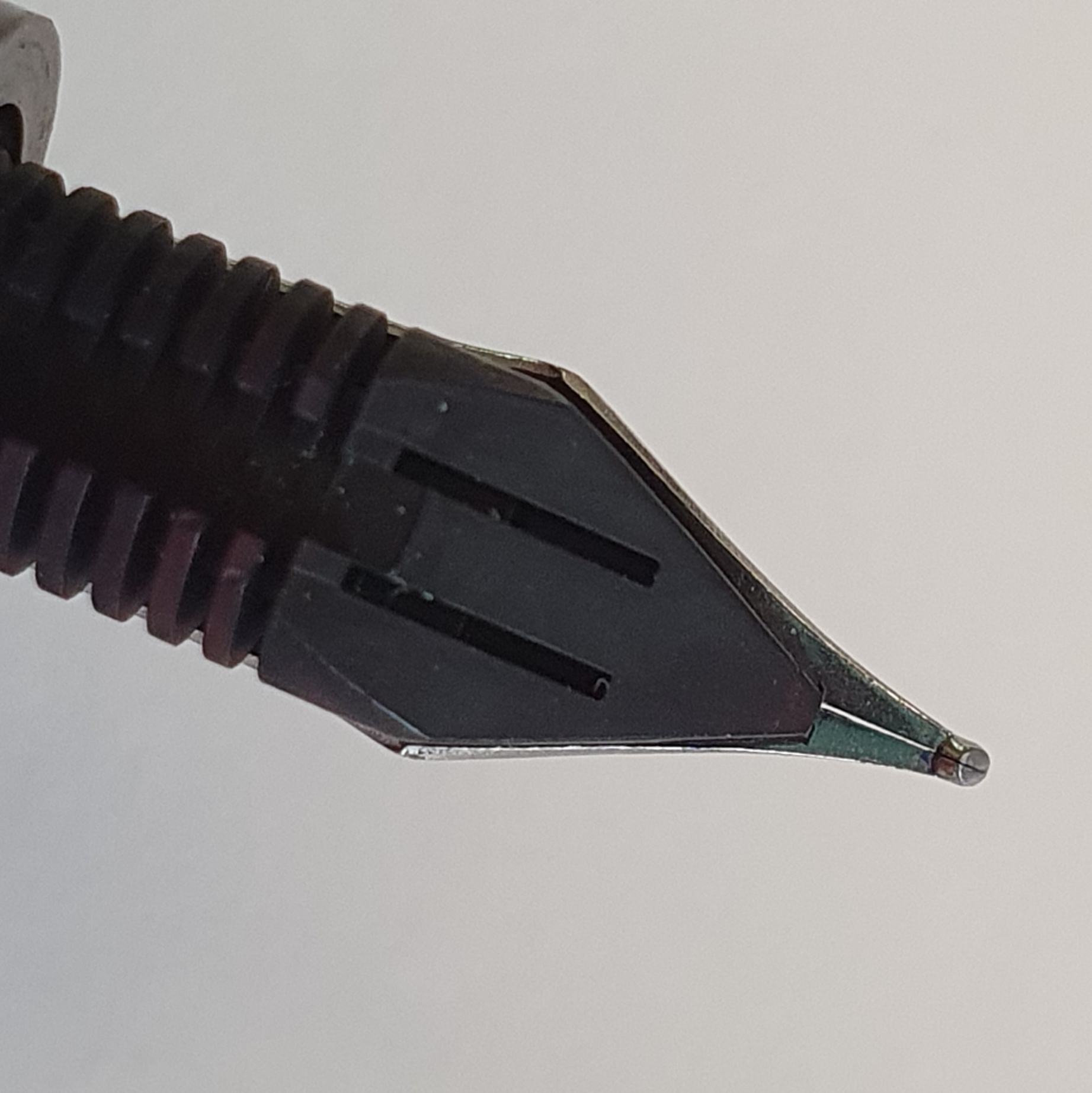
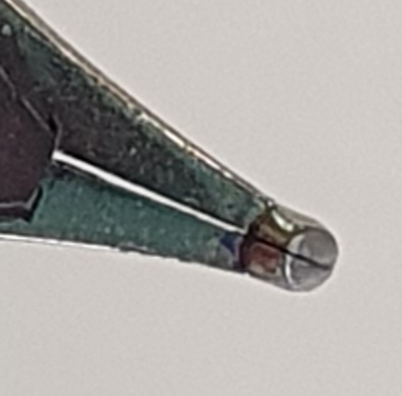
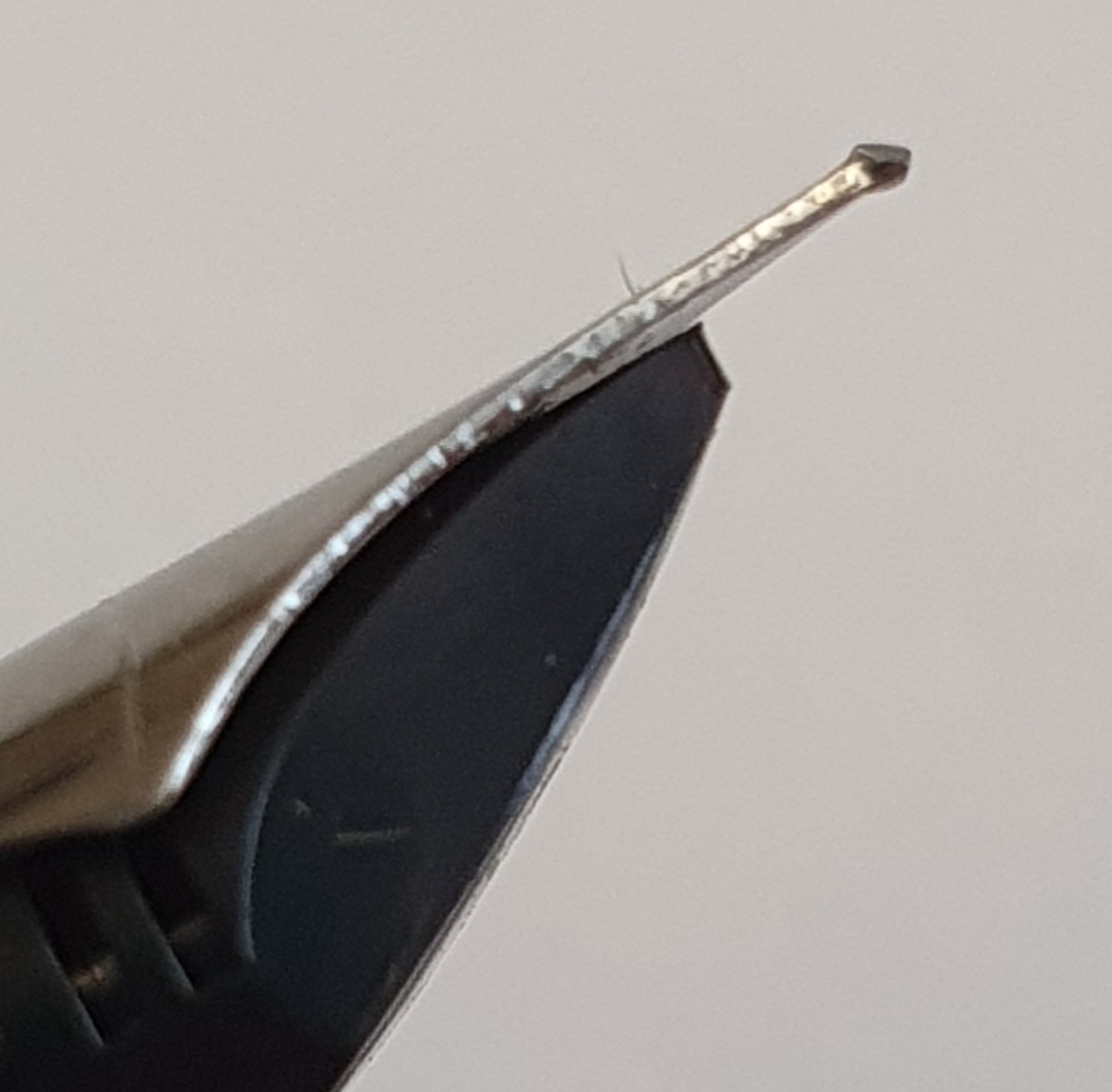
The nib is stainless steel but on my version, has a gold colour plating or coating, matching the arrow clip and bears the name Parker and logo. The nib grade can be seen on the feed as M for medium.

Nicely finished nib.

The black grip section is slightly tapered with no facets but features a non-slip surface. This is not a rubber grip, but a thin skin giving a slightly sticky feel. This does eventually blister unfortunately.

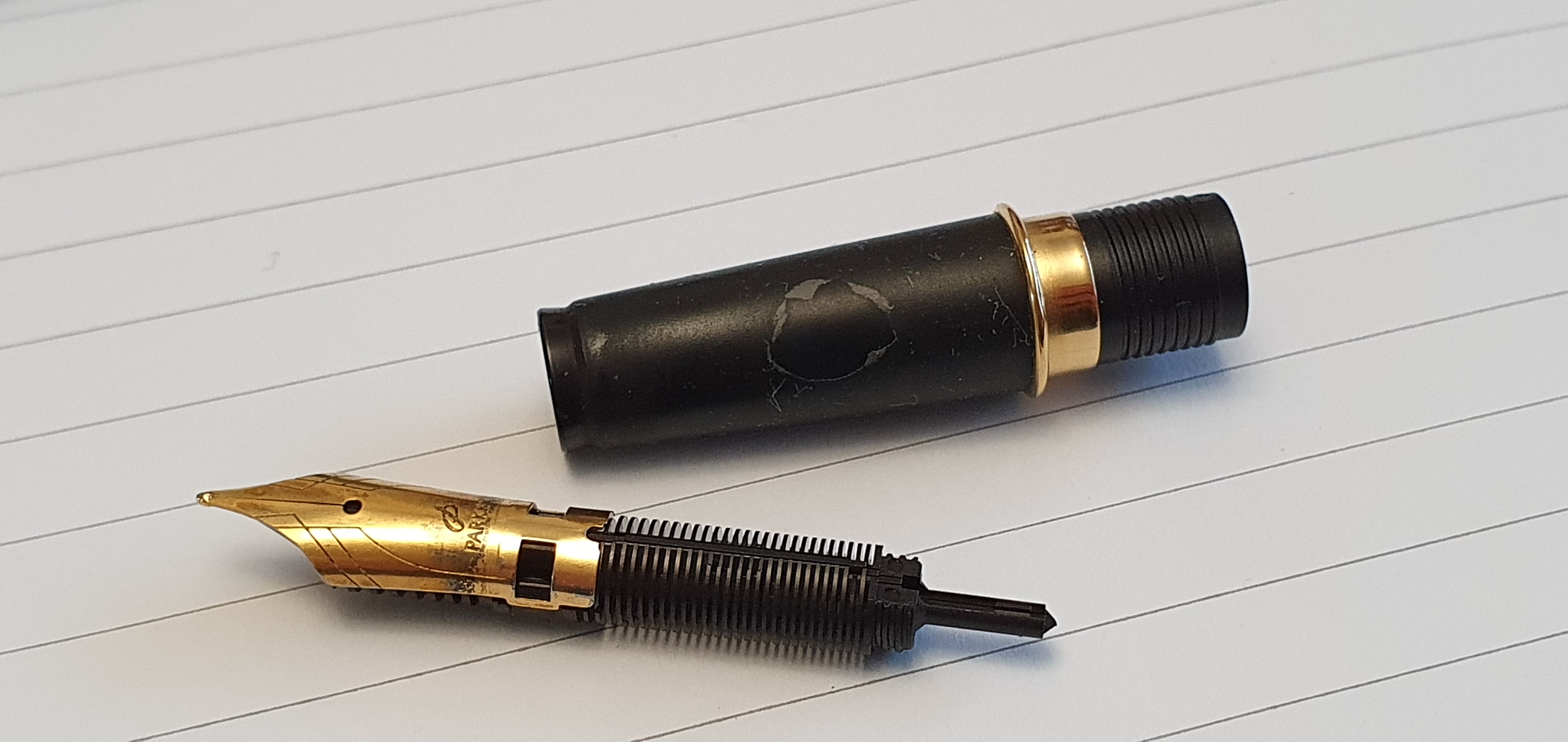
Nib and feed unscrewed. Grip section showing blistering of the non-slip coating.

The pen takes Parker proprietary cartridges or a Parker converter although not included with the pen.

With Parker Quink cartridge.

I enjoyed mine and used it a lot. The nib wrote very smoothly with good flow, showing how good a steel nib can be when set up correctly. The nib and feed can be unscrewed for cleaning or maintenance.

Likes and dislikes

This seems a fairly straight-forward pen but one which presumably benefited from Parker’s 120 years’ experience of nib and feed design. It looks smart, is sturdy and durable (apart from the covering on the section) and is comfortable to hold. Being able to unscrew the nib and feed is a nice feature. Above all, it writes smoothly and well with good flow. Mine is currently inked with Waterman Serenity Blue.

Writing sample, with Serenity Blue on Radley notebook paper. Extract from John Milton.

On the downside, the tendency of the non-slip coating to wear and blister eventually leaves unsightly gaps. I would prefer a grip section without the rubbery layer, such as on the Sonnet or Duofold.

Conclusions

This pen has seen a fair amount of use. Later, I was to move on to a Parker Sonnet, in burgundy. That also had a steel nib which performed similarly but a more luxurious body.

I went through my secondary school days using Parker pens and grew up believing that a Parker pen was special. After my Sonnet, as I began to discover the fountain pen online community, online pen dealers, YouTube reviewers, and pen shows, my pen accumulating gathered pace. It escalated for a good five years or so. However it is nice to revisit our beginnings once in a while to keep a sense of perspective. Anyone can buy a new pen but to have one for nine years, takes a little longer.

The final Frontier (photo).

My Lamy 2000, a brief update.

After writing up my history with the Lamy 2000 recently, (My Lamy 2000 fountain pen and I), I made a fairly simple do-it-yourself adjustment to the nib to increase the flow. Mine has a broad nib. Being left-handed and writing in an “overwriter” style, I need a slightly wetter flow.

This involved carefully bending the small nib upwards very slightly to widen the gap between the tines. The result was a wetter flow, better lubrication and a generally far happier and less frustrating writing experience. No longer was it necessary to maintain pressure on the nib to write. The gap between the tines is now clearly visible when viewed under a loupe, although in profile, any upward bend of the nib is barely evident.

Lamy 2000 Broad nib, 14k gold and platinum plated. Now with tines a little wider than before.

I happily wrote more than 12 pages of A4 paper before getting through one fill of Waterman Serenity Blue ink, which gives you an idea of the wetness of the nib. If anything it was perhaps a little too much on the wet side.

I found that trying to close the gap is more difficult than opening it. Instead, it occurred to me to try a drier ink and I recalled that Pelikan 4001 Royal Blue (“Konigsblau”) is such an ink.

Showing front section, nib and feed, disassembled for cleaning.

Once again, the Lamy 2000 went upstairs for a bath. It is an easy and enjoyable pen to clean. For the benefit of anyone unfamiliar with this, my routine is as follows:-

  • Unscrew the section from the barrel. Lift off the metal horse-shoe shaped ring which sits in a recess at this join, which is the clip to hold the cap on. Do not lose it or let it go down the plug hole.
  • Then, holding the nib between finger and thumb (above and below the nib, not at the sides), gently push the nib inwards, so that the entire nib and feed unit comes out through the back of the section; note that there is a thick rubber washer towards the back of the feed, which you must also be careful not to lose.
  • The nib and feed unit can then be rinsed in water to remove all traces of the last used ink. If desired the nib can be slid off the feed, as this simply clips over the sides, just like a Lamy Safari nib. Be extra careful not to lose this either, as it is quite small and fiddly on its own.
  • Wash the ink reservoir by drawing water up and down a few times until this runs clear. If desired, to lubricate the piston, (although I do not do this every time), introduce a tiny amount of silicone grease to the inside walls of the reservoir, with a toothpick or similar implement and wind the piston up and down a few times to spread the grease. Thank you, to an old Goulet Pens video for this advice.
The small bits – cap locking ring, the nib and feed washer. The washer makes a handy support for nib photos.

I filled the pen with Pelikan 4001 Konigsblau and, low and behold, the flow now seems to be spot on for me. It is still sufficiently wet to give great flow and lubrication, for effortless writing with minimal pressure, but the flow is not excessive.

Writing sample, Lamy 2000 with Pelikan 4001 Konigsblau on Basildon Bond letter writing paper.

The Konigsblau is an ink that I have not used very much before. I have had two bottles of it hanging around for a long time. I had never really liked the shade of blue all that much as it seemed to me rather pale and lacking the vibrance of say Waterman Serenity Blue or Montblanc Royal Blue. And yet now, in a wetter pen with a broad nib, this Pelikan ink comes into its own. It does seem paler than Serenity Blue but gives an elegant look, with some subtle shading. With the stubby broad nibbed Lamy, you benefit from this shading and also a degree of line width variation.

I could easily have given up on the Lamy or left it dormant as I had not got on with it for so long. Similarly, the Pelikan ink had been little used and was always passed over when I wanted a royal blue, as I would pick another from Waterman, Montblanc, Aurora, or Caran d’Ache from my ink drawer.

I am now using and enjoying my Lamy 2000 more than at any time since I bought it almost six years ago. The conclusion is that not only pens, but inks too, can enjoy a renaissance if we give them (or ourselves) another chance.

Writing sample on John Lewis Script, Post quarto laid writing pad, Ivory, 100gsm.

The Cross Apogee fountain pen, revisited.

During this period of lockdown, I have been looking back over my fountain pen accumulation. This now spans a period of some 50 years. A number of my pen purchases have been part of a recurring pattern, of wanting a new special, or “best” pen, as a trusty companion for life that would be a step up from what I had at the time.

This would generally be a black pen with a gold nib. Hence, certain milestone purchases have been a Parker 75 Laque, a Sheaffer Connoisseur, a Cross Apogee, a Lamy 2000, a Pelikan M800 (in this case, blue stripe with black cap) a Montblanc Meisterstuck 145 Classique and an Aurora 88 (black with a gold plated cap).

With hindsight, it is obvious that none of these signalled the end of my journey of pen buying. Rather, they were like waymarks along the path, some leading to dead ends and others to a seemingly endless onward journey. Sometimes, when you are on a walk up a hill, it is useful to meet someone who is coming down who can tell you how far it is to the top and what you will find when you get there.

I recently got out my Cross Apogee. I remember buying it, in around 2006 or 2007 with a slightly dizzy excitement at spending as much as £100.00 (which is what it cost then, rather more now). The pen looked very handsome in the glass topped counter of the department store.

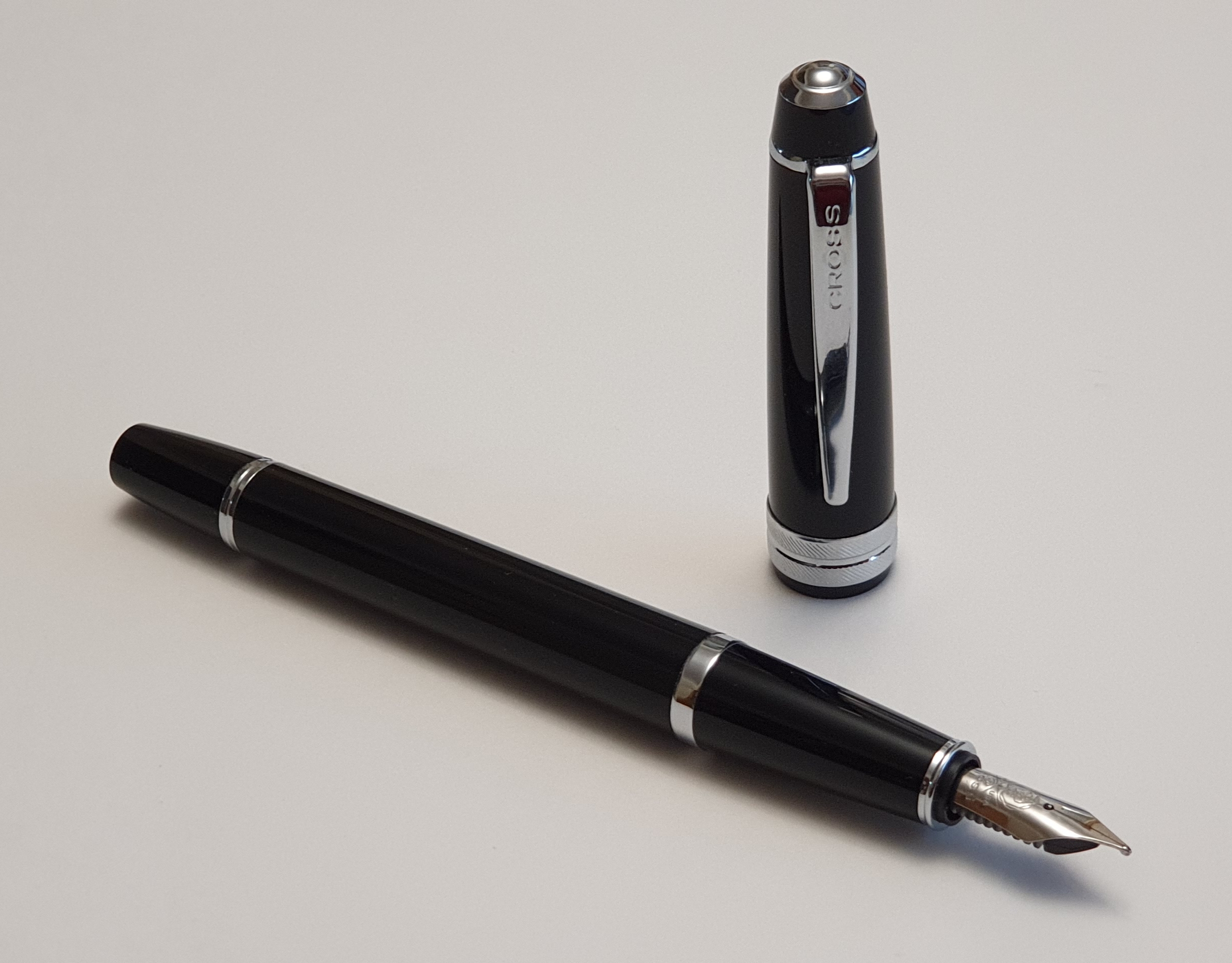
Cross Apogee fountain pen.

This Apogee is a metal bodied pen, with a gleaming black laquer finish. It is supposedly superior to the Bailey, as it has an 18k gold nib. There is a sprung metal pocket clip, with a sharp point, like an arrowhead. The cap is snap-on, secured by a raised rim at the base of the section. The broad cap ring, reads on the back, “CROSS, EST 1846”

The pen is comfortable to hold, by virtue of the wide girth and the absence of any cap threads or step between barrel and section. Uncapped, the pen measures around 127mm. The cap can be posted deeply and securely, to increase the length to 144mm. It weighs around 44g capped, or 26g uncapped.

Posted.

The barrel tapers to finish in a shiny plated metal finial. Removing the barrel, the cartridge or converter metal housing is imprinted with a date code, in my case 0805, being manufactured in August 2005. I particularly enjoy having a date on my pens. The Apogee takes Cross proprietary cartridges, or else the screw-in converters.

Showing the 0805 production date code.

The nib is attractively decorated with CROSS, 18k 750 and with lines running down each side, perhaps to suggest the vanes of a feather, which ties in with the arrowhead style of the pocket clip. The nib grade of M for medium is found on one side of the nib, rather like on a Sailor or a Pilot nib.

18k gold nib, medium. Silver-coloured plating. The M is on the other side.

In the event, I did not take to this pen, which was disappointing. First, I recall being troubled about the degree of lateral wobble in the pocket clip. I appreciated that it was designed to rock up and down but the side to side movement was, I felt, possibly a defect. However this issue does not bother me at all now.

The greater problem was one of ink flow. Once filled from a bottle, it seemed that the pen might not always make it to the end of a page of A4 paper without suffering from ink starvation. I never discovered the reason for this. I lost patience with the pen and put it away. Getting it out again a few years ago, armed with a little more experience in nib-wrangling, I examined the nib and feed under a loupe but all looked normal to me and I could not work out why it would not keep writing. The nib and feed are friction fit.

Friction-fit nib and feed, removed.

Recently, (after some success in tuning the nib of my Lamy 2000 to my liking) I got out the Apogee and cleaned the nib and feed. Under a loupe, all certainly looked well. The nib has a tiny gap between the tines, right down to the tipping which usually indicates a good flow. I filled it with the nicely behaved Waterman Serenity blue. The pen did keep going for a full page of A4, but then after being stood for just a few minutes in a pen cup, it exhibited hard-starts. I tried inking it with Pelikan Edelstein Smoky Quartz, an “Extra Soft Ink” to see if this might help. Trying again for the full-page-of-A4 test, the pen kept going but after then standing the capped pen upright in a pen cup for 20 minutes, it hard-started again and needed several good shakes. This pen does not like to be stood up. It seems that the ink all drains away from the nib. My inexpensive Cross Bailey Light pens never have this problem.

I looked on Amazon and read some of the varied reviews of the Apogee. It seemed that others had also encountered problems with ink flow on this pen. If any readers know the reason for this and how to solve it, I would be interested to hear from them in the comments below please!

It is not realistic to expect that every pen we buy will be fantastic. For anyone wanting a high end Cross pen, I would recommend perhaps trying a Townsend over the Apogee. Also, although quite a bit more expensive, there is the flagship Peerless, of which I have read good reports, although I have not owned one.

I can conclude, at least for me, that the Cross Apogee was not to be the pen purchase of a lifetime. As to where my pen journey leads, I am beginning to suspect that it will eventually bring me back to where I first started, with a simple pen that works well, like a Cross Bailey Light, for example. This has become my office pen over recent months and which I have found more dependable than the costly Apogee.

My Lamy 2000 fountain pen and I.

Having time at home now, I have enjoyed looking back through the many pen photos stored on my computer and my list of previous posts in this blog. I was surprised to find that I had not yet written about the Lamy 2000.

This is probably because I never really got on with it all that well. Perhaps, it was from a feeling of “If you have nothing nice to say, it’s better to say nothing at all.” Well, it’s not that bad. There are lots of features that I like about it, except that mine never wrote as effortlessly and enjoyably as I had hoped for.

The classic, understated Lamy 2000 fountain pen.

I remember buying my Lamy 2000, in May of 2014. It was in a lovely pen shop in Brighton, called Websters, sadly not there any more. After having a good look around the display cases and having bought a couple of bottles of Watermans ink and a Lamy Logo fountain pen, I had strong urge to take home a Lamy 2000. At £175.00 it may have then been my most expensive pen purchase to date and requiring of spousal approval, which was duly sought and granted.

The pen came with a medium nib. There were no other options at the point of sale. The packaging was simple and modest. I admired the pen in the train on our way home to London that evening and was excited to try it out.

The medium nib that my pen came with, in 2014

I should add here, that the brushed metal Lamy Logo fountain pen that I also bought that day, with its Safari-style steel nib, proved to be buttery smooth. At almost six times the price, I had high hopes for the gold nibbed Lamy 2000.

Unfortunately writing with the 2000 was frustrating. The medium nib was smooth but dry and needed constant effort to write. Over the following weeks, I tried several different inks, flushed the nib and feed numerous times and tried different papers. I wrote pages and pages and drew spoked wheels to see in what direction the driest lines were occurring. Being a lefty overwriter, I need a wetter nib as the pen does more pushing forwards and sideways and not many downstrokes to recharge the nib.

Disassembled for cleaning. Over the years I probably enjoyed cleaning the pen more than writing with it.

I did not want to take a chance on adjusting the gold nib myself. To cut a long story short, I eventually gave up on the pen and put it away. I had others that wrote better.

However, some six months later, something prompted me to get in touch with Lamy and I sent them an email to ask if anything could be done. They replied and invited me to send the pen back to them in Germany, which I did, with a note requesting an adjustment to my nib, or else a replacement nib, perhaps a broad.

To their great credit, notwithstanding the passage of several months since purchase, Lamy returned my pen a few days later, free of charge with a new nib. And this time it was a stubby broad.

A new broad nib brings new hope.

Once again I went through the process of filling the pen, trying it on different papers and writing pages and pages. It was better than before! I liked the line produced by the broad nib. Yet, it still suffered from the problem of needing pressure to make it write, to get ink to flow but of course this pressure caused friction and resistance as the pen moved across the paper. All in all it was hard work and not enjoyable. What’s more, the nib literally squeaked on the paper.

Enjoying the Cult Pens Deep Dark Blue ink.

From time to time over the years I would get it out again, thinking that a different ink would make the difference. But always I would end up flushing the ink and putting the pen away again and so for almost six years the pen has been unfulfilled and largely unused. Yet, even now as I write this, I am tempted to give it another try. Maybe it just needs the nib tweaked to open up the tines more. How hard can that be? Whereas in the past I was not brave enough to try it, I think I may have reached the “past caring” point at which I am prepared to take the risk. And if all else fails, I could get it done by an experienced nibmeister.

I know that so many enthusiasts speak highly of their L2K’s and I want a part of that enjoyment. I do admire the minimalist, understated design; the barely visible seam where the piston knob meets the barrel; the clever mechanism for the push-on cap; the free-floating nib which can be so easily removed for cleaning; the unique finish of the Makrolon body and the clean juxtaposition with the brushed stainless steel section and the subtle, platinum coated gold nib. I also know that I am not alone and that others have found the pen hard to use.

Yet, the design wins me over every time and makes me want to give it another chance. We will see how this turns out.

Who can resist this unique design?

Update, 9 April 2020:

The exercise of writing this post had the effect of focusing my mind on the problem with my nib. This morning, I awoke with a resolve to try to adjust the nib myself, with some very simple tine spreading.

I examined the nib again under the loupe to remind myself of the problem. I then pushed the nib downwards against my thumb nail, in a few very gentle, controlled presses, and examined the nib again. Within moments, the tines had opened up. I thought that I might have overdone it and flipped the pen over and tried pushing again to close the gap. I found that it was easier to open the gap than to close it.

I tried dipping the pen in ink and wrote a few lines. All indications were that it was still writing smoothly, with the tines level, but that the wetness would be increased. I then filled the pen properly, with Waterman Serenity Blue and enjoyed writing for a page or so of A4. I tried a few different notebooks and found marked differences in absorbency between different types of paper.

Trying the effect of opening up the tines a little. Much wetter now, but without being too wet.

The nib and feed kept up without problems for a full page. The nib still squeaks and needs careful handling to keep to the sweet spot. But it is now wetter and better lubricated than before and this will be a much needed improvement for my style of writing.

After a few brave moments of opening up the gap between the tines.

A look at the Visconti Van Gogh Starry Night fountain pen.

Not so much a review today, but rather an excuse to air some photos of this lovely pen, that would otherwise remain buried in my computer.

The Visconti Van Gogh Starry Night.

Last summer seems a long time ago now, in the care-free days before the coronavirus pandemic. Now, at home in partial lockdown, I took the opportunity to look back through my hundreds of pen photos to try to tidy up the folders a bit.

It was at a meet up of the London fountain pen club, last June, that I acquired this pen. Its provenance is that it belonged to Penultimate Dave, the pen collector, prolific Instagrammer and YouTube pen reviewer formerly known as Visconti Dave. He was offering this pen and a few others from his collection, for sale. I did not have a Van Gogh. I had admired them in Selfridges and thought that the Starry Night was the one to have but had not stretched to buying one. This was the perfect time to rectify that.

The Van Gogh pens come in a variety of colours, each based upon the palette of a different famous painting, named on the cap ring. Hence, Starry Night is predominantly a rich dark blue, with splashes of yellow and whisps of white. Each pen is unique as the distribution of colours comes out slightly differently. There are over a dozen different paintings to choose from and some enthusiasts collect the whole set.

Beautiful swirls of rich dark blue, yellow and white, set off by silver coloured furniture.

The pen has a sprung metal pocket clip, (bow shaped, like the arches of the Ponte Vecchio in Florence) and a removable magnetic metal cap finial that can be replaced with a jeweled one or with your initials, although I have not done so.

The Visconti curved and laser etched pocket clip.

The cap and barrel are multi faceted. The cap snaps shut by means of a magnet inside the cap and so there are no cap threads to interfere with your grip. Nor is there any significant step from the barrel to the section, where you might grip the pen and so it is smooth to hold. Fun fact: the magnetic cap can be used to pick up spent staples from your desk.

The faceted cap and barrel. A Leuchtturm A5 plain paper journal, with pencil lines ruled by me. My notebook, my rules.

The grip section is metal with shiny plating. This looks attractive, and photogenic, particularly in contrast to the dark blue swirls of the barrel. It also gives the pen some heft at the front end. The down side, for some, is that it makes for rather a slippy surface to grip but I hold the pen just above this and am therefore able to anchor the pen with my thumb and forefinger on the barrel to keep the nib at the sweet spot. I find the pen very comfortable and balanced whether unposted (for short notes) or posted, for longer writing sessions.

Weighty metal section but slippery to hold.

The nib is steel, (mine is a fine), plated and with some fancy scroll work, rather more elaborate than on my Visconti Rembrandt. It is firm nib but beautifully smooth and with good flow and lubrication. I should add that it was not quite as wet when I first got it. After using it for a few days I decided to open up the tines just a little to improve flow (which I had also done on my Visconti Rembrandt, to good effect), to better suit my lefty-overwriter style.

Gorgeous scroll work on this steel nib, now with a hint of light between the tines.

I employed a trick learned from an SBRE Brown video, whereby you place your thumb on the middle of the nib, place the tip of the nib on the nail of your other thumb, then push downwards on the nib, very carefully, but just enough to start bending the tines upwards away from the feed. As you do this, it has the effect of widening the gap between the tines and increasing ink flow. You should go very carefully when bending this, or any nib. The aim is only to open up the tines a fraction and not to leave the nib looking like a ski jump. Check the results constantly with a loupe and by writing with the pen and do not overdo it. Also, as Stephen Brown said, “You will get ink on your fingers, but that is ok because you’re helping your pen.”

The pen takes standard international cartridges, or a converter. There are metal threads on the inside of the barrel.

Metal to metal for the barrel threads.

When I received the pen, Dave had it inked with a dark blue ink with an amazing red sheen. Once this was exhausted, I flushed it and refilled it with Waterman Serenity blue, which I like to use when getting to know a new pen and also to chase away any residue from more persistent inks. (This is another trick I have learned, this time from Laura of Fountain Pen Follies).

Penultimate Dave’s sheeny ink. I forgot to note down what it was.

Looking back at my notebook from that time, I filled about twelve pages with the Van Gogh, in conversation with myself (Van Gogh would approve) as to how the pen wrote and whether or not to tamper with the nib. I felt that my Rembrandt was smoother, but then that was a medium nib, not a fine.

Enjoying the Visconti nib on Leuchtturm paper.

Later that summer, I travelled to northern Italy for a holiday on Lake Garda. I brought the Van Gogh with me. I thought it would like that. I paired it with Graf von Faber-Castell Cobalt blue cartridges. In the event, I did not use it all that much as I got distracted by another pen that I bought on holiday. This is often the way of things when you keep buying more pens.

Recently I inked it up, with Conway Stewart Tavy, by Diamine which is an old favourite blue black. This suits it very well. After this I tried the pen on a handful of different notebooks. It was particularly enjoyable on a thick, 100gsm paper from an A4 wire-bound notepad called Concord, premium writing paper.

The Van Gogh feels rather superior to the Rembrandt, as is reflected in the higher price tag. It is faceted, whereas the Rembrandt is not but otherwise the size and features are very similar. They compliment each other well. Both are probably regarded as near entry level Viscontis, in comparison to the various Homo Sapiens, Divinas and Opera Masters of the Visconti catalogue, none of which I own. But they are still very commendable pens in their own right with Italian flair and lofty artistic associations, albeit that the nib might need tweaking.

Visconti Van Gogh (left) beside a Visconti Rembrandt for comparison.

A New Year party conversation.

Back in early January, I found myself in a party situation at a flat in London overlooking the River Thames, near Tower Bridge. It so happened that my wife was unable to make it and I went alone.

Like the hosts, many of the guests had six-year old children and so the general ambience was on the noisy side.

Seeing me on my own at one point, a young woman about half my age engaged me in conversation. Her name was Esther. Breaking the ice, she asked me if I had any hobbies. Caught off guard, I ‘fessed up to having a guilty pleasure, which was collecting fountain pens. I didn’t go into the distinction between collecting and accumulating but spared her this detail.

“Are those the pens with a separate capsule for the ink, that you puncture?” asked Esther, grimacing at the memory from her school days. “Yes, cartridges” I said, nerdishly adding that people generally refer to cartridge pens as fountain pens although technically a fountain pen is one which does not have a cartridge but has its own system of filling from an ink bottle, such as a piston, or lever or vac filling plunger.

“What is the attraction?” she asked. I tried to explain about finding the ideal combinations of pen, nib, ink and paper and the joy of effortless writing with no downward pressure and letting the words flow, with glistening wet ink and a comfortable pen. I babbled on about the joys of going back to analogue, like wearing a mechanical wristwatch instead of a battery one.

“So what do you write with these pens?” I said that I liked to keep a journal, a habit that I had continued for decades and also to write travelogues and to write letters. Also, I liked to write up memories. For example I had enjoyed reflecting on memories of my parents, listing key words as writing prompts and then going back to write up these memories in notebooks.

A vintage Parker 51 and bottle of Quink.

“But isn’t it easier to amend, edit and correct on a computer?” she asked, quite reasonably. Fair comment. “Yes it is” I replied. I said that perhaps writing with a pen made you more careful, rather like taking photographs on film, especially if you are shooting on medium format and have only 12 frames on a roll which makes you a better photographer. I thought back to letter writing sessions at boarding school when picking up a fountain pen and starting to write seemed to help ideas flow.

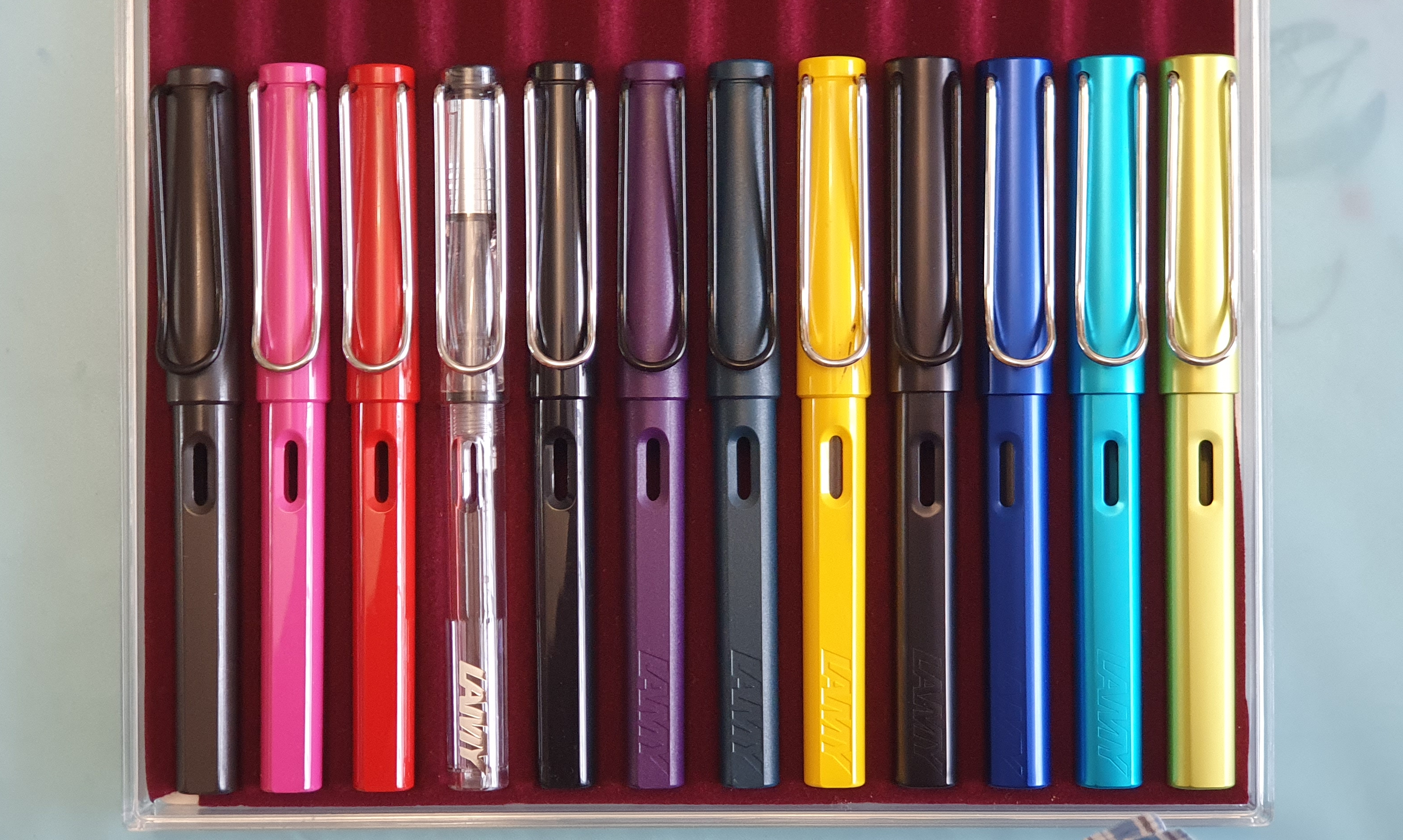
“What’s your favourite pen?” I said that many addicts would answer “My next one” which is only partly a joke. It seems that no matter how many fountain pens you have, you are always after the next one, a sign of obsession. I did then try to answer, but said it was difficult to say which was the favourite. I could perhaps try to list the favourite from each brand that I own, to narrow it down. I told Esther that lately I had discovered a pen called the Cross Bailey Light, which was inexpensive, comfortable and wrote well and had gone on to buy six of these, one in each of the available colours.

“Perhaps what you need to do is think which you like best and want to keep and then give all the rest to someone who will sell them for you on ebay.” I think I may have blacked out for a moment at this point as my mind digested this trauma. I might have said in my defence that most of my pens were not expensive ones and so it was not worth selling them. What’s more, I was rather attached to them (which is a bit silly if they are not being used regularly).

“What does your wife think about all this?” I had the answer to this one. “She thinks I am storing up problems for her for when I die.” I know that she is bothered about matching up pens with their boxes in the event of my untimely demise.

The moral of this little tale is that it can be difficult to describe and justify your hobby to a normal person. How do you explain that after a stressful day, you take pleasure in picking up a fountain pen and putting pen to paper, or even just thinking about which inks to try next in a certain pen? When fountain pen enthusiasts are together, all of this goes without saying.

The reality is that taking a disproportionate amount of pleasure from a pen, or any other day-to-day object is a bit of escapism. It is something that we do to make the bad stuff go away, to find happiness and which is cheaper than therapy.

On reflection, I did not handle the conversation with this charming young woman as well as I might. It is shameful that even on my chosen subject, when unprepared I led myself down a one way street, rather than perhaps winning another convert to join the pen club. Next time, I’ll say “I enjoy fountain pens. Now tell me about your hobbies, which no doubt will be far more interesting.” Another drink anyone?

Radley A5 notebook. A mini review.

As fountain pen users know, finding another dream combination of pen, ink and paper is one of life’s pleasures. And we could all use some of those now.

A month ago, whilst spending a weekend away in Cambridge my wife was browsing the sales in Radley, the handbag shop, when I came across a display of A5 notebooks. These were reduced from a rather ambitious £28.00, to £6.00 and so I cheerfully added a couple to our purchases.

It turned out that the notebook was remarkably good and I wished I had bought a few more to keep in stock. Many reading this post may not have access to a Radley shop, but nevertheless I hope some comments about my approach to notebooks may be of interest.

Description.

This is an A5, soft cover journal, with 160 ruled pages (80 sheets). The pages provide 21 rows at 8mm line spacing, which I find ideal. The lines are dotted, in grey, on a cream paper and so not obtrusive. Each page features the little Radley dog logo at the foot of the page, which is not in the way.

Radley A5, 160 page notebook. With Cross Bailey Light fountain pen.

The cover is a vibrant red with rounded corners and a pleasing texture that feels like leather but is not. “Radley, London” is stamped elegantly in gold letters on the front. The cover can be flexed although it offers some support and protection. Of particular benefit, the pages are stitched, so that the book can be opened flat without risk of pages popping out. There are two page markers, in matching red ribbon. However there is no elastic band or expandable pocket that you would find with a Leuchtturm notebook.

Neatly sewn pages with lined, cream paper.

Paper quality.

Trying a different notebook can be a risk, if you intend to use a fountain pen. Those first few strokes will tell you whether the paper is “fountain pen friendly” or not. Does the ink bleed through? Is there feathering? Is there show-through at levels which mean you can use only one side of the paper? How does the pen feel on the paper surface? Is it too rough, or too smooth, or is there a squeaky coating and feeling of resistance?

Happily, I was delighted with the paper in all of these respects. I tried first with my recently bought Platinum Curidas, with a Japanese medium nib and Platinum blue black ink. The paper surface felt silky smooth. There was no feathering, no bleed through and although some show-through, this was perfectly acceptable. The nib is on the fine side for a medium.

The one point to note however, was that the line width was slightly wider on the Radley paper, than with the same nib on my customary Leuchtturm journal paper. This implies that the paper is perhaps more absorbent, or less or differently coated than Leuchtturm. Yet when I looked with the loupe, there was no feathering to give the tell-tale woolly edges as if writing on blotting paper.

Saturday morning activity.

I do enjoy buying a new notebook. For the last few years I have been using Leuchtturm journals a lot, which are paginated and available with plain paper, ruled (rather too narrow for me) or dotted or square grid. For unpaginated notebooks, I often paginate them, measure the line spacing, and test out the paper on the back page with a variety of inks and pens from my “currently inked” pen cups to see what works and what does not.

I tried the Radley notebook paper with various other pen and ink combinations. There was no bleedthrough with Waterman Serenity blue. Monblack Irish Green did bleed through quite badly in places where pressure was applied. Some roller-ball pens also did not do so well: the Uniball Air micro black ink did bleed through, whereas the Uniball Signo 307 retractable gel pen did not.

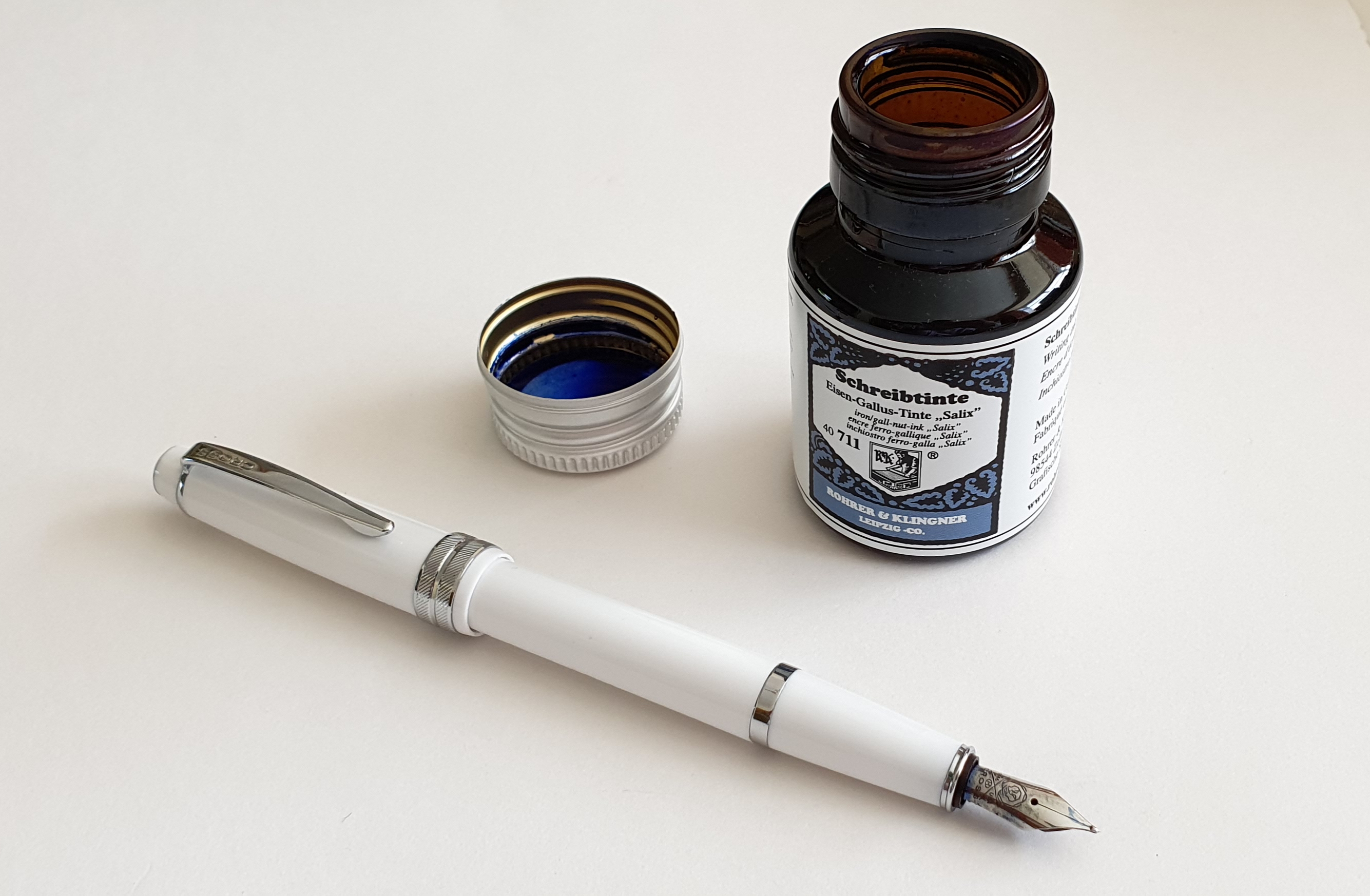
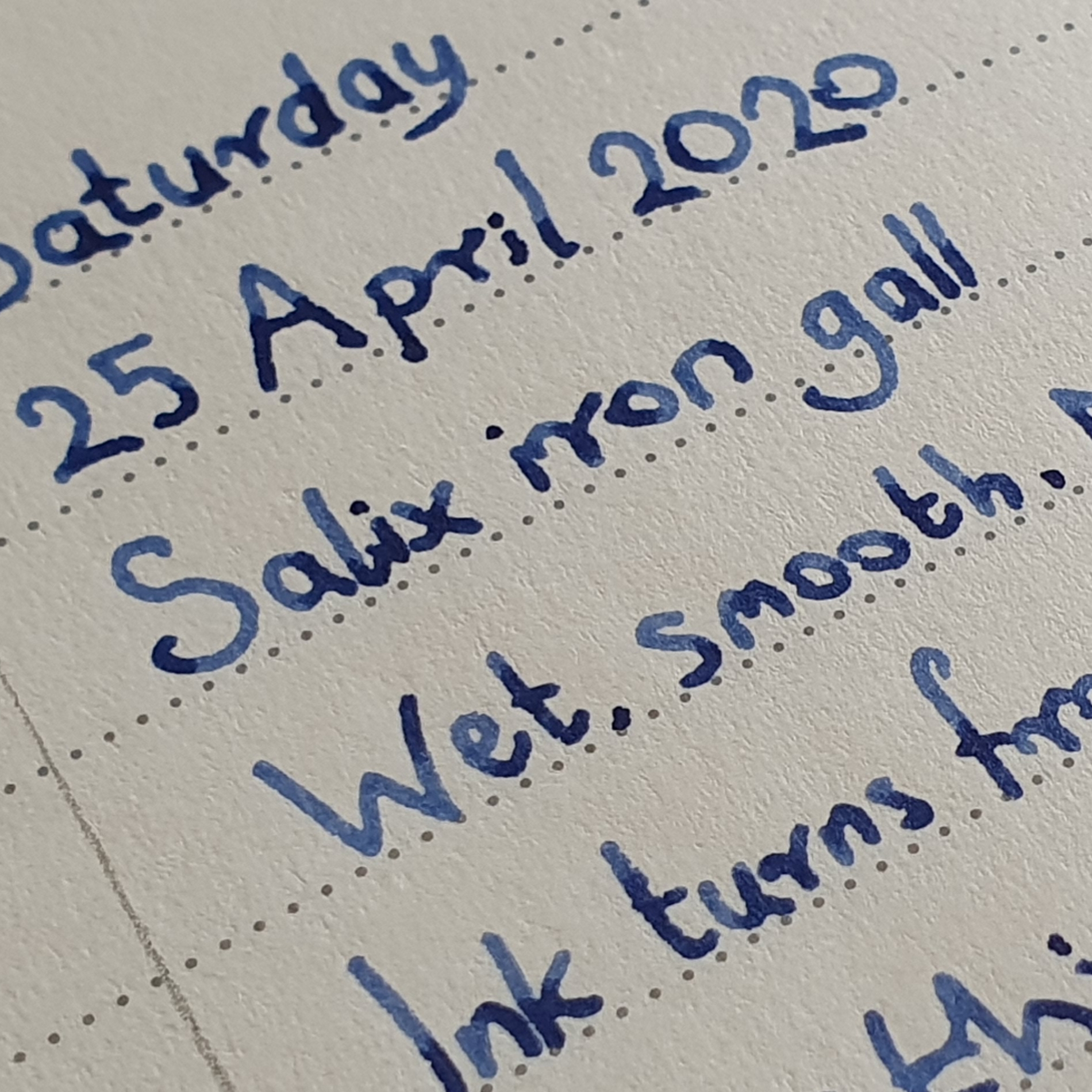
Rohrer & Klingner, Salix iron gall blue black ink.

So, what was that dream team combination that I mentioned? I recently discovered Rohrer & Klingner’s Salix, an iron gall blue black ink, sold in London at Choosing Keeping, in Covent Garden. I have been using it at work recently, in one of my Cross Bailey Light cartridge pens. (Ahem, confession: I bought six of these pens, a few months ago as soon as I heard about them!)

The Cross Bailey Light is a fairly humble entry level Cross cartridge- converter fountain pen with a steel medium nib. I have been careful to check the nibs on all those I bought and they have all been smooth, wet writers. This works particularly nicely with Rohrer & Klingner’s Salix ink, a classic blue-black which darkens as it oxidises, as the blue turns to a grey-blue black.

Random poem selection, from William Wordworth. Cross Bailey Light with Rohrer & Klingner Salix, iron gall blue black in.

The Salix ink is also water resistant, a useful quality when addressing envelopes but also giving some protection against spills or other liquid related incidents.

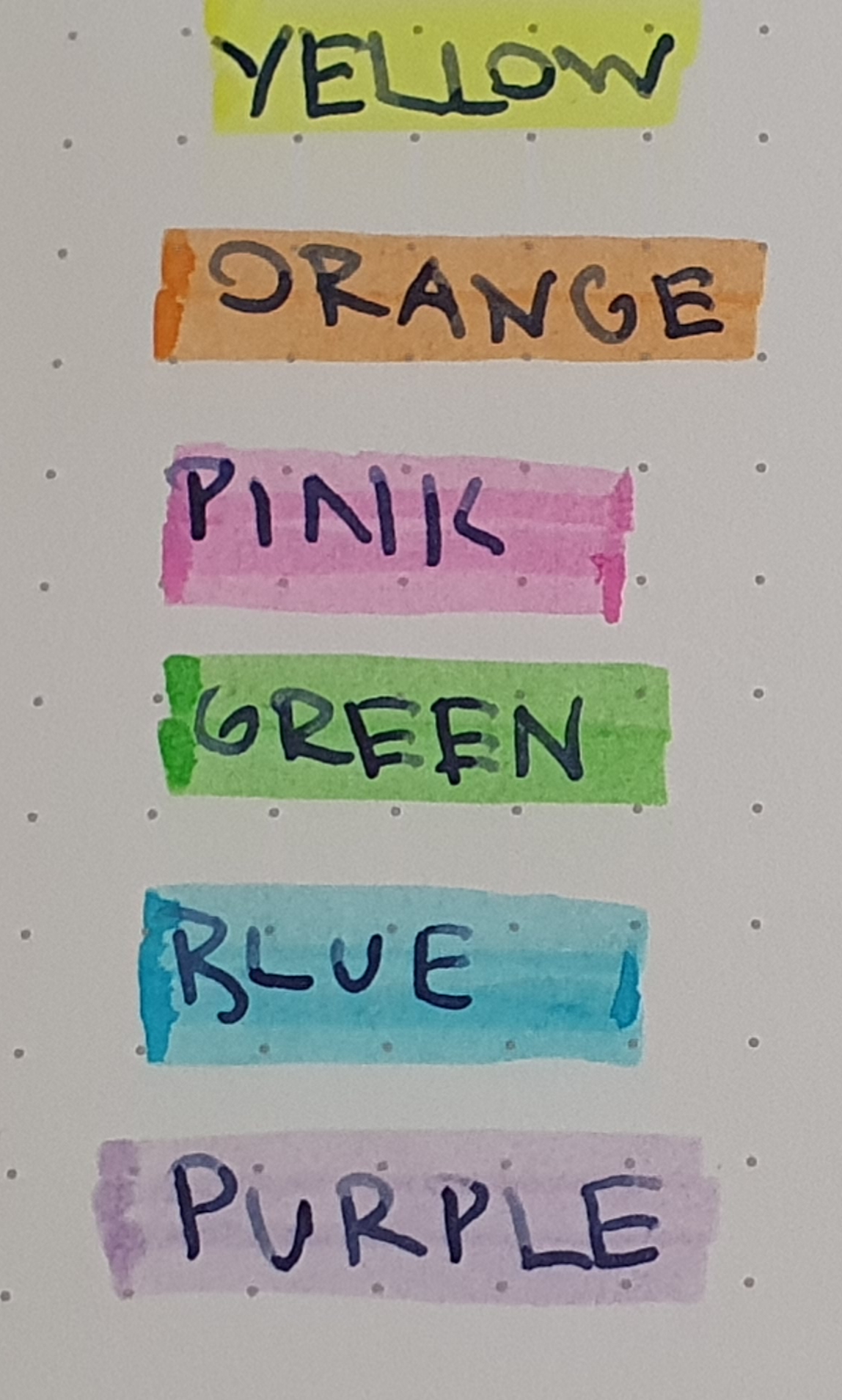
A water resistant ink will often perform well on papers which at first do not seem fountain pen friendly due to bleedthrough and so it is worth trying this before giving up on the notebook for fountain pen use. Another advantage of R&K Salix is that you can go over it with a highlighter pen, which is great for study notes. It also flows well, looks nice and gives a lovely shading and performs well on the Radley notebook paper.

Discovering that you can go over R&K Salix ink with a Sharpie highlighter, without smudging.

Finally, I went back to the Cambridge Radley shop another day but they were out of these notebooks. But then I later came across another Radley store in London’s O2 Arena shopping centre (a brand outlet mall) where, not only did they have plenty in stock but they were discounted even further to £4.00. Let’s just say I bought a reasonable number.

Early thoughts on the Pilot Synergy Point 0.5 rollerball.

The Paperchase store near my office no longer has a glass display cabinet of fountain pens. Its fountain pen offerings are now limited to a good selection of Lamy Safaris and Al-Stars, Kaweco Perkeos and Faber-Castell Grips, although it is good that these are still available. I enjoy browsing around the shop and often buy notebooks there.

Whilst visiting the shop one lunchtime recently, I came across a cup full of Pilot retractable pens, in a mix of blue or black, called the Synergy Point. These are not new pens but were new to me. I now gather that in other places they are called the Pilot Juice Up.

The Pilot Synergy Point.

To my naked eye, the writing tip looked so fine that I thought it was a fineliner, although it is in fact a tiny rollerball and one of Pilot’s gel pens. I liked the look of the pen, with its rubber grip section and rather superior metal nose cone. I bought one each in blue and black.

Features.

So, this is an inexpensive, retractable, gel pen, with a fine point. It delivers a smooth line (depending upon the type of paper you are using) with minimal pressure. Pilot’s catalogue entry states “A unique pen which, thanks to the innovative “Synergy tip”, combines a fine line with a very smooth writing experience.” Although labelled as 0.5mm, this is the tip size. The line width is said to be 0.25mm. It is also refillable, (using Pilot’s BLS-SNP5 refill).

Synergy Point, 0.5mm tip gives a 0.25mm line.

The gel ink in the blue version, is a pleasing shade of blue, which dries almost instantly and is also waterproof and so does not smudge.

When the tip is retracted, the push-button does not rattle, but it goes slack once the tip is deployed, which means that the button will rattle if you shake or turn the pen up and down. Also, there is an indicator window at the top of the barrel, just below the clip, comprised of five square dots, arranged like on a dice. If you look closely these are white when the nib is retracted and then go dark when the button is pressed down. As an indicator of whether the tip is out or not, you are better off looking at the tip itself or even the position of the button.

The pocket clip is plastic and rather soft and bendy and so not very secure and best not relied upon.

Size and weight.

The pen is about 140mm long when in writing mode. It weights about 12g. The girth is about 9mm. However the rubbery grip section and stepless barrel design make this a comfortable pen to use. The metal nose cone also places the centre of gravity further down towards the tip.

The writing experience.

The comfortable rubber grip, combined with the weighty metal nose cone and the lack of any wobble from the very narrow writing tip, all make for a feeling of precision when you are writing. Also, very little downward pressure is needed, although you do need a little to avoid skipping.

Some writing comparisons.

I have tried the pen on about half a dozen different notebooks. It is best suited to smooth papers without much texture as you do not have a large tip area to ride the bumps. However the ink flowed well. On all the papers I tried, any showthrough was minimal and there was no bleedthrough, even on papers which often struggle with ink. For example an Agenzio notebook (from Paperchase) has paper which suffers bleedthrough even with Waterman Serenity blue, but not with Montblanc Permanent Blue, Sailor Kiwa-guro or Platinum blue black, all of which are waterproof inks. The Synergy Point now gives me another bleed-free option for this brand of notebook.

A new option for bleed-prone papers. The Synergy Point on an Agenzio by Paperchase soft cover A5 notebook.

Disassembly and refilling.

At first, before checking online, I tried to unscrew the nose cone. However I later learned that the pen unscrews at the barrel, and you just hold the grip section in one hand and the smooth plastic barrel in the other. It was tight the first time and I was worried about destroying the pen, but was encouraged by seeing photos online of the two parts separated. I anticipate that the refill will last for ages but it is good to know that refills can be purchased.

Unscrews at the barrel, not the nose.

Likes and dislikes.

Plus points are the attractive design, sturdy build (aside from the flimsy clip and the rattling button) and the unusually fine writing tip for fine work. Having a waterproof ink is also useful. The familiar retractable design is obviously convenient and practical.
On the negative side, there is the feeble pocket clip and the rattling buttton. Also I would have preferred not to have a permanent bar code and a 13 digit number on the barrel but these are minor issues.
Pricewise, the blue model registered £4.25 on the cash till but then the black one registered as £5.00 which was slightly annoying. I would expect them to be the same price, whichever figure is correct, but it seemed fruitless to pursue this.

Conclusion.

I use ballpoint pens a lot for notes at work and a gel pen makes a pleasant alternative. The writing looks nicer and there is typically less pressure required yet you have all the convenience of a ballpoint pen. It is not a substitute for a fountain pen, which is still far ahead for line variation, shading and general writing pleasure. But the gel pen is a very useful writing tool to have and has its own merits.

The Platinum Curidas: removing the bump.

Today was Day 6 of my ownership of the Platinum Curidas, as discussed in my previous post.

I have been using the pen with the metal pocket clip removed, which improved comfort but I was still irritated by the protrusion on the top of the pen, where the clip had been. For a lefty overwriter, this bump sits just where I want to place my thumb when I grip the pen. I have been deliberating on whether to try to remove it, but was worried about the risk of cracking the pen in the process.

With clip removed, there is a keel-like protrusion at the 12 o’clock point which bothered me.

Apart from this issue, the pen is great. I appreciate that it will not be everyone’s cup of tea. FPNers were critical of the overly long push button (some call it a knock) to operate the pen, which is odd-looking when the nib is retracted. However this is a necessary consequence of the nib mechanism having such a long travel and the button all but disappears when the pen is in writing mode.

This morning I sat down to write a letter with it. Honestly, the writing experience of the smooth medium nib, with Platinum Blue Black ink on Basildon Bond writing paper, was joyous. If only the bump could be removed!

Over the past few days I have been pondering on how to file acrylic safely. I watched a few videos on YouTube and even popped into a nail bar today to get some tips from those who work on acrylic nails.

Fortune favours the brave. I finally decided to have a go. I applied masking tape around the four sides of the bump, just leaving the bump exposed and then very carefully applied a few strokes of a file, which came in a craft kit with various grades of micro-mesh. I started filing the top, with very light pressure and going in one direction only, not backwards and forwards.

After the first few strokes, the top of the bump was scuffed and no longer shiny. There was no turning back now. White powder deposits on my file told me that it was working.

Every 10 minutes or so I stopped to unmask the pen and examine my handiwork with a loupe. I was encouraged that there was no evidence of cracking and that the masking tape was doing a good job of protecting the surrounding area. Towards the end I switched to a finer grade of file.

Eventually, having almost reduced the bump to the level of the barrel, I stopped. I decided not to remove any more material, for fear of scuffing the glossy barrel. Also it was quite nice to leave a very slight prominence, for texture to help in gripping the pen.

Post surgery. Just a very slight ridge where the bump once was.

The whole exercise took about 45 minutes. I am very happy with the result. I am now going to enjoy the pen even more.

The new and improved Curidas.

Early thoughts on the Platinum Curidas fountain pen.

Last week I spent a most delightful evening at Choosing Keeping, a lovely stationery shop in London’s Covent Garden. They were hosting an event to launch Platinum’s new retractable nib fountain pen, the Curidas. It was also a celebration of the Platinum pen company, attended by senior representatives of the company over from Japan and with a display of rarely seen fountain pens from the company’s 100 year history.

Choosing Keeping, a wonderful stationery shop in London.

The new Curidas was on display, in each of the five colours (red, blue, green, smoky grey and clear). Also there were test pens on the counter to try out, in both the fine and medium nib options.

Description.

The Curidas is a fountain pen with a retractable nib operated by pressing the button that extends from the end of the barrel. Press once and the nib pops out through a trap door, with a satisfying click. Press again and the nib retreats and the door closes, to seal off the nib and keep it from drying out.

At first glance it is similar to Pilot’s Vanishing Point or Capless fountain pen, except that the Curidas is made of plastic and has a stainless steel nib. Also, the steel pocket clip is removable.

The Platinum Curidas.

Disassembly and filling the pen.

As fountain pens go, this is a fun mechanism to play with and a very clever design. To fill the pen, you first unscrew and remove the barrel. Next you withdraw the entire nib, feed and ink housing. Simply push it inwards and then twist (like unscrewing a light bulb) and out it comes in one piece. Next you do a similar twist and pull operation, to remove the ink reservoir cover from the nib and feed unit.

Next you can attach either a Platinum ink cartridge to the feed, or a Platinum converter, before putting back the shiny chrome cover, inserting the whole unit back into the pen and screwing the barrel back on. It is easier than it sounds.

Disassembled for fitting cartridge to nib and feed unit.

The nib.

The pen is available with choice of medium or fine steel nib. I tried the fine nib first on the test pen and was immediately struck by how beautifully smooth and precise it was. I wanted to go on and on writing with it! I then tried the medium which was slightly broader but still on the fine side. The Curidas fine and medium nib options could perhaps be said to equate to a western extra fine and fine, or leaning towards it. After trying both, I decided to buy the pen, in blue, with the medium nib.

The nib is small and some might say, too small for the large pen. However, it is necessary to remember the practicalities of designing a nib that will retract into a pen barrel of this size.

With nib extended. This was how the pen looked before I removed the pocket clip.

The writing experience.

The medium nib on my model proved to be superb. Examined under a loupe, the tines were even and symmetrical and there was a slight gap between the tines. This is how I Iike them for good flow, with smooth, well lubricated writing with no downward pressure required. This suits my lefty over-writer style of writing.

At home, I loaded the supplied Platinum Blue Black cartridge. I clicked open the nib and was delighted that the pen wrote immediately from the first touch of nib to paper.

I was also thrilled with the Platinum Blue Black ink. The special promotion included a pack of 10 of these superb cartridges. The box features a picture of Mt Fuji and and states that the ink contains 5% natural water sourced from the base of Mt Fuji. The ink is a lovely shade of blue and water resistant. There is also a metal agitator ball.

I was very happy with the nib and the ink. However in terms of comfort there are a couple of potential issues to be aware of. First on the underside of the barrel, there is a rounded protrusion which accommodates part of the nib’s trap door when opened. It is quite far forward on the underside of the barrel but you may still find your second finger rubbing against this as you grip the pen if you hold the pen low, towards the nib

But the bigger problem for me, was the metal pocket clip. This is aligned with the nib and so if you hold the pen with finger and thumb symetrically placed, either side of the 12 o’clock point then the clip may not be in your way. But if like me, you rotate the nib slightly inwards, the pocket clip may then fall directly below your thumb which is not very comfortable.

The good news is that the metal pocket clip can be removed. A plastic tool for this purposes is included in the box. It works by being placed around the underside of the barrel and then being pushed inwards so that the chamfered edges slide under the metal clip and lift it off the raised locating pegs. In theory, you then slide the clip along and off the pen. In practice I found this very fiddly and awkward and I spent a frustrating few minutes pushing and shoving whilst worrying that something might break. I did eventually get the clip off but need to spend a bit more time practising the technique.

The bad news is that even with the pocket clip removed, there is still the issue of a plastic nodule protruding at the top of the barrel, which is to keep the clip in place.

In profile, with pocket clip removed. Note the offending protrusion at the top.

At the moment, I am using the pen with the clip removed and waiting to see whether my grip adapts to this protrusion in time. Alternatively, I will have to think how I might remove it safely without risk of cracking the barrel and ruining the pen. But I do wish it was not there. For me the pen would be so much more comfortable without it: just try holding the pen by the opposite end of the barrel, to see how it would feel.

Weights and measurements.

The pen with a cartridge weighs about 26.5g of which about 2g is the pocket clip. Lengthwise, it is about 154mm closed but reduces to about 142mm when the nib is extended when most of the button retreats into the barrel. The girth of the barrel is roughly 13mm in diameter.

Apologies for poor lighting. The pen is a good 140mm long with nib extended, which is great.

Likes and dislikes.

There is a lot to be said in favour of this new pen. The generous length, girth and weight are pleasing. The nib (on my model and the two test pens that I tried) is a delight and writes beautifully. The mechanism to extend and retract the nib is a marvellous design, save perhaps for the need to have a lump on the barrel for part of the trap door mechanism to go into. This does serve as a roll stop, if you have removed the pocket clip.

The pen seems very well made and comes in a range of attractive semi transparent colours and a clear demonstrator version. It has a good ink capacity: the Platinum cartridges hold 1.2ml and there is the converter option too (although sold separately). The cartridge or converter metal housing has cutaways to serve as an ink window.

On the down side, my only real complaint is the lumps and bumps on the barrel where you want to grip. It is a big help that you have the option of removing the clip. I found this a rather awkward operation and was disappointed that even with the clip removed, there is a still a plastic protrusion at the top of the barrel just where I would like to rest my thumb. There are a couple of other tiny locating bumps for the clip too but these are far enough out of the way not to be a problem.

It is a pity to have a dilemma of whether and how to file off a protruding piece of the pen barrel, to make the pen comfortable to hold. But perhaps this is just me because of my unusual way of holding the pen. I know that many people use the Pilot Vanishing Point or Lamy Dialog without such issues.

Medium nib. Platinum Blue Black cartridge ink. A most enjoyable ink!

Conclusion.

On balance, I found the positive points about this pen more than made up for the negatives. Admittedly it is only a few days old and still well within the new pen honeymoon period but I know I am going to like it.

The retractable nib and single-handed operation make this an ideal pen for quick notes while out and about, such as in a theatre or while standing without a place to put your pen cap. Ironically, these situations are also when a pocket clip is useful to carry the pen in a jacket pocket. If you have removed the clip to make the pen comfortable and then carry the pen in a pen case or sleeve, it rather defeats the object of being quick and easy. You cannot remove the pen from a pen case single handed and you will still need to find somewhere to put the pen case down while you write.

Perhaps I am in the minority here with my unusual grip style. The retractable nib is fun and a novelty. Above all, the pen writes superbly and so I will find a way to make it work for me. I am sure that it will prove to be a great success.

That new pen feeling.