Off topic warning: the story of an unexploded bomb.

20170506_122710

Today I was asked to put together some notes about an unexploded bomb which had remained in the family for over 40 years before moving to a museum.

It seemed impossible to tell the story without saying a little about my late father, who died in 1983.  It is not about fountain pens but there is a little about collecting things. And so here is an abridged version.

The story of dad’s bomb.

My late father was born in Ealing in 1929, and grew up in Hangar Lane, West London. He was ten years old when the Second World War broke out in 1939 and remained with his parents throughout the war.

From the 1950’s until 1974 (when made redundant) he worked for Ultra Electronics, in Perivale as a general and electrical maintenance engineer. He then moved to a similar position at EMI in Ruislip. He had left school with minimal qualifications but was very practical and experienced at making and fixing equipment.

One of his main hobbies was target shooting. He had a firearms licence and always kept a variety of pistols and rifles, which he would shoot at Bisley or our local gun club, often bringing me with him from a young age. He also had a few old muzzle-loading flintlocks and percussion cap pistols and one which he had built himself. He enjoyed casting his own bullets in lead, in his garage. He also built a small cannon on a wooden carriage, which he fired in the garden at midnight every new year’s eve to see the new year in.

He collected old incendiary bombs and tall, brass anti-tank shell cases, which, along with his cannons and large jagged pieces of shrapnel, were arranged on the floor around our TV set.

Against this background, the largest item in his collection was an unexploded German 500 pound bomb. As I recall, he got this in the mid 1970’s from an industrial estate, possibly near Perivale or Kew, West London where, probably since the war,  it had served as a speed limit bollard, standing upright by the roadside, with its base set in a car tyre filled with cement. It was painted white with the speed restriction painted in black figures, for vehicles entering the estate.

I remember going in the car with him, to collect it. I have a vague recollection of him telling me that he had heard the bomb fall during the war. I suppose if you heard a bomb falling, you would wait for the explosion and if none came, you would be curious to find where it had landed.

I cannot recall now how he knew it was there or why it was being disposed of. Perhaps the site was being redeveloped and he might well have simply asked whether he could have it.  I believe we went there in his grey Vauxhall Cresta Deluxe, a 1966 model, which he had bought second hand with part of his redundancy money and so it would have been around 1974 or shortly after.  The bomb went in the large boot of the car. I imagine we left the plinth behind.

At home, he set about cleaning it up, at the back of the garden, near his bonfire patch behind the garage.  He was confident that it was safe. The cylindrical metal detonator device had been removed. He had read several books about the various types of detonators and tense stories of bomb disposal work, on UXB’s (unexploded bombs).

Originally there would have been metal tail fins on the bomb but these had long since gone. He was able to access the inside of the bomb case, through its base. It was largely empty, the explosives having been removed but there were vestiges of this (TNT perhaps) around the inside, which he chipped away and which came out in thick, rusty brown clumps. These, he assured me, were quite safe and he chucked them on his bonfire, where they fizzled and spat a little.

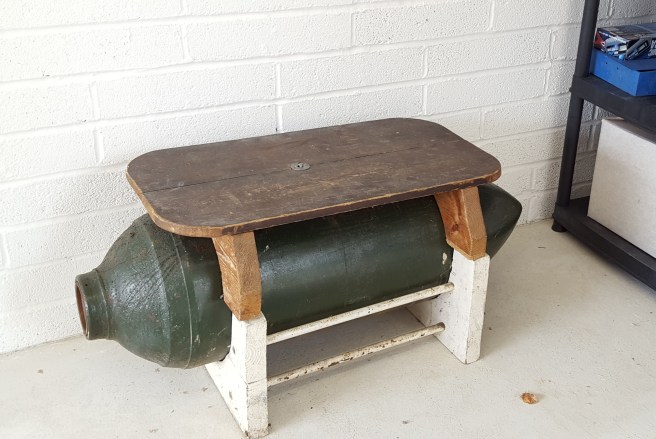
Once satisfied that he had got the inside as clean as he could, he gave it a new coat of paint, in British Racing Green. He then made a sturdy wooden cradle for it and a bench seat at the top (pictured). For the next 15 years or so, it remained in our house in Ickenham, either as a seat around the dining table or latterly, in the hallway beneath the coat pegs.  We enjoyed having it. It was a rather different and eccentric, to have a 500 pound bomb in the house.

Dad died in 1983. The bomb stayed in the house until my mother moved some six years later and since then has been in the wider family, in the custody of my aunt until she also moved house in 2016 and then my cousin. Now, having survived for over 70 years in these various unexpected roles, it will be great for the bomb to move to a museum.
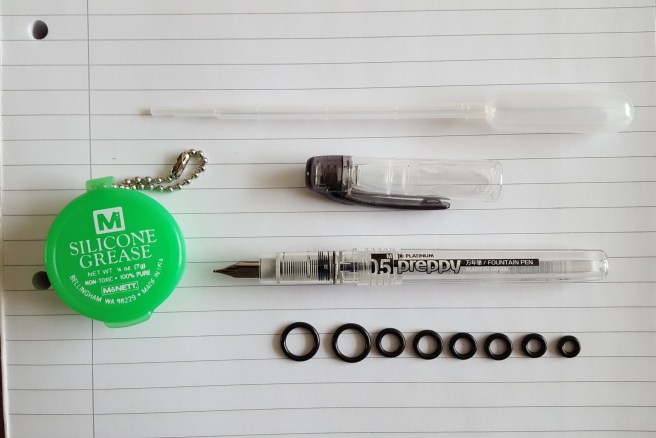
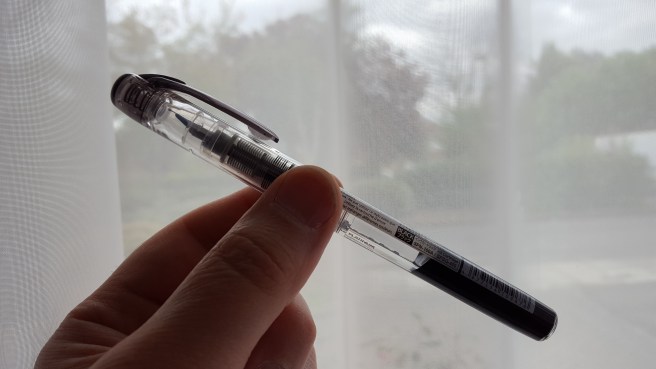
Converting a Platinum Preppy to eyedropper.

20170414_145541

If you had asked me about this a few years ago, I would not have known what you were talking about. It is one of those things that I picked up from the internet. Sensing that it seemed to be one of the rites of passage of fountain pen enthusiasts, I gave it a try today for the first time.

For the benefit of other newbies, we are talking about taking a fountain pen that is a typical cartridge/converter type filler and instead removing the cartridge or converter and filling the barrel directly with ink. The benefit, supposedly, is that you have a greatly increased ink capacity and do not need to fill the pen as often.

In order for a pen to be suitable, it needs to have a plastic barrel and plastic threads and for there to be no metal parts which might otherwise corrode from sustained contact with ink. Also the barrel must have no hole at the end, for obvious reasons.

The Platinum Preppy meets all these criteria and is a good choice. It is a very inexpensive pen, (mine was £2.79 from Cult Pens) but with a good nib available in a range of widths. The clear demonstrator barrels also mean that you can enjoy the sight of your ink sloshing around inside.

On the other hand, arguments against filling the barrel with ink are that there is a risk of greater mess if anything goes wrong. Perhaps if you were going travelling and did not want to take a bottle of ink, then having an eyedroppered Preppy would keep you writing for a good while but travelling with such a pen would be a worry. So you might want to keep your eyedropper for use at home or at work. But then given that you are likely to have a ready supply of ink on hand at home and work, it seems that there is not much of a case for an eyedroppered pen either for travelling or for home/work use. Maybe it would suit students who write large amounts of lecture notes every day, provided the pen is carried with care.

For the benefit of anyone who wants to try it, there are just a few items that you will need, as well as a suitable pen and some bottled ink, as follows:

  1. Pure silicone grease, to put in the threads.
  2. An O ring, to prevent leakage.
  3. A pipette, or syringe to transfer ink from a bottle to the barrel of your pen.

Gathering all of these items takes a little bit of hunting. I had heard that Silicone grease could be purchased from dive shops and as luck would have it, we have a dive shop in my corner of London.  The O rings can be bought in packs from the plumbing section of DIY stores. And the pipette I spotted in an art supply shop in a pack of ten.

The operation is very simple. You take an O ring,  stretch it over the threads and roll it down until it is seated at the end. I tried one of the large ones to start with, but then found that the smaller one will stretch over the threads making the rubber slightly narrower so I went with that size instead. You then take just a small amount of the pure silicone grease on your finger and smear it into the threads. Then, using the pipette, draw up some of your chosen ink and release it into the barrel.

According to an instruction video from Brian Goulet that I have just re-watched,  it is recommended that you keep the pen at least half full of ink. Also, I read on an information sheet that came with a Noodler’s Ahab pen (another good candidate for eyedropper conversion) that air in the chamber may expand from the heat of your hand and that refilling is required when the pen is down to two thirds air, in order to inhibit excessive flow.

20170414_150249

I have a Preppy with a medium (0.5) nib which writes very nicely. I had been using it recently with Sailor Kiwa-guro, permanent black ink in a cartridge which I filled with a syringe. I now planned to use this ink in the pen as an eyedropper.

On my first attempt this afternoon I had a few little issues. First I nearly forgot that the Preppy has a push on cap and I automatically started to “unscrew” the cap a few turns before realising that I was undoing the barrel and was perilously close to pouring permanent black ink all over myself. Secondly I then noticed that despite my generous application of silicone grease, ink had still worked its way part of the way down the clear plastic threads. Thirdly, the O ring was still rather too fat and so it protruded just where I grip the pen, although it did a good job of ensuring the barrel was secured pretty well. You do not want to overtighten the barrel as there would then be a risk of cracking the pen. Fourthly when I tried writing with the pen, I had a few wet blobs of ink suddenly appear on the paper.

I wondered whether this might possibly be due to a build up of air pressure as you screw the barrel onto the section, but then read the Noodlers’ advice about keeping the ink level up. I had filled the pen only half way up the barrel but went back and topped it up with some more ink until it was about three quarters full and I hope that this solves the problem.

It is rather too early to see how this is going to work out. I am very impressed with the Sailor Kiwa-guro ink and like to keep one pen inked with this, as it so useful for writing cheques or addressing envelopes. I know it is said to be fountain pen friendly, but I still feel a bit wary of having it in more than one pen at a time with the risk that it might get left to dry in the feed. I had washed it out of my Lamy AL-star and decided to use it in the Preppy instead. I like the way it moves around in the Preppy, without leaving much trace on the barrel. And unlike cartridge ink, the eyedropper method means that you do not get ink staying at the wrong end of a cartridge and causing ink starvation.

I am not sure yet whether I am going to keep the Preppy eyedroppered or go back to using cartridges. But at least it is another milestone in the fountain pen journey, to mark off the list.

My Pelikan M205 fountain pen, one year on.

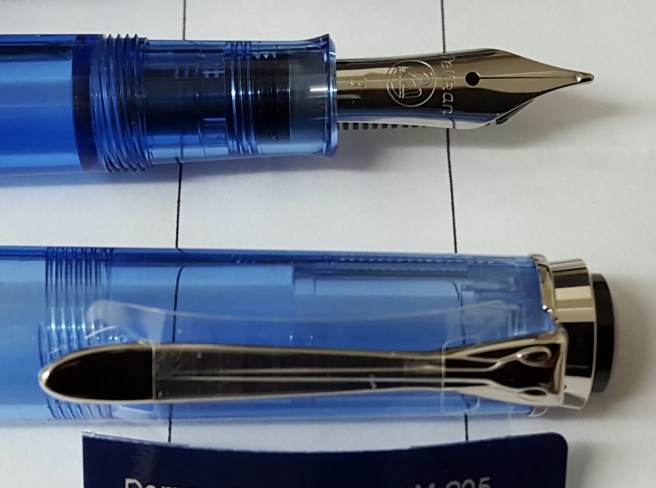
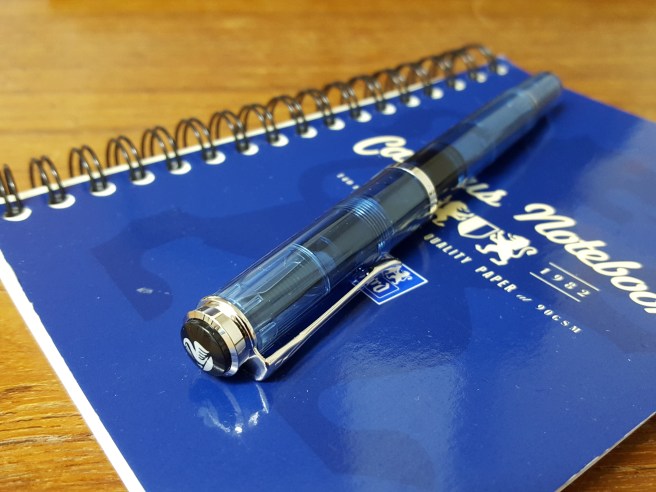
This past week marked 12 months since my purchase of a Pelikan M205. This was the 2016 special edition, blue demonstrator version. (The cropped name tag reads “Demonstrator M205, Blau/Trans. B”)

Recently I read a criticism made on FPN, levelled at some of those who provide reviews of fountain pens online, that they were often produced after the reviewer had spent little time with the pen. The inference was that the reviewer was too biased in favour of a pen still in its honeymoon period. (The thread was entitled “The Rampant Inaccuracy of Fountain Pen Reviews”; just go to FPN and search “rampant”). This ran to 125 comments when I last looked and so had clearly prompted some lively debate.

Personally, I much enjoy looking at reviews of fountain pens online, including enthusiastic ones when someone is excited with a new acquisition.  I am sure that we all make allowances for any bias that might be apparent, in order to form our own opinions, weighing up comments from multiple sources.

Nevertheless, I do take the point. I thought today would be a good opportunity to offer my reflections on the Pelikan M205 after a year’s ownership.

This was my first Pelikan. Having read much about the Pelikan M series piston filler pens, my expectations were high. And all the points that I liked about the pen when I received it, still apply a year on:-

Likes:-

  • Attractive, neat and petite demonstrator body, in a sky blue see-through material, being a little more discreet and less distracting than a clear demonstrator;
  • Piston filler; a smooth, simple, reliable, large capacity ink reservoir and with no worries of running out of ink unexpectedly; a fountain pen in the true sense, not a cartridge/converter pen;
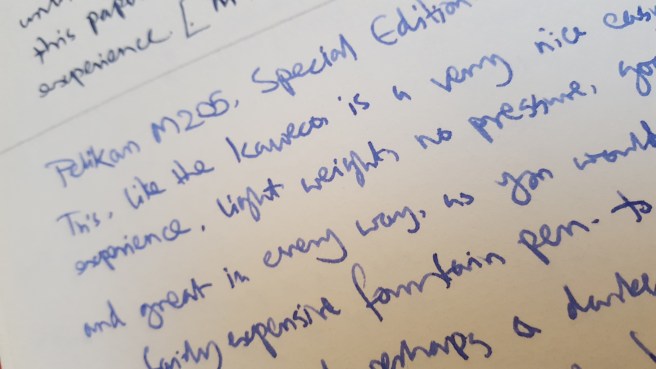
  • Wonderful stainless steel nib, (mine is a Broad), which is smooth, wet and just nicely springy for my liking;
  • Easily removable nib and feed unit, for easy cleaning or nib-swapping with replacement nib units currently available in Extra Fine, Fine, Medium or Broad at £11.25 from Cult Pens;
  • Screw cap, which posts deeply and securely, giving a comfortable posted length of around 148mm;
  • No hard starts: the nib, feed and inner cap design and screw threads located a third of the way up the cap, combine to make a pen that is always ready, even after standing idle for several days;
  • No problems with air travel;
  • The Pelikan heritage and quality name, even though this is not part of the Souveran range.

20170409_221358

Dislikes:-

“Dislikes” is perhaps too strong a word when discussing a Pelikan pen, but for want of a better one, I offer the following:-

  • I felt that its looks, at least to the uninitiated, meant that it could too easily be mistaken for an inexpensive pen like a Platinum Preppy or a single use or roller-ball type pen;
  • It is very lightweight and lacks “heft” although this is not necessarily a bad thing;
  • When filling, ink gets “under the skin” of the nib section. In this pen, the section is not detachable but is all part of the barrel. However there seem to be two layers of the acrylic body material, the space between them being unsealed, allowing ink to seep in,  which you cannot easily clean out, even with the nib unit removed although soaking in water does clear this. I am not sure whether this is common to all M205’s or whether this is just a fault of my pen; I consulted SBRE Brown, who was aware of the issue;
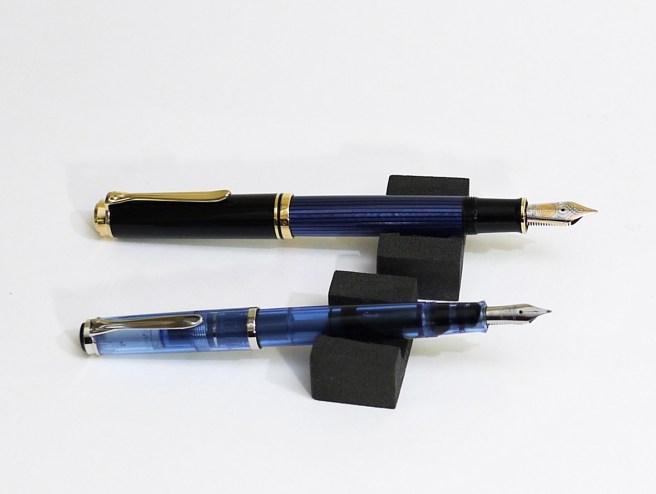
  • Being aware that this was perhaps an entry level Pelikan I still harboured an urge to try one of the familiar, striped models in the Souveran range with a gold nib and one with the heavier, brass piston mechanism which meant going for an M800 or M1000.
  • The price, at the time I bought mine from The Writing Desk, was £95.00 which is approximately double the price of a TWSBI Diamond 580. The TWSBI gives the appearance of being a better quality pen, with its faceted, polished barrel and larger proportions. I do however appreciate that it is unfair to compare pricing of German made pens with those from the Far East.

From a quick glance at my pen cup, (sixteen pens today), I note that the M205 is the only one of these that has remained inked continuously for the past 12 months, while others have been in rotation. I had used it exclusively with Waterman Serenity Blue ink, which in my view is an excellently behaved ink and reasonably priced.

On its 12 months’ anniversary, I filled the pen with Waterman Harmonious Green, an ink which I also like very much. However, in the blue M205 it just seems “wrong” and I plan to go back to the Serenity blue, ironically, to restore harmony to my pen cup.

Perhaps the greatest testimony of my appreciation of Pelikans, is that I have since bought a new M800 and a vintage M400 for myself, plus another M205 (in Aquamarine) as a getting-a-place-at-University gift for my neice.

I do enjoy my M800 and M400 too and each has its particular attributes. Yet the M205 still retains a special place in my collection and will always be my first Pelikan.


Inky pursuits: my weekend round-up.

20170306_190226.jpg

It is remarkable how soothing and therapeutic, the simple act of using a fountain pen can be. It does not even have to be proper writing. Just putting pen to paper and enjoying the flow of the ink from the tines is enough. A particular delight is to observe the ink flowing as you write, with a  magnifying glass or illuminated loupe.

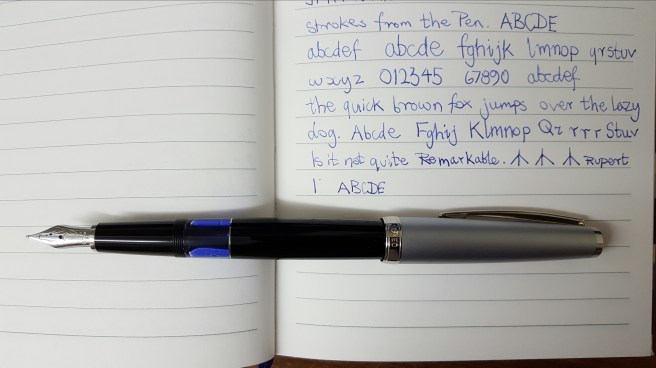
For the past two weeks I have been greatly enjoying my new Cleo Skribent piston filler fountain pen (shown above). It is still on its first fill, of Aurora Blue, but I am wondering whether to try a darker ink next time, as the nib is so fine. I will try to be patient and wait until it runs dry.

After a busy week I also find it relaxing to ponder what ink changes to make next. On Friday evening, I decided to put Sailor Kiwa-guro black pigment ink in my black Platinum Preppy. The Preppy has a good inner cap and seemed an ideal choice for this ink. Not long ago I had syringe-filled a cartridge with this ink for a Berol Handwriting pen, but was not altogether happy with the writing experience, but it was easy to switch the cartridge into the Preppy and flush the Berol. I then pottered about trying the ink on various papers and notebooks and was much happier with it in this pen.

On Saturday morning, I decided to try a black ink in my burgundy Platinum 3776 Century. I had for many months been using Waterman Harmonious Green ink in this pen, which shades beautifully. However, some time last week I had switched to Mont Blanc Burgundy Red in the 3776, thinking that this would be a clever match for the burgundy pen. I was not very taken with the result. The ink did have some shading but overall the rather subdued, lighter pinky-brown tones did not look as exciting as I had hoped.

So, I wanted to try a black ink that would replicate the shading that I had enjoyed from the Harmonious Green, but provide a few (ahem) shades of grey. I spent a happy hour or so dipping the 3776 in Parker Quink Black, then Waterman Intense Black and finally, Cross Black archival ink and examining the results on some different papers. I settled upon the Waterman ink and filled it up. The shading was not as pronounced as I had envisaged but the writing experience was very smooth and satisfactory.

On Saturday afternoon, I took the underground to the West End to meet my wife and to have a look around a few pen shops, which I had not visited for a while. First, I took her to  Campo Marzio at 166 Piccadilly, (near The Ritz Hotel), where we enjoyed browsing their colourful displays of pens and inks and accessories. I was tempted to buy another Acropolis fountain pen as the green marbled resin version looked so appealing, (imagine this filled with Harmonious Green!) but held back for now. My blue version is a favourite.

Next we walked up the Burlington Arcade to visit Penfriend. I had brought along my Sailor fountain pen bought at auction in January, hoping to get their help to identify the model and year. I was shocked to find that the shop had closed down and the inside was bare. I looked on Google and found an announcement stating “We have now closed both our shops in Burlington and Fleet Street however we are defining what the next steps are for our business” and giving an email address to keep in touch.

Back in Piccadilly, I went to have a browse in the pen department of Fortnum & Mason. The pen department had been rearranged a little when I was last there, before Christmas, but this time it had moved from the first floor completely. I met one of the sales assistants, who told me that the fountain pens had been moved up to another floor. I went up to have a look but the pen counters seemed to have been reduced to a couple of displays, although still included Visconti and Yard-O-Led.

After a nice fish and chips lunch off Regent Street, we took the tube from Oxford Circus to Knightsbridge, to have a look at Harrods. Their Great Writing Room, is probably one of the finest fountain pen departments in London. At the Visconti table, I was able to handle the Homo Sapiens, bronze model and was surprised that it did not feel at all as I had expected. I thought it would be more like pumice stone but it was smooth and rubbery. The sales assistant showed me how flexible the 23k Palladium Dreamtouch nib was, by pressing it down gently against the glass counter to spread the tines.  It was not inked but you could imagine the lovely broad strokes that might be achieved from such a nib. She told me that the material absorbed moisture and might discolour in time but that you could treat it with handcream! That sounded rather unusual advice for fountain pen care but then this is a unique pen.  I must admit, I was tempted to treat myself to one on the spot but it seemed too impetuous for such a costly pen and I managed to refrain from buying one, (for now).

At the Faber Castell corner, I spotted the Garnet ink in its gorgeous bottle and tried to remember the gist of a friend’s recent review that I had read of it. Finding the review, I was reminded that it had many good qualities but was perhaps not sufficiently different from the Mont Blanc Burgundy Red (that I already owned), to justify a purchase.

Back home that evening,  I found a couple of good YouTube reviews on the Visconti Homo Sapiens from Stephen Brown and Brian Goulet . Interesting though it was to learn more about the pen, its nib and filling system, I was pleased that I had not rushed to buy it in the afternoon before doing more research and looking at other options. Sometimes, buys which seem such a good idea at the weekend can leave me feeling a bit guilty and regretful come Monday.

This is where a wish list comes in very handy as a sort of holding reservoir, where I can let my desired pens sit for a time, while I weigh up the pros and cons. This way, I hope to make more considered decisions and to make purchases that  will give lasting enjoyment.

On Sunday afternoon, I had to pop in to our local shopping centre to return a new rain coat. I do not always get that right first time, either.


Some Sunday reflections

20160406_123010

It being Sunday, I felt in a reflective mood today. I rose early and enjoyed writing for an hour in the quiet of the morning. From the pen cup, I picked a Kaweco Sport Classic, newly  filled yesterday with Noodler’s Sequoia, as I was keen to see how this ink would perform in a wetter pen.

I then went for an hour’s walk, taking in a circuit around Golders Hill Park. It was still only around 9.00am and very empty. It was cool, a bit misty and damp with lots of wet leaves on the ground and wonderfully quiet.  I particularly like one section of footpath which winds uphill, between the trees and glades. It occurred to me that I was in my favourite part of Golders Green, in my favourite time of day. There is an animal enclosure, a free zoo in the park and I always enjoy stopping to look at the pair of Eurasian Eagle Owls, standing quietly in their open fronted hut.

Over at the duck pond there was some commotion. One mallard was fighting another, beating the water with his wings and chasing the other one quite persistently and aggressively. Even in such lovely tranquil surroundings, there is always something to spoil perfection.

As Christmas and the year end approaches, I counted that I had acquired around 40 fountain pens over the year. I know this because I keep a record of them on a handy App called “Memento Database”. Most were inexpensive and so this is not as extravagant as it sounds but the number came as a bit of a shock even to me. These pens all have one thing in common, namely, that they seemed like a good idea at the time. And I do enjoy the vast majority of them.

Being very fond of writing with a nice pen, it becomes addictive to acquire a different pen, in the hope that it might be even better. By “nice pen”, I do not mean only expensive ones as I get huge pleasure from using some which cost literally only a couple of pounds, if they write well.

Having accumulated (“collected” implies a more purposeful and focused approach) quite a number of pens, I suppose an obvious question is what is the best? The favourite. That is hard to answer. I suppose my Pelikan M205 blue demonstrator (pictured) is certainly up there in the top few, simply because I like demonstrators, I like piston fillers, I like that you can easily unscrew and clean the nib unit, that it has a large ink capacity, that the nib never seems to dry out and be unready to start and above all, it has the most wonderfully smooth and slightly springy stainless steel broad nib and writes like a dream. A joy to use.

With just about any pen, you can list some things that you like about it and things which you dislike. One person’s list will be different from another’s. But there is no such thing as the perfect pen. Of course, the range of fountain pens caters for all ages and tastes and uses. In comparing factors, there is no ideal pen which has every conceivable attribute and sets the standard by which all others are judged. Yes, there may be some pens which have very little to dislike about them. But these often lose out on the grounds of being very expensive. Once you factor in the cost, it becomes harder to chose and everyone will have his own views on what is a reasonable amount to spend, to get the best. But then who really needs (as opposed to wants) the best?

And so I wrestle with these conflicting ideas – the addictive urge to acquire another good pen – with a small voice of reason telling me that I do not need it. I am very bad at resisting.

And so these ideas were going around in my head on my walk today. Ironically I had no pen and paper to hand to capture them! All of these pen purchases were at home. I almost always carry at least one fountain pen and a notebook and perhaps there is a principle which says that inspiration will only come when you have nothing with which to write it down.

Is there a common thread to these meanderings?  My point is that pens are not perfect. But neither are we. How boring it would be if the perfect pen was invented, all the others disappeared and there was no choice. And how boring too if we were all the same. Like pens, we all have some good points and some not so good. Perhaps this is how God sees us.

On my way home, I did stop to glance in the window of Rymans. Their fountain pens are on the wall right by the window and so you see them all hanging up, the Cross Bailey Medalist, the Cross Aventura, the Parkers (Vectors, Urbans and IM’s) and of course the Lamy Safaris and Al Stars in a range of colours. I hope that they will all find appreciative owners and that new generations continue to enjoy the fountain pen life. I would like to say that in the New Year I will write more and buy less but time will tell.

And that Noodler’s Sequoia goes well with the Kaweco. The green-black shades nicely and makes a nice change from my more usual blue-black in this pen.