My NaNoWriMo experience, November 2025.

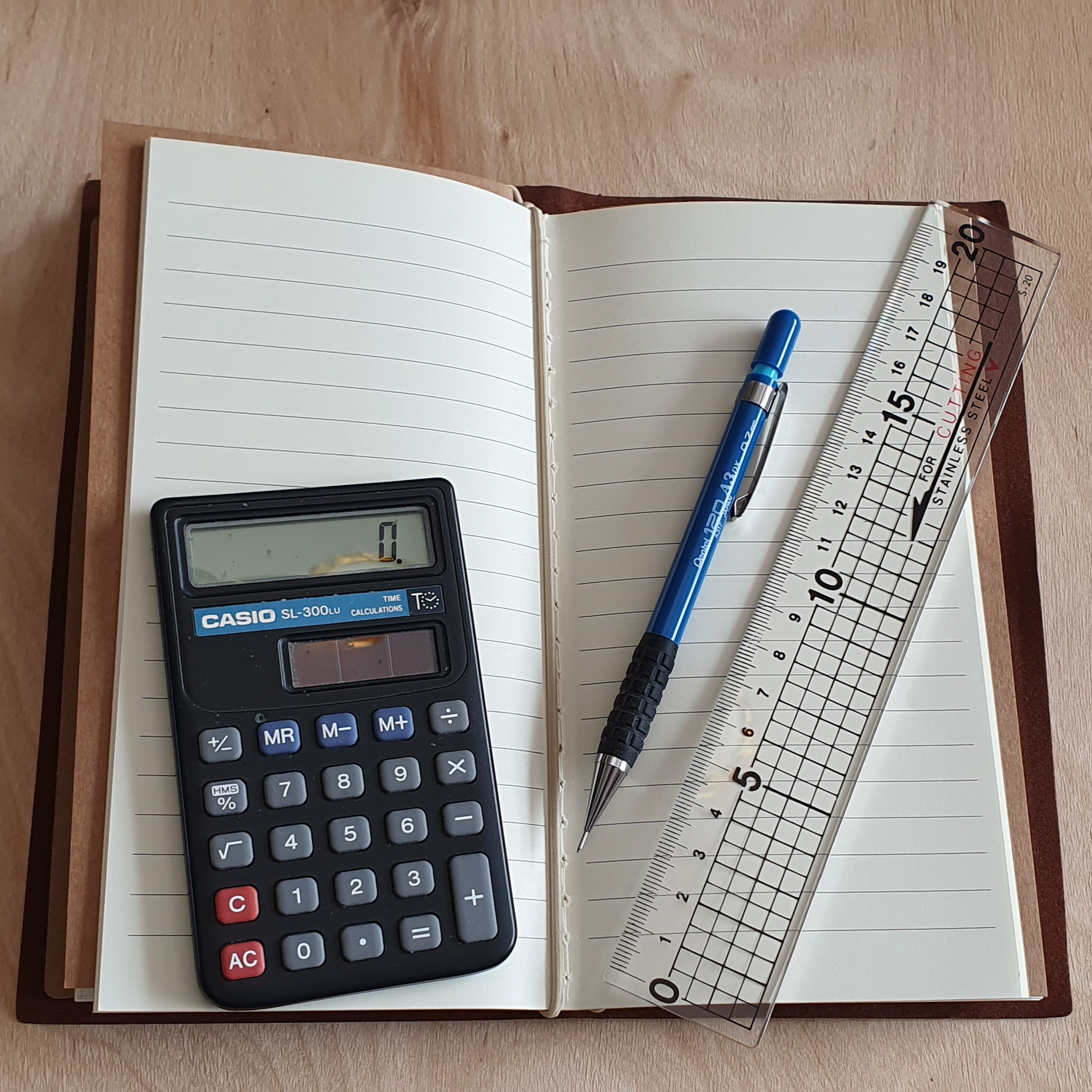
In my previous post I talked about starting the NaNoWriMo challenge, as well as reviewing the notebook that I was using. Today the challenge ended and I thought I would check in here to share my thoughts on it.

To recap, this was the National Novel Writing Month, an annual event which was launched back in 1999. The basic idea was for participants to write a novel, of not less than 50,000 words, in the month of November. I had never taken part and only when looking into it this year, did I learn that it had closed down in 2025.

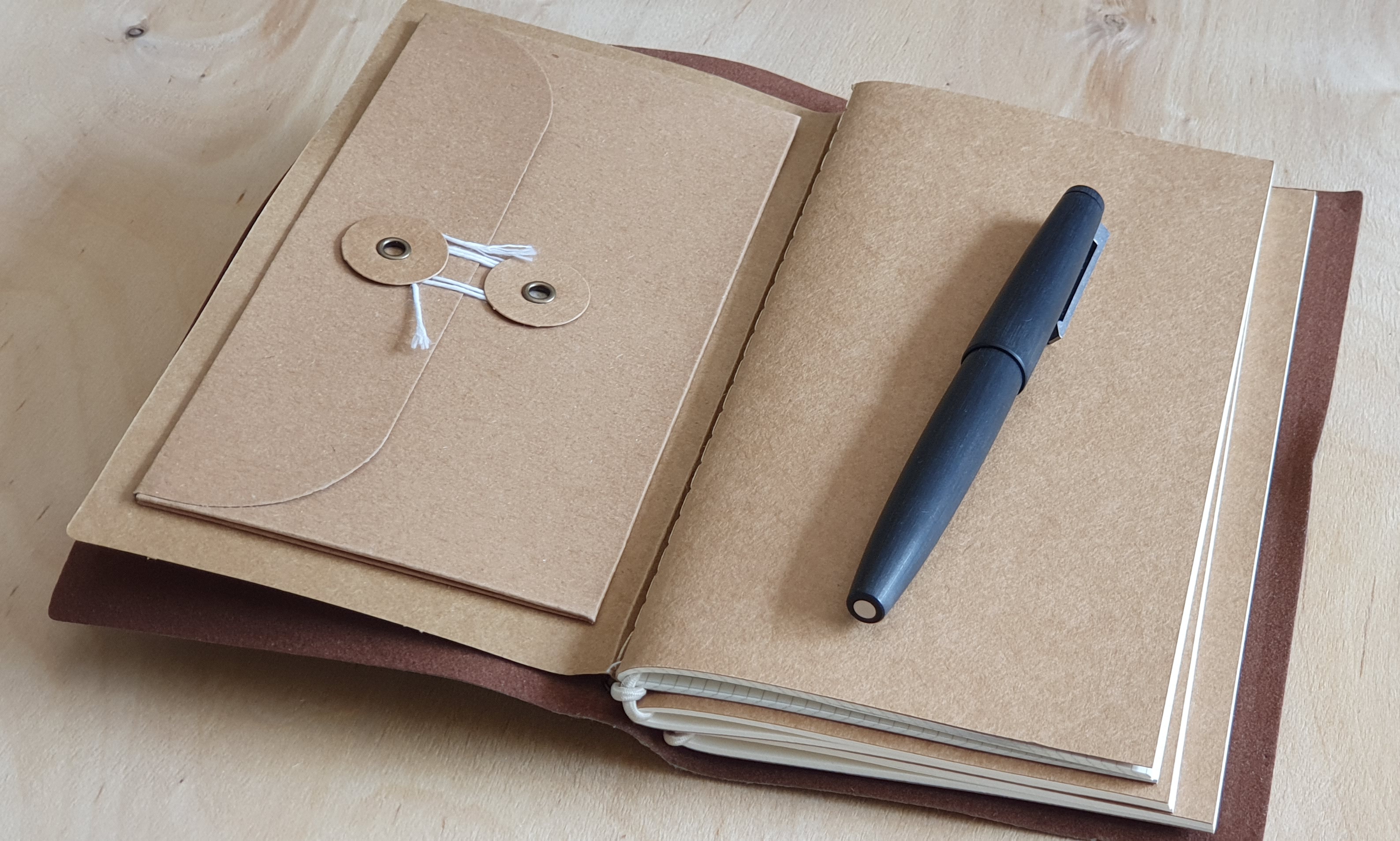
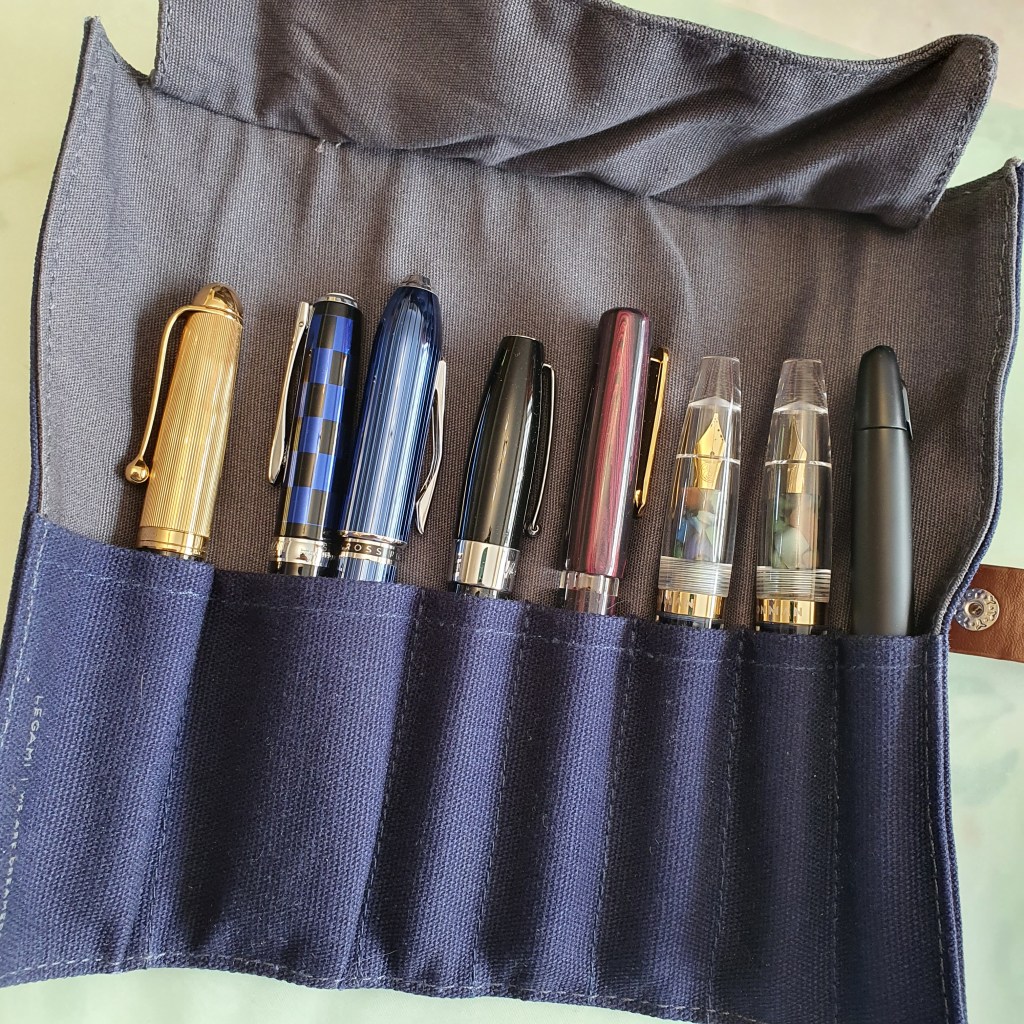
Nevertheless, I decided to take up the challenge to write 50,000 words in a month, without signing up to any online community. It would be NaNoWriMo ByMoSelf. Also, I was not going to write a novel (never having written any fiction and not having any plot in mind). That would have to wait for another year. Instead I would be a “rebel” and write on 30 daily topics from a list of writing prompts that I made. These were loosely biographical on such topics as parents, grandparents, holiday memories, childhood tv, hobbies and so on. I had a nice new notebook at the ready. I had pen cups full of eager fountain pens. A headful of memories. I just needed a writing project like this to put them all together.

This can be done by anyone at any time, of course. November seems a good month. It is getting cold and dark (in my hemisphere). Starting at the beginning of a 30 day month makes it convenient to always know how many days you have done and how many you have left.

Today I reached the end. I had kept it up each day, although once or twice I had a couple of pages left to complete from the day before. I got to the end of my notebook today. I had allowed eight pages per day of the B5 notebook until about half way through the month when I adjusted this to seven pages. Being handwritten, I do not have a word-count, but it is certainly over 50,000. From a few sample pages I have counted and averaged, I think the total is around 63,500.

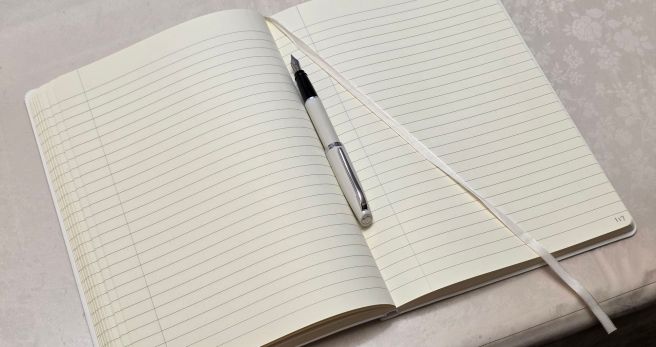
I can recommend the notebook that I used – the Ryman, B5 Soft Cover Notebook (although I appreciate that this is not helpful if you are outside the UK). I liked the texture of the paper, (especially when low, wintry sunlight fell on the page, showing up the texture). The cream coloured paper was easy on the eye and the 8mm row height suits my preference.

Most of all, it has been a real joy to have this self-imposed task to complete each day and to spend some structured time with my fountain pens. For me, writing with a fountain pen was a big part of the draw. Thinking about which pen I would use, gets me out of bed in the morning!

Would I recommend the challenge? Yes, definitely – if you are like me. That is, if you are someone who likes:

  • Fountain pens; spending a solid couple of hours using a pen to see how it feels and performs and how well the ink flows; seeing filled pages at the end of the session.
  • Working on your handwriting;
  • Dipping into and exploring your memories;
  • Practising (or finding and developing) your writing style.

The NaNoWriMo challenge enables you to indulge all of these simultaneously.

I found that I am a morning person for all of this. Much has been written about the benefits of journaling or “morning pages” to free up the mind for the day ahead. Writing to a specific topic gives a basic starting point and theme although I often found myself digressing. I have not read it back yet and may wait a while before doing so!

I think also that this practice, as well as being a valuable habit to nurture, also meets a need to communicate. As a recently retired person, no longer having the society of my office colleagues, a notebook can take the place of someone else’s ears.

Finally, a word about the pens. I usually picked a different one from my pen cup each day, except for the new Asvine V800 vacuum filler, that I filled and used for five days in a row. Several of the pens used, and which were already filled, were also recent acquisitions such as my Arclayer double helix, eye-dropper, three vintage Parkers and the Aurora Style from the October pen show. One pen that I particular enjoyed using was the Faber-Castell Ondoro with smoked oak barrel that I bought in September. One of the beauties of fountain pens is that they are all different: picking up a different one each day was one of the pleasures of this exercise.

Ryman B5 Soft Cover Notebook review and my NaNoWriMo challenge.

In September, a reader’s comment alerted me to a new Ryman notebook with 100gsm paper which was supposedly, fountain pen friendly. I was already familiar with their 70 gsm notebooks and have several of them in A5 in various colours in my stash. However I was keen to visit my local Rymans to check out their 100gsm version.

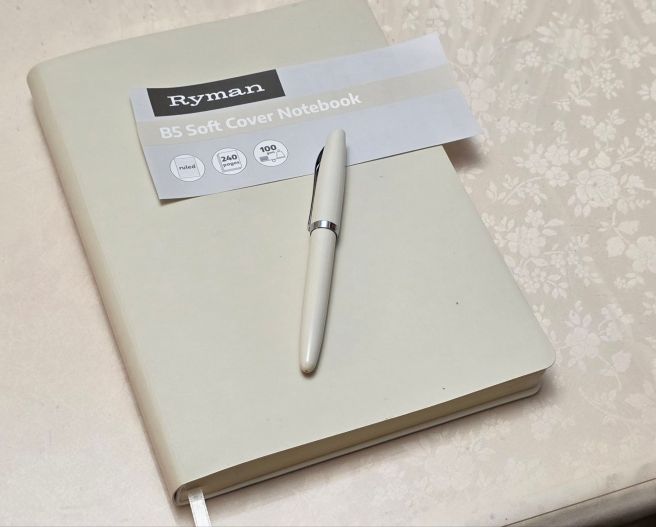
On 1st October, I paid a visit and found a shelf of these new notebooks in various sizes. The available colours were limited to “pink, mint or stone”. I opted for a B5 size in the stone, which is a very light grey. The book contained 240 pages of cream, 100gsm paper, ruled at 8mm row height (my favourite) and with 27 rows to a page. The cover has a smooth pleasant feel and offers some protection to the pages, but is a flexible, bendy cover, (not a hard-back like the versions with 70gsm paper). Crucially, the pages are stitched for open-flat use and the line spacing and the smooth soft feel of the paper are just as I like.

Ryman B5 Soft Cover Notebook. Pagination and margins added by me.

Other features of the notebook are rounded page corners, an expandable pocket inside the back cover and a single, white ribbon page marker. There are no page numbers (I added my own), no elastic closure and nothing to distinguish the front of the book from the back, unless you have a bit of the ribbon marker showing at the bottom.

The B5 size was £7.99, which I calculated gives a cost of just 3.33 pence for each of the 240 pages. I do not usually go for the B5 size, which falls between A5 and A4 (ideal for people who cannot decide which of those two sizes they prefer).

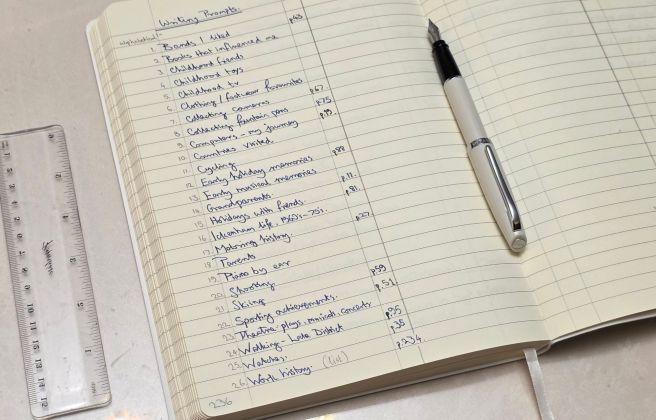
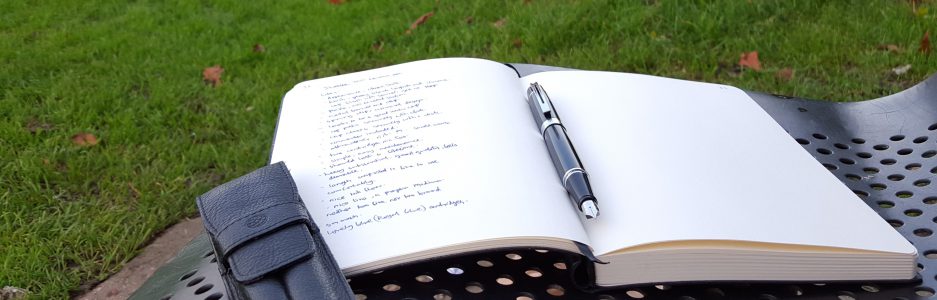
At home I tested the paper for fountain pens by writing with a Faber Castell Ondoro, medium nib inked with Graf von Faber-Castell Cobalt Blue. My note reads “Feels smooth but with some pleasant feedback. Lovely.” There was no bleed-through or feathering. I was delighted with the notebook and started using a few pages, starting from the back, to write various lists, including one list of some writing prompts that I had created and saved alphabetically in the app ColorNote.

Example of some writing prompts. The pen is an Aurora Style.

In October, after the London Pen Show my pen cups were full with inked pens. It was obvious even to me that I did not need any more pens, inks or notebooks for a while! What I needed was a writing project. I hadn’t undertaken a writing project as such, for a few years since I finished transcribing Marcus Aurelius’ Meditations.

And then, just at the right time at the end of October, I read in a blog about the NaNoWriMo challenge. I had never taken part in this before. The objective is to write 50,000 words, the first draft of a novel, in November. I understood that participants could register, and once signed up, receive some tips and support as part of the NaNoWriMo (National Novel Writing Month) community. However, I planned to tag along quietly on my own without signing up. This was just as well as I then learned that NaNoWriMo was no longer running, having closed down in April 2025.

Nevertheless, I really liked the idea of the challenge. The point of it, I think, is to get people writing regularly and to establish a writing habit. The emphasis is on completing 50,000 words, that is, on quantity rather than the quality. It is only a first draft.

I did not have an idea for a novel in mind and had never written any fiction. Instead, I decided to utilise the biographical writing prompts that I had already entered in my new B5 notebook and to use that notebook for the challenge. I would write every day with a fountain pen.

A few back-of-an-envelope calculations soon told me that 50,000 words in 30 days = 1,666 words a day. I had already written on the last 20 of my 240 pages, and allowing the first 2 pages as a frontispiece, I would have 218 pages available for the challenge and so need to average 230 words per page. The daily word count of 1666 words, at 230 words per page would mean writing for an average of 7.25 pages a day.

As of today, I have kept up. I have passed the one third point. I am really enjoying the writing exercise and like to start first thing in the morning, and so my NaNoWriMo is also a bit like doing Morning Pages. I pick a topic each day from my writing prompts list, and also pick a fountain pen. The idea then is to have a topic on which I can write continuously, rather than if I were copying from a book and needing to pause to look up and down all the time.

This challenge, apart from being satisfying day by day, has multiple other benefits. Just sitting to write with a nice pen and ink is a joy in itself. It is a way to practice and improve one’s handwriting. It is a way to test a fountain pen over an extended chunk of time (typically about two hours per day) and to check that the pen keeps up with the ink demand and is drawing ink down from the reservoir. You can spend time with a pen to remind yourself of why you like (or dislike) it. You write a pen dry in a few days and can then clean the pen with a clear conscience or else re-ink it if desired. It is a good mental discipline, the brain generating thoughts and words and the hand and eye keeping up with the flow of ideas. And I am getting to tell my little stories.

I am also enjoying the Ryman B5 notebook for this purpose. It is just the right length for the NaNoWriMo challenge. I have been using my lefty-underwriter (upright) style of handwriting whereby the book is level (not rotated) and so I do not have the problem of having to reach too far away from my body to use the right hand page: this might be a problem if I were to use my lefty over-writer style when I rotate the paper to the left: the left-hand page can then become smudged or creased. I found this to be a problem with A4 notebooks, whereas A5 notebooks are small enough to rotate without causing such an issue.

In conclusion I can recommend Rymans’ 100gsm paper notebooks. For my part, I am enjoying at least the spirit of the NaNoWriMo November writing challenge, in my own way.

Ryman notebook and Aurora Style fountain pen.

The new year diary, 2025.

It’s time to wake up this blog for another year and, where better to start than with a brief review of the diary that I plan to use?

For 2024, I used a Ryman A5, soft cover, flexi, Page A Day diary for my daily journaling, summarising what I did with the previous day. Occasionally, this might include a list of things I am grateful for (if I can be unselfish enough for a few moments, to remember). My post on the new year diary, 2024 can be re-read here.

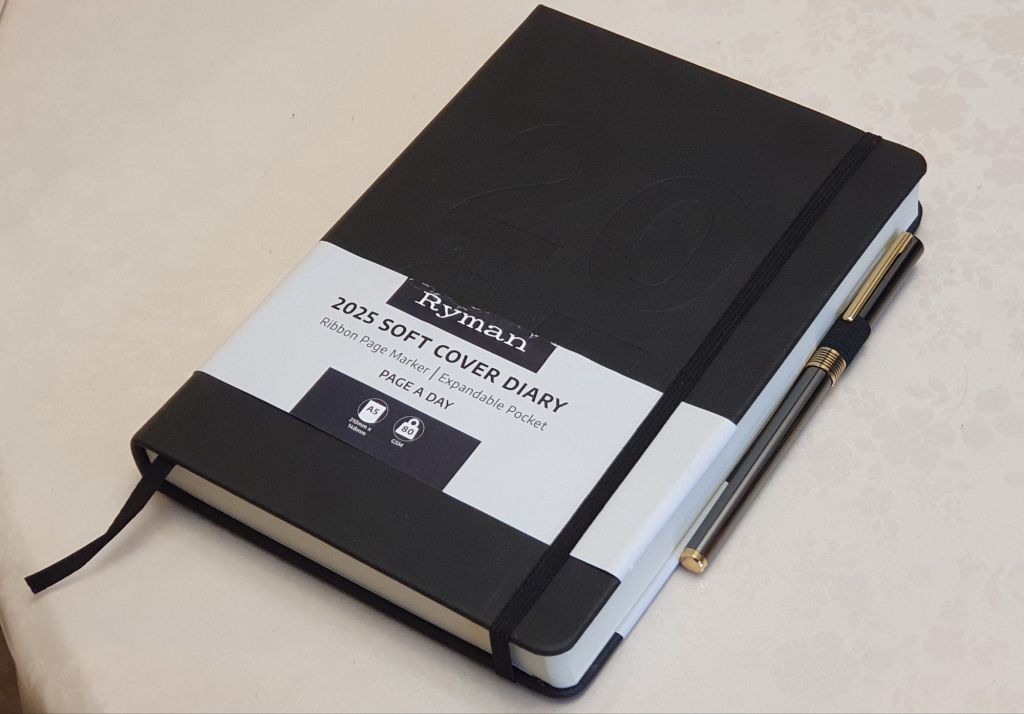
This year, I went for the closest equivalent that I could find, which was again from my local Ryman stationers. Whilst seemingly much like last years, I was glad to notice several subtle improvements have been introduced. These are as follows:-

  • Instead of last year’s horizontal thin elastic closure, we now have a more conventional, vertical ribbon elastic closure. I disliked the old style, since with short finger nails, it was fiddly to lift the elastic to open the book – an issue for which I designed a simple hack, namely tying a piece of pink ribbon to the elastic.
  • Whilst retaining the same soft texture of the covers, last year’s flexible cover has been replaced with a stiffer cover, which I like. It also does away with the need for the little metal reinforcement tab on the edge of the front cover to protect it from being worn by the elastic. Over the year, that piece of metal had lifted, leaving a sharp edge which was a danger to adjacent books.
  • A Pen loop has been added, to the back cover. I don’t actually use it (other than for this photo) but it could be useful.
  • Something that I have only today noticed, the row height has been increased very slightly from 7.6mm to 7.9mm. I must admit, I was assuming that they were both 8mm until I checked.
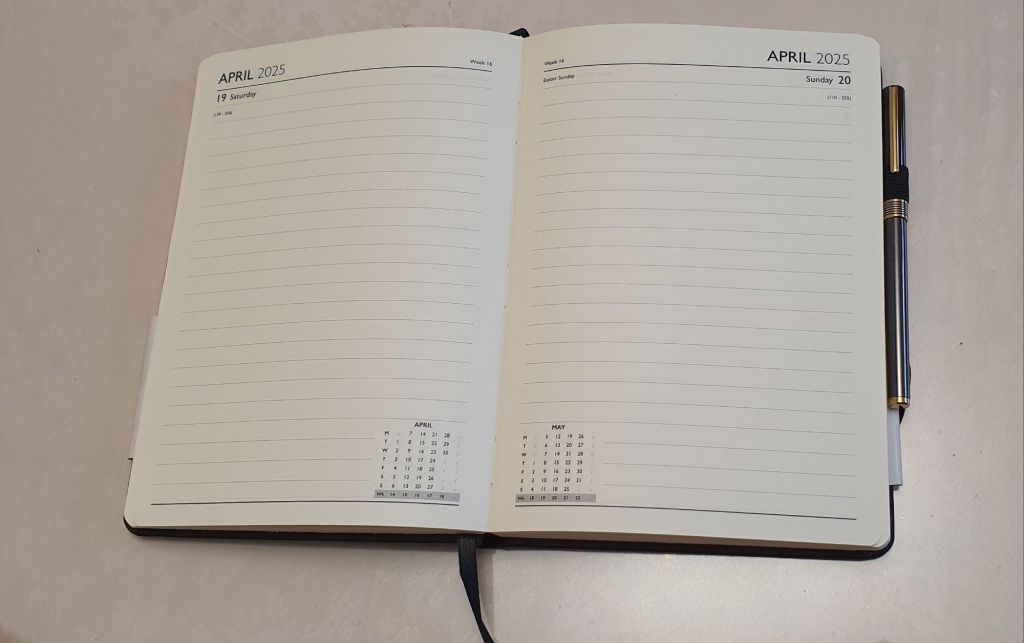
  • Best of all, the 2025 edition now includes a Page A Day for Saturdays and Sundays, whereas last year they shared a page.

Otherwise, the two editions are much the same, with a ribbon page marker, cream paper which is fountain pen friendly and with sewn binding, to open flat without damage.

This suits my needs very nicely. For longer entries, such as holiday journaling, I use a separate Leuchtturm A5 notebook, with either plain paper or dot grid. Day to day pen and ink sampling and therapeutic pen time is done in a Stalogy A5 Editor Series 4mm grid, 365 page note book, a product which I have now used and enjoyed for several years.

For bullet-journaling, I upgraded my old Ryman A4 notebook to a WHSmiths Moderna Ruled A4 Leather Notebook, with 96 ivory sheets of 100gsm paper. I have set this up with monthly spreads, for the years 2024 to 2029 inclusive. It is very useful to log dates which are a year or more in advance, such as car and house insurance renewals, guarantee expiry dates, or investment product maturity dates. As well as these grown-up uses, I also like to include books read, albums listened to, trips to the gym and other day to day life admin.

So there you have it. Here’s wishing everyone a Happy New Year and hoping for happy events to plan and record in our diaries for 2025!

Ryman Medium Soft Cover Notebook review.

I am a sucker for a new notebook. I love buying a new one, removing the cellophane, sampling pens and inks on the back page and then paginating it in pencil. The next pleasure is choosing what to use it for. Never mind that I have about 20 new ones already (a conservative estimate: I daren’t get them all out to count them: and that is just the A5’s).

There is a crowded market for A5 journals, perhaps typified and made famous by the Moleskine books with their expandable pocket in the back cover and the elastic closure. I learned only recently that the Moleskine enterprise began partly in response to a mention by the late author Bruce Chatwin, in his book The Songlines (published in 1987). He recounts a conversation when he is about to take notes and pulls from his pocket, “a black, oilcloth-covered notebook, its pages held in place with an elastic band.” The interviewee comments “Nice notebook” to which he responds “I used to get them in Paris, but now they don’t make them anymore.” The origin story of Moleskine can be found on its official website.

Presumably to fit into a pocket, the Moleskine notebook is narrower than A5. Rymans, the stationery store chain, sell their own brand notebooks, for the budget-conscious. When I bought one a couple of years ago, it followed the same, narrower, Moleskine format and also had lines ruled at 7mm row height. I wished that they were A5 width and with a line spacing of 8mm.

Rymans’ new A5 notebook with the narrower old style version for comparison.

Well, on a recent visit to my local Rymans, I was very pleased to see that their 2024 range of own brand notebooks now have both of these two changes. They also come in a new variety of attractive colours, whether your preference is for a traditional navy blue, dark green, Burgundy or tan – or a more playful pastel shade.

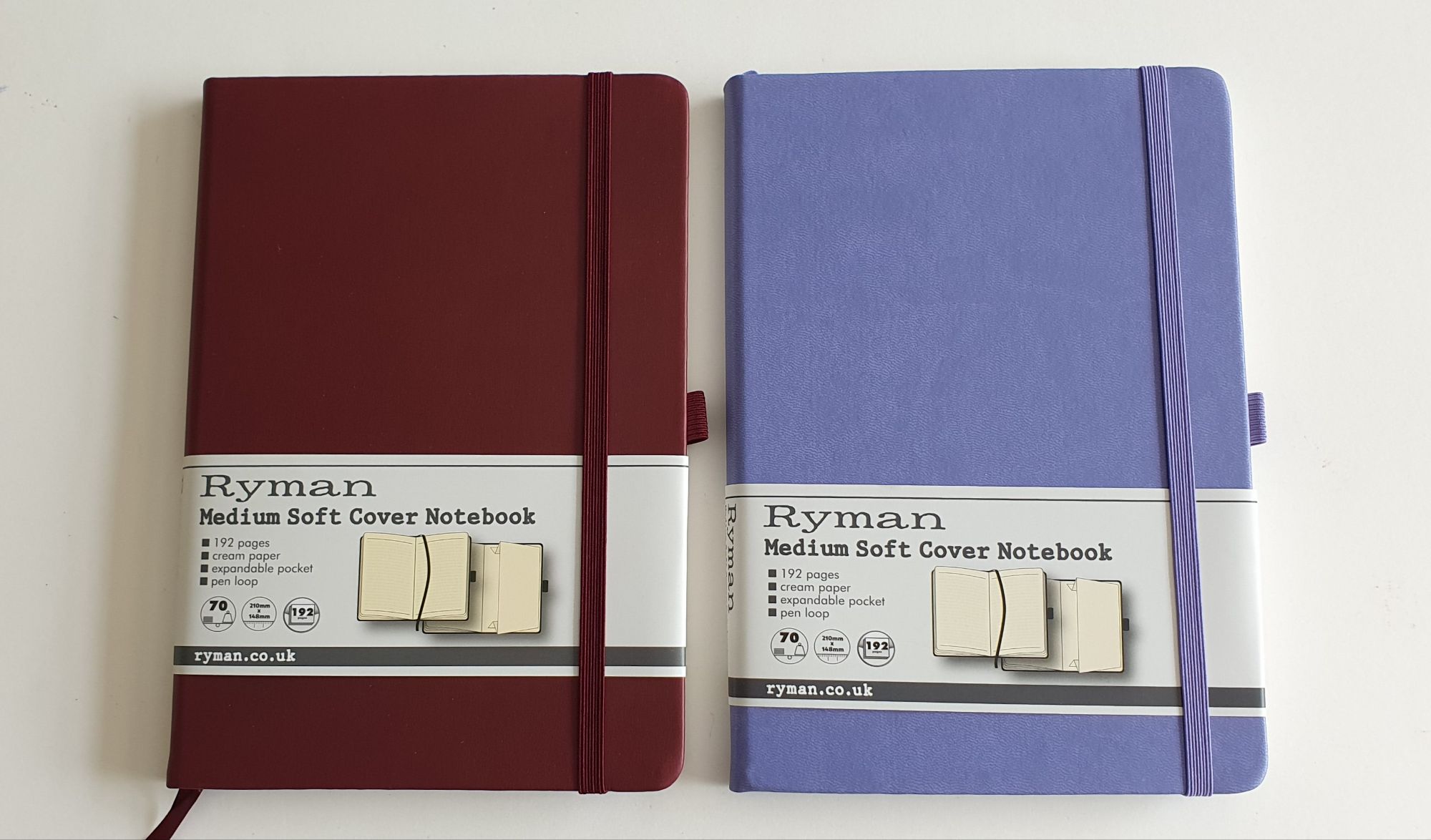
Such was my excitement that I bought two, one in Burgundy and the other in a pretty pastel colour described as Wisteria. Interestingly, Rymans do not include the term “A5” in the description, instead simply describing it as “Medium.” However, the belly-band indicates the paper size as 210mm x 148mm.

Burgundy and Wisteria – two of the many colours available.

They have a hardback cover (although described as “soft cover” by reason of its soft-to-the-touch, leather-like texture). Other features include 192 pages, stitched, open-flat binding, 70gsm cream paper, an expandable pocket, and elastic closure and pen loop and rounded corners. At £7.99 these are well below half the price of a Leuchtturm or Moleskine notebook. All good so far.

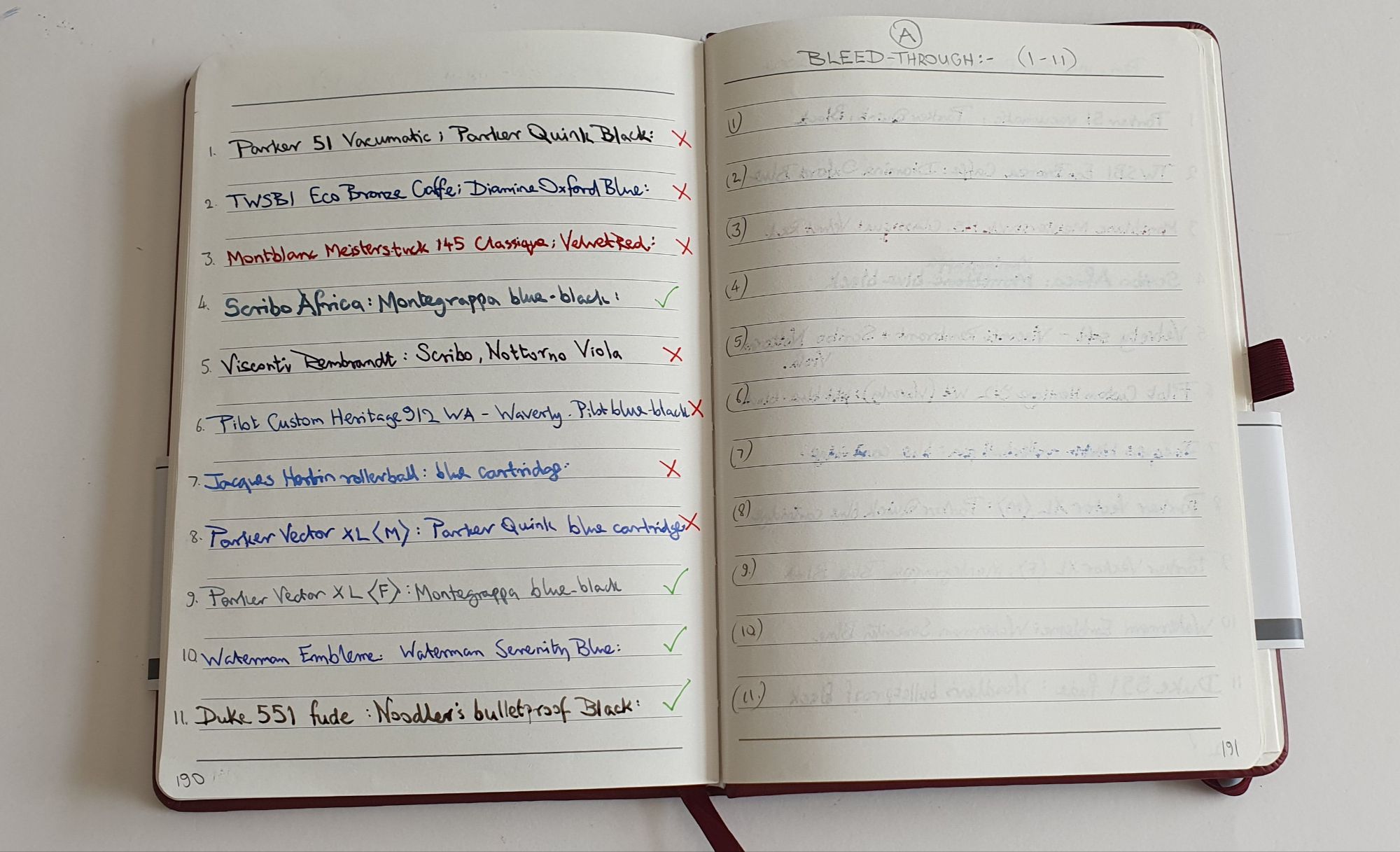
Unfortunately, for those wishing to use fountain pens, I found the paper a bit hit and miss. The surface is pleasant to write on but pen and ink combinations need to be chosen with care. On the back page, I tried a selection of fountain pens from my pen cups, hoping that none would bleed through the paper. Most did bleed through, with a few surprising exceptions.

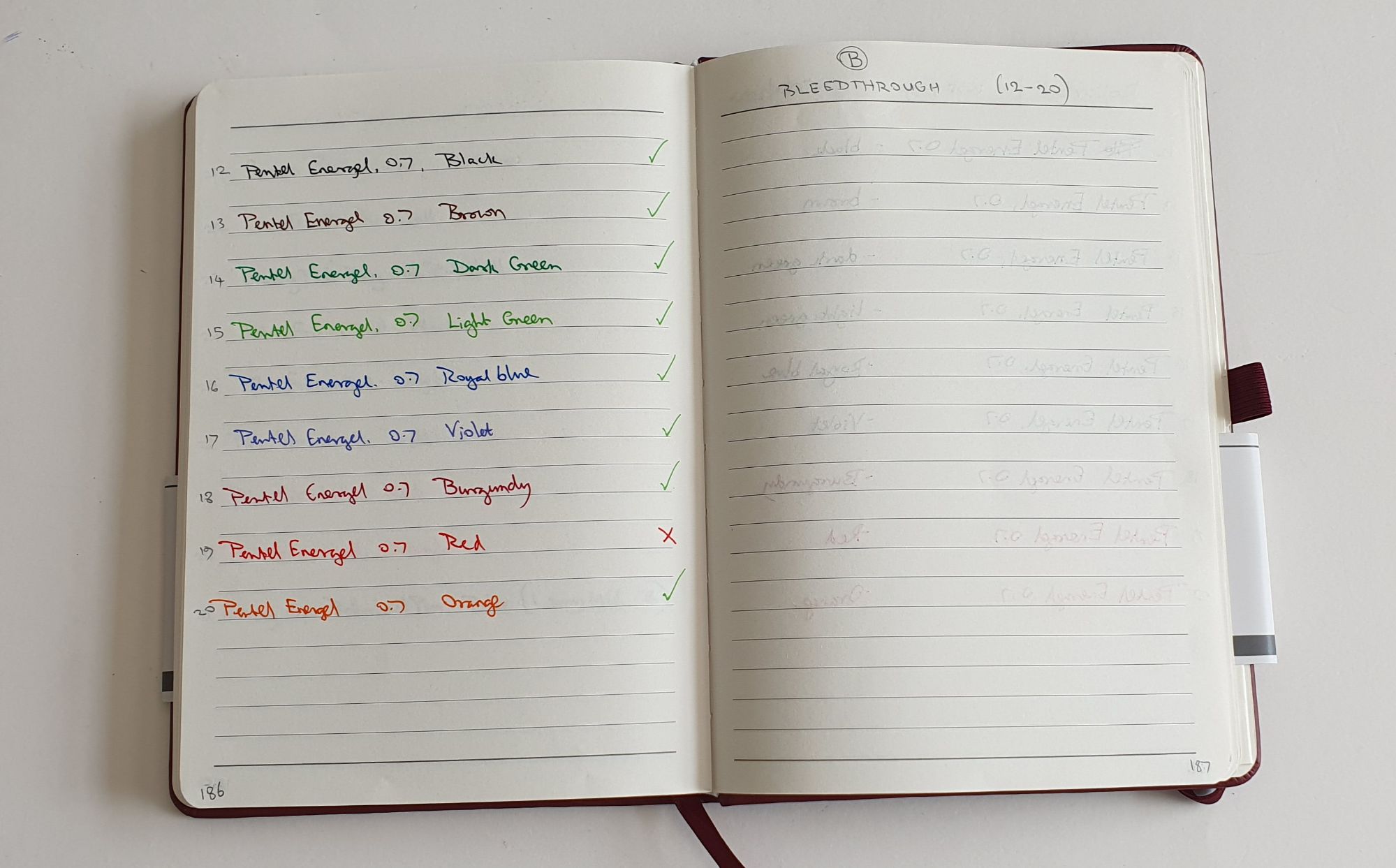
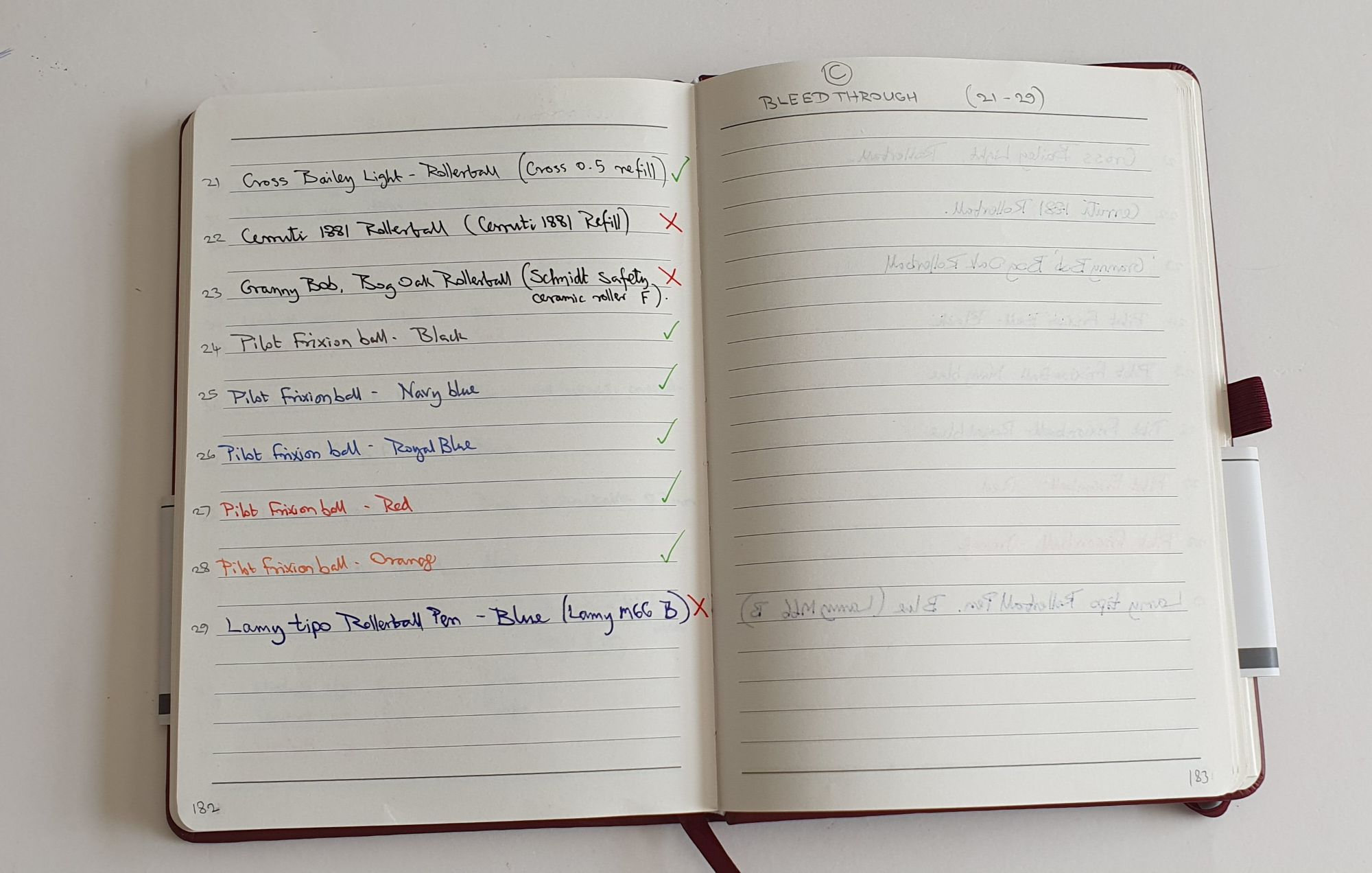
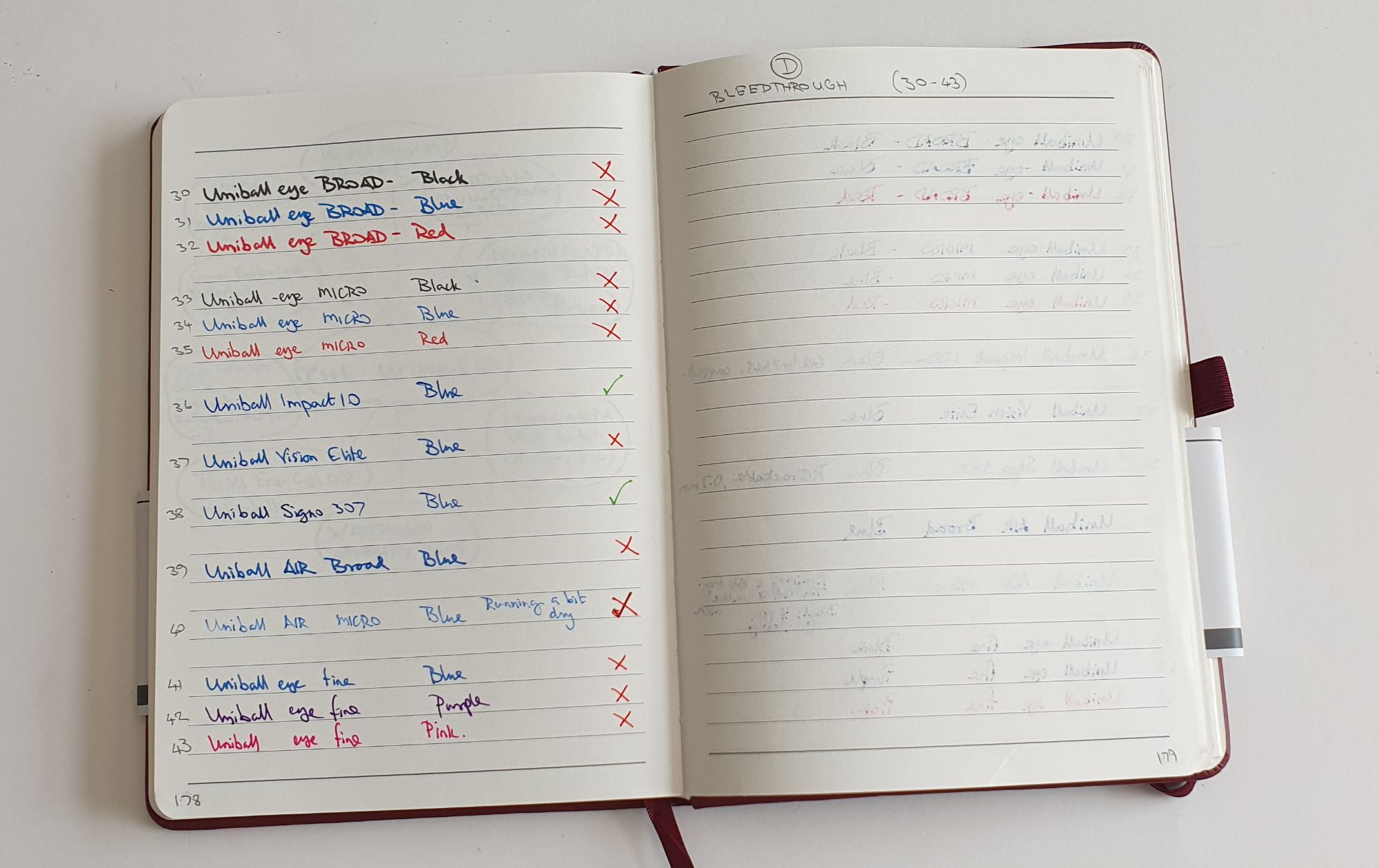
Fountain pen ink bleedthrough test combinations with results on the facing page. Those that bled through are marked with a red cross. Those that this did not, marked with a green tick.

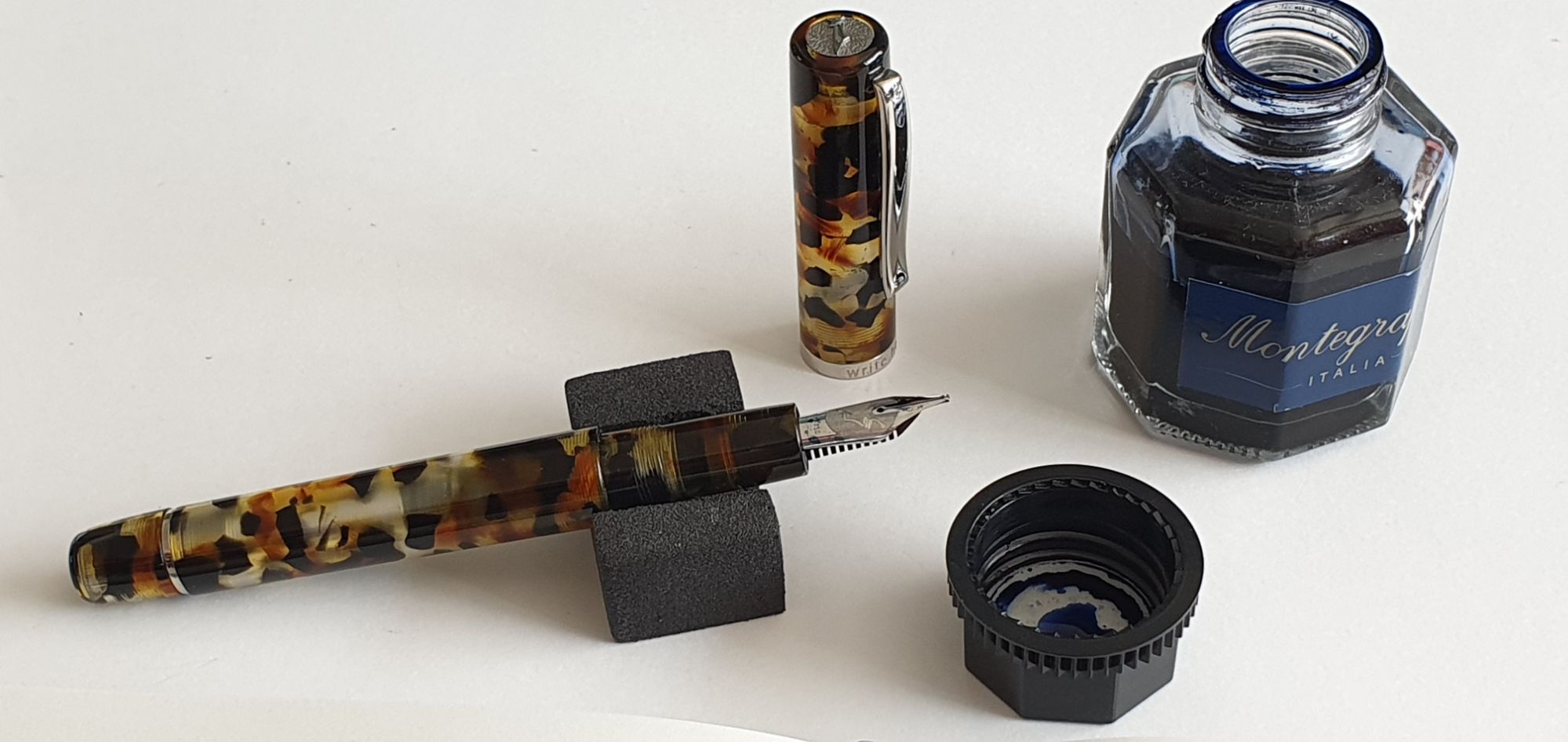
For example, my broadest and wettest fountain pen, my Scribo Write Here Africa with its 18k gold broad nib, currently filled with Montegrappa blue black, was one that did not bleed through. This led me to conclude that it is not so much the amount of ink laid down, but its type. I was pleased that at least I could use my Scribo in this book. I immediately filled a Parker Vector XL (fine nib) with the same, Montegrappa ink. [Unfortunately, this ink seems no longer available].

Juicy broad Scribo with Montegrappa Blue Black.

Another ink to avoid bleed through, was Noodler’s bulletproof black – even when applied with a 4mm long fude nib.

I felt that some more extensive pen and ink sampling was required for this book and set about filling up some pages. Starting at the last page of the book, I had tried 11 different pens. I copied this out again two pages back, leaving the facing page blank to view the bleed through. I then repeated this exercise with some Pentel Energel rollerballs, my Pilot Frixion stick rollerballs, a few other rollerballs from Cross, Cerruti and Lamy and finally a page full of Uniball rollerballs of differing colours and widths, from Uniball’s Air, Eye, Impact, Signo and Vision Elite. I had 43 samples.

Pentel Energels – mostly avoid bleedthrough.

My bleedthrough test results on the new Ryman notebook, surprised me. For example, the Pentel Energel 0.7 rollerballs were all ok, (with the possible exception of the red, which was a bit borderline). Likewise the Cross Bailey Light rollerball (a favourite) with its Cross 0.5 refill, and the Pilot Frixion stick pens were all ok to use. But the Lamy tipo with a blue, Lamy M66 B refill – a lovely smooth writer – did bleed through and had a high degree of show-through, rendering it unsuitable for double-sided writing in this book.

More rollerballs, with bleedthrough on facing page.

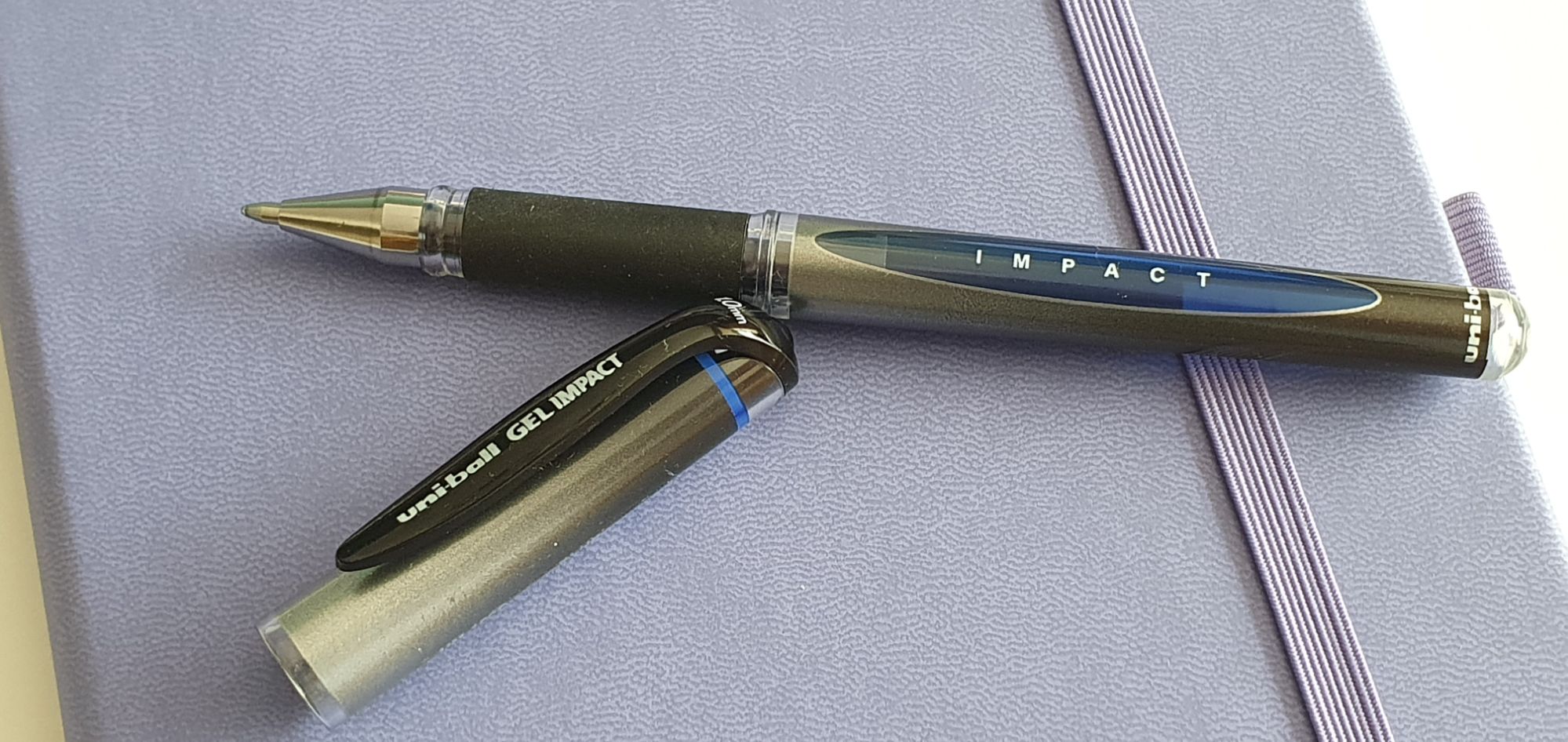
Finally, the Uniball rollerballs mostly failed my test with the notable exception of the Signo 307 retractable 0.7mm, in blue. But perhaps the biggest surprise of all was the Uniball Gel Impact 1.0mm, in blue. This is a lovely smooth, broad, wet, vibrant writer with a snap on cap, metal nose cone and comfortable rubber grip section. I very much doubted that this would go well on the Rymans book yet it showed no trace of bleedthrough and very little show through.

Uniball family. The Gel Impact was best at avoiding bleedthrough

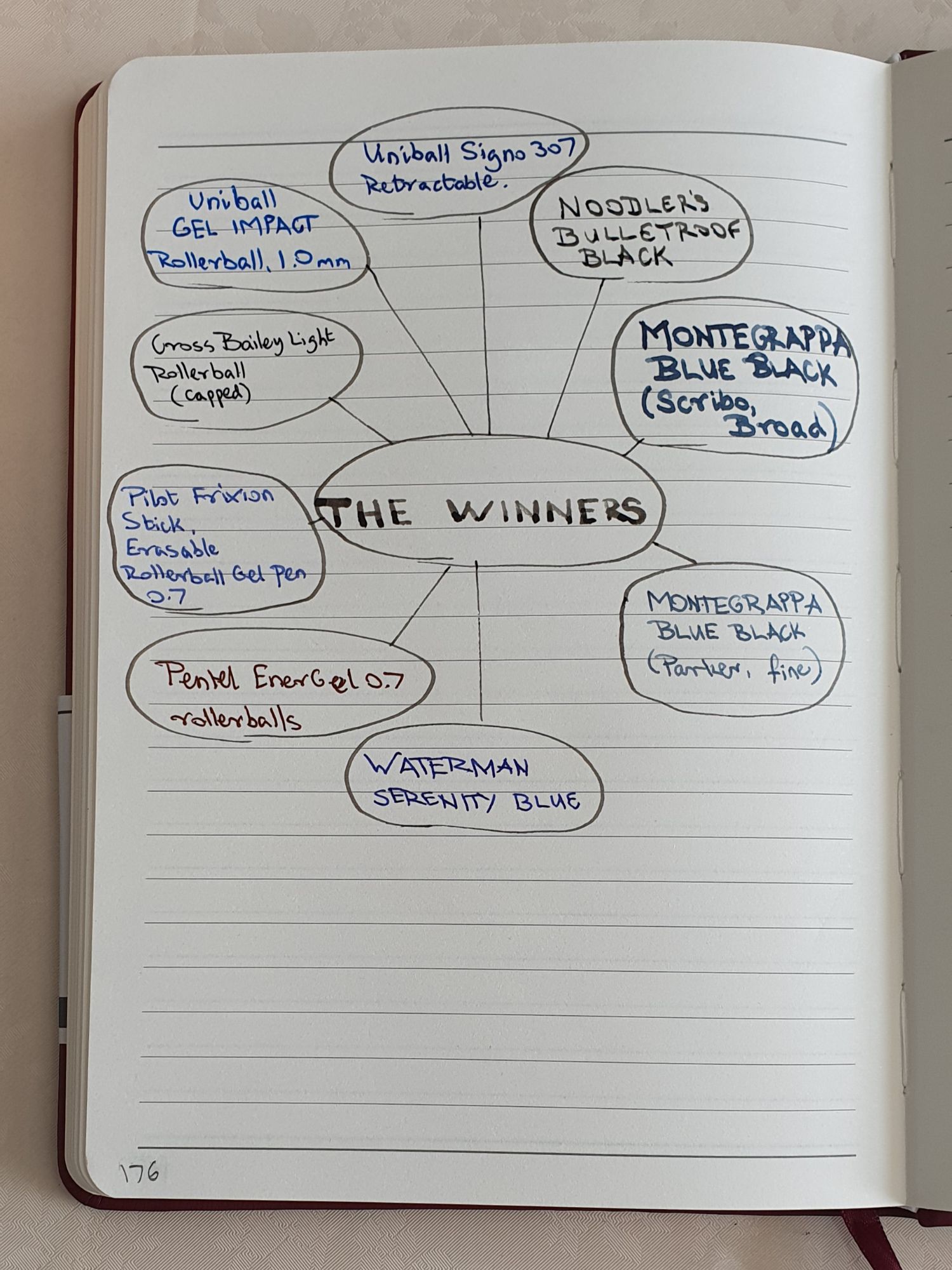
I concluded my sampling with a Winners page, the pen and ink equivalent of a victory parade. As can be seen, this handy summary shows that I am left with plenty of usable pen and ink combinations for this book.

Summary of the winning pen and ink combinations for the Ryman notebook.

To summarise, I find this new version Ryman Medium notebook good for its full width A5 pages, 8mm row height and value for money. As for the fountain pen and rollerball user, my results were mixed and some experimentation is required. However I believe that most stationery hoarders will find at least a few suitable combinations in their stash and, if like me, will have fun trying. What I need next, is not another notebook but a writing project.

Uniball Gel Impact ink handled well by the Rymans’ paper.

The new year diary, 2024.

Last year, my daily journaling was done in a page a day, Moleskine 18 month volume. I bought it too late to make use of the pages for July to December 2022, but was happy to have them as a sort of bonus notebook.

I persevered with the book although it was not particularly enjoyable to use. This was not, as you might think, due to paper quality which was actually quite pleasant and fountain pen friendly, but rather because I did not like the line spacing of only 6mm row height. Added to this, I found the width of the pages, at 130mm, a bit narrow. An A5 page is 148mm wide and losing 18mm makes a big difference, particularly on days when I wished to use a balloon diagram, to confer some retrospective order on the previous day’s events.

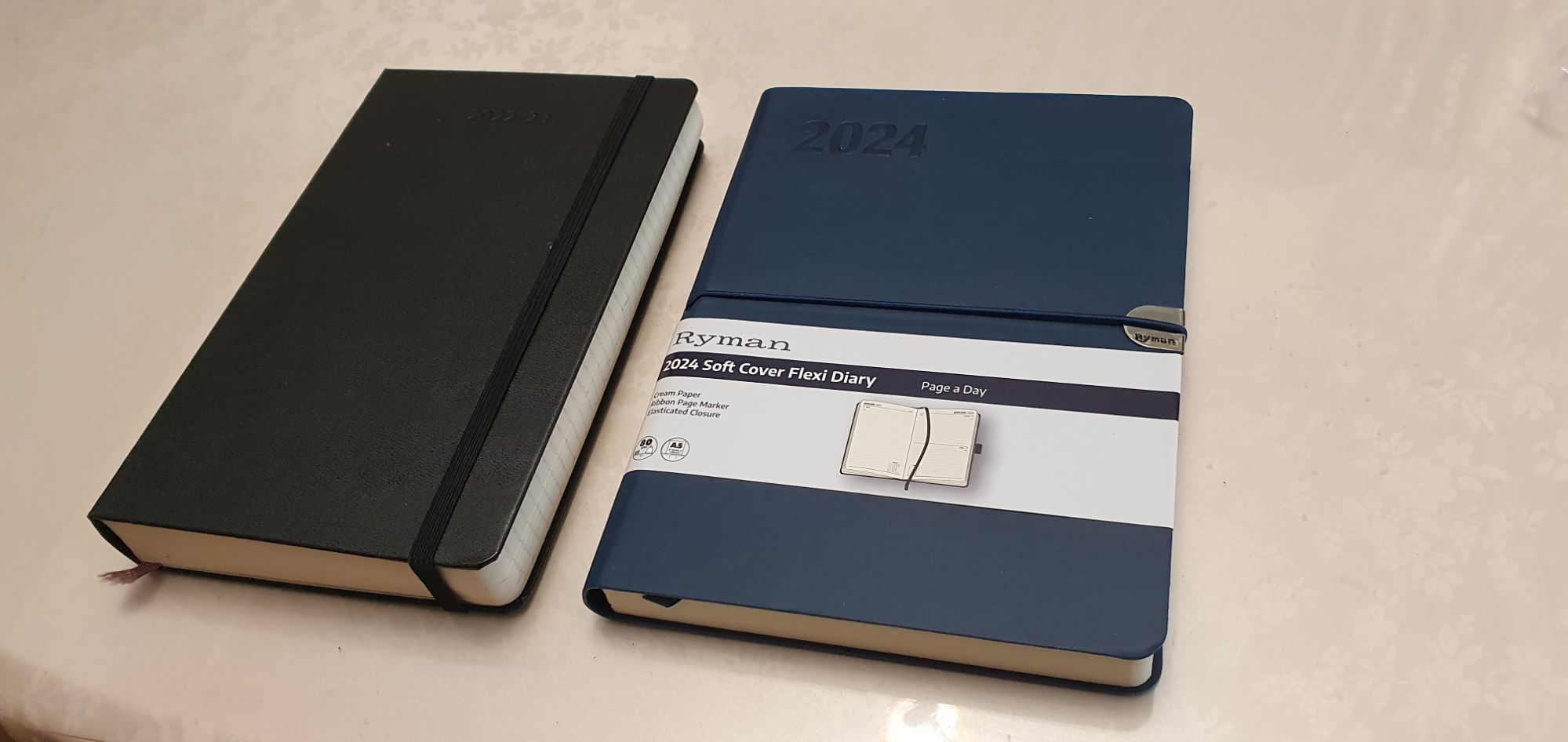
For 2024, I have gone back to my more usual Ryman A5 Page a Day diary. This does not suffer from either of my two complaints above: the row height is 7.6mm and the page width is the full A5, 148mm size. These two features make it more comfortable for me to use. However, it is not perfect. On removing the cellophane at the start of the year, my first discovery was that the covers were thin and bendy and not stiff as I had been used to. To be fair, the description on the belly band states “2024 Soft Cover Flexi Diary, Page a Day”. The word “Soft” refers to the texture which is like a faux leather, whilst “Flexi” means “bendy”, rather than “versatile“.

Whilst on the subject of the description, the words “Page a Day” apply only to Monday to Friday. Saturdays and Sundays have to share a page, which is always a pity. Rather than add the words “but only Half a Page a Day at Weekends!”, Ryman has instead chosen silently to include an image of a double-page spread with a Friday, Saturday and Sunday in view if you look closely.

New Ryman A5 diary for 2024, alongside last year’s Moleskine book.

Other than that, there is not much to add. The Ryman paper is a cream colour, 80gsm with a pleasant texture and fountain pen friendly. The binding is sewn to help the book open flat and there is an elastic closure. Given the rather insubstantial cover, there is a metal reinforcement at the edge, to prevent the elastic from wearing away at the cover. But (a) the metal is not stuck down on the front and so leaves a sharp edge, and (b) there is no metal reinforcement for the back cover. I would have preferred that there be a hardback cover so that reinforcement is not necessary.

This will be used for my daily journal, usually written up after breakfast, recalling the events of the previous day. This is an opportunity to enjoy a few minutes with a fountain pen, as well as a memory exercise.

It has also been a recent custom of mine to stick to one fountain pen and ink per month for my diary entries. For January I have started with the Parker 45 (14k gold, medium nib) with Waterman Serenity Blue that I wrote about rather gushingly in my previous post.

A Page a Day is for Mondays to Fridays only.

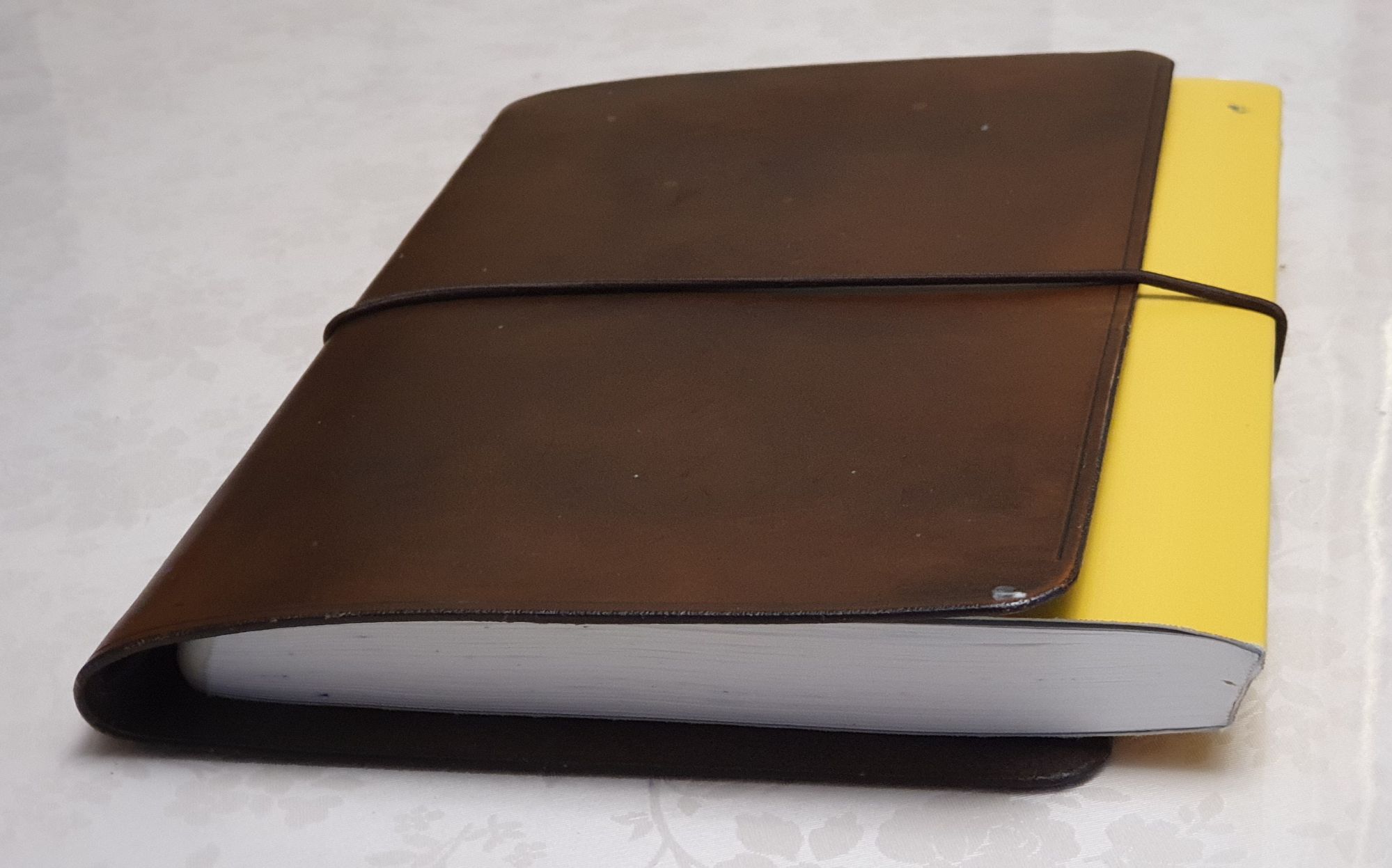
Aside from the diary, I write on most days, in a Stalogy 018 Editor’s Series 365 Days Notebook A5 size. I love the paper in these. I carry this to pen club meets and when out and about, in a stiff leather cover with elastic closure. The cover is a very simple single board, not quite A5 in width and is so stiff that it wants to slam closed all the time. I liked the fact that it did not have any pen loop, credit card pockets or other features, as I found that these make for a lumpy surface if you are writing with the book open inside the cover. However, in practice I found that the cover works much better for me, with my notebook tucked in the other way around, purely to protect it and keep it closed in transit.

My backwards “traveller notebook” set-up.

Writing with a nice fountain pen in a Stalogy notebook, is one of my favourite things to do. I use it for all sorts of things, although mostly for enjoying my pens and inks for the sheer fun of it and not for writing anything profound. This is an inexpensive form of relaxation and we all need one of those.

I do also have an A4 Ryman notebook which serves as a bullet journal, or bujo. This is a simple book of lined pages, 37 rows per page, on which I have listed dates for a month down each left-hand page, leaving the right-hand page clear for notes, often divided into two columns. This had enough pages for 2020 to 2025 inclusive, although after four years the cover is getting a bit tatty and flaky now. I find the bujo very useful for diarising dates that are far ahead, such as insurance renewals, road tax and car MOT and service due dates and a few others. Having six years at 24 pages per year, required 144 pages. As the book has 192 pages, this left plenty of double page spreads for lists, such as books read (or to be read), albums to listen to, TV episodes to watch, monthly steps counted and so forth. The possibilities are endless. I have not adorned it with washi tape or ink stamps like the photogenic ones we see on Instagram, but each to his own. I may however create a page for “Fountain pen wish list 2024”, although what I really need to do is to practice not wanting more things. As always, we shall see.

The new year diary, 2023.

I have been in the habit of keeping a diary since I was about 18. For about the last 10 years, I have used A5, page a day diaries and usually write my entry after breakfast the next day.

In recent years, I have bought these from Rymans stationers, which had 23 rows per page, with a row height of 7.9mm. These are still available for £13.99. My new year diary 2022 was reviewed here.

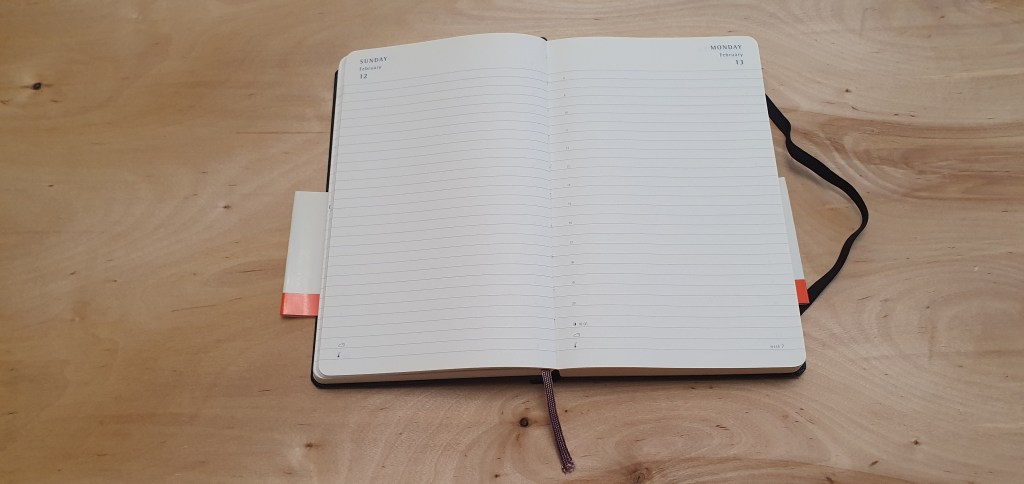
However, for 2023 I have tried something different. I am now using a Moleskine 2022-23 Daily Diary / Planner. Again this has a day per page and is ruled. A big difference is that it covers 18 months, from July 2022 to December 2023.

My Rymans page a day diary for 2022 and the Moleskine 18 months’ diary 2022-23.

This was an impulse buy, on visiting the Moleskine store in London’s Covent Garden, in early November. Admittedly, I was lured by the fact that it was reduced in a sale, from £24.99 to £17.50. I presume that this was due to the fact that it was November and over four of the 18 months covered by the diary had already passed. This did not worry me as I was quite happy to start the diary in January and to have the previous six months’ pages free to use like a notebook, as I wished.

I did have some reservations, first as to the paper quality. My experience of Moleskine A5 notebooks had been that the paper was generally not fountain-pen friendly, as most inks bled through the paper making the other side unusable. However, I thought that I might overcome this by finding an ink which would not bleed. My other concern was as to the line spacing. This Moleskine diary pages have 29 rows, with a row height of 6mm which is much narrower than my preferred spacing of around 8mm. On the other hand, you get more rows per page. Also, I often use balloon diagrams in my diary entries for work days, and so the row height is a bit less important.

Narrower pages and narrow line spacing (6mm) than I would like.

Ultimately, the reduced price, extra notebook pages, as well as the rather pleasing chunky proportions of the diary, sealed in its shrink wrap, made me overcome my reservations and I bought it.

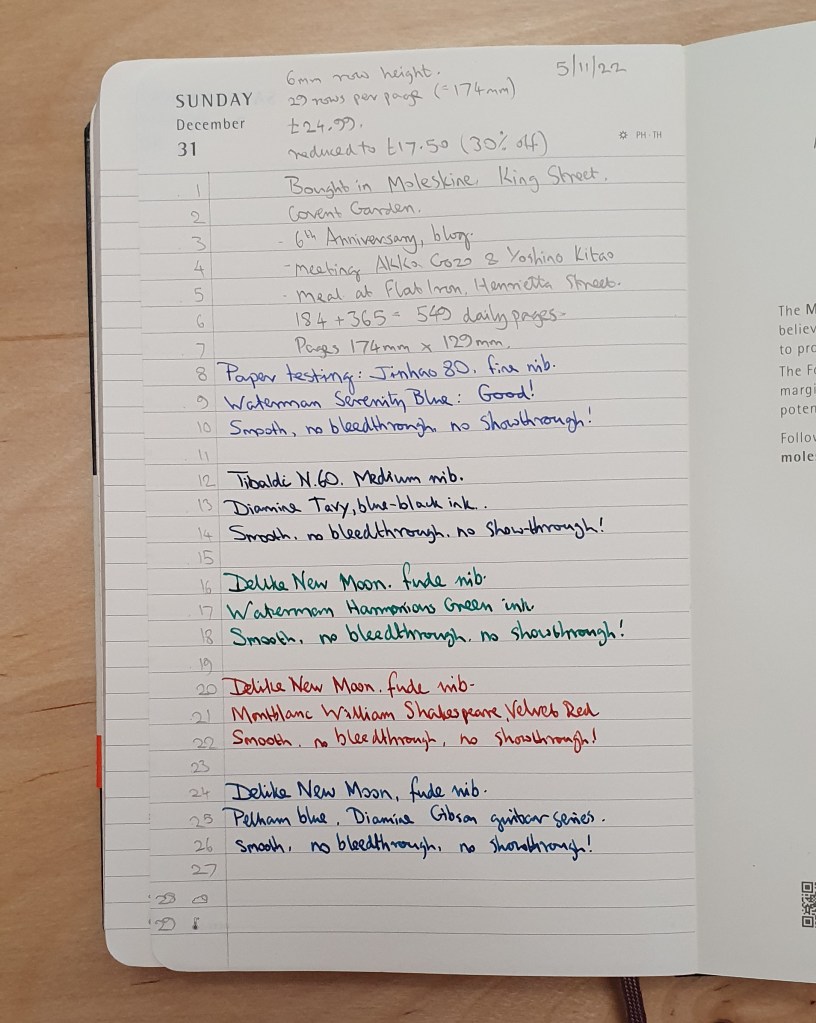
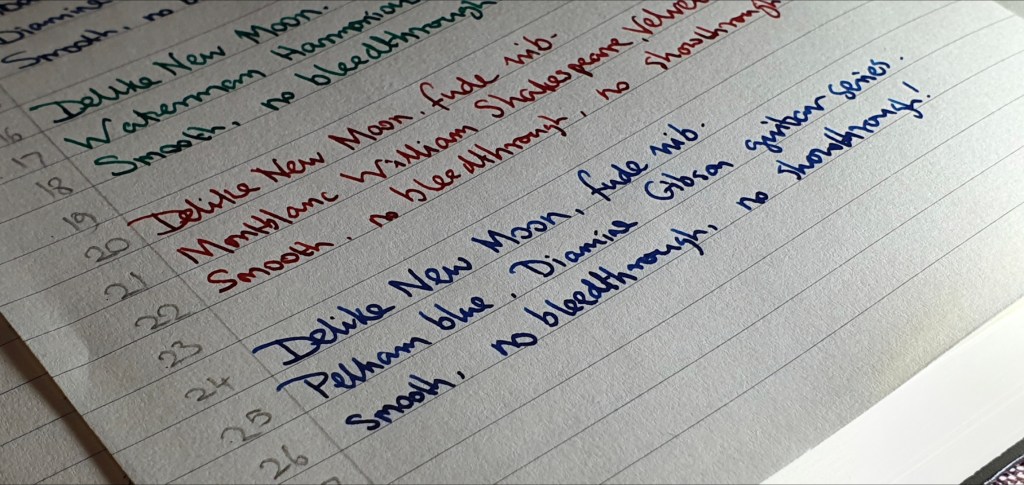
When I got it home and had the opportunity to test the paper, I was pleasantly surprised and relieved to find that the paper is not the same as I had seen in Moleskine A5 notebooks. The paper in the diary IS fountain pen friendly and very pleasant to write on! I tried writing a paragraph with five different inks (Waterman Serenity blue, Diamine Tavy, Waterman Harmonious green, Montblanc Velvet Red and Diamine Pelham blue. All performed beautifully on the silky smooth paper with no bleed through and very minimal show through.

Testing the paper for fountain pen friendliness. Success!

As for the line spacing, whilst I still prefer to have a bit more breathing space, I think I can manage with it. I noticed that the Moleskine diary page is quite a bit narrower than the Rymans diaries, (130mm instead of 145mm) but the shorter length actually helps make up for the narrower row height. (I sometimes rule a page into two columns, in notebooks with narrow line spacing).

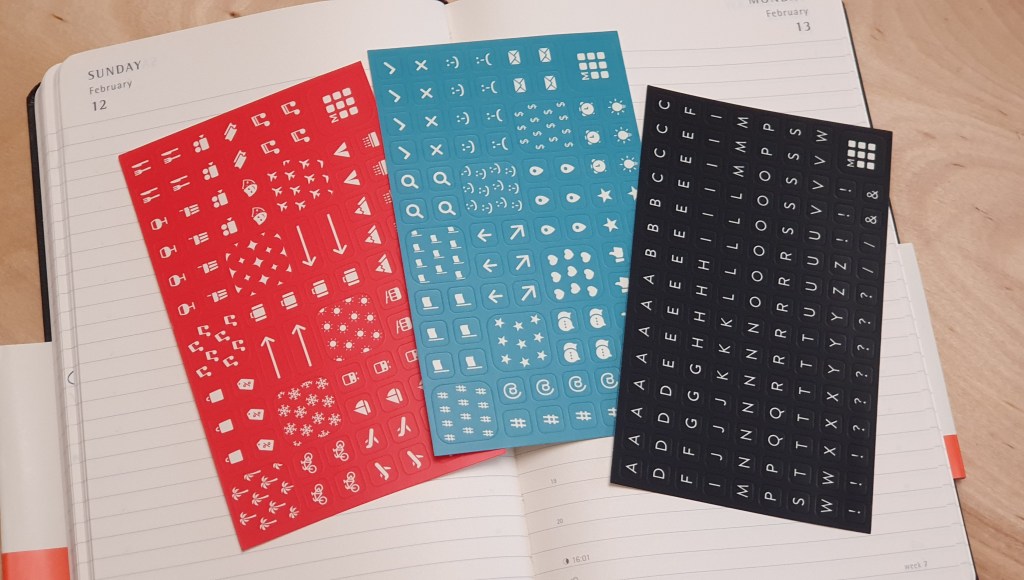
Three sheets of stickers included.

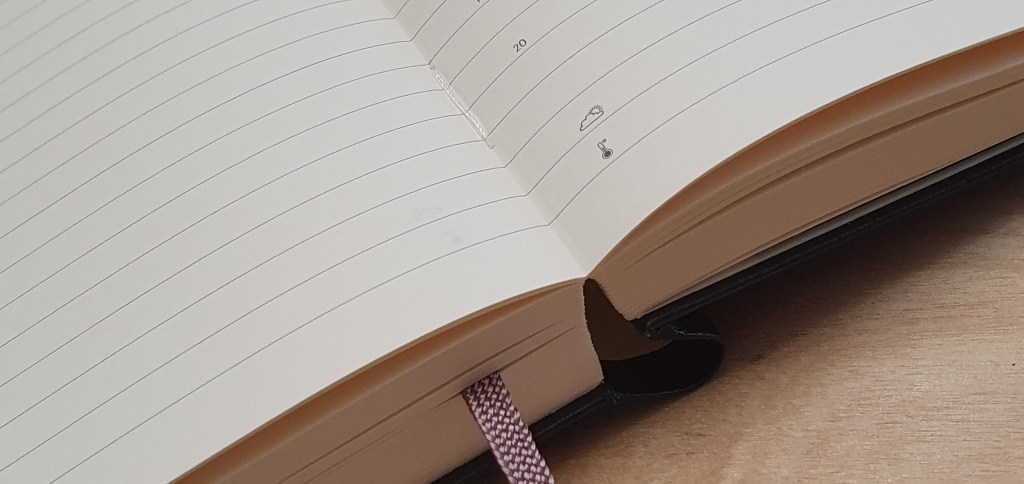
Other features of the Moleskine diary include neatly sewn binding and so the book lays open flat, without risk of pages falling out. There is a ribbon bookmark, an expanding pocket in the back cover, an elastic closer, and three sheets of sticker symbols which can be used in the diary, or elsewhere. There are plenty of information pages at the beginning, with yearly calendars and monthly planning pages, world time zones, national holidays and dialing codes.

Nice stitched binding.

So, off we go again for another year. Already 2023 looks set to be marked by the awful continuing war in Ukraine, industrial action for pay disputes and the current fall-out of Prince Harry’s tell-all biography, plus challenging times for household finances. We all live in hope for better days ahead.

Crucially, the paper in the Moleskine 18 months’ diary is very fountain pen friendly.

Early thoughts on the Flying Tiger traveller notebook.

On a recent visit to London’s Canary Wharf, I found a branch of Flying Tiger Copenhagen, and popped in for a browse.

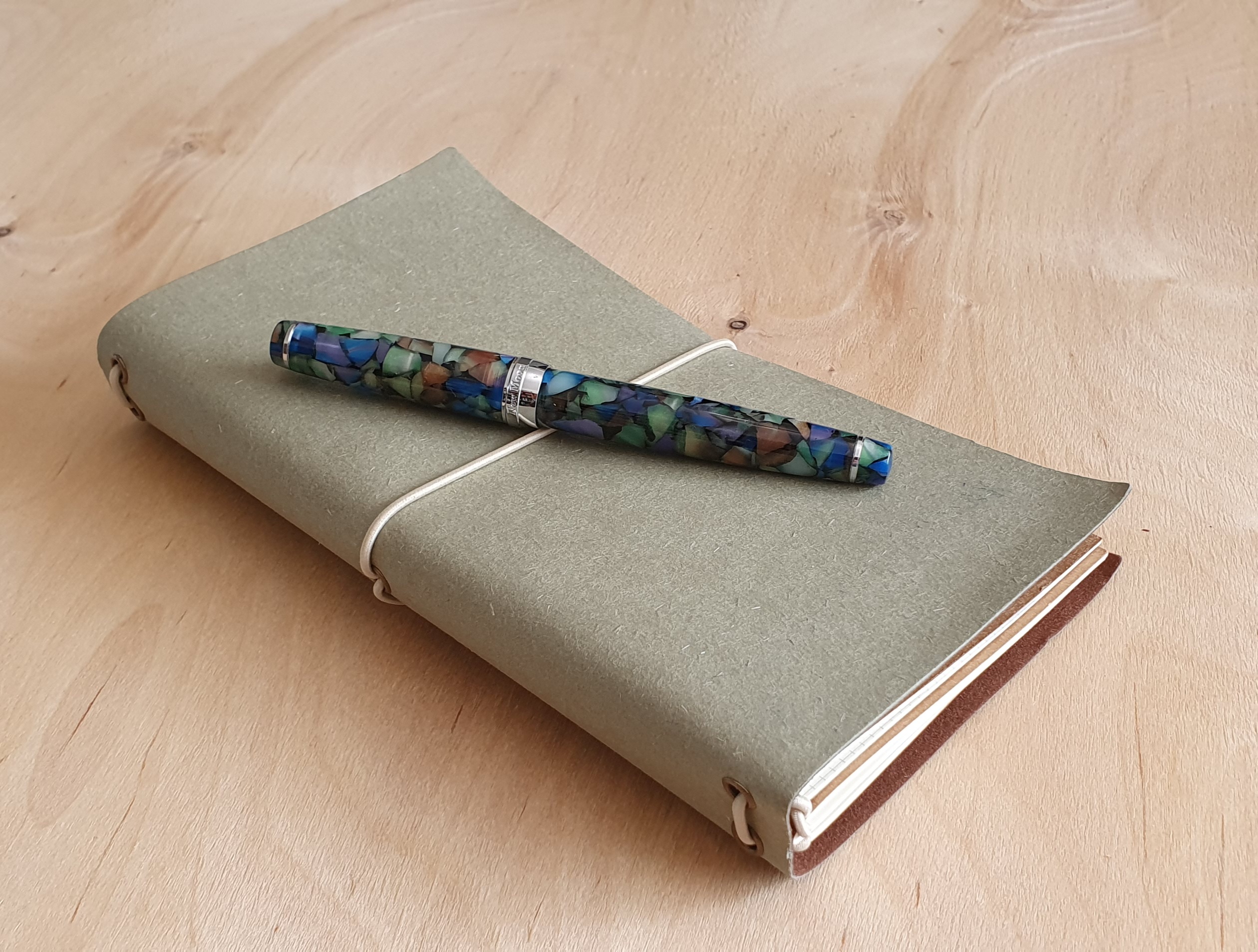
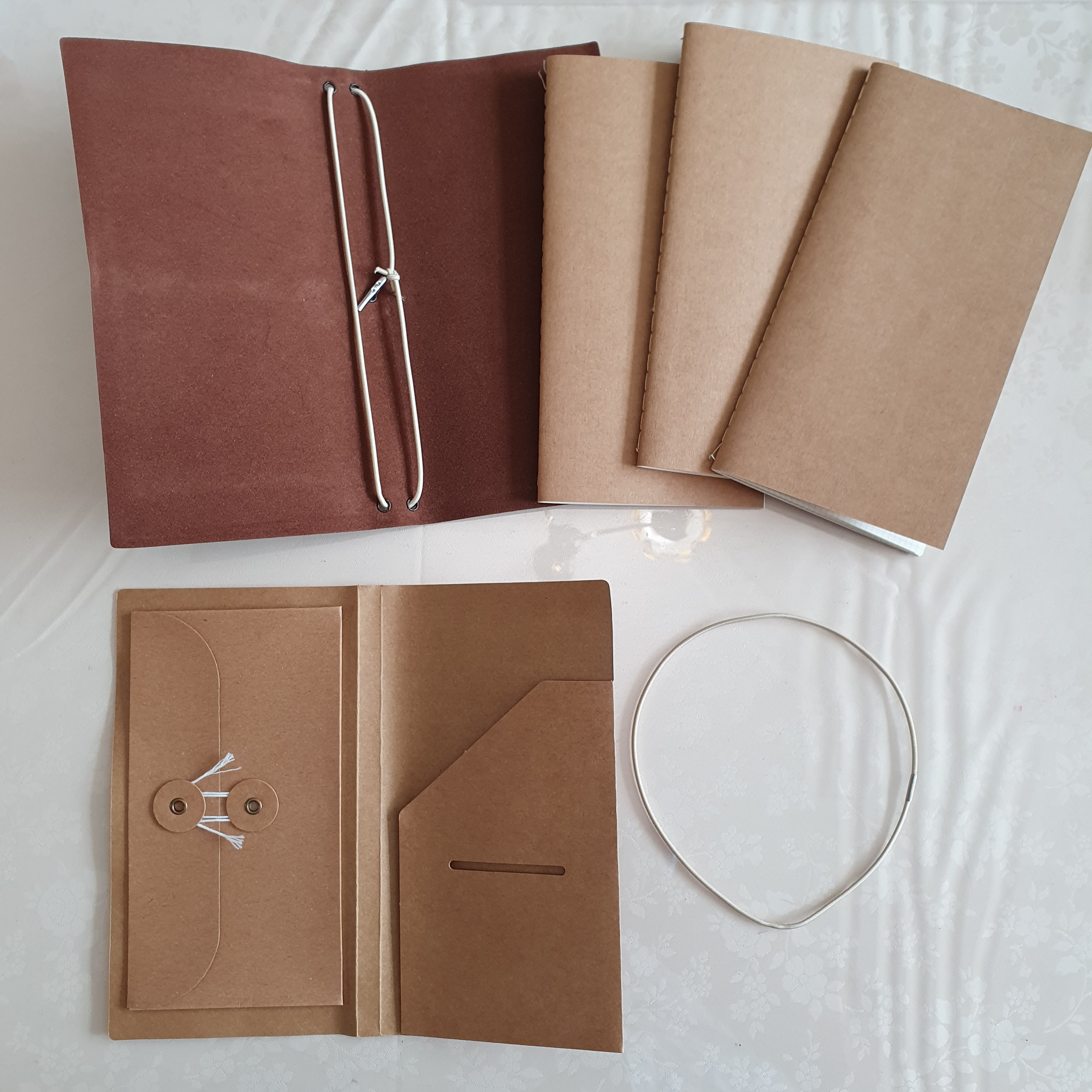
Right near the entrance, I spotted an olive colour, traveller-style notebook cover with elasticated loop, containing three notebooks, each with different paper. It was simply labelled Notebook, or Notesbog in Danish. The cover was not leather, but felt like a soft, fibrous cardstock with a brown faux-suede backing. Inside this, a removable brown card (which slips in behind the notebooks, between the books and the outer cover) provides an expandable wallet with cotton fastening on one side and another little pouch, to keep tickets or receipts or such like on the other side. As the ticket pouch needs to be the right way up, this has to be at the back, whilst the expandable wallet will be at the front of your notebooks. However if you do not need these, or prefer not to feel the uneven lumps and bumps below the paper when writing, you can slide it out.

Traveller-style notebook from Flying Tiger. Delike New Moon fountain pen for scale.

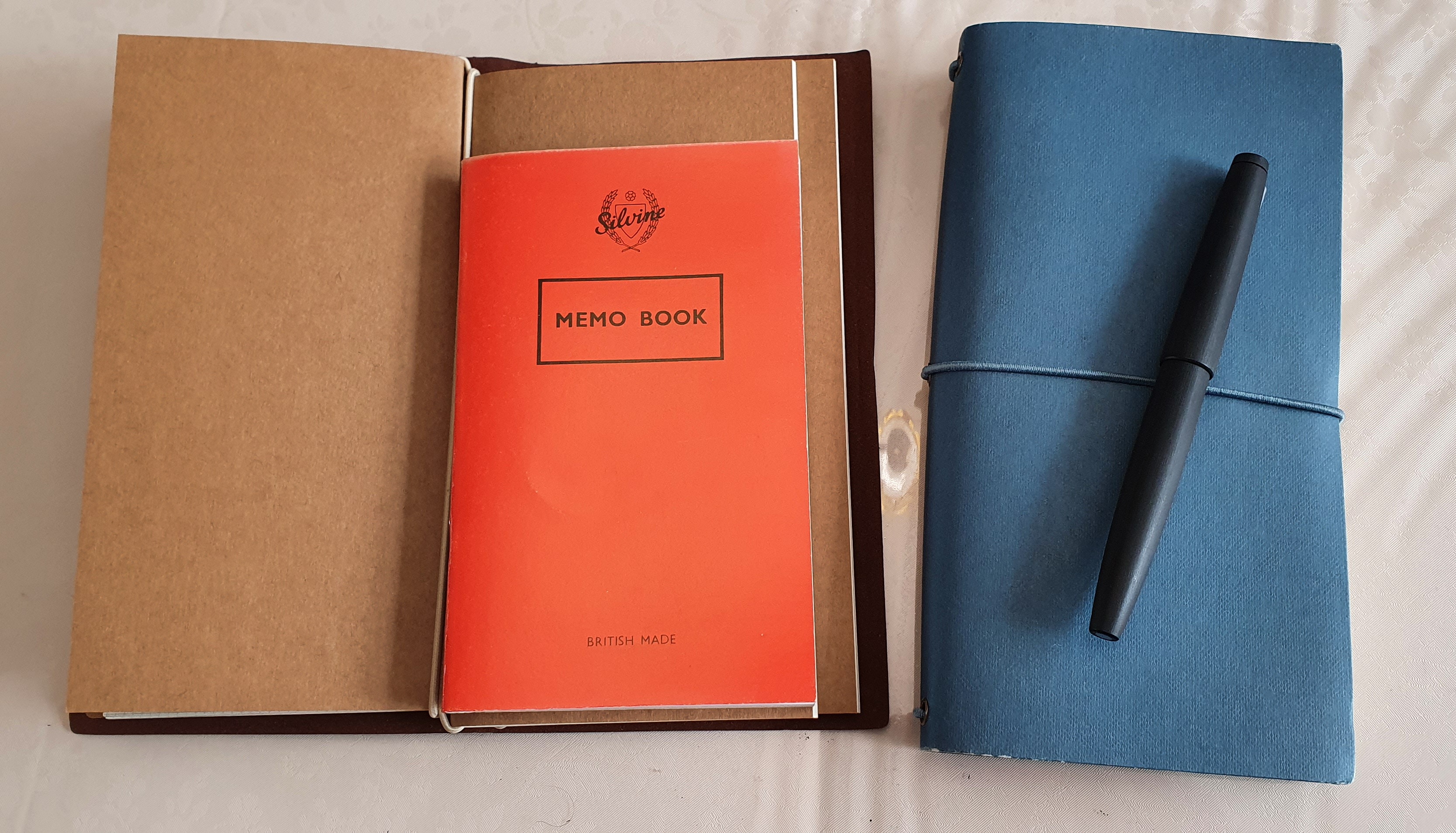
I was very taken with this, especially the olive colour. The notebooks looked tall and slim, rather taller than the red Silvine memo book that I usually carry when out and about, but the same page width. The paper in the first notebook was squared, the second book had lined pages and the third had dot grid. The paper felt reasonably thick and good quality. The notebooks were each stitched, rather than stapled and with plain brown card covers. Each book was held in place with an elasticated loop.

Size comparison with my usual carry, a Silvine pocket notebook.

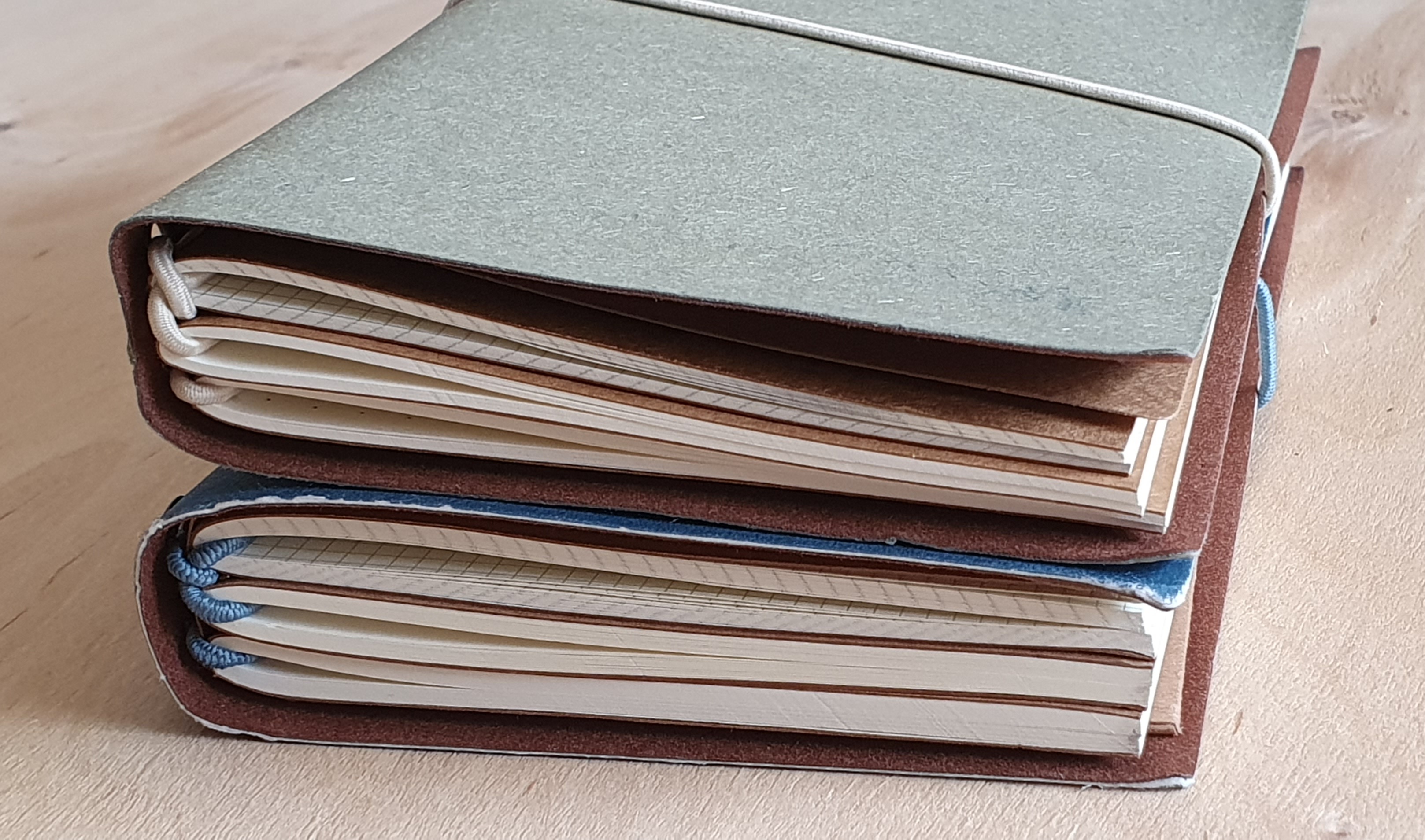
The cover includes two elasticated loops inside the spine. You could slide one notebook under each loop if you just wished to carry two. However there are three notebooks in total, the first two attached to each other by a separate elasticated loop and then slid under the first of the two loops attached to the cover.

Three slim notebooks inside.

Having picked up one to buy, I made my way toward the cash tills, following the one-way route around all the aisles so that you get to pass every item in the shop. I soon found another display of these notebooks, but this time the covers were available in blue-grey, (which I will call blue) or dark green. This threw me slightly, and to confuse matters further, these blue or green versions were fatter and heavier. On closer inspection, I noticed that whilst the covers were all of the same size, there were more pages in the blue and the green cover notebooks, than in the olive one that I had seen first. Yet they were the same price, still only £4.00. Was the olive one over-priced, or were the blue and the green ones underpriced? I decided to hedge my bets and buy one of each size.
I’ll take these two please.

Specifications:

Olive green version:

  • 1 x outer cover, olive green with one elasticated loop closure and two loops in the spine
  • 1 x cardboard insert, with expandable pouch and a slot for tickets;
  • 1 x notebook with squared paper, 48 pages, squares are 2.7mm, or 10 squares = 2.7cm;
  • 1 x notebook with lined paper, 48 pages, 20 rows per page, 8.2mm row height;
  • 1 x notebook with dot-grid paper, 48 pages, 5mm squares;
  • The notebook size is 19.5cm x 9.5cm. The paper is 80 gsm.
  • Total 72 leaves, or 144 pages. Total weight: approximately 177 grams.

Blue version:

  • 1 x outer cover, blue, with one elasticated loop closure and two loops in the spine
  • 1 x cardboard insert, with expandable pouch and a slot for tickets;
  • 1 x notebook with squared paper, 64 pages, squares are 2.7mm, or 10 squares = 2.7cm;
  • 1 x notebook with lined paper, 64 pages, 20 rows per page, 8.2mm row height;
  • 1 x notebook with dot-grid paper, 64 pages, 5mm squares;
  • The notebook size is 19.5cm x 9.5cm. The paper is 80 gsm.

Total 96 leaves, or 192 pages. Total weight: approximately 258 grams.

Traveller notebook. Lined pages are 8.2mm row height.

Finally, the difference in weight of these two options is not entirely due to the extra number of pages: the cover of the blue version feels slightly thicker and stiffer than on the olive one. This led me to disassemble both sets to weigh the component parts individually. Even I felt a bit nerdy doing this. But sure enough, the olive cover weighed approximately 26.5 grams, whilst the blue cover weighed around 30.5 grams.

The component parts. All for a very reasonable £4.00.

So in summary, you have a choice, one with a total of 144 pages, and one with 192 pages and a stiffer cover.

The paper is pleasant to use and is fountain pen friendly. The set will be great to chuck in my green canvas shoulder bag. It remains to be seen how each cover will fare over time, after being carried about. The elastic loop may in time bite into the covers – more likely with the thinner cover of the olive version. You get more for your money with the blue version, whilst the olive version is thinner and lighter to carry. Of course, you can mix and match the contents or replace them as you wish. But both seemed good value to me. Buying one of each in order to reap the average value seemed the right choice.

I’ve got the notebook. Now I just need the travel.

Travelling with ink: Blackwood Forest

One of the things I hope for when travelling, is a desk by a window, with natural light and preferably a nice view. Perhaps this desire comes from spending my working days in an office with no natural light.

Having come through a particularly busy few months at work, I was looking forward to a long weekend break in a forest cabin. Set in the heart of Blackwood Forest, Hampshire I am not sure if this still counts as part of the New Forest, but I am on holiday so who cares?

Picking some fountain pens for the trip is one of the pleasures. However this time I found myself a bit torn between (a) the usual urge to bring a selection of pens to enjoy, with different nibs, different inks, different sizes, weights and materials or (b) to go minimal, travel light and just pick one pen, perhaps even one that I did not like very much, to get more use from it. In the event, the usual option of bringing a selection was the winning one.

The final eight.

This was my first experience of a forest cabin holiday and I had not expected our cabin to have such a “Wow” factor on arrival. Imagine my delight on finding it to have such a spacious living room/ kitchen/ dining room with an entire wall of windows, looking onto the beech tree forest, beyond the decking (with table and chairs, and even our own outdoor hot tub).

Our forest cabin

I am a morning person and enjoy my writing most in the morning when my brain is fresh and rested. That tends to be the time I find best for journaling, usually off-loading the events of the previous day. One of the ironies of journaling is that when life is at its most busy and eventful you have the least time and energy to write about it, but if you are freed from the pressure to get through endless to-do lists of tasks, you have plenty of time to write about very little. I then like to refer to my lists of writing prompts, neatly and alphabetically saved on a notepad app on my phone called Colornote – often comprising a few words or phrases which I can come back to and write up when I feel like it.

Our cabin in the woods.

I set my alarm early, hoping for some time when the household (that is my wife and mother in law who was holidaying with us) had not yet risen and I could sit at my window and pour out thousands of words like an imagined Ernest Hemingway, the creative juices running at full throttle. Obviously that did not happen. But I did enjoy some light tinkering with the pens, reminding myself which ones I had brought along, which inks they had and then having just enough time to summarise each day in a few brief headings. Sitting out at the table on the decking, enjoying the tranquility was restful and restorative.

A short drive from our base, was the city of Winchester, which we visited for a sunny afternoon’s excursion. My wife spotted a stall at the outdoor market with leather goods including some lovely notebook covers, for A5 or A4 notebooks. I use both sizes but have been looking unsuccessfully for about five years for a nice leather A5 size cover, after passing up a chance to buy one once in the Cotswolds. I did once buy a cover which did not work for me as it featured a pen loop which got in my way and had bulky and unnecessary credit card slots which meant that pages would not lay flat. In short it was unusable and was returned.

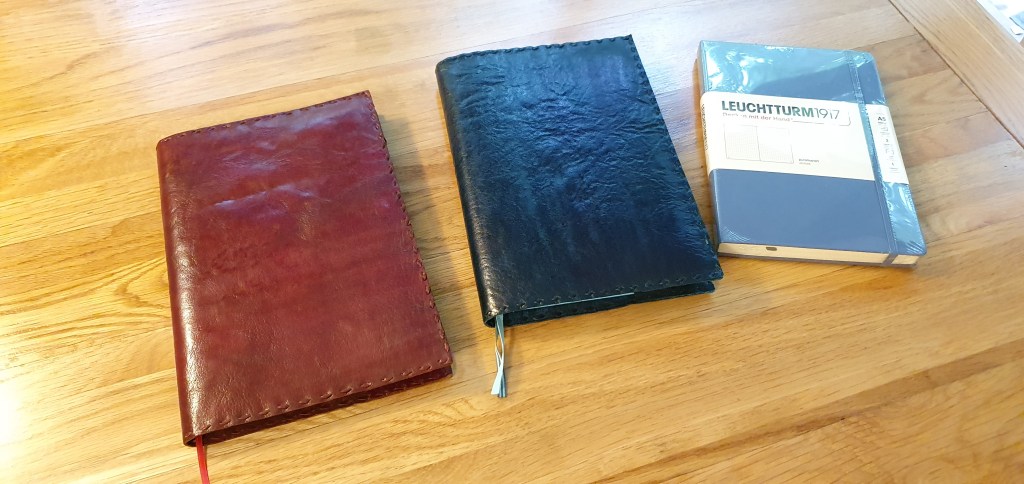
In contrast these market ones from “redleathers”, an ethically sound business run by Kirk Newton, (@redleathershandmade) were attractive, simple and functional. Unable to narrow down my choice between a dark green and a cherry colour, I opted for both.

Oooh! New leather notebook covers.

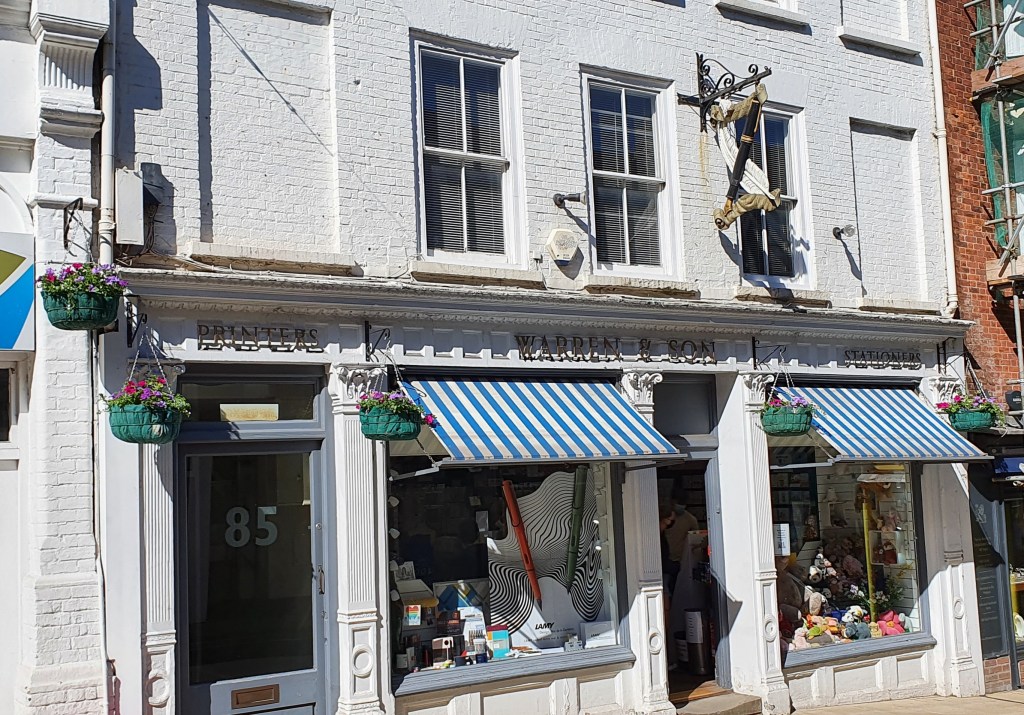
Another pleasure for the stationery enthusiast in Winchester, is Warren & Co, a stationery shop at 85 High Street, selling a good selection of stationery and pens mostly from Lamy and Cross, plus inks from Parker, Waterman, Cross, Pelikan and J Herbin. The display of Lamy pens was comprehensive, with racks of Safari and Al-Stars, Vistas, Nexx and then glass cabinets of Studios, 2000s, CP1s and even a few Imporiums. I toyed with the idea of buying the Aion again as the dark green edition looked so appealing, with either M, F or EFnibs, but I had found the black one too slippery to grip and gave mine away. I resisted and told myself that I had been down that road before. As it was almost time for the shop to close for the day, I left without buying anything this time but it is a wonderful shop to visit and was a real joy to see so many pens in the flesh rather than just online for a change and to chat with the charming proprietor.

Warren & Co of Winchester.

Back in the secluded forest, it was fun to put notebooks in the new leather covers. The Leuchtturm 1917 A5 books fit in very well and I shall enjoy using them.

We enjoyed a very restful weekend stay – with good food and walks and let the forest work its magic in sending us home rested and refreshed.

With my trusty Nikon Prostaff 10×30 bino’s.

And as for that desk by the window, the truth is that I did not sit there writing all that much. Sometimes it is nicer just to lift up your eyes to what is around you. Perhaps it is one of those things where the anticipation is better than the reality. There will be time to reflect and to write when the holiday is over.

Inky Pursuits: some notebook tales.

I have always enjoyed getting a new notebook. I start on the back page with a range of pens to test the paper, primarily for bleed through. I also like to paginate my notebooks, if they are not paginated already.

Lately I have also taken to paginating new pads of A4 paper. I use this all day for work notes and sometimes find when gathering up a pile of loose sheets, it helps me assemble them back in order. It is also handy for seeing how many pages you have used and therefore, how many remain – a bit like an ink window on a pen.

My notebooks fall into two broad categories: those that are expendable, filled up with pen and ink sampling, handwriting practice and writing for its own sake, and those that I want to keep, filled with more purposeful writing such as collected memories or other writing projects.

Finding your palette.

The logical consequence of testing a new notebook for which inks it likes, is to arrive at a list of those which can be used without bleed through or excessive show through or feathering and those which cannot. This is useful, particularly if you buy the same type of notebook regularly or if you have bought a few spares to keep “in stock”.

Taking this a step further, I thought it may be useful to arrive, for a given notebook, at a core palette of say four colours – a blue, red, green and brown, which not only behave well individually on the paper but also look good together, and compliment each other, as if part of the same range. For example, for a Radley A5 notebook that I bought last February, I made at the back, a list of inks that could be used and a list of those which could not. For my core four, I have almost got this down to (1) Rohrer & Klingner Salix; (2) Montblanc William Shakespeare Velvet Red; (3) Graf von Faber-Castell Moss Green: and (4) Pelikan Edelstein Smoky Quartz.

This is not quite as simple as it sounds. I found that I had entered Smoky Quartz in both the “can use” and “cannot use” columns. This might suggest that the paper is not consistent throughout the notebook but more likely, is because the paper’s ability to resist bleed through with a given ink, depends also upon how wet the pen writes.

I had hoped to be able to use Conway Stewart Tavy, my go-to blue black in the Radley notebooks but this ink bleeds through on some papers – Radley included. Honing my palette is a work in progress and constantly evolving. But since I picked up three spares of the Radley red notebook whilst they were in a sale, it is worth pursuing – before I fill them all!

The notebook stash.

Buying more notebooks than you immediately need, might sound a bit crazy. I seem to have accumulated a whole drawer full of mainly A5 size journals. When you find one you like, it is best not to buy too many spares in case you later find one you prefer.

However, with the UK now in lockdown again, with non-essential shops closed, I am now unable to roam through Rymans or Paperchase for supplies. Suddenly my drawers of journals and inks are not so crazy after all. Although I still have far too many to sit out any conceivable period of lockdown, to be fair.

The telephone table diary.

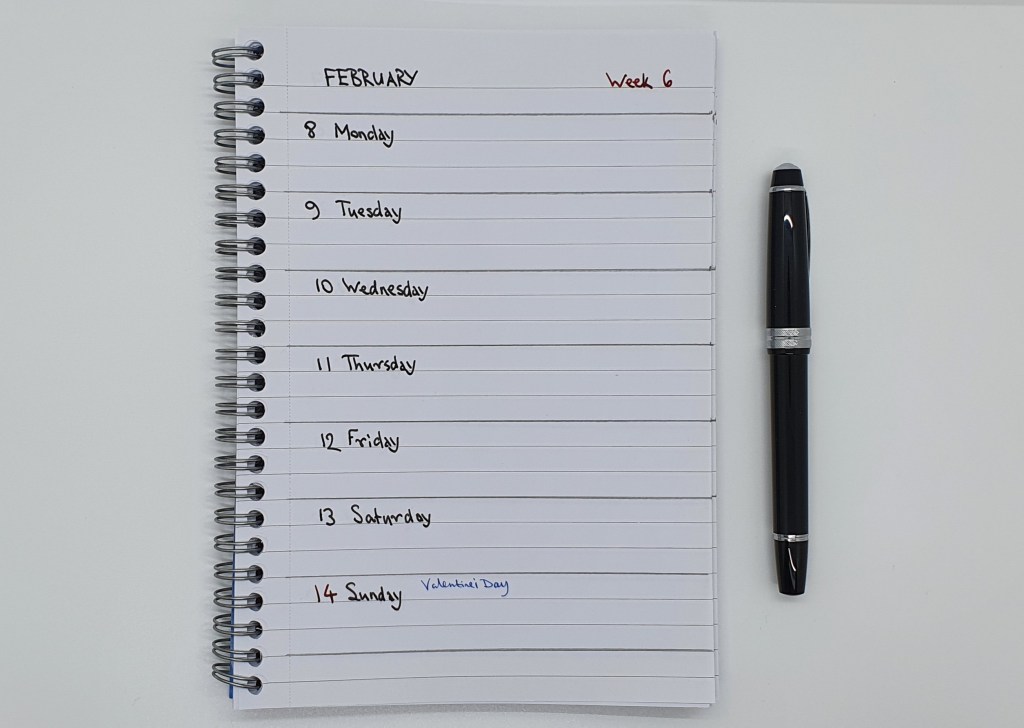
One thing that I had not bought before lockdown, was a 2021 diary to keep next to the home telephone. For the past few years, I have used a Letts Royal tablet diary from Rymans, with a week to a page, spiral bound A5 size and with the spiral at the top. Instead, for this year, I made my own from one of the spiral side-bound notebooks in my stash. I ruled pencil lines at three row intervals and then spent a merry few hours writing Monday to Sunday on each page and inserting the dates. I broke this up over two evenings as the process was a bit monotonous to be honest but it was satisfying to reach Week 52 eventually and put away my Cross Bailey Light, with its black ink cartridge. The Letts diary cost £8.49. My notebook was £2.00. A saving of £6.49 if you do not factor in my time.

Voilà! The new home-made diary. Somewhat crude but it works.

The daily diary.

Writing my page-a-day diary is a routine which I honestly could not be without, such is the satisfaction of recalling the previous day and condensing it into note form. For working days, I now find that balloon diagrams work best. It is very easy to stress oneself with “to do” lists for work but healthy to pause sometimes and reflect on what daily progress was achieved… a sort of “done” list.

There was a time when I would settle upon a fountain pen and use it for my diary for the entire year. My current plan is to change over at the start of each new month. For January I used my lovely new Cross Peerless 125, with Tavy ink. For February I am using my Aurora 88, with Aurora blue. I am very fortunate to have gathered a collection of fountain pens, of which so many are wonderfully enjoyable.

The new year diary, 2021.

One of life’s great pleasures is writing with a fountain pen. My lifelong habit of journaling, or keeping a diary, is another and to combine these two makes for a great start to a day. Just having ten minutes, to collect my thoughts and reflect on the previous day and then record it in ink and “offload” this into my archive, is something I cannot do without.

I have been keeping a personal diary in one form or another since 1976. The size has varied over the years from chunky A6 page-a-day books in the seventies and eighties (in which I used “reverse writing” with my Sheaffer No Nonsense pens to get extra fine lines), to A4 volumes, 5 year diaries, and even tried typing for a few years. In recent years I have settled on A5 as being the format that works best for me. For some days, I write in longhand and for others, typically work days, I prefer to do a balloon diagram with bullet point notes, of what progress was made on my various ongoing tasks.

This year, I have enjoyed using an A5, page-a-day diary from Rymans. It has what they call a “Soft Cover” but is a stiff cover but finished in a soft texture material that feels like leather. The cream coloured pages give you 23 rows with a row height of 7.9mm which is reasonably wide and I find this ideal. Currently, I use my Diplomat Excellence A Plus, with a Fine steel nib and Pilot Iroshizuku Shinkai, blue-black ink. It is one of those combinations that is a marriage made in Heaven and which you never want to end.

Last week, while browsing in Paperchase, I spotted an A5, page-a-day diary in an attractive viridian patterned, textured soft-back cover . On a quick flick through, I noticed that the line spacing was wide (actually 7.5mm), that it was neatly bound with stitching and opened flat. It was also in a sale with 30% off and I decided to buy it.

Paperchase A5 Day to a Page diary. £7.50 in a sale, With a Sailor 1911 Standard for scale (not included in the price).

Only when I got home did I notice that the “page-a-day” description was a bit misleading for the weekends , as Saturday and Sunday had to share a page. At least this meant that you could always find your weekends on the right-hand page of a spread, but I was disappointed. My wife helpfully suggested that I “just don’t do as much” at the weekends to have less to write about but I was not convinced.

Paperchase diary: in fact Half a Page a Day when you get to the weekend.

Today, in a Goretex jacket for the rain, I trudged out to Golders Green High Road to visit Rymans to see if they had any diaries. I found the diary section and looked at a Ryman hard back, A5 page-a-day diary at £7.50 but the line spacing was clearly narrow, unlike my 2020 version so I dismissed it.

But then I noticed nearby, the Ryman Soft Cover Diary, also a page-a-day but a little more expensive at £10.99. I found a beautiful forest green one but could not inspect the line spacing or the weekend arrangements as it was sealed in cellophane. Other colour options were an equally lovely dark red or yellow ochre, which would have been great with my Diamine Cherry Sunburst ink, or perhaps a KWZ Honey or Diamine Honey Burst.

Since these were all sealed, I could not inspect any of them for row height or to check that Saturdays and Sundays were still afforded a page each as in my 2020 diary. Call me reckless, but I took a gamble and bought it anyway. I went for the green. The sales assistant favoured the yellow ochre version but when I said that I preferred the dark green he said “Like your jacket!” to which I had to admit that my colour choices were rather predictable.

Ryman, Soft Cover Diary, Page a Day.

Back home, I sliced off the cellophane for the moment of truth. Would there be wide line spacing and would there be whole pages for Saturdays and Sundays? Yes, to both! I can look forward to another year of journaling with my lovely Diplomat. It has a pleasant, fountain pen friendly paper. Other features are a ribbon book mark, an expandable pocket inside the back cover, and elastic pen loop (which I do not use) and an elastic closure – which is useful.

The Ryman diary, with a full day each for your Saturdays and Sundays. Happiness restored.

Today I have just seen the sad news that Sir Sean Connery has died, at the age of 90. How I loved all those early Bond films, and going to the local cinema with my late father. “Do you expect me to talk?” “No Mr Bond, I expect you to die!” So that is a piece of news for today’s entry in my diary. RIP.

This has been an unique year, “unprecedented” in our lifetimes as many have said and we still have two months to go. My year 2020 and lockdown activities are well recorded. Flicking through the blank pages of my next year’s diary it is hard to imagine what I might be doing in the months to come. Let’s all hope for better times ahead.