Converting a Platinum Preppy to eyedropper.

20170414_145541

If you had asked me about this a few years ago, I would not have known what you were talking about. It is one of those things that I picked up from the internet. Sensing that it seemed to be one of the rites of passage of fountain pen enthusiasts, I gave it a try today for the first time.

For the benefit of other newbies, we are talking about taking a fountain pen that is a typical cartridge/converter type filler and instead removing the cartridge or converter and filling the barrel directly with ink. The benefit, supposedly, is that you have a greatly increased ink capacity and do not need to fill the pen as often.

In order for a pen to be suitable, it needs to have a plastic barrel and plastic threads and for there to be no metal parts which might otherwise corrode from sustained contact with ink. Also the barrel must have no hole at the end, for obvious reasons.

The Platinum Preppy meets all these criteria and is a good choice. It is a very inexpensive pen, (mine was £2.79 from Cult Pens) but with a good nib available in a range of widths. The clear demonstrator barrels also mean that you can enjoy the sight of your ink sloshing around inside.

On the other hand, arguments against filling the barrel with ink are that there is a risk of greater mess if anything goes wrong. Perhaps if you were going travelling and did not want to take a bottle of ink, then having an eyedroppered Preppy would keep you writing for a good while but travelling with such a pen would be a worry. So you might want to keep your eyedropper for use at home or at work. But then given that you are likely to have a ready supply of ink on hand at home and work, it seems that there is not much of a case for an eyedroppered pen either for travelling or for home/work use. Maybe it would suit students who write large amounts of lecture notes every day, provided the pen is carried with care.

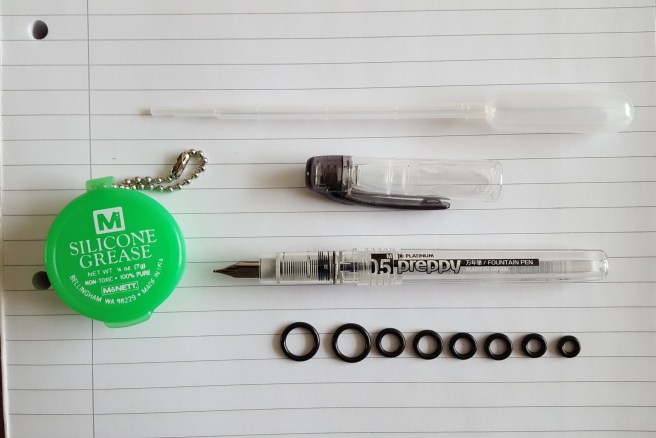
For the benefit of anyone who wants to try it, there are just a few items that you will need, as well as a suitable pen and some bottled ink, as follows:

  1. Pure silicone grease, to put in the threads.
  2. An O ring, to prevent leakage.
  3. A pipette, or syringe to transfer ink from a bottle to the barrel of your pen.

Gathering all of these items takes a little bit of hunting. I had heard that Silicone grease could be purchased from dive shops and as luck would have it, we have a dive shop in my corner of London.  The O rings can be bought in packs from the plumbing section of DIY stores. And the pipette I spotted in an art supply shop in a pack of ten.

The operation is very simple. You take an O ring,  stretch it over the threads and roll it down until it is seated at the end. I tried one of the large ones to start with, but then found that the smaller one will stretch over the threads making the rubber slightly narrower so I went with that size instead. You then take just a small amount of the pure silicone grease on your finger and smear it into the threads. Then, using the pipette, draw up some of your chosen ink and release it into the barrel.

According to an instruction video from Brian Goulet that I have just re-watched,  it is recommended that you keep the pen at least half full of ink. Also, I read on an information sheet that came with a Noodler’s Ahab pen (another good candidate for eyedropper conversion) that air in the chamber may expand from the heat of your hand and that refilling is required when the pen is down to two thirds air, in order to inhibit excessive flow.
20170414_150249

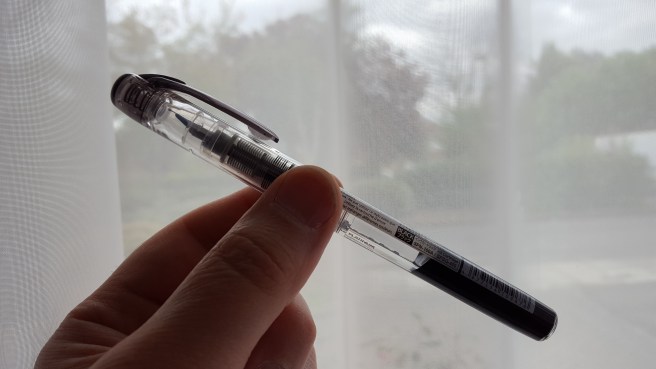
I have a Preppy with a medium (0.5) nib which writes very nicely. I had been using it recently with Sailor Kiwa-guro, permanent black ink in a cartridge which I filled with a syringe. I now planned to use this ink in the pen as an eyedropper.

On my first attempt this afternoon I had a few little issues. First I nearly forgot that the Preppy has a push on cap and I automatically started to “unscrew” the cap a few turns before realising that I was undoing the barrel and was perilously close to pouring permanent black ink all over myself. Secondly I then noticed that despite my generous application of silicone grease, ink had still worked its way part of the way down the clear plastic threads. Thirdly, the O ring was still rather too fat and so it protruded just where I grip the pen, although it did a good job of ensuring the barrel was secured pretty well. You do not want to overtighten the barrel as there would then be a risk of cracking the pen. Fourthly when I tried writing with the pen, I had a few wet blobs of ink suddenly appear on the paper.

I wondered whether this might possibly be due to a build up of air pressure as you screw the barrel onto the section, but then read the Noodlers’ advice about keeping the ink level up. I had filled the pen only half way up the barrel but went back and topped it up with some more ink until it was about three quarters full and I hope that this solves the problem.

It is rather too early to see how this is going to work out. I am very impressed with the Sailor Kiwa-guro ink and like to keep one pen inked with this, as it so useful for writing cheques or addressing envelopes. I know it is said to be fountain pen friendly, but I still feel a bit wary of having it in more than one pen at a time with the risk that it might get left to dry in the feed. I had washed it out of my Lamy AL-star and decided to use it in the Preppy instead. I like the way it moves around in the Preppy, without leaving much trace on the barrel. And unlike cartridge ink, the eyedropper method means that you do not get ink staying at the wrong end of a cartridge and causing ink starvation.

I am not sure yet whether I am going to keep the Preppy eyedroppered or go back to using cartridges. But at least it is another milestone in the fountain pen journey, to mark off the list.
Inky pursuits: my weekend round-up (2)

This weekend has seen some more inky goings-on which, taken on their own, might not be blog-worthy but together seem worth sharing in a round-up.

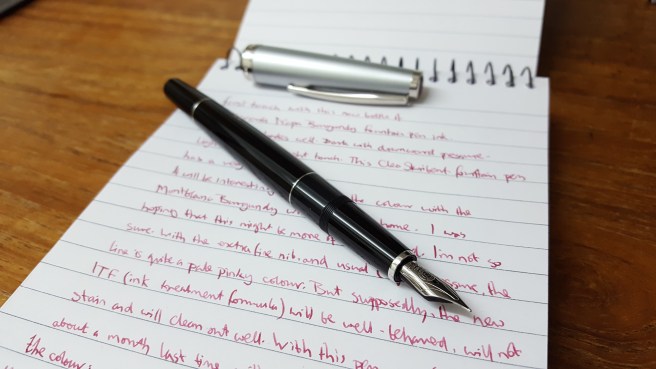
I am still delighted with the Cleo Skribent, piston filler fountain pen, four weeks in. I can genuinely say that I feel happy every time I remember it. The first fill, with Aurora Blue was still not quite finished when I ordered a bottle of Monteverde Napa Burgundy and decided to flush the remains of the blue, to have an ink change.

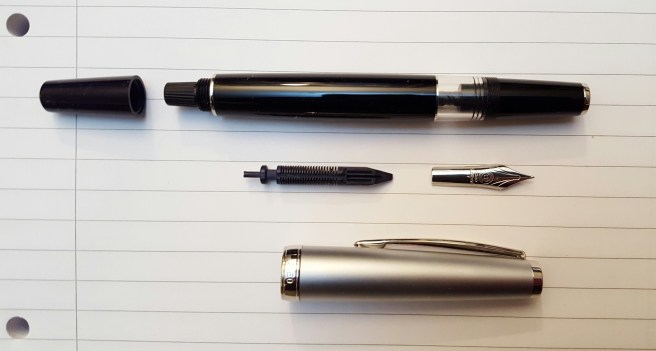
While flushing the pen, I decided to try removing the nib and feed. I had not yet found any guidance on doing this and was anxious not to cause any damage. I found that they are friction fit and came out very easily, when gripped together in tissue paper and pulled out straight. It is great to be able to rinse a nib and feed or remove the nib for any minor adjustments. To replace them, you just need to line up the nib and feed correctly, holding the nib on top of the feed centrally and with the right length of tines protruding beyond the end of the feed and then gently rotate them in the grip section until you locate the right way to push them back in.

20170319_233749.jpg

Whilst the pen was empty, I dipped it in three different inks to see how they would each look from the fine (more like extra fine) nib of the Cleo Skribent. I tried Pelikan Edelstein Tanzanite, Waterman Harmonious Green and then Diamine Conway Stewart Tavy, which is one of my favourite blue-black inks. I tried these on three different papers in turn. The Tavy gave a slightly bluer shade than the Tanzanite.

I then had the idea of seeing whether any of my pens had nibs which were interchangeable with the Cleo Skribent. The nib looked to be about the same size as the nib on a Kaweco Sport, a Cross Apogee or a Monteverde Artista Crystal. All of these are friction fit and are removed just by a careful pull of the nib and feed together, taking care not to damage the delicate feed. The nib on the Cross Apogee is 18k gold with a silver-coloured plating. However, once removed from the pens, the nibs of the Cross Apogee and the Kaweco Sport were both shorter than that of the Cleo Skribent.

The nib on the Monteverde Artista Crystal appears to be same length as the Cleo Skribent and so I think it would be possible to use that in the Cleo, if I wanted a Medium nib option. However, for now, I kept to the Cleo’s own nib.

wp-1489966399601.jpg

On Friday, I received an exciting package from Cult Pens, including the Monteverde Napa Burgundy ink that I had ordered. It came in a 90ml bottle and boasts a special formula, which they call ITF (Ink Treatment Formula). This, it is claimed, “drastically improves ink-flow quality, extends cap-off time, lubricates and protects the ink-feeding systems from corrosion and clogging and improves ink-drying time on papers.”

Whilst this all sounds very commendable, I soon found that the colour when paired with the very fine nib of the Cleo Skribent, looked a rather pale pinky-brown rather than the rich dark burgundy red that I had hoped for. I will try it in a pen with a broader and wetter nib but meanwhile decided to flush it from the Cleo.

wp-1489968067149.jpg

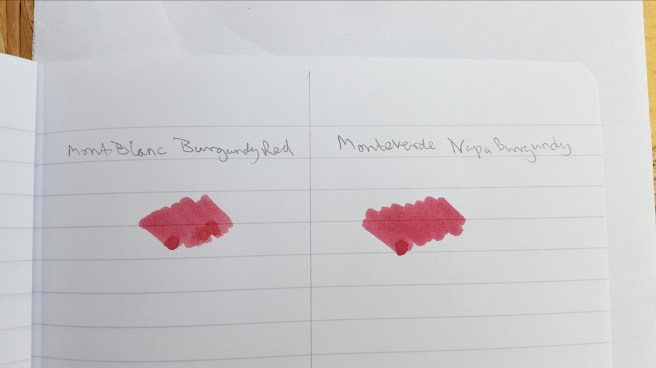
Furthermore, I did a very quick swab test comparison of the Monteverde Napa Burgundy with a Mont Blanc Burgundy and found that they appear pretty much the same colour. Others may conduct a proper and thorough comparison but to my eyes there is little to distinguish them in terms of colour on the page and if I was shown a sample of only one of them, I would be hard put to say which one it was. Of course, the other qualities listed above should also be evaluated and not only the colour. Anyway, happiness was soon restored once I refilled the Cleo, with the Tavy ink that I had sampled earlier.

wp-1489966853824.jpg

On Saturday, I spent the day at a church in Flackwell Heath, Buckinghamshire, hearing first hand about all the excellent work of a UK registered charity, Jubilee Society of Mongolia. The talk was hosted by the church which has supported the organisation since it was founded. Two Mongolian ladies from the organisation had come over to give a presentation, celebrating its 15th anniversary.

After hearing about all the very important and valuable work that the charity is doing in Mongolia, it seems rather shallow to tell you only that I took notes all day, using a Sheaffer Sagaris in the morning and then the Cleo Skribent in the afternoon. Both pens were excellent for note-taking and did not dry out if uncapped for a while.

Also in that package from Cult Pens, as well as the burgundy ink, was my new Lamy AL-star in the Pacific Blue, special edition for 2017. I had not seen these in the shops yet. The colour and finish are very appealing. Cult Pens offers a choice of nibs, in Extra Fine, Fine, Medium, Broad and Left Handed. I was rather intrigued by this last option and telephoned to ask what it meant, before ordering. Was it an oblique nib? Or one which was adjusted to write wetter for lefties? And what nib width was it? I was told that it is simply a bit more rounded and forgiving for people to hold the pen at different angles. Being a leftie, I decided to try one. I also ordered a pack of the matching Pacific Blue cartridges.

I tried the new pen and ink as soon as they arrived. I love the colour of the pen and the ink. I thought the ink to be quite similar to Pilot Iroshizuku ama-iro. However on comparing them side by side, the Pacific Blue is clearly lighter than the Ama-iro.

wp-1489967142656.jpg

As for the nib, I had  close look at it under the loupe. It has the letters LH on. There is generous amount of tipping material and the nib was usable straight out of the box, but a little skippy. I suspect it just needed to wear in. However, being impatient to enjoy the new pen and ink, I swapped over the LH nib for a medium nib from one of my Safaris and this is now writing very nicely and is the nib used for the writing sample pictured.

With this new Pacific Blue AL-star to brighten my pen cups, I now have seventeen fountain pens currently inked and need to bring this down.

This week I have one day out on a continuing professional development course. I am looking forward to taking notes with the Cleo Skribent again and possibly the Lamy AL-star Pacific Blue for annotating the handouts.

wp-1489966543149.jpg


Combo of the week: Lamy AL-star and Sailor Kiwa-guro

p1100999

I have begun to appreciate that a good ink is just as important as a good pen, in finding  an optimum writing experience. It is great when you do find a combination of pen and ink that not only works, but enables both pen and ink to bring out the best in themselves and each other.

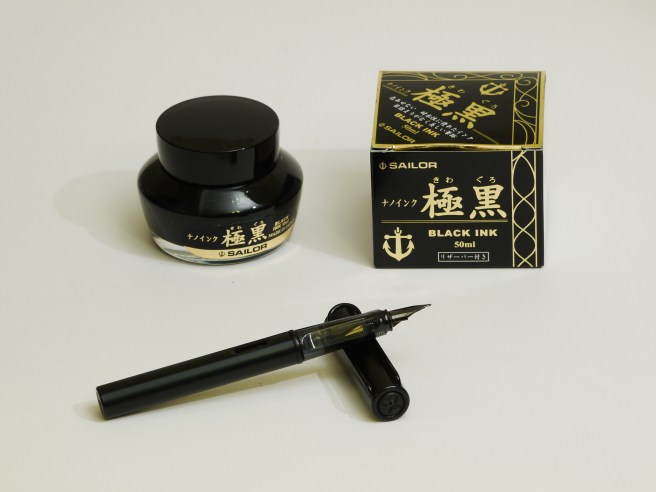
After reading great things about Sailor Kiwa-guro black pigment ink from other bloggers, I was excited to try it for myself and ordered a bottle from The Writing Desk.

This is said to be safe to use in fountain pens and has several useful attributes. First, it is largely waterproof. Secondly, it resists feathering, where other inks fail. Thirdly, it also resists bleeding and show-through.

As well as all this, it seems to be a clean and well-behaved ink, that does not leave a residue on the insides of the converter.

The bottle contains a plastic conical insert, which is filled by turning the bottle upside down and then righting it again, for ease of filling your pen when the ink level is low.

When you look at the ink in the open bottle and swill it around a little bit, it does not leave any trace on the plastic insert but keeps to itself, rather like mercury back in my school science class days.

I decided to try the ink first in my black Lamy AL-star. The matte-black barrel and cap, the black nib and black clip all pointed to this pen being a good choice.

The ink flow of the Lamy is known for being on the dry side and my medium nib is smooth and firm. Paired with the Sailor Kiwa-guro, the lubrication of the nib is wonderful, rather like the feel of a plastic spatula in a non-stick saucepan and with no skipping.

Naturally I was eager to try the ink for water resistance. I wrote a few lines and then immersed the paper in a basin of water. There was a very slight lift-off of ink but when removing the paper and allowing it to dry, the writing looked as good as new. This would be a great ink to use for addressing envelopes or any use where there is a risk of the paper getting wet.

My next test was to try the pen on an unused notebook, (a Paperchase Agenzio soft black, ruled notebook) that I had previously given up on, as being unusable with fountain pens.To my great delight, there was no bleeding with this ink. I recommend this ink if you have notebooks that you cannot use (for writing on both sides of the paper) with other inks.

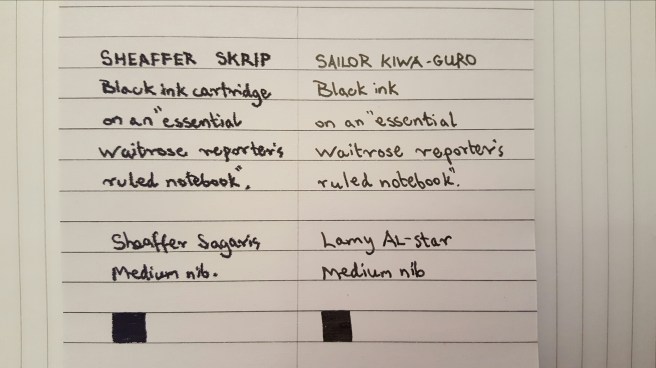
As for feathering, I had tried a new black Sheaffer Sagaris recently with the supplied black Sheaffer Skrip cartridge and was surprised at how much this feathered on a reporter’s inexpensive spiral bound note book. This same paper had been good to use with a Lamy blue ink cartridge.

Sure enough, when trying the Kiwa-guro on this paper, there was no feathering. The lines remain very crisp, whereas the Skrip black ink has gone very woolly. Admittedly the Sheaffer Sagaris is a wetter writer than the AL-star so this is not a level playing field.

20170208_214405.jpg

I have used the black AL-star with Sailor Kiwa-guro at work for over a week now, for writing notes, forms and documents and signing letters and enjoy the silky feel of the nib gliding over the paper.

On the downside, I had hoped that it might be possible to go over the writing with a yellow highlighter pen without smudging but this was not entirely successful. There is an element of the ink that is not waterproof and which will smudge if you go over it with a highlighter pen even though the writing remains very dark. Some black ink will transfer to the felt tip of the highlighter. For this reason it is probably not suited to  being used for drawing in conjunction with water colour paints, but then this is not its intended use.

The other downside is the price, at £21.60 for the 50ml bottle, making this a premium ink, but given its useful properties I have no regrets about the expense.

I have not yet tried it in any other pen. As a pigment ink, I still thought it best to keep it to one pen at a time which I then use regularly. However, it may well be that my concerns over ink drying out in the pen and being difficult to clean up, are unjustified. From my brief experience of  this ink so far I am certainly tempted to try it in a different pen next time, particularly one of those which might benefit from a more lubricating ink.


Rover 14k Extra Fine nib: a writing sample

Further to my post yesterday about the vintage Pelikan M400, here is a writing sample to show the versatility of the extra fine nib.

The nib is a Rover, 14k gold, in extra fine. (update: a “Rover 585 EXTRA PO.45” to be precise).The ink is Conway Stewart Tavy by Diamine, which I like a lot.


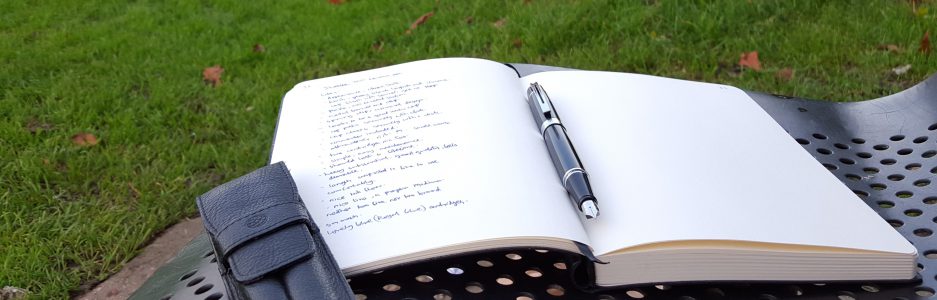
The paper is from a Silvine exercise book. It was written on my knee in the park in Golders Green, basking in 5 degrees Celsius today, while last night’s frost and ice lingers in the shade.

Having a wonderful pen and ink combination like this makes me yearn for better handwriting.