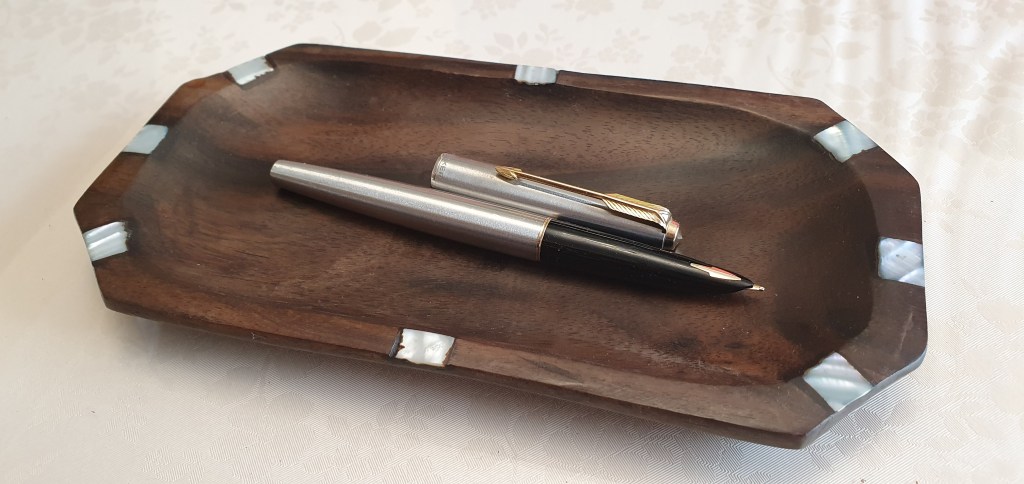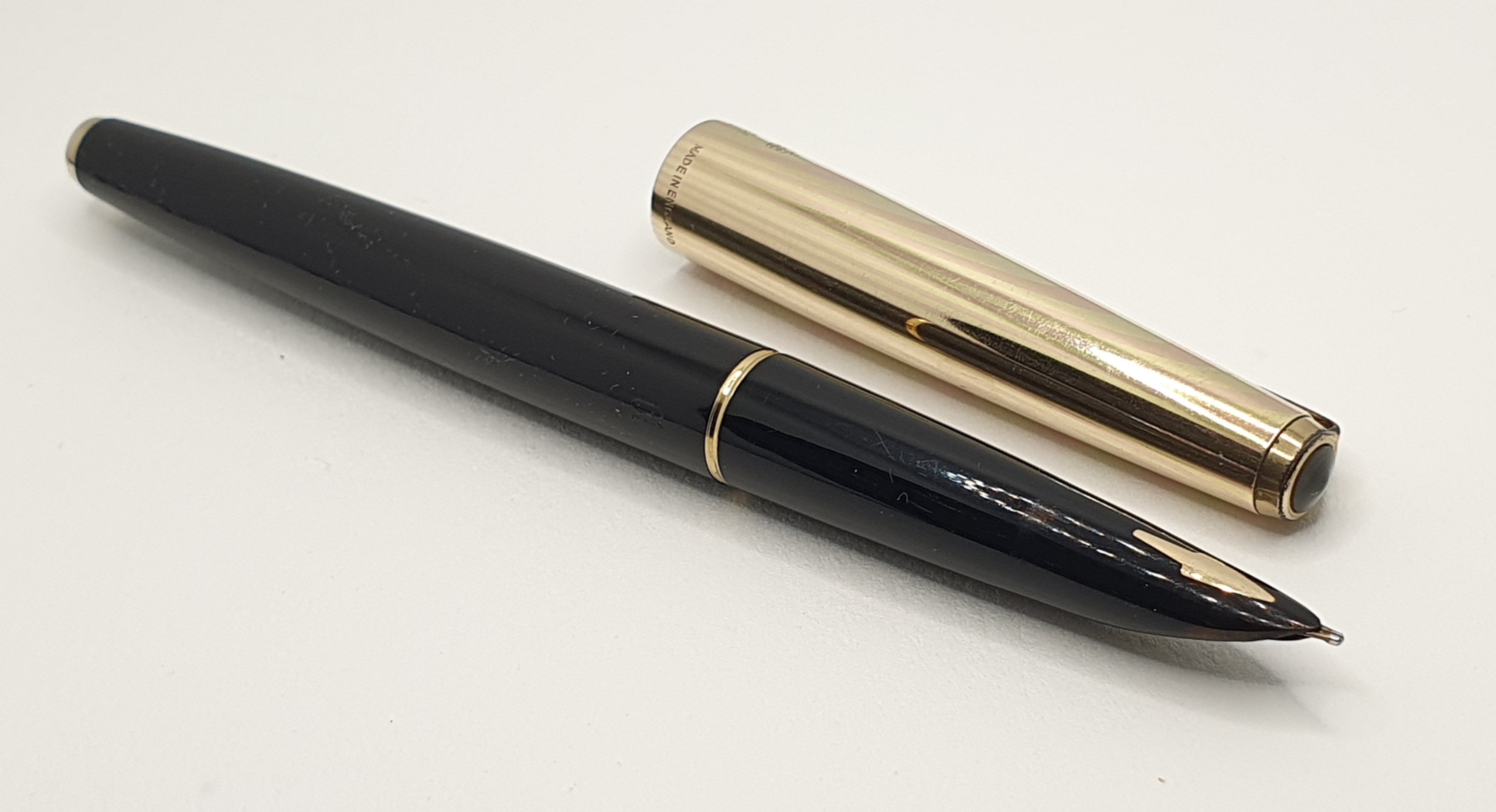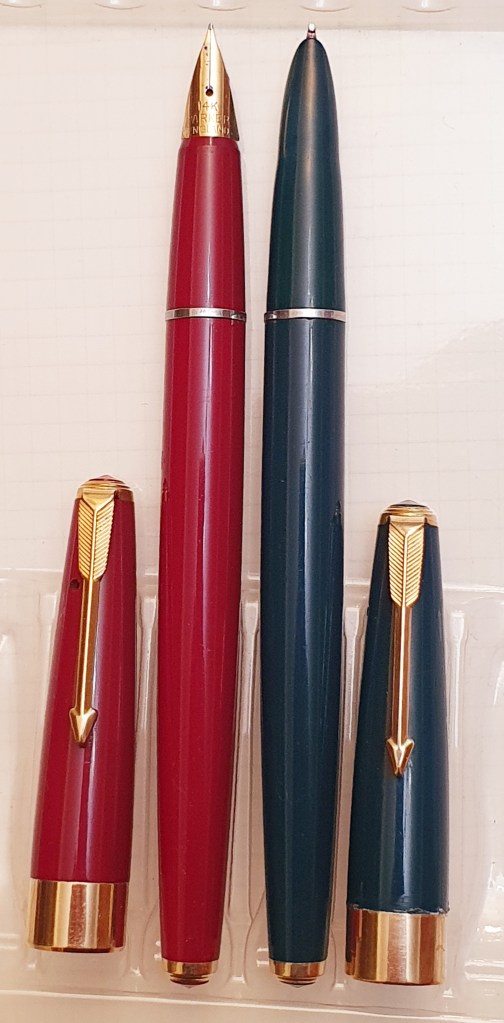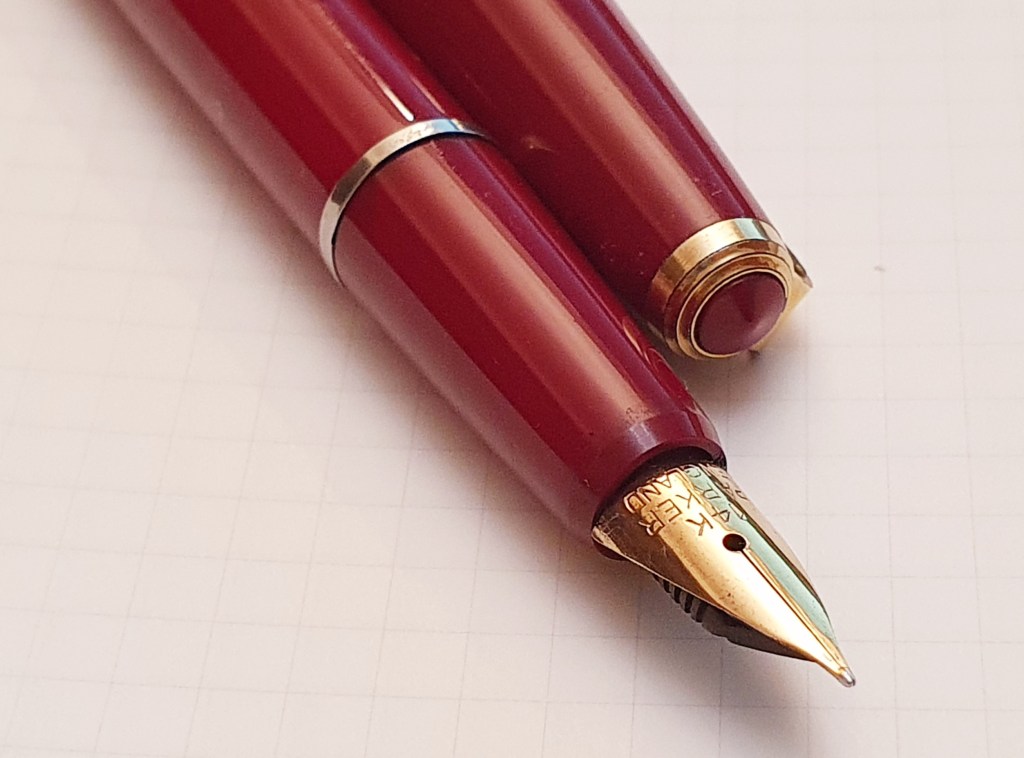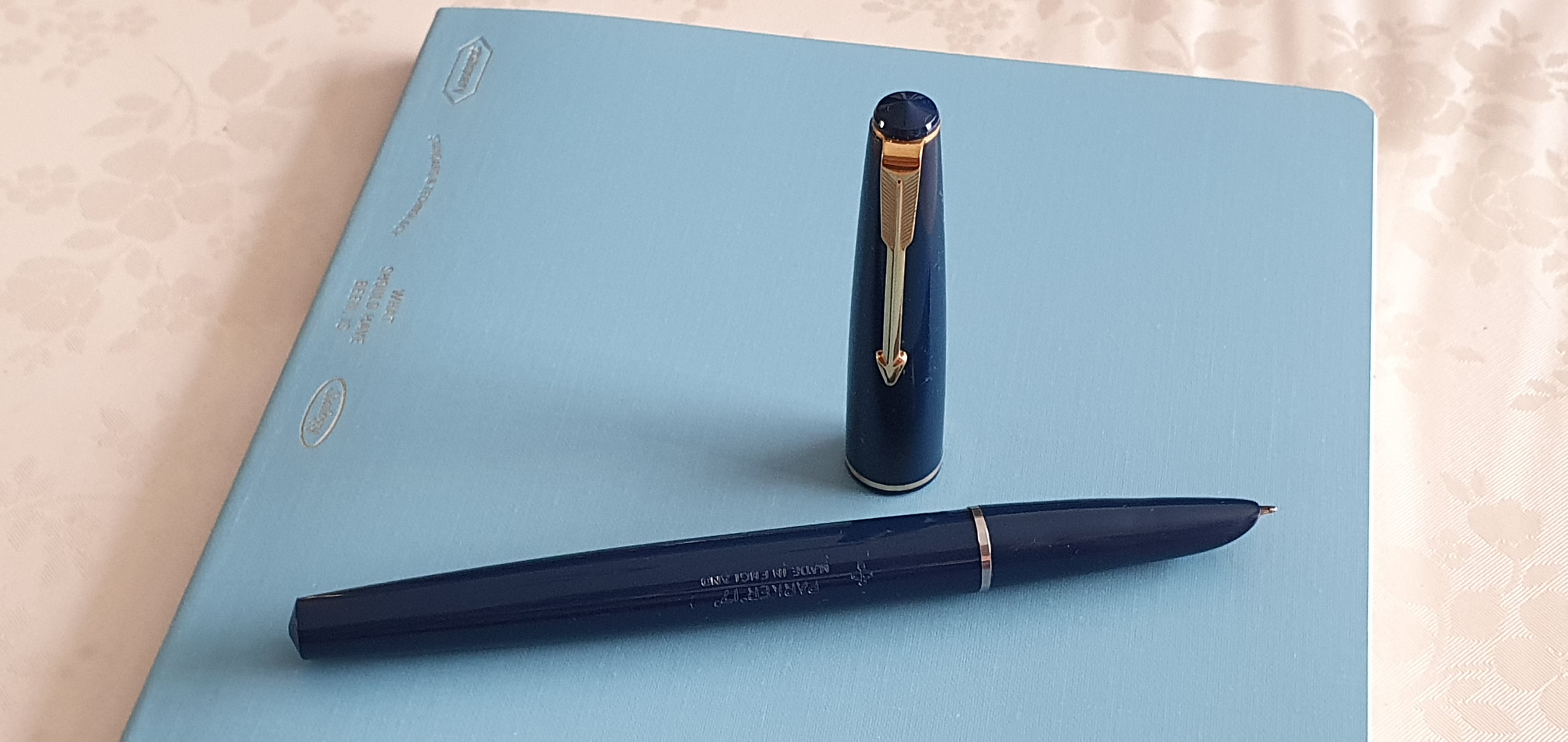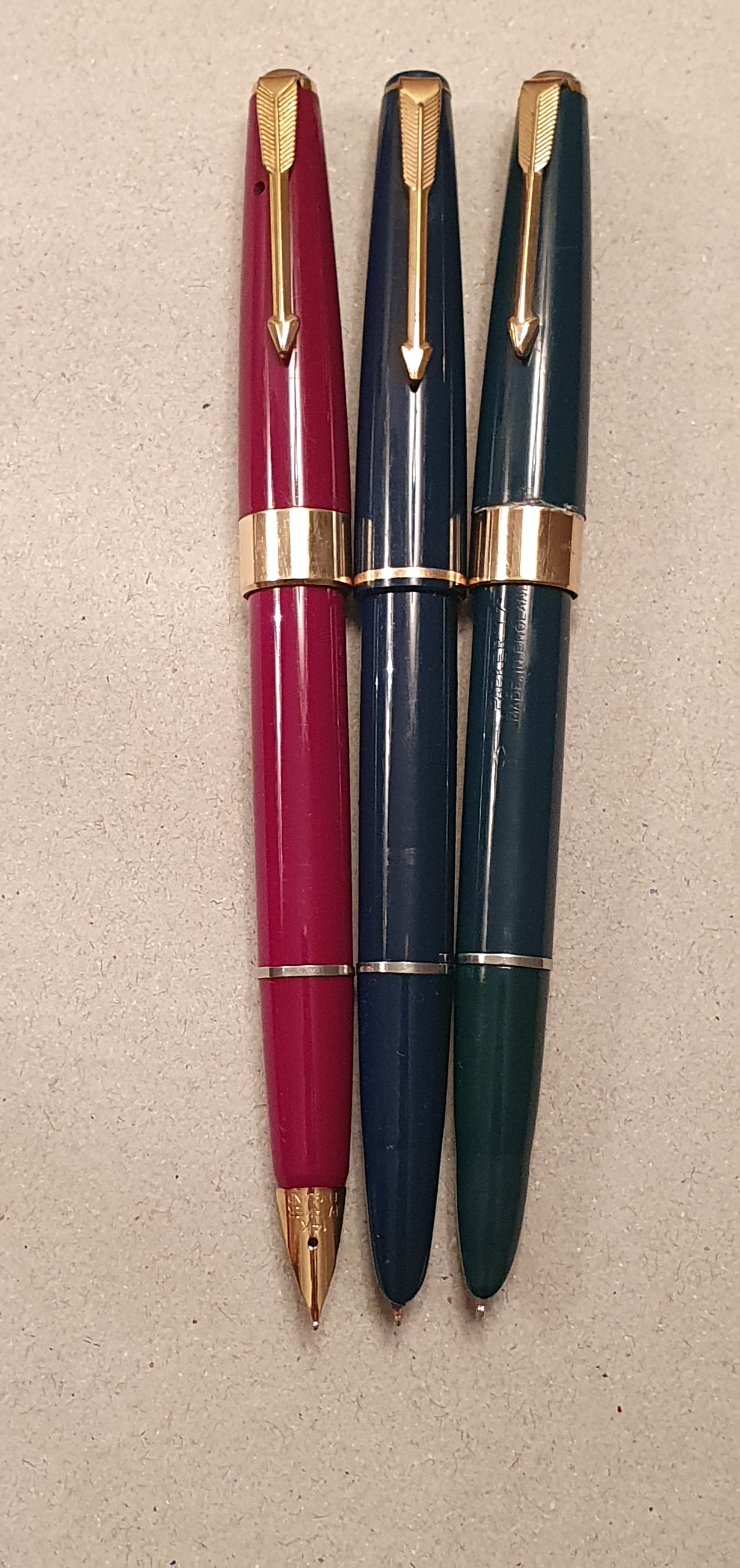
My new (to me) Parker 61 Flighter fountain pen.

Lately I have got a bit hooked on buying vintage Parker fountain pens on eBay. I have been fortunate in finding some classic pens with gold nibs and plenty of life left in them, at attractive prices.
The latest to arrive was a Parker 61 Flighter. This was an impulse buy after receiving one of eBay’s thoughtful emails, that an auction of a pen I had viewed, was soon to end and inviting me to make my bid. By the time I read the email, the auction had barely 60 seconds left to go. I made a quick decision to bid and watched nervously as the final seconds ticked down. I did not have long to wait. The outcome was that three people had bid in the final minute. By a stroke of luck, my bid of £31.36 had won, by just 85p.
Parker 61 Flighter.

The pen arrived this morning. Although I have enjoyed Parker pens since the 1970’s, I had not owned a Parker 61 before. I recall being very enamoured with Parker’s Flighter pens, as a ten year old boy.

First impressions were good. The brushed stainless steel finish feels smooth and luxurious. The slip cap pulls off silently and easily yet feels secure enough when on. The pen is more sleek and tapered than my Parker 51, and slightly shorter overall, yet the grip section is about 1cm longer. The Parker 61 has a distinctive inlaid arrow on the section, introduced to help people know which way the tiny nib was facing, although these are known to fall off.

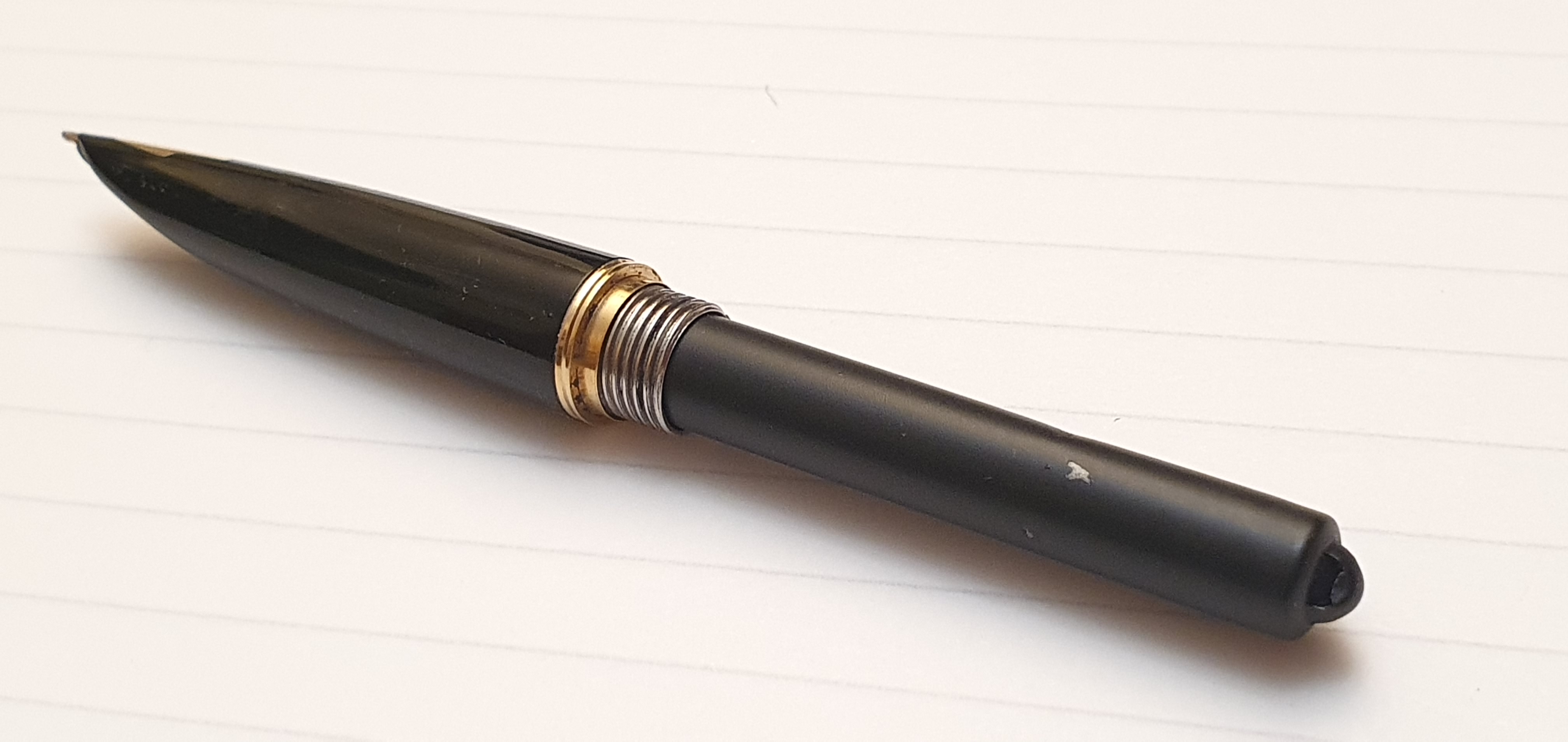
The Parker 61 was first introduced in the USA in 1956 but not in England until the early 1960’s. The early models featured an innovative new capillary filling system. This was part of the quest for a convenient method of refilling a fountain pen without the mess. This new system consisted of a cylinder coated in Teflon, a non-stick finish. To fill the pen, the user had simply to unscrew the barrel, place the pen, nib up, in a bottle of ink, and wait about 30 seconds for the cylinder to fill itself by capillary action. Then the pen could be lifted from the bottle and, in theory at least, ink would not adhere to the Teflon coating. The barrel could be screwed back on without a need to clean the cylinder.

In practice the Teflon would flake off eventually and some cleaning was necessary. It seems that the system was not as popular as hoped. Also, there was a tendency for the cylinder to get clogged up, if the pen was not cleaned out from time to time. Before long the system was dropped and instead, later versions used Parker’s new cartridges or else a detachable aerometric-style cartridge-converter.

My model has the cartridge-converter. I do not know the date of it. It was made in England, which puts it before the closure of the Parker Pen factory in Newhaven in around 2011. But I read on Tony Fischier’s site, parkerpens.net that the Parker 61 range was discontinued in 1983 and so my pen is at least 40 years old. It does not have the “Quality Pen” date code on the cap, introduced in 1980 and so I can narrow the date down to 1960’s or 1970’s. I suspect that there are other clues to discover.

The squeeze bar, cartridge-converter version.

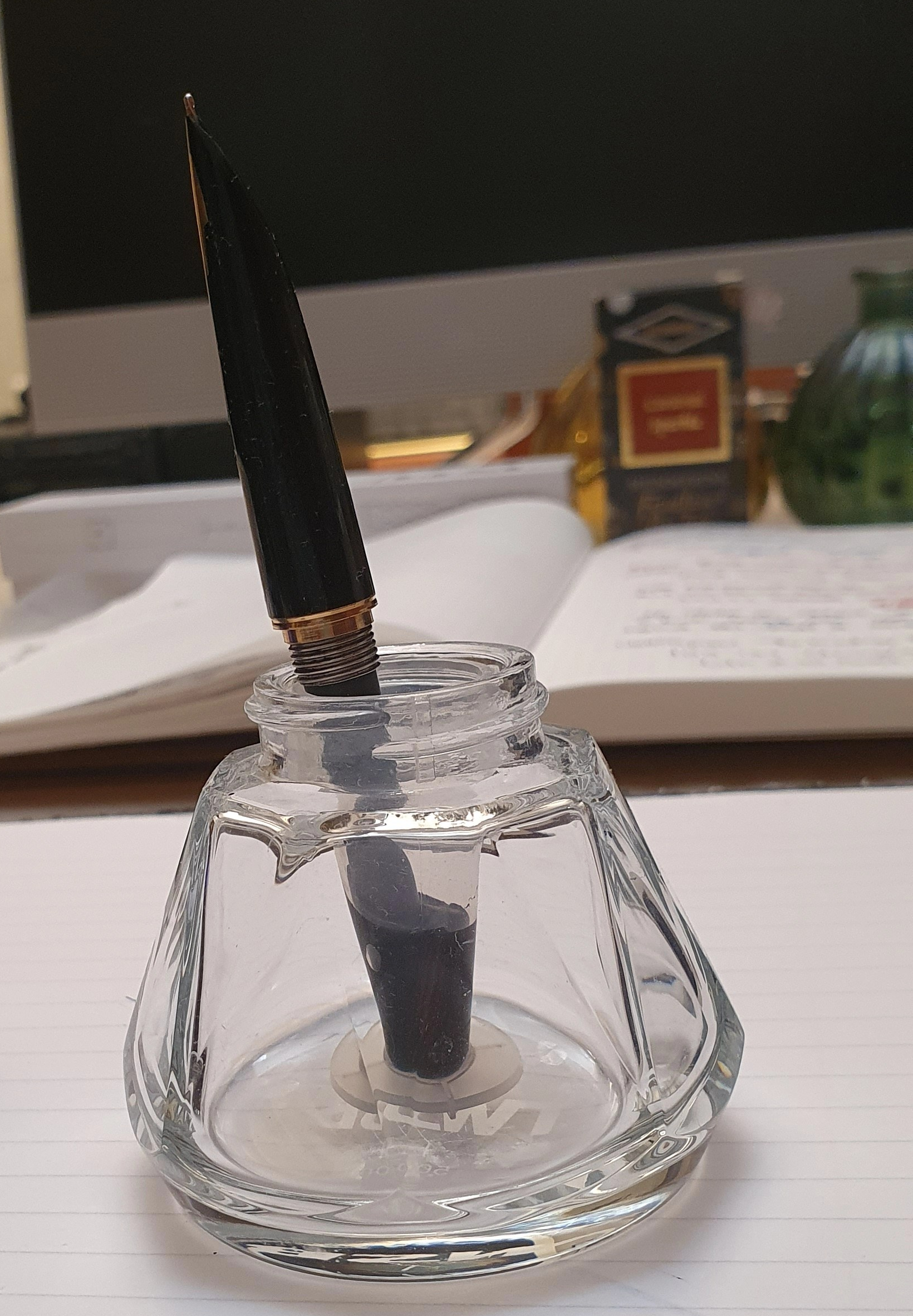
On its arrival, my pen still had traces of blue ink and I gave it an initial flush in water, using the converter. On squeezing the converter, a healthy stream of air bubbles was emitted from the nib, an encouraging sign.

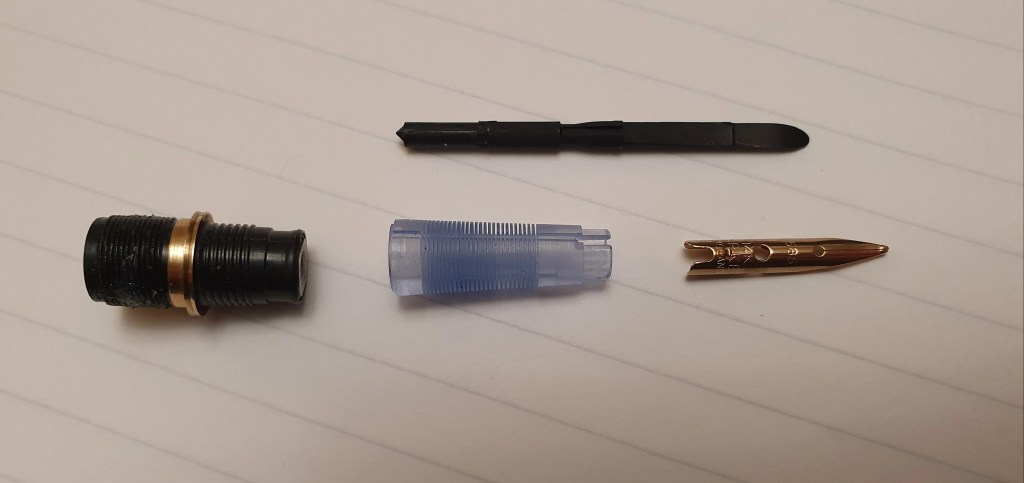
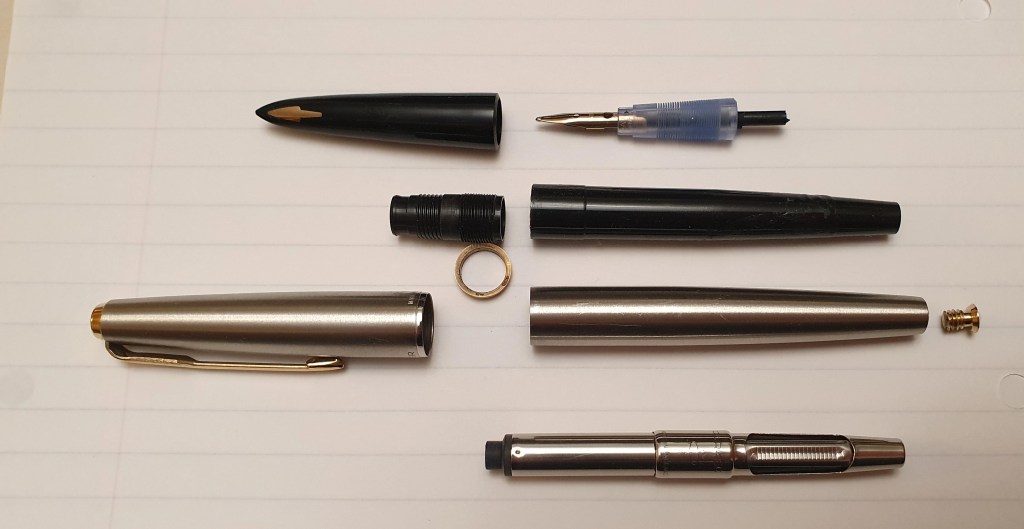
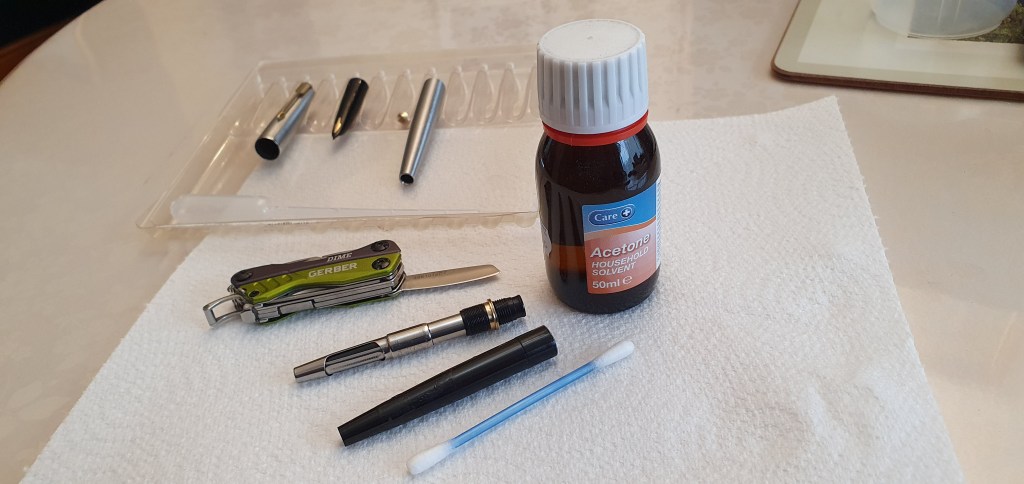
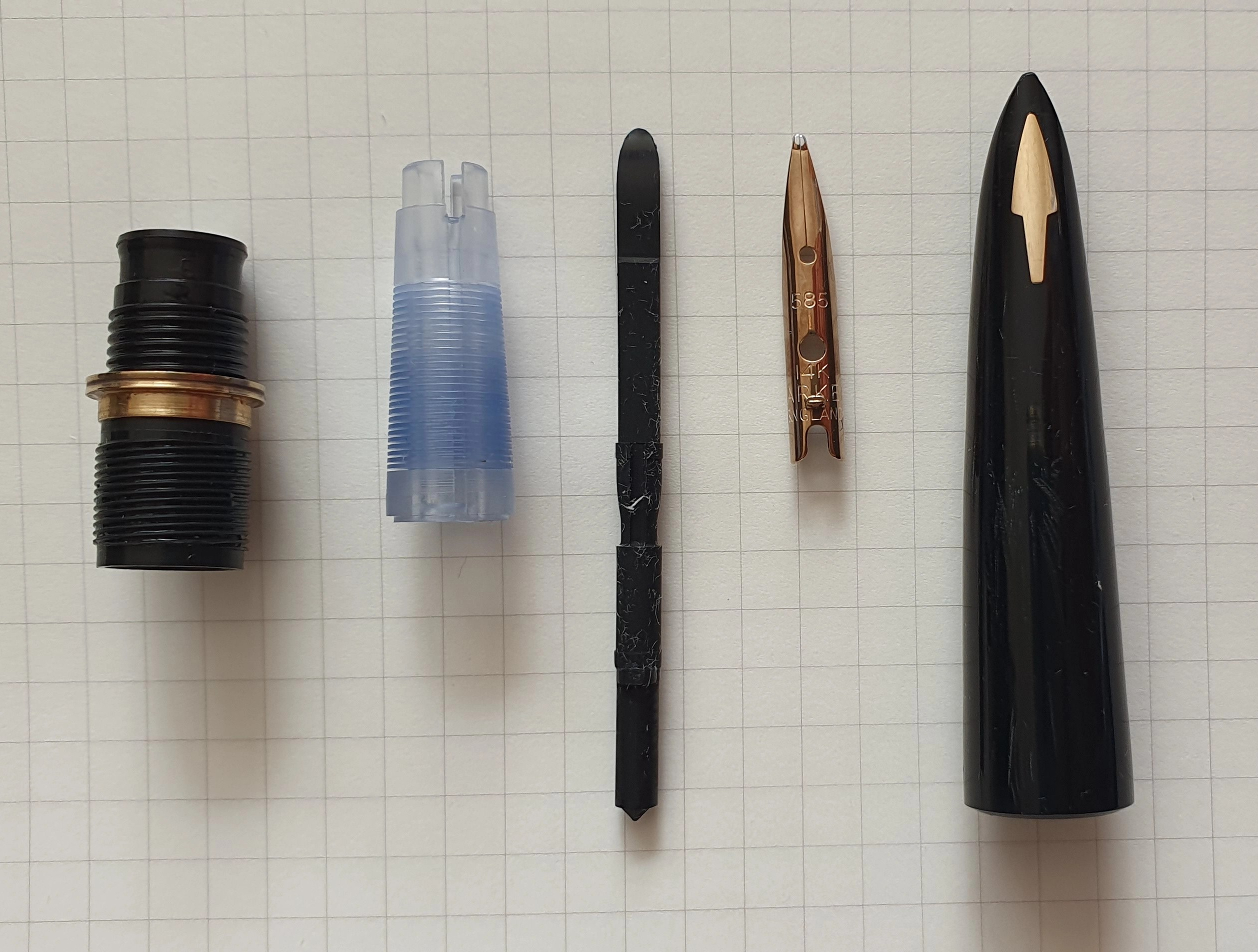
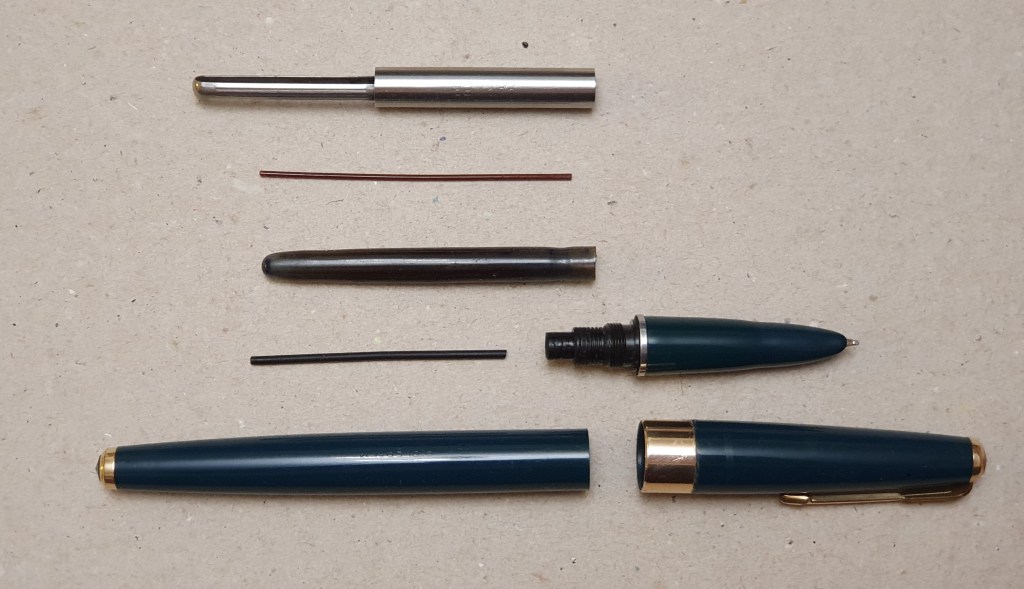
Then as I removed the converter to wash out the section, I noticed that the connector was loose and rotating. I carefully unscrewed this, whereupon I could take out the nib, feed and ink collector, separate them and give them a clean.

Connector, ink collector, feed, nib and shell, after their bath.

I was careful not to lose any small parts. In my excitement, and after cleaning and photographing the pieces, I forgot the sequence for reassembly and watched an informative YouTube video from Grandmia Pens, which set me right. Steff advises against unscrewing the shell in the Parker 61s, as they are prone to cracking and shrinkage. It is not advisable to apply heat to them to soften the adhesive, (as you might with a Parker 51) for this reason.

Although the pen in his video was the capillary filler version, the principles are largely the same, as follows:

  • first find the channel in the the ink collector. This should be aligned with the nib;
  • insert the nib carefully into the collector, pushing it in as far as it will go.
  • slide the black plastic feed into the ink collector from the back, all the way into the nib, which leaves a small part of the nib protruding beyond the feed;
  • insert the nib, feed and ink collector into the shell, or section; notches will align them correctly;
  • preferably, apply a little silicone grease to the threads, before screwing the connector inside the shell with the end of the feed passing through the hole in the connector;
  • push the converter back onto the section.

This all went very smoothly. I was pleased that the connector was not glued, enabling me to take the pen apart safely and clean the components. For those with the capillary version, there will be a retaining washer gripping the cylinder on the connector. This slides forward onto the ink collector, for the cylinder to be removed for cleaning, then later slides back over the end of the cylinder again to secure it. Note also that the plastic feed is much longer in the capillary fill version.

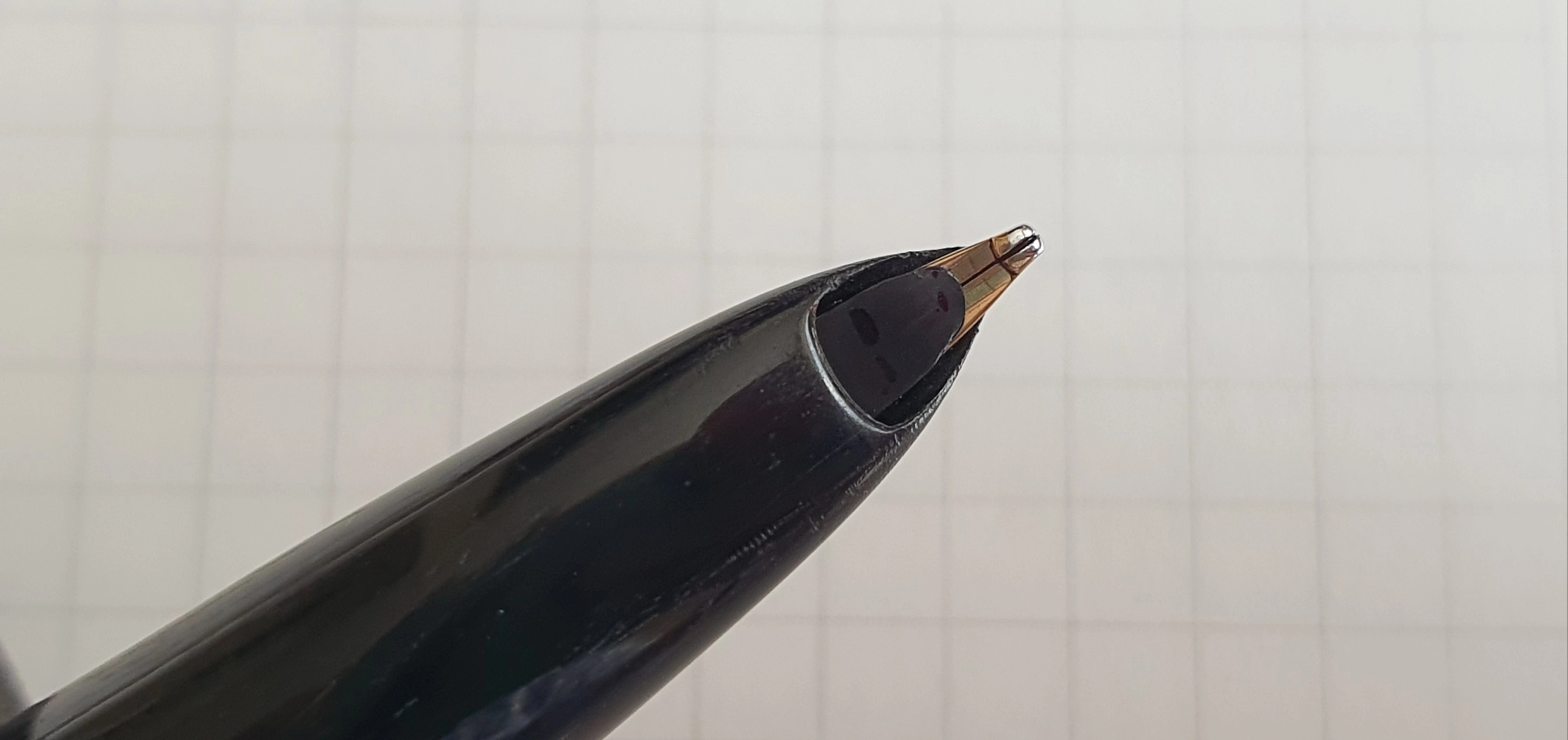
On examining the nib, there was no date code on it. The gold cleaned up very easily. The nib appeared very slightly bent and the tine gap was rather wide, such that the pen was likely to be a gusher. Rather rashly, I squeezed the sides of the nib together, to narrow the tine gap a little, which had the desired effect. After this it was necessary to realign the tines, for smooth writing.

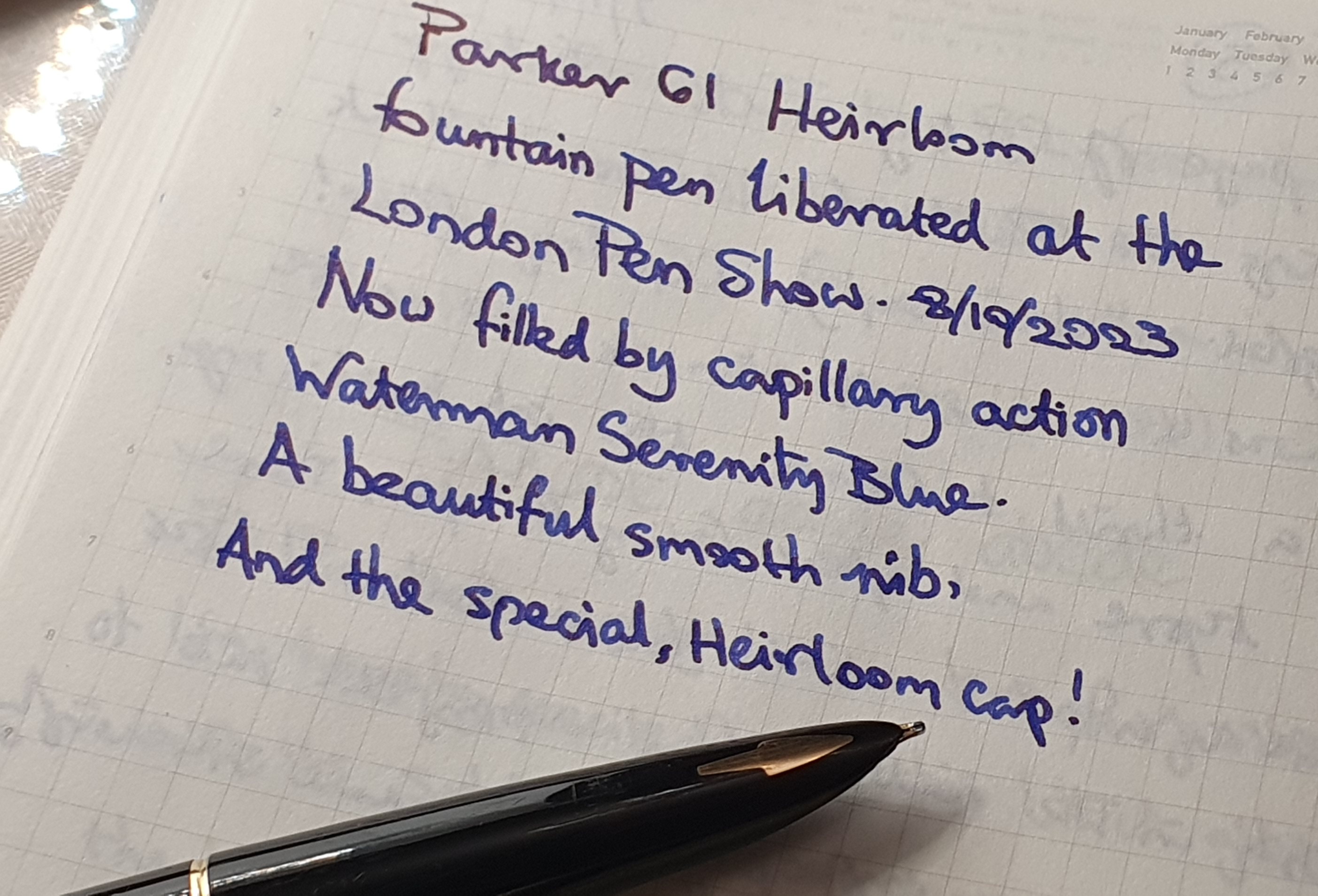
At the end of this exercise, I filled the pen with Waterman Serenity Blue, and tried writing on a Stalogy A5 notebook. Success! The pen writes very nicely. Whilst the generous blob of tipping suggested a Broad nib, the line is closer to a Medium.

I have much enjoyed my first day with this pen, tinkering, cleaning, photographing and writing with it. For the pleasure it gave me today, I have already got my money’s worth and so every new day with my Parker 61 will be a bonus.

14k gold, smooth and juicy.

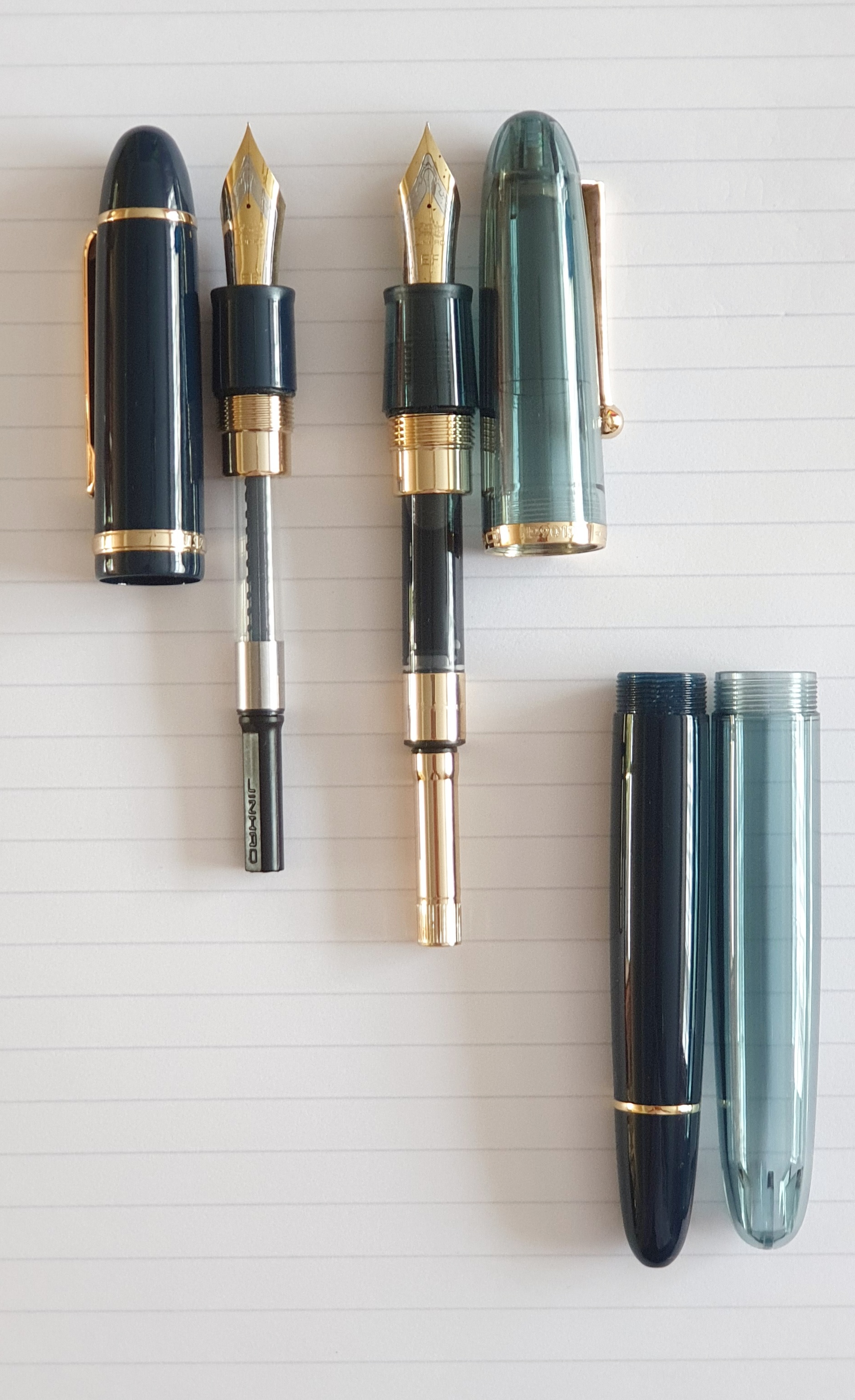
Early thoughts on the Jinhao Dadao No. 9019 fountain pen.

This will likely be a shortish post, because there are many similarities to the Jinhao X159 which I have reviewed recently. The short version is that I like this pen very much.

Jinhao Dadao No. 9019

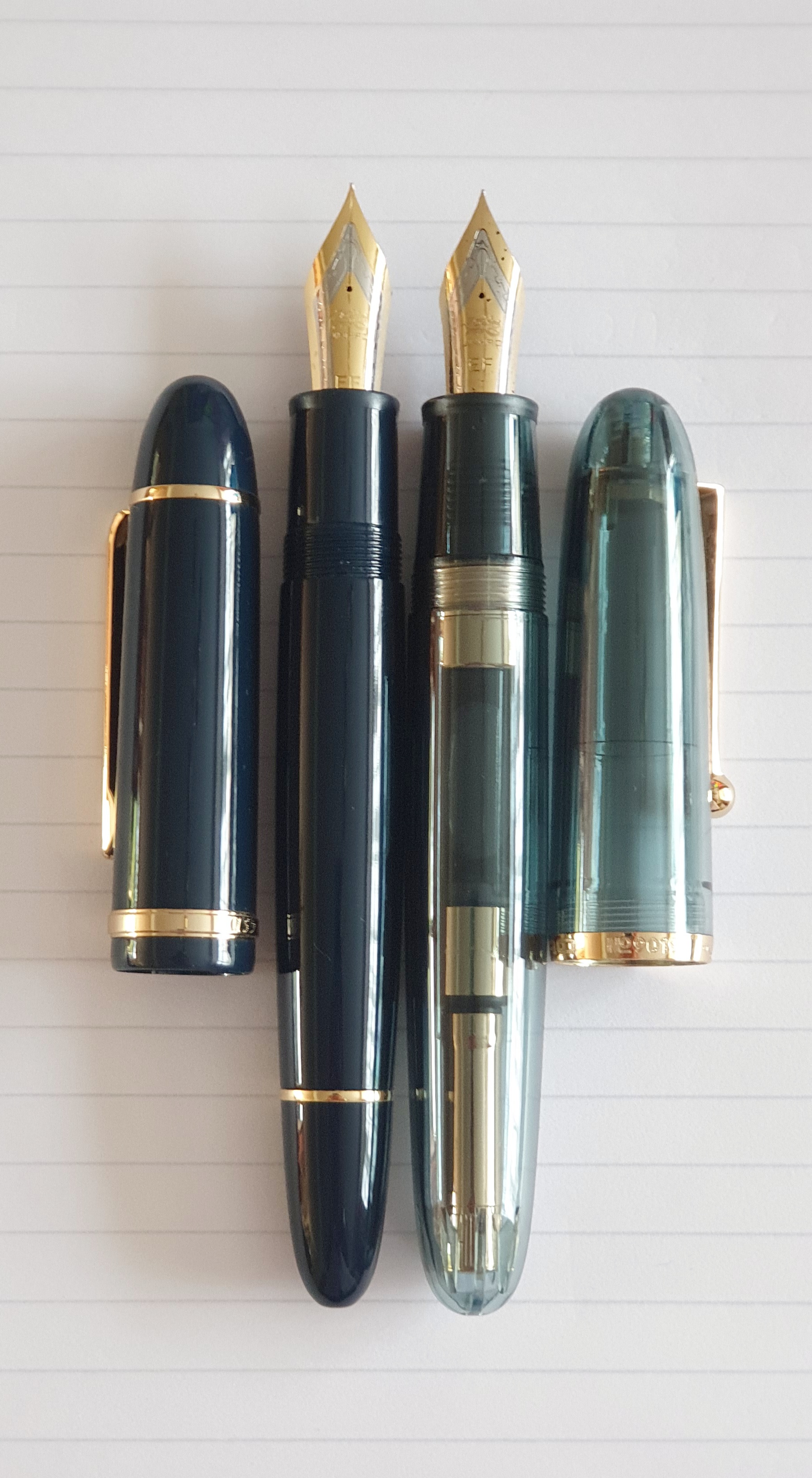
But whilst this pen might at first glance look like the X159, there are several notable differences, most evident when comparing the two pens side by side. These points, in no particular order, are as follows:-

  1. As well as the opaque versions, in black, blue or burgundy, the 9019 is also available as a demonstrator in clear, blue or pink.
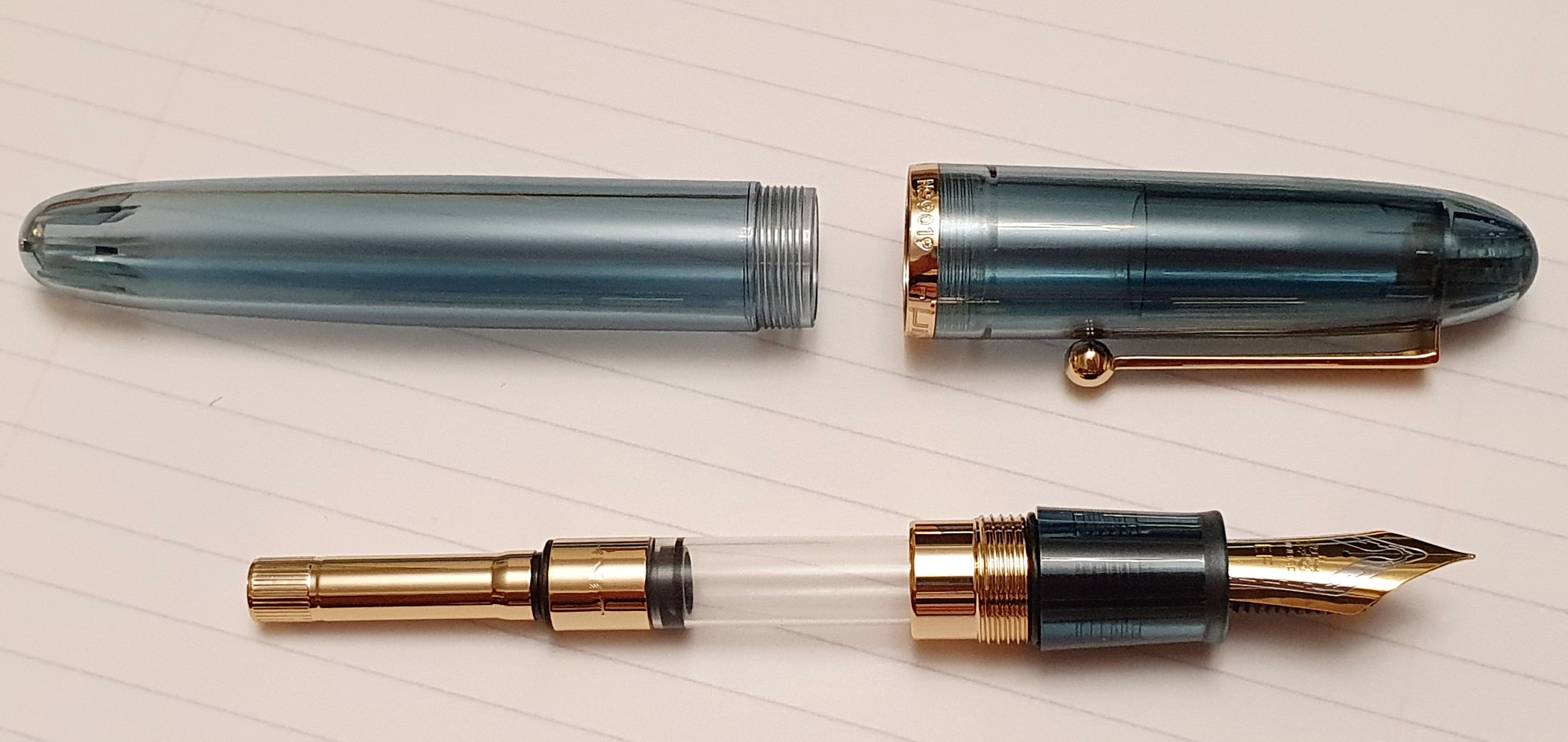
  2. Although it still features the large, number 8 steel nib in extra fine, fine or medium, the body is different. The cap is shorter. The pocket clip sits higher up the cap. The clip itself is different. The means of attaching the clip to the cap is different, being a nut and bolt inside the cap, so that the cap and finial are seamless.
  3. The grip section is significantly longer on the 9019.
  4. The foot of the barrel is still rounded, but more bulbous and cigar shaped, than the bullet shaped X159. This is to accommodate the larger turning rod of the converter.
  5. The converter is larger capacity than that of the X159, and is now a screw fit instead of push fit.
  6. The converter is also considerably more fancy than the X159’s, having a gold coloured turning rod, which is rather impressive and a nice touch, given that it is always on show in the demonstrator editions.
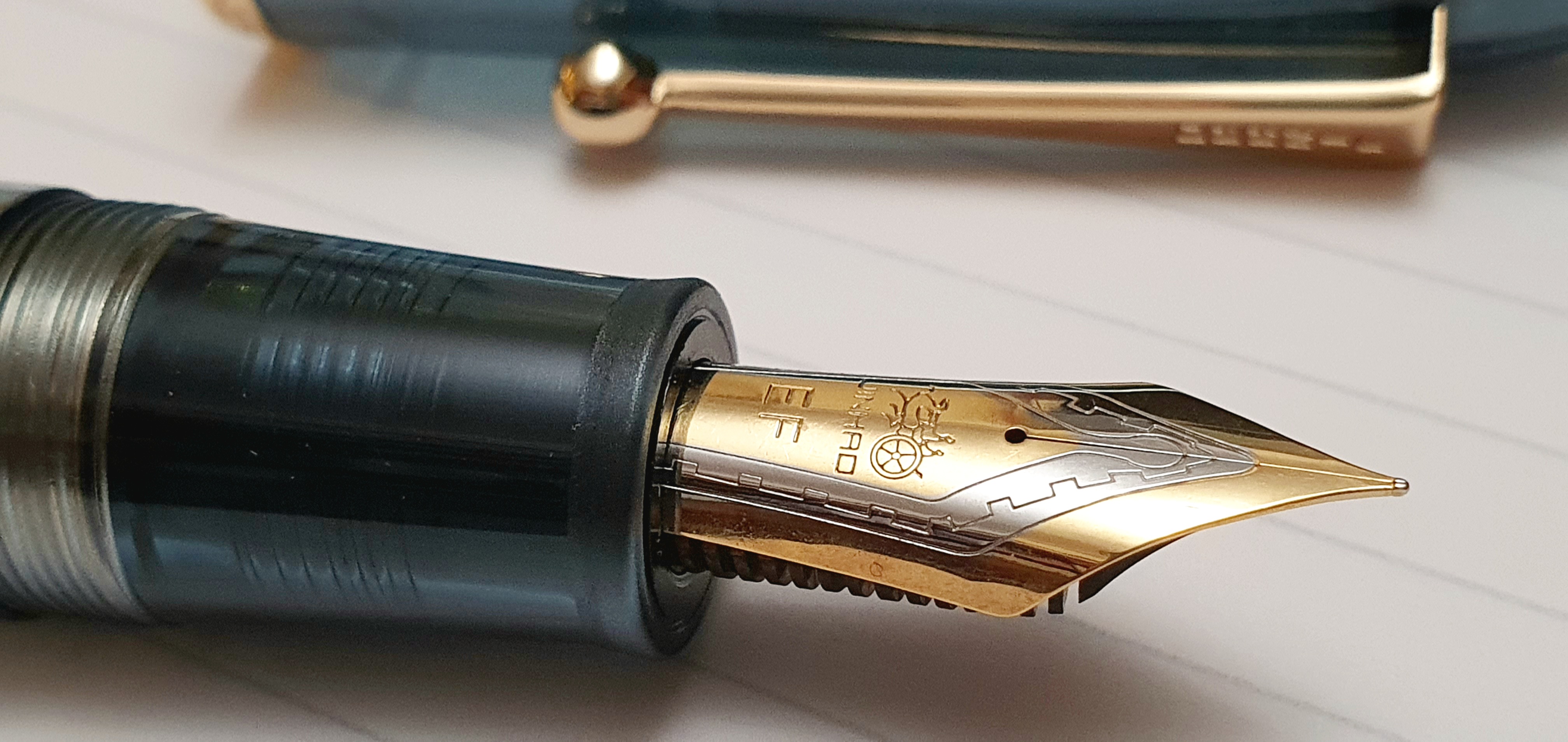
A number 8, two tone steel nib, extra fine. You get a lot of nib for your money.

I first tried the 9019 at our pen club, (the “London Pen Fountaineers”) and was instantly smitten. For the features included, at the current price (£10.49 from Erofa, via Amazon) the purchase is a no-brainer. The nib unit alone and the converter alone, each seem worth more than that.

Note the longer section and larger converter on the 9019.

I ordered the blue demonstrator model, with an Extra Fine nib, having found the EF nib particularly enjoyable on my X159s. My pen was delivered the next day. It comes in a simple polythene sleeve inside a small brown padded envelope with no box or papers but arrived in perfect condition. The only adjustment that I made was to push the nib very slightly over to one side so as to be more accurately centred over the feed, but this was minimal.

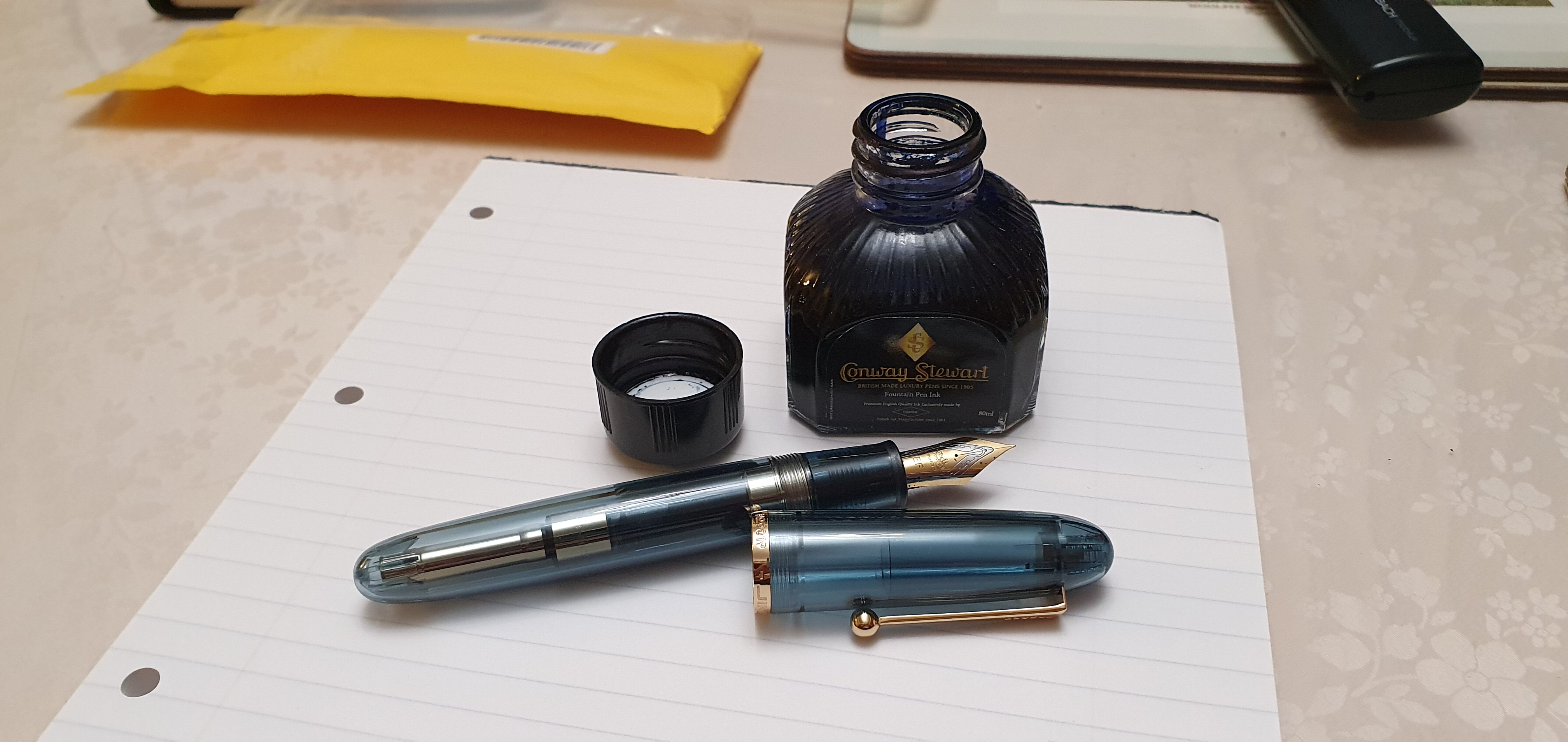
I filled the pen with a blue black ink, Diamine’s Conway Stewart Tavy, which flows and lubricates well and is a dark, pleasing shade. I have lately been enjoying a Stalogy 018 Editor’s Series, A5 notebook and like the paper very much. The nib performed admirably, with just the right flow and feedback, that makes you want to keep writing for ever. For an extra fine nib, the tip is smooth and pleasant to write with, although firm. I was very pleased with my initial choice of ink and plan to stick with it.

Differences in barrel, cap and clip too.

It appears that there is no inner cap, but instead, a moulding in the shape of one as part of the cap design, so that the nib seals nicely once the section meets the inside lip in the cap. I have had absolutely no issues of hard starting or skipping.

I appreciate that the enhanced ink capacity is rather unnecessary, particularly in a demonstrator body where you can see the ink remaining and can top up at any time. Nevertheless, I find it strangely exciting to think how many pages I could write on one fill, paired with such a fine nib. We shall see!

Freshly filled with blue black ink and expectations.

“Two Supes.”

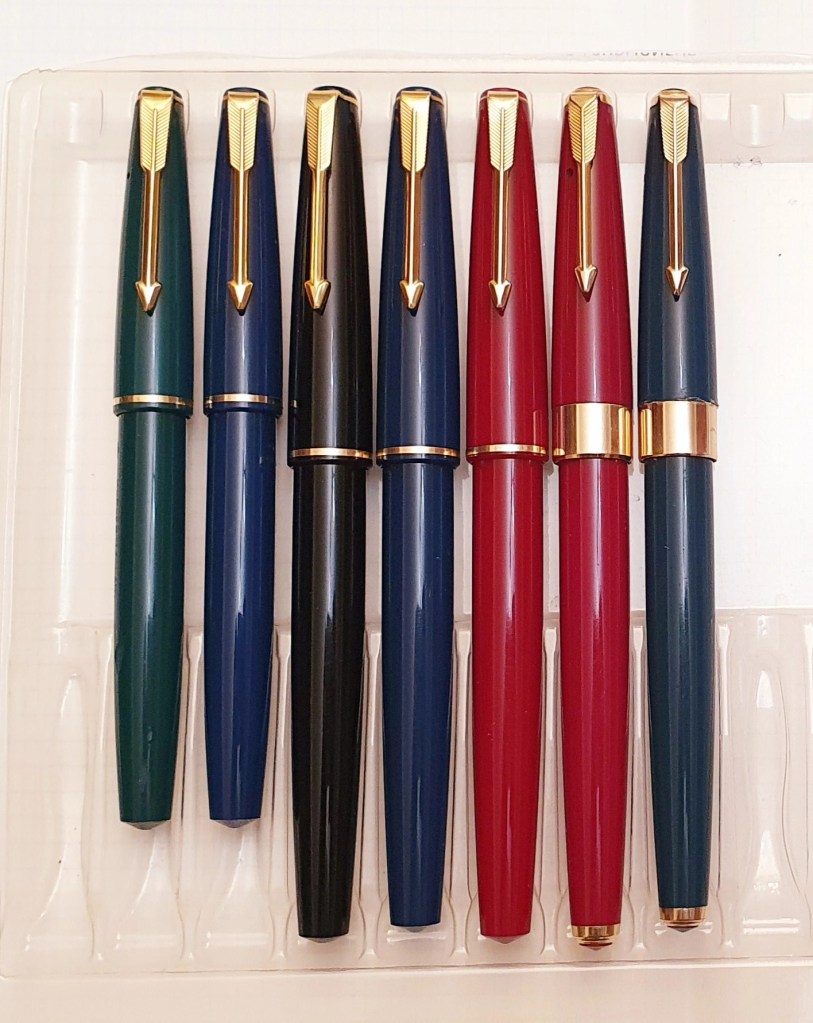
Since discovering the Parker 17 range less than a year ago, I have accumulated seven of them. Two are small, Parker 17 Lady fountain pens. Of the five full size models, three are standard models and two are Supers, or Parker 17 Super Duofolds, to give them their full title.

My Parker 17 fountain pens. The two on the right are the Super Duofolds.

These Super Duofolds are distinguished by their wide gold cap band and decorative metal ring (called a tassie) at the end of the barrel. Otherwise, they are the same. All have the fixed squeeze-bar filling system known as the aerometric filler, although more basic than in the Parker 51 which is more enclosed and may also be larger capacity.

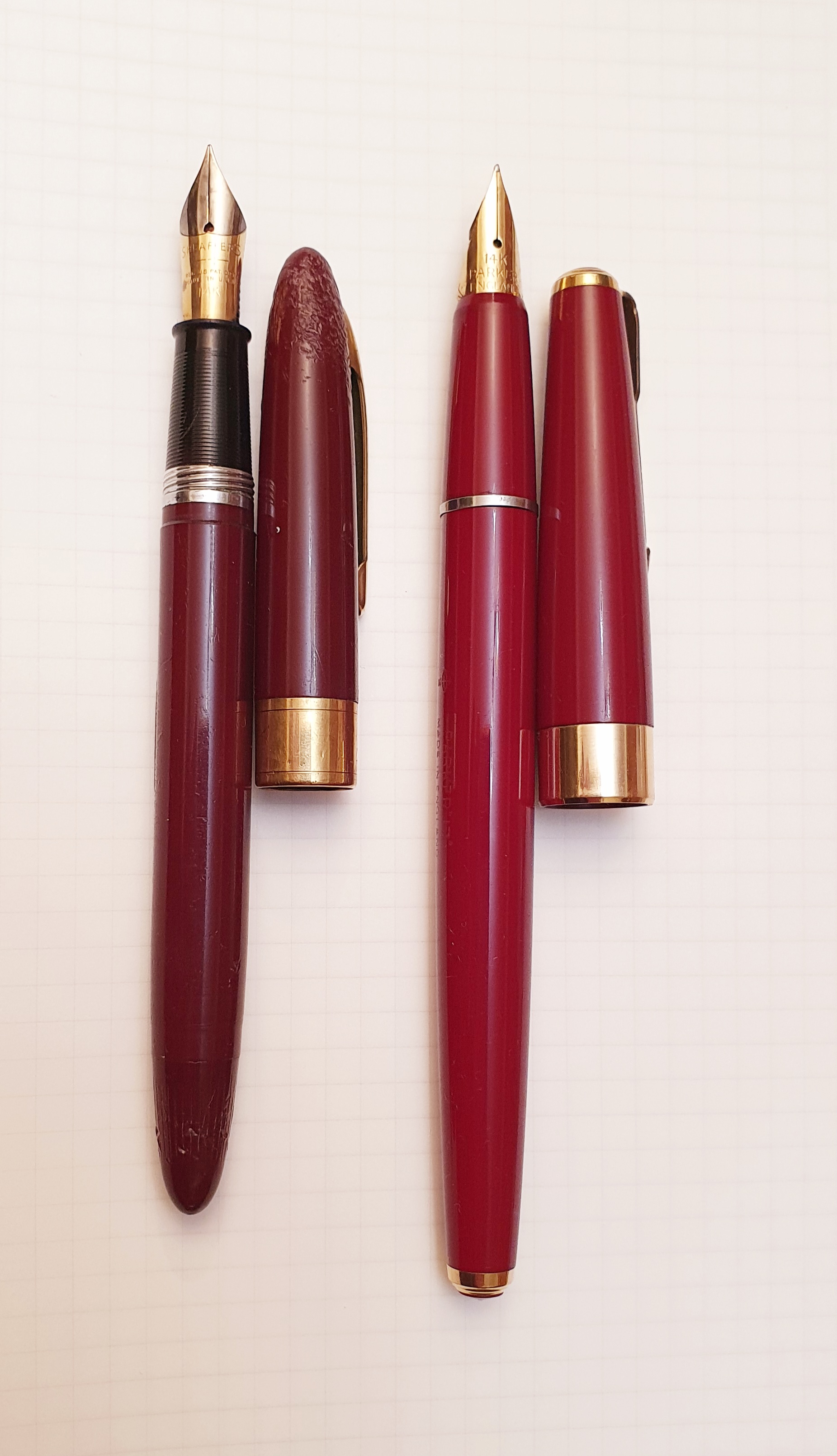
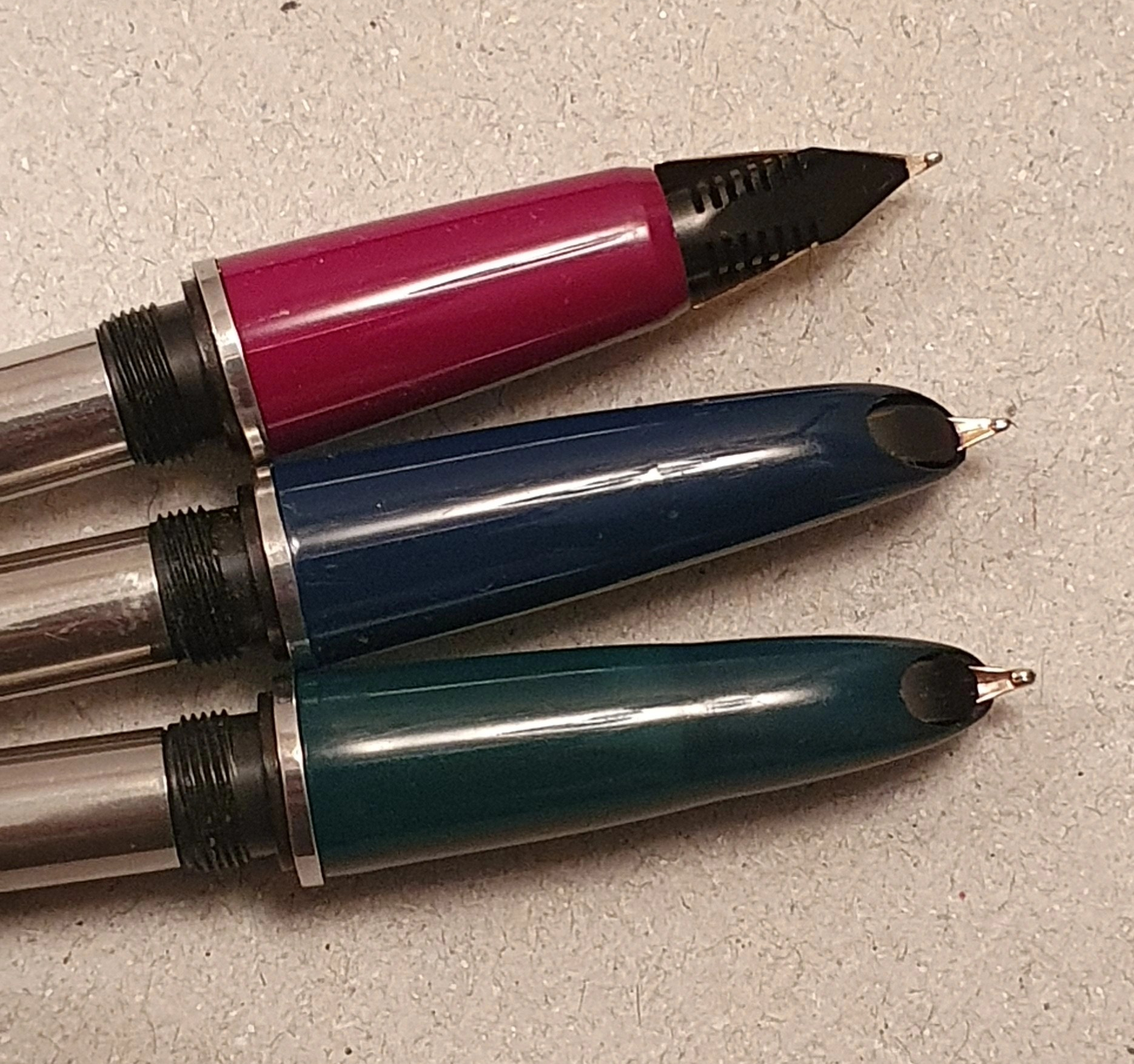
My red Parker 17 Super Duofold is the early model which was made from 1962 to 1964 only. This has an open nib, known as the beak nib, in an unconventional triangular shape. After that year, production switched to hooded nibs for the remaining run of the 17 range, ending in 1972.

Left: Early model with open nib. Right: Later model with hooded nib.

I had read good reports of these early, beak nibs and was keen to get my hands on one. When I saw this one for sale in an eBay auction I set my heart on winning it. The seller provided a series of good close up photographs. I looked at these many times in the days leading up to the auction, particularly the images of the nib, front and back. It looked in tip-top condition. It also occurred to me that the pen had some similarities to an old Sheaffer that my late mother had used, at least in its burgundy colour and wide gold cap band.

Parker 17 “Beak nib” (1962 – 1964 only).
And again.

After a tense finish to the auction, the pen was mine! The final price was £59.00 and I appreciate that you can buy a Parker 51 for that, but the early version Parker 17 commands a higher price than the later ones due to its rarity.

The package arrived just in time for me to bring on a weekend away, where I enjoyed cleaning it and trying it out with Parker Quink Royal Blue. The only visible markings on the nib are “14K, PARKER, ENGLAND.” It may be that there is more to see if the nib is removed but I have not done so. The nib writes beautifully. I would guess it to be a Fine. It is very smooth, fairly firm and has an ideal flow, all making for a very enjoyable writing experience, especially on my Stalogy notebook paper.

On close examination of the pen body with a loupe, I did find two hairline cracks, one on each side of the cap. These are not noticeable unless you look hard for them and do not affect the pen’s performance. I could run a little glue along these to seal them but there does not seem to be any real need. Crucially, I have not experienced any hard starts. The nib does not dry out, even though there is a round air hole in the cap, through which the nib can be directly seen. There is no inner cap. I am delighted with this purchase.

My green Parker 17 Super Duofold was another recent eBay purchase. On arrival, this did seem a problem pen. The slip cap was very stiff. There appeared to be a residue of adhesive above the cap band. Uncapping the pen, the grip section appeared slightly misshapen, as if deformed by having the cap pushed on too far or maybe, just by being capped tightly and left for years in a warm place. It could also be some chemical degrading of the plastic: I don’t know. It is some 50 years old, after all. But the pen filled normally and wrote with a buttery smooth feel. This nib could be a Broad or a Medium.

Unfortunately I found that the main issue with this pen was that, once the ink in the feed had been exhausted, it would dry up and stop. Ink was not getting to the feed. I suspected that this may be due to a blockage stopping air getting into the sac. I tried flushing and refilling the pen several times and changed inks but the problem persisted. Eventually, after a week or two, I disassembled the pen. Using a hairdryer, I warmed the section to soften the shellac to unscrew the section. However I was not able to remove it and suspected that it might have been glued with something stronger. Perhaps I should have persisted with my hairdryer to make sure.

Instead, I found that I had loosened the shellac holding the sac cover and, beneath this, the ink sac. I removed them both. This revealed the breather tube, which I pulled out of the section. But as well as this, there was something else in the sac: a loose, plastic rod. I gather that this is an ink agitator, to break any surface tension which may stop ink moving. It seemed a bit too long and I trimmed a bit off.

Parker 17 Super Duofold partly disassembled. The rod near the top is the ink agitator.

At this point, an ultrasonic cleaning bath would have been useful. As I do not have one, I washed the nib section by hand, also jetting some water through it with a syringe and then left it to soak in a jar of water for a few days.

Then, after reassembling the pen, I filled it with Waterman Serenity Blue, probably my favourite ink and a sort of “Pen-icillin” for pens. I was not holding out much hope that my efforts had solved the ink/air-flow problem but I began to write, in a Stalogy A5 notebook. Once again, the writing experience was super-smooth and silky. But this time, it kept going! I carried on writing for five pages, just to make sure. The problem of ink starvation had been resolved.

I am very happy with all my Parker 17’s. I gave a blue one to my niece recently, but promptly replaced it with an identical model from eBay, although every nib feels slightly different. I love the look, feel and writing experience, as well as the affordability of these pens.

A Parker 17 and a Stalogy A5 Editors Series half year notebook. Lovely paper!

Finally, for the benefit of anyone reading who was not around for 1980’s British tv comedy, the title of this post was a reference to the famed “Two Soups” sketch, starring Julie Walters and written by Victoria Wood, well worth a Google if you have three minutes to spare. I appreciate that this may be unfamiliar to many, but the pun seemed too good to waste.

My mum’s old Sheaffer (left) and the Parker 17 with a fine nib, that she would have liked.

On pens and pensions.

I have mentioned before that I have a long-standing affection for Parker pens, which I can trace back to childhood well over 50 years ago. I can still recall a time when I became aware that a Parker ball point pen cost perhaps ten times the price of a disposable Bic Crystal. I associated seeing a Parker arrow pocket clip with wealth and thinking that anyone carrying more than one Parker pen must be very rich. My French teacher even had a Parker ball pen just for red ink, which seemed very decadent. On receiving my first Parker fountain pen, I had the idea that the 14k gold nib could eventually be sold to support me in retirement or if I fell upon hard times.

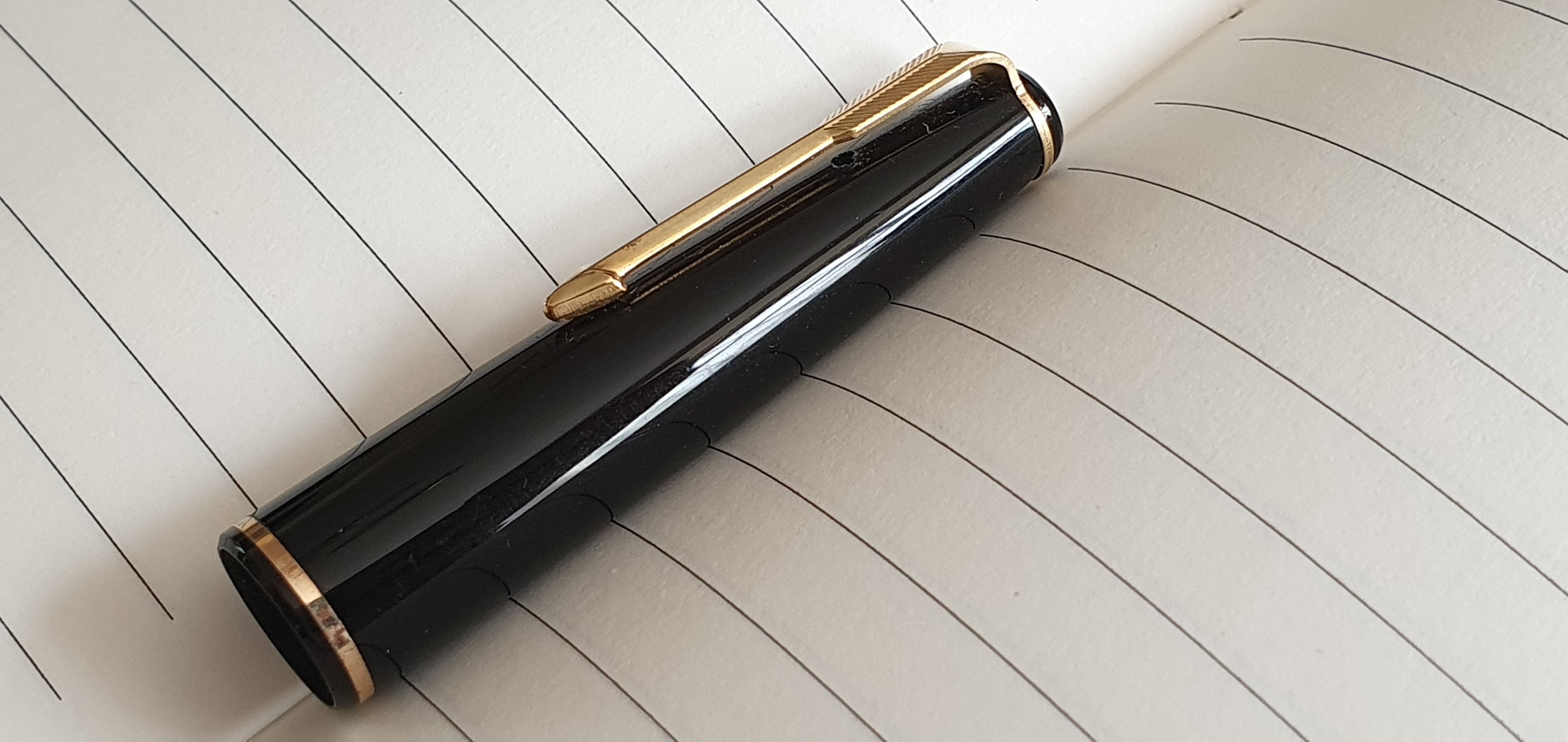
Parker 17 cap.

Now as I approach retirement age, I have long been aware that my understanding of relative values was somewhat distorted. It turns out that a Parker pen nib won’t go very far in covering one’s living expenses, after all. Learning this is one of life’s hard lessons.

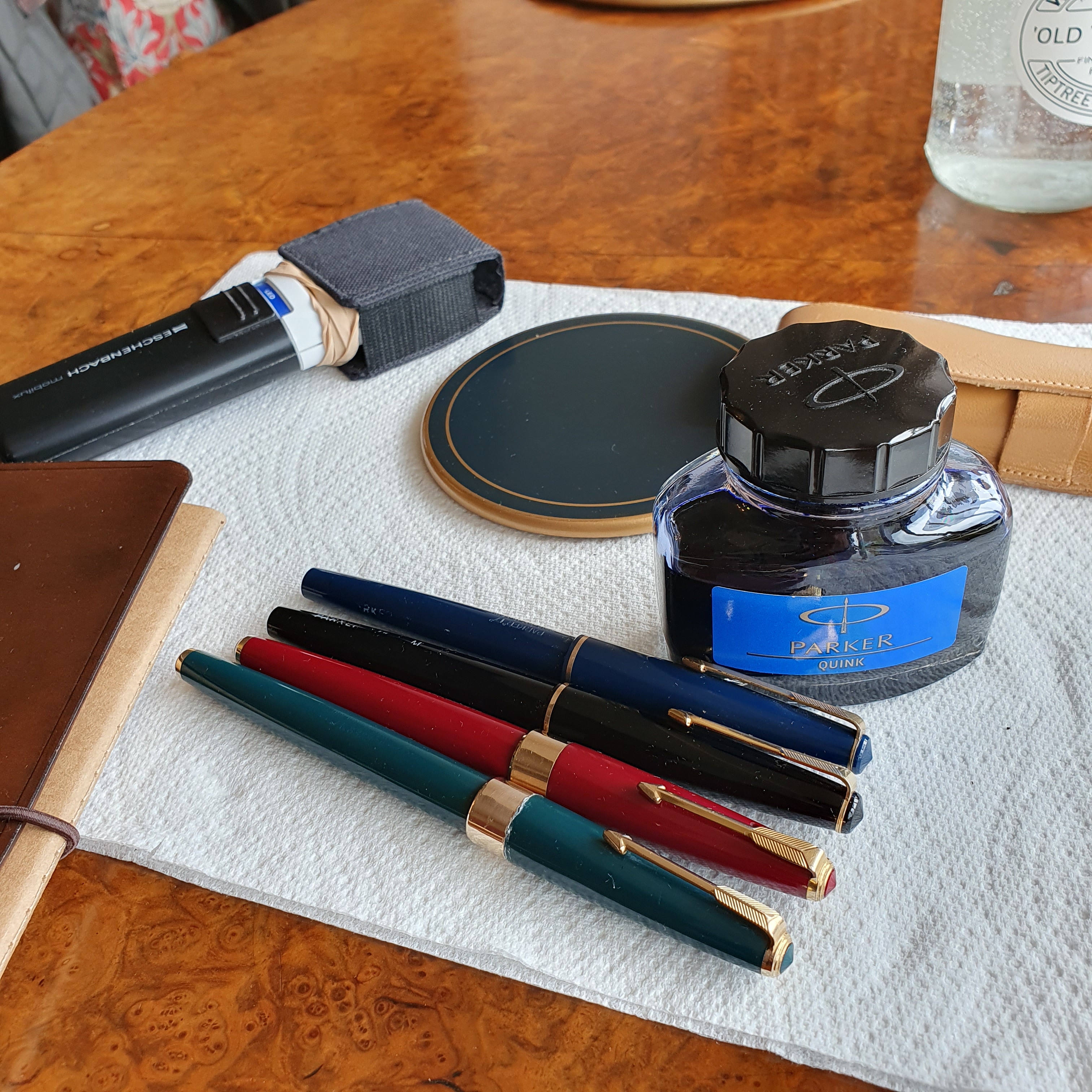
Yet I still have my life-long interest in fountain pens. If my fountain pen journey were likened to a stationery-themed board game of Snakes and Ladders, then you now find me lingering on the Vintage Parker Pens square. A glance of my currently inked pens, of which there are 14, shows that five of these are vintage Parkers, all acquired in recent months as eBay purchases. Oh, and there is one other Parker 17 currently in bits, with the section soaking in a jar of water.

My fountain pen hobby continues to give me a huge amount of enjoyment. How can a value be put on this? In the BBC news, the newsreaders’ first question to their special correspondent is often an open question to quantify the unquantifiable: “So, how worried should we be about…” or “How much of a problem is this?”

As I am now at the age when retirement looms, I am getting to grips with my personal pension plans. The fund value of one of these in particular, has fallen by many thousands of pounds over the last couple of years, which is a depressing thought. But whilst a vintage gold nib will not fund my retirement, I have noticed that the enjoyment of the hobby does go a long way towards compensating for such financial losses, which gives a sense of worth to the hobby. I am constantly grateful for just how much pleasure I get, for relatively little expense, in wonderful combinations of pens, inks and paper. Perhaps my childish sense of relative values was not so far off, after all.

A Parker 17 and a Stalogy A5 notebook.

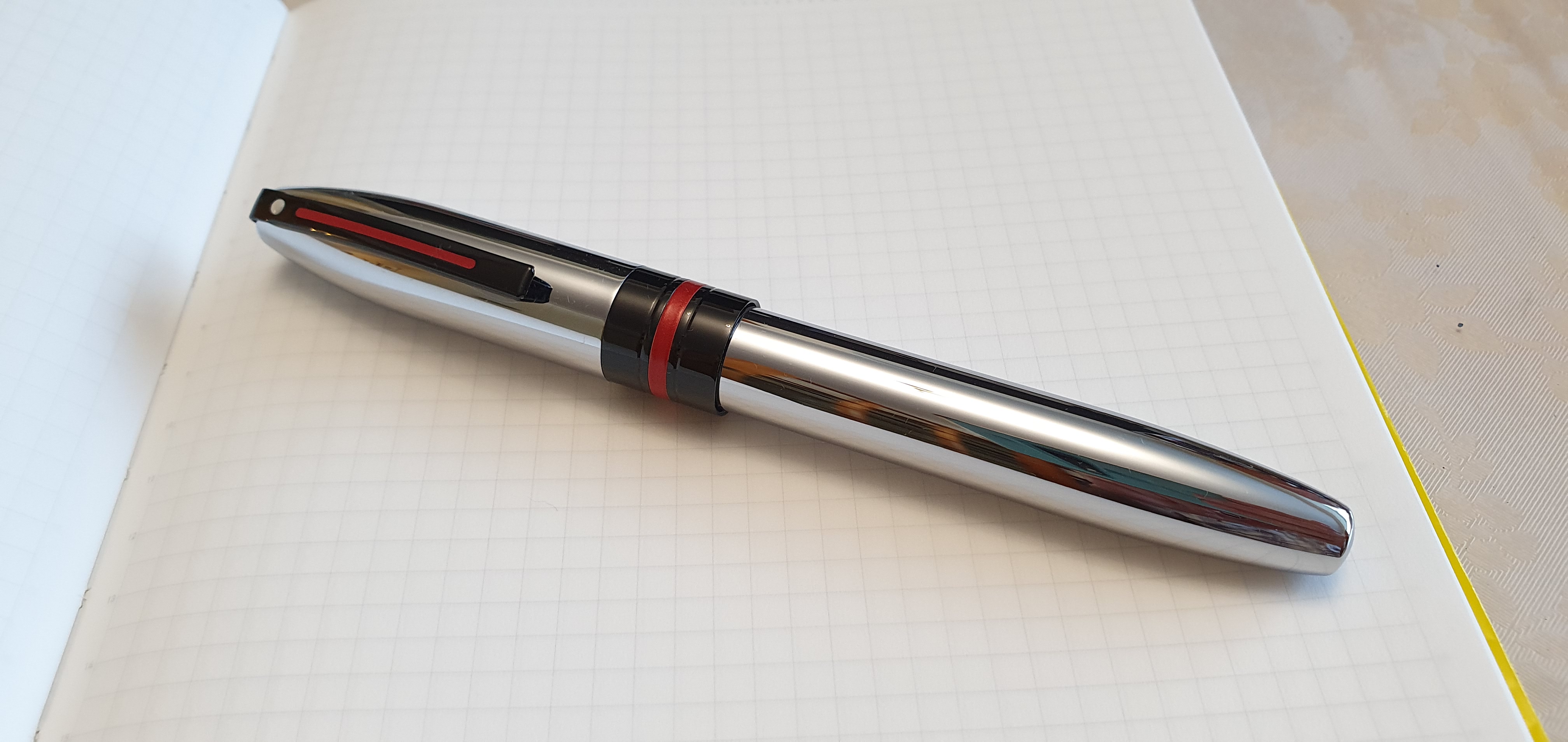
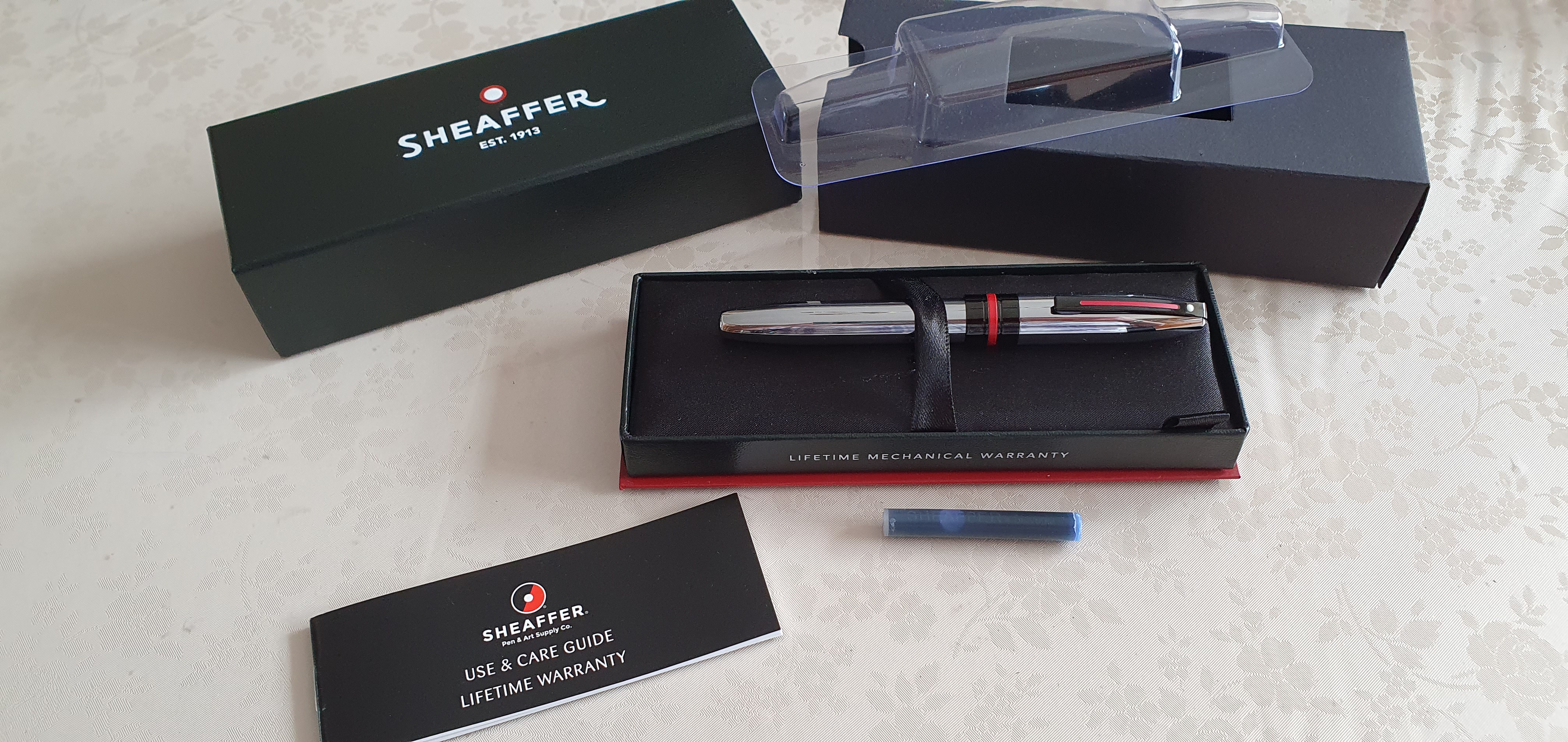
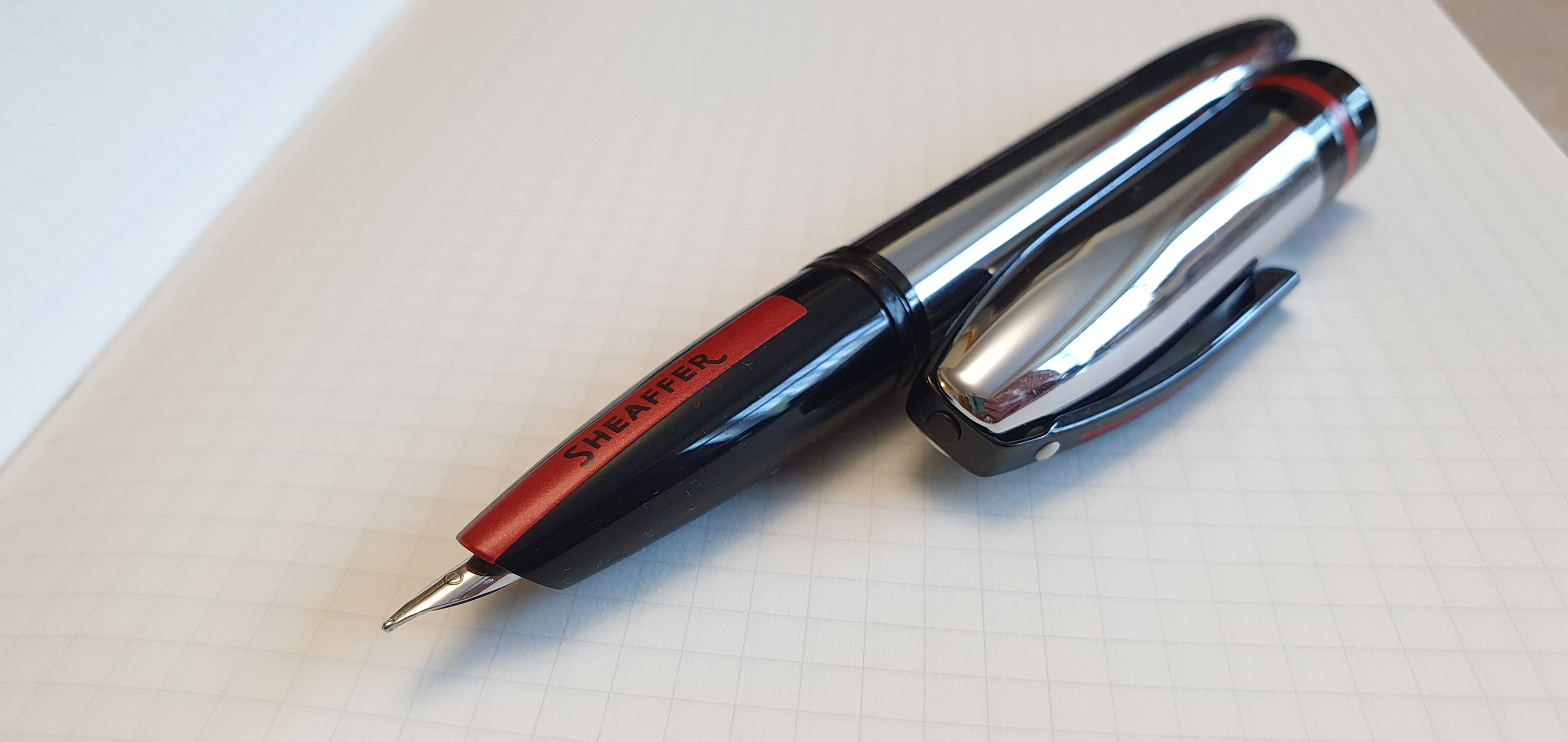
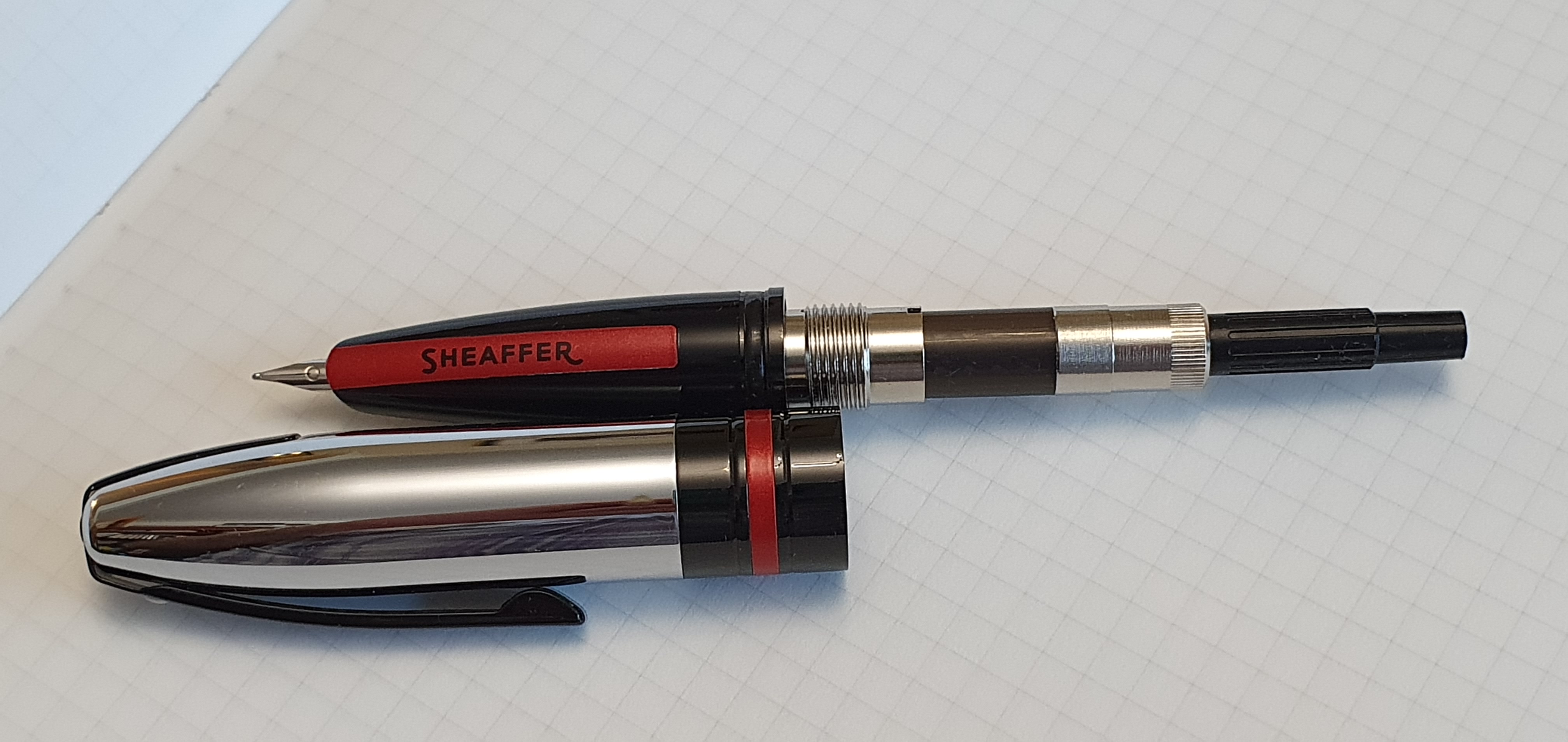
Early thoughts on the Sheaffer Icon, Lustrous Chrome fountain pen.

On a recent visit to my old stomping ground of Uxbridge, in the north west outskirts of London, I took the opportunity to check out the options if one were looking to buy a fountain pen. From my brief reconnaissance, I found three shops: WHSmiths for some entry level Parker and Lamy pens and a few own brand cheapies; Ernest Jones, jewellers for a few Montblancs and finally, F. Hinds, another high street jeweller for some mid-range Parker, Cross and Sheaffer.

It was in the Bracknell branch of F. Hinds in April, that I had first seen a Sheaffer Icon, but did not know its name at the time. I had been struck by the gleaming chrome finish and the contours which harked back to the Sheaffer Legacy, a pen that I admired but never owned.

Sheaffer Icon, Lustrous Chrome edition.

Here in Uxbridge, I spotted the same model Icon in the shop window, displayed next to a matching rollerball. The fountain pen was reduced from £85.00 to £63.75. I went inside to have a closer look.

The sales assistant, a helpful lady named Vaishali, came back outside with me so that I could point out the pen in the window. Ah, the joys of buying from a bricks and mortar shop, which I have missed lately!

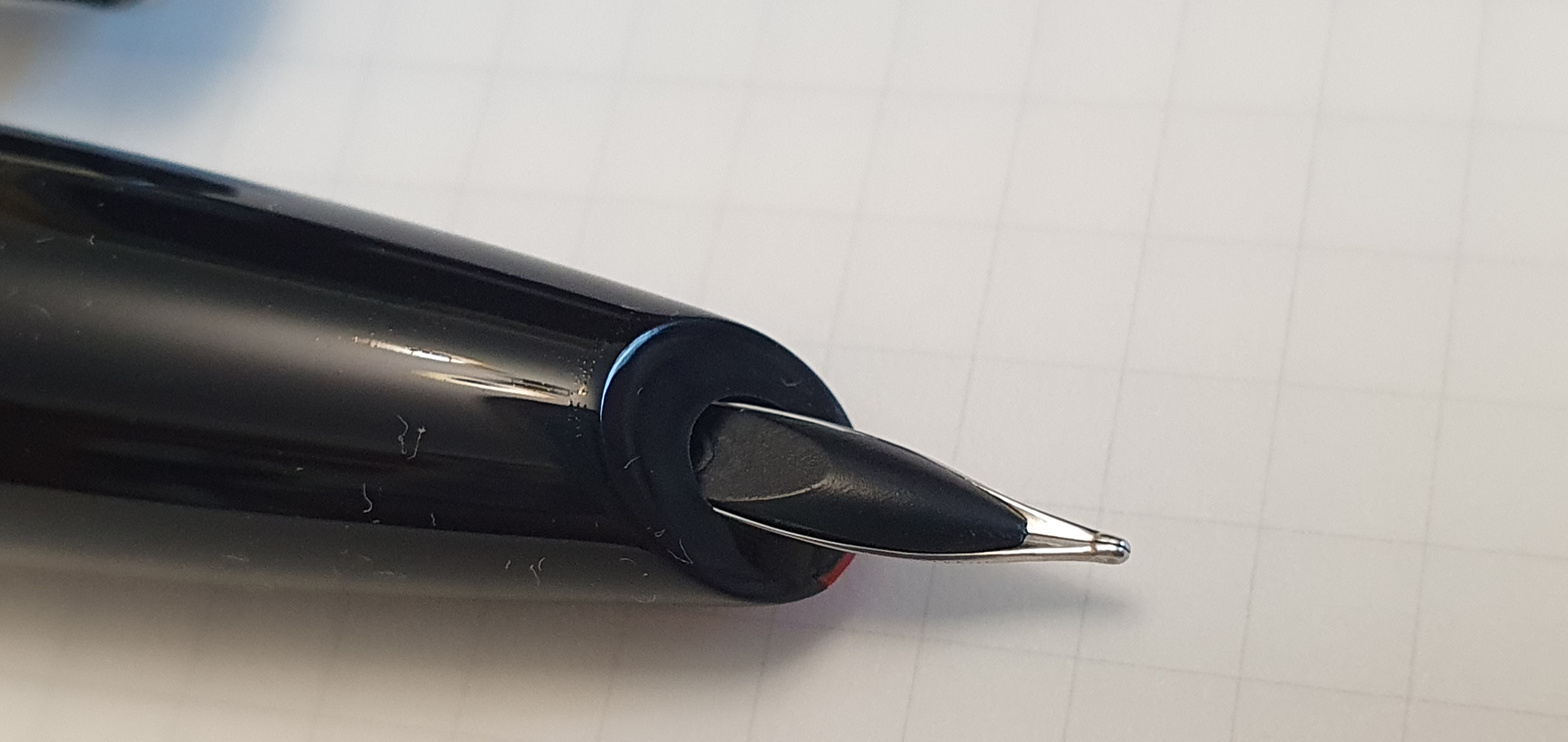
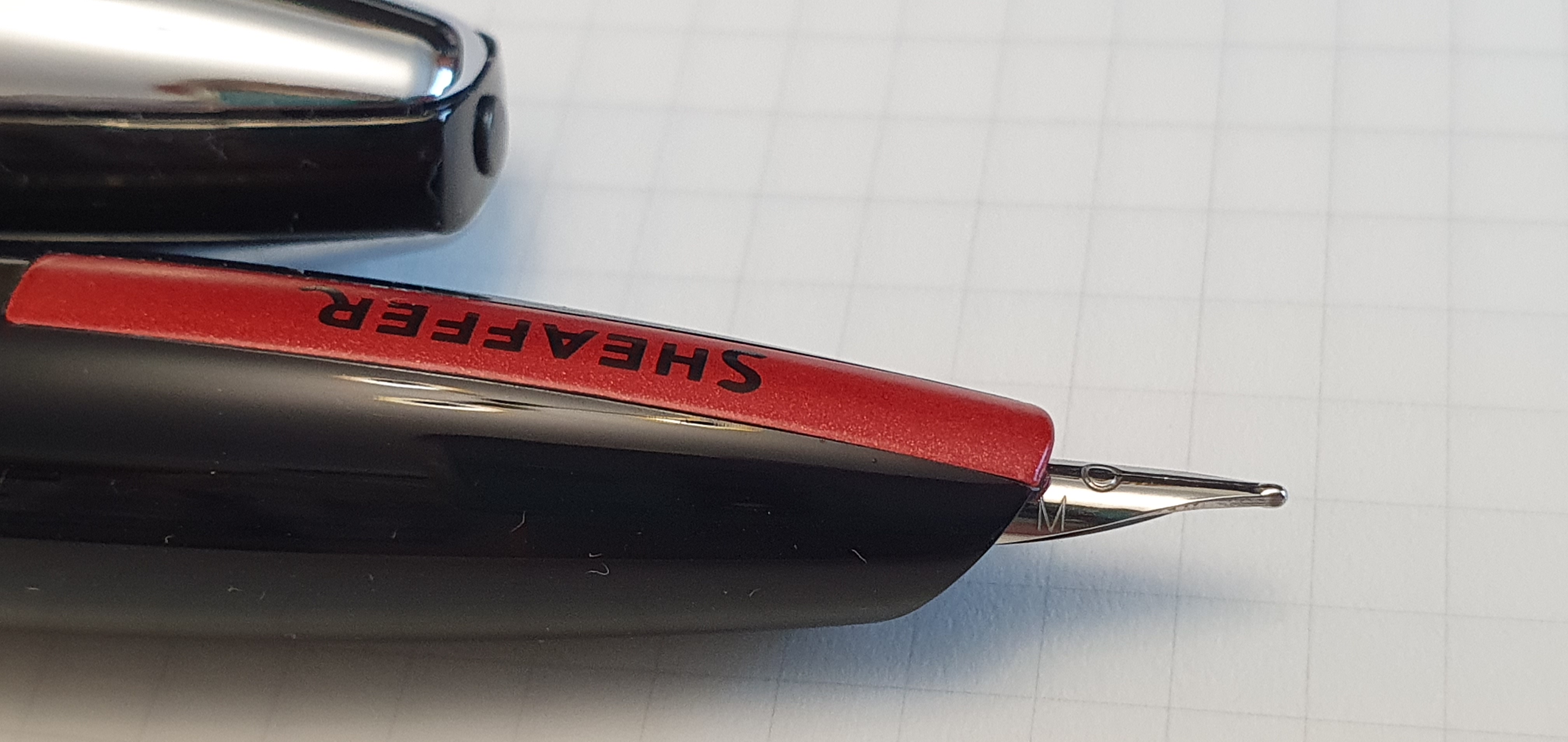
The steel nib is tiny, firm, smooth and a joy to use.

I had a close look at the nib, using the magnifying app on my phone. The pen felt very comfortable to hold with a generous wide girth and no step or cap threads. The nib certainly looked unusual and small in relation to the large pen but appeared to be perfectly aligned over the tiny feed. The tines and tipping and the tine gap all looked spot on. Without needing to try it, I decided that I would take it. Vaishali went to get the box, which she found with impressive speed, unlike my recollections of Paperchase or Rymans where this often means a long wait!

Unusual semi-hooded nib.

The pen came with a converter fitted but the gift box also contained two Sheaffer cartridges, one black and one blue. On a nearby public bench I inserted the black cartridge. I had a Stalogy A5 notebook with me and eagerly put pen to paper. Within a few seconds, ink reached the nib. The nib was very smooth. Ink flow was just right. However the Sheaffer black ink was feathering and bleeding through, even in my Stalogy notebook which normally resists this.

A push-in converter included.

Later at home, I ditched the black cartridge, flushed the pen and filled it instead with Diamine’s Gibson Guitar Series Pelham Blue. This was much better: no feathering or bleeding on Stalogy. Indeed the pen felt so enjoyable that I wrote for five pages. I revisited reviews of the pen on The Pen Addict and SBREBrown.

Unboxing. Two cartridges and a converter included.

Size and Weight.

Length capped134mm
Length uncapped125mm
Length posted145mm
Weight capped / or posted44g
Weight uncapped29g
Weight of cap alone15g
I only found the M later when I got the pen home.

Likes and Dislikes.

Likes:

  • Unusual, sporty design with elements from the Legacy and the Taranis;
  • Striking, bold grip section and semi-hooded, tiny nib – which is exquisite;
  • Comfortable grip, generous girth, no step, no cap threads;
  • Tough, metal barrel and cap; Nib would be protected if the pen were dropped or stepped on;
  • Long enough to use unposted and with a decent heft, without being too heavy;
  • Small nib, (marked as “M”), beautifully set up and which writes a smooth, medium/fine line; A Fine nib is also available;
  • No branding on the outside, except the Sheaffer white dot and, if you look very closely, the name Sheaffer on the far end of the pocket clip;
  • On close examination under a loupe, I found that the red stripe in the cap band and the red portion of the grip section, are glittery!
  • Converter included;
  • Inside, there is a long metal collar to support the cartridge or converter; (this was lacking in my old Sheaffer Connaisseur, where a cartridge could wobble about);
  • Metal threads on the outside of the cartridge collar, meeting plastic threads inside the barrel;
  • Two cartridges included (although the black ink may bleed through)
  • Lifetime mechanical warranty;
  • Comes from Sheaffer, a brand for which I have a long-standing affection (albeit now part of A.T.Cross Company);
  • Nicely presented in a lidded cardboard gift box, with padded pen bed, a clear plastic protector cover, and a compartment beneath for cartridges or converter and the care and guarantee booklet.
  • Is photogenic!
Doesn’t this look a bit like a racing car or an aircraft?

Dislikes:

  • Polished chrome looks great but is a bit slippery when you uncap the pen;
  • The cap posts deeply but not securely (at least, mine didn’t) – although Stephen Brown did not have this problem;
  • Cap is quite stiff to pull off;
  • The metal collar which supports the cartridge or converter, is so long that it leaves little of the converter’s ink reservoir on view;
  • Another reviewer commented that the rim of the cap is sharp, although this did not trouble me;
  • Black ink cartridge included is so wet that it feathers and bleeds badly.

Conclusion.

Overall, I am delighted with the pen, glad that I bought it and happy that it was on special offer. The nib is tiny but a joy to write with. Although the design might not appeal at first sight, I have quickly come to appreciate it.

Travelling with ink: Audley, near Stoke-on-Trent.

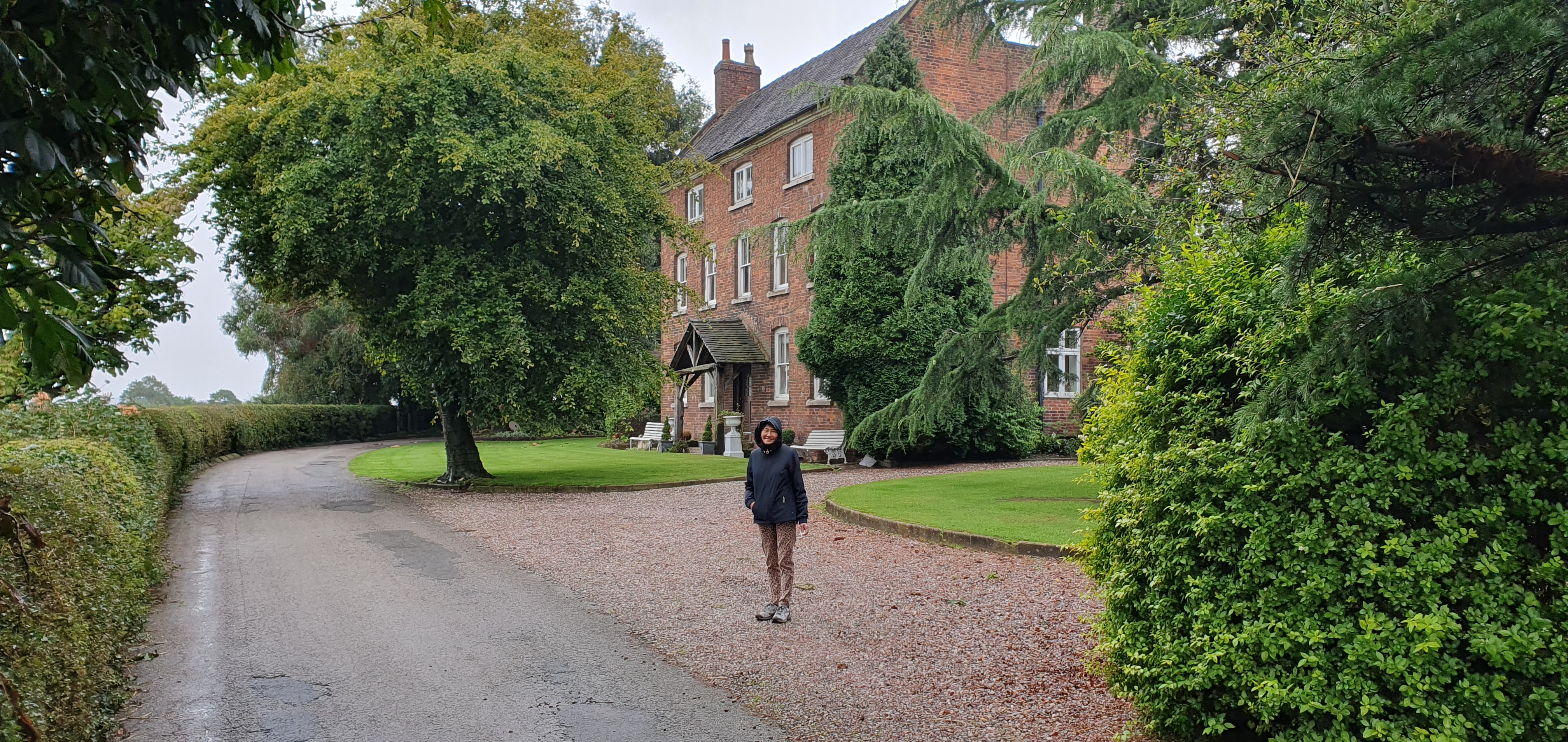
We recently enjoyed a relaxing long weekend break, on a farm. Our accommodation was annexed to the impressive Georgian farmhouse, facing a delightful courtyard. This is a working dairy farm, with 240 acres of land and 400 cows.

Our cottage was annexed to this farmhouse.

During July, I had an outbreak of Parker Pen Purchasing on eBay. The first of these was a Parker 17, in black with a medium nib, which I wrote about earlier. This was followed by a Parker 51 also black, but with an oblique nib which I was very keen to buy. Next, there were two more Parker 17 fountain pens, each for sale by auction. There were no competing bids and I got both 17’s at their opening prices of £16.99 each, plus p&p.

The final purchase was rather more dramatic. I had seen a Parker 17, burgundy red fountain pen, with the open, “beak” nib, made only from 1962 to 1964 and harder to come by. I read that these command a higher price than the later, hooded nib models but had heard good reports of the nibs.

The auction was still several days away. For most of this time, mine was the highest bid but I made a maximum bid, of £59.90. In the tense final few seconds, I watched my screen helplessly as a flurry of increased bids were placed. I was successful! Afterwards, I found that another bidder had offered £58.00 with just four seconds remaining: eBay then bid one pound higher for me automatically, so it was a close shave.

Three more Parker 17 fountain pens. I am hooked on these.

These last three Parker 17s arrived just as we were setting off for our break, so I was able to bring them with me to clean and try out, with a bottle of Parker Quink Royal Blue.

Pen Time on the farm.

It was wonderful to get away and have a change of scene. We were in a rural area with views of fields and trees. Our comfortable cottage had vintage furniture, a large kitchen with an electric AGA and a lounge/dining room which included a grand piano, which I enjoyed playing.

Having a full sized, concert grand was a bonus!

There was time to inspect my three new Parker 17’s. The blue one was a basic, standard model with a medium nib and wrote very nicely, with a pleasing bit of feedback. The green one was the Parker 17 Super Duofold, which featured a wider gold coloured cap-band and a ring on the end of the barrel. However this one had a few issues. The cap-band appeared to have been glued but with glue residue around the edge, on the cap. Also the cap was unusually tight. The grip section was misshapen, as if it had been forced into a cap that was too small. The pen filled normally and the nib was glassy smooth and felt like a broad.

The four colour options of the Parker 17.
The nibs turned out to be Fine, Medium and Broad.

However, the pen would write only for a paragraph or so before drying up and suffering “ink starvation.” A check inside showed that the ink had not got stuck at the back of the sac and so it was not obvious why ink flow had stopped. I suspect that it may be an issue with the air replacement to the sac, rather like trying to pour from a carton of milk with only one opening.

Talking of milk, we were invited to watch the cows being milked in the afternoon. This was a highly informative and memorable experience. The owner had farmed here for 53 years, taking over from his father who came in 1930. These days, the milking process is highly computerised with the milk piped to a large holding tank. The milkman comes to collect, every day including Christmas Day. The milk from this farm, goes to make cheese. Whilst being milked, the cows eat from a hopper of grain, which is automatically piped into the milking sheds from a big silo outside. Each cow is identified on the computer system, which monitors how much milk they yield and how much grain to give them. We were shown the harvester, which cuts grass for silage, the cows’ winter feed. It was quite an education for us city dwellers.

The view from our bedroom window.

We explored the nearby city of Stoke-on-Trent. We browsed the shops and bought some clothes and shoes and enjoyed a meal. There was little in the way of fountain pen action, aside from a WHSmiths with Lamy and Parker pens for the “back to school” season. Looking at these, I felt that my vintage Parker 17s with their 14k gold nibs were a better buy.

Returning home, I found that my Quink bottle had leaked. It was only around the cap and had not done any harm except that I got it all over my fingers. Fortunately it was Washable blue, but I might not chose Quink bottles for travel next time.

The Parker 17 with beak nib (1962-1964 only).

On how I did not buy a Montblanc Meisterstuck 149.

Although I have bought my fair share of costly fountain pens over the years, I still feel that one of my attributes, or my “super-power” amongst the fountain pen community, is the ability to enjoy some inexpensive pens, just as much as expensive ones. This is a benefit for which I am most grateful.

In theory, this should enable me to save a lot of money. In practice however, I am still tempted when I come across a more “luxury” pen, especially if it is on a special offer.

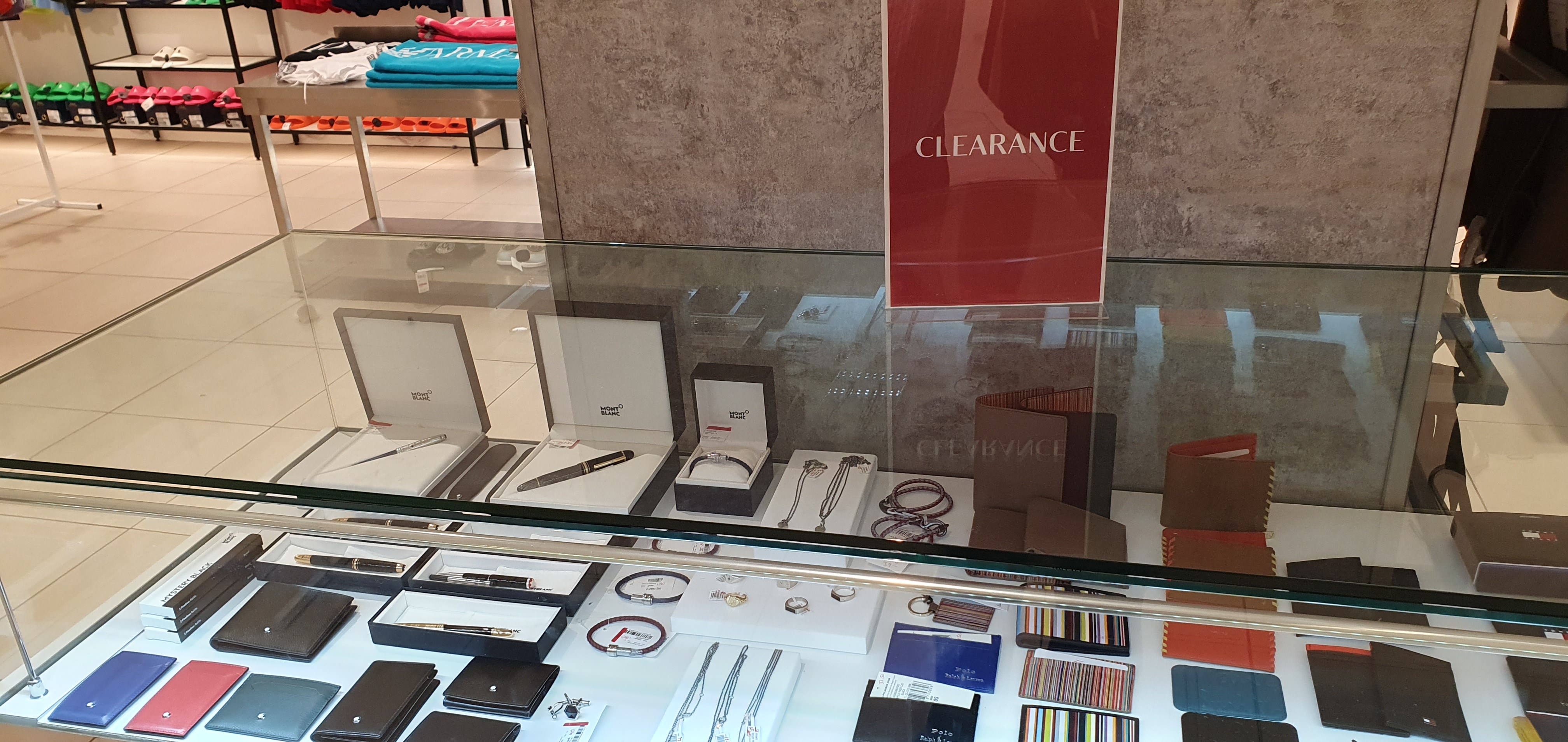
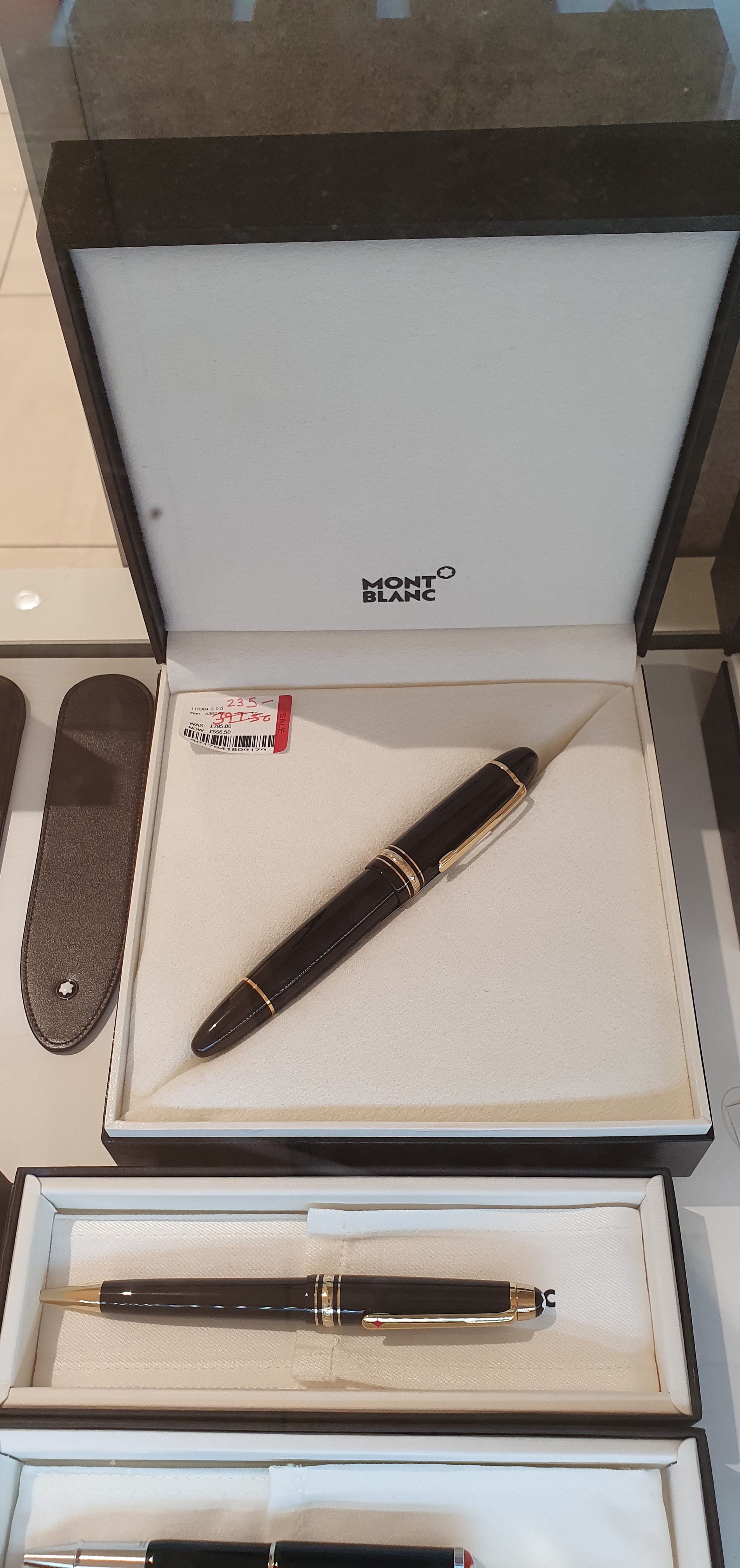
Recently, I found myself thinking that I was as happy as can be using the vintage Parker 17, with Parker Quink blue black ink picked up on ebay for a modest £12.00 plus post and packing, with a notebook costing £4.00 from Flying Tiger. So, I should have the courage of my convictions, stand by my principles and act on them. Yet, within the last week or so I have been tempted three times: first by a Parker Sonnet Cisele, (reduced for Clearance in the John Lewis sale, from £366.00 to £183.00), then by a Cross Townsend Medalist, (with 23k gold-plated nib) reduced from £175.00 to £87.50 in Daniels of Windsor and then finally, by a Montblanc 149, black with gold trim, reduced from £795.00 down to (wait for it…) £235.00.

Montblanc 149, back row, second on the left.

Having withstood the test of the Parker and the Cross, the Montblanc offer pushed me to my limits. I was very surprised to see in Fenwicks, Brent Cross, a glass display counter of Montblanc pens and a few of their leather goods in a glass display cabinet marked “CLEARANCE.” This was extraordinary and I had never seen them discounted before.

A 149 for £235!

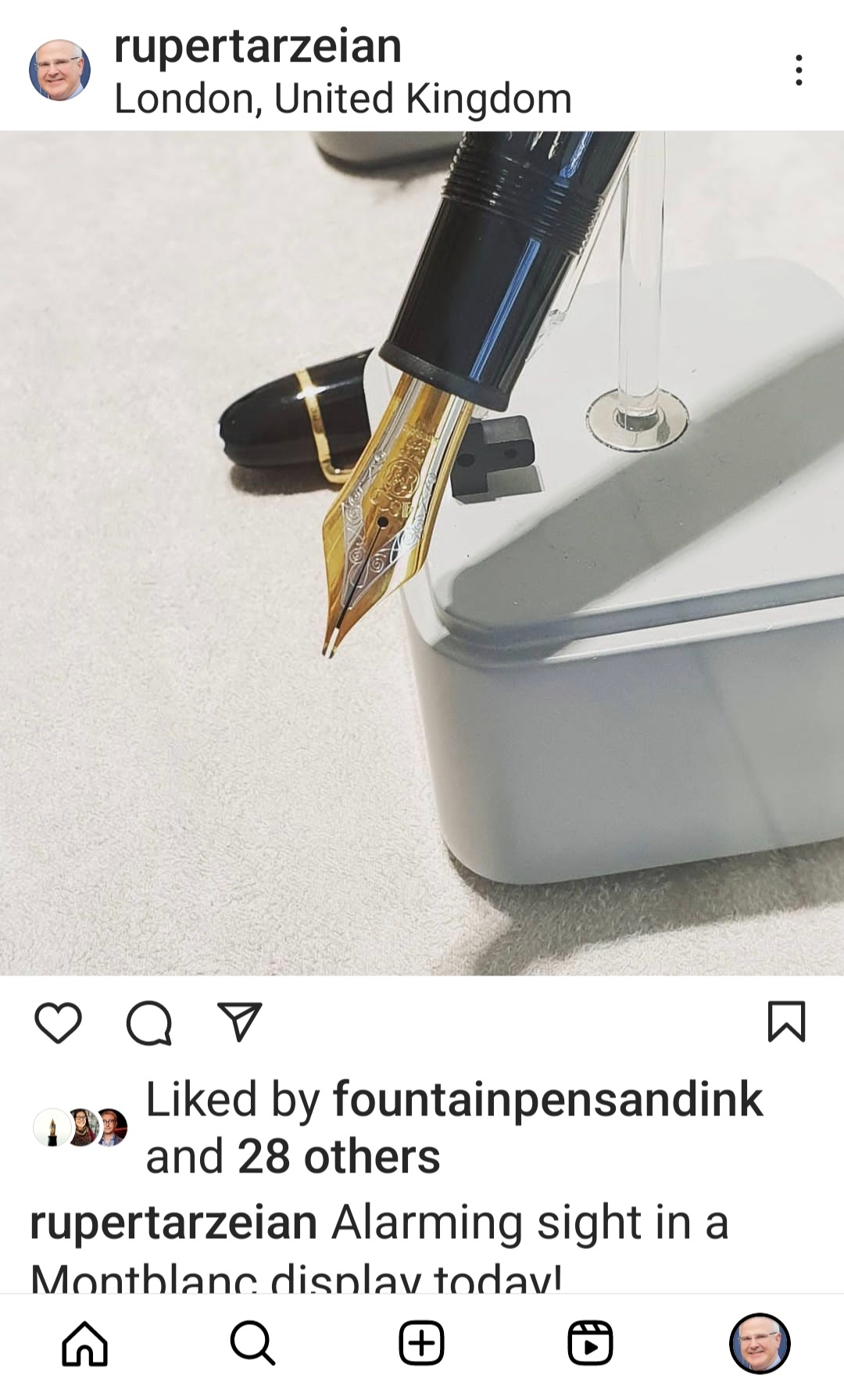
I summoned a sales assistant to unlock the cabinet for me. I first wished to check that it was a fountain pen and not a rollerball. The good news was that it was the fountain pen; the bad news was that the nib had been sprung and this was the reason for such a large discount. I recalled having seen the pen and posting a picture of it on Instagram, back in November 2021.

My photo from November 2021.

I do not have a Montblanc 149. I have often admired them in Selfridges and elsewhere but had never been tempted to pay full price for one. I had to make a decision. The pen would not write in this condition and would need some nib work. I wondered whether this might be a simple fix, just turning the nib over and flexing it downwards against my thumb-nail, just bouncing it back down very gently until the tines came together and then getting the tipping aligned. Gold is soft and can be bent quite easily but there is a risk of ruining it. Montblanc offer a nib exchange within 6 weeks of purchase but the nib must be in mint condition. Most likely, I would need to get a nibmeister to work on it, possibly at a pen show or else send it away. I wondered how long this would take and what it would cost. However, the discounted price allowed an ample margin to cover nib work, or even replacement and still be well under list price (which has now risen to around £855 I believe).

I did not buy the pen immediately but decided to think it over. I did some research online into Montblanc nib servicing or replacement. I also looked at various Montblanc nib-removal wrenches on ebay.

That evening, I posted a photo of the pen clearance display on Instagram. Three of my friends helpfully chimed in with encouraging comments. Jon wrote “I am sure that it could be fixed at a forthcoming pen show….”. Anthony wrote “That is an irresistible bargain!” and Allie added “You could have it repaired. I am not helping am I?” (laughing face emoji).

I gave myself a night to sleep on it. Do I like a challenge? Does it excite me or do I shrink from it? There is potential for satisfaction and a sense of achievement. But why take the risk? Does the potential benefit outweigh the risk? And how badly do I really want a 149 anyway? I have some Jinhao X159 fountain pens of similar dimensions and the wide girth is not my ideal choice. On the other hand, the pen needed rescuing. If I did not buy it, who would? Do it for the pen, and support the economy and a bricks and mortar shop! Be brave and do something wonderful! All of these thoughts and more were swirling around my head.

Come the following morning, I was leaning towards liberating the pen, and decided at least to go and have another look at it – assuming it was still there. I did not rush to get there at opening time, but gave it an hour and half or so, figuring that if someone else had bought it, the decision would have been made for me.

Back in Fenwicks, the pen was still there in the locked display counter. However, a gentleman was also eying the pen and the other Montblancs, for which the prices were not visible. I knew from my previous visit that these were the Montblanc “Around the World in Eighty Days” edition fountain pens, in 146 (Le Grand) and 145 (Classique) sizes and both were reduced to about half list price and was able to tell him this before the assistant came to open the cabinet for us.

It transpired that this gentleman, who I now know to be Edmond, had seen my post and driven over to look at the pen (if I had not already bought it) and that he was also interested in a cute Montblanc Baby rollerball, which he had also spotted in the photograph.

We both examined the 149 at length and he thought it worth a punt. He proposed to buy it, if I did not do so, but felt that I should have first choice in the matter, it having been my spot. It fell to me to make my mind up. It was undoubtedly a very tempting offer. However, I eventually concluded that I could happily go either way on it and, feeling magnanimous and a gentleman, I announced that I would like him to have it, whereupon he shook my hand and declared that he would buy me a coffee and a pastry.

It was his intention to buy the 149, plus the Le Grand and the Baby rollerball and asked whether a further 10% discount might be available if he bought all three. We were told that this would be up to the manager, who was in a a meeting but would be back in 15 minutes or so. Meanwhile, the assistant put the pens aside for him and we went for our coffee upstairs in Cafe Nero. We had a most enjoyable natter, finding that we had many other interests in common including photography, cameras and watches, as well as fountain pens.

Returning to the pen counter, the manager was now back. No, he was not willing to give any further discount which was a little disappointing. Nevertheless, Edmond went ahead with his purchase of the three Montblancs anyway. I congratulated him and wished him enjoyment with his new acquisitions and we parted on excellent terms.

Later, having time to reflect, I was happy with my decision and also that the 149 had gone to suitable owner who would ensure that the nib received the care and attention that it needed. I meanwhile continue to enjoy my budget priced Parker 17 and a warm and fuzzy feeling of goodwill.

New pen day: another Parker 17 arrives.

Occasionally, everything goes right with a pen purchase. One evening last week, whilst browsing Parker pens on ebay, I came across a Parker 17 in black with gold trim, for sale at the very reasonable price of £12.00 plus post and packing. The description read “Parker 17 Aerometric/Reservoir Fountain Pen. Black & Gold. VGC/Desk.”

Parker 17. White markings still present.

Readers may recall that I have a burgundy Parker 17 with an oblique nib, bought at the London Pen Show in March 2023. I could not resist buying another, this time in black and with a medium nib.

The seller despatched the pen the very next morning by Royal Mail and it was delivered at 8.20am today. Any worries that I might have had about it being damaged in transit were soon dispelled. It was expertly packed in a cutaway between two blocks of foam polystyrene and secured with brown tape, snuggly inside a cardboard outer box. It could not have been better protected.

THIS is how to protect a pen.

I read on Parkerpens.net, an informative site run by Swedish pen collector Tony Fischier, that the Parker 17 was introduced in 1962 and the hooded nib versions in 1964. The line was discontinued in 1972. Accordingly any Parker 17 that you see now, must be at least 50 years old.

Hooded nibs on the Parker 17 began from 1964.

Examining the pen, initial impressions were very favourable and kept getting better. The glossy black cap and barrel with gold trim, looked classically handsome. Aside from a few minor scratches, there were no cracks or chips. The white chalk or crayon markings on the barrel reading PARKER “17” M, (which easily wear off) were still intact, suggesting that the pen had been handled very little. Also, the engravings on the barrel, PARKER “17” MADE IN ENGLAND, with the Parker symbol, looked as fresh as if they had been made yesterday.

Often these engravings are so worn as to be barely legible. This one is like new.

Removing the pull-off cap, the hooded nib looked in great shape and showed no signs of wear. There were slight traces of ink and paper fibres between the tines and I gave the nib a rinse in water and flossed the tines lightly with a fine brass shim. The nib needed no adjustment. There was the desired gap between the tines, narrowing down to the tipping material which was rounded and symmetrical and the tines were in perfect alignment. All good so far.

Small but perfectly formed.

The aerometric filler (which all Parker 17s have) was clean, with no ink stains and I wondered whether the pen had ever been inked (although it had at least been dipped). The metal housing of the sac looked like new, with no corrosion. Flushing the pen in water, the sac drew up a progressively good fill with about ten squeezes of the bar.

Aerometric filler, looking as good as new.

Cleaned and dried, I was ready to ink it up with Parker Quink blue black. I am glad to say that the pen wrote beautifully, with a good medium line, smooth and with no scratchiness. Indeed it was like new. There is just a little skipping sometimes if the nib is not quite held at the sweet spot. I expect this to resolve as the nib gradually wears in. Applying a little pressure opened the tines at the tip and produced a broader and wetter line. Quink blue black is a good shading ink. I found that I could use both underwriter and overwriter styles although the pen performed best in the underwriter, upright style. (The opposite is true with my burgundy version with its oblique nib). It measures 123mm uncapped and 143mm with the cap posted which I prefer.

Trying out the medium nib on the Parker 17 with Quink blue black ink. Notebook from Flying Tiger, 8mm row height. Bliss.

All in all, I could not be more pleased with this purchase.

Happiness in a bottle.

Two fun nibs for lefties.

Left handed writers have a disadvantage when using fountain pens, compared to right handers. Typically, there will be less ink flow when the nib is “pushed” along the line, as opposed to being “pulled” along, writing from left to right. Less ink flow means less lubrication and a less smooth writing experience.

Secondly, if the lefty writes with a hooked wrist, there is a likelihood of smudging the wet ink as his hand passes over it.

There are two main styles of writing for the lefty: these I call “underwriting”, by which I mean writing with the pen under the line, with the back of the pen pointing towards the body, or “overwriting” where the hand is above the line, and the back of the pen is pointing away from the body. Many overwriters hook their wrists. As a lefty myself, I am most comfortable when using the overwriter style although I have my own particular method which I developed as a child and still use. Instead of hooking my left wrist, I rotate the paper about 45 degrees left (or anti-clockwise), adjusting the paper rather than my wrist.

One of the joys of using a fountain pen is the ability to produce lines of varying width. We have all seen beautiful copperplate calligraphy with attractive fine and broad strokes, adding character to the writing, such as a thickening in the tail of a lower case letter “y”.

One way ito achieve line variation is to use a flexy nib, where the tines widen as you apply pressure. However this is not suitable for a lefty overwriter as you can apply pressure to the nib only when pulling it back, not when pushing it forward.

The other way to achieve line variation, and which is more practical for us lefties, is to use a stub nib which will produce a broad line up or down, or a fine line left or right, assuming it is held at a consistent angle.

The opposite effect is achieved by using a nib with an “architect” grind, which produces a fine line in the down stroke, and a broad line in the cross stroke. Such nibs are not usually available with a new pen and so require some specialist work by a nibmeister.

However, a similar effect to the architect grind, can be readily enjoyed by using a “bent nib” where the tip is bent upwards to create a flattened, elongated writing area, again producing a fine line in the down stroke or a broad line in the cross stroke.

Today I want to highlight two of the fountain pens that I particularly enjoy using at the moment. The first is the Delike New Moon, an inexpensive Chinese pen bought on Amazon and described as having a “bent” nib. I now have three of these, in different colours. I like the effect that the bent nib has on my handwriting when I use the underwriter style, giving narrow down strokes and broad cross strokes although the difference is subtle.

The upturned “bent” nib of the Delike New Moon.

The nib is very versatile, being capable of four distinct line widths. Held normally, it writes a medium line. Hold it more vertically, and it will produce a fine line, or lay it back at a lower angle than normal and apply a little pressure and you will get a broad line. Turn the nib over and “reverse writing” will give an extra fine line, when needed.

But here is an interesting thing: the bent nib produces fine down strokes and broad cross strokes, when used in the underwriter style. But if used in the overwriter style, the fine and the broad strokes are switched. Take the capital A for example and see how the fine and broad lines are reversed, in these two writing styles.

Subtle line variation from the New Moon, in underwriter mode. Pilot tsuki-yo.

The other pen that I am much enjoying, is the vintage Parker 17, with an oblique broad nib, bought at the London Pen Show in March this year. Ironically, at £30.00 it was one of the least expensive of the seven pens that I bought myself that day yet probably has the best effect on my handwriting.

Parker 17, with Oblique nib.

As opposed to the bent nib pen, the Parker’s oblique nib produces broad down strokes and fine cross strokes, used in an underwriter style, and the opposite if used, (as I prefer) in the overwriter style.

Writing samples from the Parker 17. Quink blue black. Note how the thick and thin sides of the A are reversed, in the overwriter and underwriter styles.

Currently, of the nine inked fountain pens in my ink cups, these are two that I reach for the most and provide the most enjoyment, out of all proportion to their modest cost. The Delike New Moon is inked with Pilot Iroshizuku Tsuki-yo, whilst the Parker 1 7 is inked exclusively with Quink Blue black. Both are very pleasing combinations. The Parker 17 with its oblique nib was a very lucky find at the pen show as medium nibs were much more common. There was a crack to the shell, just above the nib to which I applied some superglue. It does not leak and the pen writes wonderfully. The crack is still visible but in a way the pen is all the more endearing for this, rather like a Japanese Kintsugi bowl.

As well as the line variation, I also enjoy the shading from the Quink blue black ink. I need to write a bit slower with the Parker, to keep it from skipping but slowing down helps me to keep my writing more tidy and legible and reduces mistakes.

In a hobby where there can be temptations to spend ever increasing sums of money for one’s next best pen, it is worth remembering that the simple joys of line variation and shading, particular to fountain pen use and helping your handwriting to look its best, can all be had without breaking the bank.

Goodbye to Paperchase.

In recent weeks we have witnessed the disappearance of another well-loved chain of shops from our high streets and shopping malls. Now the UK’s Paperchase stationery stores have closed.

This means the loss of 106 stores, 28 concession stands (in shops such as Next and Selfridges) and the loss of some 820 jobs. As well as being a familiar presence in the shopping centres, there were Paperchase shops at some railway stations too.

At the eleventh hour, the supermarket giant Tesco stepped in and acquired the Paperchase brand. It remains to be seen what they will do with it. The Paperchase shops are gone. If you click on Paperchase’s web site, you are now diverted to Tesco and greeted with a message that Paperchase online and UK Paperchase stores are now closed and that “we look forward to bringing this well loved brand to Tesco.”

Paperchase was founded in 1968 and grew to be a familiar sight, along with stationers Rymans and WHSmiths. The branches were not all identical but were bright and inviting to browse in, featuring a large selection of greeting cards, shelves offering numerous styles of notebooks in all shapes and sizes, tables of toys and novelty products appealing to children, loads of stationery accessories, pots of colourful pens and, in some stores, displays of fountain pens in glass cabinets. These might included Parker, Cross and Kaweco and a few others although generally none too expensive for an impulse buy.

The Paperchase logo on the back of a journal.

Over the years, I visited Paperchase a lot. If my wife and I came across a Paperchase we would pop in for a look round and often buy something.

Today, looking around my writing space (aka the dining room) I rounded up just some of the products that had come from Paperchase, for a team photo. These ranged from packets of standard international cartridges in a variety pack (I seem to remember that they had once cost £2.50 for a bag of 50), through literally dozens of notebooks, pads of writing paper and file paper, to a few memorable pen purchases.

A quick round up of just some of my Paperchase purchases over the years.

If you chose a fountain pen from the display cabinet, the staff often struggled to locate the box. My favourite Paperchase story (told here before) is of once buying a handsome Cross Century II fountain pen in black with a chrome cap, at the price marked on the display. Several months later, I was in the same shop and saw the matching Cross ball pen and asked to buy it. This time, they were unable to find the box and its code in order to sell it. Eventually, it transpired that it could be sold only as part of a set with the fountain pen. After proving that I had bought the fountain pen already, they agreed that the ball pen was mine too!

Loose cartridges from my first variety pack. I have a lot of pinks left.

I remember where I was when I bought my first Kaweco Perkeo: it was the Paperchase shop in St Peter Port, Guernsey. The pen was a success and I later stocked up on about five more, in various colours. This pre-dated my same behaviour with the Cross Bailey Light, although those were not from Paperchase.

However, my greatest dependence on Paperchase, was for notebooks and journals. I remember discovering the little chunky black A6 journals with a staggering 600 pages of squared, fountain pen friendly paper. I bought a couple of those and was sorry when on a later visit, they seemed to have ceased selling them. But then I later found them back in stock again a year or two later, I binged on another three! They were great, such as for jotting down trivia when watching tv or listening to music online. They would last for ages.

One of my favourite Paperchase products. Actually 600 pages.

Paperchase had a wide choice of journals. Some had paper that was not fountain pen friendly. I liked the A6 flexi-covered books, nicely stitched, with 320 pages of either lined paper (8mm line spacing) or plain paper, both of which were great for fountain pens. They were usually £8.00 each and occasionally reduced in a sale. I tended to buy more than I needed (an understatement).

Paperchase A6 journals, of various designs.

For larger, A5 journals, Paperchase once sold journals with bonded black leather covers, with 384 pages of smooth, lined paper, with a generous 10mm row height. I used these for more lasting projects, such as memories of my school days and would enjoy writing in these with various fountain pens and inks.

A few of the more luxurious, bonded leather covered journals.

Paperchase also had an online service, although I did not use it as I was well served with branches in London. But I did make use of their loyalty card. If presented when making a purchase, you would be given an offer with your receipt, for a discount on your next purchase, subject to various conditions. I once bought some pads of file paper, only to be told that there was nothing to pay as it was all covered by accrued benefits. I was very fond of their pads of file paper, which I use at home and at work. Not only was the paper of good quality but also, the pages could be torn off the pad easily without ripping the paper, unlike some I have used.

Paperchase pads of white A4 file paper. They also had yellow paper.

The final months of Paperchase’s departure have been sad to see. I visited the branch in Windsor and bought a few more pads of file paper. The staff had just heard the news of the closures and did not know what the future held for them.

I was at the O2 Centre in Swiss Cottage when I saw the massive black-on-yellow posters in the shop window, announcing the closing down sale. I went in to look round, but most of the stock had gone. What was left was all discounted and it was unclear what the final price would be. I picked up a few small items, such as Lamy ball pen M16 refill, marked at £3.75 but which came to only fifty pence when rung on the till. Similarly, a clear plastic ruler was only a few pence.

One of Paperchase’s occasional, own-brand cartridge pens.

On visiting Bracknell recently, and also Southampton, the Paperchase stores were dark with their shutters down. I almost took a photo of the sad looking shop fronts, but it seemed like gloating.

I have been sorry to see Paperchase go. I will miss them. I read that the company had suffered years of plummeting sales and soaring costs and was a victim of the Covid lockdowns and the growing shift to online shopping.

But we had many good years. I will wait to see what becomes of Tesco’s involvement. If some of the better notebooks and journals can be offered through Tesco’s many stores, this will be some consolation.