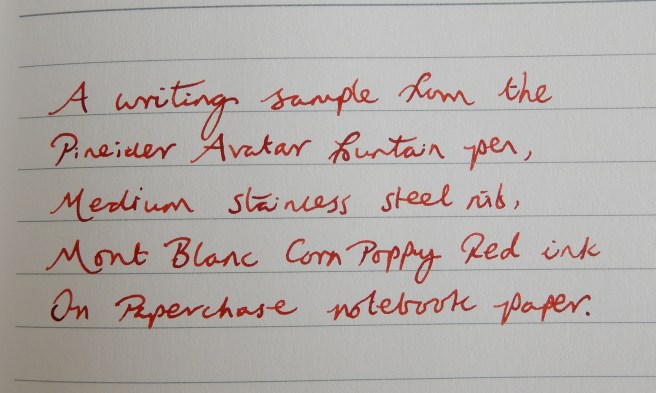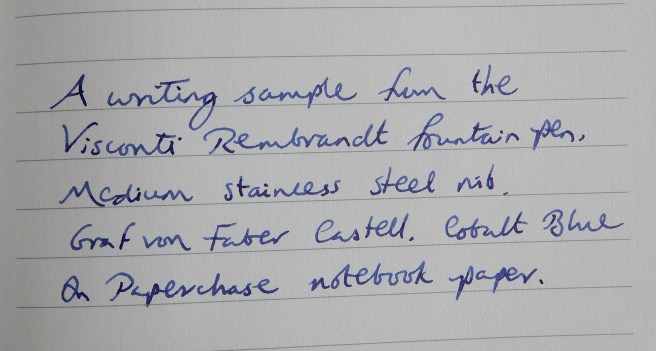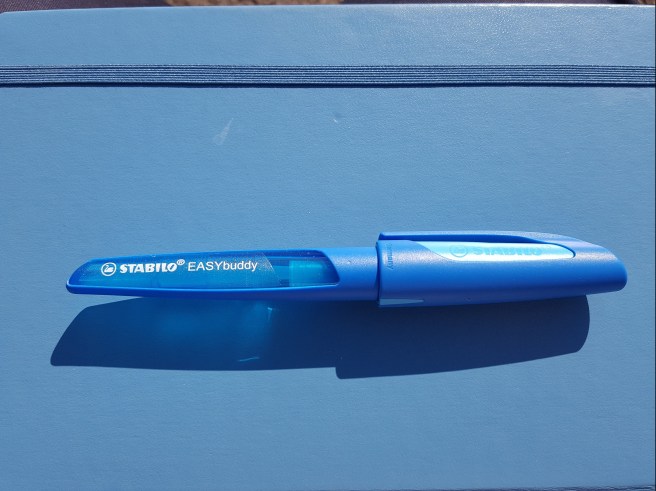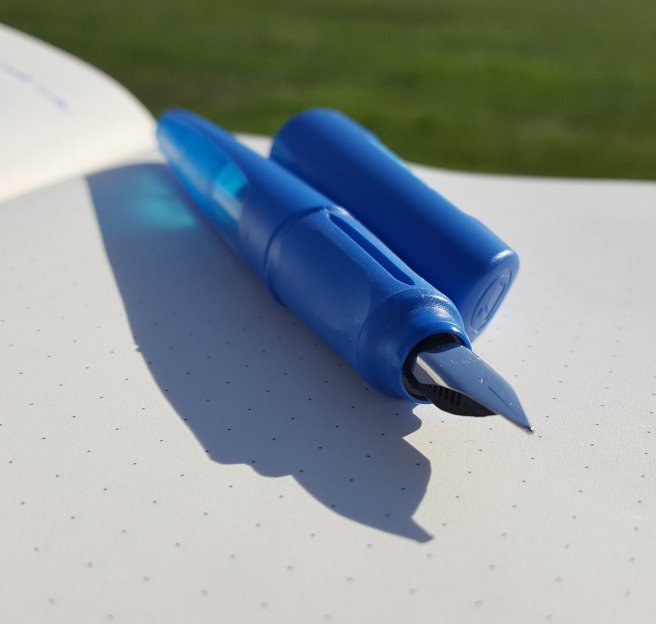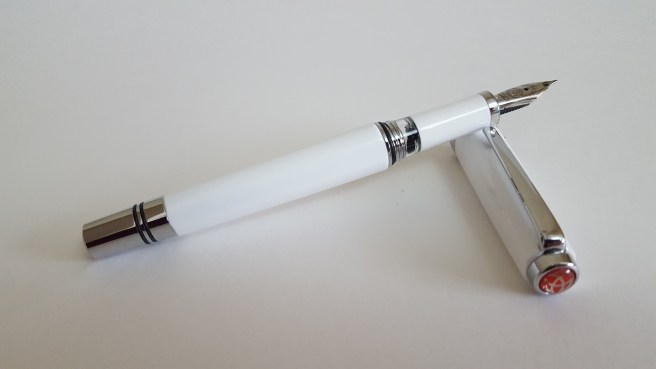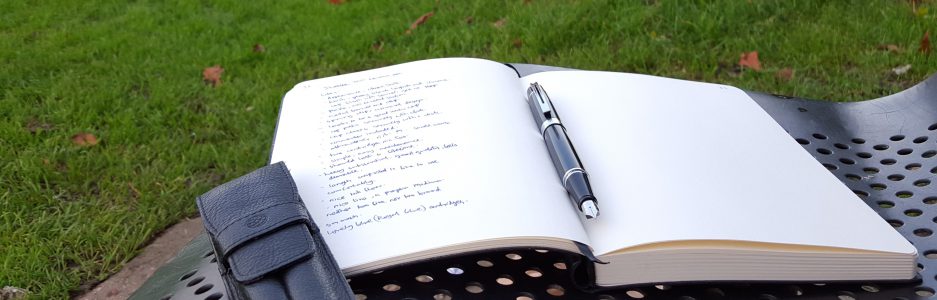
In June of last year, I stumbled across the new Kaweco Perkeo fountain pen, in Paperchase in St Peter Port, Guernsey. I bought one in each of the two available colours. My subsequent blog posts about them (A peek at the Perkeo and Kaweco Perkeo, a brief update.) attracted more views than any of my other posts, (after being mentioned on FPN) and so there has evidently been much interest in this model.
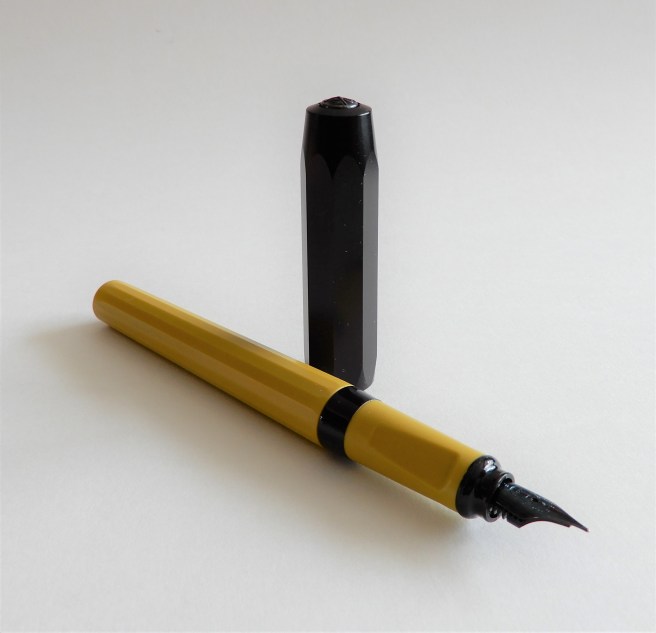
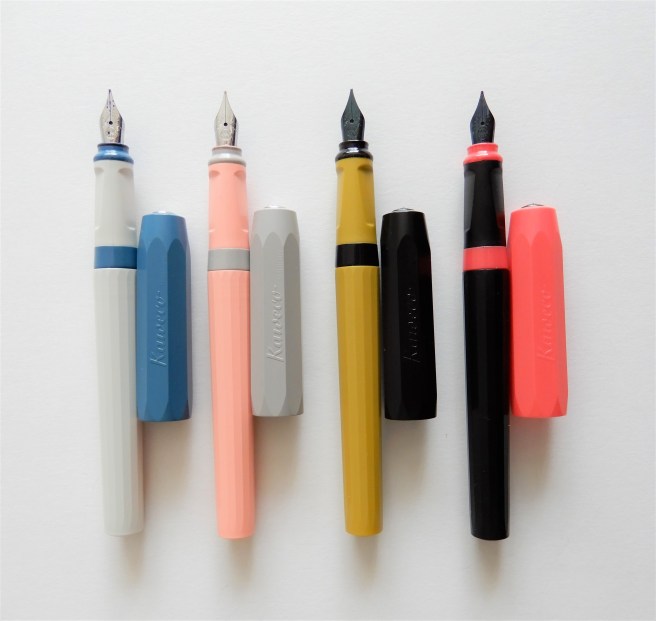
For almost a year, it seemed that only those two colours (Old Chambray and Cotton Candy) were stocked in the shops, although two more colour combinations were available online. But in May 2018 I first spotted the “Indian Summer” version, again at a branch of Paperchase (this time, in London’s Brent Cross shopping centre) and bought one on the spot. This is the mustard coloured barrel with the black cap. However it also differed from my previous two models, in having a black nib (or rather a stealthy gun-metal blue-black) in a Fine.
Kaweco Perkeo Indian Summer, with Fine nib.
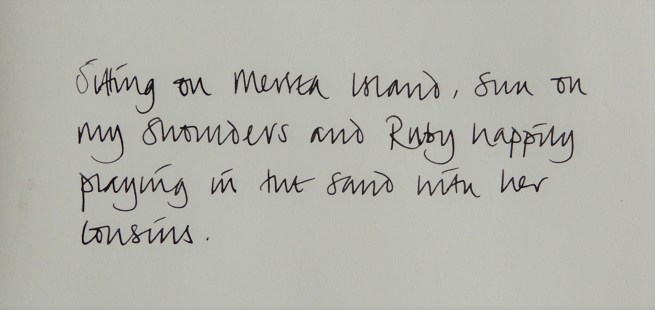
I have heard it said that Kaweco’s nibs are not always correctly aligned out of the box, but mine was perfect with an ideal flow and I really enjoy its smooth, fine line. Admittedly, the mustard colour is unusual but actually I rather like it. I have been using it with black ink cartridges, of the sort that you buy in a bag of thirty and the pen loves them!
Writing sample from Kaweco Perkeo Indian Summer, provided by my cousin Becca during a family day at the beach.
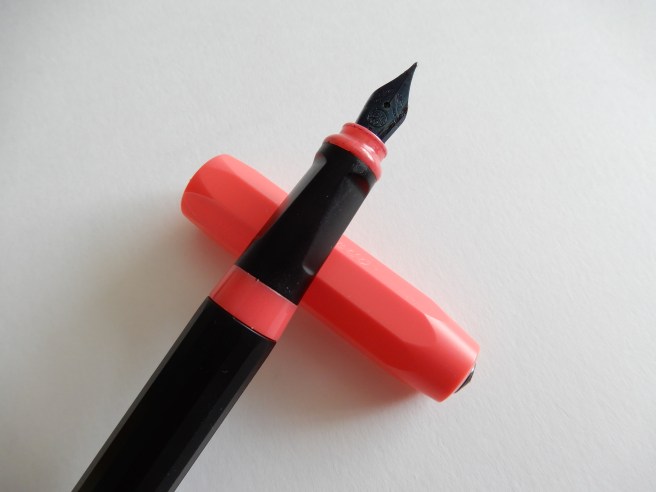
And then just a month ago, I found the fourth colour also in a Paperchase, (Swiss Cottage, London branch), the aptly named “Bad Taste” which has a black barrel and a bubble-gum pink cap. Again, this came with a black nib in a Fine. This one seems to write a little broader than the Indian Summer nib but again, flow was good and it needed no adjustment.
Quality wise, there was some issue with my Perkeo Bad Taste, in that the inner cap has a slight obstruction. It will still snap on and off, but there is a distinct resistance to overcome, before you reach the second ridge for the cap to click onto. I pondered whether to exchange it but haven’t bothered and it might improve with use.
Kaweco Perkeo Bad Taste. I wouldn’t argue with that.
Looking back at my previous Perkeo posts, I mentioned the three facets on the grip section. In fact they no longer bother me at all as I always grip the pen around the coloured ring, with the section resting on my second finger. I hold my pens quite high up from the nib, which I suppose is why I like longer pens, or pens that can be used with caps posted. In the case of the Perkeo, it is about 128mm long unposted and long enough to use that way, although the cap will post securely if you want extra length and weight.
I also mentioned that the nib and feed can be pulled out (they are friction fit) from the section. However, I since learned that whilst there is no obvious flat edge requiring you to realign them when replacing them in the section, I believe that there is a flat step right at the far end once you have pushed the feed almost all the way back, so that it may not be possible to push the feed in fully unless the feed is aligned symmetrically with the grip facets. Sorry about that.
Conclusion
I have been lucky that all four of my Perkeos write very nicely. They are great for not drying out. The inner cap does a good job at avoiding hard starts. My first two Perkeos have remained inked pretty much constantly since I bought them in June 2017. I have kept one of them at work and it is an easy pen to grab for a quick signature or for making notes. For blue ink, I mostly used it with Kaweco’s own royal blue cartridges which are excellent.
The fact that I have now acquired all four colour options is the best testament I can provide of my enjoyment of this pen. It is great value and a good alternative to the similarly priced Lamy Safari.
The Perkeo squad: Old Chambray, Cotton Candy, Indian Summer and Bad Taste. You can mix and match the caps if you like.
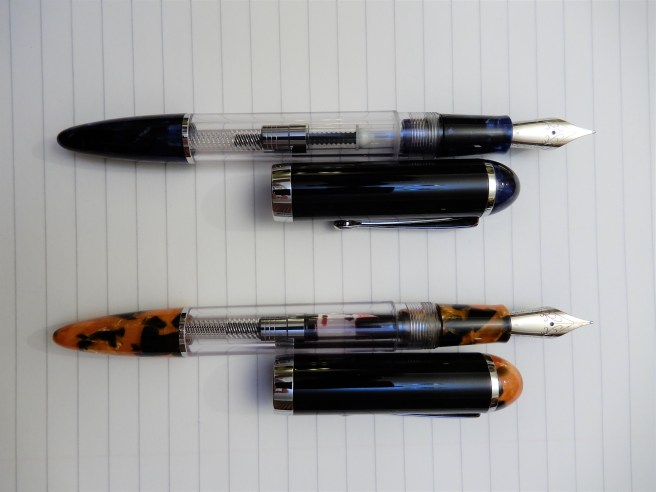
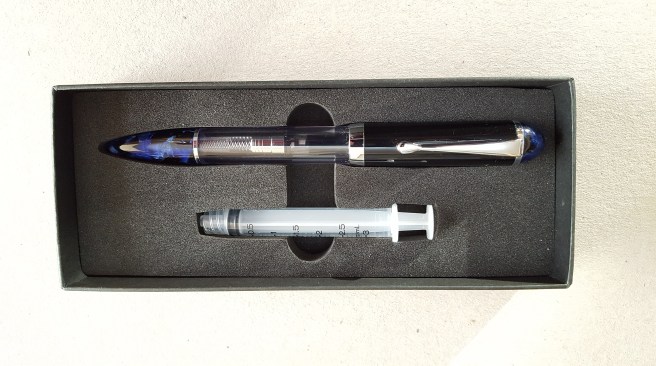
Some readers may remember my post Wanted: an identity for this pen from 8 February 2018, about a fountain pen that I bought at the London Pen Show which was devoid of any branding. It is a large and comfortable pen with a size 6 nib, featuring a clear demonstrator barrel (with coloured bullet-shaped end) and the options of cartridge, converter or eye-dropper filling.
I bought two of these, based on their own merits, without knowing who made them.
Now, six months on, a reader Anthony K from Australia, kindly got in touch with me through the blog, to share some information that he had found on these pens. Thanks to him I can now update you with the following:-
A Japanese online store, called Engeika, sells its own brand of pens under the name of Wancher.
This particular model, is branded as the Wancher Crystal. It is available in five colours, named after precious stones, namely Emerald, Indigo Sapphire, Fire Opal, Smoky Quartz and Light Smoke Topaz. Pens sold under this name have “Wancher” on the cap band. (Mine do not).
As well as this version with the pointed end, there is a flat ended version.
However, the pens are manufactured by a Taiwan company, Fine Writing International (Shang Yu Tang), said to be the second largest or most well known pen company in Taiwan (after TWSBI). The nibs are from Germany (a Jowo, number 6 steel nib).
The pen is also sold as the Wancher Crystal, by Jet Pens, priced at $70 US.
My first model was bought from John Twiss, a seller at the London Pen Show last October and the second one when I met him again at the Cambridge Pen Show in March, at a show price of £30.00.
I particularly like the pen due to its 140mm long body when opened, (about 5 1/2 inches) and also its very smooth and pleasant nib. The cap also features a sprung inner cap, which seems to stop the problem of dry-out and hard starts sometimes associated with large nibs. All in all, you get a lot of good features and a big pen for not a very big price. Thanks again to Anthony for the detective work and for cracking the mystery.
An unbranded eye-dropper fountain pen otherwise known as the Wancher Cystal, Indigo Sapphire.
Here is another pen that I bought while on holiday in Italy. Except that this one was bought on ebay and has just arrived in the post, four weeks later.
“What were you thinking, ordering pens online while away on holiday?” you might ask. I had taken a new Wing Sung 601 demonstrator with me on the trip, and was delighted with it but still had the urge to have one in a colour seen on a friend’s Instagram post (@jonr1971). I think it is called Lake Blue although the names of the colour descriptions can be a bit puzzling.
Appearance and Design.
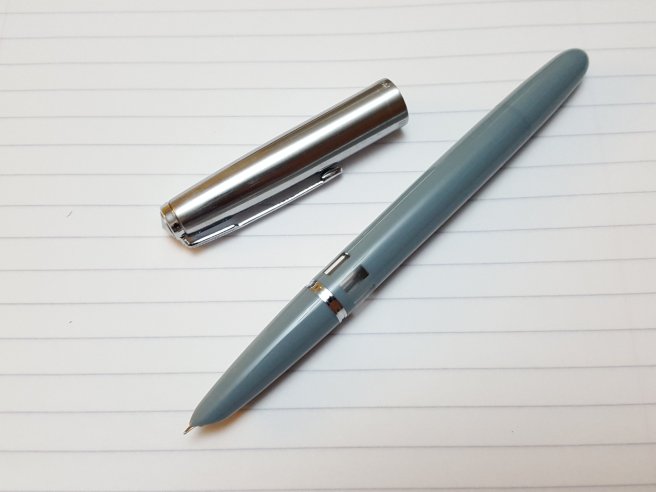
This is the Wing Sung model that looks very much like the well loved, vintage Parker 51, with a slip-on metal cap with arrow pocket clip and the distinctive hooded nib, but in stainless steel rather than gold. I will not argue the rights or wrongs of this being a Chinese version of a classic Parker pen. It does not claim to be a Parker and is named Wing Sung (written in Chinese characters) 601 on the front of the cap band, with “Made in China” at the back. Unlike the Parker, it has six ink windows in the barrel, which are hidden when the pen is capped.
Wing Sung 601 vacumatic fountain pen.
Construction and Quality.
I was very impressed with my first, demonstrator version. The materials and finish all seemed commendable. I recall that the nib needed just a slight tweak to align the tines for smooth writing. On my new one, again the materials and finish all seemed to be to a good standard. There was no issue with the tines being uneven, but the nib was not quite symmetrical with the black plastic feed. As the nib is hooded, this is barely noticeable unless you look closely (which I did). It does not seem to impair the ink flow, but it would be nice to remove the nib and line it up centered around the feed.
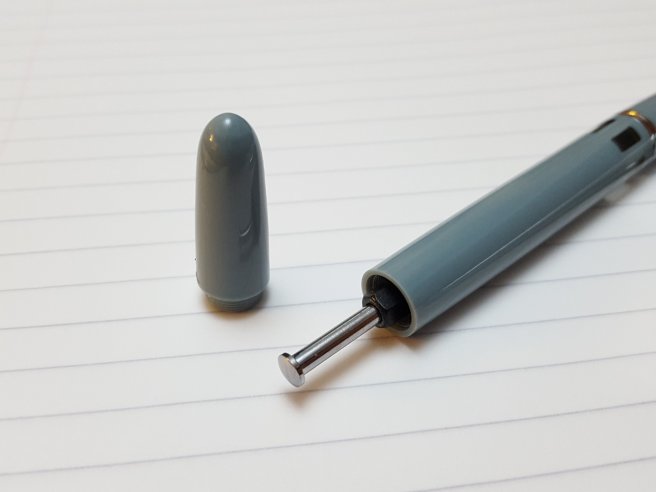
Under the blind cap, you have a metal plunger rod, to operate the vacumatic filling system. At the foot of this rod you have a black, hexagonal nut, which you may unscrew to remove the whole filler unit. The nut looks like black metal but I have heard that it is plastic and therefore gets chewed up and deformed if you use a metal wrench on it. Best to use plastic on plastic. I have not tried removing it yet.
Blind cap unscrewed to reveal metal push-button plunger for the vacumatic filler unit.
Weight and Dimensions.
I would call this a medium-sized pen and fairly light. Closed, it measures about 138mm. Uncapped, it is about 127mm long, which many would find long enough to use unposted. However, I prefer the look, feel and weight of the pen with the metal cap posted, which increases the length to 147mm. I do not find it to be unbalanced as the cap posts deeply and securely and I then grip the pen a little higher up.
Uncapped the pen weighs around about 12.5 grams (including some ink in mine). The cap alone weighs 7.5 grams and so capped, or posted the total is 20 grams, which is still on the light side.
Nib and Performance.
The nib is a Fine, or possibly Extra Fine. I could not see any marking on the visible part of the nib. Being so small, and with only about 2mm of nib protruding under the shell, it is firm and does not provide any significant line variation. Like a rollerball, it does not give much character to your writing. But on both of mine, the ink flow has been good, giving sufficient lubrication to the nib to allow for effortless writing. Being a Fine nib, it does not have the smoothness of a generously tipped broad nib but it is smooth and also has sufficient “tooth” to enable the pen to cope with ease on smooth papers without any skipping. You might find that you need to rotate the pen a little to find the “sweet spot” and with a hooded nib, it is not so easy to see how your pen is rotated, when you are writing. It helps to post the cap with the arrow clip in line with the nib to see the alignment of nib to paper in the writing position and make adjustments as necessary.
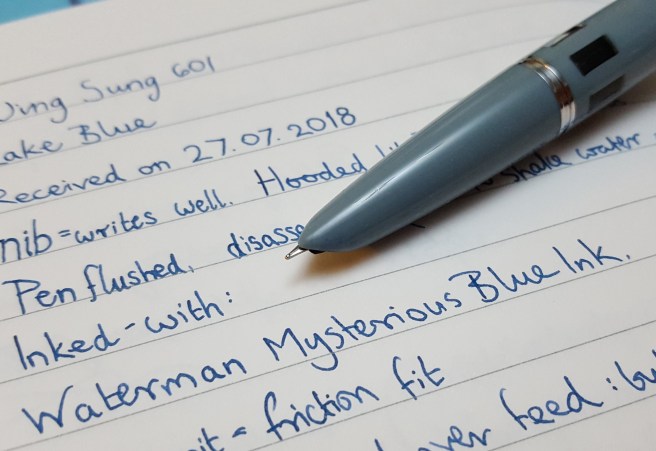
I did test my first nib with Conway Stewart Tavy, blue-black ink by Diamine and was pleased to find that it wrote well in all directions, never skipping and needing no pressure. I had the same success with Waterman Mysterious Blue in my latest pen.
No skips or hard starts. Waterman Mysterious Blue on smooth Paperchase note book paper.
Filling System and Maintenance.
This is a vacumatic filler; you immerse the nib in ink, press and release the spring-loaded button a few times, expelling air and allowing ink to be drawn into the reservoir. In the demonstrator version you can observe this fascinating process, with the ink level rising a little higher in the reservoir with each press of the button. “I pressed down down down and the ink went higher” as Johnny Cash might have sung. In the non-demonstrators, it is not so spectacular but you can easily check that you have a good fill using the ink windows.
As for maintenance, the pen is not easy to flush. I experimented first with water and found that pressing the button repeatedly does not expel all the water from the pen. If this were ink, and you were changing colours, you could contaminate a bottle of ink with the ink residue from the pen. So, to clean the pen you therefore need to unscrew the shell, pull out the nib and ink collector unit (which is friction fit) from the barrel and then rinse out any residue.
Collector, pulled from the barrel. Before you push it back in, you need to mark on the barrel, where the protruding lip of the shell will finish up once screwed back on, and then position the collector so that the nib is in line with this point.
I have not yet found a way to separate the metal nib from the collector unit. I tried pulling it out but it would not budge and I was wary of distorting either the nib or the fins on the collector and so suspended my efforts. The little nib is just too tiny to get a hold of, even with “grippy material”.
When pushing the collector back into the barrel, it is necessary to line it up so that, when the shell is screwed back on fully, the protruding lip of the shell will end up precisely in line with the nib. This can be done by marking on the barrel, the position where the nib needs to be, or just by holding the barrel horizontal in one hand imagining that the top is the 12 o’clock position. You soon find out if you have got it wrong; if the nib is not in the right place, look at which direction it needs to be moved and by roughly what distance. Repeat as necessary.
A little silicone grease on the plastic threads is a good idea. One of my 601’s actually came with a little container of grease and so you are encouraged to disassemble and maintain your pen.
Cost and Value.
These can be found new on ebay for prices of around £10, and so come in well under the price of a Lamy Safari, currently about £17.00 here in the UK. That is excellent value for a vacumatic filler fountain pen.
Conclusion.
I enjoyed my first 601 sufficiently to want to buy another. The familiar design is obviously well-known and loved. It is great that these are now available with a Vacumatic filling system. The fine nib combined with the large ink capacity, mean that you can write for ages on one fill. Whether you chose the demonstrator or ink windows version you can see when you are getting low on ink and top up accordingly.
It is probably best not to change ink colours too frequently unless you are prepared to disassemble the pen for cleaning first. Another option is to decant some ink into a receptacle with a pipette or syringe and to fill from there, rather than from a bottle to avoid the risk of contaminating the rest of the bottle.
As a smart, classic and reliable pen, light enough to carry in a shirt pocket, I can see how it can become the daily writer of choice. This is a pen that you will want to show people.
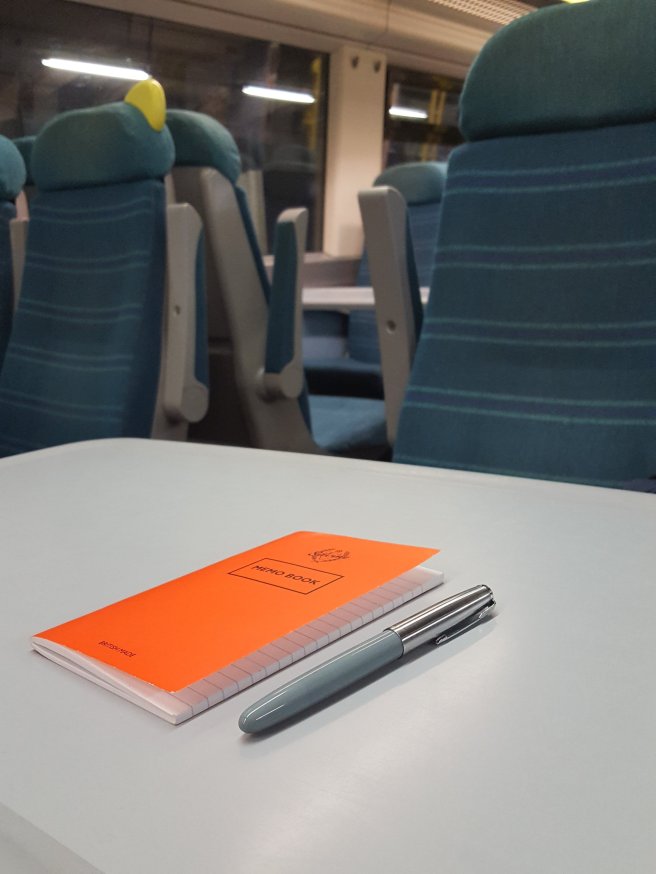
The Wing Sung 601 would grace any table. Seen here on a train.
Once again it has been holiday time and an opportunity to visit a beautiful part of the world, that is northern Italy. My wife and I and mother-in-law were to spend a week at Garda Town, on the eastern side of Lake Garda (or Lago di Garda).
My forward planning had consisted of chosing what pens to bring for journaling and deciding upon a Wing Sung 601 (clear demonstrator, vacumatic filler), plus a Kaweco Dia 2 and a Perkeo. Rather than bring bottled ink this time I brought some cartridges for the Kawecos. I also packed a WH Smith exercise book. However, at the last minute, at Stanstead airport, I spotted a soft cover Leuchtturm plain paper journal with elastic loop closure. I stuffed it in my bag and took to the skies feeling like an Ernest Hemingway.
Wing Sung 601, vac filler.
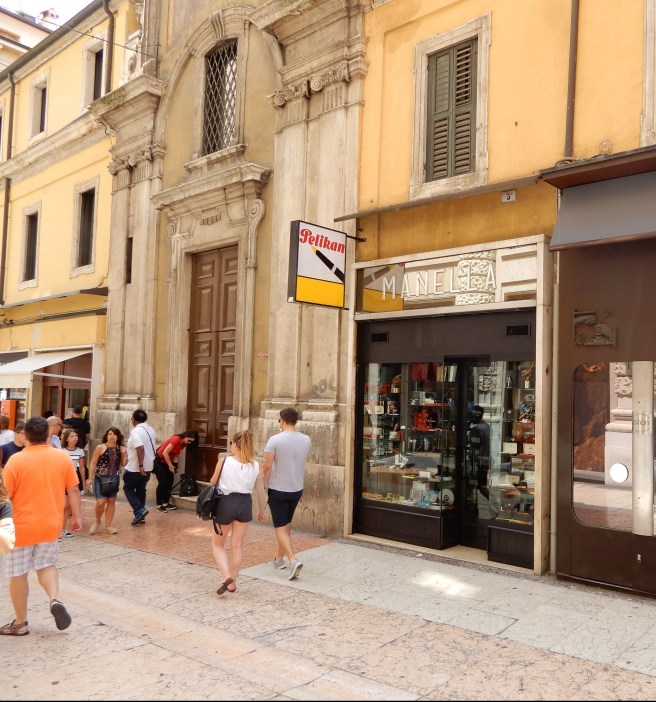
I had also googled “pen shop Verona” and jotted down the name of a shop on the via Mazzini called Manella, to check out when we got there.
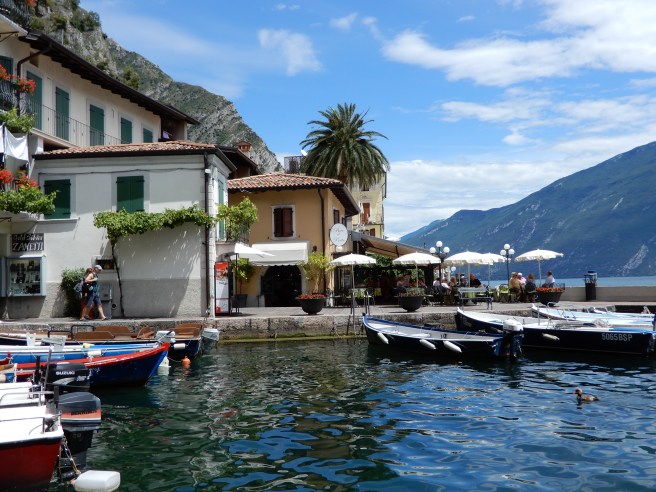
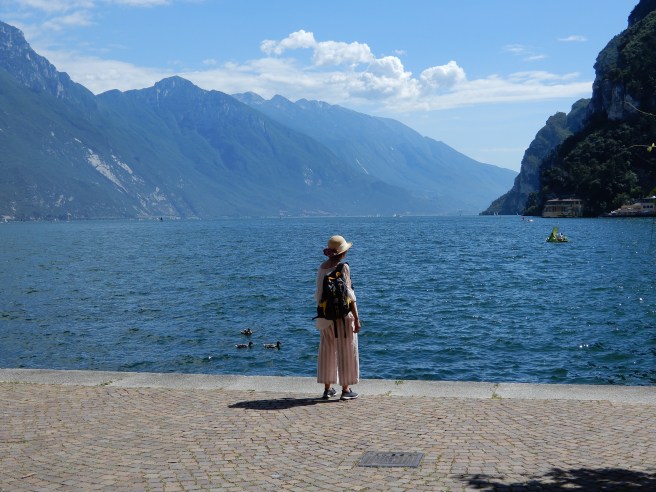
Lake Garda, set among the spectacular backdrop of the Dolomites, has a perimeter of 158km (98 miles). Early in our holiday, we joined a coach tour to go all the way round, visiting four of the lakeside towns, Sirmione, Limone, Riva and Malcesine.
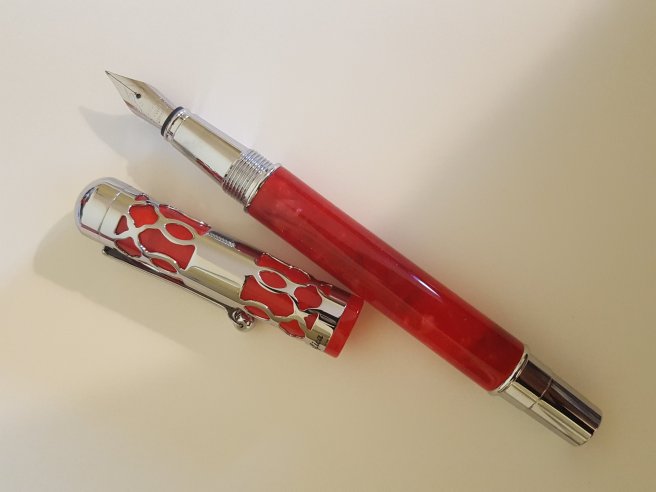
Sirmione is located at the tip of a narrow peninsula, on the southern banks of the lake, and famed for its thermal baths, a medieval castle and the remains of a Roman villa. We arrived via a motor launch for the short journey to the tip of the peninsula and cruised into the castle, which was very cool. Busy with tourists on this hot June day, I did stumble across a stationery shop with some attractive fountain pens in the window and went to investigate. I did not recognise any of the brands on display but was drawn to a red resin pen with shiny chrome lattice work around the cap, sold with a converter and a bottle of black ink and one standard cartridge. The brand was La Kaligrafica and at under 30 euros and with a nice steel nib it seemed like a good buy.
Later, inking the pen up with the supplied cartridge, I was quite content with the nib (the ubiquitous “Iridium point, Germany”) but found that the pen was a little short to use unposted. It was clearly designed to have the cap posted, where it sits flush with the barrel. But the problems were (a) the metal furniture on the cap makes the pen a bit top heavy and (b) the cap does not grip securely on the barrel and very easily works loose as you write, which is very irritating. There is a risk of it falling onto a hard floor and breaking or disappearing over a balcony. I tried wedging a scrap of paper under the cap but this did not seem to help. I think this pen is destined for someone with smaller hands who will not need to post the cap.
La Kaligrafica, Italian cartridge-converter fountain pen.
We travelled up the west side of the lake by coach, passing through many tunnels, built in the 1930s by Mussolini. Lunch was at another pretty town, Limone, before taking a ferry up to Riva on the northern bank, from where there were marvellous views down the lake. Having some free time to explore Riva, I found another stationery shop, selling leather bound journals, ornate glass handled dip pens (with steel nibs) for calligraphy or for display and a few inexpensive Italian fountain pens geared for the tourist trade at between 20 to 30 euros. I was able to resist these.
The final visit on the lake tour was Malcesine on the eastern side, with another castle and also boasting a cable car to the top of Mount Baldo. The cable car gondola is round and actually revolves very slowly as it ascends. (We returned to do the cable car trip another day).
The lake tour was a very good start to our holiday, giving a good introduction and a taster, to plan trips by ferry during the rest of the week.
Typical scene on Lake Garda
Later in the week we took a bus to Verona which is only an hour away. The bus terminates in the centre of the city right next to the impressive arena, a Roman amphitheatre, still used as a venue for opera. The scenery for a performance of Aida was laid out in the square.
We walked down the via Mazzini, the pedestrian shopping street which takes you from the arena to the piazza delle Erbe, a beautiful square with a bustling market.
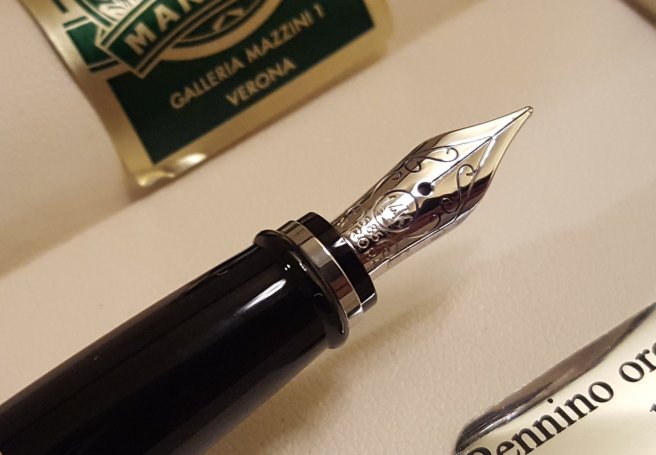
I found the Manella pen shop, under a Pelikan sign! Unfortunately it was closed so I was resigned to missing it this time. I had to content myself with pressing my nose up to the windows and taking a few photos (marred by reflections from the busy street) of the displays of Pelikans, Auroras, Delta, Montegrappa and other delights.
Manella, fountain pen shop, Via Mazzini 5, Verona.
However, after spending some time exploring Verona, including a visit to the casa di Giuletta (the “house” of Shakespeare’s Juliet) and the impressive Cathedral, we passed the pen shop again and this time it was open! The very cordial proprietor told me that this shop had been here since 1940 and run by his father before him. On telling him that I was keen on fountain pens he kept getting things out to show me,such as a Montegrappa Fortuna although I had to tell him that I had one already.
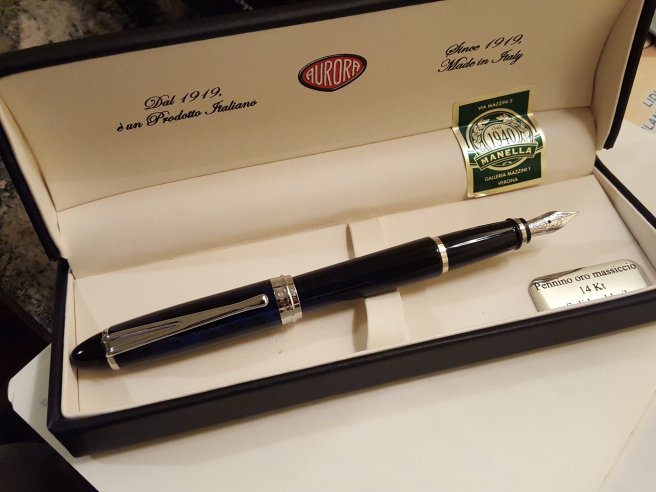
I was interested to try an Aurora, not having owned one and he showed me the Aurora Ipsilon Deluxe, in red resin with a gold nib. However, he had some more colours and models in his other, larger shop, literally just around the corner and together we walked around to look at some more pens.
There he also had an Aurora Ipsilon Lacca, the metal lacquer version, in a new dark blue and black finish and also with a gold nib, which looked to be rhodium plated with matching furniture. This I chose as my souvenir from Verona. Oh, and I spotted a display of “Pelikano Up” pens and one of those went home with me as well.
Aurora Ipsilon Lacca.
Back in London, I filled the Aurora, rather unimaginatively with Aurora blue. It is a smallish pen but weighs a solid 31.5g. It is short when uncapped, at around 118mm, but the cap posts well with a secure click.
My Fine nib version wrote well. But the nib is small and firm without much give. I was also a bit troubled by what looked like rows of tiny mysterious scratches right across the mid part of the nib, from edge to edge, although only visible with a loupe. Also the nib was not precisely centred over the feed and I have not yet figured out how to remove the nib and line it up more symmetrically. However neither of these issues affects writing performance.
Detail of the Fine, 14k gold nib, Aurora Ipsilon Lacca.
I must confess, that I did find the pen a bit bland, particularly matched with royal blue ink. I then flushed it and refilled it with Monteverde Napa Burgundy, which has injected some more life into it. I think it is a decent pen but on reflection, I enjoyed the buying experience more than the pen itself. Perhaps it is just that I am “penned out” at the moment and spoilt from a surfeit of other very satisfying aquisitions in recent weeks. I had been happier with the Montegrappa Fortuna and Pineider Avatar pens bought earlier this year, two Italian pens which both have steel nibs.
Finally, the modest Wing Sung 601 served me well on the trip, as did the Leuchtturm journal. After about 35 pages the Wing Sung (with its fine nib) still had half a fill of ink remaining and I had no need of my two Kawecos or spare cartridges which came to Italy for the ride.
Within the last few weeks, I have been on the receiving end of three wonderful, unexpected, unconnected and very generous gifts.
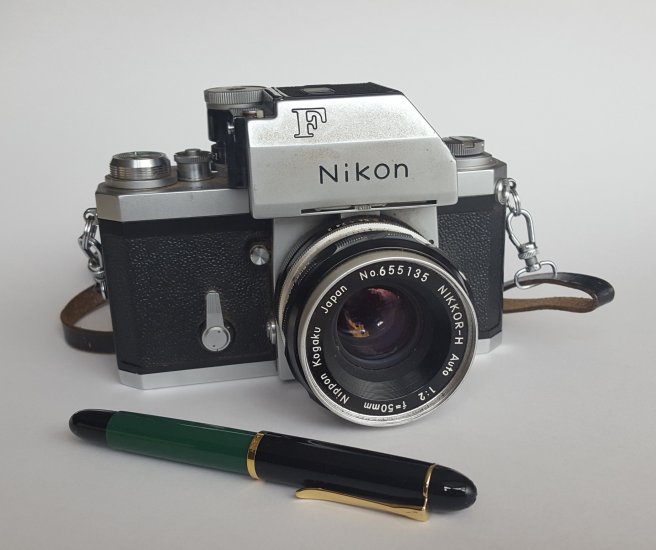
First, a Methodist minister retiring from her post at a city church in London, and moving from the manse to smaller accommodation, offered me an old camera that she no longer used. This turned out to be a Nikon F, the very first of Nikon’s line of single lens reflex cameras introduced in 1959. Well travelled but well looked after, the camera was in good working order and I have enjoyed taking it out and about, remembering the way that we used to take photographs: winding on, setting speed, aperture and focus and then hearing the shutter release and the mirror returning. Before the fountain pen hobby grew and took over, I had built up an accumulation of classic cameras (particularly Voigtlander and Zeiss) but had never owned a Nikon 35mm film camera. I am now thrilled to have this classic model.
Then, a reader of my blog, whom I met up with for the first time in London recently, kindly passed on to me a bunch of his fabulous pens as mentioned in my post Inky Pursuits: a recent round-up. I am greatly enjoying the Pilot Custom 74 and Custom Heritage 92, the nibs and comfort of which give a writing experience amongst the best I have ever known.
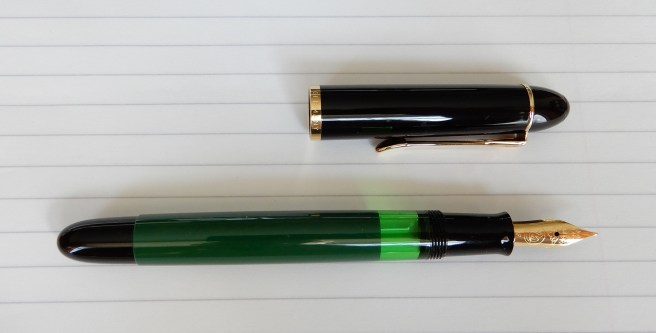
And then on returning from holiday recently, I had a parcel waiting for collection. This was the size of a small pillow, and contained a very well wrapped, new and unused Pelikan M120, in classic green and black, complete with presentation gift box, a bottle of Pelikan 4001 royal blue ink, and the guarantee and guide to the Pelikan range.
This generous gift was from another reader of my blog and a fellow blogger, but from another country and whom I have never met. I am most grateful but also humbled that people can be so generous even to a total stranger. Events like this make the world seem a friendlier place and help to redress the balance when so much world news is so troubling. Indeed, in the last few years, I have found the online fountain pen community, to be a wonderful bunch, from all over the world and from all walks of life, united by a common passion for fountain pens, inks and stationery.
Returning to work after a week away, (into a tumultuous week including World Cup football, Wimbledon tennis, and President Trump’s visit to the UK) it has taken me a little while to adjust and get back into my routine. However, I have now had a closer look at this pen and have been using it with the lovely Pelikan Edelstein Smoky Quartz (which I did not pay for either, as it came from last year’s Pelikan Hub).
I understand that this model, in green and black, is a 2016 re-issue of a classic Pelikan from 1955 but with a few improvements.
Appearance and design
This is a vintagey-looking cigar shaped pen, with a green body and black grip section and piston knob and rounded ends. There is a good sized ink window with a green tint. The black cap screws on securely, needing only half a rotation. The gold plated pocket clip features the Pelikan bill. A gold plated cap band reads “PELIKAN GERMANY”. But one feature that is not so obvious is the logo of pelikan and chick on the finial, very subtle in black with no colouring so that you would hardly notice it.
Pelikan M120, special edition (2016) in green and black.
Construction and quality
Being a resin pen it is lightweight but looks and feels to be of good quality, not plasticky. I cannot find any fault in the construction.
Weight and dimensions
With ink, the pen weighs only 16g capped or posted, or 10g for the body only, and 6g for the cap. Capped, it measures 130mm (not too long for a shirt pocket), whilst open it is 120mm (a bit short; I prefer 130mm plus, to use un-posted); with cap posted it is a very comfortable 155mm and this is how I like to use it. The cap grips quite deeply and securely on the back of the pen without upsetting balance. Also the clip will then stop the pen from rolling if put down on a sloping surface.
Nib and performance
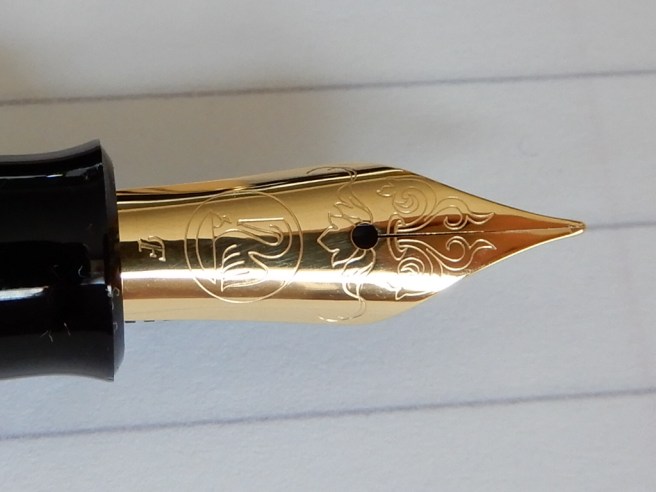
Ah! Thanks for asking! This is a steel nib, (mine is a Fine) with gold plating to match the cap furniture (or vice versa). A special feature of the pen is that the scroll work on the nib is based upon a Pelikan price-list from 1889 and looks very attractive under a loupe (although, like the logo on the finial, it is not noticeable in ordinary use but it is nice just to know it is there). The nib wrote beautifully out of the box and has a pleasant bit of springiness or softness to it (although not a flex nib). It has a very pleasant touch on the paper, a little feedback but no scratchiness. I would say that the line is more towards the Medium side, than a true Fine and is perfect for me. Also, the nib and feed unit can be easily unscrewed for rinsing or swapping with any nib from the M200 or M400 pens, should you wish to do so.
Curlicues borrowed from an 1889 Pelikan price list.
Filling system and maintenance
This is a piston filler and is very smooth and effective and holds a good supply of ink although I have not measured it. For cleaning I would just fill and empty the pen a few times in clean water until all traces of ink are gone from the water. It is good to be able to unscrew the nib and feed units to wash them or soak overnight if need be, if changing ink colours. I am not sure whether or how you can remove the piston mechanism but it should be good for many years yet.
Cost and value
This pen, in green and black, was a special edition to be made for a limited period. I remember seeing them for sale on Cult Pens at the time. Currently there is a similar model but in blue with blue cap and blue ink window for sale at £128.00 and I think the green and black model used to be a similar price.
This puts it somewhat higher than the regular M200 models which are currently offered in the £70.00’s and £80.00’s on Cult Pens, which is lower than they used to be.
Is it worth it? This is a tough question. Several reviewers concluded that it was a great pen but let down only by being rather over-priced for what it is, when based on a school pen from the 1950’s. Personally, I would recommend the pen if you like the nostalgic style combined with modern Pelikan materials and reliability.
Certainly it is a pretty pen, with vintage looks from a bygone era, very well made and if like my other modern Pelikans, perfectly reliable and always ready. And it makes a good companion for my Nikon F.
Time for another episode of Inky Pursuits, an occasional series of round-ups of my fountain pen related news. I have had an eventful week pen-wise, including the arrival of five more fountain pens.
Last weekend, I had the task of registering a marriage in our local church in Golders Green, at which I am the “Authorised Person” for such duties. This means having a fountain pen inked with the regulation Registrar’s Blue Black iron gall ink from ESS (Ecclesiastical Stationery Supplies). I chose to use my TWSBI Classic in white with medium nib to complete the register and for the signing. The ink comes in 110 ml bottles and now needs to be used up within about 18 months of first opening, before it starts to lose its properties of darkening to a rich near black shade.
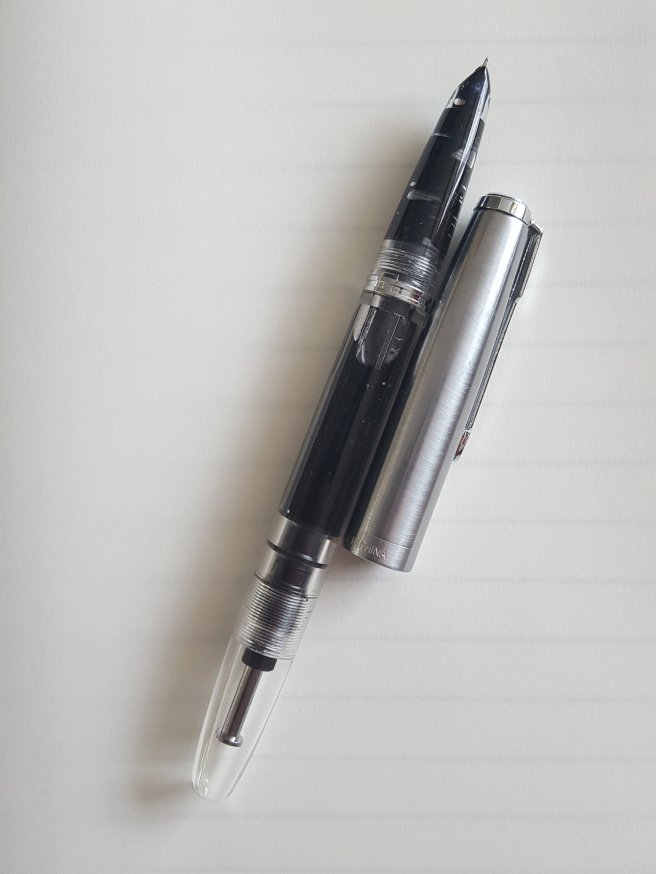
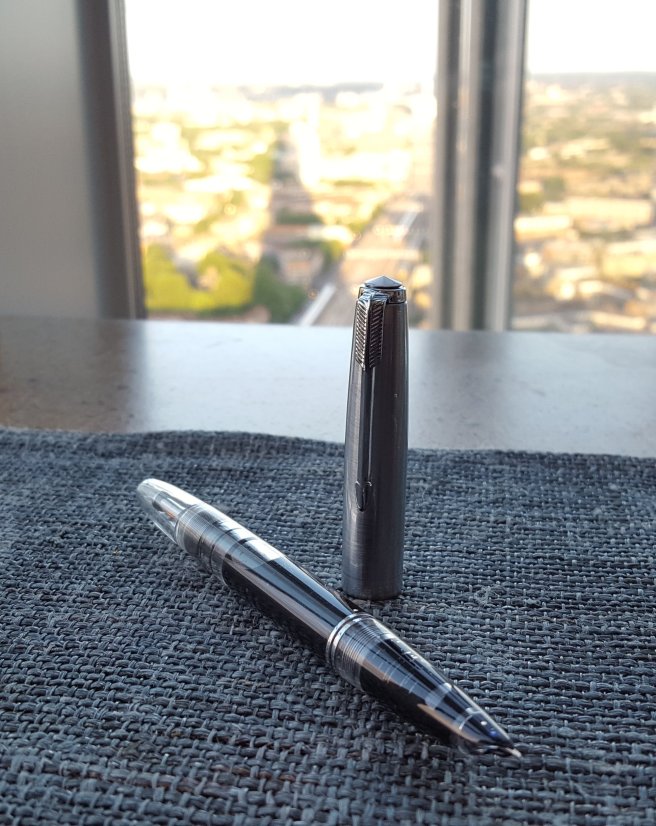
On Tuesday, I had the excitement of a New Pen Day, with the arrival of a Wing Sung 601 that I had ordered from China a couple of weeks earlier. This is the one that is based upon the Parker 51, with a hooded nib (although in stainless steel) with a stainless steel cap, but with a clear demonstrator body and section and a vacumatic filling system. There is a metal filling button, visible under the blind cap.
Wing Sung 601, clear demonstrator, vacumatic. View from the 32nd floor of the Shard, London.
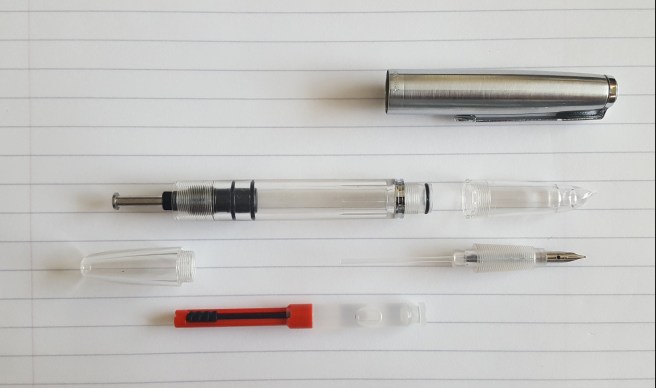
I am embarrassed to admit that I was stumped at first, on unboxing the pen, by something which looked like a red plastic converter, but which was filled with a clear liquid. Where does this go? Is it part of the vacumatic filling mechanism? No, it turned out to be a useful container of silicone grease for when you come to disassemble and clean the pen.
The Wing Sung 601 partly disassembled. Oh no, where does the red bit go? (It is a container of silicone grease, confusingly supplied in a converter that a vac filler does not need).
I played around with the pen at first, examining the nib under a loupe. The nib needed a little help to align the tines but this was fairly easily remedied, the only challenge being that the accessible part of nib is so tiny to hold. I then tried disassembling the section and learned that, when screwing it back on again, you need to remember to keep the nib so that it lines up, centred under the long lip of the section.
On inking the pen for the first time, I was surprised to see just how quick and efficient the filling system is. You just immerse the nib in the ink, give the button a few presses and the demonstrator body enables you to watch ink come rushing into the barrel. With each press of the button, the ink level rises higher. I gave it about seven presses by which time I had a really good fill, with far less air space remaining than I have ever achieved with a TWSBI Vac 700 (although I know that there is a technique for that, if you are feeling brave).
The pen then wrote pretty well. I was very pleasantly surprised. I had filled it with Conway Stewart Tavy, by Diamine (my go-to blue black ink) and was delighted with the wet, fine line that it produced. No skips or hard starts. I squiggled in all directions and was unable to get it to miss a beat. The nib is pleasantly feedbacky and copes well with smooth papers. It is firm though, and does not give any significant line width variation. But I love the look and feel of the pen and am really pleased with it. It is amazingly good value.
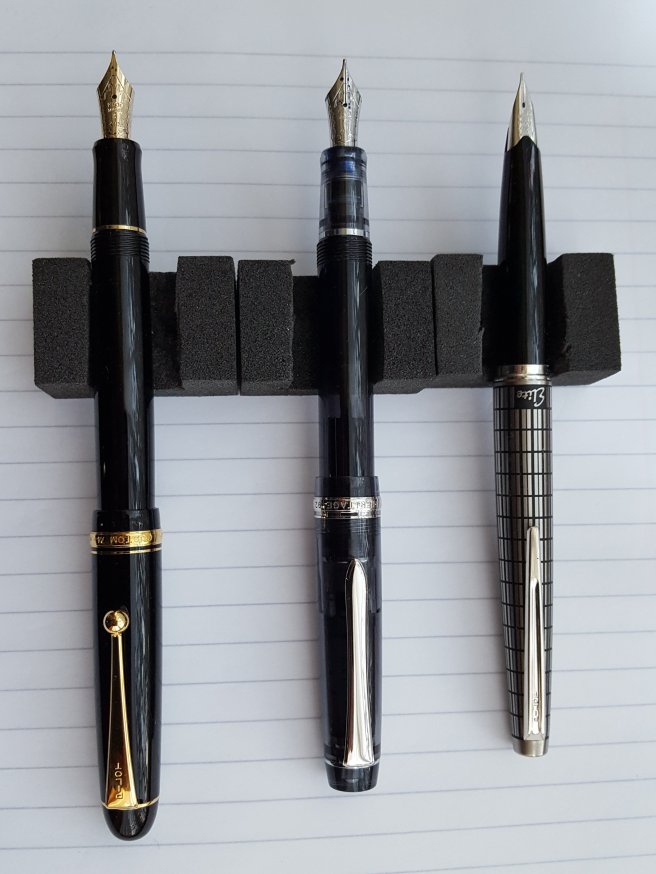
Later this week I met up for a coffee with one of the readers of my blog, who brought along a wonderful selection of his fountain pens to show me, gathered over years of travel to Germany, Singapore, Japan and other places. Now preparing to move to Australia in a few months and wishing to pass on some of the pens that he no longer uses regularly, he had been giving many away to pen enthusiasts. He offered me three of his Pilots and very generously, gave me a Custom 74, a Custom Heritage 92 and a third pen that I did not know, called the Pilot Elite, – a stylish pocket pen that becomes full length when posted and has an elegant 18k gold nib.
Pilot Custom 74, Pilot Custom Heritage 92 and a Pilot Elite pocket pen.
You can imagine my delight! I had never owned any of these models before, although I have long been interested in the C74 and CH92. Both had medium 14k gold nibs and were inked with Pilot Iroshizuku tsuki-yo, a lovely blue black. I have been much enjoying them both all weekend, slightly more so the CH92 as I prefer the shape and the nib is particularly wonderful. Meanwhile I have flushed the Elite and am taking a pause to enjoy pondering what ink to try in it!
My friend also gave me the bottle of tsuki-yo plus a bottle of Diamine Sargasso Sea, a Schneider Rave XB retractable ball point pen and a few interesting Lamy fineliners which I had never seen in this country.
Everything you could ask for in a nib. The Pilot Custom Heritage 92, 14 gold, medium, and rhodium plated
Finally, as if that was not enough fountain pen action for one week, I happened to find the Lamy Safari All Black, 2018 special edition today, in a blister pack with a box of black cartridges. I have been looking out for one in our local stationery shops ever since about February and despite searching in all the usual places, this was the first one that I had actually seen in the wild. It came with a medium nib, in black. I plan to keep it for use as a black ink pen, which is always useful to have. I do like the black-everything look, including the textured matte black body and black clip. Even the threads are jet black. A good stealthy pen to use in jungle warfare. Or in my office.
My current Safari and AL-Star stash. The new Safari All Black is ninth from the left.
This pen was part of my haul from the London pen show last October and has now been in light use for over six months.
I am very fond of TWSBI’s fountain pens and already owned a Vac 700, a Diamond 580 and an Eco, all of which I enjoy using. The London show was my first time to handle the newly modified Classic. I had to make a swift decision whether to go for the white or the light blue (which was adorable) but settled on the white version on the ground that it might be less jarring on the eyes in a workplace scenario.
TWSBI Classic fountain pen
For its first inking, I chose a new bottle of KWZ Azure #4, also bagged at the same pen show. However, I had been playing with the pen prior to filling it, disassembling the section and evidently had not tightened it enough on putting it back together again, as the ink oozed out of the gaps and over my fingers.
This was very easily remedied, by flushing and cleaning the pen, tightening it up a little bit harder this time and re-inking. Note, that when unscrewing the section, there is a little rubber O ring at one end, which might be mistaken for a smear of black ink. Take care not to lose this.
Like the Diamond 580 or the Eco, this is another piston filler, but not a demonstrator. Instead there is a modest sized ink window, next to the metal threads for the cap. The cap also has metal threads, which might make you worry about causing scratches when posting the cap. However, there is no need for concern, as the cap has been re-designed to post very neatly over the piston knob, where it clicks into place above a couple of rubber O rings. Used in this way, the pen is a very comfortable weight and length (about 166mm). You can however use it without the cap posted, being around 125mm in length.
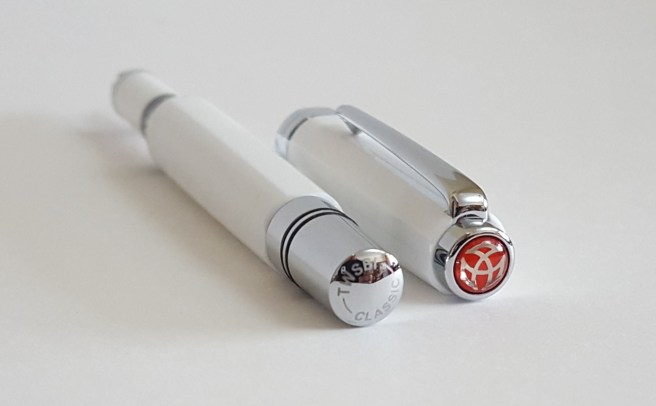
The material is a pleasant, hard-wearing resin of some sort which, in the white finish, almost looks like porcelain. The cap, the barrel and the cap band are octagonal. The shiny chrome furniture makes a nice contrast and there is the distinctive red TWSBI logo in the finial, which makes the pen stand out in the pen cup. The pocket clip is strong and firm. I always find myself wanting to align the flat surfaces whenever I post the cap.
Nice looking from both ends.
The steel nib on this model is smaller than that of the VAC 700 or Diamond 580 but looks proportionate to the size of the pen. I chose a medium and it writes very well – smooth and with good flow, but fairly firm.
As with other TWSBIs, this comes with a little wrench to enable you to unscrew the piston mechanism should you wish to do so. I did this, only for the first time, late at night, whilst tired and a bit reckless and impatient. I made the “Classic” mistake of finding out the hard way that I did not know how to put the piston back together.
This set me thinking about the term “penmanship” which should denote not only good handwriting, but other qualities including care, wisdom, patience and appreciation for one’s fountain pens. Happily with the aid of one of SBRE Brown’s disassembly line videos on Youtube, I was soon able to reassemble the pen.
For much of the last six months, I have been using this pen with Sailor Kiwa guro, a black pigment ink which is safe for fountain pens. It is very useful to have a waterproof ink sometimes for such duties as writing addresses on envelopes.
However, having recently received a new 110ml bottle of Registrar’s Ink (a blue black iron gall ink) I decided to try this in the TWSBI. I am delighted with the results. I may use this pen when I next register a marriage at our local church. The white pen should look nice in the “signing the register” photos. I will make sure that the pen is properly assembled this time.
Likes and dislikes.
In summary, this is an attractive, medium sized fountain pen, which performs well. I particularly like the ink window. It is useful that you can (if you wish), strip the pen for cleaning and maintenance, like a Bren gun, although there is no necessity to do so, particularly the piston, which should serve well for years without maintenance.
My only criticism would be of the section in that it would perhaps be more aesthetically pleasing if it were not so perfectly straight. Looked at in profile, it does not look quite right. A slight curve to make a nice finger rest or a slight tapering towards the nib would help the look, although it is comfortable to hold as it is.
The price at the London pen show was £40.00, which makes it a little more than the Eco but less than the Diamond 580 or Vac 700. I like it a lot.
After attending our monthly pen club meet in London recently, I took myself off to Harrods to have a browse around The Great Writing Room. It is wonderful to see their large selection of luxury fountain pens from so many leading brands.
A new name to me, was Pineider, an Italian brand established in 1774, whose pens and stationery were displayed in a corner of the large room. Under the glass counter, one pen was shown in a gift box which immediately caught my eye as it opened like a miniature writing desk. I asked to see the pen, with an attractive green marbled body and a silver section. However, it had an 18k gold nib and was five hundred and something pounds and so I hastily handed it back.
But next to this pen was a display of, what I now know to be the Pineider Avatar fountain pens, in their four available colour options of saffron yellow, pacific blue, lipstick red and coal grey. These looked very striking, particularly the yellow and the red versions.
Pineider Avatar in gift box including samples of Pineider stationery.
I must say, I am generally wary of pens with shiny metal sections as they can be slippery to hold. The salesman got the red one out to show me and produced some ink and paper. I fell in love with it pretty much instantly.
As this is a relatively new pen on the market and there do not seem to be all that many reviews or photographs online I will attempt an FPN-style review, save for giving marks out of ten.
The long steel, Rhodium plated nib of the Pineider Avatar. After my early worries about scratching the barrel, I soon decided that the pen felt better with cap posted.
First impressions, appearance and design.
This is a stunning-looking pen. The highly polished, bright red marbled resin with contrasting silver coloured clip and cap band, with rounded ends, make the pen a joy to hold and to look at. The resin has light and dark shades which give a beautiful chatoyance as you turn the pen in your hands.
The pocket clip (in marine steel) is long and slender, engraved to suggest a quill. It is bowed in the middle and is sprung, giving a good reach to clip onto thicker material if needed although the spring tension is not very firm.
Distinctive clip in the shape of a quill.
A surprise awaits when you come to remove the cap. It is a pull-off cap, but secured by a magnet inside the cap which meets a metal ring around the barrel. When you cap the pen, offering it up slowly as it nears the barrel, it jumps into place with a little click. The magnetic power is enough to keep the cap in place. Removing the cap requires perhaps rather less force than you might be used to and I would not be overly confident about carrying the pen in a suit pocket for fear that the pen may slip out of the cap.
Another lovely feature is the cap band, which features the name Pineider above a stylised engraving of the Florence skyline recalling to mind the many domes and towers of that beautiful city.
Better than just writing “Florence” on the cap band.
Under the cap, you have a long, sleek, elegantly shaped nib and some attractive engraving, which includes on closer inspection, the name Pineider in capital letters, written normally along one edge of the nib and in mirror image along the other edge. Put like that, it might sound off-putting but it is only noticeable when examined under a magnifying glass.
The section is of a shiny metal finish, and gives the front end of the pen a pleasant weight, which you notice and appreciate as soon as the cap is removed. The metal section tapers slightly save for the last five millimetres or so where it straightens, to give a barely visible but effective, curved, finger rest, when the pen is held in the writing position.
Construction and Quality.
The pen seems very nicely made and I have no complaints with my model. The resin barrel screws firmly onto the metal threads of the section. Everything fits together well. If looking for faults, you could say that the rim of the cap band is a little sharp to the touch, but this has not been noticeable in normal use. The pocket clip, whilst attractive, looks rather delicate (compared, for example to the mighty and barely lift-able clip on my Montegrappa Fortuna), but this is not a problem for me as I carry the pen in a leather pen case, not a pocket.
Weight and dimensions (approximate).
Capped: 142mm
Uncapped: 130mm
Posted: 161mm
The pen weighs around 27.5g, capped or posted. Uncapped, it is about 17g and the cap alone weighs 10.5g. These weights are ideal, being neither too heavy nor too light.
The uncapped length of 130mm makes this about the same as a Lamy Safari. But whilst I find the Safari comfortable to use unposted, I much prefer to use the Avatar with the cap posted. Perhaps this is because I hold it higher up, (due to the shiny section) or due to the fact that the barrel tapers slightly, but it feels very comfortable posted. It is long, but the cap is light and does not upset the balance. I worried a little at first about whether posting the cap with its magnet inside, would leave scratches on the barrel. However, I found the pen so much more comfortable when posted and soon decided not to worry about this. The pen is meant to be used. I think it does actually cause some scratches but they are only visible under a loupe.
Nib and Performance.
I love this nib! It is Rhodium plated steel, with no breather hole and having a very polished finish that matches the section. The long sweeping curves look stylish. Mine is a medium. A fine is also available. I had tried the pen before buying and was delighted that it wrote so smoothly. It is on the finer side of medium and ideal for me. Flow is wet, but not gushy. Overall, it provides a really pleasant writing experience with some feedback. There is some softness or flex available to give some pleasing line variation in normal writing, and this suits me nicely as my handwriting style is not compatible with more flexible nibs. I like that the nib is steel and not gold as this keeps the cost down.
Writing sample, medium nib. Ink is Conway Stewart Tavy.
Filling system and maintenance.
This is a cartridge converter pen taking standard international cartridges, or bottled ink from the Pineider branded, push-fit converter that is included. Cleaning of such pens is straightforward: you just run water through the section until it comes clear, or leave the whole section, with nib and feed inside, to soak in water overnight if needed before rinsing again.
I have not tried going any further, removing the nib from the section. The fins on the underside of the feed look quite fine and delicate and I would be worried about damaging them or upsetting the nib alignment.
Cost and value.
The price in Harrods was £148.00, which I thought was fair. I was thrilled to learn that it came in the same type of gift box as the much more expensive model. A converter is inside, but the box also includes a sample of Pineider’s famous stationery – a set of six cards with matching envelopes. It is probably towards the top end of what you would want to pay for a steel nibbed pen before moving up to a gold nib.
Free stationery!
Conclusion.
This pen was an impulse buy from a brand that was unknown to me, and therefore bought entirely on its own merits and on the basis of what I learned in the store. This absence of homework is not always recommended but on this occasion I am really pleased with the pen. Trying the nib in the shop makes a big difference in lowering the risk.
I have since learned a little bit more about the company behind the pen. The Pineider company was founded in Florence in 1774, and for many years was known for its high quality stationery, which it supplied to the Vatican and to royalty. Luciano Pavarotti was also a customer. The company also sold luxury leather goods, but was not noted for its pens. However, Dante Del Vecchio, pen designer of Italian brand Visconti left that company and moved to Pineider where for the last year, he has set about making the fountain pen line more prominent. Thus it is no accident that the Avatar bears similarities to the Visconti Rembrandt. There are some differences too, and whilst I do not have experience of the Rembrandt, I rather preferred the Avatar’s overall flair.
I am greatly enjoying the pen. There are few pens that actually make you want to get up in the morning, to write with. This one is a keeper and I look forward to writing with it for many years to come.
This is not so much a review, as an admission that our first impressions are not always correct and we can change our minds about pens.
The Lamy Studio is a pen that, for a long time, I did not think I needed. Certainly, I liked the idea of the pen, namely a nib of a Lamy Safari or AL-Star, but housed in a more business-like and slightly more up market body. I do possess numerous colourful Safaris and several AL-Stars, as they are good value, decent sized without posting and perform well, despite my not being a fan of the faceted section.
Lamy Studio 65 fountain pen, with Lamy Safari above
So when I first learned of the Studio, having all the benefits of the stainless steel nib that I like but without the faceted section, I was quite keen. But then I handled the pen and was put off by the shiny chrome tapering section, which I could imagine being slippery to hold. Apart from that, when handling the pen in a shop, I noticed that the rim of the cap seemed rather sharp (almost as though you could use it to cut holes in leather) giving the impression that it was unfinished.
So I was able to put the Studio out of my mind quite easily, without hankering to own one.
However, fast-forwarding several years, I realise now that not all Studios are equal. Whilst the dark Imperial Blue or the Black versions (named the 67) have the shiny chrome section, there is also a steel version with a black section (called the 65). And whilst I had assumed these to be priced the same, it transpires that the steel version without a chrome section, actually costs a little less.
Lamy Studio 65, with soft-touch grip.
When in our local WH Smiths recently, I saw the steel Studio offered for sale at just £39 and decided to take a closer look. And there I discovered that the black grip section on this model is not finished in metal but in a rubbery material which is not at all slippery. And so for this modest outlay, I gave it a go.
Unboxing. A cartridge and a converter are included.
First, about the grip: I cannot tell you exactly what it is made of. It could be a plastic with a soft-touch finish. But I rather suspect that the rubbery feel might be formed from a thin transparent skin of silicone or similar synthetic rubber. I have another fountain pen with a similar feel to the grip, an old Parker Frontier in brushed stainless steel finish, which served me well for several years, but the grip material eventually wore away in places, leaving a very smooth (and slippery) plastic underneath.
So the Studio 65 might have a similar material. If so then a more normal moulded plastic, perhaps textured like some of the Safaris, (but without the facets) would I think have been preferable.
But the purpose of this post is to say that I have been using the Studio now for several weeks, and am finding it to be great as a day to day work pen and an EDC. It is comfortable to hold. It is pleasant to use either posted or not posted. Yes, the rim of the cap is a bit thin and sharp but I appreciate that this is a consequence of the pen having a cap which is perfectly flush with the barrel when capped, and with just a minimal step down from barrel to section when the cap is removed.
Cap forms flush fit with barrel. Also, thin cap material means a minimal step between barrel and section.
Any post about the Lamy Studio would not be complete without some mention of the pocket clip. It is attractive and unusual and sometimes described as being like a blade of a propeller (although this is not strictly correct). It is appealing to look at and does well at stopping the pen from rolling on a flat surface. But as a pocket clip, (to actually clip the pen into a pocket) it is awkward to lift over material. It does not bother me as I carry it in a pen case. Some may like it but I fear that it was a triumph of looks over function.
The famous Lamy Studio clip.
Having said all of that, I do enjoy using the pen. I found recently that I had accumulated a dozen or so pens over the years with an all steel finish, including the Parker Frontier mentioned above, but I think that this Studio 65 may prove to be my favourite of these, in terms of size, writing performance, reliability and comfort.
The Elmo & Montegrappa S.p.A. (public company) traces its origins to the Italian city of Bassano del Grappa in 1912, a date commemorated in the finial of this pen. Fortuna was the Roman name for the goddess of fortune (chance, luck and fate), so I gather.
My experience of Montegrappa fountain pens has until now been minimal. I had noticed them a few times in recent years when browsing in Harrods or Selfridges in London but had never owned one. However, I had heard good reports and on my latest visit to Selfridges I decided to give them a closer look. I was drawn to the Fortuna, in black which looked to be a good sized, un-fussy model with a stainless steel nib. Initially I was interested to hold it to see whether the metal cap threads and step from the barrel to the section, would be uncomfortable. They do coincide with where I hold the pen but the threads are not sharp and I was satisfied that they would not cause discomfort.
Montegrappa Fortuna fountain pen.
I then had a closer look at the nib. It looked to be very nicely set up but I was also impressed by the decorative work in a sort of geometrical honeycomb pattern. I then tried writing with it. Wow! It felt beautifully smooth. It was a steel medium although the sales assistant explained that these were on the finer side of medium. This sounded ideal for me as I am sometimes unsure which to chose, between a fine and a medium.
After comparing the alternative models in the range, I settled on the black one that I had tried and also picked up a bottle of Montegrappa ink, in blue black.
My writing paw.
Description
The Fortuna is constructed of resin in a gleaming, polished black finish and is a cartridge-converter pen taking standard international cartridges. The cap is rather torpedo shaped after which the cap and barrel taper down . The two ends of the pen are flattened. The pocket clip is extremely stiff but ends in a metal wheel which rolls as the clip slides over the side of a leather pen pouch, for example. The cap screws on, in about one and a quarter turns. The section is of the same, glossy back resin as the cap and barrel. All threads are steel, except for those inside the cap. Under the barrel, a Montegrappa converter is included although the package also included two black cartridges.
Montegrappa screw-fit converter included.
Size and weight (approximate)
Capped, the pen measures 135mm. Uncapped, it is 127mm but the cap posts deeply and securely to give a length of 157mm. Being a resin pen, this does not make the pen too back heavy, in my opinion, and I tend to prefer using it posted for all but the shortest of notes. The exposed part of the nib measures 24mm.
Capped or posted, the total weight is around 30.5g, which I find to be neither too heavy nor too light. Uncapped it was 18.5g and the cap alone was around 12g.
The nib
As mentioned this is a stainless steel nib, and will suit those who like their nibs firm, but smooth. It bears the inscription, Montegrappa, ITALIA, and an M for medium. I was thrilled to find the nib so well adjusted, giving what I consider an ideal flow, generously wet without being overly so and providing a lovely smooth writing experience.
After filling, ink pools in the patterns and lettering of the nib. Quite lovely.
Likes
Getting the pen home, I spent some time making pleasant surprise discoveries, apart from the obvious pleasure of the writing experience with the Montegrappa blue black ink. To list them all here may need a spoiler alert. Skip this paragraph if you prefer to be surprised by joy!
Detailing in the finial, with the year 1912, a laurel wreath pattern and other decoration. It looks distinctive in the pen cup;
Unusual rolling wheel design at the end of the pocket clip;
Attractive pattern on the nib; after dipping the pen, the nib emerges with the lettering filled with ink;
Nice quality, screw-in converter, with Montegrappa branding, and a metal coil ink agitator inside; this should avoid ink starvation, from ink staying at the top end of the converter;
Montegrappa name in silver, on the two supplied cartridges;
Particularly nice, dark blue gift box, with silver coloured (metal?) Montegrappa name plate on the top and the name in blue on the inside. Removable pen tray, reveals warranty and information booklet below; but lower section of box is also lined, making this a nice storage box to keep for future use;
The gift box is protected in a separate blue cardboard box and lid, with a hinged front flap for ease of access and a separate paper outer sleeve. Both boxes (and the ink box) bear the same geometric pattern as appears on the nib;
Attractive, octagonal glass ink bottle with plastic lid and silver coloured centre badge with “1912”.
Secure packaging of ink bottle, with cardboard insert in box; bottle and lid wrapped in protective layer and also sealed in clear plastic.
24 months’ guarantee against manufacturing defects;
I will not review the ink here but suffice it to say, that Montegrappa Blue Black performs beautifully paired with this lovely smooth wet nib and I have found this combination to work better on the paper of some of my Paperchase journals than many other pen and ink combinations.
Cap and finial
Dislikes
Pocket clip is very stiff; whilst it is good that the pen is unlikely to fall out of a pocket, this does make it rather hard to use and I am more likely to carry the pen in a leather pen pouch than a jacket pocket;
The rolling wheel in the pocket clip could fall out and get lost;
The steel-into-plastic cap threads need care not to over-tighten but also feel a little too easy to undo. Another good reason for carrying the pen in a pouch rather than straight in a pocket;
Whilst I have been fortunate (ha!) to get such a well adjusted nib, it is fair to mention that in a blue mosaic model reviewed by SBRE Brown, he found the nib to be very feedbacky and the step from barrel to section, to be sharp to the touch;
He also commented that the price is perhaps high, for a stainless steel nibbed cartridge converter pen and compared the pen to a Conklin All American which was approximately one half of the price.
Two branded Montegrappa cartridges included
Conclusion
I have been very impressed so far with the nib performance, which seems to give as pleasurable a writing experience as any pen I have used, regardless of price range. I can imagine this quickly becoming a favourite, for home and work use.
Whether or not, at £170.00, it is the best use of the money, given the competition at this price level, is a matter of personal choice. Certainly there are gold nibbed pens to be had for less. You could go for a steel nibbed Edison Collier for a little less or a Sailor Pro Gear, with a gold nib (and from a company one year older!) for a little more, to name but two. But as pen enthusiasts will know, a higher price does not always go hand in hand with a better writing experience. Much will depend upon whether fortune is smiling upon you, as you make your purchase.
Enough packaging to create your own shop display. Lovely box though.