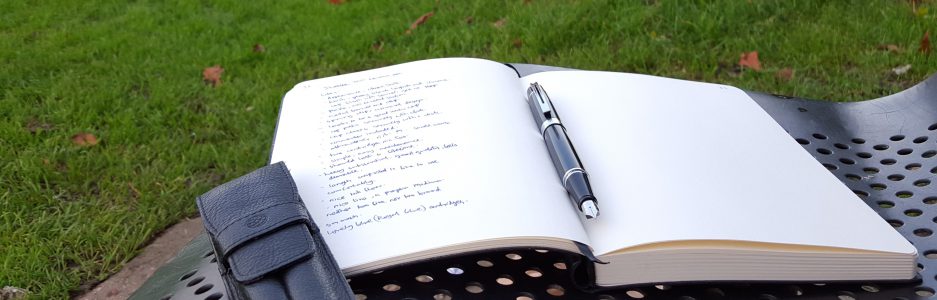
Since I began this blog over three years ago, the banner photo has featured my black Sheaffer 300 fountain pen, poised on a Ryman’s A5 notebook on a park bench. Yet until now, this pen had not enjoyed a post of its own.
I recall that I bought the pen at the John Lewis department store in Brent Cross and that the price then was about £45.00. Not super cheap but not expensive either.
Description.
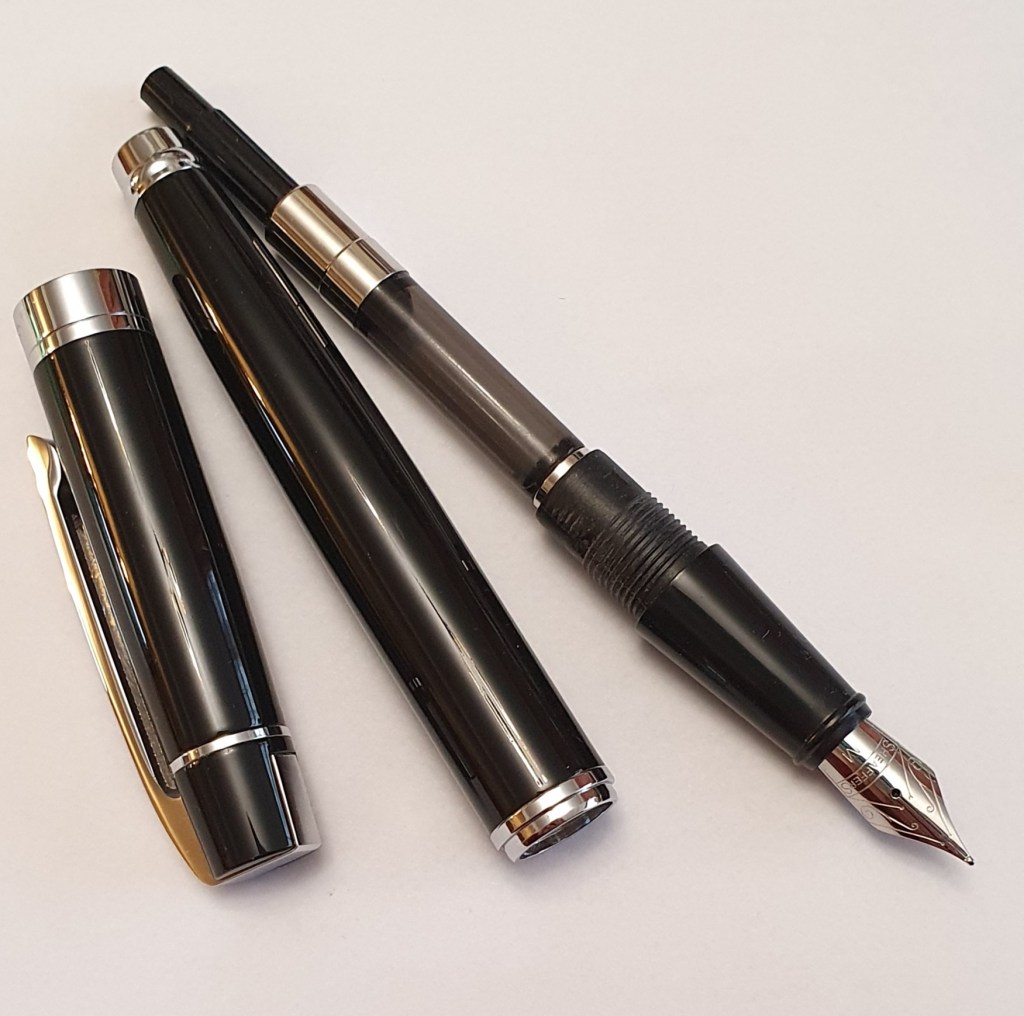
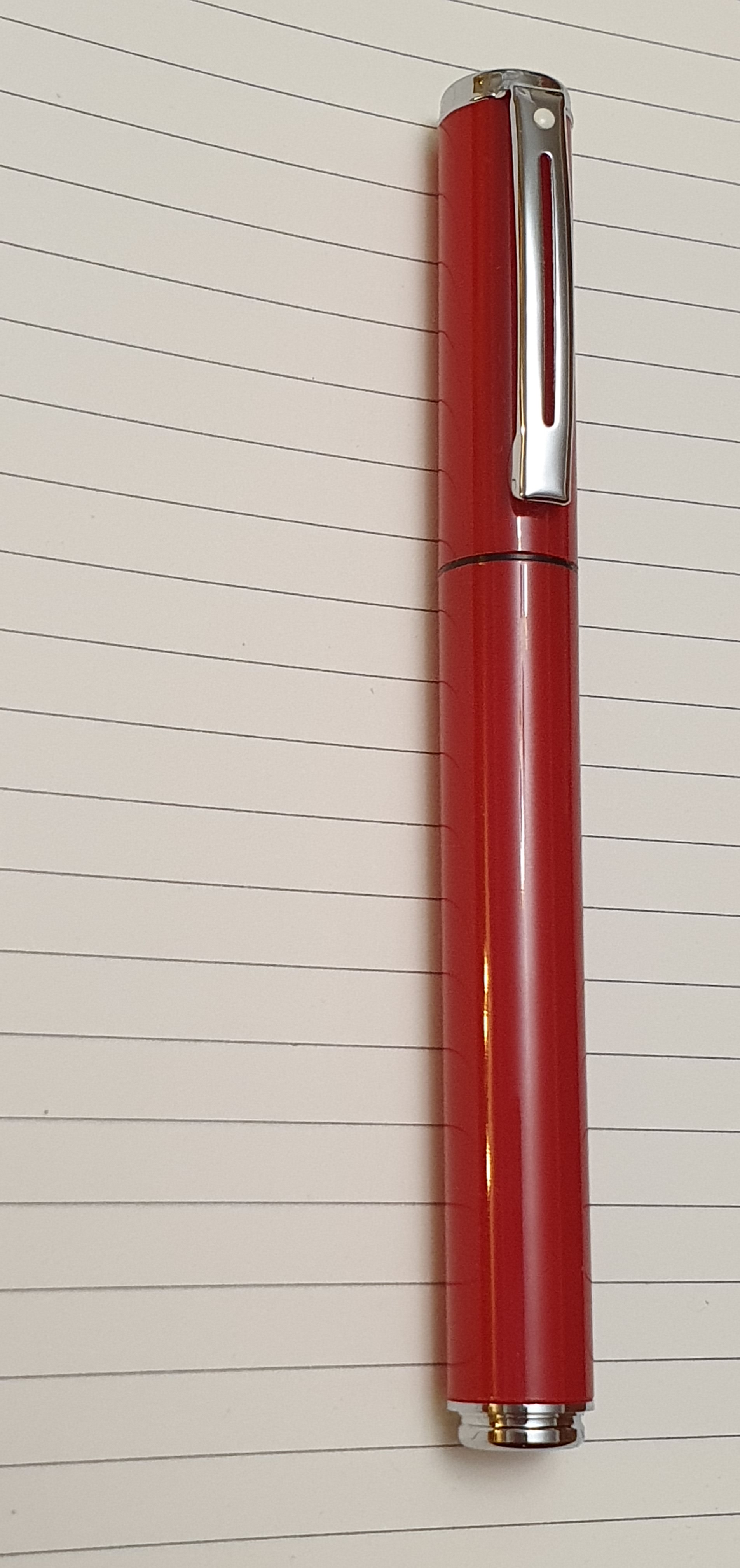
This is a lacquered metal pen, heavy and robust, in a glossy black finish. The cap fits flush with the barrel. The cap features a sprung pocket clip with the Sheaffer white dot. The broad shiny chrome cap band bears the name, Sheaffer.
Sheaffer 300.
The cap pulls off silently but makes a click as it goes back on and needs only a modicum of effort. It also posts very securely, designed to click onto a ridge on the barrel finial.
The grip section is black plastic, tapering but free of any facets telling you where to put your fingers. There is a slight step down from the barrel to the section (enabling the cap to fit flush as mentioned) but this does not feel rough or uncomfortable.
The nib.
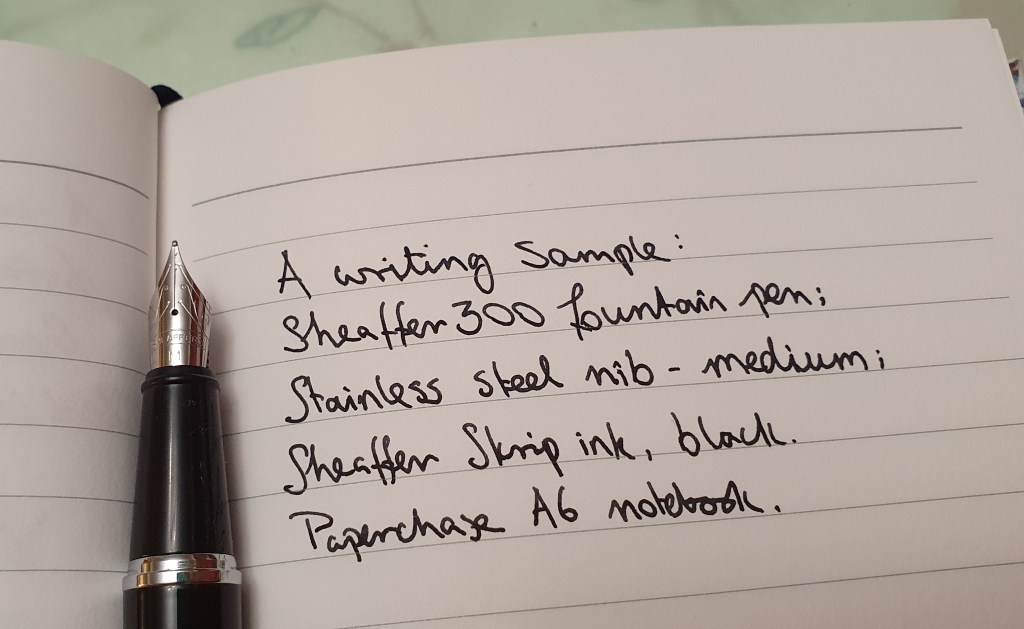
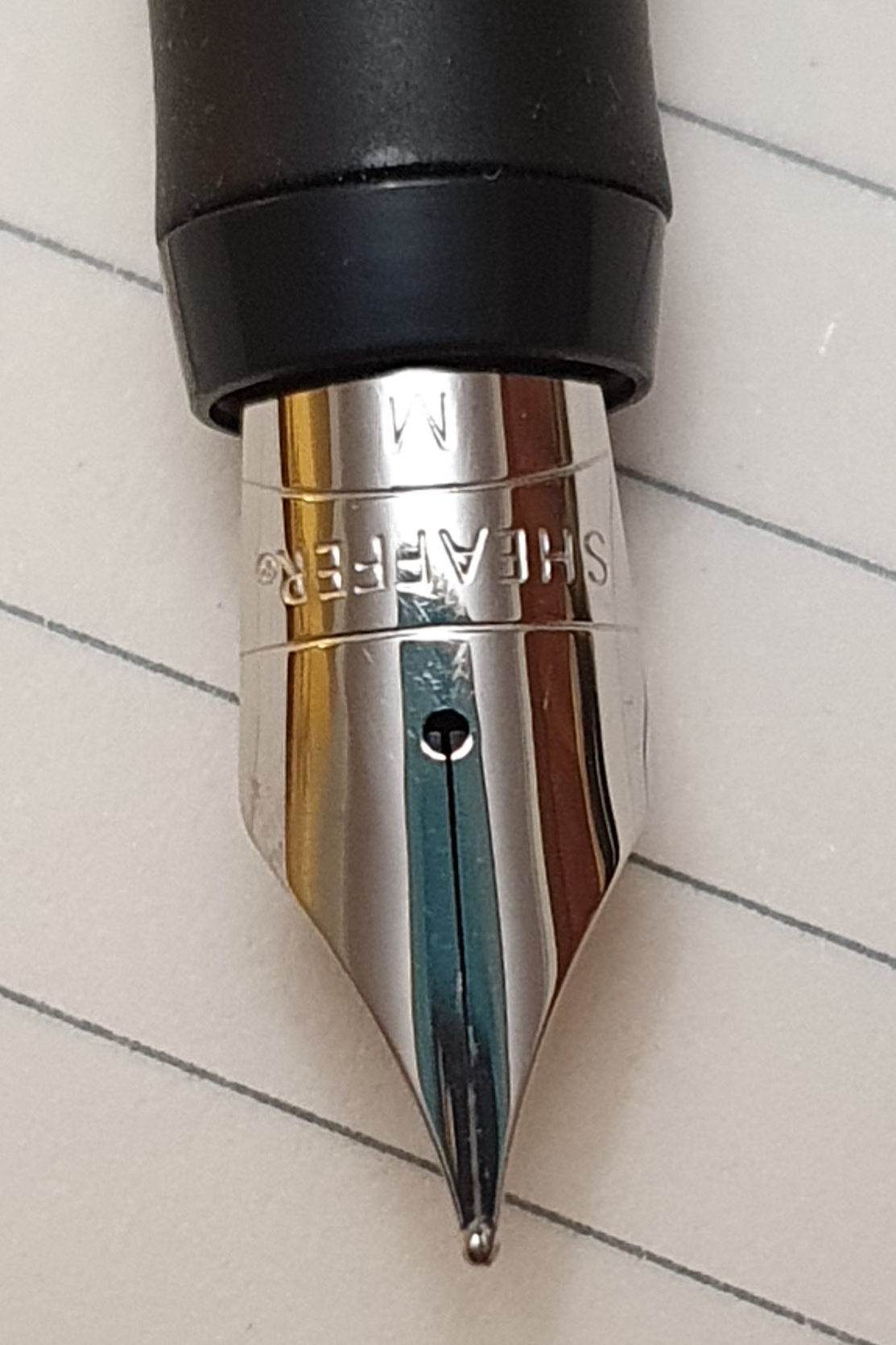
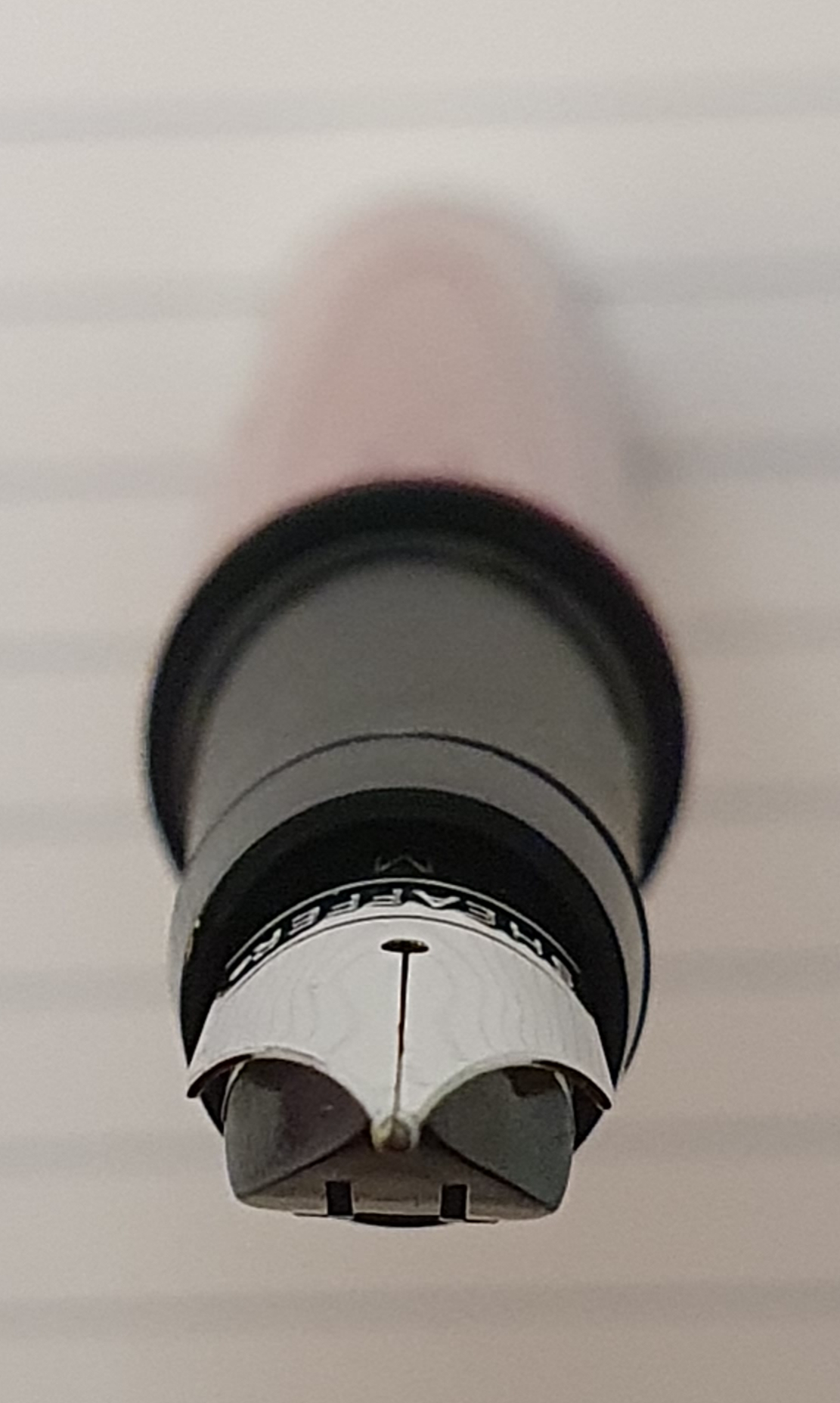
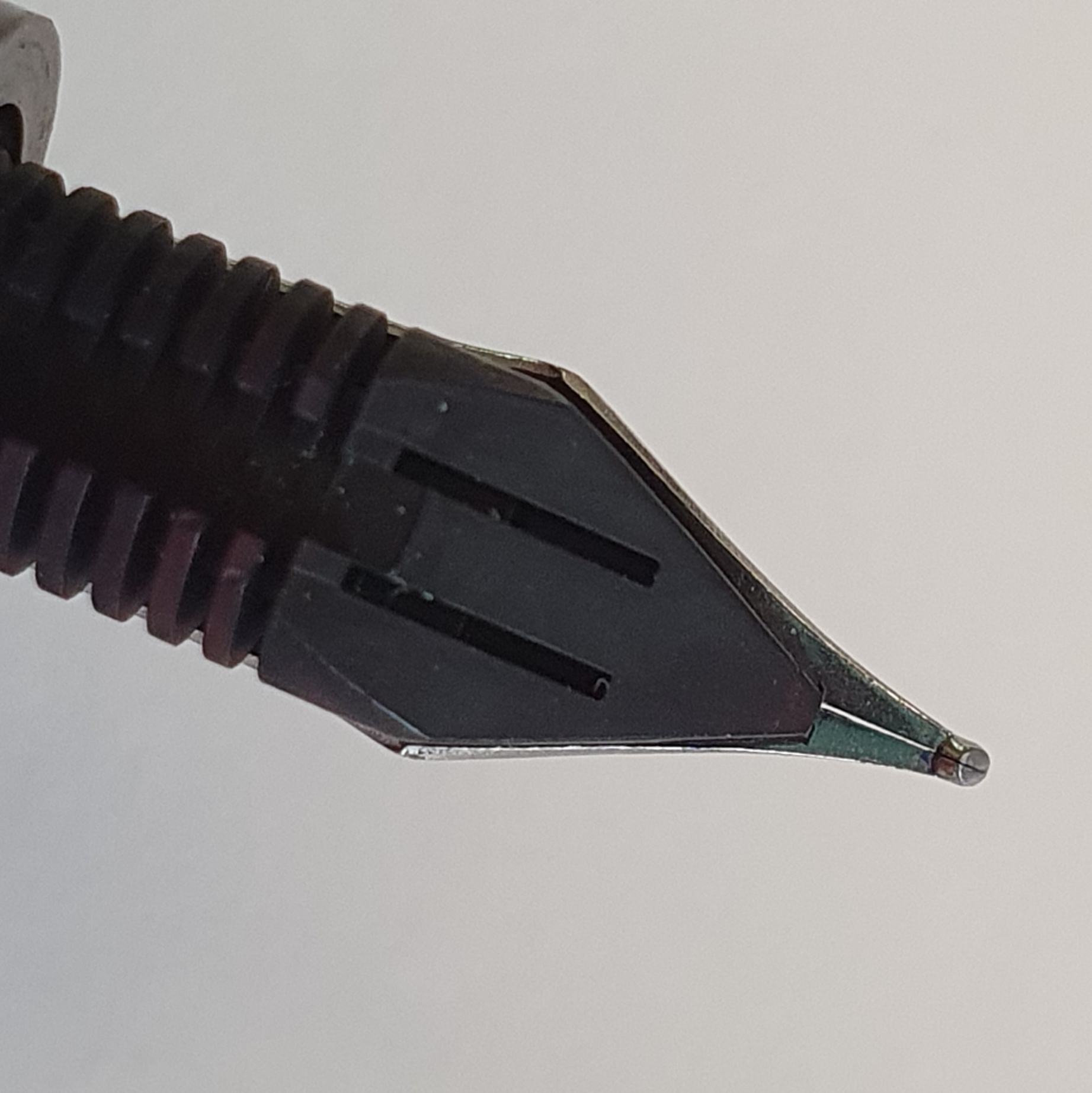
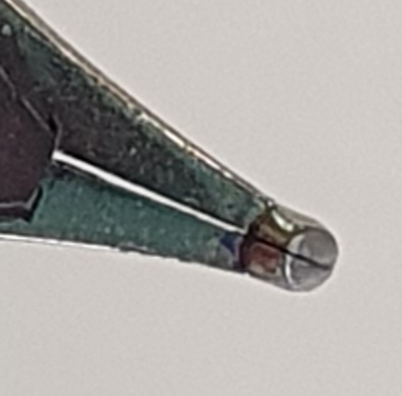
The steel nib has some attractive scroll work and states Sheaffers, with an M for medium. The tines are nicely aligned and there is just a minimal gap visible between them, which is to say that the nib is tuned just as I like. It writes smoothly with a good flow, on the fine side of medium. If you need a fine/extra fine line occasionally, you can turn it over to write with the other side of the nib. It is a firm nib, which I find more practical as a left hander.
Attractive steel nib.
Filling is by Sheaffer Skrip cartridges or else a Sheaffer converter.
Cartridge converter filler.
Weights and measures.
The pen has a generous girth, for those who like larger pens. However, uncapped it measures only 120mm. The cap can be posted, which brings the length up to 155mm, but it then becomes back heavy, unless (like me) you hold it fairly high. Closed, the pen measures 141mm.
If used unposted the pen weighs around 19g, which is quite substantial. However, the cap alone weighs in at 23g making a total of 42g if you wish to write with the cap posted.
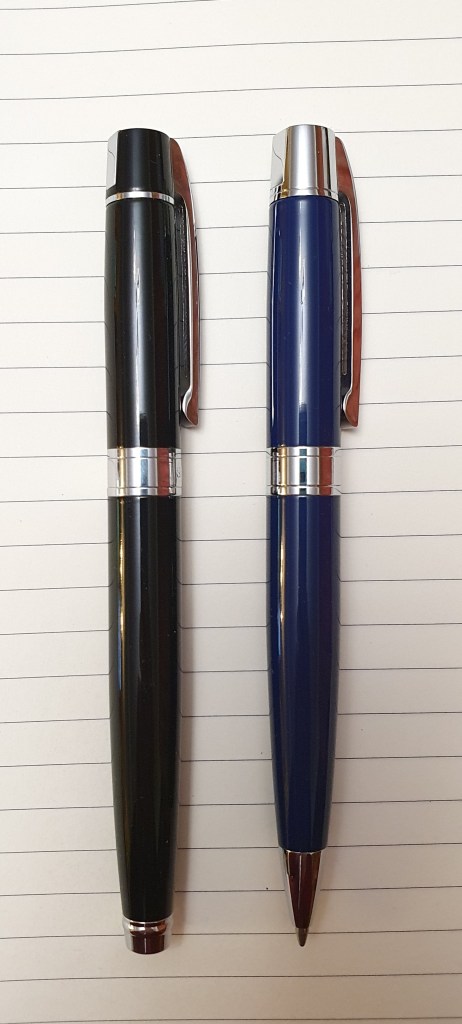
Later, I was persuaded to buy a Sheaffer 300 ball pen when half price, but at 49g this is even heavier than the fountain pen.
Fountain pen next to a Sheaffer 300 ball pen.
Likes and Dislikes.
On the plus side, the pen feels solid, well made and indestructible. It has a good sizeable girth, (broader than the Sheaffer Sagaris) and the nib on mine writes very nicely. The pen seems built to last, of sober design and good value for money. Other colours or a chrome cap version are available.
Writing sample from medium nib.
On the negative side, the section can feel a little plasticky, in comparison to the glossy lacquered metal finish of the cap and barrel. Also I would have preferred the barrel to be another 10mm longer so that I could use it more comfortably unposted. But this is just my preference and others who grip their pens lower may find the length no problem. Also, the threads to unscrew the barrel seem to go on forever.
Posting the cap does make for a very heavy unit and the pen can feel unbalanced unless you then grip quite far back from the nib.
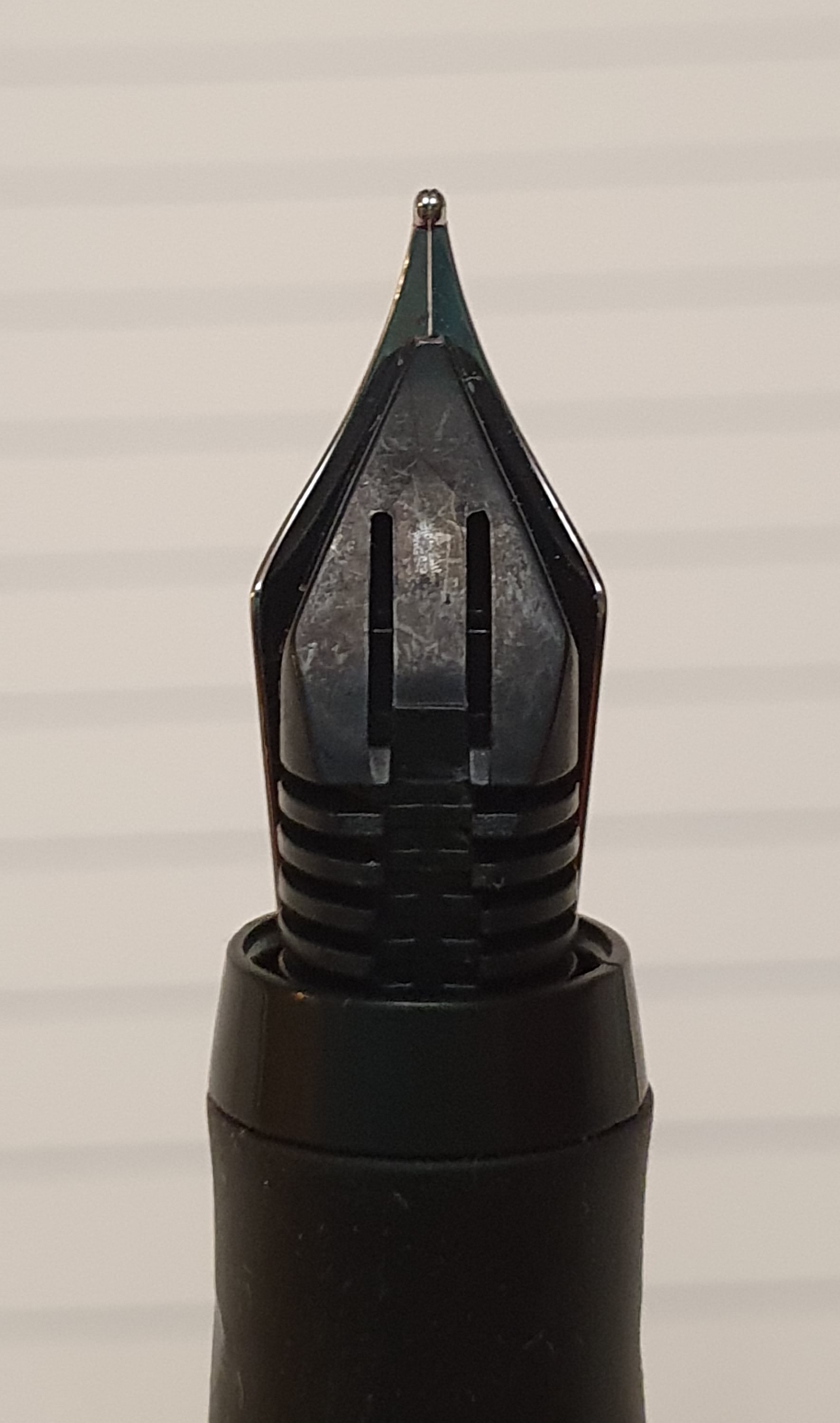
The nib cannot easily be removed. I did once try to pull it out of the section but it would not budge and I did not want to use any greater force, for fear of damaging the plastic feed. Having used Pelikans with their easily unscrewable nib units, I am rather disappointed when other pens do not have this feature.
Plastic feed.
Conclusion.
All things considered, this is a decent pen for the money. Pricewise it could be a rival to the Cross Bailey, but now Cross and Sheaffer are both under the same umbrella. For a steel nibbed, lacquered metal pen there is a lot to commend it. Mine has been rather neglected in recent years but I am glad to still have it, to enjoy from time to time and to use for my stock of Sheaffer Skrip cartridges.
Once in a while, I come across a fountain pen which writes so smoothly and well, that I almost want to put all my others away. If it happens to be inexpensive, so much the better. Such discoveries are partly what make the hobby so enjoyable and addictive.
Last August, I met up in London with a pen friend now living in Australia. We went for a coffee and got talking about pens. He showed me one that he was carrying, which he called his “melon pen.” It was an Online College. I was immediately struck by how smoothly it wrote and what an attractive line it produced. When I remarked upon this, he kindly said that I could keep it as he could easily pick up another, having bought it for a few euros from a German department store or pharmacy.
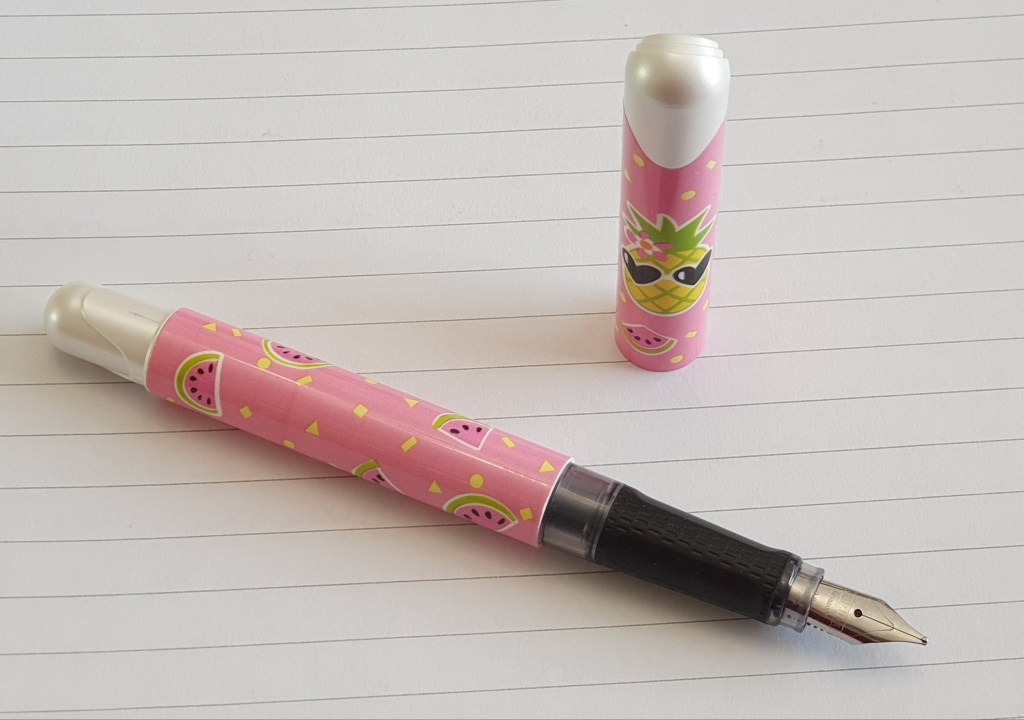
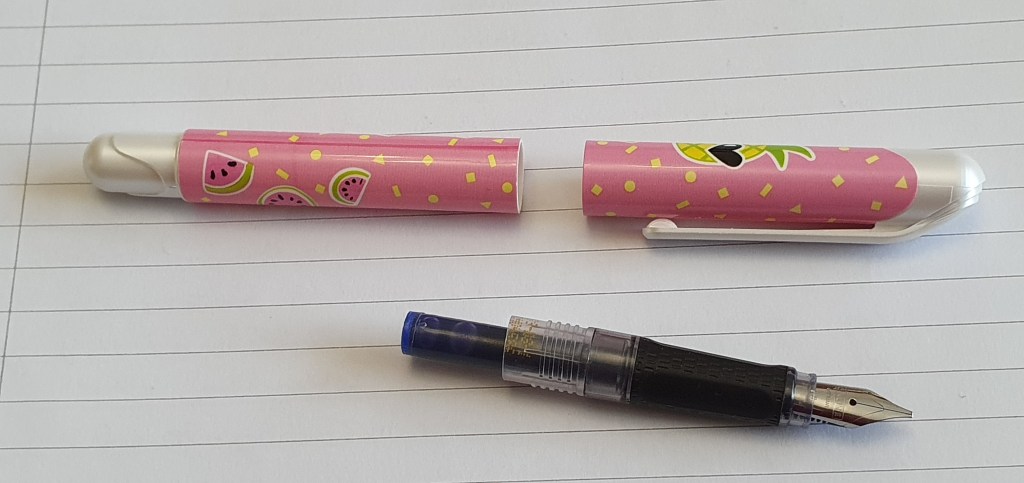
Online College cartridge pen, with melon and pineapple design.
Online is a German pen brand, established in 1991. Whilst this does not seem long ago to me, it pre-dated internet shopping. However they do now sell online (see website http://www.online-pen.de), as well as in shops.
To put this pen in context, the website shows various categories of pens. Under “Young Line” we see that the College is one of six different models geared towards children and the young at heart. Clicking on the College, you are taken to a large number of different patterns with brightly coloured graphics and with various nib options too. This particular model, to give it its full title, is the “Online Best Writer College 0.8mm Pineapple” and currently sells for 9.99 euros.
The extraordinary thing about this, is that there are so many nib options at this price point, from Medium, Fine, Extra Fine, Left handed to calligraphy nibs of 0.8mm, 1.4mm and 1.8mm.
Description.
This is a plastic pen, with a snap cap that can be posted. It has a steel nib. The grip section is soft touch and ergonomic, that is, rubberised and tapering but with two flattened facets for finger placement. There is a clear plastic ink window from which you can see if your cartridge is running low, when held up to the light. The barrel unscrews on plastic threads but with a distinct click at the end when tightened back on again.
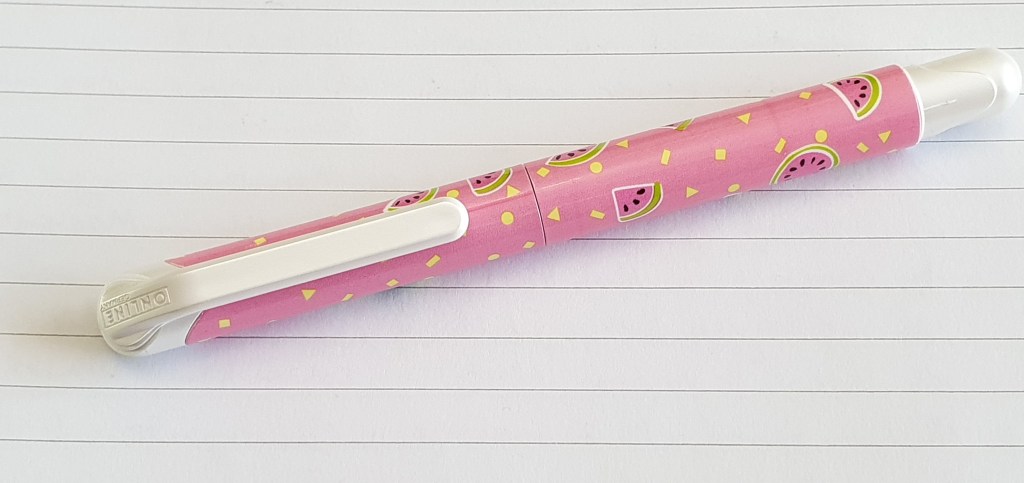
The cap and barrel are pink with a pattern of a pineapple and slices of watermelon and some yellow shapes. The clip is plastic and quite flexible but not very tight and secure.
More melon than pineapple.
The nib and writing performance.
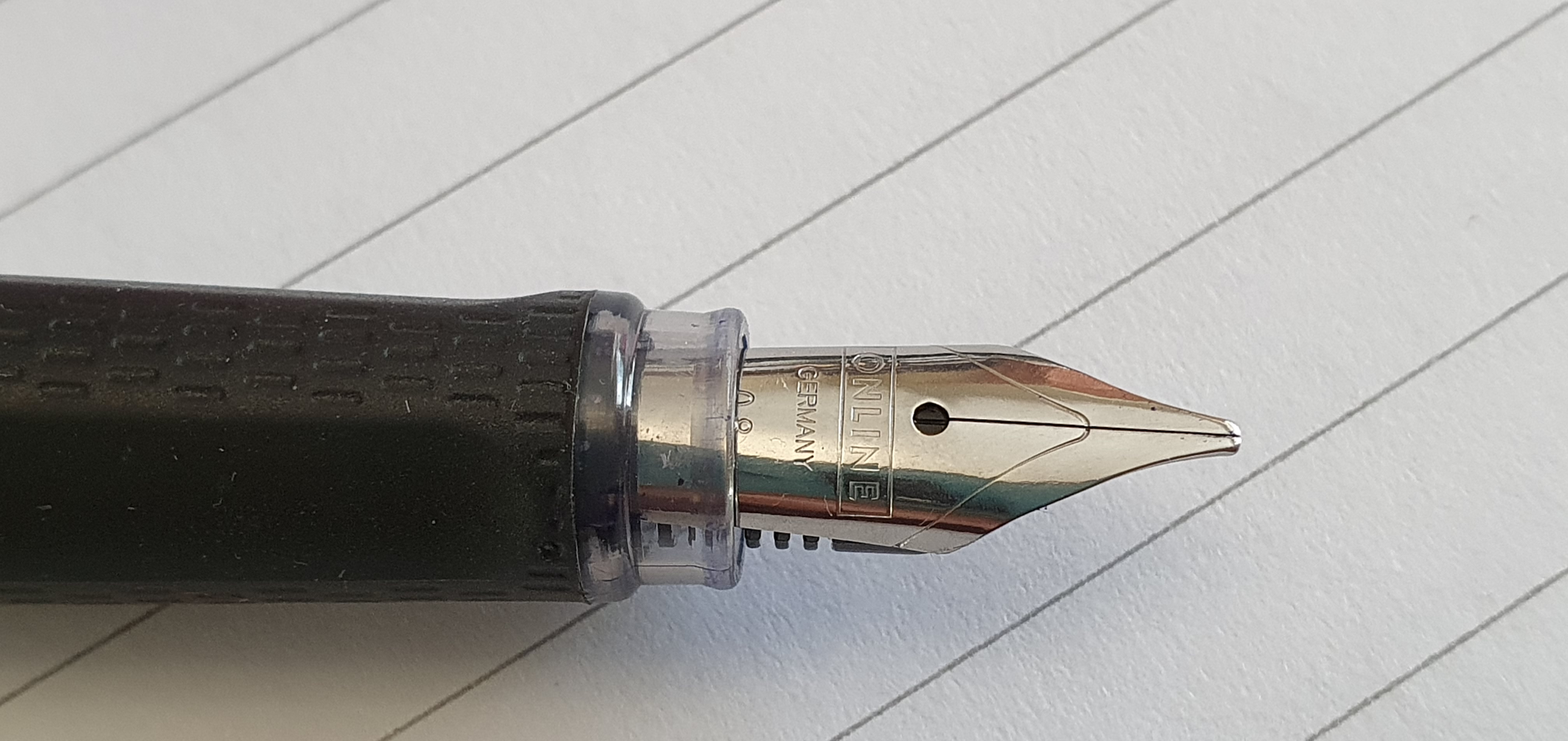
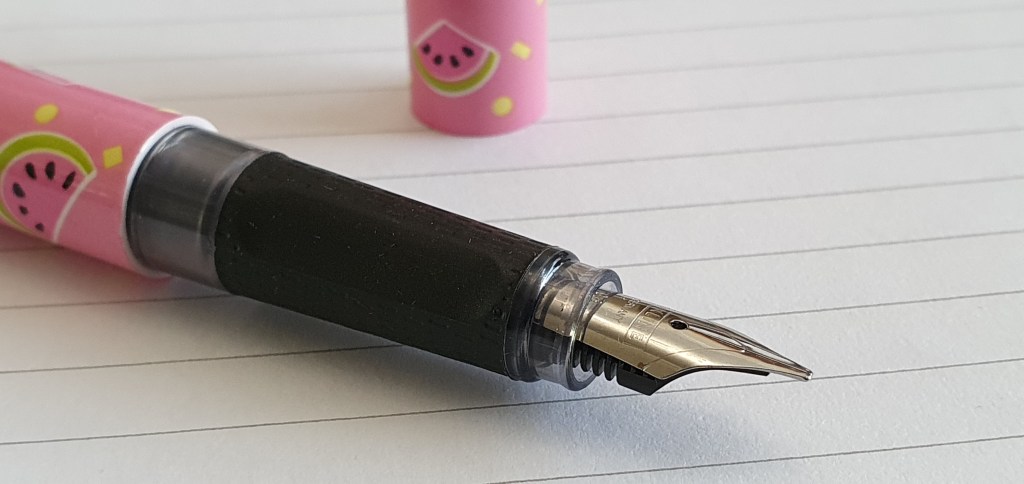
This particular one has the 0.8mm stub nib, imprinted with the words Online, Germany and 0.8. As I have said, it is very smooth. It is hard to tell whether it has a small amount of tipping material or is just very well polished but the effect is delightful and belies its low price. Personally I find this tip size very useful, being somewhat finer than the more common 1.1mm stub size from other brands. It is very flattering to one’s handwriting, whilst still being forgiving and without sharp edges to dig into the paper.
The Online 0.8mm stub nib.
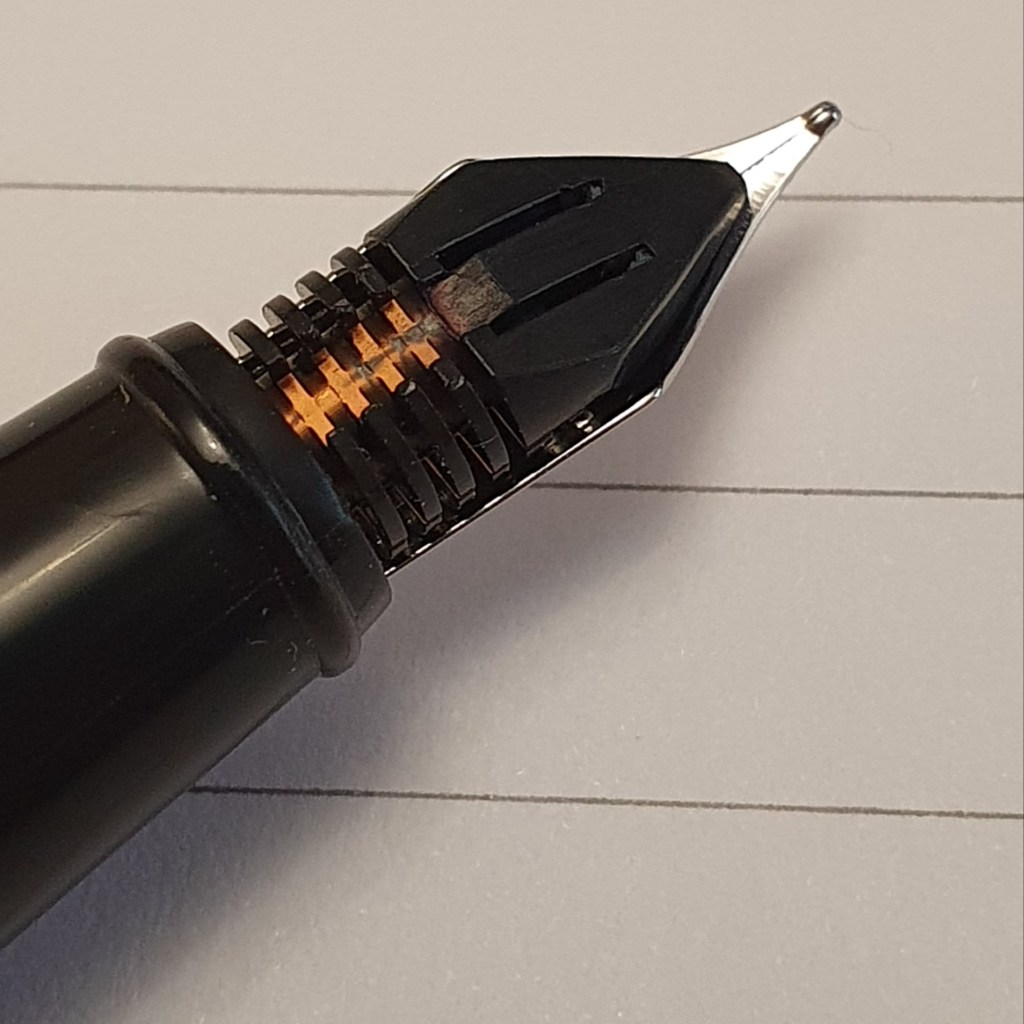
The nib and feed are friction fit. I have tried transplanting this nib into a TWSBI Eco, which partly worked but was not entirely successful as the nib did not fit snuggly against the Eco’s feed and so eventually I returned it to its own pink melon and pineapple body.
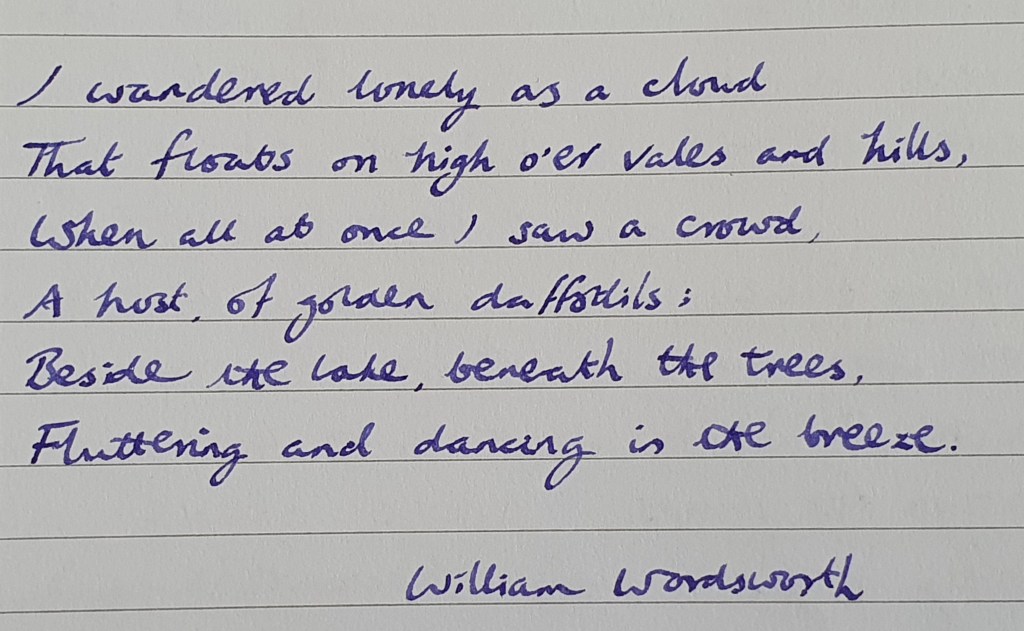
Writing sample from 0.8mm stub nib. With Kaweco blue cartridge and Concord 100gsm A4 premium writing paper notebook.
Filling system.
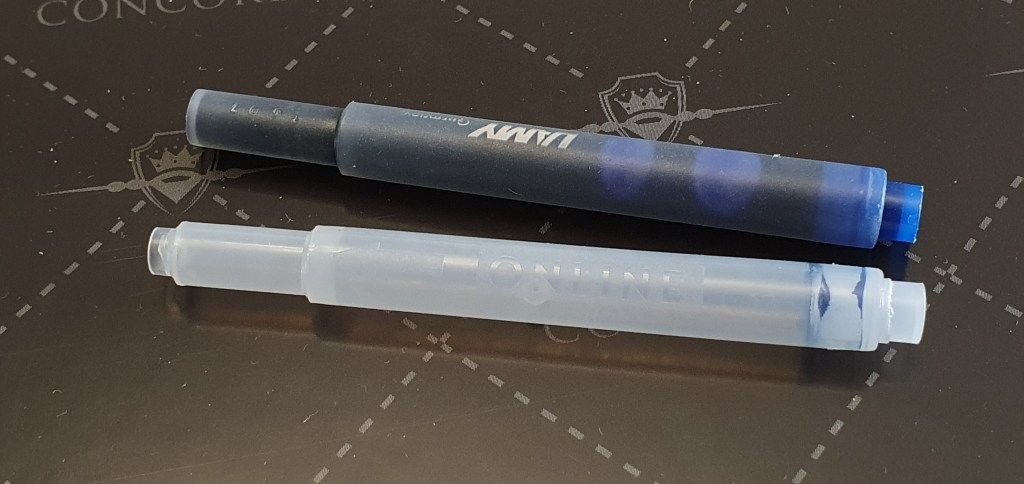
This is a cartridge pen, which takes standard international cartridges. When I received it, it was inked with an Online branded cartridge. The interesting thing is that these are “combination cartridges”, that are double ended: one end is the standard international fit (for this pen) whilst the other end has the Lamy fitting, thus enabling people to use their Online ink cartridges to fit in their Online or Lamy pens.
Online cartridge (empty) with standard international fitting on the left and Lamy fitting on the right.
Size and weight.
Being all plastic, this is a very lightweight pen. Inked, it weighs around 12g in all, of which 4g is the cap, and so only around 8g if used un-posted.
Capped, the pen measures around 139mm, and uncapped, a respectable 126mm. It is designed to be posted (the cap fitting over a recess in the barrel) but then measures a whopping 172mm, although still very comfortable and light. I prefer to use it posted and to grip high up, over the ink window.
Likes and dislikes.
For its modest price, this is a great buy and the smooth 0.8mm stub nib punches well above its weight. The pen is comfortable to use posted or unposted although very light. The cartridge filling system is very convenient although presumably, a converter could be used for bottle filling. The website states “The design contains fun and joy and lots of vitamins!”
With standard international cartridge fitted.
As for dislikes, it is lightweight and plasticky, but that is the point. I would have preferred a more boring plain colour or pattern, but that is a reflection on me and not the pen, which is obviously meant for young people. The fruit is refreshing and distinctive. There is no risk of me mistaking this for another pen. If melons and pineapples do not work for you, there are dozens of other designs to chose from.
Conclusion.
It is good to know that such a pleasant writing experience can be enjoyed for such little cost. It would be fun to visit a shop selling these in Germany and to rummage through the many patterns and nib options. I have not found them for sale in the UK either in shops or my usual online stores and so you may need to order your Online direct. But if you do not mind the lightweight plastic body and the lively design, you will be rewarded with a surprisingly good writing performance.
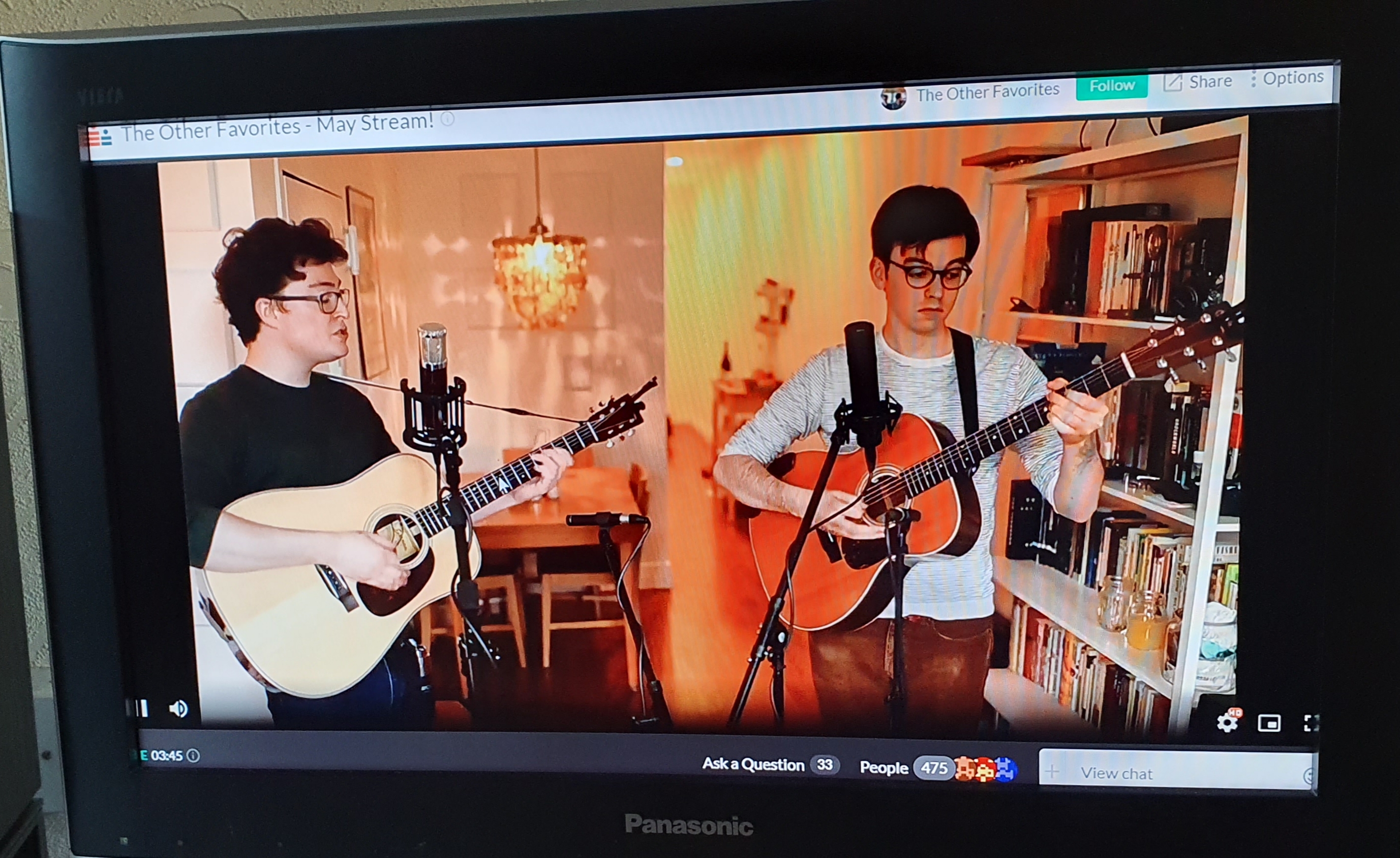
On 23rd May 2020, I joined a live stream concert given by The Other Favorites, the duo Carson McKee and Josh Turner. This was their third such venture and was streamed from Josh’s apartment in Brooklyn, New York, conveniently timed at 2.00pm eastern time, being 7.00pm for us watching in the UK.
The Other Favorites: Carson McKee and Josh Turner.
This was available to anyone who signed up via Crowdcast with a voluntary contribution, who then received a link to join the stream.
Some readers may recall that I was highly impressed with The Other Favorites, having found them on YouTube last year. I then got to see them at Bush Hall in Shepherd’s Bush last August and wrote a review here.
I saw Josh Turner in London again in October in Graceland Live at the Shepherd’s Bush Empire, with a band and The South African Cultural Choir UK. The first half was given to performances of selected Paul Simon songs up to the 1986 Graceland album interspersed with lively pieces from the choir. In the second half, the company performed the entire Graceland album with Josh on guitars and vocals. It was truly special to hear this classic album brought to life so vividly, 33 years after its release.
The Other Favorites were to have been touring again this year but this was not possible in view of the pandemic. Performing a livestream session from home enables musicians to generate some revenue during these times and also provides welcome “live” entertainment for fans also in lockdown.
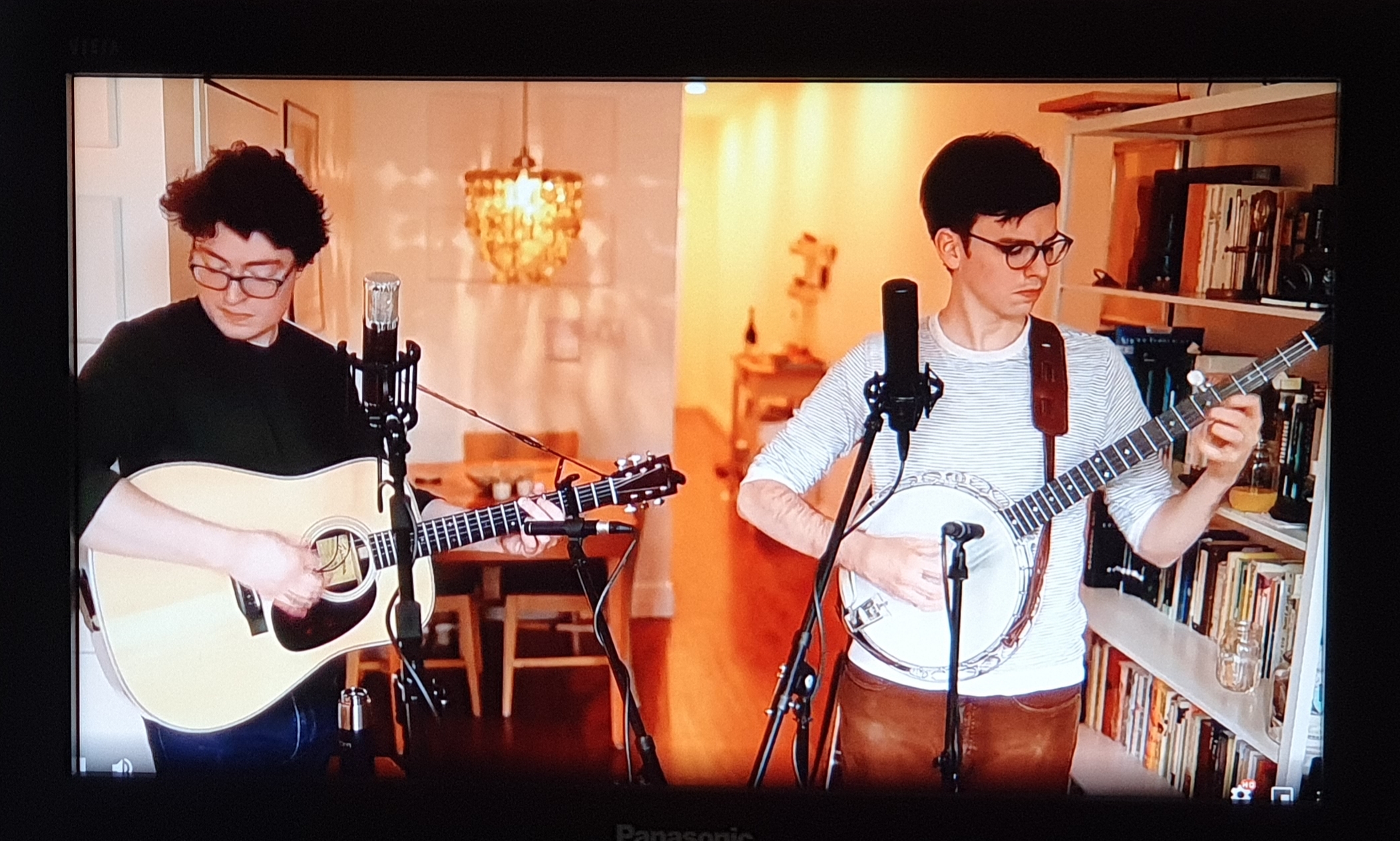
I continue to be amazed by this duo. From a rainy afternoon in Brooklyn, with the sound of an occasional car horn from the street below, they gave a very professional performance. Carson McKee played acoustic guitar and seemed the more relaxed of the pair, giving such a steady rhythm guitar and warm vocal performance that it looked effortless. Josh meanwhile began on his Martin acoustic for the first five songs before switching to a Fender Telecaster for the next five and then a banjo.
Josh now on banjo.
They played for an hour with a good mix of original material and covers, then gave a Q&A session for another half hour, answering questions from the chat messages. The original pieces spanned their ten years of playing and writing together. “Flawed recording” was one of their earlier songs, whilst “Nineteen and Aimless” was the opening track from Josh’s 2019 album As Good A Place As Any.
Once again, their performance demonstrated their genre-hopping versatility which takes in singer- songwriter styles such as James Taylor, jazz, bluegrass and Americana murder ballads and, with equal gusto, Abba’s Mama Mia. Josh’s guitar and banjo work on these is sublime, but never over-the-top. Listening to these young men, it is not unreasonable to compare their talents to a young Paul Simon or James Taylor.
The songs that they played are listed below (not including the rendition of Happy Birthday for Josh’s mother), to which I have added links to some of the YouTube videos. I am not sure if I have the title correct for number 7 but it was one of the standout pieces of the night and is one to watch out for.
Edit. 5 January 2022. I now know that song number seven is called Colorado Cowboy.
What we learned in the Q&A.
Asked whether they ever heard from artists they covered, they mentioned Robin Pecknold of Fleet Foxes. They had also performed with the Backstreet Boys. However, Josh had never met Paul Simon or interacted with him in any way, which was surprising given Josh’s involvement in the Graceland show last year as well as the Simon & Garfunkel story, theatre show.
Asked when they had started in music full time, Josh had worked in retail for three or four years after college, building up some revenue from Youtube and Patreon but it was not until it became feasible for him to tour repeatedly that he gave up his day job, in late 2018. For Carson, it was as recently as late 2019 that he stopped work in an Apple Store.
Josh clearly is keen on the technical aspects of recording and streaming to the web. Asked about their set-up for this show, Josh turned the camera on some of their gear, showing the mics all going into a Zoom L-8 mixing/recording board (given by Zoom after they had appeared in an advertisement) but I then got lost as he explained the signal path through the compressor and computer software, for the audio and video.
As for their dream venues to perform in, Carson named the Ryman Auditorium in Nashville and the Troubadour in LA, as the most iconic for him, to which Josh added Clowes Memorial Hall in Indianapolis, Indiana, being at his old alma mater.
Josh had studied music theory at high school and at college. We did not see his classical guitar work this evening (or the mandolin, lute, keyboards or percussion instruments that he sometimes plays in his videos). Asked about artists he admired, he listed Glen Campbell and Chet Atkins. However, in answer to a suggestion about appearing with mandolinist Chris Thile on his show Live From Here, Josh dismissed this as being way too intimidating as Chris Thile and his approach to music “is on such another level.” So even our heroes have heroes.
The Other Favorites do plan to host another livestream towards the end of June. They also mentioned a planned comedy project in the pipeline, where we would get to see Carson exercise his acting chops. Their long history of playing together has produced a great body of work on YouTube and they keep getting better and better. Just as I finished re-watching the livestream, YouTube brought up a song that they had recorded, singing in Japanese!
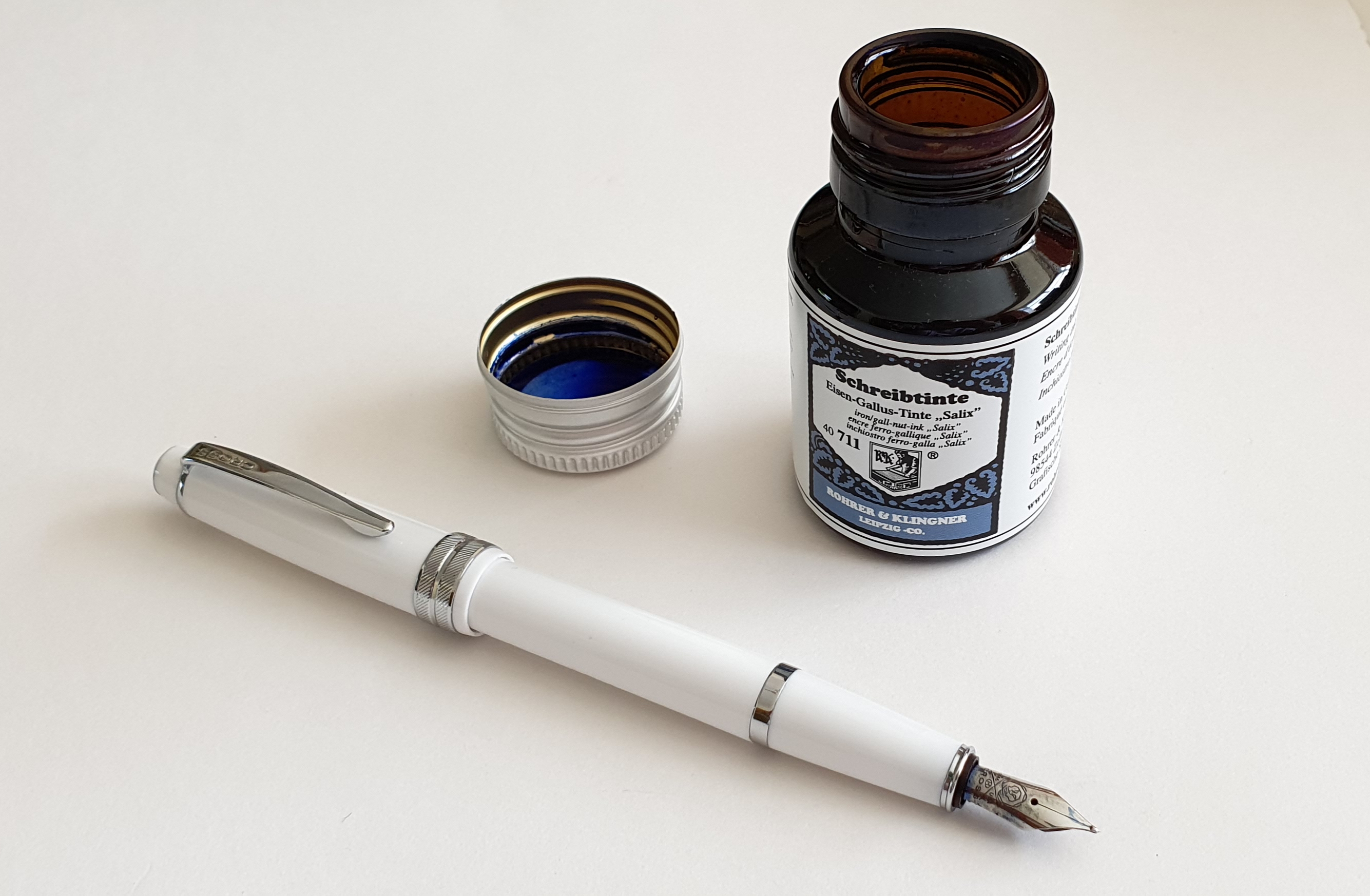
Whatever else I have in my pen cup, I like to keep one pen inked with a waterproof ink. For a few years, it was Sailor Kiwa-guro; then I tried Montblanc Permanent Blue. For the past three months, I have been using Rohrer & Klingner’s Salix in a Cross Bailey Light.
Cross Bailey Light with a medium stainless steel nib and a bottle of Rohrer & Klingner Salix, iron gall ink. I chose the white pen as it is suggestive of weddings and marriage registers.
This is an ink from Germany, sold in glass 50ml bottles without a cardboard box. The label on the bottle states “For fountain pens, steel nibbed pens, dip pens and individual writing utensils for calligraphy.”
Some benefits of this ink are as follows:-
1. It is an iron gall ink.
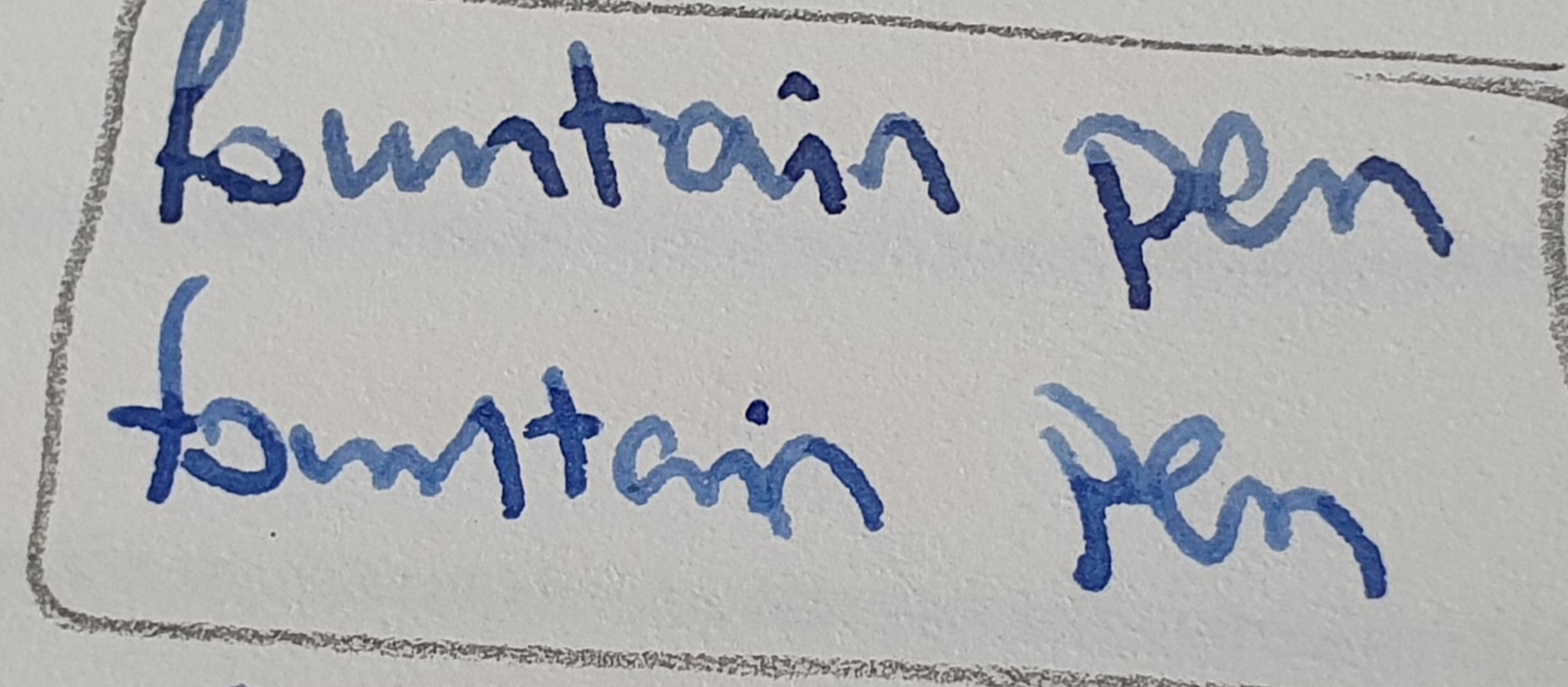
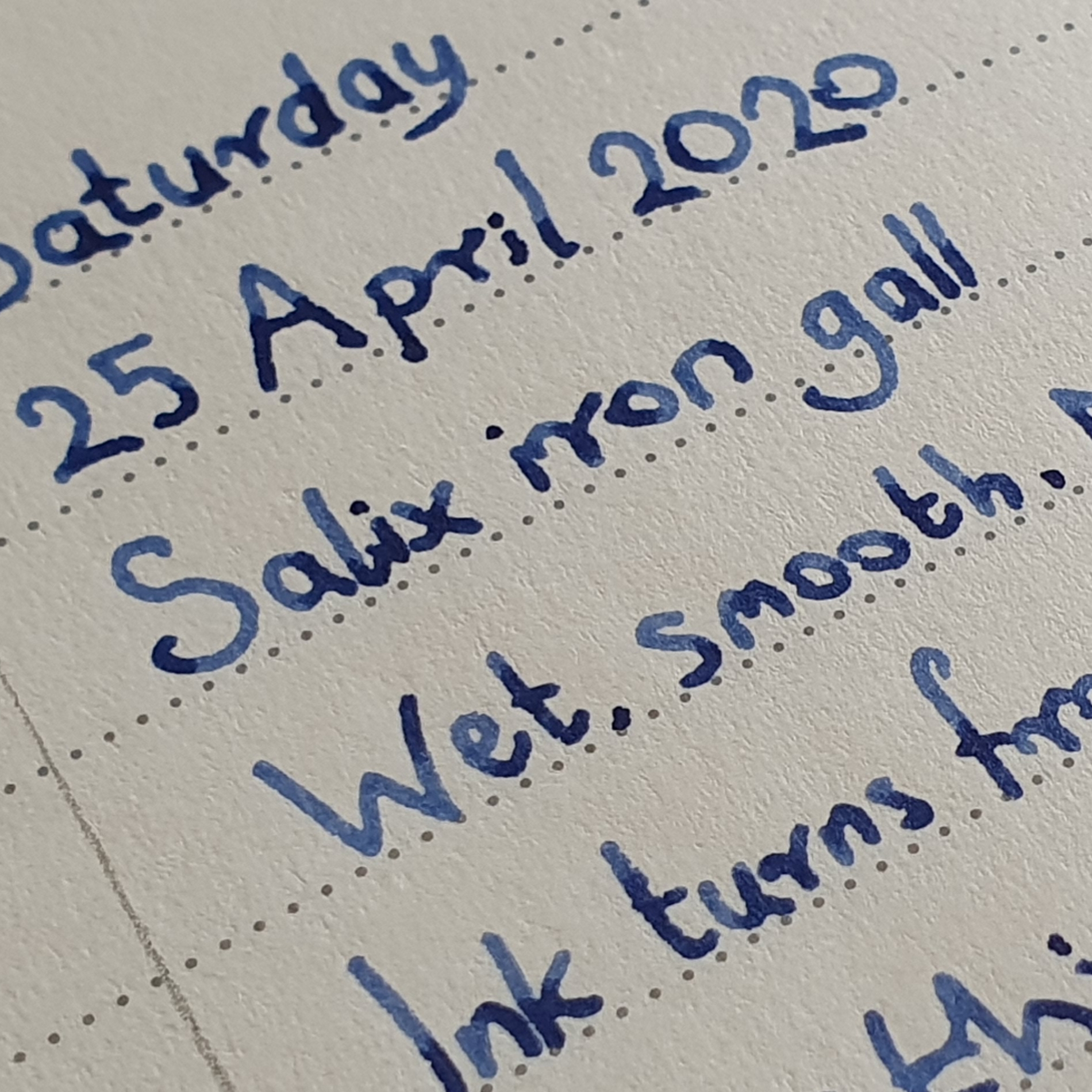
As such it has greater permanence than regular inks and should be suitable for documents which need to be kept for many years. It goes on like a pale royal blue when wet but darkens as it dries and oxidises over time, to a darker blue black. This change can be seen in both the light and dark tones:
Salix iron gall ink. This photo was taken immediately after writing the second line. The top line was written about 15 hours earlier. Basildon Bond letter writing paper.
2. It shades well.
Salix has an attractive, pronouncedshading in blue black tones, which has a pleasing, vintage style.
Ink journal entry, on Radley A5 notebook paper.
3. It is waterproof.
It is useful to have a waterproof ink when addressing envelopes but also to protect against spillages and smudges.
4. Less bleed through.
It can often be used on types of paper that would otherwise be subject to bleed through and feathering with normal inks, such as photocopying paper. Thus some notebooks that might have been put aside for being not fountain pen friendly, can be used for double-sided writing after all.
5. You can highlight over it!
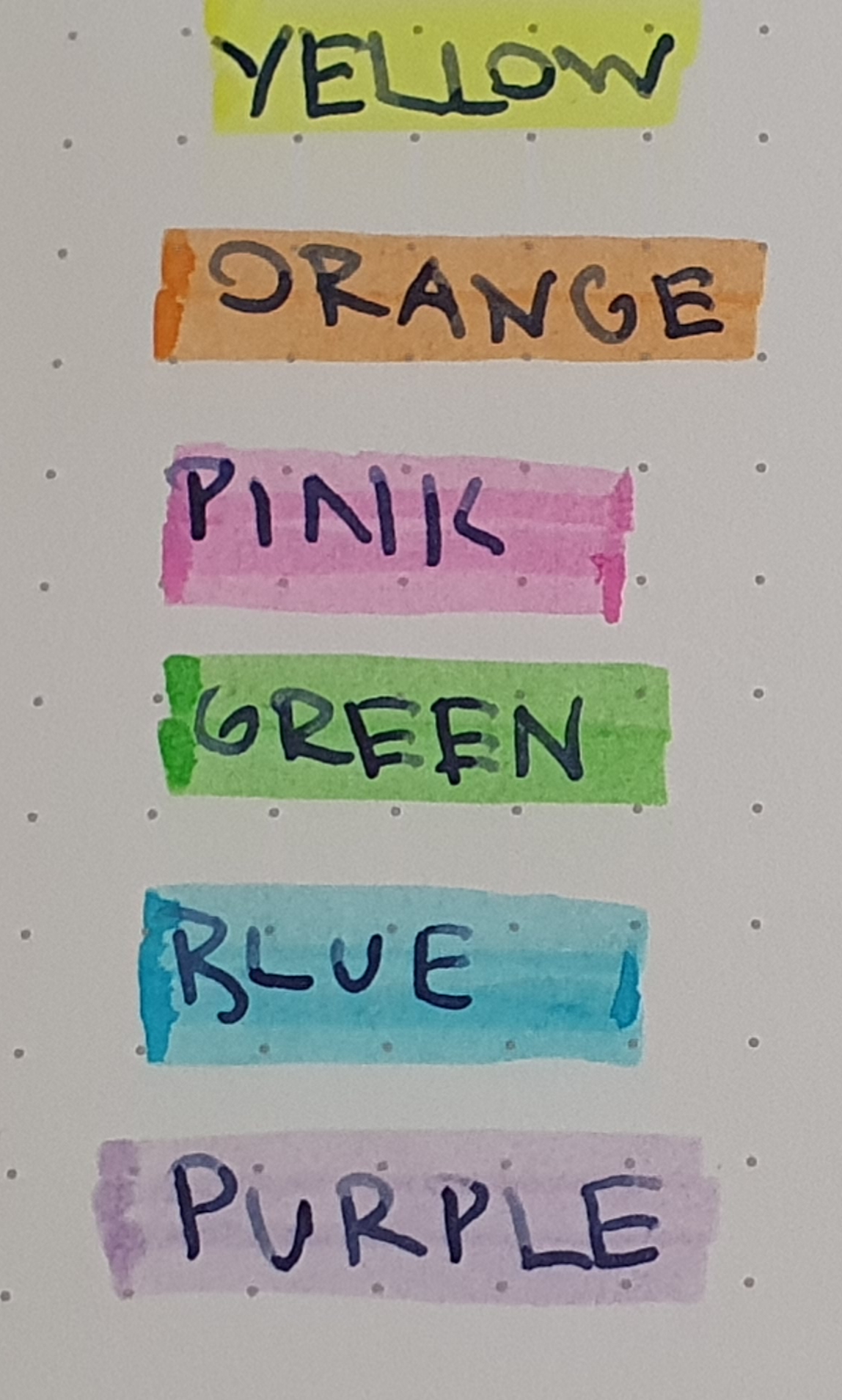
Being waterproof once dry, it does not smudge if you go over it with a highlighter pen. Ink is not transferred to the tip of the highlighter. I was excited to discover this. Being able to highlight sections of your own handwritten notes opens up new possibilities, for example for use in a work diary.
Testing out my Sharpie highlighters over some handwriting with Salix. Note the absence of any smudging of the Salix ink. Tomoe River paper.
6. It is good value.
The ink is not expensive. I bought mine at Choosing Keeping, a stationery shop in London. According to their web site, their current price is £8.00 for a 50ml bottle.
The downside is that iron gall inks are regarded as being higher-maintenance than normal inks. They are more acidic and may cause staining and corrosion of steel nibs. Rohrer & Kingner recommend that you clean your pen once a week. This advice is also given by Goulet Pens on their web site. Jet Pens recommend cleaning every four weeks or so.
For this reason I have been using it in an inexpensive pen so far but I am encouraged that I have not yet noticed any ill effects. Cleaning of the pen has been quick and easy. Also, the ink flows back and forth freely in the converter, leaving a nice even film on the sides and does not get stuck at the far end. Because of concerns over corrosion and staining of the nib, the natural response is to use it in an inexpensive pen with a steel nib. However, a gold nib will actually be more suitable as gold does not corrode. I plan to try it in my Sailor Pro-Gear slim, for its next fill.
My only prior experience of iron gall ink has been with the registrar’s ink from Ecclesiastical Stationery Supplies prescribed for use on marriage registers. I learned that once opened, their ink needed to be used up within around 18 months or so. Certainly, if kept for years after opening, the ink loses its colour and turns to a pale grey. Once that happens it is time to throw it out and order a fresh bottle. I do not know whether Salix also does this but will try to make regular use of my bottle.
Rohrer & Klingner also have one other iron gall ink in their range, called Scabiosa, which is a dusty purple. I believe that it will have similar properties to the blue black Salix. I am keen to try it when I can get my hands on a bottle.
Recently I have been taking stock of my fountain pen accumulation. This involved getting them all together and listing them on a spreadsheet, a sure sign of having too many pens.
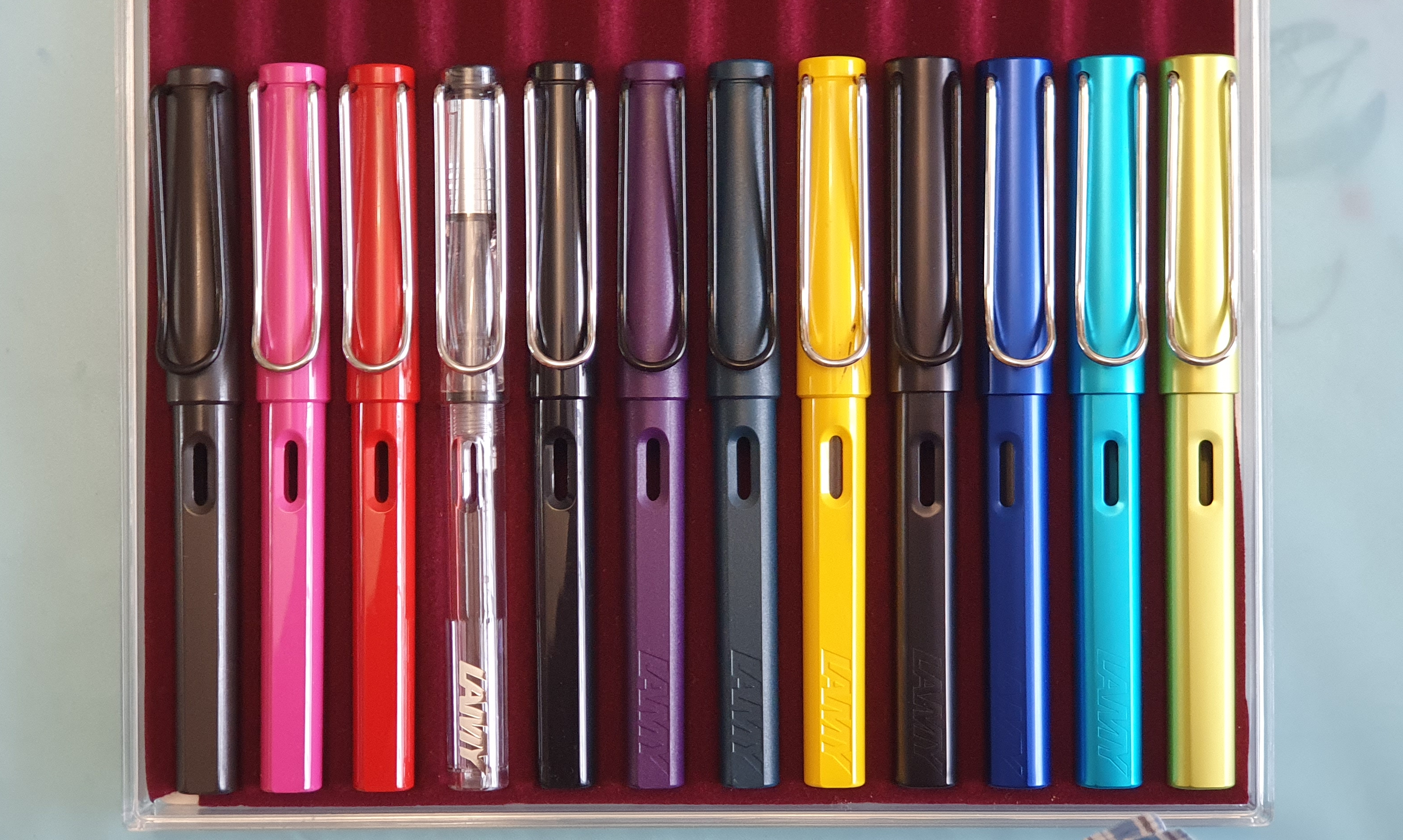
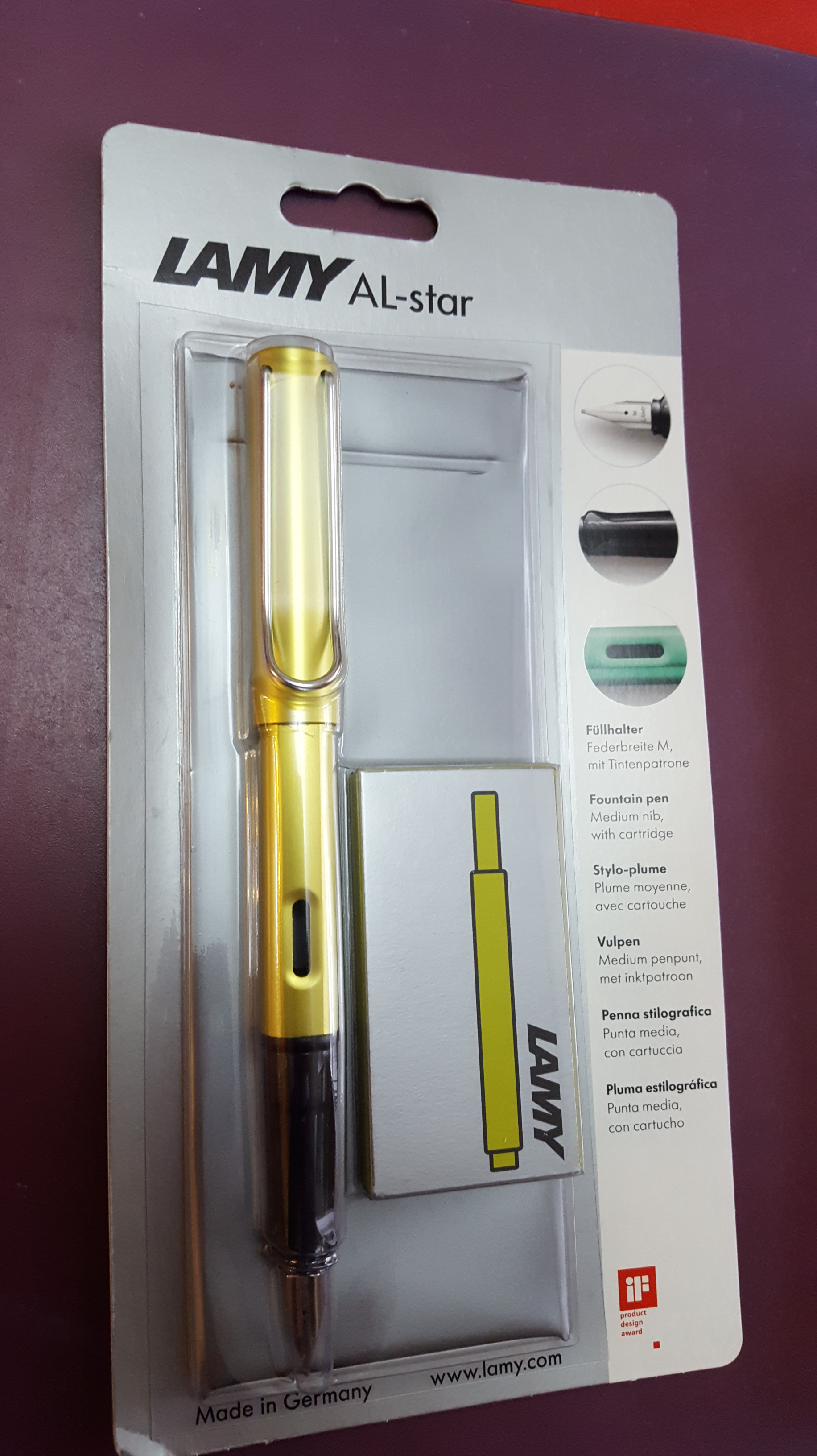
They included twelve Lamy Safaris and AL-stars. I am not even a particular fan of these pens. What was I thinking?
My Lamy Safari, Vista and AL-star fountain pens.
But then as I looked, their stories came back to me, one by one. The charcoal Safari was my first. It was an impulse buy in Rymans in Golders Green when my wife had sent me to buy Sellotape. She was busy making a photo display for our church. I used that pen a lot.
Then the pink one was bought in Marlow, a pretty town on the River Thames. We had gone for a day trip with Joey, a Chinese student who was visiting us at the time. I tried unsuccessfully to enthuse her in fountain pens.
I bought the red one in a traditional fountain pen shop on another day trip, to Oxford. An aunt had sent me a cheque for my birthday to buy myself something pen-related. A Safari seemed just the thing. The helpful lady in the shop offered me a choice of nib too, in silver or black. I chose black. (At the moment, this nib has been borrowed by my Lamy Studio, whose own nib was ruined when it fell off a table).
The Lamy Vista, (Safari demonstrator version) was bought in the summer of 2014. I remember showing it to my brother when we met up to see the Eagles at London’s O2 Arena, in the final stages of the History tour. It was one of the most fabulous concerts I had ever seen, more poignant now as it included the late Glenn Frey, who passed away in 2016. My brother and his partner had generously bought me the ticket as a surprise.
I remember buying the black Safari in Harrods’ stationery department, from a pen cup rather than in the usual blister pack. It was probably my intention to use this with black ink. A black pen always looks smart.
I was thrilled to find the limited edition Dark Lilac Safari, when eventually it appeared in our local shops. I had been waiting for it to arrive. This was a great colour and so was the matching ink.
Similarly, the limited edition Petrol was a thrilling find, when it arrived in our shops quite some time after news of the colour had first appeared on the internet. I much enjoyed the matching ink colour, a dark teal with lovely shading.
The yellow Safari is still my favourite of the Safari colours. I was on the way home from Hampstead after an annual cardio check-up at the hospital. I popped in to have a look around Rymans and treated myself to the Safari “for being good.”
Turning to my AL-stars, the black was my first. I remember being excited to discover that an aluminium version existed and enjoying the touch of the cool aluminium body. I had this pen with me during a short stay in Tetbury, in the Cotswolds in May 2013 where we had been for a wedding. I found a stationery shop there with a display in the window of the same black AL-star as mine. Naturally I took a photograph of it.
“Snap!” A window display in Tetbury, 2013.
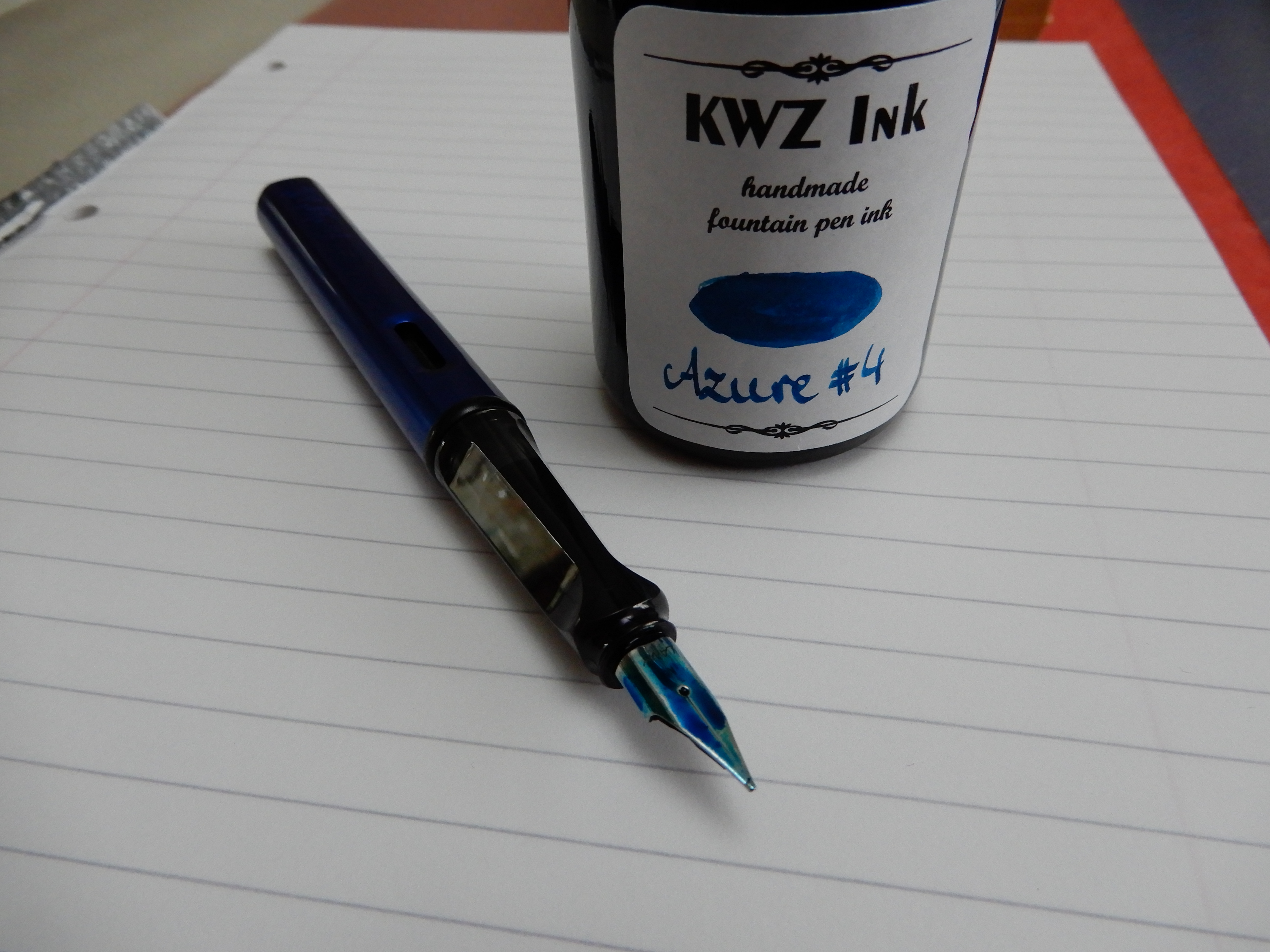
The Ocean blue AL-star was bought in Rymans Golders Green and has been featured in this blog before (here). The nib was particularly smooth.
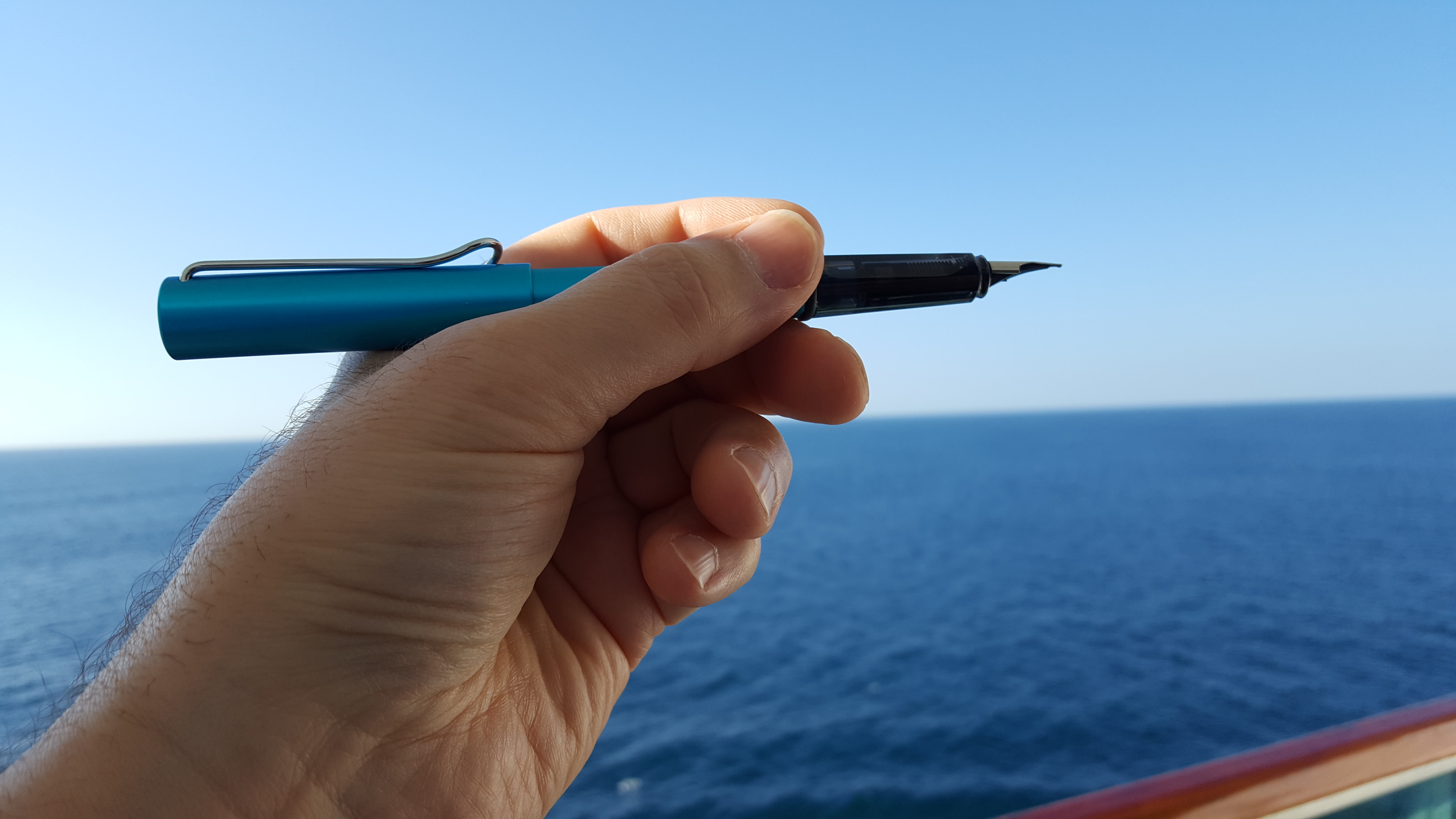
The colour name is not to be confused with the lighter, Pacific blue version, which I ordered from Cult Pens and which came with a pack of cartridges in the lovely bright Lamy turquoise.
Being artistic on a cruise with the Pacific blue AL-star.
Finally, the rather unusual colour called Charged Green was another impulse buy, probably because the price was reduced. It was not a colour that appealed to me really but I decided to give it a go. However the accompanying cartridges were too light a shade to be useful.
Lamy AL-star in charged green.
I did not set out to be a pen collector. I think the fact that I passed up all the other colours of the Safari and AL-star and the LX models too, proves that I am not a collector. But as I get older, I am realising that it is not so much the merits of a pen in our ownership that make it important to us, but the associations that the pen has for us. I have shared mine here, not because they are particularly significant but to prompt you to reflect on what associations your pens have for you. Whether we see ourselves as collectors of pens or not, we are traveling through life collecting memories.
Recently I was asked in an email, what fountain pen I would recommend for a beginner. She mentioned that she had traditional taste, enjoyed good quality and style and wished to start with a cheaper pen, costing no more than say 20 to 30 euros. She wished to use it with a Leuchtturm 1917 notebook. “Is it possible to get a good quality pen for that price?”, she asked.
Happily, the answer to the last question is yes. There are numerous fountain pens on the market in this price bracket, from a wide range of brands and with a host of different attributes.
Ideally, before making recommendations, I would find out a little more such as her previous experience of fountain pens, how she holds her pens, her writing size and style, whether she has any preferences as between brands, materials (plastic or metal), filling systems and the pen’s size and weight, and so on.
In the absence of such information to narrow down the field, I made a number of assumptions and the following can be general advice only and is based upon my own experience, likes and dislikes.
From the mention of the Leuchtturm notebook, I assume that the pen may be used for journaling but may also be enjoyed for letter writing, occasional notes and other general tasks: in short, a general purpose pen.
Also, the suggestion of “starting with a cheaper pen”, implies that she wishes to try an entry-level pen first and then later progress to the next level. This is sensible to ensure that she likes using a fountain pen before investing too much money and secondly, to spend some time with a beginner’s pen and so appreciate the improvements when moving on.
A beginner’s pen will have a stainless steel nib. I suggest a medium nib to start with (assuming average sized handwriting). As for filling systems, the pens in the following selection are almost all cartridge-converter pens. That is, they are filled by inserting a plastic cartridge of ink but can also be adapted for filling from a bottle, by inserting a “converter,” typically an ink reservoir with a twist mechanism for drawing up ink.
Cartridges are quick, clean and convenient for refilling on the go. The downside is that it is generally more expensive to buy ink in cartridges, (especially if the pen accepts only its own branded cartridges, as with Lamy and Cross for example). There is also the plastic waste. Bottled ink gives the benefit of being available from a variety of brands and in a huge number of colours.
The one other filling system represented in my list, is the piston filler (TWSBI Eco) which draws ink directly into the barrel and can be filled only from a bottle.
If possible, it is best to visit a shop to see the pen before buying but this is not always practical, not least because of the current lockdown and so buying online may be the only option.
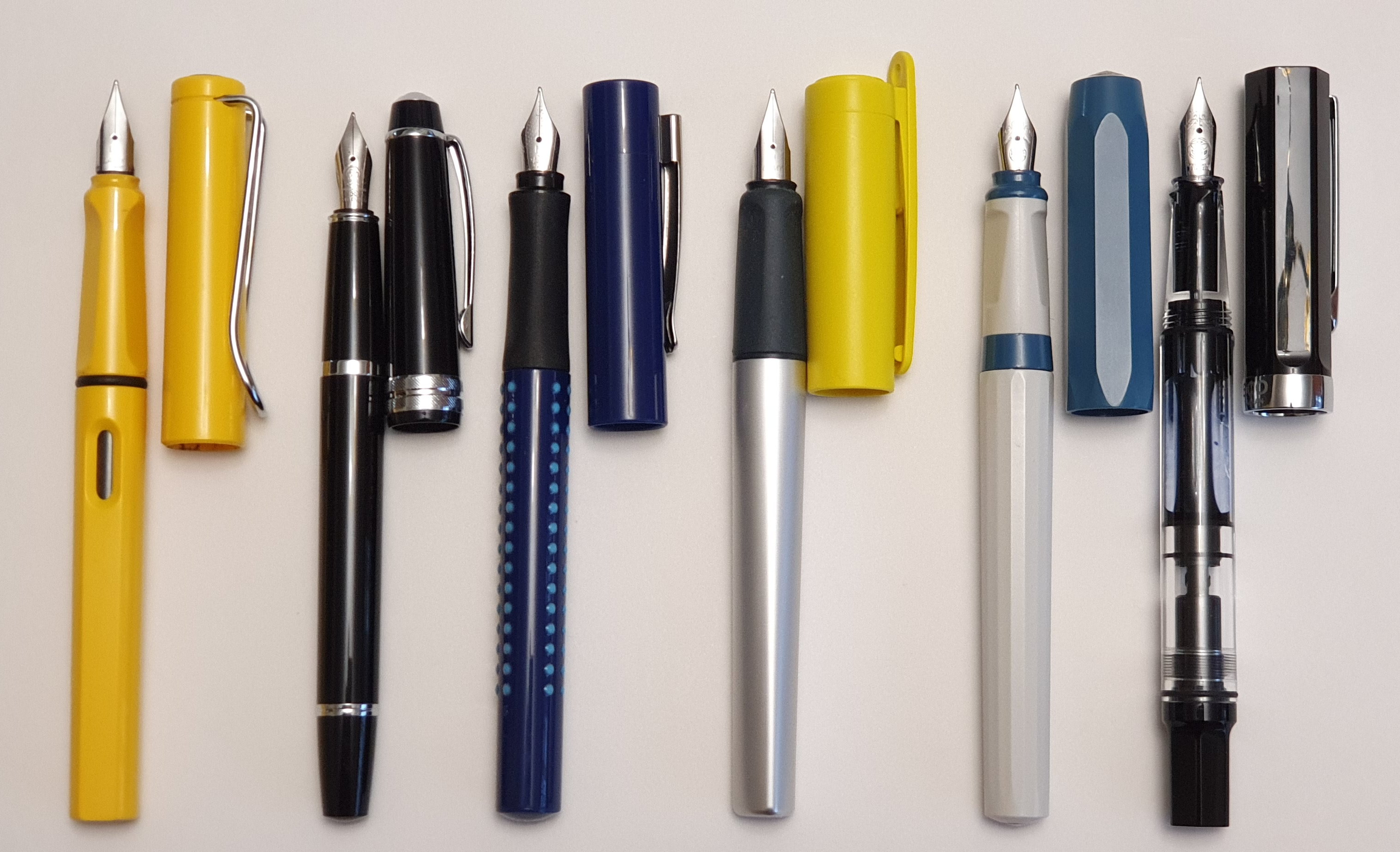
With all these caveats in mind, here is my personal selection, in no particular order, with a few thoughts on each:-
Lamy Safari
Lamy Safari. This is still the best colour in my view.
Perhaps the most obvious choice, the Lamy Safari is widely available, in a range of colours with new special edition colours coming out every year. These are tough, plastic pens with quick, snap-on caps and are a decent size even for larger hands. Thanks to state of the art engineering, good quality control and testing, the nibs are well finished and write smoothly, straight out of the box. Replacement nibs are available in various widths and are easy and inexpensive to replace. The pens cost around £18.00 in the UK
The downside for some is that the grip section has two facets, pushing you to adopt a symmetrical grip between finger and thumb, centred above the nib which is not so comfortable if you prefer to rotate your nib inwards as you write (as I do). This puts some pen enthusiasts off, although most whom I know, probably own or have owned at least one. Also you are restricted to Lamy cartridges. A Lamy converter can be bought separately.
An aluminium version of the pen, in a range of colours, is available at around £25.00.
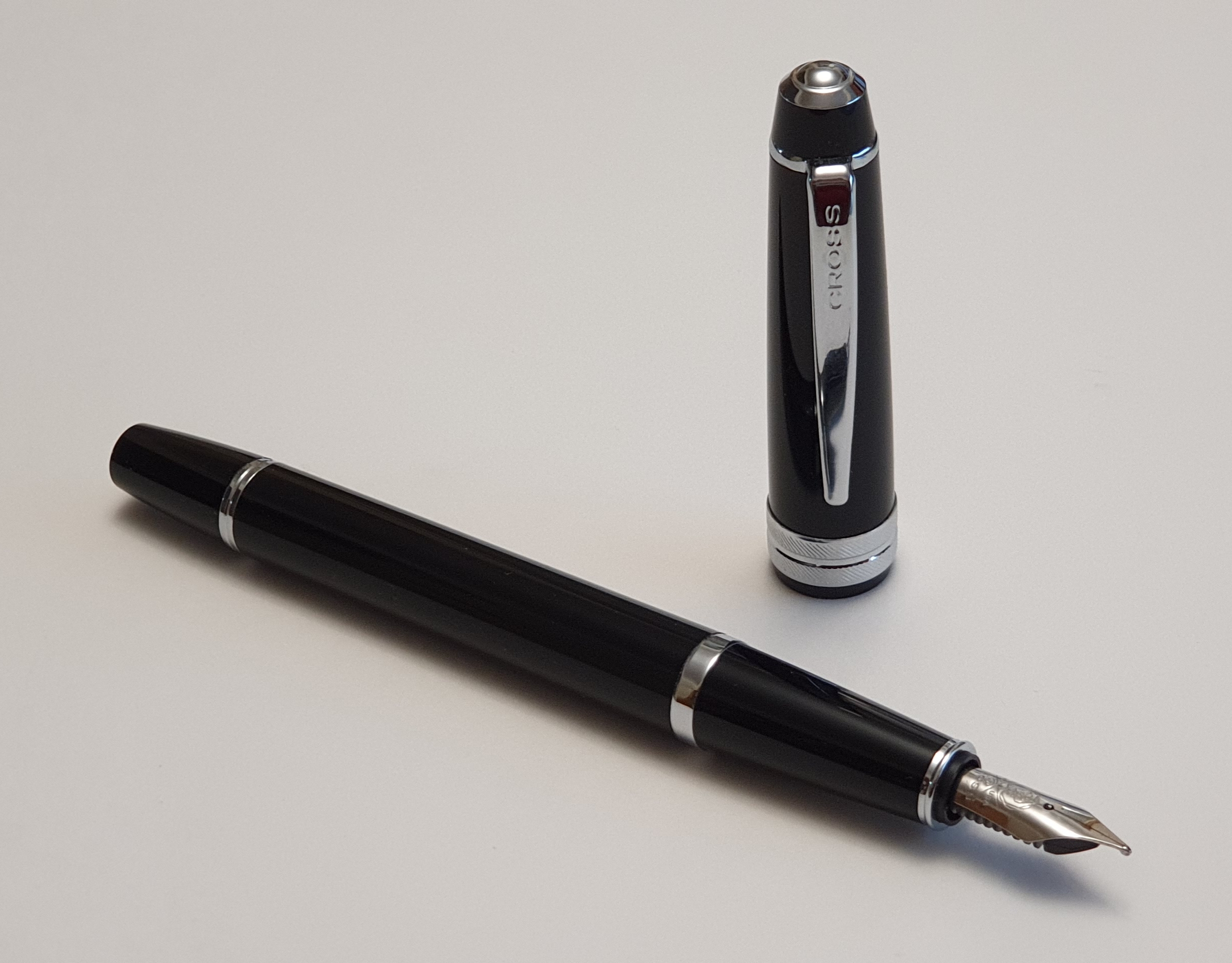
Cross Bailey Light
Cross Bailey Light
This new pen from Cross appeared in 2019, as a plastic version of the popular, heavier lacquered metal Cross Bailey. This is a cartridge-converter pen, taking Cross proprietary cartridges or else a Cross converter (the push-fit version, model 8751). It is a simple, traditional style pen of a good, medium size and proportions. The plastic cap can be “posted” (pushed on the back of the pen) for added length and weight. This looks a more adult pen than the Safari, having no facets on the grip. The pens are sold in sealed packs, with medium nibs. These offer a firm writing experience, good for note-taking and faster writing. Personally I try to pick out pens with nib tines with a slight glimpse of daylight between them, which mean good ink flow and effortless fast writing.
The downside is that Cross cartridges are rather expensive. But with the pen costing £20.00 in the UK plus a converter for £7.00, you are still under £30.00 in our currency. I am a big fan of these pens finding them very comfortable and reliable.
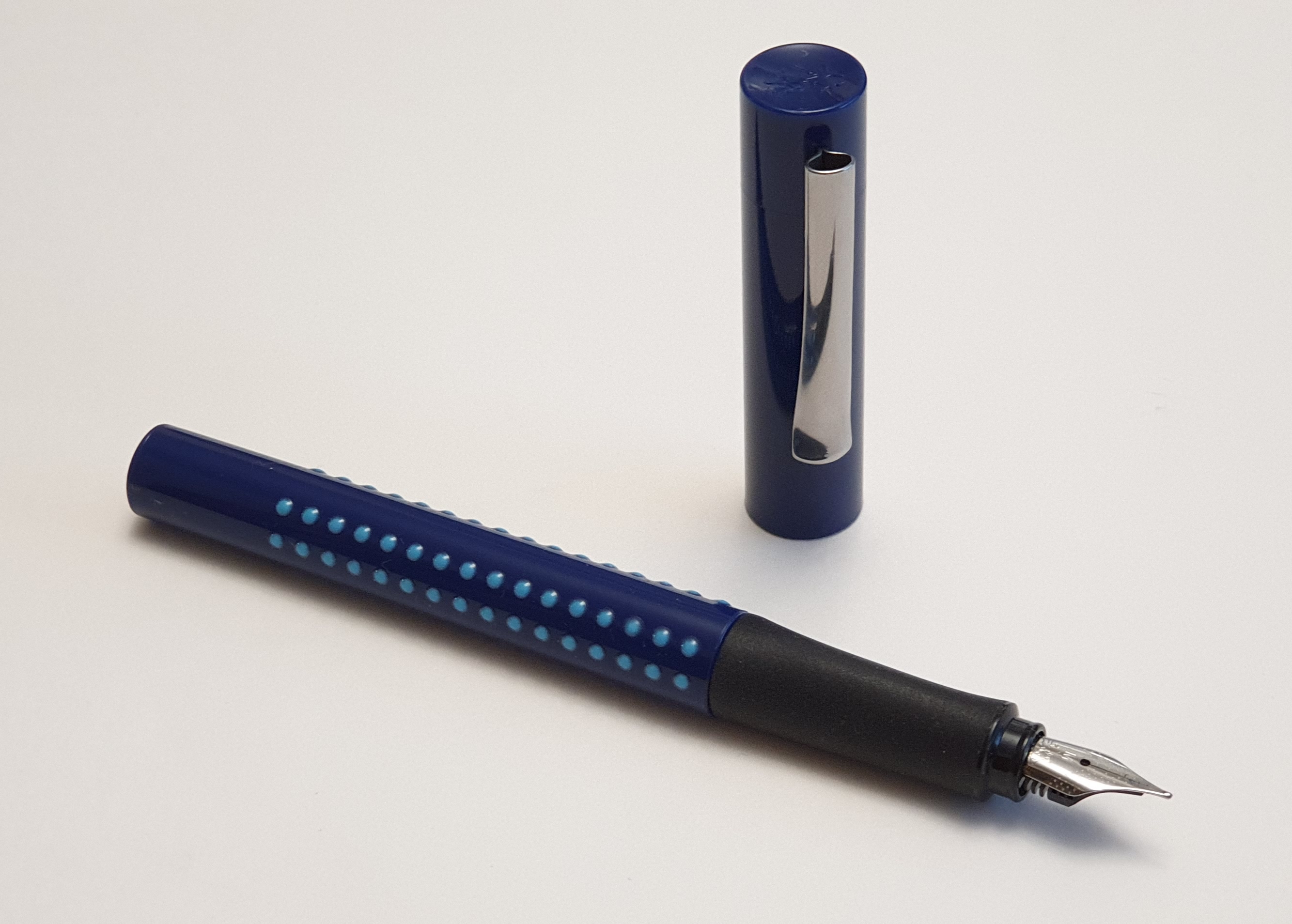
Faber-Castell Grip
Faber-Castell Grip. Interesting raised bobbles on the barrel.
This is another fairly traditional syle pen, perhaps rather under-rated here and certainly less prevalent in the shops than Lamy and Cross brands. However, this pen has a delightful smooth, steel nib. If bought online, from Cult Pens for example, there is a choice of nib in extra fine, fine, medium and broad widths. I have only tried the medium nibs but imagine that a broad would be silky smooth. The pen features a rubber ergonomic grip with subtle, smooth edged facets for your thumb and forefinger to rest on. At around £15.00 these are excellent value. They also have the advantage of accepting standard international cartridges, which are readily available from numerous brands and in a vast array of colours.
For the price there is little to say against this pen. It is a good size, light in weight and the cap can be posted if desired but this makes it rather too long at 17.5cm.
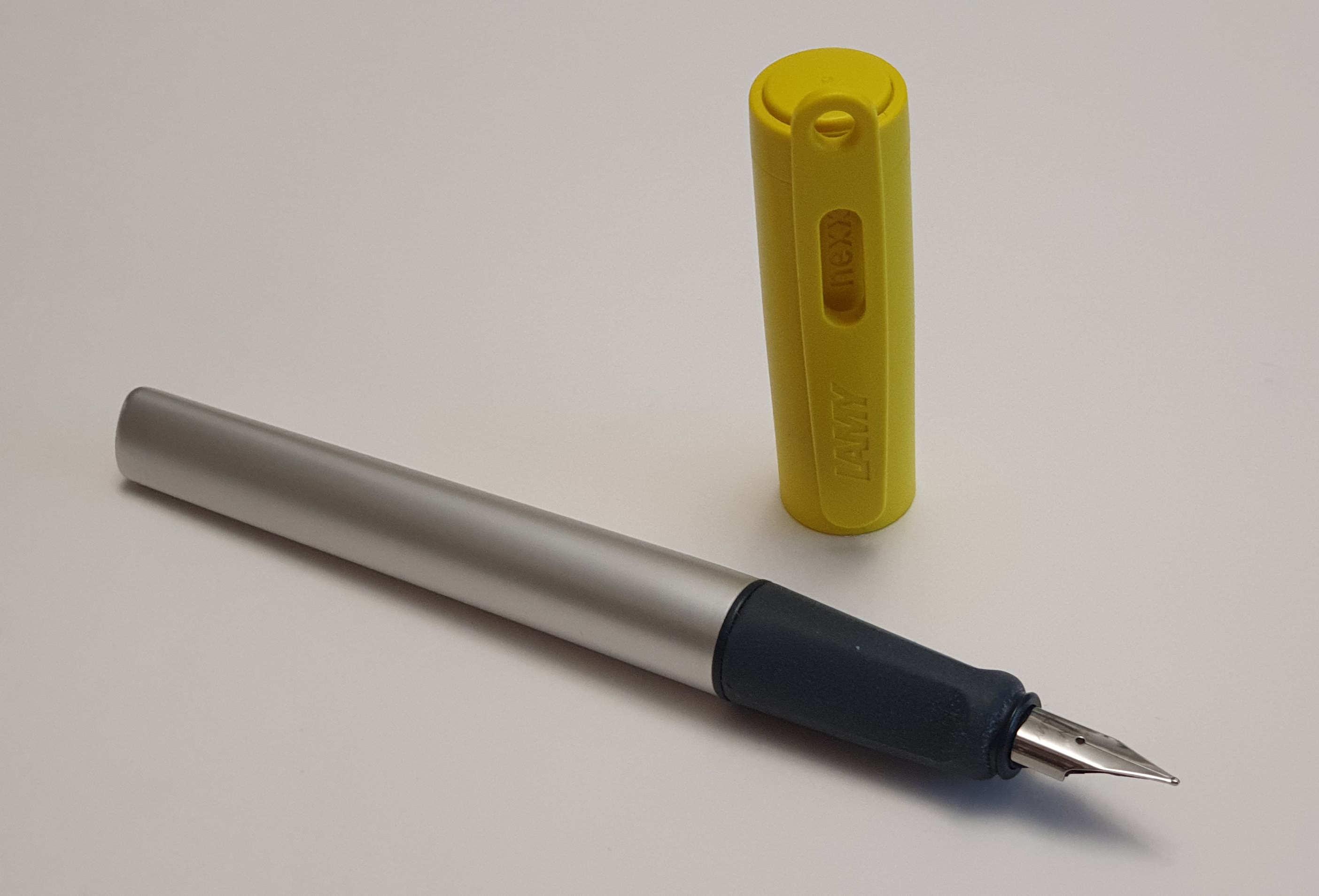
Lamy Nexx
Lamy Nexx
The Nexx seems to be rather overlooked here, being over-shadowed by the ubiquitous Safari. However, it is a tough workhorse pen. It has the same nib as the Safari and AL-Star, but features a wider, rubber grip and an aluminium barrel which blends gradually from being cylindrical to a rounded triangular shape at the end. It has a tough plastic cap in a variety of bold colours. Again, like the Safari, it will need Lamy cartridges or the appropriate Lamy converter. The price here is around £19.00, similar to a Safari.
The downside of this pen for me is that the rubber grip makes it slightly harder to make small adjustments to the angle of rotation of the pen as you write: you need to lift the pen off your fingers before you can twist it in your hands. Secondly, there is an unusual clash of materials, as between the plastic cap, rubber grip section and aluminium barrel. This, plus the unusual shape of the barrel makes for an interesting tactile experience. Personally, I am not keen on rubber grips or triangular barrels and yet inexplicably, taken as a whole I am impressed by the pen. I have had mine for only a few months. It could not be described as traditional in style.
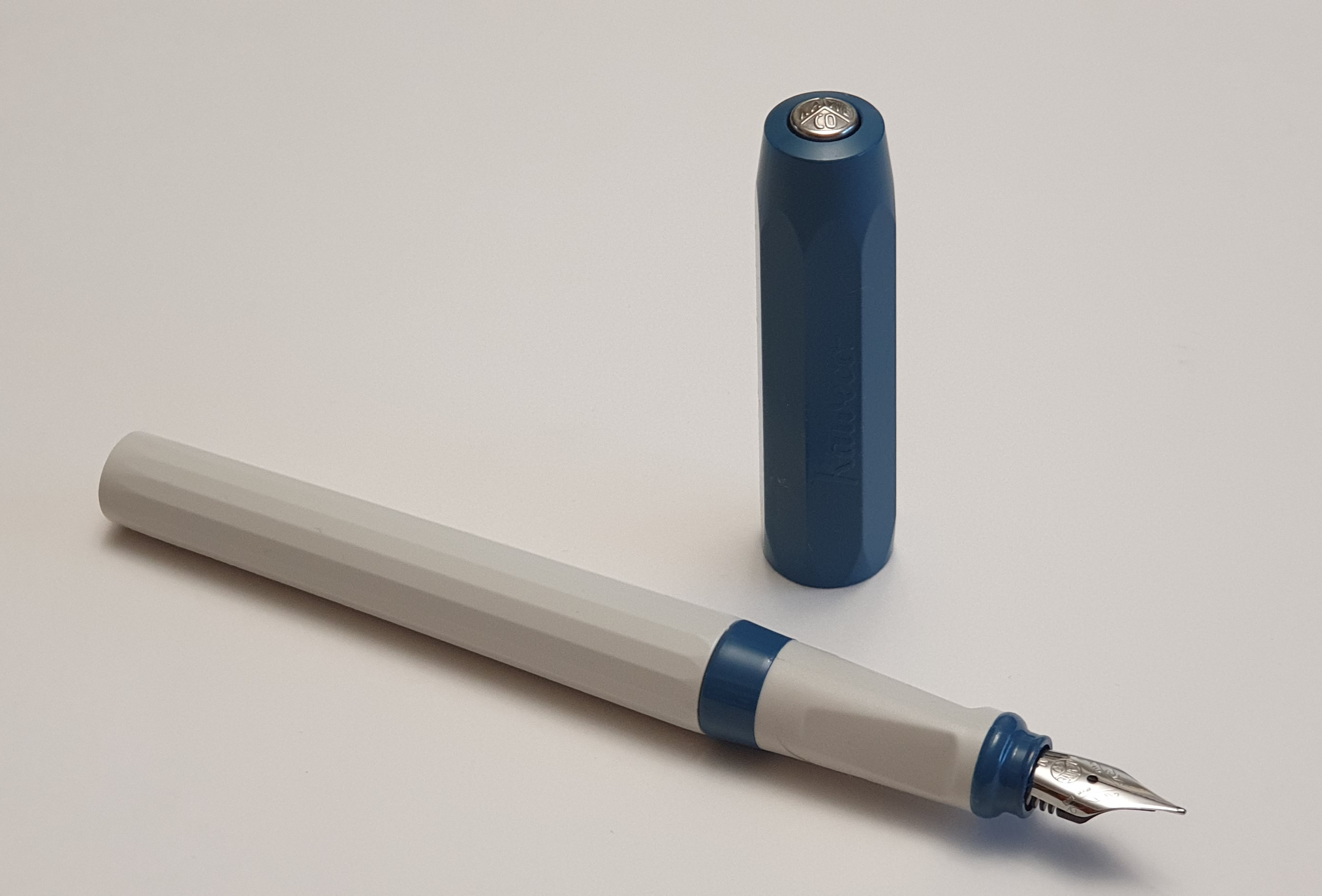
Kaweco Perkeo
Kaweco Perkeo
The Perkeo is another cartridge-converter pen, in a range of colour options and an All Black in tough plastic and multi faceted cap and barrel. The grip does have some facets for your finger positions but it is not rubber and these are less obtrusive than on the Lamy Safari. Personally I grip the pen higher than the facets and so they do not interfere with my grip. The pen is a good size, whether posted or not. I enjoy the Kaweco nibs which are slightly softer than the Lamy Safari nibs. The pens are sold in clear plastic packs with either a medium or fine nib. I have bought quite a few of these in both widths. The medium nibs are great for general use but I also like the fine nib version to use with black ink which is very precise with a pleasant feedback. The pens cost around £16.00 here. They take standard international cartridges and are supplied with four blue cartridges of the lovely vibrant Kaweco blue.
The downside perhaps is that the pen is not traditional in style and looks like a whiteboard marker pen. There is no pocket clip. Also, the build quality can be a bit variable and some people have had complaints with the nibs. Aside from such quality control issues I think they are great value and provided you get a good one, the writing experience can be delightful.
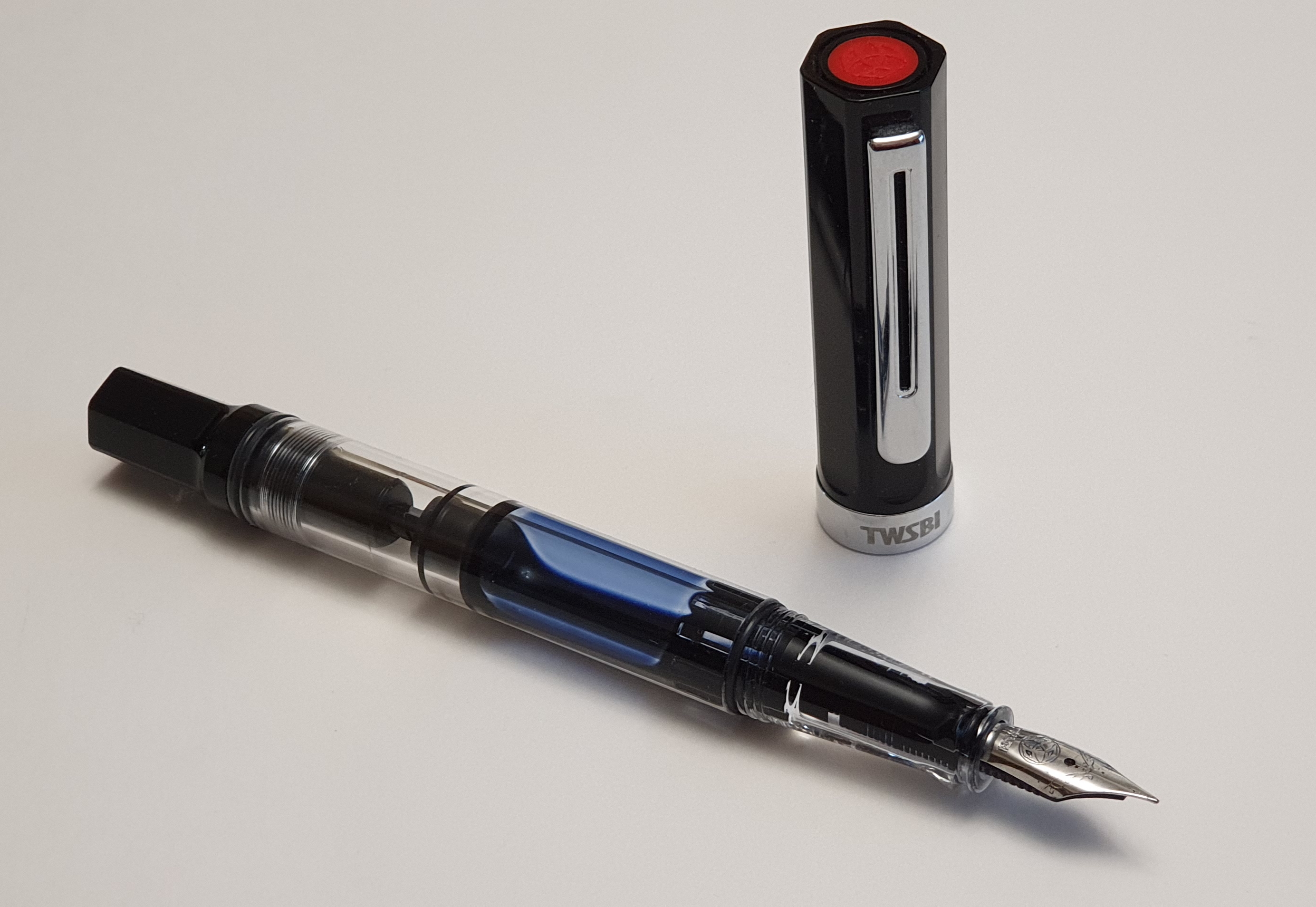
TWSBI Eco
TWSBI Eco. Still with a little ink inside.
My final suggestion is different from all the above in that it is a “piston filler” (bottle only) pen, which means a much larger ink capacity than any cartridge. Secondly, it is a “demonstrator” pen meaning that it is made of a clear plastic so that you can see the nib and feed and filling mechanism. Once filled, you can also see the ink sloshing around. Nibs are available in a range of widths. The pens start from around £28.00 here increasing for some of the different colour options. It is also the only pen in this selection with a screw on cap.
TWSBI pens are appreciated by enthusiasts, not only for their quality and value but also because they can be disassembled for cleaning. TWSBI supplies its pens with a wrench to unscrew the piston. The nib and feed can be pulled out and are “friction fit” for ease of changing, cleaning or maintenance, although none of this is strictly necessary if you prefer not to tinker with it. TWSBI even supplies each pen with a small container of silicone grease to lubricate the piston.
Conclusion
There are numerous other pens that I could have included but have left out to keep the list managable. As it is, I have already stretched the brief rather beyond the traditional. Any pen enthusiast would have his own opinions and this is clearly subjective and tastes differ.
I have not included Parker pens at this price level. A Parker Vector is well within the budget but rather too slender in my view and not one of my favourites. Many people might recommend the Pilot Metropolitan as a starter pen, also within budget, but I do not find them very comfortable and the nibs are very fine. Then there are Chinese pens such as the Wing Sung 601 or the Wing Sung 699, both well inside this price range and of traditional design but although great value, I think that they are not everyone’s idea of a beginner’s pen.
My own preference, would be for the Cross Bailey Light with medium nib and converter which is a good, traditional pen of quality and style. Although having said that, everybody should have at least one Lamy Safari, preferably yellow.
I have done quite well over the past three months at resisting temptation to buy another fountain pen. However I cheated slightly and opened one from my small stockpile of pens bought long ago as possible gifts or for a rainy day. This one I bought in October 2017 in a sale, reduced from around £18.00 to £9.00.
This is the Sheaffer Pop, Glossy Red, or Sheaffer 9207 according to a sticker on the blister pack. It does not say “Pop” anywhere on the packaging or on the pen, but this is the name on the company’s website, Sheaffer.com. It is available in a range of colours including some Star Wars themed designs.
Sheaffer Pop fountain pen.
Thus we are dealing with an entry level type of pen, presumably targeted mainly at school students and so it is not appropriate to be overly detailed or critical in a review. I am fond of Sheaffer fountain pens and like their steel nibs which are generally well finished. Nowadays the packaging also bears the name A.T. Cross Company and this model was made in China.
Construction and design.
This is a plastic pen, light weight and with a uniform diameter cylindrical barrel and cap, which snaps shut firmly to be completely flush with the barrel. The cap features a strong metal pocket clip with a cutaway and the easily recognised Sheaffer white dot.
Owing to the flush cap, the walls of which are quite thick, there is a significant step down to the section. This has a black rubber sleeve grip, which is soft and grippy to rest on your finger. Personally, I hold the pen with my thumb on the barrel and my first and second finger at the section. The cap can be posted if desired, where it sits very securely perched on the back of the pen and again, flush with the barrel. The downside is that the pen is then very long, although the cap is not heavy and so does not make the pen back heavy.
The nib.
The stainless steel, medium nib was set up nicely and wrote, straight out of the box. I was delighted to see that the tines and tipping were even, with a glimpse of daylight between them signalling a good ink flow.
A simple but attractive nib, a stainless steel medium.Nicely set-up steel nib and plastic feed with a slender gap between the tines.
Filling and writing performance.
This is a cartridge converter pen, taking the proprietary Sheaffer Skrip ink cartridges, one black cartridge being included. A Sheaffer converter can be bought separately.
The medium nib on mine is firm and writes without any fuss, in all directions with no skips and no hard starts as yet. The nib writes smoothly and will improve after a few weeks once it has worn in to my angle of writing. The line is perhaps better described as a medium – fine. Ink flow from the supplied black cartridge is good, requiring no pressure. However, the black ink does have a tendency to bleed through on some papers and this might be a reason to get a converter and have a wider choice of inks.
Size and weight.
The Pop measures (approximately) 127mm closed, 121mm open and 166mm posted. It weighs approximately 16.5g in all of which around 5.0g is the cap.
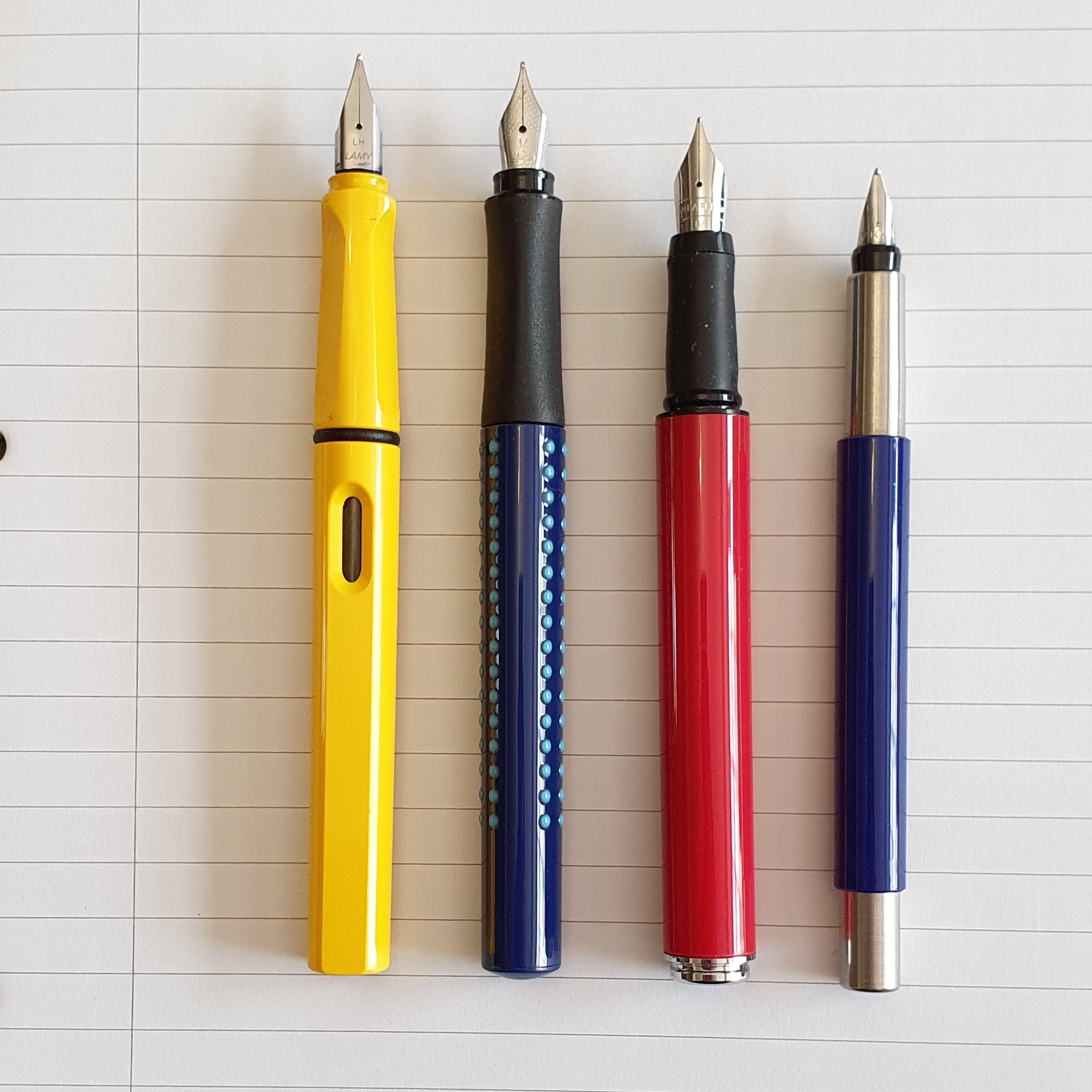
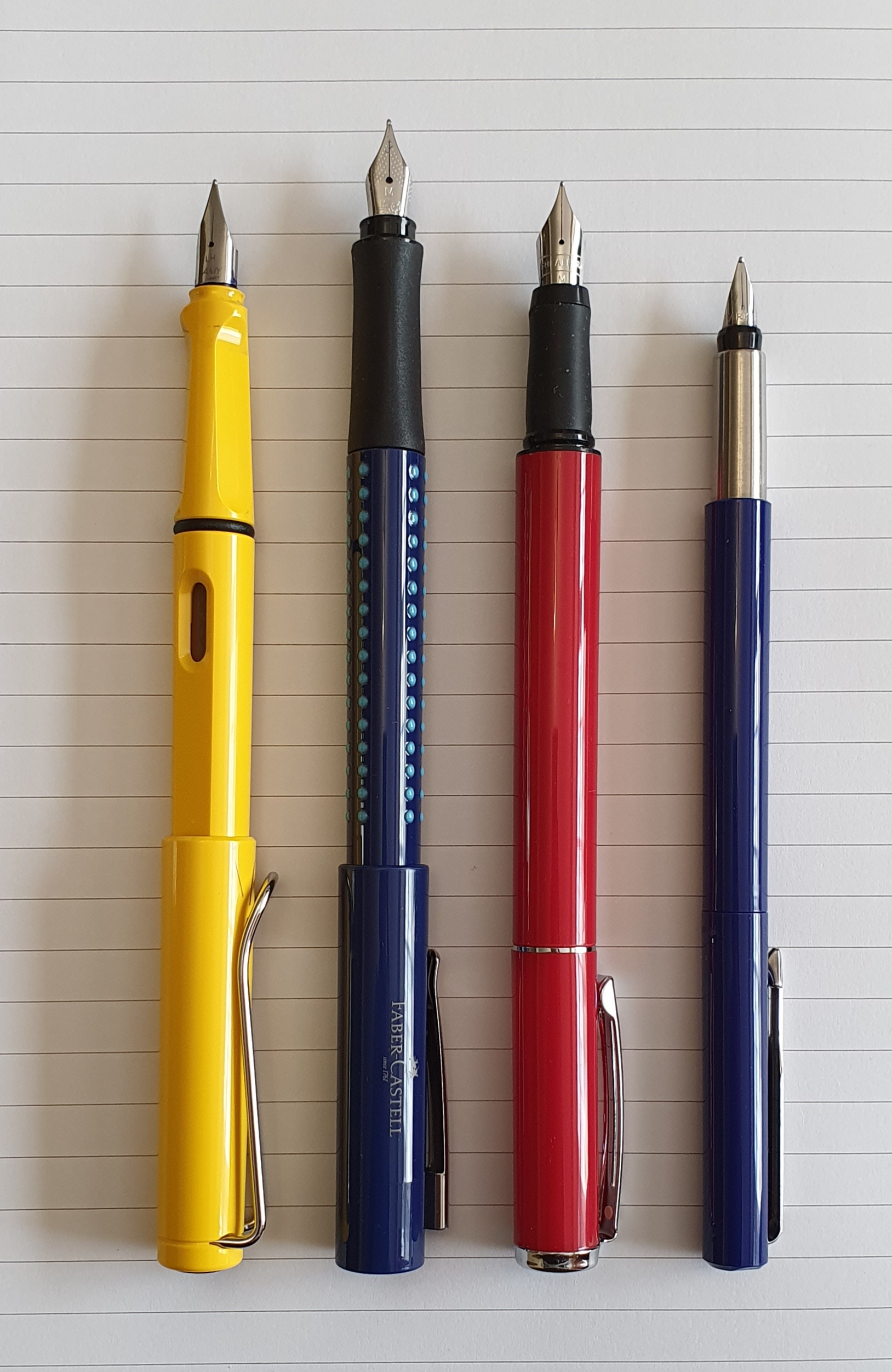
Size comparison of the Sheaffer Pop with a few likely competitors, the Lamy Safari, Faber-Castell Grip and the Parker Vector.And here again, posted.
Likes and dislikes.
To get the negative stuff out of the way first, the possible issues I noticed with this pen are as follows:-
Dislikes:-
Very stiff snap cap. Also very stiff on posting; needs to be handled with care;
Significant step down from barrel to grip section although not sharp, could be an issue for some;
Rubber sleeve on the grip section can rotate (although it does not do so whilst writing); section needs to be squeezed tight when unscrewing the barrel, otherwise the grip will just rotate without the section unscrewing;
The cap makes a loud pop, especially when being removed after posting; could become irritating or embarrassing in quiet surroundings;
Plastic cap appears thick walled but could eventually crack;
No inner cap present, although I have not yet experienced any hard starts.
Likes:-
Nib performs well;
Comfortable wide girth of around 12-13mm, similar to a Montblanc 146; much larger than a Parker Vector;
Soft rubber grip;
Very secure snap cap. Good for an every day carry;
Simple design with attractive cylindrical shape and metal fittings.
Step down from barrel to grip section. The projecting ring, or flange for the snap cap is also here and reduces the drop.
Conclusions.
I have been pleasantly surprised by this inexpensive pen. There are certain design elements which have both positive and negative impacts: the flush cap and barrel means a significant step down from barrel to section; the very secure capping (with no rattle, wobble or play at all when the pen is capped or when the cap is posted) makes for a safe every day carry and perhaps avoids nib dry out, but the downside is a very stiff and noisy cap to remove (especially after posting).
Overall however, aside from the stiff cap, I like the pen and am much happier with this girth than that of the Parker Vector. I imagine that competition between brands is fierce at this price level. Having bought mine at half price, I got a bargain here.
Looking back at the fountain pens which have been particularly significant for me, there is probably none more so than the basic Sheaffer No Nonsense. Certainly, these got the heaviest usage. These are the pens that I used as a law student at Bristol Polytechnic (as it was then called, but now the University of the West of England), from 1977-80.
A Sheaffer No Nonsense fountain pen from the 1970’s.
I would buy these from a local WH Smiths. They were sold on hanging card blister packs. I cannot recall the price back then but it might have been around £7.00. There were a few different nib options including Fine, Medium and Italic but I mostly went for the Medium nib. They took Sheaffer Skrip cartridges. A Sheaffer converter could be used, of the push button or press bar type, if you had one, but the cartridges were easier, to refill mid lecture. Just unscrew the barrel, remove the empty cartridge, drop a new one into the barrel and then screw the section back on; the pen did the rest.
Looking back on my first term at Bristol, the amount of information that we were expected to take in, assimilate and learn, was daunting and stressful. Typically a college day included two hours of lectures, always in the same lecture theatre with its banked rows of orange, folding seats, each with a small, fold-out tray from the arm rest, rather like the aisle seats in a passenger plane. These were barely big enough to support an A4 pad of notepaper, let alone the printed handouts of course material to refer to. Being left handed, I remember the dilemmas of whether to take notes by annotating the printed handouts, (which were of varying degrees of detail) or by writing on my A4 pad and, more fundamentally, whether to write in lefty-underwriter style (with my elbow tucked in) or my faster, neater more usual, lefty-overwriter style, which meant rotating the notepad 90 degrees anticlockwise.
I decided on the latter, overwriter style on A4 paper and also settled on black ink. In a typical lecture, I would write six pages full of notes in an hour. A reliable and comfortable pen was essential. The No Nonsense pens, with their firm, steel nibs, were well suited to this regime. The feeds were plastic although looking at them now, I have one which is of a different shape and might be ebonite. Some of the fins have broken off.
The usual feed.A different feed on my white No Nonsense, now with a few of the fins broken.
Over the months, the nibs would wear down, so that the rounded pellet of tipping material would develop a circular, flat foot. By then, the writing experience would be super smooth for my writing angle but if you strayed away from this sweet spot, you would encounter a sharpened edge which would be scratchy. Eventually, when the nib was worn and getting too scratchy and when I fancied a change, I would replace the pen. Well, I say “replace” but I just bought a new one and never disposed of the old ones. I still have them all.
A well-worn nib.
Aside from using the pens for lectures, study notes and essays, it was also my practice to write up my diary each night, using small, page-a-day diaries from Boots. These were chunky little volumes, about the size of a pack of playing cards, with a page of plain, thin, fountain pen-friendly paper for each day. I would use reverse writing, (writing with the opposite side of the nib) to get an extra fine line and would, with very tiny writing, manage about 28 lines to a page. Back then I did not know that this was called “reverse writing”, SBRE Brown being not yet born.
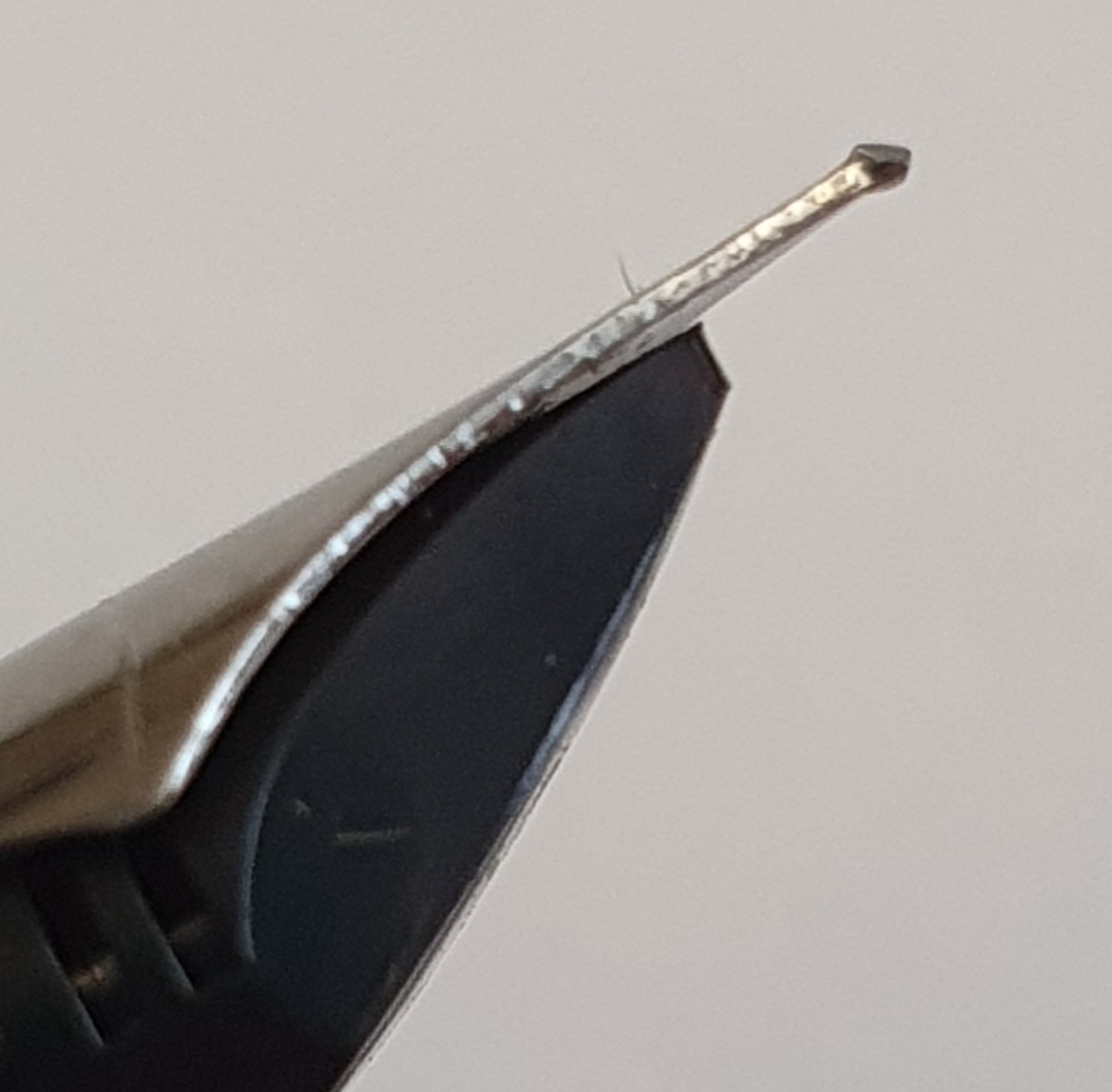
I do not think I had a strong magnifying glass at that time, let alone the ability to take macro photos of pen nibs, and with a mobile phone! But looking now more closely at some of those No Nonsense nibs, there is wear on both sides of the nib so that the tip is almost like a sharp chisel.
Nib tipping wear from both normal and reverse writing. Apologies for the fluff.
The Sheaffer No Nonsense was available in various colours but I tended to buy blue, black or white. I also found some metal bodied versions, supposedly superior and bought a couple of these although I actually preferred the normal, plastic ones.
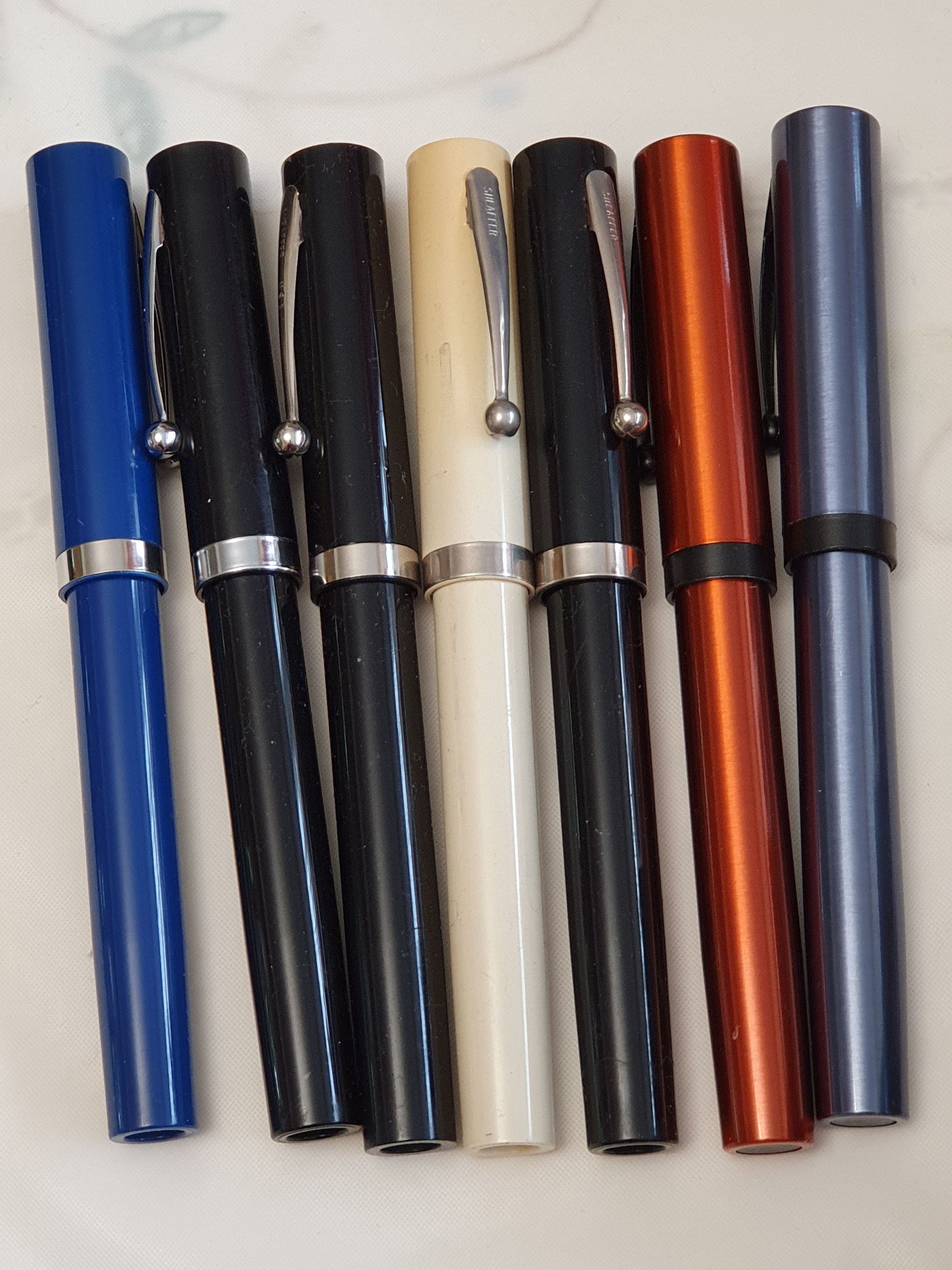
Rooting through a tin of old, long-since retired pens, I assembled my No Nonsense pens for a group photo:
My No Nonsense pens: the college years. The two on the right are the metal ones.
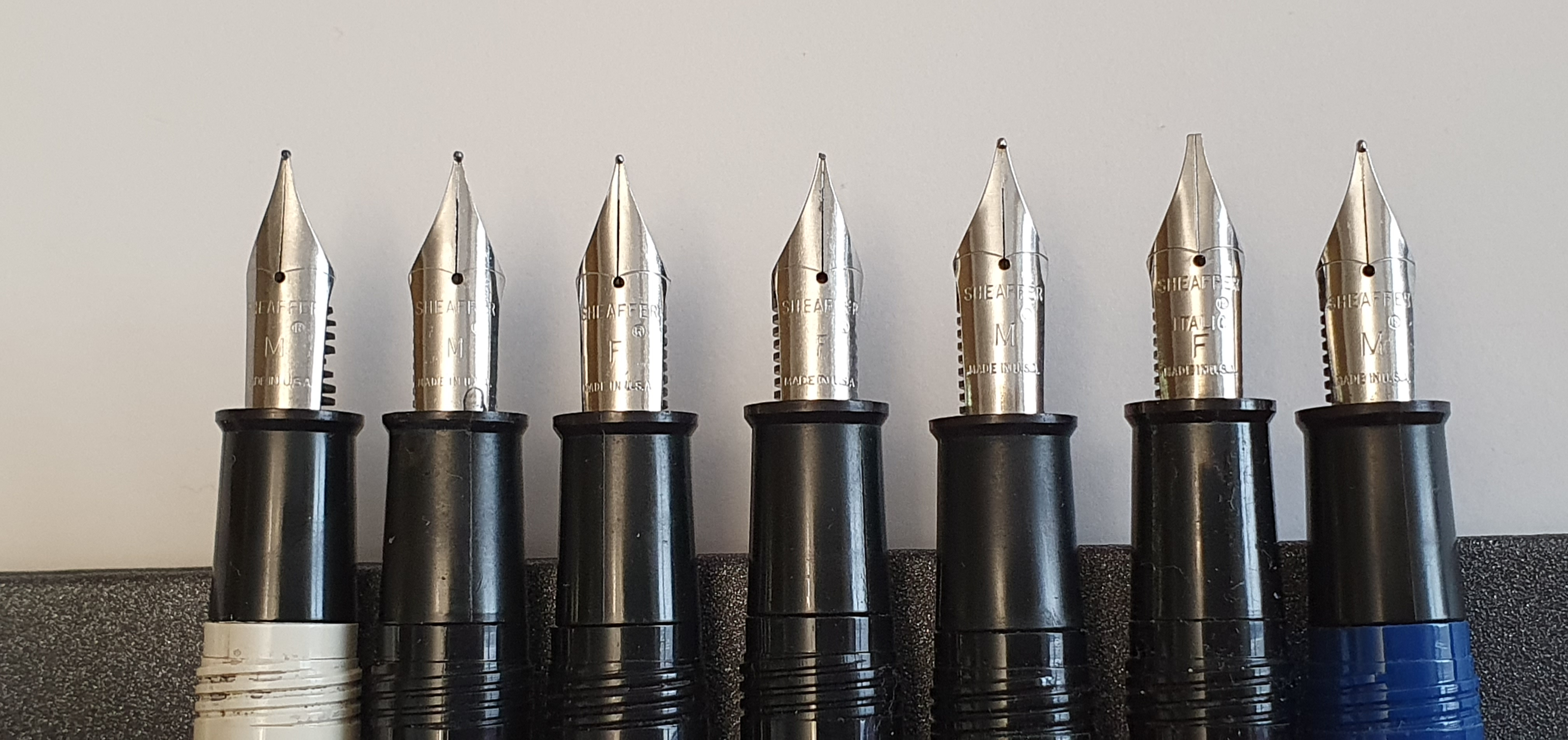
And here, in a never-before-seen-together group shot, are the nibs that got me through college:
My magnificent seven No Nonsense pens. Note the absence of any corrosion or staining, despite being some 40 years old.
The pens, as the name suggests, were no frills, basic, workhorse tools. They were of a good size, 121mm opened and 151mm posted. Being plastic they were very light, but solid. The caps featured a sturdy metal pocket clip with a round ball at the end which would serve very well although I carried mine in a pencil case. The brand Sheaffer was imprinted in the pocket clip. There was no Sheaffer white dot, for reasons unknown to me as I do not think that this would have added much to the cost. There was a chrome cap band, devoid of any text. The cap unscrewed on plastic threads, in one full rotation.
The steel nibs were imprinted with the name Sheaffer, the registered trade mark circled R, the nib grade and Made in USA. I suppose that this meant in Fort Madison, Iowa which I understand closed in 2008. There is a Sheaffer Pen Museum there now, with displays of their many ranges of fountain pens, desk pen sets, advertising posters and memorabilia as well as some fascinating old machines from the former factory and a gift shop. I have not been but enjoyed an amateur video of a trip to the museum on YouTube.
The No Nonsense pens are still produced as calligraphy sets although last time I bought one it was disappointingly plasticky, with a snap cap, soft grip section and a huge open ink window in the barrel.
Some years after college, I bought myself a Sheaffer Connaisseur, which seemed to be an upmarket version of the No Nonsense with an 18k gold nib. It sounds good on paper but I never really took to it for some reason.
Not long ago I inked up one of my No Nonsense pens, the blue plastic one with a super-smooth nib. It is still very usable and still remembers my writing angle. But I think it has deserved its retirement now.
There are several reasons for my writing about this pen today:
I have been looking through my accumulation and rediscovering pens which are like old friends.
I added an Index of Pen Posts to the blog menu recently and noticed that this is a worthy pen not covered before.
I thought that it was coming up to ten years since I bought the pen, although it turns out to be nine.
Background
I bought this pen at Rymans, our local stationers in May 2011. It cost £22.99 normally but there was a discount of £6.00, which was a bonus. I had some previous experience with other versions from the Frontier range. I used the plastic barrelled ones for registering weddings at our church, a duty that I had taken on a few years earlier. I had liked it, as a plain and simple but respectable pen, for use with iron gall ink.
Parker Frontier, in stainless steel with gold coloured nib and clip.
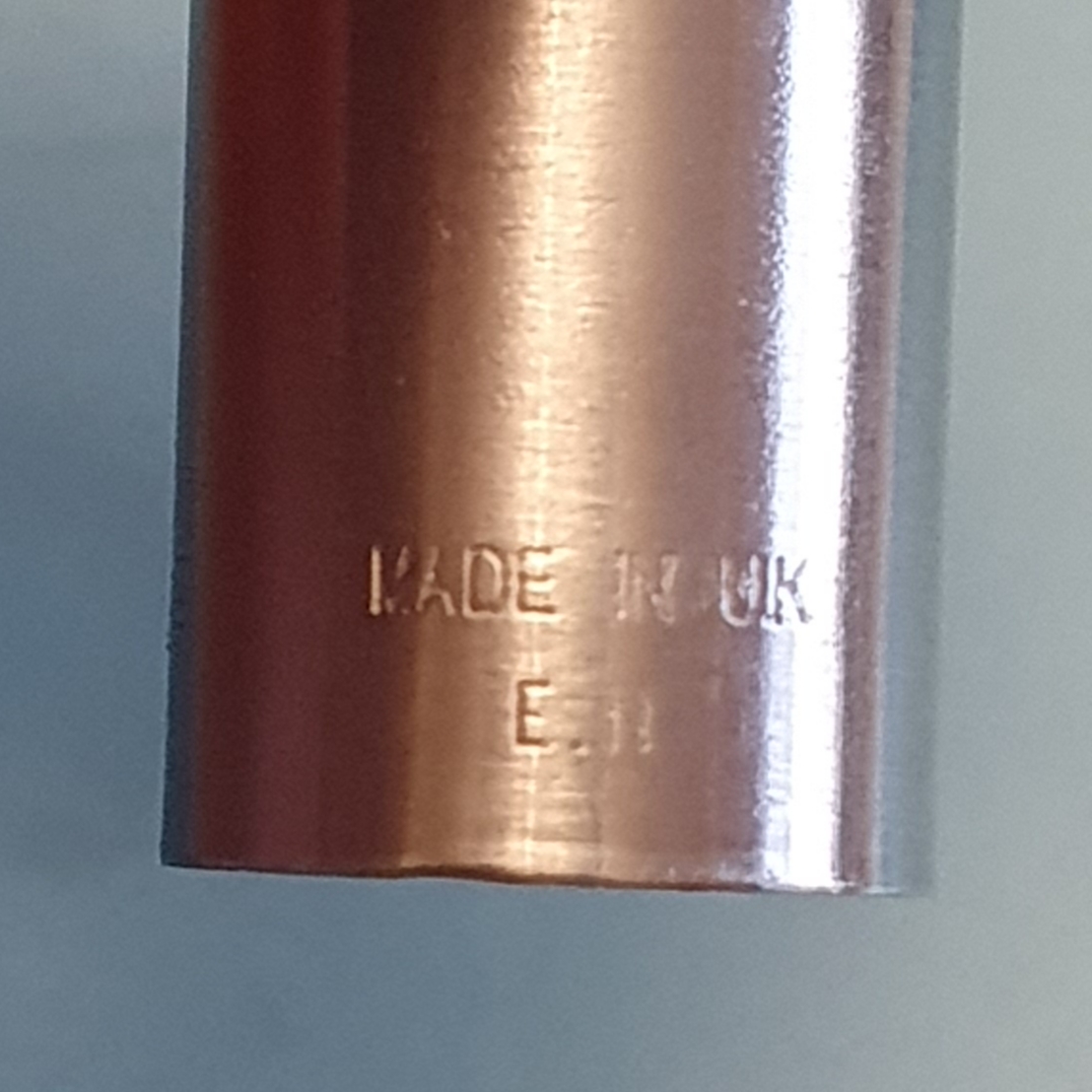
The story of the Parker Pen Company is a long one and dates back to 1888. This particular pen bears the production date code E which denotes the year 2008, (using the “QUALITYPEN” system with Q being a year ending with zero). The cap also states that it was made in the UK which would be from the Newhaven site, which was to close in 2011.
Make and Model name shown here…and the place and date of production.
Thus at the time of manufacturing this particular pen in 2008, Parker had a history of 120 years. Apparently, this milestone was celebrated with a souvenir DVD of the company’s history, a copy of which was given to all the employees at the Newhaven site along with a twin set of a Parker Frontier fountain pen and ball pen. The Parker film (about 51 minutes long) on 120 years of Parker, can be viewed on YouTube. It is somewhat dated now but gives an interesting insight into the company’s origins in Janesville, Wisconsin, the introduction of the Duofold, the vacumatic and the Parker 51, the management buyout, visits by dignitaries including Margaret Thatcher and culminating in the production of 40 million pens a year.
The Frontier was to fill a place in the market at the lower end of the Parker range, sitting above the Vector but below the Sonnet. I remember reading a number of reviews of the pen on Amazon at the time. I was very happy with mine and it became my main pen, for several years.
Construction and design
My model has the brushed stainless steel barrel and cap with a gold coloured pocket clip and cap finial. Some people do not like “mixing their metals” but I liked the gold and silver colours together, (a feature which Cross calls “the medalist”). Parker did also make a version with all-silver coloured fittings which was the model that SBRE Brown owned and reviewed and with which he wrote his final exams in high school.
There is no cap ring. The rim of the cap is quite sharp but sits almost flush with the barrel when the pen is capped. It also posts deeply and securely. The length is around 131mm capped, 123mm uncapped and 149mm posted. Despite the steel body, it weighs only around 22g in all, or 14g uncapped.
The barrel seems to be made from a single piece of steel and has no seams, and has a rounded end like a bullet. When capped the pen feels very robust and protected, encased in steel.
The nib is stainless steel but on my version, has a gold colour plating or coating, matching the arrow clip and bears the name Parker and logo. The nib grade can be seen on the feed as M for medium.
Nicely finished nib.
The black grip section is slightly tapered with no facets but features a non-slip surface. This is not a rubber grip, but a thin skin giving a slightly sticky feel. This does eventually blister unfortunately.
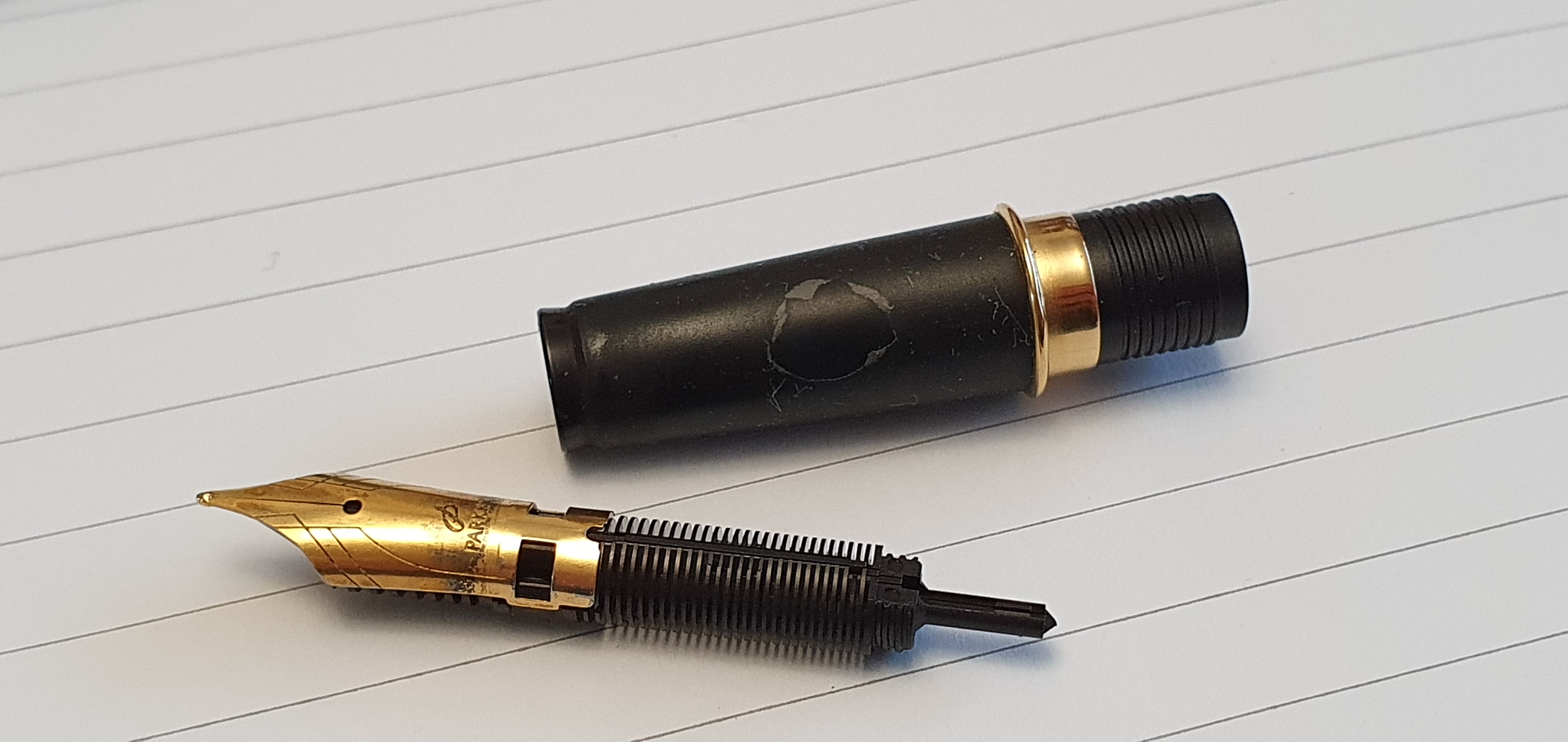
Nib and feed unscrewed. Grip section showing blistering of the non-slip coating.
The pen takes Parker proprietary cartridges or a Parker converter although not included with the pen.
With Parker Quink cartridge.
I enjoyed mine and used it a lot. The nib wrote very smoothly with good flow, showing how good a steel nib can be when set up correctly. The nib and feed can be unscrewed for cleaning or maintenance.
Likes and dislikes
This seems a fairly straight-forward pen but one which presumably benefited from Parker’s 120 years’ experience of nib and feed design. It looks smart, is sturdy and durable (apart from the covering on the section) and is comfortable to hold. Being able to unscrew the nib and feed is a nice feature. Above all, it writes smoothly and well with good flow. Mine is currently inked with Waterman Serenity Blue.
Writing sample, with Serenity Blue on Radley notebook paper. Extract from John Milton.
On the downside, the tendency of the non-slip coating to wear and blister eventually leaves unsightly gaps. I would prefer a grip section without the rubbery layer, such as on the Sonnet or Duofold.
Conclusions
This pen has seen a fair amount of use. Later, I was to move on to a Parker Sonnet, in burgundy. That also had a steel nib which performed similarly but a more luxurious body.
I went through my secondary school days using Parker pens and grew up believing that a Parker pen was special. After my Sonnet, as I began to discover the fountain pen online community, online pen dealers, YouTube reviewers, and pen shows, my pen accumulating gathered pace. It escalated for a good five years or so. However it is nice to revisit our beginnings once in a while to keep a sense of perspective. Anyone can buy a new pen but to have one for nine years, takes a little longer.
After writing up my history with the Lamy 2000 recently, (My Lamy 2000 fountain pen and I), I made a fairly simple do-it-yourself adjustment to the nib to increase the flow. Mine has a broad nib. Being left-handed and writing in an “overwriter” style, I need a slightly wetter flow.
This involved carefully bending the small nib upwards very slightly to widen the gap between the tines. The result was a wetter flow, better lubrication and a generally far happier and less frustrating writing experience. No longer was it necessary to maintain pressure on the nib to write. The gap between the tines is now clearly visible when viewed under a loupe, although in profile, any upward bend of the nib is barely evident.
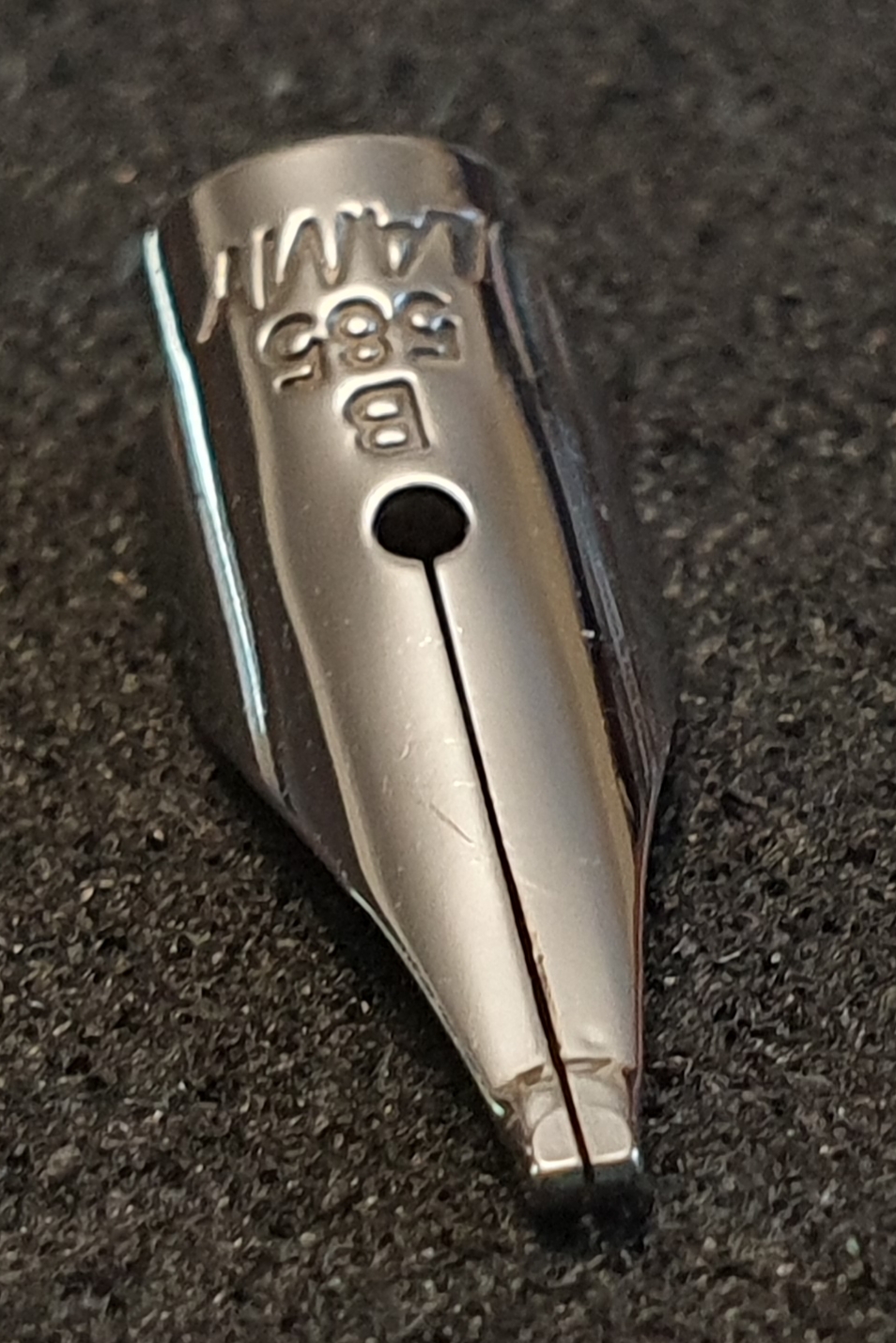
Lamy 2000 Broad nib, 14k gold and platinum plated. Now with tines a little wider than before.
I happily wrote more than 12 pages of A4 paper before getting through one fill of Waterman Serenity Blue ink, which gives you an idea of the wetness of the nib. If anything it was perhaps a little too much on the wet side.
I found that trying to close the gap is more difficult than opening it. Instead, it occurred to me to try a drier ink and I recalled that Pelikan 4001 Royal Blue (“Konigsblau”) is such an ink.
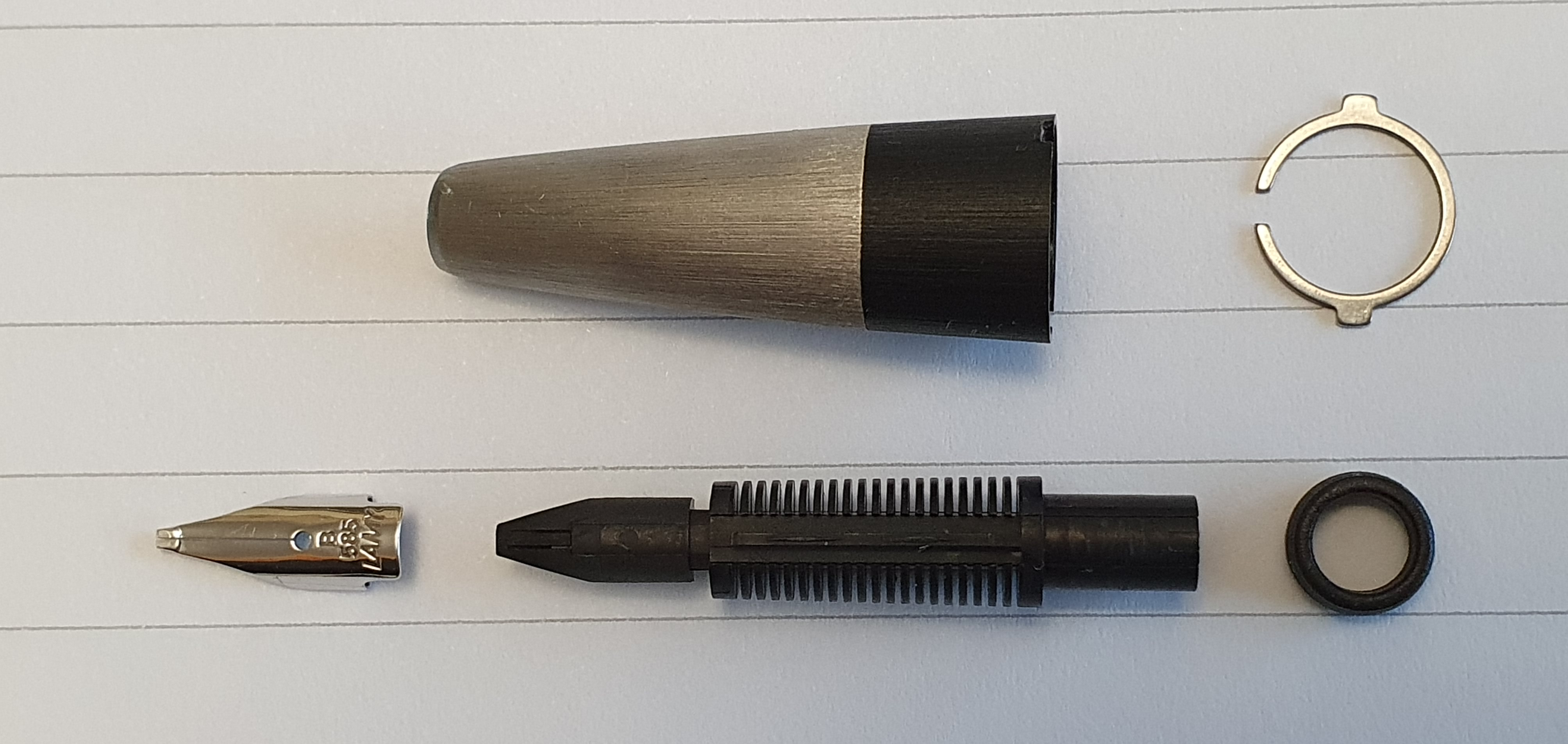
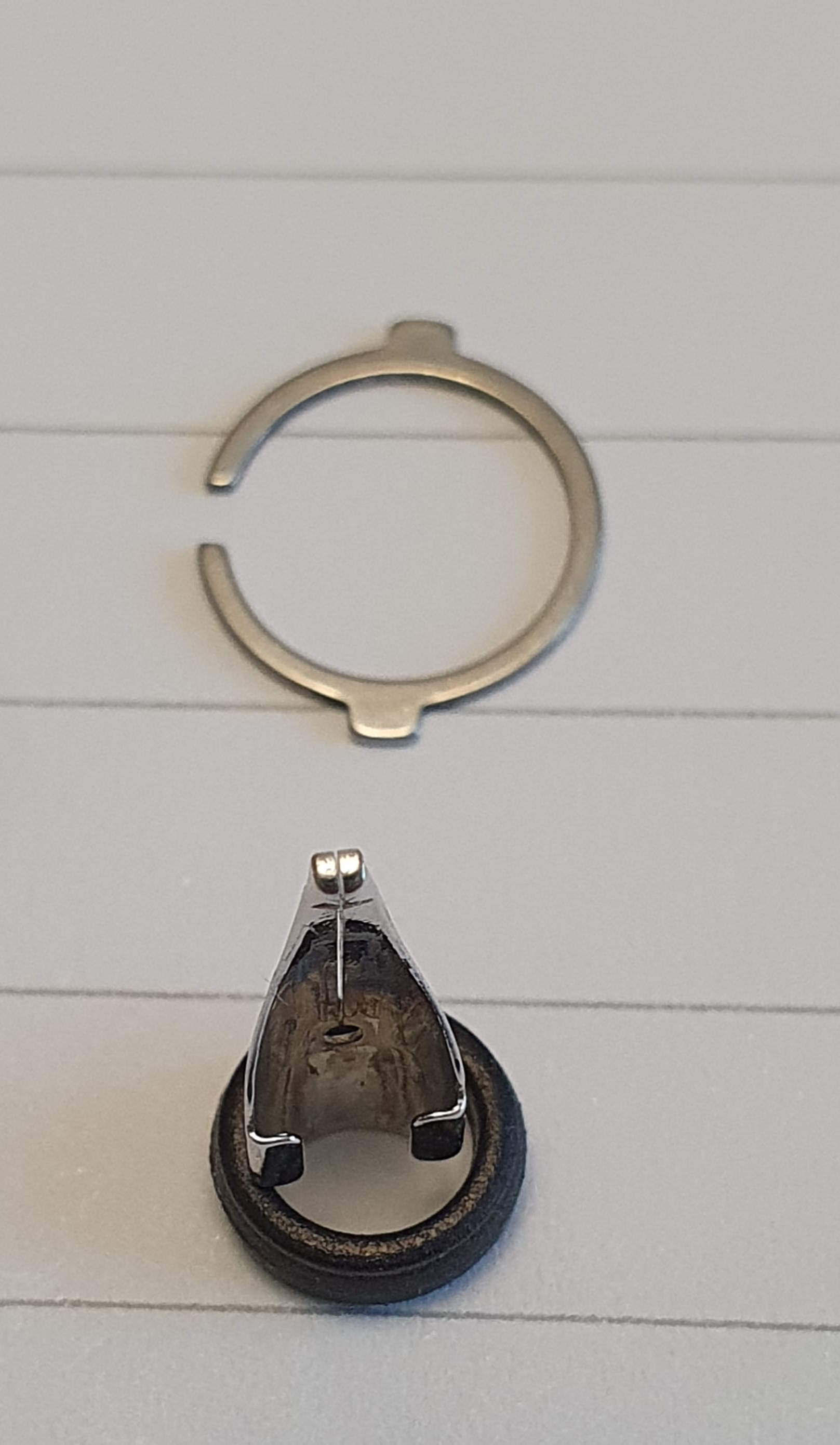
Showing front section, nib and feed, disassembled for cleaning.
Once again, the Lamy 2000 went upstairs for a bath. It is an easy and enjoyable pen to clean. For the benefit of anyone unfamiliar with this, my routine is as follows:-
Unscrew the section from the barrel. Lift off the metal horse-shoe shaped ring which sits in a recess at this join, which is the clip to hold the cap on. Do not lose it or let it go down the plug hole.
Then, holding the nib between finger and thumb (above and below the nib, not at the sides), gently push the nib inwards, so that the entire nib and feed unit comes out through the back of the section; note that there is a thick rubber washer towards the back of the feed, which you must also be careful not to lose.
The nib and feed unit can then be rinsed in water to remove all traces of the last used ink. If desired the nib can be slid off the feed, as this simply clips over the sides, just like a Lamy Safari nib. Be extra careful not to lose this either, as it is quite small and fiddly on its own.
Wash the ink reservoir by drawing water up and down a few times until this runs clear. If desired, to lubricate the piston, (although I do not do this every time), introduce a tiny amount of silicone grease to the inside walls of the reservoir, with a toothpick or similar implement and wind the piston up and down a few times to spread the grease. Thank you, to an old Goulet Pens video for this advice.
The small bits – cap locking ring, the nib and feed washer. The washer makes a handy support for nib photos.
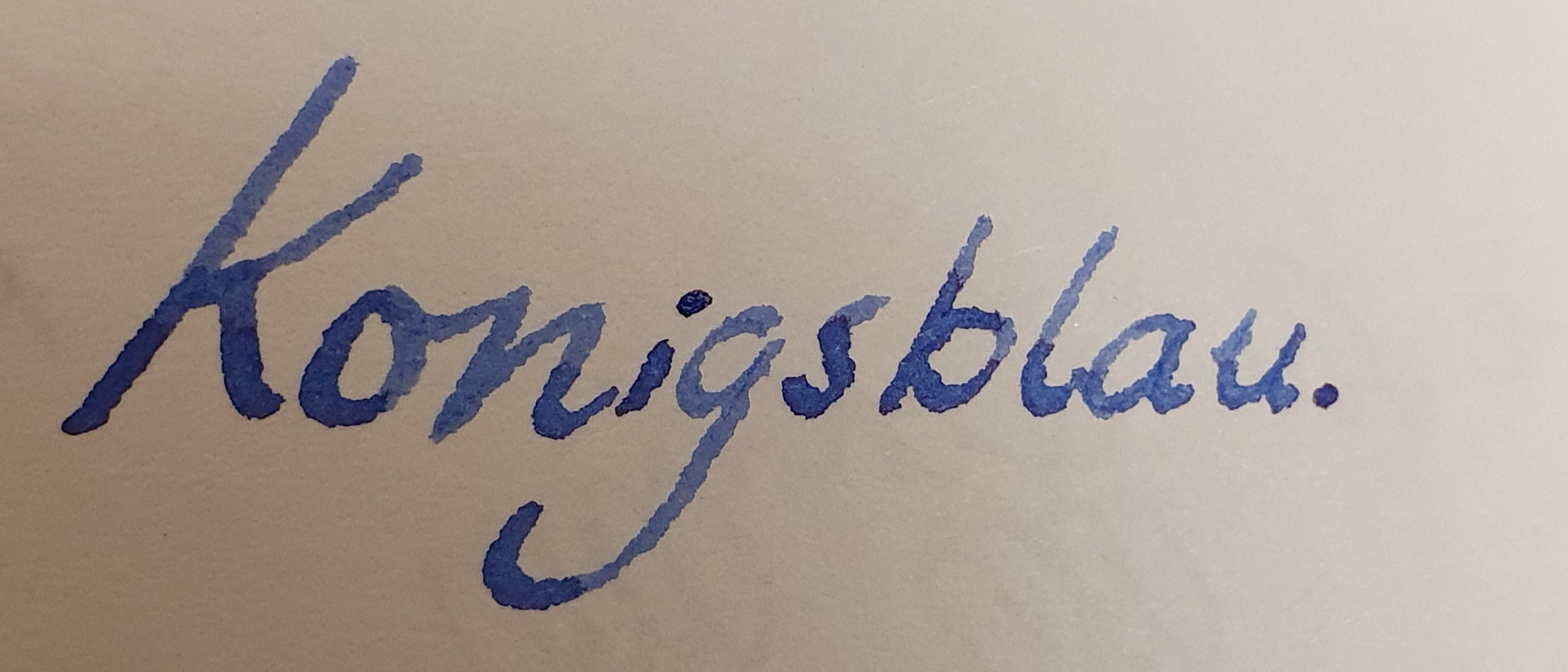
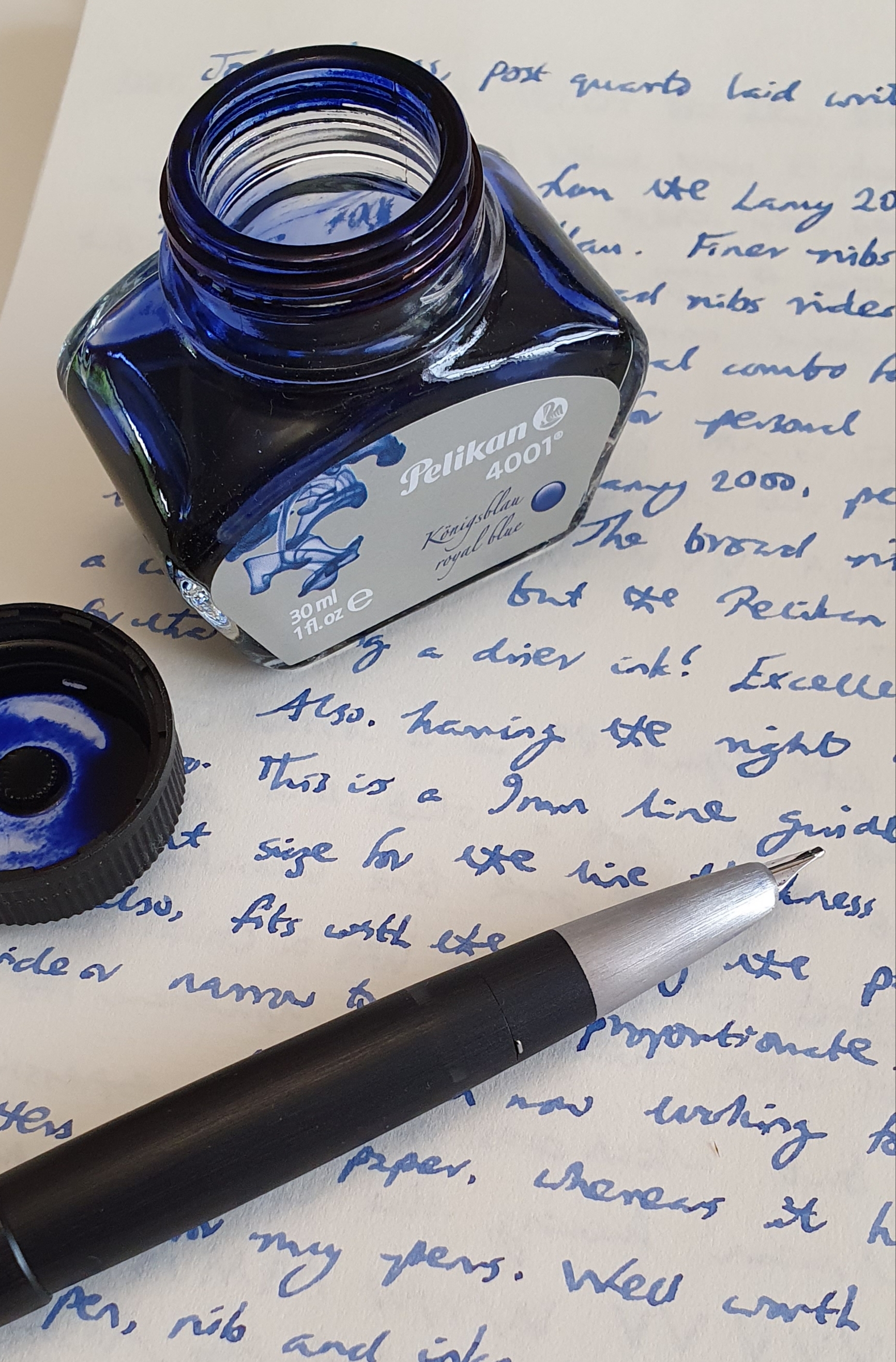
I filled the pen with Pelikan 4001 Konigsblau and, low and behold, the flow now seems to be spot on for me. It is still sufficiently wet to give great flow and lubrication, for effortless writing with minimal pressure, but the flow is not excessive.
Writing sample, Lamy 2000 with Pelikan 4001 Konigsblau on Basildon Bond letter writing paper.
The Konigsblau is an ink that I have not used very much before. I have had two bottles of it hanging around for a long time. I had never really liked the shade of blue all that much as it seemed to me rather pale and lacking the vibrance of say Waterman Serenity Blue or Montblanc Royal Blue. And yet now, in a wetter pen with a broad nib, this Pelikan ink comes into its own. It does seem paler than Serenity Blue but gives an elegant look, with some subtle shading. With the stubby broad nibbed Lamy, you benefit from this shading and also a degree of line width variation.
I could easily have given up on the Lamy or left it dormant as I had not got on with it for so long. Similarly, the Pelikan ink had been little used and was always passed over when I wanted a royal blue, as I would pick another from Waterman, Montblanc, Aurora, or Caran d’Ache from my ink drawer.
I am now using and enjoying my Lamy 2000 more than at any time since I bought it almost six years ago. The conclusion is that not only pens, but inks too, can enjoy a renaissance if we give them (or ourselves) another chance.
Writing sample on John Lewis Script, Post quarto laid writing pad, Ivory, 100gsm.












 Fountain pen blog