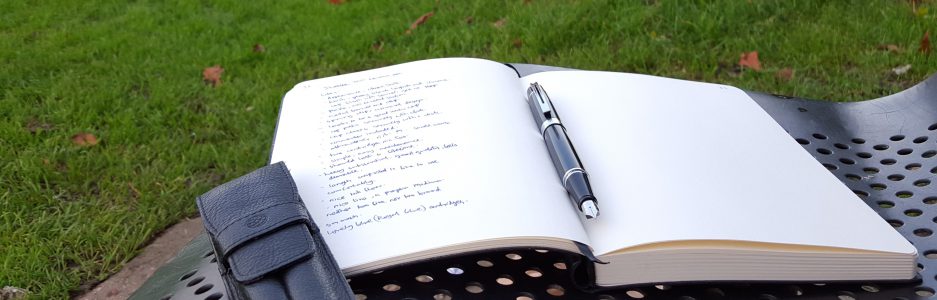
I noticed recently, a glaring omission in my Index of Pen Posts: more than 9 years into this blog, I had yet to write a post about the Parker 51. For a fountain pen blog, not having featured what is arguably the most famous, recognisable, respected and iconic models of the last century, seems remiss. It is time to correct that.
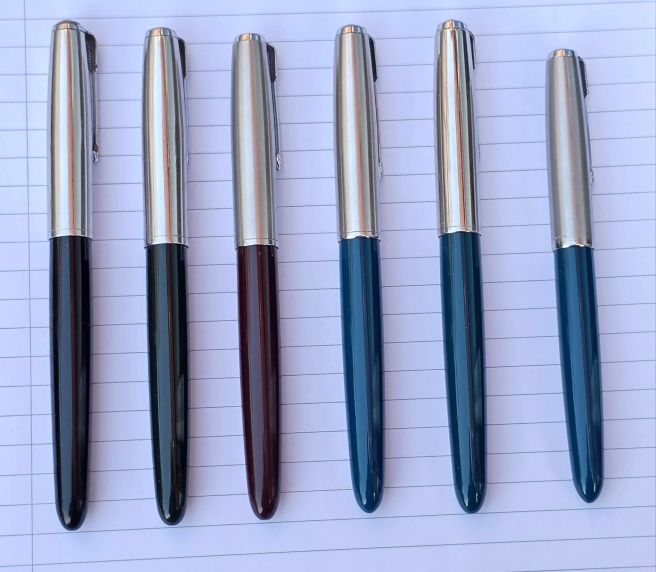
Shortly after our recent London Spring Pen Show, my friend Monica asked me whether I had any Parker 51’s that I was looking to sell. She was after a Parker 51 with a medium or a fine nib since her model, in grey with a broad nib was just too broad for her. I had shared a table at the pen show and sold a number of my modern pens but had not brought along any of my vintage Parkers as I had not envisaged selling these. However, a subsequent check of my Parker stash, revealed that I was sitting on six Parker 51 Aerometrics, and so I thought I could probably be of help. I also have one Parker 51 Vacumatic.
This is not intended to be a treatise on the history of Parker or the 51 in particular. For that I would recommend the excellent website parkerpens.net run by Tony Fischier which provides a very useful illustrated account of all the pens produced by Parker and their many variations and also a bibliography for the numerous books written on the subject. Rather, this present post is a shameless exercise in parading my own modest accumulation of 51’s. After Monica’s enquiry, I took the opportunity to get them all out, ink them all with Waterman Serenity Blue and spend a happy week or two reminding myself of how they wrote. Also the recent nice weather has enabled me to take a few photos of them in natural light.
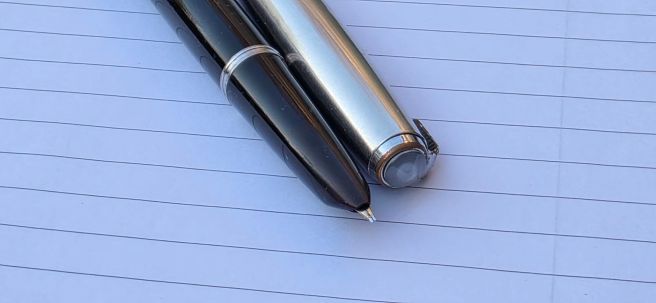
The Parker 51 was first produced in 1940, after many years of development and boasted many new features. Probably the most iconic of these was the hooded nib. Most of the nib area is hidden beneath the shell and this was in order to reduce ink evaporation and hard starts.
The Aerometric fillers have a sac housed in a metal protective cover, with a squeeze bar to fill the pen from a bottle of ink. It is remarkable that the material used for the sac, which claimed to be good for 30 years, is still going strong today and I have yet to come across a Parker 51 in which the ink sac has perished.
Receiving a Parker 51 is a memorable occasion. I still remember getting each of mine. The first was a cedar blue model, purchased from Mr Graham Jasper at a pen show. He has a large number of vintage Parkers and it can be difficult to pick one from trays of numerous similar-looking models. I recall him testing the ink sac by putting the pen to his ear and squeezing the filler bar, to check for a small puff of air (pro-tip)! The barrel imprint reads Made in USA 9, with the digit 9 being the date code. The nib on this one writes a fine line. With all the Parker 51’s there is no visible marking of the nib width.
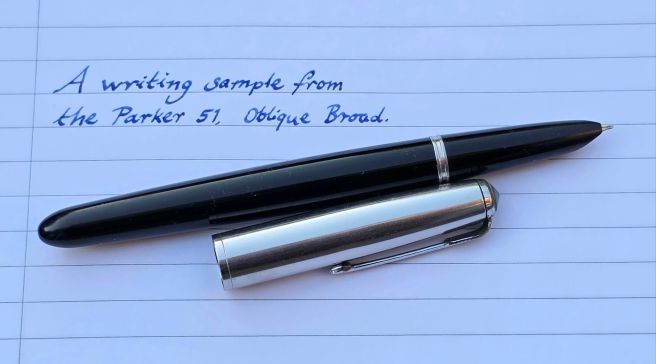
My black Parker 51 was an eBay purchase and is my only one with an oblique nib, probably an oblique broad. This suits my lefty-overwriter handwriting style nicely. It also writes well if used in a more conventional underwriter style. The barrel imprint reads “Made in England 4”. The nibs may give further indications of the year of production but I have not disassembled them. It was missing the cap finial but I was able to buy a replacement from Mark Catley’s Vintage Fountain Pens tables, at the pen show.
The model with a burgundy barrel (which I think may be called Cordovan Brown) was bought in a job lot of five vintage pens from a local antique seller in Childs Hill, North London. It had likely come to the seller as part of a house clearance. I wish I knew more of the past lives of these pens and their owners. This one writes an extra fine line and also has a date code of 4.
My forest green edition is I think a less common colour. It writes a medium line and bears a date code of 2. This was another of my pen show finds.
Finally, these next two pens were a surprise gift received in the post from my friend in Melbourne, Australia. The Parker 51 demi is slightly smaller than the regular 51. It was made in the USA and this has a date code of 8, putting the year at 1948. It writes a medium line.
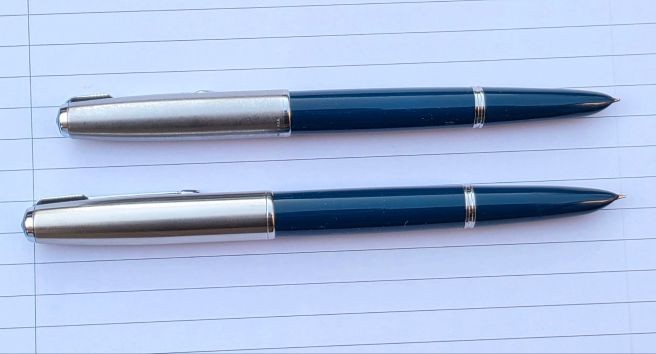
Lastly, in a blue-green colour, I have the Parker 51 “Special”. This differed from the regular 51 models in several respects. The nib was of an eight metal alloy called “Octanium” instead of the usual gold. The aerometic style filler leaves the rear half of the sac exposed under a U-bar (rather than the more fully enclosed metal sac covers in the regular model). For some reason, mine smells of gun oil. Also the cap was a brighter, polished chrome finish rather than the usual “Lustraloy” satin finish caps and has a black plastic jewel in the finial. Mine writes a medium line. There is no date code but I believe this one dates from between 1950 and 1956 (as the filler case still refers to Superchrome ink, a reference which was removed around 1956).
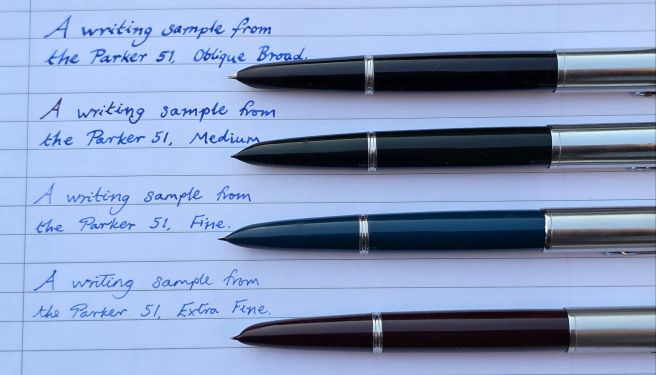
It is remarkable that these pens all perform perfectly and still look modern, after all these years: a triumph of design that perhaps not even Parker could have predicted.
 Fountain pen blog
It is a remarkable pen. I never liked it until I had one in my hand and then I fell in love with it. I’ve inherited a couple and find the OB nib the the most amazing nib to use. Love it.
LikeLiked by 1 person
Yes, the oblique broad nib is a joy. It suits me well, as a lefty and I was thrilled to find it on eBay.
LikeLike
I have managed to disassemble my fleet of 51s by soaking in hot water for a few minutes. Now they’ve all been given a thorough clean!
LikeLiked by 1 person
That sounds enterprising. I have not tried disassembling mine. If I were to do so, I use a heat gun with precise temperature control, but it is important to proceed very carefully. I learnt this to my cost when accidentally overdoing the heat on a Cleo Skribent pen barrel, which melted.
LikeLike
Great post!
I have a cedar blue Parker 51 with gold-filled cap. It belonged to my dad. I received it about 25 years ago, when he and my mom gave me that pen and her red Esterbrook SJ. Those two excellent pens pulled me way down the fountain pen rabbit hole.
What a fantastic writer and piece of technology; this pen design is classic for good reason. The balance is perfect, the gold nib is excellent, and after all these years the only TLC mine needs is a new jewel for the cap. (If you have any tips about how to track one down, please share.) I bought a replacement sac for it years ago, but the original is still holding up and I haven’t needed to swap it out.
Yesterday I ordered a late model Parker 51 Special. I’m eager to see how the weight compares and how the Octanium nib compares to the gold.
LikeLiked by 1 person
Thank you Jenny.
For a replacement cap jewel, I recommend http://Www.vintagepenparts.co.uk. This is a part of Vintage Fountain Pens. They should be able to provide the cap jewel for your Parker.
LikeLike