The moral of today’s tale is that things can go wrong quite quickly when you try to improve a fountain pen nib, if you are not an experienced nibmeister.
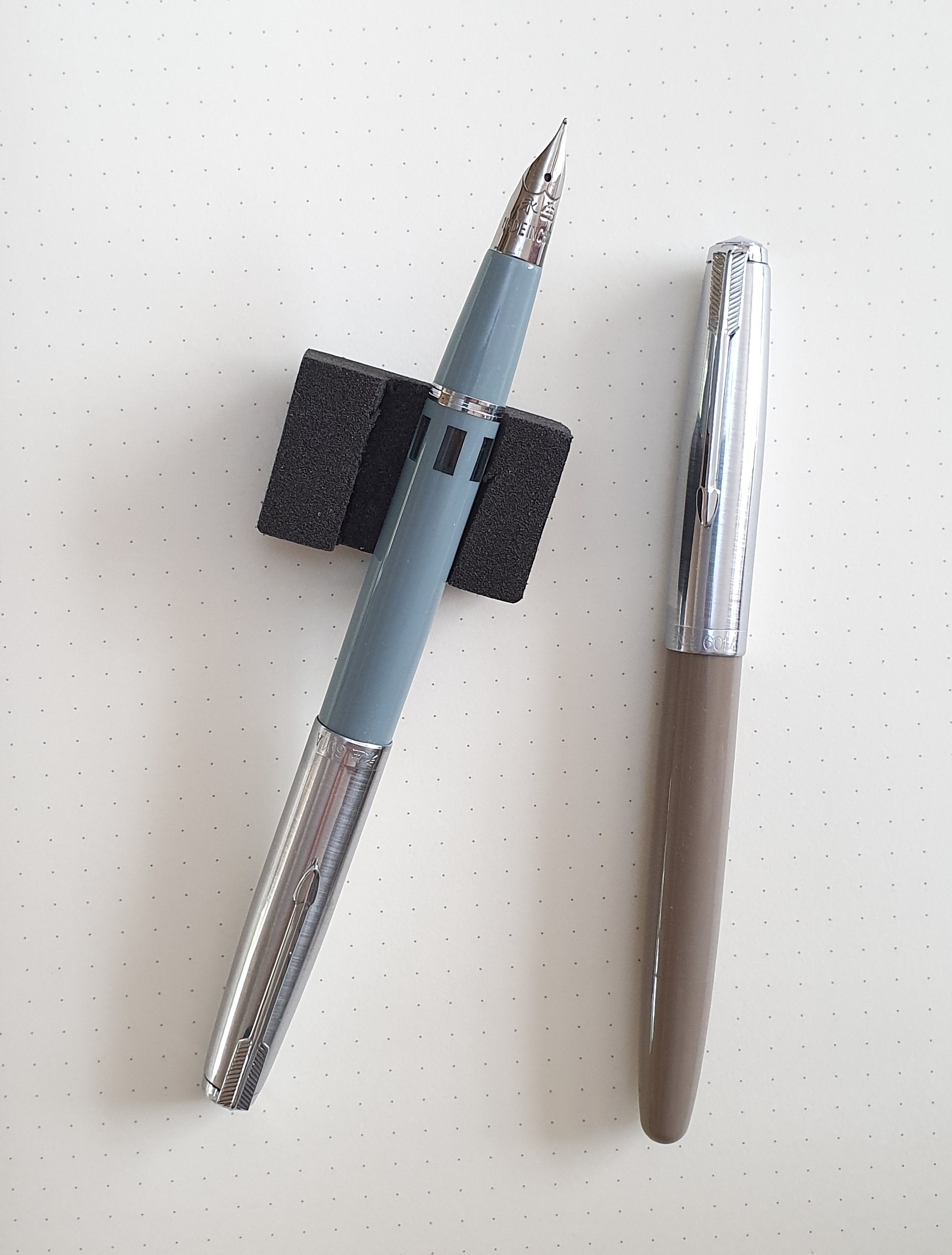
I am a fan of Chinese fountain pens. I was thrilled when I first discovered the Wing Sung 601, a pen in the classic style of the Parker 51 but with a steel nib and costing just a few pounds. Not long after that, in December 2018 I learned that there was a model 601A, similar on the outside but featuring a conical nib, in the style of some vintage Sheaffers. I simply had to try it and ordered three of these online.
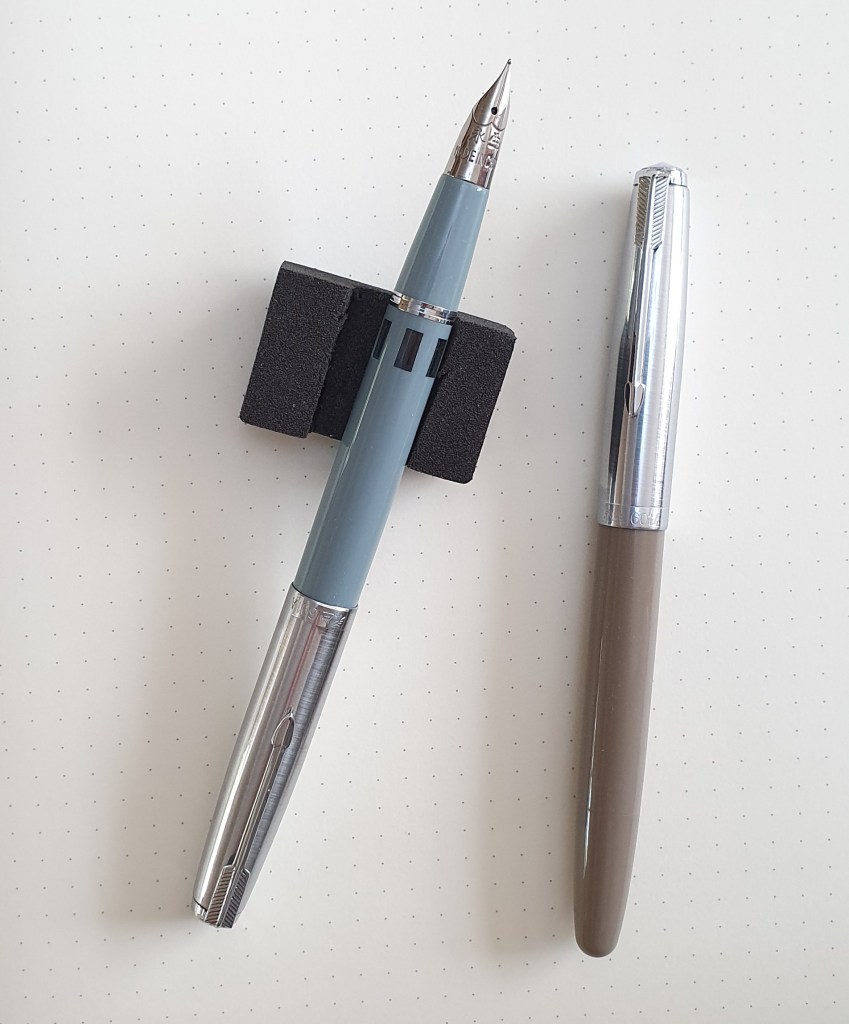
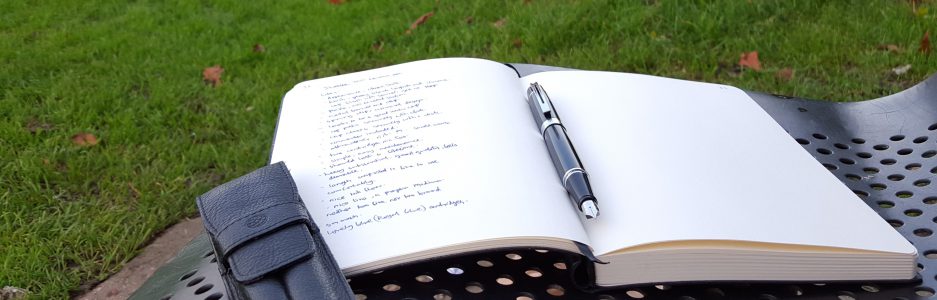
Last month, I got one of these out to ink up again. Lately I have been copying the book “Meditations”, by Marcus Aurelius, with fountain pens, in a slow and laborious print style like a type face, or Times New Roman font. This was not an original idea but inspired by Kimberly, of @allthehobbies on Instagram after seeing her updates of attractive page spreads written with a different pen and ink combo each time.
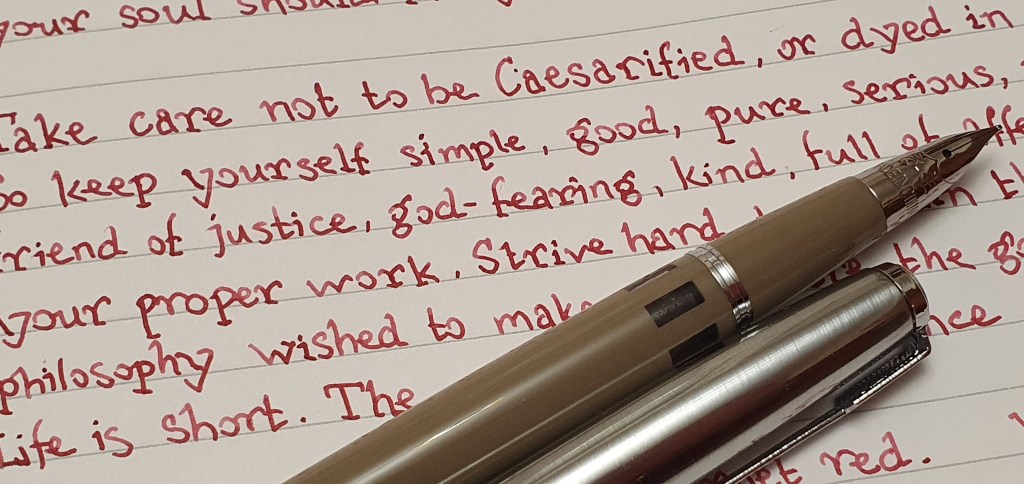
Some days, it can be soothing to unwind with a fountain pen and ink and to write someone else’s words without having to think too much. And so it was in such a state of mind that I found myself late yesterday evening, using a Wing Sung 601A, inked with the lovely Graf von Faber-Castell Garnet Red.
Unfortunately, this combo with its fine nib was not the best of matches for my notebook paper and after a couple of paragraphs, I put the pen down and reached for the brass shims.
It is simple enough to floss the nib a few times with the thinnest grade and then examine it again with a loupe. I was hoping to open up the tine gap just enough to increase ink flow and lubrication and to get a slightly wider line in the process.
The steel nib proved quite stubborn to adjust. I shifted up a grade with my brass shims, poking a corner into the breather hole and drawing it down to the tip a few times. When this did not seem to be making much impression, I lowered a blade into the tine gap to wriggle gently from side to side, with a confidence born of recent success with my Aurora 88.
However, when I next examined the Wing Sung’s conical nib, the tines had separated rather too much and the pen looked unlikely to write at all. A Wing Sung is not an expensive pen but I was determined to fix it and set about trying to push the tines back together again.
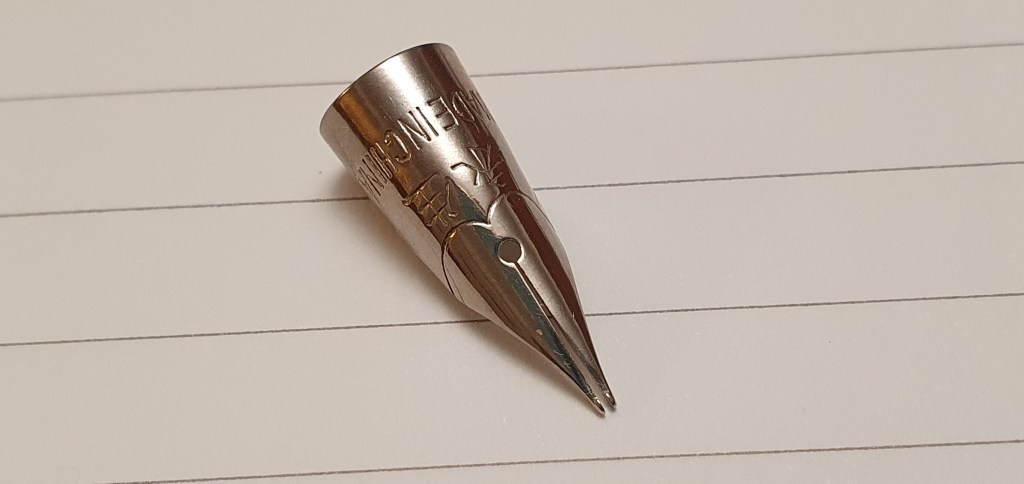
This, it turns out, is harder than separating them. Even if you can push them back together, hurting your thumbs and fingers in the process, the tines simply spring back again when you let go.
By this time a fair bit of Garnet Red had transferred to my fingers and it seemed sensible to flush the pen. Also I thought that it would be easier to adjust the nib if I could detach it from the pen.
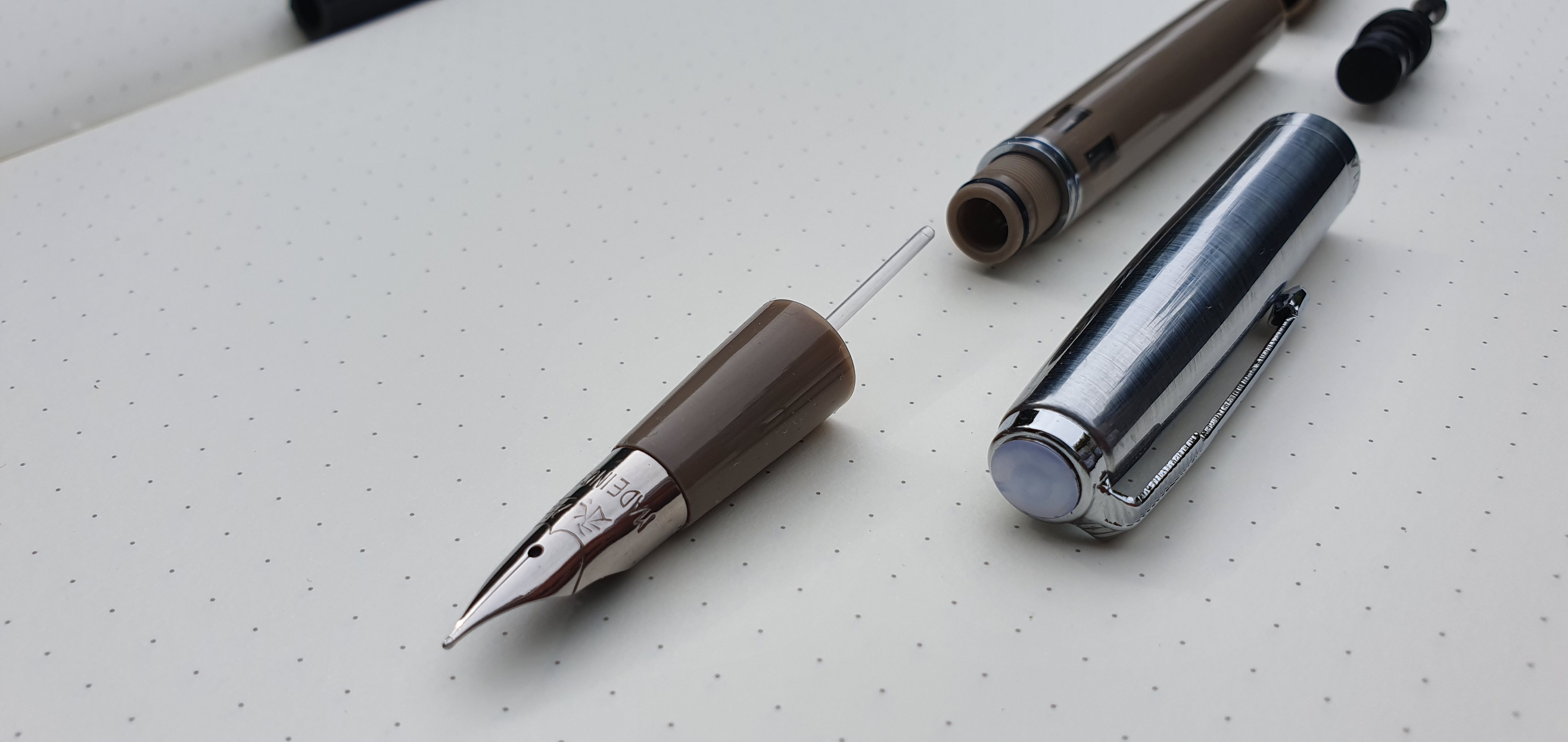
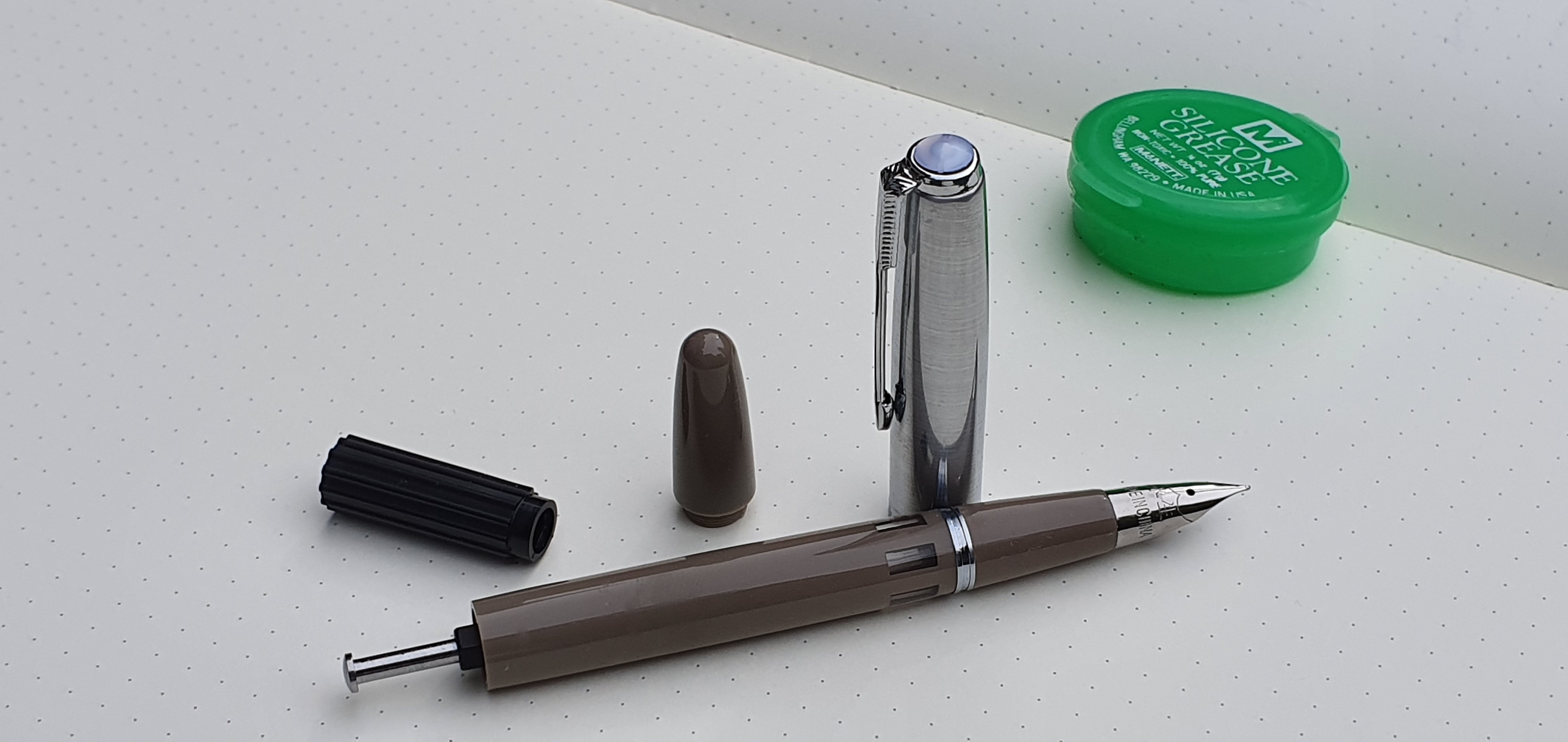
I was not sure how to disassemble the nib section on this pen. I tried pulling the nib off but instead, just the feed and breather tube came out. Then, with the feed removed, I was pleased to find that the conical nib simply unscrews from the section.
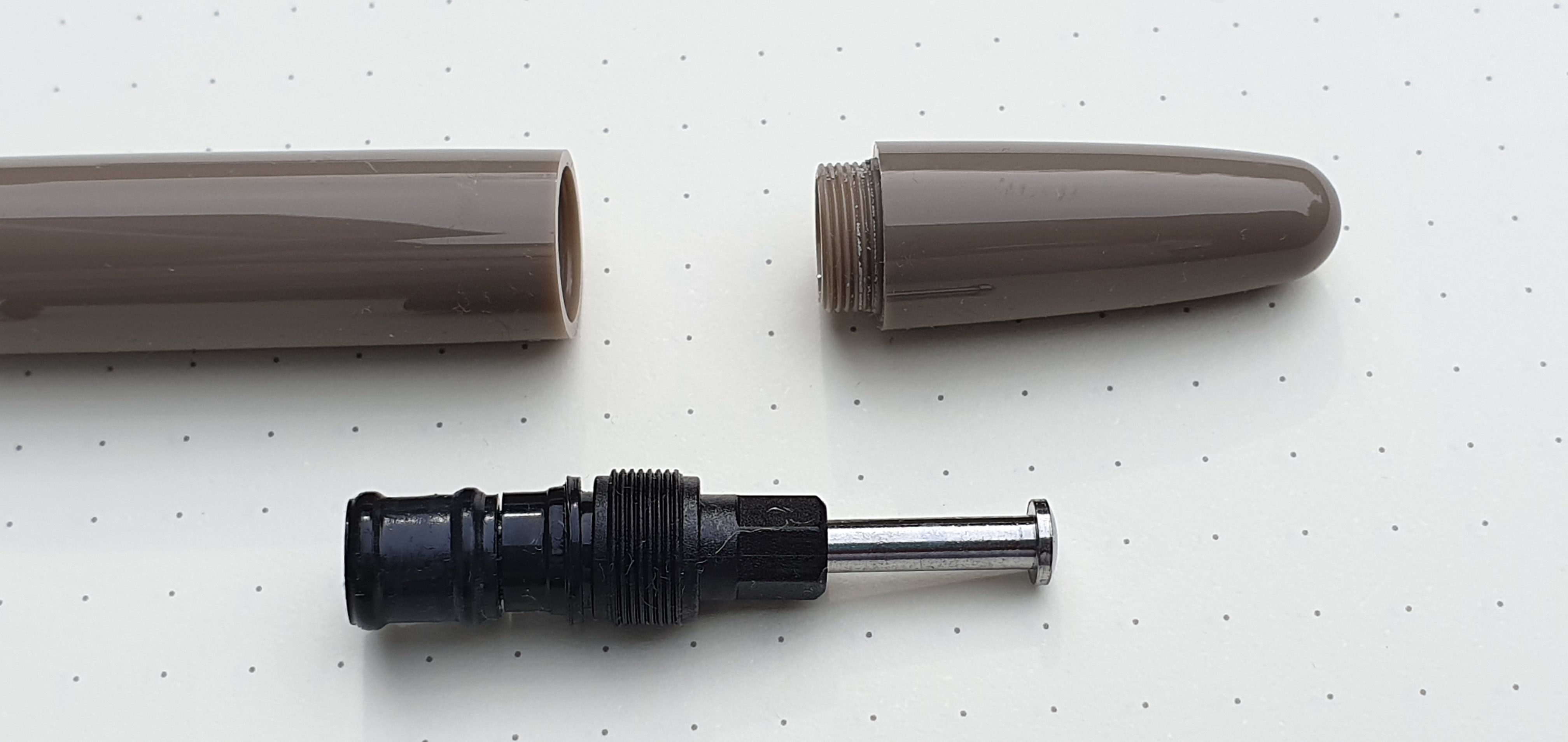
At the other end of the pen, I used the supplied Wing Sung wrench to unscrew the plunger and remove it, then unscrewed the barrel so that it could be flushed through.
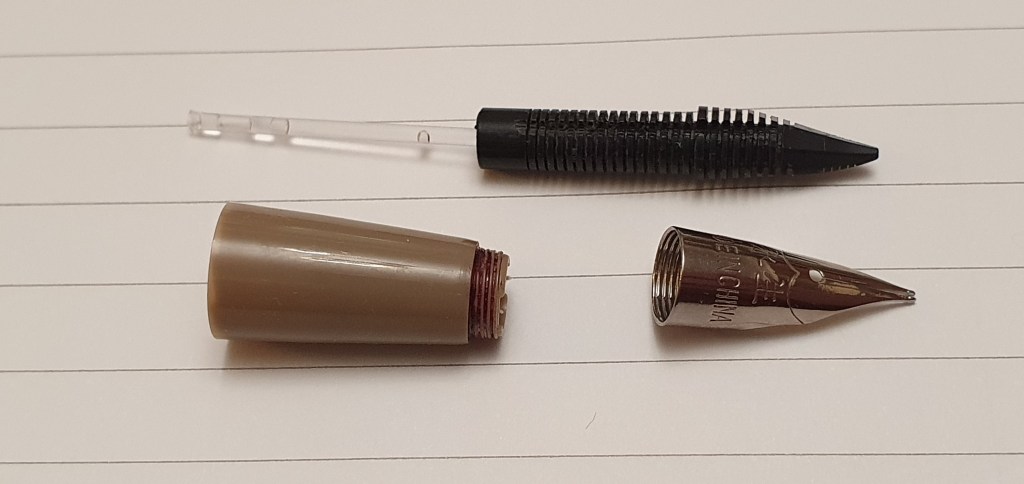
Then with the pen cleaned and dried and in bits, I looked again at the nib with the loupe. The tines were still woefully far apart and the pen did not look usable.
I found that one way to try to narrow the tine gap, was to push one tine both upwards and across, so that there was bit more space for it to move before springing back – and then repeating with the other tine. However my finger tip efforts were not having much effect.
I then remembered SBRE Brown’s tip of bending the tines downwards against a surface. This did work better and, as the tines bent down slightly, so the gap narrowed.
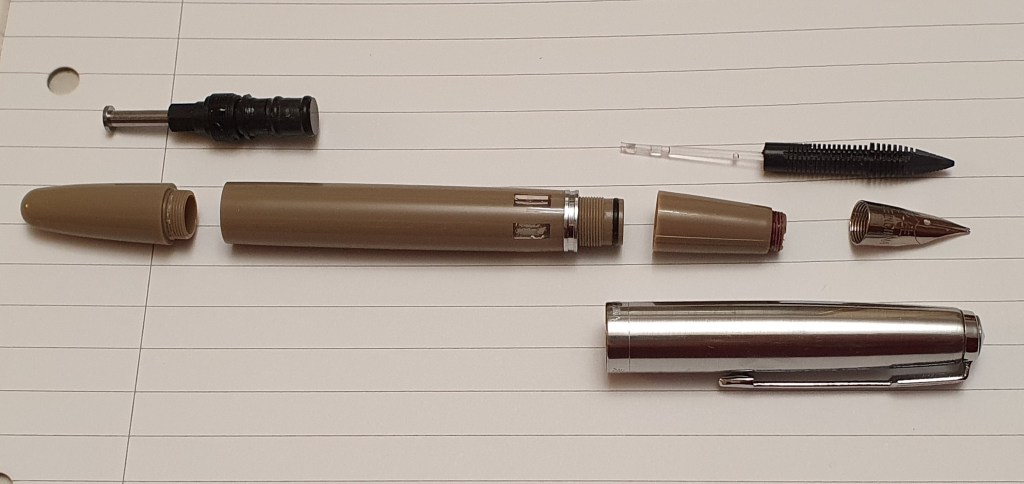
I then re-assembled the pen. Doing this for the first time involved a bit of trial and error. If you place the feed into the section before putting the nib on, you need to align it with the position in which the nib will be once it is screwed back on. Alternatively, it seems easier to screw the nib on first and then push the feed through the nib and into the section taking care not to break it.
Once reassembled, I tried dipping the pen in Garnet Red. It wrote! It was not the smoothest experience as the tine gap was still a bit too wide, but at least it wrote and just needed careful handling to keep to the sweet spot, with both tines in even contact with the paper.
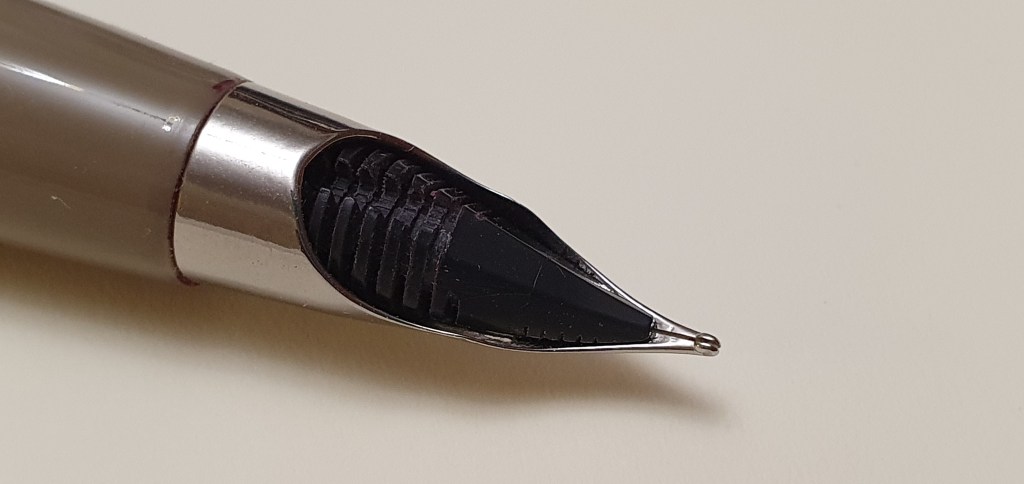
Having established that the pen had been brought back from the brink, I then inked it fully and finished my two page spread of Meditations in my A4 notebook. The pen holds a massive amount of ink and this Garnet Red will be with me for a while. I was pleased that the line was wetter and wider than those first two paragraphs, although I had forfeited some smoothness in the process.
I am still learning. Nib-tinkering needs a certain amount of courage and confidence and a willingness to take risks. But over confidence is dangerous and this was a timely reminder that care, caution and patience are key to success. I like to think that Marcus Aurelius would have approved of my tenacity.
 Fountain pen blog