In September, a reader’s comment alerted me to a new Ryman notebook with 100gsm paper which was supposedly, fountain pen friendly. I was already familiar with their 70 gsm notebooks and have several of them in A5 in various colours in my stash. However I was keen to visit my local Rymans to check out their 100gsm version.
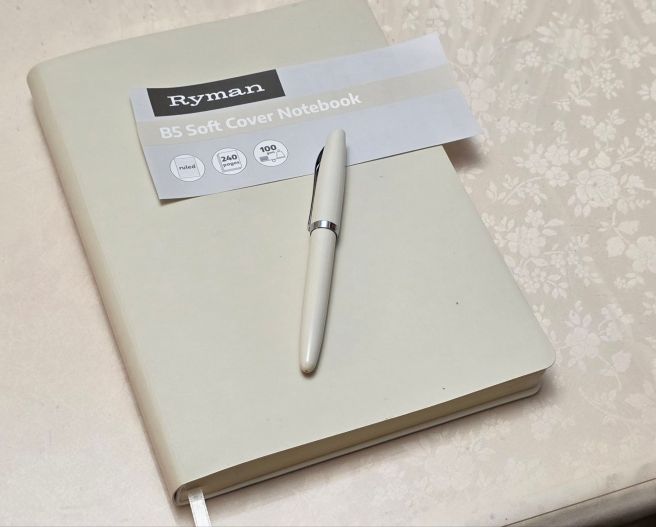
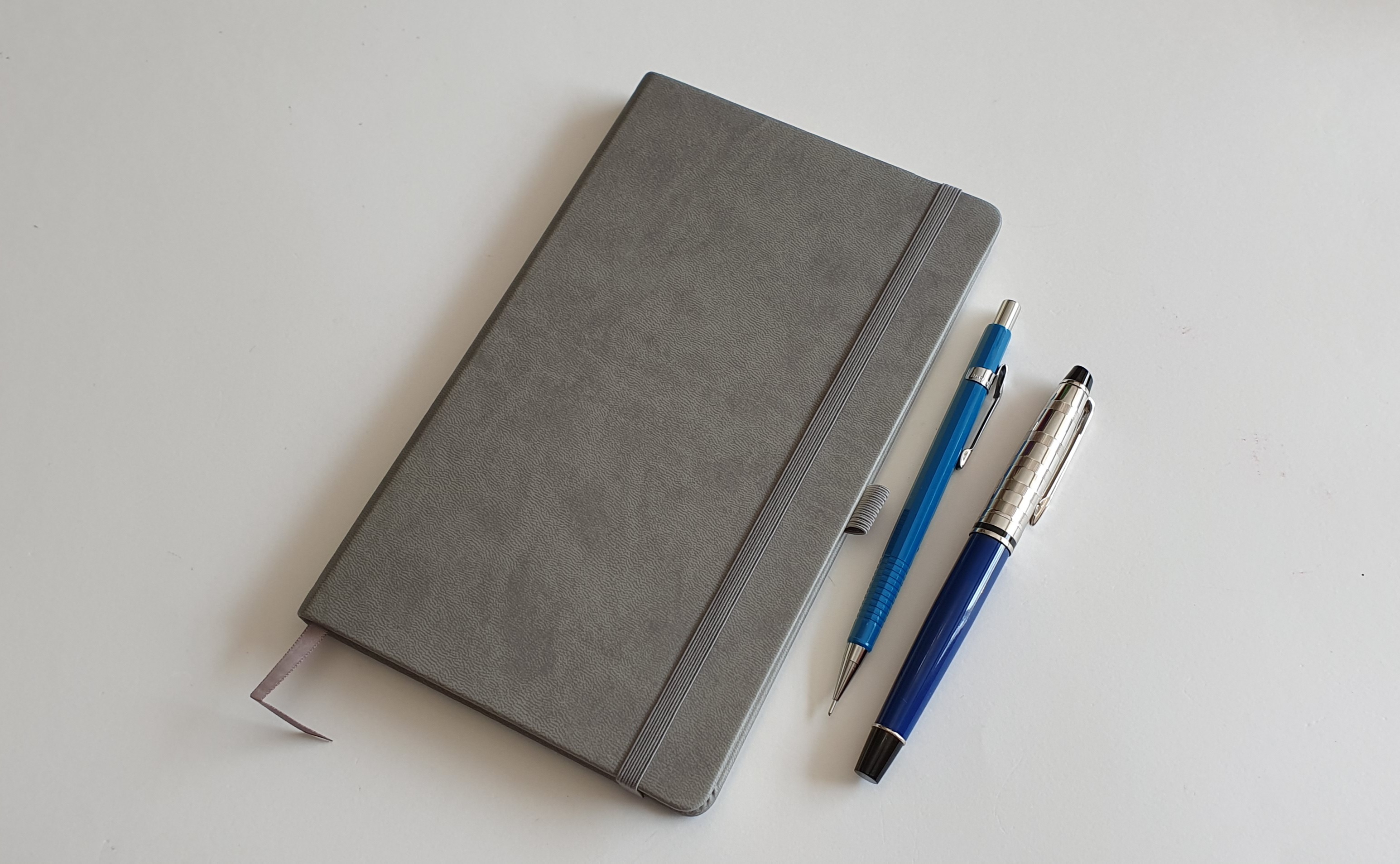
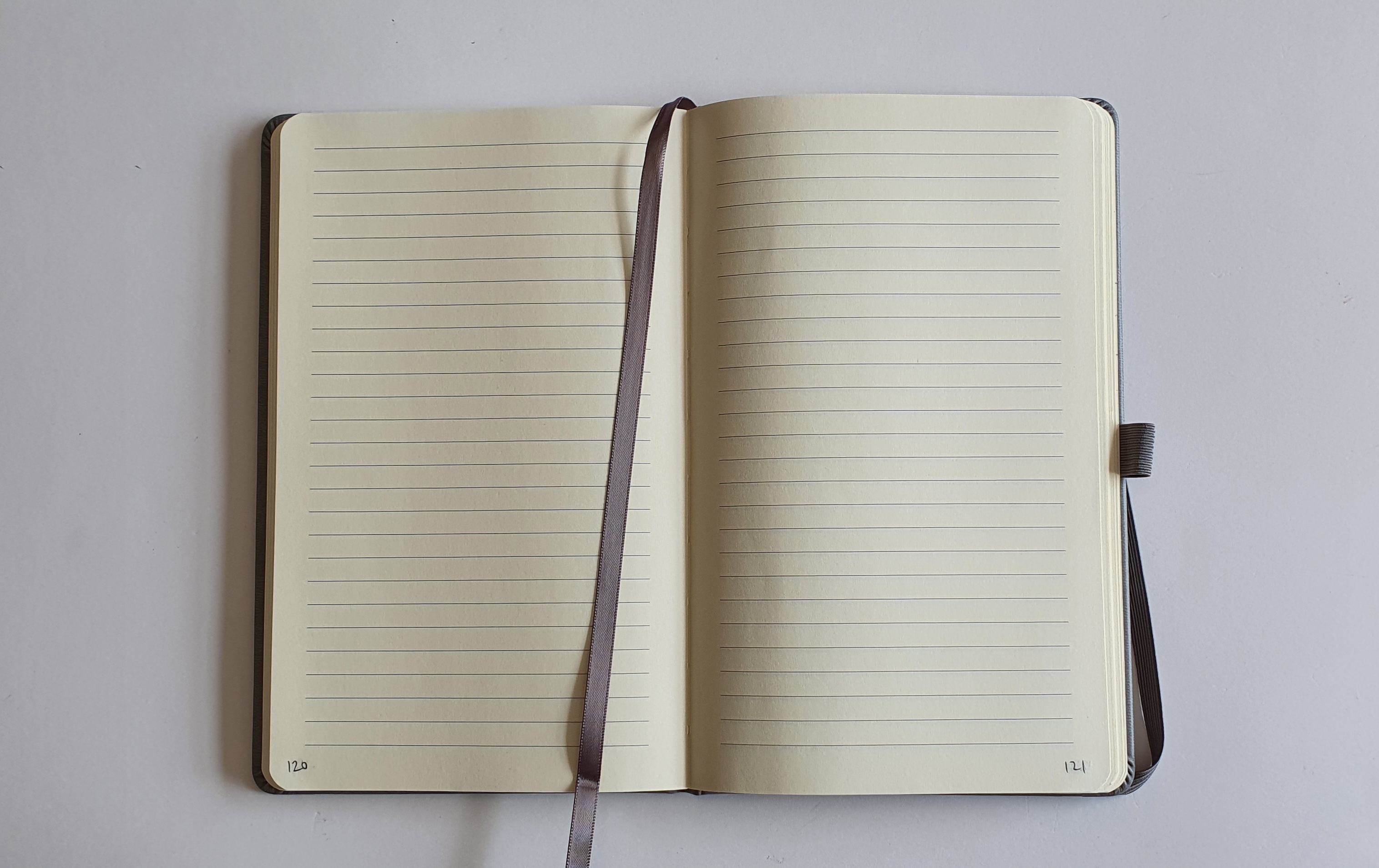
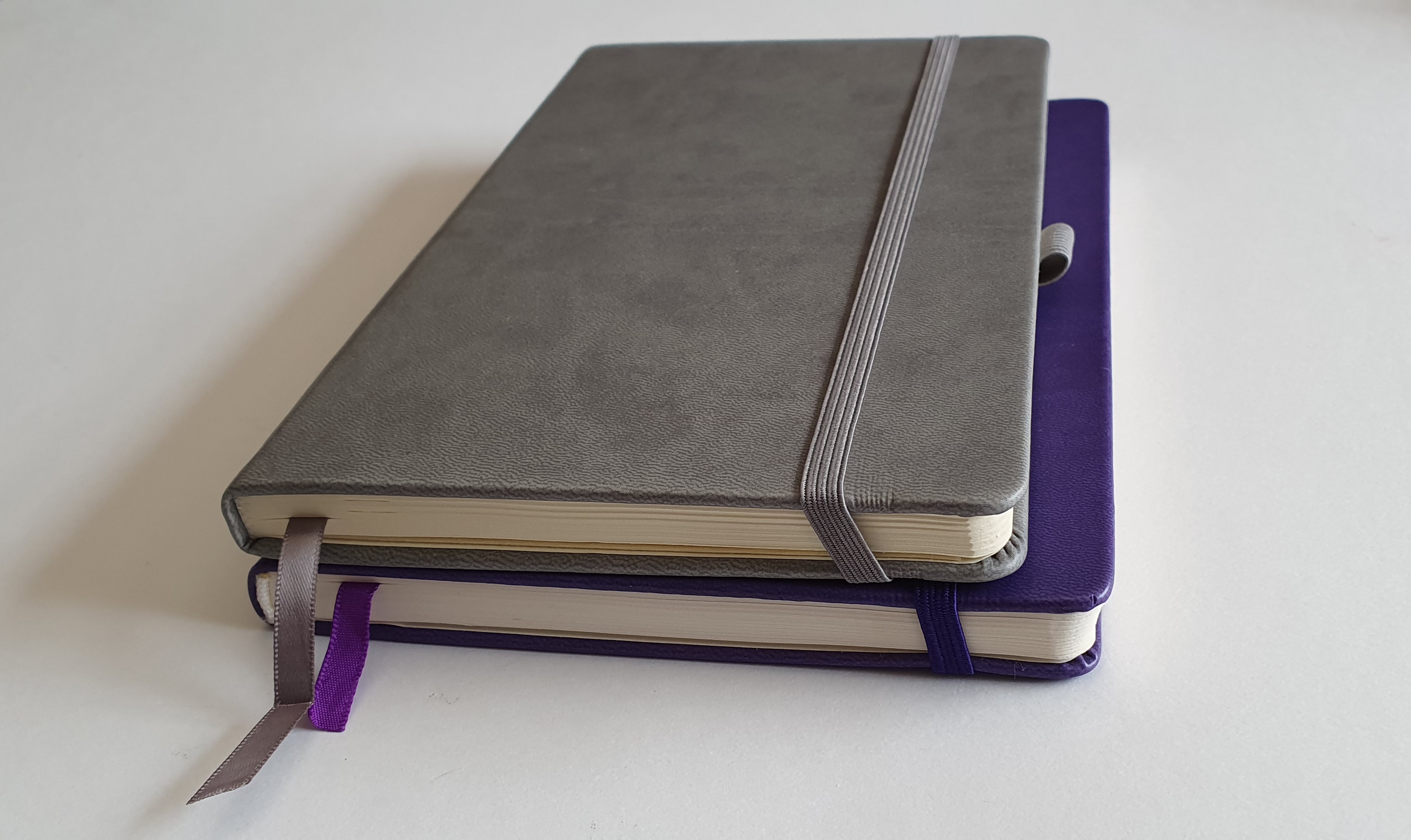
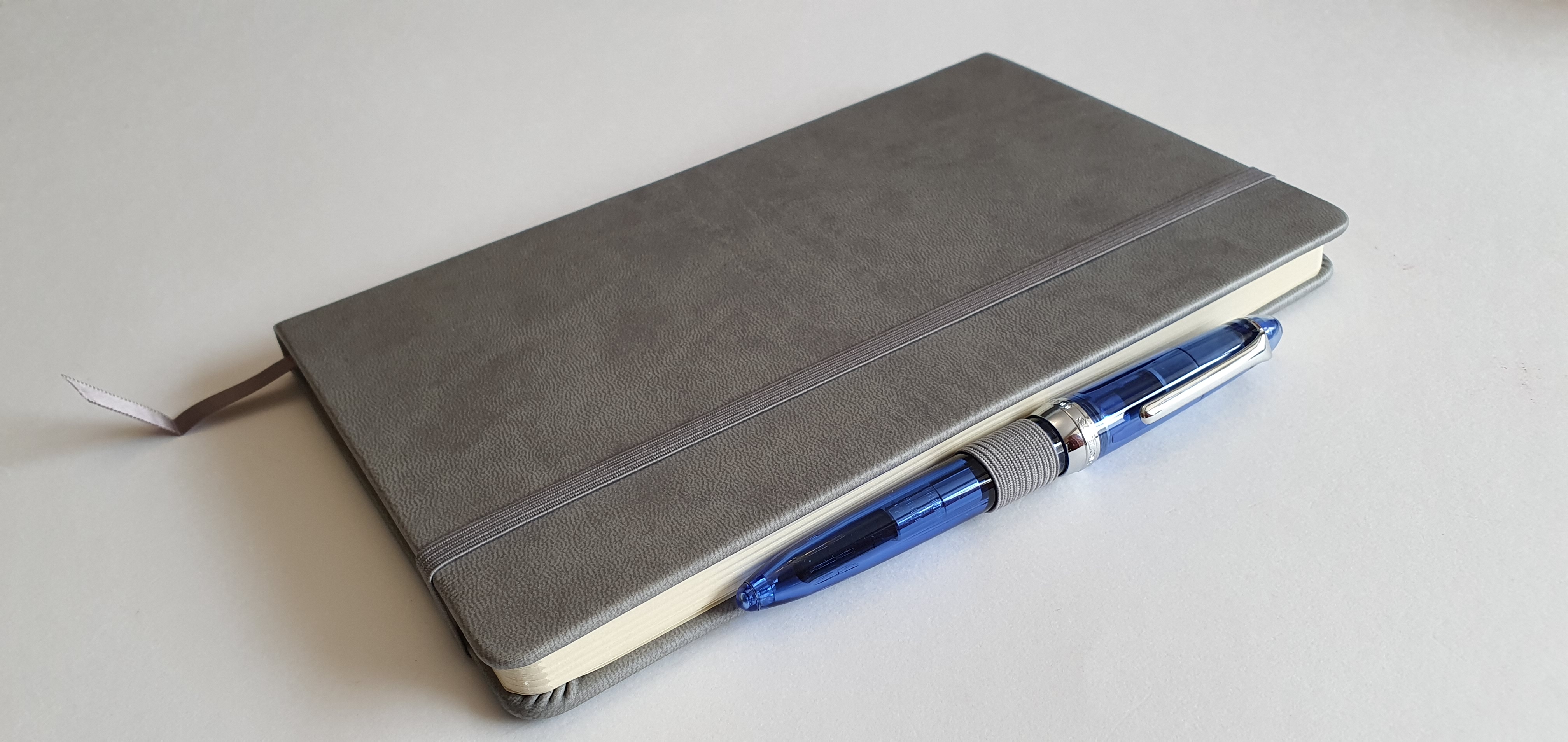
On 1st October, I paid a visit and found a shelf of these new notebooks in various sizes. The available colours were limited to “pink, mint or stone”. I opted for a B5 size in the stone, which is a very light grey. The book contained 240 pages of cream, 100gsm paper, ruled at 8mm row height (my favourite) and with 27 rows to a page. The cover has a smooth pleasant feel and offers some protection to the pages, but is a flexible, bendy cover, (not a hard-back like the versions with 70gsm paper). Crucially, the pages are stitched for open-flat use and the line spacing and the smooth soft feel of the paper are just as I like.
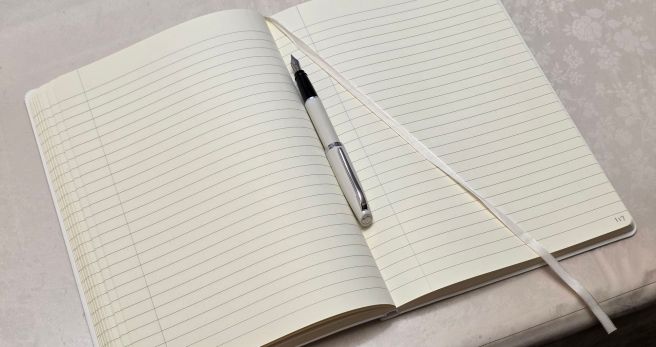
Other features of the notebook are rounded page corners, an expandable pocket inside the back cover and a single, white ribbon page marker. There are no page numbers (I added my own), no elastic closure and nothing to distinguish the front of the book from the back, unless you have a bit of the ribbon marker showing at the bottom.
The B5 size was £7.99, which I calculated gives a cost of just 3.33 pence for each of the 240 pages. I do not usually go for the B5 size, which falls between A5 and A4 (ideal for people who cannot decide which of those two sizes they prefer).
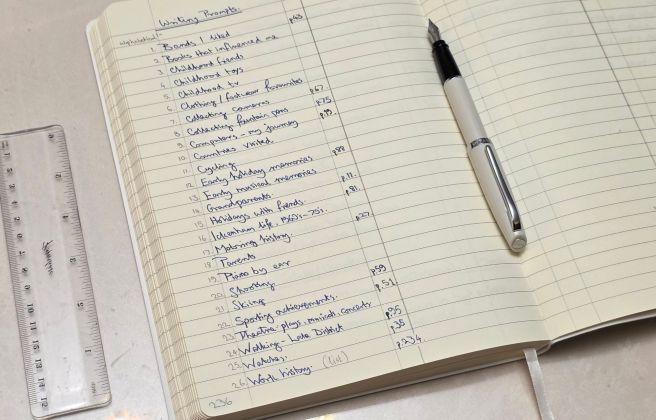
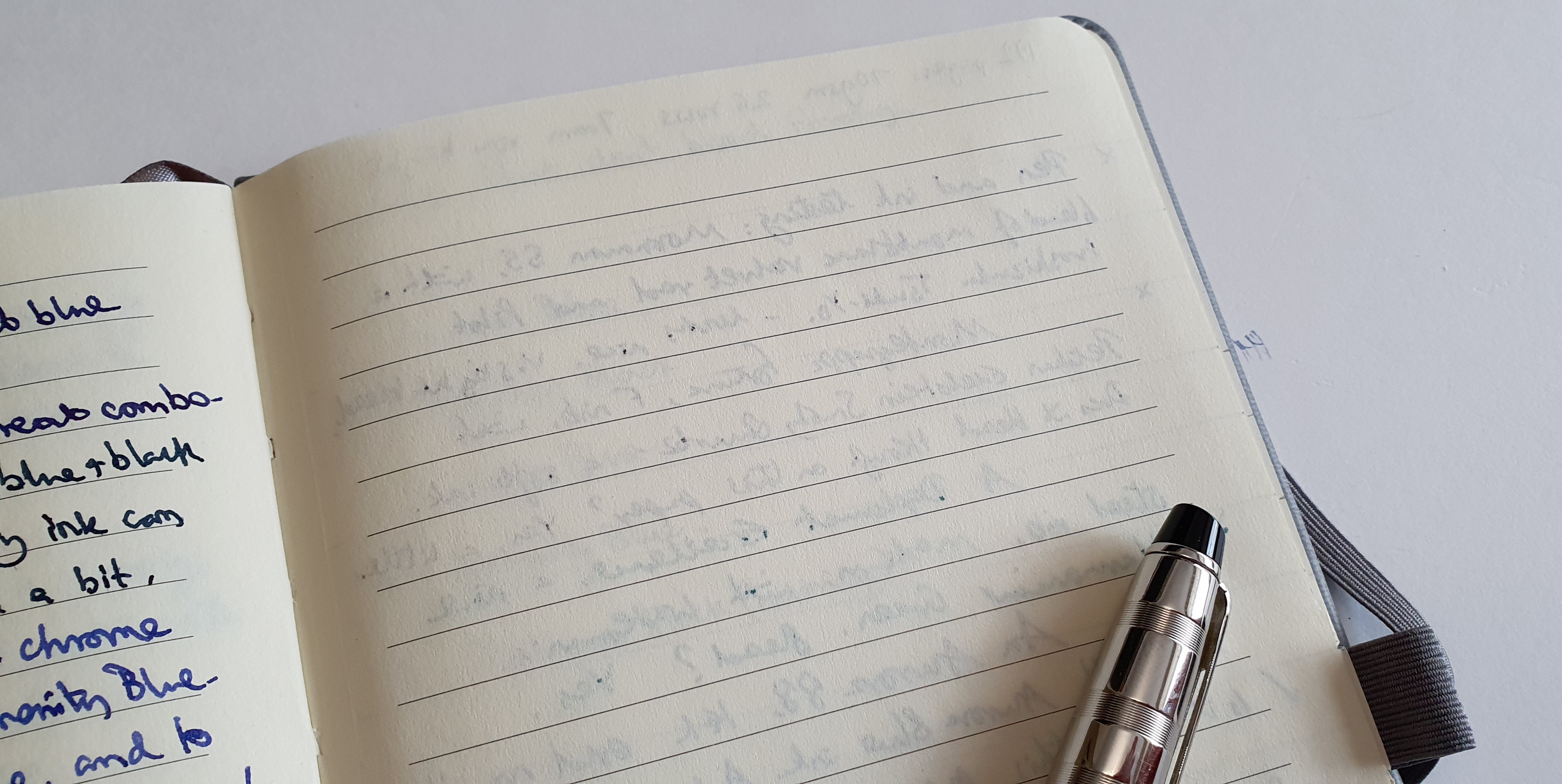
At home I tested the paper for fountain pens by writing with a Faber Castell Ondoro, medium nib inked with Graf von Faber-Castell Cobalt Blue. My note reads “Feels smooth but with some pleasant feedback. Lovely.” There was no bleed-through or feathering. I was delighted with the notebook and started using a few pages, starting from the back, to write various lists, including one list of some writing prompts that I had created and saved alphabetically in the app ColorNote.
In October, after the London Pen Show my pen cups were full with inked pens. It was obvious even to me that I did not need any more pens, inks or notebooks for a while! What I needed was a writing project. I hadn’t undertaken a writing project as such, for a few years since I finished transcribing Marcus Aurelius’ Meditations.
And then, just at the right time at the end of October, I read in a blog about the NaNoWriMo challenge. I had never taken part in this before. The objective is to write 50,000 words, the first draft of a novel, in November. I understood that participants could register, and once signed up, receive some tips and support as part of the NaNoWriMo (National Novel Writing Month) community. However, I planned to tag along quietly on my own without signing up. This was just as well as I then learned that NaNoWriMo was no longer running, having closed down in April 2025.
Nevertheless, I really liked the idea of the challenge. The point of it, I think, is to get people writing regularly and to establish a writing habit. The emphasis is on completing 50,000 words, that is, on quantity rather than the quality. It is only a first draft.
I did not have an idea for a novel in mind and had never written any fiction. Instead, I decided to utilise the biographical writing prompts that I had already entered in my new B5 notebook and to use that notebook for the challenge. I would write every day with a fountain pen.
A few back-of-an-envelope calculations soon told me that 50,000 words in 30 days = 1,666 words a day. I had already written on the last 20 of my 240 pages, and allowing the first 2 pages as a frontispiece, I would have 218 pages available for the challenge and so need to average 230 words per page. The daily word count of 1666 words, at 230 words per page would mean writing for an average of 7.25 pages a day.
As of today, I have kept up. I have passed the one third point. I am really enjoying the writing exercise and like to start first thing in the morning, and so my NaNoWriMo is also a bit like doing Morning Pages. I pick a topic each day from my writing prompts list, and also pick a fountain pen. The idea then is to have a topic on which I can write continuously, rather than if I were copying from a book and needing to pause to look up and down all the time.
This challenge, apart from being satisfying day by day, has multiple other benefits. Just sitting to write with a nice pen and ink is a joy in itself. It is a way to practice and improve one’s handwriting. It is a way to test a fountain pen over an extended chunk of time (typically about two hours per day) and to check that the pen keeps up with the ink demand and is drawing ink down from the reservoir. You can spend time with a pen to remind yourself of why you like (or dislike) it. You write a pen dry in a few days and can then clean the pen with a clear conscience or else re-ink it if desired. It is a good mental discipline, the brain generating thoughts and words and the hand and eye keeping up with the flow of ideas. And I am getting to tell my little stories.
I am also enjoying the Ryman B5 notebook for this purpose. It is just the right length for the NaNoWriMo challenge. I have been using my lefty-underwriter (upright) style of handwriting whereby the book is level (not rotated) and so I do not have the problem of having to reach too far away from my body to use the right hand page: this might be a problem if I were to use my lefty over-writer style when I rotate the paper to the left: the left-hand page can then become smudged or creased. I found this to be a problem with A4 notebooks, whereas A5 notebooks are small enough to rotate without causing such an issue.
In conclusion I can recommend Rymans’ 100gsm paper notebooks. For my part, I am enjoying at least the spirit of the NaNoWriMo November writing challenge, in my own way.
 Fountain pen blog