I spotted this pen in the window of a shop selling mostly greetings cards and only a few pens, most of which were ball points. It was in a small grey Parker gift box, with the clear plastic lid and appeared to be rather dusty and in need of rescue.

I was surprised to see this model currently for sale. I remembered the Parker ball point pens with this distinctive rubbery grip section. I had one which has lived in my camera bag, for some 10 years or so. It was good to use outdoors, for jotting down exposure details, when using old twin lens reflex cameras. I did not remember there being a fountain pen. I have had the ball point pen for so long that I had forgotten that it was called the Reflex and had to look that up.
I decided to liberate the pen which at just £11.00, was less than I had paid for two hours’ parking at London Gatwick Airport earlier that day. I was particularly attracted to the grip section, having been thinking a lot lately about the problem I am having in gripping the slippery but otherwise enjoyable Lamy aion. I had even toyed with the idea of buying rubber thimbles, as used by clerks in post offices for counting paper.
At home, I gave the Reflex a good wash. What I had thought was dust, was actually the result of the cap and barrel having faded in the sunlight, except where the barrel had been covered by the posted cap. You can see the tan lines. I flushed out the nib section with a bulb blower.
Examining the nib under a loupe, I was delighted to find that the tines were level, that the tipping material looked symmetrical and that all looked generally well. I have often found that inexpensive modern pens do not write well straight out of the box, due to poorly finished nibs. Not so with this Reflex though.
It did not come with a converter, or even a cartridge, or any paperwork, which makes me wonder about this one’s history. There is a date code, TII on the cap. This is a bit of a puzzle. I understand that T denotes a year ending in 5 (under the QUALITYPEN system, where Q is zero). The II means that there were two quarters of the year remaining and so this was made in the second quarter. The cap is also stamped PARKER, MADE IN UK. I have read that the Newhaven factory for Parker production in the UK was closed in 2011 and so if this pen was made in the UK, in a year ending in a 5, that would suggest 2005. Could it be that this new pen had not yet been sold in 12 years?
I inserted a basic Parker converter, with the slider fill and metal agitator ball. The converter pushed in nicely, but so deeply behind the long threaded collar that the entire clear plastic reservoir area was covered. Thus you could not see how much ink it was holding.

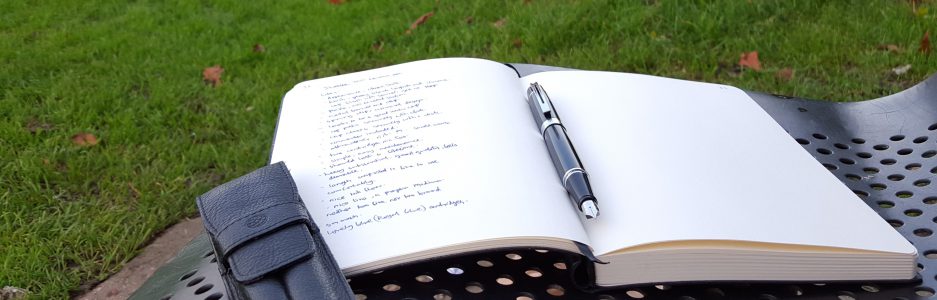
I decided on a royal blue ink to match the barrel colour and chose Aurora Blue. It wrote nicely, smooth and with ideal ink flow! That is often the gamble, part of the risk and thrill of buying a fountain pen. I enjoyed trying it out on various notebooks. At 132mm long unposted, the pen is a good length and pleasant to use. However, the cap is very light and posts securely and deeply and I prefer to use it posted, for that extra length, weight and comfort.
The rubber grip section works well. It has an unusual finish, like cross-hatched tyre treads. If you want any more grip, add snow chains!
The nib appears to be the same as in the currently available Parker Vector fountain pen. You do not expect marvels at this price level but if you are lucky enough to have a Vector style nib that performs well, it can be a real joy, with lightweight and effortless writing, if you just want a simple writing tool, to write without much flex or character.
Viewed in profile, the nib and housing are reminiscent of the Parker 45 fountain pens that I used through my secondary school years and give a very similar writing experience.
Description
This is an entry level cartridge-converter type fountain pen (although neither cartridge nor converter was supplied in my case). The pen is a good size and has a light plastic body, but features an easy to grip rubbery section. The cap simply pushes on and off with a snug fit, over the chrome ring behind the rubber grip. The pocket clip features a modern look Parker Arrow. The clip is sprung, making it easy to use. The cap is not airtight and this might be due to a design decision to reduce risk of choking, or perhaps to avoid pushing air up through the nib each time the pen is capped. The stainless steel nib in my model is a Medium. The threads on the section are plastic and very long, needing about ten twists to unscrew the barrel.
Specifications (approximate)
Length closed: 141mm
Length opened: 132mm
Length posted: 155mm
Weight, capped and with converter: 14.5g
Uncapped: 10g
Cap: 4.5g
Conclusion
The Parker Reflex is a good answer for anyone who likes the Parker Vector nib but who wishes that the body was slightly wider and that the grip was fatter, easier to hold and more comfortable. I am delighted with mine and think it was excellent value.

 Fountain pen blog