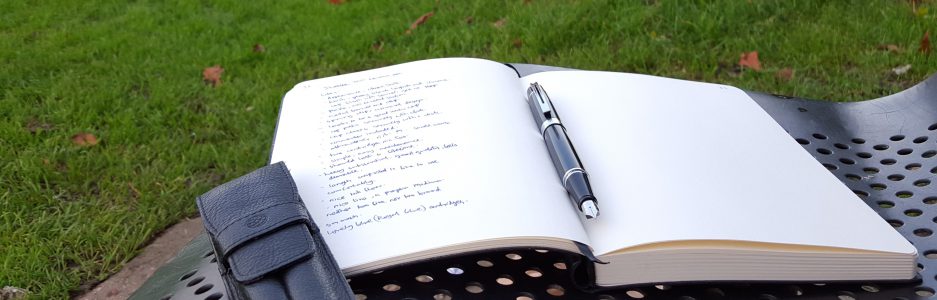
Some dos and don’ts on repairing a Parker Duofold button filler.

Within the circle of my pen club friends, I am known for enthusing about vintage Parker fountain pens. These are plentiful at pen shows and can represent excellent value, when compared with their modern counterparts.

One of my friends bought a vintage Parker Duofold, button filler fountain pen at a recent pen show and asked for my help to get it working and to fix a bent nib. I had completed the Writing Equipment Society’s pen repair course, only last winter. The course was great but attendees still need to practice what they have learned, preferably on their own pens to start with, to gain experience and confidence before being let loose on someone else’s pen. My friend was aware of this but still content for me to have a go.

Having seen a photograph of her pen in pieces, I hoped that it might only need a replacement sac and I suggested that she order one from The Pendragons, whereupon I would have a look at the pen at our next monthly get-together.

Prior to attending the course, I had not even known what a button-filler pen was. It has an ink sac in the barrel. Alongside the sac, is a thin metal bar with a pressure plate. One end of the bar slots into a recess underneath a button (beneath a “blind cap”). When the button is pushed, the metal bar flexes, pushing a pressure plate against the sac. This forces air out of the sac, sending a stream of bubbles to your ink bottle. Then as the button is released, the sac regains shape and draws up ink.

When we met, my friend had already done the hard part, which was to disassemble her pen – remove the barrel, (which was a screw-fit), remove the sac which had perished and also remove the button from the barrel. She had not removed the nib and feed from the section but had purchased a replacement number 17 sac. The repair then went something like this:-

Replacing a sac on a Parker button-filler fountain pen (with a screw-on barrel):

  • Examine and clean the parts; the metal bar was free of corrosion; scrape off any residue of the sac from the sac peg;
  • Straighten out the nib to re-align the tines;
  • Trim the new sac to a length to fit in the barrel;
  • Tip: if the section screws into the barrel, there is a risk that, when a new sac is attached, the sac will become twisted as the section is turned; for this reason it is best to remove the nib and feed – either by pulling them firmly, or else by soaking or washing in an ultrasonic bath, applying gentle heat from a heat gun, and then knocking them out using a hammer, a drift and a nib knock-out block. Then, fit the new sac, and insert a rod up through the section and into the sac to prevent it from twisting as you screw the section into the barrel. The nib and feed are then replaced last. However, we did not do this as the nib and feed could not easily be removed.
  • I attached the new sac to the sac peg, with shellac and then dusted it with French Chalk;
  • Once the section went in the barrel, we could feel the sac twisting. However, it was only catching at the far end and we overcame this by snipping about 5mm off the sac and re-attaching it;
  • Once the section was in place, the spring bar was carefully inserted, guiding it through the hole where the button goes. This needs to be slid in with care to avoid catching on the sac. Again, the bar was liberally dusted with French Chalk.
  • The push button was then pushed back into the barrel. The pen was ready to fill.

Happily, the pen then filled. Bubbles could be seen and heard, which is what you want. The pen wrote smoothly and all appears to be well.

Being asked to repair someone’s fountain pen is a privilege and an honour but carries risk: a bit like being asked to baptise their child, you do not want to drop it! I was grateful for the honour and relieved that the repair was a success.

I do have one Parker Duofold button filler of my own, bought at the March London Pen Show. I had not used it much but thought that it was working. But on closer examination, it would write for only two pages before drying out. It appeared that this was just the ink retained in the nib and feed and that the sac was not filling. When pressing the button, no bubbles appeared in the ink bottle. With my newfound optimism, I decided to disassemble my Parker.
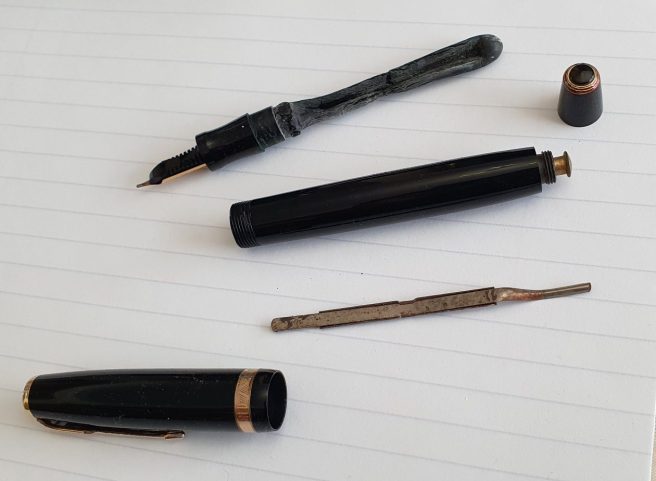
Old perished sac before replacement.

The steps were very similar to repairing my friend’s pen and so I will mention only the key differences:
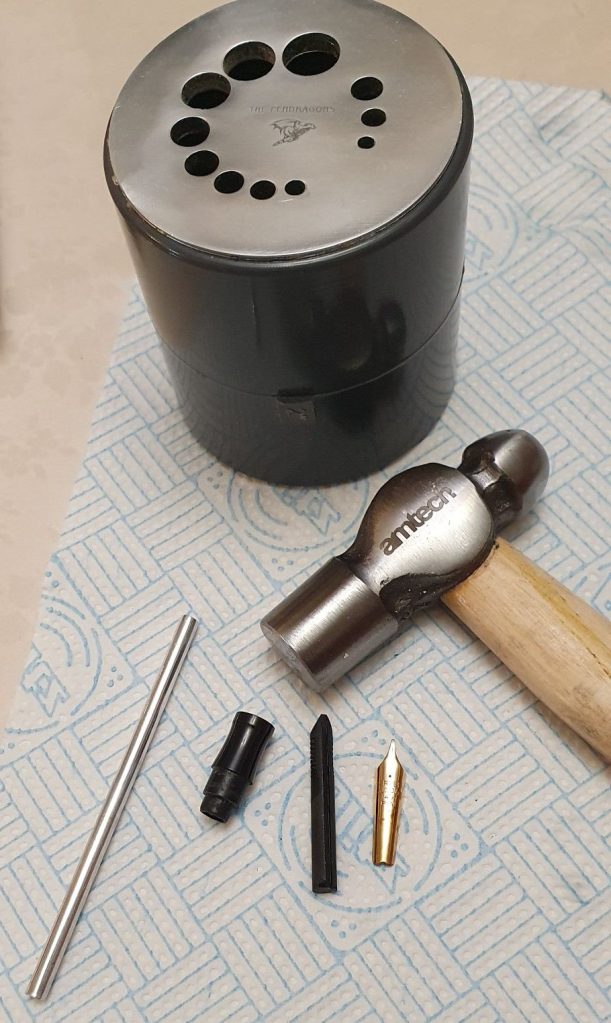
Knock-out block, hammer and drift.
  • I soaked the nib and section in water for several hours and then applied some gentle heat from my heat gun, before attempting to remove the barrel. As my tutor used to say, “Soaked pens come apart; unsoaked pens break.”
  • After about 5 – 10 minutes’ heat, at around 160 degrees, the barrel separated from the section and, unlike my friend’s pen, mine was a simple push-fit, not threaded.
  • The sac had indeed perished and was hard and cracked.
  • The spring bar had a bit of rust, but was still usable; I dusted it with French Chalk;
  • I soaked the section in an ultrasonic, then removed the nib and feed, using a knock-out block with a hammer and drift;
  • The new number 17 sac went on nicely, attached with shellac and then dusted with French Chalk
  • I had not been able to remove the button, from the end of the barrel. Not wishing to apply excessive force, I left it in place. However this meant that the spring bar could not be inserted through the button hole, after the section and new sac were in place. Instead the spring bar had to be placed in the barrel from the open end, taking care to have the pressure plate facing inwards, before inserting the section with sac attached.
  • The pen went back together smoothly and I was ready to fill it.
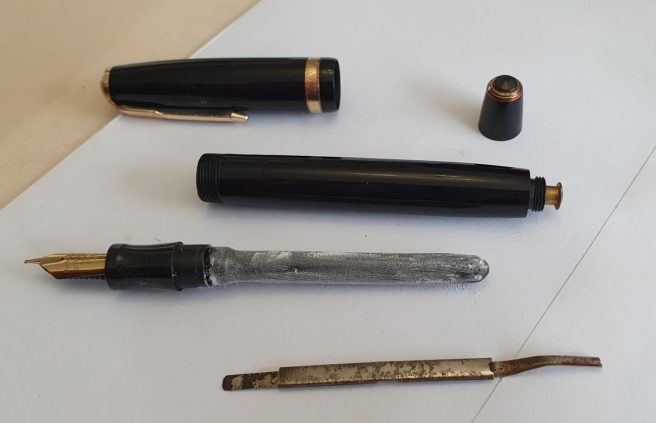
New sac attached and dusted.

Since my pen had a push-fit barrel, it was not really necessary to remove the nib and feed and insert a rod into the new sac to prevent twisting when screwing the barrel back on, but it was nice to be able to clean and inspect the nib thoroughly.

Falling at the last hurdle.

However, pride comes before a fall. In my excitement at seeing the pen fill properly, I had neglected to support the pen sufficiently, whilst pressing down on the button. Without realising, I had driven the pen down into the glass bottle and bent the soft gold nib to a right angle.
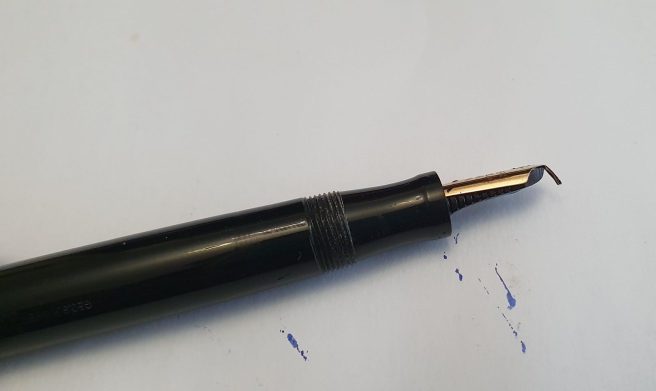
Oh no! It’s Gonzo from the Muppets!

Perhaps I was lucky, but I was able to bend the nib back into shape and do some rudimentary burnishing, using the tools available, namely a wooden McDonalds’ tea stirrer and a table mat. I got the nib back in shape with the tines aligned as best I could. The pen wrote smoothly and well.
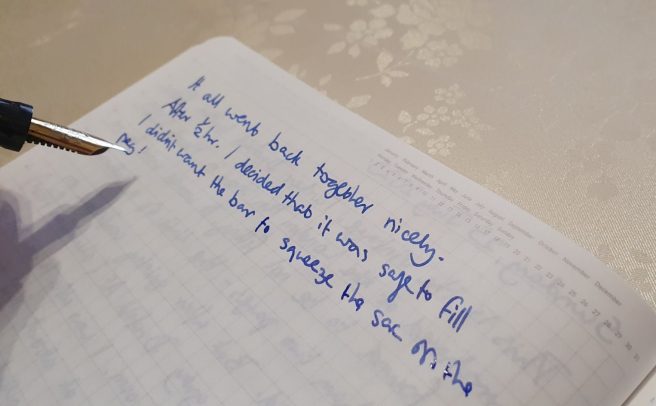
Now that the pen fills properly, I kept track of its output and noted that it wrote for 15 pages of an A5 notebook on one fill.

There is always more to learn, even in a seemingly basic task like replacing a sac or inking your pen! This is why it is best to practice and make your mistakes on your own pens first. With the button filler I tackled my friend’s pen first but I am glad that the Gods of pen repair were aware of this and saved this humbling blunder for my own.
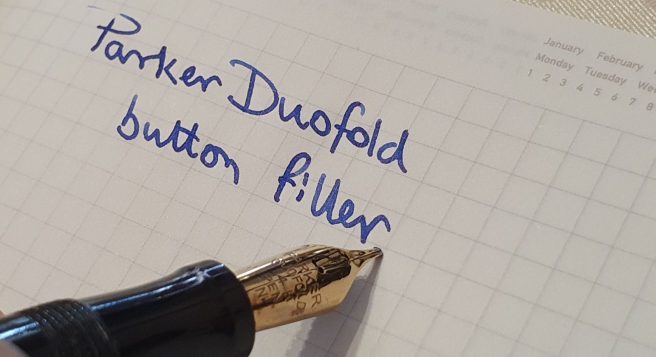
A little battered but not beaten.

London Spring Pen Show 2025: my haul.

Well, this is embarrassing. I had pencilled in a post for this week, intending to call it a pen show recap, as “my haul” would not work on a “no-buy”. But as it turns out, the “no-buy” promptly went out of the window as soon I got through the gates. Another generous interpretation from one of my pen club friends, is that purchases during a pen show do not count in a no-buy.

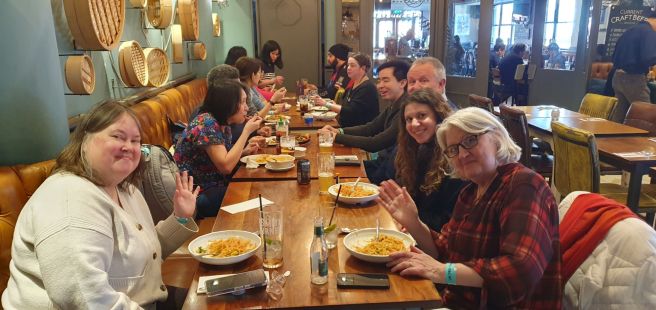
Anyhow, I had a brilliant day at the show as always, running into many friends. As most of our pen club (The London Fountaineers) had arranged to meet up nearby at Latymers for a pub lunch during the show, I decided to go for the 9.00am early bird admission, to compensate for the lunchtime erosion of shopping time. This worked out perfectly and it was lovely to sit down and catch up with friends over a delicious Thai meal and share what each of us had found.

Pen club lunch at Latymers.

Over the course of the day, I acquired nine pens. I know that this sounds like a lot but none of them was terribly expensive and many folk spent more than my total on a single pen.

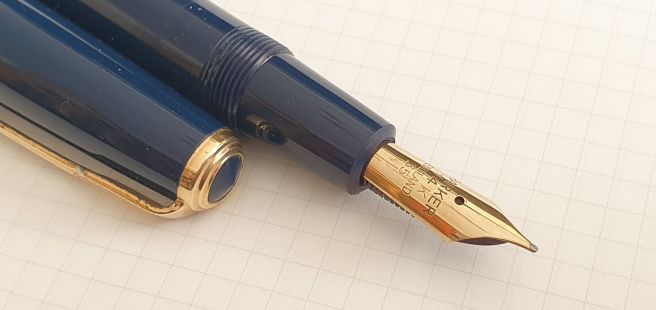
The only pen that I had specifically hunted for, was a Parker Duofold Senior, in blue. I found that the typical prices of these old Duofolds rise as you progress through the seven different sizes. The “Senior” (with a #35 nib), is the second largest of these and I paid £80.00 for a very nice example. The largest one was called the Maxima (#50 nib).

Parker Duofold Senior (#35 nib)

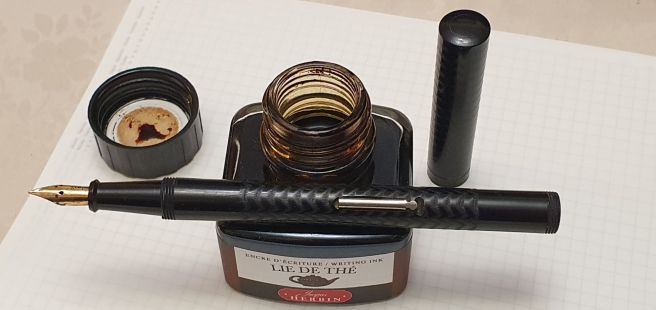
One of my earliest finds was a “Ty-phoo Tea” pen, a lovely old (1930’s?) lever filler, in black etched with a wave pattern, flat ended and clipless and a small, 14k gold nib. This would have been acquired as an offer in return for coupons from packets of tea. It is said to be “British Made” although the maker is not specified. I have since read on FPN that there were several such models made for Ty-phoo Tea over the years, likely to have been supplied by Swan, Wyvern or Conway Stewart. With a sudden brainwave, I have paired it with Jacques Herbin Lie de Thé.

Typhoo-Tea pen with aptly chosen ink

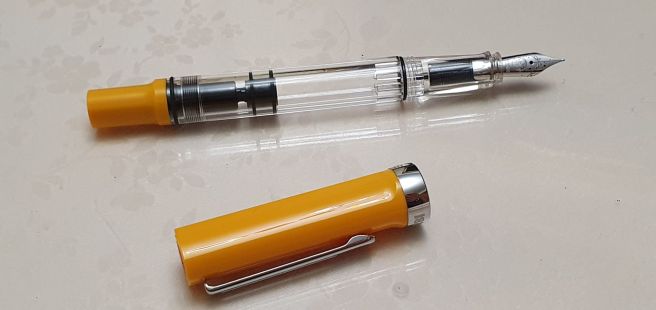
I picked up a TWSBI “Eco T” in Saffron with a lovely EF nib. Admittedly, I thought that I was buying a standard Eco, but later discovered it to be an Eco T, which has three, softly rounded facets on the grip section and a triangular cap and piston knob – a model that I had not been aware of, but still a pleasing buy with summery vibes.

A TWSBI ECO T, Saffron with EF nib.

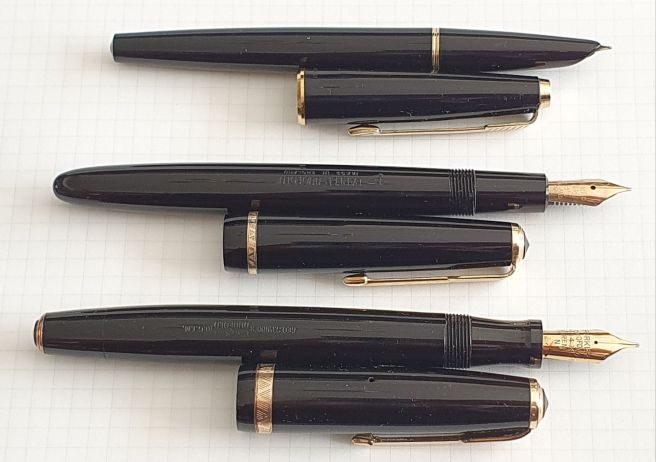
I had a successful run of buying three vintage Parkers, all in glossy black with gold trim, each from different vendors. First, a Duofold button filler (1940’s?), the first button filler I have owned, from Heritage Collectables. Next a Duofold Junior, with a Fine nib which, amazingly, was in near mint condition with original chalk marks and an aero filler which appeared never to have been inked. This was from Justin Janse van Vuuren. Finally, a gorgeously cute irresistible Parker 17 Lady (Fine), which posts beautifully to become a really delightful pocket pen, sold by Carneil Pens. I have been using this for sketching, with Parker Quink Black.

Three vintage Parkers.

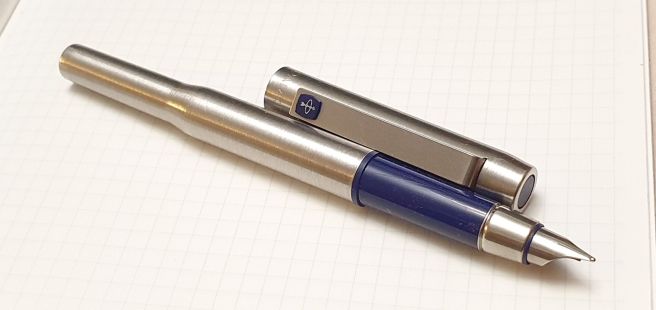
I also bought my first Parker 25! I had never much liked the oddly industrial brushed steel tapered barrel and so had refrained from buying one when they were part of Parker’s range. But having learned that they were designed by Sir Kenneth Grange, also responsible for designing the Inter-City 125 train, I felt it was high time I tried one. There were several to chose from at the show and so I could examine their nibs with a loupe. In the hand, the pen is more comfortable than it looks and the cap posts beautifully, flush with the barrel, whereupon the tapering barrel makes sense.

Parker 25.

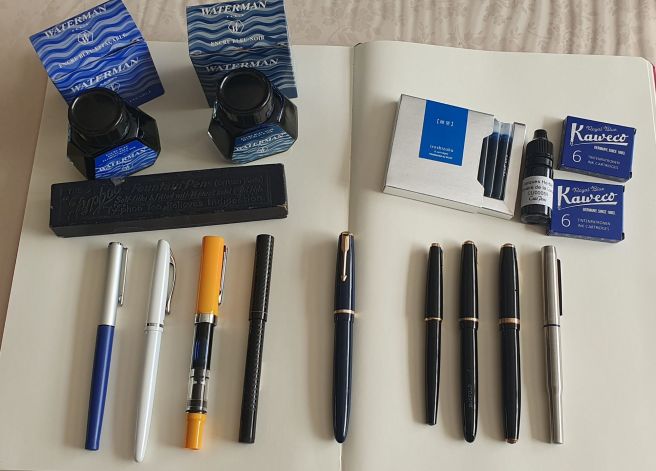
Otherwise, my pen-buying flurry included a Pelikan Jazz and a Sailor High Ace neo, each offered at just £5.00 from Cult Pens. I also stocked up on ink, finding bottles of new old stock Waterman Florida Blue and Waterman Blue Black, plus a luxurious box of 6 Pilot Iroshizuko kon-peki cartridges and a couple of boxes of the Kaweco Royal Blue cartridges.

Another suitcase, another haul.

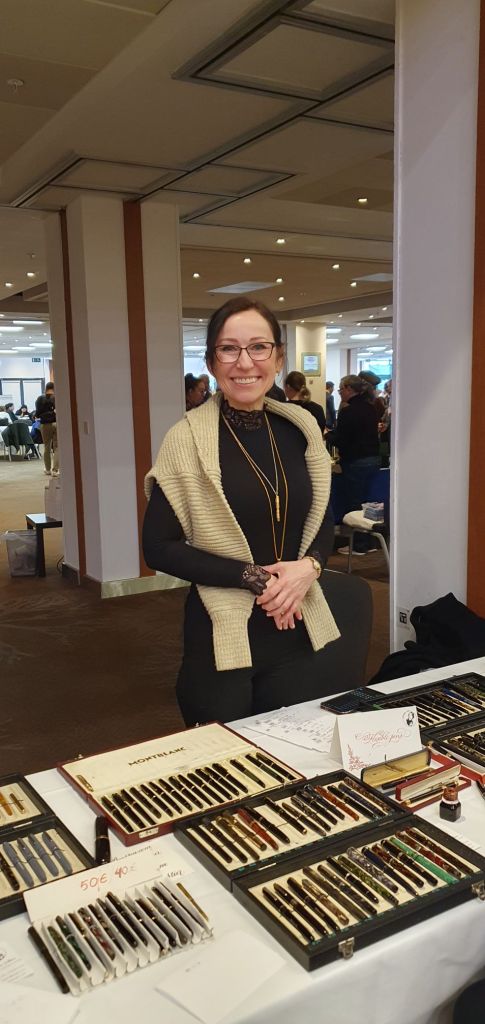
The day was punctuated by lots of lovely conversations with friendly dealers including Jeremy Collingbridge, John Hall, Kirit Dal, Ray Walters, John Foye, Sarj Minas, Kasia Stier, Justin Janse van Vuuren, my good friend Jon of Pensharing and many others. On the train home, I also tried to list all the friends I had seen and this came to more than 20.

Kasia Stier of PenSpa.

For anyone serious about being on a no-buy, the London Pen Show is not the place to go. As a recent retiree, I discovered that I am still at heart, a child who wants a new toy a little too often. But I am thrilled with my acquisitions which I am sure will punch well above their weight in providing joy for years to come. Thanks, as always, to all the organisers, dealers and the fountain pen community. See you all next time!

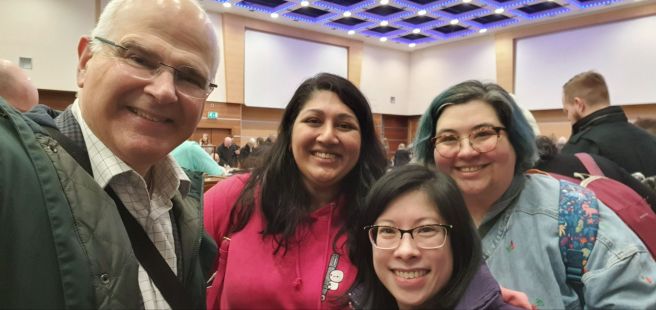
The author (left) with some pen friends.

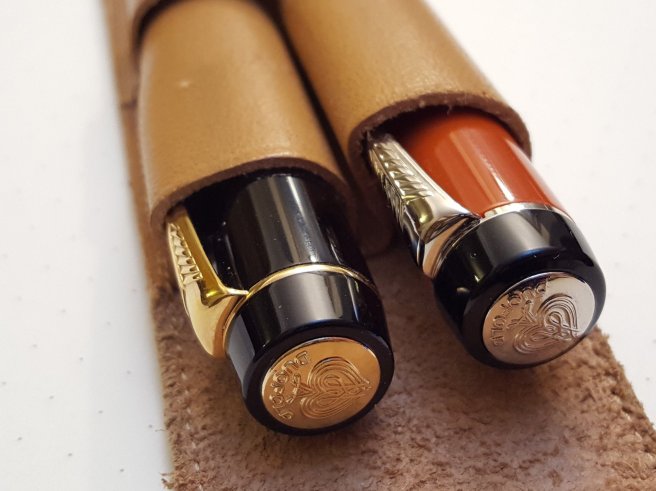
My Duofold Duo.

Regular readers may recall that I was fortunate enough to find a new Parker Duofold International, Big Red on sale at half price, in John Lewis, Oxford Street branch in October. I wrote a post about it here. 

I have been very much enjoying the pen, these past two months. What had aroused my interest in the pen, just before I bought mine, was a post by Anthony on UK fountain pens blog entitled A Day with a Duofold.

Fast forwarding two months, Anthony advertised his Duofold for sale, as he was not getting along with the very firm nib. I pondered buying it myself and, after sleeping on it, was sure that this was the right thing to do. (“There is a Duofold out there and it needs my help!”).  At 07:42am the next day, I sent Anthony a DM offering to buy it, if it had not already gone. Within moments, he had replied that the pen was mine. He kindly sent it out to me that day and it arrived the next day. 

I felt like I knew the pen already. It is not often that you get a chance to own a pen not just of a type that you have read about online, but that very one. 

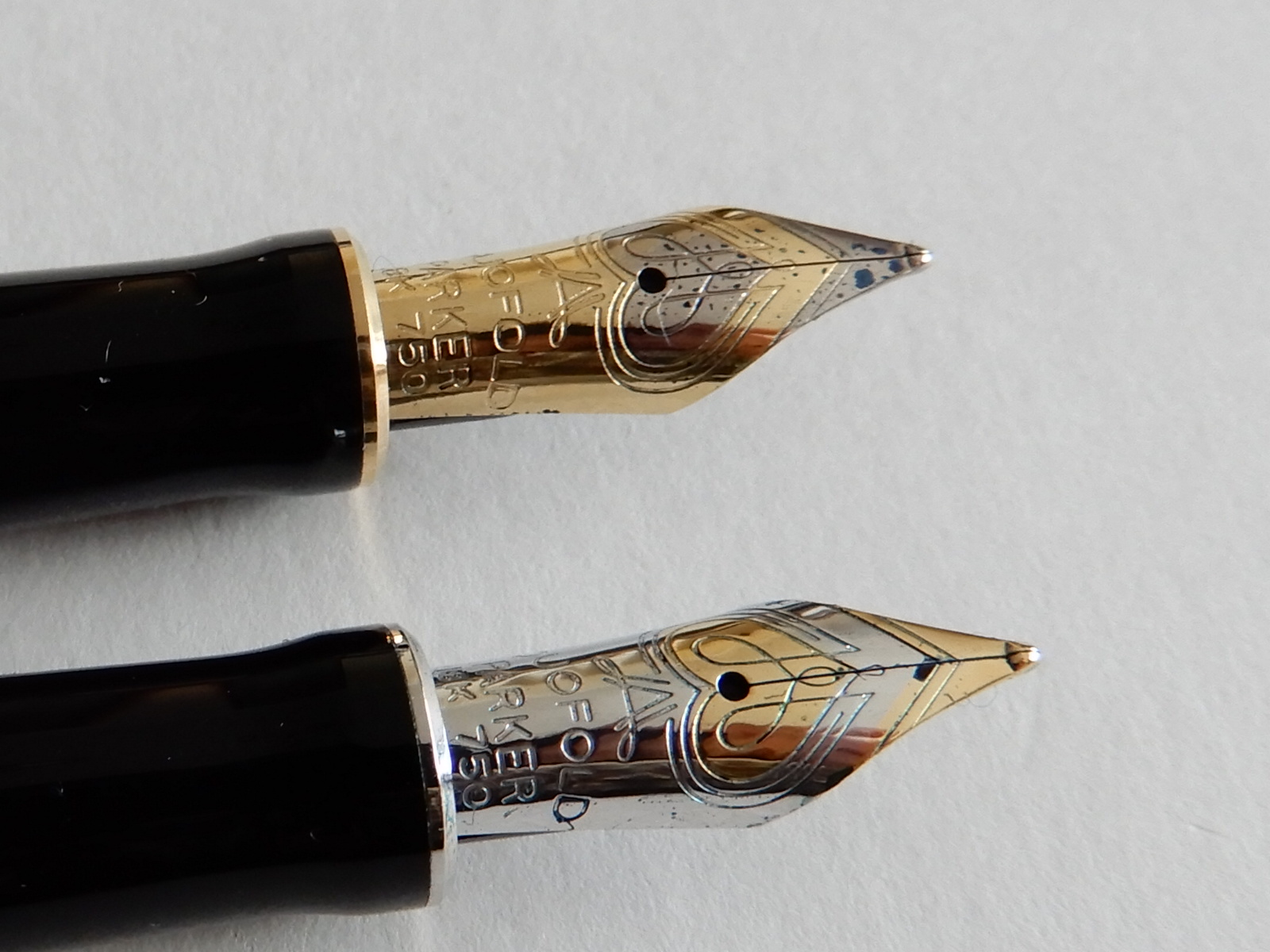
This differed from mine sufficiently to make it a very worthwhile addition. First, it is black, and a gleaming glossy black at that. Secondly it is a 2006 model and had a few subtle differences from my 2016 model. And also the metal furniture on it is gold coloured as opposed to silver on mine. 

They both have 18k gold, bi-colour medium nibs, but the silver and gold colours are reversed in the two versions:-

Parker Duofold Internationals. The black one is a 2006 model and the ‘Big Red’ is 2016.

Plating reversed. Excuse the ink residue, but these are both currently inked. 

I knew already that I would like the size, shape and weight of the pen. I use it with the cap posted, holding near the cap threads (which are not sharp) and find it very comfortable like this. 

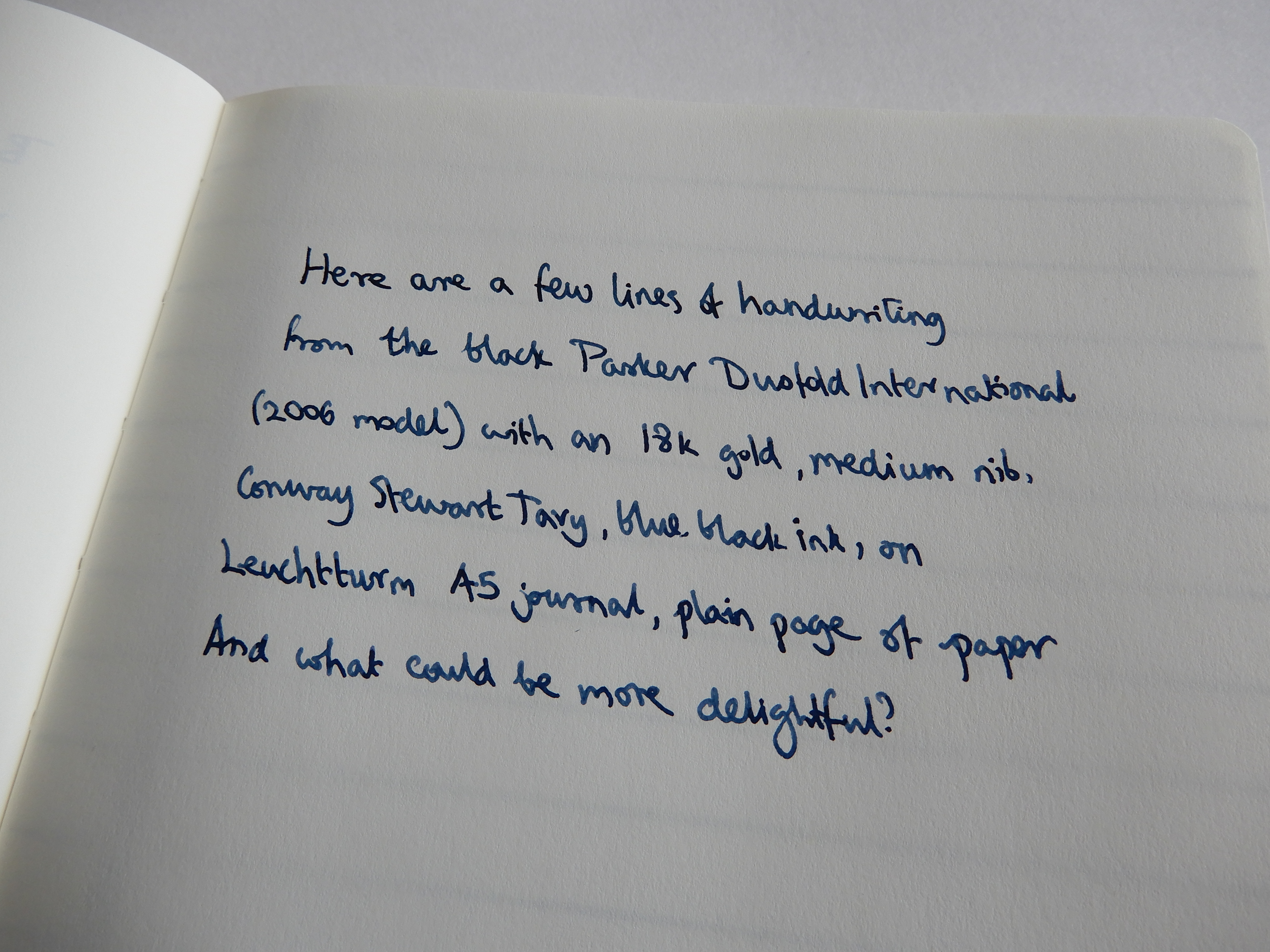
The nibs ought to feel similar. My Big Red had been a bit skippy at first but, like my Pelikan M800 nib, I had written it in, a few pages a day and within a week or so, the skipping subsided until it was all but gone completely. It is now a joy to write with and has a distinctively pencil-like feedback. I use it with Conway Stewart Tavy, a blue black ink now made by Diamine. 

Anthony had commented in his post about how the nib drooped or dips downwards, which it does. The nib of my Big Red has a more level profile. Perhaps this is what contributes to the nib on Anthony’s being quite so stiff. I recall hearing Stephen Brown say in an old YouTube review that the Duofold nibs were reputedly stiff in order to make carbon copies, through two layers of paper (back in the day) and hence the name “Duofold”. Also the tipping material, at least on the old vintage model Duofolds, was advertised by Parker as being harder than others. Perhaps the gold is thicker too than on other pen nibs and this is no bad thing. 

I do not mind the stiff nib. I have spent some time each day writing with Anthony’s Duofold (I must stop calling it that now) and am thrilled to have it. The tines are aligned. The tipping material is huge and so there is a lot of mileage in this nib yet. The nib is smooth, provided that you hold it level; if I rotate it clockwise a little, it starts to scrape the paper, which suggests that the outer edge of the tipping needs smoothing. I do not think this is such a problem as an inner edge being prominent (which causes not only scratchiness but a build up of paper fibres in the nib slit). I have a sense that the tipping material is shaped slightly like a garden roller with flat sides, rather than rounded like a ball. I am exaggerating but you get the idea. I am wary of doing any harm to the nib by my ham-fisted grinding and so for now I will continue to use it with nib angled the way it likes. 

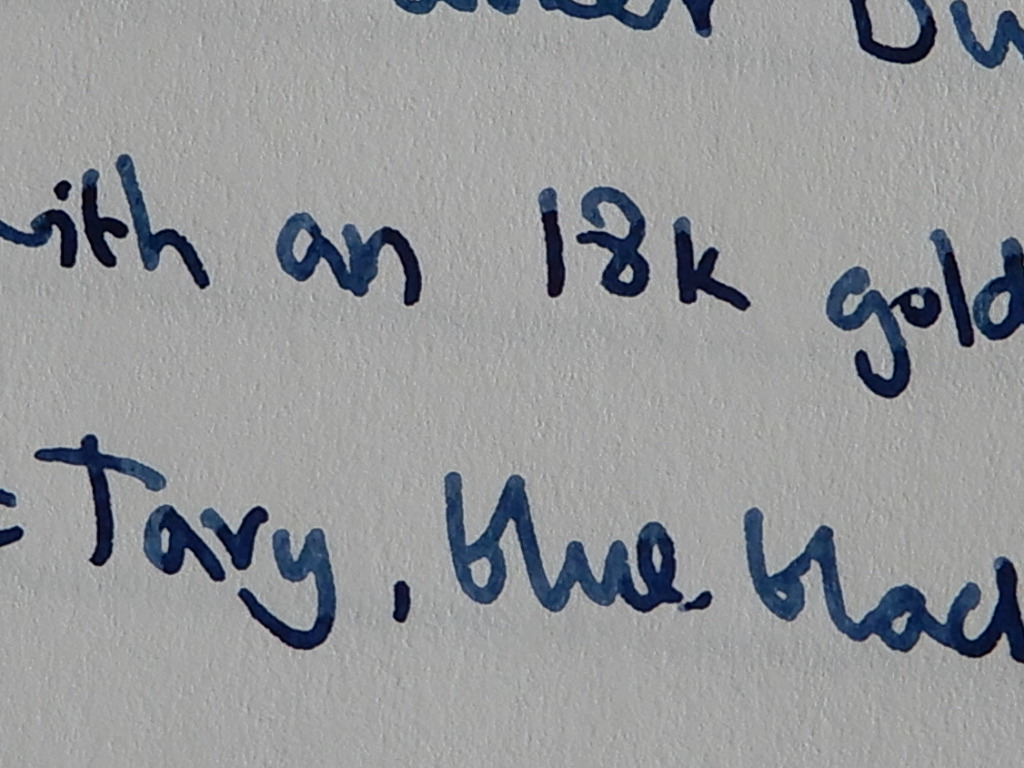
Notwithstanding the stiffness of the nib, there is some very pleasant shading apparent, just from writing quite normally with no pressure. Looked at this under the loupe,  the shading from this blue black ink has a lovely vintagey iron-gall look which is in keeping with the whole 1920’s vibe of the pen. Thank you Anthony for passing this one on. I am delighted with it. 

From the black Parker Duofold. Tavy ink, Leuchtturm paper. 
And look at that shading 🙂
The same. But different.