My Parker 51 Aerometric collection.

I noticed recently, a glaring omission in my Index of Pen Posts: more than 9 years into this blog, I had yet to write a post about the Parker 51. For a fountain pen blog, not having featured what is arguably the most famous, recognisable, respected and iconic models of the last century, seems remiss. It is time to correct that.

Shortly after our recent London Spring Pen Show, my friend Monica asked me whether I had any Parker 51’s that I was looking to sell. She was after a Parker 51 with a medium or a fine nib since her model, in grey with a broad nib was just too broad for her. I had shared a table at the pen show and sold a number of my modern pens but had not brought along any of my vintage Parkers as I had not envisaged selling these. However, a subsequent check of my Parker stash, revealed that I was sitting on six Parker 51 Aerometrics, and so I thought I could probably be of help. I also have one Parker 51 Vacumatic.

This is not intended to be a treatise on the history of Parker or the 51 in particular. For that I would recommend the excellent website parkerpens.net run by Tony Fischier which provides a very useful illustrated account of all the pens produced by Parker and their many variations and also a bibliography for the numerous books written on the subject. Rather, this present post is a shameless exercise in parading my own modest accumulation of 51’s. After Monica’s enquiry, I took the opportunity to get them all out, ink them all with Waterman Serenity Blue and spend a happy week or two reminding myself of how they wrote. Also the recent nice weather has enabled me to take a few photos of them in natural light.
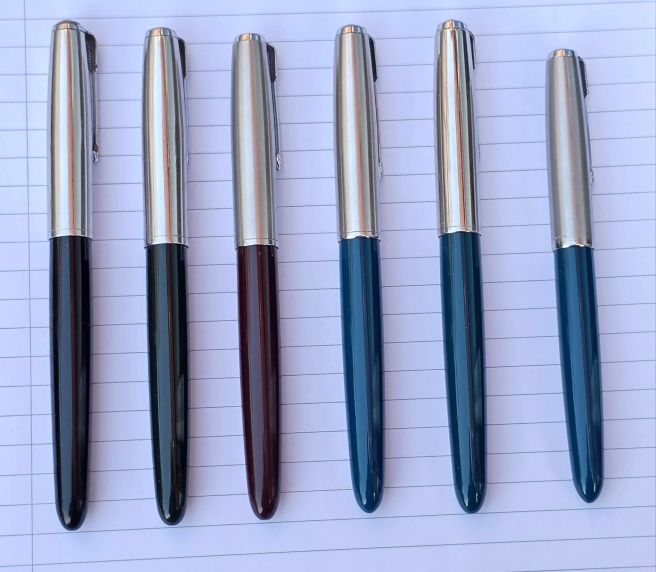
A team photo of my Parker 51 aerometrics. The 51 Special and the 51 Demi are 5th and 6th from the left.

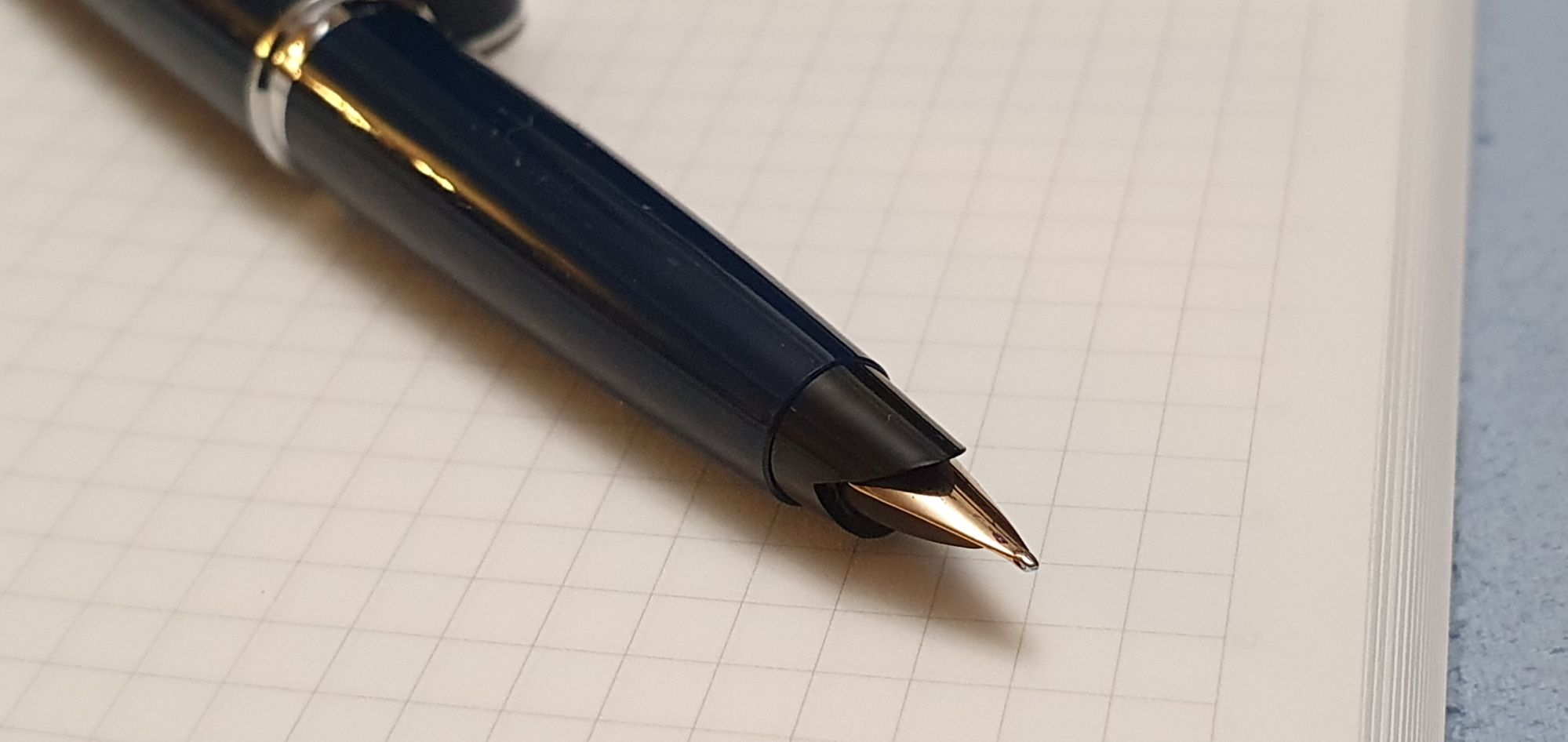
The Parker 51 was first produced in 1940, after many years of development and boasted many new features. Probably the most iconic of these was the hooded nib. Most of the nib area is hidden beneath the shell and this was in order to reduce ink evaporation and hard starts.

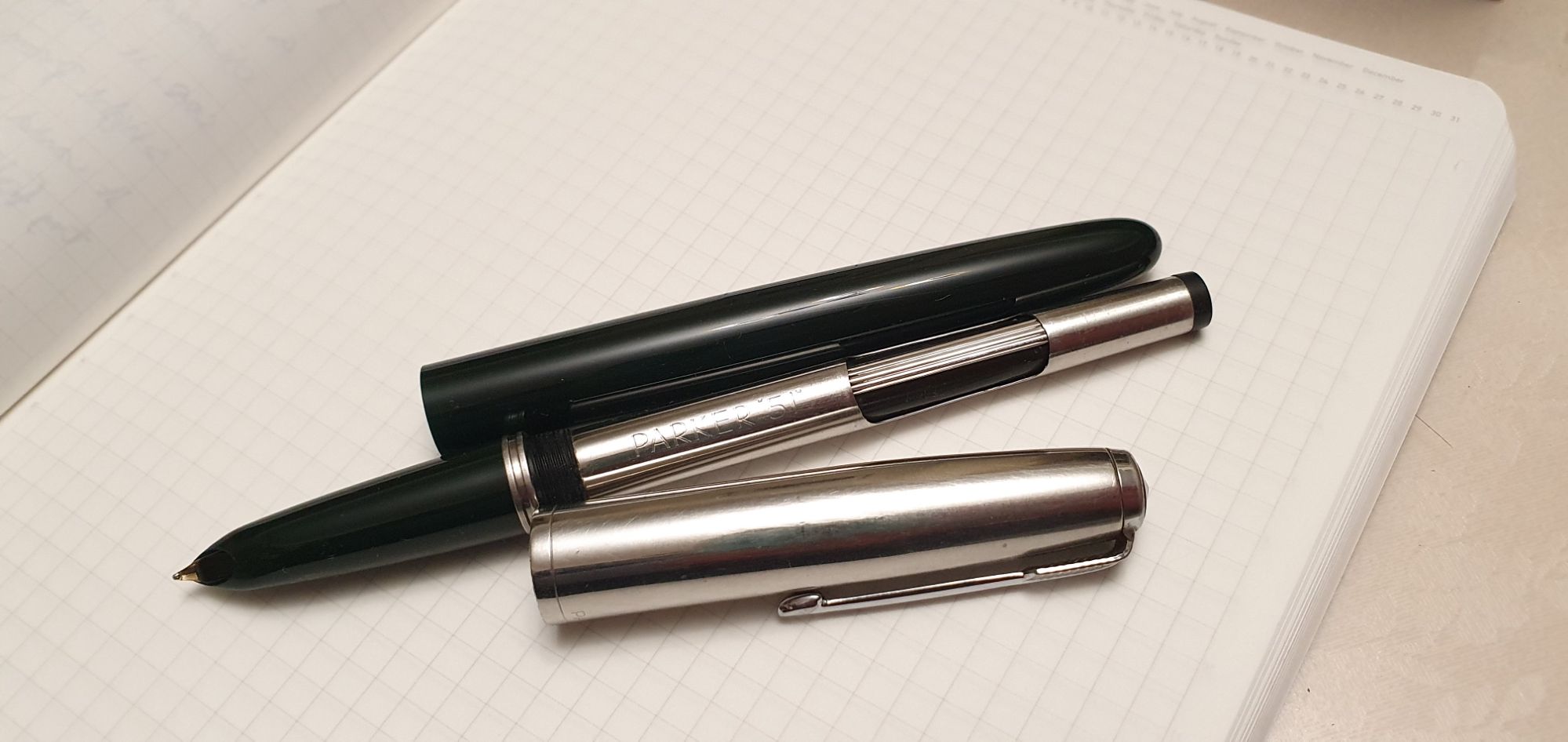
The Aerometric fillers have a sac housed in a metal protective cover, with a squeeze bar to fill the pen from a bottle of ink. It is remarkable that the material used for the sac, which claimed to be good for 30 years, is still going strong today and I have yet to come across a Parker 51 in which the ink sac has perished.

Receiving a Parker 51 is a memorable occasion. I still remember getting each of mine. The first was a cedar blue model, purchased from Mr Graham Jasper at a pen show. He has a large number of vintage Parkers and it can be difficult to pick one from trays of numerous similar-looking models. I recall him testing the ink sac by putting the pen to his ear and squeezing the filler bar, to check for a small puff of air (pro-tip)! The barrel imprint reads Made in USA 9, with the digit 9 being the date code. The nib on this one writes a fine line. With all the Parker 51’s there is no visible marking of the nib width.

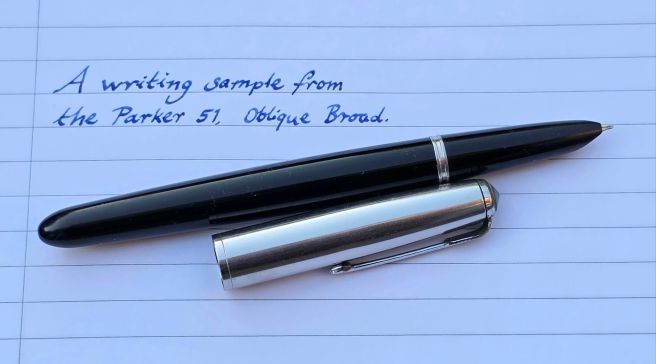
My black Parker 51 was an eBay purchase and is my only one with an oblique nib, probably an oblique broad. This suits my lefty-overwriter handwriting style nicely. It also writes well if used in a more conventional underwriter style. The barrel imprint reads “Made in England 4”. The nibs may give further indications of the year of production but I have not disassembled them. It was missing the cap finial but I was able to buy a replacement from Mark Catley’s Vintage Fountain Pens tables, at the pen show.
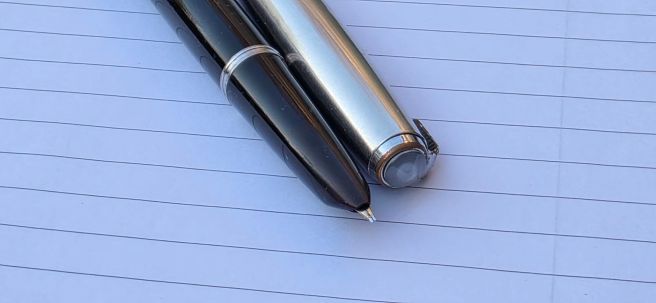
Oblique Broad nib. The cap jewel was a replacement.
Writing sample, Oblique Broad.

The model with a burgundy barrel (which I think may be called Cordovan Brown) was bought in a job lot of five vintage pens from a local antique seller in Childs Hill, North London. It had likely come to the seller as part of a house clearance. I wish I knew more of the past lives of these pens and their owners. This one writes an extra fine line and also has a date code of 4.

My forest green edition is I think a less common colour. It writes a medium line and bears a date code of 2. This was another of my pen show finds.

Finally, these next two pens were a surprise gift received in the post from my friend in Melbourne, Australia. The Parker 51 demi is slightly smaller than the regular 51. It was made in the USA and this has a date code of 8, putting the year at 1948. It writes a medium line.
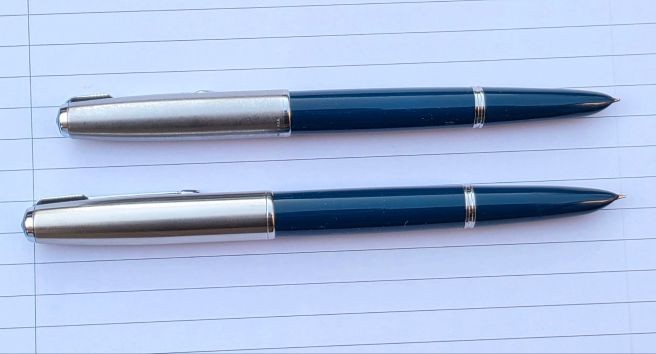
Size comparison of the Parker 51 Demi (top) and a regular model.

Lastly, in a blue-green colour, I have the Parker 51 “Special”. This differed from the regular 51 models in several respects. The nib was of an eight metal alloy called “Octanium” instead of the usual gold. The aerometic style filler leaves the rear half of the sac exposed under a U-bar (rather than the more fully enclosed metal sac covers in the regular model). For some reason, mine smells of gun oil. Also the cap was a brighter, polished chrome finish rather than the usual “Lustraloy” satin finish caps and has a black plastic jewel in the finial. Mine writes a medium line. There is no date code but I believe this one dates from between 1950 and 1956 (as the filler case still refers to Superchrome ink, a reference which was removed around 1956).
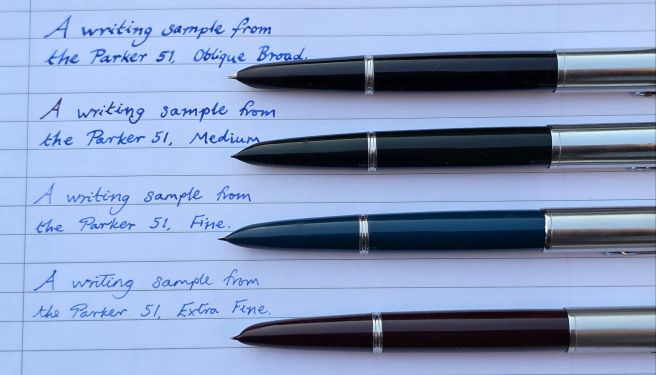
Comparing nib widths.

It is remarkable that these pens all perform perfectly and still look modern, after all these years: a triumph of design that perhaps not even Parker could have predicted.
The London Spring Pen Show 2024: my haul.

Well, what a great day that was! I felt like there was nowhere I would rather be, and nothing that I would rather spend my money on: the London Spring Pen Show at Novotel, Hammersmith, on Sunday 3rd March 2024.

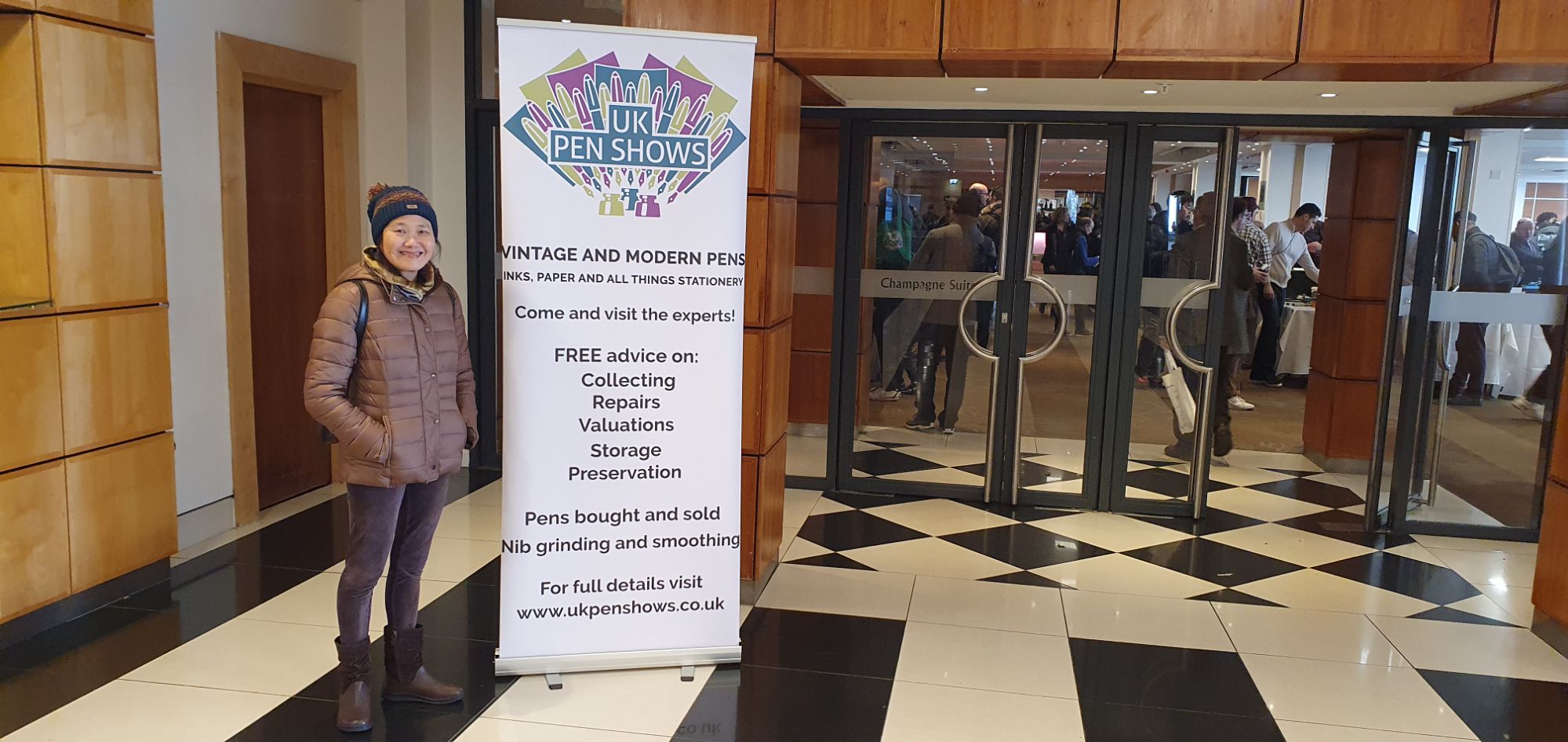
This time, my wife Ling accompanied me. She enjoyed meeting all my pen club friends and a big group of us had arranged to meet for a lunch break at nearby Latymers. Almost everyone to whom I introduced her, joked that I was a bad influence in my penabling, particularly with regard to vintage Parkers! I do tend to gush about Parkers but I make the case that buying these actually saves you money, compared to the cost of a modern equivalent gold nibbed fountain pen. Oh well, more for me then.

Ling came to support me and meet my friends.

This post will list my purchases at the show, rather than naming all the wonderful stall-holders and fellow enthusiasts in the pen community who were there in force. It was good to see so many familiar faces and I am grateful to all the organisers and dealers for making the day so successful and enjoyable. We tend to forget all the work that goes on behind the scenes before and after the show: the preparation, the travelling, the setting up, and then the packing up and more travelling. Several folks such as Sarj Minhas had literally only just returned from the California pen show the night before

So, what did I buy this time? Despite not hunting for anything in particular and trying feebly to stop accumulating, I did not expect to go home empty handed. Here I will try to justify, to myself at least, some of my purchases.

Parker 45, blue with chrome trim, 14k gold nib, Fine.

Parker 45, still looking new.

First up was this Parker, which I spotted on the table of Janse van vuuren (Justin). It was in its original box with filling instructions and guarantee dated 21 April 1976, original press-bar converter, and two blue cartridges still taped under the pen tray with some very yellowed Sellotape. I used these pens throughout my secondary school years although mostly they were the steel nib versions. Last winter I bought a very similar one to this, but in black with chrome trim and with a Medium gold nib which is an absolute joy to use and cost only £20.00. Coincidentally, this gorgeous dark blue one was also just £20.00 and being in such good condition and with a Fine nib, was an easy decision for me.

Aside from the style and comfort of these pens, one of their best features is the ease of cleaning and maintenance. For those not familiar, you unscrew the little nib-housing to remove it from the section. Then, being very careful not to bend or break the long feed or lose the nib, you slide the housing backwards off the feed. The nib can then be lifted off the feed, and cleaned or adjusted. When putting it back, it slots into place over the feed and does not move, so you know you have the correct position. That evening, I took the nib apart and gave everything a very satisfying wash, before filling with Waterman Serenity Blue. It writes like a dream.

Nib unit disassembled. Note the “F” for Fine on the housing.

Parker 51 vacumatic.

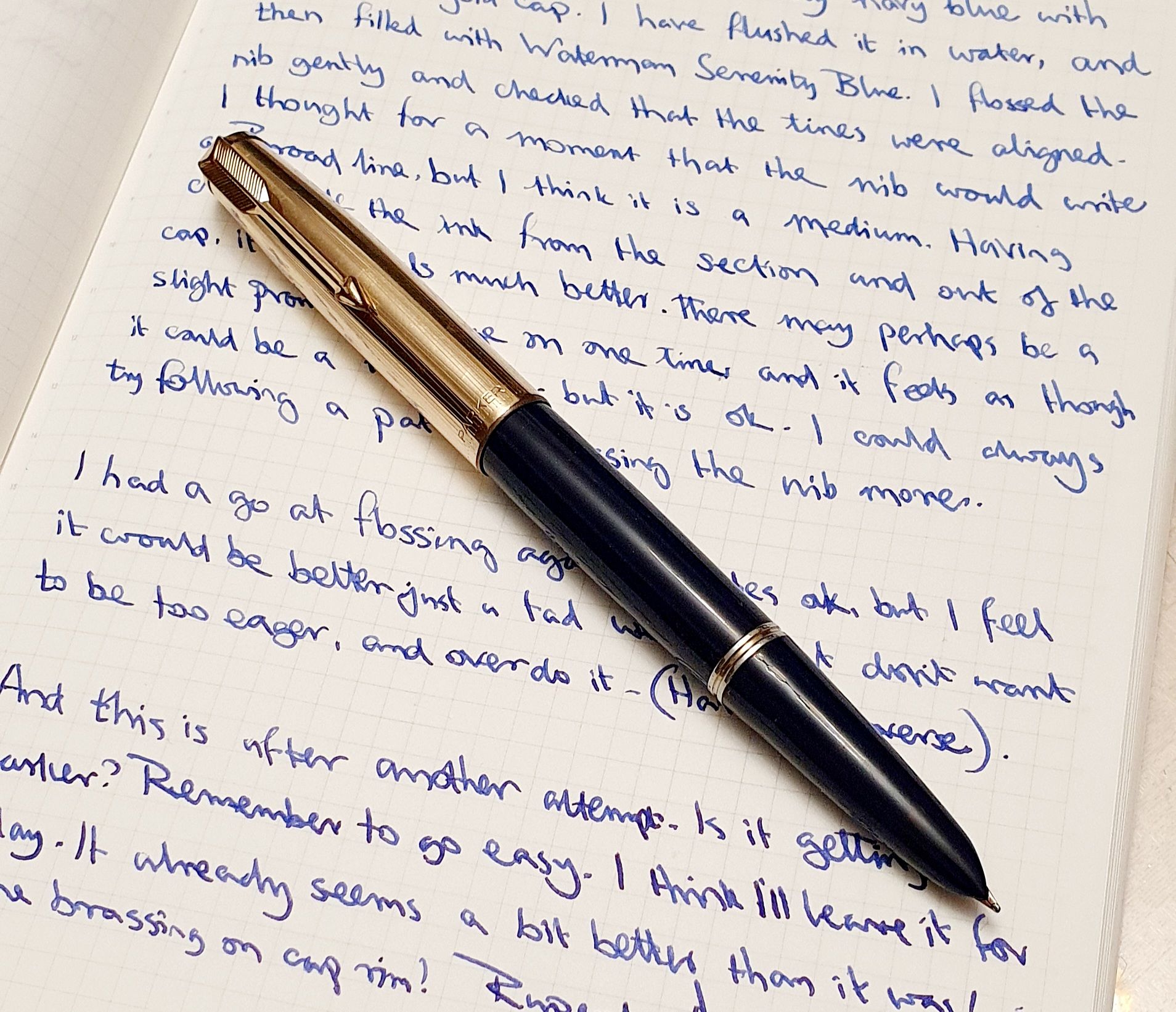
I am happier when I can see the price of a pen, without having to ask. Some dealers have pen trays grouped by price, “everything £40.00” which is where I found my next purchase in a tray of Parker 51s. All but this navy blue and gold-capped one were aerometrics. I spotted the tell-tale blind cap of the vacumatic and had a closer look. On removing the cap, I found the section covered in wet ink. This did not put me off but just added to the attraction and my desire to take the pen home and clean it. The pens in this tray were all tested and so I did not worry that it might leak. The condition of the nib and the barrel all looked very good and the plunger button responded nicely. The rolled-gold and striped cap had brassing at the rim, which I did not mind. I am not sure whether the cap is the original one for this pen.

A gorgeous dark navy blue Parker 51 Vacumatic.

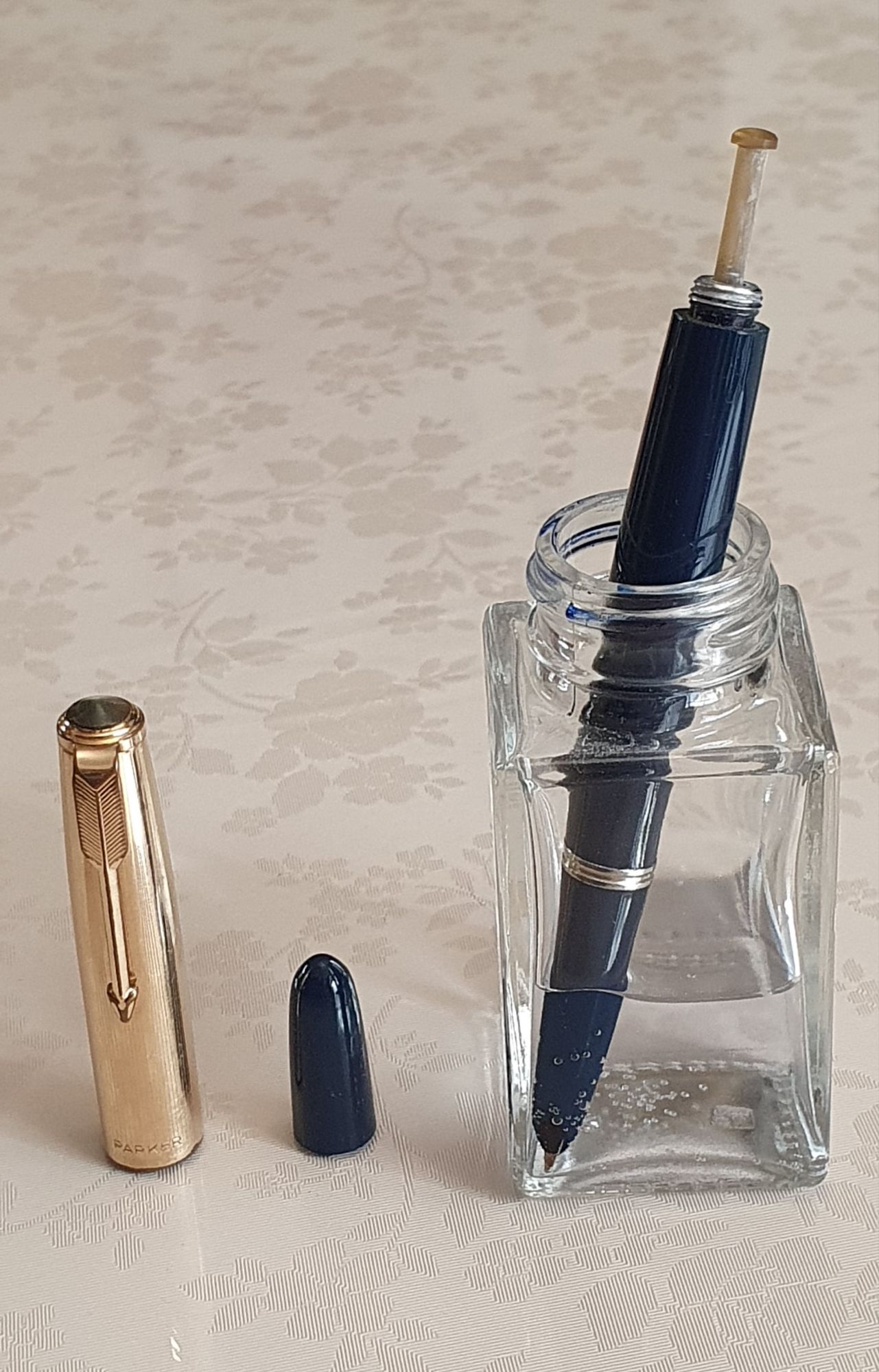
At home I took great pleasure in flushing the pen and cleaning out the inside of the cap. I considered leaving the pen to stand in some water overnight but was too impatient to ink it and so decided that I would only soak it if it needed.

Again, the pen filled and worked well. This one writes a little dry but I did not want to rush into any adjustments, given that the pen dates from the 1940’s and is around 80 years’ old. I used it for a few days, as it was. This weekend I have flushed it again and let it stand in water for 24 hours. I am hopeful that this might improve the ink flow but if not, I can ease the tines apart just a fraction. I am thrilled to have my first Parker vac, and at just £40.00.

As I write this, the Vac is having a long soak.

Parker 51 Aerometric, forest green.

Readers may remember that I passed up a beautiful, mint condition Parker 51 in forest green, at the pen show last year. This time I spotted another one, again in great condition but at a much more affordable price at the tables of Jeremy Collingridge (from whom I bought a lovely Parker 61 Heirloom last time). I was invited to try the Parker 51 but despite several dips, it refused to write. With permission, I even tried filling the pen but still it would not write. Nevertheless, I was not put off but was only drawn to the pen all the more. I suspected that there was nothing wrong but that it just needed a thorough clean. This proved to be correct. It is a stunner and I love the green!

Poor lighting, but a forest green 51.

Sailor Profit fude nib pen.

Sailor Profit fude nib pen.

This was an impulse buy from Pure Pens’ table. Having enjoyed the Duke 551 Confucius fude nib pen bought earlier this year I was interested to try this much smaller and lighter pen. It came boxed with two Sailor cartridges, at £22.00. The fude nib is marked only with the anchor logo and the initials MF.

Sailor Profit fude nib.

The pen actually performs extremely well and as I hoped, can write with a variety of line widths, depending upon how you hold it.

Fun with the Fude.

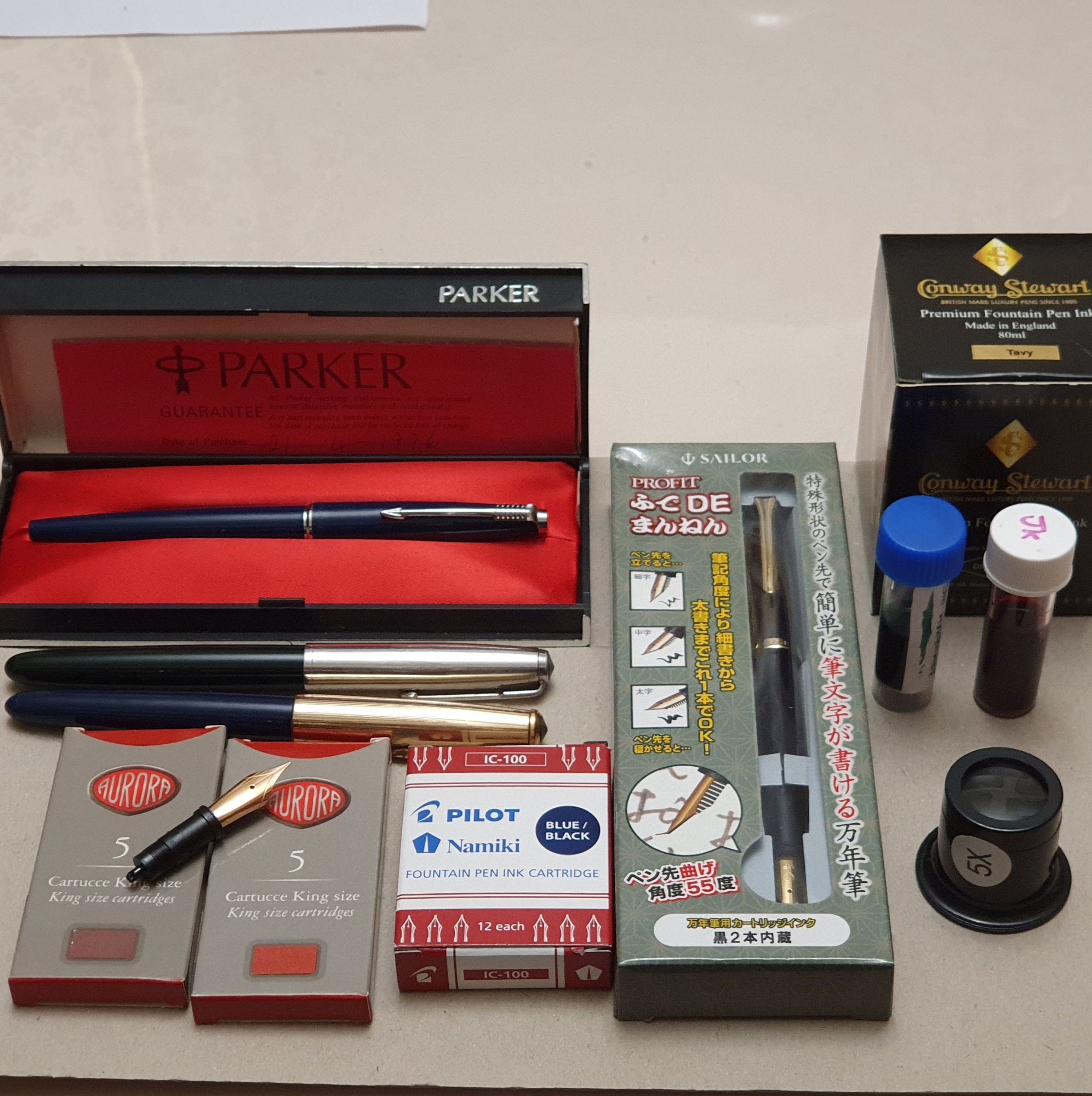
Aside from these four pens, my other purchases were:

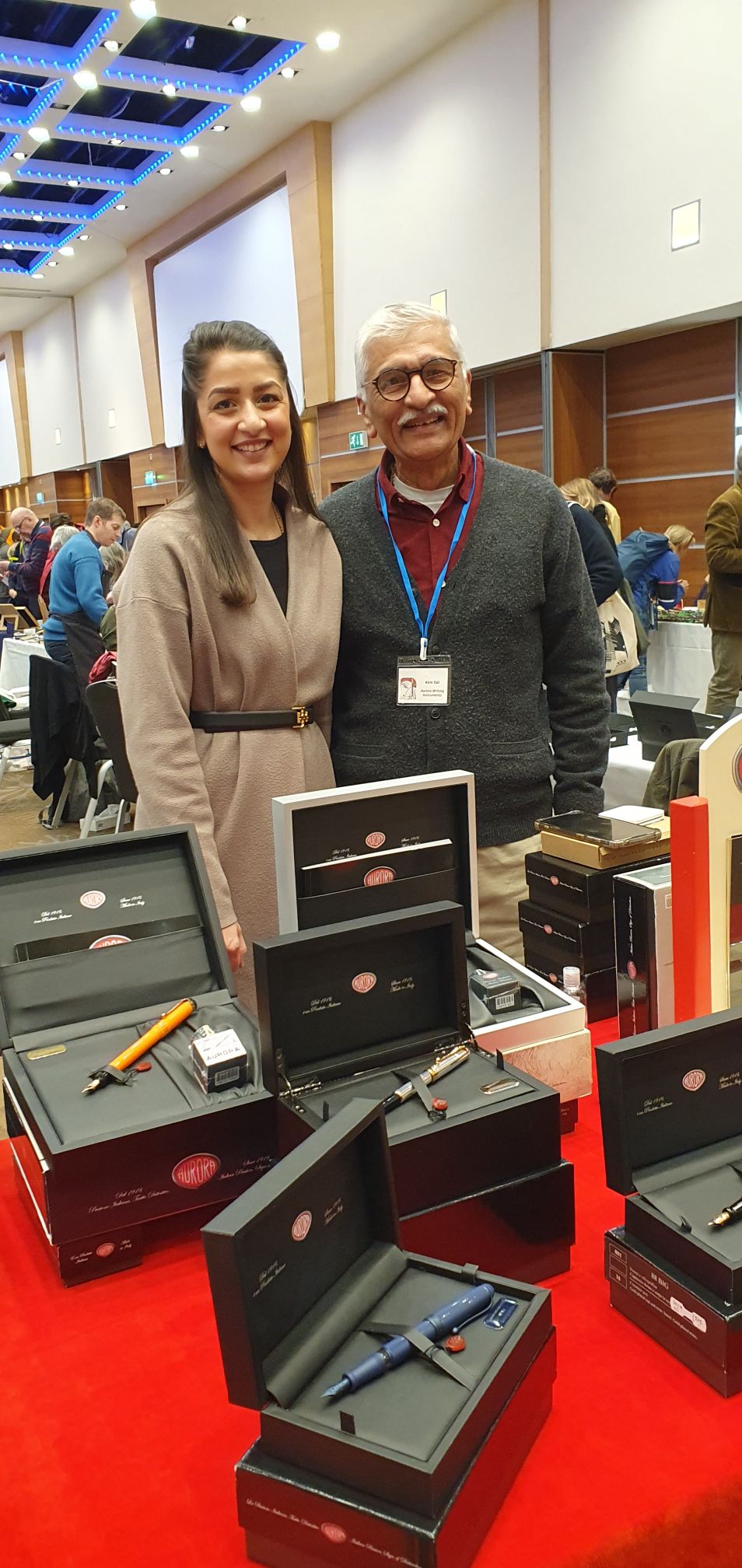
  • Two packs of Aurora cartridges, from Kirit Dal and daughter; (as anyone who has tried will know, these cartridges are very difficult to find in the UK);
  • A 12-pack box of Pilot Namiki blue black cartridges, from Amaya Cerdeirina of Penfriend. These are for my Pilot Custom Heritage 912;
  • Another bottle of Diamine’s Conway Stewart Tavy, blue black ink. I buy one almost every year;
  • A handy little x5 loupe;
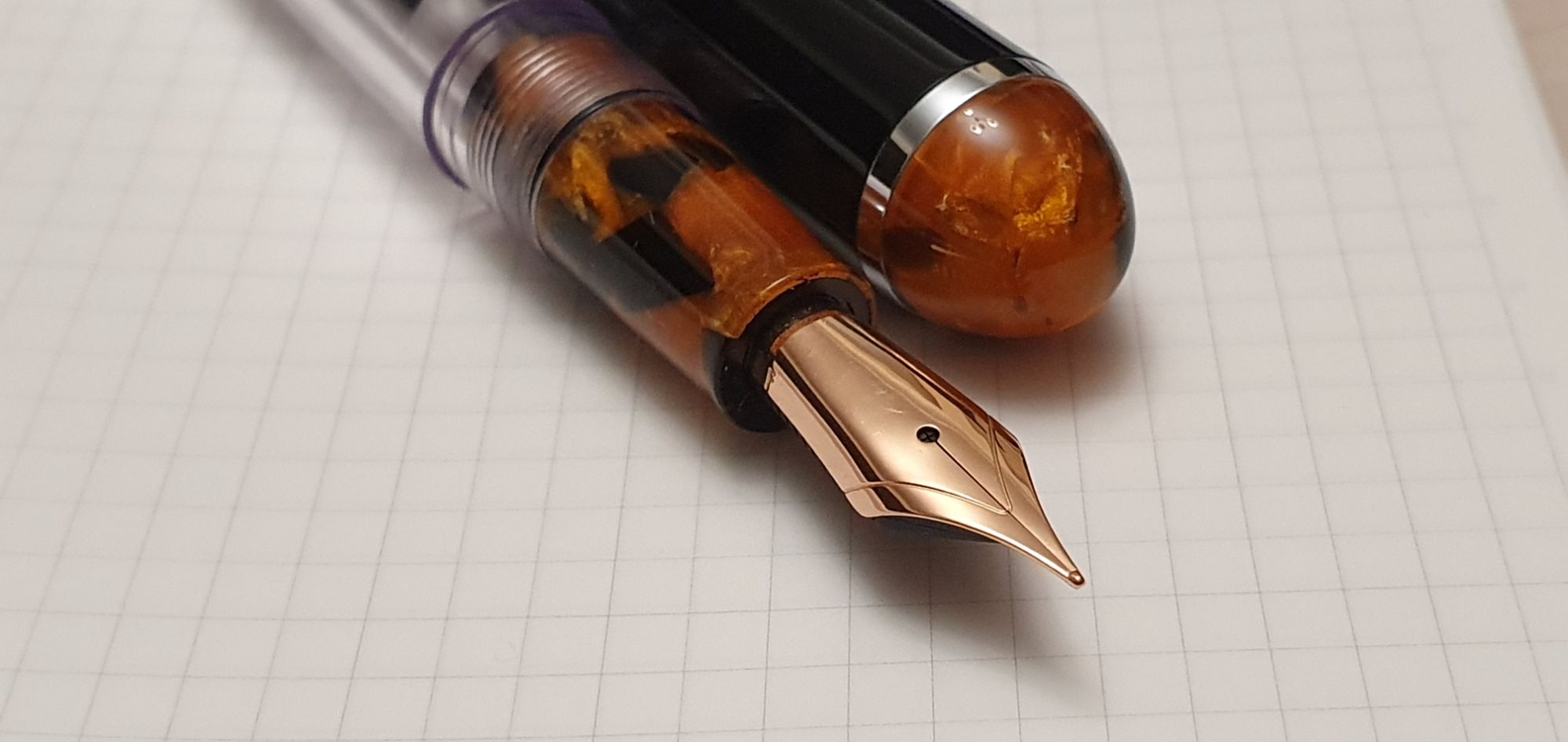
  • A Jowo fit nib, feed and housing with rose gold coloured coating, from John Twiss.
Kirit Dal and his daughter.

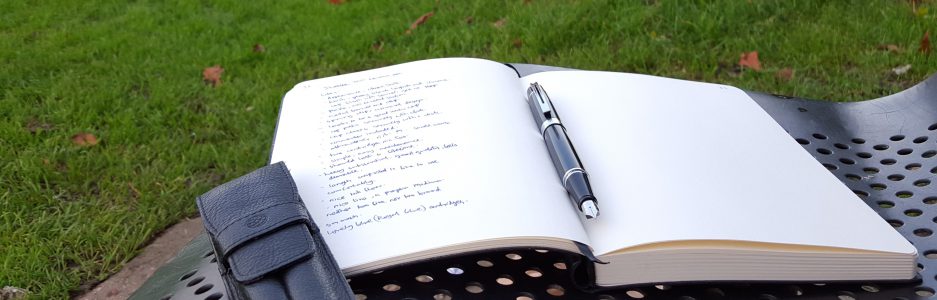
Sometimes, after buying several pens in a day, I ration myself to trying one new pen per day. But not this time. Within a few hours, all four new arrivals were cleaned and inked and being introduced to my Stalogy notebook. All in all, it was a very successful day. My total spend at the show was just over £200.00 and for that, I have lots of lovely new toys to play with and no buyer’s remorse whatsoever.

My day’s shopping plus some gifted ink samples.
The new nib unit in my Wancher Crystal fountain pen.