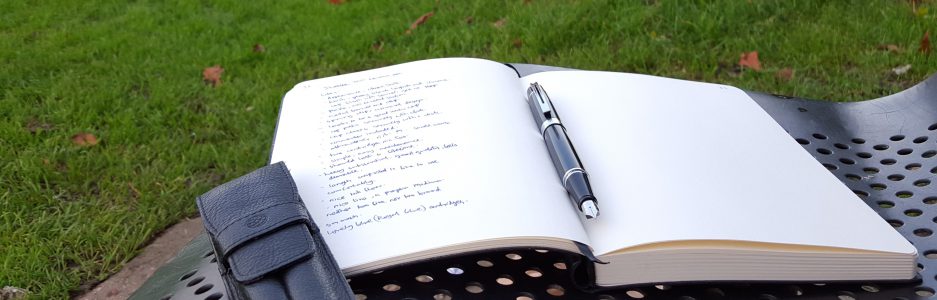
Rediscovering the Parker 45 fountain pen.

I think I may have mentioned that I am fond of vintage Parker pens. My admiration dates back to the late 1960’s when I collected Parker advertisements from newspapers and magazines. A Parker was also my first “grown-up” fountain pen when I went to my secondary school. It follows that this blog post might come across as slightly biased.

The Parker 45 model was part of the current range when I was at school. Buying a new one in town was a rare treat. I remember using them in lessons to write in exercise books. If you left one uncapped for too long the nib was likely to dry out, although this is true of most fountain pens.
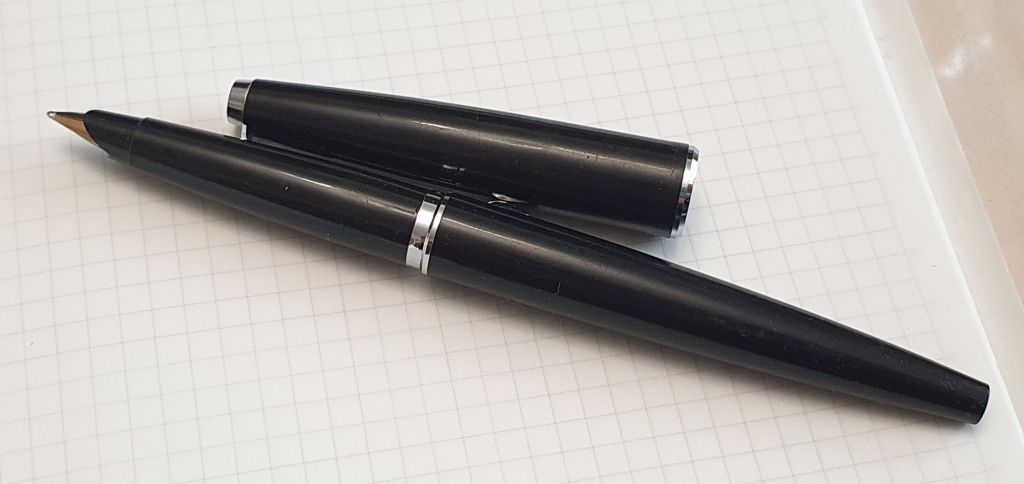
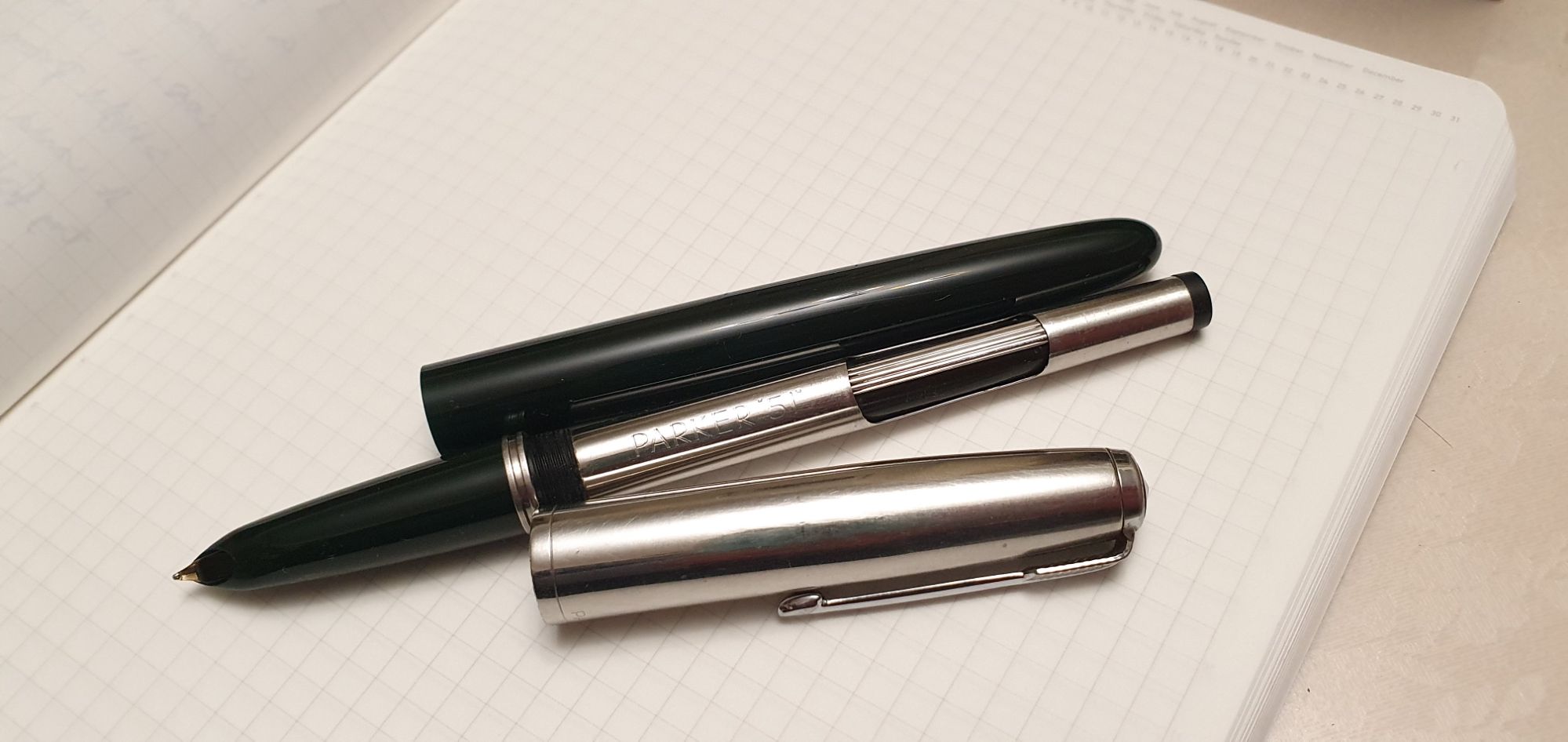
A Parker 45 Arrow.

In those days, I would have used the cheaper, steel nib versions, mostly Medium. They were also available with gold nibs. I do not recall being aware that there was such a wide choice of gold nibs to choose from for the Parker 45. The nib grade is shown by a letter on the underside of the little black nib housing. I never ventured beyond M (medium) and F (Fine). Only recently, have I discovered the X (Extra Fine) and the R (Medium Oblique). For a list of the nib codes, see the following thread on Fountain Pen Network.

I still have a couple of my Parker 45’s from the seventies – one in grey and another in brushed stainless steel. As ever I recommend Tony Fischier’s site, Parkerpens.net for an authoritative and comprehensive history of the Parker 45 range. They were produced from 1960 until 2007 and heralded the beginning of the Parker Quink cartridge system. The all-plastic version was called the Parker 45 Arrow. The version with a metal cap was the Parker 45 Classic and the brushed stainless steel version (very desirable to my 11 year-old self) was the Parker 45 Flighter.

Fast-forwarding to the present, my fountain pen journey took me down the vintage Parker rabbit hole. Last year was my year of the Parker-buying. I swooped on the inexpensive but surprisingly good Parker 17 models at pen shows and on eBay, before moving on to the Parker 61 and 51.

In the midst of this run, I happened to spot a Parker 45 Classic with a somewhat rare Medium Oblique (code “R”) nib, which proved to be delightful. Oblique nibs seem to be the most flattering for my handwriting when using a lefty-overwriter style, whereas non-oblique nibs work better for me in an underwriter style.

My last Parker pen purchase of 2023 was bought on eBay and intended as a Christmas present for someone else. It was a black model with a 14k gold Medium nib. But here’s the strange thing: after testing it the writing experience was so utterly delicious, exquisite and wonderful, that I honestly could not bring myself to part with it and had to keep this one for myself. Selfish, shameful and shocking I know, but true.
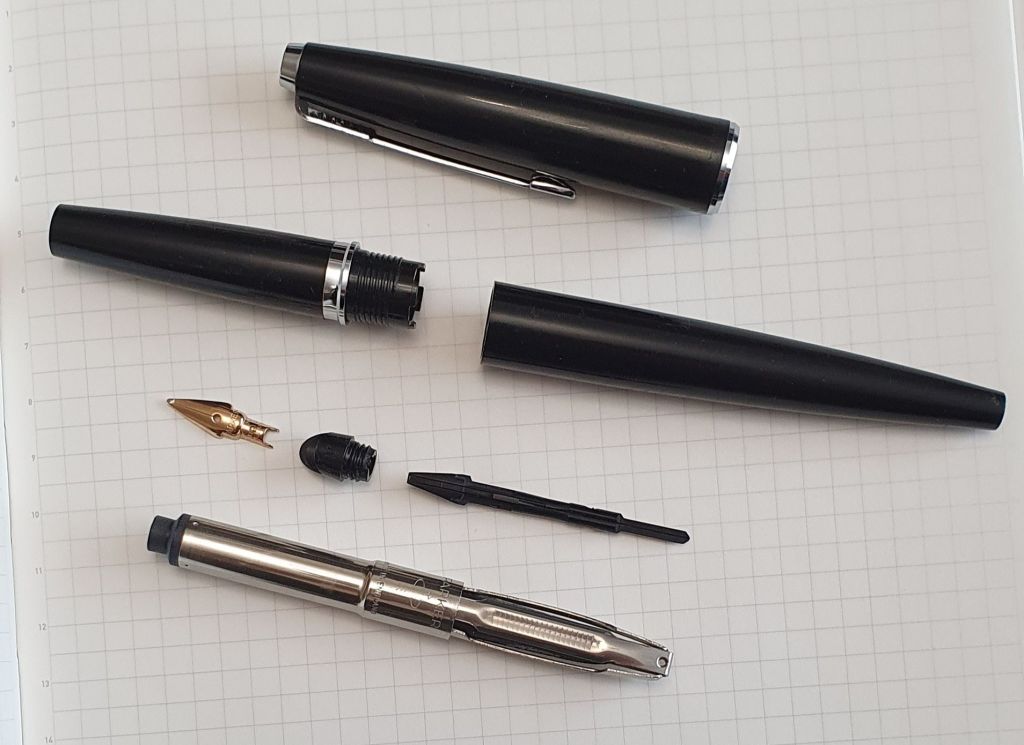
Easy to disassemble. No heat gun or shellac required.

But then, like a drug (I imagine), or at least chocolate, I craved another one. Happily at the London Spring Pen Show in March, I spotted and pounced on a lovely midnight blue model with a Fine nib. And then finally, back more recently on eBay I bought a burgundy red model with the less-common Extra Fine nib.

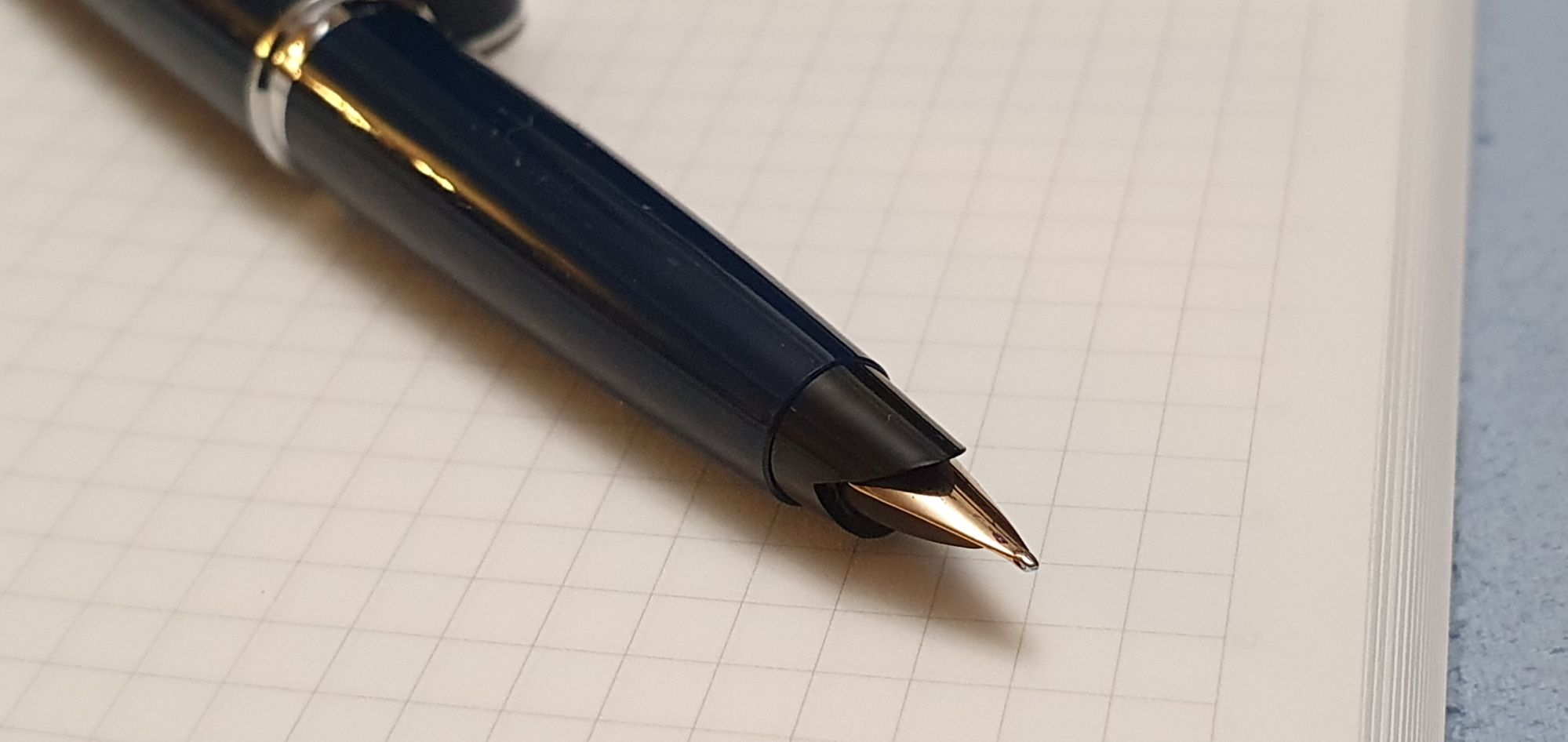
You can just make out the “X” for Extra Fine on the nib housing.

And so in the last seven months, my little Parker 45 family grew from two to six pens. My four recent buys all having 14 gold nibs, have all been superb and yet each cost between around £20 to £25 only.

The four on the right have 14k gold nibs in Oblique medium, Medium, Fine and Extra fine, respectively.

“What is so good about them?” you might ask. Here are a few answers:

  • Comfortable to hold (not too short, long, heavy or light; not having any step or cap threads);
  • Well balanced whether used unposted or posted. The lightweight cap posts very deeply and does not throw the balance off;
  • Convenience of accepting cartridges or a converter;
  • Great-looking pen (subjective and in the eye of the beholder, I know);
  • Best of all, having a screw-in nib housing. The nib, feed and housing can be removed easily for cleaning or nib adjustment; this is where the 45 scores over the 17, 51 or 61.
  • Can be found at pen shows or on eBay for a very modest outlay – similar to the cost of a Lamy Safari or Cross Bailey Light, both of which would have steel nibs.
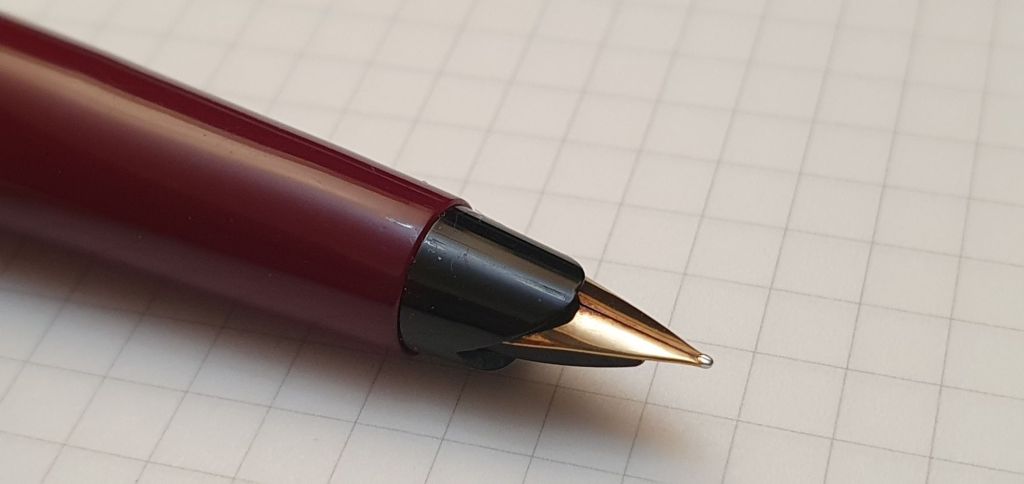
The rather rare “X” (Extra Fine”) nib in 14k gold.

In summary, it comes down to good design. I read on Tony Fischier’s site (linked earlier) that the Parker 45 was designed by Don Doman who also designed the Parker 61 and Parker 75 amongst others.
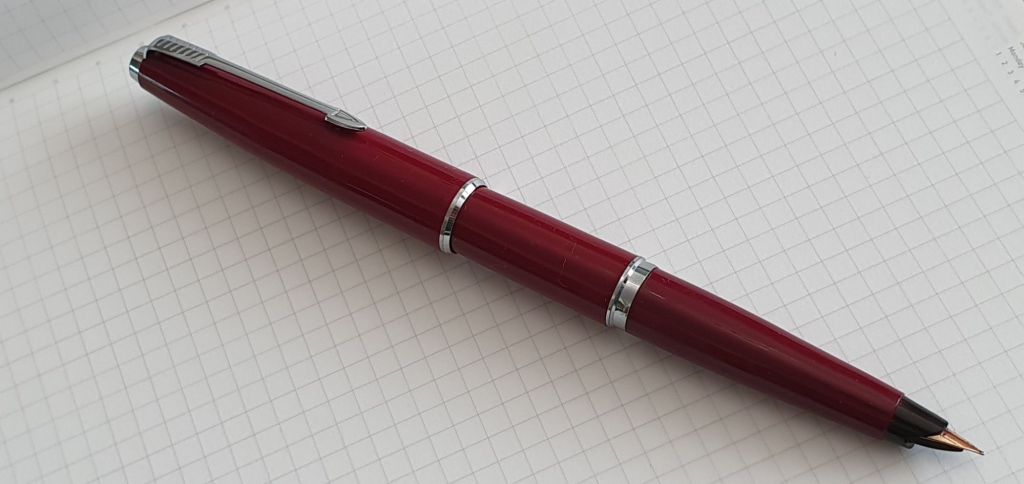
17 grams and 145mm with cap posted.

Are there are any negatives? Yes, the type of plastic material used for the Parker 45 is softer and inferior to the material of the Parker 51. It would show bite-marks, rather like a chewed cap of a Bic Crystal biro.

Size and Weight: The length capped is around 136mm or uncapped, 127mm. The length posted is 145mm. The all-plastic version weighs around 17 grams, or 12 grams uncapped, whilst the Flighter is only slightly heavier at around 20 grams.

For anyone who has any liking for fountain pens, let alone an obsession, vintage Parkers can save you money, so long as you do not buy too many of them. Which is why (as politicians annoyingly say), I have garnered a reputation in my pen club as the vintage Parker influencer.
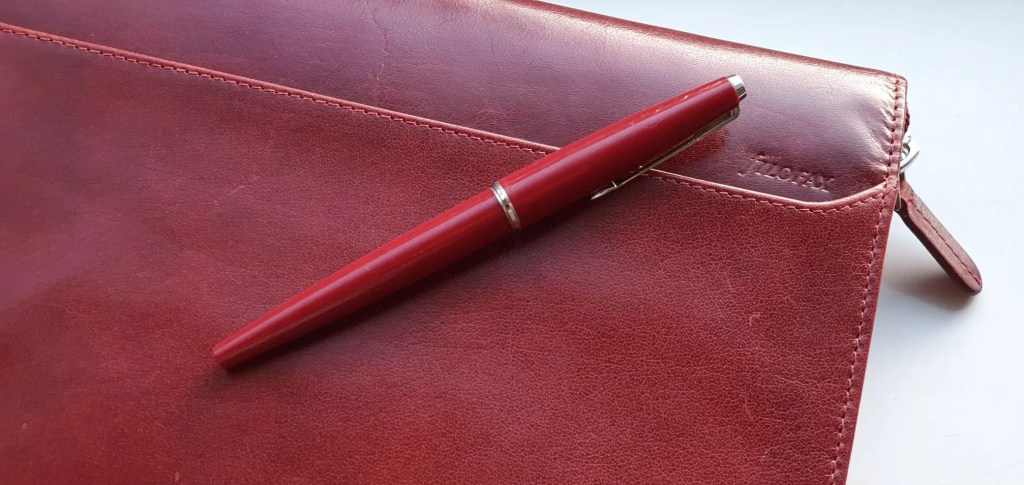
Parker 45 with the Filofax A5 Lockwood zip in Garnet.


The London Spring Pen Show 2024: my haul.

Well, what a great day that was! I felt like there was nowhere I would rather be, and nothing that I would rather spend my money on: the London Spring Pen Show at Novotel, Hammersmith, on Sunday 3rd March 2024.

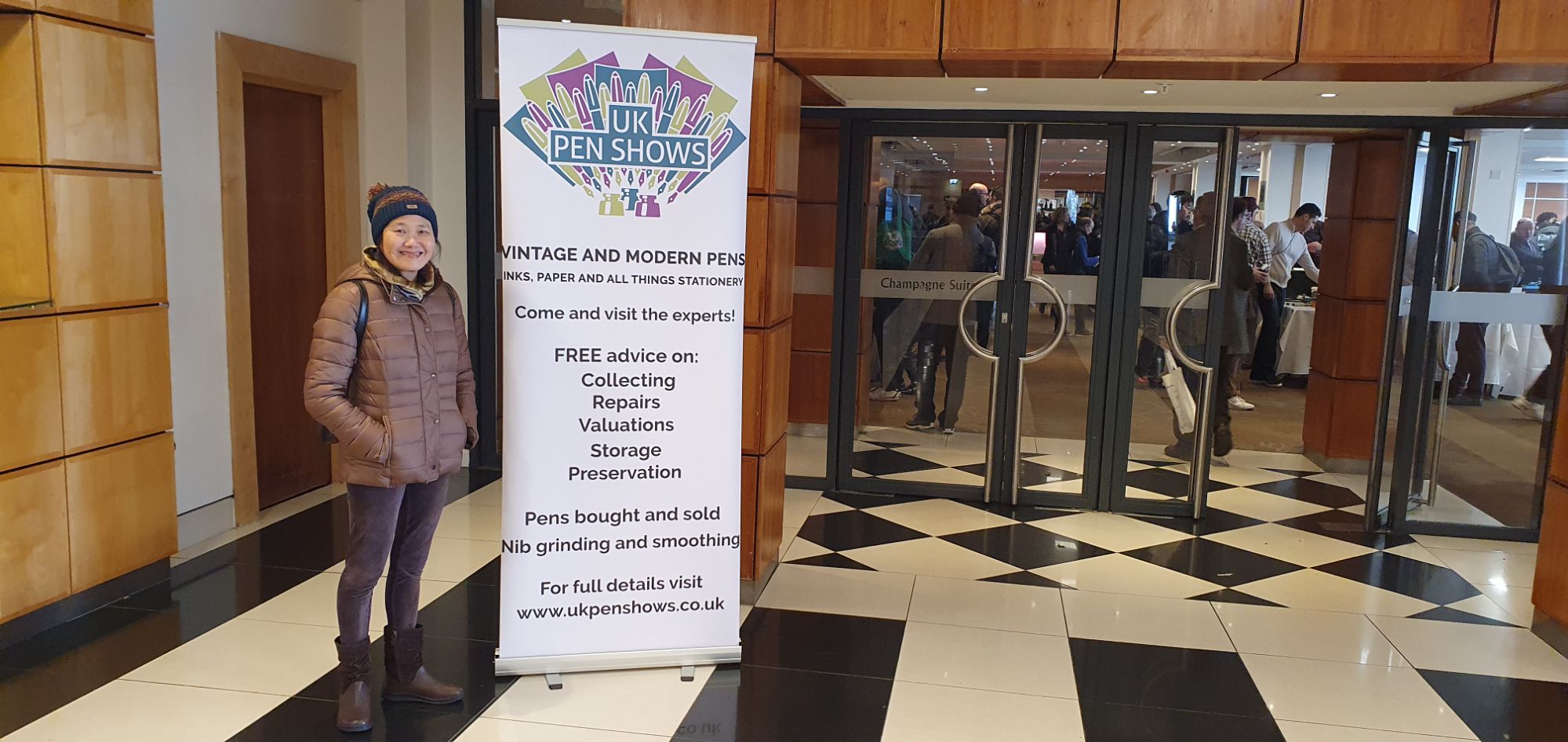
This time, my wife Ling accompanied me. She enjoyed meeting all my pen club friends and a big group of us had arranged to meet for a lunch break at nearby Latymers. Almost everyone to whom I introduced her, joked that I was a bad influence in my penabling, particularly with regard to vintage Parkers! I do tend to gush about Parkers but I make the case that buying these actually saves you money, compared to the cost of a modern equivalent gold nibbed fountain pen. Oh well, more for me then.

Ling came to support me and meet my friends.

This post will list my purchases at the show, rather than naming all the wonderful stall-holders and fellow enthusiasts in the pen community who were there in force. It was good to see so many familiar faces and I am grateful to all the organisers and dealers for making the day so successful and enjoyable. We tend to forget all the work that goes on behind the scenes before and after the show: the preparation, the travelling, the setting up, and then the packing up and more travelling. Several folks such as Sarj Minhas had literally only just returned from the California pen show the night before

So, what did I buy this time? Despite not hunting for anything in particular and trying feebly to stop accumulating, I did not expect to go home empty handed. Here I will try to justify, to myself at least, some of my purchases.

Parker 45, blue with chrome trim, 14k gold nib, Fine.

Parker 45, still looking new.

First up was this Parker, which I spotted on the table of Janse van vuuren (Justin). It was in its original box with filling instructions and guarantee dated 21 April 1976, original press-bar converter, and two blue cartridges still taped under the pen tray with some very yellowed Sellotape. I used these pens throughout my secondary school years although mostly they were the steel nib versions. Last winter I bought a very similar one to this, but in black with chrome trim and with a Medium gold nib which is an absolute joy to use and cost only £20.00. Coincidentally, this gorgeous dark blue one was also just £20.00 and being in such good condition and with a Fine nib, was an easy decision for me.

Aside from the style and comfort of these pens, one of their best features is the ease of cleaning and maintenance. For those not familiar, you unscrew the little nib-housing to remove it from the section. Then, being very careful not to bend or break the long feed or lose the nib, you slide the housing backwards off the feed. The nib can then be lifted off the feed, and cleaned or adjusted. When putting it back, it slots into place over the feed and does not move, so you know you have the correct position. That evening, I took the nib apart and gave everything a very satisfying wash, before filling with Waterman Serenity Blue. It writes like a dream.

Nib unit disassembled. Note the “F” for Fine on the housing.

Parker 51 vacumatic.

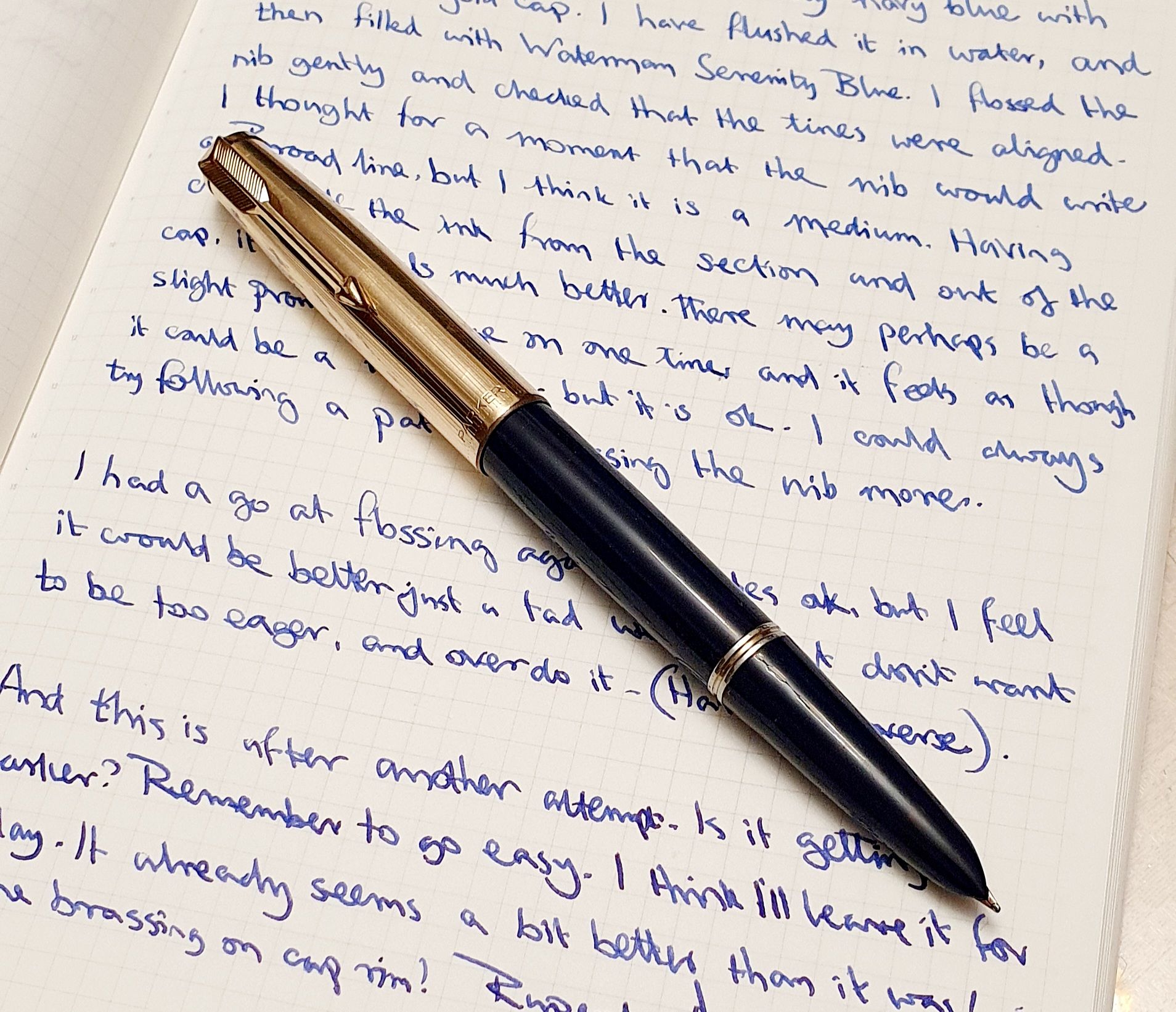
I am happier when I can see the price of a pen, without having to ask. Some dealers have pen trays grouped by price, “everything £40.00” which is where I found my next purchase in a tray of Parker 51s. All but this navy blue and gold-capped one were aerometrics. I spotted the tell-tale blind cap of the vacumatic and had a closer look. On removing the cap, I found the section covered in wet ink. This did not put me off but just added to the attraction and my desire to take the pen home and clean it. The pens in this tray were all tested and so I did not worry that it might leak. The condition of the nib and the barrel all looked very good and the plunger button responded nicely. The rolled-gold and striped cap had brassing at the rim, which I did not mind. I am not sure whether the cap is the original one for this pen.

A gorgeous dark navy blue Parker 51 Vacumatic.

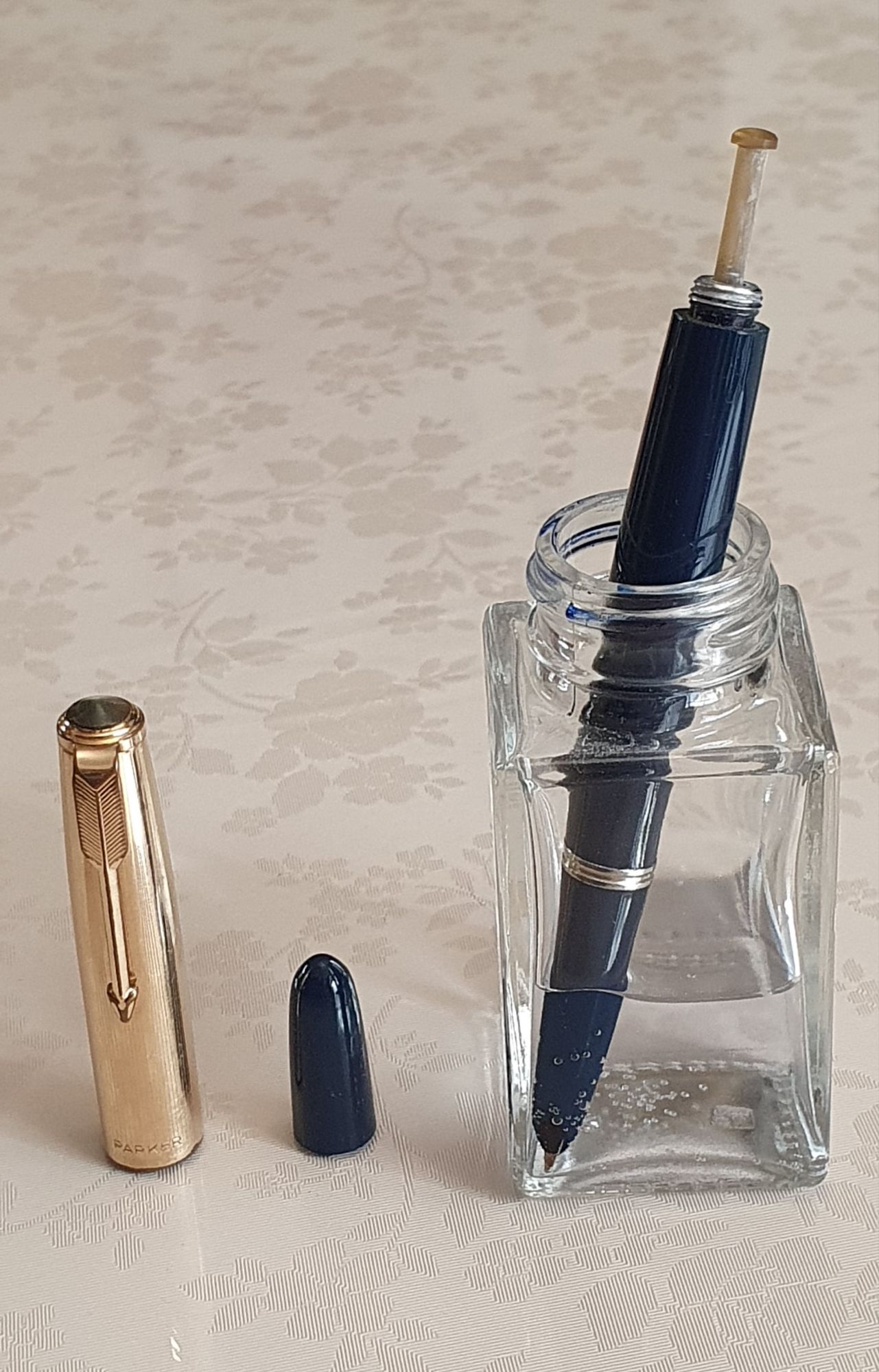
At home I took great pleasure in flushing the pen and cleaning out the inside of the cap. I considered leaving the pen to stand in some water overnight but was too impatient to ink it and so decided that I would only soak it if it needed.

Again, the pen filled and worked well. This one writes a little dry but I did not want to rush into any adjustments, given that the pen dates from the 1940’s and is around 80 years’ old. I used it for a few days, as it was. This weekend I have flushed it again and let it stand in water for 24 hours. I am hopeful that this might improve the ink flow but if not, I can ease the tines apart just a fraction. I am thrilled to have my first Parker vac, and at just £40.00.

As I write this, the Vac is having a long soak.

Parker 51 Aerometric, forest green.

Readers may remember that I passed up a beautiful, mint condition Parker 51 in forest green, at the pen show last year. This time I spotted another one, again in great condition but at a much more affordable price at the tables of Jeremy Collingridge (from whom I bought a lovely Parker 61 Heirloom last time). I was invited to try the Parker 51 but despite several dips, it refused to write. With permission, I even tried filling the pen but still it would not write. Nevertheless, I was not put off but was only drawn to the pen all the more. I suspected that there was nothing wrong but that it just needed a thorough clean. This proved to be correct. It is a stunner and I love the green!

Poor lighting, but a forest green 51.

Sailor Profit fude nib pen.

Sailor Profit fude nib pen.

This was an impulse buy from Pure Pens’ table. Having enjoyed the Duke 551 Confucius fude nib pen bought earlier this year I was interested to try this much smaller and lighter pen. It came boxed with two Sailor cartridges, at £22.00. The fude nib is marked only with the anchor logo and the initials MF.

Sailor Profit fude nib.

The pen actually performs extremely well and as I hoped, can write with a variety of line widths, depending upon how you hold it.

Fun with the Fude.

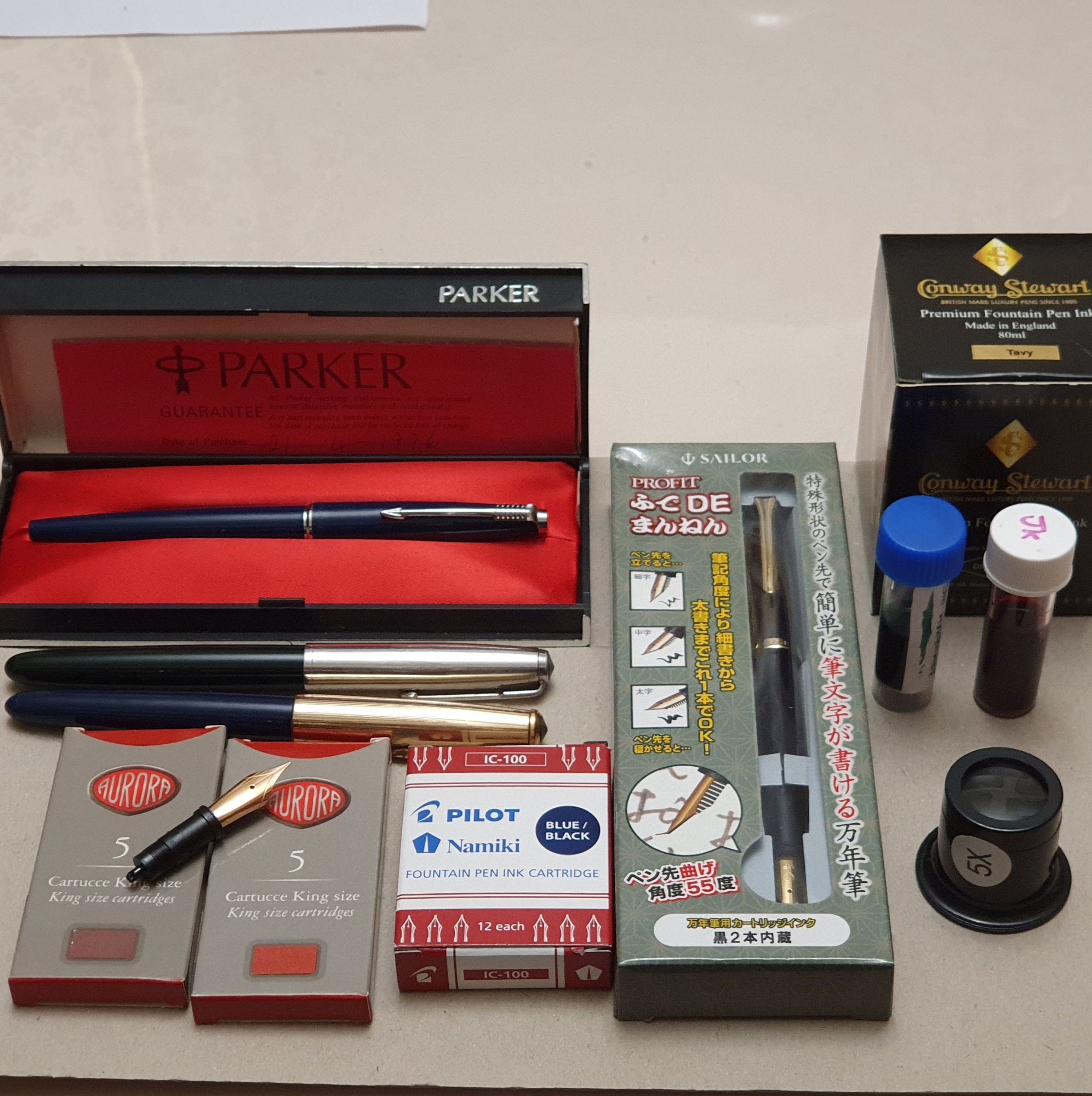
Aside from these four pens, my other purchases were:

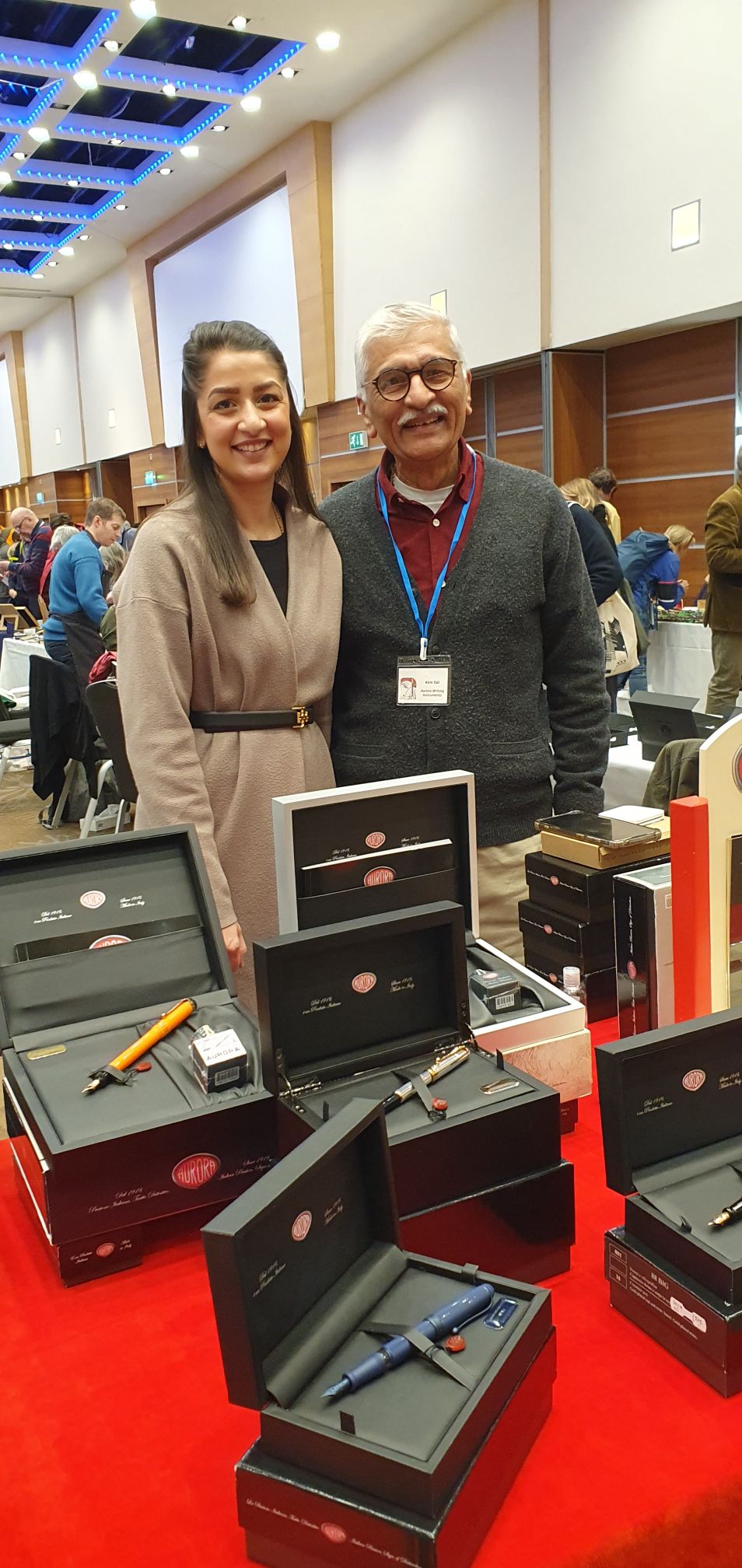
  • Two packs of Aurora cartridges, from Kirit Dal and daughter; (as anyone who has tried will know, these cartridges are very difficult to find in the UK);
  • A 12-pack box of Pilot Namiki blue black cartridges, from Amaya Cerdeirina of Penfriend. These are for my Pilot Custom Heritage 912;
  • Another bottle of Diamine’s Conway Stewart Tavy, blue black ink. I buy one almost every year;
  • A handy little x5 loupe;
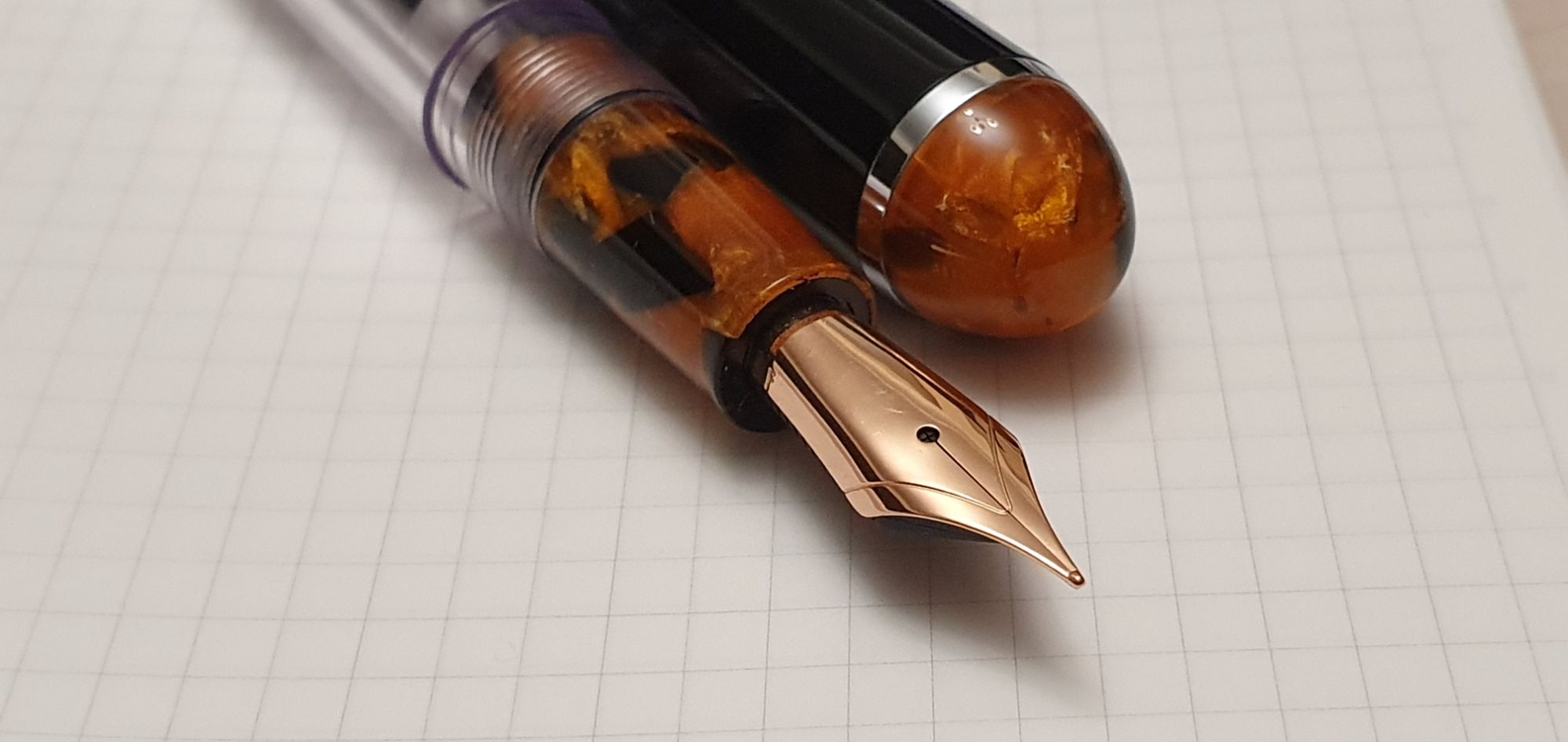
  • A Jowo fit nib, feed and housing with rose gold coloured coating, from John Twiss.
Kirit Dal and his daughter.

Sometimes, after buying several pens in a day, I ration myself to trying one new pen per day. But not this time. Within a few hours, all four new arrivals were cleaned and inked and being introduced to my Stalogy notebook. All in all, it was a very successful day. My total spend at the show was just over £200.00 and for that, I have lots of lovely new toys to play with and no buyer’s remorse whatsoever.

My day’s shopping plus some gifted ink samples.
The new nib unit in my Wancher Crystal fountain pen.

2023: some of my fountain pen highlights.

I usually start this exercise by looking at how many pens I acquired over the year and how much I spent on the hobby. 2023 saw me acquire 39 fountain pens, of which four were gifts for others, so 35 for me. The total spent was £1,676.19: not too terrible.

A strong theme throughout the year was vintage Parkers, mostly bought on eBay plus a small number at the London Pen Shows.

Always late to the party, this was really the first year in which I started looking for and buying vintage pens on eBay. Of the pens acquired in 2023, 15 were vintage Parkers and the remaining 24 a mix of other brands. I would search a make and model, say “Parker 17 fountain pen,” for example. This might find several hundred listings, which I would whittle down by filtering the results to UK only and then sorting them in order of auctions ending soonest.

Occasionally, a special item would come up, such as a Burgundy red Parker 17 Super Duofold with the early “beak” nib, which I would set my heart on winning. In the days leading up to the auction, I repeatedly checked how the bids were going and always stopped to look at the close-up photographs, particularly of the nib, front and back. Happily I was successful and that pen is now mine.

After buying a number of Parker 17s, with their 14 carat gold hooded nibs and hooped squeeze-bar fillers, I moved on to the Parker 61. Again with so many for sale I decided to be choosy and ignored any with the inlaid arrow missing from the section. By the end of the year, I had acquired four Parker 61s. Two were the early, capillary fillers, with one of these being the “Heirloom” (with two-tone rolled gold cap also called the rainbow cap). Two were cartridge or converter fillers; one was a Flighter; one was Made in USA and the others all Made in England; so, a good cross-section.

I was thrilled when a Parker 51 with an oblique nib came up and again when I found a Parker 45 with an oblique medium nib. Both are great for me to use in lefty-overwriter mode.

Some of my 2023 vintage Parker finds.

Eventually, my wife expressed concern that my buying of Parkers on eBay was getting “out of control,” and that temptations would be never-ending, since hundreds more pens come on the market every day. True. We agreed that a recent, lovely teal Parker 61 would be my last. 

It was about this time that I happened to spot a black Parker 45, with a 14 carat gold Medium nib, in great condition. I zoomed in on the close-up nib photos and made screenshots of them. It was only £24.99 “buy now or best offer”. I held out bravely for a few days but then received a thoughtful notification from eBay that the seller had dropped the price to £19.99! This was too much to bear. I knew from the photos that the pen would write like a dream. A vintage Parker, with a pristine gold nib at less than the price of a new Parker Jotter or Lamy Safari. I could not not buy it. Then a solution came to me: I would buy the pen, but as a gift for someone else!

The pen duly arrived. As it was to be a gift, I had to check it first, flush it and test it out. The nib was as wonderful as I had imagined and needed only a light flossing with a brass shim and a rinse. I separated the nib and feed to clean and photograph them. The sac puffed out air bubbles into the water and all looked well. I dried the pen and filled it with Waterman Serenity Blue. It was a joy to write with. Ink flow was ideal, once I had ejected about three or four drops of ink.

I decided to “test” the pen over a few days. Big mistake. This pen was exceptionally enjoyable and I bonded with it. With Serenity Blue, it wrote like my Pelikan M800. There was no way I could part with it. Instead, I gave the intended recipient a lovely new fountain pen of equivalent price.

Of the remaining brands represented in my 2023 acquisitions, these included a flurry of Jinhaos, first the X159 and later the 9019 and 82 models. After trying these, the most enduringly successful seem to be the blue demonstrator version 9019 with an EF nib and filled with Diamine Tavy blue black and the 82 in Caribbean Sea Blue with gold trim, F nib and the same ink. Both start immediately after long intervals and write smoothly with good flow.

I greatly enjoyed the London Pen Shows in March and October. These are always joyous days, running into numerous friends from the online fountain pen community and talking to the sellers. Some of my favourite buys of 2023 were:

  • Montegrappa “Monte Grappa”, in black with 14 carat gold M nib: possibly John Hall’s last one as Write Here of Shrewsbury was to end links with this brand;
  • A Cleo Skribent Classic, cartridge-converter filler version in Burgundy red with 14k Broad nib (also purchased from John Hall);
  • An Aurora Duo-Cart, sold by Kirit Dal from his ex-samples tray at a generous discount; he kindly sent me a branded Aurora converter for it afterwards and a box of cartridges.
  • A Benu Euphoria Bourbon, with a broad nib, from Stonecott Fine Writing Supplies Ltd: the perfect vehicle for Diamine’s Caramel Sparkle ink.

My last and quite possibly most special fountain pen arrival of the year was a gift from my aforementioned wife, bought whilst on her trip to Hong Kong in November. It is the Pilot Custom Heritage 912 with a 14 carat gold Waverly (upturned) nib. I use it every day and it is a wonderful pen, with an element of Unobtainium about it, since they are not readily available in the UK. The WA nib is great for me as a lefty who uses both over and under-writer styles.

I have enjoyed attending our monthly pen club meets, (The London Fountaineers) whenever I can. Also, there have been daily interactions with a host of fellow enthusiasts online, via WordPress and Instagram and in correspondence from the UK and beyond.

As I do every year (and usually fail), I will endeavour once again to buy less pens, ink and notebooks and to make more use of what I already have. Thank you for reading and I wish everyone a Happy New Year.

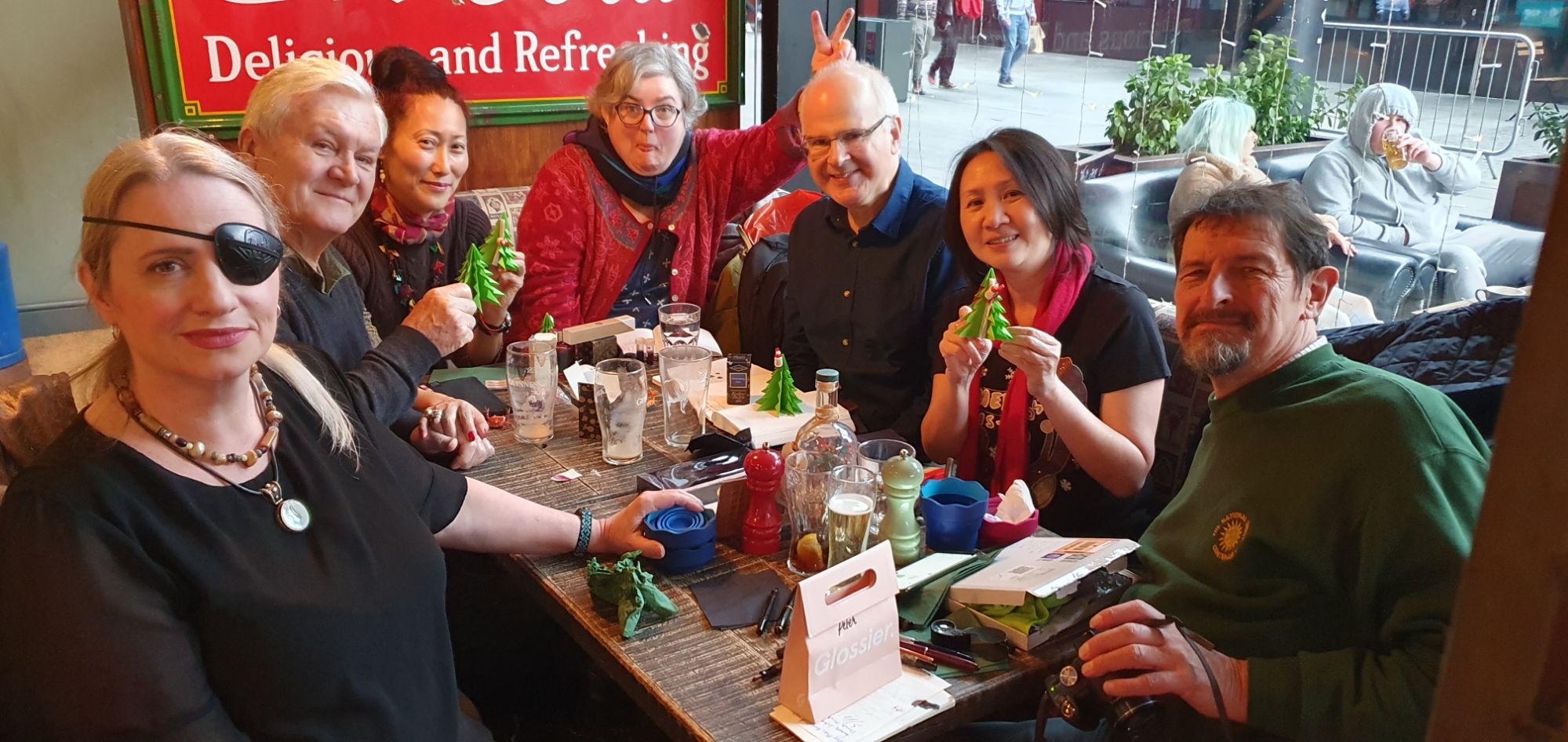
Some of The London Fountaineers at our Christmas meet. I am the one with the bunny ears.