The Montegrappa “Monte Grappa” fountain pen might not be perfect, but mine holds a special place in my heart.
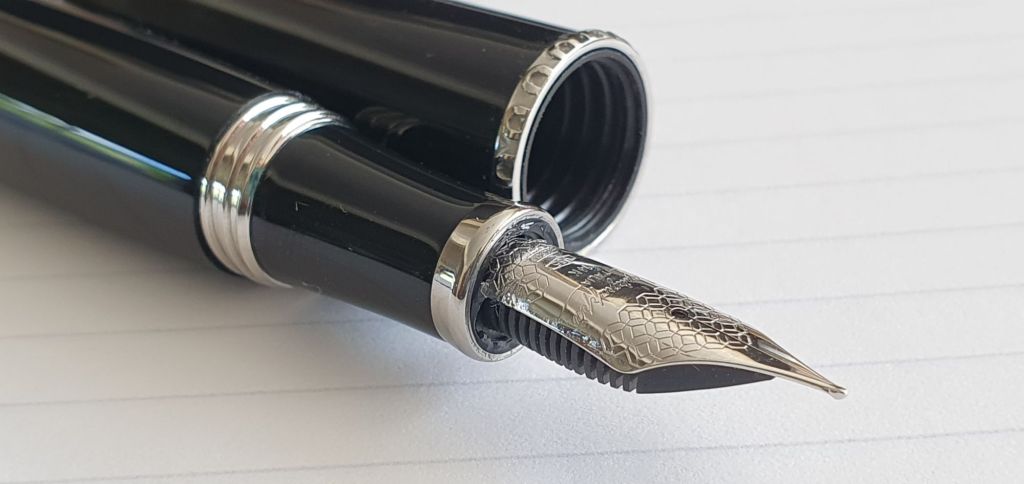
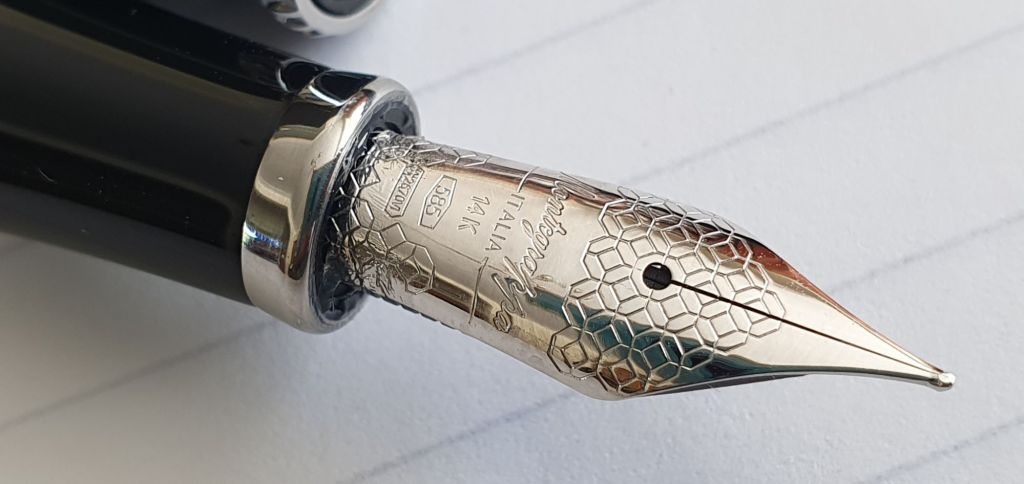
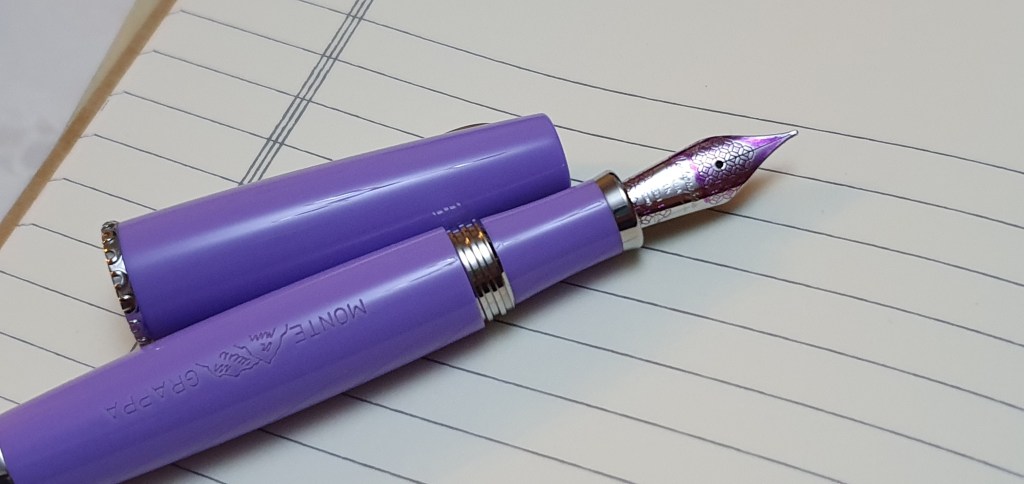
Montegrappa’s distinctive nib imprint and the “tunnel entrances” Monte Grappa cap ring.
I first purchased one of these, in the pretty lilac colour with 14k gold medium nib, from Harrods in November 2019. It was an impulse buy, for which my conscience later suffered and I took it back a few days later. The story was told in my brief encounter post, for those who like fountain pen love stories.
Then, as the winds of fortune blew in my favour once again, I got a second chance to own one at a very generous discount, from John Hall’s Write Here tables at the London Spring Pen Show of March 2023. John was ceasing to deal with Montegrappa and clearing his remaining stock. If price/value had been an issue for me previously, then it was no longer. John was down to his last one of this model. It was the smart, black version with a 14k gold nib in medium. I came away with a huge grin on my face and a saving of over 50%.
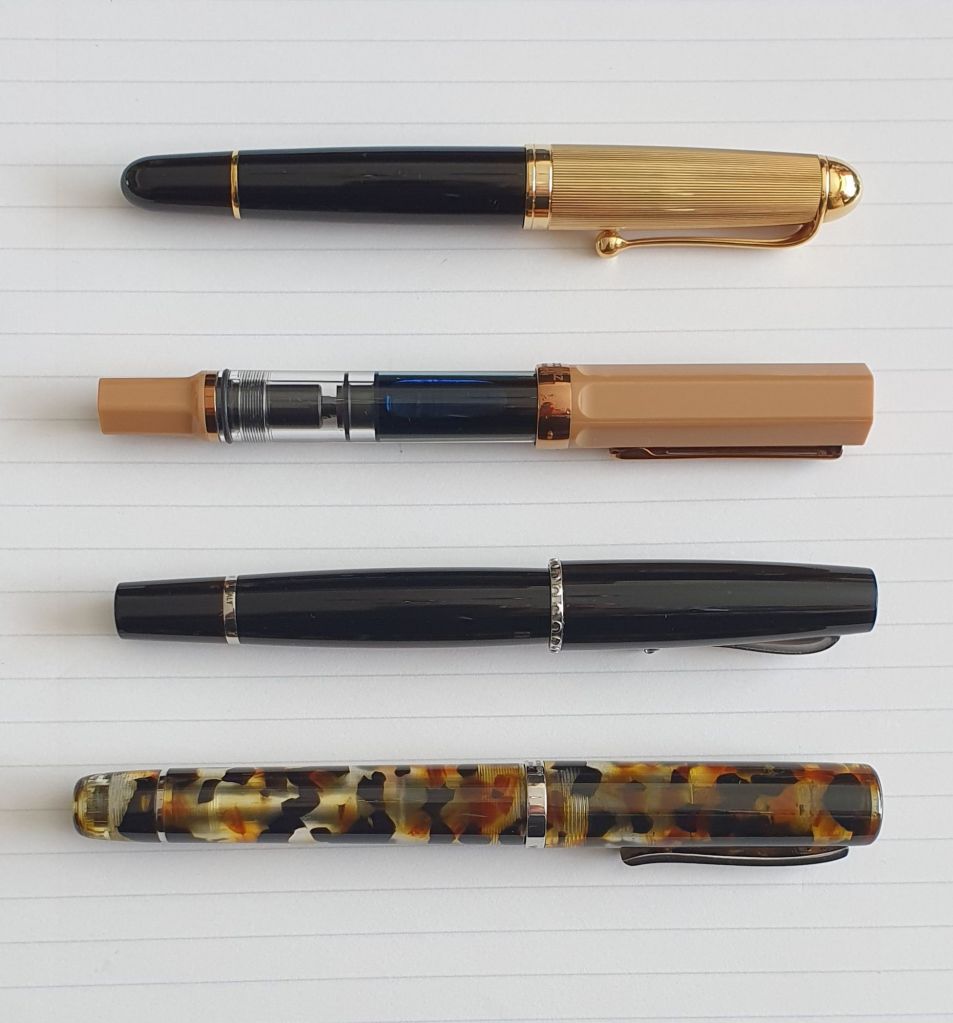
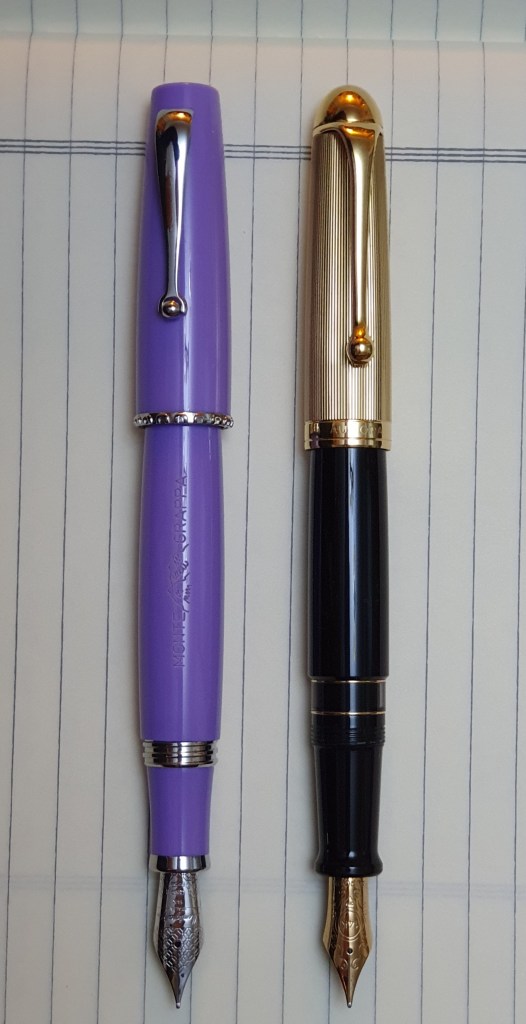
Montegrappa Monte Grappa, (third from the top) with an Aurora 88, TWSBI Eco and a Scribo Write Here Africa, for scale. (The Eco is not Italian, but all are piston fillers and the bottom three pens were all purchased from Write Here of Shrewsbury).
At home, I filled it with Diamine Conway Stewart Tavy, my go-to blue black, which immediately became its forever ink. A feature of the pen is the clicky piston filler which sounds and feels like winding a mechanical watch. You cannot see how much ink the pen is holding but can measure it by slowly ejecting the ink again and counting the drops. I am not sure whether purists call this a piston or a captive converter filler. I recall watching a short video from Montegrappa, proudly showing the patented new filling mechanism on its own, and explaining the various different materials that it comprised, (as related in my brief encounter post) but unfortunately I can no longer locate the video. * [see link below].
Picking up this pen after an interval, is always a joy. Its contours and weight all suggest quality, although in terms of Montegrappa’s range of fountain pens, it might be ranked as entry level to the upper echelons. Unusually, it was available with a choice of steel or gold nib.
On re-inking the pen recently I found in the following days, that the pen always left an inky stain on my second finger where I had rested the pen – rather like a smoker’s finger. Despite wiping the section carefully, this continued. I deduced that the ink was coming from behind the flared metal ring at the point where it meets the black resin section. Initially I thought that perhaps the ring had not been glued and sealed sufficiently such that ink would get trapped behind it when dipping in an ink bottle.
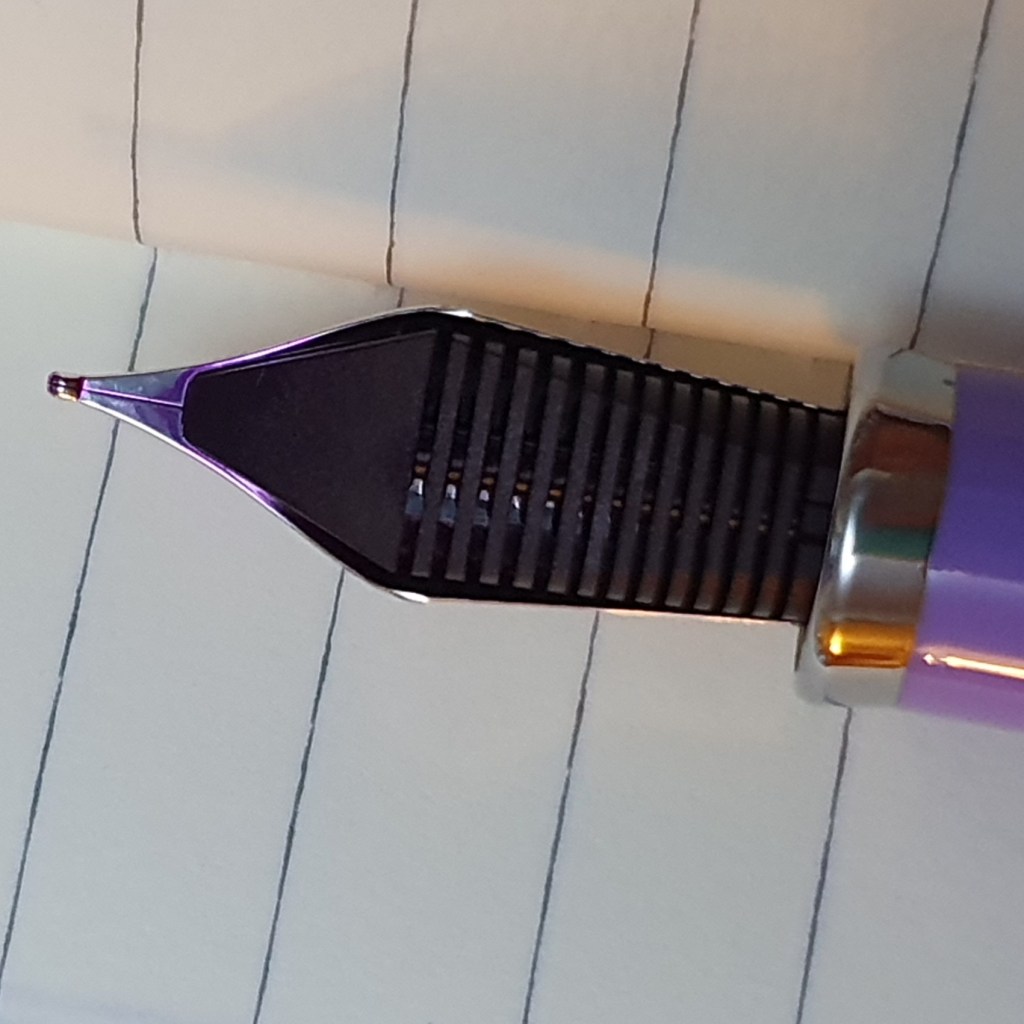
The offending ring (but a gorgeous nib).
To investigate, I flushed the pen and then unscrewed the nib and feed unit. The nib housing simply unscrews from the section. To my surprise, the metal ring then came off the section: it was not glued on at all. (Note: if disassembling a pen over a basin, be sure to have the plug in).
Monte Grappa nib disassembled. Note that the metal ring is not glued into place. Note also that the rubber O ring sits on the back of the nib housing.
I rinsed and dried all the components. Before reassembling, I took the opportunity to apply some silicone grease around the nib housing and particularly at the ridge where the metal ring is seated. I then screwed the nib housing back tightly into the section, whilst checking that the nib stayed centred over the feed and that the tines were level. I hoped that the combined steps of greasing and tightening the nib housing, would eradicate the inky finger issue.
The pen is now filled, (with Tavy, once again). So far there has been no recurrence of ink on the section.
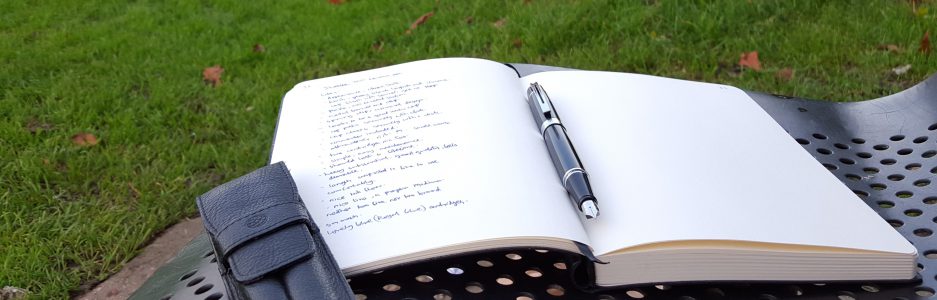
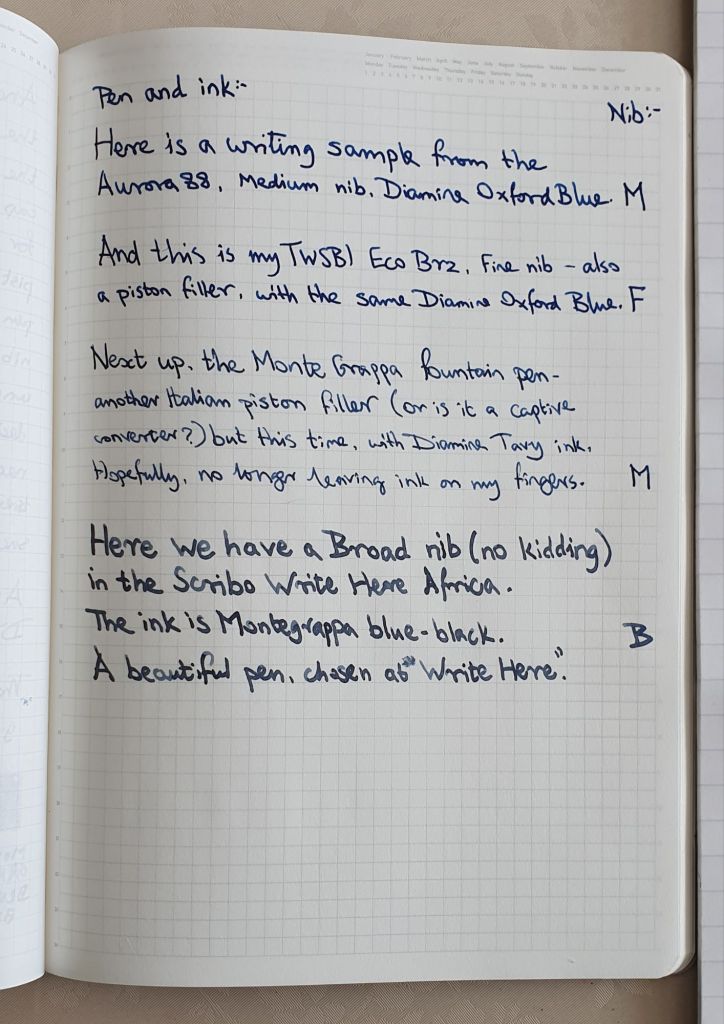
Comparing writing samples in a Stalogy A5 journal.
Such tinkering with a pen on a peaceful Sunday morning is a satisfying activity and to be recommended. It is good to have the Monte Grappa back in rotation. But even when not in use, the remembrance that I own this pen can sometimes be drawn upon to help persuade myself that I do not need more gold nibbed Italian piston fillers. It should be noted however, that this psychology is not always successful.
*Update: I have since found the YouTube video, from Kenro Industries on the Montegrappa Monte Grappa, from six years ago. This featured the piston fill mechanism and can be seen here:https://youtu.be/xgv-FxRnHOU?si=lCtHb2GY-WMQLW-Q
The past week has seen me on an emotional roller-coaster journey with this Italian beauty. I could write just a bare review of the pen but it would be incomplete without the twists and turns of my experience.
I first saw one of these about a year and half ago, while visiting Harrods’ Great Writing Room. A visit to Harrods is a rare treat for me and always memorable. You can lose track of time and distance and also your sense of proportion in this huge emporium of casino-like halls full of luxury products.
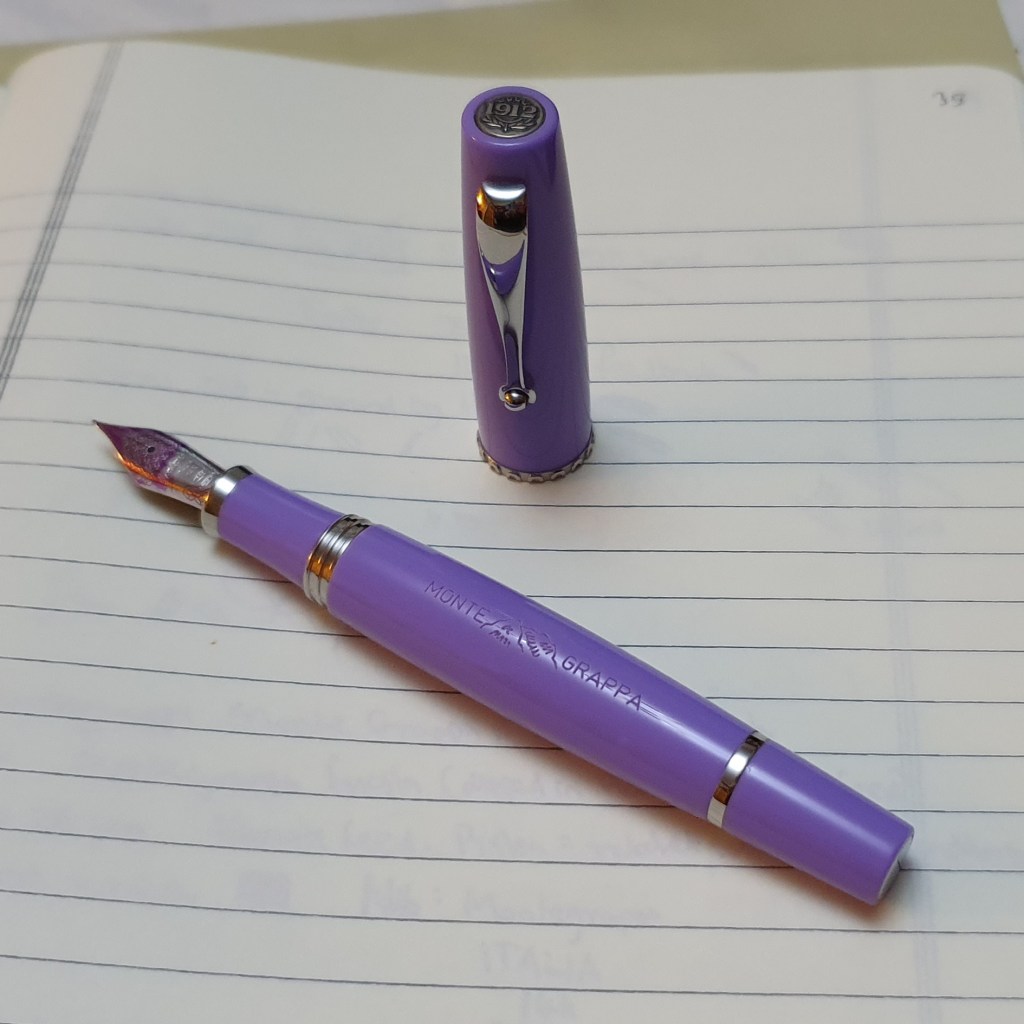
The Montegrappa Monte Grappa in Lavender resin.
On that first sighting, I handled the pen and was impressed at how comfortable it felt. This is a piston-filling fountain pen, of decent size and relatively plain and simple and with a 14k gold nib (but with a silver coloured plating, perhaps rhodium). The price then was about £440.00. The pen was available in four colours, black, navy blue, lavender or coral, all with silver coloured trim.
I did not buy the pen immediately, but after finding my way out of the store into the evening air of busy Knightsbridge, I was already having second thoughts and wondered if I should dash back in and buy one.
I do not know anyone else who owns this pen, or of any other bricks and mortar store in London that stocks them, but the pen remained in my consciousness.
Then, last Saturday whilst in London after a monthly pen club meet, I visited Harrods again and went to browse in the pen department. The store is undergoing a refit and the pens had moved floors and are to move again, I am told, once works are finished. I only mention this as, to the occasional visitor, Harrods can seem like a huge maze and so by the time you find the pen department you may feel that you deserve a new pen. Well, I do.
On this visit, I browsed the displays and alighted on the Montegrappa counters. I spotted a Montegrappa Monte Grappa, currently £445.00, but being a 10% discount weekend, reduced to £400.50. Still pricey for me, but it looked positively good value as the model next to it was £1,075.00 in celluloid and sterling silver.
I got talking to the Montegrappa representative who got out the Monte Grappa for me to try. They had only the lavender model left, but it was rather attractive, unusual and distinctive. He found some ink (Montegrappa fuchsia?) for me to try. I made a few tentative strokes, sampling the smooth Medium gold nib, with a little line variation possible with slight pressure.
After a short time, the rep left me with the pen whilst he went to attend to another customer. I was enjoying the pen, imagining myself owning it and generally “bonding” with it in those precious first few moments. I had to decide how this was going to end. When he returned I was still dithering but leaning towards taking it home with me, rather than leaving empty handed as I had done a year earlier.
When the crunch time came I decided to buy the pen. He offered me a brand new, boxed one. I took a look at it. The nibs on both looked to be perfectly finished but I opted to take the one that I had already tried. I carried it home, in a smart Montegrappa bag.
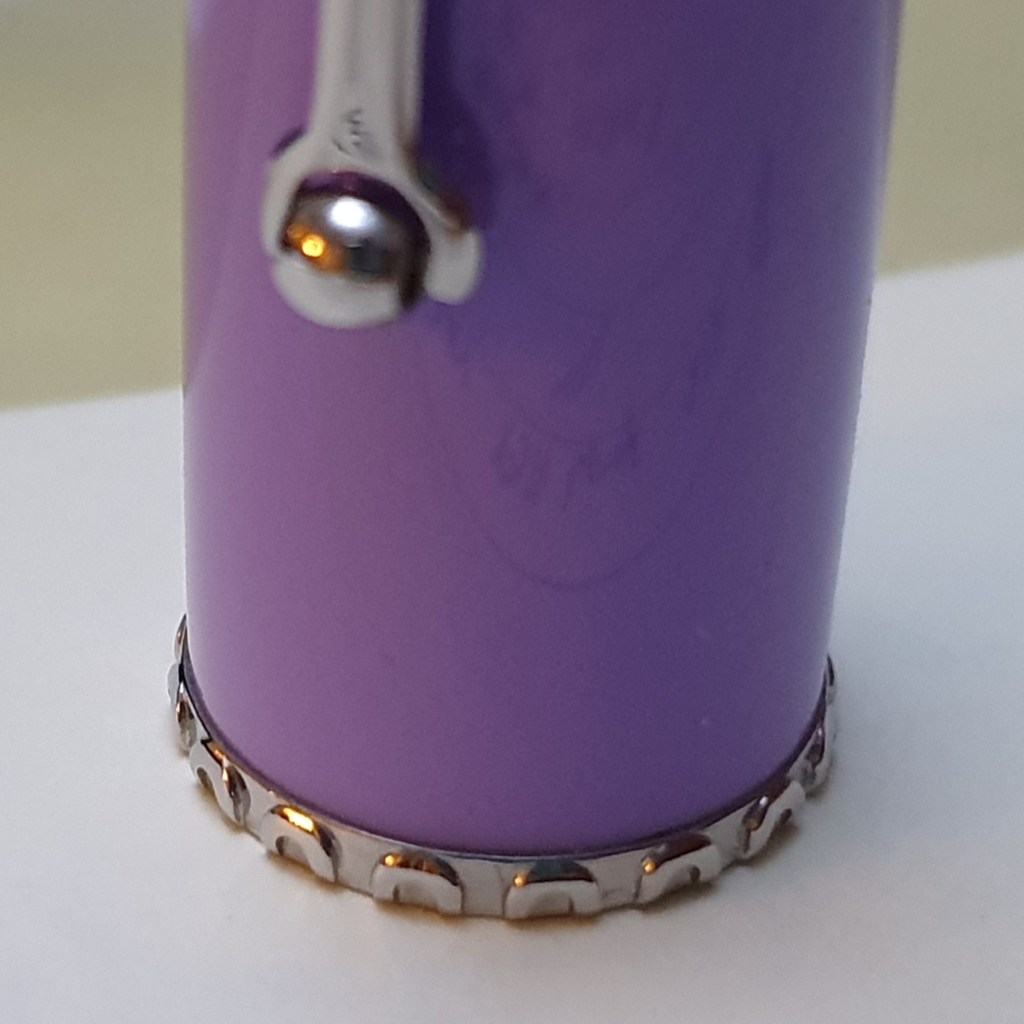
Montegrappa, founded in 1912, is one of the oldest or possibly the oldest fountain pen manufacturers in Italy. Now famous for their extravagantly designed, limited editions, I was more interested in their accessible models, without too many embellishments but with a gold nib and a piston filling mechanism. The Monte Grappa model fulfills this. There are just a few adornments, in this case, the characteristic pocket clip with a revolving wheel at the end and a silver coloured cap ring, which has the look of having been hammered by hand. On closer inspection the design around the cap ring looks like lots of little entrances to a road tunnel. I am not sure if this may be a reference to the mountain, close to the Bassano del Grappa factory.
The unique cap band.
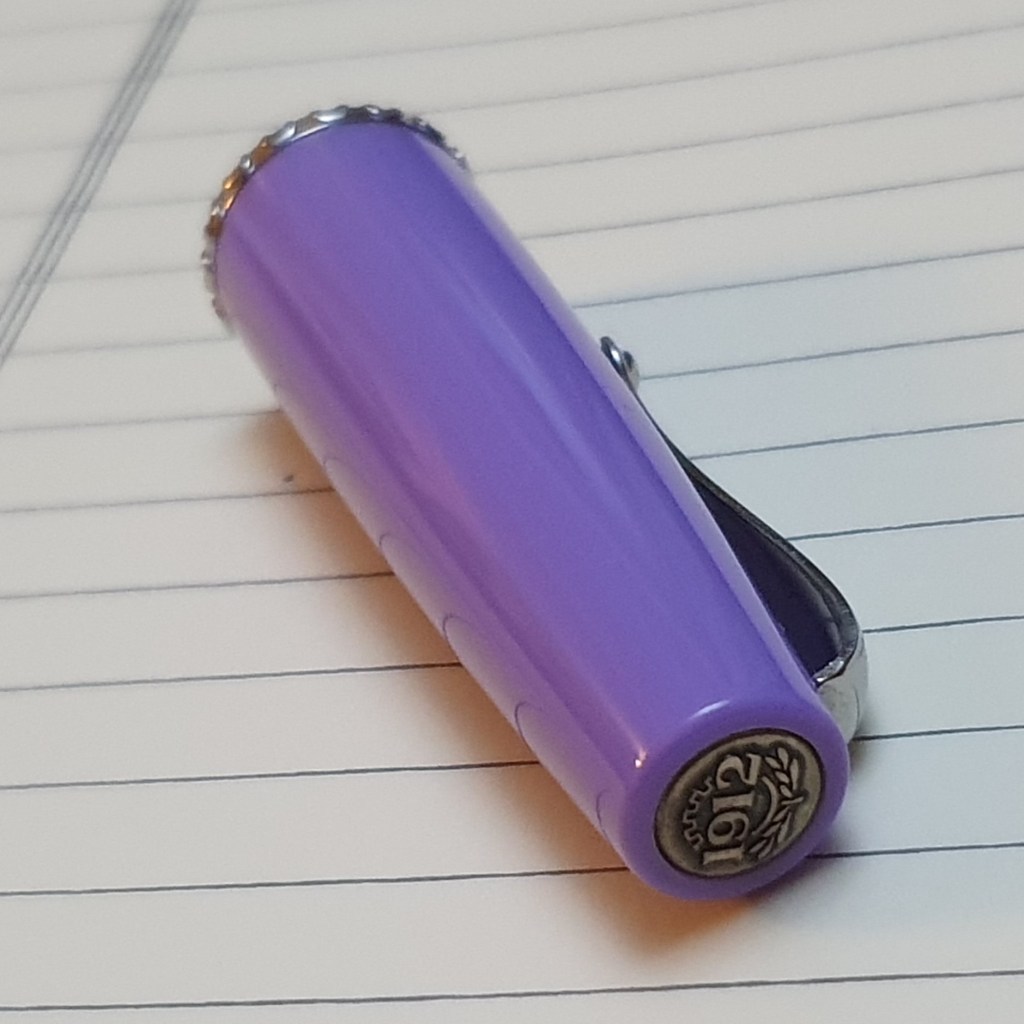
The cap finial has the year 1912, on a metal disk. The wheeled pocket clip and the cap ring did not particularly appeal to me. It was the writing experience that attracted me.
Cap and finial with the year of founding.
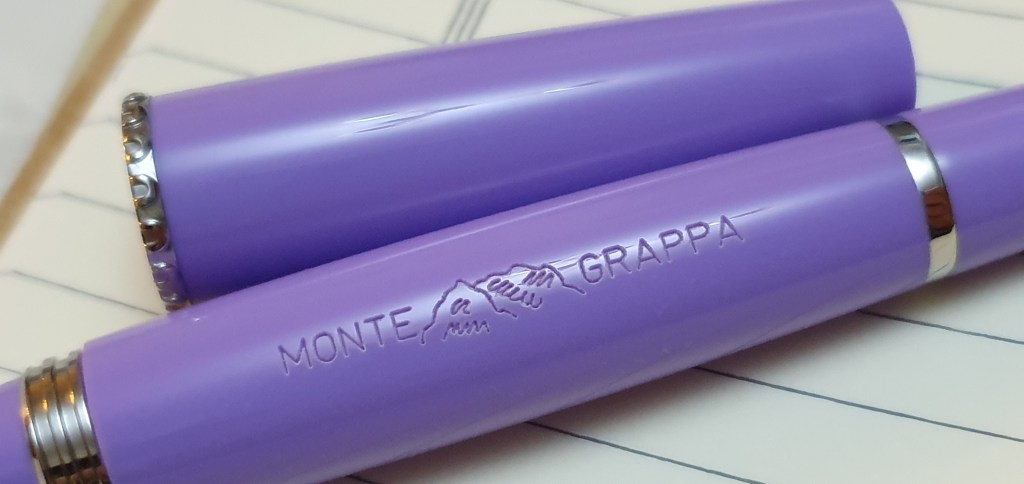
The section is comfortable although you may need to grip the pen at or close to the chunky but non sharp, plated metal cap threads. The barrel design is a nice feature, slightly bulbous in the middle and with the name Monte Grappa engraved in the resin, with an emblem of the mountain itself between the two words. This I did like, except that the words are upside down if you write left handed. Also the pen rolls around very easily if not posted.
Barrel engraving.
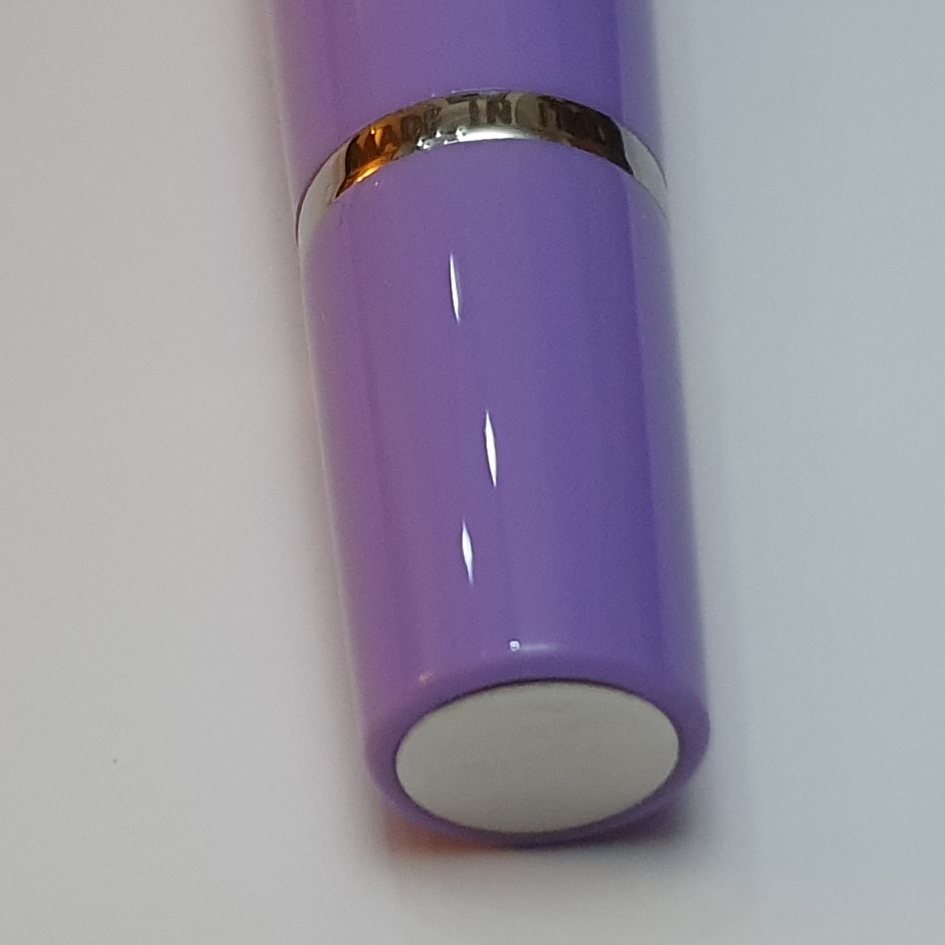
The piston knob is separated from the barrel, by a shiny silver coloured trim ring. If you look closely you find the words “Made in Italy” etched here.
Piston knob. Made in Italy on the trim ring. Stainless steel disc in the base.
Another feature, new to me, is the ratchet-sounding piston turning knob, which emits a sound akin to winding a mechanical watch. This is intended to emulate that very task, for those of us who miss wearing hand-wound watches. Also the piston knob does not extend outwards as you lower the plunger, as it would on a Pelikan, Montblanc or other typical piston filler. It simply rotates, and clicks, without going up and down. You cannot see the operation of the plunger within. A few practice runs soon tell you that you turn the plunger anti-clockwise to lower the plunger and then clockwise to raise it again, filling the pen. Unusually, it takes a lot of twists to operate the plunger, perhaps 12 or so (depending upon how far you go with each twist), before it reaches the end of its travel. This is not really a problem. But you cannot tell from looking at the pen, how much ink it contains.
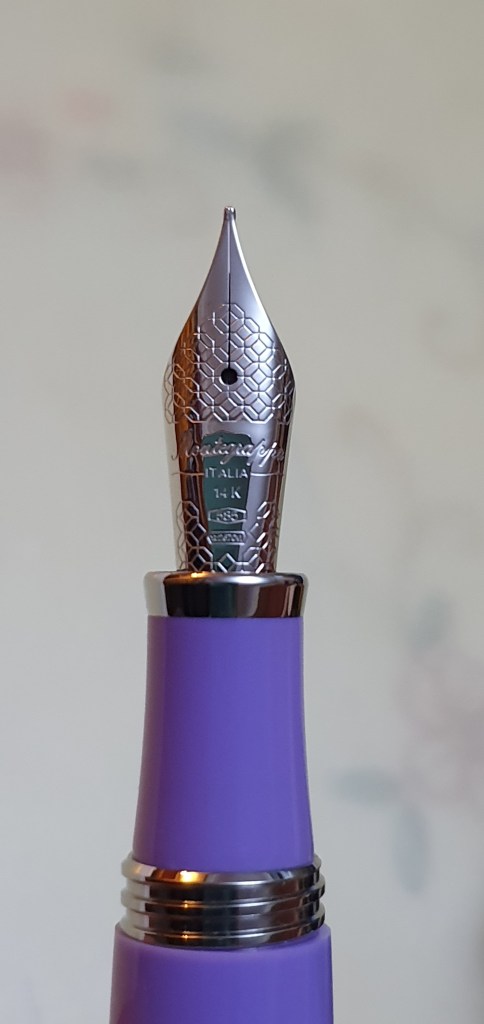
The nib is an attractive, traditional shape with the Montegrappa filigree pattern, and the inscription “Montegrappa ITALIA, 14k, 585” and finally “2670VI” the significance of which I do not know. The rep told me that the feed was ebonite although I wonder if he might have been mistaken on that. It looks like a plastic Jowo feed to me.
14k gold nib, Medium. Comfortable section. Metal cap threads.
At home, I watched some YouTube reviews to find out more about my new pen. A short video from Guiseppe Aquila of Montegrappa, talks of the pens being available with either stainless steel or 14k gold nibs, but all fitted with the same special, international patented filling mechanism. This is comprised of parts made of five different materials: the clear plastic reservoir, rubber plunger, brass piston, an aluminium body and a stainless steel fitting.
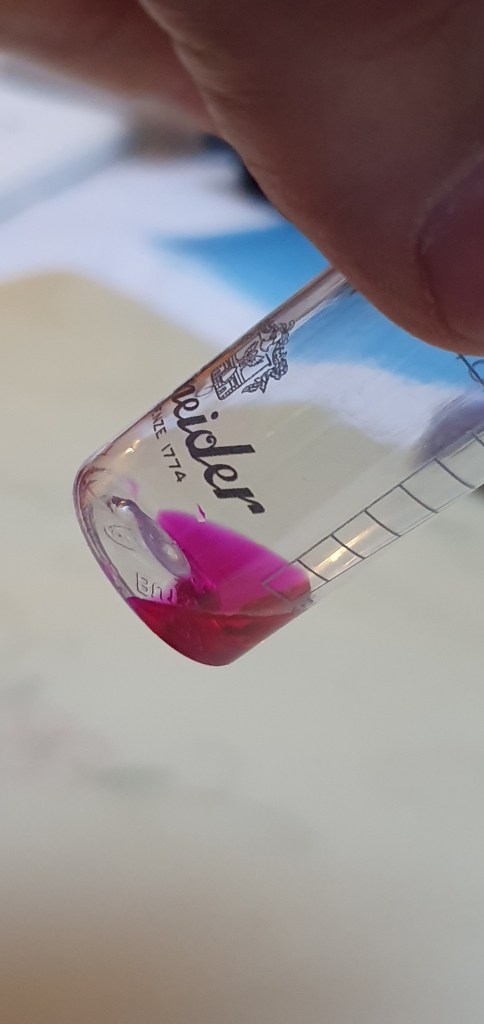
I was keen to see how much ink it would draw up. Having to flush the pen anyway after its dip in fuchsia ink, I tried filling it with water and then ejecting it into a vial to see how much came out. This gave me a shock as the volume of water looked rather feeble, although admittedly it was in a larger diameter container than the pen’s own reservoir. I tried the same experiment with an Aurora 88 and found that even the contents of the Aurora did not look very much although it was considerably more than the Monte Grappa held.
Attempting to measure the ink capacity. The ejected contents after filling.
I then found another video on the OdE (Objectos de Escrita) YouTube channel which showed the same exercise to measure the ink capacity of the Monte Grappa. The ink ejected amounted to about 0.6ml. Arguably it may be that there is some residue left in the feed which is not being expelled. However this volume would be similar to the contents of a standard international cartridge and only around half of what you might expect of a piston filler.
This bugged me as I had hoped that a fill would be around a similar volume to a Pelikan M800, Aurora 88 or Montblanc 146. Why can the Montegrappa not carry as much as these, or even a TWSBI Eco?
Montegrappa Monte Grappa. Cap posted. Next to an Aurora 88.
On delving into Fountain Pen Network, I found opinions from various threads, that this filling system is not a “true” piston filler but a “captive converter.” This means it is like a cartridge converter reservoir, albeit permanently fixed inside pen, which draws the ink into a reservoir rather than directly into the pen’s barrel, which would be a larger diameter. This also explains why the piston turning knob did not rise.
I found this a little disappointing. I appreciate that even 0.6ml of ink is sufficient to write a good number of pages with a medium nib and that refilling the pen is no hardship (actually quite pleasurable) yet this discovery, combined with the feed probably being plastic and not ebonite, made me question the wisdom of my purchase.
Size and weight
The pen does have a lovely tactile shape and finish. It is heavier than you might expect for a resin pen, probably due to the metal components in the filling mechanism. The pen measures around 137mm closed, 125mm uncapped and 158mm posted. Uncapped, it weighs around 30.5g, or 40.5g posted (with the cap alone weighing 10g).
The cap posts well and to me, did not seem to unbalance the pen although I hold my pens quite far back. The cap ring might feel rough against your hand, depending on where you chose to grip the pen. If you grip the pen lower, you may find it to be too back heavy. But then if you hold your pens low, you probably will not need to post the cap anyway.
Likes and dislikes
I liked the pen, for its brand history, its shape, comfort and heft and the solid, high quality feel. The medium nib wrote well. The self-contained ratchet-sound filling mechanism is a novelty but not necessarily an advantage and I have no complaints about filling my Pelikan, Aurora and Montblanc pens in silence. I liked the vintage look, the barrel text and the fact that this aligned with the nib and pocket clip.
On the downside, you need to accept that this is a mystery filler with no ink window, and as I suspect, not a large ink capacity and (unless I am mistaken) a plastic feed. This, I felt, made the cost rather on the high side.
The feed.
All in all, whilst I much enjoyed writing with the pen, I found myself suffering from “buyer’s remorse.” A decision had to be made quickly of whether to continue with the bonding process and accept the pen as it is or else to return it promptly for a refund.
I am sad to say that I decided to take the pen back to Harrods. After flushing it out I took it back to the store where I saw a different Montegrappa rep this time. I said that there was nothing wrong with the pen, but that I had changed my mind about it and that it was not quite what I had expected. He took a look at the nib and joked “It looks better than when it left the store!” I had certainly cherished it in those few days whilst it was in my ownership.
We talked about the feed and about the ink capacity. He explained that it should be around 1.2ml and that the plastic ink reservoir was to protect the body of the pen from the ink, which is alkaline. This sounded reasonable enough. However, to Harrods credit, they took the pen back and gave me a full refund without any fuss.
The story should end there, except that I found myself feeling rather bereft in the following days, with a case of the “refunder’s remorse.” I missed my lavender pen with its superb nib. My decision could quite easily have gone the other way. The pen had got under my skin. Montegrappas can do that to you.

 Fountain pen blog