Further thoughts on the Jinhao X159 fountain pen.

I am still besotted with these. Following the success of my recent purchase of two Jinhao X159 fountain pens, I found myself tempted to add more, in other colours.

They are available in a variety of editions. Most colours have the option of gold-coloured or silver-coloured trim and a choice of a Fine or Extra Fine nib. Depending upon your preferences the prices ranged from £7.49 up to around £20.00 and the estimated delivery times also vary.

Lingering repeatedly over the online photos, I contemplated adding a couple more to my existing pair. Readers may recall, I had started by ordering a black one, with silver trim and a Fine nib. This was swiftly followed by a blue one with gold trim and Extra Fine nib.

For my next order, I went for a dark orange with silver trim, Extra Fine nib and also a dark red one, gold trim and Extra Fine nib. Two pens in one order. See how this escalates!
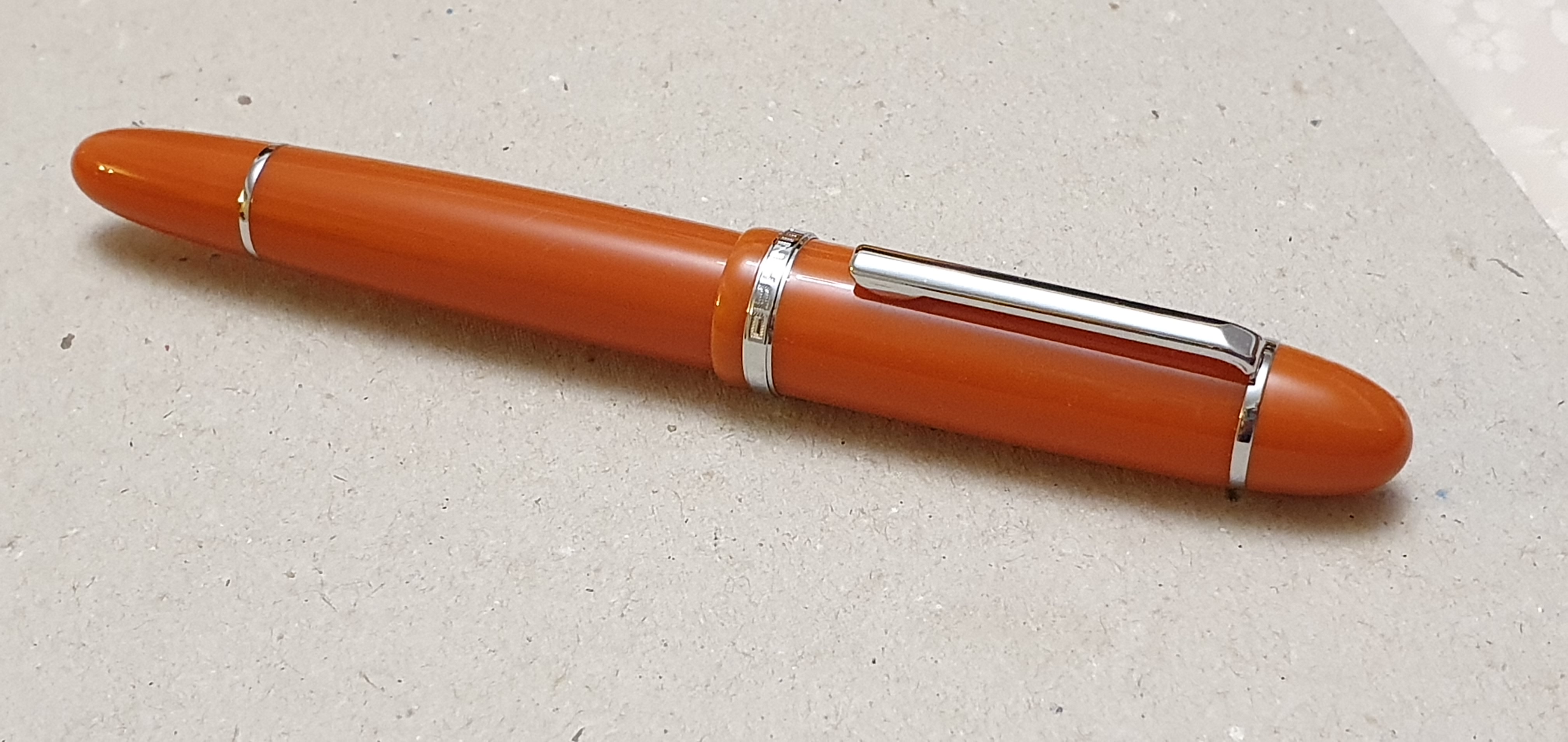
A dark orange edition, with silver colour trim.

They arrived within 24 hours of ordering. Again, each pen was packed in its own simple padded envelope. Each comes with a converter fitted. No cartridge is included although they take standard international cartridges.

New pen induction ritual.

Again, I had the happy prospect of inspecting and preparing my new pens. Starting with the orange pen, and in what has become a familiar routine with my Jinhao flock, I started by examining the nib under a loupe. It looked to be set up well. I unscrewed the nib housing, separated the nib and feed and gave them a good rinse in warm water. In each of my Jinhaos from the seller Erofa, I have noticed a little blue ink residue in the water at this stage, a sign that the nib has been tested before sale. This is very admirable for its modest price.

I reassembled the nib, taking care to centre the nib over the feed and to hold it to the feed tightly as I pushed it back into the housing. I like the dark orange colour. It is not bright and showy, but more of a terra cotta.
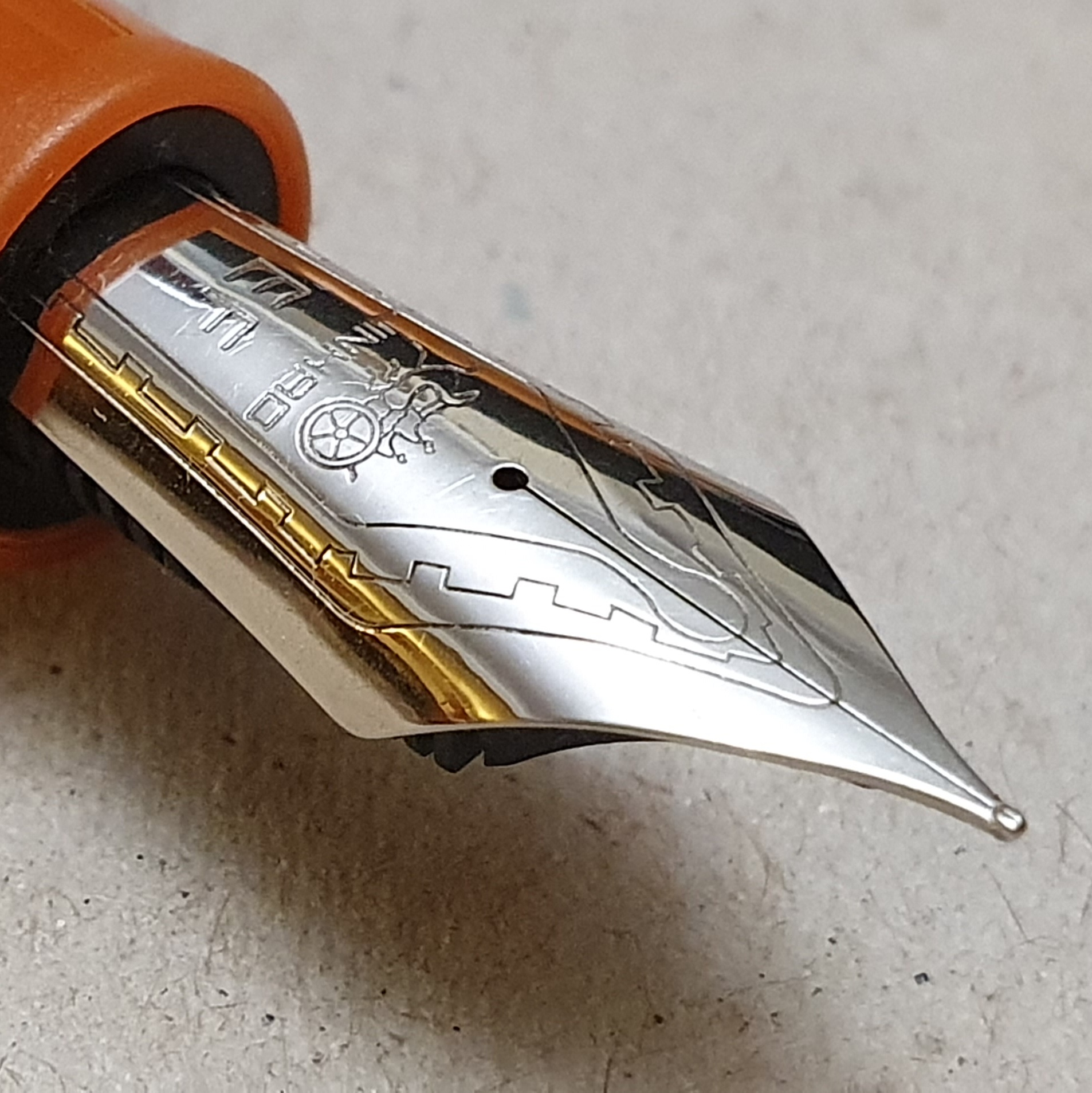
A lot of nib for your money.

Using cartridges.

I had given some thought to what ink to use, pondering a brown perhaps. But when the time came to ink the pen, I decided on trying a black cartridge. I have a stash of these, having bought WHSmith bags of 30, when they were about £3.00. I found that this ink actually performed very nicely and flows well. Somehow, this humble and inexpensive ink seems right to pair with the budget priced Jinhao – to keep the theme of getting the job done at the lowest possible price.

One big advantage of using these cartridges is that a pen will often have room in the barrel to carry a spare, great if you run dry while away from your supplies. I popped a spare one in the cavernous barrel of the X159. There was ample room for the barrel to be screwed back on, so much so that the spare cartridge could be heard ratting inside.

I thought of cutting a small piece off an eraser and putting it at the back of the barrel. I tried this, but on screwing it back together with the spare cartridge inside, the piece of rubber got stuck in the pen. I had also cut it too large, as the barrel would not screw on all the way. Having something stuck in the pen, or the risk of it happening, annoyed me and after eventually dislodging it, I decided on a different option, that of using a scrunched up piece of kitchen roll paper, (about 1 inch square, rolled into a ball) and placing it between the two cartridges, rather than behind the spare. This worked nicely: no rattle, and it could be removed easily. The cartridge did not get stuck either (a common issue with the Cross Bailey Light, incidentally).

Nib tweakery.

I had saved the red Jinhao for the next evening. When I inspected the nib, it was quite a way off the centre line of the feed, but this is very quickly and easily corrected. Again, I took out the nib housing and separated the nib and feed. I flexed each tine up and down a few times to loosen up the tine gap a bit, before rinsing and drying the parts and reassembling. I took my usual care over centering the nib and put it all back together.

A dark red edition, with gold colour trim and bicolour nib.

I then noticed that the tine gap was a bit wider than it had been. Important lessen to self: make sure the nib is correctly centred symmetrically over the feed BEFORE widening the tine gap. It may be that once centred, the tine gap will be wider.
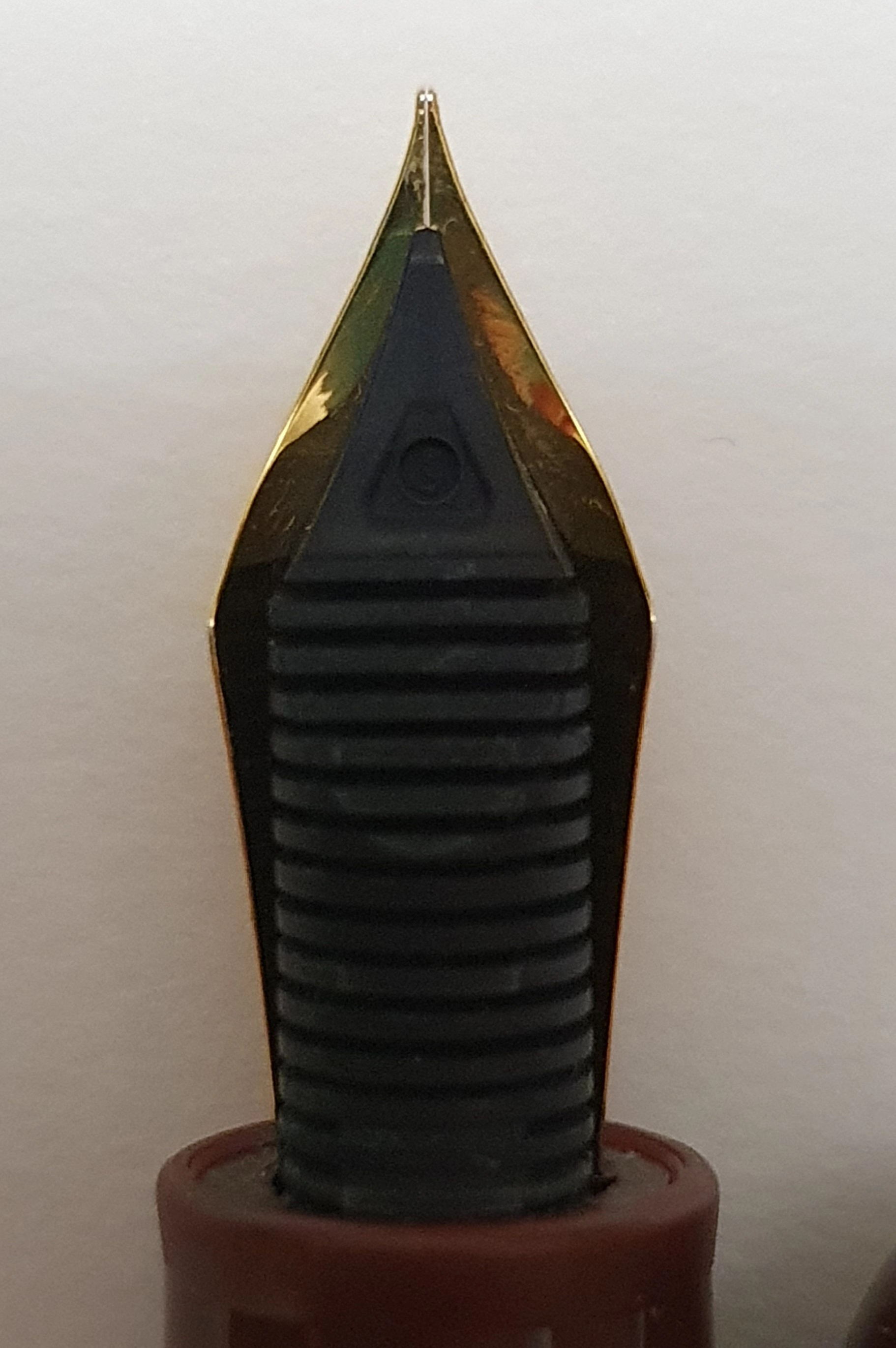
Now centred on the feed. Tine gap a bit on the wet side, but good for lefty overwriters.

To ink the dark red pen, I got out six bottles of red ink and sampled them all with a glass nib dip pen. I settled on Pure Pens Cadwaladr, a lovely dark red. The colour reminds me of my favourite wax crayon as a child, in primary school “wet play” times!

I now have four Jinhao X159s each inked with a different colour. Here is the collection (so far!):-

Pen colourTrimNib Ink
BlackSilverFineMontblanc Royal Blue
BlueGoldExtra FineDiamine Tavy blue black
OrangeSilverExtra FineWHSmith black cartridge
Dark redGoldExtra FinePure Pens Cadwaladr red

When you buy more than one of a pen, the downside is that you may find yourself liking one over the others. Currently, I tend to bring the orange one if going out, since its spare cartridge means I will not run out, away from home. With the prices being so attractive, it is tempting to gather up one of every colour, perhaps to use with corresponding inks. I would fancy a dark green and a brown next, if I were to buy any more. Then there are the white or ivory editions.

Mixing and matching parts.

There is also the useful option of being able to mix and match the pen parts and make your own colour combinations. For example I could put a black cap on my orange pen, and give it a Delta Dolce Vita vibe. Also the black pen, given an orange section, looks rather special. Mixing has a practical purpose as well as an aesthetic one, in that you can chose what ink colour you want to carry and then put the nib section with its converter or cartridge, into whichever barrel you wish. Don’t want an orange pen in a courtroom? Clothe it in a black cap and barrel!
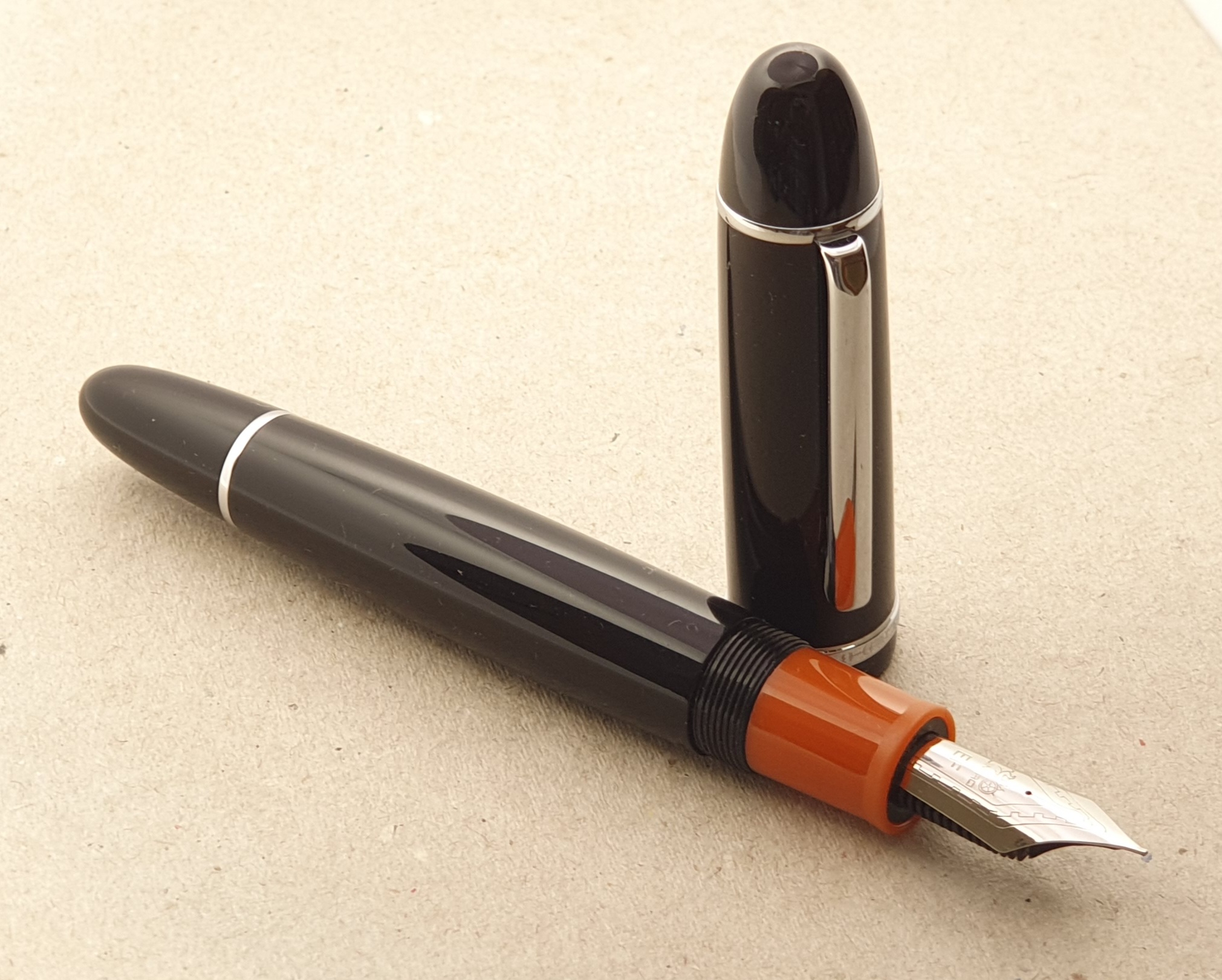
If you have more than one X159, you can pull off crazy stunts like this.

So, four new pens for me before January was out. The black version is probably the most versatile to take any ink colour but if you want to treat them like a set of colouring pens, with every colour carrying a matching ink, then the Jinhaos are probably the most economical way of doing so.
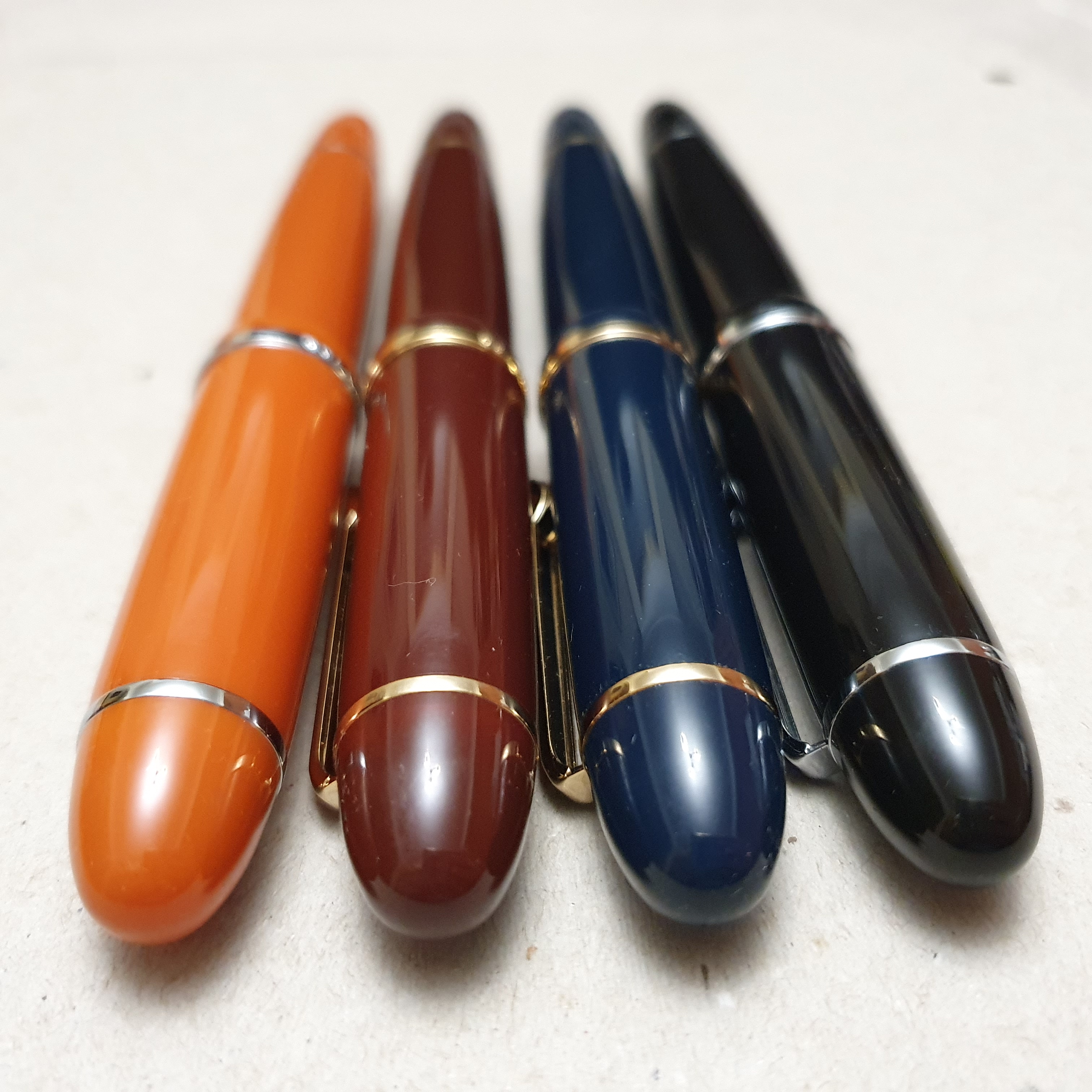
My Jinhao X159 family.

Early thoughts on the Jinhao X159 fountain pen.

Occasionally, something new comes along in the pen world which sets social media buzzing amongst the fountain pen community. Recently, we have had a new offering from Jinhao, named the X159.

The imposing Jinhao X159.

This is not entirely new: there has long been a Jinhao 159 (without the “X” factor), which we might call an homage to the Montblanc Meisterstuck 149, but with a steel nib, cartridge-converter filling and a fraction of the cost. However, it was a heavy beast, being made of metal. I owned one myself. In the event it did not see a lot of use, on the ground that the ink flow in my model proved to be a bit erratic despite my efforts.

However, the new version, the X159 is different in many respects and offers significant improvements. Whilst similar in size and appearance to its forerunner, the main changes are as follows:

  • It is now made of acrylic and is much lighter;
  • It has a larger, number 8 nib;
  • There is new, more subtle pocket clip;
  • The grip section is much less tapered and does not end with a metal ring (colloquially termed a “rust ring”);
  • The threads on the barrel, for the cap are now acrylic instead of metal.
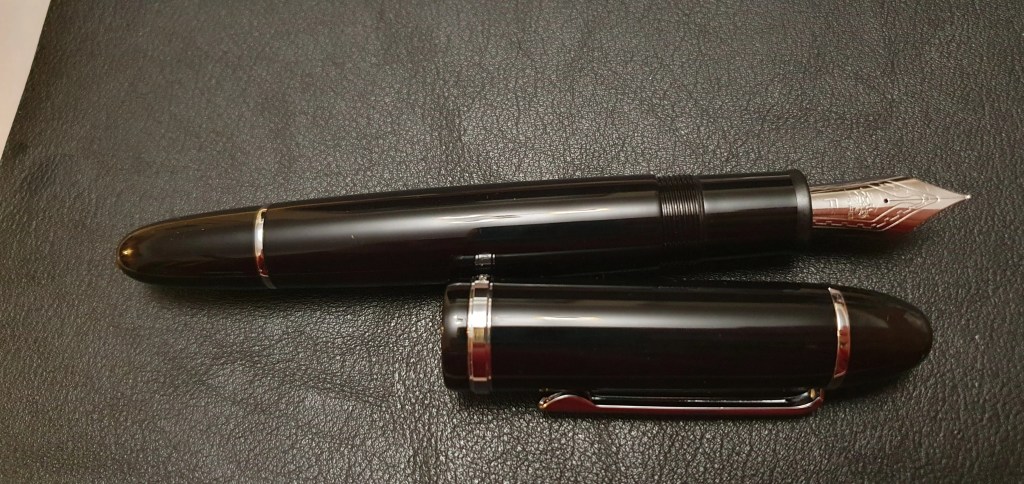
Uncapped. Big girthy pen with number 8 nib.

These cannot be found in our shops but are available online. The prices on Amazon currently range from £7.49 to around £20.00 depending upon which colour, trim finish and nib size you chose. Nib sizes are Fine or Extra Fine. There is an option for gold or silver colour trim, the former having a bicolour nib.

I resisted the temptation to order one for several weeks, happy with my current line-up and convincing myself that the Jinhao could not possibly perform any better than steel nibbed pens that I already owned, such as my Onoto Scholar or the Otto Hutt Design 06 to name but two. Whilst the price was obviously not an issue, I did not want the added clutter.

However the temptation did not go away and I learned that a few friends had ordered one. Still curious to try one for myself, I eventually weakened and pulled the trigger. I opted for a black version, with silver coloured trim and a Fine nib, for a princely sum of £9.99.

The unboxing.

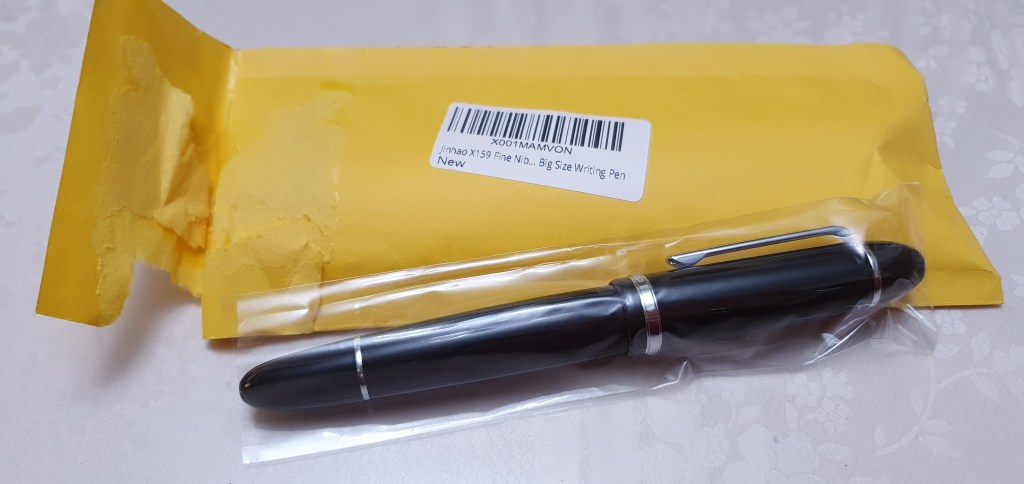
With Amazon Prime, the pen arrived the following day. Inside the cardboard envelope, the pen was packed in a simple polythene sleeve inside a padded envelope. This was just enough to get the pen to me without damage and did not leave me with any unnecessary box.

That’s all the packaging.

In the flesh, first impressions were very favourable. The black acrylic body was smooth and glossy. Fit and finish all seemed good. The number 8 nib, being the first pen I have bought with one, was a good bit larger than the usual number 6 size and looked impressive and perhaps a bit more in keeping with the large girth of the pen.

The nib and feed.

I examined the nib under a loupe. The tines looked to be even, with good symmetrical tipping. There was a nib slit which narrowed down from the breather hole to the tipping at which point the tines were quite tightly together. Viewed from the back, the nib was not quite symmetrical to the feed, but this is easily adjusted.

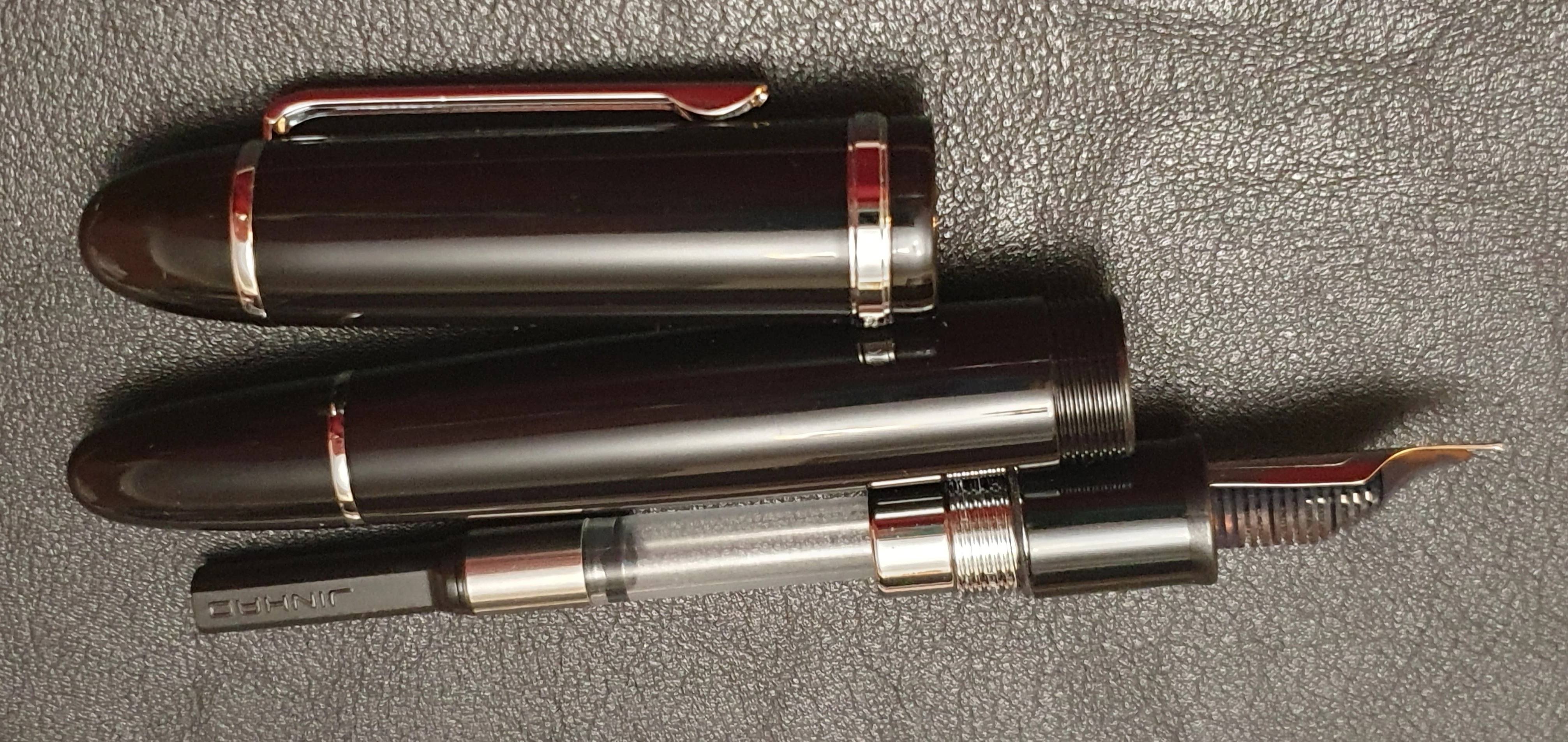
Disassembled.

I flushed the nib and feed in warm water to remove any residue of grease from manufacturing. The nib is easy to disassemble – a feature that I appreciate very much. You can unscrew the nib housing from the section. Once out, the nib and feed are friction-fit and can be pulled out from the housing, by gripping them together, perhaps with a soft cloth or tissue and pulling in a straight line, being careful not to damage the delicate plastic feed. Once out, you can lift the nib off the feed, and it is more easy to clean and adjust if necessary. I noticed that the ink channel at the top of the feed was cut quite wide and more like a trough than a slit. Good!

I had expected the nib to be a bit dry, having seen a video review by Stephen Brown. As a lefty-overwriter, my preference is for pens which lay down ink with little or no pressure needed. This can usually be achieved by opening up the gap between the tines at the tipping, just a very little until you can see a space, or daylight, between them.

After separating the tines slightly and realigning the nib on the feed.

This is a very useful adjustment. It is often easier with a gold nib than a steel one. There are various tricks to doing this, using brass shims to floss the nib, bending the tines up, or trying to wriggle a blade between the tines – all of which should be attempted with great care and with frequent pauses to inspect the nib under a loupe and to try writing with it again. Eventually, I had the best success by lifting first one tine, with my thumbnail, bouncing it up and down a few times – and then doing the same with the other. I then replaced the nib onto the feed, and pushed them back into the housing, carefully ensuring that the feed’s point was centred with the nib and that the tines were both level and smooth.

Filling:

After flushing and drying the pen, I filled it with Montblanc Royal Blue. The large nib does need quite a full bottle to be able to immerse the nib for filling. My Montblanc bottle has the useful feature that you can tip it to make the filling area deeper. Before doing this, the converter did not draw up any ink leading me to wonder whether it was not pulling a vacuum. Note that the converter is like the Lamy ones, with a flat edge to hold rather than being round. Personally I do not like this feature as it makes the converter harder to twist.

Converter included.

Writing and performance:

Having adjusted my nib I then flushed, cleaned, dried and filled it, all of which took less than an hour. I was thrilled that it wrote superbly, as well as I could wish for. The nib was smooth, with good ink flow and lubrication. It is a firm nib. My fine nib writes a slightly wider line than intended by reason of my tine-widening exercise, but the end result, a medium-fine, is very pleasing. All in all, I was absolutely delighted.

It then just remained to do two further tests. One is to write for about a page of A4, to see how the feed keeps up, once the excess ink from filling the pen and saturating the feed, is used up. This is to check for “ink starvation” if ink is not being replenished from the converter. This (like opening the tine gap) is another tip I picked up from Stephen Brown’s videos. All looked good on this front. The final test was to check for hard starts. Leaving the pen untouched for 8 hours, revealed no issues. Later, when I could bear to leave it alone, I managed some longer intervals and again, there were no hard start issues.

Size and weight.

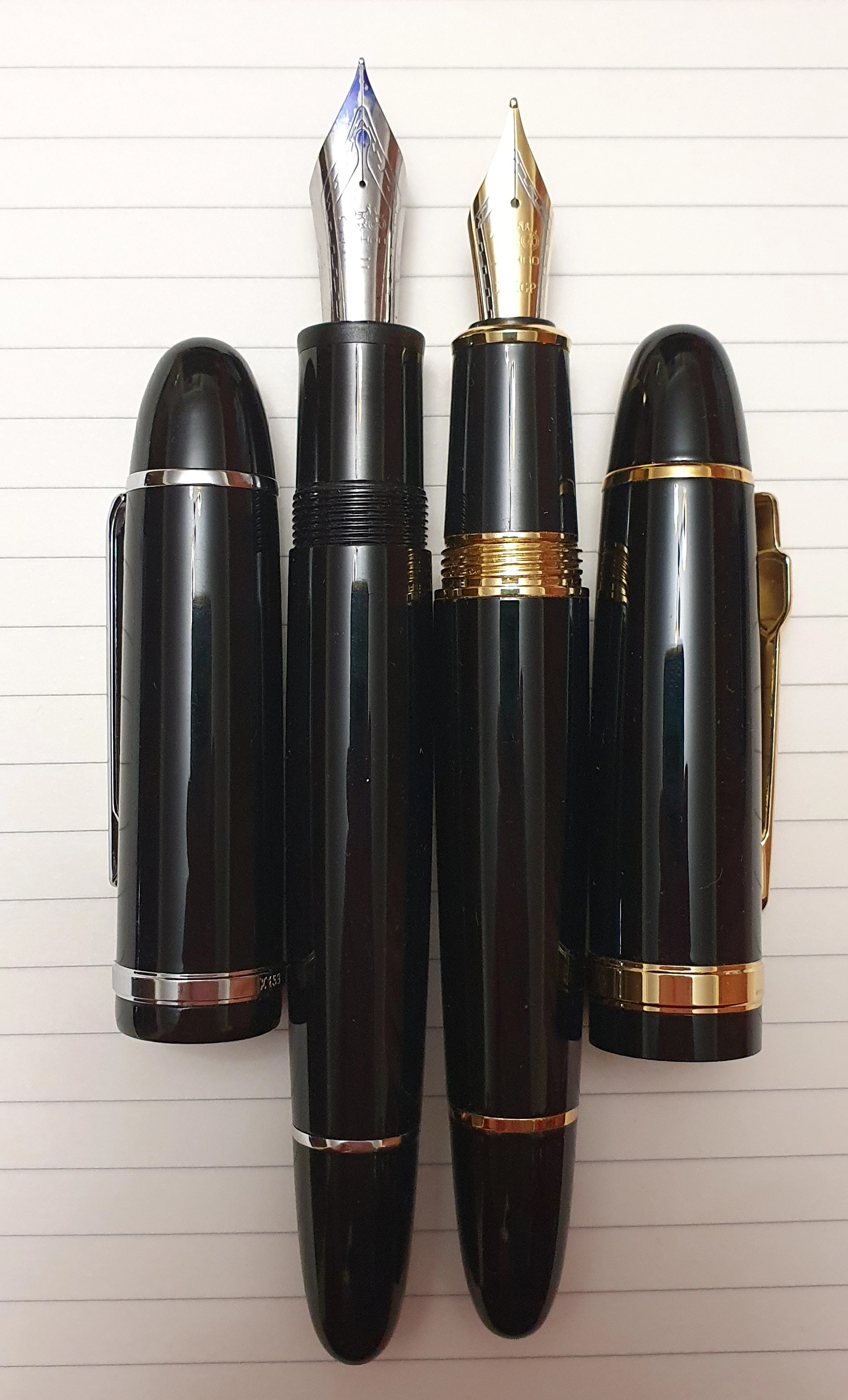
Jinhao 159Jinhao X159
Weight, total46g28g
Weight without cap27g18g
Weight of cap 19g10g
Length capped148mm148mm
Length open125mm130mm
Length posted165mm162mm
Size and weight (approximate) comparison.
Comparing the X159 with the 159 (right).


Epilogue.

I have been really thrilled with the Jinhao X159. I think it is phenomenally great value. There is nothing else quite like it on the market. It could compete well with some pens in the £100.00 to £200.00 bracket. I hope that it continues to perform as well as it does now, and see no reason why it should not, with usual care and maintenance.

Indeed, so impressed and blown away was I, that I ordered a second one, this time trying a different colour, and with gold coloured fittings with a bi-colour nib and in Extra Fine. I opted for a blue and gold one. This cost just £7.99, firmly within “no-brainer” territory. There is also a Dark Blue version but this was priced around £20 and would come from the US, taking longer.

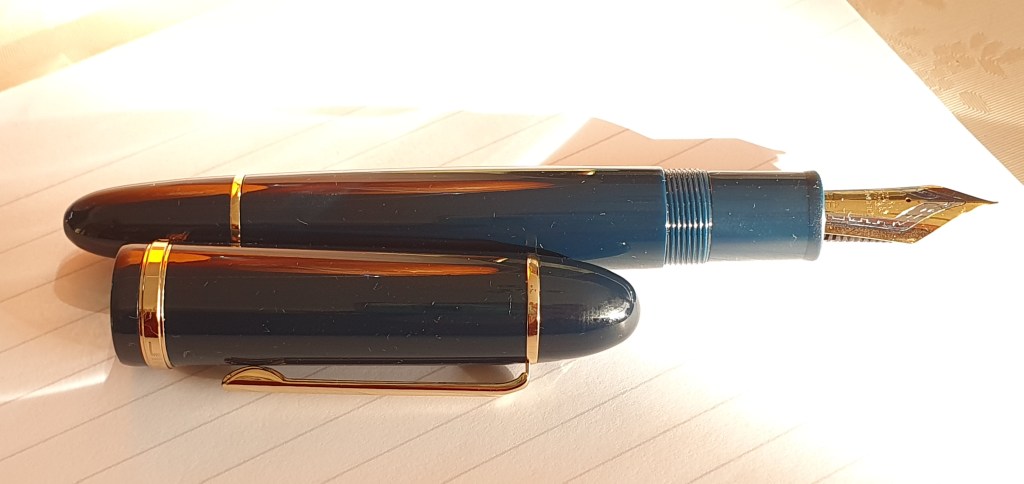
The blue-teal colour is quite hard to capture in a photo.

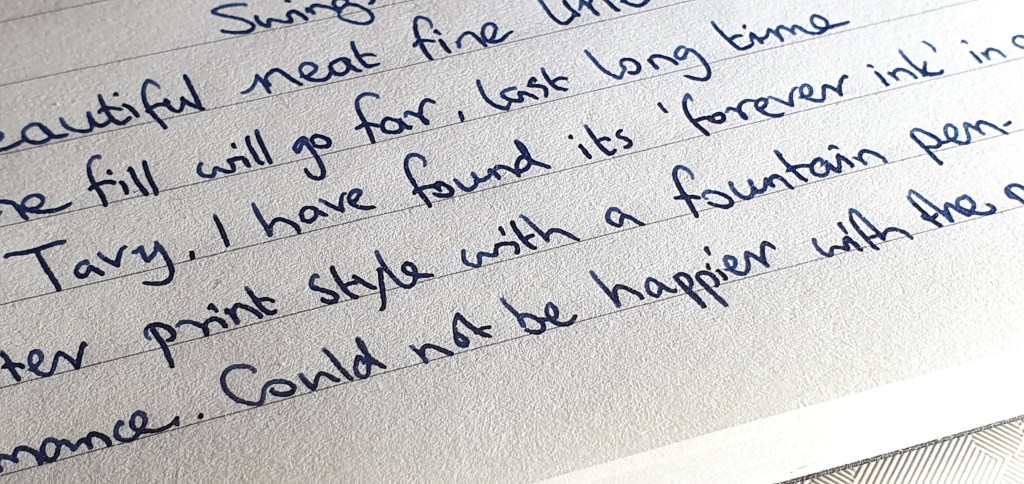
Once again, my pen arrived the following day. At first, it looked like I had got Dark Blue as it looked like navy, in artificial light. However, daylight revealed the colour to be a very pleasing blue-teal, which I am very happy with. I was excited to see under the loupe that the EF nib looked to be tuned to my liking, with the slightest of gaps between the tines, promising a good writing experience. After flushing the pen, I filled it with Diamine’s Conway Stewart Tavy, my go-to blue black. Bliss. This feels like its “forever ink.” The extra fine nib performs beautifully. In my notebook I wrote “I am genuinely over the moon at how good this pen looks, feels and writes and all for a £7.99 price tag.”

Writing sample of EF nib.
A big pen with a tiny EF tip.