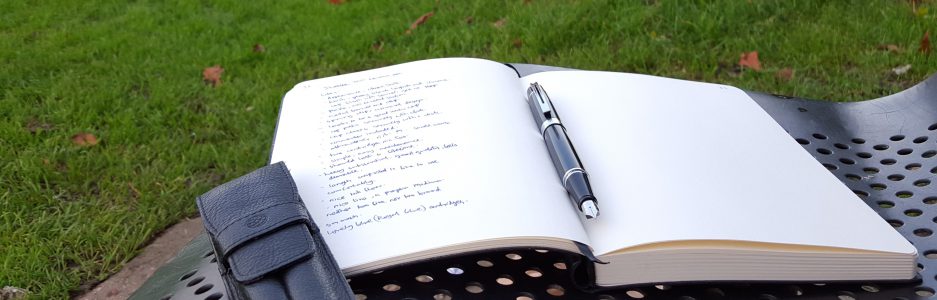
During a recent holiday to visit my wife’s relatives in China, I was given a bag of eight old fountain pens, by an elderly uncle who assured me that he had no further use for them.
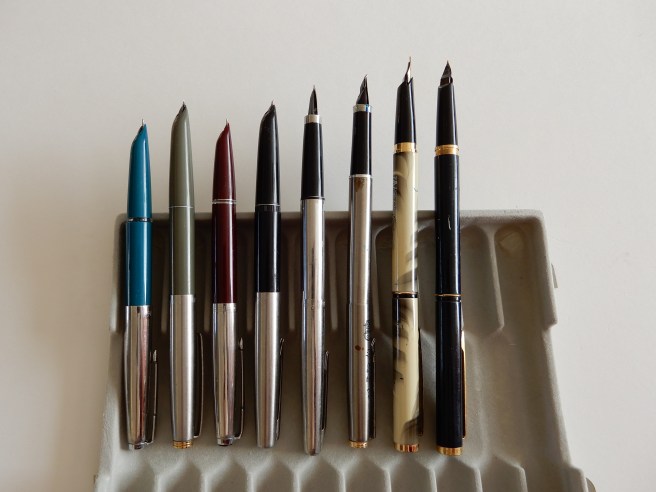
Over the Christmas holidays I have had a chance to have a play with these and try them all out. All were Chinese made pens, all with steel nibs and all with the Parker 51 Aerometric style (squeeze bar) filler. Four of them are what I loosely call Parker 51 copies, with the distinctive hooded nib, resin barrel and section and a metal cap. It is perhaps not correct to describe them as copies since they are unashamedly branded as Hero pens of various models and not all even have the arrow clip. However the origins of the design are unmistakable.
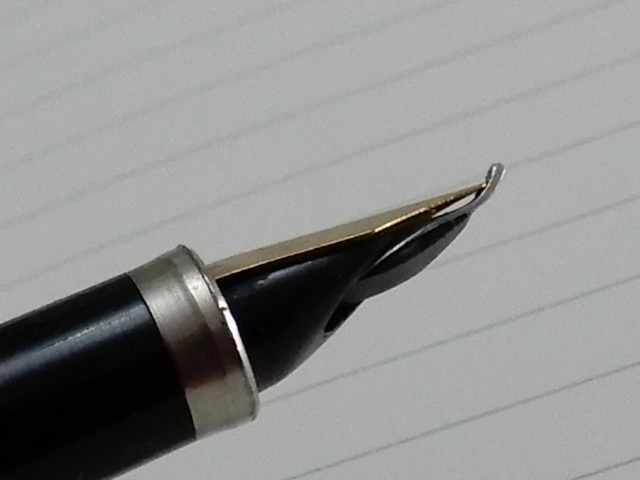
Then there were two metal pens, one being a Hero 443 in chrome finish with black section, the other a brushed stainless steel pen, with an attractive light blue reflective inlay and a letter “Y” on the pocket clip and an interesting looking curved nib. I do not know the make.
The final two were a pair of lacquered metal pens one cream coloured and one black, bearing the name Jin Rong.
I uncapped all the pens, posted the caps (taking care not to get the caps mixed up), unscrewed the barrels then took them all to be washed. With a sac filler, you do not immerse the sac in water but just the nib section and then operate the squeeze bar a few times to flush water in and out of the pen until the water runs clear. I was pleased to find that they all produced a small stream of air bubbles when I squeezed the bars, which I took to be sign that the sacs were air tight. Furthermore, all were clean. It was good to know that uncle had washed the pens before putting them away. Only the burgundy model produced a pale wisp of red ink in the water. This made me smile. So uncle also matched his pens and inks. I do that too. Perhaps this one had been used for marking school work.
After flushing and drying them all, I then tried dipping and testing each of the nibs and writing a few lines, to see which might be usable. I used Waterman Serenity Blue ink. All of them wrote although they tended to be firm, feedbacky and not the smoothest of writing experiences that money can buy. But I was pleased that they all at least wrote and could be used.
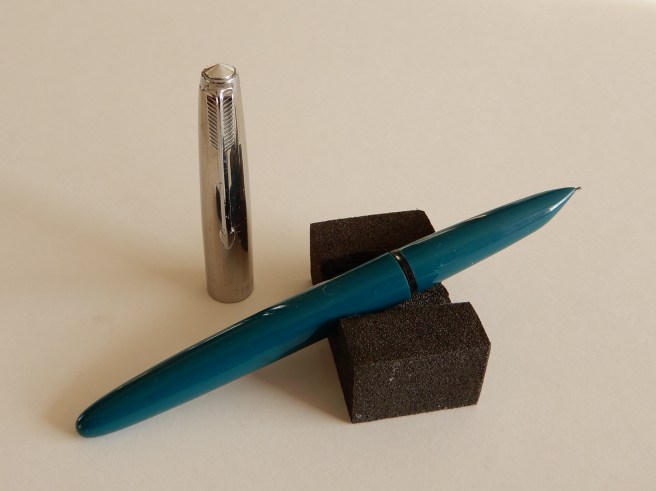
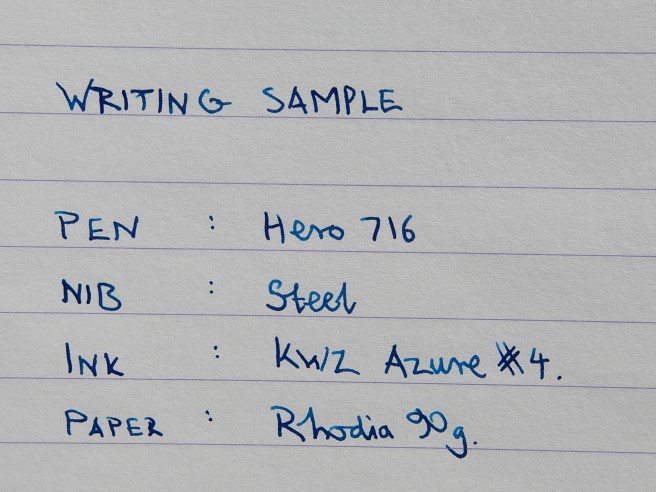
I have since chosen to ink the teal Hero 716 and the stainless steel one with the curved nib both with KWZ Azure #4.
The curved nib pen is rather unusual. At first glance, the nib appears to be a gold coloured piece of metal with a fold down the centre. On closer inspection, this is not the bit that does the writing. Beneath this sits the stainless steel nib, with the tip curving upwards at about 45 degrees and beneath it, the feed unit. The gold coloured part serves to stop the nib from bending upwards any further. Perhaps it might also serve as an ink reservoir since there is a gap between it and the nib, if you are using this as a dip pen.
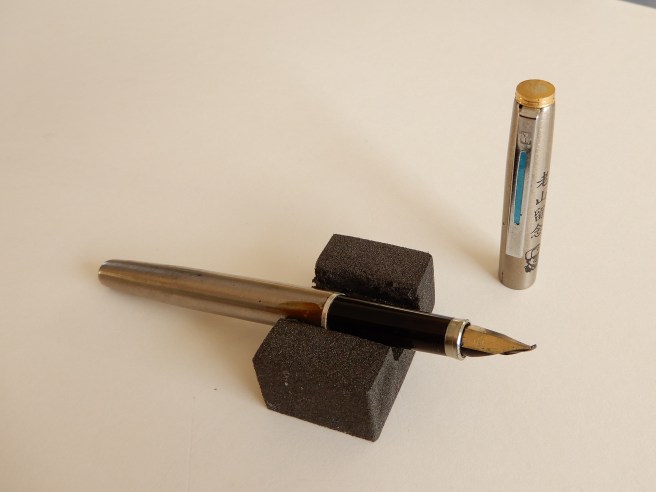
This nib produces a fine line on the downstroke and a broad line on the cross-stroke. This is rather unusual and is the opposite of what you get from a stub nib. This is similar to the writing experience from an “architect grind” nib. I found it fun to try although it takes a bit of experimenting to find the correct angle at which to hold the pen. Also, I need to write a little larger than usual to avoid loops all being blocked in.
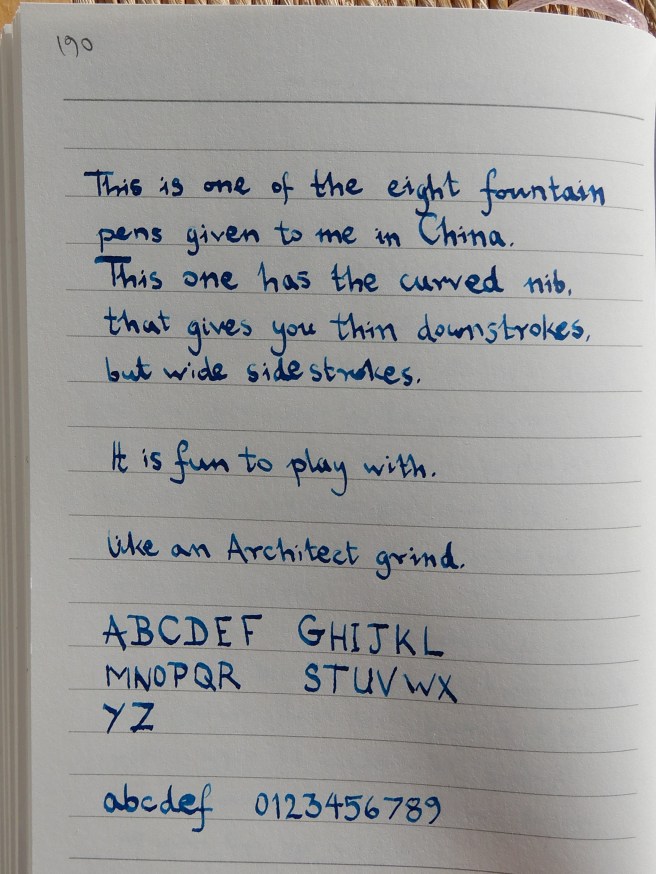
As for the teal Hero 716, I am enjoying it, particularly with the KWZ Azure #4 ink that seems a good match for the pen. My only reservation would be that the sac did not seem to be drawing up much ink. Perhaps the breather tube was blocked or the rubber sac had insufficient vacuum-pulling power when resuming its shape. Next time I will try to measure the ink up-take.
It is a pity that original Parker 51s are no longer made and that you can no longer visit a local stationery store and purchase a brand new one with gold nib, but times have moved on. Fortunately, used models can readily be found at pen shows. I am told that the original aerometric filler sacs rarely have anything wrong with them, although if need be, the sac can be replaced.
It is rather old fashioned nowadays in this digital age to be using a fountain pen at all and particularly to be filling from a bottle with a squeeze bar. But as we know, this is all part of the joy of fountain pen ownership. The satisfaction of filling a pen from a bottle more than makes up for the inconvenience. For me, anyway. I will enjoy picking up one of uncle’s old pens to use from time to time, along with my other pens. Thank you uncle. I will take good care of them.
 Fountain pen blog