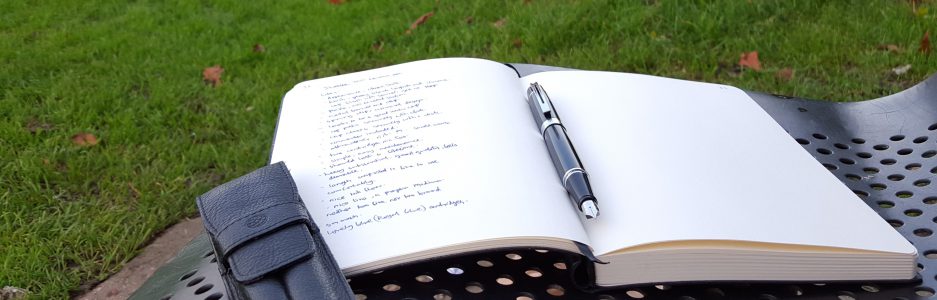
Inky pursuits: January 2024 round-up.

Inky pursuits is my series of occasional posts, gathering together some of my recent pen-related shenanigans which might not otherwise be blog-worthy stories on their own.

Duke 551 Confucius update.

This was my only new fountain pen acquisition in an otherwise dry January. I am enjoying it immensely although it takes a bit of getting used to. The size and weight are like nothing else in my pen cup. I love the look and feel of the natural bamboo wood of its barrel. I read in the Amazon description that this is Golden Silk Bamboo, whereas the Duke 552 is said to use Golden Stripe Bamboo which looks darker and more exotic.

I need to correct one statement made in my recent early thoughts post on the 551, where I said “It is not a zoom nib and there is not an easy way to get a medium width line between these two extremes.” With a little experimenting, I found that by lowering the angle at which I hold the pen it is actually very simple to get progressively broader lines, until you end up with the entire flat part of the nib on the paper, giving a line about 4mm thick. It can fill a row, in my Stalogy 4mm grid paper journal. Also, the twin slits/three tines nib ensures that the flow keeps up with demand: even when repeatedly laying down lines of the maximum width.

A sample of line widths from this fude nib.

Montegrappa Blue Black ink.

The pen drew much interest when I brought it along to our January pen club meet. I was asked about the ink in it, Montegrappa Blue Black. I had bought a bottle in Selfridges in 2018, when buying my Montegrappa Fortuna:(that was a good day!). I had not used the ink much, feeling that the colour was a bit light, and preferring my Diamine Tavy blue black. Now, six years on, I find myself liking the Montegrappa ink more and am glad to have kept it. Unfortunately, it appears no longer available as I have not been able to find any online. However there will no doubt be many close equivalents from other brands.

Montegrappa Blue Black ink.

The London Fountaineers pen club.

As mentioned, we had a monthly meet up recently. As always, I got to try lots of different pens and inks. Looking back at my notebook, one of the stand-out pens for me was a Pilot Custom 743 with a number 15 size “SU” (stub) nib, in 14k gold. It was Bryan’s pen and was inked with Yama-budo (I think: I didn’t write that down) and felt absolutely lovely, being very narrow for a stub, and highly enjoyable for ordinary writing.

Having said that, I am still very pleased with my new Pilot Custom Heritage 912 with its number 10 size Waverly nib. As a reliable pen, with a fine nib, loaded with a blue black ink (Pilot) with some water-resistance and a nib that copes with all types of paper and writing styles, it is a very useful tool.

One of my pen club friends, a former calligrapher, gave me a huge stash of William Mitchell dip nibs, all left-foot obliques but in a variety of widths. There must have been over a hundred of them. She also gave me a couple of mapping pens – very fine dip pens, with the nib fixed in a plastic housing which can be removed from the holder and put back the opposite way around, for ease of carrying. I had never seen one before. They will be great to include with a travel kit. I am most grateful!
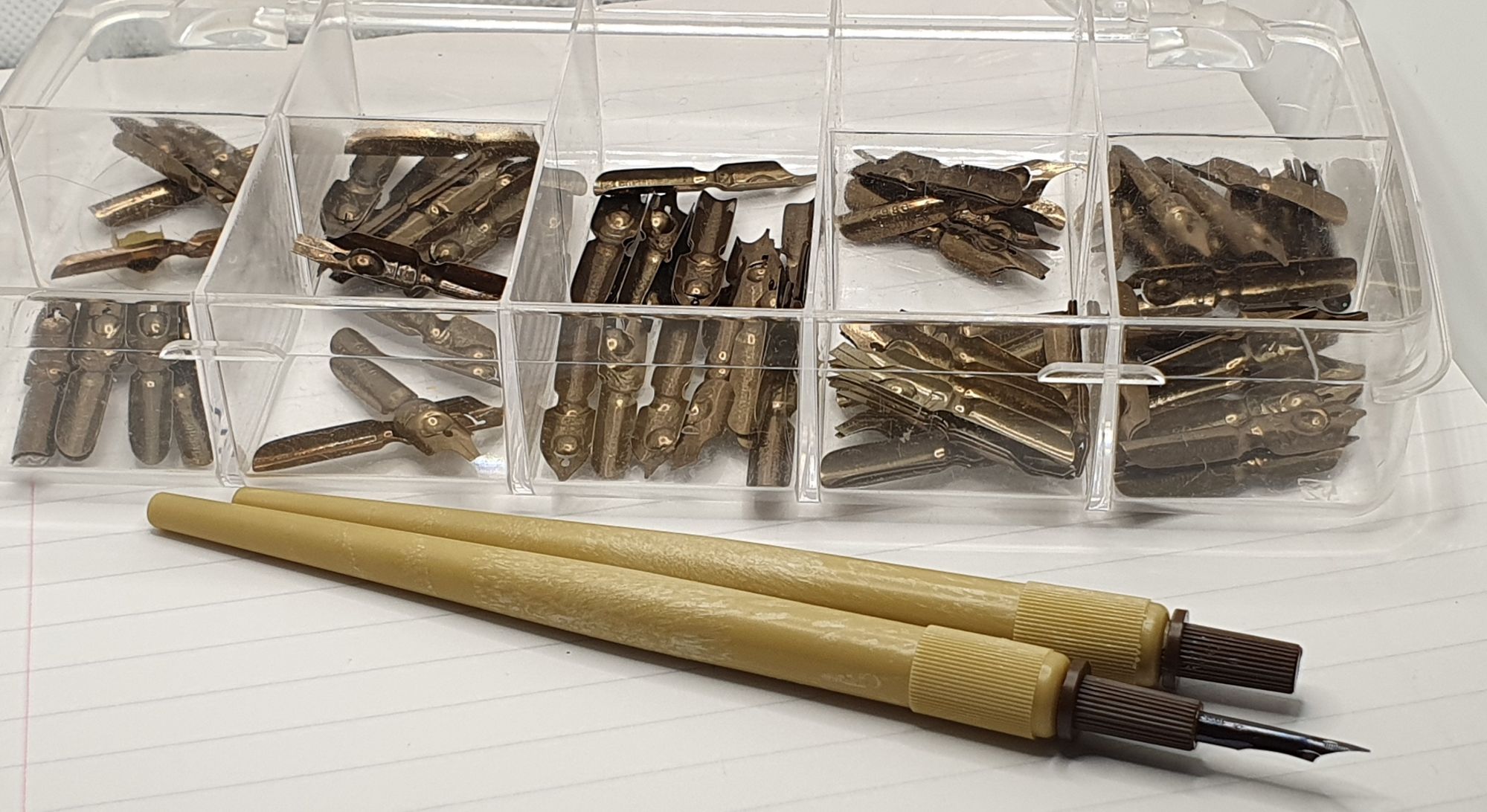
A hoard of oblique nibs comes my way!

One of the ladies, Kim, brought along an old Parker 45 that she had been given, that was hard-starting and blobbing. I disassembled the nib and feed and was able to replace them in better alignment, which I hope was all it needed. The pen filled ok, with her Waterman Mysterious blue. I was able to give her the good news that her nib, which she had thought was steel, was actually 14k gold and that the “X” on the underside of the housing signified “extra fine”.

Inkcoming.

Whilst in Central London to accompany my wife on some errands recently, we made a short detour to the lovely Choosing Keeping, where I bought two bottles of Pilot Iroshizuku ink, in syo-ro and asa-gao, both of which had been on my radar for some time. I also picked up a couple of boxes of Kaweco cartridges (Ruby Red and Smokey Grey), this being one of the few places in know of in London where you can buy such things. Ruby Red lives permanently in my Online Campus Fluffy Cat pen.
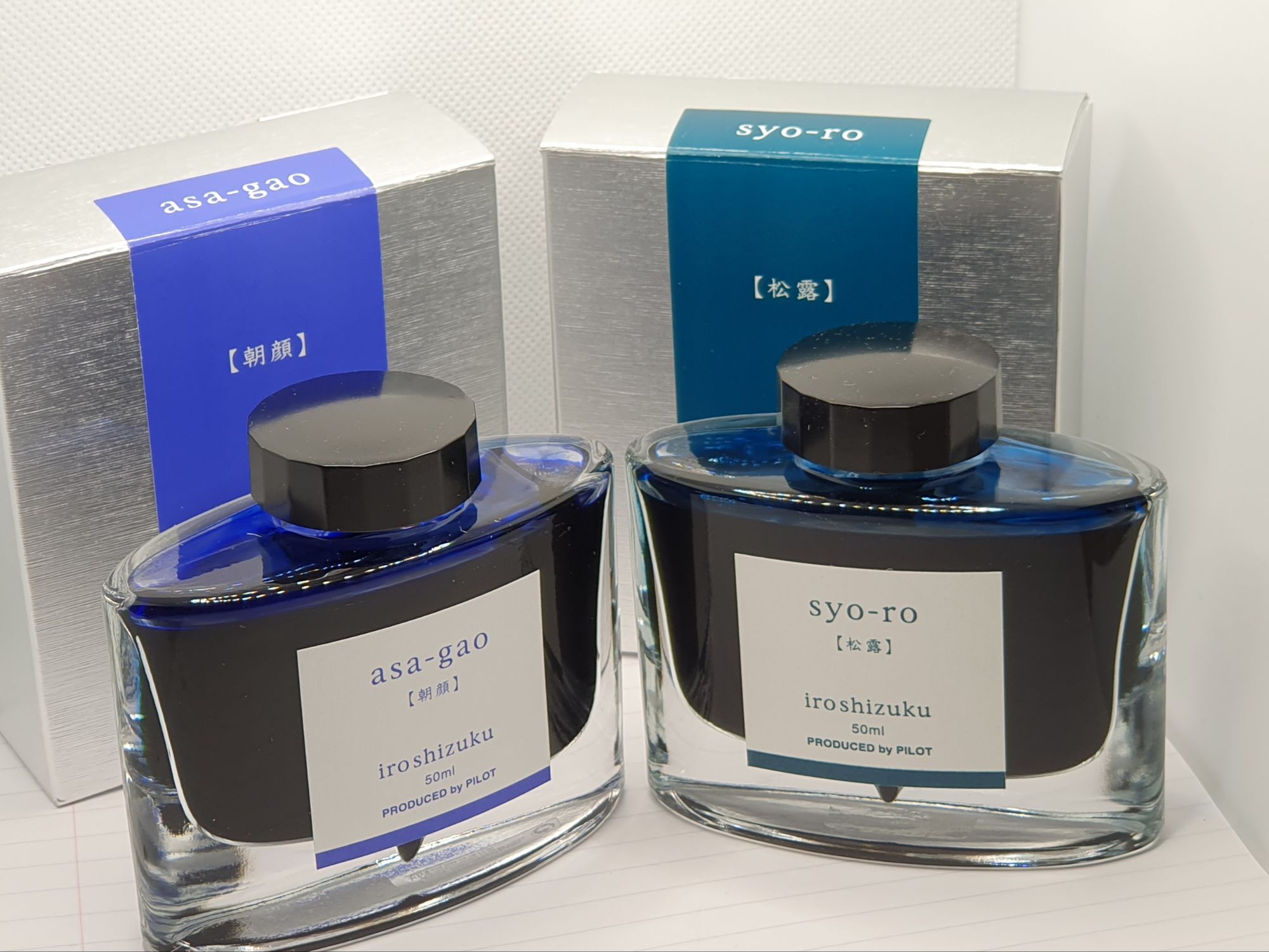
Two inks from Choosing Keeping.

Mark Twain goes Titanium.

In March 2023 at the London spring pen show, I bought a Conklin Mark Twain Crescent Filler, in black with rose gold fittings and a black-coated nib. Unfortunately the nib proved rather too wet for my liking and I did not succeed in adjusting it much. At a recent pen show, I had bought a Titanium nib set in an ebonite housing and feed. The housing was not compatible with the Conklin unfortunately and I could not find any other pen that it would fit and so it sat idle.

That is, until last week. I decided (just around midnight when I should be going to bed) that I could extract the Titanium nib from its housing and swap it into the Conklin. Removing the two nibs to carry out the transplant, proved harder than I had expected as they were both VERY tight in their housings. I had to resort to gripping the housings with pliers (copiously wrapped in kitchen towel) and at last they came out.
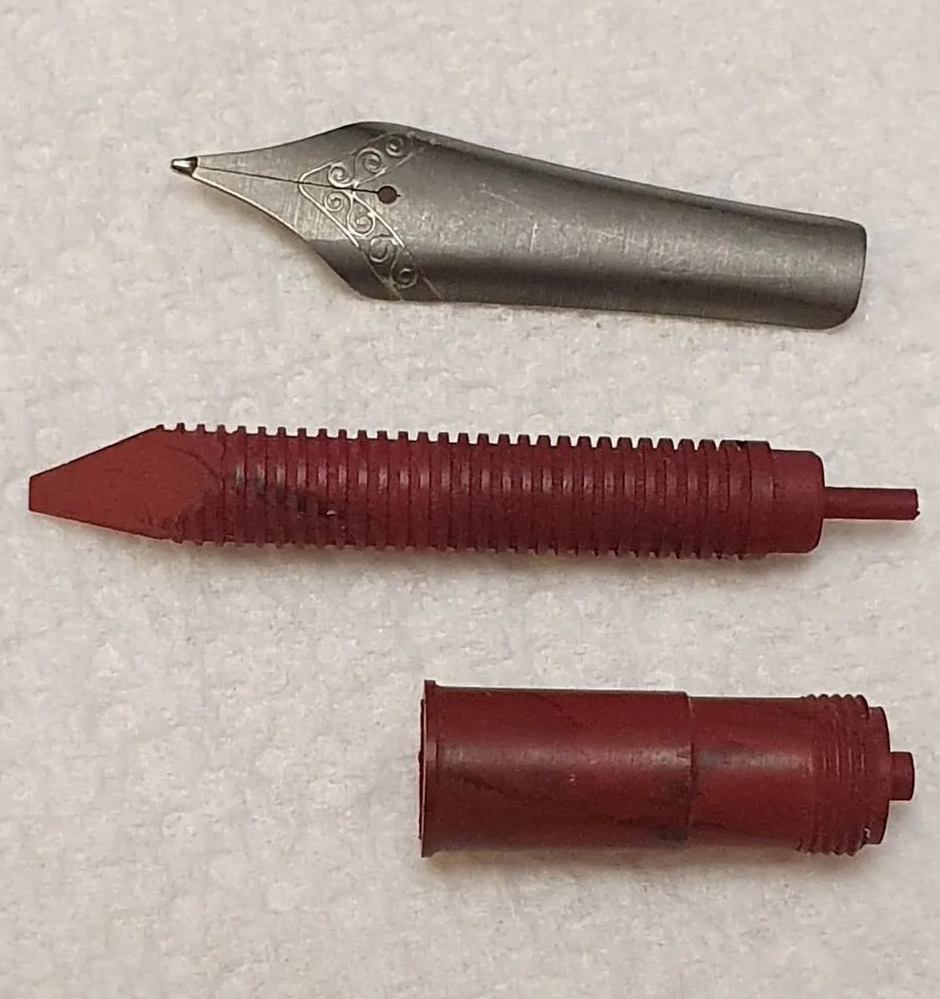
I was able to use this Titanium nib, but not the feed and housing.

I was rewarded with a much improved writing experience with the Conklin. I filled it with Parker Quink Black. I am using it as my journaling pen for February. The only slight issue is that the shoulders of the nib just touch the sides when I screw the cap on. However this is only slight and the nib seems un-affected. I could try bending the shoulders in but fear that it would risk distorting the tines or ruining the nib’s symmetry and so I will leave it alone.

I am much happier with the Conklin now.

All in all, the year finds me with a deep sense of gratitude, for the joy of this hobby and the friendships that it brings. Recently, I cleaned two large batches of pens and reduced my currently inked number to twelve. Right now, I want for nothing more in my pen collection and so a dry February looks on the cards. I cannot make any promises when the pen show comes to town in March, but it is good to keep an open mind.

Early thoughts on the Duke 551 Confucius bamboo fude nib pen.

As early thoughts go, today’s are even earlier than usual as this lovely pen has been with me for barely 24 hours. However, my first impressions are very favourable: the quality and finish and the sheer fun that you can have with it, exceeded my expectations.

Duke 551 Confucius, bamboo fude nib pen.

This model has been around for several years now and I am informed by artist Terry Christopherson (Instagram @theTravelSketcher) and of peninkandpaint.com that it is big in the urban sketching community. I was already familiar with another model that I reviewed previously called the Duke 552, also featuring a natural bamboo barrel. I had imagined that the 551 would be similar, but with a fude nib and a more decorated cap. It turns out that they are quite a bit different.

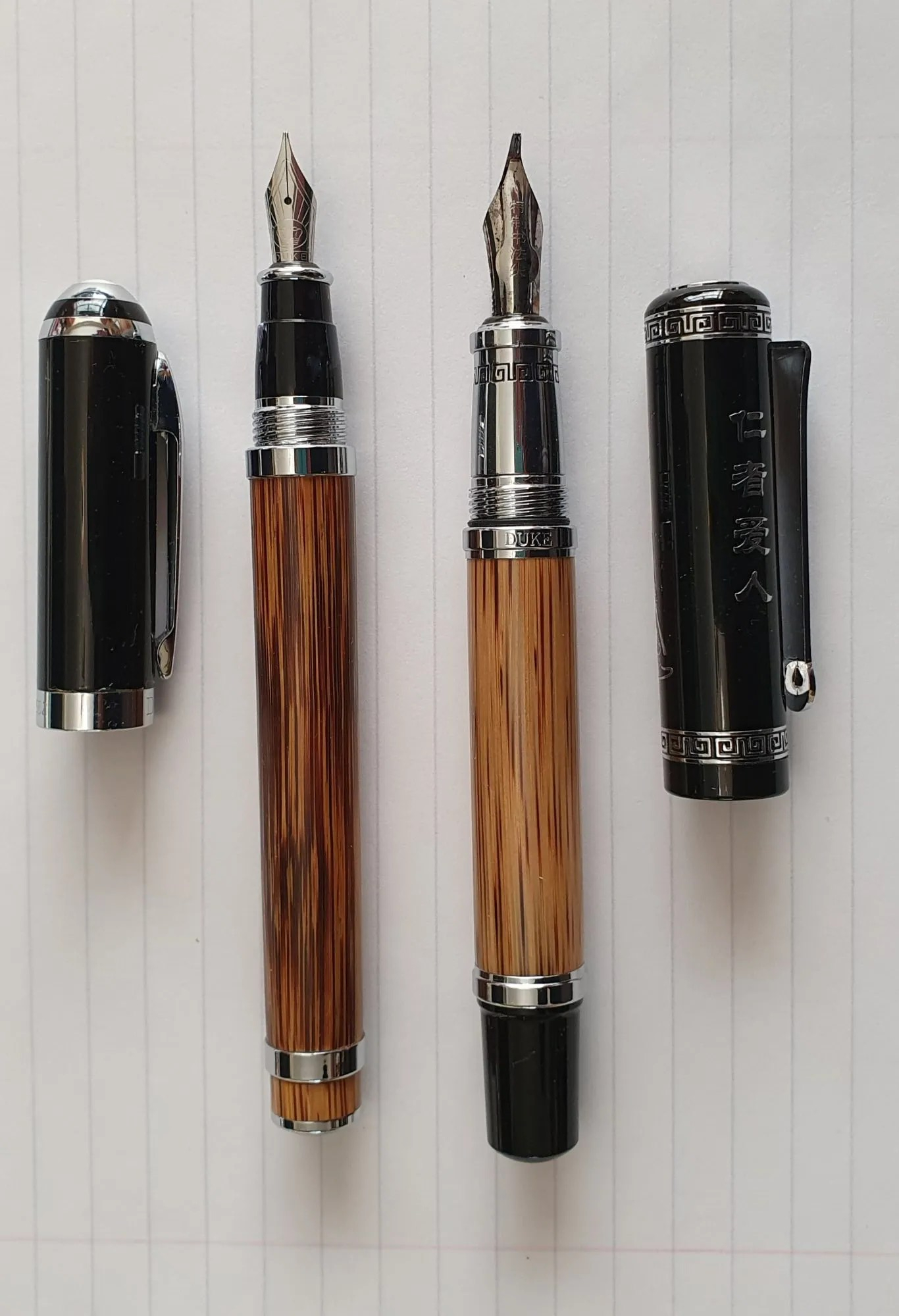
Although the 551 is similar in length and has a similar look of bamboo barrel, black cap with silvertone furniture, it is girthier, heavier, has a much bigger nib and a section which is longer and made of metal. The differences are apparent when the two models are seen side by side.

Duke 551 fude (right) with Duke 552 (left)

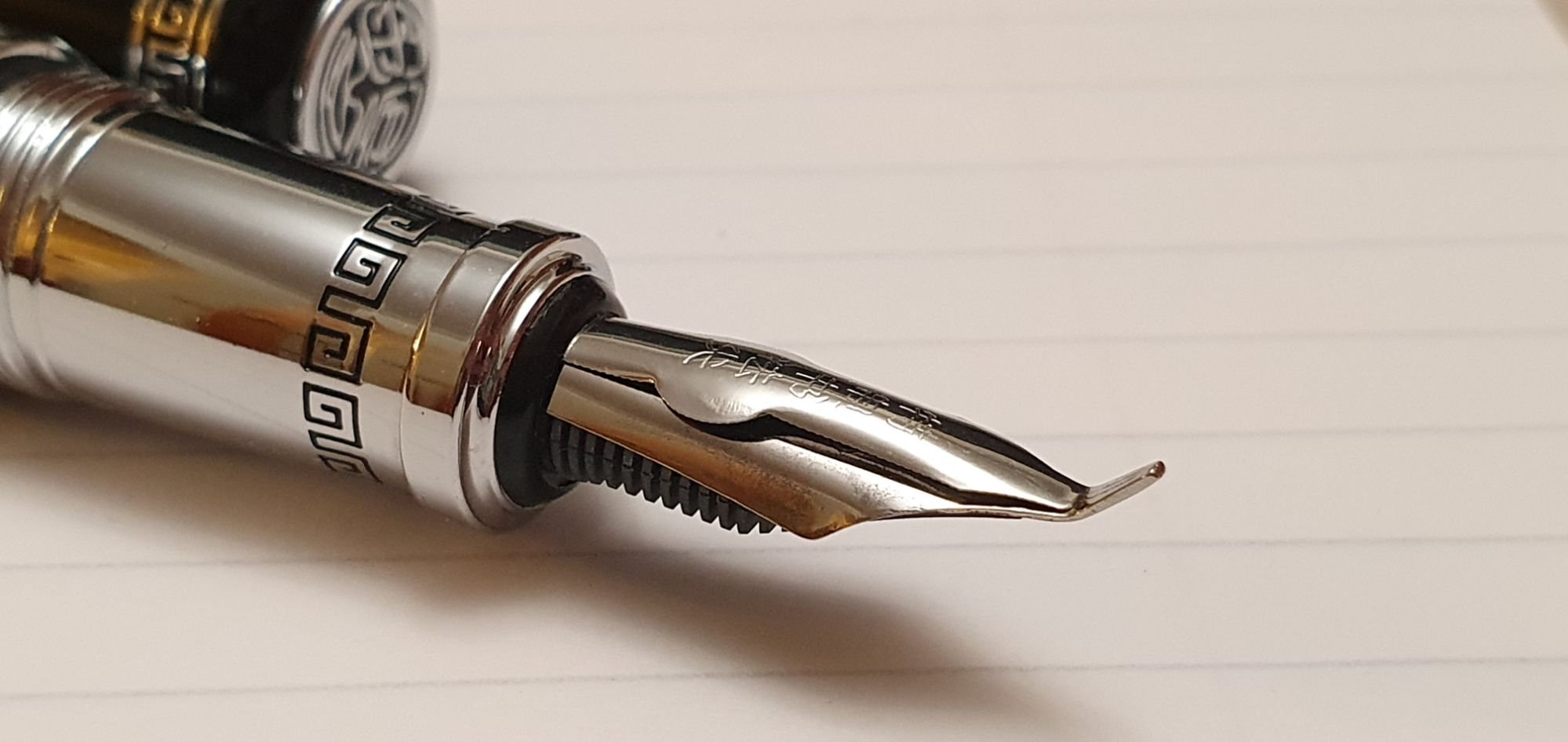
However, the main difference and reason to buy the 551, is for its amazing, steel fude nib. The nib looks quite alarming at first to anyone not expecting it. The tip is angled upwards, at about 45 degrees and presents a flat surface approximately 4mm long, to the paper.

The three tine, steel fude nib with fitted ink reservoir for when dipping.

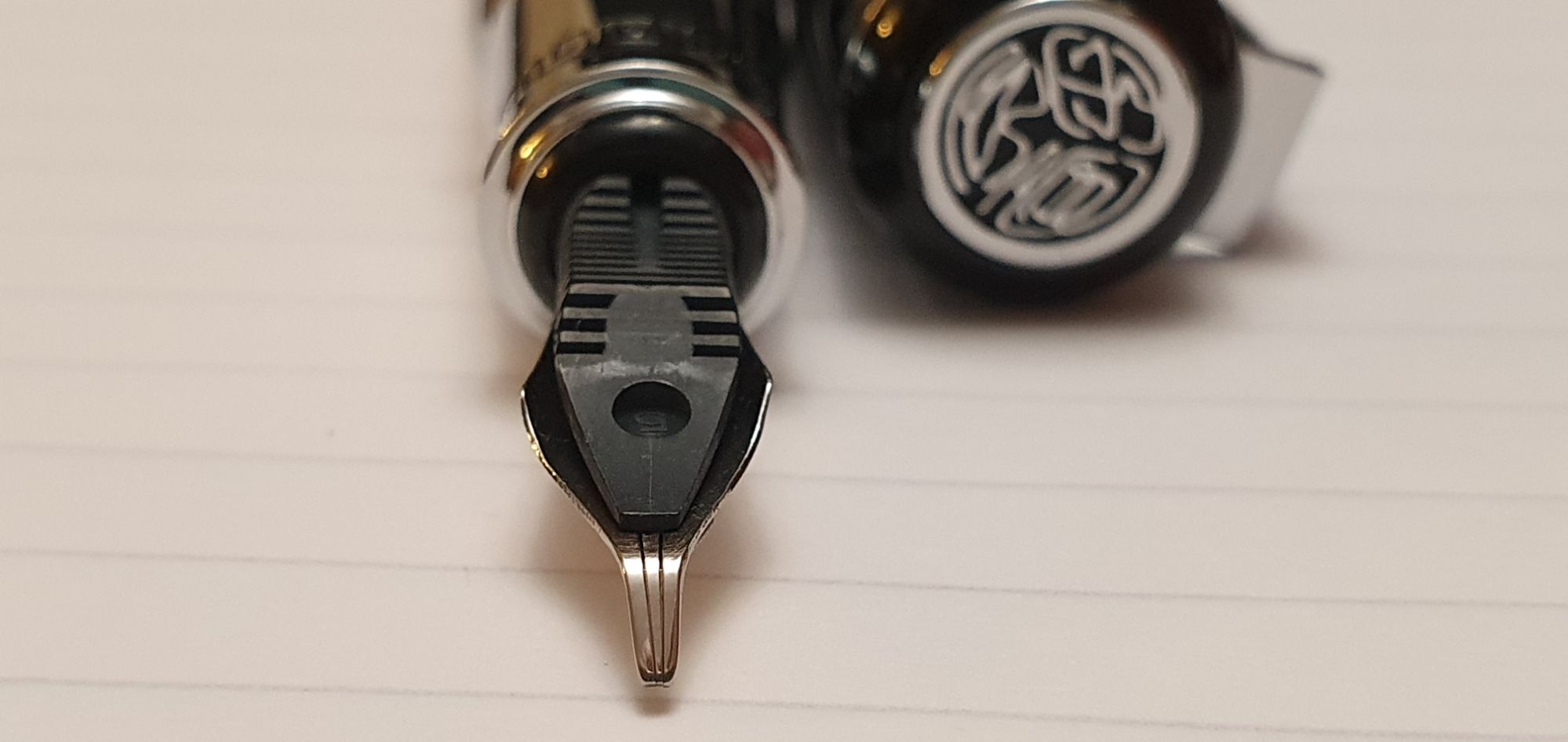
What I had not fully appreciated before the pen arrived, were two other special features of this fude nib, namely that it has two slits for improved ink delivery and an ink reservoir on top of the nib, so that when used as a dip pen, it needs dipping far less frequently. There are some Chinese characters on the nib, which my wife translated as “special calligraphy nib.”

Smooth nib with three tines, like some music nibs.

As well as its dip pen suitability, it is also a cartridge-converter filler and is supplied with a push-in converter. This contains a small coil of metal to serve as an ink agitator, which can be useful. However I saw in a YouTube video review by @chrisrap52 that this little spring does make it harder to flush the converter thoroughly when changing ink colours and he prefers to remove the spring, by unscrewing the metal collar of the converter.

A Duke branded converter is included.

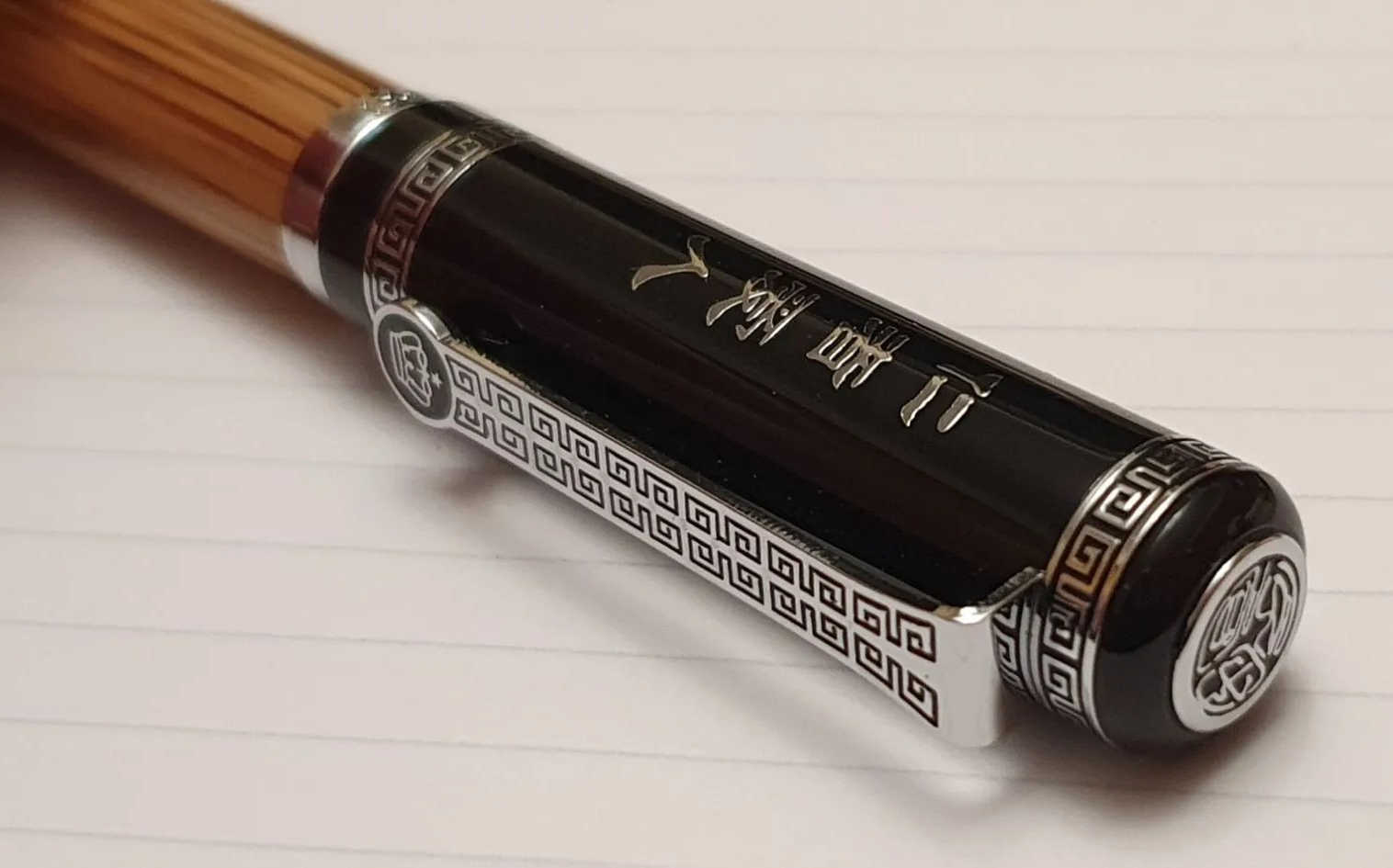
The cap features an engraving of Chinese philosopher Confucius on one side and more Chinese text on the other side. My wife translated this, approximately, as “A kind person loves everybody” which is part of a Chinese saying which continues “and everbody loves him.” There is a nicely decorated finial, a very stiff and strong pocket clip culminating in the Duke crown emblem and decorated metal rings at both top and bottom of the cap.

The cap unscrews in just over one full turn. When screwed on, it meets a rubber O ring, giving a reassuring tightness to the cap. It also makes for a good seal and, from other reviews I have read on Amazon’s site, the nib does not suffer from drying out although I have not had my pen long enough to put this to the test.

Lots going on with the cap too.

I very much like the natural bamboo of the barrel. I think the inside of the barrel may be lined in metal here, and it feels heavier than the Golden Stripe Bamboo barrel of my Duke 552 (23.5 grams as opposed to 16.5 grams).

I do not generally get on with shiny chrome sections, as they can be slippery to hold. However this one is of a substantial size. It tapers slightly towards the nib where there is some engraved ornamentation and then a step up at the end, to stop your fingers sliding onto the nib.

From my initial trials with this pen, I have not found the section to cause difficulty in holding the pen securely. I can keep my thumb on the bamboo barrel for better control. However, I am finding that where the pen rests on my middle finger, the step does feel a little uncomfortable and so it is necessary to draw your finger back from it slightly.

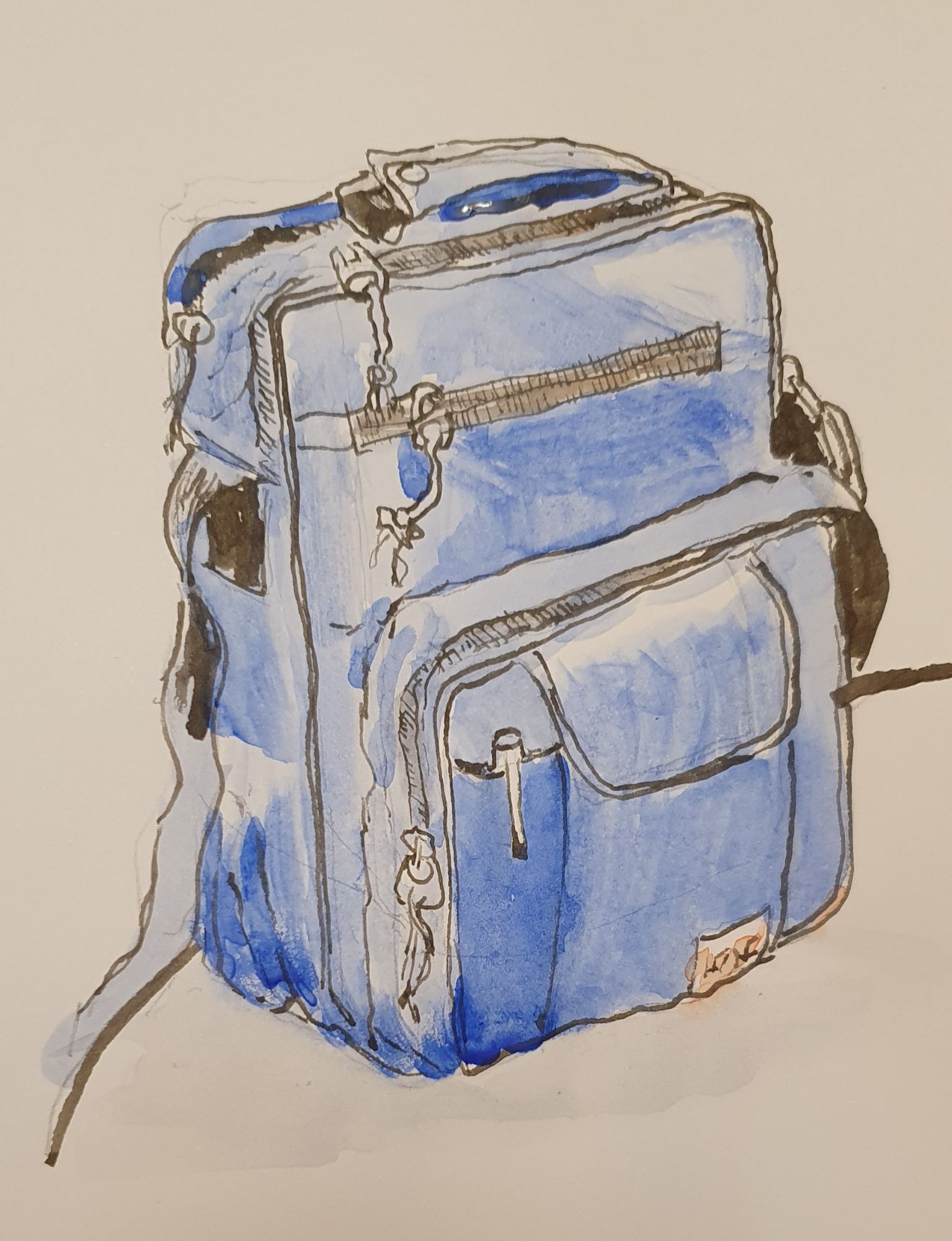
So how does it write? I was very excited to find out. After flushing the nib and feed and the converter, I filled the pen with Noodlers Black, a water resistant ink that would allow me to paint over the ink, once dry, with watercolours without the ink smudging.

The nib is very smooth, as I have read in other reviews. The twin slits, like a music nib, provide a more generous flow of ink to the nib, which is needed when making side strokes with that long fude nib. It covers large areas at a single stroke. It would be great as a redacting pen, for hiding confidential text from a document before disclosure.

The fude nib is designed for calligraphy, allowing for fine lines to be drawn with the tip or very broad strokes with the flat part. It is not a “zoom” nib and there is not an easy way to get a medium width line between these two extremes.

In the right hands, the pen would be great for sketching, as the line width extreme variation, and ease of blocking in areas of colour, are a real benefit. Mine are not the right hands to demonstrate this properly but I enjoyed trying.

My man bag: Duke 551 fude, Noodlers Black ink and watercolours.

As for normal writing with this pen, it is possible but in order to get a fine line, the pen needs to be held upright at a steep angle, as you would for a ball pen. If the pen is allowed to lay back towards a more typical fountain pen angle, the line will be much broader and, with a 4mm line, you would need to write very large letters to avoid all the loops being filled.

It is very early days but already I am enjoying my experiments with the fude nib. It will get through a converter of ink quicker than most pens, particular if used for drawing and blocking in large areas. Before refilling it, I am keen to test out its built-in nib reservoir in dip mode.

Duke 551 Specifications:

  • Length capped: 147mm
  • Length uncapped: 132mm (I am very happy with this)
  • Length posted: 182mm
  • Weight (total) 64 grams (compared to 40 grams for the Duke 552)
  • Weight uncapped: 37.5g
  • Weight, cap only: 26.5 grams

Well, so much for my New Year pen-buying abstinence once again. I made it all the way to 18 January 2024 this time. But then this pen is quite an exceptional piece of kit and I am unrepentant.