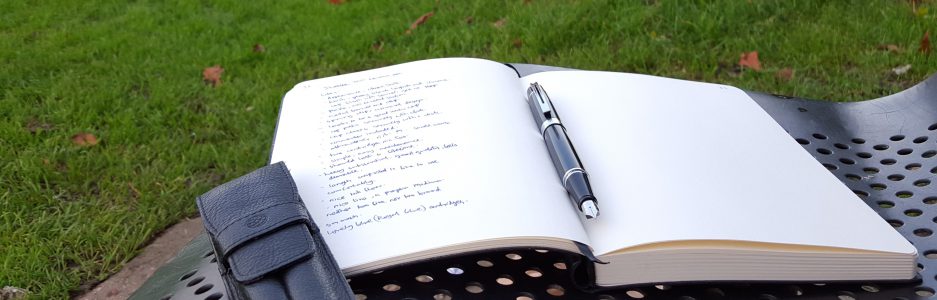
Ashera Aeon update: unexpected consequences.

Last month I posted a review of the Ashera Aeon fountain pen. The pen had been sent to me on loan, to try out (for as long as needed to familiarise myself with it) and then to review and return to Ashera in Germany. All very normal, you might think, except that in my case in eight years of pen-blogging, this was the first time that I had entered into such an arrangement.
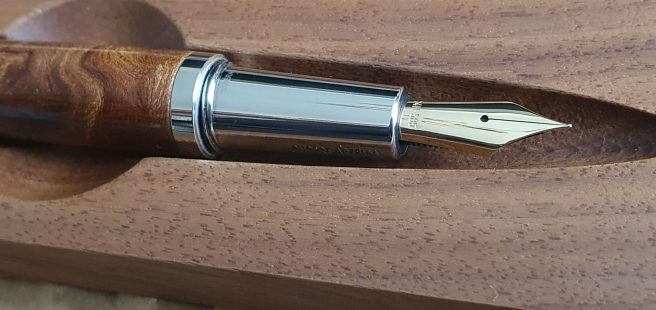
Ashera Aeon.

After my review had been up for about three weeks, I thought that it was probably time to get the pen back to Ashera. I dropped them an email to check a few details and also enquired on what terms they might be prepared to sell the review pen to me. I received a warm and friendly reply. Indeed, all my correspondence from Ashera has been courteous and friendly and it has been a real pleasure dealing with them. They had considered my suggestion and offered me a generous discount, if I wished to buy the pen.

At this point, my wife reminded me, fairly emphatically, that I already have more than enough fountain pens for her to deal with after my demise and that another pen was the last thing we needed. Accepting her line of argument, albeit under duress, I replied to Ashera’s email and reluctantly declined their kind offer.

That could have been an end of my Ashera journey. However I was not prepared for quite how bereft I felt in the following few days. Whilst the pen was with me, I had used it at every opportunity with many different inks and read all I could find about it, to write an informed review. The pen was like nothing else in my collection in many ways – its hand polished wood body, its long tapering profile (reminiscent of a desk pen or art pen), its titanium grip section and the unsigned 14k gold nib from Bock. From showing the pen and its wooden box/pen tray to friends I was familiar with potential danger areas: “Be careful – the box lid is held on by magnets; yes it’s a screw-cap; no, don’t try to post it; be careful screwing the cap back on” etc. My review pen, having the elm burl wood body, has a very pretty grain although there are numerous small “holes” in the grain of the cap, seen by shining a light from outside the cap, whilst rotating the cap and peering inside. These all have to be filled when the wood is lacquered and polished, one reason why the elm burl version costs more than the holly or olive wood models.

I felt that I may never have such a good opportunity again, to buy such a high quality pen with the luxury of testing it first, for some two months! Knowing the pen so well, it almost felt as though I should write some care instructions for its eventual owner: “It likes Pilot Iroshizuku asa-gao and Stalogy paper” and “Don’t let it roll off the table!”

Around this time, I went to see Wagner’s opera “Die Walküre” from the Ring Cycle. In the protracted scene when the God Wotan expresses his emotion at having to banish his favourite but rebellious daughter, Brünnhilde, I could think only of my own, imminent separation from the Ashera (a Goddess in ancient Semitic religions, associated with sacred trees). In short, I had a bad case of non-buyer’s remorse.

In my case, the remedy was rather simpler than for Wotan. I tip-toed onto the subject again with Mrs A, who listened to my closing arguments for the defence. After some admonishing to “learn to control yourself” etc, she conceded that, if I felt so strongly about it, then she would not stop me. I wasted no time in notifying Ashera that I had changed my mind (cough) and asked for the bank details to send payment!

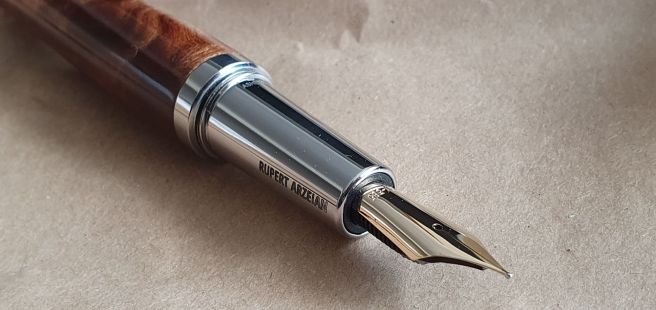
I was thrilled to receive their confirmation once payment had gone through. It was good to know that the pen was officially mine – although it does literally have my name on it!
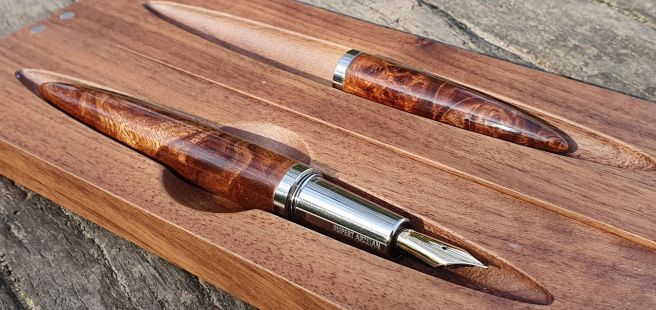
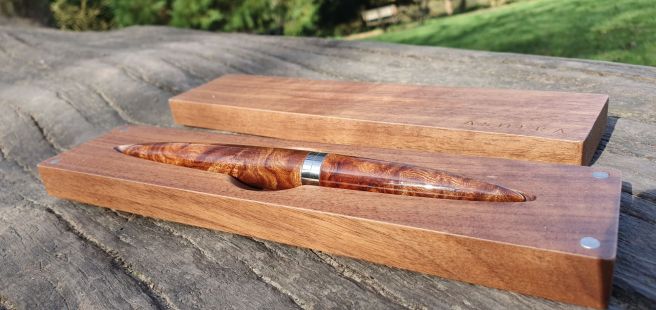
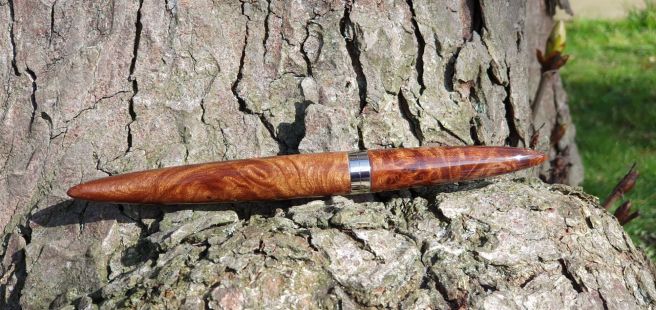
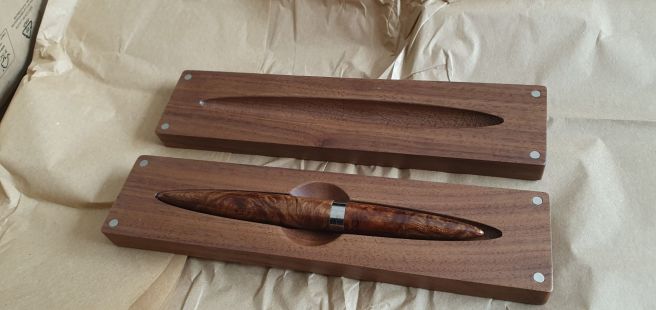
Ashera Aeon in elm burl, with its walnut wood box.

Aside from this brief, emotional roller-coaster ride, the other unexpected effect of the Ashera upon me has been to give me a taste for wood varnishing. The Ashera features a natural wood cap and barrel, turned and smoothed and then lacquered. The eventual deep gloss finish is a result of the wood being lacquered, dried and polished again and again, over a number of weeks, for eight layers. The finished pen is joy to hold with the long, smooth, cigar-like ellipsoid, interrupted only by the titanium rings flush with the cap and barrel.

This work is done by artisans and not a skill that you can acquire in five minutes. However, I found that it is possible to achieve some very pleasing results by sanding some wood and applying some varnish to it. Recently, I came across a little wooden, lidded box in a charity shop. It comprised a single tray on the bottom layer, then a separate middle layer divided longways into two further trays. It was about 13½” long by 5″ high. It was in white, bare wood and at just £10.00, I thought that it should have a new life as a pen box. I bought myself a small tin of wood varnish, (walnut, gloss) from our B&Q store and a few brushes.
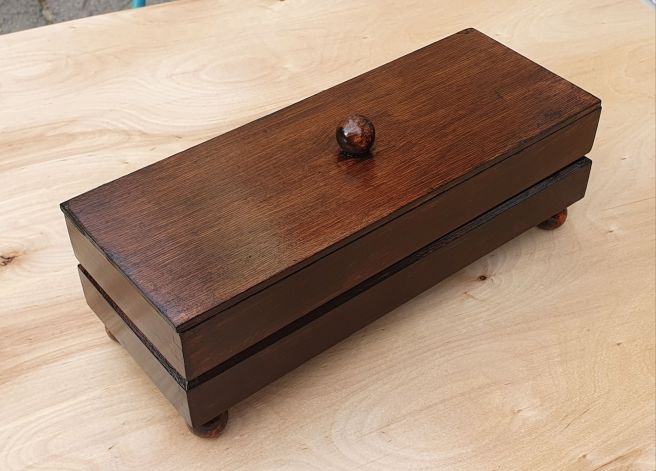
A two-layer pen box, newly varnished.

It was surprisingly satisfying and a bit addictive, to watch the box being transformed into a rather elegant, glossy dark chest. My varnish was quick-drying, and just tacky after 30 minutes and dry after 4 hours. The instructions recommended using three or more coats allowing each coat to dry before applying the next. Theoretically, you could apply all three coats in a day, but I rather enjoyed doing the varnishing late in the evening and then leaving it to dry overnight.

Once I had applied three coats all over, I added some green felt to the three trays. Rather than stick the felt directly to the wood, I stuck it to some card stock to have the option of changing these easily in the future.
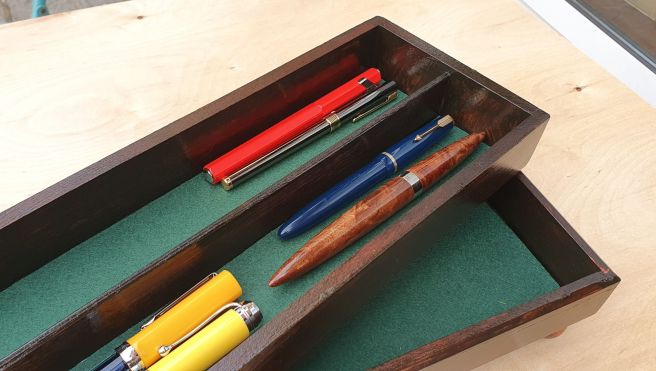
Upper deck of my pen box.

Encouraged by my early efforts, I browsed some more charity shops and found a small wooden bowl, slightly marked but having potential to be restored with some sandpaper, varnish and TLC. This was much smaller and quicker than the pen box project. I use the word “project” to keep up with my wife, who is currently embarking on a project of her own to convert her mother’s garage into a day-room or office space.

My bowl project went well, thanks. I used the same walnut gloss finish for the outside but a clear gloss varnish for the inside to show the natural wood grain. The first coat of varnish did cause the grain to rise and become rough and so it was necessary to sand it smooth again before the next coat. I am rather chuffed with the result! I did find a long crack or split, about ½” below the rim, which appears to go all the way through suggesting that the bowl might have been dropped at some time in its life. It is no longer easily visible on the inside but is prominent on the outside. A younger me might have been put off by this flaw but now it actually gives me more affection for the bowl – just as we all pick up some scars, physical or mental, as we go through life.
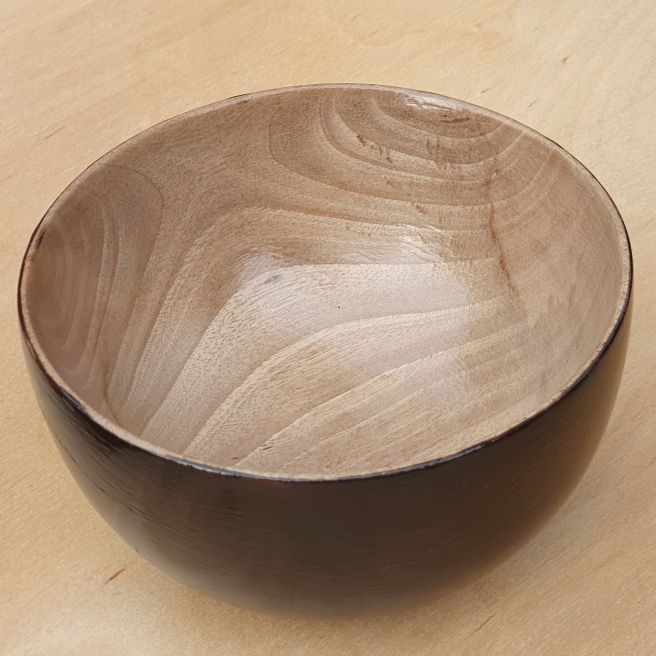
Varnished wooden bowl. (Walnut gloss outside, clear gloss inside).

Currently, I am on my third wood varnishing project! This is another very cheap knick-knack from a local charity shop, bought with no apparent wood protection and I am now advancing through my three-coats procedure. I think this may be another candidate for my self-adhesive, holly-green felt.
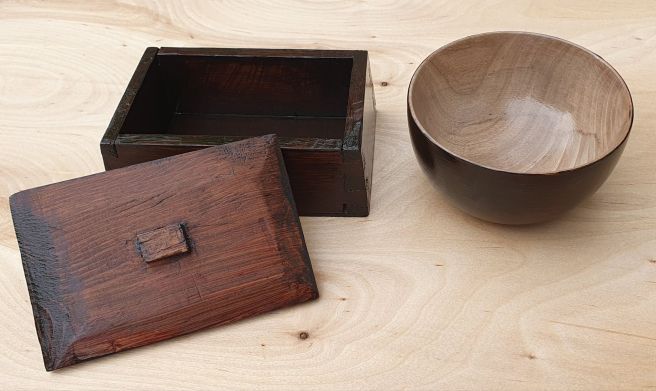
Wooden bowl (finished) and a lidded box (work in progress).

It is possible that but for the Ashera fountain pen, I might never have discovered my inner artisan (LOL). I cannot promise that an Ashera will have the same effects on everyone. I appreciate that it is an expensive pen. Even with the generous discount that I received, it was still one of the costliest pens I have bought and one of only a tiny number on which I have broken my £400.00 barrier. I am happy to report that I have no regrets and that it continues to be in daily use. I am grateful to Ashera for entrusting me with the pen, initially for a review.

For anyone reading this who is still thinking of ordering an Ashera, there is still (at the time of writing) a discount available via a link in my last post, and repeated here, which results in a 20% reduction. The link takes you to a page created by Ashera referring to a “Rupert Arzeian Edition.” This indicates to Ashera that the purchaser comes via my blog, triggering the discount and a commission. It does not mean that I designed the pen or that you have to have my name on it!

To order, (1) chose one of six wood options, (2) select either gold or platinum for the Bock nib ; (3) chose a nib width of either Fine or Medium, and (4) indicate your chosen name for the engraving. The price is then adjusted automatically, albeit shown only in US dollars or Euros at present. When you click “Add to basket”, the 20% discount price shows in the Summary. You then have the option to “Proceed to Checkout” or to delete the pen from the basket. The choice is yours.
Ashera Aeon fountain pen review.

Back in February, I received an email from Ashera GmbH, inviting me to review one of their pens. They offered to send me a pen on loan for evaluation and review. In return they offered a commission on any pens sold through my blog.

Ashera Aeon fountain pen, in Elm Burl wood.

Disclosure.

Readers will be aware that it has been my practice not to accept goods or favours from suppliers in return for a review, to avoid any suggestion that my opinion was biased in any way. Ashera understood this and asked only for my independent and honest feedback and review. After seeing their web site and reviews of early prototypes of their Aeon fountain pen, I was curious to try one. The photos of the pen looked stunning and the company’s environmental commitment was impressive and admirable.

After a little back and forth, we agreed terms whereby I may select the configuration of a pen for review and return, and that a discount of 20% be given on pens sold to readers, (available on up to ten pens) plus a modest commission for me.

Background.

Ashera introduced themselves to me as “a brand dedicated to crafting handmade luxury fountain pens that blend traditional craftsmanship with modern design.” Much can be learned from their web site, https://ashera-design.com which includes answers to FAQs.

They started making the Aeon pens in 2022. These are handmade in Germany, offered in a choice of six woods, with a titanium grip section and Bock nib in 14k gold or platinum (fine or medium). Production is limited to 999 pens in total.

The company has been most helpful in clarifying a few points that I raised. Their web site is being updated and contains a few inconsistences. For each pen sold, the company now plants 250 trees (not 100 as stated at the time of their video clip). The trees are planted via Ecologi. Ashera might add details of specific projects and sites where the trees are planted.

The unboxing.

I was aware from the website that the pen comes in a wooden box. In my correspondence with Ashera, I suggested that they send me the review pen without the box to save on shipping costs each way. I am glad that they chose to disregard this request. The box is beautiful, although it now differs from the one on the website. The pen is supplied in a fully custom-built walnut wood box, smooth and tactile with a satin finish. It comprises two slats with a milling inside that fits the pen perfectly and magnets in the corners to hold it closed. The two parts have a cutaway, to display the pen or prevent it from rolling, which it would do. In the lower half, this cutaway is intersected by a hemisphere space for thumb and forefinger to pick up the pen. This creates a satisfying geometric meeting of curves, although the pen can also be scooped up easily from either end.

Walnut wood box/pen tray.

The box lid bears the name ASHERA engraved on the top, as well as another pen rest. This is a box which is attractive and useful and genuinely adds value.

I took the pen and its box along to my pen club. There was universal acclaim for the walnut wood box, the magnetic closure and then for this extraordinary pen, with its stunning lacquered wood grain and long tapering contours, nestled in its custom box.

Ashera Aeon and accompanying box.

Initial impressions.

My review pen is of Elm Burl which features a lovely swirling wood grain. Each pen is unique. The finish is high gloss and super-smooth as the process involves lacquering, drying and polishing the pen eight separate times, over a few weeks. The prices of the pens vary according to choice of wood and nib material, my chosen sample being about mid-way in the price range. I was drawn to the Elm, as they were common in Middlesex where I grew up although I remember many being lost to Dutch Elm Disease in the 1970’s. The wood for the pen actually comes from a burl, or burr, which is the gnarled, rounded, growth on a tree typically found on the trunk or branches and formed as a result of stress which the tree experiences. I can relate to that.

Barrel and section.

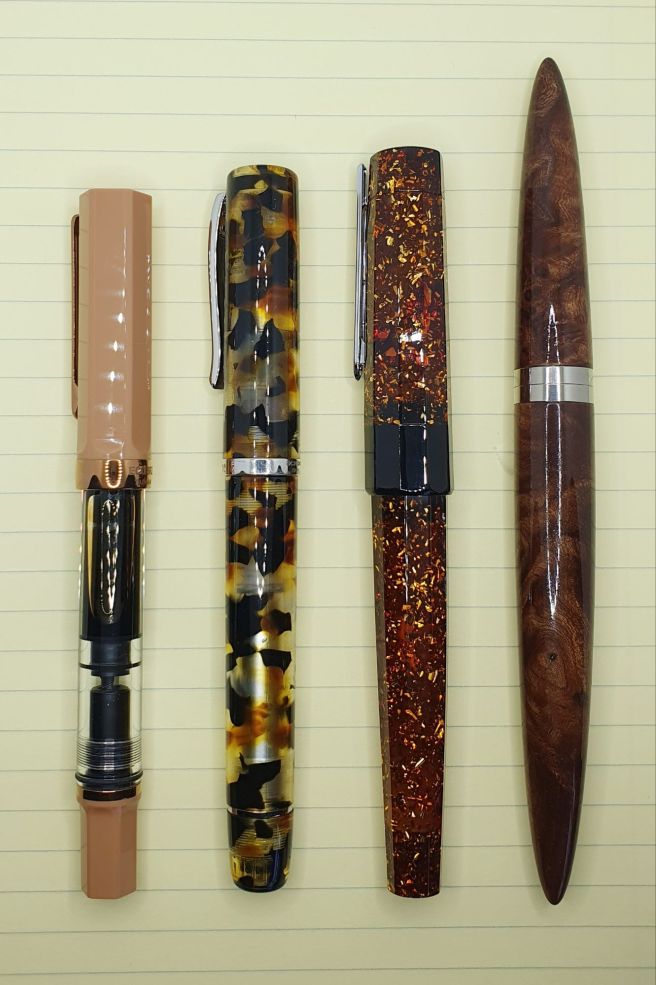
At first sight, the length of the pen is also striking. My sample is 17.2cm capped, although since these are handmade, there may be a little variation. (The length of 18cm, shown in the website is slightly overstated, although the cut-away in the pen box is that length).

Aesthetically, the pen is very pleasing. The shape is an ellipsoid (a three-dimensional ellipse). The cap and barrel, ending with titanium fittings, are completely flush when the pen is capped. The cap meets the barrel 7cm from the top of the pen, which is around 40% of the total length of the pen. Whether this has any place in sacred geometry I do not know, but it distinguishes the cap from the barrel. All threads and rings on the cap and barrel are titanium.

Uncapping the pen, on triple-start threads, requires only about 40% of a turn (as measured with a yellow post-it note!). This reveals the long metal section. This is solid titanium, not plated but mirror-polished. The website states “The feel of the titanium offers a sense of solidity in hand, and the mirror polish, unexpectedly, ensures a steady grip with minimal grip pressure required.”

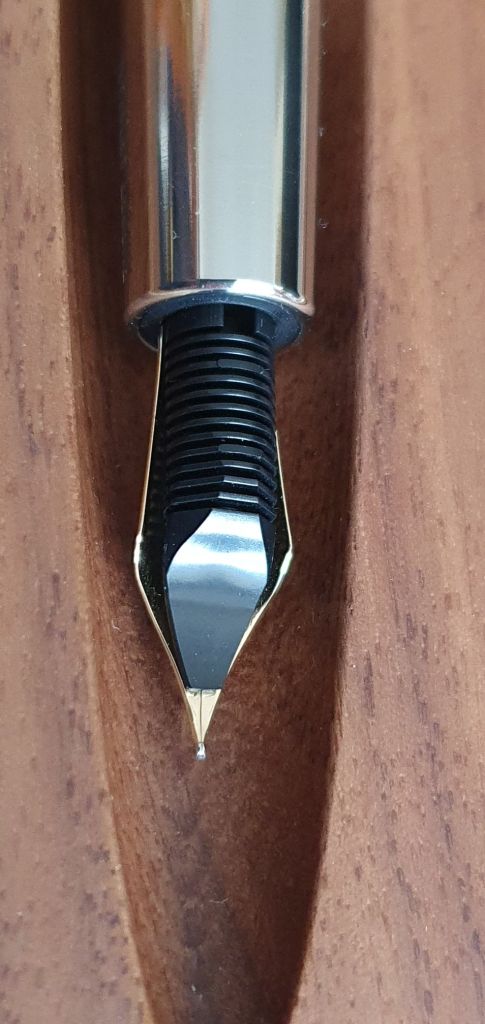
The nib that I chose is 14k gold, in a fine. I did ask why there was no name or logo on the nib, but only the gold description “14K-585”. This is to showcase the beauty of the gold (or platinum), and ironically, costs more to produce than if an imprint was present. Each nib is hand-polished individually for maximum gloss and hand-tuned and tested to ensure that the tine spacing is just right. This is quality control at its best.

The only branding on the pen is the name Ashera, laser etched in tiny capital letters just below the cap threads. This could hardly be less obtrusive.

Although titanium is a lightweight metal, the wood barrel is also light. The section is sufficiently weighty to give the pen a comfortable front-weighting, despite the long barrel. Uncapped, my sample pen measures about 15.3cm, which is wonderfully long. I like a pen to be at least 13cm long when uncapped and so the Aeon sits well above this. There would be no need to post the cap of the Aeon. In fact, don’t even think about it: the coming together of titanium cap threads and hand lacquered wood will not end well.

One concern from the design of the pen, is the step down from the barrel to the section. This is a necessary consequence of the cap closing flush with the barrel. However, whilst I usually dislike such a step, I can say that within two weeks of use, I had ceased to notice it and could pick up the pen and use it without any thought of discomfort. This, it occurred to me, should be the aim of any pen, rather like a pair of shoes. Nor has the metal grip been an issue. I read that titanium is highly resistant to corrosion, due to the formation of a thin, protective oxide layer on the surface. I wonder if it is this which helps provide some grip. It does feel different from a typical resin or acrylic pen with no such step, if that is what you are used to, but I soon adapted to it and it feels like holding a precision instrument.

Personalised engraving.

When ordering the pen, there is an option to choose to have it engraved for an extra 20 euros. Although I did not ask for this on my review sample, I was thrilled to see my name laser etched along the side of the section, and on both sides to be visible whether held in the left or the right hand. If Ashera thought that seeing my name in titanium would appeal to my ego, they were right!

Writing performance.

I first filled the pen with Diamine Gibson Guitar series, Cherry Sunburst, a smooth-running warm brown ink with good lubrication. The nib was smooth and firm with just a little bounce. The tines were well aligned with the small gap between them, narrowing until the tipping, just as it should. The nib was nicely centred over the feed. In use, this nib produces a smooth, consistent flow and a line width of around 0.40mm on a down stroke and 0.30mm on a cross stroke.

Nib and feed.

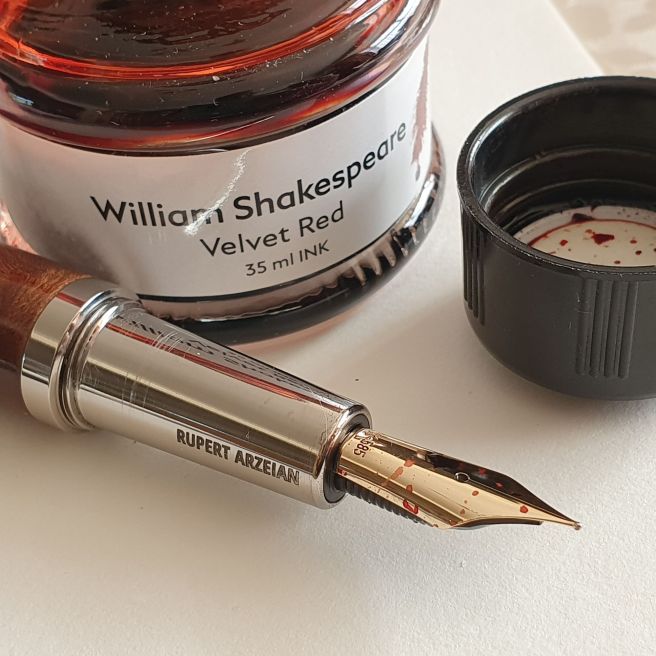
I was also pleased to find that the nib did not dry out overnight. My second fill was with Pelikan 4001 Brilliant Brown, a drier ink but still I experienced no hard starts in three weeks of use. I am currently using Montblanc William Shakespeare Velvet Red, with equally good results.

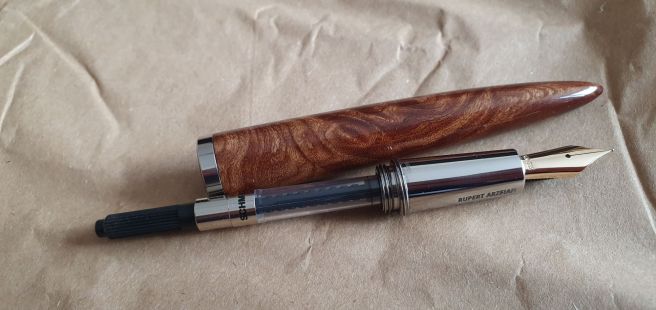
Pen and ink, uncapped

There is a little feedback from the nib, but no scratchiness or drag. The pen is a joy to use and I pick it up often.

Filling and maintenance.

The pen is a cartridge-converter filler. It takes standard international cartridges or can be filled with the push-in Schmidt converter, supplied with the pen, making for easy cleaning.

The Bock nib unit can be unscrewed from the section and the nib and feed can be pulled out for cleaning or maintenance although I have not tried to do so.

There is no inner cap. Whilst I found that none is needed here to prevent hard starts, I had a concern that ink drops could stain the inside of the cap, if the pen were to leak or be shaken in transit. However I am told that the cap is also lacquered from the inside, just like the outside. The lacquer is low viscosity and penetrates deeply into the wood fibres. If necessary, the inside of the cap could be cleaned with a cotton bud. Ashera advise against soaking the cap or barrel in water.

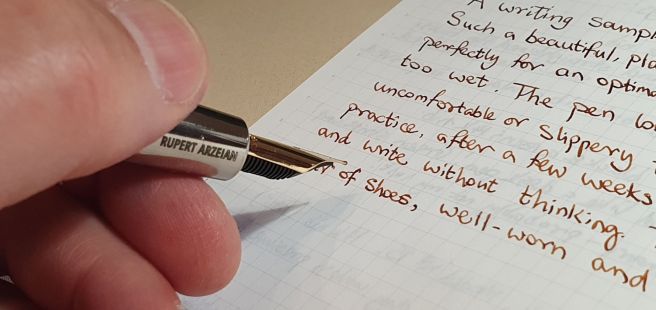
A one-handed selfie photograph.

Likes and dislikes.

I found much to like about this unusual pen. In summary the main points are:-

  • Choice of natural woods for cap and barrel, sustainably sourced;
  • Glossy, eight layer lacquering;
  • Unusually lengthy, with a comfortable balance;
  • Clean, minimalist ellipsoid design; there is no pocket clip;
  • Titanium grip section, rings and threads for strength and durability;
  • Comfortable girth, neither too wide nor too narrow for me;
  • High quality gold or platinum nib, free of branding or decoration, but hand-polished and tuned; writes smoothly; (reverse writing is also smooth and gives an extra fine line);
  • Seeing your name on such a high quality pen feels very special:
  • Company’s commitment to reforestation;
  • Attractive and practical wooden box/pen tray.

Some points to note:-

  • At first I was concerned that when uncapping the pen, the barrel might unscrew instead. It has worked loose a few times but generally, once screwed on tight, (and tighter than the cap) this does not happen;
  • The cap threads can be a little fiddly to align until you get used to them; the solution is to rotate the pen the other way until a click signals the start of the threads, and then screw it into the cap gently, ensuring that the cap and barrel remain in a straight line. My concern, when anyone else uses the pen, is that the cap may be put back on cross-threaded; one member of my pen club said that the threads felt rough and were not quite up to the same standard as the rest of the pen;
  • The threads on the inside of the cap are sharp and, even with careful use, appear to have left some scratch rings on the miror-polished titanium section (although personally, that would not bother me and might even improve grip);
  • Metal sections can be slippy, but I have not found this one to be a problem for long writing sessions. When writing, my thumb is half over the barrel ring and cap threads, which gives grip;
  • The step down from barrel to section is quite prominent but I have not found it uncomfortable in practice;
  • A couple of people at my pen club felt that the pen was too light; however it weighs 28g closed, or 23g when uncapped, the cap weighing 5g. Personally I find the weight and the balance, fine as they are and comfortable for long writing sessions;
  • Whilst I enjoy the extra length of the pen, it will be too long to fit in some pen cases. I carry it in a pouch.

Size comparison with TWSBI Eco, Scribo Write Here “Africa”, and Benu Euphoria “Bourbon”.

Conclusion.

I have thoroughly enjoyed using the Aeon, these past three weeks. I was delighted with my choice, of Elm Burl and gold nib (Fine) that I opted for. Some of the wood options do increase the price, not because of the cost of the wood but rather due to the extra difficulty of working with it. A platinum nib also adds to the price.

Ashera have kindly arranged to provide a discount of 20% on the price of an Aeon fountain pen, (limited to ten pen sales) purchased via the following link: https://ashera-design.com/aeon-rupert-arzeian-edition The discount is applied at checkout.

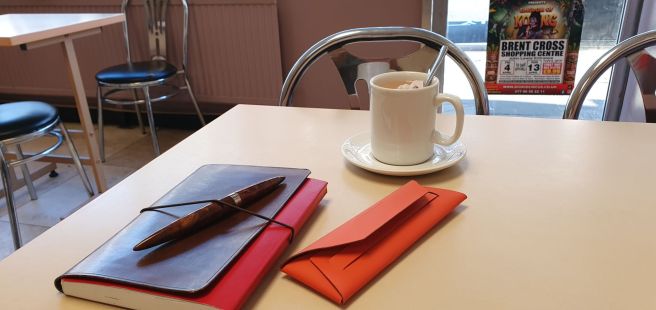
Coffee shop journaling.