Travelling with ink: Porto, Portugal.

A recent trip with my wife to the city of Porto, was a most welcome break and my first time out of the UK in three years. It was also an opportunity to bring a few pens and notebooks and to discover pen shops in the area.

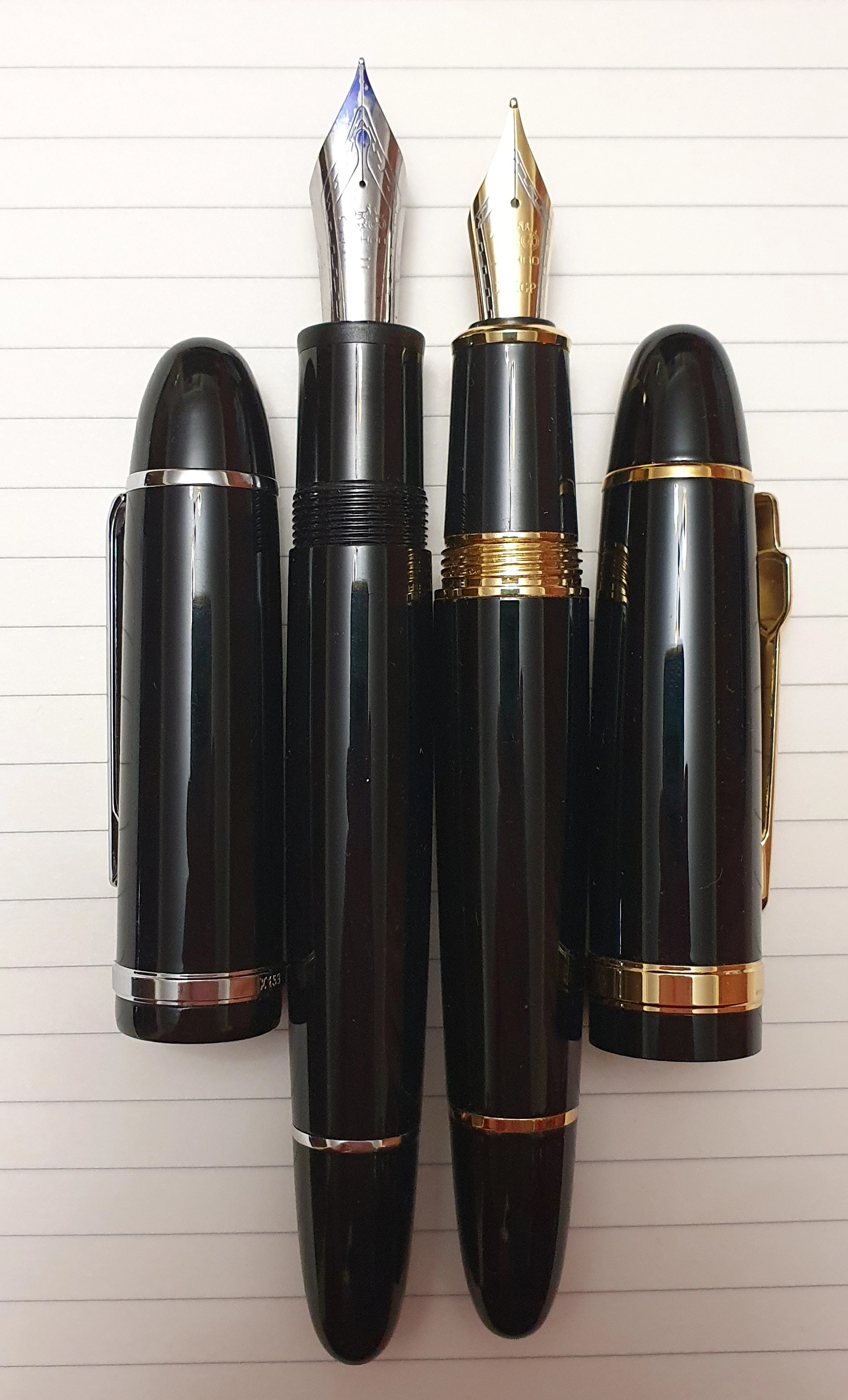
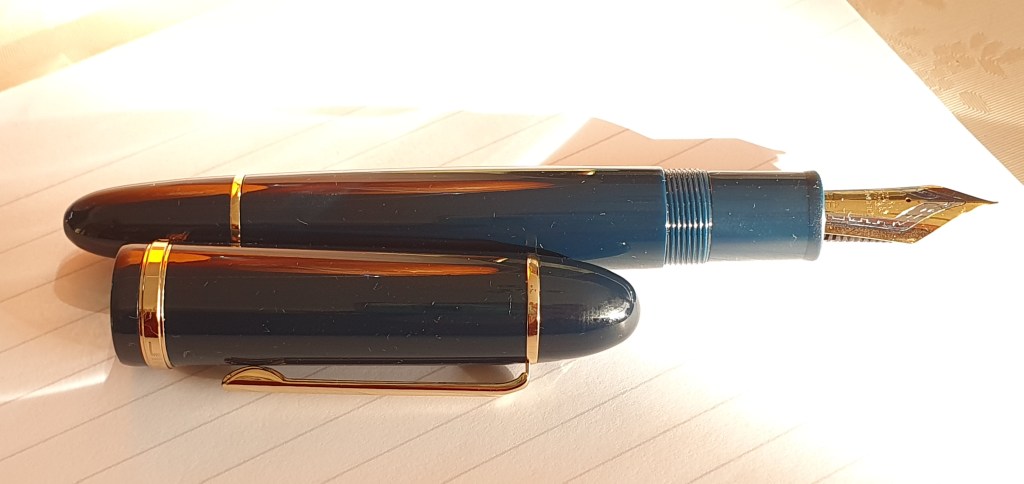
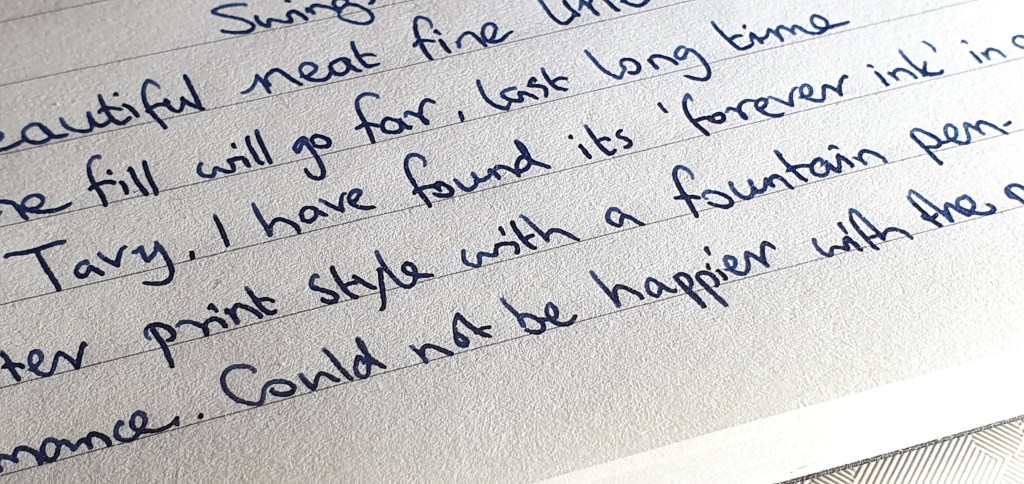
I considered bringing only one fountain pen, but as usual ended up with several. These were my new Onoto Scholar and two Delike New Moon fude nib pens, which I enjoy. I also brought a Lamy 2000 multi-pen and a Pentel 0.7mm mechanical pencil. For notebooks, I had a Leuchtterm A5 as my holiday journal, another cheap A5 book for random writings and a traveller-style notebook and cover from Flying Tiger Copenhagen.

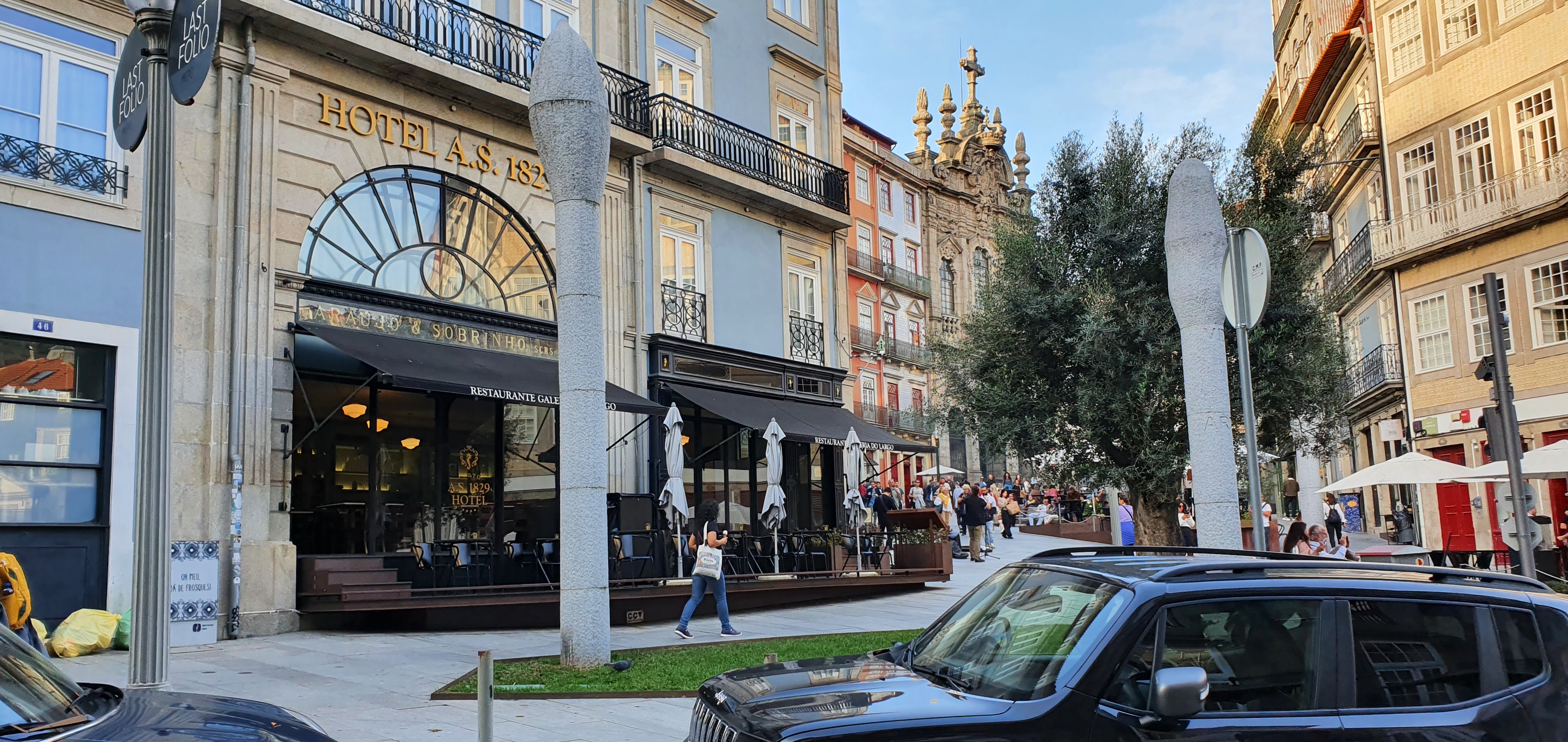
I had learned from FPN of a pen shop in Porto called Araujo & Sobrinho, founded in 1829 and still belonging to the Araujo family, now in its fifth generation. As luck would have it, this shop was just 100 yards from our hotel.

At the Douro River, Porto.

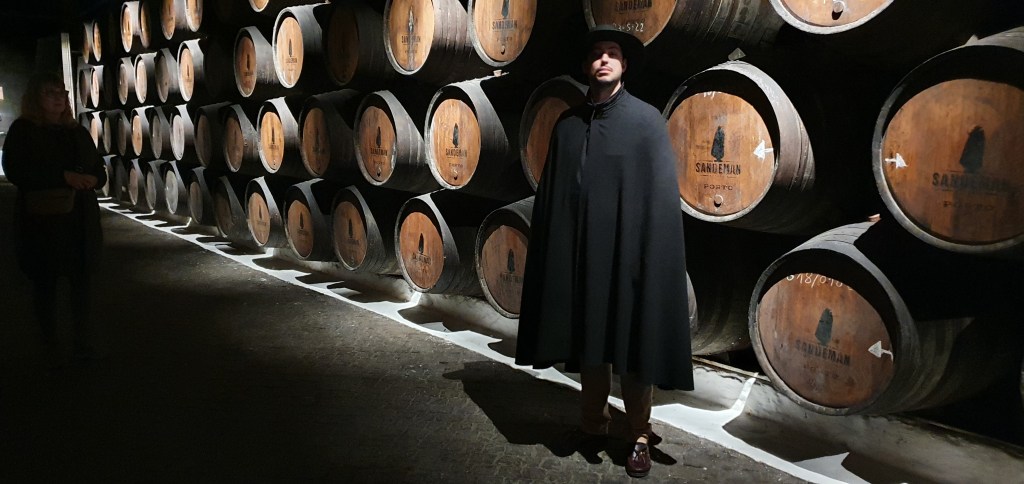
It is wonderful to explore the city, on foot. It is built on hills each side of the River Douro and famous for the production of Port. Fronting the south side of river, there are a dozen or so Port wine companies. We visited one of these, Sandeman, for a memorable tour of their cellars, finishing with a tasting of three types of their Ports.

Sandeman’s premises and visitor centre, Porto.
Our knowledgeable tour guide at Sandeman.

In an indoor market I found a man making and selling leather notebook covers, branded Sango Handmade Creations. My wife bought me an A5 cover in stiff, dark brown leather with an elastic loop closure and containing one Moleskine notebook. It appealed to me as the notebook is held only by an elastic loop and does not need its covers to be slid into a raised leather pouches which cause an uneven writing surface. However the cover is very stiff and needs effort to keep it open flat, as it wants to slam shut. I expect that with use, and some leather softener on the spine, this will ease.

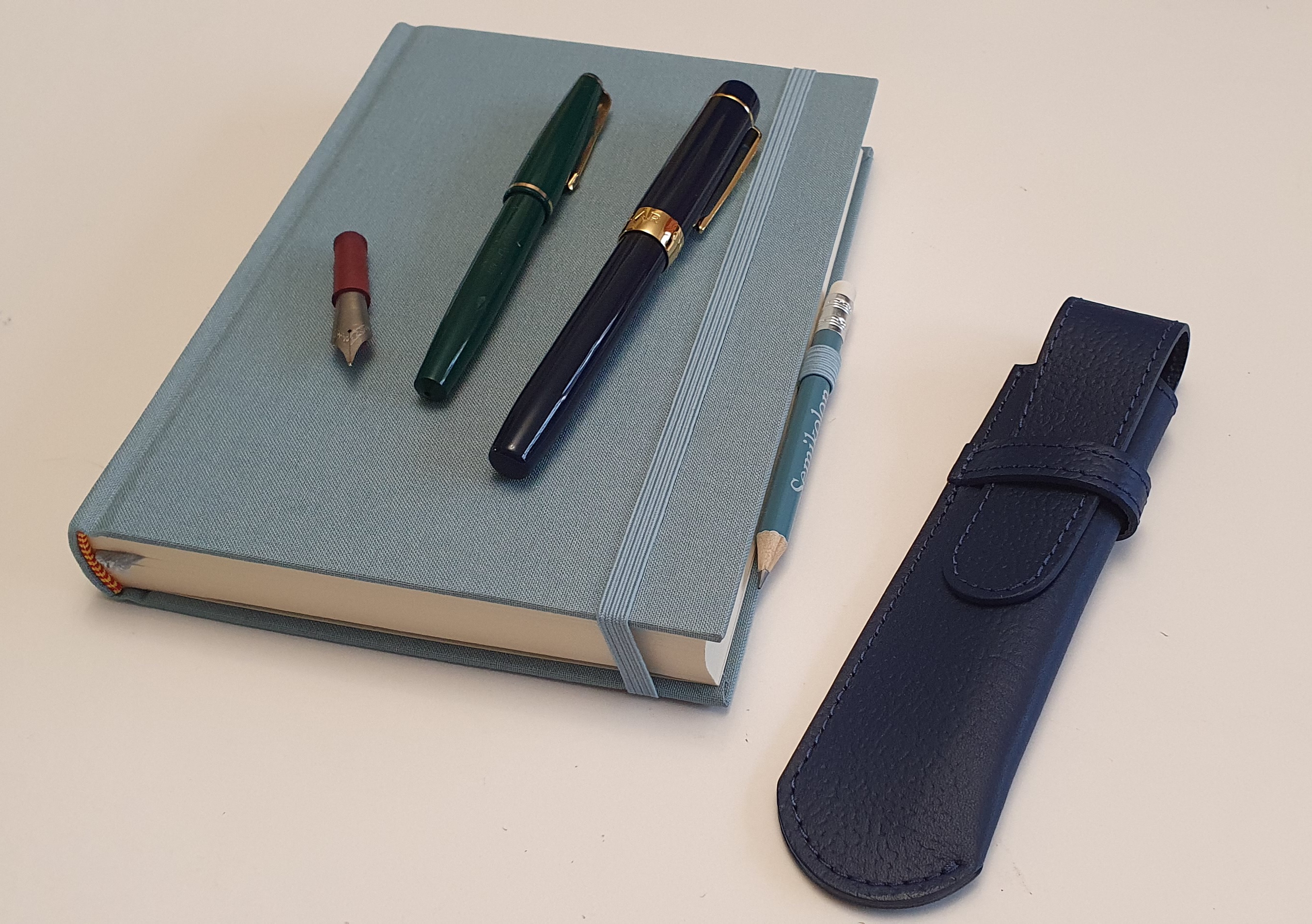
My new Sango Handmade Creations notebook cover and a pen case. On a mosaic floor of the Bolsa Palace.

As well as the ubiquitous confeitaria pastry shops, I learned to look out for shops called papelaria, Portuguese for stationer. I enjoyed browsing one called Papelaria Peninsular where I bought a couple of Pentel EnerGel 0.7 gel pens, in brown and navy blue.

Papelaria Peninsular. An attractive stationers with print shop at the back.

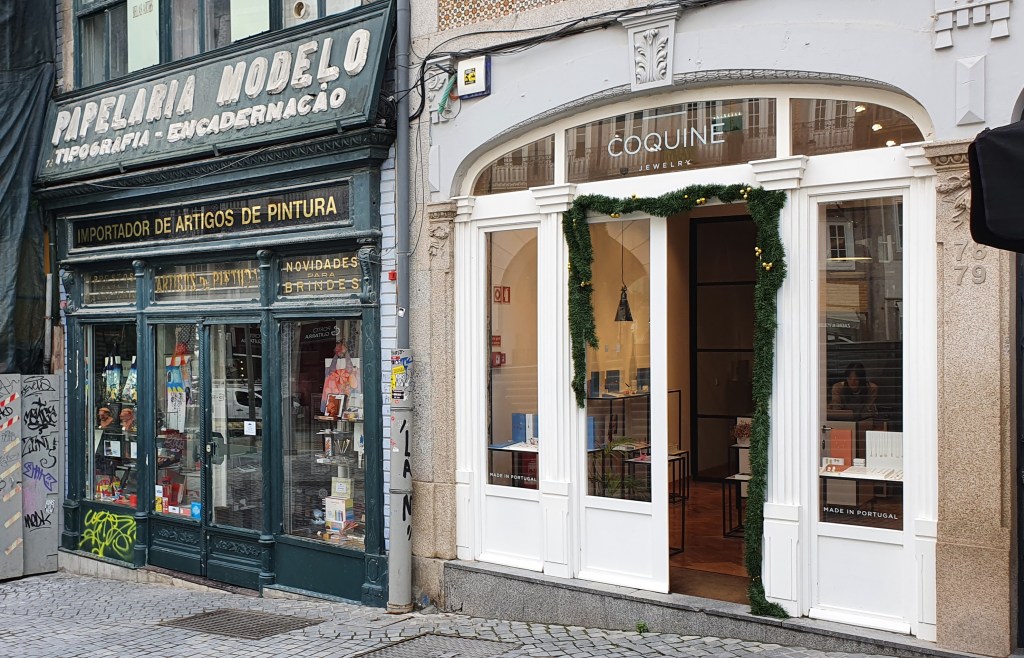
I came across another, Papelaria Modelo but it was closed for lunch and I could only savour the attractive window including some Kaweco pens and inks.

Papelaria Modelo.

A book shop called Livraria Lello is a popular tourist attraction, claiming to be The Most Beautiful Bookstore in the World. So popular has this become, that it is necessary to book a visit, which has to be done online and to pay a fee of five euros and then wait in a long queue to be admitted. I learned only several days later that you can recover the ticket price against the price of book purchase. The features of the shop, which was very crowded, include a stained glass roof, and curved wooden, red-painted staircases to the galleried first floor. There was currently a display of The Little Prince, with two books from the first 1943 print run inside a mirrored infinity box (to represent the enduring appeal of the book). Also, there was a display of books by the late Nobel prize winning writer José Saramago. A display case included his passport and also a fountain pen that he had used.

Inside Livraria Lello.
A pen used by José Saramago.

It was well worth visiting Clerigos Church and to climb its tower, to see the panoramic views of the city. Just wandering the streets, particularly at the weekend with many buskers and other street entertainers performing, makes for a relaxing holiday atmosphere. One of my favourite performers was a couple dancing to music and it took a moment to realise that the lady was a mannequin whose shoes were attached to her partner’s.

A view of roof tops in Porto.
A dancing “couple” in Porto. She blew me a kiss.

And so to Araujo & Sobrinho. On our first day, we had lunched opposite and, having found the shop location, thought that it may now be a hotel restaurant. But on entering from the front, I spotted a passage leading behind the dining area, where there was a Caran d’Ache sign. There is a pen shop! We had a browse around, assisted by a young man who was working there but unrelated to the family owners. I was keen to return for another look and to take a few photos. This did not materialise until our last morning before our flight home.

Araujo & Sobrinho, at the lower end of Rua das Flores.
The pen shop is more evident from the side entrance.
The inviting interior.
I asked whether Canetas was a Portuguese brand. No, it means “pen.”

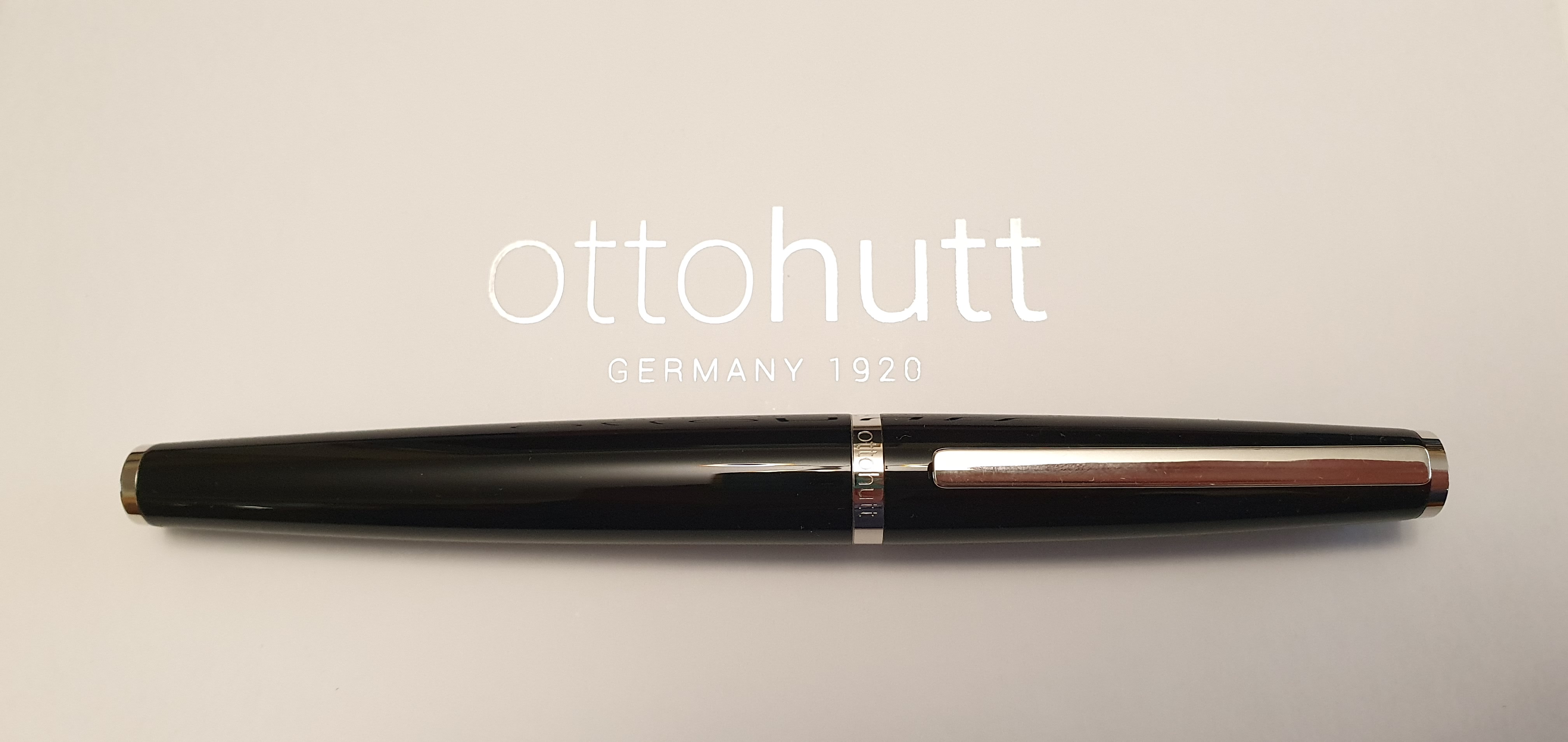
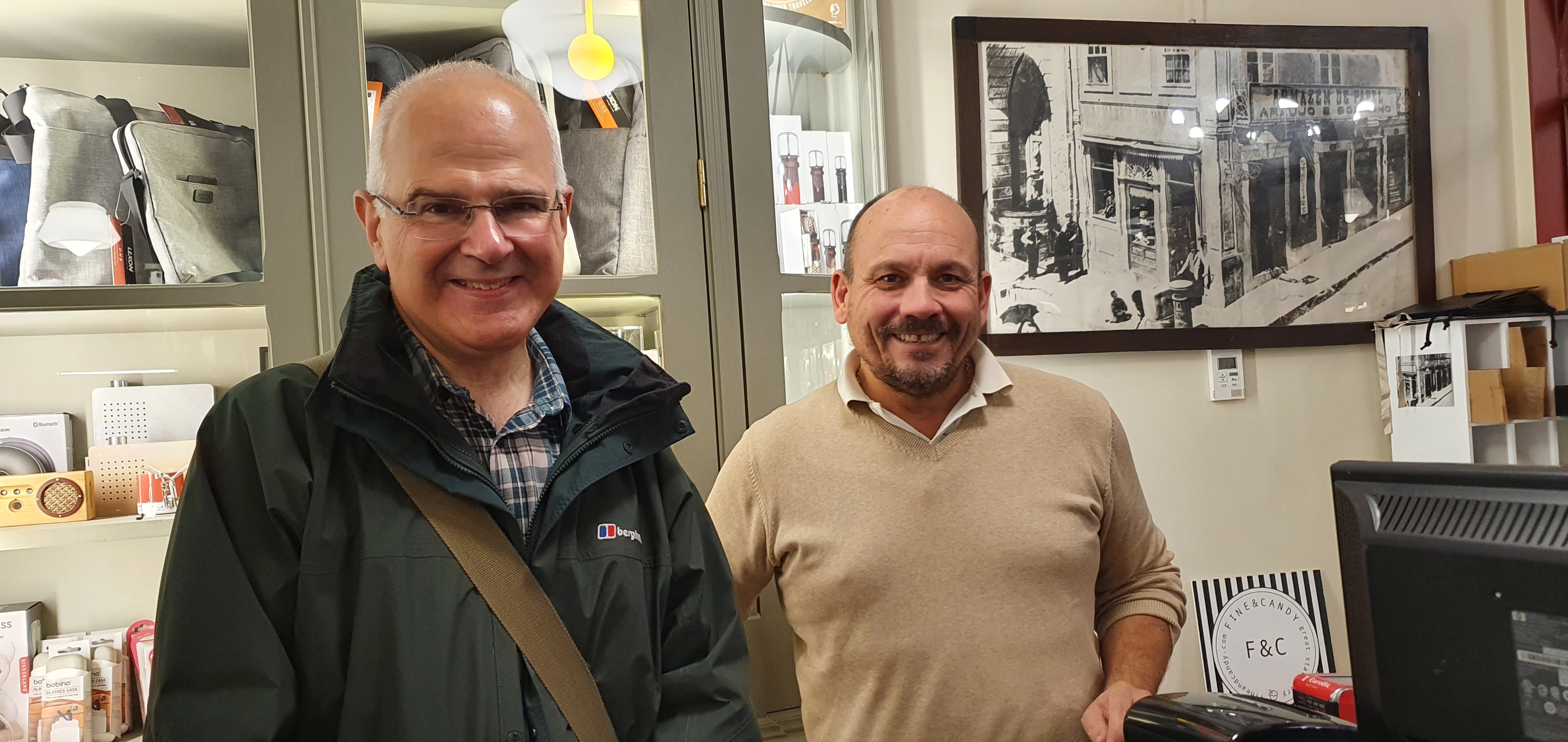
On this second visit, I was delighted to meet Mr Miguel Araujo, who kindly allowed me to take some photos of his very attractive shop. Glass cabinets contained displays including Parker, Pilot, Namiki and Caran d’Ache pens. There was a large selection of mechanical pencils, notebooks, Traveler Notebook refills, and inks. For the first time in a bricks and mortar shop, I saw displays of pens from Otto Hutt of Germany, seldom found in the UK. These included a Design 08 with its distinctive guilloche patterned body and black grip section, and the Design 07 in sterling silver.

The author with Mr Miguel Araujo (right).
Notebooks and a display of old large size ink bottles.

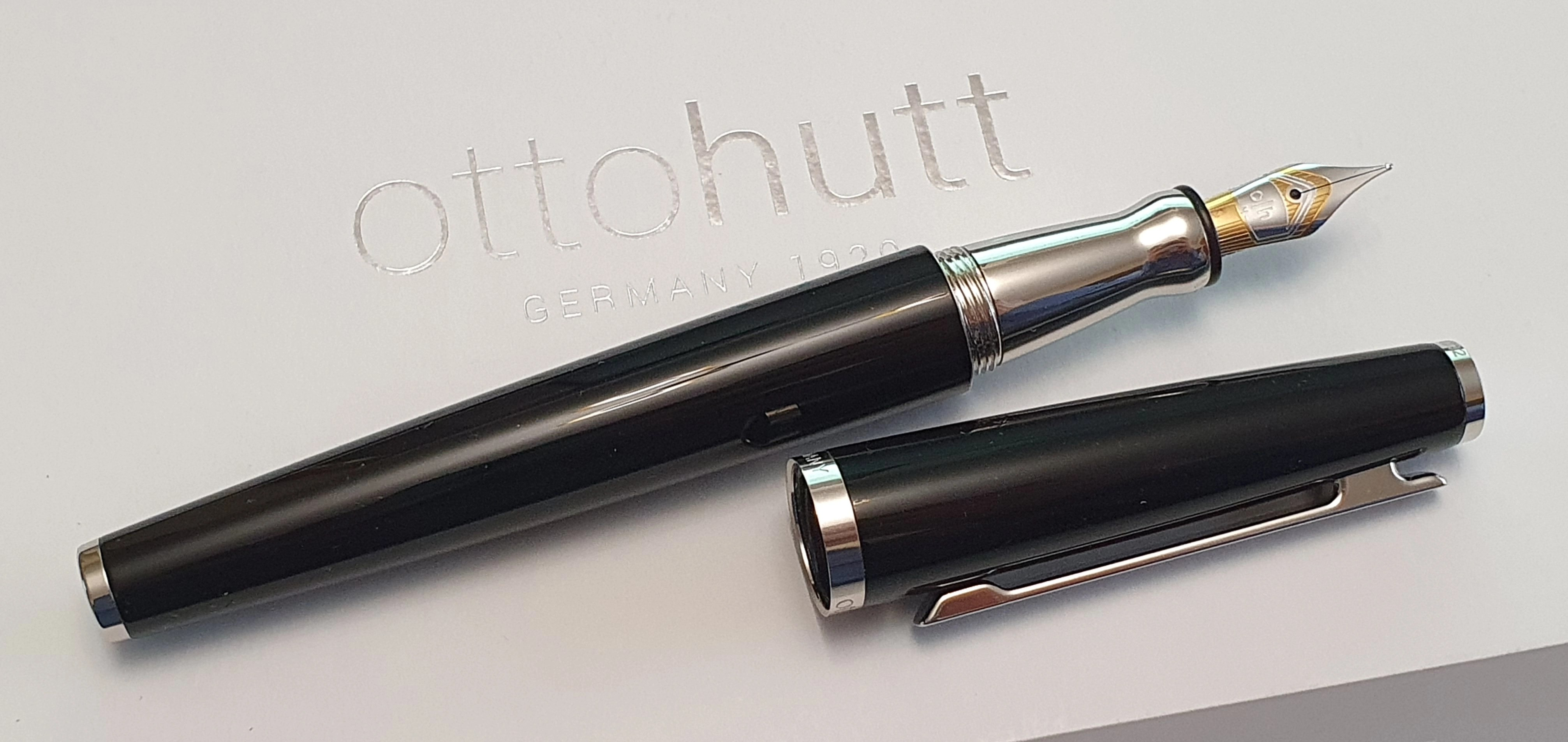
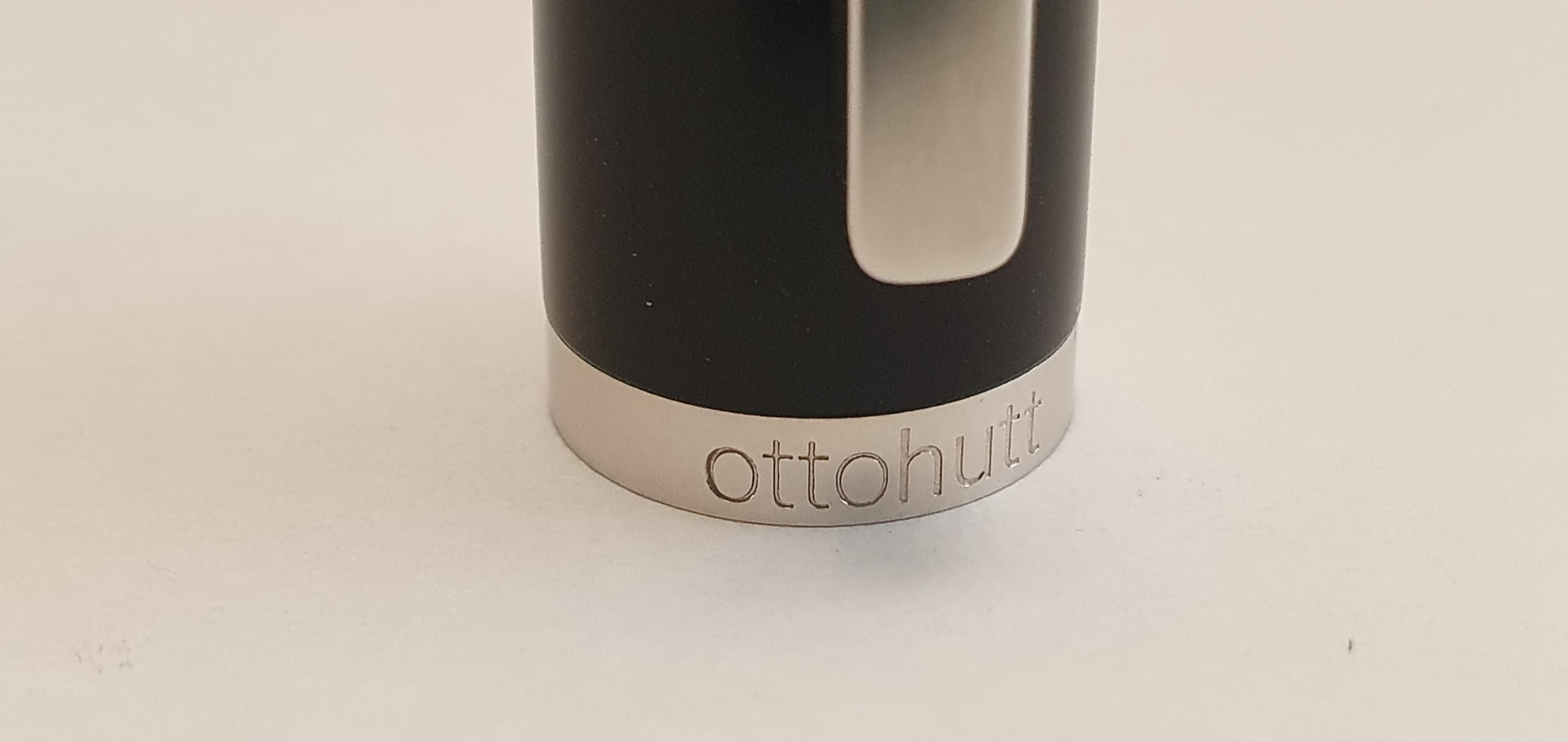
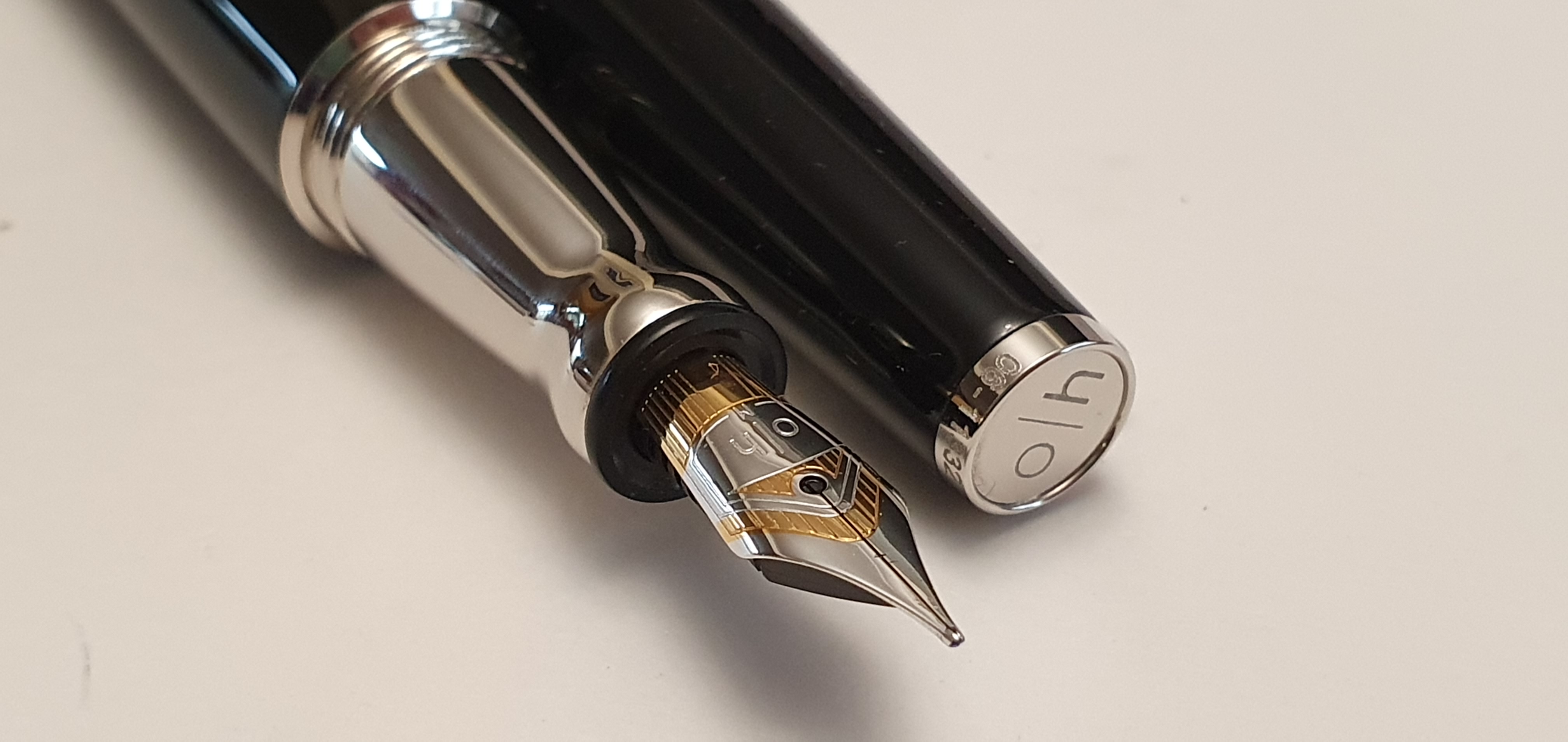
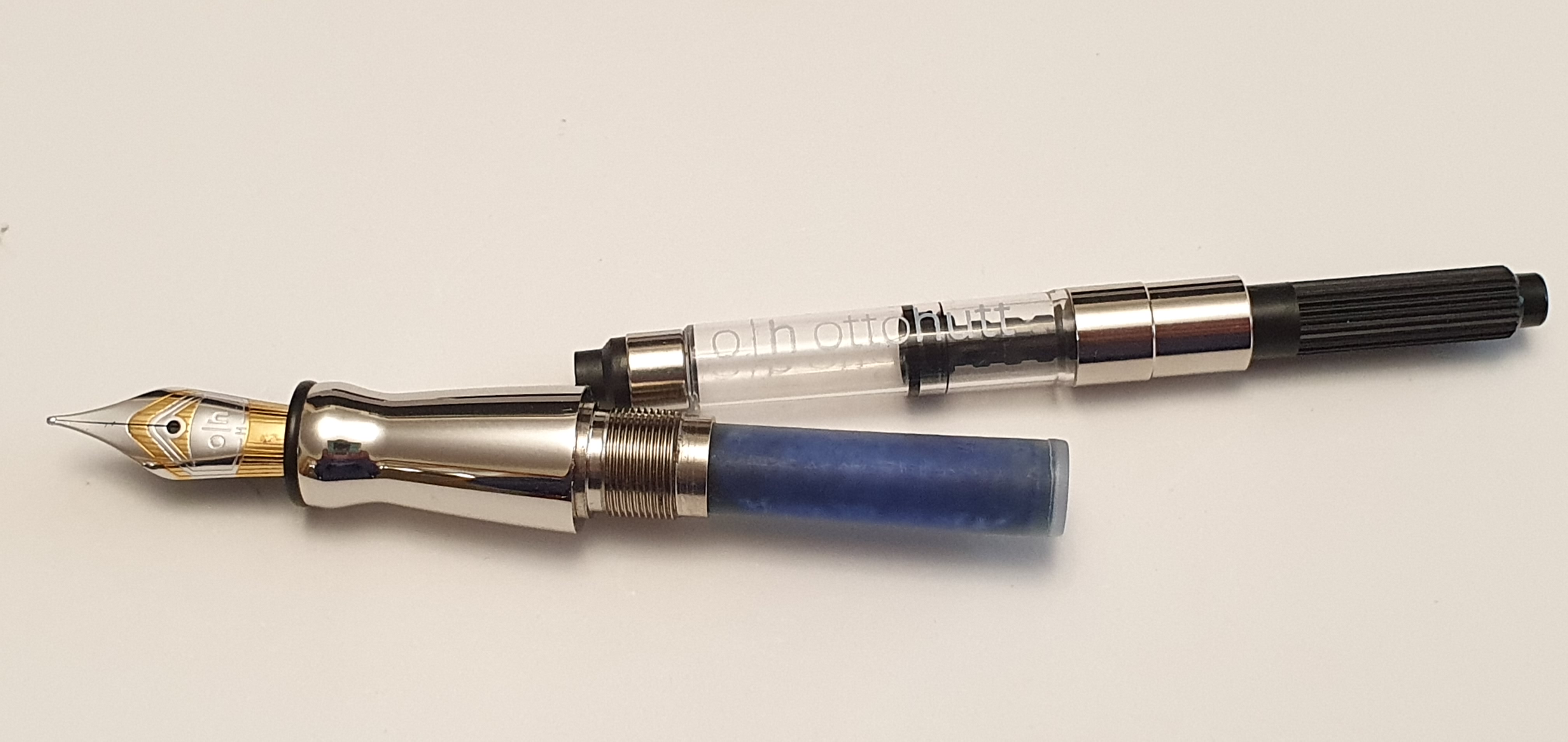
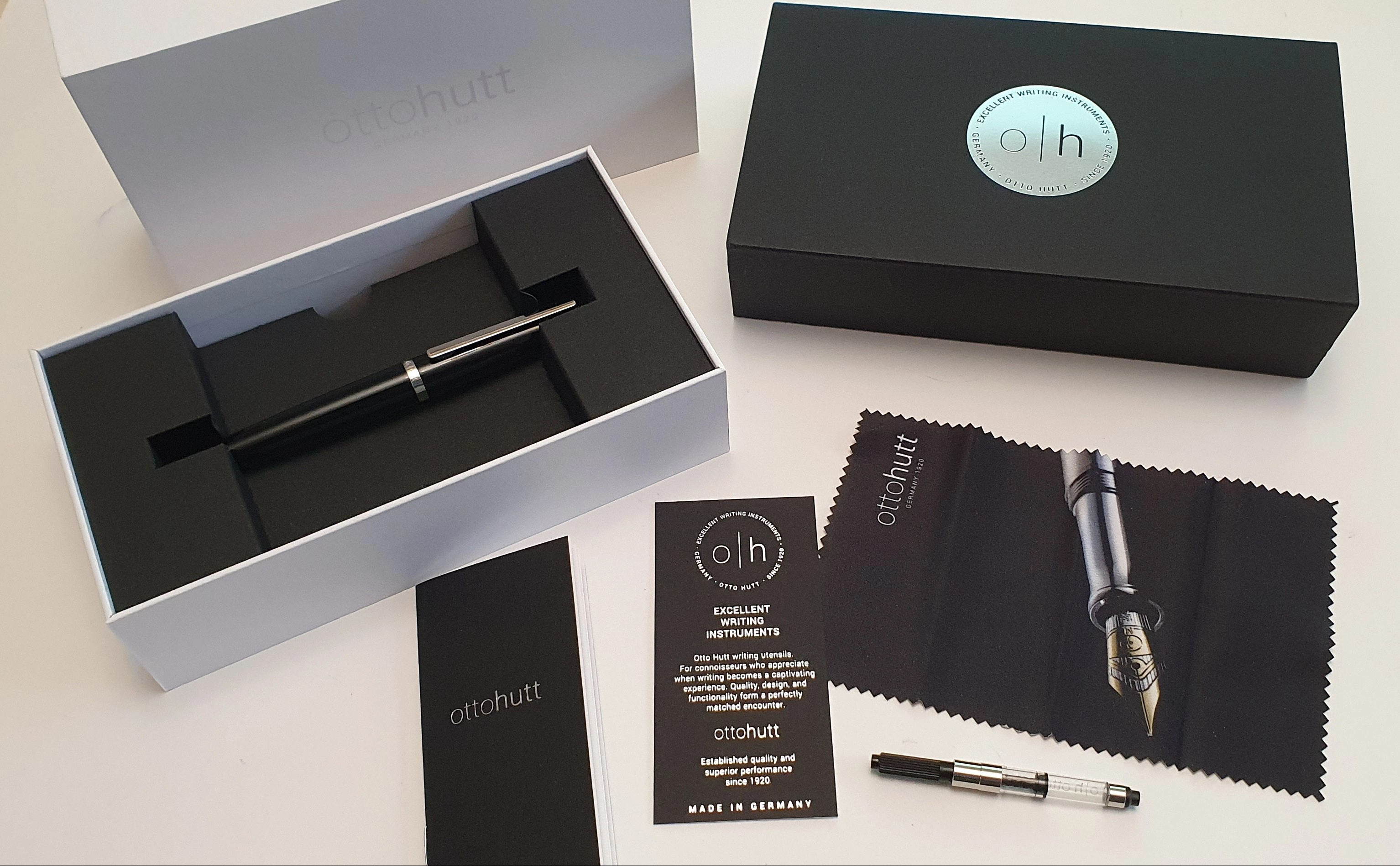
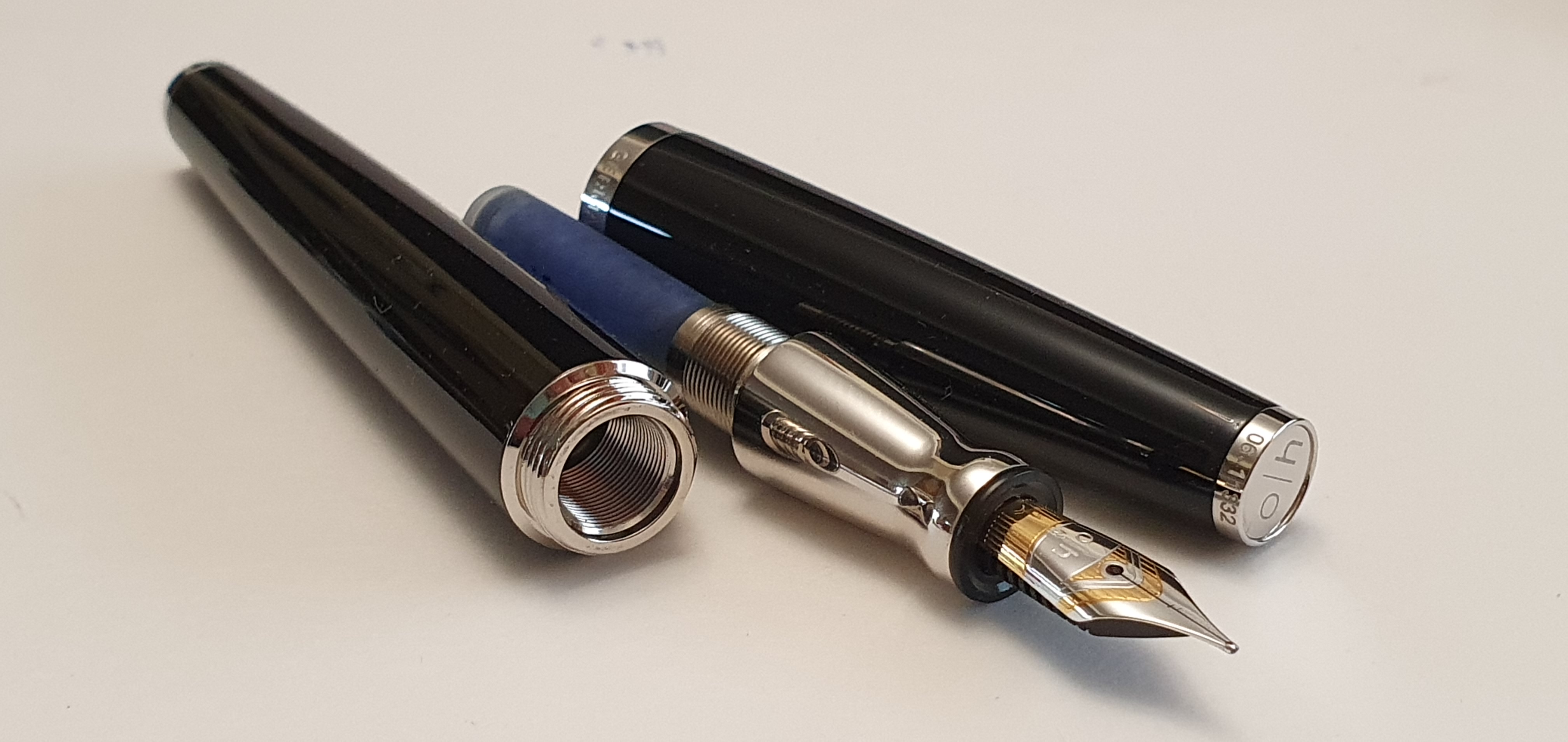
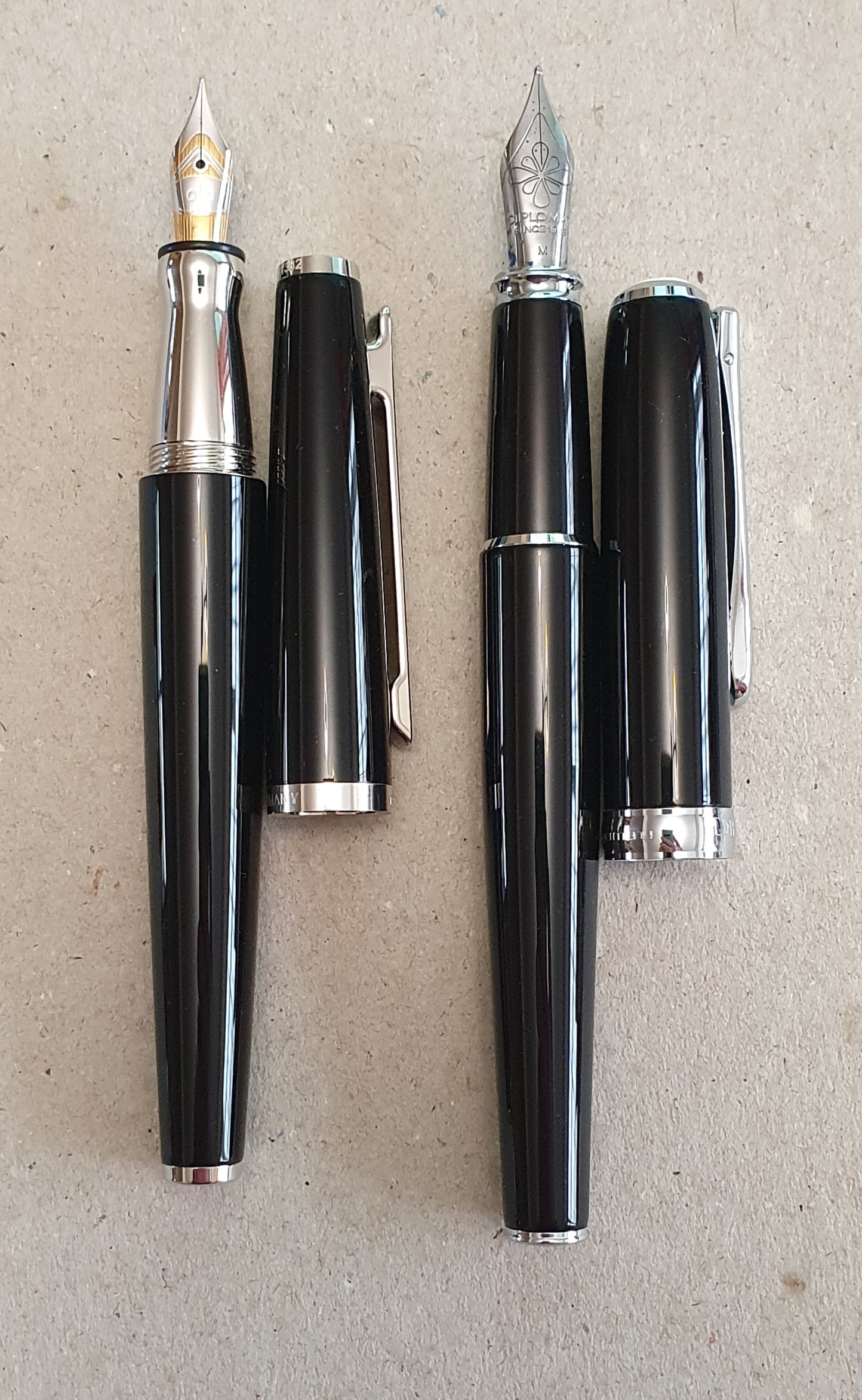
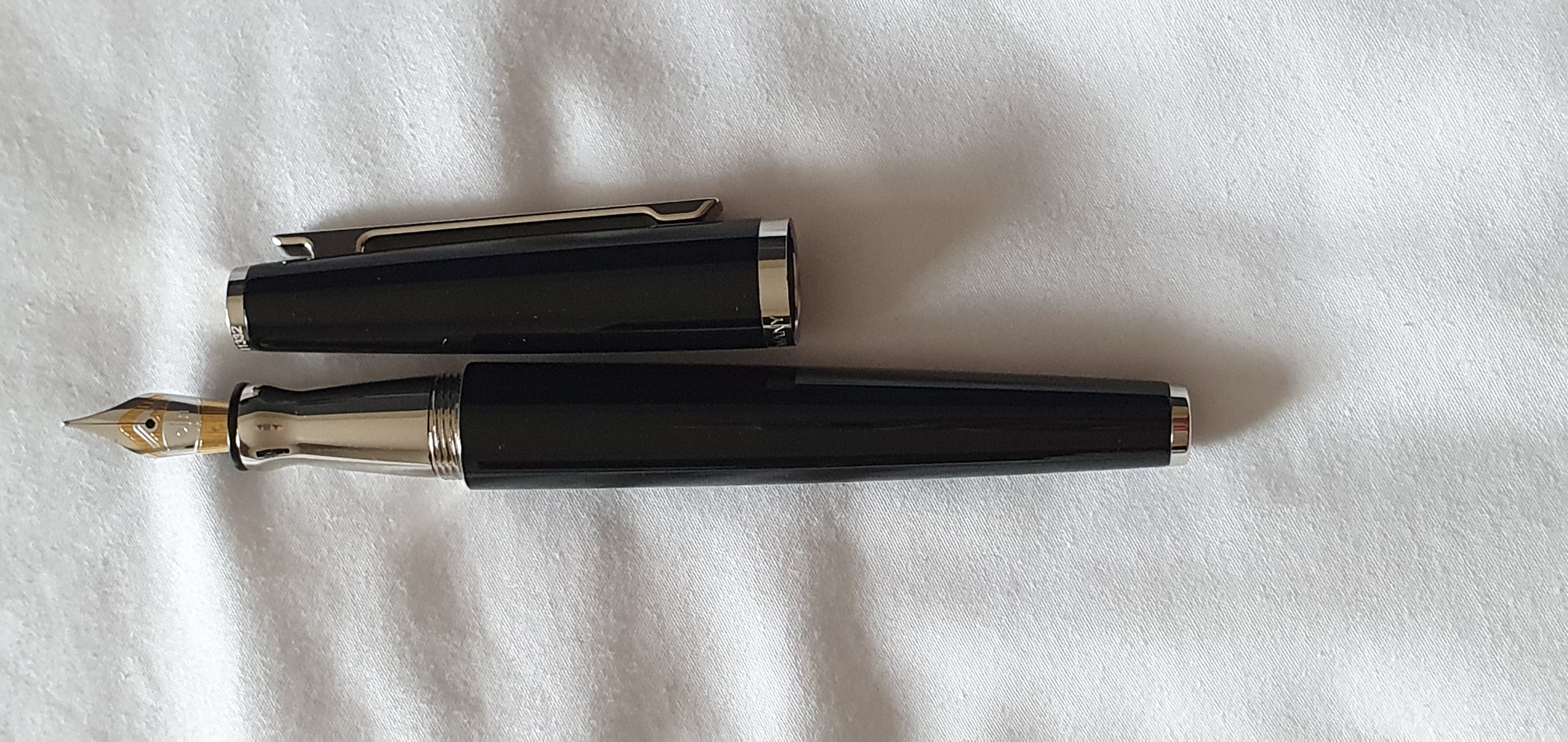
I asked to take a look at a black lacquered fountain pen with a shiny plated section (Platinum plating) which I now know to be the Otto Hutt Design 06. I wanted to feel whether the grip would be a problem, either due to the shiny metal plating or the step down from barrel to section to accommodate the flush-fitting screw cap. Rather to my surprise, the pen fits the hand very comfortably and neither of these points was an issue. Miguel dipped the pen in some ink for me to try. Here I was blown away by how smooth and soft the nib was. It is a steel nib but has the soft feel of a gold one. And so, the Design 06 was to come home with me! It was a treat to enjoy a personal and attentive buying experience. Miguel carefully cleaned the nib, put the pen in its box, which also included a converter and gave me a souvenir post card of the shop and an Otto Hutt catalogue, all in an Araujo & Sobrinho tote bag.

One of the Otto Hutt display cases in the shop. My pen, third from the front!
Hard to resist, once you have experienced writing with it.

I caught up with writing some notes in my Flying Tiger notebook on the two hour flight home, now with my new Otto Hutt fountain pen. And on the coach back to London, I was interested to re-read an old review of the pen by Anthony on UKFountain Pens, and was pleased to discover that my opinions very much echoed his from two years ago.

I can strongly recommend a visit to Porto. And if you go, do not miss Araujo & Sobrinho to support this lovely long-established shop for many more years to come.

Goodbye, Porto.

A few bloggiversary thoughts.

Today, Fountain pen blog turns six! It seems like a good moment to take stock, share a few statistics and to reflect on where I am at on this journey.

Born on 5 November 2016, there have now been 218 posts, which makes an average of around 36 per year. There have been 360,000 views, 212,000 visitors and 1,761 comments.

The posts have for the most part been a record of my personal journey through the world of fountain pens, inks and paper. They provide a snapshot of what was on my mind at the time they were written. The blog is an outlet to share my thoughts on recent purchases. I do not plan these posts very far in advance (in case that was not obvious). I have not so far received items for review. Just this week, after some consideration, I declined a friendly and flattering invitation from a well-respected notebook company to feature a product in the blog. It has been my preference, to write reviews only on items that I have bought. Naturally I would have been only too happy to receive a free journal to try but I worry about feeling some obligation to write favourably about a product in those circumstances. Perhaps this will change. I know many others have overcome such reservations.

Meanwhile, the journey of discovering and learning about different makes and types of pen is a long and interesting one. There is a risk that you are constantly tempted to buy ever more expensive pens and that the amount that you feel reasonable to spend on a pen will escalate. I do not think I have fallen too far into that trap. I can think of only three occasions when I spent over £400.00 on a pen: one was a Visconti which I promptly returned a couple of days later. Another, a Montegrappa Monte Grappa I also returned. Finally, a Montblanc 145 Classique, I have had for three years now was an impulse buy but outside my usual comfort zone.

My annual expenditure on fountain pens and the number of pens bought, did rise for a time but is under better control now. Looking back on 2022, I have had 22 pens incoming. Of these, five were gifted to me, which leaves 17 purchases. But of my purchases, four were gifted to other people. Total spent: £931.60.

I am still learning about what pens and nibs best suit me and my writing styles. I am left-handed and for the most part, an overwriter at that. This means writing with little or no downward pressure. Without that downward pressure the nib still needs to have a good ink flow. In recent years, I have found that oblique nibs work well for me and I have enjoyed nibs on a Moonman S5 eyedropper, an Aurora Optima (oblique broad), an Aurora Talentum (oblique medium) and some vintage Montblanc and Geha models that were kindly given to me by a friend knowing of my liking for such nibs.

I do also write in a lefty-underwriter mode sometimes, particularly for short notes since this is less comfortable and natural for me. I am usually not happy with how my writing looks in this style, chiefly because it is so hard to keep the upstrokes vertical. The good news is that fountain pens are much happier in this mode and the natural pressure that you apply in a downstroke, opens the tines, enhances ink flow and lubrication and you get a silky, smooth writing experience (assuming you have a smooth nib and suitable paper).

For underwriting style, I am happy to use standard nibs with fine, medium or broad rounded tipping. I have learned that Sailor’s standard nibs, with the tipping flattened at the sides, have a sharp and unforgiving edge and are not the best option for my style. This year, I have discovered the “bent” (fude) nibs of the Delike/Majohn New Moon fountain pens. As told in my last piece, I have three of them now and am very pleased with their flattering influence on my handwriting, particularly in my lefty-underwriter style.

My three Delike New Moon, fude nib pens. Currently my most-reached for pens!

Over the years I have learned that you do not need to spend more than a certain amount, to enjoy a really pleasant writing experience. You need to spend a bit, of course, to get something which is of decent quality, well made and appealing. The great news, in my opinion, is that the amount you need to spend is probably no more than £30.00. I am thinking here of the Moonman S5, the Cross Bailey Light or the Delike/Majohn New Moon, for example, which make up my most oft-used pens.

I realise that I am probably getting “off message” here for a fountain pen blog and risk not being taken seriously. Well, I do also enjoy my slightly more valuable pens. This year, my four most costly pen purchases were an Aurora Talentum at £240.00 (possibly one of the best value gold nib pens that I know of), an Esterbrook Estie (£140.00), a Tibaldi N.60 (£157.25) and, most recently the entry level Onoto Scholar (£150.00 pen show price). Of these, only the Aurora has a gold nib.

This year’s “big four” purchases: Esterbrook Estie, Aurora Talentum, Tibaldi N.60 and Onoto Scholar.

My fountain pen hobby did not begin with the blog but has always been there since I was a child. I remember cleaning my Parker pens, twisting tissue paper tightly to dry the inside of the cap. I still do this. I once (aged about 10) sent a letter to Parker, to ask about a Leonardo da Vinci drawing used in their advert (what I now know to be the Vitruvian man).

My fountain pen, ink and notebook obsession shows no signs of going anywhere. I still derive a lot of pleasure from using them or even just thinking about using them! And this blog has been a joy, as a platform to share some thoughts and pictures. I enjoy the interaction that it brings with this wonderful fountain pen community. I have made many lasting friends, both at home and abroad through the blog.

Whilst I still get excited about a new bottle of ink, I am now at an age when I also get excited about finishing one. It takes a long time to get to the end of a bottle, when you are using multiple pens and inks simultaneously. This year I have got through my stash of Kaweco blue cartridges and am now working through my Graf von Faber-Castell Cobalt blue cartridges, in my Onoto Scholar (an excellent match for the navy blue body).

Although I do not get to do it very often, a favourite occupation is to take a break from the abundant choice of pens, inks and notebooks that surrounds me at home and to focus on one of each for a while in a writing session, say in a coffee shop somewhere. Perhaps this need for simplicity is to balance the modern-day problem of too much choice, or else is a yearning to return to simpler times when we had only one pen. The wish to buy more, whilst also wishing to have less, are clearly conflicting aims. The journey continues.

New pen: New Moon.

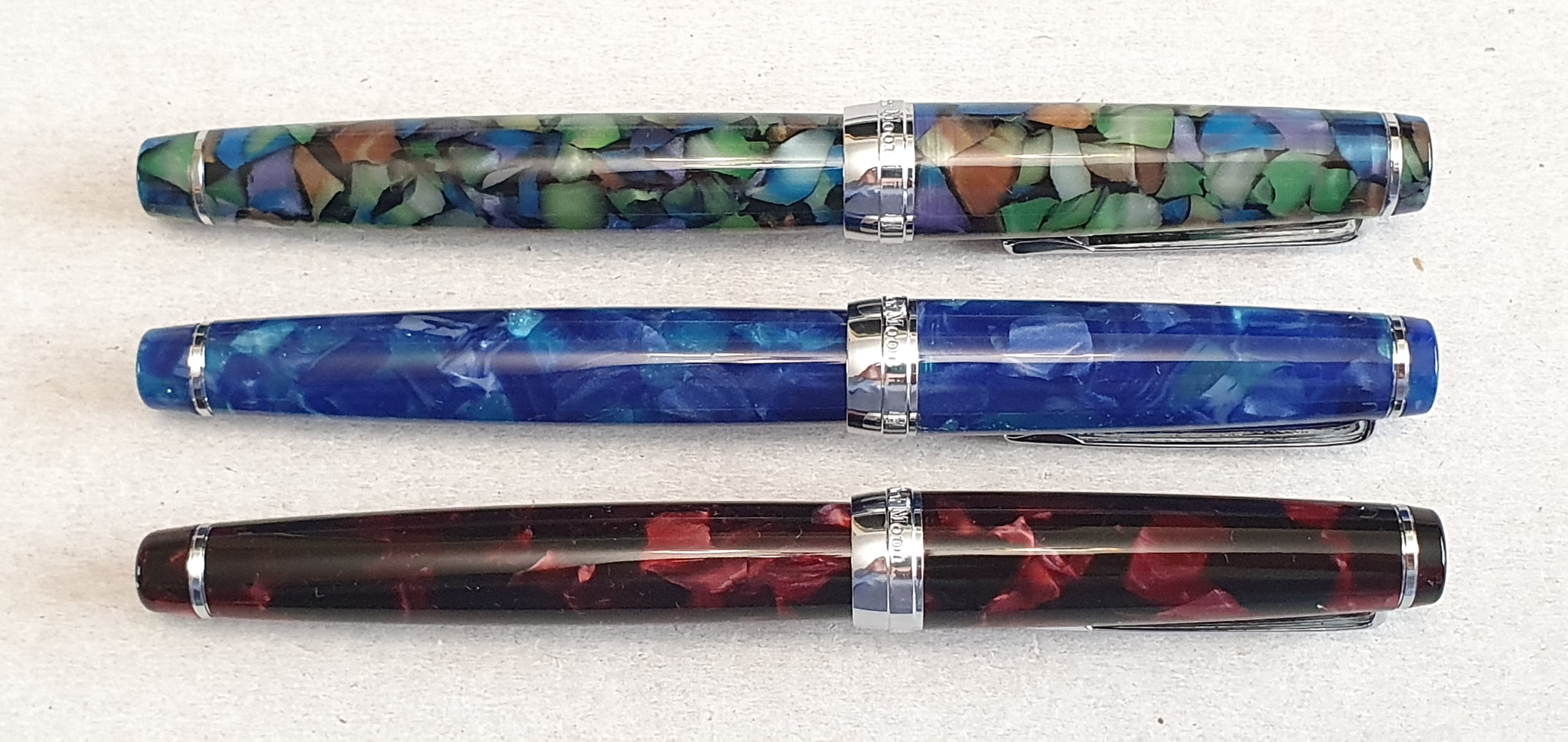
My number of currently inked fountain pens stands at 17, which is about average for me. But what is a bit unusual at the moment is that three are the same. They are my Delike New Moons.

Delike New Moon fountain pen with fude nib.

I have already written an Early thoughts and a More thoughts post on this model, in March and April this year so there is little more to say. At that time I had bought one, loved it, given it away and bought a replacement. That was my marbled green acrylic version. Since then, I added the marbled blue and then, just recently, the marbled red.

Team photo.

What is so good about these inexpensive pens? Well, the fact that they are inexpensive is one benefit. They are well made, they have screw caps, they have attractive colours (which includes the grip section), three shiny plated metal bling rings on the uncapped pen, plus two more on the cap, they are uncomplicated, comfortable and come with a converter which has a spring coil ink agitator. But what makes them so enjoyable, and versatile, is the fine “bent nib”.

Marbled green acrylic version.

On all four of the Delike New Moons that I have purchased, the nibs have been faultless, out of the box. They all write smoothly, with a good flow and all have that capability of writing four distinct line widths, depending upon how you hold the pen.

Marbled Blue version.

I have never been proud of my handwriting. I am no calligrapher and have not studied or been trained in those skills. On my fountain pen “journey” I have owned countless standard nibs, of fine, medium or broad tips (mostly mediums) which are easy to use, practical and forgiving, but which do little to produce a line which can be distinguished, one pen from the next.

A marriage made in Heaven.

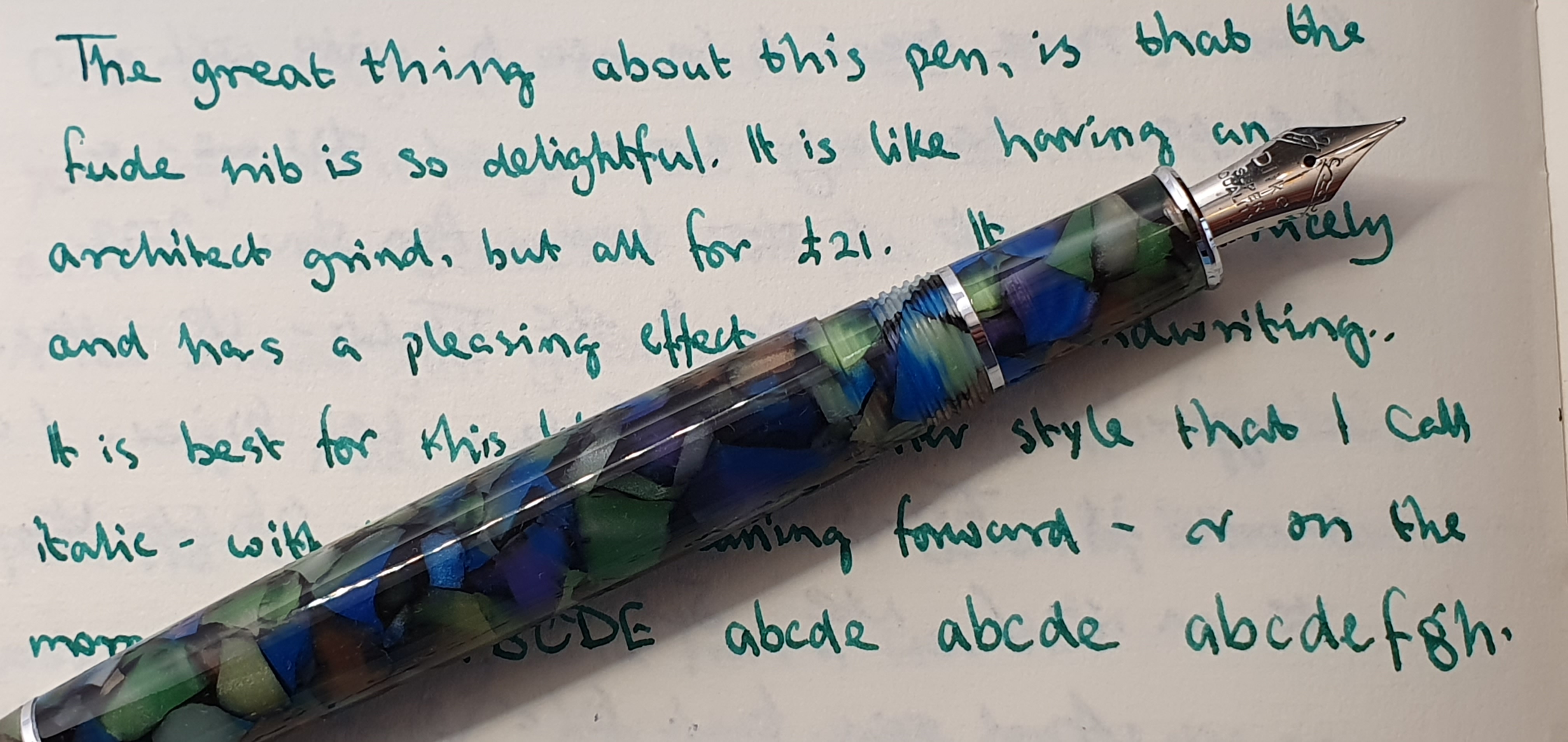
And then this year I discovered the fude nib: a tip which bends upwards giving a flat area to write with. If the pen is held in a conventional way (an under-writer style) this will produce a narrow down stroke and a wide cross stroke and various widths in between. This is the opposite effect of a stub nib. It is how I imagine an “architect grind” nib might be.

Waterman Harmonious Green. Semikolon Grand Voyage journal, 100gsm laid paper.

Flicking back through the pages of my notebooks, for once I like how my writing looks with these pens. I can use them in my lefty, over-writing style which feels the most natural to me, either with the pen laying back in my hand to give a medium line, or held more vertical like a ball point, which then produces a finer line. But I tend to prefer to use the pen in my under-writer style. This slows me down and I form each letter and word more carefully and deliberately. I delight in the line variation such as in the two sides of the capital A.

The capital A is an opportunity for line width variation

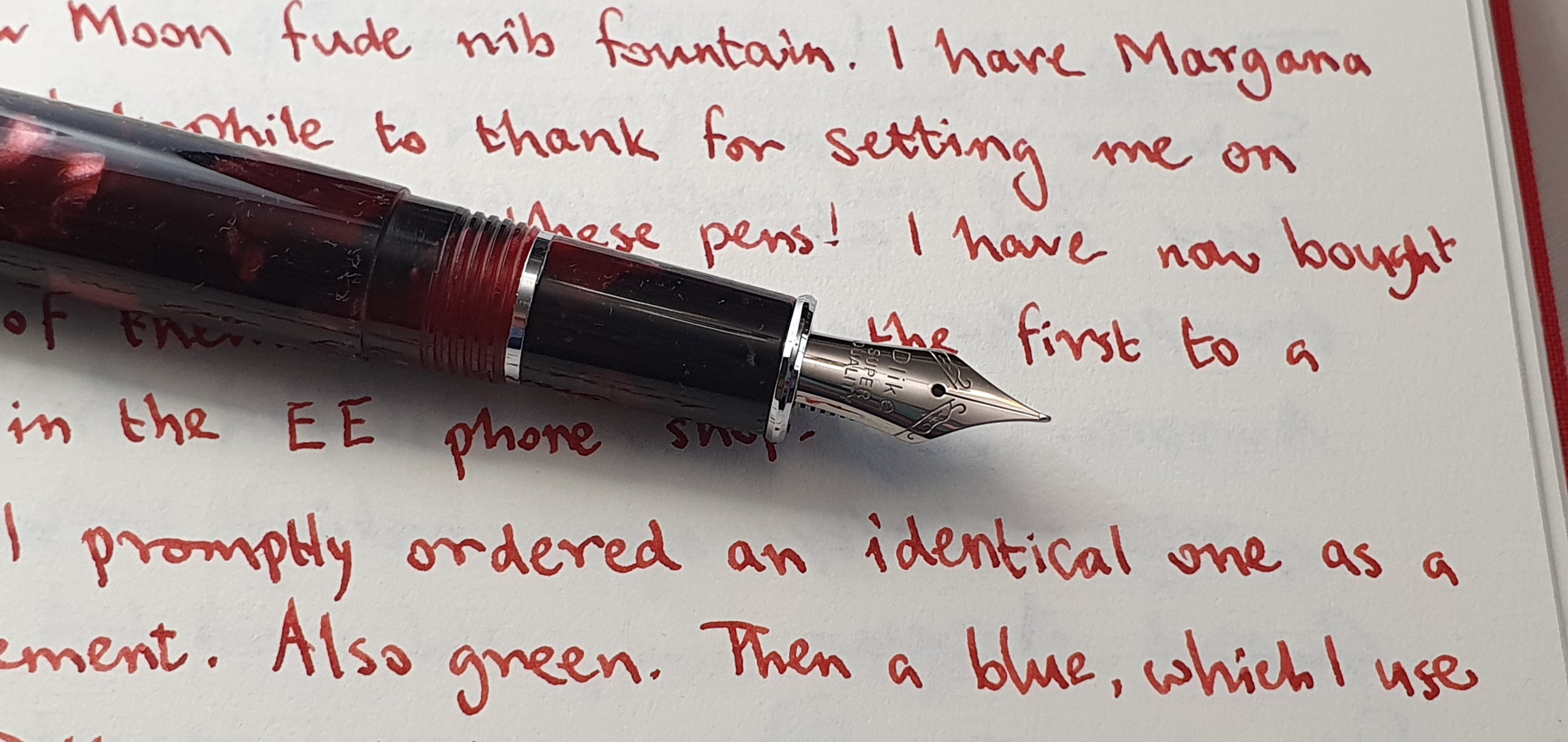
As you might have guessed, I now have these three pens inked with a matching ink. The green has Waterman Harmonious Green, from a bottle that I have had since 2015. The newer, blue pen is filled with Diamine Pelham Blue, a very pleasing shade from the generous flow of this nib. My latest New Moon addition, the marbled red one, is now filled with Montblanc William Shakespeare Velvet Red, which is possibly my GOAT red ink.

Matchy matchy.

I expect a lot from my pens. Not only must they look good and feel good. They must write and behave well. They must (most of them) be good value. They must be enjoyable to use – by which I mean that the act of putting pen to paper is a pleasure, but also that the resulting script is expressive, neat, attractive, legible and satisfying. And as if that were not enough, I depend upon my pens for their role in maintaining my mental health, as a source of relaxation and unwinding to counter the stresses and strains of daily life. Writing with pen and paper lifts my spirits.

Diamine Pelham Blue. (Wetters?!)

I realise that this is a lot to ask of a pen, particularly one that you find on Amazon and which costs under £25.00 including shipping. But when you find one (whatever yours might be), buying three of them does not sound so silly after all.

The tale of the Lady and the Scholar: my London Autumn Pen Show 2022.

Here in London, our Pen Show took place on Sunday, 9 October 2022, held again at the spacious Novotel London West, Hammersmith. I have been attending pen shows now for 9 years and still find them a bit overwhelming and a challenge to make the most of the day.

What makes for a good pen show experience? It helps to go with a list of anything in particular that you want to buy and cash for your budgeted spending, although it is equally enjoyable to go with an open mind and to see what catches your eye. This year I hoped to find another Titanium nib unit with ebonite feed, in a Bock fitting. Previously I had bought one with a Jowo fitting, which I had installed in my Opus 88 Demonstrator to good effect. I also hoped to take a look at an Onoto Scholar in the flesh. I hoped that the Semikolon Grand Voyage journals would again be available. Finally, I planned to take a look at some vintage Parkers. Spending enough, but not too much money, and wisely, helps avoid being left with regrets.

My mini-haul: Titanium nib unit, Parker 17 Lady, Onoto Scholar and case, plus a Semikolon journal.

Of course, it is the wonderful people of the fountain pen community that make the day special. This year I met in real life for the first time, Pamela of pamalisonknits.com attending her first pen show. Also, from Instagram, @amuse.bouch8 was here with her family, and Phil of @theinkscribe. There were the regulars, penultimatedave, Gary of dapprman https://dappr.net/ and Jon of https://www.pensharing.com/ with his Pensharing table, signing up new members. I met many of the well-known dealers – John Foye, John Hall of Write Here, John Twiss, Vince Coates, Dennis (of Den’s Pens) and Kirit Dal at whose Aurora table I tried a Talentum with a medium nib.

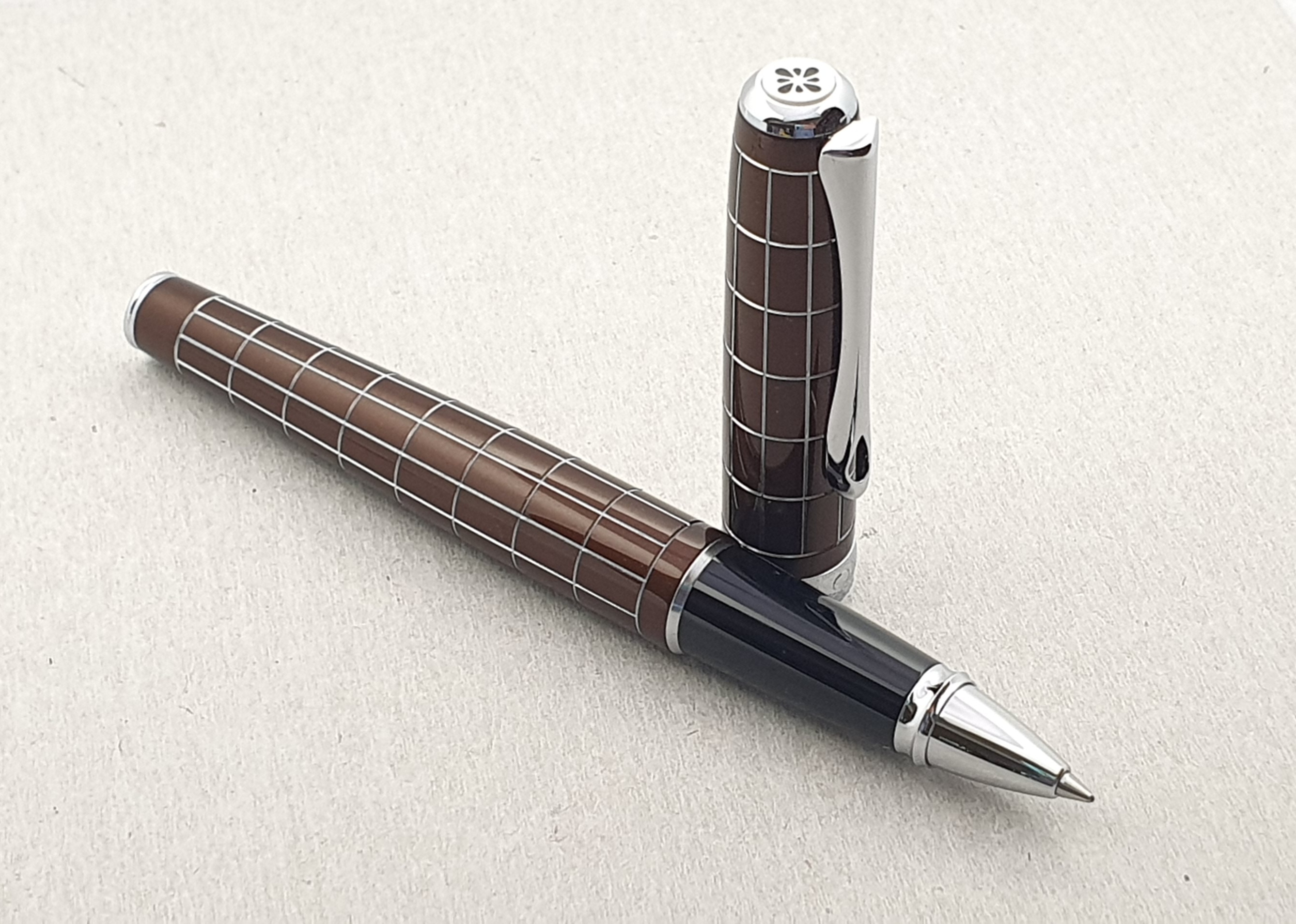
My wife came too. She made her purchases early, finding a handsome Diplomat (Excellence, brown guilloche rollerball), plus a Troika fineliner and a few Troika tool pens (ballpoint pens with screw drivers, ruler and spirit level) that she chose for gifts. Soon after, she discovered some colourful Semikolon twist action ball pens in matching colour plastic boxes and chose a selection of them, telling me excitedly “I have spent £80.00!” The game was on!

From wife’s haul: Diplomat Excellence rollerball.
And some Semikolon ball pens for gifts.

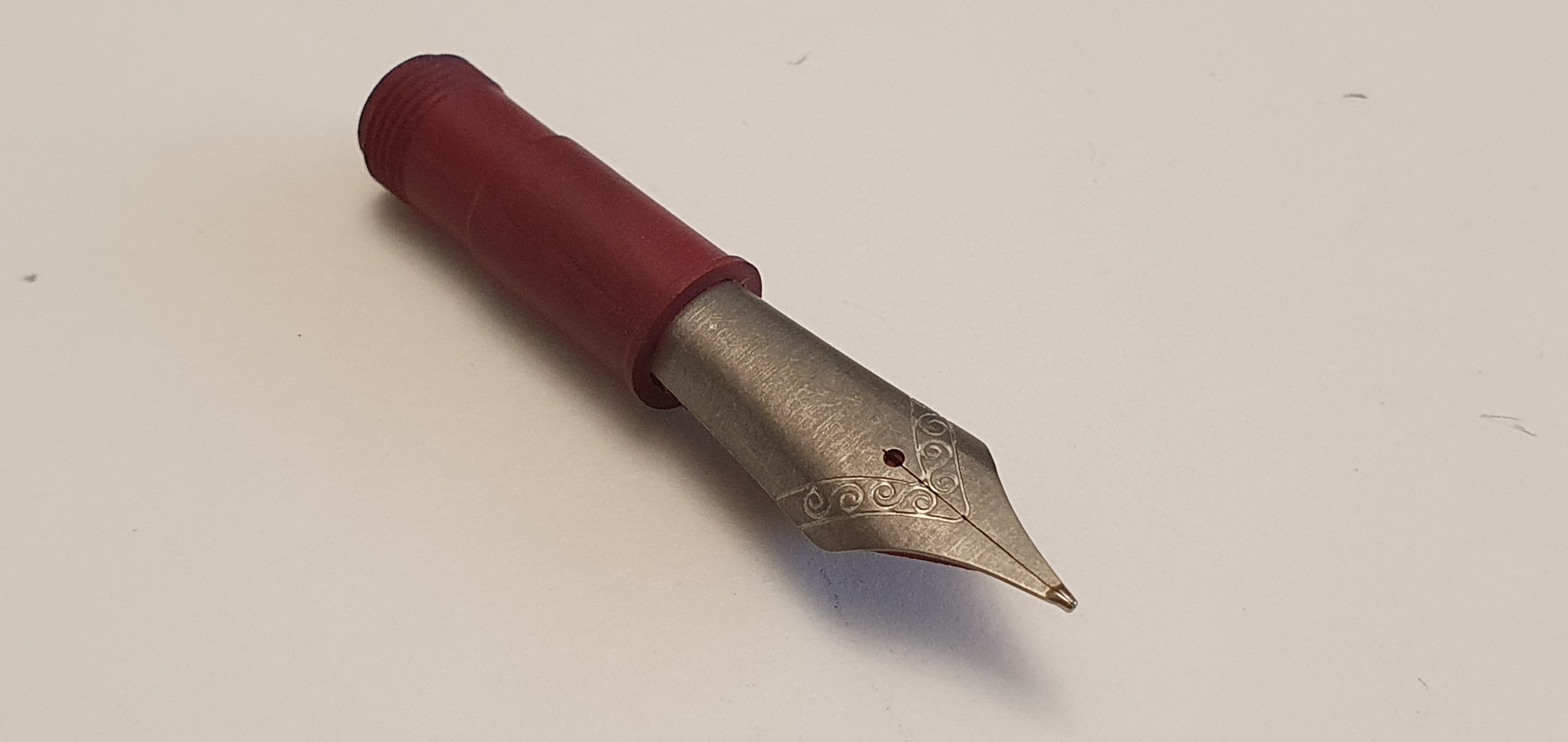
I went to find Vince, to ask about a Titanium nib unit. I bought one, in a Medium with red feed. It did not fit in the Campo Marzio Ambassador which I had planned to put it in, but I hoped it might fit in something else at home.

Magna Carta Pens, titanium nib unit.

We went to see the Onoto table, manned by Feng Li and James Boddy, Shirley and Emma. I was yet to own an Onoto pen but had long admired the Magna Classic, reputed to have one of the best stainless steel nibs around (or a gold nib if you wish to upgrade). I was able to handle both the Magna and the recently introduced Scholar, which is similar in shape but slightly smaller but which comes with the same number 7, bicolour stainless steel nib that you would receive on the Magna. Onoto were offering the Scholar at a tempting show price of £150.00 reduced from the usual £195.00. I was hooked. With a choice of red, yellow, navy blue or black, I chose navy blue and with a medium nib. Rather stupidly, I passed up the splendid, sumptuous leather Onoto pen roll pouch included in the price, to have a simpler flat leather pen case which I could more see myself using.

Happily, I was able to buy another Semikolon journal (reviewed here in my last post) which I will greatly enjoy using.

During the day I had many interesting conversations with the friendly dealers. I saw some lovely Conway Stewart pens from Bespoke British Pens, of Emsworth. I saw the 20mm square rods from which their pens are turned, on a lathe. The Churchill is the most popular. I wondered if in years to come, people would buy pens called the Johnson, or the Truss. Don’t answer that.

Derek at Stonecott Fine Writing showed me the Venustas carbon fibre pen with a Titanium nib. It looked like no other pen. I met, for the first time, Emy of Pen Venture. At his table I handled a marvellous Leonardo Mosaico with a size 8 gold nib, exclusive to the show and for £500.00 I think, but well outside my comfort zone for an impulse purchase. A lady at Sparks Nibs had a table of pieces showing me the various stages in making a fountain pen nib.

I browsed at Graham Jasper’s table of vintage Parker pens. I was tempted by the elegant Parker 51 in black with a gold cap, of which there were half a dozen or so examples, with prices not shown but ranging from £60.00 to £200.00, he said. I would have needed to inspect them all to check the nib and the aerometric filler, as well as the general condition of the caps and barrel, which showed differing degrees of wear as expected from these elderly pens. There was a bit too much choice and I could foresee that after this exercise, I would have chosen the one that was the highest price and so I moved on, this time.

After a very enjoyable day of meeting friends and browsing the tables, it was time to go. On a last walk round the tables, I found more trays of vintage Parker pens, but marked as either £40.00, £20.00 or finally, a miscellaneous box in which every item was £10.00. Here, I bought a little Parker 17 Lady, with a hooded nib, in dark green with gold furniture. The nib looked promising, and I could see myself enjoying it.

Parker 17 Lady, made in England.

The aftermath.

Back at home, I tried the Titanium nib in a succession of pens but could not find any that it would fit, so far. I will enjoy paginating the Semikolon journal. I knew that the Onoto Scholar fountain pen would be perfect and left that to try last. Surprisingly I found that it was the Parker 17 Lady that I was most eager to examine and which was to dominate my evening.

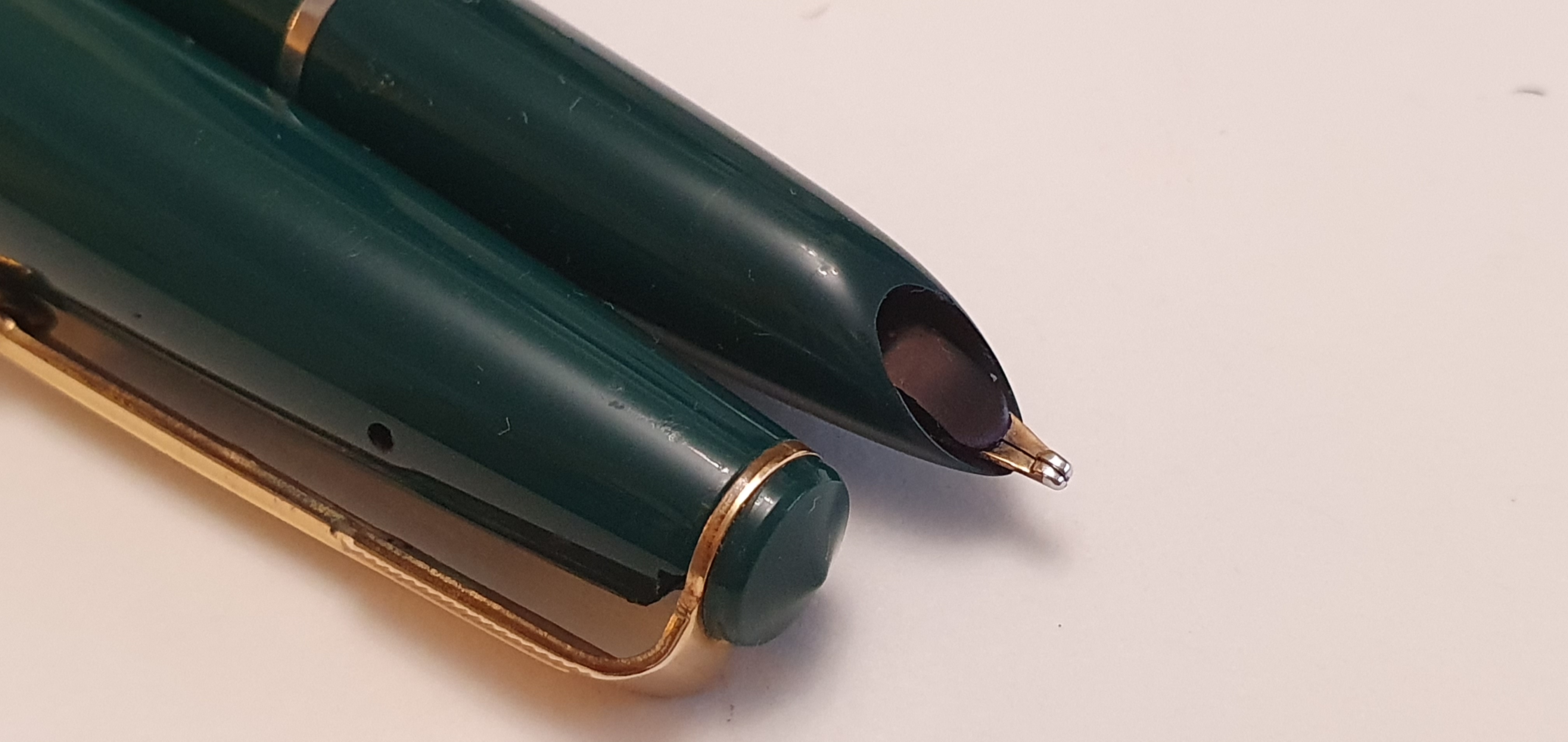
I soon spotted a large chip in the cap, just below the finial. However, when unscrewing the green plastic finial, I found that I could position the pocket clip in front of this, and also that when the finial was screwed in, there was no daylight showing from the chip and so hopefully it would still be reasonably airtight (not counting the deliberate hole found in the side of the cap). There were scratches on the barrel and cap. I then found that some of these were actually cracks, but I still clung to the hope that these were cosmetic only. The nib unit and aerometric, squeeze-bar filler were in good usable condition. I filled and wrote with the pen. The nib was a smooth, soft juicy broad.

Uncapped. The cracks start to appear.
But the 14k gold nib is lovely.

Using the pen, I noticed an increasing amount of ink on my fingers. It transpired that the section, or shell over the nib unit was not only scratched but cracked and that ink was leaking out from the shell. By this time, I had already had my £10.00 worth of enjoyment and education from the pen. My wife suggested putting it in the bin. I could not bring myself to do so. No one can bear to see a broken Lady. I pondered filling the pen by first unscrewing the nib and filler unit from the shell. This did not seem very practical but I decided to keep the pen and perhaps find another Lady or some spare components at a pen show to rebuild her some day.
Nib and aerometric filler unit unscrewed from the section and reusable.
Chip to the cap.

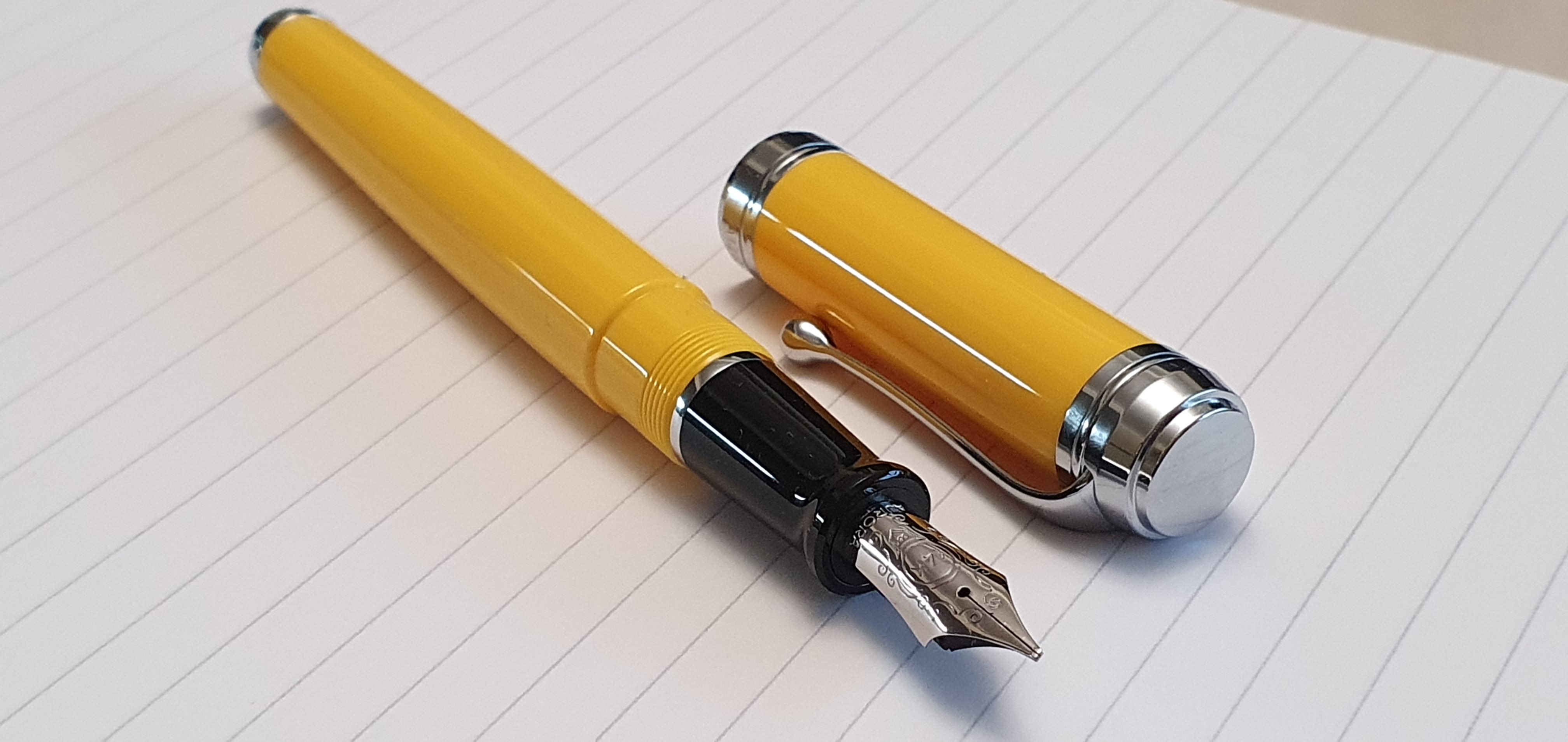
And so finally to the Scholar. This was predictably excellent. The steel nib was faultless and the pen felt very comfortable. You even get a brass tubing liner to add weight to the barrel, which is an optional extra on the Magna. Yes, the Magna at double the price would have been a little bit longer and broader, but then I have that size covered already by my recent Tibaldi N.60. I was no scholar myself but coincidentally the silver and the gold colours of the steel nib, and the gold coloured finial, clip and cap ring, next to the navy blue are reminiscent of my school uniform colours at the Reading Blue Coat School in the 1970s. I am thrilled with this beauty.

Onoto Scholar. An exquisite steel nib.

A few days after the show, I learned from Onoto that I was one of several lucky runner-up winners of a Coffee Dusting Stencil with the Onoto logo, so that was good!

With hindsight, I should have taken a little more care in choosing the Parker and spent a bit more money there to buy a pen without so many issues. I could also have passed up the Titanium nib after finding that it was not the right fit for my Campo Marzio. At least I stopped myself from buying any more ink. It takes years of practice to make the best use of a pen show and I am not quite there yet.

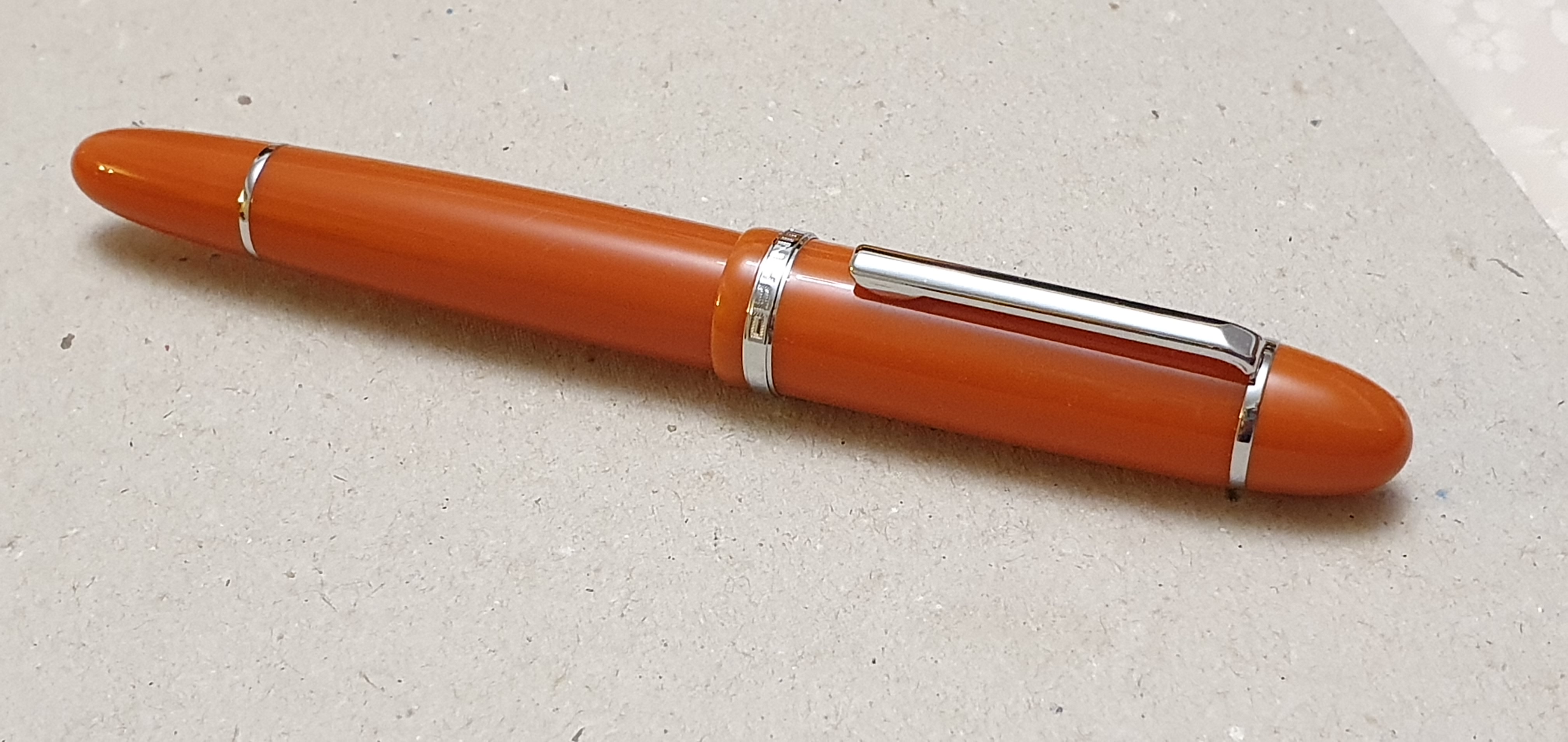
Early thoughts on the Jinhao 80 fountain pen.

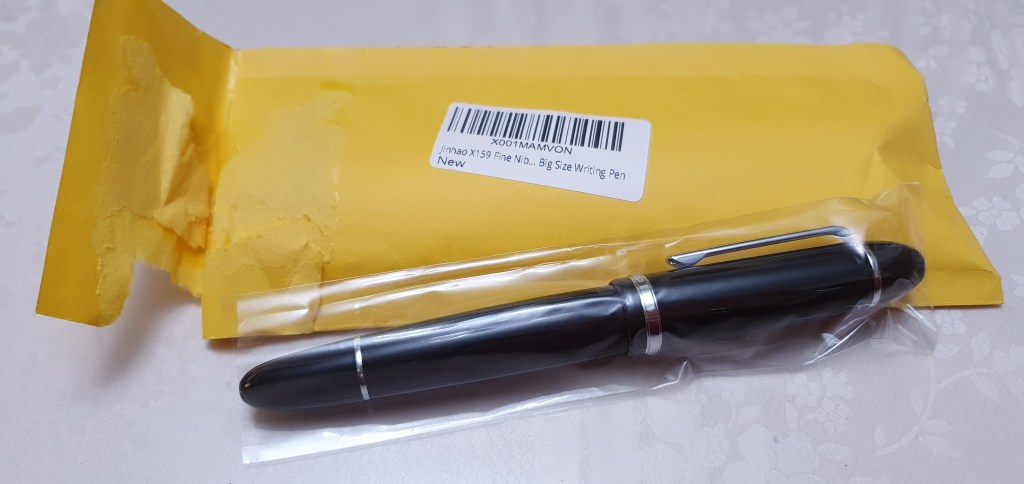
Don’t judge me. I found this by accident whilst innocently scrolling for pens, on Amazon (don’t judge me, again).

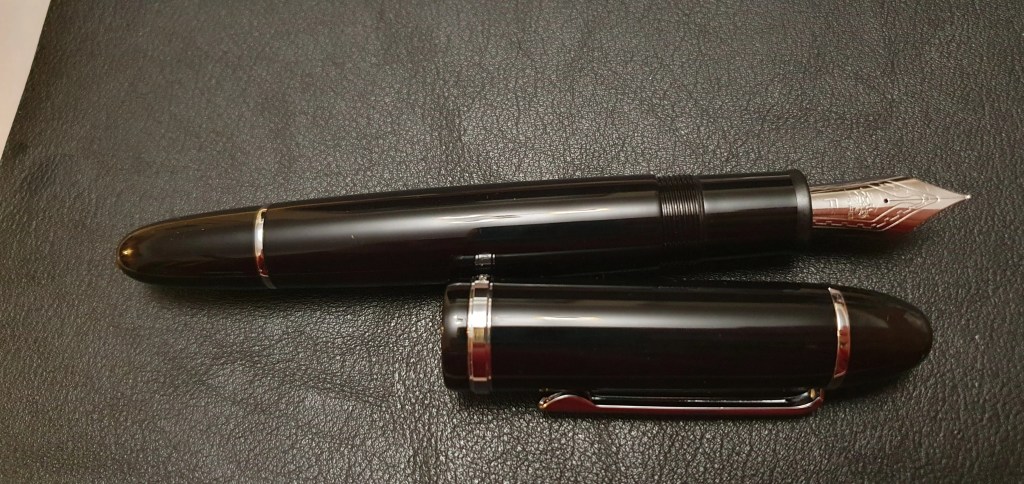
To give it its full description, this is the Jinhao 80 Gray Fiber Brushed Fountain Pen. I chose the Fine nib version. There were also options for a black pen with either a silver coloured or black clip and options of Fine or Ultra Fine nib.

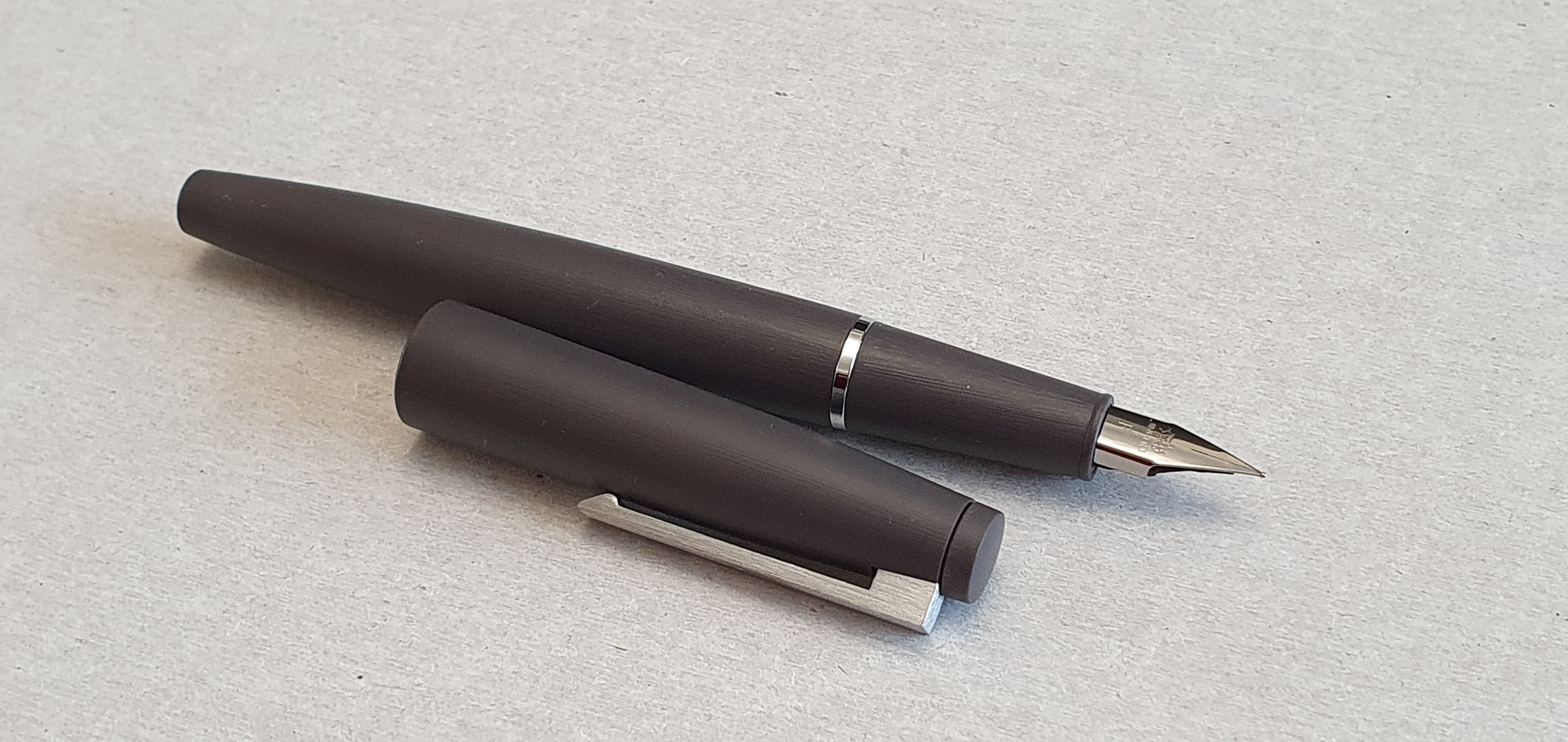
Jinhao 80 fountain pen.

To acknowledge the elephant in the room, this is clearly based upon a certain well known iconic, much loved German fountain pen designed in the 1960’s although there are many key differences, including as to body material, nib and feed design, grip section material and filling system. The snap capping is also simplified.

Conveniently leaving aside the ethical considerations of purchasing such a pen, I will describe the pen and give you my opinion of it on its own merits. Let’s call this a homage to the Lamy 2000.

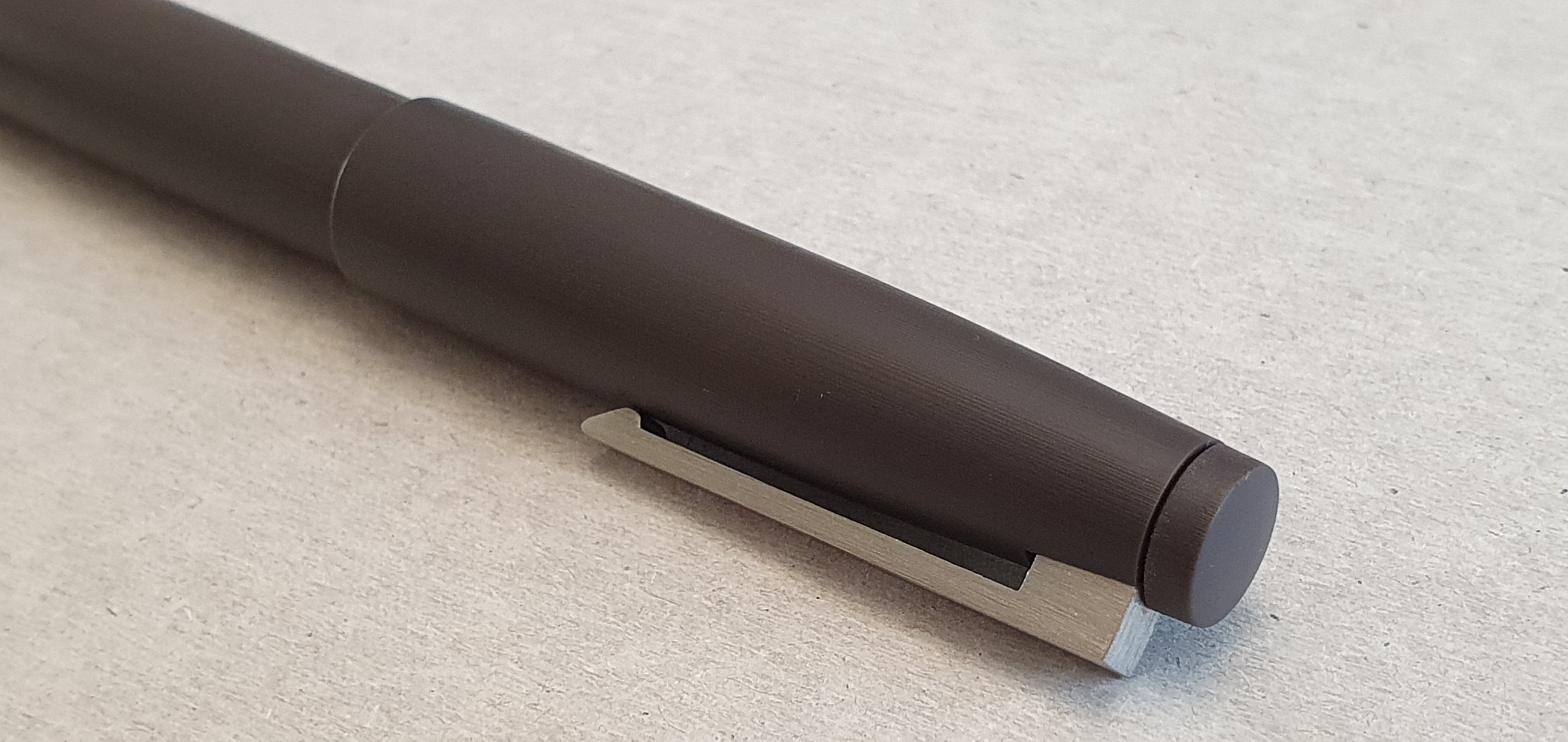
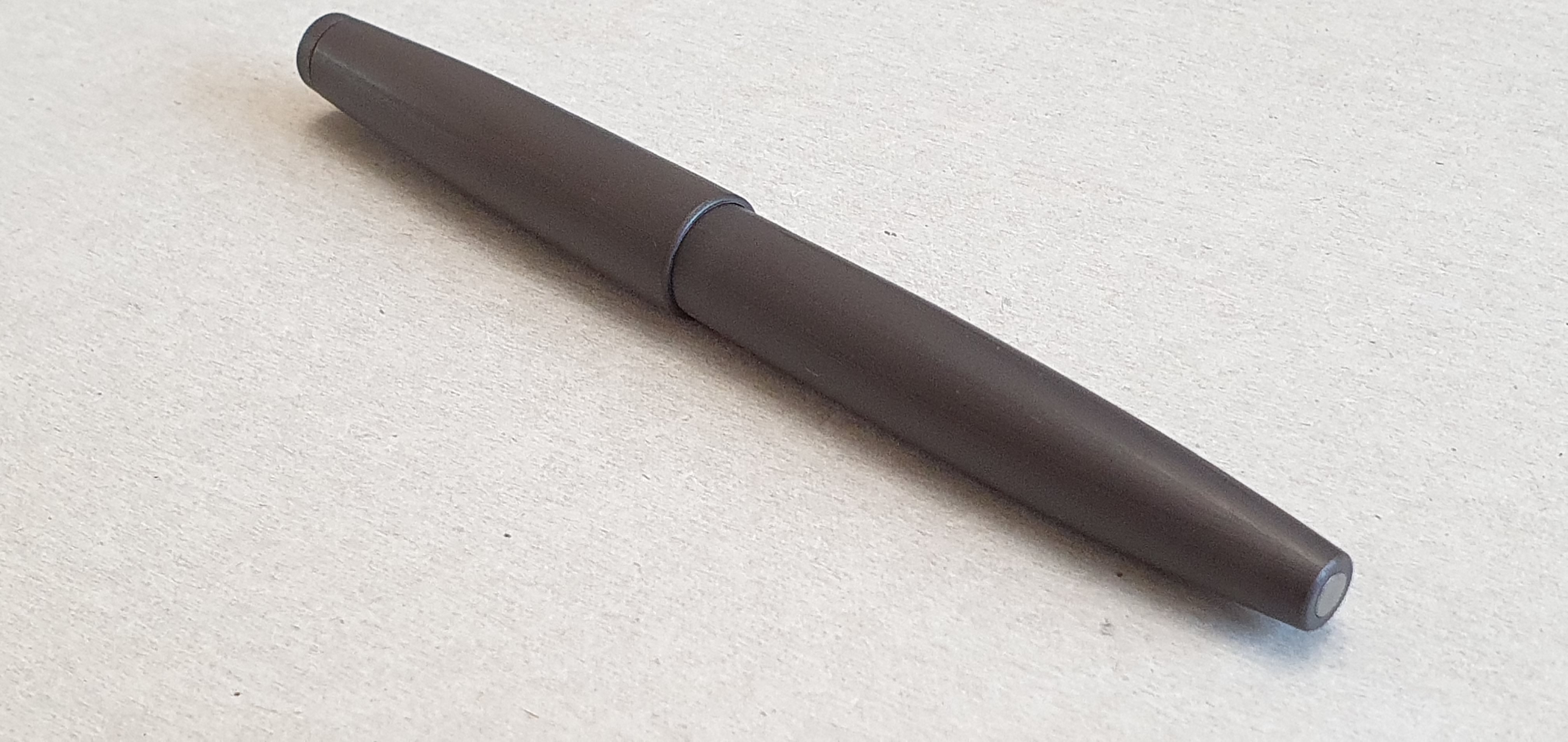
Matte finish finial, and solid steel, sprung pocket clip.

I was curious as to how the pen would feel, compared to the unique, tough and textured Makrolon of the Lamy. I have to say, that the plastic used does look and feel good and there is a textured finish in the plastic, which is pleasant to the touch.

The cap features a chunky, brushed steel clip which is sprung and works very well and is really quite astonishing given the price by western standards. There is no visible branding on the pen body or the clip, until you get to the nib. The cap finial is also just like that of the Lamy 2000, except in a matte finish rather than glossy.

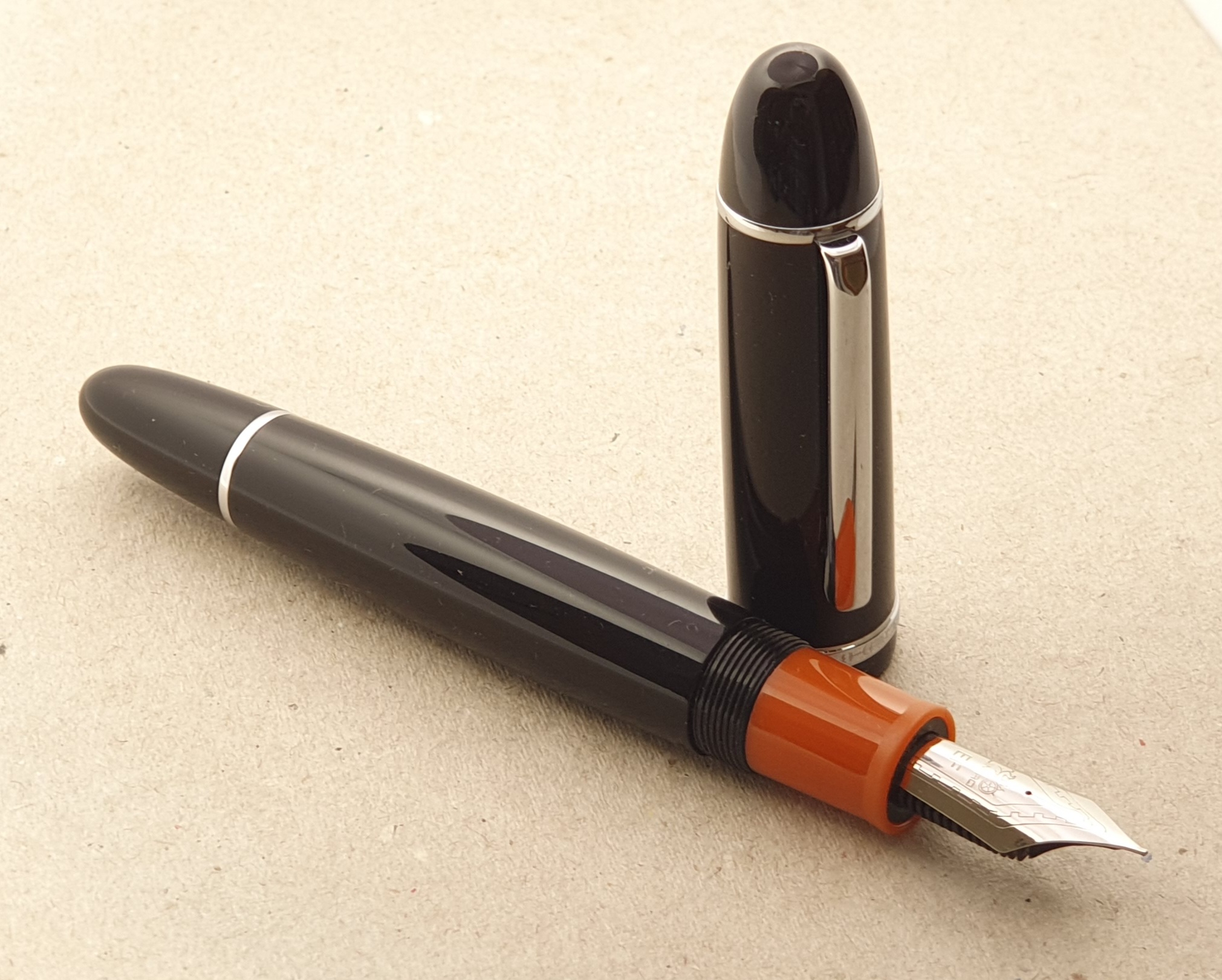
Uncapped.

The cap pulls off with a click. It is secured by the raised lip at the at the nib-end of the grip section clicking into the inner cap, as opposed to the horse-shoe metal ring (with its two protruding ears) of the Lamy. There is a plastic inner cap and I have not encountered any nib-drying and hard starting so far.

The grip section is of the same textured plastic as the cap and barrel and is very comfortable to hold. Where it joins the barrel, there is a shiny plated metal ring on the barrel. The absence of any step makes for a comfortable grip, wherever you wish to grip the pen.

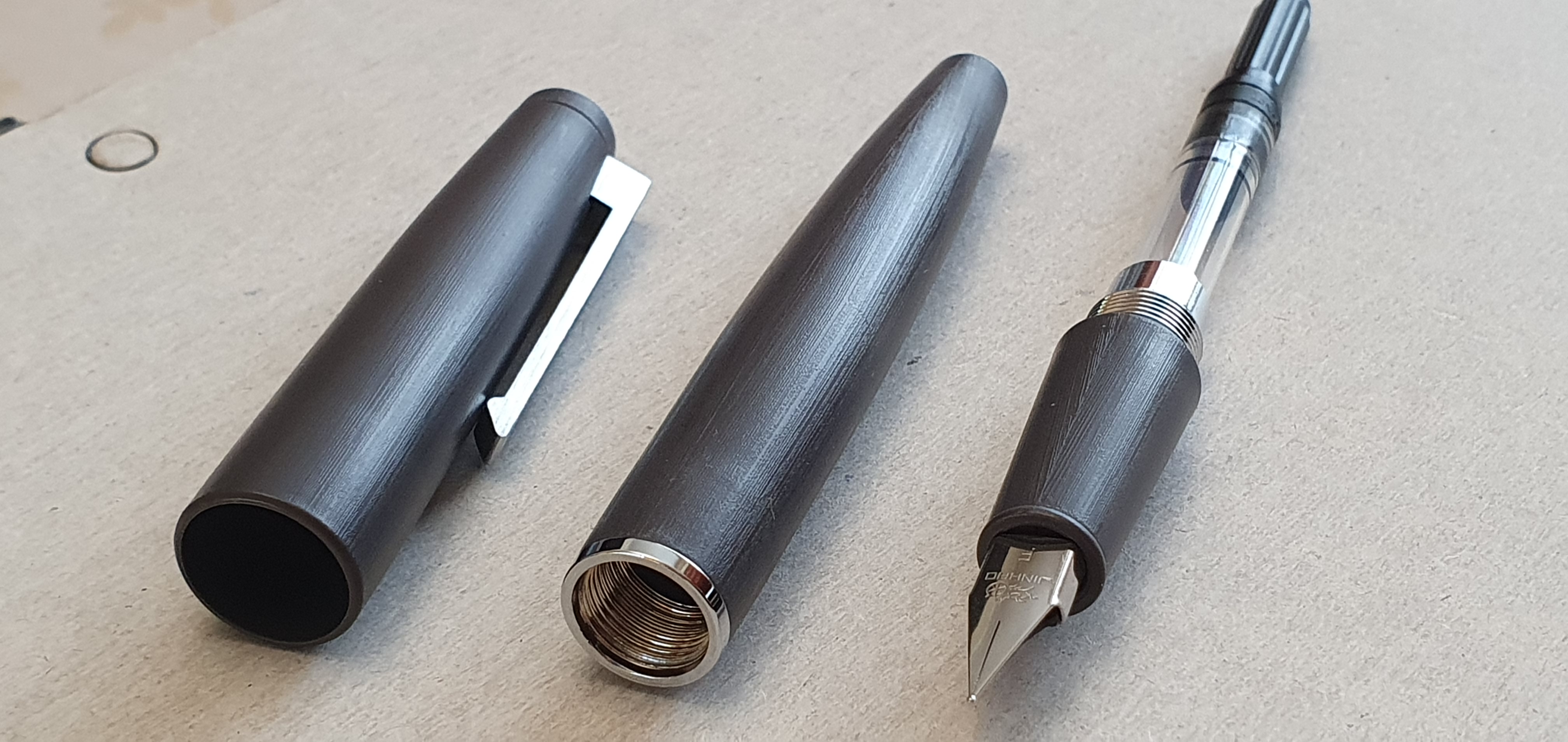
On the Lamy 2000, the join between the barrel and piston knob is famously almost invisible. On the Jinhao 80, you cannot see the join either, but this is because there is none: it is a cartridge-converter pen, not a piston filler.

At the foot of the barrel, there is a steel disc inset, which presumably is just cosmetic here but gives the pen a distinctive look on a desk and shows attention to detail in this homage.

Metal disc in the end of the barrel.

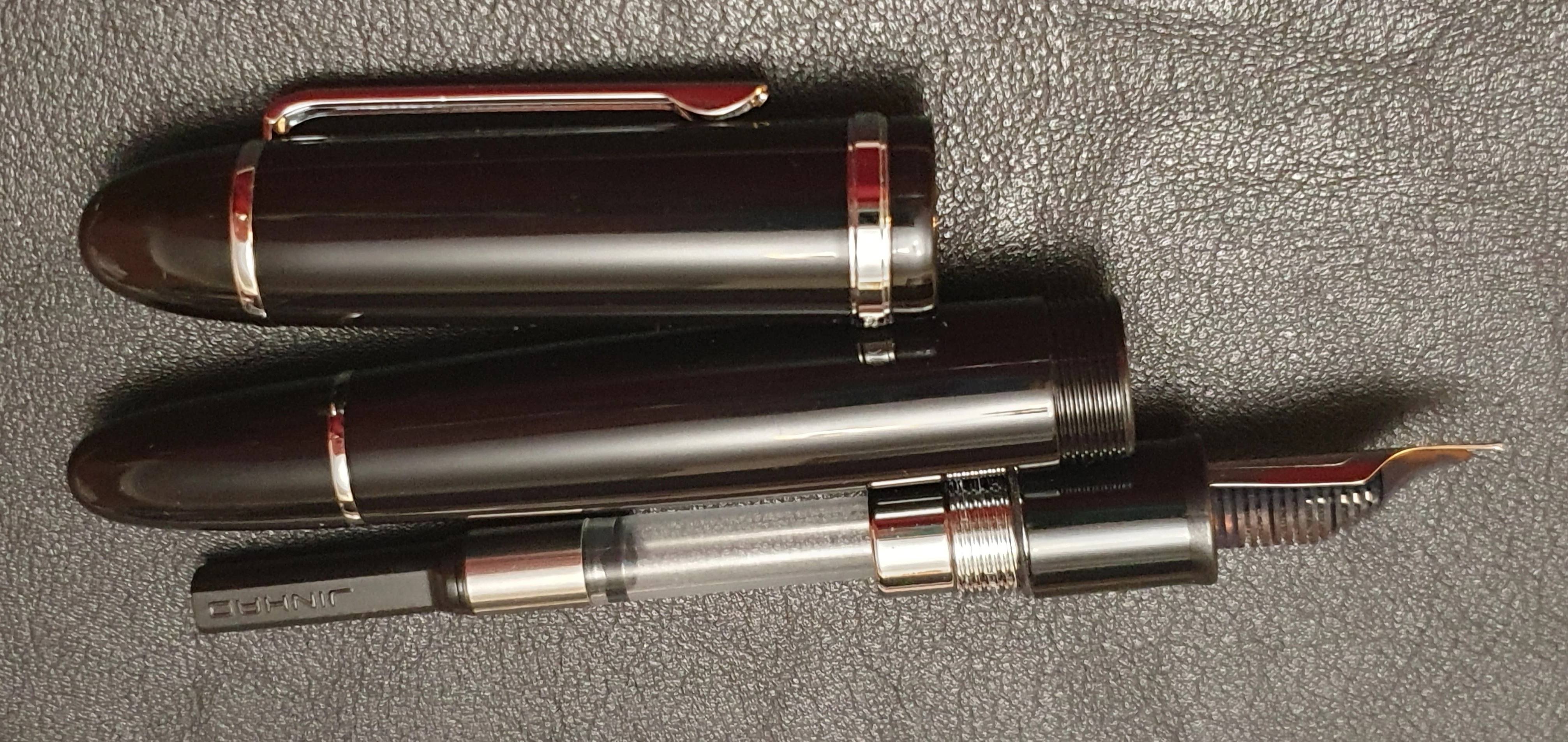
Unscrewing the barrel, the pen comes with a converter which works ok although I would have liked it to contain a metal coil ink agitator. This would help prevent ink sometimes sticking at the back end with surface tension rather than sloshing down to the nib and feed. But I was pleasantly surprised to find that the barrel had metal screw threads inside and so you have metal-to-metal threads for the barrel to grip section.

Metal threads in the barrel.

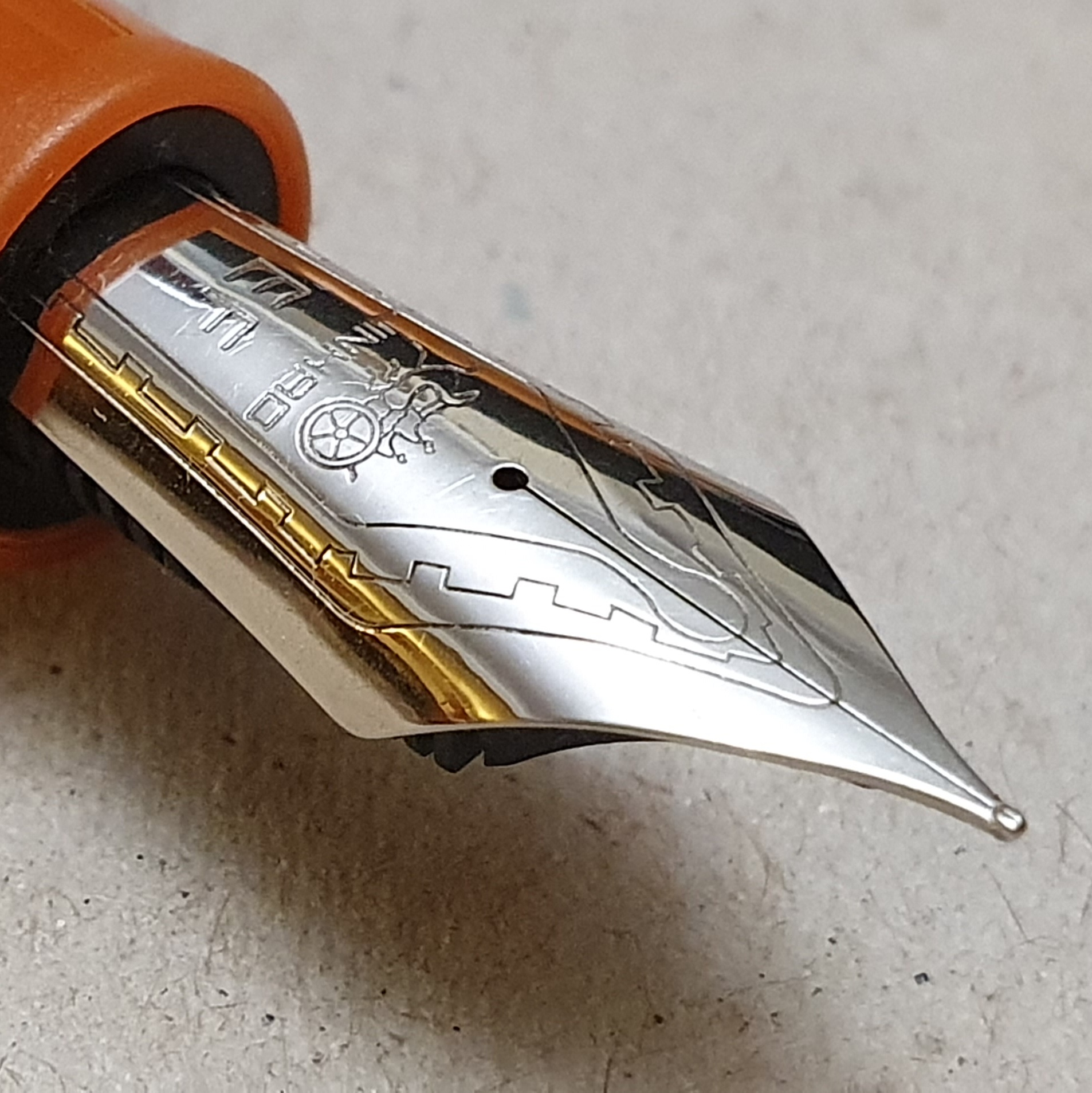
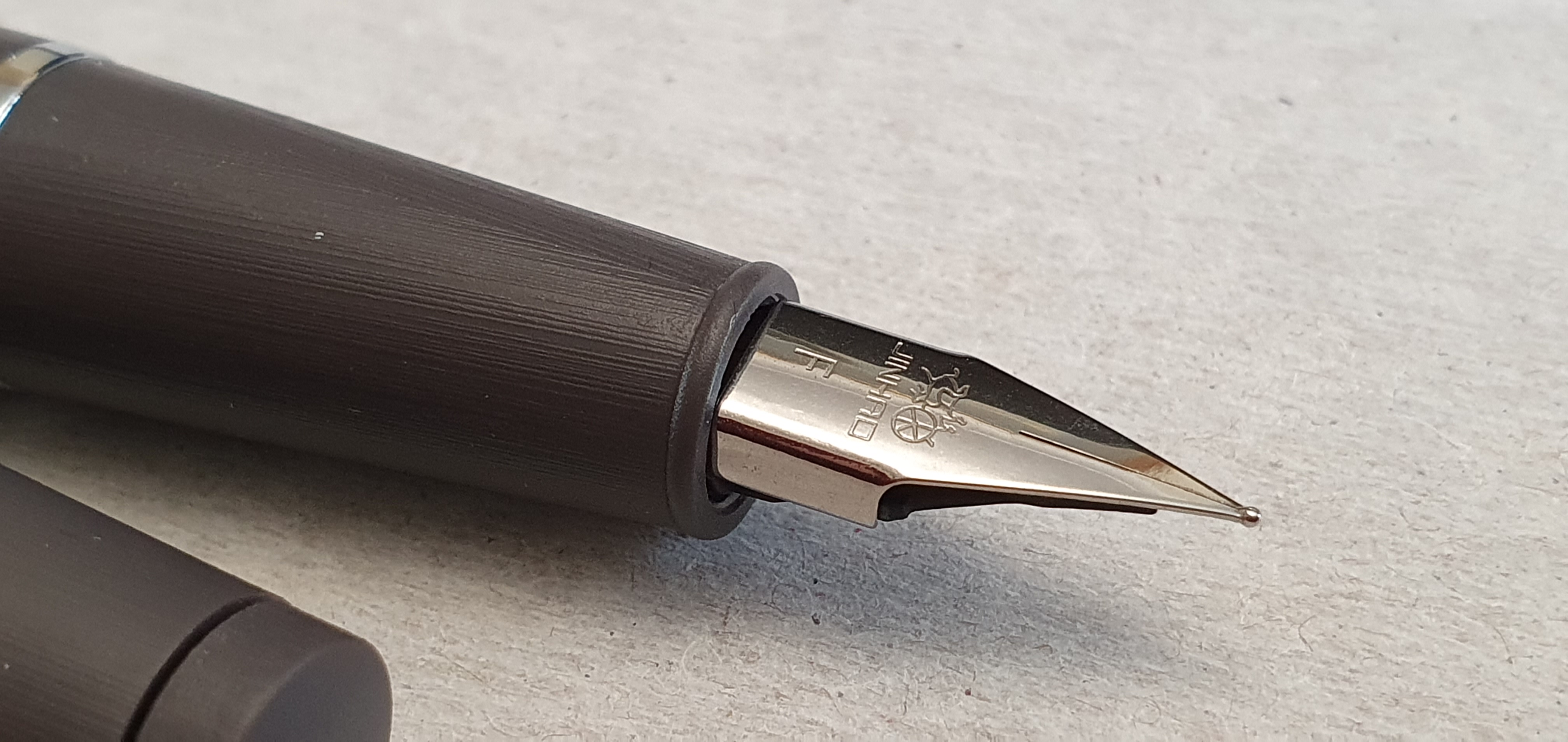
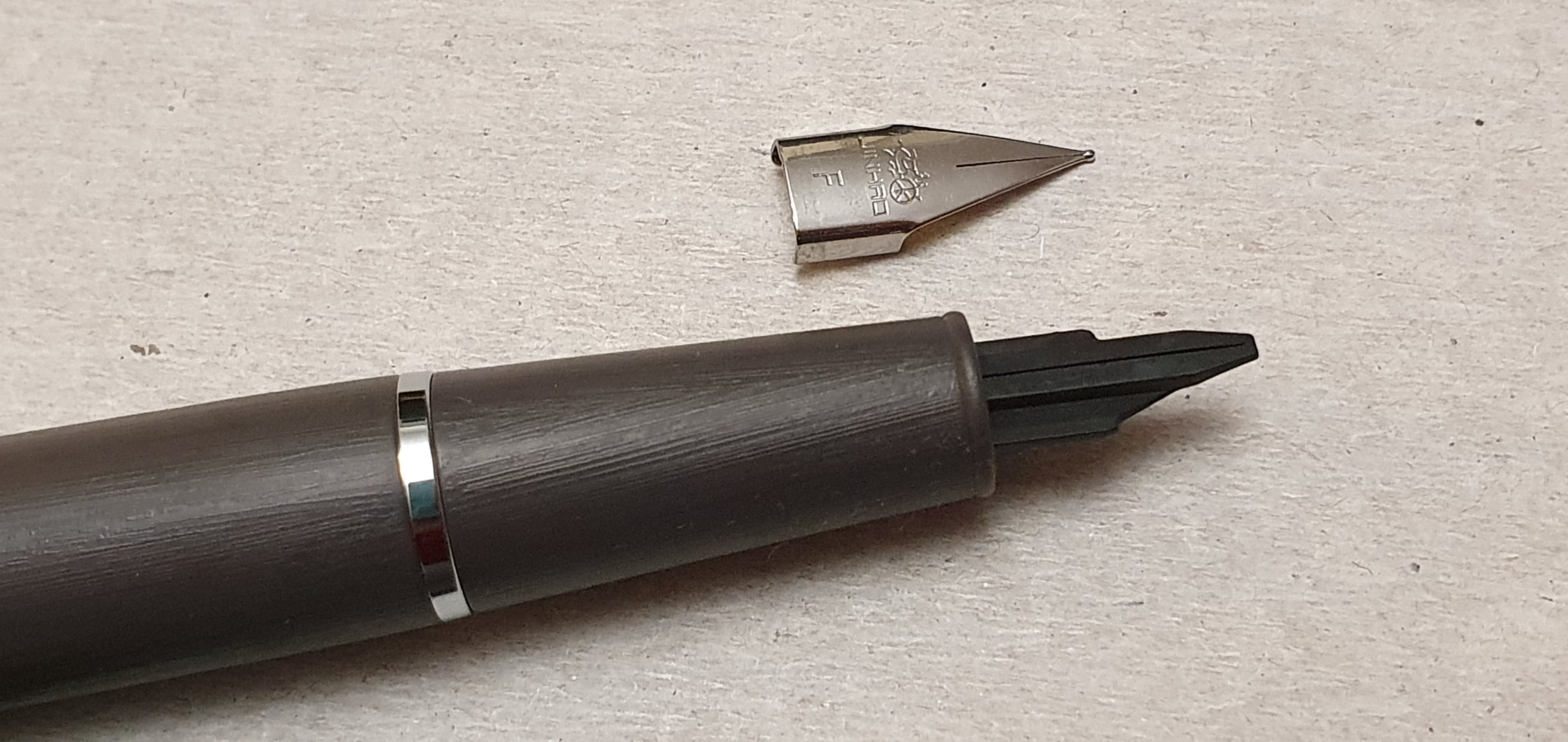
And so to the nib. The pen came with a Jinhao steel Fine nib. There is no pretence of making a Lamy 2000 style semi-hooded nib, but rather Jinhao has adopted the design of a Lamy Safari or Al-Star nib, which has its advantages.

Jinhao nib, Fine.

On mine, the nib wrote a fine line which was very dry. The nib was smooth with nice even and level tines but they were too tightly together for my taste. As I had chosen an ink that was also new to me (Rohrer & Klingner Isatis, limited edition of 2021) I soon found that in such a dry nib, the very thin single coat of Isatis, with no back-wash, looked very pale indeed.

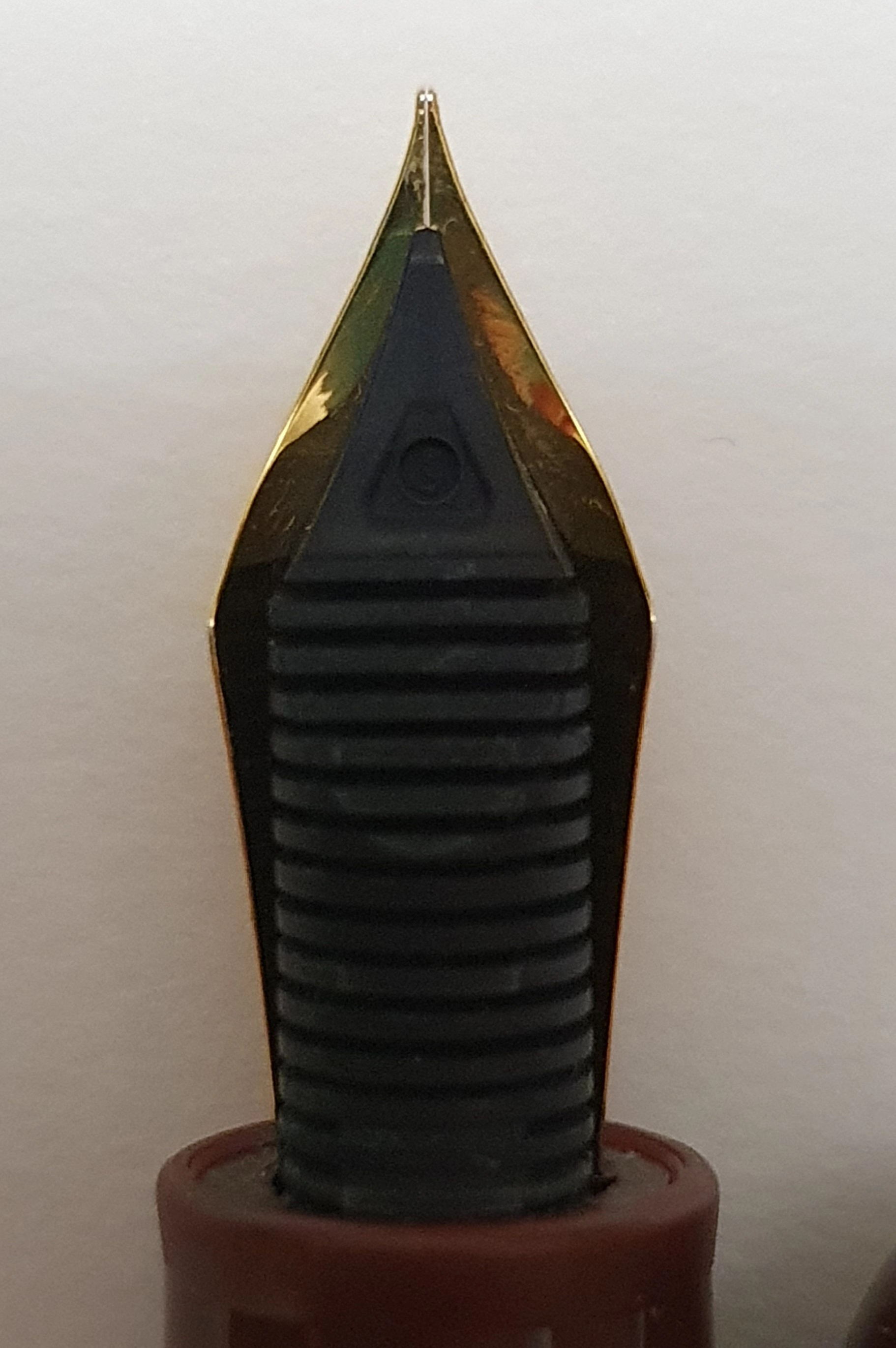
It may be that the nib set-up would have suited someone with a more conventional writing style, but as a lefty overwriter needing a wetter flow, I tried to ease the tines a little, with brass shims. This proved to be quite difficult, there being no breather hole and the face of the nib being flat, rather than curved over the feed. After struggling with this for some minutes, I gave up and instead swapped the nib for one from a Lamy Al-Star. This operation was quite easy, using a piece of Selotape wrapped over the nib to pull it directly off the feed.

With nib removed, prior to installing a Lamy nib.

Now, with a Lamy steel nib, the pen is writing very nicely. I have refilled it with Waterman Serenity Blue, filled from a bottle, which is the ink that I normally use when trying out a new pen.

The cap posts, both deeply and securely and the pen feels comfortable and well balanced whether the cap is posted or not. It feels comfortable, lightweight and solid and writes very well.

Giving credit where it is due, the pen has been made to a good standard of quality. Whilst the supplied nib was a bit too dry for me, the pen makes an excellent vehicle for a Lamy Safari-style nib which can be enjoyed without the Safari’s faceted grip. You could even fit a Lamy gold nib if you were so minded.

For its very modest price, which was just £9.49, the pen is undeniably good quality and value. The only issue is whether your scruples allow you to live with yourself for supporting what some would call a “knock-off”. In my case, I did not buy it because I wanted people to think I have a Lamy 2000. I can flaunt my own Lamy 2000 to do that. But for a low cost writing tool and now benefiting from a Lamy nib, this is, leaving aside the ethical debates, a great pen. There are plenty of examples of pen homages for those who would like a low-cost alternative to a Parker 51 or Duofold, Pilot Capless, a Montblanc Rouge et noir, or even a Lamy Safari, perhaps to use as body double whilst our originals stay at home.

A London walk in a time of national mourning.

Today there was a special atmosphere in London. With blue skies and warm sunshine, thousands came to central London to see Buckingham Palace and The Mall, Green Park or St James’s Park, some to lay flowers in memory of HM The Queen. Others have come to queue to see her coffin lying in state at Westminster Hall, ahead of the state funeral at Westminster Abbey on Monday 19 September 2022. It is a moving sight, even on television, with guards in splendid uniforms standing in silent vigil, 24 hours a day, whilst members of the public pay their respects.

For those wishing to see the lying in state, there is a huge queue stretching back to Southwark Park. The authorities are prepared for this to reach 10 miles long. There are constant updates online but at one time today there was an estimated queuing time of 24 hours, and as I write this the current estimate is 13 hours. A colleague of mine at work joined the queue on Thursday evening and reached Westminster Hall at around 7am on Friday. Total estimates were of 400,000 people filing past the coffin, over four days, some travelling from great distances to do so.

I did not wish to visit Westminster Hall but wanted to come to London to mark this rare occasion and experience the atmosphere. I began at Trafalgar Square and joined the many people walking along The Mall. There were a lot of families with young children, and many bringing flowers. Much of the area was closed to traffic. In the quiet without the usual traffic noise, I found myself noticing the architecture of so many grand buildings and it was poignant to see so many flags flying at half-mast.

The police were doing a good job of controlling the crowds. You could not simply wander about where you liked and could only cross some roads at special crossing points, and there were some one-way systems in place for pedestrians. People accepted this and cooperated, chatting to the police. There was a sense that we were all there for the same reason, united by our common loss.

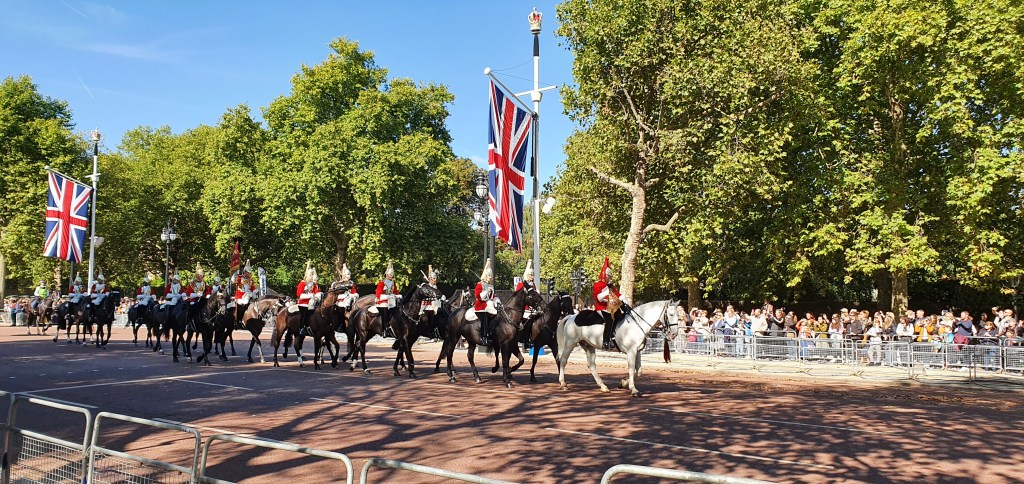
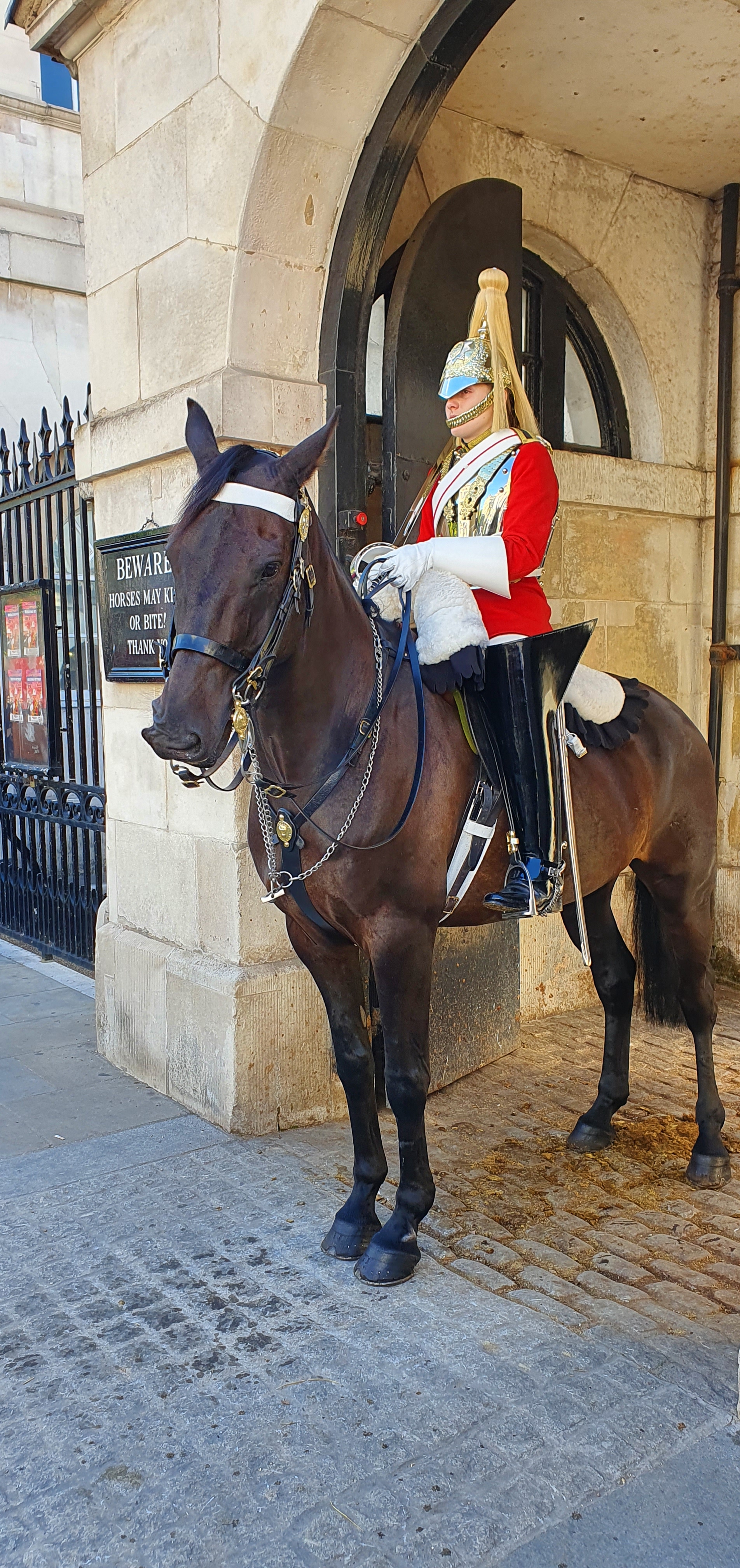
We paused to watch a group of mounted guardsmen ride past, with a police escort. Often helicopters could be heard high overhead. There were tv cameras and reporters everywhere and it seemed as if the attention of the world was focussed on London at this time.

The Mall: preparations for the state funeral.

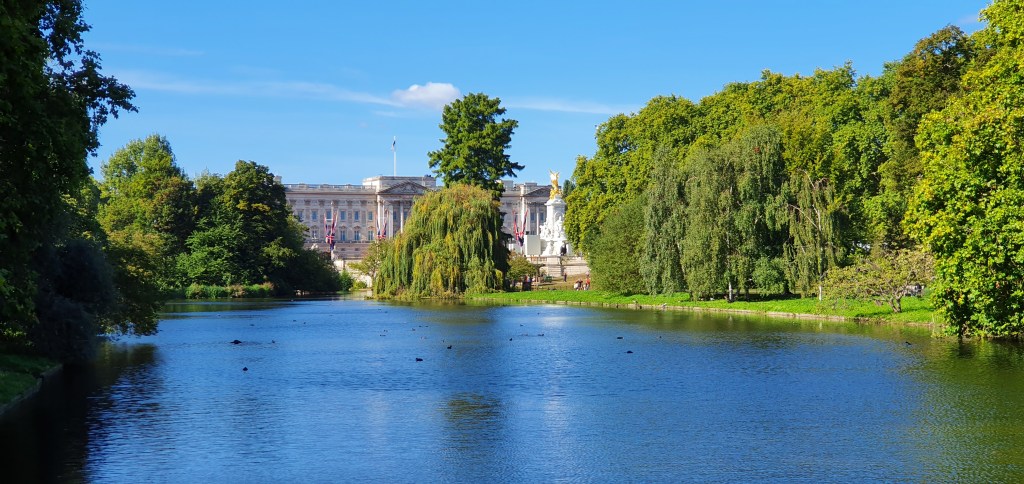
Because of the volume of people, we could not walk directly up the Mall to Buckingham Palace but had to cross St James’s Park and join long queues down one side of the road and back up the other for those wishing to go to the Palace. With even this queue likely to take a few hours I was feeling a little bit hemmed in by the sheer number of visitors, although there was no pushing and shoving. I decided to change direction and take a path of less resistance away from the main attractions.

Buckingham Palace from St James’s Park.

From Birdcage Walk, I continued on to Buckingham Gate passing the Rubens hotel (where I had enjoyed a weekend break a few months ago) opposite The Royal Mews. Souvenir shops had portraits of the Queen in the window with her dates. There were mugs with the Queen’s picture and dates 1926 to 2022 and messages such as “Forever in our hearts.”

I cut through to Victoria Street, where there was more space to walk normally and headed towards Parliament Square. I was sorry to note that the landmark department store, House of Fraser on Victoria Street had closed down. I ventured down Artillery Row and came to Horseferry Road and found a cafe for some lunch. A man at the next table had just been to Westminster Hall after queuing for 14 hours. A group of police came in for coffee and takeaway lunches, taking these back to their minibus.

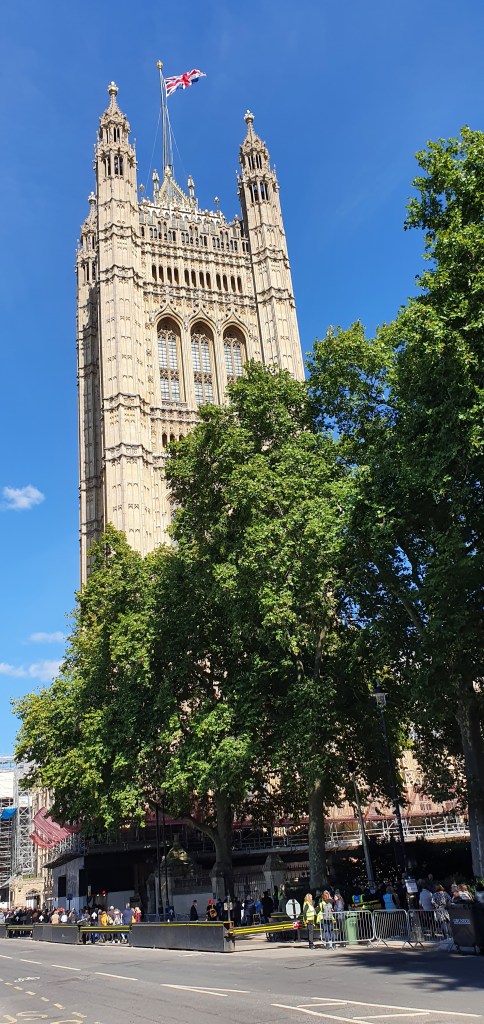
At Lambeth Bridge I saw sections of the epic queue heading for Westminster, like a pilgrimage. Not being a part of this, I could walk freely along Millbank and see the Houses of Parliament and Big Ben as I neared Parliament Square.

Houses of Parliament.

It was extraordinary to see and hear Parliament Square without any traffic. I passed Westminster Abbey where all eyes will be on the proceedings in two days’ time. There are already stands erected for tv camera crews.

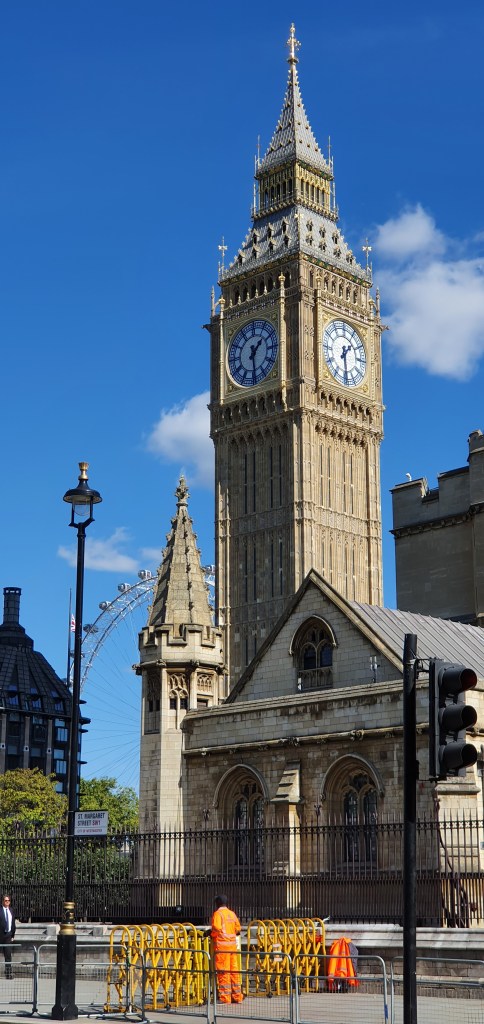
Big Ben in the autumn sunshine.

Once inside Parliament Square, there was a pedestrian one-way system again and so it was necessary to go with the flow. First though, I enjoyed sitting in the sun to write down some impressions of the day, with my new Tibaldi fountain pen and the “traveller” style notebooks from Flying Tiger. I like the Tibaldi more and more and appreciate everything about it, particularly the retro zest green colours, its generous size, firm nib and the ebonite feed.

My journaling companion today, the Tibaldi N.60.

A young woman busker named Harmonie London set up a keyboard and began to sing the national anthem and soon drew a big audience. Without the traffic noise, her beautiful voice and playing could be heard from quite a distance and her set captured the collective mood perfectly. Many videoed her with their phones.

I made my way up Great George Street, passing the impressive Treasury building, and along Horse Guards Road, before cutting across Horse Guards Parade to emerge in Whitehall and back to where I had started.

Whitehall at entrance to Horse Guards Parade.

Before returning home, I headed up to Leicester Square to visit Choosing Keeping at Tower Street, surely one of London’s most delightful stationery shops. I browsed the Japanese pencils, Tomoe River paper notebooks, and a display case of fountain pens including Sailor, Pilot, Lamy, Kaweco and Pelikan. Resisting these I still found myself buying a bottle of Rohrer & Klingner ink in a dark blue or blue black called Isatis tinctoria, their limited edition of 2021. In my relaxed state I had forgotten all the golden rules of ink buying, which are to ask yourself “Do I actually need any ink at the moment?”; “Do I need this colour?”; “Is this sufficiently different from all the other inks that I already have?” and “Would my spouse approve?” and “What is WRONG with me?!” However, it is lovely ink, and it is important to support such wonderful shops.

All in all it had been a remarkable and memorable day. And my phone tells me I walked 7.87 miles so that’s good.

Early thoughts on the Tibaldi N.60 fountain pen.

I do not buy an expensive pen so often now. This has been only my third in 2022, the others being my Esterbrook Estie and then an Aurora Talentum, both of which proved successful purchases.

Purchase backstory

I first saw a Tibaldi N.60 in the flesh, whilst browsing in Selfridges some months ago. They had the Ruby red edition on display. It was a little too pricey for an impulse buy, and felt too similar in specification to my marbled red Leonardo Momento Zero. But the memory of it stayed with me. I read some reviews online which further whetted my appetite. I found that the pen was also available in Emerald green, Amber yellow, Samarkand blue or Rich black, with Palladium trim.

And then came the tempting Iguanasell summer sales. I had already bought three Aurora fountain pens online from Iguanasell. Their keen prices and fast service are hard to resist and receiving the parcel from FedEx is exciting. It was whilst scrolling through their sale pens, that I spotted the Tibaldi N.60, but not in any of the versions I knew of: this was called Retro Zest green and featured an 18k gold plated nib and trim, instead of the Palladium. I was immediately taken with this edition. In the photos the cap looked a lighter green than the body. After a few days I eventually and inevitably caved in and pulled the trigger. I opted for a medium nib.

The history

Tibaldi was founded in Italy in 1916 by Guiseppi Tibaldi, being amongst Italy’s earliest pen manufacturers. I believe it continued in business until 1965. I found images of a vintage Tibaldi online, which my pen closely resembles, save that the original was made of celluloid, had a solid gold nib and was a piston filler. Like many pen companies, for example Esterbrook, the company brand was later reborn. The headquarters was moved from Florence to Bassana del Grappa in 2004, which readers may recognise as the home of Montegrappa fountain pens. I gather that Tibaldi shares the same management as Montegrappa, in the Aquila family. Other models in the Tibaldi line are the Bononia, the Infrangible and the Perfecta.

Unboxing

The pen comes in a simple but sturdy black cardboard box, with a tray sliding out from an outer black sleeve, all within an orange paper outer sleeve. The pen cushion lifts out, to reveal a 2 year warranty card and a sealed pack containing two Tibaldi branded cartridges.

Tibaldi N.60 Retro Zest fountain pen.

Description

The Retro Zest green material was far more spectacular in real life than in the photos. On my model, the cap was not a lighter green than the barrel, but there are stripes of light and dark tones, from a very light green-gold to a dark green that is almost black. The colours look stunning as you rotate the pen in your hands. The pen body has the appearance of being faceted, yet is not and is entirely rounded and polished.

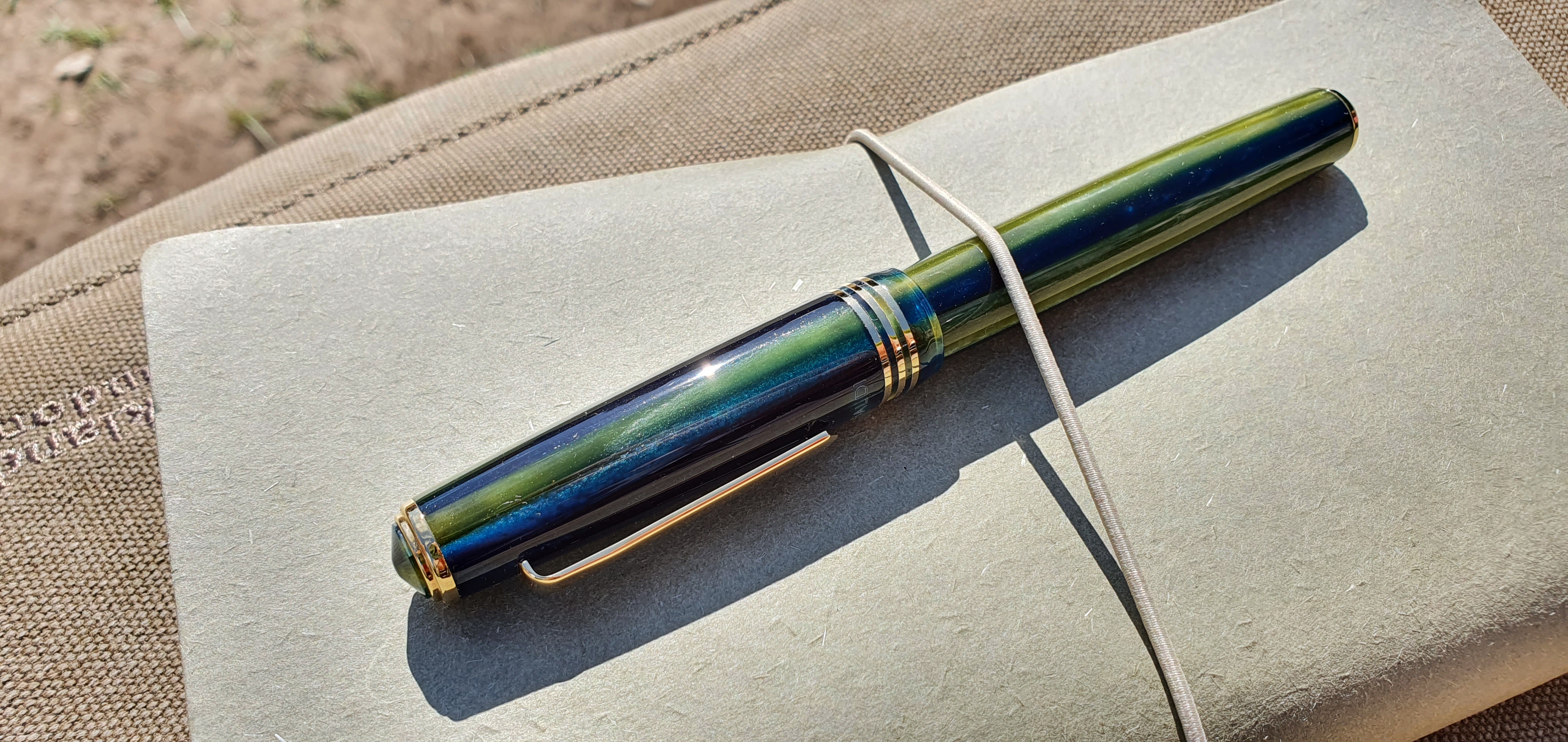
Catching the chatoyance in the cap.

It is a large pen. There is a distinctive, pointed finial in the same green acrylic material as the body, surrounded by a gold trim ring; a very stiff, tie-shaped pocket clip; three gold plated cap bands; Tibaldi on the front and Made in Italy on the back. The cap unscrews in one full rotation.

Uncapped

The section is of the same coloured material as the cap and barrel on this edition, whereas on the other colours mentioned earlier there is a black section. The section is rather short, before meeting the cap threads on the barrel but these are not sharp or uncomfortable if you grip the pen there. The section and barrel are very girthy however at around 12mm at its widest point.

The barrel unscrews and there is a gold-plated metal mount for a cartridge or converter. A Tibaldi branded converter is supplied, which is screw fit, a feature which I always enjoy. The other end of the barrel ends with another finial with a green acrylic “jewel” matching that on the cap.

Tibaldi screw-fit converter included.

Nib and feed

The stainless steel nib is gold plated and has the name Tibaldi, the bird’s wing logo and an M for medium. A particularly welcome feature at this price point, is the ebonite feed rather than plastic. This is semi-porous and partly absorbs ink, helping the flow of ink between nib and feed and also helps to ensure that the nib stays ready to write, even if the pen is unused for a few days.

Nib and the cap finial.

On my model, the nib was smooth and wrote right out of the box. It is a very firm nib. My early trials with the nib found it to be rather on the dry side. This may suit the majority of right-handed under-writers but I prefer a slightly wetter nib for greater lubrication and a darker line even when writing without any downward pressure, this being my usual lefty over-writer syle. I therefore set about easing the tines apart just minimally, first with brass shims and then with a gentle wiggle of a craft knife. This had the desired effect and I am now enjoying good flow and effortless writing.

Size and Weight

The pen measures 148mm end to end, including the raised finials. Uncapped it remains a generous 132mm which is plenty long enough to use unposted. The cap can be posted but brings the length to 173mm. It weighs aground 27.5g, 17g uncapped and 10g for the cap alone.

Size comparison with the Montblanc Meisterstuck 146.

Likes and dislikes

On the plus side, the colour and finish of this pen’s material has a big appeal for me. To a casual glance in poor light it might look like a black or very dark green, but on closer inspection as you turn the pen in the hand the polished feel and the strips of different shades of green reveal themselves having the appearance of an exotic vintage celluloid of pens of old. The pen is of a generous length and girth, without being unduly heavy. The ebonite feed (as found on my Aurora Talentum, Optima, and 88) is a rare delight in a steel nibbed pen at this price. Having a steel nib keeps the cost down.

On the negative side, the section is short. Some may find it too wide. The pocket clip is very stiff which means it grips securely but is not so easy to use. I would have liked to see “Tibaldi Model 60, Made in Italy” engraved on the barrel, in the manner of an Aurora Optima or Parker Duofold but I am probably asking too much now. Finally, one could argue that the pen is pretending to be something it is not, with a body which looks like celluloid and a nib which looks like gold. I do not see it that way and think that even without comparison to the pre-1965 model which it resembles, the pen stands up well in its own right for a modern, safe and convenient equivalent.

I recently saw a review by SBRE Brown of the Tibaldi N.60 in Emerald green. His only complaint was that the grip section was black, not of the same colour as the rest of the body. That is not an issue on the Retro Zest edition.

Size comparison with a (dusty) Montegrappa Fortuna

Conclusions

It is sometimes said (at least, in fountain pen circles) that if you find a pen you like and in a finish that you like, then buy it! Tibaldi pens are not very easy to find in the UK. Cult Pens sells them, including the N.60 but not currently the Retro Zest edition. Iguanasell has served me well now on several occasions even including a surprise free gift with this order and I would recommend them.

Perhaps some comparables below £200.00 might be an Edison Collier, a Conklin All American, Leonardo Momento Zero or a Montegrappa Fortuna. In terms of size and girth, the N.60 could be a good test of whether you will get along with such a large pen, before splashing out on a Pelikan M1000 or Montblanc 149.

Some final thoughts. This has been a momentous and sombre week in the UK: HM Queen Elizabeth II died on 8 September 2022 at the age of 96, after serving as monarch for over 70 years and just two days after greeting our new Prime Minister Liz Truss and inviting her to form a new government. The Queen was of my parents’ generation and hugely loved and respected. She had been the Queen for all of my life and so there is a sense of loss here. The N.60 was the last pen I bought whilst our Queen was alive. We are in period of mourning, which I will record in my journal. We have a new King and a new Prime Minister. Amidst all this change the N.60 Retro Zest is a good tool for such reflections and an echo of another age.

Long term thoughts on the Visconti Rembrandt fountain pen.

It has been four years since I wrote a post The Visconti Rembrandt v The Pineider Avatar fountain pen (8 September 2018). At the time, I had owned the Rembrandt for less than a week. I think my comments then were fair and still hold good. As to which one of those two pens you prefer, that is subjective and each has its merits.

It has been my habit for decades, to write a daily entry in my diary. Currently I use an A5 page-a-day diary from Rymans. This year, it was my intention to use a different pen and ink combination each month. I started out with a Cleo Skribent Classic Gold in January but was enjoying it so much that I continued with it for February too. Then, forcing myself to have a change, I started March with the Visconti Rembrandt. I am still using it now. By the end of August, I had been using the Rembrandt almost every day for six months, barring a few days when I went away and took other pens for holiday journaling.

My Visconti Rembrandt Twilight, at four years old.

As for ink, I have been using it with Kaweco blue cartridges. I had a stash of these, acquired on buying Kaweco pens, particularly the Perkeo of which I have several. With each purchase, there would be four new Kaweco blue cartridges, with the Kaweco name along the side. I particularly liked this ink and kept these cartridges in a Kaweco tin, separate from my hoard of generic blue standard international cartridges.

This adorable Kaweco tin lives on my desk and held my stash of Kaweco blue cartridges.

Since 9 February 2022, I have filled the Rembrandt eight times with these cartridges and am down to my last one. I plan to switch to Kaweco midnight blue next, as I have a box waiting. I will never get through all my ink, but it feels satisfying to have used up these Kaweco blues, at least.

Whilst using a standard international cartridge, the Rembrandt has space to carry a spare. The spare cartridge does rattle around though, and to stop this I cut a small cube of rubber from an eraser and dropped it into the back of the barrel. Be careful with this however: too large a piece and it will jam inside and you will not be able to get it out again unless you break it up with a cocktail stick.

I should mention the chrome section of the Rembrandt. Generally, I am not a fan of slippery metal sections. For this reason I have avoided the Lamy Studio (apart from the brushed steel version with the black rubberised grip section). But in all fairness, the Rembrandt’s shiny plated metal section has not been a problem for me at all. My grip on the pen does not slip. I do not have trouble controlling the nib or stopping it from rotating left or right. I think that this may be partly because the section and the nib are both relatively short and when I hold the pen, my thumb still rests on the purple barrel, serving to anchor the pen and stop it from rotating in my hands.

The shiny plated business-end of the Rembrandt.

When I first got the pen, I preferred using it with the cap posted, but my habit has changed and I now use it unposted. If I had been put off buying the Rembrandt because of its metal section, then I would have missed out. The magnetic cap fastening still works well and is quick and convenient. It makes for a grip area free of any sharp step or screw threads.

Above, all, the pen writes really well. I get no hard starts. I did adjust the nib slightly when it first arrived, to ease open the gap between the tines to improve flow to my taste, but having done this in the first few days, the pen has written smoothly and effortlessly ever since and works well with the Kaweco blue cartridges.

As for the Pineider Avatar in its vibrant Lipstick Red, I still have it and it is a beauty. It has the “Wow factor” which the Rembrandt lacks and got the best admiring looks at our London pen club. Yet the Rembrandt has proved itself a solid performer over time and deserves credit for that.

It is hard to show that it is actually purple, with subtle “brush strokes” of lighter colours in the material.

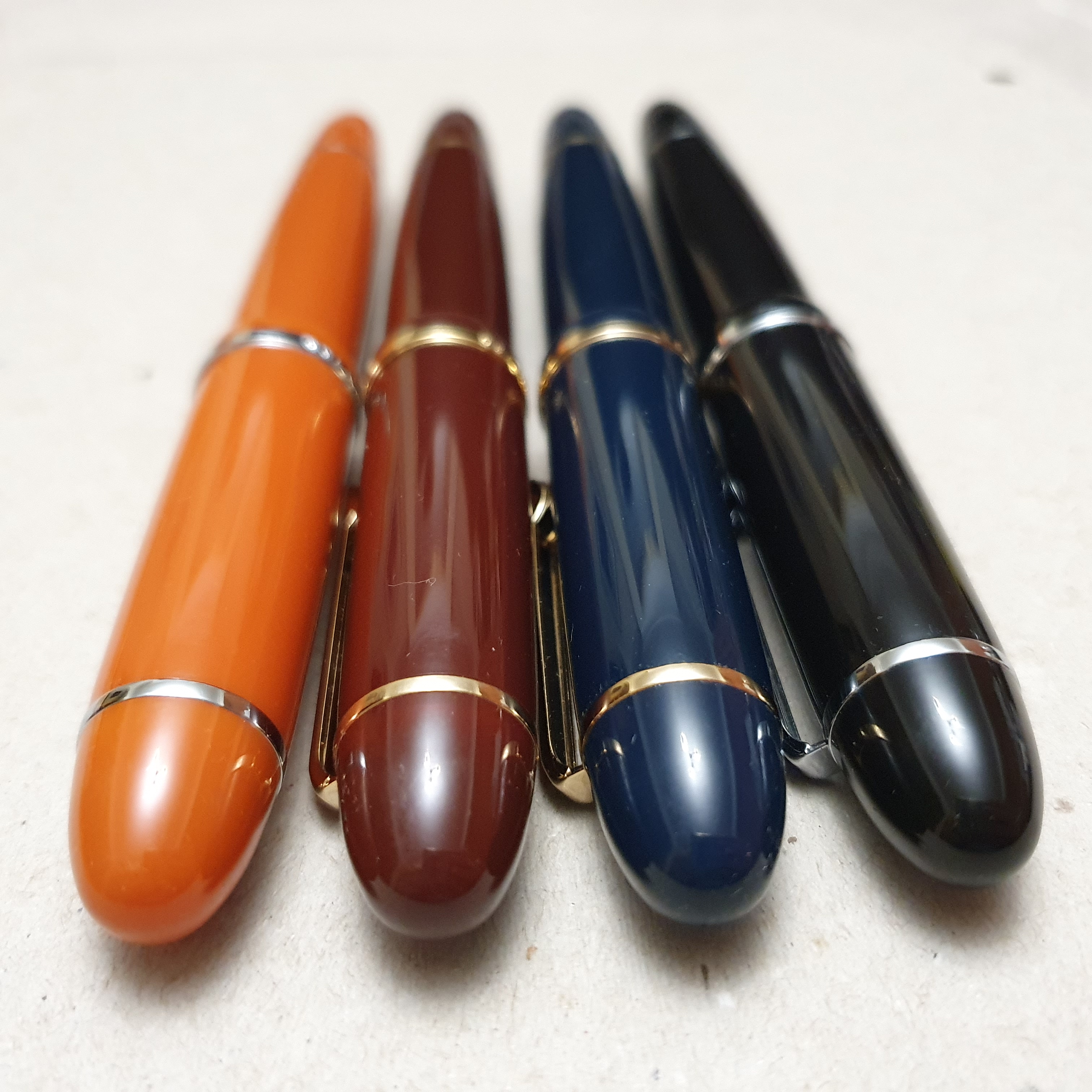
Finishing my greens: a look at my green ink stash.

Like many others in this hobby with a passion for fountain pens, I have suffered from Gear Acquisition Syndrome and now find myself with an embarrassing number of pens, unused notebooks and bottles of ink. From time to time I need to remind myself of what I have “in stock.”

When my late Godfather (“Uncle Brian”) died, his wife Mary offered me his almost full bottle of ink. It was Cross Blue. I gladly took it to finish and have been getting through it in the pen that I use at work, a Cross Bailey Light. It is now on its tenth fill, since last December.

Unlike Uncle Brian, I have two drawers full of bottled inks in various colours and will never get through it unless I decide to paint the walls with it. Of course it is nice to have a good selection of different inks to play with and most inks keep well for years. (One exception is registrar’s blue black iron gall ink, which once opened, is best used within 18 months or so, before it starts to lose its darkening ability).

I may at last be reaching the age where my desire not to fill my house with extra possessions, can sometimes outweigh the attraction of the thing itself. As I try to to use and enjoy what I have, it can help to break this down into smaller goals. Green inks are a category of inks that I have relatively few of. I can count my bottles on the fingers of, well, two hands.

The Green Team, from my ink stash

The only one of these that I have finished, and which was for many years my only green ink, was a bottle of Parker Quink. I still have the classic bottle and its cardboard box. Sadly these bottled inks are sold in plastic blister packs now. My bottle has a faded price label and I can still see that it came from WHSmiths.

I did eventually finish this but had had it for so long that I could not part with the bottle.

A modern equivalent, for a good day-to-day green ink might be Waterman’s Harmonious Green. Nowadays, I like to write the date of purchase inside the box lid. Mine bears the date 26 September 2015 and I bought it in the Burlington Arcade, off Piccadilly in London. It is still a good two thirds full. However I am now using it regularly in my Delike New Moon, fude nib pen. It is a good combination for the marbled green acrylic pen. It is an inexpensive ink for an inexpensive pen.

My Delike New Moon, fude nib pen with its current pairing of Waterman Harmonious Green.

I have some more up-market green inks: Montblanc Irish Green and, probably my favourite, Graf von Faber-Castell Moss Green in its attractive heavy bottle.

I have a 30ml plastic bottle of Diamine’s Deep Dark Green, which I bought at the same time as their Deep Dark Blue and Deep Dark Red. I used the Deed Dark Blue by far the most and finished the bottle, often using it in a TWSBI Vac 700 or Diamond 580.

Some less common greens are my Noodler’s Sequoia: a brim-full glass bottle containing 3oz of this green-black ink. Unfortunately, although I was very taken with the colour, I found it all but unusable for a lefty-overwriter as it is so slow-drying and smudges long after I would expect it to be dry.

Seven bottles. That is still a lot of writing.

At the London Pen Show one year, I picked up a cute little bottle of Conway Stewart green ink, made by Diamine. I do not know the name of the colour but think it was of the same series as Conway Stewart Tavy, which is a nice blue black. However I bought it more for the bottle, nice for travelling, than the ink.

Finally, I have a bottle of Krishna Inks Ghat Green, which is an attractive khaki green-gold. I did not use it much at first as I suspected it of causing unsightly and disturbing nib crud on my Montegrappa Fortuna’s steel nib. But I later gave it another chance, in my Sailor Pro-Gear with a 21k gold nib and have had no problems with it at all.

If you want to get through ink faster, using a pen with broad, stub or music nib will help. Or you could use it for drawing. For some years I could not settle to using a green ink as I would soon have the urge to flush it out and refill with a blue. But I now appreciate a green ink from time to time and it is well worth having at least one green-inked pen! I heard it said that there is, or was, a convention in the Royal Navy, of different colour inks being used by different ranks of officer. I have not been able to verify that. I do remember that green was the colour of correspondence from Rolex, if you got a typed letter from them in the 1960’s. It also makes a good colour for amending and editing typed drafts, rather than red.

A green ink can look attractive, particularly on cream coloured paper and paired with the right pen and can make a refreshing change from the usual blues. I don’t know when I will next finish a bottle or whether I will ever own just one bottle but I am at least trying not to buy more.

My Lamy 2000 and I: a new chapter begins.

If you were to ask a group of watch enthusiasts to name the most iconic, recognisable watches of the last 100 years, they might include a Rolex GMT Master, an Omega Speedmaster, a Casio G Shock and maybe even a Fitbit. Try the same exercise with camera enthusiasts and you might hear the Leica M3, Hasselblad 500CM, a Rolleiflex, Nikon F and Olympus OM1. The debate will be endless.

Take a group of fountain pen fans – a random selection from a pen show perhaps. Again, everyone will have a different answer. Some likely contenders might be the Parker 51, Pilot Capless, Montblanc Meisterstuck 146, Cross Townsend and a Pelikan M800. Also there is the Onoto Magna, an Aurora 88, and a Visconti Homo Sapiens. I suspect that there is a good chance that a Lamy 2000 and a Lamy Safari will be mentioned.

This week, I have had a lot of love for Lamy. A generous pen friend in Australia had very kindly sent me a Lamy 2000 fountain pen, with an Oblique Broad nib, knowing of my new-found liking for oblique nibs. This began by accident on my purchasing a Moonman S5 demonstrator pen online, with three nibs included. I went on to buy an Aurora Optima with OB nib and then an Aurora Talentum with OM nib. Both are wonderful. My friend had passed on to me, all the way from Australia, a Geha 715 with OB nib, a vintage Montblanc 34 with OB or OBB nib (fabulous to write with) and a Montblanc Carrera with a steel OB nib and the Lamy 2000 OB: each very different.

However the Lamy 2000’s OB nib was a very different experience from, say the Aurora. The Aurora’s nib, although broad, is not very “thick”, or deep, and so allows for fine cross strokes. The Lamy 2000 nib (at least, the way I held it), had a writing surface which was both broad and deep. Perhaps it needed holding more upright. But for me the effect was not pretty and it was necessary to write larger to avoid loops being filled.

I emailed Lamy customer services in Germany to explain my predicament and to ask whether they would allow me to send the Lamy 2000 back for a nib swap. I soon received a friendly reply, that they would be happy to swap the nib, provided that the existing one was reusable. I sent my pen in, and waited eagerly for the reply. There were a few anxious days when the tracking information showed that my pen had been waylaid in Customs, on the way to Heidelberg. This prompted me to email them again. I had followed their advice on completing the Customs Declaration form and so hoped that there should be no duty to pay. Happily, I got a reply to reassure me that they now had my pen and would return it to me within a few days.

Last Thursday, after just over a month, the Lamy arrived back. It was well protected in a polythene sleeve, in a white envelope, in a cardboard box with a surprisingly copious 12 pages of documents but stating that the pen had been repaired free of charge, the nib exchanged for a Fine, the ink flow checked and the surface refurbished.

I was thrilled to have the pen back and with a fine nib this time. The tipping material is long and narrow. I gave the nib a little flossing and a rinse and checked the tines were level.

For its inaugural inking, I filled the pen with Onoto Mediterranean Blue (which might be called a cerulean blue perhaps) in contrast to my usual royal blues. The writing experience was a joy – all the more so for the month’s wait. At last, I have a Lamy 2000 which writes effortlessly and without squeaking. The fine nib has a good flow, just a little softness and some pleasant feedback.

The pen is well travelled, having gone from Germany to Australia, to the UK, then to Germany and back to the UK again. My own journey with the Lamy 2000 has also been a long one. I bought my first in May 2014, but struggled to get along with the M nib. I later exchanged the nib for a B which I found much better although not until after some rather risky do-it-yourself tine-gap widening.

I have wanted to like the Lamy 2000 fountain pen for a very long time – not because it is fashionable to do so, but for its many unique merits. Over the years and after all I have heard and read, I had come to the view that if I were to buy another, that the fine nib was the one to have. Now thanks to a generous friend and an impressive customer service from Lamy, I have one. It feels great.