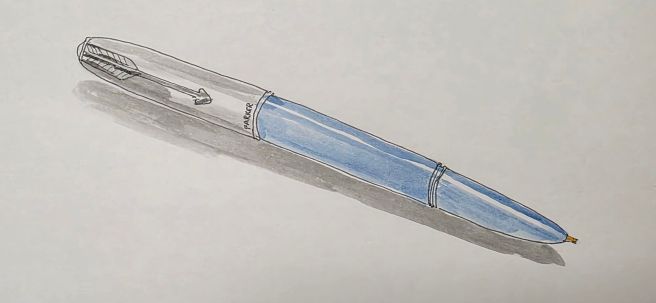
My Parker 51 Aerometric collection.

I noticed recently, a glaring omission in my Index of Pen Posts: more than 9 years into this blog, I had yet to write a post about the Parker 51. For a fountain pen blog, not having featured what is arguably the most famous, recognisable, respected and iconic models of the last century, seems remiss. It is time to correct that.

Shortly after our recent London Spring Pen Show, my friend Monica asked me whether I had any Parker 51’s that I was looking to sell. She was after a Parker 51 with a medium or a fine nib since her model, in grey with a broad nib was just too broad for her. I had shared a table at the pen show and sold a number of my modern pens but had not brought along any of my vintage Parkers as I had not envisaged selling these. However, a subsequent check of my Parker stash, revealed that I was sitting on six Parker 51 Aerometrics, and so I thought I could probably be of help. I also have one Parker 51 Vacumatic.

This is not intended to be a treatise on the history of Parker or the 51 in particular. For that I would recommend the excellent website parkerpens.net run by Tony Fischier which provides a very useful illustrated account of all the pens produced by Parker and their many variations and also a bibliography for the numerous books written on the subject. Rather, this present post is a shameless exercise in parading my own modest accumulation of 51’s. After Monica’s enquiry, I took the opportunity to get them all out, ink them all with Waterman Serenity Blue and spend a happy week or two reminding myself of how they wrote. Also the recent nice weather has enabled me to take a few photos of them in natural light.
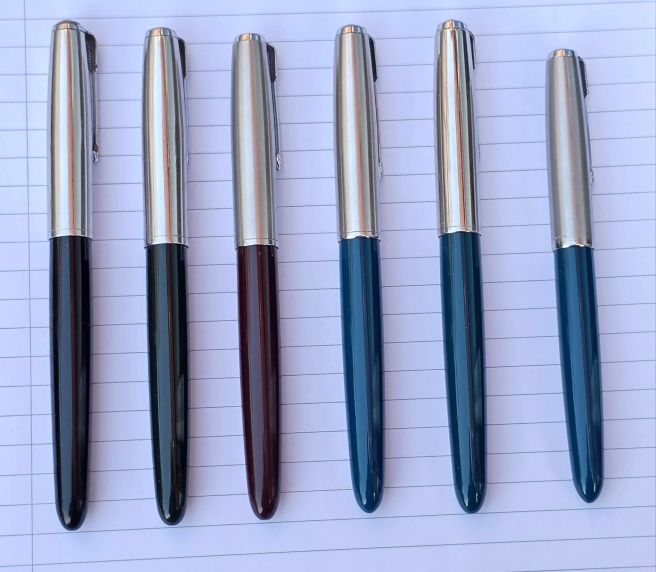
A team photo of my Parker 51 aerometrics. The 51 Special and the 51 Demi are 5th and 6th from the left.

The Parker 51 was first produced in 1940, after many years of development and boasted many new features. Probably the most iconic of these was the hooded nib. Most of the nib area is hidden beneath the shell and this was in order to reduce ink evaporation and hard starts.

The Aerometric fillers have a sac housed in a metal protective cover, with a squeeze bar to fill the pen from a bottle of ink. It is remarkable that the material used for the sac, which claimed to be good for 30 years, is still going strong today and I have yet to come across a Parker 51 in which the ink sac has perished.

Receiving a Parker 51 is a memorable occasion. I still remember getting each of mine. The first was a cedar blue model, purchased from Mr Graham Jasper at a pen show. He has a large number of vintage Parkers and it can be difficult to pick one from trays of numerous similar-looking models. I recall him testing the ink sac by putting the pen to his ear and squeezing the filler bar, to check for a small puff of air (pro-tip)! The barrel imprint reads Made in USA 9, with the digit 9 being the date code. The nib on this one writes a fine line. With all the Parker 51’s there is no visible marking of the nib width.

My black Parker 51 was an eBay purchase and is my only one with an oblique nib, probably an oblique broad. This suits my lefty-overwriter handwriting style nicely. It also writes well if used in a more conventional underwriter style. The barrel imprint reads “Made in England 4”. The nibs may give further indications of the year of production but I have not disassembled them. It was missing the cap finial but I was able to buy a replacement from Mark Catley’s Vintage Fountain Pens tables, at the pen show.
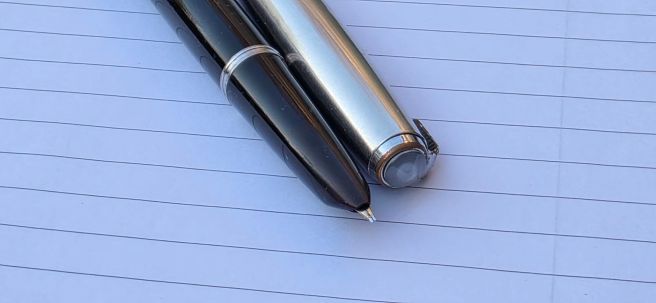
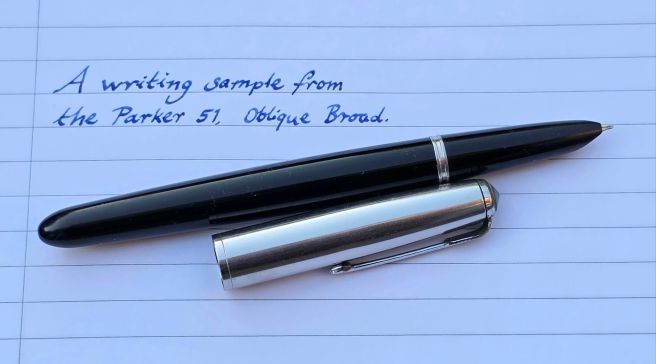
Oblique Broad nib. The cap jewel was a replacement.
Writing sample, Oblique Broad.

The model with a burgundy barrel (which I think may be called Cordovan Brown) was bought in a job lot of five vintage pens from a local antique seller in Childs Hill, North London. It had likely come to the seller as part of a house clearance. I wish I knew more of the past lives of these pens and their owners. This one writes an extra fine line and also has a date code of 4.

My forest green edition is I think a less common colour. It writes a medium line and bears a date code of 2. This was another of my pen show finds.

Finally, these next two pens were a surprise gift received in the post from my friend in Melbourne, Australia. The Parker 51 demi is slightly smaller than the regular 51. It was made in the USA and this has a date code of 8, putting the year at 1948. It writes a medium line.
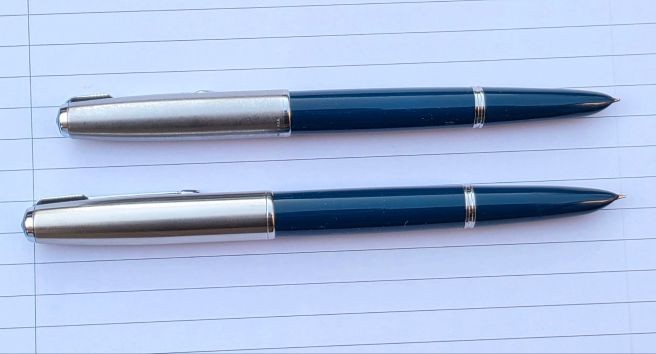
Size comparison of the Parker 51 Demi (top) and a regular model.

Lastly, in a blue-green colour, I have the Parker 51 “Special”. This differed from the regular 51 models in several respects. The nib was of an eight metal alloy called “Octanium” instead of the usual gold. The aerometic style filler leaves the rear half of the sac exposed under a U-bar (rather than the more fully enclosed metal sac covers in the regular model). For some reason, mine smells of gun oil. Also the cap was a brighter, polished chrome finish rather than the usual “Lustraloy” satin finish caps and has a black plastic jewel in the finial. Mine writes a medium line. There is no date code but I believe this one dates from between 1950 and 1956 (as the filler case still refers to Superchrome ink, a reference which was removed around 1956).
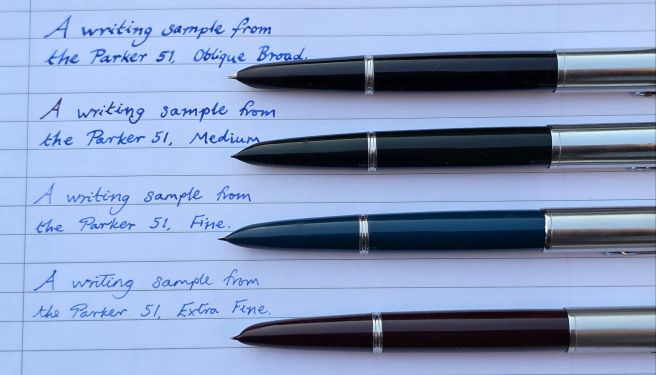
Comparing nib widths.

It is remarkable that these pens all perform perfectly and still look modern, after all these years: a triumph of design that perhaps not even Parker could have predicted.
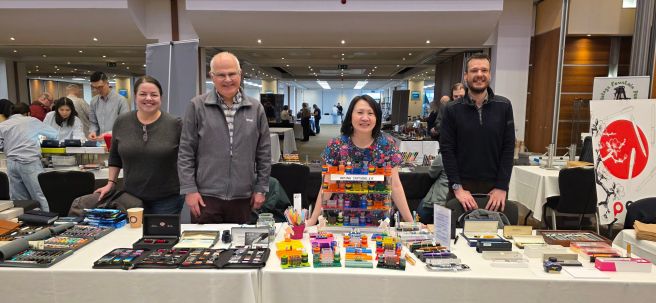
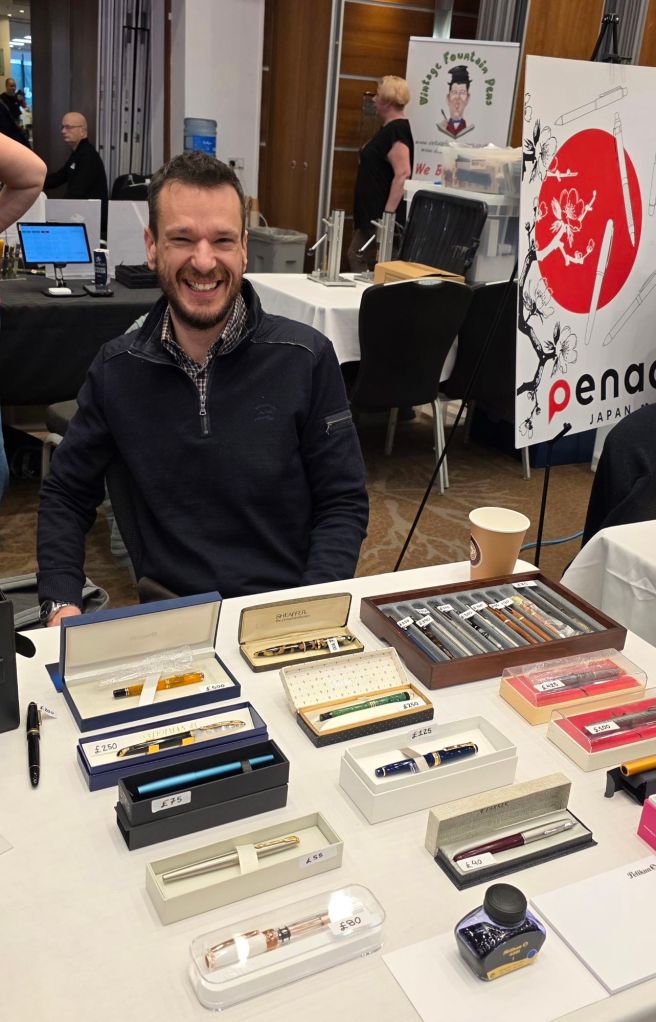
The London Spring Pen Show, 2026: my stall.

On Sunday, 1 March 2026 the London Spring Pen Show was held, once again at the Novotel London West, Hammersmith. It was a great day as always but this year, my experience was very different: I attended as a vendor for the first time. So rather than posting about my haul, (which was nil), this post will be to share a few reflections from a first time vendor.

The suggestion of booking a table was floated at our pen club, sometime last year. It seemed a good idea and an opportunity for me to sell some pens instead of constantly buying more. In the event, four of us chose to book a table to share. Doing this together immediately made it seem a lot less daunting.

In an initial burst of efficiency, I purchased a card reader device, to take payments at the show. But for the following few months, I thought only intermittently, about which of my pens I might try to sell. Being a hoarder and fountain pens being a prime hobby, I found it difficult to contemplate parting with my pens. Each had been acquired with no intention of selling. But I must have anticipated that they would be passed on to someone eventually as I had also hoarded most of their boxes.

It made sense to prune my accumulation of pens, even by a little. I was leaving it until nearer the time, to decide which to sell.

Putting a sale price on a pen, was harder than I had thought. I expected to sell most at a loss. I had a very loose formula, thinking how much I had paid for the pen; factoring in what its current replacement cost might be; and allowing a discount for it being a used (or pre-loved) pen. I could then adjust the resulting figure up or down to reflect how I felt. As well as my wish to hold on to my pens, I was also a bit despondent about losing money on them. But, as my wife cleverly pointed out, if you are not using the pens, you have already lost money on them.

As the show drew closer, I looked over my entire pen accumulation, and made a draft list of those that I might sell. I focused on the modern pens, as opposed to vintage. The majority of my vintage pens are Parkers from recent pen shows or eBay and I was not intending to sell those.

Seeing the pens listed was a good start. Conveniently the number was around 48. These could all be carried in two zip pen cases, each holding 24 pens. Over a few days, I wrote down my provisional sale prices.

How to decide which pens to sell? One way is to ask yourself whether you have used it in the past year, or even two years, and whether you are likely to use it again. I had quite a few in this category, but that did not always mean I wanted to sell them. A few of these pens caused me to feel quite sad whenever I remembered that they were on the sale list. Of course I could simply withdraw them from the sale, or adjust the price upwards a little, or keep them in the sale and hope that no-one bought them!

With pens listed and prices set, I put the pens in the zip cases. I then needed to write the prices on tags. I envisaged writing the prices and a few words of description such as nib size on the tags and to thread the strings through the pocket clip. The pens could be transported and displayed in the zip cases, but I feared that on opening them, I would find the price tags all tangled together. Alternatively I could bring the tags separately and attach them on arrival. No, I did not want to do that either. Then it dawned on me that I could type up a price list instead of labels. This seemed a much better option.

The next task was to gather all the available pen boxes. I had them for about 30 of the pens I was selling. In some of them, I found the purchase receipts and some of these dated back to the 90’s, 80’s or even 70’s. The boxes would conveniently fit into a small wheeled suitcase. With my suitcase of boxes and a ruck sack for the pens and other bits and pieces I could use public transport to get to the show and back.

I had made a checklist of items to bring. This included a bottle of ink and paper for people to try the pens; a jar for water and some kitchen roll to clean nibs after dipping; a large magnifying glass and a small loupe; the card reader, USB charging pack, calculator – and sandwiches for lunch.

On the big day, I arrived at the hotel soon after 07.30am. I was welcomed by Michael, one of the organisers who showed me into the hall where vendors were setting up. Our table was in a great location on a main thoroughfare but it soon became apparent that one table, shared between four of us, would leave each of us very limited room to display our stuff. Michael had anticipated this and offered to move us to a different spot where we could have more space. As luck would have it, he was able to move us up to an excellent nearby neighbouring position.

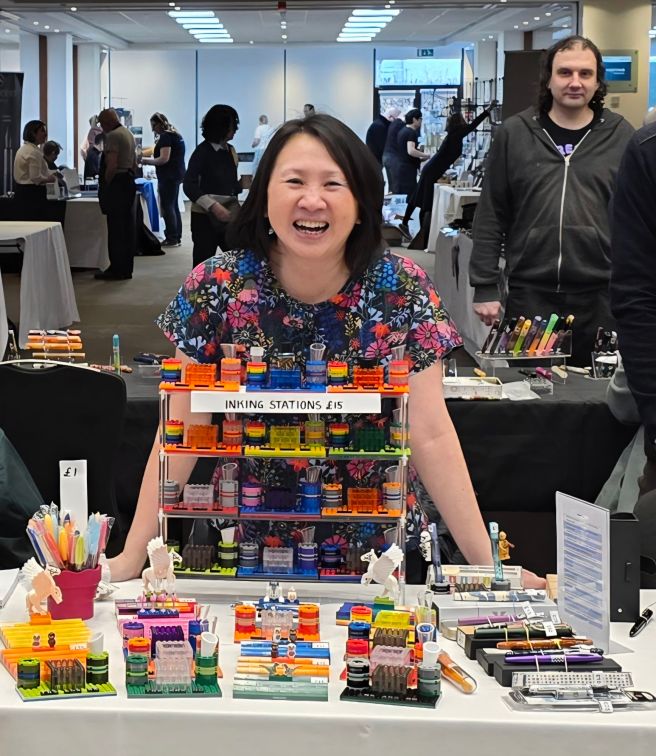
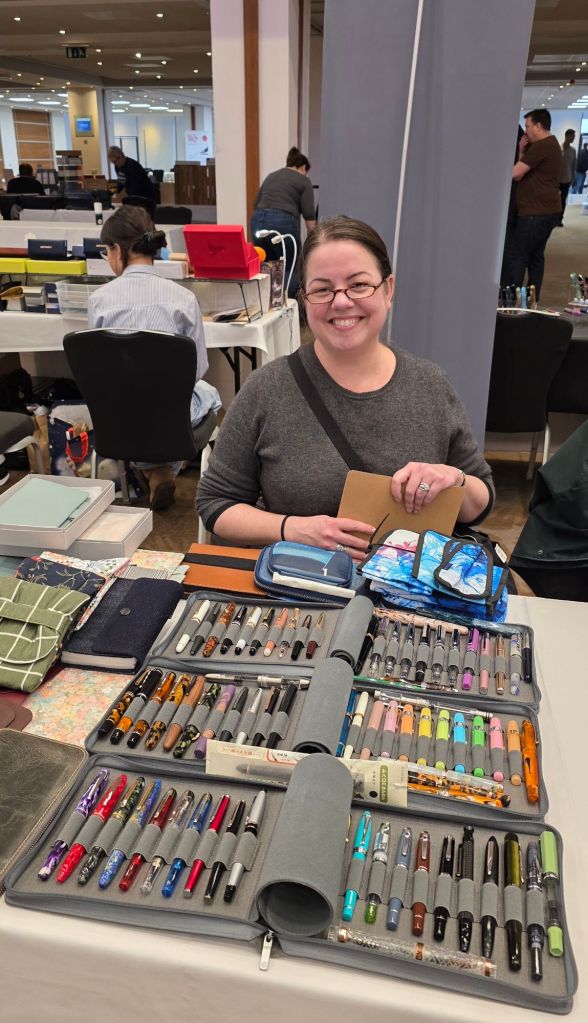
My three friends arrived and we set out our wares. Kee had brought a number of inking stations that she had created from Lego, in various attractive colours, as well as some pen trays and various pens. Elizabeth had a good selection of her modern pens, plus some leather journal covers. João had brought a selection of pens, both modern and vintage.

Elizabeth, me, Kee and João behind our tables.

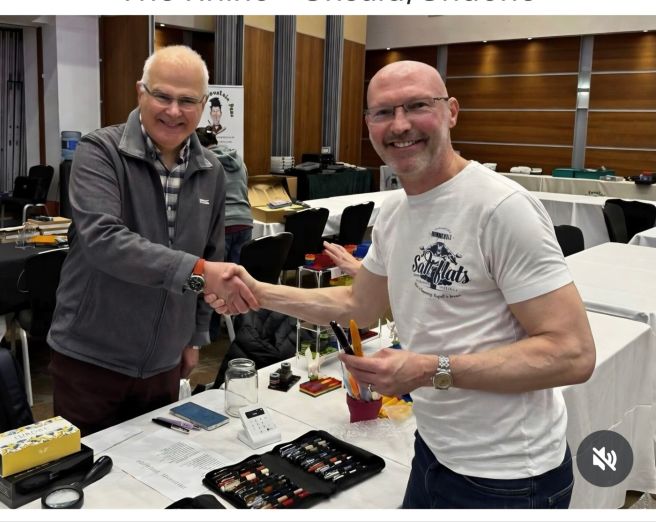
My good friend Jon of Pensharing was setting up his table nearby and came to say hello. He spotted two Leonardo pens that I was selling and promptly bought them both. My first pen show sales! This was also the first payment I had taken with my card reader device, which performed well all day. Jon also offered me some useful advice about pricing. In my eagerness not to overcharge, I had priced a few pens on the low side, a rookie error, and Jon suggested checking prices with eBay Sold listings.

Making my first sale – to Jon of Pensharing.

Soon after this, my Cross Peerless also sold. It was lovely to see familiar friendly faces and always nice when people stopped by our table to say hi. Before the show I had been a little apprehensive, being a novice, at the prospect of possibly up to 900 or so people passing by our table. However, in the event, although there were plenty of people about, at no time were we overwhelmed by the numbers.

Early bird entrants started to circulate at 9am. I was told that there had been a long queue of them, waiting to be admitted. Then at 10am, the standard entry visitors came in and the numbers started to build up.

Having the company of three friends on our two tables, was such a plus. Between the four of us, we had quite a varied selection of goods to sell without displaying too much to take in. Also it meant that if one of us was away for a moment, the others could watch his or her table.

Kee’s inking stations were very popular.

With a regular stream of visitors to our tables, including numerous people whom we knew, the time passed quickly. I had been fortunate to have a flurry of good sales in the morning. Before I knew it, mid-day was upon us. I had not budged from the table. Some of our pen club friends were meeting for a pub lunch nearby but we all had to forego this as it would have meant too much time away from our tables. I did take a short break around mid-afternoon to talk to Kirit Dal on his Aurora tables. He had helped me to chose an Aurora for a friend in Australia at the last show in October, and asked me how he had liked it. Kirit showed me some special new pens that he had created himself, from wood or Ultem in which he had installed Aurora nibs, having obtained Aurora’s blessing to do so, which must be a rare honour.

Elizabeth with her pens and notebook covers.

As time went on, I sold my Aurora Optima rossa with an oblique broad nib. This had been one of the hardest pens to decide to sell. A red Waterman Carene and a Sailor Pro-Gear also went, along with some lower value Lamys. It was particularly enjoyable to be able to sell a pen to someone new to fountain pens, to help them pick out something suitable and give them a few tips to help them get started.

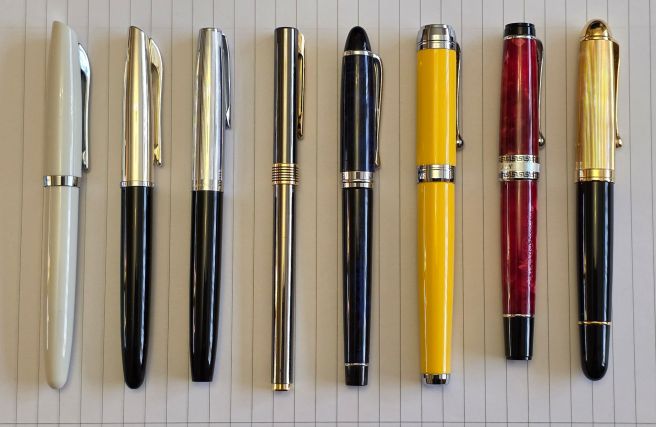
I had taken a photo of my Auroras, just in case the Optima rossa was sold.

By the time the show drew to a close around 4.00pm, I had sold a total of 14 pens (five to people I knew), ranging from a Lamy Safari to a Montblanc Heritage 1912. I was very satisfied with that. I had a new respect for the regular pro’s who carry such large numbers of pens to sell and those sellers who create such enticing table displays of pens, inks, notebooks and other ephemera. My own set up had not required much more effort than unzipping and opening my two pen cases.

João, with his modern and vintage pens for sale.

After the show, the four of us adjourned to the hotel bar to relax over a drink before journeying to our respective homes. We had all had fun and agreed that it would be worth doing this again some time!

My only regret was that I had missed out on browsing all the other tables at the pen show and talking to the vendors. I had been too intent with tunnel vision, on minding my own table and not wanting to miss a sale. However I think that if I did this again, I would relax enough to do at least one lap of the tables at some point in the day and it was a shame not to have done so.

At the end of the day, I reflected on all the people who had come to see us and tried to list the names of all those I knew. It was a lot of conversations for one day and no wonder my brain was exhausted.

So that is over for now. It was a great and memorable experience and I can see why some people do this regularly. Both of my grandfathers were shopkeepers and so perhaps it is in my blood. I was happy to have made some sales. And for those pens that did not sell, I was happy to bring them home again to make another go of our relationship. It is a win-win situation. My thanks go to the organisers UK Pen Shows, to Michael for the extra table, to my co-sellers on our shared tables and to all those who came to see us and buy from our tables.

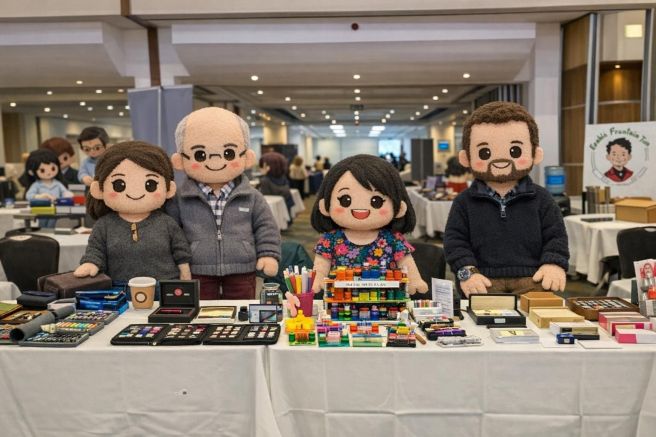
Here we are immortalised as Plushies (photo courtesy of Kee Armstong, made by AI).