Introduction
Back in February, Ashera invited me to review their Aeon fountain pen. My review can be seen here. It was sent to me on loan but I became so attached to the pen that I arranged to buy it, with a generous discount. It is one of my most special pens and the only one with my name engraved on it.
Ashera GmbH are based in Grünwald, near Munich. The team comprises creator Marius Visser and his co-founders Hans and Claudia Harenberg. Their website ashera-design.com shows that the brand has a strong commitment to sustainability and specialises in producing high quality pens turned from wood.
This autumn, Marius got in touch with me again, offering to send me a new version called the Aeon Oleatus to try out and review, but this time to keep as a “thank you.” This was most generous and unexpected. As before, I was able to select the wood type, the nib material and width from the various menu options for the pen, and finally, the engraving to appear on the titanium grip section.
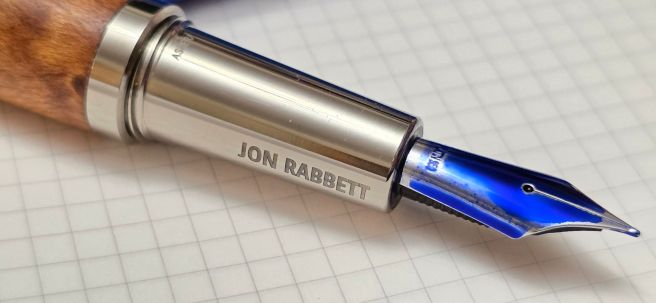
However, I decided that I could not justify owning two such luxurious fountain pens, beautiful though they are, and instead requested that the pen be inscribed for a good friend in the fountain pen community, Jon Rabbett, founder of Pensharing, to whom I would pass it on after my review.
The Oleatus can be supplied in a choice of eight different woods. I selected the attractive Birdseye Maple. For the nib, given that my existing Ashera Aeon has the 14k gold nib in a fine, I wished to try something different this time and chose a platinum 950 nib in a medium.
Much of what I have written before about the design of the pen, its size, shape and weight and the stunning box that it comes in, applies equally to the Oleatus. The main difference is that whereas the Aeon’s wood cap and barrel are finished with eight coats of lacquer, each layer being dried and polished before applying the next in a painstaking process, the Oleatus instead has an unlacquered, oiled finish. Oleatus, AI tells me, means “oiled” or “moistened with oil” (from the Latin oleum (oil), but AI has already picked up that the term “also names a luxury fountain pen, (AEON Oleatus) from Ashera Design, known for its craftsmanship and wood/titanium build.”
Unboxing
I was very excited to unwrap the new pen when it arrived. The website advises that there may be a wait of around four to six weeks for the pen to be assembled and finished.
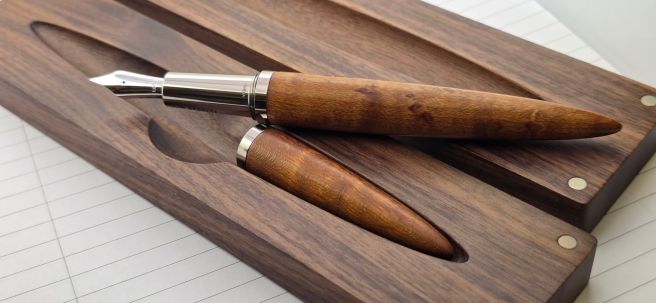
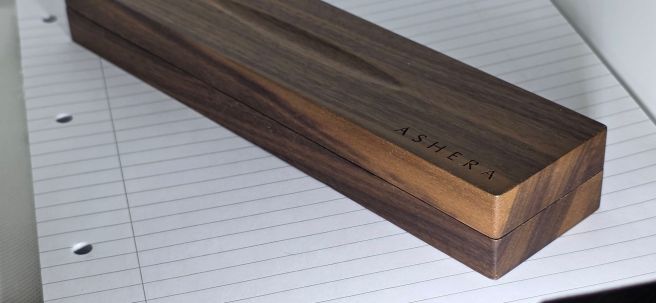
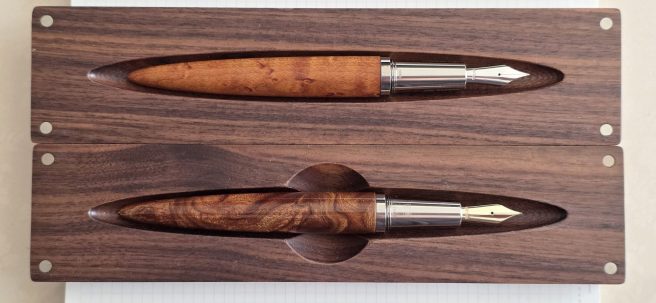
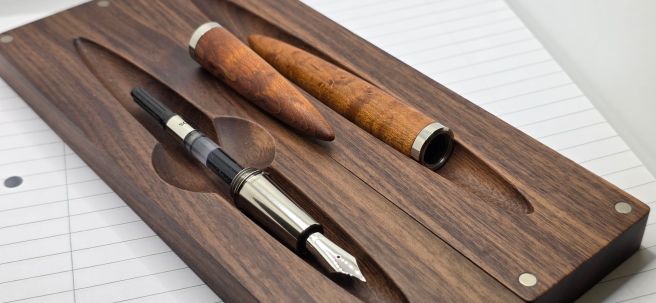
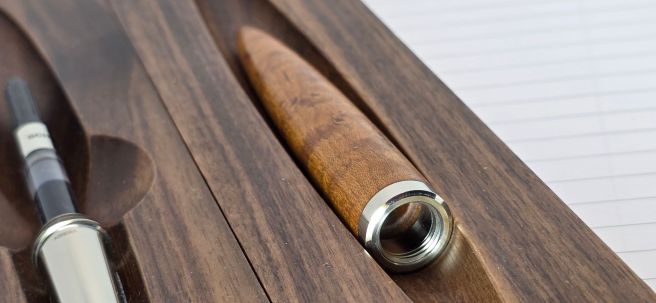
As before, the pen arrived in a box which is solid walnut, cut into two slats with the pen nestled inside. You can see that it is made from a single piece as the grain aligns although alignment is not always perfectly continuous from piece to piece, partly down to natural variation. The box is beautiful, with a silky smooth matte finish, the name ASHERA engraved in one corner and a shallow recess on the top should you wish to place a pen on the lid. However a safer way to rest the pen is to use the deeper, shaped cutaway inside the box. A second pen can be placed in the similar cutaway in the upturned lid. Each half of the box can serve on its own as a desk pen rest. When closing the box, the two slats jump together with a satisfying “clack” and are held together firmly with pairs of magnets in each corner.
Ashera’s goal was to avoid the usual throwaway box and instead create something sustainable that meaningfully complements the pen. Of all the pen boxes I have owned, this is the most impressive, tactile and practical and the most likely to be afforded desk space.
First impressions
Picking up the Oleatus fountain pen for the first time, I had expected it to feel slightly waxy, from the “oiled wood” description, but it does not feel waxy or oily at all. On the contrary, the wood feels cool and smooth. I was thrilled with my choice of Birdseye Maple. It is stunning and has a chatoyancy, not apparent from photographs. If you hold the pen horizontal and then tilt it up and down to change viewing angles, the patterns appear to shift and to have a 3D effect. I read that this is caused by the denser, wavy wood fibres reflecting light differently from the softer areas. Figured Maple is particularly known for this and the effect is enhanced by the oiled finish.
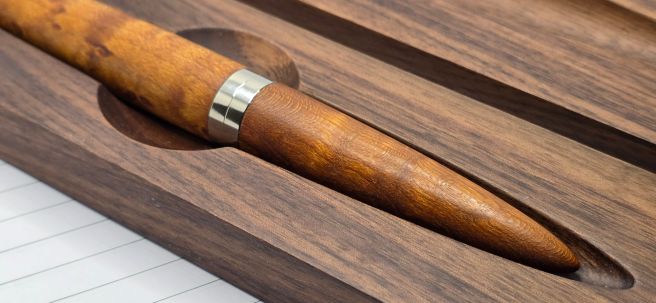
The cap and barrel are flush and there is no interruption to the long, ellipsoid form except the titanium rings where they meet. There is no pocket clip or roll stop. The pen is a certain roll-risk, whether capped or uncapped and a pen rest should be used at all times.
The cap unscrews on a very short travel of just one third of a rotation. The grip section is in solid titanium. Whilst I am usually not a fan of shiny metal grip sections finding them slippery, I had no such issue with the Aeon or Oleatus. The titanium is polished, not plated. The metal section means the pen is nicely front-weighted, despite its very generous length. Whilst it may feel a little unfamiliar at first, like a precision tool, I soon found it a pleasure to use.
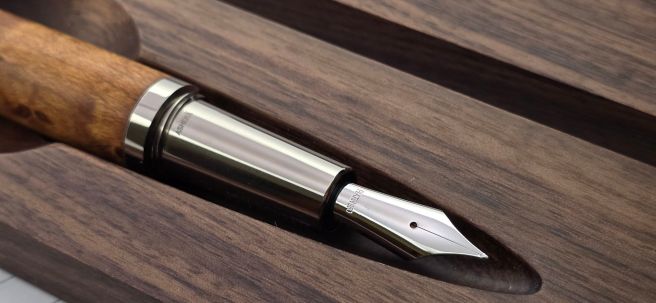
An engraved name appears on the section, each side of the nib, visible whether held left or right handed. The section also has the only occurrence of the brand name on the pen, with ASHERA laser-etched in small capital letters just below the cap threads. I should mention that the cap threads, titanium on titanium, are likely to cause micro scratches to the grip section, as has occurred on my pen even after a few months’ careful use. However the threads are not uncomfortable unless you deliberately seek them out and rub them. The titanium rim of the cap is sharp to the touch. The cap should most certainly not be posted, but given that the pen measures about 154mm uncapped, there is no need to.
The nib is of polished platinum and has no decoration to interrupt the simple beauty of the metal, other than the imprint “PLATIN 950.” This denotes 950 parts per 1,000 or 95% pure platinum. This maintains a bright, silvery-white lustre without needing to be plated. It does not tarnish. The remaining 5% is an alloy to add strength. The nib is mounted with a plastic feed. I understand that Ashera’s nibs are sourced from Peter Bock GmbH, now a subsidiary of Schneider.
The barrel threads are also titanium, for durability and precision. They can feel coarse and squeaky but do settle down with use. The pen takes standard international cartridges or a converter which is included.
Initial trials
After a happy time spent admiring and photographing the pen, I was finally ready to ink it up and try it out. In particular I was keen to compare the feel of the platinum nib with my gold one and also to see the difference between my fine and this new medium nib.
I would like to report at this stage that everything was plain sailing, but I did encounter some teething problems, all of which I was soon able to resolve myself. First, the nib was slightly scratchy. I examined it closely under a loupe and could not see any obvious cause. I therefore deduced that it was simply a small burr or a proud edge on the tipping that would resolve itself in normal use from writing with the pen. However, I was impatient to remove the roughness and a very light smoothing on a fine micromesh pad soon solved the problem, after which the nib wrote beautifully. I am assured that every nib is hand-tested and polished.
Secondly, at one stage I somehow managed to get the barrel jammed on the section threads. I must have accidentally started to screw it on cross-threaded. The titanium-on-titanium threads are unforgiving and do require careful alignment. Fortunately with some gentle wriggling I was able to release the barrel. I then spent a little time in twisting the barrel back and forth on the section threads, starting from different points along the travel, with some gentle pressure either pushing or pulling. A few minutes of this seems to have smoothed out a few rough spots and I had no further problems.
Finally, I ran into ink-starvation problems, as the pen would gradually dry up and then stop writing after a few pages. This occurred a few times, whether I used a cartridge or a converter. After trying different inks, flushing and refilling the pen each time, including from a fresh bottle of Waterman Serenity Blue that I knew would not be to blame, the problem was at last resolved. Several times, I had cleaned and refilled the pen, releasing three drops of ink back into the bottle so as not to leave the feed saturated and air channels clogged, whilst at all times being extra careful not to get ink on my fingers which might then get transferred to the beautiful Maple body of the pen.
I was relieved when after several attempts, the issue disappeared and I was able to write non-stop for over an hour, covering six pages of an A5 notebook without the ink starvation problem returning and with no priming, shaking or tapping from me. From this I deduce that it most probably was simply a blockage or perhaps some residual grease on the nib or feed, which was eventually flushed away by the repeat filling. Ashera have since tightened their final inspection and flushing processes.
Platinum nib
As to the platinum nib, which is the first such nib I have ever used, I found it very firm. It feels more firm than the gold nib on my Aeon. I am not aware that a platinum nib offers any writing advantage over a gold nib. It does feel stiffer than gold, but its appeal lies more in the preciousness of the material, its durability and its visual harmony with the titanium section and fittings. Personally I have no objection to the pairing of the 14k gold nib with the titanium section.
Although Jon’s pen has a medium nib and mine is a fine, the difference between these two particular examples was minimal. I think both could be classed as fine-mediums.
Conclusion
The new, oiled wood version is a most welcome addition to Ashera’s line-up, bringing a new selection of woods, a luxurious satin finish and also a steel nib option. A gold or platinum nib of course adds a special value, but given that they are both firm nibs, there is perhaps less difference in the writing experience than if you were to opt for the steel nib. A well-tuned steel nib can provide an equally smooth and pleasant feel to precious metals. It is the final polishing, testing and quality control which is important.
I am most grateful to Marius and his team in gifting the pen to me and in answering the questions that I raised in correspondence with him. Regarding the oiled finish, I am told that ink generally can be wiped off without staining, since the wood has been treated with linseed oil. I have not dared try this but it is good to know. However, if the surface is exposed to strong solvents or cleaning sprays that degrease, it may lose its protective layer. In that case, lightly re-oiling with boiled, linseed oil and wiping off the excess after a few hours, will reseal the surface. Routine re-oiling is not strictly necessary and the oiled wood finish does not require any special maintenance.
As with the lacquered Aeon that I reviewed previously, Ashera has generously agreed to provide a 20% discount to readers of this blog, purchasing the Oleatus via this link and I receive a modest commission on such sales. The discount is applied automatically on adding to basket.
 Fountain pen blog
Hi! It sure is a beautiful piece of craftsmaship. I very much envy (in a positive way…) the fortunate recipient of such a gentle offer. Cheers! Vic, from Portugal
LikeLiked by 1 person
Thanks Vic! Yes, it certainly is a beautiful piece of craftsmanship with top quality materials, not only in the pen but the box too. It is unusual to have such a writing tool comprising maple wood, titanium and platinum in a walnut wood box.
LikeLike