The London Autumn Pen Show 2024: my haul.

Here in London, our Autumn pen show took place on 13 October. As always, I had a wonderful day, meeting dozens of friends and acquaintances in the fountain pen community, both punters like myself, and dealers. Unfortunately, I failed completely to take any photos but am sure that others will have this covered.

This year, the show seemed bigger and better than ever. My wife and I did not arrive until mid-morning, when the show was in full swing, but it was clear that there were many more sellers than in recent years, including many from overseas, such that two large halls at the Novotel, Hammersmith were filled, with rows of tables, crowds of enthusiasts and a happy buzz of buying and selling. From what I heard, there was a long queue for the early-bird admission, for those eager for a first bite at the cherry.

Also, this show was different for me as I now find myself drawn increasingly to vintage pens rather than modern (although not entirely). I recently enrolled for the Pen Repair course, starting in November and available to WES (Writing Equipment Society) members. In preparation for this we had been advised to gather a few examples of certain pens to practice upon in the classes. My wife was better at keeping me on track to steer me towards the vintage tables, whereas left to my unaccompanied state, I have a tendency to be distracted and excited by every table.

The browsing was soon interrupted by a most enjoyable lunch with many from our pen club, at the nearby pub and restaurant, Latymers, where we gathered to refuel and see each others’ acquisitions.

We returned to the show after lunch. Despite spending less time in the show than I would have liked, I still came away with eight pens. However, for my first time at a pen show, these were all vintage pens. I bought no modern pens, notebooks or inks, not that I needed any!

Such was the fervour of my shopping spree that it was not until I got home that I could take stock of what I had bought, from whom, and what I had spent. The final tally was that my eight pens had cost a total of exactly £300.00, off-set by another pen which I sold for £100.00, to leave a net outlay of £200.00. I was content with that. Also, none of the pens had cost more than £60.00.

So without further ado, here are my purchases:
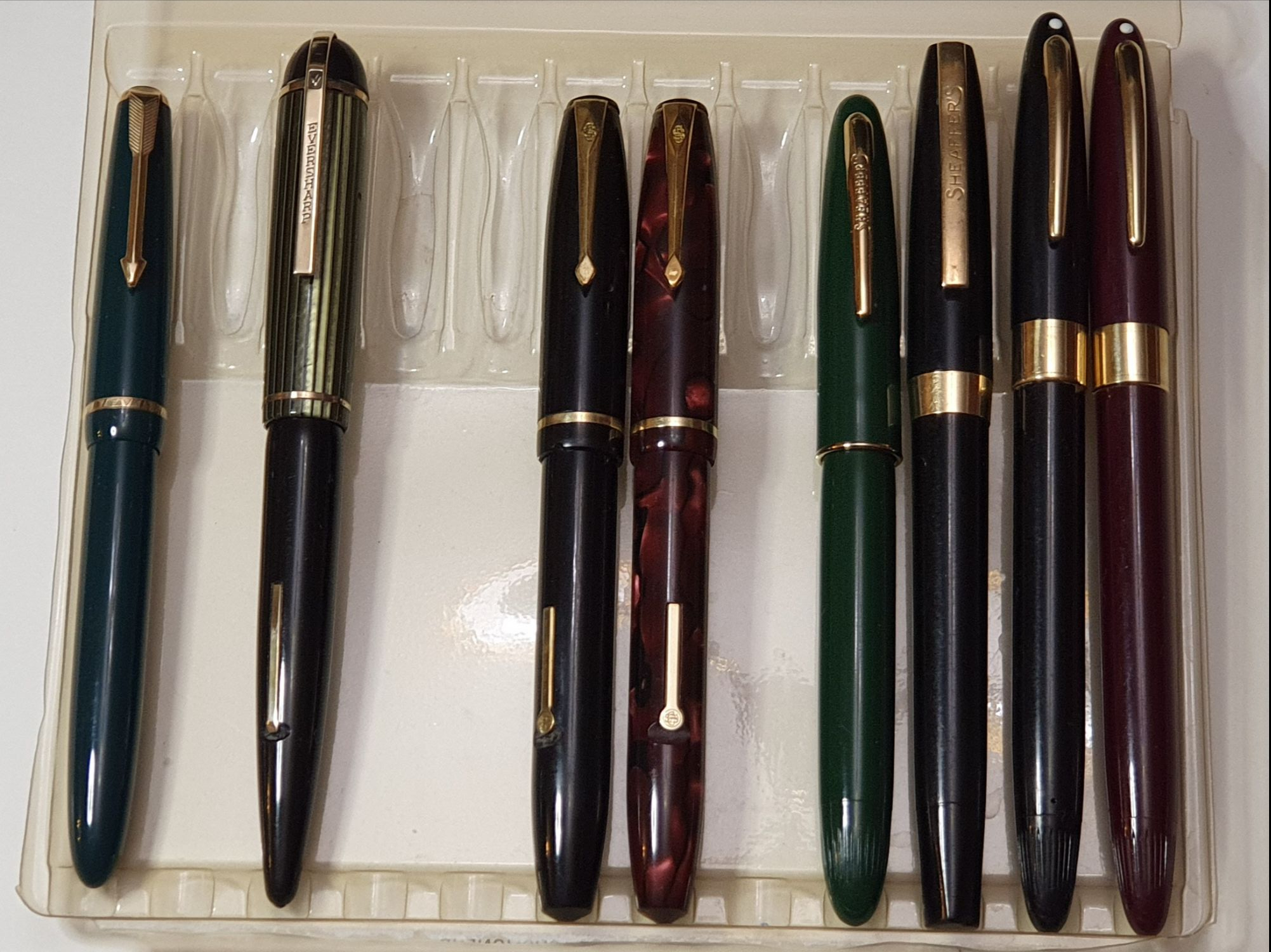
My vintage haul.
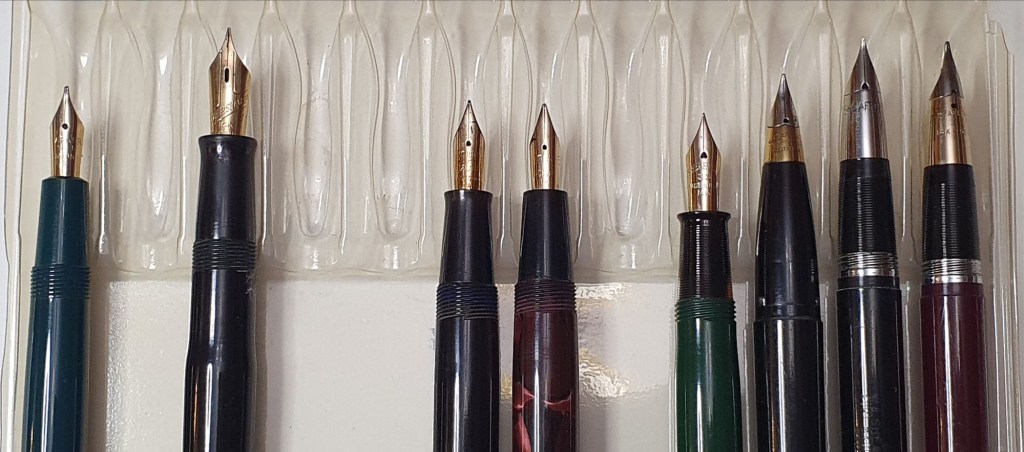
  • Parker Slimfold, green; 14k gold No. 5 nib;
  • Eversharp Skyline, green and black: 14k gold nib; (very excited with this one);
  • Conway Stewart 15, black; 14k gold No 1A nib;
  • “Conway 15”, marbled red; 14k gold No 1A nib;
  • Sheaffer Craftsman Touchdown filler, green; 14k gold No. 33 nib;
  • Sheaffer, black, (model not yet identified) Touchdown filler; two-tone steel nib; made in Australia;
  • Sheaffer Clipper Statesmen, Snorkel filler, black, stainless steel nib (needing repair), made in USA; (see update)
  • Sheaffer Clipper Valiant, Snorkel filler, Burgundy, 14k two tone nib, made in USA. (see update)
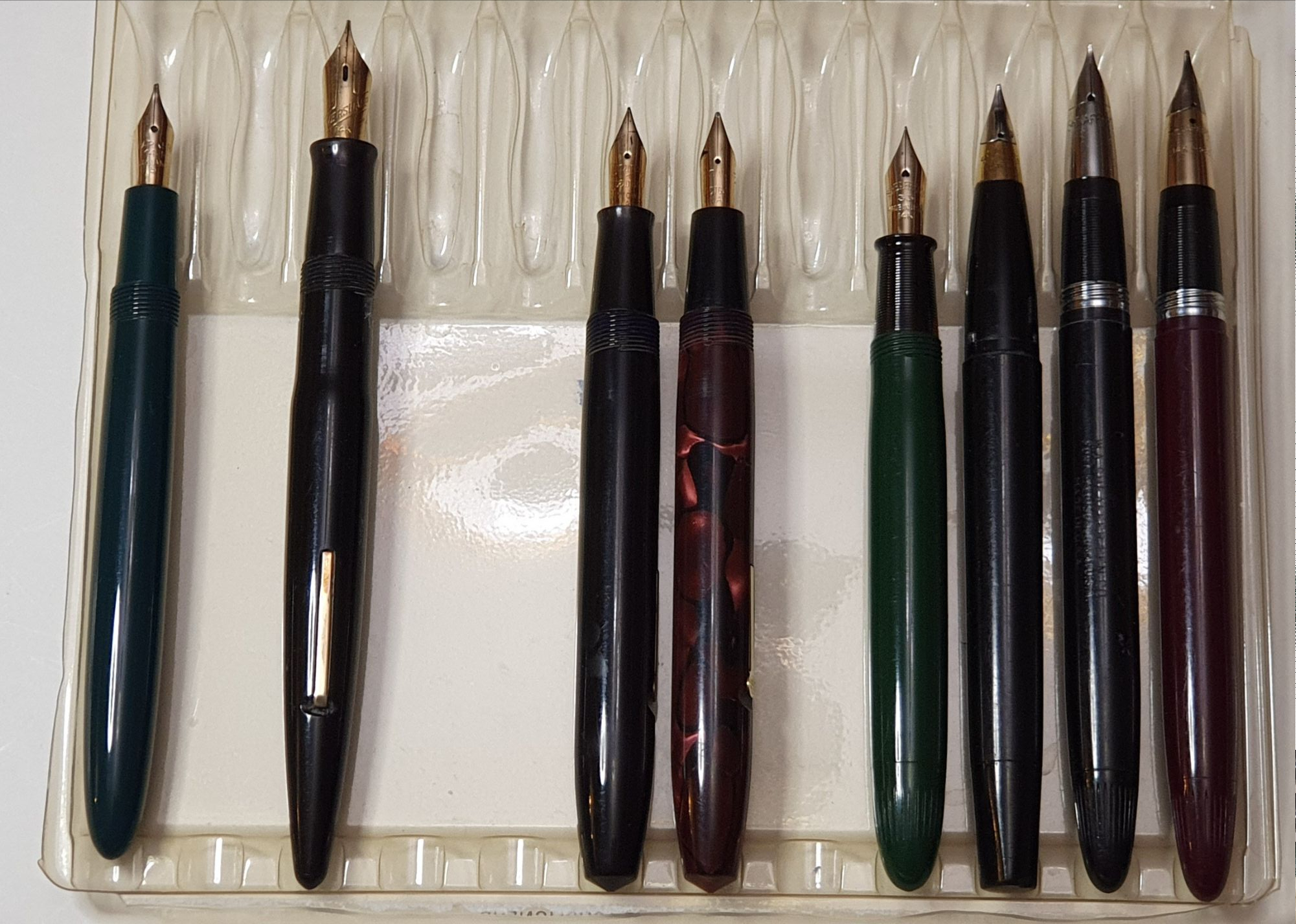
Grouped and uncapped:- Parker; Eversharp; Conway Stewart; Sheaffer.

I spent a happy evening, inking and testing half of these. The remainder, minus the one that is for repair, I inked and tested the following day. There are a variety of nib widths. The Parker has the usual squeeze bar filler. The rest are all lever fillers, Touchdowns or Snorkels.

The Eversharp Skyline is the first that I have owned. The seller, Heritage Collectables, had several to choose from but the green striped cap was calling to me! It writes with a lovely smooth effortless flow.
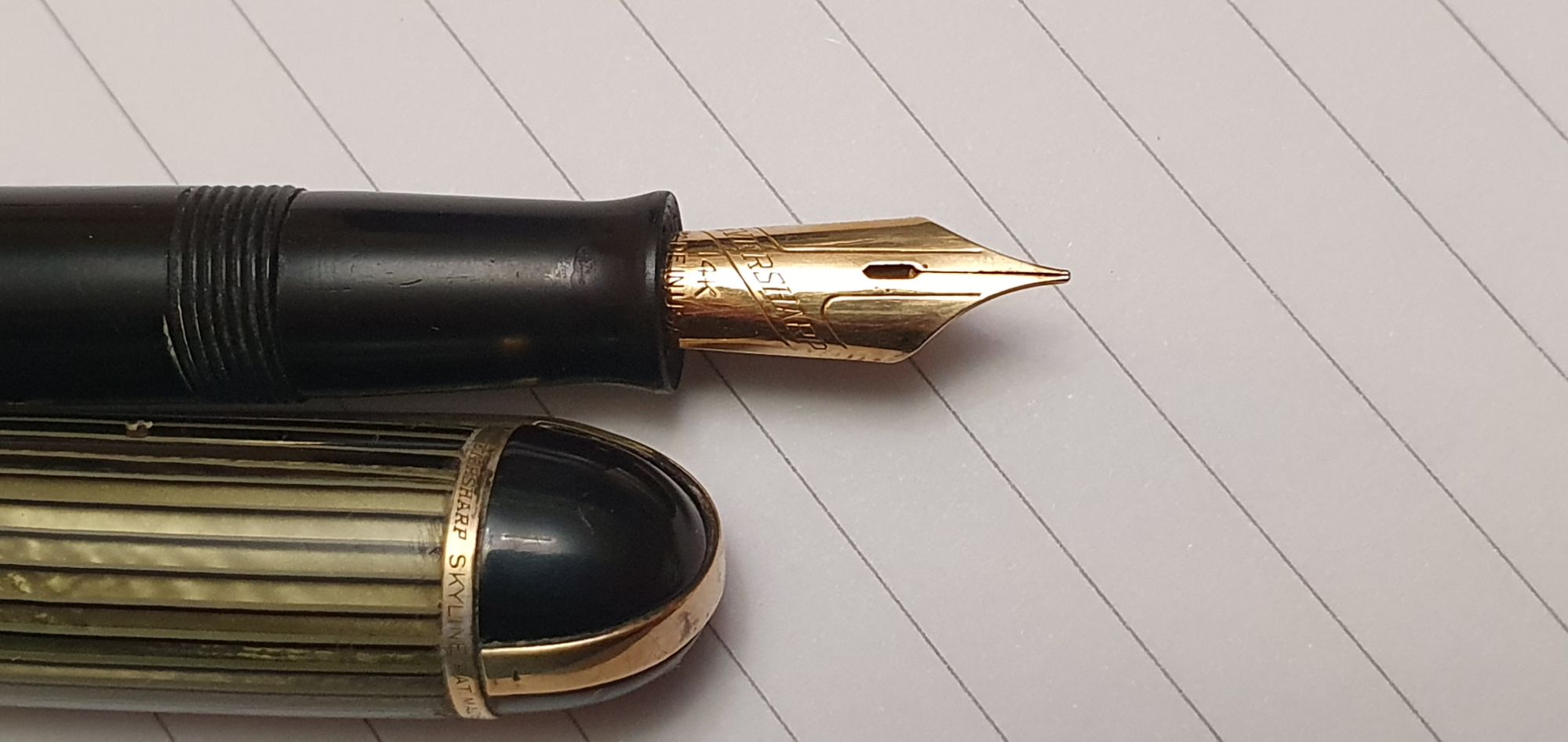
My first Eversharp Skyline.

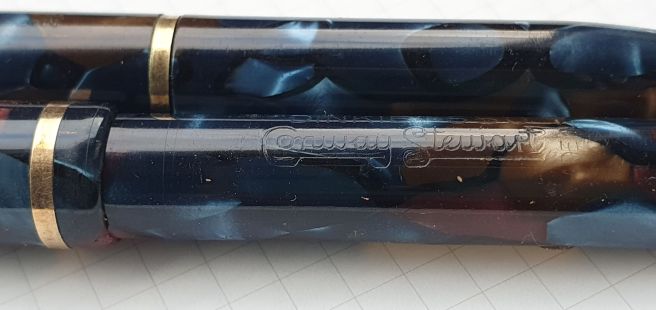
I did not appreciate until I got home that my two Conway Stewarts were both 15s, although the red one is marked “Conway” and the black one “Conway Stewart.” One is a fine and the other broad and I am delighted with them both. (A recent eBay purchase, a black lever fill Burnham 61, which is very similar in size to the Conway Stewart 15, was a surprise success and now one of my favourite pens).
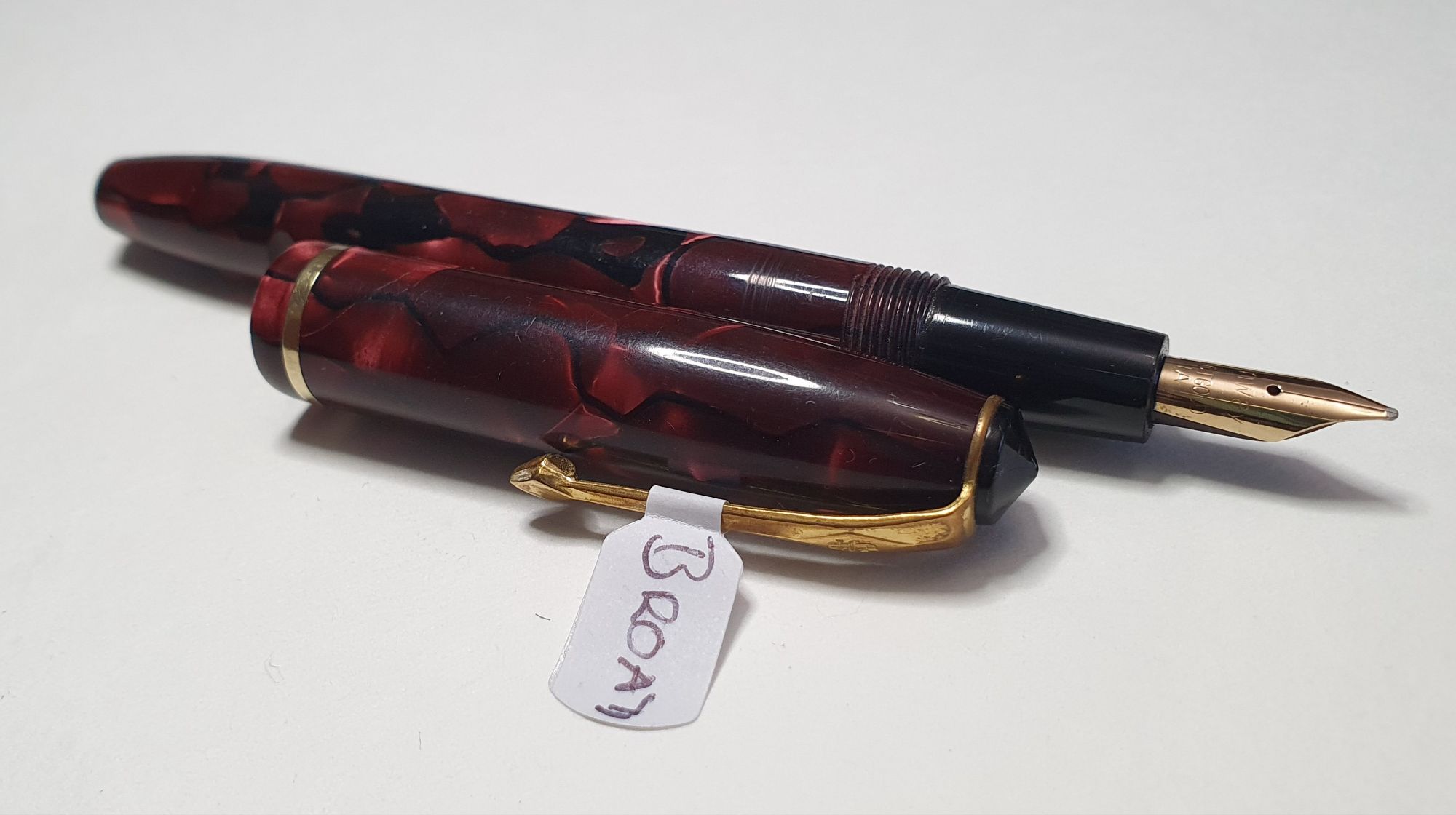
The Conway 15, lever filler.

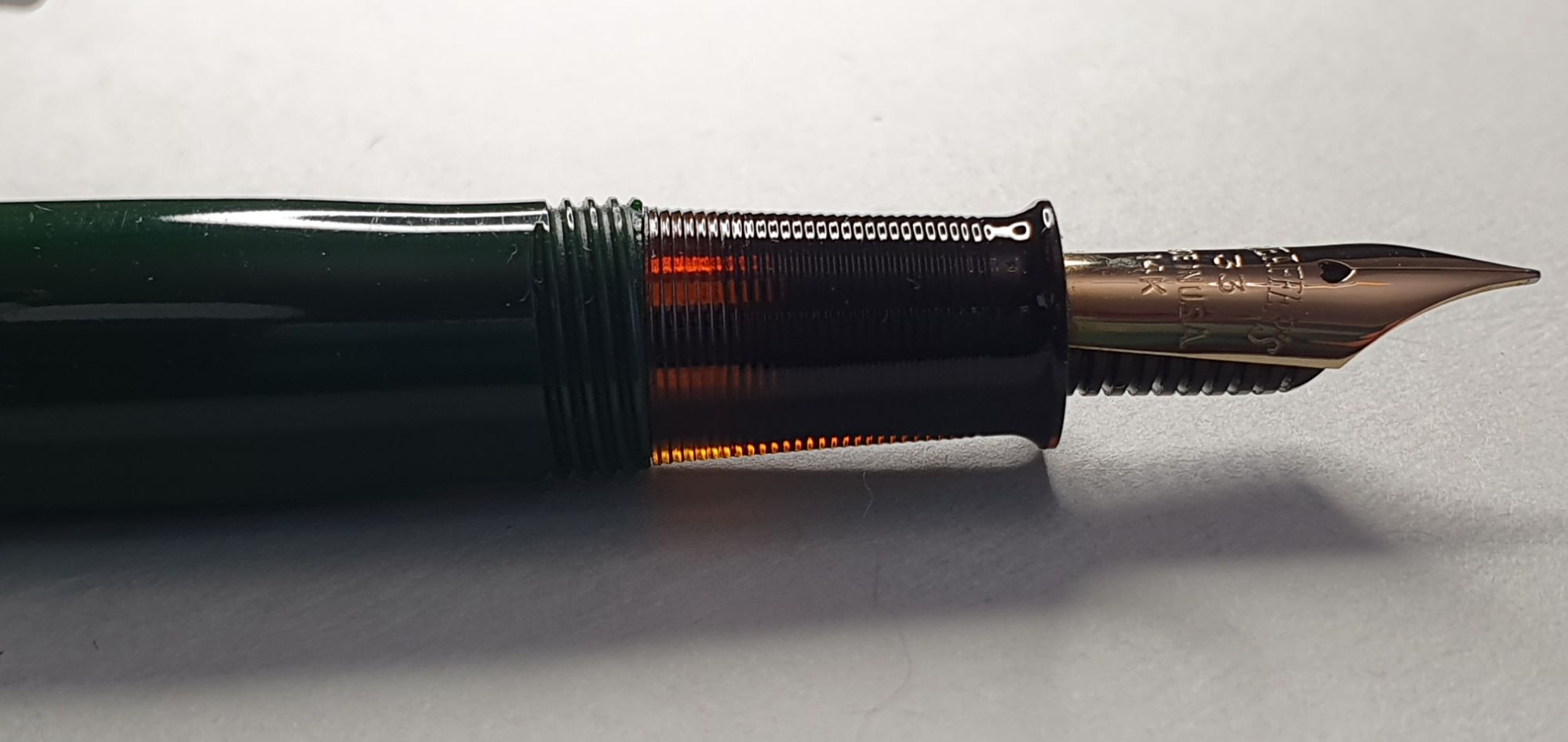
Of the four Sheaffers, the smaller, green Sheaffer is, I believe, a Craftsman, Touchdown filler and has a dreamy, 14k gold EF nib. I am always thrilled at how enjoyable these vintage pens can be, for so little outlay.
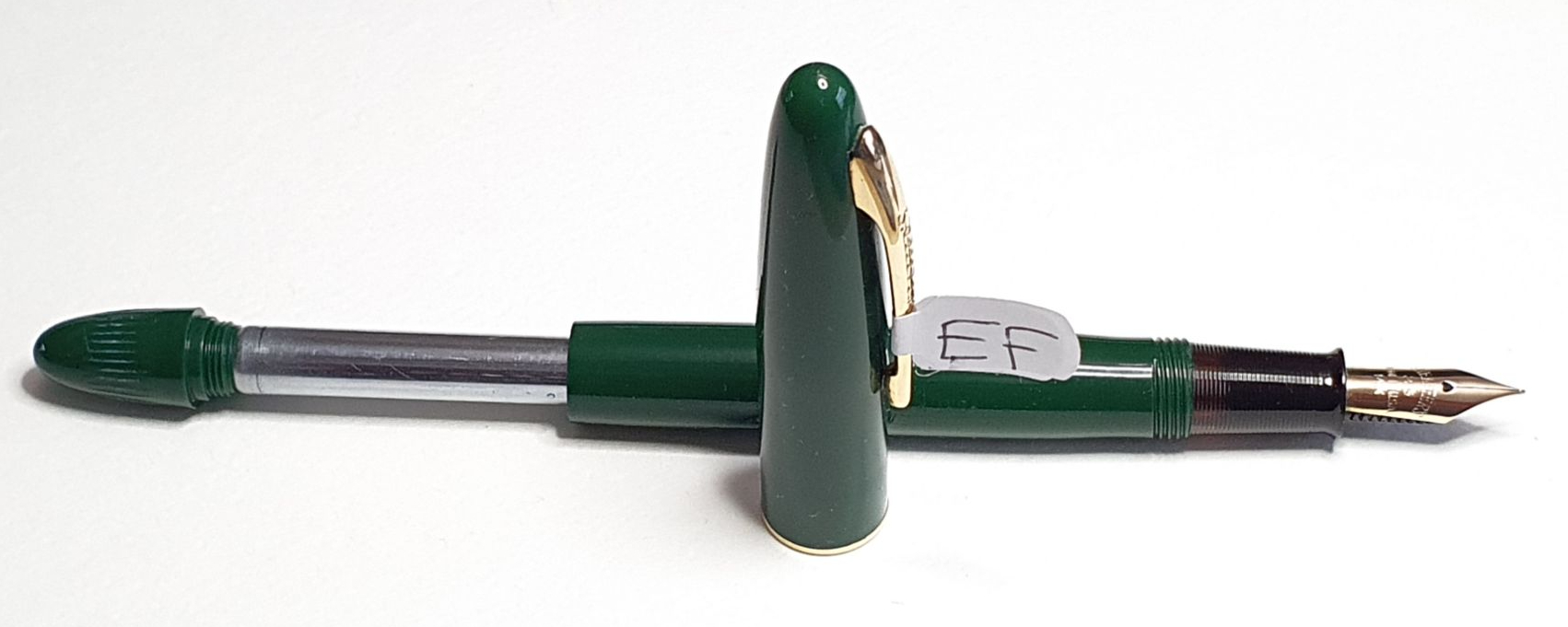
Sheaffer Craftsman Touchdown, Extra Fine.
An ink window in the Sheaffer Craftsman.

There is a black, steel nibbed Sheaffer from Australia, a Touchdown filler but a model that I have not yet identified. It was rescued from a bin of jumbled pens, each only £20.00 yet seems to be working well and with a decent smooth nib, but having a loose clip.

Finally, there are the two Sheaffer Snorkels, which I think are the Clipper model but I am not yet certain. Of these, the Burgundy model is functioning well, whereas the black one needs attention and was purchased cheaply to practice upon.

Update edit, 14 October 2024: I have since learned that there were some 13 different named versions of the Sheaffer Snorkel filler, which can be identified according to whether or not there is a white dot on the cap, whether the nib is open or a “Triumph” style, conical nib, whether the nib is made of Gold or a Palladium/Silver alloy (sometimes marked PdAg), and whether the cap is of plastic or metal. From this, I now think that my Burgundy snorkel is the Valiant, whilst the black snorkel is a Statesman, but I may be wrong! The nib of my black snorkel is a Triumph style, monotone silver-coloured but the imprint consists only of SHEAFFER’S, with no hallmark.
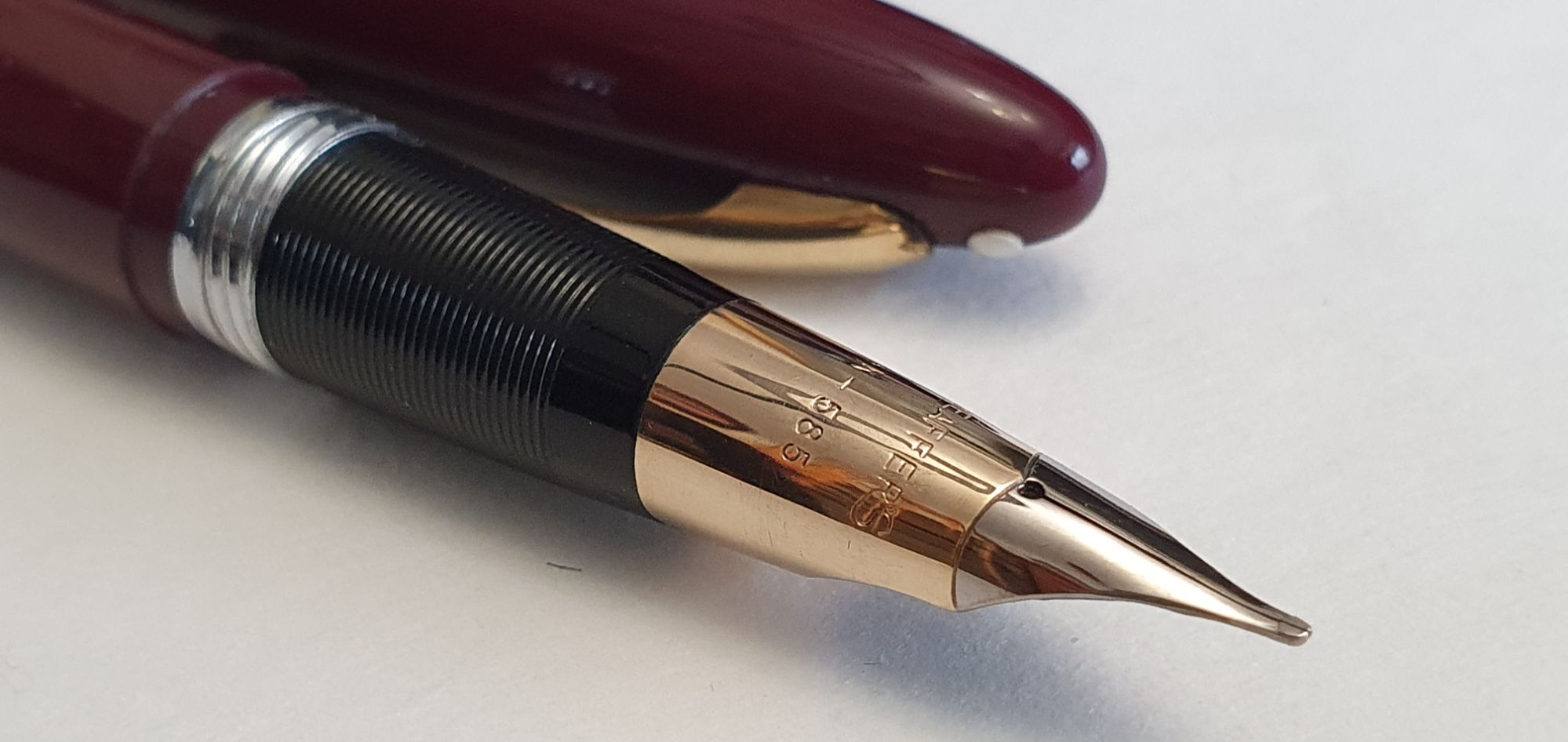
Sheaffer Clipper Snorkel (from Pengineers‘ tables).

I have not yet got used to knowingly buying pens for repair, but am looking forward to learning new skills and gaining confidence on the coming Pen Repair course. Even just enrolling for the course has improved my confidence! I have worked on four pens recently with my newly-acquired tools. I did not manage to buy many pens for repairs at the show, although a few dealers did have some. I may need to resort to eBay for more to practice on.

Word went around at the show that from next Autumn, the London Pen Show will be held over two days instead of one and this is a good sign for the future of the hobby and its wonderful community.
A vintage Conway Stewart “Dinkie” 550 gets a new sac.

Last week, I enjoyed a week’s holiday in the heart of the Lincolnshire Wolds, a rural landscape in the east of England. We had rented a cottage which was formerly a blacksmith’s forge, in a tiny village.

We had been advised to visit the Hemswell Antiques Centre, said to be Europe’s largest antiques centre, occupying a former bomber airbase (of which there are many in Lincolnshire). Spread over four large buildings, each with many rooms of antiques of all descriptions, particularly furniture, there was a lot to explore.

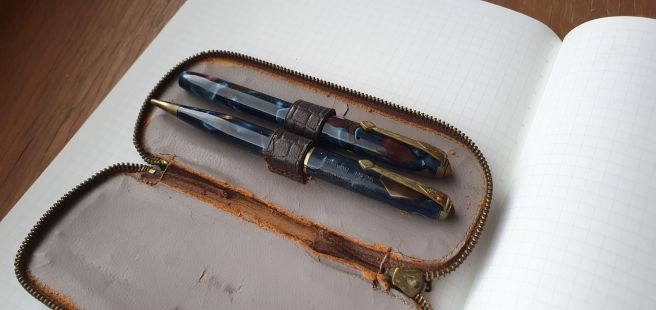
A quick google search beforehand, had indicated a few vintage fountain pens for sale, including a Conway Stewart fountain pen and pencil set, which looked tempting. Once I had tracked it down, I found it to be a “Dinkie” 550 lever filler, barely four inches long, with a matching “Conway” No. 25 mechanical pencil. The Centre sells items from around 400 vendors and, unlike at a pen show, they are not on hand to answer questions. Whether rightly or wrongly, I made a hasty decision to buy the set. (This was only one search away from being an impulse buy).

Conway Stewart “Dinkie” 550 fountain pen and No 25 pencil.

After making payment, I was able to inspect the items at more length. I am ashamed to say that, in my excitement I had looked only at the body of the pen and the nib. I had not even thought to try operating the lever. When I did so, I found that it could only be raised to about 30 degrees from the barrel. Also, the barrel could not easily be removed to see what was going on inside. I had purchased a “project.”

A friend from our pen club kindly offered to replace the sac for me, having undertaken the WES (Writing Equipment Society’s) Pen Repair course and advised me not to try doing it myself. But, as she was about to go on holiday, I decided to have a go myself. I watched a video or two and read up on the procedure. Basically, you take off the barrel, take out the old sac, fit a new one and put the barrel back on. What could possibly go wrong?

First, removing the barrel was not as easy as on a Lamy Safari. I assumed (wrongly as it turned out) that the barrel was on screw threads but glued with shellac, requiring gentle heat to soften the adhesive. I borrowed my wife’s hair dryer, with a nozzle attachment to warm the barrel slowly, where I assumed the threads and the glue would be. I paused frequently to twist and pull the barrel off, conscious of the need to apply enough force to get it off but not so much as to crack the barrel.

Once the barrel started coming away it was evident that it was not threaded, but friction fit. With a bit more warming and pulling, the barrel was off! This felt like a major milestone.

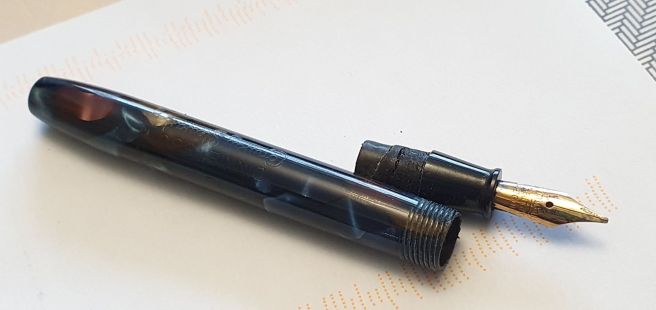
Barrel removed!

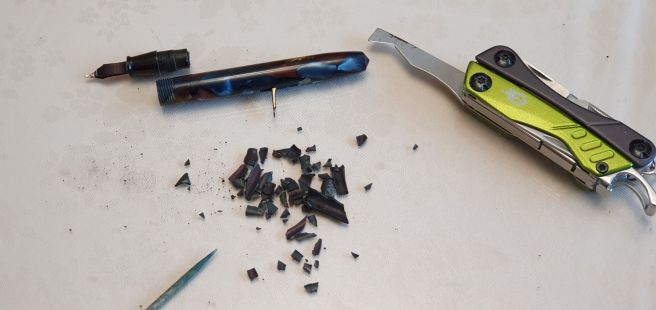
The existing sac had become hard and brittle. I tipped out the contents of the barrel, forming a sorry pile of black dust and debris. I poked inside the barrel with a tooth-pick to get out any residue.

Definitely time for a new sac.

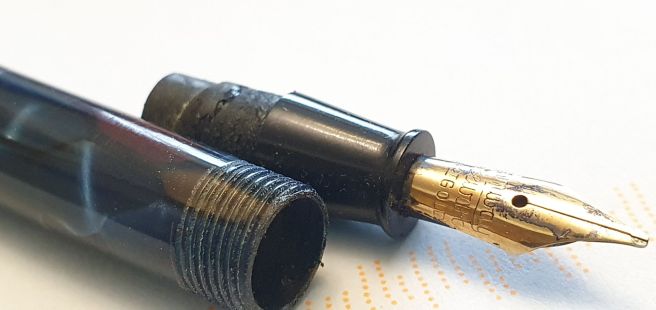
The good news, was that the lever mechanism then moved freely, through 90 degrees and I could see the pressure bar being lowered and raised again. This looked promising. I washed the nib and feed section and cleaned up the 14k gold nib with an old toothbrush.

Dinkie nib.

I was then able to measure the diameter of the sac peg, the lower step of the section, on which the sac fits. From information I found online, I would need a size 15 sac.

I ordered the latex sac and a small bag of pure French Chalk, to dust the sac after fitting to help it slide into the barrel and stop it from sticking. The sacs came in packets of two, 8cm long and to be cut to length as required. They arrived a couple of days later, from The Pendragons Partnership. They had a slight dusting of French Chalk already but it was good to add more.

I measured that I needed the sac to be about 5cm long and so cut off the excess. I then practiced pulling it over the sac peg. This was fiddly and awkward to do by hand. I believe you are supposed to use reverse needle-nose pliers to open the sac but in the absence of these, I simply held one side the sac against the peg with my thumb nail, whilst pulling at the other side of the sac to stretch it and pull it over the peg. Several times, it jumped off. Also, the opening of the sac became ragged such that I had to trim a bit more off.

Once I had practiced this, I applied some shellac to the sac peg. I managed to get the sac on the peg, but the leading edge had rolled inwards over itself. Being unable to unpick this, I decided to roll the whole sac a bit further up the pen and then slice off the excess, back to the start of the sac peg, using a craft knife. This worked and I hoped that there had still been sufficient shellac on the peg to secure the sac. A little more wriggling of the sac had been needed, to line it up straight. I then let it sit for almost 24 hours for the shellac to set fully.

The following day, I was ready to replace the barrel. This stage was also difficult! The sac (now a little shorter than I had intended) went into the barrel easily but the barrel was a very tight fit over the sac peg. I had not wanted to glue the barrel on but it was clear that this would not be necessary. With the aid of some French Chalk for lubrication, I eventually managed to push the tiny barrel all the way home, all the time afraid that it would break under the strain. Perhaps I should have filed down the sac a little, before replacing the barrel, although this would risk puncturing it.

Once reassembled, I could at last fill the pen. I chose Waterman Serenity Blue. I decanted some into an ink miser so that I could check that the pen was filling. To my relief, the pen drew up ink nicely. When I expelled the ink again a couple of times, I found that it amounted to only about 11 drops of ink. But to be fair, this is similar to the capacity of a Sailor converter.

It was exciting to have carried out my first sac replacement and to have got this vintage pen working again. It now writes smoothly and, luckily is not a gusher.

I suspect that I made many mistakes, both in the buying and restoring process although, perhaps with some beginner’s luck, it worked out all right in the end. However, I have since enrolled for the WES Pen Repair course starting in November and look forward to finding out how it should be done.

Barrel markings