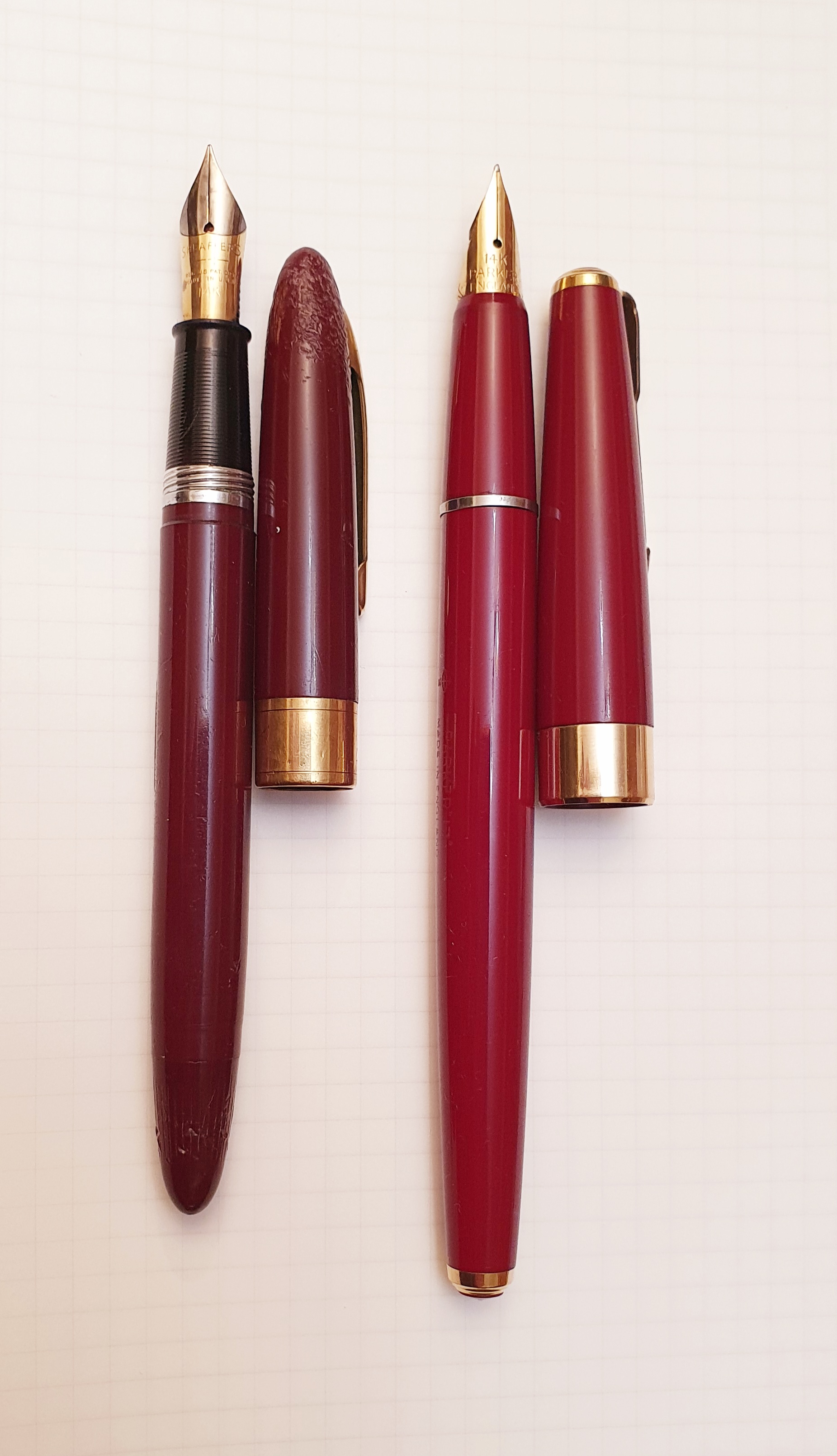
Since discovering the Parker 17 range less than a year ago, I have accumulated seven of them. Two are small, Parker 17 Lady fountain pens. Of the five full size models, three are standard models and two are Supers, or Parker 17 Super Duofolds, to give them their full title.
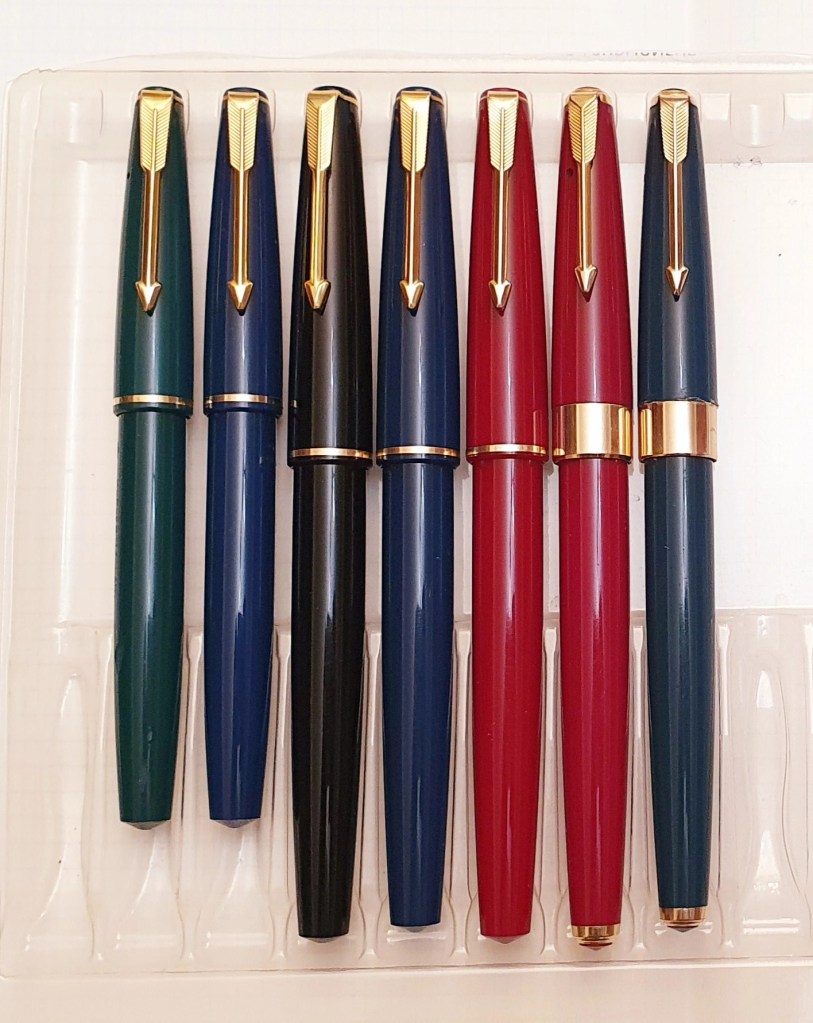
These Super Duofolds are distinguished by their wide gold cap band and decorative metal ring (called a tassie) at the end of the barrel. Otherwise, they are the same. All have the fixed squeeze-bar filling system known as the aerometric filler, although more basic than in the Parker 51 which is more enclosed and may also be larger capacity.
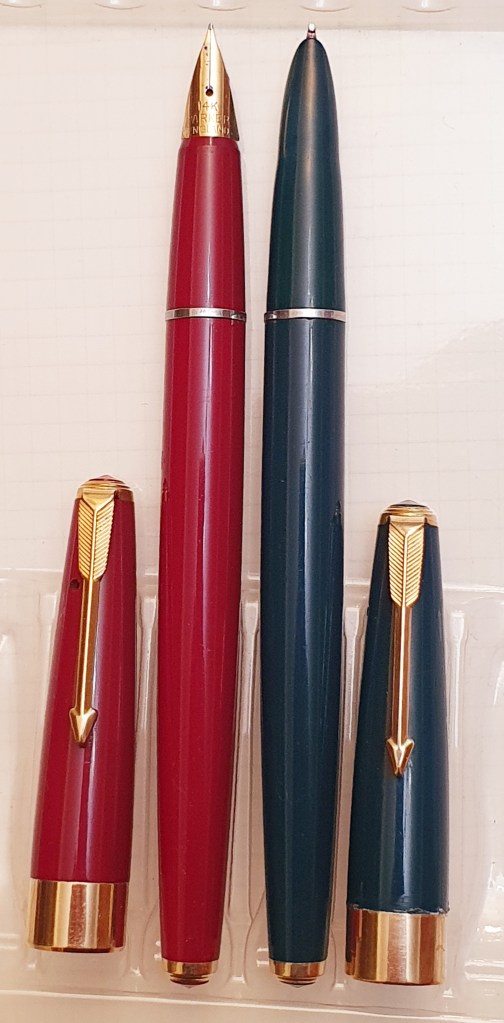
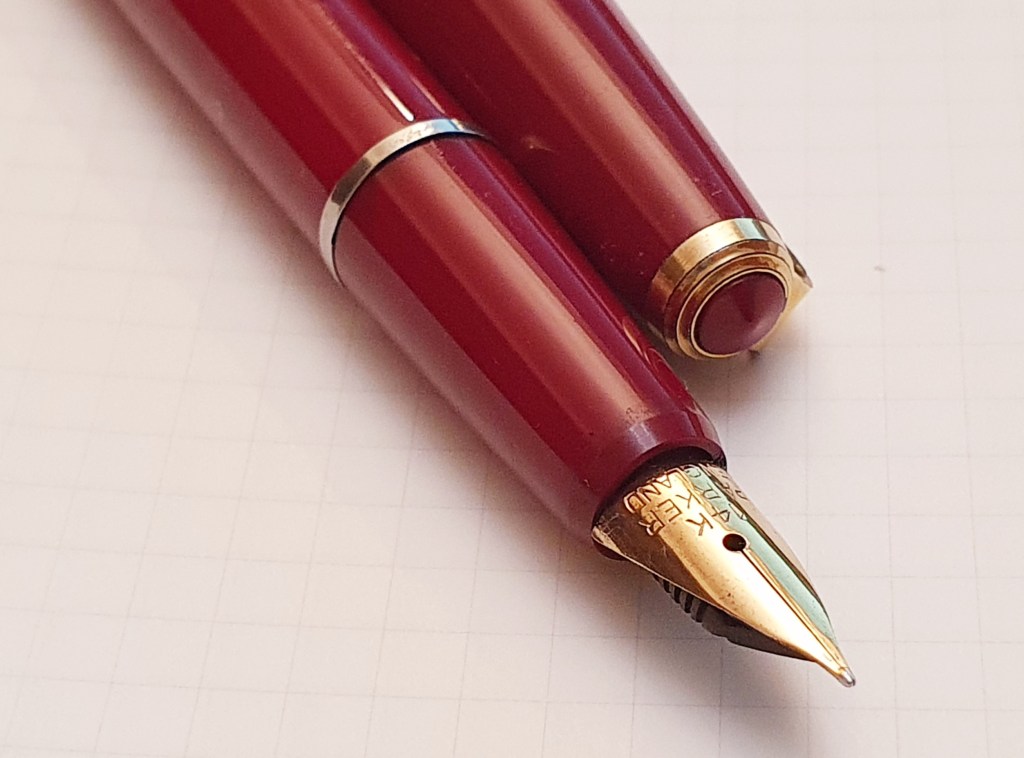
My red Parker 17 Super Duofold is the early model which was made from 1962 to 1964 only. This has an open nib, known as the beak nib, in an unconventional triangular shape. After that year, production switched to hooded nibs for the remaining run of the 17 range, ending in 1972.
I had read good reports of these early, beak nibs and was keen to get my hands on one. When I saw this one for sale in an eBay auction I set my heart on winning it. The seller provided a series of good close up photographs. I looked at these many times in the days leading up to the auction, particularly the images of the nib, front and back. It looked in tip-top condition. It also occurred to me that the pen had some similarities to an old Sheaffer that my late mother had used, at least in its burgundy colour and wide gold cap band.

After a tense finish to the auction, the pen was mine! The final price was £59.00 and I appreciate that you can buy a Parker 51 for that, but the early version Parker 17 commands a higher price than the later ones due to its rarity.
The package arrived just in time for me to bring on a weekend away, where I enjoyed cleaning it and trying it out with Parker Quink Royal Blue. The only visible markings on the nib are “14K, PARKER, ENGLAND.” It may be that there is more to see if the nib is removed but I have not done so. The nib writes beautifully. I would guess it to be a Fine. It is very smooth, fairly firm and has an ideal flow, all making for a very enjoyable writing experience, especially on my Stalogy notebook paper.
On close examination of the pen body with a loupe, I did find two hairline cracks, one on each side of the cap. These are not noticeable unless you look hard for them and do not affect the pen’s performance. I could run a little glue along these to seal them but there does not seem to be any real need. Crucially, I have not experienced any hard starts. The nib does not dry out, even though there is a round air hole in the cap, through which the nib can be directly seen. There is no inner cap. I am delighted with this purchase.
My green Parker 17 Super Duofold was another recent eBay purchase. On arrival, this did seem a problem pen. The slip cap was very stiff. There appeared to be a residue of adhesive above the cap band. Uncapping the pen, the grip section appeared slightly misshapen, as if deformed by having the cap pushed on too far or maybe, just by being capped tightly and left for years in a warm place. It could also be some chemical degrading of the plastic: I don’t know. It is some 50 years old, after all. But the pen filled normally and wrote with a buttery smooth feel. This nib could be a Broad or a Medium.
Unfortunately I found that the main issue with this pen was that, once the ink in the feed had been exhausted, it would dry up and stop. Ink was not getting to the feed. I suspected that this may be due to a blockage stopping air getting into the sac. I tried flushing and refilling the pen several times and changed inks but the problem persisted. Eventually, after a week or two, I disassembled the pen. Using a hairdryer, I warmed the section to soften the shellac to unscrew the section. However I was not able to remove it and suspected that it might have been glued with something stronger. Perhaps I should have persisted with my hairdryer to make sure.
Instead, I found that I had loosened the shellac holding the sac cover and, beneath this, the ink sac. I removed them both. This revealed the breather tube, which I pulled out of the section. But as well as this, there was something else in the sac: a loose, plastic rod. I gather that this is an ink agitator, to break any surface tension which may stop ink moving. It seemed a bit too long and I trimmed a bit off.
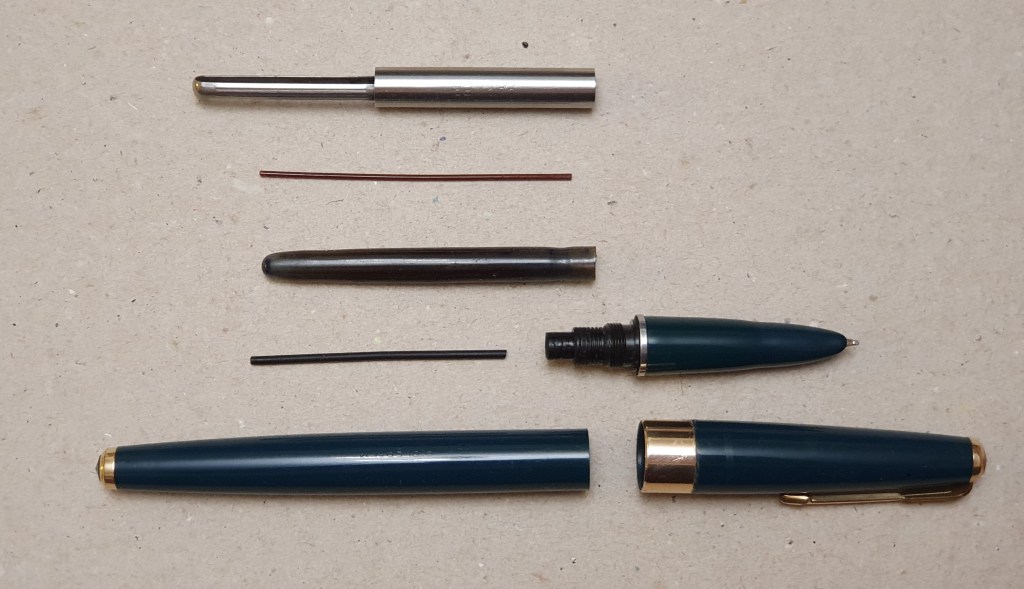
At this point, an ultrasonic cleaning bath would have been useful. As I do not have one, I washed the nib section by hand, also jetting some water through it with a syringe and then left it to soak in a jar of water for a few days.
Then, after reassembling the pen, I filled it with Waterman Serenity Blue, probably my favourite ink and a sort of “Pen-icillin” for pens. I was not holding out much hope that my efforts had solved the ink/air-flow problem but I began to write, in a Stalogy A5 notebook. Once again, the writing experience was super-smooth and silky. But this time, it kept going! I carried on writing for five pages, just to make sure. The problem of ink starvation had been resolved.
I am very happy with all my Parker 17’s. I gave a blue one to my niece recently, but promptly replaced it with an identical model from eBay, although every nib feels slightly different. I love the look, feel and writing experience, as well as the affordability of these pens.
Finally, for the benefit of anyone reading who was not around for 1980’s British tv comedy, the title of this post was a reference to the famed “Two Soups” sketch, starring Julie Walters and written by Victoria Wood, well worth a Google if you have three minutes to spare. I appreciate that this may be unfamiliar to many, but the pun seemed too good to waste.
 Fountain pen blog
Handsome collection indeed. And congratulations on the successful repair. Looking at the cap of your mother’s Sheaffer, I couldn’t help but think, ‘Ah, the worrying that parents must do.’
LikeLiked by 1 person
Thanks Paul. Yes, well spotted! Thanks for reading. This old Sheaffer has sentimental value and is long since retired. I remember my dad and I buying her a Parker 45 fountain pen and ball pen set in a similar colour to replace it, one Christmas back in the seventies. She liked fine nibs 😀.
LikeLike
How interesting that the bottom gold bit on the pen is a “Tassie”. And I thought only us people who live in Tassie used that word (Tasmania, the island state of Australia. I enjoy your pen travels very much so keep them coming.
LikeLiked by 1 person
Hi Andrea. Thanks very much for your comment. I had heard the term “tassie” used in several YouTube videos to describe a decorative ring at the end of a barrel of a pen. I found verification of this on http://www.definitions.net, although I understand that the term is also used for an inhabitant of Tasmania. It is great to have this confirmed by someone living there! I am glad that you enjoy the blog. Greetings from here in the UK. 🙂
LikeLike
Lovely collection. Your love affair sparked my interest. I was able to pick up a red Parker 17 Super Duofold for a mere £7,5. The pen needs a good cleaning while the nib has a slight downward bend I feel can be fixed. Thanks for sharing.
LikeLiked by 1 person
Thanks Danny. It seems that the Parker 51 gets all the attention, and so the Parker 17s, whilst more basic, were still great pens and can be picked up for good prices…less than the price of a Lamy Safari. I am glad that the tradition of penabling in the community continues!
LikeLiked by 1 person
I couldn’t resist it! I have just bought a black Parker 17 Lady from a seller on eBay. It will be my first experience of this pen. I look forward to trying it.
LikeLiked by 1 person
Congratulations Dave! The Parker 17 Lady is a cute pen and comfortable length when the cap is posted. I am sure you will enjoy inking it up and getting acquainted.
LikeLike