21 plus 5 Pen Questions.

I have enjoyed reading people’s replies to these questions, posed by the Well
Appointed Desk with the supplementary five questions added by The Gentleman
Stationer. Answering these is rather like being interviewed by an imaginary
friend, on one’s chosen subject. So, here goes with my answers. I have used the
English spelling of “favourite.” Also, these replies are correct at
the time of going to press, but should be taken with a pinch of salt as I
reserve the right to change my opinions on a daily basis.

1: What is the pen they’ll have to pry out of your cold dead hands?

In the sense of what pen I would not part with, I suppose
for sentimental reasons it would be one of my Sheaffer No Nonsense pens, that I
used through college over 40 years ago. Either that or my blue Waterman Expert
which I used for many years in my first job after qualifying as a solicitor.

2: What’s your guilty pleasure pen?

My Montblanc Meisterstuck 145 Classique, with platinum plated trim. This is
because it remains the most expensive pen that I have ever bought and was an
impulse buy whilst drifting around our local shopping centre.

3: What’s the pen you wish existed?

A Lamy Safari without the facets.

4: What pen would you give to a new enthusiast?

Perhaps a Cross Bailey Light.  I would include a cartridge converter to enjoy the vast
choice of bottled inks and because Cross proprietary cartridges are expensive.

5: What pen do you want to get along with but it just never clicked?

The Pilot Capless, or Vanishing Point. Obviously, there is a joke coming
here as the pen did click, but I could not use it in overwriter style because
the pocket clip was exactly where I wanted to place my thumb. Eventually, being
unable to remove the clip in the proper manner, I resorted to bending it and
breaking it off. This then left a sharp edge. I tried to round this off
smoothly with a file, but scratched off the matt black finish on the pen. I
then bought a Dremel, with the idea of grinding the sharp edges or even
grinding off the remaining piece of the clip – but have not dared take the
Dremel out of the box yet.

6: What pen do you only keep only because its pretty?

This is a difficult one. I think I will instead say what is my prettiest
pen, which is the Pineider Avatar in Lipstick Red, which wowed everybody at our
pen club. Apart from the glossy red body, the shiny plated section and the
large sweeping curves of the nib are very photogenic.

7: What pen (or stationery product) did you buy because everyone
else did?

This was not a bad thing. The most recent example would be the Jinhao X159, with its number 8 nib. These are great value and I went on to buy four of them in different colours.

8: What pen (or stationery product) is over your head or just
baffles you?

Fortunately, expensive pens such as the Visconti Medici or London Fog etc
and various special editions do not appeal to me. I can enjoy a blissful guilt-
free writing experience for far less outlay.

9: What pen (or stationery product) surprised you?

Again, to give a recent example, the Otto Hutt design 06 surprised me, first
because I did not expect it to be comfortable to hold with its shiny plated
section (platinum plating) and the step down from barrel to section, and
secondly because I was blown away by how softly and smoothly it wrote when I
dip-tested it in the shop. I thought that it must be a gold nib but it is not.
Other nice surprises with this pen are the short cap threads (only half a turn)
and the serial number on the finial.

10: What pen doesn’t really work for you but you keep it because
it’s a collectible?

A Sailor, numbered limited edition with a Zoom nib. I bought it at a local
auction and enjoyed cleaning it up and trying out the nib but never put it into
regular use.

11: What is your favourite sparkly pen (or ink)?

I do not own any sparkly pens or inks. If I were to buy a sparkly pen, my
first choice would be a Benu Euphoria having tried one at a pen club meet just
yesterday.

12: Which nib do you love – but hate the pen?

I would not say “hate”, as I have bought many of them, but I am
not a fan of the faceted sections of the Lamy Safari and Al-Star although the
steel nibs are very functional and occasionally delightful.

13: What pen (or stationery product) gives you the willies?

I have avoided the Visconti Home Sapiens bronze age, volcanic lava pen.
Although this sounds a great concept, I do not like the idea of the material
being porous and absorbing perspiration or of being easily stained. The only pen that I have really hated, was a cheap Maped, bought in a department store in China. I hated it because the cap was so tight to pull off that I strained my thumb which tooks weeks to recover.

14: What’s your favourite pen for long form writing?

Currently, the Esterbrook Estie, Nouveau Bleu, with gold trim and a broad
nib and Waterman Serenity Blue ink. The pen is a good size for me and very
comfortable.

15: What pen (or stationery product) do you love in theory but not
in practice?

I like the idea of a leather notebook cover, such as the Midori Traveler’s
Notebook. I tried one from another brand but it immediately became obvious that
the pockets for credit cards etc caused lumps and bumps which you
could feel when writing in a notebook. Also the pen loop got in the way whilst
writing. Instead I now use a very simple stiff leather cover with no
pockets or pen loop. Although a bit narrower than A5 size, I use it to protect
an A5 notebook when in my bag. I put the notebook in, spine outwards, and close
the cover with the elastic loop.

16: What pen (or stationery product) would you never let someone
else use?

I don’t mind letting other fountain pen users try my pens. There is a risk with
others, that they may try to pull off a cap which is a screw on, or that they
may drop the pen or spring the nib.  

17: What pen (or stationery product) would you never use for
yourself?

I avoid glitter inks as I have no use for them and would fear clogging of
the pen’s nib and feed. Also, I have not been tempted to try Noodler’s Bay
State Blue due to its notorious staining.

18: What pen (or stationery product) could you NOT bring yourself to
buy?

I have mostly avoided buying any pens that cost more than £400.00. The exception was the Montblanc Classique mentioned earlier although with a 10% discount it was only just over that figure.

19: What’s your favourite vintage pen?

A few years ago, I would have answered my Pelikan 400 tortoise as it was the only vintage pen that I owned. Since then I have been given some lovely 1960’s Montblancs. In particular I love the Montblanc 34, a piston filler with a gold oblique nib, a blue ink
window and a screw cap. Also, in recent months I have become a big fan of the
Parker 17 range (and bought three more on ebay this last weekend). I also
bought a vintage Parker 51 recently because it had an oblique nib and this is arguably
one of the best fountain pens of all time.

20: What is your favourite EDC/pocket pen?

My favourite pocket pen is the Kaweco Sport. I have several but like the burgundy with gold trim version best.

21: What’s the pen (or stationery product) that got away?

That is an easy one. I recently passed up an opportunity to buy a new Montblanc 149 which was reduced for clearance to £235, but needed some work to repair a sprung nib. The full story was recounted in my previous post.

(1): Why do pens and stationery continue to play such an important role
in your life, especially in an age when everything is supposed to be going
paperless and digital?

I find great enjoyment in writing with a fountain pen. First, writing is a good way to organise and record your thoughts,to journal and to write letters. You could say that any writing tool would meet this requirement but a fountain pen just feels nicer, forcing you to slow down and the line looks nicer on the page. Secondly, there is the exquisite and
unique pleasure of the feel of a fountain pen nib on paper and of seeing fresh
ink on the page. Writing more slowly is a key factor in improving the neatness
and legibility of handwriting. Practising one’s penmanship, trying different combinations of pens, inks and papers is a continuing source of relaxation and entertainment for me.    

(2): What do you view as the key benefit of writing by hand?

I have touched on this in the previous answer. I suppose the “key” benefit is that it is uniquely personal.

(3): What is your favourite thing about the pen/stationery hobby?

There are so many: trying out different pens, inks and paper or notebooks;
collecting pens; tinkering with pens; writing and receiving letters; keeping a
diary; pride of ownership; friendships made both online and in real life. But
if I had to name just one thing, it comes down to the joy of writing with a
fountain pen, which any enthusiast will know.

(4): What is your least favourite thing about the pen/stationery
hobby?

For me, it is the addictive natureof Instagram and the “screen time” spent, although I have learned a great deal about the hobby from the internet, from blogs, from watching YouTube videos, such as Stephen Brown and his helpful “disassembly line” posts, and from looking at the web sites of pen dealers such as Cult Pens, Write Here, The Writing Desk,
Iguanasell and of course Amazon and ebay .

(5): If you could choose one combination of stationery items to use
for the rest of your life, exclusively, what would those be and why?

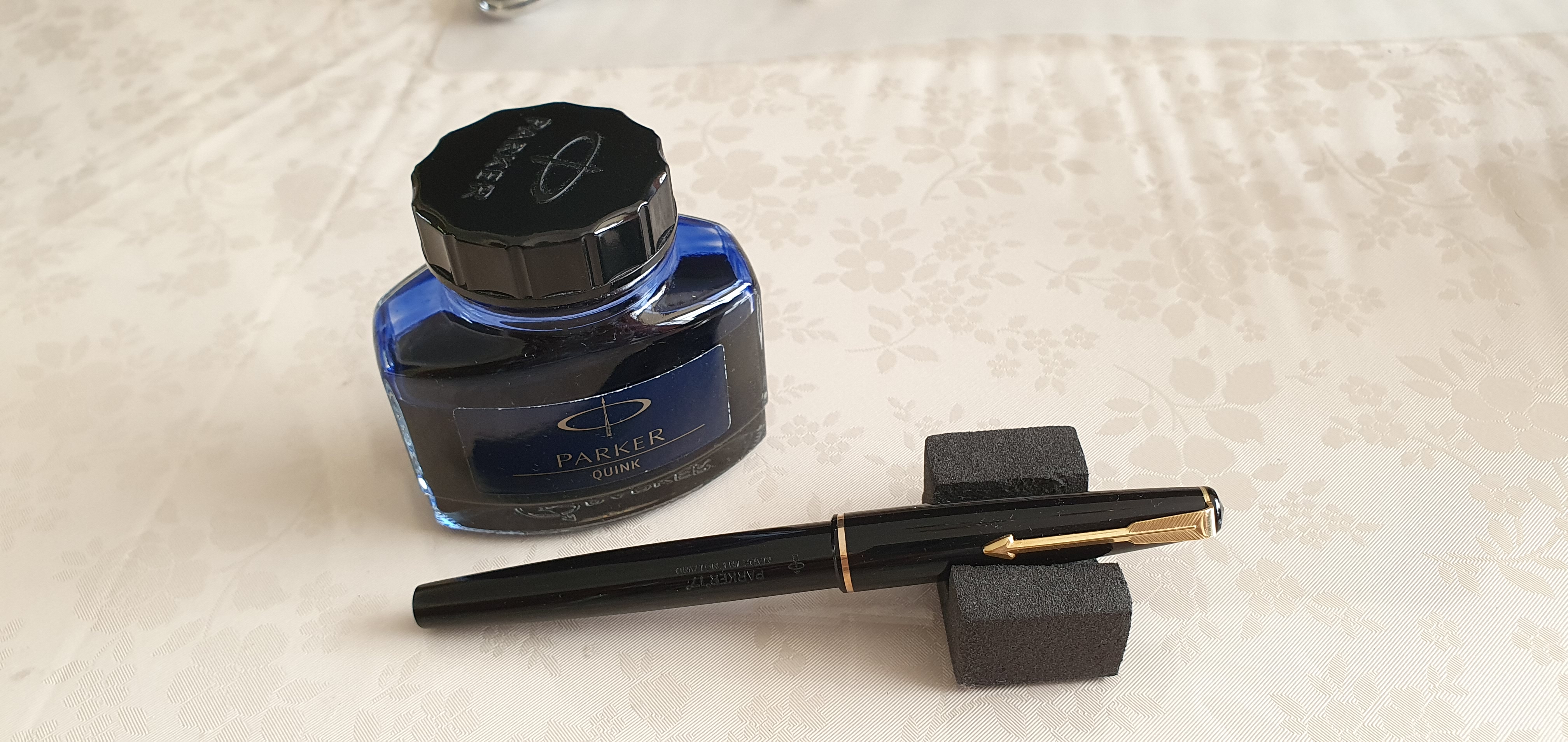
There have been so many. It would need to be a simple and reliable pen, one that is comfortable, that I would not get bored of. Most recently I struck the stationery jackpot by finding a near perfect combination of Parker 17 (black with gold trim, cap posted, medium 14k gold nib), Parker Quink blue black ink and a simple £4.00 notebook from Flying Tiger. However, there is some bias here as this was one of my most recent pen
purchases.

Taking a step back, I might pick the Cross Bailey Light. I have almost all the colours but like the royal blue one best. I would use Waterman Serenity Blue. The pen has a firm nib. The snap cap is quick and easy. It writes smoothly and with good flow. I can write without
thinking about the pen. As for paper, I would be happy with the Flying Tiger
notebook mentioned above as the paper texture was wonderful, but on buying two
more of them recently I found that the paper had changed and was no longer
fountain pen friendly. The ink spread slightly and bled through.  My most frequently bought notebooks are the A5 hardback journals from Leuchturm although I need the dotted or plain paper as the ruled lines are too narrow for my liking. The A5 size is ideal for me, not too large to carry. Hard covers protect the paper and are useful if you are writing on your lap in a comfy chair, without a table.

That was a longer answer than I intended. Thanks for reading!

Update 1 August 2023: Apologies to anyone who received the earlier version of this post. I had trouble with the formatting and the questions were not shown as new paragraphs. This appeared only after publishing the post and I did not have time to improve it until several hours later, when I removed the old post and published this one.

Secondly, here are some links to a few other sets of replies in case you missed them:

  1. #21PenQuestions (via The Well-Appointed Desk)
  2. #21PenQuestions – Laura’s Answers (via the Well-Appointed Desk)
  3. #21PenQuestions – Jesi’s Answers (via the Well-Appointed Desk)
  4. #21 Pen Questions from The Gentleman Stationer (via The Gentleman Stationer)
  5. #5 More Pen Questions: What I really wanted to answer (Via The Gentleman Stationer)
  6. 21 + 5 Pen Questions (via Weirdoforest Pens)
  7. 21+5 Questions Answered to Celebrate 8 Years of Writing at Large (via Writing at Large)
  8. 21 Pen Questions (via Rachel’s Reflections)
On how I did not buy a Montblanc Meisterstuck 149.

Although I have bought my fair share of costly fountain pens over the years, I still feel that one of my attributes, or my “super-power” amongst the fountain pen community, is the ability to enjoy some inexpensive pens, just as much as expensive ones. This is a benefit for which I am most grateful.

In theory, this should enable me to save a lot of money. In practice however, I am still tempted when I come across a more “luxury” pen, especially if it is on a special offer.

Recently, I found myself thinking that I was as happy as can be using the vintage Parker 17, with Parker Quink blue black ink picked up on ebay for a modest £12.00 plus post and packing, with a notebook costing £4.00 from Flying Tiger. So, I should have the courage of my convictions, stand by my principles and act on them. Yet, within the last week or so I have been tempted three times: first by a Parker Sonnet Cisele, (reduced for Clearance in the John Lewis sale, from £366.00 to £183.00), then by a Cross Townsend Medalist, (with 23k gold-plated nib) reduced from £175.00 to £87.50 in Daniels of Windsor and then finally, by a Montblanc 149, black with gold trim, reduced from £795.00 down to (wait for it…) £235.00.

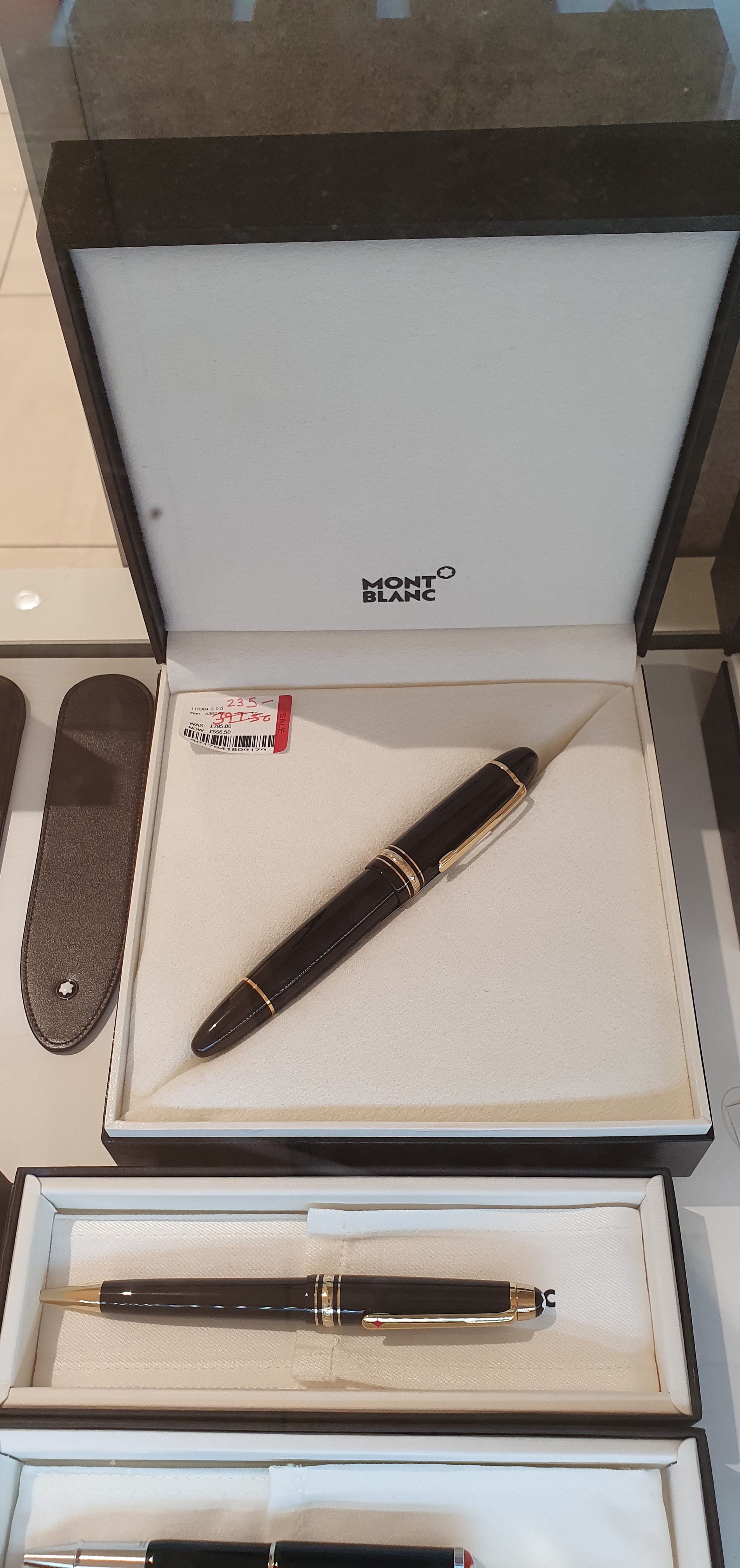
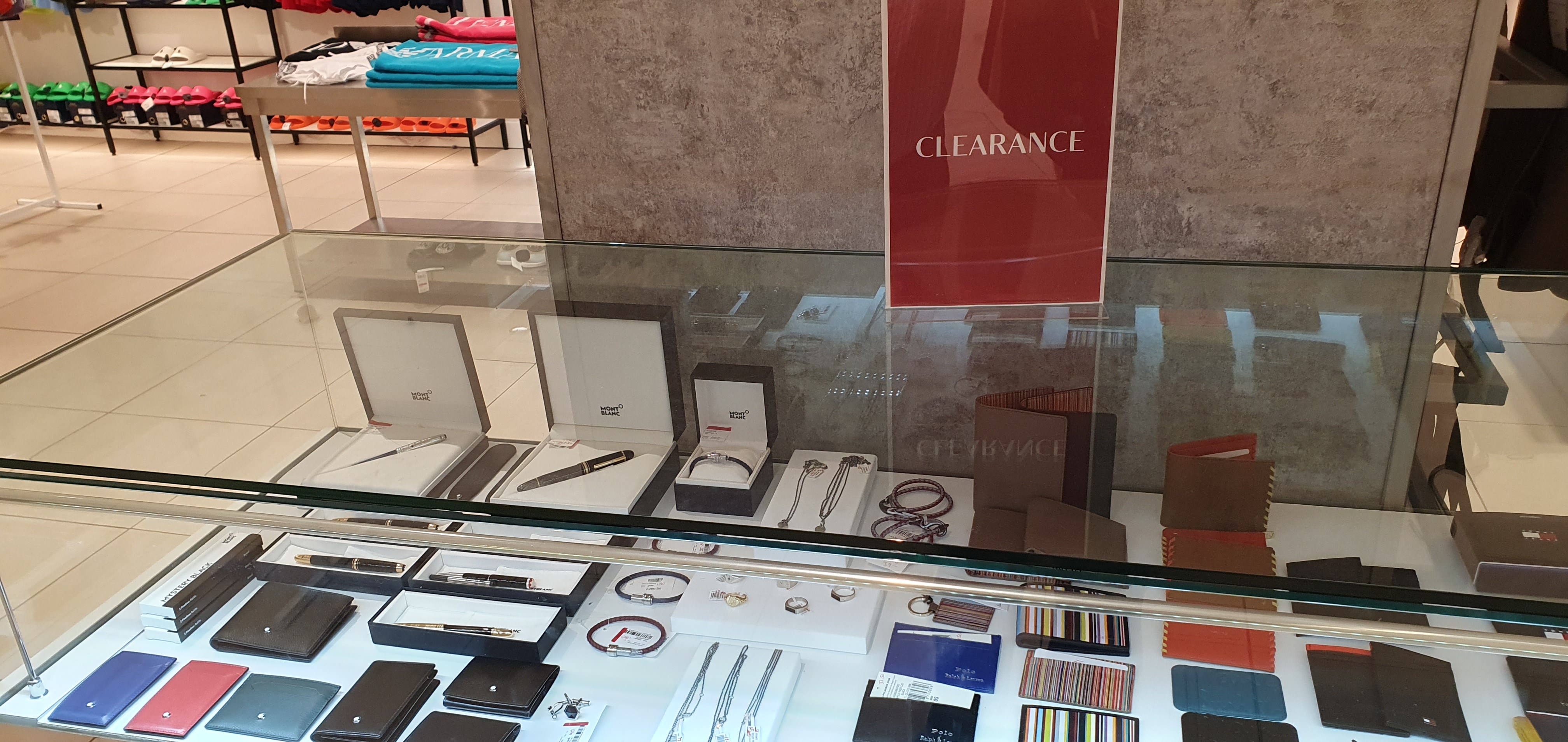
Montblanc 149, back row, second on the left.

Having withstood the test of the Parker and the Cross, the Montblanc offer pushed me to my limits. I was very surprised to see in Fenwicks, Brent Cross, a glass display counter of Montblanc pens and a few of their leather goods in a glass display cabinet marked “CLEARANCE.” This was extraordinary and I had never seen them discounted before.

A 149 for £235!

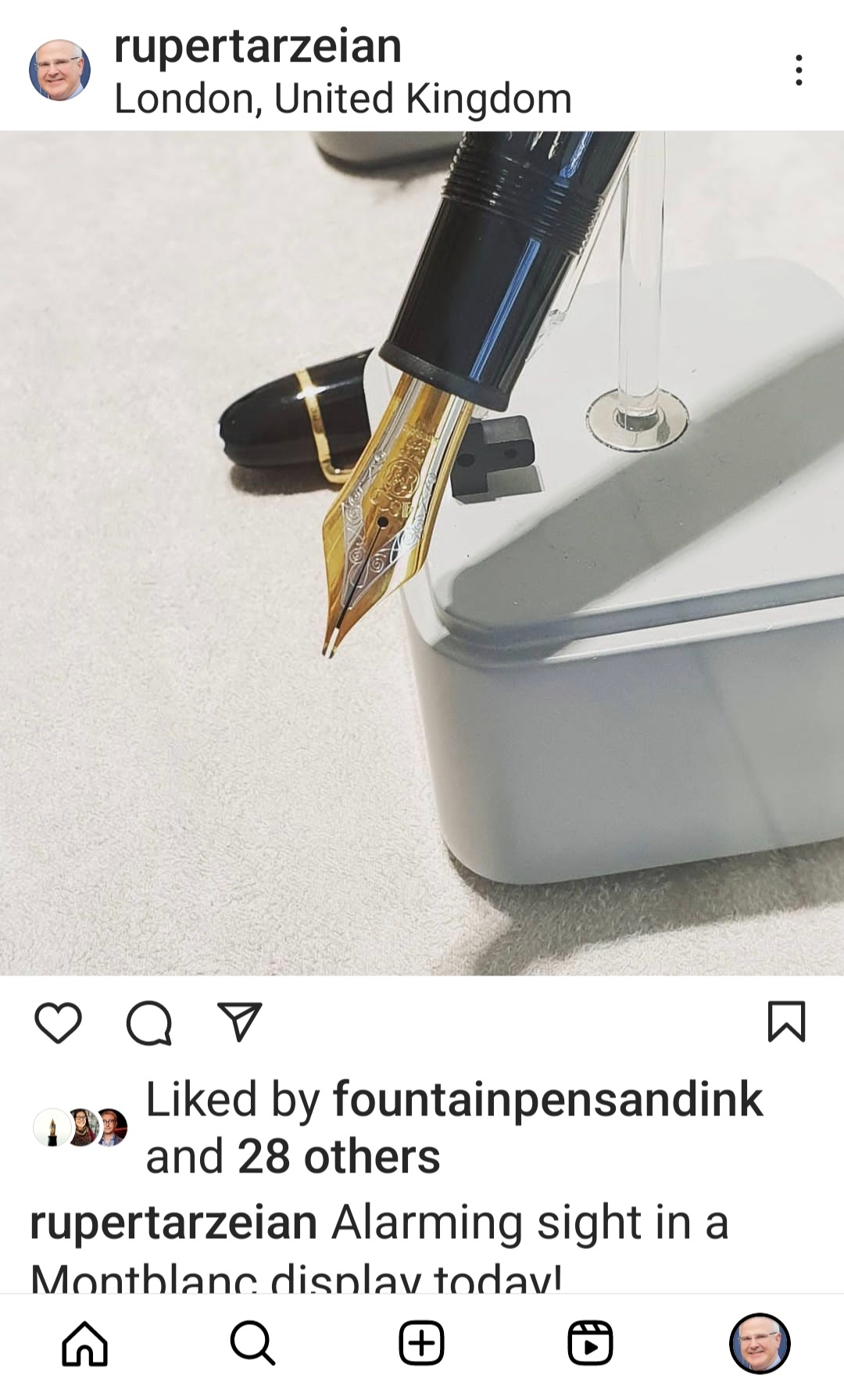
I summoned a sales assistant to unlock the cabinet for me. I first wished to check that it was a fountain pen and not a rollerball. The good news was that it was the fountain pen; the bad news was that the nib had been sprung and this was the reason for such a large discount. I recalled having seen the pen and posting a picture of it on Instagram, back in November 2021.

My photo from November 2021.

I do not have a Montblanc 149. I have often admired them in Selfridges and elsewhere but had never been tempted to pay full price for one. I had to make a decision. The pen would not write in this condition and would need some nib work. I wondered whether this might be a simple fix, just turning the nib over and flexing it downwards against my thumb-nail, just bouncing it back down very gently until the tines came together and then getting the tipping aligned. Gold is soft and can be bent quite easily but there is a risk of ruining it. Montblanc offer a nib exchange within 6 weeks of purchase but the nib must be in mint condition. Most likely, I would need to get a nibmeister to work on it, possibly at a pen show or else send it away. I wondered how long this would take and what it would cost. However, the discounted price allowed an ample margin to cover nib work, or even replacement and still be well under list price (which has now risen to around £855 I believe).

I did not buy the pen immediately but decided to think it over. I did some research online into Montblanc nib servicing or replacement. I also looked at various Montblanc nib-removal wrenches on ebay.

That evening, I posted a photo of the pen clearance display on Instagram. Three of my friends helpfully chimed in with encouraging comments. Jon wrote “I am sure that it could be fixed at a forthcoming pen show….”. Anthony wrote “That is an irresistible bargain!” and Allie added “You could have it repaired. I am not helping am I?” (laughing face emoji).

I gave myself a night to sleep on it. Do I like a challenge? Does it excite me or do I shrink from it? There is potential for satisfaction and a sense of achievement. But why take the risk? Does the potential benefit outweigh the risk? And how badly do I really want a 149 anyway? I have some Jinhao X159 fountain pens of similar dimensions and the wide girth is not my ideal choice. On the other hand, the pen needed rescuing. If I did not buy it, who would? Do it for the pen, and support the economy and a bricks and mortar shop! Be brave and do something wonderful! All of these thoughts and more were swirling around my head.

Come the following morning, I was leaning towards liberating the pen, and decided at least to go and have another look at it – assuming it was still there. I did not rush to get there at opening time, but gave it an hour and half or so, figuring that if someone else had bought it, the decision would have been made for me.

Back in Fenwicks, the pen was still there in the locked display counter. However, a gentleman was also eying the pen and the other Montblancs, for which the prices were not visible. I knew from my previous visit that these were the Montblanc “Around the World in Eighty Days” edition fountain pens, in 146 (Le Grand) and 145 (Classique) sizes and both were reduced to about half list price and was able to tell him this before the assistant came to open the cabinet for us.

It transpired that this gentleman, who I now know to be Edmond, had seen my post and driven over to look at the pen (if I had not already bought it) and that he was also interested in a cute Montblanc Baby rollerball, which he had also spotted in the photograph.

We both examined the 149 at length and he thought it worth a punt. He proposed to buy it, if I did not do so, but felt that I should have first choice in the matter, it having been my spot. It fell to me to make my mind up. It was undoubtedly a very tempting offer. However, I eventually concluded that I could happily go either way on it and, feeling magnanimous and a gentleman, I announced that I would like him to have it, whereupon he shook my hand and declared that he would buy me a coffee and a pastry.

It was his intention to buy the 149, plus the Le Grand and the Baby rollerball and asked whether a further 10% discount might be available if he bought all three. We were told that this would be up to the manager, who was in a a meeting but would be back in 15 minutes or so. Meanwhile, the assistant put the pens aside for him and we went for our coffee upstairs in Cafe Nero. We had a most enjoyable natter, finding that we had many other interests in common including photography, cameras and watches, as well as fountain pens.

Returning to the pen counter, the manager was now back. No, he was not willing to give any further discount which was a little disappointing. Nevertheless, Edmond went ahead with his purchase of the three Montblancs anyway. I congratulated him and wished him enjoyment with his new acquisitions and we parted on excellent terms.

Later, having time to reflect, I was happy with my decision and also that the 149 had gone to suitable owner who would ensure that the nib received the care and attention that it needed. I meanwhile continue to enjoy my budget priced Parker 17 and a warm and fuzzy feeling of goodwill.

New pen day: another Parker 17 arrives.

Occasionally, everything goes right with a pen purchase. One evening last week, whilst browsing Parker pens on ebay, I came across a Parker 17 in black with gold trim, for sale at the very reasonable price of £12.00 plus post and packing. The description read “Parker 17 Aerometric/Reservoir Fountain Pen. Black & Gold. VGC/Desk.”

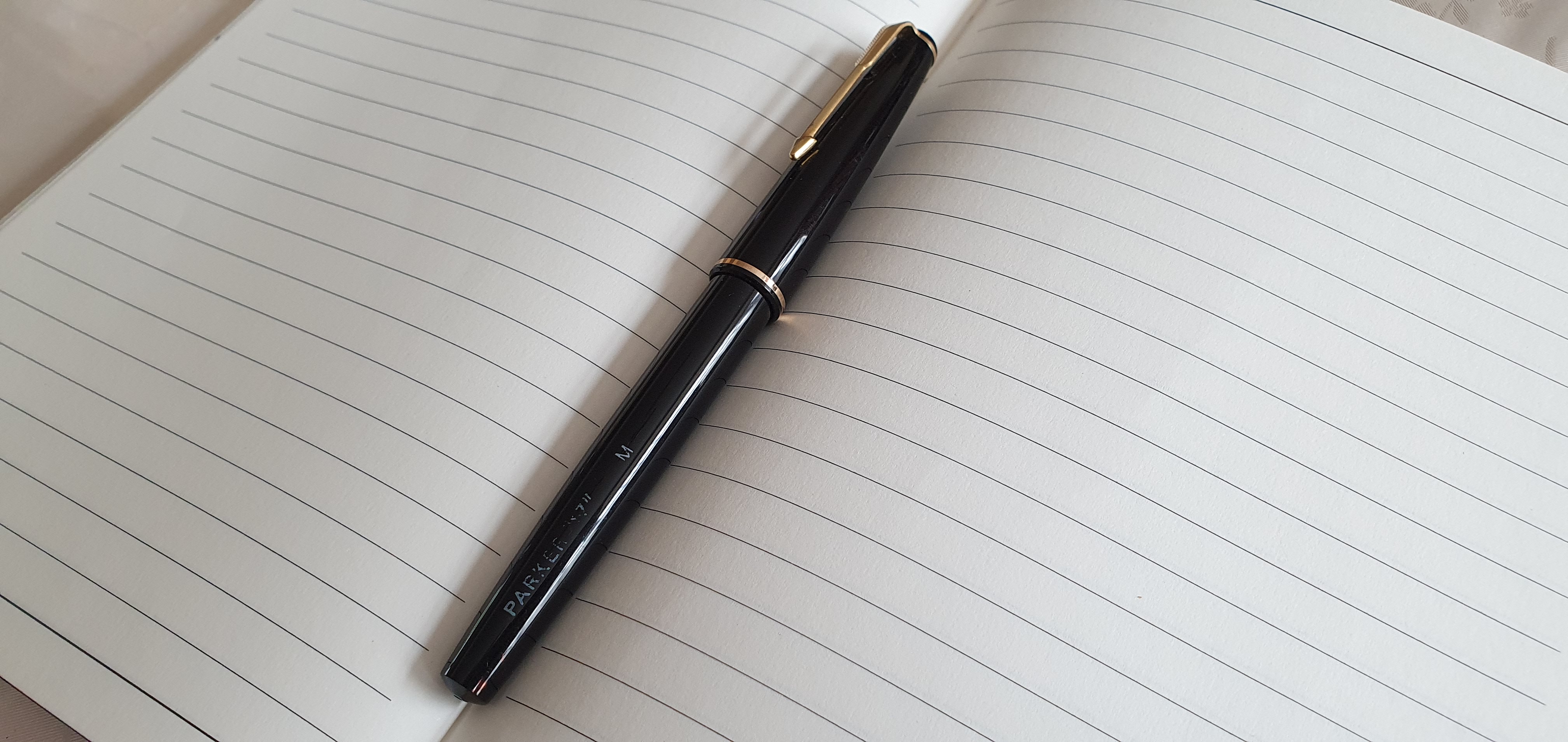
Parker 17. White markings still present.

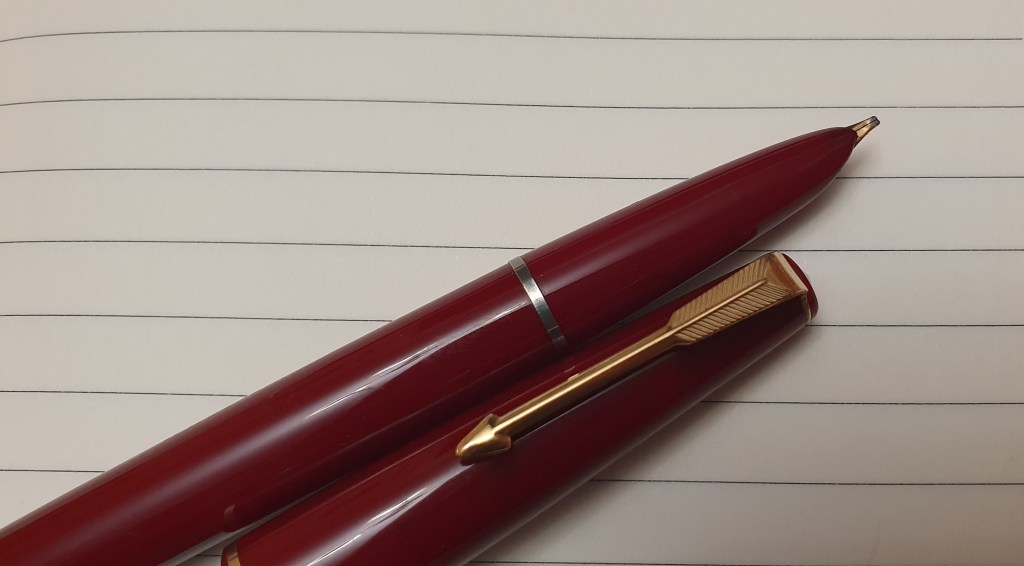
Readers may recall that I have a burgundy Parker 17 with an oblique nib, bought at the London Pen Show in March 2023. I could not resist buying another, this time in black and with a medium nib.

The seller despatched the pen the very next morning by Royal Mail and it was delivered at 8.20am today. Any worries that I might have had about it being damaged in transit were soon dispelled. It was expertly packed in a cutaway between two blocks of foam polystyrene and secured with brown tape, snuggly inside a cardboard outer box. It could not have been better protected.

THIS is how to protect a pen.

I read on Parkerpens.net, an informative site run by Swedish pen collector Tony Fischier, that the Parker 17 was introduced in 1962 and the hooded nib versions in 1964. The line was discontinued in 1972. Accordingly any Parker 17 that you see now, must be at least 50 years old.

Hooded nibs on the Parker 17 began from 1964.

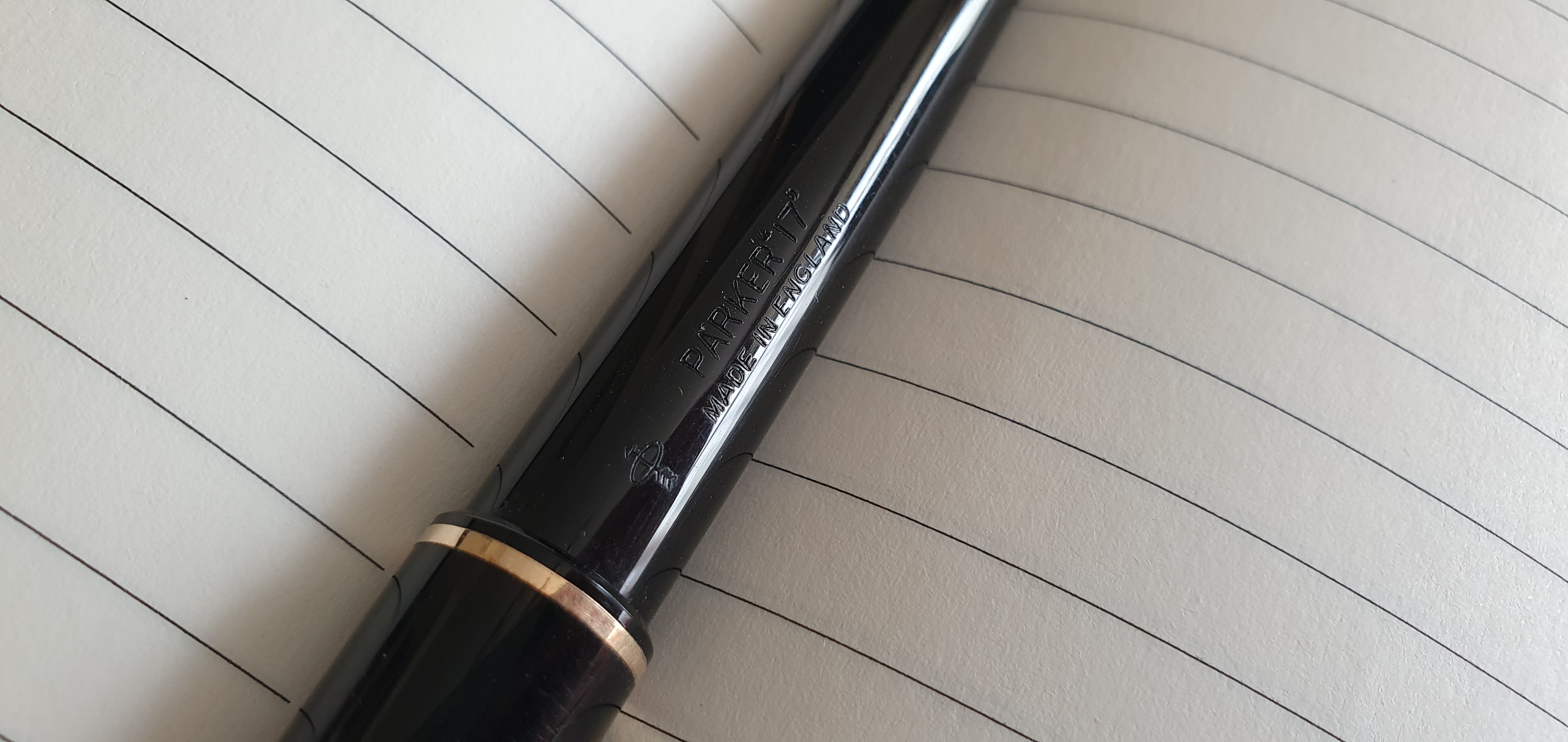
Examining the pen, initial impressions were very favourable and kept getting better. The glossy black cap and barrel with gold trim, looked classically handsome. Aside from a few minor scratches, there were no cracks or chips. The white chalk or crayon markings on the barrel reading PARKER “17” M, (which easily wear off) were still intact, suggesting that the pen had been handled very little. Also, the engravings on the barrel, PARKER “17” MADE IN ENGLAND, with the Parker symbol, looked as fresh as if they had been made yesterday.

Often these engravings are so worn as to be barely legible. This one is like new.

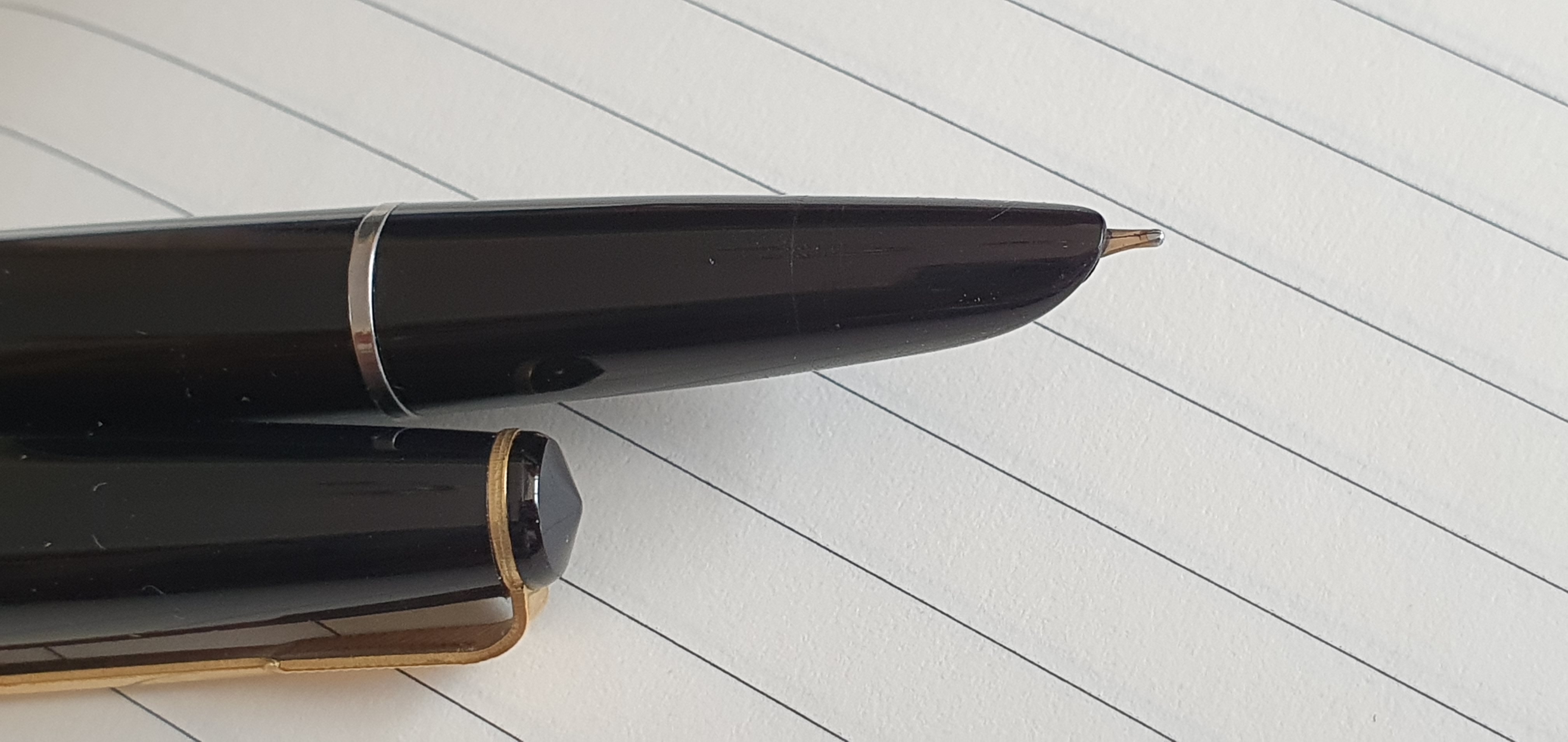
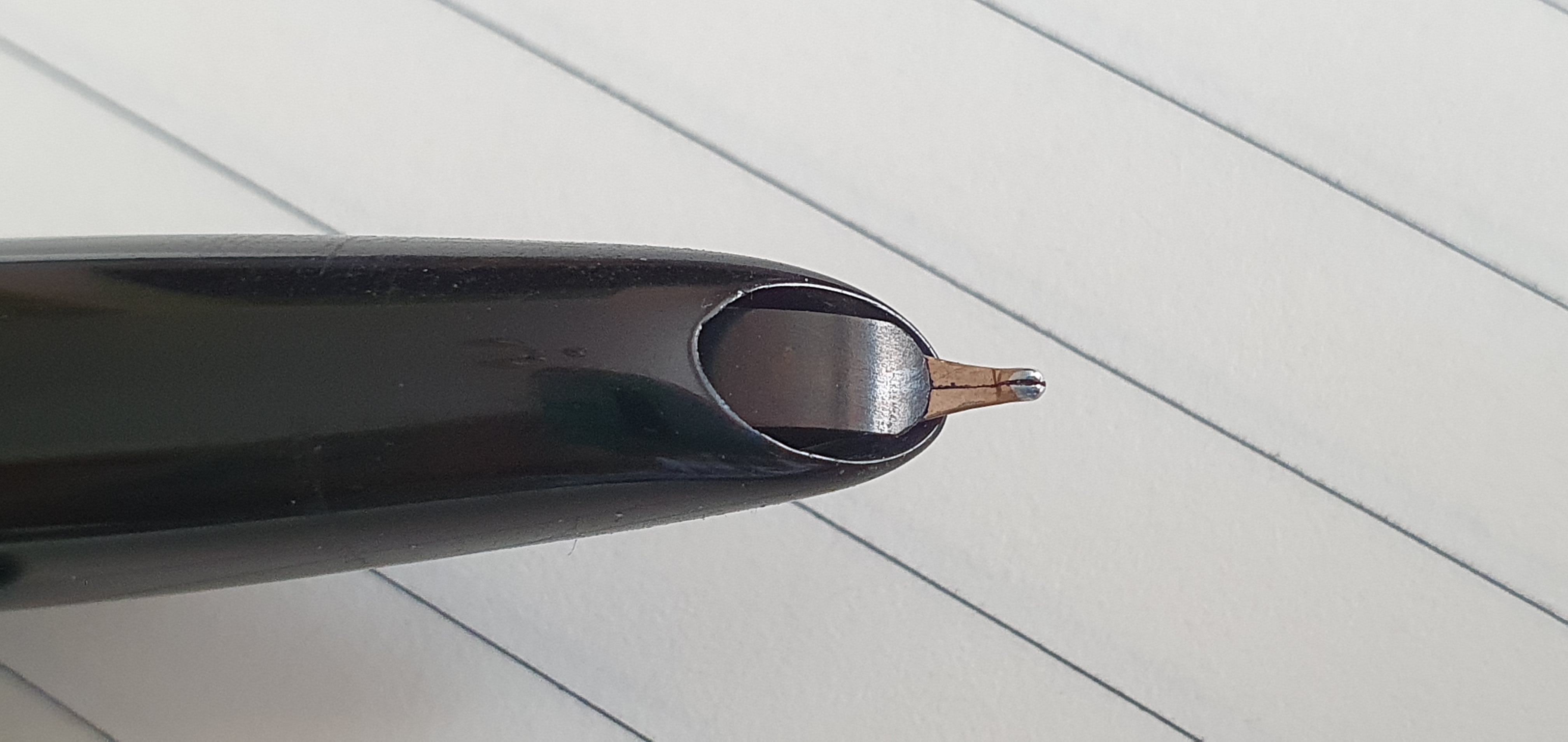
Removing the pull-off cap, the hooded nib looked in great shape and showed no signs of wear. There were slight traces of ink and paper fibres between the tines and I gave the nib a rinse in water and flossed the tines lightly with a fine brass shim. The nib needed no adjustment. There was the desired gap between the tines, narrowing down to the tipping material which was rounded and symmetrical and the tines were in perfect alignment. All good so far.

Small but perfectly formed.

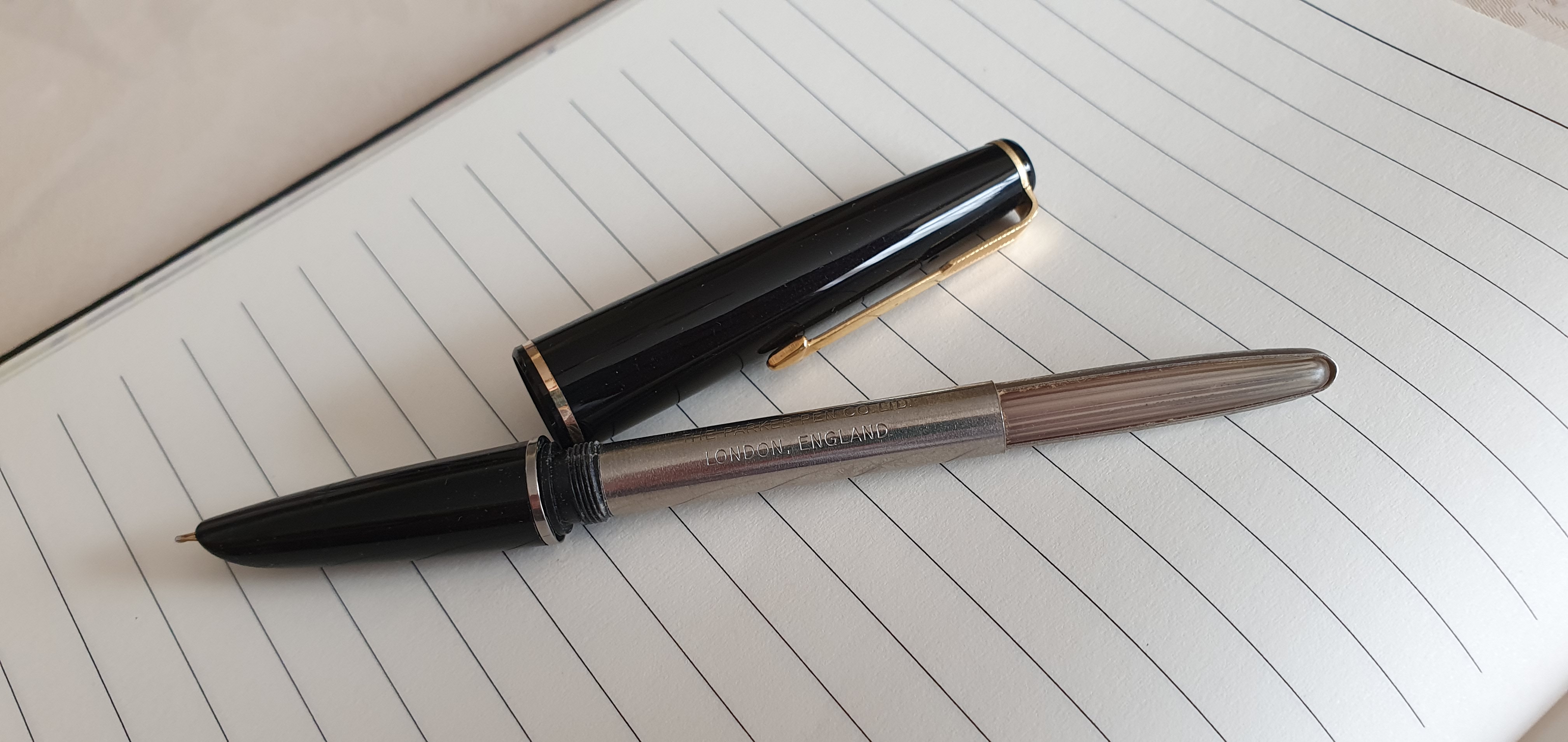
The aerometric filler (which all Parker 17s have) was clean, with no ink stains and I wondered whether the pen had ever been inked (although it had at least been dipped). The metal housing of the sac looked like new, with no corrosion. Flushing the pen in water, the sac drew up a progressively good fill with about ten squeezes of the bar.

Aerometric filler, looking as good as new.

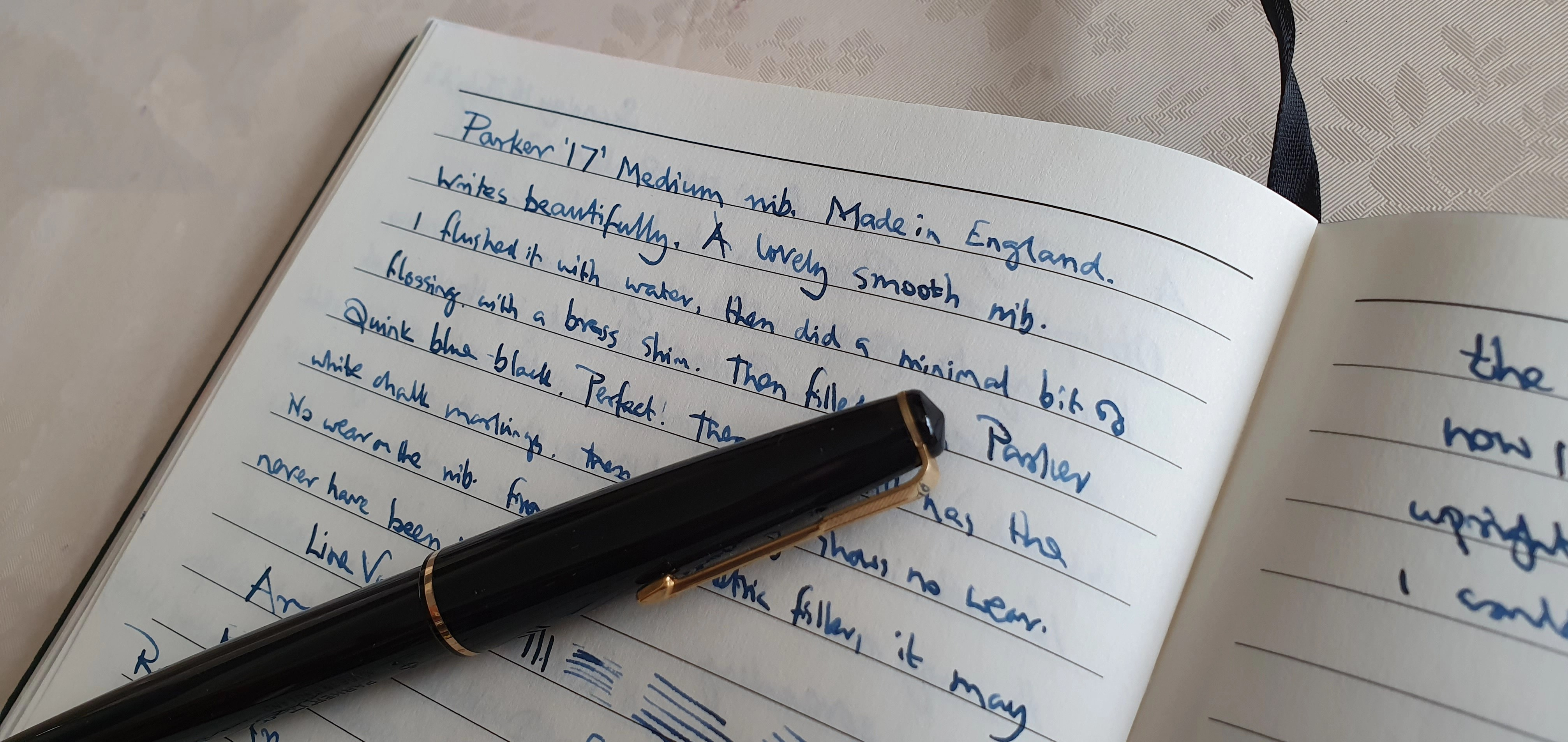
Cleaned and dried, I was ready to ink it up with Parker Quink blue black. I am glad to say that the pen wrote beautifully, with a good medium line, smooth and with no scratchiness. Indeed it was like new. There is just a little skipping sometimes if the nib is not quite held at the sweet spot. I expect this to resolve as the nib gradually wears in. Applying a little pressure opened the tines at the tip and produced a broader and wetter line. Quink blue black is a good shading ink. I found that I could use both underwriter and overwriter styles although the pen performed best in the underwriter, upright style. (The opposite is true with my burgundy version with its oblique nib). It measures 123mm uncapped and 143mm with the cap posted which I prefer.

Trying out the medium nib on the Parker 17 with Quink blue black ink. Notebook from Flying Tiger, 8mm row height. Bliss.

All in all, I could not be more pleased with this purchase.

Happiness in a bottle.

Two fun nibs for lefties.

Left handed writers have a disadvantage when using fountain pens, compared to right handers. Typically, there will be less ink flow when the nib is “pushed” along the line, as opposed to being “pulled” along, writing from left to right. Less ink flow means less lubrication and a less smooth writing experience.

Secondly, if the lefty writes with a hooked wrist, there is a likelihood of smudging the wet ink as his hand passes over it.

There are two main styles of writing for the lefty: these I call “underwriting”, by which I mean writing with the pen under the line, with the back of the pen pointing towards the body, or “overwriting” where the hand is above the line, and the back of the pen is pointing away from the body. Many overwriters hook their wrists. As a lefty myself, I am most comfortable when using the overwriter style although I have my own particular method which I developed as a child and still use. Instead of hooking my left wrist, I rotate the paper about 45 degrees left (or anti-clockwise), adjusting the paper rather than my wrist.

One of the joys of using a fountain pen is the ability to produce lines of varying width. We have all seen beautiful copperplate calligraphy with attractive fine and broad strokes, adding character to the writing, such as a thickening in the tail of a lower case letter “y”.

One way ito achieve line variation is to use a flexy nib, where the tines widen as you apply pressure. However this is not suitable for a lefty overwriter as you can apply pressure to the nib only when pulling it back, not when pushing it forward.

The other way to achieve line variation, and which is more practical for us lefties, is to use a stub nib which will produce a broad line up or down, or a fine line left or right, assuming it is held at a consistent angle.

The opposite effect is achieved by using a nib with an “architect” grind, which produces a fine line in the down stroke, and a broad line in the cross stroke. Such nibs are not usually available with a new pen and so require some specialist work by a nibmeister.

However, a similar effect to the architect grind, can be readily enjoyed by using a “bent nib” where the tip is bent upwards to create a flattened, elongated writing area, again producing a fine line in the down stroke or a broad line in the cross stroke.

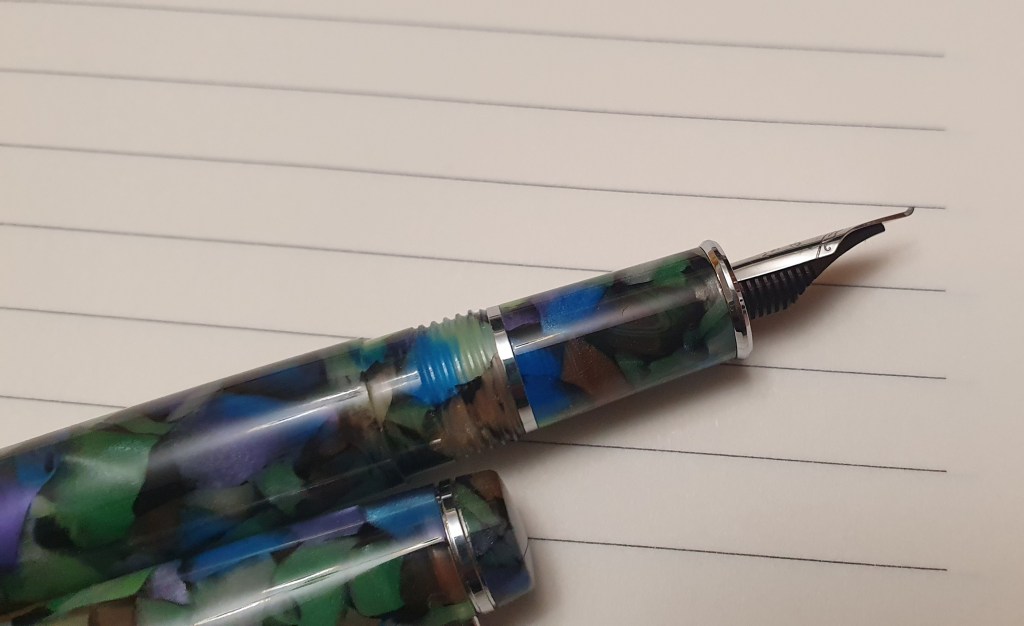
Today I want to highlight two of the fountain pens that I particularly enjoy using at the moment. The first is the Delike New Moon, an inexpensive Chinese pen bought on Amazon and described as having a “bent” nib. I now have three of these, in different colours. I like the effect that the bent nib has on my handwriting when I use the underwriter style, giving narrow down strokes and broad cross strokes although the difference is subtle.

The upturned “bent” nib of the Delike New Moon.

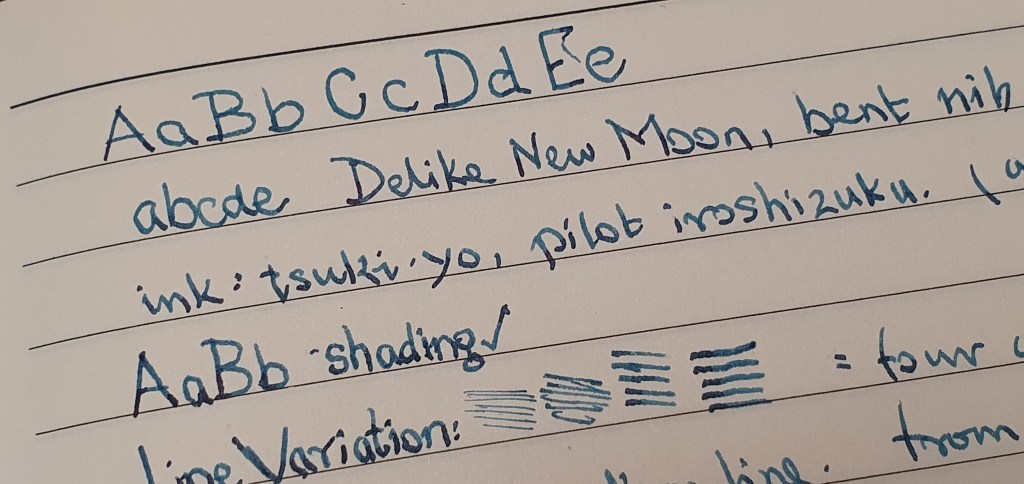
The nib is very versatile, being capable of four distinct line widths. Held normally, it writes a medium line. Hold it more vertically, and it will produce a fine line, or lay it back at a lower angle than normal and apply a little pressure and you will get a broad line. Turn the nib over and “reverse writing” will give an extra fine line, when needed.

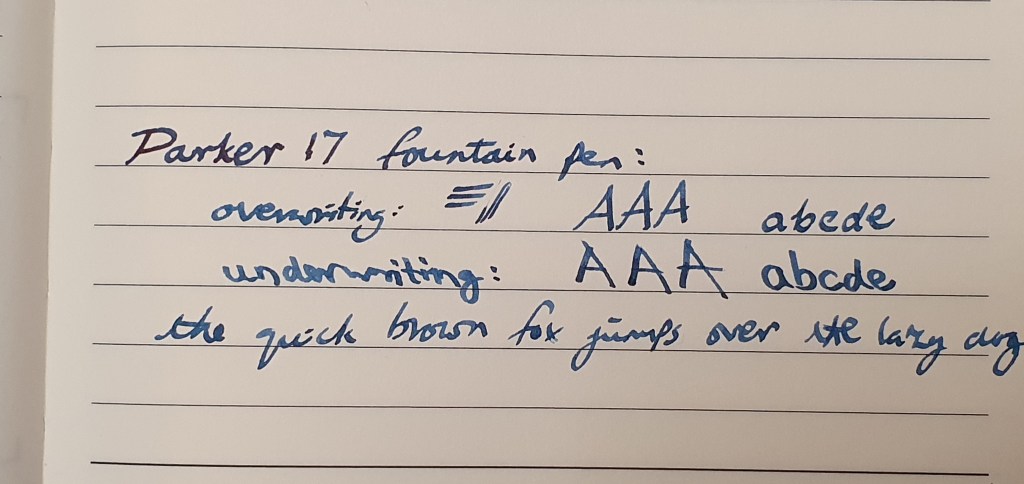
But here is an interesting thing: the bent nib produces fine down strokes and broad cross strokes, when used in the underwriter style. But if used in the overwriter style, the fine and the broad strokes are switched. Take the capital A for example and see how the fine and broad lines are reversed, in these two writing styles.

Subtle line variation from the New Moon, in underwriter mode. Pilot tsuki-yo.

The other pen that I am much enjoying, is the vintage Parker 17, with an oblique broad nib, bought at the London Pen Show in March this year. Ironically, at £30.00 it was one of the least expensive of the seven pens that I bought myself that day yet probably has the best effect on my handwriting.

Parker 17, with Oblique nib.

As opposed to the bent nib pen, the Parker’s oblique nib produces broad down strokes and fine cross strokes, used in an underwriter style, and the opposite if used, (as I prefer) in the overwriter style.

Writing samples from the Parker 17. Quink blue black. Note how the thick and thin sides of the A are reversed, in the overwriter and underwriter styles.

Currently, of the nine inked fountain pens in my ink cups, these are two that I reach for the most and provide the most enjoyment, out of all proportion to their modest cost. The Delike New Moon is inked with Pilot Iroshizuku Tsuki-yo, whilst the Parker 1 7 is inked exclusively with Quink Blue black. Both are very pleasing combinations. The Parker 17 with its oblique nib was a very lucky find at the pen show as medium nibs were much more common. There was a crack to the shell, just above the nib to which I applied some superglue. It does not leak and the pen writes wonderfully. The crack is still visible but in a way the pen is all the more endearing for this, rather like a Japanese Kintsugi bowl.

As well as the line variation, I also enjoy the shading from the Quink blue black ink. I need to write a bit slower with the Parker, to keep it from skipping but slowing down helps me to keep my writing more tidy and legible and reduces mistakes.

In a hobby where there can be temptations to spend ever increasing sums of money for one’s next best pen, it is worth remembering that the simple joys of line variation and shading, particular to fountain pen use and helping your handwriting to look its best, can all be had without breaking the bank.